Sunday, September 13, 2026

The Sixteenth Sunday after Pentecost

O Lord, look unto my aid; let them be confounded and ashamed, who seek after my soul to take it away. O Lord, look unto my aid. (The Offertory of the Sixteenth Sunday after Pentecost.)

Offertorium, Ps. 39 Dómine, in auxilium meum réspice: confundantur et revereantur, qui quaerunt ánimam meam, ut áuferant eam. Dómine, in auxilium meum réspice.

This Offertory is also sung on Friday of the second week of Lent; when I went to search for it on YouTube, this very beautiful polyphonic version by Palestrina, written for that season, also came up.

Friday, June 05, 2026

The Offertory: Preparation of the Gifts or a Sacrifice to God? (Part 2)

Having surveyed the Offertory Rite in the 1962 Roman Missal and its theological rationale last week, we turn now to the Offertory Rite in the 1970 Roman Missal.

Modern Revision
Several liturgists of the twentieth century were either unaware or unimpressed with the explanations offered in our last post. They deplored the Offertory’s sacrificial language, its alleged clericalization, its silent recitation, and its medieval Gallican origin, which in their opinion destroyed the “noble simplicity” of the Roman Rite. Some even wanted the washing of the hands and the addition of water to the wine to be eliminated. And most saw the prayers as redundant since they touch upon several themes that are in the Canon. [1] Regarding the latter critique, what these liturgists failed to appreciate was how these prayers were structured to form anticipatory parallels with the Canon, and to develop several themes that are either in the Canon inchoately or not present at all. The result, writes Michael Fiedrowicz, is “a locus theologicus of the highest degree: [the Offertory’s] prayers and rites contain a theology of sacrifice…[that] is unambiguously articulated.” [2]
Vatican II’s Sacrosanctum Concilium makes no mention of the Offertory Rite, but a note from the Conciliar Liturgical Commission circulating at the time states:
The rite of the offertory is to be arranged in such a way that the participation of the people is more prominent. The priest’s prayers, which tend to express a private or singular piety, are to be reviewed; the prayer over the offerings is to be said aloud. [3]
The language is somewhat confusing. For example, how are the priest’s prayers, which frequently have in mind other people, both living and dead, “singular”?
Whatever the answer, the 1967 missa normativa (prototype of the Novus Ordo) went much further in its edits, eliminating almost all sacrificial language, the prayer to the Holy Spirit (Veni Sanctificator), and the Trinitarian prayer Suscipe Sancta Trinitas. An earlier drafted even omitted all offertory language as well, presumably conceiving of the Rite as nothing more than a “preparation of the gifts.” Pope Paul VI, however, insisted that the word offerimus (“we offer”) be incorporated into the two new prayers for the bread and wine, the so-called Berakah prayers (“Blessed are You, Lord God of all creation”). The prayer In spiritu humilitatis and the Orate fratres / Suscipiat were also retained, both of which have sacrificial language. And the name of the Secret was changed to Oratio super oblata, “The Prayer over the Offerings,” a name that presupposes something has indeed been offered.
Interestingly, the new rubrics ignore the wish of the Conciliar Liturgical Commission to have an audible Offertory, stating that the prayers are to be recited secreto (quietly) and may be said aloud only if there is no singing. (GIRM #141-2)
Finally, the beautiful prayer about human dignity (Deus qui humanae substantiae) was removed from the Ordinary. Writing about this decisions decades later, McEvoy and Lebech were astonished that the liturgical reforms uncoupled “human dignity from the mystery at the heart of the liturgy,” [4] especially “given the rise to prominence of the concept of human dignity with the human rights tradition after the Second World War.” They express the hope that “the prayer will be restored in its Tridentine integrity to the liturgy at some point in the future.” [5]
Reception
With its combination of pro- and non-offertory elements, the Novus Ordo Offertory has given rise to vastly different interpretations. Fr. Dennis Smolarski, S.J., is the author of the popular book How Not to Say Mass. Writing over thirty years after the promulgation of the new Missal, he advises his fellow celebrants:
Do not offer the gifts during their preparation – in particular, do not lift them high in the air. The 1969 Order of Mass significantly changed what formerly occurred between the Creed and the eucharistic prayer. In the current Order of Mass the gifts are received, prepared, and formally placed on the altar by the priest after he briefly blesses God in thanksgiving for God’s gifts. Formerly, we “offered” bread and wine to God, but now we realize that offering anything other than Christ is theologically inappropriate…. At this point of the Mass we do NOT OFFER – that will be done during the eucharistic prayer. [6]
Smolarski cites in his favor the fact that the new rubrics omit the gestures of offering, namely, of raising the host and the chalice to eye level. But Smolarski does not account for the language of offering in the prayers that remain or were added, nor does he attempt to reconcile his brazen claim that one should only offer Christ to God with the prayer In spiritu humilitatis, in which the priest offers himself to God—or, for that matter, with the biblical command that inspired the prayer. (see Rom. 12, 1)
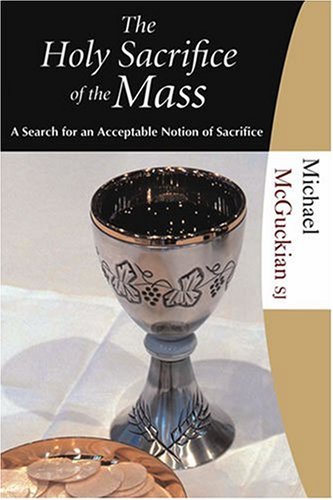
At the other end of the spectrum is Fr. Michael McGuckian, S.J., who applauds the new Offertory for the opposite reason, namely, that it is more sacrificial on the strange grounds that less is more: “the language of [the] 1969 [Missal] is less overtly sacrificial, but is, if anything, more deeply so.” [7] McGuckian loves the Old Testament three-act model of sacrifice so much that he applies it in a fundamentalist manner to the Mass. To his thinking, if the Offertory corresponds to the laity slaying the victim, then Christ must be “really and truly present during the Offertory,” [8] before the priest’s consecration of the bread and wine; [8] and if the Canon corresponds to the second act, then it is not about Christ’s Passion and Death but His intercession in Heaven. McGuckian deplores the Tridentine rite as the “lowpoint” of the Offertory in Western liturgy for no other reason than that the procession of gifts by select lay folk is absent in it, [9] blissfully unaware of the fact that a presentation of gifts is not outlawed in the 1570 Missal and indeed occurred in some parts of Europe before the liturgical reforms.
Conclusion
Pace Smolarski, the Novus Ordo affirms, by virtue of the few prayers that it has, that the presentation of the gifts is also an offering to God. On other hand and pace McGuckian, it does so minimally, without any blessings of the oblata, offertory gestures, or clear theological articulation. 
The difference between the two Offertories reminds me of the difference between the robust mission statements of unapologetically Catholic colleges such as Thomas Aquinas College, which vow to “pass on the great intellectual patrimony of our civilization and the wisdom of the Church’s greatest thinkers, and to do so in complete fidelity to the Church and her Magisterium” versus the statements of CINO (Catholic In Name Only) universities that mumble something vague about educating the person “within the Jesuit, Catholic tradition.” The latter state nothing heretical but conduce to a climate of heresy and apostasy and, not surprisingly, heresies and apostasies tend to abound at such institutions. Similarly, the Novus Ordo’s Offertory Rite lands on the side of the Angels but an inch away from the divide, and, not surprisingly, misunderstandings of its nature are legion.
At the same time, I believe that it behooves us who attend a traditional Latin Mass to kindle in our hearts a fuller appreciation of the laity’s role in the Offertory. I personally am tempted to think of this portion of the Mass as an interlude: after I have handed over my donation and perhaps sung a verse or two of a hymn, I tend to zone out until the next priestly prompt. A rather poor showing for a member of “a chosen generation, a royal priesthood, a holy nation”! (1 Peter 2, 9) Instead, I should be heeding the words of Pope Pius XII:
The conclusion that the people offer the sacrifice with the priest himself… is based on the fact that the people unite their hearts in praise, impetration, expiation and thanksgiving with the prayers or intention of the priest, even of the High Priest himself, so that in the one and same offering of the victim and according to a visible sacerdotal rite, they may be presented to God the Father. [10]
Notes
[1] See the excellent article by Manfred Hauke, “The Offertory as a Challenge to Liturgical Reforms in History,” in The Sacrifice of the Mass, ed. Matthew Hazell (Smenos, 2023).
[2] The Traditional Mass: History, Form, & Theology of the Classical Roman Rite, trans. Rose Pfeifer (Angelico Press, 2020), 257-58.
[3] Acta Synodalia I.2.121-22, cited in Hauke, 146.
[4] James McEvoy and Mette Lebech, “Deus qui humanae substantiae dignitatem: A Latin Liturgical Source Contributing to the Conceptualization History of Human Dignity,” Maynooth Philosophical Papers 10 (2020), 117-33, 123-24.
[5] Ibid., 130-31.
[6] Dennis C. Smolarski, SJ, How Not to Say Mass: A Guidebook on Liturgical Principles and the Roman Missal, Revised Edition (Paulist Press, 2003), 75-76, 77, original emphasis and capitalizations.
[7] Fr. Michael McGuckian, S.J., The Holy Sacrifice of the Mass (Hillenbrand, 2005), 74.
[8] Ibid., 126.
[9] Ibid., 68.
[10] Pius XII, Mediator Dei (1947), 93.

An earlier version of this article appeared as “The Offertory: Preparation of the Gifts or a Sacrifice to God?” in The Latin Mass magazine 34:3 (Fall 2025), pp. 42-46. Many thanks to the editors of TLM for allowing its publication here.

Friday, May 29, 2026

The Offertory: Preparation of the Gifts or a Sacrifice to God? (Part 1)

The nature of the Offertory Rite is a recurring topic on this website. What follows is a summary of sorts in two parts. In part one, we survey the Offertory in the pre-conciliar Roman Missal and ascertain whether or not it constitutes a sacrifice. In part two, we examine the new Offertory Rite in the 1970 Roman Missal and ascertain whether or not it constitutes a sacrifice.

One of the more contentious areas of the liturgical reform was over the function and nature of the Offertory. An earlier generation of liturgists had hailed the Roman Offertory Rite as “a most appropriate… preparation for the sacrificial action accomplished at the moment of Consecration.” [1] In the days of St. Justin Martyr (100-165), bread and a cup of water and wine were simply “brought to the president of the brethren.” [2] But as Adrian Fortescue notes,
Very soon the idea developed that as [these elements] are brought they should be offered to God at once, before they are consecrated. This is only one case of the universal practice of blessing, dedicating to God anything that is to be used for his service. We dedicate churches, altars, chalices, so in the same way we bless the water to be used for baptism and offer to God the bread and wine to be consecrated. [3]
The Traditional Offertory
The fruit of this idea in the 1570 Roman Missal is the following.
The Offertory begins with the priest removing the chalice veil. This small act is of great significance, for it begins the Mass of the Faithful. Anyone who is not present for this unveiling does not fulfill his obligation to assist at Mass (if he has one), the implication being that if a lay believer is to assist, his presence at and participation in the Offertory are crucial for him.
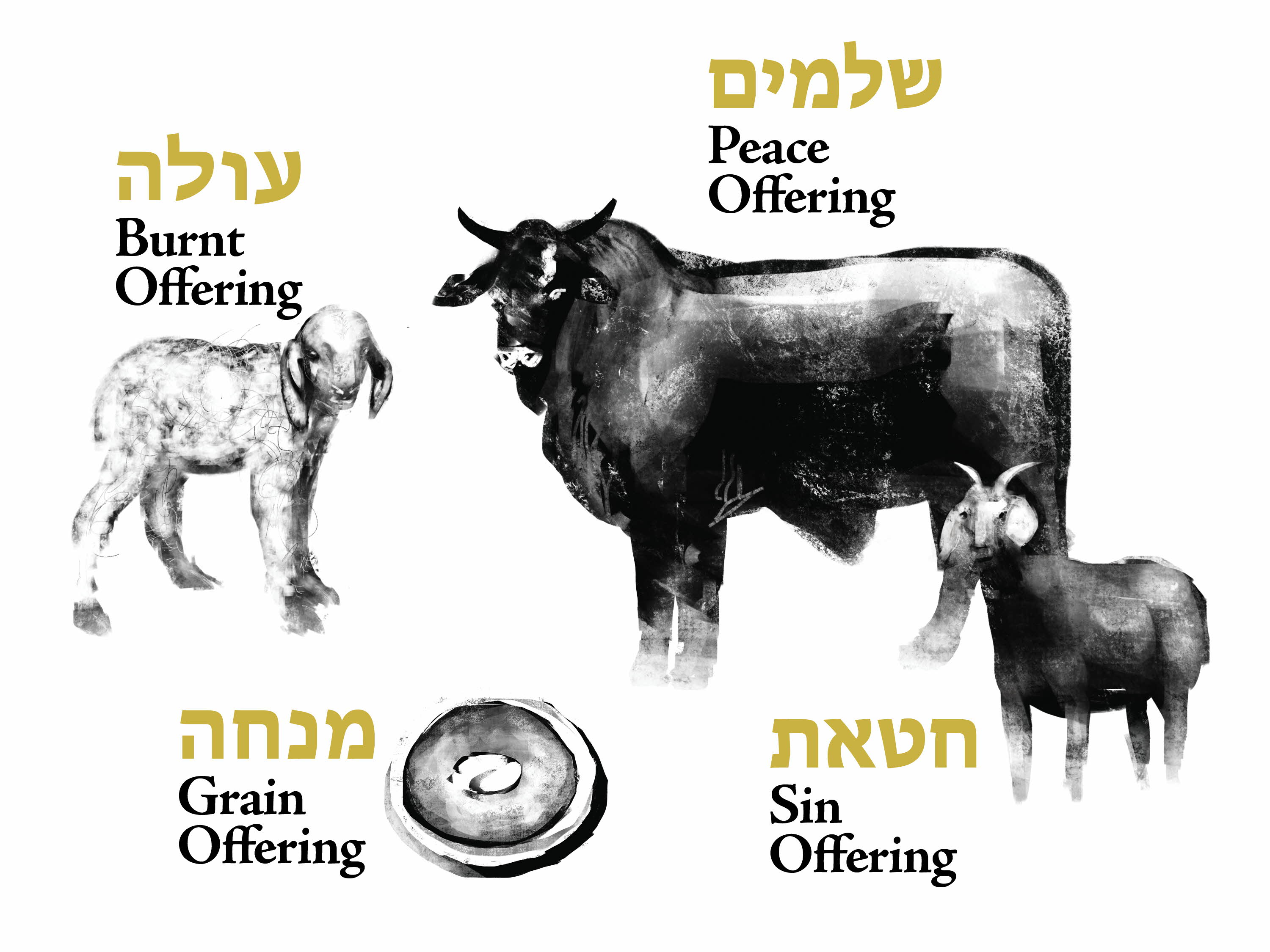
The priest takes the unconsecrated host and prays the Suscipe, Sancte Pater in which he calls the host “this unspotted victim (hostia).” The language is arresting. Only the object of a bloody immolation was called a victim in the Old Testament; grain offerings were not. We do see in this prayer shades of the Grain Offering (Minchah) since bread is being offered, but with the reference to an unspotted victim we also see an allusion to the Peace Offering (Shelem), which required an animal without defect, an “unspotted” animal, for the sacrifice. The Peace Offering, in turn, could be used as a Purification Offering (Chattah), which purported to purge the offerer of sin, and which, according to this prayer, is the purpose of the priest’s offering of bread. The priest concludes the prayer by making the sign of the cross with it as he lays it on the corporal—a blessing.
The priest then prepares the chalice by mixing water and wine while reciting the Deus qui humanae, a beautiful prayer that links the dignity of human nature to its creation and the Incarnation and then to the Sacrifice of the Mass. Fr. James McEvoy and Dr. Mette Lebech argue that the Deus qui humanae substantiae made a significant contribution to the Western conceptualization of human dignity even before its use at the Offertory, and that after it was included in the Rite during the Middle Ages, it created an association between human dignity and the holy exchange of gifts. “In this way,” McEvoy and Lebech conclude, “the prayer significantly shaped the Christian concept of human dignity as the holy ‘place’ of commerce with God.” [4] All human dignity, in other words, is forever linked not just to our creation in His image and likeness and not just to God’s assumption of our humanity in the person of Jesus Christ but to Jesus Christ in the Eucharist. Human dignity is Eucharistic.
The Deus qui humanae substantiae also has distinctive language. The combination of water and wine is not called a mixing but a mystery, the traditional explanation (which goes back to Cyprian of Carthage (210-85)) [5] being that it is a symbol of the Incarnation: wine represents Christ’s divinity and water His humanity. The rest of the prayer confirms this incarnational interpretation.
Finally, before the priest adds water to the wine, he blesses it—another blessing.
The priest then offers the mixture to God, saying the prayer Offerimus tibi. But instead of calling this offering “wine and water” (which it is), he refers to it as “the chalice of salvation,” which it is not yet. The priest makes the sign of the cross with the chalice before he places it on the corporal, again another blessing.
After the priest offers up the bread and wine together, he offers up himself and others with the prayer In spiritu humilitatis, asking we may be made acceptable to God and that “our sacrifice” be pleasing to Him. But how is this offering a sacrifice?
The same question about sacrifice is posed with the Veni Sanctificator. The priest makes the sign of the cross over the bread and wine (in other words, blessing it) while he invokes the Holy Spirit:
Come, O Sanctifier, almighty, eternal God, and bless this sacrifice prepared for Thy holy name.
At a High Mass, the priest now blesses incense and likewise offers it to God before blessing the crucifix, the gifts, and the altar with it. When addressing God about the incense, the priest uses the Latin pronoun iste, meaning “this thing of yours.” Ascribing incense to God (even though it is a human, manufactured good) ties into the central paradox of the entire Offertory, namely, that we are offering to God what already belongs to Him, or as the Byzantine Divine Liturgy puts it, “We offer to Thee Thine own of Thine own, in all and for all.” The priest first asks God to bless this incense of His and then asks God to make this blessed incense of His ascend to Heaven in order for mercy to descend to earth. Instead of construing incense as the “work of human hands,” the priest omits the secondary causes of human agency and focuses on the Primary Cause in an act of gratitude.
What and who are incensed is also noteworthy: the bread and wine; the cross, relics, and altar; and the priest and everyone else, including the congregation. The laity should be especially grateful for being included in this rite: besides being a sign that they are one of the oblations being offered, it is also a sign that they are one of the offerers. For in their own way and by virtue of their royal priesthood in baptism, the lay faithful are agents in the offertory: expendable agents to be sure (Mass can be celebrated without them), but agents nonetheless.
The priest then washes his fingers while praying the Lavabo, a psalm with the theme of innocence. The action and the words together call to mind Pilate’s washing his hands and declaring his innocence before “sacrificing” Christ to an angry mob. Here, the priest washes his hands praying for innocence before he enters into the Canon, when the sacrifice of the altar will occur.
The priest addressed the Father in the Suscipe Sancte Pater, alluded to the son in the Deus qui humanae substantiae, and invoked the Holy Spirit in the Veni Sanctificator. Now, he concludes by addressing the Holy Trinity with the Suscipe Sancte Trinitas, a prayer that marvelously and concisely summarizes the orthodox theology of offertory:
Receive, O holy Trinity, this oblation which we offer to Thee in memory of the Passion, Resurrection and Ascension of our Lord Jesus Christ, and in honor of Blessed Mary ever Virgin, blessed John the Baptist, the holy Apostles Peter and Paul, these Saints of yours here, and all the Saints, that there may be an increase of honor for them and of salvation for us, and may they deign to intercede for us in Heaven, whose memory we celebrate on earth. Through the same Christ our Lord. Amen.
Finally, the priest addresses the congregation with the Orate fratres:
Brethren, pray that my sacrifice and yours may be acceptable to God the Father almighty.
To which the servers or congregation respond:
May the Lord receive the sacrifice from thy hands, for the praise and glory of His name, for our benefit and that of all His holy Church.
The priest makes an important distinction: instead of saying “our sacrifice,” he says “my sacrifice and yours.” The sacrifice of priest and congregation are different insofar as one is sacrificing according to his holy orders (confecting the Eucharist) and the other is sacrificing by virtue of their baptism into the common priesthood. But the latter, this prayer affirms, are sacrificing nonetheless.
And yet, how can this offering (in the case of the laity, saying a few prayers and throwing a couple of bucks into the usher’s basket) be considered a sacrifice?
Solution
There are two classical—and complementary—answers to this nagging question. The first is that the oblational and sacrificial language in the Rite is “proleptic”: [6] it anticipates a thing as existing before it actually comes into being. An unconsecrated host is just a piece of unleavened bread, but once I know that it has been chosen to become the Body of Our Lord, I think of it differently and view it with increased reverence. In support of the “proleptic” explanation is its strong presence in both Eastern and Western Christendom. In the Byzantine Rite, for example, all bow before the unconsecrated gifts of bread and wine when they are processed to the altar during the Great Entrance.
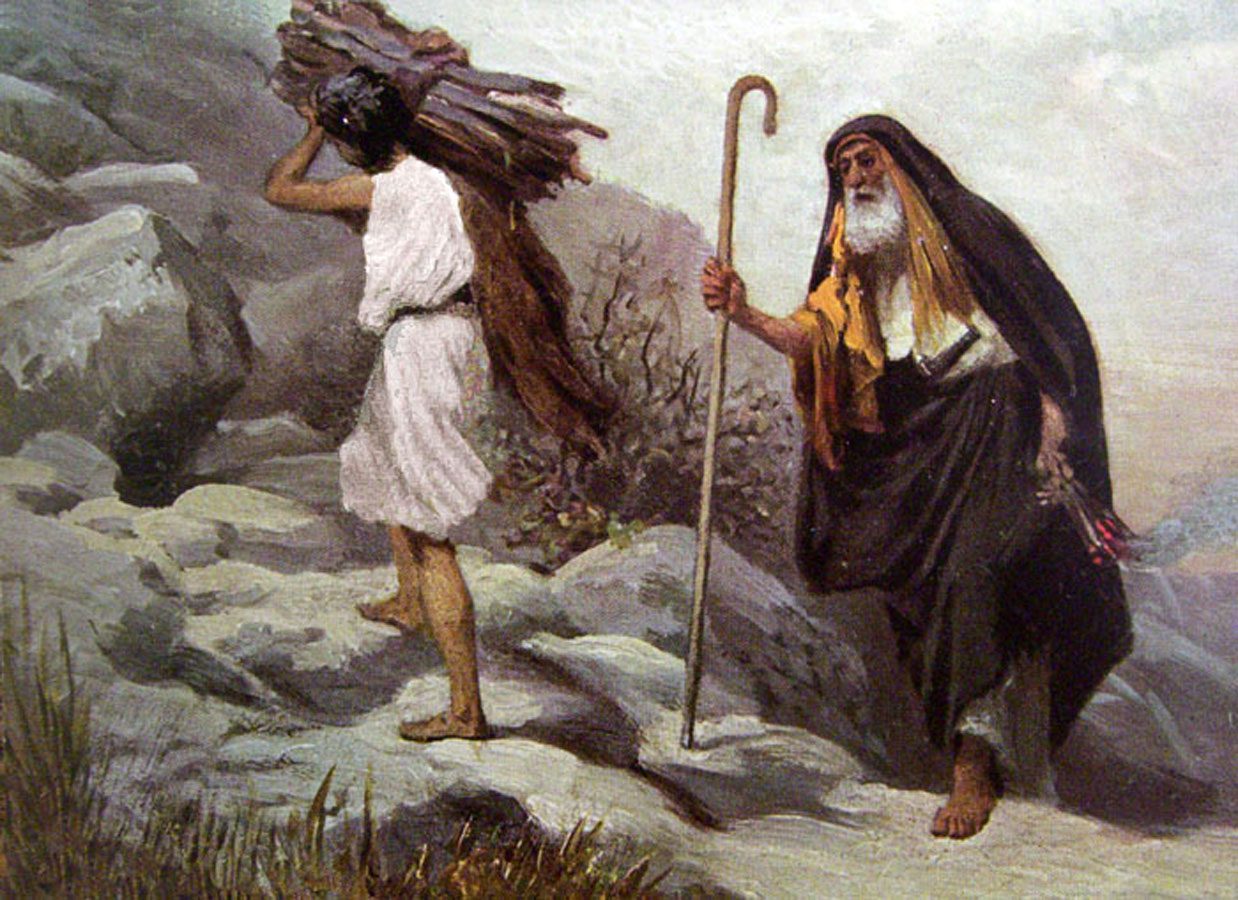
Further supporting this explanation is biblical usage. During their journey to Mount Moriah for what is supposed to Abraham’s sacrifice of Isaac, an ignorant Isaac asks his father: “Behold… fire and wood: where is the victim for the holocaust?” (Gen. 22, 7) The central sacrificial act of shedding blood and throwing the slain creature onto a fire is days away from happening, but Isaac is already referring to the designated creature as the “victim,” which until the seventeenth century only referred to something immolated and offered to God in a religious sacrifice.
Second, the Offertory is not just the anticipation of the sacrifice but its commencement. Summing up centuries of theological reflection on the subject, Manfred Hauke writes, “The offertory is only the beginning of the sacrifice, which is completed in the consecration.” [7] One may think of the bread and wine as having three possible modes of existence. First, it is simply bread and wine: even bread that has been shaped into eucharistic wafers and made specifically for the celebration of Mass can be eaten as a snack, as we see in the case of the German cookie lebkuchen. But the moment the priest says the Suscipe Sancte Pater over the bread and the Offerimus tibi over the wine, these elements are now sacred—set aside for divine use. In this second stage, they may not have the Real Presence yet, but neither should they be used in making cookies: they now belong to God. And third, the bread and wine cease to be bread and wine when the Words of Institution are said over them during the Canon. In the Offertory, the gifts are sacralized; in the Canon, they are transubstantiated into Christ’s Body and Blood.
Further supporting this thesis is the witness of Old Testament sacrifices, several of which involved three stages: 1) lay persons bring to the priest a sacrificial victim and in some cases slay it themselves; 2) the priest places some or all of the victim on a fire to be destroyed; and 3) if some is left over, it is consumed by priest and people. In this threefold act we see a foreshadowing of our Offertory, Canon, and Holy Communion.
Notes
[1] Nicholas Gihr, The Holy Sacrifice of the Mass, 5th ed. (Herder, 1918), 494.
[2] I Apol. 65.3; see also 67.5.
[3] Adrian Fortescue, The Mass: A Study of the Roman Liturgy (Longmans, Green, and Co, 1912), 296.
[4] James McEvoy and Mette Lebech, “Deus qui humanae substantiae dignitatem: A Latin Liturgical Source Contributing to the Conceptualization History of Human Dignity,” Maynooth Philosophical Papers 10 (2020), 117-33, 117.
[5] See Epistle 62.13.
[6] See Jungmann, The Mass of the Roman Rite, vol. 2 (Benziger Brothers, 1951), 37. Fortescue uses the term “dramatic misplacement” (Ibid., 305).
[7] Manfred Hauke, “The Offertory as a Challenge to Liturgical Reforms in History,” in The Sacrifice of the Mass, ed. Matthew Hazell (Smenos, 2023), 153.

An earlier version of this article appeared as “The Offertory: Preparation of the Gifts or a Sacrifice to God?” in The Latin Mass magazine 34:3 (Fall 2025), pp. 42-46. Many thanks to the editors of TLM for allowing its publication here.
Friday, June 20, 2025

The Secret


Lost in Translation #128

After the Orate fratres and Suscipiat, the priest recites the second proper oration. In the so-called Gregorian Sacramentary, it is titled the Oratio super oblata, the “Prayer over the Offerings;” in the so-called Gelasian Sacramentary, it is called the Secreta or Secret. The 1970 Roman Missal uses the former title for this prayer, the 1570/1962 Missal the latter.

The use of the word secreta has given rise to much historical speculation and even more theological reflection.
First, it may indicate the voice of the celebrant. According to Josef Jungmann, the Gallo-Frankish liturgy, like the Mozarabic and Eastern liturgies, had a silent offertory rite, and it was this practice that influenced the terminology of the Gelasian sacramentary. [1] Secreta, in other words, means here “secret” or whispered, and for Jungmann such a rubric stands in tension with what he alleges is the earlier Roman (and perennial Ambrosian) practice of saying the oration aloud, a vestige of which is left in the Tridentine Missal when the priest says the concluding part (per omnia saecula saeculorum) in an audible voice.
Second, even though it is not the likely historical reason for the naming, it is not unreasonable to think of the word in reference to the offerings—that is, the bread and wine that have been designated to become the Body and Blood of Our Lord—since, after all, secreta is from the Latin secerno (to dissociate or set apart). [2] Adrian Fortescue notes that originally, “the amount of bread and wine to be consecrated was taken from the large quantity offered” while “the rest was kept for the poor.” [3] That the hosts and wine on the altar have been truly sacralized at this point is testified by the traditional Roman Missal’s De defectibus X.9, which states that a broken host that has already been made an oblatio but has not yet been consecrated [transubstantiated] should be consumed after the ablution (and hence not returned to profane use).
Third, if the bread and wine at this point are secreta, then so too is the congregation, which has been offered up as well (see the In spiritu humilitatis). Secreta in this case would be an abbreviation of ecclesia secreta, the Church set apart. Historically, the three orations of the Roman Rite—Collect, Secret, and Postcommunion—once corresponded to three processions—a liturgical procession to the church, the offertory presentation of the gifts, and the “procession” of the faithful to the sanctuary to receive Holy Communion. The Collect was said after the congregation processed from another church to the church where Mass would be celebrated: the oratio collecta figurately “collected” the prayers of many congregants into one, but it also concluded the physical collection of peregrinating souls into a single body of worshippers. The Secret, on the other hand, follows the separation of the catechumens from the baptized faithful (which once occurred at the beginning of the Offertory) and the further separation of the latter as a consecrated oblation for the Mass. Thus Pius Parsch concludes:
In the primitive Church the neophytes and penitents were dismissed at the end of the Mass of the Catechumens. The ecclesia collecta, the assembled congregation, becomes now the ecclesia secreta, the congregation of the elect, the community of the saints; it is bound together into the mystical body of Christ, lifted up above the cares of this worldly life—now the sacrifice may begin. [4]
Fourth and finally, secreta may refer to the actions or current status of the celebrant, and as such, the oration acts both the ending of the Offertory Rite and the bridge to the Canon, the prologue to which is the Preface (the audible ending of the Secret, which matches the audible dialogue that immediately follows, reinforces this idea that the Secret has a transitional function). Citing a tradition that called the Canon and not this oration the Secret, [5] Claude Barthe goes so far as to suggest that the silence of the Secret prayer is in unison with the silence of the Canon and not the silence of the Offertory prayers, which have “a different sacred character.” [6] “The prayers of the Offertory,” he suggests, “are silent because they are the personal prayers of the minister who is carrying out the action of oblation. But “the great priestly prayers of the Secret and the Canon are silent because of the mystery wrapped up within them.” [7] The underlying idea is that the priest enters into the Canon alone, like the High Priest into the Holy of Holies. In that respect he is also like Christ in the Garden of Gethsemane, praying alone moments before His Passion. In the words of Jean-Jacques Olier,
After [the Orate fratres], the priest does not again turn to the people: focused entirely on God, says the prayers of the Secret, something which represents Our Lord entirely hidden and buried in the bosom of God his Father, where he continues to offer prayers and to render to him his dues, of which the heavenly community of the Church knows nothing, and which are hidden from the greatest part of the angels and saints, in the same way that the apostles were not always witnesses of the prayers that he offered while he was alive on earth. [8]
Notes
[1] Josef Jungmann, The Mass of the Roman Rite: Its Origins and Development, vol. 2 (Benzinger Brothers, 1951), 90-92.
[2] Nicholas Gihr, for example, writes: “Utterly without foundation is the assertion [“found throughout the Middle Age liturgists], that the prayers in question are called Secretae—eo quod super materiam ex fidelium oblationibus separatum et secretam recitantur” (The Holy Sacrifice of the Mass: Dogmatically, Liturgically and Ascetically Explained, 5th ed. [Herder, 1918], 550, fn 5).
[3] Adrian Fortescue, The Mass: A Study of the Roman Liturgy (Longmans, Green, and Co, 1912), 299. A similar practice is maintained to this day in the Coptic rite. According to a recent comment from Aquinas138: “In the Coptic rite, the bread offered to the priest before the Liturgy is called "korban," and the best of the loaves is selected to be the Lamb. The other loaves are distributed with unconsecrated wine after Communion as a way to clear the mouth of any leftover pieces of the Eucharist to avoid profanation such as accidentally spitting out a particle of the Eucharist.”
[4] Pius Parsch, The Liturgy of the Mass, trans. Frederic C. Eckhoff (St. Louis, Missouri: Herder, 1940), 152.
[5] See William Durandus, The Symbolism of Churches and Church Ornaments, trans. John Mason Neale and Benjamin Webb (NY: Charles Scribner’s Sons, 1893), Appendix A, p. 175: “The temple of old was divided into two parts by a veil hung in the middle thereof. The first part was called the Holy Place, but the inner part the Holy of Holies. Whatever part then of the office of the Mass cometh before the secret is performed as it were in the outer place: but the secret itself within the Holy of Holies.” In his Rationale Divinorum Officiorum IV.35.1, Durandus lists three other valid names for the Canon: actio, sacrificium, and secreta. “It is called the secret,” he explains, “as if it were hidden from us because there is no way that human reason can fully capture so great a mystery: and that it may signify this, it is rightly celebrated in a secret voice” (IV.35.2: Secreta dicitur, quasi nobis occulta, quia humana ratione nequaquam tantum mysterium plenarie capere potest; ad quod significandum, merito secreta voce celebratur.)
[6] Claude Barthe, Forest of Symbols: The Traditional Mass and Its Meaning, trans. David J. Critchley (Angelico Press, 2023).
[7] Ibid.
[8] Jean-Jacques Olier, The Mystical Meaning of the Ceremonies of the Mass (Arouca Press, 2024), 151.

Friday, June 13, 2025

Final Reflections on the Offertory and the Lebkuchen Litmus Test

Lost in Translation #127

One of the most surprising treats our family ever received was a German Christmas cookie called lebkuchen. The spiced glazed cookie is made with honey, nuts, citrus peel, marzipan and, most importantly, oblaten, paper thin wafers. According to the story, monks and nuns in medieval Bavaria are credited with making the first lebkuchen as a way of making good use of old, unconsecrated hosts. Today, German bakers make their own oblaten, but the German-American family who baked the lebkuchen for us used the three-inch hosts commonly used by and for the celebrant at Mass.

And consequently, I must confess, our original reaction was one of shock. Was it not sacrilegious to munch on something that had been made for no other reason than to become the Body, Blood, Soul, and Divinity of Jesus Christ? Were not these wafers dedicated from their inception for a most sacred purpose and was not using them in a Christmas cookie therefore a profanation?
Little did I know then that my initial shock was a useful stimulus in thinking through the two competing theologies of offertory regarding the Mass. The more recent theology contends that the offertory in the Mass is a mere presentation of the gifts and nothing more; to suggest anything else (that is, that it is a genuine offering to God) is to detract from the unique sacrifice that takes place during the Consecration. The older theology agrees that there is but one sacrifice of the Mass, and that it occurs during the Consecration, but it also maintains that the Offertory Rite is somehow a part of that sacrifice. Specifically, it is the first stage in a three-act sacrifice: preparation and consecration (Offertory), transubstantiation (Canon), and consumption (Holy Communion). In the traditional Roman Rite, understanding the Offertory as the beginning of the sacrifice of the altar is reinforced by its proleptic language (calling the wafer the “Victim” and plain wine the “Chalice of Salvation” before their transubstantiation), and by the rule that anyone who arrives at Mass after the beginning of the Offertory Rite (namely, when the priest removes the chalice veil from the chalice) has missed part of the sacrifice and therefore has not fulfilled his Sunday obligation.
The older theology of offertory is in harmony with the Old Testament portrayals of sacrifice. During their journey to Mount Moriah for what is supposed to Abraham’s sacrifice of Isaac, an ignorant Isaac asks his father: “Behold… fire and wood: where is the victim for the holocaust?” (Gen. 22, 7) The central sacrificial act of shedding blood is days away from happening, but Isaac is already referring to the creature to be sacrificed as the victim. Similarly, when the people offer one of their livestock to the priests in the Holy Temple for a sacrifice, the animal is already thought of as the victim even though it has not yet been immolated.
Ambiguities in our language make it difficult to appreciate the difference between consecration and transubstantiation. To consecrate is to set apart for divine or sacred use, while to transubstantiate is to change the substance of one thing into another, as when during the Words of Institution bread and wine are turned into the Body and Blood of Jesus Christ. We refer to this act as “Consecration,” but strictly speaking, the elements are consecrated (set apart for divine use) earlier, during the Offertory. The bread is consecrated when it is offered to God during the Suscipe Sancte Pater, and the wine is consecrated when it is offered during the Offerimus tibi. From that moment on, the bread and wine are sacred and special, even though they are certainly not yet Body and Blood.
To appreciate this distinction, I recommend the lebkuchen litmus test. A host (wafer) can have three modes of existence: 1) mundane or profane, 2) consecrated (in the strict sense of the word as set apart), and 3) transubstantiated, in which case it only retains the appearance of a wafer and is now in fact the glorified flesh of the Risen Christ. Can any of these be used to make lebkuchen?
1) Even in the case where a wafer-host has been manufactured exclusively for use at Mass, and even if the German word oblaten is related to the word “offering,” the wafer nevertheless remains an ordinary, profane object and may therefore be used to make lebkuchen. Indeed, it may be salutary for people to make cookies with such wafers as a way of reminding themselves of the enormous difference between ordinary bread and the miracle of the Eucharist.
2) To use a transubstantiated Host for anything other than Adoration or pious reception by a baptized Catholic in a state of grace is a grave sacrilege.
3) That leaves the case of hosts that have been consecrated during the Offertory Rite but have not been transubstantiated during the Canon. What happens if the celebrant has a heart attack as he is saying the Orate fratres and the Mass is discontinued: can one take the hosts from the altar and make lebkuchen with them? If an expanded edition of the De defectibus Missae is someday issued, I believe that it should answer in the negative. Although not transubstantiated, these hosts have been sacralized, designated as “victims,” and to return them to profane use would be a desecration. They should be used for another Mass or disposed of reverently in the manner of a so-called Consecrated Host.
The more interesting question is whether the same can be said for hosts in the New Mass. On one hand, the prayers do not explicitly offer bread and wine to God (a de facto consecration); on the other, it can be argued that because the prayer formerly known as the Secret is now called the Prayer over What Has Been Offered (Oratio super oblata) and that in so far as a sacrifice is still mentioned in the prayers In animo contrito and the Orate fratres, an offertory (the first stage of sacrifice) is implied. In any event, if the new Offertory Rite is nothing more than the preparation of the gifts, and if the Mass should be discontinued before the Eucharistic Prayer, then perhaps those gifts could be returned to sender and used for cookies, since they were never formally given back to God in the first place.

Friday, May 23, 2025

The Orate fratres and Suscipiat

Lost in Translation #126

After praying the Suscipe Sancta Trinitas, the priest kisses the altar and turns clockwise towards the people, saying Orate fratres while opening and closing his hands. He completes the prayer as he continues his clockwise movement, finishing both at the same time. When he is done, the prayer Suscipiat is said. 

The Orate fratres is:
Oráte, fratres, ut meum ac vestrum sacrificium acceptábile fiat apud Deum Patrem omnipotentem.
Which is commonly translated as:
Brethren, pray that my Sacrifice and yours may be acceptable to God the Father almighty.
The Suscipiat is:
Suscipiat Dóminus sacrificium de mánibus tuis, ad laudem et gloriam nóminis sui, ad utilitátem quoque nostram, totiusque Ecclesiae suae sanctae.
Which is commonly translated as:
May the Lord receive the Sacrifice from thy hands, for the praise and glory of His name, for our benefit and that of all His holy Church.
Adrian Fortescue and other rubricists identify three tones of voice at a Low Mass: aloud, audible but low, and “silent” (at a whisper). At a Low Mass, the priest says the two words Orate fratres aloud while the rest is said audibly but lowly. Although not in the rubrics, it is customary for the priest to say the last word of the prayer, omnipotentem, somewhat more loudly so that his respondent(s) knows when to begin the Suscipiat. [1]
Who says the Suscipiat in reply depends on the kind of Mass being offered. At a Solemn High, the deacon does it; if he has not returned to his position in time, the subdeacon says the prayer for him. At a Missa cantata or sung Mass, if there is an MC, he says it; if there is not and there are only two servers, they say it. At a low Mass, the Suscipiat is said by the server(s) and/or congregation. If there is one server and for some reason he cannot answer, or if there is no server and the priest is alone, the priest says the Suscipiat himself, changing “thy hands” (de manibus tuis) to “my hands” (de manibus meis).
The Orate frates is said or used differently on Good Friday and during a Missa coram Sanctissimo, a Mass during which the Blessed Sacrament is exposed on the altar. On Good Friday, after finishing the In spiritu humilitatis (not the Suscipe Sancta Trinitas), the priest kisses the altar, genuflects, turns counterclockwise towards the Gospel side, says Orate fratres, and turns back the same way with no answer made. At a Missa coram Sanctissimo, since it would be rude to turn one’s back on one’s Lord and King, the priest turns clockwise as usual but does not complete the circle; rather, he returns counterclockwise to the altar, as he does at the Dominus vobiscum. [3]
The circular—or rather, semicircular—motion of the priest is distinctive. Usually, when the priest faces the people to make a declaration such as Dominus vobiscum, he returns whence he came, as if powered by a spring that stretches him out and brings him back again. But with the Orate fratres, the priest crosses the meridian and never returns. The only other time that this action happens is after the dismissal (Ite, missa est) and before the Last Gospel. If you consider anything that happens after the dismissal an epilogue of the Mass rather than part of the Mass per se, then the semicircular motion of the Orate fratres is unique within the Mass.
In terms of diction, we call attention to three aspects of these prayers:
First, meum ac vestrum. Had the Holy Spirit been lazy or in a hurry, He could have said, nostrum sacrificium or “our sacrifice” instead of “your sacrifice and mine.” The original ICEL translators chose this route (despite the obvious meaning of the Latin), but their decision was rejected in the new official English translation in 2011. What is the difference, and why does it matter?
The original wording calls attention to the common yet differentiated priesthood of all believers which, it is alleged, the 1970s ICEL translation blurs and buries intentionally. As a validly ordained minister, the priest has the faculty to offer the Sacrifice of the Mass, to turn bread and wine into the Body and Blood of Jesus Christ. In that respect the sacrifice is his and his alone, one for which he himself has sacrificed much (with vows of celibacy, obedience, etc.).
But Catholics also comprise a “royal priesthood” by virtue of their baptism (see Exodus 19, 6; 1 Peter 2, 9) They too, when assisting at Mass, offer the Mass in their own way. Other Western rites (e.g., the Mozarabic) and various usages of the Roman Rite (e.g., that of Cologne) make this facet clear when they add pariterque to the Orate fratres, as in ut meum sacrificum pariterque vestrum. Pariterque means “and equally,” but we can also translate it as: “May my sacrifice, and every bit as much as well yours, be…” Keeping to its signature economy with words, the Roman Rite lacks this added formulation, but the sentiment is still there. Even though they are not essential to the confection of the Eucharist, the laity help offer the sacrifice all the same.

My sacrifice, and yours
Second, sacrificium. What or which sacrifice is being referenced? As we have seen in previous articles, the Offertory Rite in Apostolic liturgical tradition, both East and West, is rightly understood as no mere preparation of the gifts, but as the first stage of the Holy Eucharistic Sacrifice and as a proleptic of that Sacrifice. (see here and here and here) And so we may wonder if the sacrifice in question is the sacrifice that has been offered so far, or the sacrifice that will be offered soon during the Canon. Sages from our tradition, such as Fr. Martin von Cochem (1630–1712) and St. Leonard of Port Maurice (1676–1751), interpret the sacrifice to be that which is to come through transubstantiation. Of course they are right, for there is only sacrifice of the Mass, which consists of the transformation of glutinous and vinicultural earthly matter into the divine Flesh of Our Lord. But given the importance imposed upon the laity to be present during the Offertory Rite (if they miss it, they have not “attended Mass” or fulfilled their Sunday obligation), it would be reductionistic to think of the “sacrifice” at this point of the Mass as something in the future and nothing more. The priest’s sacrifice and ours, when the Orate fratres is uttered, has already begun and is on the way to its numinous crescendo.
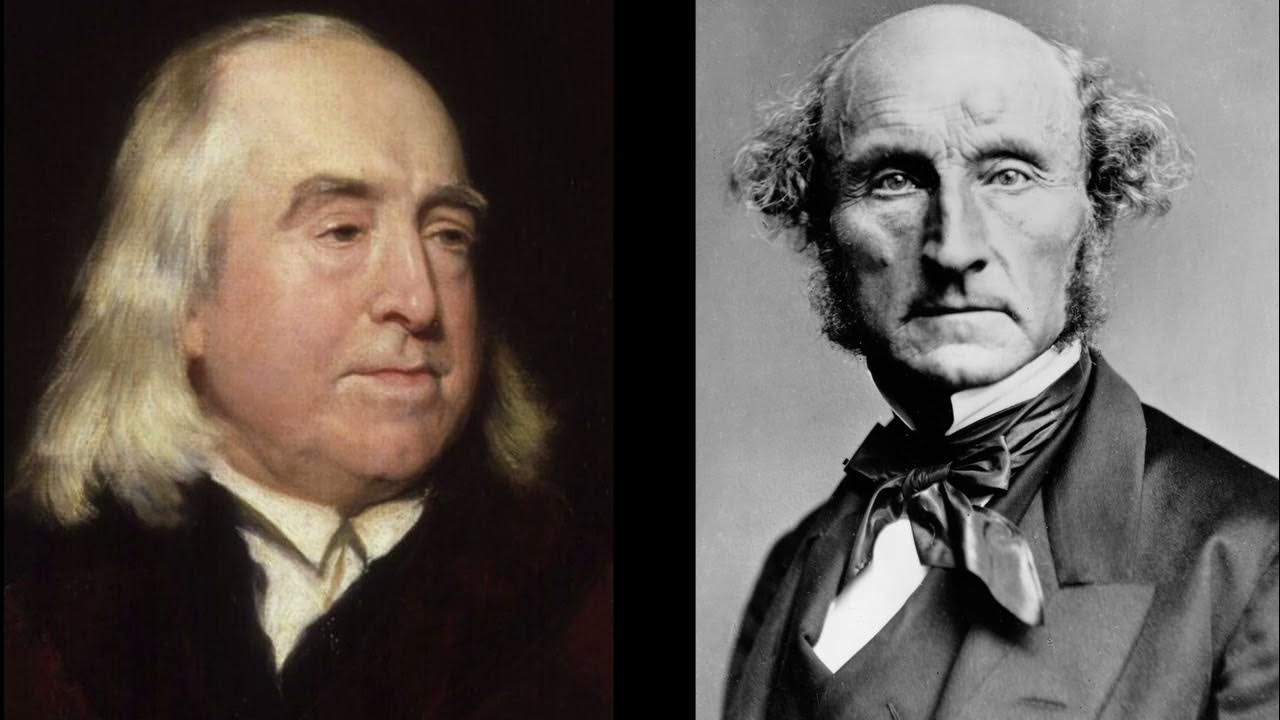
Third, utilitatem. English translations overwhelmingly favor “benefit” as the correct equivalent, and they are prudent in their judgment. At first blush “utility” is the more obvious choice, but the problem is that the Anglophonic well has been poisoned by the utilitarian philosophy of Jeremy Bentham and John Stuart Mill, which privileges anything useful in the hedonistic attainment of happiness, even, perhaps, flagrant acts of injustice. The use of utilitas in this prayer, on the other hand, calls to mind the classic Augustinian distinction between use (utor) and enjoyment (fruor). For Augustine, God alone is that which is to be enjoyed, and the useful is that which (in accordance with His law, of course) is that which is made use of in light of that enjoyment. Whereas nineteenth-century utilitarianism tries to claw its way up to happiness from the bottom up (looking to everything and anything utilitarian that will help it along the way), Augustinian theology looks at life from the top down, seized by the love and enjoyment of God that puts all of His temporal goods in their true (and useful) perspective.
Bentham and Mill: do they look happy to you?
One sees this celestial, as opposed to grungy, perspective in the Suscipiat. The Sacrifice is first and foremost for the praise and glory of God’s name, come what may, and only secondarily is it for our benefit. That “secondarily” is reinforced by the addition of quoque (also) in the prayer, which is rarely if ever translated although it should be. It is as if the Suscipiat is saying: “May God be glorified for His own sake (enjoyment). Oh, and yeah, also for our benefit (use), which in the rapture of love only comes to mind as an afterthought.”
Notes
[1] Ceremonies of the Roman Rite, 41.
[2] 299.
[3] 61-62.

Sunday, May 18, 2025

The Offertory Jubilate Deo, Universa Terra

Shout with joy to God, all the earth, sing ye a psalm to his name; come and hear, and I will tell you, all ye that fear God, what great things the Lord hath done for my soul. allelúja. V. My mouth hath spoken, when I was in trouble; I will offer up to thee holocausts full of marrow.

This recording of the Offertory of the Fourth Sunday after Easter, the text of which is taken from Psalm 65, includes one of the extra verses with which the Offertories were generally sung in the Middle Ages (in this case, the second of two), with a long melisma on the word “offeram - I will offer.” It is also used on the Second Sunday after Epiphany, on which the Gospel of the Wedding of Cana is read; in his commentary on that day, Durandus explains the repetition of certain words within it. “We sing out for joy, doubling the words both in the Offertory and its verses, an effect of spiritual inebriation.” The text and music can be seen in this pdf, starting on page 69:

https://media.musicasacra.com/books/offertoriale1935.pdf


Jubiláte Deo, universa terra, psalmum dícite nómini ejus: veníte et audíte, et narrábo vobis, omnes qui timétis Deum, quanta fecit Dóminus ánimae meae, allelúja. V. Locútum est os meum in tribulatióne mea, holocausta medulláta ófferam tibi.

Friday, May 09, 2025

The Suscipe Sancta Trinitas

Lost in Translation #125

After the lavabo, the priest goes to the middle of the altar, looks up to Heaven, and, bowing, asks the Triune God to receive his entire offering:

Súscipe, sancta Trínitas, hanc oblatiónem, quam tibi offérimus ob memoriam passiónis, resurrectiónis, et ascensiónis Jesu Christi, Dómini nostri, et in honórem beátae Maríae semper Vírginis, et beáti Joannis Baptistae, et sanctórum Apostolórum Petri et Pauli, et istórum, et omnium sanctórum: ut illis proficiat ad honórem, nobis autem ad salútem: et illi pro nobis intercédere dignentur in caelis, quorum memoriam ágimus in terris. Per eundem Christum Dóminum nostrum. Amen.
Which I translate as:
Receive, O holy Trinity, this oblation which we make to Thee in memory of the Passion, Resurrection and Ascension of our Lord Jesus Christ, and in honor of Blessed Mary ever Virgin, blessed John the Baptist, the holy Apostles Peter and Paul, these Saints of yours here, and all the Saints, that there may be an increase of honor for them and of salvation for us, and may they deign to intercede for us in Heaven, whose memory we celebrate on earth. Through the same Christ our Lord. Amen.
The formula is not unique. The so-called Gallican rite had several prayers beginning with Suscipe sancta Trinitas hanc oblationem, quam tibi offerimus, and continuing with any number of petitions, such as the wellbeing of the Holy Roman Emperor and the King of the Franks. The prayer that made it into the 1570/1962 Missal first appeared in the Monte Cassino region of Italy around the eleventh century and was unaccompanied by similar prayers. [1]
By appearing without prayers of the same formula, and by following the single offerings of bread, wine, incense, and worshippers, the Suscipe Sancta Trinitas in the traditional Roman Missal serves several purposes.
First, it is a fitting Trinitarian capstone to the earlier Offertory prayers. The Suscipe Sancte Pater addresses the Father, the Deus qui humanae praises the Son, and the Veni Sanctificator invokes the Holy Spirit. And now, by way of summary, the priest speaks to all three Divine Persons at the same time.
Second, the Suscipe Sancte Pater is a remarkably succinct and eloquent summary of the theology of Eucharistic sacrifice. The Mass re-presents not the Last Supper but the Paschal Mystery, the Passion [and Death], Resurrection, and Ascension of our Lord Jesus Christ. The latter event, which brings the fruits of the Resurrection into Heaven, is often overlooked as an integral part of the Paschal Mystery.
What is more, every Mass honors the shining stars of Christ’s Mystical Body, the Blessed Virgin Mary and all the Saints. The prayer’s list of Saints roughly follows that of the Confiteor with two exceptions. First, Michael is not mentioned, perhaps because he has just received a shout-out in the prayer Per intercessionem. Second, the Saints whose relics are in the altar are remembered with the word et istorum, which we translate “these Saints of yours here” (for more on the Latin pronoun iste, see here). This is the second and final time that these Saints are invoked, the first being when the priest kisses the altar at the beginning of Mass. It is appropriate that they are remember here, soon before the Consecration, for only the bones of martyrs were put in altars, and the martyrs, by virtue of their blood being shed for Christ, have a special affinity to the sacrifice of the Cross. There was even a sort of urban legend in the early Church that every martyr, male and female, became an honorary priest by virtue of their shed blood.
Third, the prayer expresses the intended effect of every Mass: to increase the honor of the Saints and the salvation of the Church militant, and it concludes with a special prayer for their intercession. It is perhaps surprising to modern ears to hear how much both the Bible and traditional liturgy seem to care about honor, but the worshipping community of believers derives special joy from giving honor and glory to God and His friends.
Finally, the priest began the Lavabo by stating that he will walk among the innocent. Here, surrounded by the holy cloud of witnesses he has invoked, he may be said to be fulfilling that prediction.
Note
[1] Jungmann, vol.2, 46 and 49, n. 35.

Friday, April 11, 2025

The Offertory Incensation, Part II

Cardinal Hayes incensing the altar at the opening Mass for the 7th National Eucharistic Congress at the Public Auditorium in Cleveland, 1935
Lost in Translation #123

When the priest incenses the altar, he recites Psalm 140, 2-4:
Dirigátur, Dómine, oratio mea, sicut incensum in conspectu tuo: Elevatio manuum meárum sacrificium vespertínum. Pone, Dómine, custodiam ori meo, et ostium circumstantiae labiis meis: Ut non declínet cor meum in verba malitiae, ad excusandas excusatiónes in peccátis.
Which the Douay Rheims translates as:
Let my prayer, O Lord, be directed as incense in Thy sight: the lifting up of my hands as an evening sacrifice. Set a watch, O Lord, before my mouth, and a door round about my lips. May my heart not incline to evil words, to make excuses in sins.
The choice of Ps. 140,2a is obvious: one of the few explicit allegorical readings in the Bible of a liturgical act is the interpretation of incense as the prayers of the faithful. (see Rev. 8, 3-4) Moreover, the pairing of uplifted hands with the evening sacrifice in 104, 2b typologically points to the Crucifixion, when Christ dies with outstretched arms at 3 p.m., the time of the Levitical sacrifice of lambs. And it is that Sacrifice of the Cross that is re-presenced during this Sacrifice of the Mass.
   
What is less obvious is why the prayer also includes Ps 140, 3 and 4, a petition for clean words and thoughts. I consider this inclusion to be another example of the liturgical stutter. Here, at this point of the Mass, it is being prompted by an awareness of heightened numinosity. The priest is about to enter into the Sancta Sanctorum of sacrifice, and he knows it.
When the priest returns the thurible to the deacon (at a Solemn High Mass) or the thurifer (at a Missa cantata), he says:
Accendat in nobis Dóminus ignem sui amóris, et flammam aeternae caritátis. Amen.
Which I and others translate as:
May the Lord kindle within us the fire of His love and the flame of everlasting charity. Amen.
The prayer adds more details to the phenomenology of liturgical incense. Before, we learned that incense is like prayer and its fragrance is like God’s approval of our prayer. Here, we envision the fire that burns the incense as God’s love and charity. We are again reminded that whatever we give to God (in this case, our prayers) He has already given to us (the ability and inspiration to pray). Further, if the thurible is what holds the fire, we may conclude that the thurible represents the human heart, where love resides. Hence the prayer by St. Augustine: “Let the hymn of praise and the weeping rise up together in Your sight from Your censers which are the hearts of my brethren” (Conf. 10.4.5).
Cardinal Hayes, again
But perhaps the most curious feature of this prayer is that it is included at all. When the Accendat first appeared in Mass ordines in the eleventh century, it was uttered by each individual who was incensed. (This practice might not be a bad idea as a private devotion today.) The location of the prayer in the 1570 Missal, on the other hand, gives it a somewhat different purpose and even a different “feel.” Originally, the Accendat functioned as a sort of elaborate “Amen” by a person has just been incensed. By repeating the words of the prayer, he acknowledges that incensation is a blessing and he petitions that this exterior action have an interior effect upon his soul. There is a certain logic and fittingness to this arrangement.
In the Tridentine Missal, on the other hand, the Accendat appears almost unexpectedly and out of the blue. When the priest blesses the deacon before the Gospel, it is in response to the deacon’s petition and an important component in preparing for the Gospel’s proclamation. But here, the priest addresses the deacon with this prayer unprovokedly after the priest has finished the most elaborate incensation of the Mass with the help of the deacon. The unexpectedness of the address gives it a spontaneous feel, as when a hero has accomplished a difficult task and then offhandedly says something to his subordinate that ends up being profound or revelatory. The prayer in this context also suggests a closeness between the priest and the deacon, who together have been collaborating in the important work of the offertory.
We conclude by noting what and who are incensed: the bread and wine; the cross, relics, and altar; and the priest and everyone else, including the lay congregation. We may see in this a symbol of the unity of Christ in His Church both as offered and offering. The altar and cross are symbols of Christ, the High Priest who offers and also the Victim who is offered. The bread and wine are symbols of the Christ who is to be offered, and which are about to become more than symbols. And the ministers and the faithful, along with the Saints whose relics are present, are members of the mystical Body of Christ; they too (clergy and laity) are about to be offered, united in the sacrifice. The laity should be especially grateful for being included in this rite: besides being a sign that they are one of the oblations being offered, it is also a sign that they are one of the offerers. For in their own way and by virtue of their royal priesthood in baptism, the lay faithful are agents in the offertory: expendable agents to be sure (Mass can be said without them), but agents nonetheless. Finally, the incensation is a visual fulfillment of the priest’s prayer for mercy to descend upon us all, both in and out of the sanctuary.

Friday, April 04, 2025

The Offertory Incensation, Part I


Lost in Translation #122

After preparing and offering the gifts and himself, the priest blesses the incense. As he places three spoonfuls of incense onto a live coal, he says:

Per intercessiónem beáti Michaélis Archángeli, stantis a dextris altáris incénsi, et ómnium electórum suórum, incénsum istud dignétur Dóminus benedícere, et in odórem suavitátis accípere. Per Christum Dóminum nostrum. Amen.

Which I translate as:
Through the intercession of blessed Michael the Archangel, who is standing at the right side of the altar of incense, and [through the intercession] of all His Elect, may the Lord deign to bless this incense of His and receive it as an odor of sweetness. Through Christ our Lord. Amen
When the priest incenses the bread and wine, he says:
Incensum istud, a te benedictum, ascendat ad te, Dómine, et descendat super nos misericordia tua.
Which I translate as:
May this incense of Thine, which has been blessed by Thee, O Lord, ascend to Thee, and may Thy mercy descend upon us.
Who You’re Going to Call
The Per intercessionem requests the intercession of all the Saints and an archangel. In the original prayer from the eleventh century, the role went to St. Gabriel, who stood “on the right side of the altar of incense” when he visited Zechariah. (Luke 1,11) But in the thirteenth century, Michael’s name slowly began appearing as a substitute and became obligatory in the 1570 Roman Missal. Even so, as late as 1705 the Congregation of Rites had to remind holdouts to stop using Gabriel’s name. [1]
Saint Michael on Mount Gargano, Cesare Nebbia
Michael may be associated with incense because according to some accounts he appeared on Mount Gargano bearing a censer in A.D. 490, and this apparition may have inspired later generations to identify him as the anonymous angel who stands in front of the altar with a golden censer in Revelation 8,3. But the 1570 version of the prayer only exchanges the names; it does not update the angel’s location. Michael, the angel who ostensibly carries his own censer, is thus portrayed standing at the right side of the altar of incense. In a Catholic sanctuary, incidentally, that would be the Gospel-side, for right and left are determined by God’s view of us from the sanctuary rather than vice versa.
Despite his not having an explicit biblical association with incense, Michael is arguably the better archangel to invoke at this point of the Mass. In the New Testament, Gabriel is the angel who delivers messages of great importance; Michael is the angel who casts out the dragon Satan. (see Rev. 12, 7-9) Invoking Michael is thus an implicit petition for spiritual fumigation in order to expel evil from the sanctuary before the Consecration. “In the liturgy,” writes Fr. Pius Parsch, “incensing has a positive and a negative purpose: to cleanse (to lustrate), and to sanctify. Here it is to free the gifts offered from every unholy influence and envelop them in an atmosphere of holiness.” [2] And let us be honest: Gabriel’s relationship to incense is literally tangential at best. He was there to speak to Zechariah, not to be close to the altar of the incense because it was the altar of incense.
Angel of the Censer, by Lawrence or AnNita Klimecki
Preferred Pronouns
The choice of pronouns in the Per intercessionem and Incensum istud is significant. Whereas English has two demonstrative pronouns, Latin has three. In English, “this” is used to point to things that are near the first person (I, me) while “that” is used to point to things that are near either the second person (you) or the third (he, him). In Latin, on the other hand, there are two different words to distinguish things near the second person and things near the third:
  • Hic, haec, hoc is for things near the first person (“this”);
  • Iste, iste, istud is for things near the second person (“this or that thing of yours”);
  • Ille, ille, illud is for things near the third person (“that”).
One way to visualize this distinction spatially is that hic is for when the object is closer to me, iste is for when the object is closer to you, and ille is for when the object is equidistant from us.
By using iste to designate the incense at hand, the priest is indicating that the incense already belongs to God even before it is blessed. It is easy to concede that all natural objects belong to the Maker of nature, but incense, although it is biotic material, is a human artifact. Frankincense, for example, is made from the resin of the olibanum tree by workers tapping the tree, letting the resin ooze out, and allowing the resin to dry on the tree for several months. The hardened sap is then cut into grains to become incense.
It may seem odd to designate a man-made object as God’s, but it serves two purposes. First, on a more general level, it aligns with a Catholic way of viewing manufactured goods. The production of wine, for example, requires far more human invention and intervention than making incense, and the end-result (wine) is an entirely different substance from the natural materials out of which it was made. And yet in the blessing of wine for the sick, wine is called a “creature” that God gives as a refreshment to His servants. The blessing of wine on the feast of St. John the Evangelist goes even further with its opening line: “O God, who in creating the world brought forth for mankind bread as food and wine as drink…” In Genesis, it is Noah who first brings forth wine without any explicit encouragement or help from God, but the Catholic imagination nonetheless credits God with the win, and sees it as one of His gifts for which we are to give thanks. Instead of construing wine as the “work of human hands,” this pious hermeneutic omits the secondary causes of human agency and focuses on the Primary Cause in an act of gratitude. [3]
Second and more specifically, ascribing incense to God ties into the central paradox of the entire Offertory, namely, that we are offering to God what already belongs to Him, or as the Byzantine Divine Liturgy puts it, “We offer to Thee Thine own of Thine own, in all and for all.” [4] The priest first asks God to bless this incense of His and then asks God to make this blessed incense of His ascend to Heaven in order for mercy to descend to earth. The priest wants God to receive the burning smoke curling its way upwards as an odor of sweetness, but it is God who made incense have these properties in the first place.
Crosses and Crowns
Finally, we note the fulsome manner in which the gifts are incensed, three times cross-wise and three times in a circle. Joseph Jungmann interprets these actions as a performative extension or reinforcement of the Veni sanctificator [5], while Nicholar Gihr sees them as a visual fulfilment of the two prayers. “While the odor of ascending incense denotes devout sacrifice and prayer penetrating to heaven, the clouds of incense floating round about signify the effects of prayer and sacrifice, namely, the sweet odor of grace descending from Heaven or issuing from Christ on the altar.” [6] As for the detailed gestures, the interpretation of William Durandus is especially beautiful. The three crosses betoken the three times that Mary Magdalen brought fragrant spices or ointment to anoint the body of Our Lord Jesus Christ, while the three circles are crowns that symbolize the Trinity, the Three Persons to whom the Cross leads us. [7]

Notes
[1] Joseph Jungmann, The Mass of the Roman Rite, vol. 2, 72, n. 11.
[2] Pius Parsch, The Liturgy of the Mass, 179.
[3] This shorthand method is similar to the biblical custom of describing God’s care for His creatures, e.g., Matt 6,26: “Behold the birds of the air, for they neither sow, nor do they reap, nor gather into barns: and your heavenly Father feedeth them.” God the Father does indeed feed the birds of air but through trillions of intermediary causes and not like an old man on a park bench.
[4] Tα σὰ ἐκ τῶν σῶν σoὶ προσφέροµεν, κατὰ πάντα, καὶ διὰ πάντα.
[5] Jungmann, vol. 2, 74.
[6] Gihr, The Holy Sacrifice of the Mass, 373.
[7] William Durandus, Rationale Divinorum Officiorum IV.31.3.

Friday, February 21, 2025

The Veni Sanctificator

Lost in Translation #121

After bowing down to recite the In spiritu humilitatis, the priest stands up, lifts his hands in a circle, and raises his eyes to Heaven. As Gregory DiPippo notes, “This is the same gesture that he makes at the beginning of the Gloria, the Creed and the Canon, indicating the importance of the action.”

The priest then makes the sign of the cross over the bread and wine while he says:
Veni, Sanctificátor, omnípotens aeterne Deus: et bénedic hoc sacrificium, tuo sancto nómini praeparátum.
Which I translate as:
Come, O Sanctifier, almighty, eternal God, and bless this sacrifice prepared for Thy holy name.
After first appearing in the Irish Stowe Missal (early ninth century), the Veni Sanctificator found its way into various medieval Missals at different places during the Offertory, while in the Italian ordines it occupies the place that it still has in the 1570/1962 Roman Missal. [1]
From a linguistic point of view, there are two riddles to solve. The first is the invocation of God as Sanctifier. Abbé Claude Barthe does not think that it is the Holy Spirit which the prayer has in mind [2] while Rev. Nicholas Gihr insists that the referent “is beyond doubt.” [3] Later amplified versions of the prayer support Gihr’s confidence, such as this invocation from the Missal at Monte Cassino (eleventh and twelfth century):
Veni, Sanctificator omnium, Sancte Spiritus, et sanctifica hoc praesens sacrificium ab indignis manibus praeparatum et descende in hanc hostiam invisibiliter, sicut in patrum hostias visibiliter descendisti. [4]
Which I translate as:
Come, O Sanctifier of all, O Holy Spirit, and sanctify this present sacrifice prepared by unworthy hands, and descend upon this victim invisibly, as You descended visibly on the victims of the Fathers.
And if indeed the priest is praying to the Holy Spirit, a familiar pattern emerges: that of the Holy Spirit overshadowing something or someone in order to bless it or give it life. Examples include the Spirit moving over the face of the waters when God created Heaven and earth, and the Spirit breathing a soul into Adam when God created the first human being. But the most relevant biblical precedent is the Blessed Virgin Mary conceiving of the Holy Spirit when He overshadowed her. (Luke 1, 35-38) Just as the Word became flesh in the hidden womb of the Mother of God, the priest prays that the Word become flesh hidden under the appearance of bread and wine. As Gihr writes, there is an
analogy which the Consecration bears to the Incarnation. The great similarity and manifold relation between the accomplishment of the Eucharist on the altar and the mystery of the Incarnation of the Son of God in the bosom of the Immaculate Virgin Mary are often commented on by the Fathers, and are expressed also in the liturgy. The Incarnation is, in a manner, renewed and enlarged in the Eucharistic Consecration and that at all times as well as in numberless places. [5]
Because it is most likely the Holy Spirit who is being invoked, the Veni Sanctificator is sometimes portrayed as the Western Epiklesis. But we need not enter into this controversy in order to appreciate how the prayer reinforces the Trinitarian dimension of the Holy Sacrifice of the Mass, which is offered to the Father, through the Son, and with the Holy Spirit.
The second riddle is the meaning of “this sacrifice.” Critics of the traditional Offertory rite think that its sacrificial language falsely invents a second sacrifice, one that is different from that which takes place during the Canon. DiPippo is right to conclude that they are wrong. “The Offertory as it stands in the Missal of St. Pius V,” he writes, “….does not constitute a separate act of offering from the Canon of the Mass, much less an offering of something other than what the Canon itself offers.” On the other hand, the Offertory rite does seem to be more than a mere “Preparation of the Gifts” insofar as something sacrificial does seem to be taking place from the moment the chalice veil is lifted.
One clue into a possible tertia via is to revisit the biblical allusion in the amplified version of the Veni Sanctificator from the Monte Cassino Missal, when the priest prays for the Spirit to come invisibly just as He once descended visibly on the victims of the Fathers. The clearest instance of God visibly descending on a sacrificial victim is when Elijah challenges the false prophets of Baal to a contest of holocaust offerings to see which party is praying to the true God. After the false prophets fail to get Baal to ignite their sacrifice, Elijah drenches his offering in water three times and then asks God to light the fire.

Then the fire of the Lord fell, and consumed the holocaust, and the wood, and the stones, and the dust, and licked up the water that was in the trench. And when all the people saw this, they fell on their faces, and they said: ‘The Lord He is God, the Lord He is God.” (3 Kings [1 Kings] 18, 38-39)
Here, the sacrifice was consummated or completed when the fire of the Lord fell on the holocaust victim, but the sacrifice began when Elijah, after repairing the altar stones, ritually prepared the wood and the victim. Similarly, the sacrifice of the Mass begins when the priest begins the Offertory; he can thus refer to his actions as sacrificial even though he knows that the sacrifice will not reach its apex until the Words of Institution are uttered.

Notes
[1] Josef Jungmann, Mass of the Roman Rite, vol. 2, trans. Francis Brunner (Benziger Brothers, 1995), 68.
[2] Abbé Claude Barthe, A Forest of Symbols: The Traditional Mass and Its Meaning, trans. David J. Critchley (Angelico Press, 2023), 86.
[3] Gihr, The Holy Sacrifice of the Mass (Herder, 1902), 530.
[4] Jungmann, 68, fn 146.
[5] Gihr, 532.

Thursday, February 20, 2025

The Offertory Prayer In Spiritu Humilitatis in Plainchant and Polyphony

Once again, we are very grateful to Mr Thomas Neal for sharing his work with us, some historical notes on motets which use the same words as one of the Offertory prayers which Dr Foley has been examining in his Lost in Translation series.

In the 119th installment of his Lost in Translation series, Michael Foley offered a close reading and explanation of the priest’s prayer at the Offertory, In spiritu humilitatis:

In spíritu humilitátis et in ánimo contríto suscipiámur a te, Dómine: et sic fiat sacrificium nostrum in conspectu tuo hodie, ut pláceat tibi, Dómine Deus.
In a spirit of humility, and in contrite heart, may we be received by Thee, O Lord; and may our sacrifice take place in Thy sight this day, that it may please Thee, O Lord God.
It is a particularly beautiful prayer which, along with the Suscipe, sancta Trinitas, occurs in the majority of medieval uses.
As Foley discussed in a follow-up post, one of the central subjects of this short prayer is the contrite heart, reflected in the priest’s posture: he recites the prayer in a low voice, as he prostrates himself before the altar. It is unsurprising, then, to find the text also used as the fourth psalm antiphon at Lauds on the First Sunday in Lent. It is set to a particularly beautiful chant in the second mode, found in both the Roman and Dominican Rites. The rising melisma on “fiat” underlines the speaker’s supplication, and is echoed on “tibi” in the penultimate quarter-measure.
This beautiful prayer was set to polyphony by the priest-composer Giovanni Croce (ca. 1557-1609). Born in the coastal town of Chioggia, on the southern side of the Venetian lagoon, in or around 1557, Croce studied with the great theorist Gioseffo Zarlino (1517-90) and sang in the choir of the Basilica di San Marco, Venice. He took holy orders in or before 1585 and spent the remainder of his life attached to the church of Santa Maria Formosa. By the early 1590s, Croce was vicemaestro at San Marco and taught singing at the seminary. In 1603 he succeeded Baldassare Donato (1525-1603) as maestro di cappella at the basilica, dying in post only six years later. While Croce is mostly remembered for his canzonette and madrigal comedies, he also composed a substantial body of liturgical music including masses (1596) and volumes of motets (1591, 1594, 1595) for double-choir or cori spezzati.
Croce’s polychoral setting of In spiritu humilitatis is not known to survive in any sources from his lifetime, but it was published posthumously, appended to Alessandro Grandi’s Motetti a cinque voci […] (Venice: Alessandro Vincenti, 1620). Is it too romantic to imagine Croce conceiving of a setting of this text one day while he celebrated Mass at Santa Maria Formosa? Here is the front cover from the Quintus partbook. A modern edition is available on the Polyphony Database.

While several commercial recordings of this motet have appeared in recent years, arguably none has matched that by the Choir of Westminster Cathedral under Martin Baker:
The Perugian composer Lorenzo Ratti (c.1589-1630), who made a career as a singer and composer in various churches and colleges at Rome and later at the Basilica della Santa Casa at Loreto, also composed a setting of In spiritu humilitatis. Ratti’s motet was published in the third part of his three-volume series Sacrae modulationes […] (Venice: Alessandro Vincenti, 1628), in which he sought to provide polyphonic settings (from two up to nine voices) of the Gradual and Offertory texts, as well as motets for the Elevation, for every Sunday of the liturgical year. Ratti’s setting is scored for two voices and continuo, and was intended as an Elevation motet for the First Sunday after Pentecost. To my knowledge, little of Ratti’s music has been transcribed into modern editions, let alone performed or recorded.

More recent articles:

For more articles, see the NLM archives: