Wednesday, April 03, 2024

Rolling Back the Tide of Post-Conciliar Iconoclasm: Newly Revealed Wall Painting at the Oxford Oratory

A friend and parishioner at the Oxford Oratory, has drawn my attention to a spectacular development in its ongoing restoration project: the white paint has been removed from large sections of the church walls to reveal the original decoration and wall paintings. The murals of scenes from the life of St Aloysius were painted by Gabriel Pippet between 1902 and 1905.

Whitewashing over wall paintings has often been a measure taken by those who wish to remove images from churches. Applying a coat of paint is cheaper and quicker than replastering the surface! Islamic iconoclasts at Hagia Sophia, Protestant Reformers in 16th-century England, and, it seems, Catholic iconoclasts of the 1970s all resorted to this method of obliterating sacred art to hide the beauty of the Church.  

The good news is that very often, this actually preserves the images underneath, and the white surface can be removed to reveal what was beneath. This has just been done with great results at St. Aloysius to reveal scenes from the life of the patron saint. 
Here are some before-and-after photographs: I encourage you to go to oxfordoratory.org, to read the account written by the Fathers of the Oratory themselves about what has happened.  
Due to dampness and the ravages of time, it was not possible to save all the original paintings. Still, the goal is to restore the remainder of the church using the revealed imagery and decoration as a model for a full restoration. I have no doubt that they will do a good job. Do consider donating to this excellent cause!

Tuesday, November 28, 2023

The Byzantine Golden Legend

Today is the older feast day of a Byzantine Saint called Simeon the Metaphrast, who is believed to have died on November 28th sometime towards the end of the tenth century, or within roughly the first decade of the eleventh. (He is now commemorated in most places on the ninth of this month.) Very little is known of his life, apart from the fact that he flourished in the days of the emperor Basil II, who reigned from 976-1025, and the patriarch Nicholas II (984-91). He has often been identified with a writer of the same name, Simeon the Logothete (the title of a class of high-level officials of the Byzantine court), who composed an important chronicle of world history, but this identification is now very much disputed. (Seventy years ago, it was more generally accepted, as noted in the revised edition of Butler’s Lives of the Saints.)

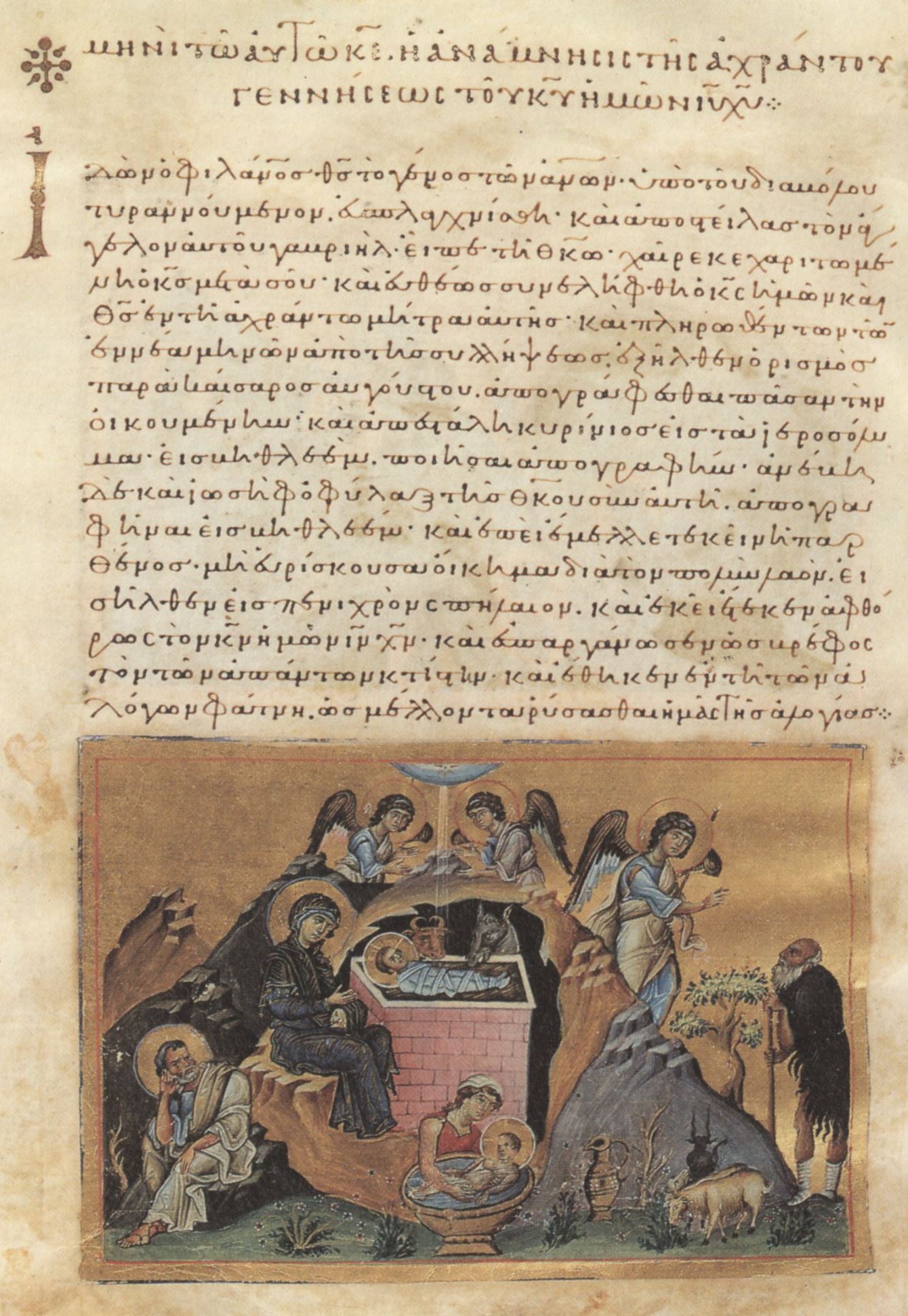
The entry in the Menologion of Basil II for Christmas Day. (Public domain image from Wikimedia Commons.) “Simeon” was a very popular name in the period of Byzantine history known as the Macedonian Renaissance, roughly the mid-9th to mid-11th centuries; the Metaphrast and the Logothete (if they are not the same person) count among their namesakes of that era two of the illustrators of this manuscript, a famous monastic poet and writer known as “the New Theologian”, plus his spiritual father, “the Studite”, and the first emperor of Bulgaria.
Simeon was the author of many liturgical texts in the various Byzantine liturgical genres (of which there are very many indeed), and he compiled an anthology of patristic writings, but he is most famous for his Menologion, a ten-volume compilation of the lives of the Saints, put together to be read in the Divine Office. The Greek verb “metaphrazein” from which his epithet derives means “to paraphrase”, because he would update and improve his sources stylistically, and supplement them with new material. This compilation met with such tremendous success that in many cases, the older versions of the texts were completely displaced, and no version of a Saint’s life older than Simeon’s now survives. Over time, however, the Menologion itself has mostly fallen into disuse as a formal liturgical text, since the Hour at which it is read, Orthros, is already spectacularly long and complex. In monasteries, it is now often read in the refectory instead.

Medieval Christians of the Byzantine world believed in the omnipresence of God, and His constant, benevolent and miraculous intervention, especially in the lives of the Saints, no less than their Latin counterparts did. Simeon’s Menologion is often spoken of as an Eastern Golden Legend, the highly influential collection of Saints’ lives by the Dominican bishop of Genua, Bl. Jacopo da Voragine (1230 ca. – 1298). Like the Golden Legend, it is full of stories of miracles and wonders, many of them very astonishing, many of them stretching credulity to or well past the breaking point. And like Jacopo, Simon has very often, and for the most part very unjustly, been impugned for his uncritical acceptance of such legends. Better and more dispassionate scholarship has in more recent times had the good sense to realize that they looked at the world very differently than modern men do (and that does not always mean for the worse), but also that much of what they recorded was simply received tradition, accepted and loved without skepticism or cynicism.
However, in the Byzantine liturgy as we have it nowadays, today is dedicated to the most prominent martyr of the iconoclast persecution, Stephen, who is given the epithet “the New” to distinguish him from the Protomartyr. He was born in Constantinople in either 713 or 715, and as a teenager, placed by his parents in a monastery on Mt Auxentius, on the eastern outskirts of the city’s Asian side. At the age of thirty, he became abbot, but left this position to live as a recluse in a remote cell twelve years later.
A mosaic of St Stephen in the monastery of St Luke (Hosios Loukas) in the Greek province of Boeotia. (Public domain image from Wikimedia Commons.)
Not long before Stephen entered the monastery, Leo the Isaurian (717-41) had become the latest Byzantine emperor to invent a heresy and try to force it on the Church, the heresy of iconoclasm. And not long before Stephen became abbot, Leo was succeeded by his son Constantine V (741-75), an enthusiastic promoter of his father’s heresy. His traditional epithet, “Copronymus”, means “dung-named” in Greek, a reference to a diaper accident that occurred at his baptism; this was taken by those who honored the sacred images as a presage of his impiety. It occurs several times in the Roman Martyrology, in reference to the many Saints killed or otherwise persecuted by him for the sake of the holy images.
In 754, the emperor held a synod in the imperial palace at Chalcedon, across the strait from the capital, to confirm the iconoclast position, and formally condemn the cult of the sacred images; it is known from the name of the palace as the Synod in Hieria. As long as iconoclasm held sway as an official policy of the Byzantine government, this synod was legally recognized as a legitimate council. With its conclusion, there began a fierce persecution of the iconodules; in The Church in Crisis: A History of the General Councils, Mons. Philip Hughes describes the 22 years from Hieria to Constantine’s death as a “reign of terror.” The stories of the treatment meted out to the orthodox rival those of the English reformation for shame and horror.
Throughout the iconoclast period, monks were the leaders of the opposition to it, and after some years, the emperor was very anxious to have Stephen approve Hieria, thinking, perhaps, that its acceptance by such a prestigious figure would go far towards persuading others of his order. Stephen refused absolutely to comply, and was persecuted in various ways for four long years. Among other things, he was accused of improper relations with a woman named Anna (variously reported as his own mother, or a widow under his spiritual direction, or a nun), who was whipped almost to death for proclaiming his innocence. He was banished for two years, then brought back to the city, where he had an interview with the emperor at which he successfully defended the veneration of images, and was therefore brutally scourged. The emperor, on hearing that he had survived the scourging, cried out (much like a later king would famously do in England), “Will no one rid me of this monk?” Stephen was then dragged out of his prison by a mob, and half-clubbed, half-stoned to death. In the Roman Martyrology, he is commemorated on this day along with three others named specifically, Basil, Peter and Andrew, and a company of 339 other monks.
The martyrdom of Ss Stephen the New, Peter and Andrew, also from the Menologion of Basil II. (Public domain image from Wikimedia Commons.)
The troparion of St Stephen Having struggled aforetime in asceticism upon the mountain, thou didst destroy the spiritual hosts of the enemies with all the arms of the Cross, o all-blessed one; but again, thou didst manfully strip thyself of them for martyrdom, and slayed Copronymus with the sword of the Faith; and for both hast thou been crowned by God, o holy renowned martyr Stephen.

The kontakion From a barren woman didst thou grow forth, the offshoot of a root, o venerable father, namesake of the Protomartyr; and thou wast shown to be a great instructor of monks, unafraid of the wrath of the emperor who did not wish to venerate the image of Christ. Wherefore, in dying thou didst receive the crown of martyrdom, o Stephen.

Monday, April 04, 2022

A Litany of Saints Who Suffered for the Sake of Holy Images

(icon courtesy of Uncut Mountain Supply)
An earlier litany at NLM invoked saints who had been driven into exile for the Faith. The largest single subcategory of exiles were the Byzantine iconophiles, bitterly persecuted by the iconoclasts. As many have pointed out (including me in an earlier article at NLM), there have been three great periods of iconoclasm in the Church: the Byzantine period; the Protestant period; and the modernist period during and after Vatican II. In terms of the sheer quantity of religious art and architecture destroyed, the last of these three periods has been by far the worst[i]—especially because the greatest of all holy “images,” namely the liturgy itself, was also violently defaced, and continues to subsist in many places in that condition. We are therefore all the more justified in calling on the intercession of those who gave their health, their limbs, their very lives, for the defense of holy icons.

A Litany of Saints Who Suffered for the Sake of Holy Images
(for private use)

Lord, have mercy on us. Lord, have mercy on us.
Christ, have mercy on us. Christ, have mercy on us.
Lord, have mercy on us. Lord, have mercy on us.
Christ, hear us. Christ, hear us.
Christ, graciously hear us. Christ, graciously hear us.
God the Father, invisible and uncircumscribed, have mercy on us.
God the Son, Image of the Father, made flesh for man, have mercy on us.
God the Holy Ghost, sent under the form of a dove and tongues of flame, have mercy on us.
Holy Trinity, one God, have mercy on us.
Holy Mary, pray for us.
Holy Mother of God, pray for us.
Holy Virgin of virgins, pray for us.

Ye forty-two holy monks of Ephesus, tortured under Constantine Copronymus, pray for us.
St Lazarus, monk, tortured under Theophilus as a painter of sacred images,
St Tharasius, bishop, recipient of a letter from Pope Adrian I in defense of holy images,
St Euthymius of Sardis, bishop, exiled by Michael and martyred under Theophilus,
St Theophanes, monk, imprisoned, then exiled by Leo the Armenian for venerating images,
St Nicephorus, bishop, exiled to the island of Prokonesis for reverencing holy images,
St Paul of Constantinople, burnt to death under Constantine Copronymus,
St Nicetas of Apollonia, bishop, driven into exile,
St John Damascene, apologist of icons, whose cut-off hand was restored by the Mother of God,
St Macarius, who under the Emperor Leo ended his life in exile,
St Nicetas of Medikion, abbot, who suffered much under Leo the Armenian,
St Plato, monk, who strove dauntlessly against the heretical breakers of holy images,
St George of Antioch, bishop, who died in exile for the veneration of holy images,
St Anthusa, virgin, beaten with scourges for the veneration of holy images and exiled,
St Emilian, bishop, who suffered at the hands of the Emperor Leo and died in exile,
SS Julian, Marcian, and eight others, slain with the sword for venerating an image of the Saviour,
St George Limniota, whose hands were cut off and whose head was set on fire,
SS Hypatius and Andrew, who suffered flaying, burning, and the cutting of your throats,
St Theophilus, cruelly scourged and driven into exile by Leo the Isaurian,
St Andrew of Crete, monk, scourged by Constantine Copronymus who cut off thy foot,
St Theodore of Studium, zealous fighter for the Catholic veneration of holy images,
St Gregory Decapolites, who suffered much for the veneration of holy images,
SS Theodore & Theophanes, brothers, beaten and sent into exile twice for the honor due to icons, pray for us.

Lamb of God, who takest away the sins of the world, spare us, O Lord.
Lamb of God, who takest away the sins of the world, graciously hear us, O Lord.
Lamb of God, who takest away the sins of the world, have mercy on us.

V. 
There is no idol in Jacob, neither is there a simulacrum in Israel.
R. The Lord his God is with him, and the sound of the King’s victory is in him. (Num 23:21)

V. He is the image of the invisible God, the firstborn of every creature:
R. For in him were all things created in heaven and on earth, visible and invisible. (Col 1:15–16)

Let us pray. Almighty everlasting God, who dost not forbid us to carve or paint likenesses of Thy saints, in order that whenever we look at them with our bodily eyes we may call to mind their holy lives and resolve to follow in their footsteps: may it please Thee to bless us by images made in memory and honor of Thine only begotten Son, our Lord Jesus Christ, and to grant that all who in their presence pay devout homage to Thine only-begotten Son may by His merits and primacy obtain Thy grace in this life and everlasting glory in the life to come, through Christ our Lord. Amen.
 
St Andrew of Crete

Sources in the Martyrology

At Ephesus, the passion of forty-two holy monks, who were cruelly tortured under Constantine Copronymus in defense of the veneration of holy images, and consummated their martyrdom. (Jan 12)

At Constantinople, St Lazarus, monk, who was tortured with dread torments by command of the Iconoclast Emperor Theophilus, because he painted sacred pictures. His hand was burnt with a hot iron, but he was healed by the power of God and repainted the holy pictures that had been destroyed. He ended his life in peace. (Feb 23)

At Constantinople, St Tharasius, Bishop, famous for learmng and piety. A letter of Pope Adrian I to him, defending holy images, is extant. (Feb 25)

At Sardis, St Euthymius, Bishop, who was sent into exile by the Iconoclast Emperor Michael because of his veneration of holy images. Later on during the reign of Theophilus he suffered martyrdom by being cruelly beaten with leather thongs. (Mar 11)

At Constantinople, St Theophanes, who from being a very rich man became a poor monk. He was kept in prison for two years by the impious Leo the Armenian, for his veneration of holy images, and then exiled into Thrace, where, weighed down with miseries, he gave up the ghost. He was renowned for many miracles. (Mar 12)

At Constantinople, the translation of St Nicephorus, Bishop of that city and Confessor. His body was brought to Constantinople from the island of Prokenesis, in the sea of Marmara, where he had died on June 5 in exile because of his reverence for holy images, and it was buried with honour by St Methodius, Bishop of Constantinople, in the church of the Holy Apostles in this the very day on which Nicephorus had been driven into exile. (Mar 13)

At Constantinople, St Paul, Martyr, who was burnt with fire under Constantine Copronymus for his defense of the veneration of holy Images. (Mar 17)

At Apollonia, St Nicetas, Bishop, who was driven into exile for the veneration of holy images, and there died. (Mar 20)

At Damascus, the festival of St John Damascene, Priest, Confessor and Doctor of the Church, famous for his learning and holiness. By his writings and preaching he powerfully defended the veneration of holy images against Leo the Isaurian. When his right hand had been cut off by the Saracen caliph because of the calumnies of the emperor, he appealed to the Blessed Virgin Mary, whose images he had defended: forthwith he recovered his right hand, whole and well. (Mar 27)

At Constantinople, St Macarius, Confessor, who under the Emperor Leo ended his life in exile for defending holy images. (Apr 1)

In the monastery of Medikion in Bithynia, St Nicetas, Abbot, who suffered much under Leo the Armenian, for the veneration of holy images, and finally, as a confessor, died in peace near Constantinople. (Apr 3)

At Constantinople, St Plato, monk, who strove with dauntless spirit for many years against the heretical breakers of holy images. (Apr 4)

At Antioch in Pisidia, St George, Bishop, who died in exile for the veneration of holy images. (Apr 19)

In the island of Prokonesis in the Sea of Marmara, St Nicephorus, Bishop of Constantinople; he was a most zealous fighter for the traditions of the fathers and fearlessly opposed Leo the Armenian, the iconoclast emperor, in regard to the veneration of sacred images. On this account he was exiled by him and, after a long martyrdom of fourteen years, departed to the Lord. (Jun 2)

At Constantinople, blessed Anthusa, Virgin, who was beaten with scourges under Constantine Copronymus for the veneration of holy images, and being sent into exile, fell asleep in the Lord. (Jul 27)

At Cyzicus, on the Hellespont, St Emilian, Bishop, who suffered much at the hands of the Emperor Leo on behalf of the veneration of holy images, and at last ended his life in exile. (Aug 8)

At Constantinople, the holy martyrs Julian, Marcian and eight others, who after many torments were slain with the sword by command of the impious Emperor Leo because of an image of the Saviour which they had set up on a brazen gate. (Aug 9)

St George Limniota, a monk, who reproved the wicked Emperor Leo for breaking the holy images and burning the relics of the saints. At the latter's command his hands were cut off and his head set on fire, and he passed as a martyr to the Lord. (Aug 24)

At Constantinople, the holy martyrs Hypatius (a bishop of Asia) and Andrew (a Priest), whose throats were cut, under Leo the Isaurian, after their beards had been smeared with pitch and burnt,  and their heads flayed because of their defence of the veneration of holy images. (Aug 29)

At Constantinople, St Theophilus, monk, who was most cruelly scourged by Leo the Isaurian for defending the veneration of holy images, and driven into exile where he passed to the Lord. (Oct 2)

At Constantinople, St Andrew of Crete, a monk, who was often scourged by Constantine Copronymus on account of his veneration for the holy images, and at length gave up the ghost  after one of his feet had been cut off. (Oct 20)

At Beyrouth in Syria, the commemoration of the Image of the Saviour, which when crucified by the Jews poured forth blood so plenteously that the churches of the East and West drew copiously from it. (Nov 9)

At Constantinople, St Theodore, Abbot of Studium, who fought zealously for the Catholic faith against the Iconoclasts and became famous in the Universal Church. (Nov 11)

At Constantinople, St Gregory Decapolites, who suffered much for the veneration of holy images. (Nov 20)

At Constantinople, the holy confessors Theodore and Theophanes, brothers, who were brought up from childhood in the monastery of St Sabbas. They strove zealously against Leo the Armenian in defense of the veneration of holy images, and by his command were beaten with sticks and sent into exile. After his death they again bravely resisted the Emperor Theophilus, who continued the same impiety, and were again scourged and driven into exile. There Theodore died in prison; but Theophanes, when peace was at length restored to the Church, became Bishop of Nicaea, and, famous for his glorious witness for the faith, rested in the Lord. (Dec 27)
 
St Theodore the Studite

NOTE [i] Fr. Jean-François Thomas, S.J., noted: “France is an immense reliquary, both because of the number of saints who rest there and are venerated there, and because of the names of places. All who fought against this over the centuries were not mistaken: the Protestants, the first iconoclasts in France, destroyed reliquaries and relics, and burned pilgrimage shrines; then the French Revolution completed the sacrilege by attacking relics and confiscating the precious metals and gems of the reliquaries for its war effort; not to mention—which is really the last straw!—that a portion of the clergy itself, in the wake of the Second Vatican Council, decided that all these superstitions no longer made sense and, having become effectively Protestant, removed reliquaries from churches or sold them to the highest bidder. A cultural heritage curator told me thirty years ago that, in the region for which he was then responsible, the post-Vatican II destructions had without doubt been more significant than those that took place during the French Revolution itself” (Are Canonizations Infallible? [Arouca Press, 2021], 7).

Tuesday, May 11, 2021

Can Non-Christian Rituals or Incantations Invisibly Destroy the Good of Holy Images?

A concerned reader wrote to me recently with a question about some icons she had bought online. She was happy with the images, but then heard that the company that supplied the high-quality reproductions was owned and staffed by Buddhists. Furthermore, she said, before the icons went out of the warehouse, non-Christian prayers and incantations, perhaps even Satanic in origin, were said over them. Are these icons still authentic? She asked me.

I thought about this, and in fact, I don’t see any reason to worry, even assuming that the worst of the rumors are true. Here’s why:
Icons are as good as they look. It is from the visible image that a sacred image derives its power. If you destroy the image, then it has no impact, it is just wood and ink or paint. Assuming the images are authentic, even if reproductions, then they have all the power of a holy image worthy of veneration. We can rely on them.

It seems to me that the error is in assuming too much of an icon. Some wrongly suppose that there is a presence associated with the icon in the way that Christ is present in the Blessed Sacrament. So the misplaced fear here is that the company selling them has somehow destroyed the invisible presence of the Saint and, even worse, have performed a sort of transubstantiation of the devil by which there is an internal evil presence that is distinct from the external appearance.

We should be reassured that these fears are misplaced, for there is no such invisible presence, good or bad. As with sacramentals, icons direct and focus our prayers through the engagement of our imaginations. Even blessed icons do not have the presence of the saint in them in that way. Furthermore, if the devil could be hidden away in an icon in this way, it would potentially invalidate every famous icon or piece of sacred art ever made. After all, we cannot guarantee that there is no one among all of the millions of people who have stood in front of them in church or procession (or museum) who has not uttered a curse or evil incantation before the painting or statue. It is quite possible that people with malign intent have done so on occasion. But there is nothing to worry about, for their words and intentions can have no power at all on the impact of an icon. Short of taking an ax to them so as to destroy the image we see, no one can destroy the power of the good images in front of them.
This is an error of attributing too much to an icon rather than too little. If taken too far, it could lead to iconoclasm, for if it is likely that the image is concealing an invisible threat to my spiritual well-being, it is better to destroy it rather than take the risk!

It is interesting that Protestant iconoclasts went straight for the faces of the saints, thereby inadvertently creating an image of the devil.

A blessing, incidentally, does not give a magic power to an icon, and is not even necessary for it to be a holy icon. However, it does obtain favors from God through the prayers of the Church offered for those who make use of them, and through the devotion they inspire.

If on the other hand, someone is venerating a grotesque or distorted image, say of the devil in such a way to falsely elevate his status, then that is idolatry and a serious problem, but that is not what we are describing here. One may also decide as a matter of principle that he would rather financially support a Christian icon supplier than a Buddhist one, but again, that is a separate consideration from the impact of the icons themselves on our faith.
It is better for the Church that wherever we get them from and whoever creates them, we venerate and promote the use of good and holy images. All sacred images are immensely powerful in propagating and reinforcing faith in God. To go back to the case of the company that inspired the original question, if the suppliers are indeed Buddhist or Hindu, the effect is far more likely to be one of directing the Buddhists to Christ, than of turning Christians to Buddhism. This is the hope, after all, in processing in public places!
I always try to remember that the battle is won and we are pinning our colors to the victor, Christ. The devil cannot harm us, except by fear and distraction that influences us to choose to reject God.
The Immaculate Conception, by Giovanni Battista Tiepolo, 1767
There is nothing the serpent can do; Our Lady has trampled on him and he cannot escape.

Thursday, February 11, 2021

The Roman Mosaics of Pope St Paschal I

The Roman Martyrology today includes a notice of Pope St Paschal I (817-24), one of many sainted Popes of the early medieval period whose feast was hardly ever kept outside Rome itself. The story of his reign is much concerned with the relationship between the church of Rome and the Frankish kingdom. It was his predecessor but one, St Leo III (795-816), who crowned Charlemagne as the Emperor of the Romans at St Peter’s Basilica on Christmas Day of 800, the beginning of what would later come to be called the Holy Roman Empire. (The Pope between Leo and Paschal, Stephen IV, reigned for only seven months.)
The Coronation of Charlemagne, by Raphael, 1514-15 (Public domain image from Wikimedia Commons.)
This event has often been discussed solely in political terms, as a shifting of the Church’s attention away from the slowly waning power of Byzantium, which held a nominal suzerainty over much of Italy that it could not effectively exercise, and towards the Franks under the much more effective rulers of the relatively new Carolingian dynasty. This is a fair way to look at the matter, but not by any means the whole story.
Rome and Byzantium had become estranged (not for the first or last time) a century earlier over the iconoclast heresy, which the Eastern emperors imposed on the Church within their domains with terrible violence, beginning in the days of Charlemagne’s grandfather, Charles Martel. And in point of fact, today is also the feast of Pope St Gregory II (715-31), who in a famous letter, reproved the inventor of Byzantine iconoclasm, Leo III the Isaurian (emperor from 717-741), by saying, “It grieves us that the savages and barbarians are becoming tame, while you, the civilized, are becoming barbarous (i.e., by destroying the sacred images).” By “savages”, the Pope means the peoples of northern Europe, whom St Boniface was then converting to Christianity, sent by Gregory himself.
A mosaic with a bare cross, a motif admitted by the first iconoclasts, in the church of Holy Peace (Hagia Irene) in Constantinople, ca. 750. (Image from Wikimedia Commons by Nina Aldin Thune, CC BY-SA 3.0)
Iconoclasm was officially repudiated in 787 at the Seventh Ecumenical Council, the second to be held in the city of Nicea. (For a sense of chronological perspective, a greater distance in time separates Nicea I from Nicea II than separates Trent from Vatican II.) It was not, however, permanently defeated. In 814 (also the year of Charlemagne’s death), the Emperor Leo V the Armenian revived it, a policy continued under his successors until its definitive overthrow in 847. St Paschal had therefore to contend with its re-emergence after almost a quarter of a century of relative peace. [note]
During his papacy of seven years, three of Rome’s ancient basilicas were either significantly restored or completely rebuilt: St Cecilia in Trastevere, Sancta Maria ‘in Domnica’ on the Caelian hill, and St Praxedes on the Esquiline, a minute’s walk from St Mary Major. Each of these churches has over the subsequent centuries undergone at least one other massive restoration, such that on the whole, they now bear little resemblance to the buildings as Paschal himself would have known them. Nevertheless, in each of them there are still preserved to this day important parts of the mosaic work installed in his time. At Sancta Maria in Domnica and St Cecilia, these consist solely of the apsidal mosaic, but at St Praxedes, they are very much more extensive.
The high altar, chancel arch, proscenium arch and apse of the church of St Praxedes; photo by Nicola de’ Grandi.
These mosaics are often described as Byzantine in style, and this is not wholly inaccurate. They show much of the same lack of depth and proportion to the figures that is often seen in the iconographic style of Byzantine art, which is as much a function of the era’s simple lack of technical capacity as of anything else. But Paschal’s works also deliberately look away from Byzantium, and back to an earlier aspect of Rome’s Christian heritage.
In 527, Pope St Felix III had rebuilt part of an early 3rd-century structure in the Roman Forum as a church dedicated to Ss Cosmas and Damian. Of the original decorations, only the apsidal mosaic remains, and that much restored, but in St Paschal’s time, it would, of course, have been much closer to its original state. This mosaic is the Eternal City’s last truly Roman artwork, made right before a series of events that mark the real break between late antique and early medieval Rome. Shortly after they were completed, the city was almost totally depopulated during a devastating war between Byzantium and the Goths over control of the Italian peninsula. When it was reoccupied, much of its cultural and historical tradition was irrevocably broken, and its population reduced to perhaps as many as 10,000. Byzantium, the Pyrrhic victor of the Gothic wars, would become the dominant cultural influence in Rome and in the Roman church for the next two hundred years.
The following four photos are by Fr Jordan Hainsey, from an article published in 2016. The central figure of Christ in the apsidal mosaic of Ss Cosmas and Damian:
On the left side, Pope St Felix III, and one of the church’s titular Saints, either Cosmas or Damian, presented to Christ by St Paul.

Tuesday, November 19, 2019

3,000-Years-Old Newsflash! God Commanded the Use of Graven Images

Last month, on Sunday, October 13th, the Eastern Catholic Church celebrated the Feast of the Fathers of the Seventh Ecumenical Council. I am happy to share with our readers the text that was the basis of the homily given by Fr Sebastian Carnazzo, pastor of St Elias Melkite Catholic Church in Los Gatos California, on that day.

There are several points that we of the Roman Church can take from this.

First, is the content. Contrary to what is commonly believed, the 10 commandments do not forbid graven images. The relevant commandment, often quoted by iconoclastic Protestants and out of context, does not condemn the making and use of religious imagery, but rather idolatry, which is very different. Graven, incidentally, means “made by hand.” Fr Sebastian (a Scripture scholar who is a colleague of mine on the faculty at www.Pontifex.University) explains why this is the case.

Second is the fact that Fr Sebastian thought this point is important enough to make it the central subject of his homily, and to send out a summary of his points in the church bulletin which he encouraged his parishioners to take home and study. In this homily, while he did mention in passing the many contemporary forms of idolatry in our neo-pagan or secular world, (a subject that many priests today are more likely to discuss in this context), he focused primarily on the use of images in the context of worship.

As Roman Catholics, we cannot afford to be smug about this. The general situation in my observation is that images are not incorporated in worship at all. And I am not referring here to the liberal, impious parishes with whitewashed, modern churches that reflect modern iconoclasm and are barely distinguishable from a puritanical Protestant church. I am thinking of your parish and mine, that of the orthodox, pious and religious who appreciate beauty, and very likely agree in principle with the need for sacred art in churches. They might have beautiful art in their churches, and Mass at such parishes might be dignified and beautiful, with expert choirs singing chant or polyphony, but I have never yet seen liturgical imagery used in the context of worship in the way that I see it in every Eastern Divine Liturgy. The understanding of the place of liturgical imagery in the actual process of worship is so small that, in my experience, Roman Catholics simply don’t know what I am referring to when I mention it. At Roman Catholic churches, the art is reduced to contributing to a beautiful backdrop that is incidental to the process of worship, which is an eyes-closed affair that involves us having our noses buried in Missals. Most of the art is devotional, and if it is engaged with at all, it is not in the context of the liturgy. Until we remedy this situation in the Roman Church, we cannot, in my estimation, revitalize the culture powerfully. I wrote about this specifically and in detail in the following article: The Good, the Better and the Sunday Best - Using St Thomas’ 4th Way to Evangelize the Culture.

The third is the importance of this feast in the Church calendar in the Eastern Church. Of the seven Councils recognized by the Eastern Church, the first six are celebrated together, but the Seventh Ecumenical is given its own day. This is a reflection of the history of the Eastern Church and its fight against iconoclasm. There are martyrs from the period, over 1,000 years ago, people who were prepared to die rather than concede the point. We have been through our own period of iconoclasm in the West (we are not out of it yet), but in contrast with its Eastern equivalent, it is marked not by resistance from the Catholic faithful and hierarchy, but by quiet acquiescence. Greater the fools we!

Images are the stepping stones by which the spirit of man can move from contemplation of the material world to contemplation of God. We neglect them at our peril, as the history of Church in the West for the last 200 years demonstrates. I don’t think it is an exaggeration to say that until we once again incorporate imagery directly into our worship, we will continue to lose the culture wars with the anti-Christian secular forces, and Mass ayyendance will continue to decline.

The Adoration of the Golden Calf – Picture from the Hortus deliciarum of Herrad of Landsberg (12th century)
Here is Fr Carnazzo’s recorded Bible study on the topic.
And here is the written text, which was the starting point for his homily, made available at my request:

The Holy Fathers of the Seventh Ecumenical Council declared: “We, therefore...define with all certitude and accuracy that just as the figure of the precious and life-giving Cross, so also the venerable and holy images, as well in painting and mosaic as of other fit materials, should be set forth in the holy churches of God, and on the sacred vessels and on the vestments and on hangings and in pictures both in houses and by the wayside, to wit, the figure of our Lord God and Savior Jesus Christ, of our spotless Lady, the Mother of God, of the honorable Angels, of all Saints and of all pious people. For by so much more frequently as they are seen in artistic representation, by so much more readily are men lifted up to the memory of their prototypes, and to a longing after them; and to these should be given due salutation and honorable reverence not indeed that true worship of faith which pertains alone to the divine nature...but...according to ancient and pious custom” (NPNF, vol 14).

The Seventh Ecumenical Council made this declaration in AD 787, against the heresy of Iconoclasm, a heresy that had labeled the making and use of religious imagery in the Church as idolatry. The council condemned the heresy of iconoclasm on the grounds that it contradicted the Orthodox and Apostolic Faith. For the Church had used sacred images in both its liturgical life and catechesis from the earliest days, just as Israel had in both its synagogues and places of worship in the OT. And although the declaration of the venerable Council officially ended the problem for the One, Holy, Catholic, and Apostolic Church, the heresy lives on even to today.

Iconoclasm is found implicitly in the architecture and decor and explicitly in the doctrine of the vast majority of Protestant sects. These sects teach that the Bible forbids the making and use of religious imagery, such as statues and icons. The passage they most commonly cite is from the Ten Commandments given through Moses at Sinai: “You shall not make for yourself a graven image, or any likeness of anything that is in heaven above, or that is in the earth beneath, or that is in the water under the earth; 5 you shall not bow down to them or serve them...”(Exod 20:4-5). When this passage is read out of context, it can appear that the Protestant position has some support and that the Bible really does condemn the making and use of religious imagery.

However, if one reads the passage in its original context, one can see that the commandment does not condemn the making of a graven image as such (“graven” simply means ‘fashioned by hand’), but rather the making of an image to be worshiped as a god. This is made clear by a careful reading of the words which appear immediately before and after the passage in question: “I am the Lord your God....You shall have no other gods before me.....for I the Lord your God am a jealous God....” Later on in the same chapter, God repeated his commandment in one succinct statement, “You shall not make gods of silver to be with me, nor shall you make for yourselves gods of gold” (Exod 20:23). Therefore the passage, usually quoted by Protestants and often out of context, does not condemn the making and use of religious imagery, but rather idolatry, that is the making and use of an image of a created thing to bow down and worship it as a god.

An examination of the broader context further supports this conclusion, since there are a number of passages, even in the very same book of Exodus, where God actually commands that religious imagery be made. For example, just a few chapters later, God began to describe to Moses how to build the Ark of the Covenant and the Sanctuary that would be God’s dwelling place among Israel (Exod 25:10-22). In this passage God told Moses to make an ark (a box about the dimensions of a bath tub) out of wood and to cover it with gold. Then he was to put two cherubim (a cherub is a type of angel) on the lid at either end, facing each other, wings out-spread, and touching in the middle. In this box, Moses was to place the Ten Commandments, and above this box God would sit enthroned on the outstretched wings of the graven images of golden angels (cf. 1 Sam 4:4; Ps 99:1, etc.), and from there speak to Moses about all of his commandments to Israel. Continuing on in the book of Exodus, one finds that from chapter 25 to the end of the book, the majority of the text is spent describing how God wants Moses to build the Sanctuary, and how he is to cover it with images of cherubim, palm trees, flowers, and fruit (cf. Exod 25: 31-40; 26:1,30-31; 28:31-34), all according to God’s command (cf. Exod 25:40; 26:30; 27:8; 39:43; 40:33-38). As one can see, God did not condemn the making or use of religious imagery; on the contrary, he actually commanded it for his most holy Sanctuary where he would dwell among Israel. Similar imagery appears later in the Old Testament, when Solomon built the Temple.

Like Moses before him, Solomon was appointed to build a place for God to dwell among His people. And like the Sanctuary Moses was commanded to build, Solomon built the Temple in accordance with the pattern he had been shown by God (1 Chron 28:18-19; Wis 9:8; cp. Exod 25:40). In the inner sanctuary of the Temple, Solomon put the Ark that Moses had built, and at the entrance he put two 15-foot (1 cubit = 1 ½ feet) statues of cherubim to guard the way (1 Kings 6:14-32). The Temple’s inner sanctuary was covered in gold and the rest of the Temple walls were lined in cedar and carved with images of cherubim, open flowers, gourds, palm trees, lilies, and lions (cf. 1 Kings 6:33-35; 7:28,36). Twelve life-sized statues of oxen supported a 10,000-gallon bath for liturgical washing (cf. 1 Kings 7:25-26). Hundreds and hundreds of golden pomegranates (a type of fruit) hanging from lengths upon lengths of golden chains draped from every pillar (cf. 1 Kg 7:15-22,42). What Moses had made for ease of travel through the wilderness, Solomon made for permanence in Jerusalem. As with the sanctuary built by Moses, Solomon’s Temple contained numerous examples of God’s command to make and use religious imagery for both catechetical decoration and liturgical function.

Another example of God commanding the making of graven imagery appears in an episode of Israel’s wandering in the wilderness when they were stricken by deadly serpents Here God commanded the making of a graven image in the form of a serpent as a medium through which he would save his people (Num 21:8-9; cp. 2 Kings 18:4).

Therefore, the common Protestant claim that the Ten Commandments condemn the making and use of graven religious imagery is clearly refuted, not only in the immediate context as already addressed, but by numerous other passages in the Bible, as the above examples demonstrate. God did not condemn the making and use of religious imagery in the Ten Commandments, but rather the sin of idolatry. Idolatry is the act of making or using an image to be worshiped as a god. One can see the difference by an examination of the well-known biblical account of idolatry, when Israel made a golden calf (cf. Exod 32). But notice what was at issue here. It was not the fact that Israel decided to make an image of a calf, Solomon had made twelve life-size statues of oxen to be used in the Temple he built (cf. 1 Kings 7:25-26), rather the issue here was the making of an image of a calf to be worshiped as a god (cf. Exod 32:1,4).

Another example of idolatry appears in the book of Daniel, when King Nebuchadnezzar built a 90-foot tall golden image (Dan 3). He then commanded all in his kingdom to come and worship it as a god (cf. Dan 3:6,11,14,18). Here again, notice that the problem was not that Nebuchadnezzar built a large golden statue, indeed Solomon had built two 15-foot golden statues of cherubim in the Temple (cf. 1 Kings 6:23), rather the issue here was that Nebuchadnezzar had built his statue to be worshiped as a god.

So we see how Protestantism’s erroneous interpretation of God’s teaching regarding graven images in the Ten Commandments, is not only contradicted by a careful examination of the immediate context, but also in numerous examples throughout the rest of Sacred Scripture. Let us recall the golden cherubim on top of the Ark of the Covenant, whose wings formed the very throne of God upon the earth, the two 15-foot golden cherubim who guarded the way into the Temple’s sanctuary, the twelve life-size statues of oxen which supported the bath of purity in the Temple, the cherubim, lions, palm trees, gourds, pomegranates, and open flowers that decorated the Temple, and the bronze serpent, fashioned that the people of God might live. Thus it is obvious from even the ‘Bible alone’, that God did not condemn the making of religious imagery in the Ten Commandments, but rather the sin of idolatry. And so while we renounce the idolatrous making of a graven image to be worshiped as a god, we also uphold the ancient and honorable practice of the making and use of religious imagery in the Church, received from Israel of Old, since as the Council Fathers taught: “For by so much more frequently as they are seen in artistic representation, by so much more readily are men lifted up to the memory of their prototypes, and to a longing after them....” Therefore, let us proclaim with the great and venerable Fathers of that most blessed and glorious Council concerning the Iconoclasts of the past and their modern adherents today among the Protestant sects: “they have failed to distinguish between holy and profane, styling the images of our Lord and of his Saints by the same name as the statues of diabolical idols....[applying] to the venerable images the things said in Holy Scripture about idols.”

Here is the bulletin which is not only distributed to all who attend the Divine Liturgy but is emailed out to any who have ever attended the church. This contains a truncated version of the above. Again, this indicates the seriousness with which this topic is taken in the Eastern Church.

Thursday, November 09, 2017

The Origin of All Saints’ Day: A Brief Follow-Up

Last week, I wrote a post in which I proposed that the feast of All Saints perhaps originated not with the dedication of the Pantheon as a church, as is traditionally stated, but in the Papal response to the iconoclast heresy in the 8th and 9th centuries. Here I will consider rather more briefly something else which may fit in with that idea.

As I noted earlier, part of Rome’s answer to the Byzantine emperor’s rejection of sacred images was the building of an oratory at St Peter’s Basilica, which Pope St Gregory III dedicated to all the Saints, filling it with sacred pictures and relics. This was one of several major artistic projects by which the Pope declared the Church’s opposition to iconoclasm, a policy continued by his successors.

In 753, during the reign of Pope Stephen II (752-57), the Emperor Constantine V held a synod in the imperial palace at Chalcedon to confirm the iconoclast position, and formally condemn the cult of the sacred images; it is known from the name of the palace as the Synod in Hieria. As long as iconoclasm held sway as an official policy of the Byzantine government, this synod was legally recognized as a legitimate council. Furthermore, with its conclusion, there began a fierce persecution of the iconodules, which gave many martyrs to the Church. In The Church in Crisis: A History of the General Councils, Mons. Philip Hughes describes the 22 years from Hieria to the death of Constantine V as a “reign of terror”; the stories of the treatment meted out to the orthodox rival those of the English reformation for shame and horror. Constantine V’s traditional epithet, “Copronymus”, means “dung-named” in Greek, a reference to a diaper accident that occurred at his baptism; this was taken by those who honored the sacred images as a presage of his impiety. It occurs repeatedly in the Roman Martyrology, in reference to the many Saints killed or otherwise persecuted by him for the sake of the images.

Although the term “iconoclasm” literally means “the breaking of images”, Byzantine iconoclasm also involved an attack on the Church’s devotion to relics. In fact, very shortly after Hieria, the altar of the great basilica of St Euphemia in Chalcedon was dismantled, and her relics removed from it and cast into the sea. This was the very same church at which the Fourth Ecumenical Council was held in 451; the fact that the council of 753 was not held therein, but rather in the imperial palace, says much about the baleful influence of the Byzantine emperors on the Church in that era.

It is perhaps in light of this that we should consider the establishment of a second very notable oratory in Rome, within the Papal palace at the Lateran, officially known as “St Lawrence in the Palace.” From very early on, however, it was also known as the “Sancta Sanctorum – holy of holies,” not because of its status as a Papal chapel, but because of the presence of a very large and important collection of relics. To this very day, the chapel’s altar is completely surrounded by a cage of thick iron bars to protect the relics from theft, although the relics themselves have all either long since been lost or moved to other places. (Many of them are on display today in the Vatican Museums.)

(Image from Wikimedia Commons by Sailko)
The date of the oratory’s original construction is uncertain; it is first mentioned in the Liber Pontificalis’ account of Pope Stephen III (768-72). Rome’s opposition to iconoclasm never wavered in the least, and at a synod held in the Lateran in 769, the veneration of images was once again upheld, although this was not its principal topic.

From time immemorial, this oratory has also been the home of a famous icon of the Savior, one of the many “acheiropoetos” images, “not made by human hands.” It was already in Rome before Stephen III’s time, since the Liber Pontificalis records that Stephen II (752-7) held a procession with it through the city when Rome was threatened by the Lombards in 753. Its date and provenance are uncertain, ranging from the mid-5th to the 7th century, and from Rome to Byzantium; the metal sheet that covers it today is from the time of Pope Innocent III (1198-1216.)


Under Christ’s right eye is a dent which is still clearly visible, and it has been speculated that this damage was deliberately caused by an iconoclast. If the icon is indeed Byzantine in origin, it may very well be one of the many brought to Italy by those iconodules who fled from the persecution of Constantine V; images with such a history can be seen even to this day in churches up and down the peninsula. Its placement in the Sancta Sanctorum would therefore perhaps also be part of the Papal response to iconoclasm. Many of the relics formerly present in the oratory were placed there by Pope St Leo III, who was elected one year after the famous synod at Frankfurt, which, working off a very bad translation of the acts of Second Nicea, condemned that council, and what it mistakenly believed to be its teaching on the use of images. Likewise, Pope Gregory IV, who permanently established November 1st as the date for the feast of All Saints, also built an apartment for himself next to the Sancta Sanctorum, the more conveniently to go there for prayer.

We may therefore consider the possibility that the Popes built the oratory of the Sancta Sanctorum as the analog at the Lateran to Pope Gregory III’s oratory at the Vatican, and very much another part of their anti-iconoclast program.

Thursday, November 02, 2017

The Origin of All Saints’ Day

In the course of research on All Saints’ Day for a planned piece in the Liturgical Notes series, I have come to believe that the traditional story about the feast’s origin may be either incorrect, or at least very incomplete. I propose therefore to give a summary of the traditional explanation, which seems to be basically the same in a variety of reference works (the Catholic Encyclopedia, Bl. Schuster’s Liber Sacramentorum, the revised Butler’s Lives of the Saints, etc.) and then explain what I think the problem with it is. What I write here is to some degree tentative, and I shall be very glad to see what people may have to add in the combox to clarify or correct matters.

The classic account of the feast’s origin is as follows. A commemoration of all the martyrs was instituted in the Eastern churches fairly early on. St Ephraim refers to such an observance on May 13th around the year 360, (Carmen Nisibenum 6) and St John Chrysostom preached a sermon “on all the Saints who suffered martyrdom throughout the world” towards the end of the same century. (PG 50, 705) This latter is routinely described as the first reference to the custom still observed by the Byzantine Rite of keeping the feast of All Saints on the Sunday after Pentecost, even though the sermon begins with the words “The number of seven days has not yet passed since we completed the holy assembly of Pentecost.” Butler’s Lives notes that a feast of all the martyrs was kept on the Friday of Easter Week by the Syrian church, a custom still observed to this day by the Chaldean Catholics and Nestorians. This leads me to wonder whether Chrysostom’s words refer rather to a similar custom on the Friday of Pentecost week, which often imitates the customs of Easter week.

The interior of the Pantheon, by Giovanni Paolo Panini (1692-1765) Over the architrave are quotations from Psalm 149, “His praise is in the church of the Saints”, and Psalm 150, “Praise the Lord in His Saints”, words that were formerly sung every single day in the psalmody of Lauds. This inscription has been removed by modern restorations.
In the year 608, Pope St Boniface IV obtained the Roman building known as the Pantheon, the “temple of all the gods”, from the Emperor Phocas, and dedicated it as a church to the Virgin Mary and All Martyrs, as stated in the Liber Pontificalis. The date of this dedication, May 13th, is the same date as that mentioned by St Ephraim, which seems unlikely to be a coincidence. Since at the time, as it is repeatedly stated, only the martyrs were venerated as Saints, the dedication to all the martyrs is effectively the same as a dedication to all the Saints. Later, however, for reasons unknown, the feast was transferred to November 1st. This is usually said to have been done by Pope Gregory IV (827-44), although the feast was kept on that date before his time in some places. On the other hand, an Irish martyrology of the late eighth century puts it in April. We do not have a decree of Pope Gregory to such effect, but the tradition is recorded in the nearly contemporary Martyrology of Ado, bishop of Vienne, compiled in the 850s; from there it passes into the traditional text of martyrologies, all the way to the Roman Martyrology revised by Card. Baronius after Trent.

The liturgical commentators of the later Middle Ages such as William Durandus believed that the feast was instituted to displace the worship of pagan gods in the Pantheon. “Since the individual idols of the Romans could not each have a temple in Rome, they built a temple in honor of Cybele, the mother of the gods, and of all their gods.” After Pope Boniface had obtained it from the Emperor, “casting out the idols, he dedicated it … to the honor of Blessed Mary and all the martyrs, and the feast was called ‘of Blessed Mary at the Martyrs’, for feasts of Confessors were not yet kept, but only of Martyrs.” (Rationale 7, 34) He also notes the transfer of the feast to November 1st by Gregory IV; the same story is told more briefly by Sicard of Cremona. (Mitrale 9, 24) Ironically, this story was also seized upon by some protestant controversialists as evidence of the paganization of Christianity by the Romish church.

The problems with this story as I see them are as follows. First, there is very good reason to doubt that the Pantheon was in fact a temple. The word “Pantheon” means “building of all the gods”, not specifically “a temple”. There is no clear understanding of its function, but architecturally, it is completely unlike any Roman temple, and it has no altar. Furthermore, there is no evidence that the Romans had a collective worship of all the gods together. (See Amanda Claridge’s Oxford Archeological Guide to Rome.) The idea that it was a temple seems to have originated in the early Middle Ages, when the Christians could hardly imagine that such an imposing structure could be anything other than a temple.

Secondly, it is not correct to say that since “martyr” was synonymous with “Saint”, a church of all the martyrs was effectively the same as a church of all the Saints. It is certainly true that anciently, when there was no formal process of canonization, the great majority of Saints were regarded as such because they had suffered martyrdom. A great majority, however, is not the same as a totality, and in fact, devotion to sainted confessors is not as late a development as Durandus thought it was. In 386, St John Chrysostom, while still a priest of Antioch, preached a sermon on St Philogonius, who was bishop of that see from 320 to 323, and not a martyr. “The day of the blessed Philogonius, whose feast we are now keeping, has called our speech to the telling of his righteous deeds.” (PG 48, 747-56. The beginning of this sermon is included in the Breviary of St Pius V as a generic lesson of the second nocturn for simple Confessors.)

The “Wise Order of the Doctors”, from the vaulting of the Chapel of Saint Brice in Orvieto Cathedral, by Luca Signorelli, 1499.
In the West, St Gaudentius, bishop of Brescia in northern Italy from 387 to 410, preached a sermon on the dedication of a church for which he had obtained relics of the Forty Martyrs of Sebaste from the nieces of St Basil the Great; in it, he twice refers to Basil as a “blessed confessor.” The oldest lectionary of the Roman Rite, the Comes of Wurzburg (ca. 650 AD), contains feasts of Pope Silvester I (314-335), of his very brief-lived successor, Pope Mark (January to October 336), and Martin of Tours. St Mark also built a church near the Capitoline Hill in Rome, which is named for him, and is the station church of the Monday of the third week of Lent. It is reasonable to imagine that the seed planted by some of the early hagiographies, such as St Athanasius’ Life of St Anthony or St Jerome’s Life of St Hilarion, flourished earlier than the 7th century, the era of the Pantheon’s dedication.

Given that there was a distinction between martyrs and confessors, and that some of the latter were honored as Saints before the 7th century, the Pantheon as a church is always called “ad martyres” in early Roman liturgical sources, not “ad sanctos” or “ad martyres et confessores.” This strongly suggests to me that it was not originally thought of as a church dedicated to all the Saints. Its first appearance on a list of Roman station churches, also in the Wurzburg lectionary, may perhaps better explain its earliest liturgical use.

The stations from Holy Saturday to Easter Friday are arranged in descending hierarchical order, starting, of course, at the cathedral, which is dedicated to the Lord Himself. On Easter Sunday, the station is at the oldest church in the world dedicated to the Virgin, St Mary Major, followed on the next three days by the principal churches of Rome’s patron Saints, St Peter at the Vatican, St Paul on the Ostian Way, and St Lawrence outside-the-Walls. The station of Thursday is “ad Apostolos”, the church of the Twelve Apostles, and that of Friday “ad martyres”, the Pantheon. We may note here in passing that Rome therefore keeps the Friday of Easter week “ad martyres”, the same day on which the Syrian churches have their commemoration of all the martyrs; this may also not be just a coincidence.

The last station of the Easter octave is also at the cathedral, which is more commonly known as St John in the Lateran. “John” is actually both the Baptist and the Evangelist, who share the church with Christ in a triple dedication. In the early station lists, it is usually just called “the Lateran”, but there is a broad consensus that this triple dedication is fairly early. By the year 468, the Lateran baptistery also had chapels dedicated to both Saints John. This would perhaps explain in part why the station of Holy Saturday is repeated only a week later. The term “confessor” originally meant someone who had suffered for the faith without being killed, and the very first such confessor is St John the Evangelist. According to a tradition already known to Tertullian at the end of the second century, in Rome he was thrown into a pot of boiling oil, but miraculously preserved. The station at the church also dedicated to him would then complete the hierarchy of the Saints by having him represent the order of confessors.
The entrance to the chapel of St John the Evangelist in the Lateran Baptistery. On the architrave is written “Bishop Hilary, the servant of Christ, to his deliverer, John the Evangelist.” Pope St Hilary (461-68) was, as a priest of Rome, one of St Leo the Great’s legates to the false Council of Ephesus in 449, deemed “the Robber Synod” not only because of the heresy which it embraced, but because of the violence with which the Patriarch Dioscurus of Alexandria treated his opponents, which directly caused the death of St Flavian, the Patriarch of Constantinople. This chapel and another facing it on the opposite side of the baptistery, dedicated to St John the Baptist, were built by Hilary as a gesture of thanks for his safe escape from the council.
If the Pantheon was dedicated and used liturgically as a church specifically of the martyrs, and not of all the Saints, then we may wish to look somewhere other than its dedication for the origin of the feast of All Saints. I suspect that the real origin lies in the church of Rome’s response to the iconoclast heresy in the eighth and ninth centuries.

When iconoclasm broke out in the year 726, the Popes were swift to condemn it. St Gregory II (715-31), in a famous letter to the inventor of the heresy, the emperor Leo III, wrote, “It grieves us that the savages and barbarians are becoming tame, while you, the civilized, are becoming barbarous.” The “savages” are the peoples of northern Europe, then being converted to Christianity by St Boniface, whom Gregory himself had sent to Germany.

His successor, St Gregory III (731-41), was a Syrian, elected Pope by acclamation during Gregory II’s funeral procession. In the first year of his reign, he held a synod in Rome, at which it was determined that all those should be excommunicated who “take down, destroy, profane or blaspheme against the veneration of the sacred images of Our Lord, and His Mother, the glorious and immaculate ever Virgin Mary, of the blessed Apostles, and all the Saints,” as recorded in the Liber Pontificalis. It is also stated that he constructed an oratory in St Peter’s dedicated to all the Saints, filling it with relics, and decreeing that in the Masses celebrated in that oratory (and there alone), the words “whose solemnity is celebrated today in the sight of Thy majesty, o Lord, our God, throughout the world” should be added to the Canon.

In the book “Images, Iconoclasm, and the Carolingians”, Thomas F.X. Noble (Univ. Penn. Press, 2009) points out that this custom was established by a synod held on Palm Sunday of 732, the decrees of which were cut into a marble inscription and hung on the walls of the oratory; “in a case almost unique in early medieval Rome, the records of a church council were inscribed and hung in public.” (p. 125) The Liber Pontificalis goes on to describe several other artistic projects of Pope Gregory, which Noble describes (p. 126) as “an image-decorating campaign” and “a calculated affront to the emperor’s policies”, with elaborate and high-quality images of Christ and the Saints set up in several important Roman basilicas.

The lower basilica of St Chrysogonus in Rome’s Trastevere region has a large number of frescoed images of the Saints, unfortunately not very well preserved, from the time of St Gregory III. (Image from Wikimedia Commons by Sailko.)
Although iconoclasm was officially condemned by the Second Ecumenical Council of Nicea in 787, it was revived from 814-842 under the Emperors Leo V, Michael II and Theophilus. This second period coincides with the reign of Pope Gregory IV (827-44), who, as mentioned above, is said by a near contemporary source to have universally established All Saints’ Day on November 1st.

The churchmen and scholars of Carolingian and post-Carolingian Gaul also took a keen interest in the iconoclasm controversy, and the matter was discussed at more than one Gallican synod of the era. In 794, a synod at Frankfurt, working off a very bad translation of the acts of Second Nicea, condemned that council, and what it mistakenly believed to be its teaching on the use of images. Their mistake was then refuted by Pope Adrian I. In 824, the Emperors Michael and Theophilus sent a letter to Charlemagne’s son and successor Louis the Pious, justifying their opposition to the holy images. In response, a synod was held in Paris in the year 825, which to a large degree repeated the mistakes of Frankfurt. At this point, however, we have no record of the papal response or the immediate aftermath of the synod. Gregory IV was then elected in mid-to-late October of 827.

St Gregory III’s Roman synod of 731 was convoked on November 1st, as was the Parisian synod of 825. (Mansi vol. 12, col. 299; vol. 14, col. 421) If this is a mere coincidence, it is certainly a very remarkable one. Might it not be that those places which originally celebrated All Saints on November 1st did so in memory of what Pope St Gregory III had done on that day, upholding the true teaching on sacred images, and by extension, on the proper place of the Saints in the Church’s worship? And might it not also be that Gregory IV established that same day as a universal feast, partly in reply to the Parisian synod, and partly to assert that Rome continued to uphold the true teachings on sacred images?

Monday, October 31, 2016

Missals from Silverstream Priory (4): A Defaced Missal from the Post-Conciliar Revolution

In our series of missals from the library of the Benedictine Monks of Perpetual Adoration, we have so far looked at magnificent works of art from the 20th century (Maria Laach, Regensburg) and from the 18th century (the Augustinians).

Today, instead of basking in beauty, we will come face to face with the diabolic disorientation of the Church in the mid- to late 1960s, when prayers and practices of half a millennium’s duration or longer were being discarded and burned like so much chaff. Not even the Roman Canon, that ancient pristine shrine of Romanitas, was safe from this barbarian appetite for conquest, this insatiable lust for violating the sacred under the guise of “simplification” and “modernization.”

Too much kissing!
It is not surprising, in fact, that this massive appetite for cultural destruction paralleled the sexual revolution, and that the same generation of radicals that was dismantling the liturgy was also leaving the consecrated celibate life in droves and favoring so-called “liberation” of the id or the libido. As Augustine pointed out in The City of God, power among fallen human beings, without the grace of God, is exercised as libido dominandi, the lust for domination.

In the liturgical sphere, this took the form of standing in arrogant judgment over centuries of the most holy practices of faith and laying profane hands on a sacred inheritance, following the principle (if it can be called a principle) of “might makes right.” In the sphere of religious life, it took the form of abandoning the choral office and high Mass, casting off habits and veils, diluting constitutions, softening rules, and losing one’s supernatural identity by amalgamation with secular social work and civil rights. The so-called “superiors” who guided the process were guilty of the same libido dominandi as the liturgical revolutionaries, and left in their wake a similar post-nuclear desolation.

What was important for the Catholic radicals of the mid-twentieth century was to shatter, bit by bit, the taboo of an untouchable liturgy, an object of collective veneration transmitted from generation to generation.[1] They started by messing with the existing prayers and rubrics, as if to say: “See what we can get away with! We haven’t been struck dead by lightning yet. You see now that all these things must be merely human inventions; we can do as we please. Suppress or invent rubrics; omit, rearrange, bawdlerize, or make up new texts; throw out the entire aesthetic of ‘awe’ and replace it with one of ‘brotherhood’ or ‘caring community’ — we must do all this and more, quickly, before our game’s called and our time’s up.” Their eventual success, more complete than they could ever have dreamed at first, is a remarkable testimony to the limits to which Divine Providence permits evil, in order to demonstrate His power in bringing forth good from it and in spite of it, as the phoenix rises from the ashes.

To me, a poignant sign of that Providence is the fact that Catholics are returning in growing numbers to the use of just those liturgical books that were placed on the butcher’s block half a century ago, and are now praying those very prayers that were canceled out and pasted over. The Benedictines have a motto: Succisa virescit — cut down, it grows back again. It’s a variation on one of the oldest sayings of all: sanguis martyrum semen christianorum. Perhaps there is a special fruitfulness in the blood that, over the centuries, so many priests and faithful have shed (literally or metaphorically) as their Catholic worship was attacked by iconoclasm, be it of the Byzantine, Protestant, or Modernist variety.

The movement to recover and restore Catholic worship cannot be eradicated. That has been tried and it failed. It can be cut down by persecution or lack of support, but its roots remain and the new growth will be taller and stronger.

Below are additional photos from this melancholy "interimized" missal.

NOTE

[1] Before you write in the comments that the liturgy has never been untouchable and that there have been countless little changes down through the centuries, pause for a moment and ask yourself whether it is likely that I am unaware of this fact. What I am talking about is a general attitude of conservatism and respect for the liturgical rites, such that even archaic elements whose function or meaning may no longer be clear to us (or may have acquired a different, allegorical meaning over time) are jealously preserved. The trend was almost always towards retaining what had been added over the centuries; and certainly the magnitude of the modifications from the 1950s and 1960s has nothing remotely like it in the entire history of the Catholic Church.

A comparison of two similar missals -- one defaced, one unharmed

More recent articles:

For more articles, see the NLM archives: