Sunday, August 31, 2025

The Life of St Augustine, by Benozzo Gozzoli (Part 2)

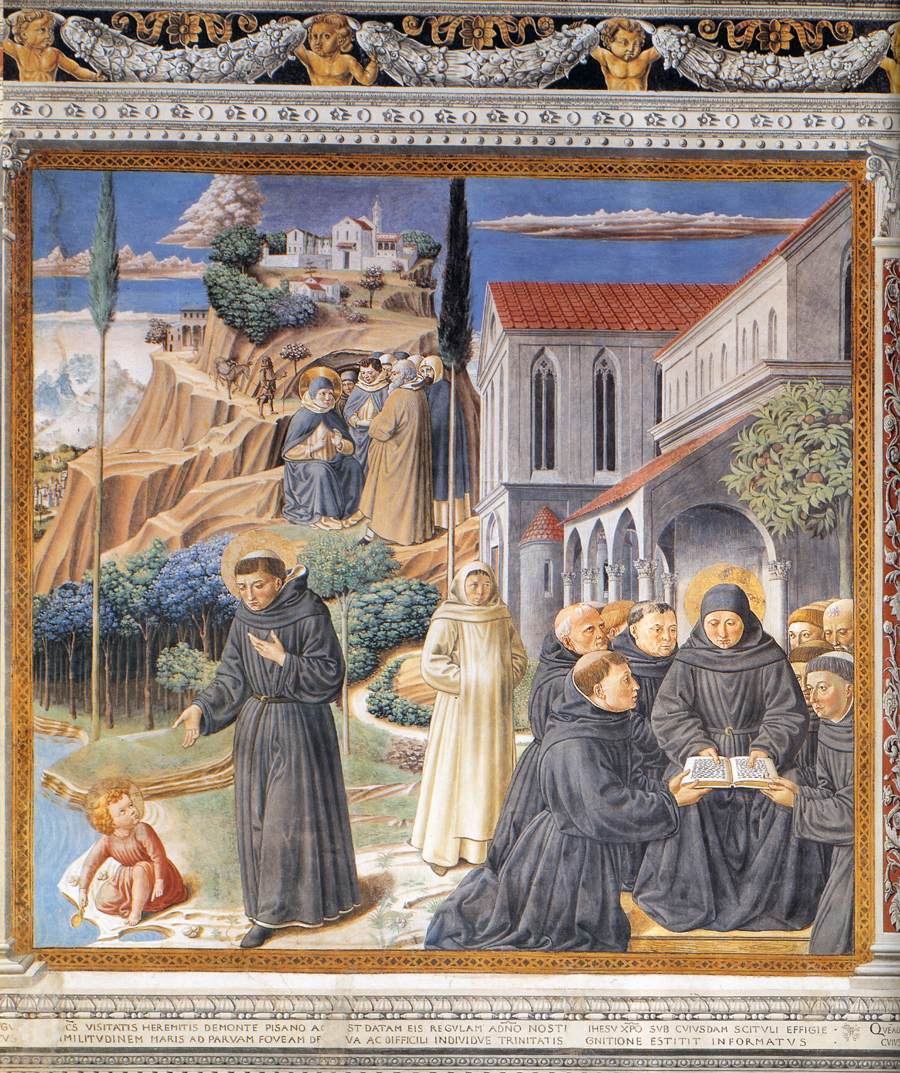
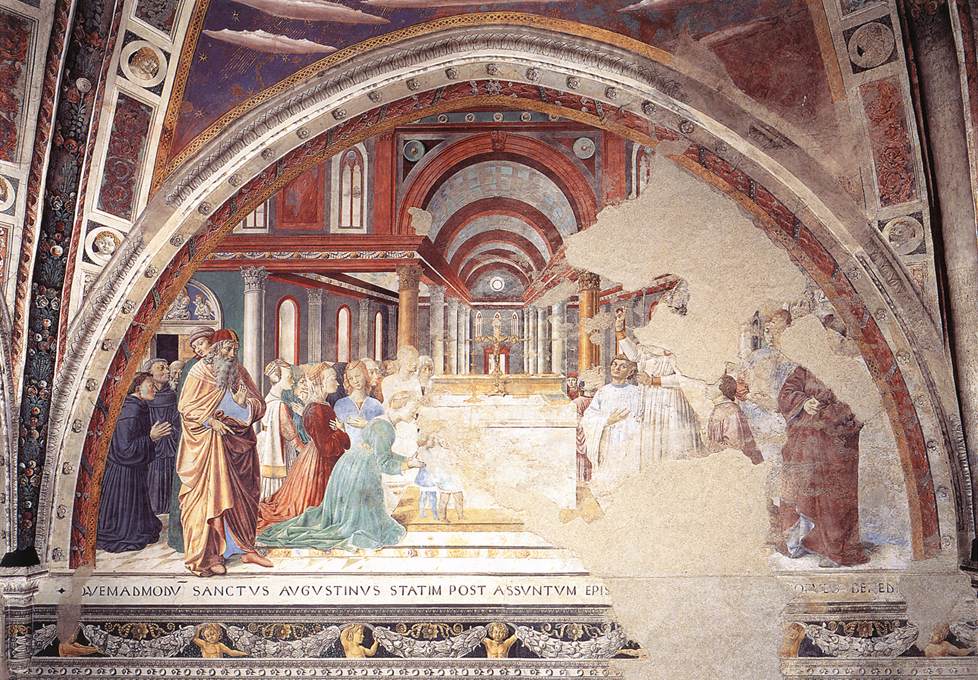
The first part of this, which was published on Thursday, the feast of St Augustine, ended with the scene of his conversion; here we pick up the story from his baptism. As in the first part, these public domain images are all taken from the Wikimedia Commons page on the choir chapel of the church of St Augustine in San Gimignano, Italy, where these frescoes were done by the Florentine painter Benozzo Gozzoli between 1463 and 1467.

Eleventh scene: St Augustine is baptized by St Ambrose. In accordance with the tradition that the Te Deum was composed by them both on this occasion, the first words of it are painted on the wall behind them. Until 1913, the header “Hymnus Ss Ambrosii et Augustini” was printed in the breviary above it. In keeping with a common artistic convention of the period, after this, the Saint always appears anachronistically clothed in the habit of medieval Augustinian friars, which Gozzoli makes dark, but not black, which would clash too strongly with the color scheme of the whole.
Twelfth scene: on the left, the famous (and apocryphal) story that Augustine, after finishing his book on the Trinity, went walking on the seashore, where he saw a boy trying to pour the ocean into a hole in the sand. When he told the boy that this was impossible, the boy replied that it was also impossible to fully explain the Trinity, and disappeared. In the background is represented a medieval tradition of Italian Augustinians that he once visited a group of hermits on Mt Pisano, about 40 miles to the north-west of San Gimignano. (The absence of any reference to a visit to Tuscany in his own writings was ingeniously explained as a lapse of memory, brought on by grief over the death of his mother, St Monica.) On the right, St Augustine is shown as a friar among friars, giving them the Augustinian Rule.

Thirteenth scene: the death of St Monica. This event, which is described in one of the most moving passages of the Confessions (book 9, 11-12), took place in the Roman port city of Ostia, well before Augustine returned to Africa and began to live in a monastic community. His departure is shown through the colonnade on the right. The Augustinian friar who commissioned these paintings, Fr Domenico Strambi, stands at the foot of the bed with an inscription underneath him to indicate who he is. St Monica was buried in Ostia, and her relics were kept there in the church of St Aurea until 1430, when they were transferred to the Roman basilica named for her son.

Fourteenth scene: St Augustine (barely visible on the right where the plaster has been damaged) blesses the people of Hippo after becoming their bishop.

Fifteenth scene: St Augustine converts a priest of the Manichean sect named Fortunatus. Note that he continues to wear his Augustinian habit under his cope.

Thursday, August 28, 2025

The Life of St Augustine, by Benozzo Gozzoli (Part 1)

In 1463, the Florentine painter Benozzo Gozzoli (1421-97) left his native city, then suffering from an outbreak of plague, and settled in the little town of San Gimignano about 30 miles to the south and west. During his stay, which lasted for four years, he was commissioned to decorate the choir of the local Augustinian church with a fresco cycle of the life of St Augustine, whose feast is today. Gozzoli had been a student of Fra Angelico, but unites to the typically Florentine style of his teacher, which tends towards the use of relatively simple backgrounds, the richly decorative style known as the International Gothic. The result is justly considered one of the best narrative cycles in fresco of its era. We begin with some overview photos, and then closer images of each individual panel of the narration. There are also several portraits of Saints on the pillars of the chancel arch, with Christ and the Twelve Apostles, and Ss John the Baptist and Elijah on the arch itself. (All public domain images from the Wikimedia Commons page about this chapel.)

A frontal view of the chapel; Augustinian religious communities tended to be quite small, as we can see from the size of the choir.
The left wall; the stories run around the chapel from left to right, first through the whole bottom band, then the middle, then the top.

The middle and top bands on the back wall.
This photograph gives a more complete view of the back wall, although it does no justice to Benozzo’s brilliant colors. I include it because it shows the whole arrangement more clearly, and includes the panel under the window, of which no other image seems to be available, St Augustine’s voyage from Carthage to Rome.
The right wall.
The vault, with the Four Evangelists (clockwise from the top, Luke, Mark, John and Matthew), and Christ and the Twelve Apostles in medallions on the chancel arch.

First scene: Augustine’s parents, Patricius and St Monica, bring him to his first day of school in his native town of Tagaste in north Africa. The kindness of his teacher is emphasized by the way he pats the boy’s cheek; note that Monica is dressed as a wealthy matron in a beautiful white dress, where below, after she is widowed, she appears more like a nun. On the right side, Augustine studies his letters, while another boy is beaten; the Latin inscription at the bottom notes that he quickly made remarkable progress in his studies. (Tagaste is now a town called Souk Ahras in eastern Algeria, about 55 miles from the Mediterranean coast. It has been a see in partibus since the later 15th century, and is currently held by the recently-retired nuncio to Portugal.)

Wednesday, August 27, 2025

The Feast of St Augustine, According to the Order Formerly Known as the Hermits of St Augustine

Lost in Translation #138

Saint Augustine of Hippo, whose feast we celebrate tmorrow, left an indelible mark on the theology of Western Christianity, as well as on the priesthood and religious life. Augustine was one of the earliest bishops to establish what were later called Canons Regular, originally, priests that live with their bishop and share a common life, and his Rule led to the formation of several religious orders. The largest and most familiar of these is the Order of Saint Augustine (OSA), founded in 1244 and originally known as the Hermits of Saint Augustine (OESA). Our current Pontiff, Pope Leo XIV, is the only member of this order to have assumed the throne of Peter.

Before Vatican II, the old Augustinians kept several feasts of their own, including a vigil on August 27 in preparation for St. Augustine’s feast day (August 28) and an octave in his honor that ended on September 4. Here are the Orations and Preface for the festal Mass on August 28.
The Collect is:
Deus, qui abditiora sapientiae tuae arcana beato Patri Augustino revelando, et divinae caritatis flammas in ejus corde excitando, miraculum columnae nubis et ignis in Ecclesia tua renovasti; concede: ut ejus ductu mundi vortices feliciter transeamus, et ad aeternam promissionis patriam pervenire mereamur. Per Dominum.
Which I translate as:
O God, who by revealing the more hidden secrets of Your wisdom to blessed Father Augustine and who by fanning in his heart the flames of divine charity, You renewed in Your Church the miracle of the pillar of cloud and fire: grant that by his leadership we may happily pass through the world’s eddies and be worthy of reaching the eternal and promised homeland. Through our Lord.
There is a clever parallelism between Augustine’s clarifying wisdom (dispelling, we imagine, the fog of ignorance) and his ardent heart on one hand and the biblical pillar of cloud and fire on the other. That pillar led the Hebrews in the wilderness, and this Collect asks God to make Augustine our leader (ejus ductu can also mean “by his generalship”) as we pass through the eddies of life (the Red Sea?) to reach the Promised Land. Augustine is thus both a new pillar and a new Moses.
I also note that here in the Collect as well as in the Secret and Postcommunion, all the second-person-singular verbs in the perfect past tense (which, addressing God, describe what He has done) are syncopated. [1] In Latin, a syncopated verb is when a ‘v’ is dropped and a vowel contracted. Although it can be compared to an English contraction such as “can’t,” there is no whiff of informality as there is in English. And although syncopated verbs are not unheard of in the ancient Roman Orations, they are not as concentrated as they are here. I suspect this concentration betrays the influence of the times, after the reintroduction of classical Latin during the Renaissance.
The Secret is:
Omnipotens sempiterne Deus, qui praeclaro sapientiae lumine, beati Patris nostri Augustini mentem illustrasti, et sancti amoris jaculo ejusdem cor transverberasti: da nobis famulis tuis; ut illius doctrinae et caritatis participes effici mereamur. Per Dominum.
Which I translate as:
Almighty, everlasting God, who illuminated the mind our blessed Father Augustine with the splendid light of wisdom and transfixed his heart with the dart of holy love: grant to us Your servants that we may be worthy of being made partakers of his teaching and charity. Through our Lord.
The Secret retains the theme of Augustine’s brilliant intellect and his charitable heart. Christian art often portrays Augustine holding his heart pierced by a dart or arrow.
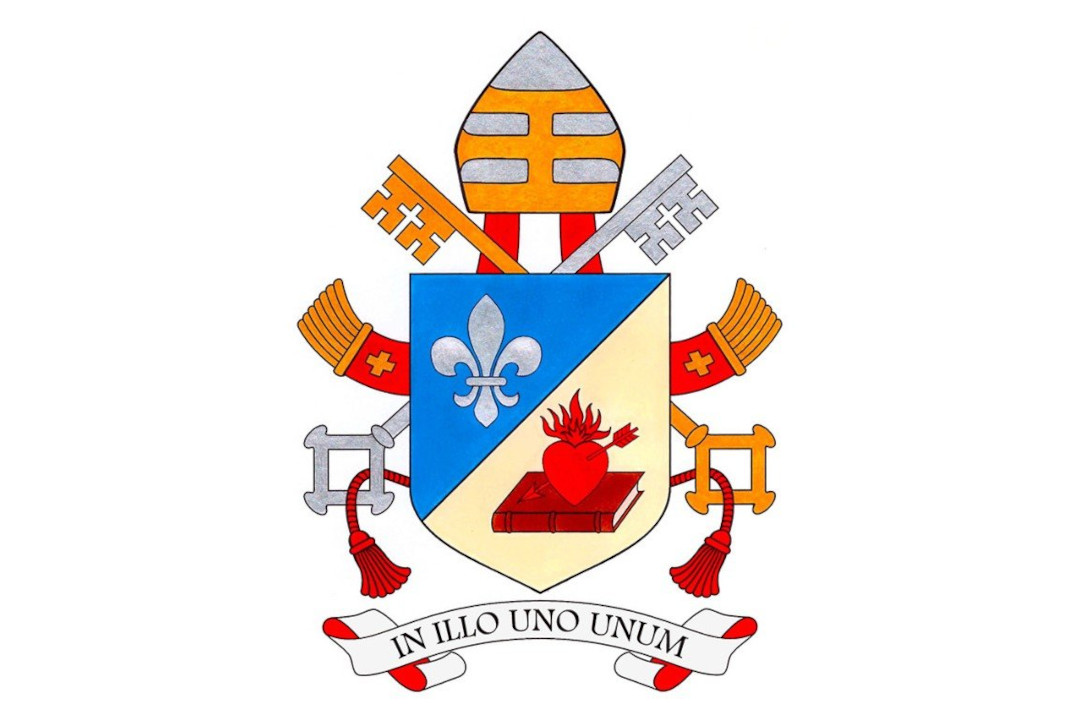
Symbol of the Order of Saint Augustine, which His Holiness Pope Leo XIV incorporated into his coat of arms.
The Mass also has its own Preface:
Vere dignum et justum est, aequum et salutare, nos tibi semper et ubique gratias agere, Domine sancte, Pater omnipotens, aeterne Deus: Quia vas electionis tuae et lux Doctorum mellifluus Augustinus, toto terrarum orbe radio mirae claritatis infulsit: et Ecclesiam sanctam fidei orthodoxae vere Augustinus illustravit: destruxit haereses; errores repulit: haereticosque prostravit: ac status fidelium universae christianae vitae, Augustinus moribus decoravit. Clericos docuit; laicos monuit; devios in viam veritatis reduxit; cunctorumque conditionibus salubriter providendo, tuam in hoc mari naviculam Augustinus provide gubernavit. Et ideo cum Angelis et Archangelis, cum Thronis et Dominationibus, cumque omni militia caelestis exercitus, hymnum gloriae tuae canimus, sine fine dicentes:
Which I translate as:
It is truly meet and just, right and salutary, that we should at all times and in all places, give thanks to You, O holy Lord, Father almighty, everlasting God; because the vessel of Your Election and the light of the Doctors, the mellifluous Augustine, enlightened the entire world with a ray of marvelous brilliance. And Augustine illuminated the Holy Church with a truly orthodox Faith; he destroyed heresies; he refuted errors; he brought low the heretics; and the status of all the faithful of a Christian life, Augustine decorated with his deeds. He taught the clergy; he admonished the laity; the returned the wayward to the Way of truth; and by salubriously providing in all conditions, Augustine providently piloted Your ship in this sea. And therefore, with the Angels and Archangels…
With its numerous short sentences and almost random placements of Augustine’s name, this Preface is far from being a model of the genius of the Roman Rite. But it does provide a fairly accurate (albeit meandering) biography of the Saint, who famously battled several heresies as well as the Donatist schism. The one glaring omission is mention of Augustine’s notorious past as a sinner. Perhaps it is indecorous when speaking of our Blessed Father to bring up his wild youth.
The Postcommunion is:
Fove, Domine, familiam tuam muneribus sacris, quam caelesti libamine recreasti: et, ut solemnia sancti Patris nostri Augustini devote concelebret; infunde lumen supernae cognitionis et flammam aeternae caritatis. Per Dominum.
Which I translate as:
Foster, O Lord, Your family, which You have revived with [these] sacred offerings and heavenly libation; and, so that it may celebrate devoutly the Feast of our holy Father Saint Augustine, pour onto it the light of supernal thinking and the flame of eternal charity. Through our Lord.
Again we see the double theme of Augustine’s intellect and will, both of which his spiritual children wish to emulate. “Light of supernal thinking” is an awkward translation of lumen supernae cognitionis; I chose “supernal” because it simply means “from above” rather than something more theologically specific, such as “supernatural” or “infused.” Augustine saw the world through the eyes of God, from a divine viewpoint, and we wish to do so as well. I also chose “thinking” rather than “thought” because I assume it is better to have a habit of thinking and of discovery that makes one a better knower rather than a series of thoughts that are injected into the mind.
But since the greatest thinkers are nothing without charity, we also ask for Augustine’s impassioned love of God and neighbor. Augustine’s first biographer Possidius wrote that as impressive as Augustine’s writings were, they pale in comparison to his daily deeds:
From his writing assuredly it is manifest that this priest, beloved and acceptable to God, lived uprightly and soberly in the faith, hope and love of the Catholic Church in so far as he was permitted to see it by the light of truth, and those who read his works on divine subjects profit thereby. But I believe that they were able to derive greater good from him who heard and saw him as he spoke in person in the church, and especially those who knew well his manner of life among men. For not only was he a “scribe instructed unto the kingdom of heaven, which bringeth forth out of his treasure things new and old,” and one of those merchants who "when he had found the pearl of great price, sold all that he had and bought it," but he was also one of those of whom it is written : “So speak ye and so do,” and of whom the Saviour said: “Whosoever shall so do and teach men, the same shall be called great in the kingdom of heaven.” [2]
Notes
[1] The verbs are renovasti in the Collect, illustrasti and transverberasti in the Secret, and recreasti in the Postcommunion.
[2] Possidius, Sancti Augustini vita, trans. Herbert Theberath Weiskotten, (Princeton University Press, 1919), 143-44.

Friday, May 03, 2024

The Feasts of Saint Monica and a New Conjecture about Her Dies Obitus

The feast of Saint Monica is celebrated in the traditional calendar on May 4 and in the new calendar on August 27. As the Calendarium Romanum, promulgated in 1969, explains:

In the fifteenth century, the Augustinian Order celebrated May 5 as the feast of St. Augustine’s conversion. Since the birthday of Monica was unknown, the Order celebrated it on May 4. About 1550, the feast was assigned to the same date in the Roman calendar. [1]
As we pointed out in an earlier article, the Order of Saint Augustine (formerly known as the Hermits of Saint Augustine) celebrated May 5 as the anniversary of Augustine’s reception into the Catholic Church by St. Ambrose during the Easter Vigil of 387. It was only natural, then, to assign Saint Monica’s feast to May 4. Monica not only lived to see her wayward son cleansed of his sins in the saving waters of baptism (along with her illegitimate grandson Adeodatus); she was more instrumental in his conversion than any other human agent. Augustine writes that it is through Monica’s merit that he is all that he is,[2] and that “from the blood of my mother’s heart, sacrifice for me was offered Thee day and night by her tears, and Thou didst act with me in marvellous ways.” [3] After his conversion, Augustine and his fellow neophyte friends and son lived together in community. He recalls that Monica “took as much care as if she had been the mother of us all, and served us as if she had been the daughter of us all.” [4]
Augustines Baptism
As far as I can tell, no one knows whether May 5 was chosen for the celebration of Augustine’s conversion out of a belief that it was the actual anniversary of his baptism or for some other reason. In any event, in the twentieth century, scholars determined that the night of April 24/morning of April 25 were the dates on which the Easter Vigil was celebrated in Milan in 387. Accordingly, the Augustinians have celebrated the feast of St. Augustine’s Conversion on April 24 since at least 1953. 
In 1969 the decision was made to move Monica’s feast day to August 27, the day before the main feast of her son, the anniversary of his death on August 28, 430. I suspect that the liturgical reformers did not leave Monica’s feast on May 4 because May 4 was no longer in close proximity to the Feast of Augustine’s Conversion, and I suspect that they did not consider moving it to the day before the new date of April 24, since this Augustinian feast was not on the universal calendar.
Still, it seems wiser to me to have left Monica’s feast on May 4. Whether or not Augustine was received into the Church on May 5, the month of May is always in Paschaltide and thus a reminder of his Holy Saturday conversion. The Church could have also added the May 5 feast to the universal calendar as a commemoration or optional memorial, for after that of Saint Paul, Augustine’s conversion is the most important in the history of the Church and therefore worthy of liturgical recognition. And even if April 24 is the more accurate date for Augustine’s conversion, one could have kept the May 4 date for the sake of historic continuity and tradition. It would not be the first time that the Church calendar and historical accuracy have failed to align perfectly, but so what.
The Vision at Ostia
Further, there is an affective consideration. When one thinks of Saint Monica, one thinks of her influencing her son in the springtime of his youth and of raising him, interceding for him, joyfully assisting at his baptism, and finally, experiencing the Vision at Ostia with him. But when one thinks of Saint Augustine’s final days, one thinks of a vastly different scene. Monica has been dead for forty-three years, and during those four decades Augustine has gone from being a Catholic intellectual layman eager to withdraw from the world into an irenic, semi-monastic community, to a priest and bishop polemically embroiled in some of the greatest theological and political controversies of his age. And as he laying dying in Hippo Regius, the barbarians were literally at the gates, an army of 80,000 Vandals laying siege to the city and poised to destroy Roman civilization in North Africa.
The Death of St. Augustine
Dating Saint Monica’s Death
But there is a third possibility for determining Monica’s feast day, which I do not recommend but nonetheless find intriguing: arriving at a reasonable estimate of Monica’s dies obitus.
We know that Monica passed away some time after Augustine’s reception into the Church, which she witnessed on April 24-25, 387, and some time before his thirty-third birthday on November 13, 387. [5] We also know that she passed away at least fourteen days after her arrival in the port town of Ostia. [6] The earliest that Augustine and his companions could have left Milan after his baptism was Easter Monday, April 26. But it is more likely that they stayed for the “Octave of the Infants,” when neophytes received further instruction in the Faith during the Easter Octave. An early departure date of Monday, May 3, then, is a more reasonable assumption. But they could have also lingered in Milan for weeks after Easter Sunday and still be in Ostia in time for the high point of the sailing season in the ancient Mediterranean, which was from May to October.
The distance between Milan and Ostia Antica is approximately 378 miles on land. The group could have journeyed by land to Genoa and then sailed to Ostia, or they could have journeyed entirely on land. Augustine’s word choice may suggest the former since he describes their journey to Ostia as a longum iter (which can also mean a long march), and he seems to contrast this journey with the forthcoming navigatio by sea (9.10.23). A Roman legion could cover twenty miles a day, but Augustine and his companions were in no such hurry, and at fifty-six-years old, Monica was considered an old woman. If the group did travel by foot, it is not unreasonable to speculate that they averaged ten miles a day and that their journey therefore took thirty-eight days.
Putting all these suppositions together: if the group left Milan on Monday, May 3, they may have arrived in Ostia around June 11. The Vision at Ostia would have taken place within the next few days (June 12-15?), Monica’s fever would have begun around June 18, and her death would have occurred around June 27. Her family--her sons Augustine and Navigius and grandson Adeodatus--would have buried her soon after and then tearfully departed Ostia for their North African home during the height of the Mediterranean sailing season.

This article is dedicated to my dear sister-in-law Hilary Ryan Tucker, whose birthday falls on the traditional feast day of St. Monica.

Notes
[1] The Roman Calendar: Text and Commentary (Washington, DC: United States Catholic Conference, 1976), 50.
[2] De beata vita 1.6.
[3] Confessions 5.7.13, trans. Frank Sheed (Hackett, 2005).
[4] Confessions 9.9.22.
[5] Augustine states that his mother was present at his baptism, and he states that she passed away when he was 32, that is, before his 33rd birthday on November 13, 387.
[6] She and her son Augustine experienced their famous “Vision at Ostia” while they were recovering from their “long journey” from Milan and preparing to set sail (the day after their arrival? Two days after?). Five days later she fell into a fever (possibly malaria), and nine days after that, her “devout and holy soul was released from the body.” (Conf. 9.11.28)

Friday, August 25, 2023

The Vigil of St Augustine, According to the Order Formerly Known as the Hermits of St Augustine

St Augustine, attributed to Gerard Seghers, 1600-50
Lost in Translation #83

Saint Augustine of Hippo, whose feast day falls on August 28, left an indelible mark on the theology of Western Christianity, as well as on the priesthood and religious life. Augustine was one of the earliest bishop to establish what were later called Canons Regular, originally, priests that live with their bishop and share a common life, and his Rule led to the formation of several religious orders. The largest and most familiar of these is the Order of Saint Augustine (OSA), founded in 1244 and originally known as the Hermits of Saint Augustine (OESA).

In addition to the universal feast on August 28, the old Augustinians kept proper several feasts of their own, including a vigil on August 27 and an octave, which ended on September 4. Today, we look at the vigil and its orations.
The Collect is:
Da, quǽsumus, omnípotens, Deus: ut beáti Patris nostri Augustíni Confessóris tui Pontíficis, quam prævenímus, veneránda solémnitas; et devotiónem nobis áugeat et salútem. Per Dóminum.
Which I translate as:
Grant, we beseech Thee, Almighty God: that the solemnity about to be celebrated for our Blessed Father Augustine, Confessor and Bishop, which we anticipate, may increase in us devotion and salvation. Through Our Lord.
The one verb (besides “we beseech”) that runs throughout all three Orations is praevenimus. The Douay-Rheims translates this word as “prevent,” but English has attached new meanings to this word in the ensuing centuries. The safest way today to translate prae-venimus, or “come before,” is “anticipate.”
The Secret is:
Ut accépta tibi sint, Dómine, nostra jejúnia, præsta nobis, quǽsumus, beáti Patris nostri Augustíni suffrágiis, cujus natalítia prævénimus, purificátum tibi pectus offérre. Per Dóminum.
Which I translate as:
In order for our fasts to be accepted by Thee, O Lord, grant us, we beseech, to offer Thee a purified heart through the supplications of our blessed Father Augustine and whose birthday we anticipate. Through Our Lord.
The Secret draws attention to the fact that the Vigil was--as traditional vigils usually are--a day of fasting. The Augustinians kept this practice, and so did the Archconfraternity of Our Lady of Consolation, which was aggregated to the Hermits in 1575. But fasts mean little without a humbled and contrite heart behind them (a subject on which Augustine was a master), and so the Augustinian community asks for such a heart through the intercession of their patron saint. Curiously, no reference is made to the Eucharistic offering, which is the most common theme of a Secret.
St Augustine, by Sandro Botticelli, 1490 
As for the reference to Augustine’s “birthday,” we turn to the Postcommunion:
Sancti Patris nostri Augustíni Confessóris tui atque Pontíficis, cujus natalítia praevenímus, quǽsumus, Dómine, supplicatióne placátus; et véniam nobis tríbue, et remédia sempitérna concéde. Per Dóminum.
Which I translate as:
Being pleased, O Lord, we beseech, by the supplication of our Holy Father Augustine, Thy Confessor and Bishop, whose birthday we anticipate: that Thou wouldst grant us pardon, and concede to us sempiternal remedies. Through Our Lord.
The prayer relies, perhaps boldly, on Augustine’s intercession or supplication and not on the Sacrifice just offered. But we should not dismiss this petition as a lack of faith in the efficacity of Holy Mass; rather, it directs our attention to the Saint, who prayed, and who continues to pray, for his spiritual sons and daughters. On this vigil, we anticipate his birthday—not his earthly birthday, which is on November 13, but on his heavenly birthday, when he passed away on August 28 while the barbarians (the Vandals) were literally at the gate of his beloved city of Hippo and as he prayed (successfully) for their deliverance.
It is, still, a somewhat cheeky assumption. Normally, only the martyrs were granted the privilege of having their “birthday” on the day that they were martyred. But these sons of Augustine are confident that the same privilege applies to their Holy Father who, they believe, went from this life to the next without any stay in Purgatory.
In 1965, the Hermits of Saint Augustine eliminated the vigil of St. Augustine, and in 1969, the General Calendar moved the feast of St. Monica from May 4 to August 27, which further cemented the fate of this Vigil, since it is not easy to fast on the feast of St. Augustine’s mother.

Friday, May 05, 2023

The Mass for the Feast of the Conversion of St. Augustine of Hippo (May 5)

The Baptism of St Augustine, by Louis de Boullogne, 1695-1700

Religious communities often have additional feasts on their calendar for the saints or occasions that influence their spirituality the most, and the Order of Saint Augustine (OSA - formerly known as the Hermits of Saint Augustine) is no exception. “The Feast of the Conversion of Our Holy Father Augustine” was celebrated on May 5 by the Augustinians from around the thirteenth century until the twentieth, when it was changed to April 24 to reflect modern scholarship’s assessment of exactly when Augustine was baptized by St. Ambrose in Milan (it is currently believed that the Easter Vigil of A.D. 387 fell on April 24-25 of that year). [1] I am not certain in exactly what year the Augustinians transferred the feast: the 1926 edition of their Missal and Office has it on May 5, while a 1953 Dutch edition has April 24, where it has remained ever since. [2]

The following is the Mass for the Feast of the Conversion from the 1926 edition. The propers are noteworthy insofar as they are an artful blend of the Common of Doctors, the Feast of St. Augustine on August 28, and orations proper to the occasion of his conversion. And the May 5 dating of the event is noteworthy because it explains the traditional date for the Feast of Saint Monica (May 4) who was so instrumental in her son’s conversion. Finally, the event itself is noteworthy because of Augustine’s extraordinary influence on Christianity. After that of Saint Paul, Augustine’s conversion may be the most important in the history of the Church.

In Conversione Sancti Patris Nostri Augustini
Introit, Ecclesiasticus (Sirach) 15.5—from the Common of Doctors
In médio Ecclésiæ apéruit os ejus:
et implévit eum Dóminus spíritu
sapiéntiæ et intelléctus:
stolam glóriæ índuit eum.
Ps. 91 Bonum est confitéri
Dómino: et psállere nómini tuo,
Altíssime. Glória Patri. In medio.
In the midst of the Church
the Lord opened his mouth:
and filled him with the spirit
of wisdom and understanding:
He clothed him with a robe of glory.
Ps. 91 It is good to give praise
to the Lord, and to sing to Thy
name, O Most High. Glory be.
In the midst.

Collect
Deus, qui nos beáti Patris nostri
Augustíni Conversiónis mirábilis
ánnua commemoratióne lætíficas:
ipsíus méritis et intercessiónibus
concede: ut, a peccátis omnibus solúti,
júgiter tibi famulémur, et ad vitam
perveniámus ætérnam. Per.
O God, who gladden us
with the yearly commemoration
of the astonishing conversion
of our blessed father Augustine:
through his merits and intercession,
grant that, released from all sins,
we may be ever in Your service
and attain life eternal. Through.

Epistle: Sirach 50, 1-14 (repeated from the principal feast on August 28)
Behold a high priest, who in his life propped up the house, and in his days fortified the temple. By him also the height of the temple was founded, the double building and the high walls of the temple. In his days the wells of water flowed out, and they were filled as the sea above measure. He took care of his nation, and delivered it from destruction. He prevailed to enlarge the city, and obtained glory in his conversation with the people: and enlarged the entrance of the house and the court. He shone in his days as the morning star in the midst of a cloud, and as the moon at the full. And as the sun when it shineth, so did he shine in the temple of God. And as the rainbow giving light in the bright clouds, and as the flower of roses in the days of the spring, and as the lilies that are on the brink of the water, and as the sweet smelling frankincense in the time of summer. As a bright fire, and frankincense burning in the fire. As a massy vessel of gold, adorned with every precious stone. As an olive tree budding forth, and a cypress tree rearing itself on high, when he put on the robe of glory, and was clothed with the perfection of power. When he went up to the holy altar, he honoured the vesture of holiness. And when he took the portions out of the hands of the priests, he himself stood by the altar. And about him was the ring of his brethren: and as the cedar planted in mount Libanus, and as branches of palm trees, they stood round about him, and all the sons of Aaron in their glory.
Alleluja (repeated from the principal feast on August 28)
Allelúja, Allelúja.
℣. Augustíne, lux doctórum,
firmaméntum Ecclésiæ,
málleus hæreticórum,
summum vas sciéntiæ,
pro tuis fíliis
roga Deum, quǽsumus.
Allelúja, Allelúja.
℣. O Augustíne, light of teachers,
mainstay of the Church,
hammer of heretics,
highest vessel of knowledge,
pray to God for us, your sons
we beseech thee.

Saint Augustine Disputing with the Heretics, 1470-86
The Gospel, Matthew 19, 21-26, chosen especially for the occasion, ends with a verse that resonates strongly with Augustine’s transition from despairing addict to an emancipated apostle of hope. In order to situate the hearer better, the opening has been changed from “Ait illi Jesus” to “Dixit Jesus adolescenti.”
At that time, Jesus said to the young man: “If thou wilt be perfect, go sell what thou hast, and give to the poor, and thou shalt have treasure in heaven: and come follow me.” And when the young man had heard this word, he went away sad: for he had great possessions. Then Jesus said to his disciples: “Amen, I say to you, that a rich man shall hardly enter into the kingdom of heaven. And again I say to you: It is easier for a camel to pass through the eye of a needle, than for a rich man to enter into the kingdom of heaven.” And when they had heard this, the disciples wondered very much, saying: “Who then can be saved?” And Jesus beholding, said to them: “With men this is impossible, but with God all things are possible.”
Offertory, Psalm 91, 13 - from the Common of Doctors
Justus ut palma florébit:
sicut cedrus, quæ in Líbano
est, multiplicábitur, allelúja.
The just man shall flourish like
the palm tree; he shall grow up
like the cedar of Lebanon, alleluia.

The Secret contains a delightful but untranslatable pivot between the two meanings of 'pietas/pius'--namely, mercy when predicated of God, and pious when predicated of man. It also makes the astonishing petition to have this votive Mass connect Augustine, a canonized saint, to a blessed reward. I have never seen a petition like this before in the Roman liturgical tradition.
Secret
Sancti Augustíni Confessóris tui
atque Pontíficis, quǽsumus, Dómine,
ánnua Conversiónis solémnitas
pietáti tuæ nos reddat accéptos:
ut, per hæc piæ placatiónis offícia,
et illum beáta retribútio comitétur,
et nobis grátiæ tuæ dona concíliet.
Per.
May the yearly solemnity of
the conversion of Saint Augustine,
Your Confessor and Bishop,
we beseech Thee, O Lord,
render us dear to Your mercy:
so that, through these offices
of pious placation, a blessed
reward may accompany him
and bring the gifts of Your grace
to us. Through.

Communion, Luke 12, 42 - from the Common of Doctors
Fidélis servus et prudens,
quem constítuit dóminus
super famíliam suam
ut det illis in témpore
trítici mensúram, allelúja.
A faithful and wise steward,
whom the Lord set over His family:
to give them their measure
of wheat in due season, alleluia.

Providence is an appropriate theme for a feast celebrated Augustine’s conversion, since it features prominently in his autobiography The Confessions.
Postcommunion
Deus, qui ineffábili providéntia
beátum Patrem Augustínum
ab errórum ténebris ad lucem
Evangélicæ veritátis adduxísti:
da nobis, quǽsumus: ut qui ejus
hódie Conversiónem cólimus,
eódem precánte, dona tuæ grátiæ
sentiámus. Per Dóminum.
O God, who by Your ineffable
providence led blessed father
Augustine from the darkness
of error to the light of the truth
of the Gospel, grant us, we beseech:
that we who on this day honor
his conversion may by his prayers
experience the gifts
of Your grace. Through.

Notes
[1] Although it is more fashionable today to speak of a catechumen’s “reception” into the Catholic Church, Augustine refers to his baptism as a conversio. (Conf. 9.3.6) This religious conversion—that is, his formal initiation into the true religion—was the consummation of two other conversions—an intellectual conversion a year or two earlier that enabled him to understand immaterial reality and the nature of evil (Conf. 7.10.16ff); and a moral conversion, which occurred a few days before August 23, 386 (see Conf. 9.2.2) while reading Romans 13:13, (Conf. 8.12.29) that enabled him to live chastely after years of enslavement to the pleasures of the flesh. For more on these three kinds of conversion, see Michael P. Foley, “A General Introduction to the Cassiciacum Dialogues,” in Augustine, Against the Academics (Yale University Press: 2017), pp. xxiii-xli.
[2] Proprium Missarum et Officiorum Ordinis Ermitarum Sancti Augustini (Paris: Desclée et Socii, 1926) and Proprium Missarum Ordinis Eremitarum Sancti Augustini; Augustijns Missaal (Gent: Paters Augustinjnen, 1953).

Wednesday, August 31, 2022

The Life of St Augustine, by Benozzo Gozzoli (Part 2)

The first part of this, which was published on Sunday, the feast of St Augustine, ended with the scene of his conversion; here we pick up the story from his baptism. As in the first part, these public domain images are all taken from the Wikimedia Commons page on the choir chapel of the church of St Augustine in San Gimignano, Italy, where these frescoes were done by the Florentine painter Benozzo Gozzoli between 1463 and 1467.

Eleventh scene: St Augustine is baptized by St Ambrose. In accordance with the tradition that the Te Deum was composed by them both on this occasion, the first words of it are painted on the wall behind them. Until 1913, the header “Hymnus Ss Ambrosii et Augustini” was printed in the breviary above it. In keeping with a common artistic convention of the period, after this, the Saint always appears anachronistically clothed in the habit of medieval Augustinian friars, which Gozzoli makes dark, but not black, which would clash too strongly with the color scheme of the whole.
Twelfth scene: on the left, the famous (and apocryphal) story that Augustine, after finishing his book on the Trinity, went walking on the seashore, where he saw a boy trying to pour the ocean into a hole in the sand. When he told the boy that this was impossible, the boy replied that it was also impossible to fully explain the Trinity, and disappeared. In the background is represented a medieval tradition of Italian Augustinians that he once visited a group of hermits on Mt Pisano, about 40 miles to the north-west of San Gimignano. (The absence of any reference to a visit to Tuscany in his own writings was ingeniously explained as a lapse of memory, brought on by grief over the death of his mother, St Monica.) On the right, St Augustine is shown as a friar among friars, giving them the Augustinian Rule.

Thirteenth scene: the death of St Monica. This event, which is described in one of the most moving passages of the Confessions (book 9, 11-12), took place in the Roman port city of Ostia, well before Augustine returned to Africa and began to live in a monastic community. His departure is shown through the colonnade on the right. The Augustinian friar who commissioned these paintings, Fr Domenico Strambi, stands at the foot of the bed with an inscription underneath him to indicate who he is. St Monica was buried in Ostia, and her relics were kept there in the church of St Aurea until 1430, when they were transferred to the Roman basilica named for her son.

Fourteenth scene: St Augustine (barely visible on the right where the plaster has been damaged) blesses the people of Hippo after becoming their bishop.

Fifteenth scene: St Augustine converts a priest of the Manichean sect named Fortunatus. Note that he continues to wear his Augustinian habit under his cope.

Sunday, August 28, 2022

The Life of St Augustine, by Benozzo Gozzoli (Part 1)

In 1463, the Florentine painter Benozzo Gozzoli (1421-97) left his native city, then suffering from an outbreak of plague, and settled in the little town of San Gimignano about 30 miles to the south and west. During his stay, which lasted for four years, he was commissioned to decorate the choir of the local Augustinian church with a fresco cycle of the life of St Augustine, whose feast is today. Gozzoli had been a student of Fra Angelico, but unites to the typically Florentine style of his teacher, which tends towards the use of relatively simple backgrounds, the richly decorative style known as the International Gothic. The result is justly considered one of the best narrative cycles in fresco of its era. We begin with some overview photos, and then closer images of each individual panel of the narration. There are also several portraits of Saints on the pillars of the chancel arch, with Christ and the Twelve Apostles, and Ss John the Baptist and Elijah on the arch itself. (All public domain images from the Wikimedia Commons page about this chapel.)

A frontal view of the chapel; Augustinian religious communities tended to be quite small, as we can see from the size of the choir.
The left wall; the stories run around the chapel from left to right, first through the whole bottom band, then the middle, then the top.

The middle and top bands on the back wall.
This photograph gives a more complete view of the back wall, although it does no justice to Benozzo’s brilliant colors. I include it because it shows the whole arrangement more clearly, and includes the panel under the window, of which no other image seems to be available, St Augustine’s voyage from Carthage to Rome.
The right wall.
The vault, with the Four Evangelists (clockwise from the top, Luke, Mark, John and Matthew), and Christ and the Twelve Apostles in medallions on the chancel arch.

First scene: Augustine’s parents, Patricius and St Monica, bring him to his first day of school in his native town of Tagaste in north Africa. The kindness of his teacher is emphasized by the way he pats the boy’s cheek; note that Monica is dressed as a wealthy matron in a beautiful white dress, where below, after she is widowed, she appears more like a nun. On the right side, Augustine studies his letters, while another boy is beaten; the Latin inscription at the bottom notes that he quickly made remarkable progress in his studies. (Tagaste is now a town called Souk Ahras in eastern Algeria, about 55 miles from the Mediterranean coast. It has been a see in partibus since the later 15th century, and is currently held by the nuncio to Portugal.)

Friday, August 16, 2019

The Abbey of St Augustine in Żagań, Poland

Our friend Dom Jakobus, a canon of Herzogenburg Abbey in Austria, administers a Facebook page about the various orders of canons regular, and recently posted pictures of the former church of the Augustinian Canons Regular in Żagań, Poland. I say “former” because the religious communites that founded the vast majority of such churches were turfed out of them during the various waves of revolutions that destroyed so much of Catholic Europe in the 19th and 20th centuries, and the church is now a parish. However, it retains many beautiful signs and memories of its earlier history, including many images of the great Saints among the various families of Canons Regular. Thanks to Dom Jakobus for his permission to share these photos with our readers.

A statue of St Augustine, whose very simple Rule was taken as the basis of canonical life for many different kinds of  religious communities, while leaving ample room for individual congregations to develop their own particular traditions.
The main altar seen from the gallery.
Very nice choir stalls, each decorated with a painting of a different episode of the life of St Augustine.

Monday, October 24, 2016

Missals from Silverstream Priory (3): Augustinian Missal of 1716

One of the oldest missals, if not the oldest, that the Benedictine Monks of Perpetual Adoration at Silverstream Priory have in their possession is this lavish volume from 1716, the title page of which clearly proclaims that it is a Roman Missal with all the feasts proper to the order of Augustinian hermits.


As is typical with books of this period, the artwork is monochromatic, while the text features red rubrics (that’s a redundancy of course!) and red capitals. The book is in excellent shape given that it is exactly 300 years old.


More recent articles:

For more articles, see the NLM archives: