
Tuesday, February 11, 2025

The Surprising Philosophical Sophistication of the Art of Paleolithic Man

...And Lessons that Could Be Learned From Them by the Neandertals in Our Universities

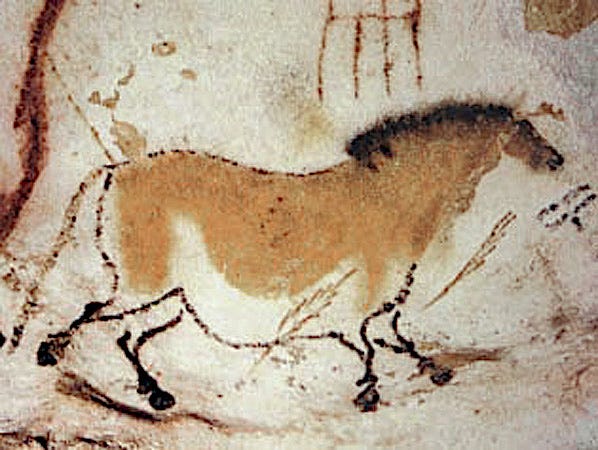
Here are wall paintings from underground caverns in Lascaux in the Dordogne region of southwest France, east of Bordeaux. Around 600 paintings exist in a network of underground caverns; archeologists estimate that they were painted during the Upper Paleolithic period, about 15,000 years ago. They were discovered in 1940 by an 18-year-old boy taking his dog for a walk, when the dog wandered into a hole in the ground leading to the cavern system. The paintings depict animals, plants, and one humanoid form—a man with a bird’s head. Although the exact reason for their creation is unknown, it is speculated that they hold some spiritual significance and are connected to ritualized worship.
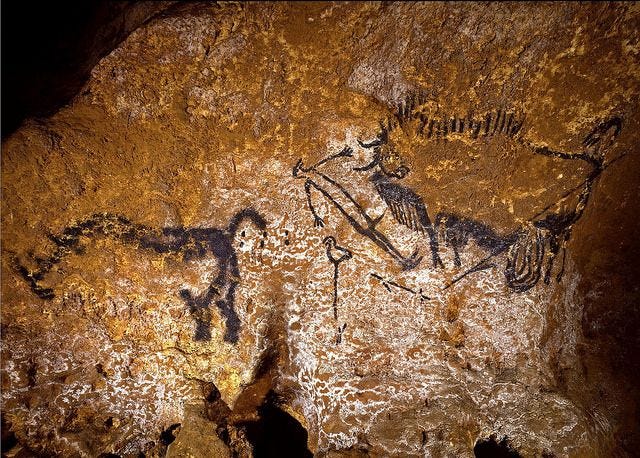
Man with bird head (somewhat reminiscent of Ancient Egyptian god, Horus!
The idea that these paintings are linked to religious rituals is likely speculative but strikes me as reasonable. Traditional Catholic teaching tells us that man’s desire for God is natural. Although Paleolithic man would likely have had a dim and somewhat distorted sense of what God is like, it would have been as natural for Paleolithic society as for any other human society to develop and express through worship this desire for what they did know of Him. This being the case, it is also natural for them to desire to create images that help connect them with a higher being or beings in the context of their worship.

The Natural Desire for God

The generally accepted view amongst theologians today is, as I understand it, that man’s desire for God is natural but not innate. (1) There is an important distinction here. It is considered natural because it arises from the power of natural reason. However, it is not innate, meaning that the inclination to worship God is not an instinct we are born with. This inclination arises instead from our observation and reflection upon the nature of the world around us.

When they observe the world and see its vastness, beauty, order, and grandeur, many different people have, over millennia, concluded that a divine being (or beings) created and orchestrates it, and that any being capable of doing such a wonderful thing is greater than us and worthy of worship.
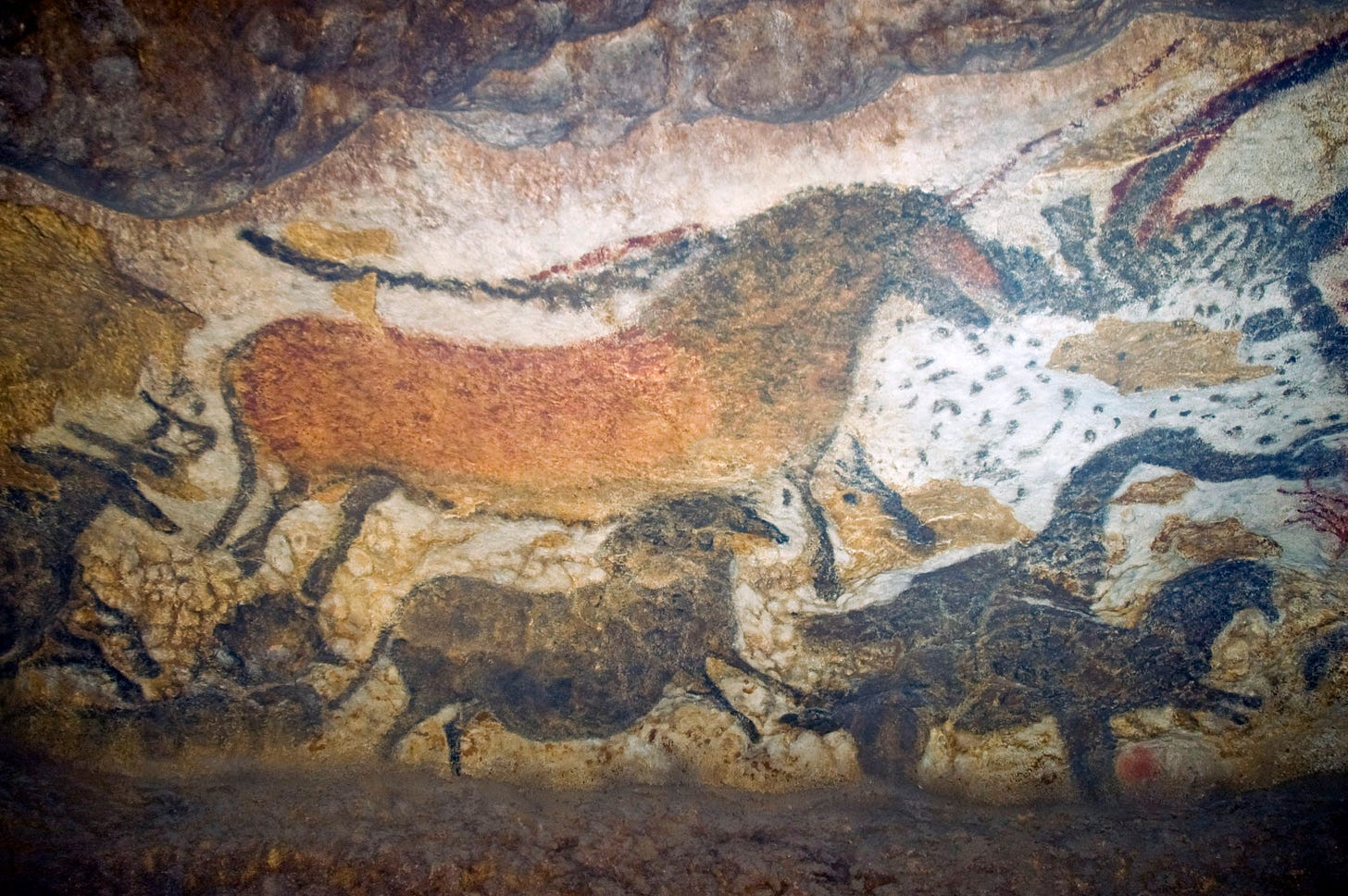
The powers of unaided human reason are limited, however. Thus, those without the benefit of Revelation will likely develop an incomplete, fractured or distorted picture of the deity. Through the power of natural reason alone, God will not be perceived, for example, as the one Triune God whom Christians know through Christ and the Gospel. Nevertheless, most societies, going back to the cavemen, it seems, have been at least philosophically sophisticated enough to conceive of a higher form of existence than human life, and have worshipped higher beings, often a series of pagan gods. Typically, this inspires artistic creation, and they create images of those gods to represent them gods, which are a focus of their worship.

Some, even without Revelation, would get close to the truth. Ancient Greeks, like Socrates, Plato, Aristotle, and their successors, even deduced the existence of a single god or supreme Good—what one might call the “god of the philosophers”. But these are exceptions. While, as St. Thomas tells us, it is theoretically possible to use natural reason alone to deduce the existence of a single, all-powerful, all-good, and all-loving God, most societies throughout history did not reach this conclusion. Typically, they fashioned false deities, and their forms of worship were flawed. Yet, at its core, for all that, such paganism is an expression, albeit imperfect, of man’s natural desire for God. As we have stated, human reason is weak, and it is not a given that people can reflect upon the natural world and get as far, even, as concluding that there is a God or gods. Some fall at the first hurdle and reach the opposite conclusion. Accordingly, atheistic systems of thought have also arisen, often, although not always, as parallel streams of thought in predominantly religious societies and as a reaction to the religious mainstream. Even where there is no supernatural being posited in the core teachings of a system of thought, such as in Buddhism, supernatural and metaphysical elements do creep into their practices and beliefs informed by local cultures. In traditional Buddhist societies, there is mention of devas and spirits in their literature, and there are temples, which are places of quasi-religious activity such as chanting, meditation and the study of Buddhist texts. And this also inspires the creation of art - we see statues of the Buddha in Buddhist temples.

The interior of a Buddhist temple in Bangkok (Image from Wikimedia Commons by Chainwit, CC BY-SA 4.0)
From the Christian point of view, the act of worshipping any false god is a misdirected participation in its ideal, which is the act of worshipping God as part of His Church. St. Thomas Aquinas considered this act of worshipping God to arise from a virtue, which he called the virtue of religion and which he believed was the highest virtue. The virtue of religion, as defined by St. Thomas, has the purpose of rendering God the worship due to Him as the source of all being and the principle of all government of things. (2)

As we have said, neither the desire for God nor the virtue of religion are instinctive. Therefore, it is not instinctive for us to worship anything. Both arise from the use of natural reason. However, even pre-historic man was capable, it appears, of sophisticated rational thought, as evidenced by this art linked to his worship. It is one of the oddities of the modern age that so many people do not worship any god or gods and are, in this respect, one might argue, more primitive in their worldview than Upper Paleolithic man. We might describe the contemporary atheist materialist, somewhat mischievously perhaps, as philosophically sub-Paleolithic!

As followers of Christ, we are privileged to have the gift of Revelation. God has revealed Himself to us in the person of Christ, who established the Church and the patterns of authentic worship in the liturgy. To be a practising Christian is not a sign of philosophical sophistication - though philosophically sophisticated some may be - but of an openness to the gift of faith.
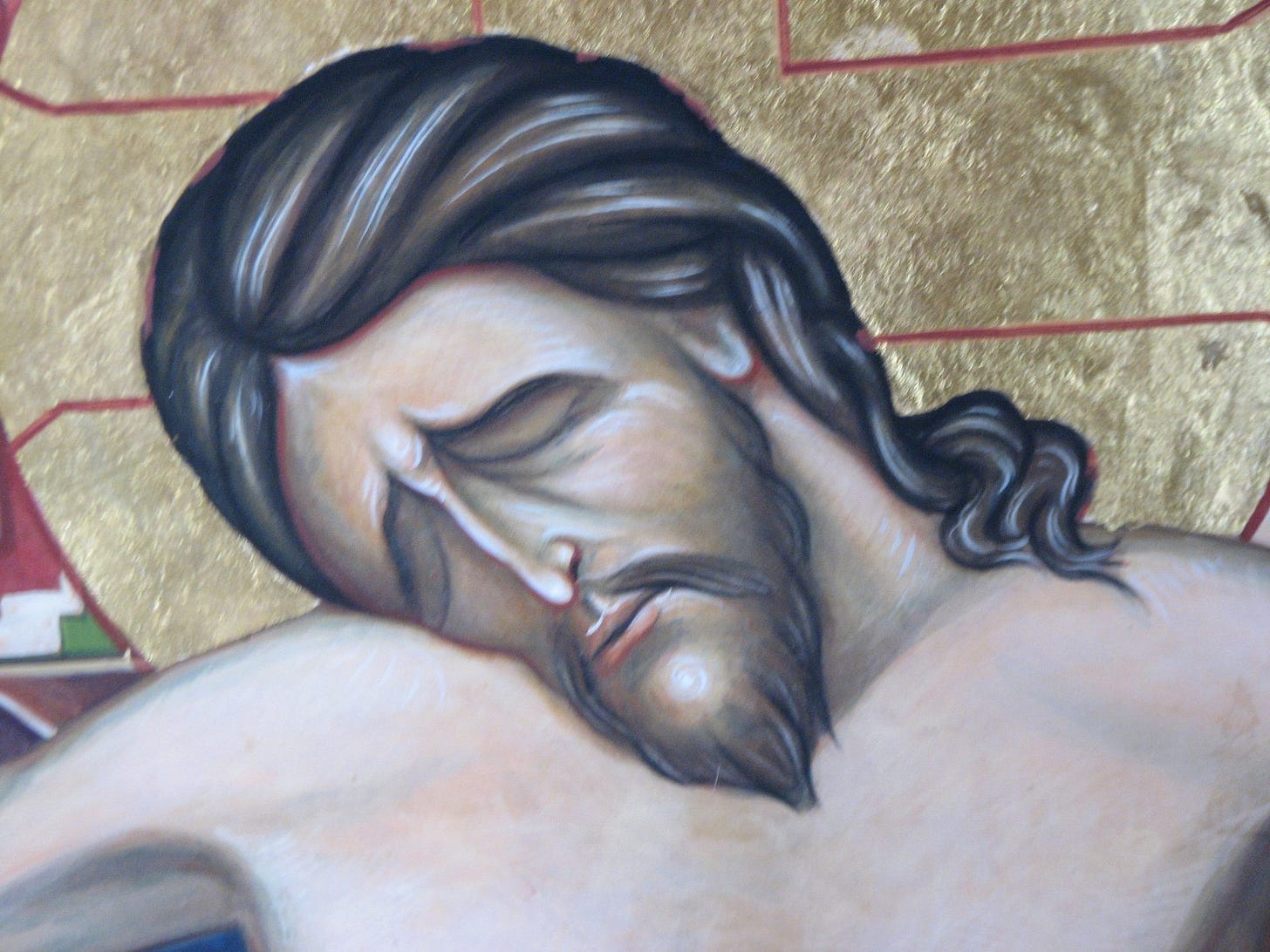
The face of the suffering Christ in the Franciscan Gothic style, painted by me.

The same may be said about the use of art in worship. Through his Church, Christ has informed us that the veneration of sacred art, which portrays the person of Christ, the Mother of God, and the Saints, is not merely allowed, but is an essential part of our worship and the practice of our faith. (3) This understanding helps us discern that even the simplest artistic depictions of divinity, as shown here, are a natural and wise anticipation of what God would later reveal to us personally and through His Church.

Education and Propaganda

Education and formation can cultivate this natural desire for God and help direct it to its proper end: Christian worship. This supernatural end is the prime goal of all sound education. Pope Benedict spoke of this and the need for good catechesis for initiates in the Faith, young and old. He also spoke of the need for a continuing formation in right worship after the rites of initiation, which he termed mystagogical catechesis directed to a deepening of the mysteries of the Faith. This would include teaching people to understand and value sacred art and venerate holy images appropriately.

Conversely, external influences can erase or misdirect that natural desire for God. One of the sad facts of contemporary society is that much of contemporary education is anti-Christian propaganda and is at the heart of the ‘sub-Paleolithic’ contemporary mainstream in this regard, and is an ideology that dominates our elite universities. We see the propagation of atheist Marxist ideologies through the schools and universities and the cultural institutions of Western culture such as Hollywood. Marxists typically seek to eradicate any inclination toward ritual or veneration of the divine as part of their mission to destroy the West as we know it. The very act of worship implies, at the very least, the existence of the metaphysical—a notion antithetical to their atheistic, materialist philosophies. However, these ideologies do require complete subservience to, if not actual worship of, the false god of the state, so undermining human freedom and stifling our chance of happiness by exercising that freedom in the pursuit of God.

Even the Marxists realised the importance of art in this mission. To this end, Marxists have always engaged with the popular and intellectual culture; as part of their propaganda, they create images that further their goals.

Image from Wikimedia Commons by Mark Scott Johnson, CC BY 2.0
and right worship….
1. Cf, The Natural Desire for God According to St Thomas and His Interpreters, by Lawrence Feingold, Sapientia Press, Ave Maria Univ, 2004

2. Summa Theologica, II-II, Q. l xxxi.

3. Cf, The Seventh Ecumenical Council, 787 AD.

Tuesday, April 16, 2024

Important Conference in London: The Royal Priesthood and the Renewal of the Church

June 20-22, at St Mary’s University in London: Register Today.

My friend Fr Andrew Marlborough sent me information about what promises to be a great conference, which he is helping to organise, on “The Royal Priesthood and the Renewal of the Church”. Readers may recognise his name from articles of his which we have shared here on sacred art and artefacts appearing in auction houses in the UK and Europe.

The poster is below. As you can see (click to enlarge), there is a great list of speakers, including highly respected names from both sides of the pond. I am delighted that Fr Brad Elliott, OP, was also recently added to the list of speakers; he is the author of the book I recently featured, The Shape of the Artistic Mind, about creativity and the virtue of art according to St Thomas.

Tuesday, September 01, 2020

Book Recommendation - The Eucharist: Mystery of Presence, Sacrifice, and Communion, by Lawrence Feingold

This book should be recommended, in my opinion, to all catechumens, and to all Catholics who didn’t study it when they were catechumens!

The Eucharist: Mystery of Presence, Sacrifice, and Communion by Lawrence Feingold. Steubenville: Emmaus Academic, 2018. 675 pp. ISBN: 978-1945125720

It was written as a textbook for seminarians, but its appeal is wider than that. It is a trustworthy text that explains what is at the core of our faith in terms that non-specialists likes me can understand. Furthermore, even though it comes in at 674 heavily foot-noted pages, it is written so engagingly that Dr. Feingold has succeeded in making what might be the driest of subjects to study (for all that everything in life hinges upon it) a relatively light read.
The book is rooted in Scripture, and explaining the prefigurement of the Eucharist in the Old Testament and its fulfillment in the New, through the eyes of Church Fathers, St Thomas, and magisterial teaching from the past right through to today. The strongest emphasis is placed upon St Thomas as an authority.

It is the best sort of book, in that it assumes high intelligence on the part of the reader, but relatively little prior knowledge. Dr. Feingold takes the trouble to establish and explain the axiomatic truths, and Thomistic terminology for those who are not conversant with them , thus also opening up to its readers the possibility of more fruitful future exploration of St Thomas. He then leads us through to the logical conclusions outlined step by step.
The book is structured in accordance with these principles in four sections: Foundations, the Real Presence and Transubstantiation, Sacrifice, and Communion. As well as his explanations of what is true, Dr. Feingold also takes us through the main errors that we might see today and their roots, in many cases, in the errors of the protestant reformers, and in some cases, of recent Catholic theologians.

Here are three detailed reviews by specialists in the field: by David Fagerberg, for the Antiphon journalby Fr Thomas Acklin for the St Paul Center; and by Roland Millare at Adoremus.org

Tuesday, December 17, 2019

Book Recommendation: Faith Comes From What is Heard - An Introduction to Fundamental Theology, by Dr Lawrence Feingold

Manuals written for the instruction of seminarians have a bad name in some quarters, especially when they are rooted in the theology and philosophy of St Thomas. Scholastic manualism is a pejorative term, indicating an unthinking and rigid approach to St Thomas that relies on rote learning and discourages individual thought. This negative view prevailed after Vatican II, and from the mid-sixties, the manuals and their approach to teaching disappeared from our seminaries.

However, as Dr Lawrence Feingold pointed out to me recently when I talked to him about his textbook on fundamental theology, Faith Comes From What Is Heard: An Introduction to Fundamental Theology , the problem was not so much in the manuals themselves, but in the way they were used. They were not intended as stand-alone texts, but as complementary texts to the fundamental sources, for example, Scripture and the Summa, and always in the context of their own time. This means that manuals always had a limited shelf-life; they assumed some things could be taken for granted in their own time, but might not be so widely known later, and concern themselves to address issues and errors of the time in which they were written. In general, therefore, the contemporary reader will likely misunderstand a manual of the past, given the unlikelihood of his being fully aware of the context in which they were written.


This being the case, the answer, says Dr. Feingold, is not to reject the manual as a teaching tool, but rather, to write a manual appropriate to today, which is he has sought to do in this book. As with the manualists of the past, he relies heavily on St Thomas, but also incorporates the thought of more recent thinkers, and some original thoughts of his own. He draws heavily on St John Henry Newman, Pope St John Paul II, and Benedict XVI. He then presents his work in the light of the Second Vatican Council’s Dogmatic Constitution on Divine Revelation, Dei verbum. This means that, in common with these more modern thinkers, he directs us strongly towards the Patristic tradition as well. This in turn influences, critically I would say, his approach to the interpretation of Scripture.

For those who don’t know (and I didn’t!) fundamental theology is the study of theology itself. It defines the principles that govern the science of God and divine things. Just as the rules of harmony and counterpoint set out the path by which the musical composer can work freely to his calling, so fundamental theology defines what we study and how. Such a book could easily be a dry read, whatever other merits it might have, but this is not the case at all with this one. Dr. Feingold wrote it with the educated layman in mind as much as the seminarian who would read it as a textbook. His is an engaging and accessible style, and as with all good introductory texts, he assumes little knowledge but reasonable intelligence. This works very well for someone like me, a curious layman who benefits from having all premises defined and explained at the outset of each train of thought. Then I have a chance, at least, of being able to go where he seeks to lead me. As he introduces very familiar words, such as faith and revelation, he explains clearly their precise meanings in context, which - sometimes, and to my shame - are not always as familiar.

The book is set out in six sections, the titles of which indicate how fundamental this text is: Part 1 Revelation and Faith; Part 2 Theology: Faith Seeking Understanding; Part 3 Transmission of Revelation through Tradition and Magisterium; Part 4 The Inspiration and Truth of Scripture: Bible Hermeneutics; Part 5 Historicity of the Gospels; Part 6 Biblical Typology.

The bulk of the book is devoted to Scripture and its interpretation. His approach is one that re-affirms the approach of the Church Fathers. He casts a critical eye over the historical-critical method of textual analysis that has steadily dominated Scriptural interpretation more and more in the last 150 years. While recognizing some good - its contributions to our understanding of the historical context, for example - he clearly points out the grave errors that an over-reliance on this method has introduced and why they have occurred. To illustrate with one example, he gives us the arguments as to why the traditional view of the order in which the Gospels are written, Matthew, Mark, Luke and finally John (the order in which they appear in the Bible) is more likely correct than the very recent analysis that claims that Mark was written first. His approach is not a simple blinkered assertion of tradition; rather, he takes the contrary arguments seriously and responds with an open mind in the faithful search for truth.

Once he has re-ordered, so to speak, our approach to the historical truth of Scripture to one that corresponds to tradition, he then introduces us to Biblical typology, a method of interpretation that has almost fallen out of use in recent years. Biblical typology is the interpretation of Scripture that sees the interconnection of the texts read symbolically. A tradition that owes much to Origen in 3rd-century AD Alexandria puts the historical figure of Jesus, described in the Gospels, at the center of history, connecting us to him in the present, the past and the future. The events of the Old Testament foreshadow those in the New through what is termed allegorical typology. The events in the New Testament are connected to us, in the present, through a moral interpretation that informs our daily lives, and they direct us to our final end by speaking to us of our heavenly end, which is termed anagogical.

He describes also how this typology connects the text of the Bible to the words and actions of the liturgy. The Bible is a liturgical document, containing the template for our worship and written to be proclaimed in the context of it, and therefore is best understood when heard in that same context. The canon of Biblical books was established by the early Church in consideration of those books that were read most commonly in the context of Christian worship.

In the final subsection of this book, which is four pages long, entitled Importance of Typology for Preaching and Contemplation, he explains why this approach is so important. The ability to connect the perceptible to the imperceptible by sign and symbol is what allows us to grasp the Faith, and to believe deeply in an imperceptible God. This can be taken too far. One of the problems with Origen and his approach was the tendency to see a symbol in every historical fact, to a degree that can appear contrived and superstitious. However, if ignored altogether, we lose our faith, and it is likely no coincidence that both the numbers of the faithful and our facility for reading texts and the world around us symbolically have declined dramatically.

As someone who is concerned with sacred art, this resonated with me strongly, and made me want to insert a final chapter on the essential role in art in reinforcing typology and deepening faith. This goes further than a simple portrayal of a narrative; the great power of art is that it can connect two different narratives together in a single moment, even more powerfully, in many ways, than a text can. For example, in one painting we can connect the Baptism in the Jordan with its types in the Old Testament, such as the crossing of the Red Sea and of the Jordan by the Israelites, by putting visual connections in the same painting. When such a painting is placed in a baptistry, it connects all three narratives to our own baptism. I talk about this particular typology in an earlier article on art and liturgy, here.

In this icon of the Epiphany, we see the personifications of the Red Sea and the Jordan being “driven back” (cf. Psalm 113) and Christ trampling down the gates of hades and the serpents. As the hymn for Easter in the Byzantine Rite says, “Christ is risen from the dead, trampling down death by death, and on those in the tombs bestowing life!”
Faith Comes From What Is Heard- An Introduction to Fundamental Theology, by Dr Lawrence Feingold is available from Amazon.com.

More recent articles:

For more articles, see the NLM archives:



