Tuesday, September 15, 2026

The Iconographic Style, #1: Truths and Myths

What is an icon? Where the tradition came from, and the modern myths that have grown up around it.

The first of two related articles on the iconographic tradition of sacred art. This first article addresses what icons actually are, where the tradition came from, the modern myths that have grown up around it, and the theology that accounts for its distinctive visual language. The second will examine the revealed images “not made by human hands” — above all Our Lady of Guadalupe, which I take to be among the strongest arguments for the authenticity of the tradition.

When people today talk of ‘icons’ or ‘holy icons,’ what many have in mind is the style commonly associated with the Eastern Church, especially that of the Greek and Russian Orthodox Churches. In fact, the iconographic tradition took root across the Christian world, East and West, before Russia existed, and was not limited to the Greek Orthodox Church.

As Christianity became the dominant religion of the Late Antique classical world, a distinct style of art, an adaptation of contemporary Roman art, emerged, and by the early 5th century AD it had become the universal standard for liturgical art across the Christian world. This is the style that became known as icons today and, broadly speaking, is associated today with the Orthodox and Byzantine Catholic churches.

As with so much of Christian culture, the liturgy is the driving force behind the tradition, in that what gives it authenticity as a style is its role as a complement to right worship. Yet, as with Christian culture more broadly, we see variants responsive to particular local cultures and times, all consistent with the broader principles that characterize it and make it authentically liturgical. In the Latin West, sacred art up to about the 12th century — encompassing, for example, the Anglo-Saxon, Celtic, Ottonian, Carolingian, and Romanesque styles — was all consistent with the iconographic prototype. Most non-Roman Churches in the Christian East have their own styles, too. Beyond the Greek and Russian Orthodox traditions, one thinks, for example, of Coptic iconography from Egypt as a particularly distinctive variant. Not only are these national styles distinguishable from one another, but within each there are typically distinct regional variants as well.

It is important to distinguish between the use of the word ‘icon’ as a generic term for any work of sacred art that is worthy of veneration, as we might use it in considering the decrees of the Seventh Ecumenical Council, and its use to denote a particular style of sacred art. In translations of the writings of St John of Damascus and the deliberations of the Seventh Ecumenical Council in the 8th century, and of Theodore the Studite in the 9th century, the word ‘icon’ is best understood as interchangeable with the English word ‘image.’ It is not being used to denote a particular style of sacred art or to elevate any one style above another. Everything the Council documents about, for example, the necessity of having sacred art in our churches and the criteria by which that art is worthy of veneration applies to all liturgical art. The theology the Council articulates is therefore a general theology of images.

In what follows, when I refer to icons, I mean sacred art in the iconographic style. Before considering how to identify that style and distinguish it from the other legitimate forms of liturgical art, the Gothic and the Baroque, I want to address a few misunderstandings and myths about icons so that we are clear about what we are discussing.
The Creative Retrieval of Iconography

The theology of the iconographic style, developed to account for the stylistic elements that characterize the tradition, is a relatively recent development. It may surprise many to learn that, to my knowledge, no such formulation appears in the writings of any Church Father, East or West, until theologians in the 20th century began to develop the theology of icons. This does not necessarily mean there was no shared understanding of the governing principles prior to that; there may well have been. Yet if there was, no record of it has come down to us.

A group of Russian Orthodox expatriates living in France in the mid-20th century developed what is now generally accepted as the theology of the iconographic style. This group included prominent figures such as the theologians Paul Evdokimov, Vladimir Lossky, and Leonid Ouspensky, who was both a painter and a theologian, as well as the icon painter Gregory Kroug. They were responding to what they saw as the steady degeneration of the iconographic tradition in the Eastern Churches over centuries and wished to reestablish it authentically.
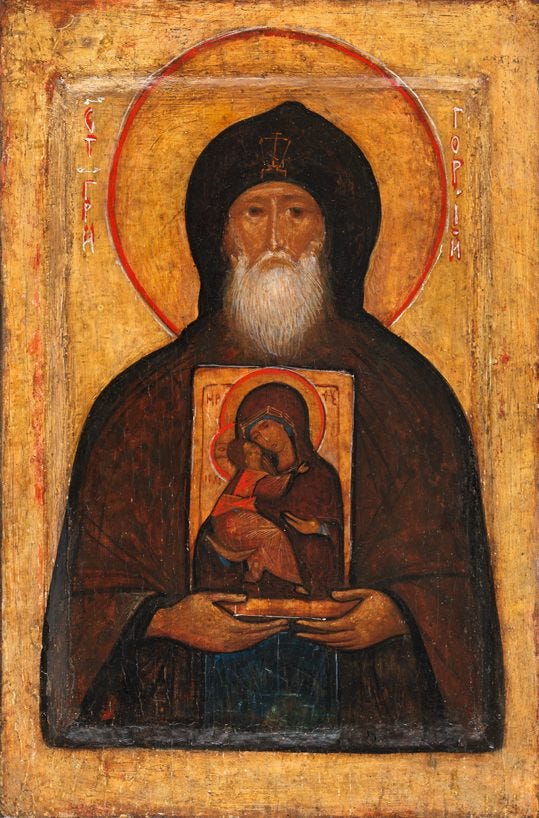
Image: St Gregory the Iconographer, painted by Gregory Kroug, 20th century

Unlike the West, which saw the development of Gothic and then Renaissance traditions from the 11th to the 16th centuries, the art of the Eastern Church did not undergo these transitions. However, the effects of the Enlightenment, which came after the Renaissance, were felt in the East, particularly in Russia, through the efforts of reforming rulers — Peter the Great and Catherine the Great especially — who looked to Western Europe as their model for modernization. Arising from this, there was an increased naturalism in iconography that, unlike the naturalism of Gothic art, was not grounded in a truly Christian understanding. The result was a style that is neither properly naturalistic nor properly iconographic.

Russian painters of the 19th century noted this degeneration, and arguments were made to abandon the iconographic style altogether in favor of Western naturalism in sacred art. For a while, Orthodox churches were adorned with 19th-century naturalistic styles. While this may have produced fine results in secular painting — the Russian traditions of portraiture and landscape in this period were indeed spectacular — they jarred with many Orthodox Christians, who felt that this naturalistic style of art undermined their worship. By the turn of the 20th century, commentators once again argued for the reestablishment of a purer, more authentic iconographic tradition. This process of creative retrieval, begun in that period, was interrupted by the Bolshevik Revolution, and it was not until the mid-20th century that the expatriates based in Paris who had escaped from Russia, including those already mentioned above, were able to work toward a change.
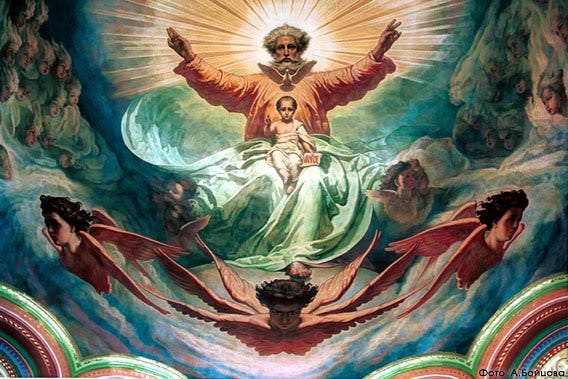
Image: 19th century Russian painting of God the Father and God the Son
Their approach was first to establish a canon of imagery they considered the epitome of the style (generally Russian icons from the 15th century). By analyzing the common features within this canon, they developed a theology to explain them, hoping to define a set of principles that would allow both conformity to the tradition and the legitimate organic development of styles within it, as needed by the Church in particular times and places.

It is a tribute to the work of this small group of pioneers that the painting of icons has developed so authentically that many people today wrongly assume that the iconographic tradition of the Eastern Churches has been passed down through an unbroken line since St Luke painted the first icon of the Theotokos. We are now in the third or fourth generation of icon painters who have passed these principles down from teacher to pupil since those 20th-century pioneers, and the best of them are creating work today that is as beautiful and significant as that of the great iconographers of the past.

Because of the success of the pioneering Russians based in Paris, iconographers from other Orthodox and Eastern Rite churches were influenced by their work. Among these were the Greek painter Photis Kontoglou, who contributed to the reestablishment of a flourishing Greek iconographic tradition, and the Egyptian Isaac Fanous, who did the same for the Coptic style.

I have long felt that their approach should serve as the template for Roman Catholic Christians to reestablish their Western traditions of Gothic and Baroque art today. My own analysis of those traditions is based on the work of those 20th-century Russian theologians and is my attempt to begin that process.
The Modern Myths of Iconography

The mystique that so many contemporary Roman Catholics and Protestant Christians associate with iconography has also emerged from this recent period, and bound up with this are several modern myths about icons. These include the ideas that you have to be Orthodox to paint icons well, that you have to be a monk to paint icons, that you must ritually fast and pray before painting an icon, and that the true iconographer does not paint icons but only ‘writes’ them.

Is it true that only Orthodox Christians can paint icons successfully? I would certainly agree that someone who regularly worships with sacred art is more likely to paint it well. This does place Roman Catholics at a disadvantage. Unless a Roman Rite Catholic prays the Divine Office with an image corner at home, he will almost certainly not have the opportunity to do so in the Roman liturgy as it is generally celebrated today, even if there is beautiful art in the church. This therefore greatly favors Orthodox and Eastern Rite Christians, although in principle it does not preclude others from painting icons well; in fact, there are several excellent Catholic iconographers today.

Can only monks paint icons? While a monk’s spiritual life is likely to be compatible with that of an artist who wishes to pursue his vocation, it is not the only form of Christian life that can offer such formation. A devout and sincere layman might flourish as an artist too, and there are many fine icon painters today who are not monks.

On the question of fasting and praying: while there is no accounting for whom God may choose to inspire, or which individual will respond well to that inspiration, the greatest chance of a good response lies with those who lead good and holy lives, and typically this involves regular fasting and prayer. However, this principle is not uniquely applicable to artists; it applies to every aspect of the Christian life and to every Christian. Icon painters should fast and pray regularly, as all Christians should, but this is not a special requirement peculiar to icon painters.

On whether we ‘write’ or paint icons: this question arises from the fact that the Greek and Slavonic words for creating an icon carry no distinction between the two activities, and could legitimately be translated as either writing or painting. One well-known Orthodox iconographer told me that he considered the insistence on the word ‘write’ to be ‘a bit precious.’ As far as he was concerned, if someone uses a paintbrush to apply paint, the English word for that activity is painting, and it does not diminish the standing of the profession to say so. On the contrary, when the icon is beautiful, and we venerate it as we should, that elevates the role of the painter of icons to one of the highest importance, regardless of what we call the process of creating them.

There is also an associated myth that overstates the role of a theology of method, as distinct from the theology that governs the style of the finished image. Some, for example, hold that the image must be created by starting with a dark base and adding layers of lighter color, because God created Light out of darkness. There is no basis for this. A painting is as good as it looks, and if the finished work is good, the method by which it was made is of secondary importance. This is confirmed by modern X-ray analysis of authentic and ancient icons, which shows that painters of the past used a wide variety of methods to produce authentic work.

A Short Summary of the Theology of Iconographic Style

So what is the theology of icons? The iconographic style expresses a desire to present man in full union with God, that is, eschatological man. Consider the Transfiguration icon below, painted in Yaroslavl, Russia, in 1516.
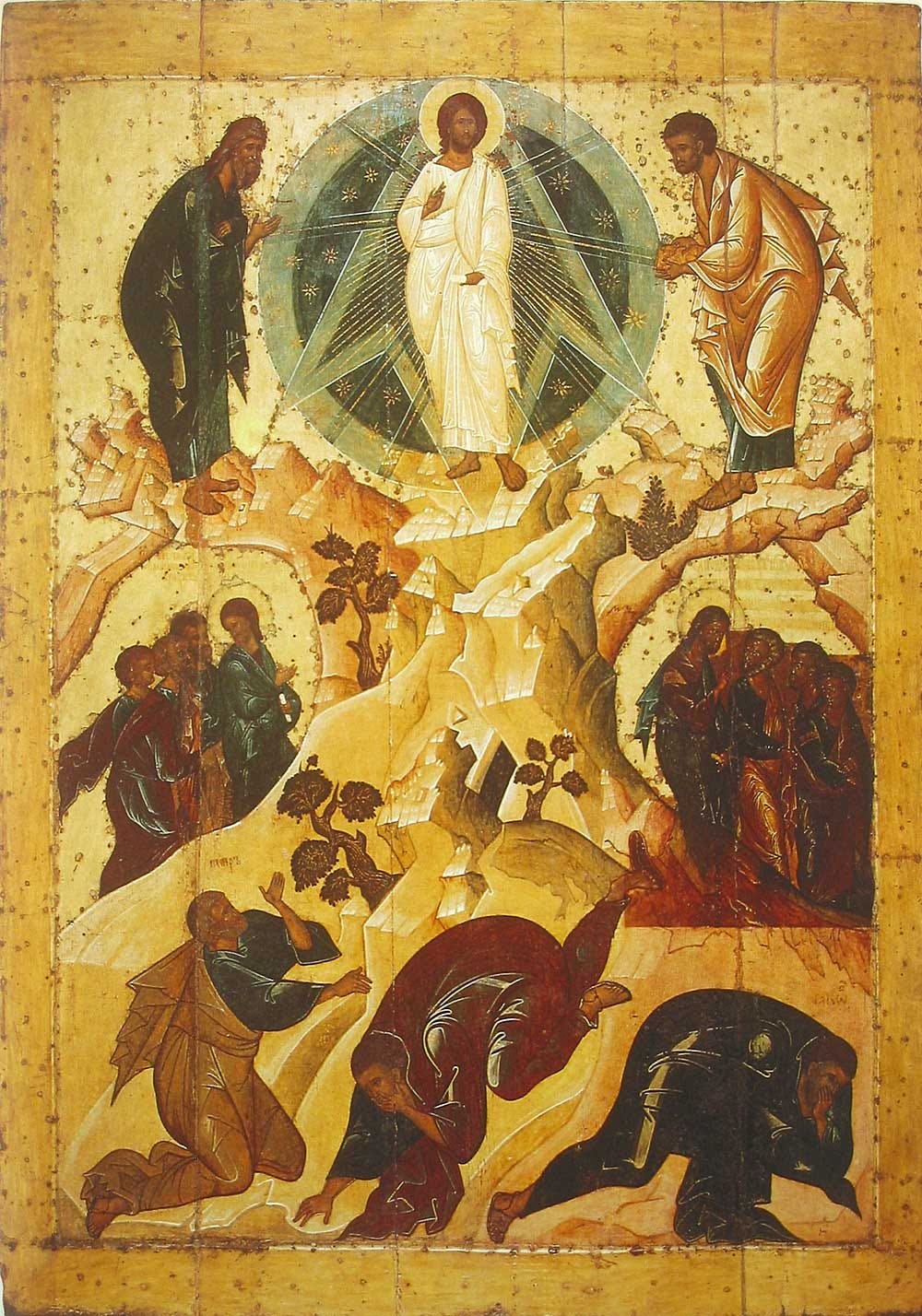
The nimbus around Christ darkens toward its center, reflecting a theological point about the nature of divine light. Christ in the Transfiguration is understood as the prototype for all iconographic imagery, and the principle extends further, since all saints shine with the light of Christ because, as baptized Christians, they have ‘put on Christ’. The halo, typically a gold disc around the head, is a stylized representation of the light emanating from the person. In the Transfiguration icon, the prophets and Christ bear halos, while there is a convention that before Pentecost the apostles do not, though they are still portrayed as saints in other respects: there is no cast shadow from any figure, since each is his own source of light, and we see the floating sparkles of uncreated light on their clothes and bodies.

To convey the heavenly dimension, which is outside time and space, the image avoids creating the illusion of depth. The artist paints the image so that it lives, as it were, in the plane of the surface. Rarely does an iconographer use single-point perspective, in which things diminish with distance; he will often use inverted perspective instead, in which things appear wider as they recede.

The size of the beings and creatures portrayed varies according to the hierarchy of being, a feature often referred to as hierarchical perspective. Christ is the largest figure, while trees and mountains are shown smallest relative to their natural size. Even inanimate objects, such as trees and mountains, can be shown bowing toward Christ, indicating that each owes its existence to him and further reinforcing our sense that each has its place in the hierarchy of being. The negative space around the figures is usually a single color, often gold leaf, with minimal indication of the location. The gold or other single-color background reinforces the sense of flatness, and the environment is suffused with light, an effect accentuated by gold leaf that reflects candlelight, causing it to shimmer as though it were a source of light in itself. Some variants, particularly Western variants, have complex patterned backgrounds that achieve the same end — the sense of flat negative space around the figures.

The sense of another world is further heightened by placing the figures in the middle distance. No matter how near we approach the image, there is always some sense of distance between us and the closest figures depicted; they seem to recede as we draw closer. Even with our faces pressed against the surface, they remain some way from us. This creates a dynamic between us and the icon when we pray with them, for it instills in us a longing to be with the saint. This is a longing that finds its fulfillment only in heaven.

All icons aim to portray heavenly realities. Heaven is a realm in which time is compressed into a single moment; past, present, and future are perpetually in a single moment. It is difficult even to imagine this, but it is possible to reflect this mystery. A way to do so is to present a full narrative with different scenes from a story portrayed simultaneously in the image, even though, in real time, they happened sequentially. What took place over an extended period appears in a single image. This might be useful in an icon of the life of a saint, for example. It is common for an important event in the saint’s life to be the largest image, with several miniature scenes of other events from his life around the periphery.

Consider now another image. This icon of the Mother of God with Christ is known as the Vladimir Mother of God. It was painted in Constantinople around 1100 AD, brought to Russia, and became the prototype and model for Russian iconography.
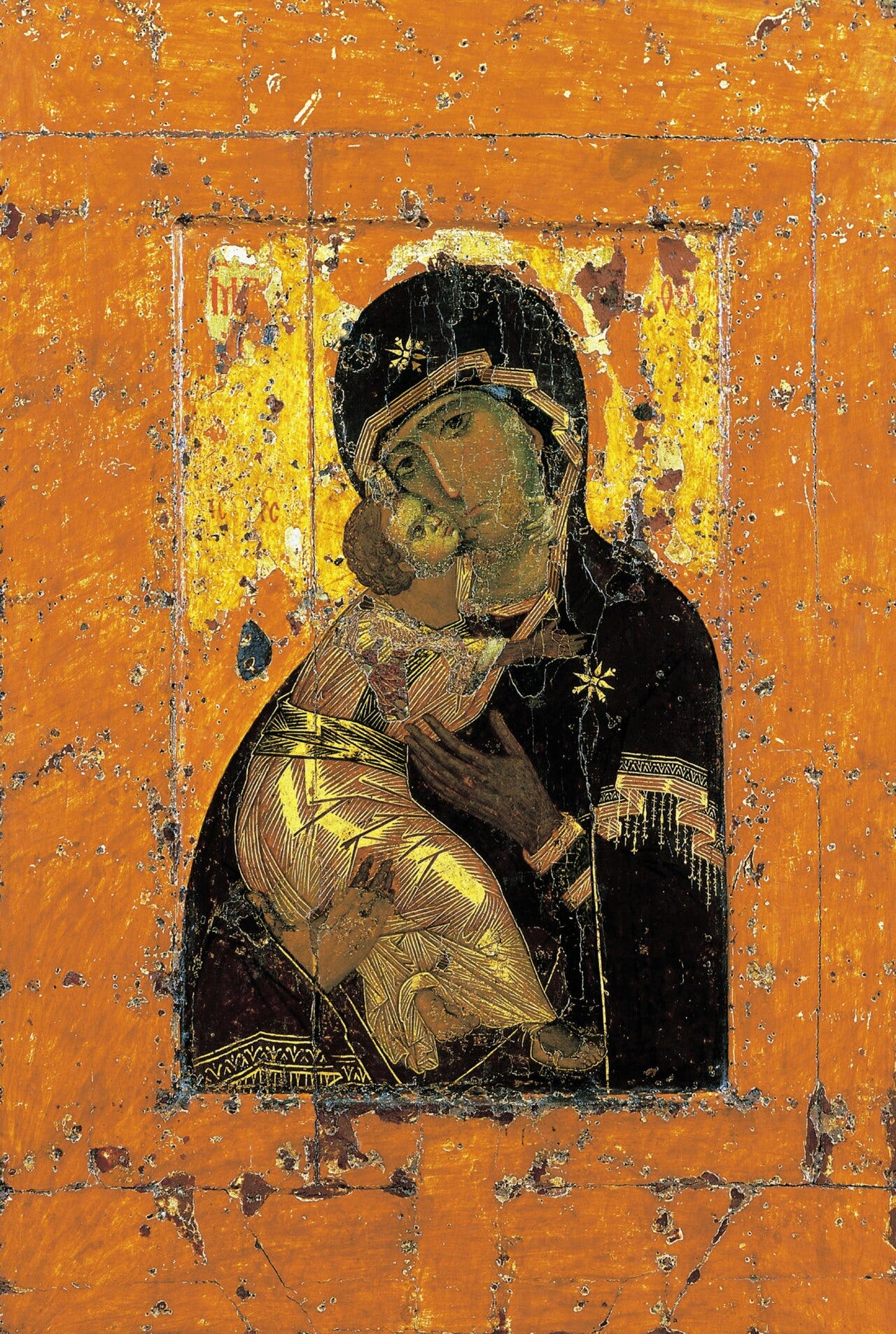
Image: The Vladimir Mother of God, Constantinople, c. 1100 AD. The prototype for Russian iconography.

The first thing to notice is how the Theotokos, who bore and gave birth to God, expresses a contentedness tinged with melancholy. This is called ‘bright sadness’ and is intended to convey that the saint lives in eternal bliss but nonetheless feels compassion for those who are not yet with God. The saints want us to join them, and they are happy to intercede for us so that it might happen.

The proportions of the person's features are subtly modified to communicate holy wisdom. The wise man reflects on God’s will before acting. To convey this aspect of wisdom, the receptive organs are relatively large, while the active ones are smaller. Therefore, the eyes are enlarged, and the nose, which inhales the fragrance of heaven, is elongated slightly, and the ears, if they are visible, are slightly larger than they would be naturally. (Typically, we don’t see Our Lady’s ears.) In contrast, the mouth and hands are made smaller. This is not to say that saints are inactive; when they act, their actions are effective. Rather, it speaks of an economy of effort in which nothing is wasted. And similarly, while there is no superfluous word coming from the mouth of a saint, every word that is spoken is golden.

We also see that Christ, though a child in his mother’s arms, appears as a little man. This indicates the paradox that, though human and physically immature, he is still fully God.

Another feature of icons is that the faces of saints are always portrayed in either a full or three-quarter view, so that both eyes are clearly visible. This symbolizes the idea that in heaven we can behold another and know them fully; nothing is hidden, and we are fully known to all others. Only the devil would be shown in full profile. (This is one feature that differentiates early Gothic art from iconographic art. Gothic artists, in order to portray a more naturalistic three-dimensional setting and the sense of a more lifelike interaction between the figures in the composition, gradually begin to place some of those key figures in profile.)

These stylistic devices in icons draw out realities that would otherwise be invisible. The modification of natural appearances, therefore, produces a greater realism than any naturalistic painting or photograph could achieve.

It is common for people who cannot draw well to want to learn to paint icons, assuming that draftsmanship matters less in this tradition, but this is not the case. The artist must not be tempted to use the style to conceal a lack of drawing ability. It takes great skill to reflect visible and otherwise invisible realities in the same painting, so that the two aspects support rather than undermine each other. Our figures must both sparkle with the uncreated light of Christ and read anatomically, just as the drapery must hang and fold as it would naturally around the figure.

Here is another common image of Christ, known as the Mandylion.
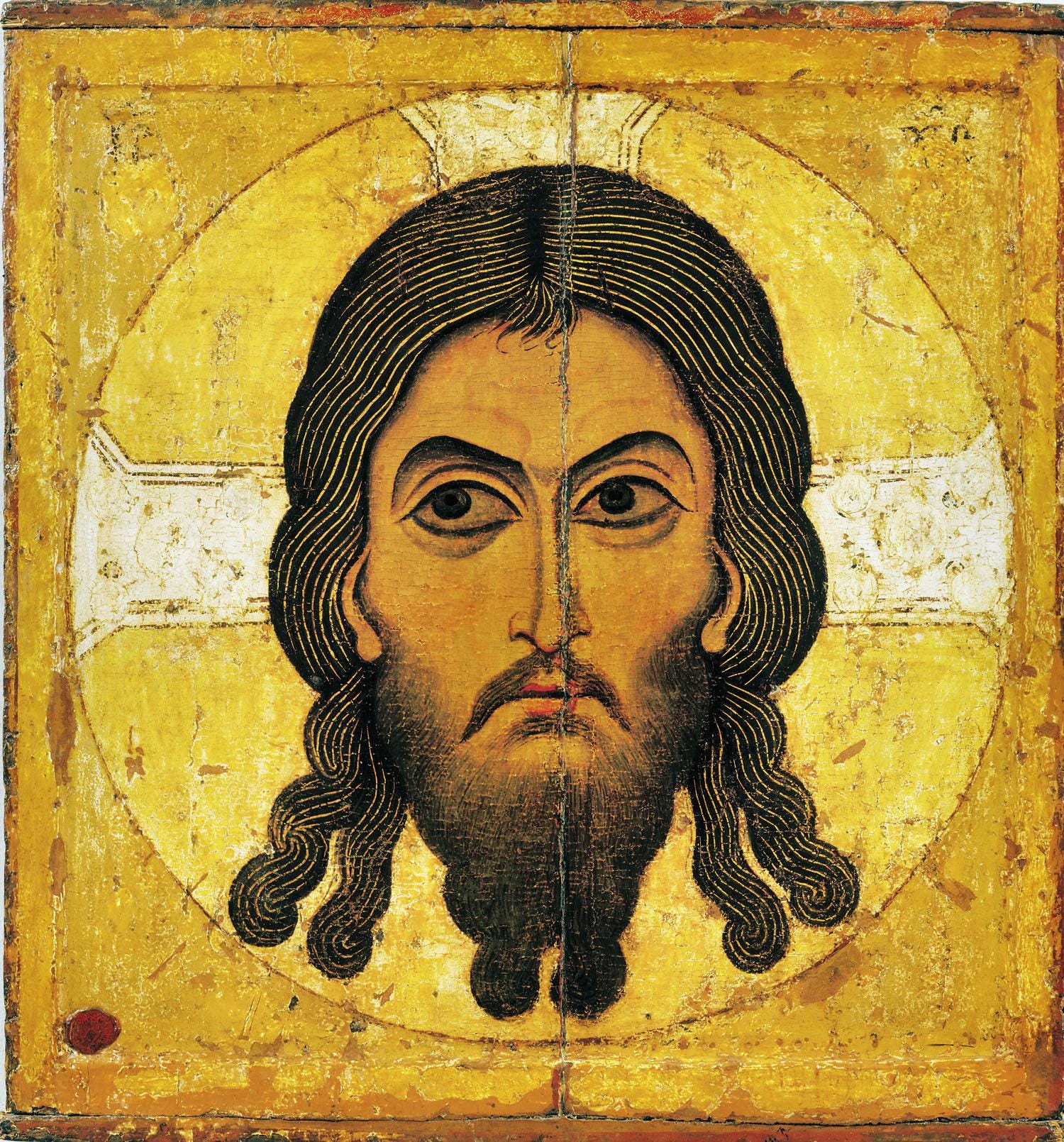
Image: The Mandylion (Christ Acheiropoietos), 12th century, Russia.

The name comes from the archaic Greek term for ‘cloth’ or ‘towel’ and refers to the tradition that the prototype of this icon was a cloth pressed against the face of Our Lord, and that the image was miraculously transferred to it. It is perhaps the most famous of the icons called acheiropoietos, meaning ‘not made with human hands,’ images that are revealed rather than painted. Notice how stern Christ appears. This sternness is sometimes employed in the depiction of Christ to indicate that he is a judge. It must never be excessive, because we also wish to convey that he is a just judge and that divine justice is always tempered with great mercy.

In common with all authentically liturgical art, there is a general disposition against innovation and originality for their own sake. New icons are created only as needed by the Church, for example to portray a newly canonized saint. The icon painter always reproduces the prototype with an understanding of the ideal it is intended to express and always aims to portray the ideal as best he can rather than a simple copy of another work of art. Accordingly, the goal is to create something greater than that which he copies.

These revealed images — the ones said to be “not made with human hands” — raise a question that goes to the heart of the whole tradition: does what we see in an icon actually correspond to what Christ and the saints are like in heaven, or is it simply an internally consistent system of symbols? That question, and the most remarkable of these revealed images, Our Lady of Guadalupe, are the subject of the second of these two articles.

Thursday, April 23, 2026

An Icon of St George

Today is the feast of the martyr St George, who is honored with particular solemnity among the Greeks. This very nice icon of stories of his life was painted by an anonymous artist of the Cretan school sometime in the first half of the 18th century; it is now at the Musée des Beaux-Arts in Paris. The central panel shows the classic story from George’s legend of him slaying the dragon; the twelve panels around it depict various episodes of his martyrdom.

In the central panel, George kills a dragon which had long terrorized a town in Libya called Sylene (or “Silena” in the Golden Legend). In the background on the right, the king and citizens watch from the battlements of a fortress; on the opposite side, the king’s daughter (dressed in red), who had been scheduled to be fed to the dragon, is seen running from the scene.
Perched on the horse behind the Saint is a young man called Amiras, who is holding a wine jug. According to a much later legend, he was a boy captured by Saracens from the city of Mytilene on the island of Lesbos, and brought to Crete as to serve as a cupbearer of the Muslim princes who ruled over the island. Amiras prayed to George to deliver him from his captivity, and one day, as he was in the middle of serving at table, the Saint appeared to him, picked him up and set him on his horse, then rode over the sea to bring him back home to his mother.

On the top section are the first three episodes of the Saint’s passion: he is brought before the emperors Diocletian and Maximian, the agitators of the last great Roman persecution, in their capital of Nicomedia; he is led away to his punishment by two soldiers; a stone slab is laid on top of him to crush him to death. As is so often the case in the stories of the martyrs, the world refuses to cooperate with the persecutors, and everything they do that doesn’t involve them personally attacking the Saint (such as drowning, burning, throwing them off a cliff) fails. The wicked are in this way forced to assume responsibility for their actions.

The narration then goes back and forth from one side of the central panel to the other. The next image is composited out of these two sections.
At the upper left, St George is tormented on the wheel; upper right, he is comforted by an angel. Center left, he appears again before Diocletian; center right, he is submerged in quicklime, which again, does not work. Lower left, he is beaten with rods; lower right, he revives the dead ox of a farmer... 
and then in the first panel of the lower section, he revives a dead man. In the central panel, George refuses to adore an idol which is perched on top of a column, (and not easy to see); at last, he is slain by the sword.

Monday, September 29, 2025

The Feast of St Michael and All Angels

The traditional title of today’s feast is “The Dedication of St Michael the Archangel”, a term already found ca. 650 A.D. in the lectionary of Wurzburg, the oldest of the Roman Rite that survives, and in the ancient sacramentaries. The Martyrology erroneously refers this feast to the dedication of the famous shrine of St Michael on Mt Gargano in the Italian region of Puglia, following a medieval tradition attested by William Durandus at the end of the 13th century. In reality, the title comes from the dedication of a church built sometime before the mid-6th century on the via Salaria, about seven miles from the gates of Rome, and remained in use long after the basilica itself fell completely to ruin. The traditional Ambrosian liturgy, which borrowed the feast from Rome, has in a certain sense preserved the memory of its origin better than the Roman Rite itself; not only does it use the Roman name, but it also takes several of the Mass chants, as well as the Epistle and Gospel, from the common Mass for the dedication of a church.
The central panel of The Last Judgment, by Rogier van der Weyden, 1446-52, showing Christ above, and below, St Michael weighing the souls of the dead.
Despite the fact that the feast’s title refers specifically only to St Michael, September 29th is really the feast of all the Angels, as stated repeatedly in the texts of both the Office and Mass. The Introit is taken from Psalm 102, “Bless the Lord, all ye his angels: you that are mighty in strength, and execute his word, hearkening to the voice of his orders.”

This text is repeated in part in the Gradual.

The Communion is taken from the Old Latin version of the canticle Benedicite, “Bless the Lord, ye angels of the Lord: sing a hymn, and exalt him above all forever.” (Daniel 3, 58)

The collect of the Mass makes no reference to St Michael at all: “O God, who in wondrous order assign the duties of Angels and of men: mercifully grant that our life on earth be guarded by those who continually stand in Thy presence and minister to Thee in heaven.”

The Lauds hymn of the Office speaks in its first stanza of all the Angels, and in the following three of Ss Michael, Gabriel and Raphael, the only Archangels specifically named in the Bible. In the Greek version of the book of Tobias (12, 15), however, St Raphael refers to himself as “one of the seven holy Angels, who present the prayers of the saints, and who go in before the glory of the Holy One.” This gave rise to a Byzantine custom of depicting seven Archangels standing together around the Lord; many icons of this motif give names to the remaining four from various apocryphal sources. One is called Uriel, who is mentioned several times in the Book of Enoch which St Jude quotes in his epistle (verses 14-15). The names of the remaining three are not the same in all sources; in the 19th century icon seen below, they are given as Jegudiel, Selaphiel and Barachiel.

The Byzantine feast of all the Angels is kept on November 8th, and like the Roman feast, originated with the dedication of a church; this was a basilica in Constantinople known as the Michaelion, traditionally said to have been built by Constantine himself. The formal title of the feast is “The Synaxis of the Great Commanders (ἀρχιστρατήγων) Michael and Gabriel, and the rest of the Bodiless Powers.” Curiously, the liturgical texts of the feast make no reference to St Raphael, nor to any of the other Angels, nor to the origin of the celebration.

In the Middle Ages, many places imitated the Roman custom of celebrating a second feast of St Michael, commemorating the famous apparition which led to the building of the shrine on Mt Gargano. In northern Europe, however, we find instead the feast of “St Michael on Mount Tumba”, the Latin name of the celebrated Mont-St-Michel, as for example in the Use of Sarum, which kept it on October 16th. A votive Mass of all the Angels was already in common use in the early ninth century, as attested by Alcuin of York, and is present among the votive Masses in every medieval missal. However, only very rarely does one find a feast of St Gabriel or of the Guardian Angels in the pre-Tridentine period; a Mass of St Raphael is sometimes found among the votive Masses especially to be said for the sick, but I have seen no no more than a handful of references to an actual feast day for him in the medieval period.

In the year 1670, Pope Clement X added to the general Calendar of the Roman Rite a feast of the Guardian Angels, which had been granted to the Austrian Empire by Paul V at the beginning of the century. The feast was kept in some places on the first Sunday of September, but the common date, October 2, was chosen as the first free day after the feast of St Michael.

The Three Archangels and Tobias, by Francesco Botticini, 1470
Pope Benedict XV, who reigned from 1914 to 1922, took a particular interest in devotion to the Angels. At the end of 1917, he raised the feast of St Michael to the highest grade, double of the first class, along with the March 19 feast of St Joseph. In 1921, he added the feasts of Ss Gabriel and Raphael to the general Calendar, the former on the day before the Annunciation, the latter on October 24 for no readily apparent reason. The feast of St Michael’s Apparition was removed from the General Calendar in 1960; in the post-Conciliar liturgical reform, Ss Gabriel and Raphael have been added to September 29th, and their proper feasts suppressed, along with the traditional reference in the title to the church dedication.

Sunday, October 15, 2023

The Feast of the Holy Fathers of the Seventh Ecumenical Council

In the Byzantine tradition, today is the commemoration of the Holy Fathers of the Seventh Ecumenical Council, the second held in the city of Nicaea, at which the Iconoclast heresy was condemned, and the sacred images restored to their rightful places for the veneration of the Christian faithful. At the seventh session of Second Nicaea, the definitive decree on the veneration of images was promulgated, on October 13, 787; the commemoration is fixed according to various traditions to a Sunday close to that date. Some years ago, I heard a sermon at a Byzantine liturgy on this day which recalled an important truth about Second Nicaea, namely, that it did not decree that sacred images are merely good and useful, but that they are necessary!

The rejection of the sacred images, particularly those of Christ, is ultimately a denial of the Incarnation. The very choice of location for the council expressed this idea; at the time it was called, the two previous ecumenical councils and the important synod ‘in Trullo’ had all been held in Constantinople. The Empress Irene, who as regent of her young son Constantine VI, arranged for a council to condemn iconoclasm, had tried to hold it in the imperial capital, but it was broken up by soldiers friendly to the iconoclast heresy. It was therefore moved to Nicaea, where the first ecumenical council had gathered 462 years earlier to condemn the Arian heresy that denied the true divinity of Christ. (To put this in chronological perspective, this is a greater distance in time than that between Trent and Vatican II.)

The refusal to depict Christ is a rejection of the fullness of His humanity, which is real, solid, and “circumscribed”, i.e., subject to limitations, and therefore capable of being expressed in an image. His humanity is the means of our redemption and salvation, as we confess in the Creed every Sunday, “For us men and for our salvation He came down from Heaven etc.” In the eighth and final session, the Council therefore also anathematized all who do not confess that “Christ our God is circumscribed according to His humanity.” The Greek word used here, “perigrapton – circumscribed”, is related to the verb “graphein – to write”, the term which is often used in Greek to refer to the painting of icons. None of this is accidental.
The famous icon of Christ the Pantocrator from the Monastery of St. Catherine on Mt Sinai, 6th century. The collection of icon at St. Catherine’s is particularly important, since it contains a large number of pieces that predate the iconoclast persecutions.
The liturgical texts proper to this commemoration make the point in a very interesting way. At Second Nicaea, the Patriarchs of Constantinople who had supported the iconoclast heresy were all condemned by name. However, they are not referred to in the liturgy, nor are the iconoclast emperors Leo the Isaurian, the real inventor and motivator of the heresy, and his two successors, Constantine V and Leo IV. (The traditional nickname of the second of these, “Copronymus”, means “dung-named” in Greek, a reference to what would now be called a diaper accident that occurred at his baptism; this was taken by those who honored the sacred images as a presage of his impiety. It occurs repeatedly in the Roman Martyrology, in reference to the many Saints killed or otherwise persecuted by him for the sake of the sacred images.)

It would be easy, but unjust, to see in this omission nothing more than an unwillingness to offend the offices of the Emperor and Patriarch. The greater truth taught by the Council, and by the Byzantine liturgy, is that the refusal of sacred images is a refusal of the Incarnation. To this point, therefore, the earlier Christological heretics are named repeatedly in the liturgy of the day, as in these texts from Vespers (bold texts are my emphases).
As true shepherds you bravely drove away those who are like Macedonius, Nestorius, Eutyches, Dioscorus, Apollinaris, Sabellius and Severus (of Antioch), exposed as dangerous wolves in sheepskins, far from the Savior’s flock, stripped of their fleeces, making them thrice-wretched; therefore we call you blessed.

Let us praise today the mystical trumpets of the Spirit, the God-bearing Fathers, who sang a harmonious melody of theology in the midst of the Church, to the one Trinity, unchanging Essence and Godhead; the overthrowers of Arius, the champions of the Orthodox, who intercede with the Lord that He may have mercy on our souls.

Holy Fathers, you have become sure guardians of the Apostolic traditions; for by teaching the orthodox doctrine of the consubstantiality of the Holy Trinity, you overthrew in council the blasphemy of Arius. With him you refuted Macedonius, the opponent of the Spirit, and condemned Nestorius, Eutyches and Dioscorus, Sabellius and Severus the Leaderless. We implore you: beg that we who have been delivered from their error may preserve our life spotless in the faith.
The following text, sung between the first and second parts of the Doxology at the Aposticha, is particularly noteworthy. One might easily assume it was a part of the commemoration of the Fathers of the First Ecumenical Council on the Sunday after the Ascension, rather than that of today, again underlining the intrinsic connection between iconoclasm and Arianism, and between veneration of the images and the Incarnation. (A friend of mine who is a great scholar of the Byzantine liturgy tells me that this hymn may very well have been composed for the commemoration of the Fathers of First Nicaea, and later added to this feast.)
Let us with faith celebrate today the yearly commemoration of the God-bearing Fathers, who were assembled from the whole world in the radiant city of Nicaea, as we reverence the gatherings of the orthodox; for they, their minds attuned to true religion, overthrew the godless teaching of Arius, and in council banished him from the Catholic Church; and in the symbol of faith, which they precisely and devoutly laid down, they taught all to confess clearly the Son of God as consubstantial and co-eternal, and existing before the ages. And so we too, following their divine teachings and firm in our belief, worship the Son and the all-holy Spirit with the Father, in one Godhead, a consubstantial Trinity.
A 19th-century icon of the Fathers of the First Seven Ecumenical Councils. The Byzantine liturgy contains several such commemorations: of the fathers at First Nicaea, at Ephesus, at Second Nicaea, at the Seven Councils collectively.
Although Iconoclasm was definitively condemned at Second Nicaea, it was revived in the early 9th century for almost thirty years under the emperors Leo V (813-20), Michael II (820-29) and Theophilus (829-42). Shortly after Theophilus’ son Michael III, (the bearer of another unfortunate nickname, “the Drunkard”), came to the throne as a child of two, his mother and regent Theodora arranged for the definitive restoration of the icons at a synod in Constantinople. (Theodora is venerated as a saint in the Byzantine Rite.)

St. Theodora, Empress of Byzantium, in a 19th-century Greek icon.
The liturgical expression of this final victory is the celebration of the first Sunday of Lent as the “Feast of Orthodoxy.” On that day, the Byzantine liturgy reads a text known as the “Synodikon of Orthodoxy”, a collection of the anathemas of the first seven ecumenical councils. The text has been much altered and added to over the years, but the first rubric in one of the oldest manuscripts describes it thus: “A yearly thanksgiving is due to God on account of that day when we recovered the Church of God, with the demonstration of the dogmas of true religion and the overthrowing of the blasphemies of wickedness.”

The final eight anathemas are dedicated to the iconoclasts, (and the iconoclast patriarchs are named explicitly.) The first one says,
On those who accept with their reason the incarnate economy of God the Word, but will not allow that this can be beheld through images, and therefore affect to receive our salvation in words, but deny it in reality: Anathema!
And the second:
On those who wickedly make play with the word ‘uncircumscribed’ and therefore refuse to depict in images Christ, our true God, who likewise shared our flesh and blood, and therefore show themselves to be fantasiasts: Anathema!

Tuesday, September 12, 2023

A 14th-Century Italo-Byzantine St Francis of Assisi, And a Relic of His Habit

Plus a Puzzling Piece of Bad Modern Art

In the final posting of this short series of art in the exhibition of works connected with St Francis of Assisi at the National Gallery in London, here is a 14th-century painting, a Western variant of the iconographic style. It shows the Saint with the sunken cheeks of an ascetic, and narrative scenes from his life.

It normally resides in Assisi. The painting is heavily stylised and has a beauty derived from the decorative effect of the strong color and gold, the abstract patterns in the borders, and the parabolic grace of the lines that describe form, especially in the robe of St Francis.

This iconographic stylization persisted in Italy in some regions for different reasons. One reason is that some parts of Italy remained under Byzantine rule until as late as the 11th century, and the painting style continued in those areas, passed down by tradition. Another is that contact with Byzantium on the part of Italians who were not under Byzantine rule was later renewed, and occurred regularly due to trade, and to the conquest of Byzantine lands out of Italy. This contact refreshed the iconic influence, but in ways that reflected development in the iconographic style that had occurred in Byzantium itself, especially in the 9-11th century, that were not necessarily reflected in all the Byzantine provinces. To my eye, this has look of the influence of one of the older, provincial Italo-Byzantine styles.
Finally, here is a relic - the actual habit of St Francis.

It is not unattractively presented, but as such it is not sacred art. It contributes to the faith of Catholics as a focus for prayer, which is derived more by the knowledge of what it is, rather than specifically what it looks like.

This makes art that is based on the fabric of the habit a pointless exercise, it seems to me, as it has neither artistic merit and very likely no influence over the prayer of the faithful over what it is. Nevertheless this is what we see in a contemporary piece on show, see below. I am not convinced, as the pseudo-spiritual language of the description that accompanied the piece, that this represents the ‘heights of artistic expression’.

Visual art is as good as it looks, and this in my opinion has no beauty, no authentic meaning other than what is arbitrarily imposed on it, and no authentic religious connection. It does serve to highlight, by contrast with other works in the show, the terrible impoverishment of contemporary art in comparison with tradition! It is however, perhaps more appropriately termed a crock than a sack!
I would reiterate the point I made earlier about the inclusion of such pieces in an exhibition at an art gallery, however. In criticising the art, I would add that I am nevertheless in favour of such pieces appearing in the exhibition. The National Gallery is not a church. Provided that the Christian art is properly represented, which it most certainly is in this wonderful exhibition. I feel that these modern, anti-traditional works of art, help us to focus on what a Christian ought to do and appreciate tradition even more.

Monday, December 12, 2022

The Mysteries of the Mandorla in the Our Lady of Guadalupe Icon

The story of the appearance of Our Lady of Guadalupe is remarkable in many ways. An important part of that story, that of the image that was given to St Juan Diego Cuauhtlatoatzin, is itself enigmatic. What follows is personal speculation - I am describing what strikes me as so mysterious when I look at this image.

As a revealed image, it is a rare Western example of a small category of sacred art called in Greek acheiropoieta - not made by human hands. In this example, we have some details clearly derived from Aztec culture and some from traditional Christian culture, including some features not normally associated with the Spanish Christian culture of the day. Something else that is striking about this image is how these aspects are combined so as to create something that has great power to convince one of the truth of what it conveys. This apparition caused millions to convert, and a large part of that was due to the persuasive influence of the visual vocabulary employed by the “artist” of this image. It spoke simultaneously to both the Aztecs and the occupying Spaniards, and continues to draw devotion today from Christians from all over the world.

The subject of this sacred image came up in a lively podcast in which I was in conversation with Christopher West (of the Cor Project and the Theology of the Body Institute). We discussed the broader subject of the place of contemporary popular culture in a Christian culture and whether or not it has a place for Christians as a tool for evangelization. In the course of this, we touched on subjects ranging from 1970s rock music (British, Irish and American) to Gregorian chant. (You can listen to the podcast here, or watch it on YouTube, here).

In the course of this exploration, we spoke of how the liturgy is the wellspring of Christian culture, and it is the culture of faith, connected to the liturgy, that is the strongest contributor to the universal human aspects of culture. In addition, this can be integrated discerningly with the contemporary culture so that it also reflects a particular time and place. If this integration is done well, the effect of the combination is to powerfully connect the universal truths to contemporary society; if, on the other hand, it is handled clumsily, it will have the opposite effect, and will lead people away from salvation.

As an example of such an integration that is successful, Christopher referred to the image of Our Lady of Guadalupe, and spoke beautifully of some of its elements that are particular to the culture, and of which I had not been fully aware before. So referring to this detail:

Our Lady’s hairstyle, parted in center, was in 16th-century Aztec culture the sign of a maiden, a virgin, but the ribbon and bow around her waist signified that she was pregnant. This is therefore a young woman who is portrayed simultaneously a virgin and pregnant. The quatrefoil roses articulated in sepia lines on the pale brown-ochre shawl signify royalty in the visual vocabulary of Aztec culture.

But this image spoke to the Aztecs of more than their own culture, because it has elements that come from traditional Christian culture as well. These are universal in that they speak to all Christians (one might make an argument in some cases for non-Christians too). It is these that speak to 16th-century Spaniards and to many Christians from all over the world since.

We can see, for example, the blue shawl, a common color for Mary’s outer robe. It is said to denote royalty. and Marian chapels often have their walls painted in this color. The exact shade of blue is unusual in that it is not lapis lazuli blue (French ultramarine), which a contemporary painter of the High Renaissance period might have used, but rather a turquoise blue often described as cerulean. I have no explanation for this difference. Also, I am curious to know more about the pigment that provides this color than Wikipedia can tell me. Cerulean blue pigment is only known since the late 18th century, when it was chemically created; it is not from a naturally occurring mineral. It might be that there is no great mystery here and that it is an effect created by a simple combination of other, naturally occurring green and blue pigments available at the time.

The eight-pointed stars represent her connection with the “eighth day” of Creation, her Son, Jesus Christ, who rose on the eighth day of the week. Traditionally in Eastern icons, there will be just three stars, symbolizing the perpetual virginity of the Theotokos - God-bearer - before, during and after her pregnancy. There are many more than three stars here. Perhaps it was deemed unnecessary by the Divine Artist to stay with three stars because her virginity is indicated in a different way, as already mentioned. There is also the moon, which is consistent with Scripture in that it shows Our Lady as the woman of the Apocalypse (12, 1), with the upturned crescent moon.

Another feature which interests me greatly is the nimbus of light around her. The account of the woman in the Book of the Apocalypse describes her as being “clothed in the sun.” The golden nimbus around her whole person might correspond to this. However, this is more complicated, there is something else going on here I believe that relates to the symbolism of the mandorla.

A mandorla is an iconographic symbol in the shape of a circle or an almond-shaped oval signifying heaven, divine glory, or light; mandorla is Italian for “almond.” It is an indication of the divine light of sanctity, but the mandorla of this type is generally reserved for Christ, at least in traditional iconography. I suggest that it is included here to indicate the presence of Christ within her womb. It is not there so much for the God-bearer, but for God! This is the Christian way of indicating that Our Lady is with child, the divine child, which complements the symbolism of Aztec culture. Remember that if this image had not spoken to the Spanish occupiers too, no one would have taken Juan Diego seriously.

Furthermore, take a close look at the gold envelope that surrounds her. This is not, as one might first suspect, a series of bright gold darts emanating from Our Lady. Rather it is a series of dark darts emanating from her on a gold background, the outer limits of which describe the mandorla shape, which is a smooth almond. In other words, this mandorla is getting darker the closer it is to her. Why should this be?

She really is, to use a familiar phrase, a riddle wrapped up in an enigma!

The answer is that this is how it is painted in traditional iconography. As I wrote in a previous article on the subject, “The mandorla surrounding Christ usually shows concentric bands of shading which get darker toward the center, rather than lighter. It is painted in this way so as to communicate to us, pictorially, the fact that we must pass through stages of increasing mystery in order to encounter the person of Jesus Christ. This encounter, which takes place in the Mass with the Eucharist at its heart, is one that transforms me supernaturally so that I can begin to grasp the glory of Christ more directly.”

You can see an iconographic mandorla here in an icon of the Dormition painted, by Theophan the Greek in 1392.

In the following icon, the sense of a mandorla getting darker as it moves towards the center is done in a different way.

As we can see above, the hidden “heart of darkness” is suggested visually by darts of darkness that come from a point obscured by the figure of Christ. This is similar, but not identical, to the device used by the artist in the image of Our Lady of Guadalupe. Notice also, incidentally, that while the Apostles are able to perceive the glorified Christ, they still do so dimly. They are partially and temporarily deified, but not fully, and so are partially blinded by the Light and knocked off their feet. To indicate this we see the rays that strike them as shafts of darkness, and the Apostles themselves will not receive halos until Pentecost, in contrast with the Prophets who are already in heaven, flanking Our Lord.

It is interesting to note that virtually every copy of the Our Lady of Guadalupe icon gets this detail wrong and inverts the direction of the lines. For example, here is one painted around 1700.

Thursday, September 29, 2022

The Feast of St Michael and All Angels

The traditional title of today’s feast is “The Dedication of St Michael the Archangel”, a term already found ca. 650 A.D. in the lectionary of Wurzburg, the oldest of the Roman Rite that survives, and in the ancient sacramentaries. The Martyrology erroneously refers this feast to the dedication of the famous shrine of St Michael on Mt Gargano in the Italian region of Puglia, following a medieval tradition attested by William Durandus at the end of the 13th century. In reality, the title comes from the dedication of a church built sometime before the mid-6th century on the via Salaria, about seven miles from the gates of Rome, and remained in use long after the basilica itself fell completely to ruin. The traditional Ambrosian liturgy, which borrowed the feast from Rome, has in a certain sense preserved the memory of its origin better than the Roman Rite itself; not only does it use the Roman name, but it also takes several of the Mass chants, as well as the Epistle and Gospel, from the common Mass for the dedication of a church.
The central panel of The Last Judgment, by Rogier van der Weyden, 1446-52, showing Christ above, and below, St Michael weighing the souls of the dead.
Despite the fact that the feast’s title refers specifically only to St Michael, September 29th is really the feast of all the Angels, as stated repeatedly in the texts of both the Office and Mass. The Introit is taken from Psalm 102, “Bless the Lord, all ye his angels: you that are mighty in strength, and execute his word, hearkening to the voice of his orders.”

This text is repeated in part in the Gradual.

The Communion is taken from the Old Latin version of the canticle Benedicite, “Bless the Lord, ye angels of the Lord: sing a hymn, and exalt him above all forever.” (Daniel 3, 58)

The collect of the Mass makes no reference to St Michael at all: “O God, who in wondrous order assign the duties of Angels and of men: mercifully grant that our life on earth be guarded by those who continually stand in Thy presence and minister to Thee in heaven.”

The Lauds hymn of the Office speaks in its first stanza of all the Angels, and in the following three of Ss Michael, Gabriel and Raphael, the only Archangels specifically named in the Bible. In the Greek version of the book of Tobias (12, 15), however, St Raphael refers to himself as “one of the seven holy Angels, who present the prayers of the saints, and who go in before the glory of the Holy One.” This gave rise to a Byzantine custom of depicting seven Archangels standing together around the Lord; many icons of this motif give names to the remaining four from various apocryphal sources. One is called Uriel, who is mentioned several times in the Book of Enoch which St Jude quotes in his epistle (verses 14-15). The names of the remaining three are not the same in all sources; in the 19th century icon seen below, they are given as Jegudiel, Selaphiel and Barachiel.

The Byzantine feast of all the Angels is kept on November 8th, and like the Roman feast, originated with the dedication of a church; this was a basilica in Constantinople known as the Michaelion, traditionally said to have been built by Constantine himself. The formal title of the feast is “The Synaxis of the Great Commanders (ἀρχιστρατήγων) Michael and Gabriel, and the rest of the Bodiless Powers.” Curiously, the liturgical texts of the feast make no reference to St Raphael, nor to any of the other Angels, nor to the origin of the celebration.

In the Middle Ages, many places imitated the Roman custom of celebrating a second feast of St Michael, commemorating the famous apparition which led to the building of the shrine on Mt Gargano. In northern Europe, however, we find instead the feast of “St Michael on Mount Tumba”, the Latin name of the celebrated Mont-St-Michel, as for example in the Use of Sarum, which kept it on October 16th. A votive Mass of all the Angels was already in common use in the early ninth century, as attested by Alcuin of York, and is present among the votive Masses in every medieval missal. However, only very rarely does one find a feast of St Gabriel or of the Guardian Angels in the pre-Tridentine period; a Mass of St Raphael is sometimes found among the votive Masses especially to be said for the sick, but I have seen no no more than a handful of references to an actual feast day for him in the medieval period.

In the year 1670, Pope Clement X added to the general Calendar of the Roman Rite a feast of the Guardian Angels, which had been granted to the Austrian Empire by Paul V at the beginning of the century. The feast was kept in some places on the first Sunday of September, but the common date, October 2, was chosen as the first free day after the feast of St Michael.

The Three Archangels and Tobias, by Francesco Botticini, 1470
Pope Benedict XV, who reigned from 1914 to 1922, took a particular interest in devotion to the Angels. At the end of 1917, he raised the feast of St Michael to the highest grade, double of the first class, along with the March 19 feast of St Joseph. In 1921, he added the feasts of Ss Gabriel and Raphael to the general Calendar, the former on the day before the Annunciation, the latter on October 24 for no readily apparent reason. The feast of St Michael’s Apparition was removed from the General Calendar in 1960; in the post-Conciliar liturgical reform, Ss Gabriel and Raphael have been added to September 29th, and their proper feasts suppressed, along with the traditional reference in the title to the church dedication.

Tuesday, August 02, 2022

The History of the Icon of the Transfiguration

This coming Saturday, August 6th, is the feast of the Transfiguration of the Lord. To mark this event, I would like to present a short history of the development of the traditional icon of the Transfiguration, based on a chapter devoted to the subject in Aidan Hart’s excellent book, Festal Icons. Hart’s account is a 40-pages long and has far more detail than I can supply here.  

The chapter follows the general pattern of his approach to describing 14 festal icons: he outlines the history of the feast itself, the history of the development of the icon, and then systematically discusses the main features of the icon as it is generally recognized today, introducing us to the theology associated with the feast, and how that theology is communicated through an artistic vocabulary.
Icon painted by Theophan the Greek, 15th century
So, as Hart describes it, the earliest accounts of the celebration of the feast itself date back to liturgical documents from the Church in Jerusalem in the early 6th century. It spread from there, initially south to Sinai and north to Syria, and then through the whole Church. It was not formally adopted in Rome until 1456, when Pope Callixtus III ordered that it be held annually on 6 August, in gratitude for the defeat of the Turks at Belgrade that year. However, there are records of the Transfiguration of the Lord being celebrated in Spain in the 9th century.

Commentaries on the Scripture, Old Testament and New, that relate the importance of the Transfiguration predate this, as one might expect. In the 3rd century, for example, Origen describes how Tradition has passed on to him the understanding that the mountain in the New Testament accounts is Mount Tabor.  
The first images date back to the fifth century; by the 6th, we see two prototypes emerging. The first is more symbolic in nature and appears as a mosaic in the apse of the church of St Apollinare in Classe, outside Ravenna. 

As Hart explains:
The Saint Apollinare mosaic shows the three disciples as sheep, and the transfigured Christ as a massive bejewelled cross with a barely distinguishable bust of Christ at its centre. The strength of this magnificent work is the multivalenced theology. The Transfiguration is shown as a foretaste of Christ’s second coming in glory, preceded by the appearance in heaven of ‘the sign of the Son of Man’ (Matt 24, 30) which Church Tradition has always understood to be the cross. Another theme is the transfiguration of the whole of creation through the Church’s priestly ministry, expressed by Bishop Apollinaris standing in a paradisical scene in an attitude of epiclesis and consecration. 

The other prototype is shown in the apse of the katholikon of St Catherine’s Monastery on Mt Sinai, again dating from the 6th century.

As we can see, this is a more literal, less symbolic representation. The Council of Trullo (which was not an Ecumenical Council) held in the late 7th century, banned symbolic representations of Christ and the Saints. 

Three theological themes of the Transfiguration are consistently emphasized visually:

Christ’s divinity, which is His nature; each Christian’s deification, which is granted by grace: and Trinitarian love which is experienced by the Church through her mutual love, sacraments and liturgical life.

Hart gives a fascinating account of, for example, the ways in which the different designs of the aureole - the layered envelope that surrounds the figure of Christ - are all ordered to communicate His divinity, and the connection of the Holy Spirit through the rays that emanate from it, complementing the voice of the Father that was heard.

So, for example, the rays are very often painted as triple rays, indicating the relationship of those touched by the rays with the Trinity in the Holy Spirit and through Christ. The eight-pointed star indicates Christ as the 8th day of creation. St Maximus the Confessor commented, Hart tells us, that the perfect number 6 denotes the perfection of the work of the creation of the cosmos, and the ideal of the perfected work of man in prayer, meditation, and good works. The number 7, the day of rest, indicates contemplation; and the number 8 deification.

The darkness is a cloud of unknowing, or rather, of ignorance, which indicates the mystery of God known to the degree that he reveals Himself to us through Christ, at its center, and through our encounter with Him in the Holy Spirit. 

Hart also points out that Christ was always both human and divine, as seen in the Transfiguration. The miracle, therefore, he says, might be considered not so much that we see his glory here, but rather that He hid it in the rest of His earthly mission.

Through the chapter, Hart by turn analyses the compositional structure, the portrayal of the Saviour, the portrayal of Light in relation to darkness, the portrayal of the prophets and disciples, the structure of the mountain, and the colors used. In each case, he describes how the different choices available to the iconographer are all connected to different theological messages. There is even a section on the influence of hesychasm and how the theology of Gregory Palamas (not always received enthusiastically in the West) has affected the images we see today.

To illustrate, referring back to the discussion of the aureole, he describes the three different varieties of shapes used within it: 

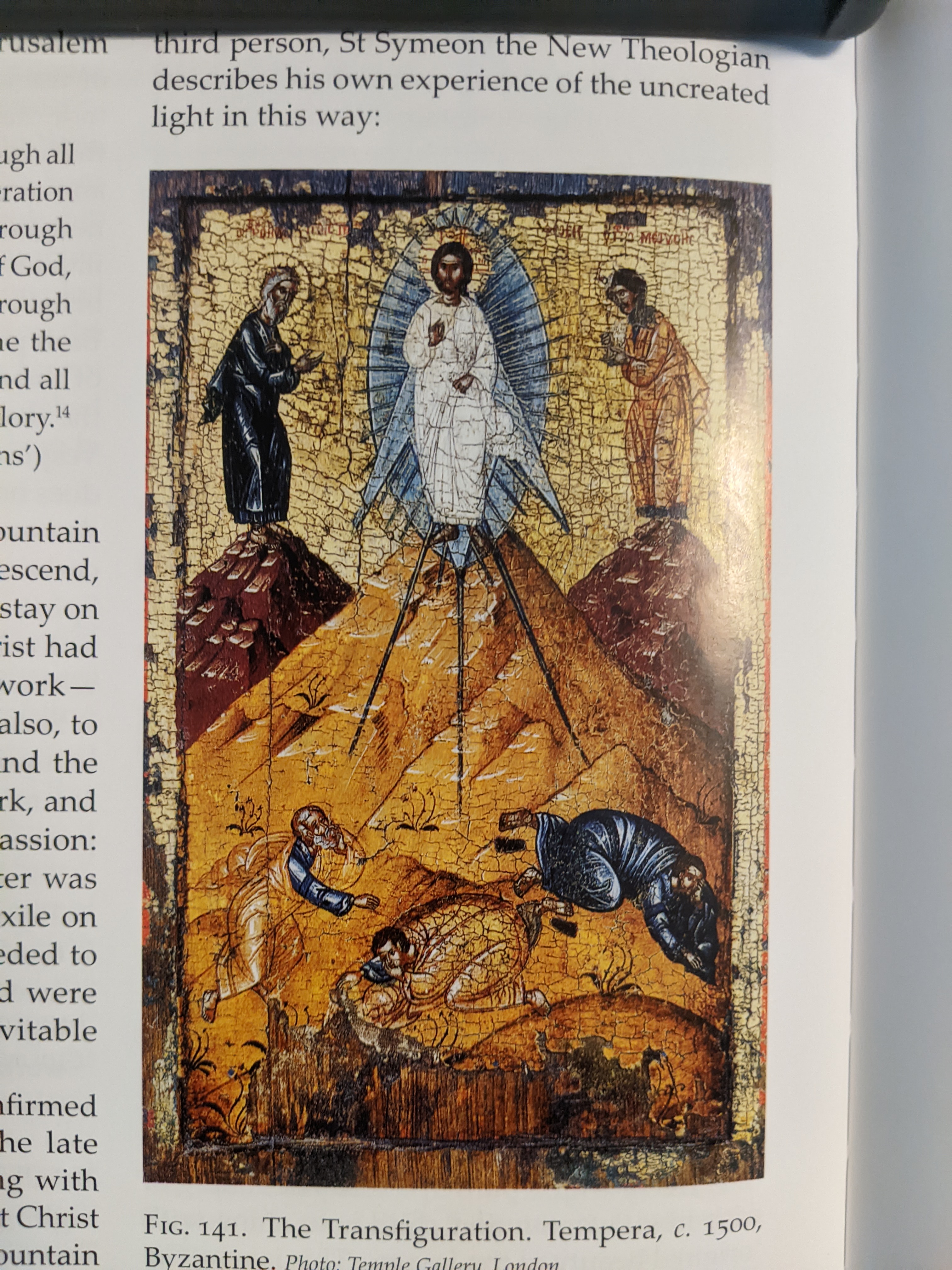
He then describes the variation in the number of rays, and why the internal color can be either blue or red. So this 16th-century example shown below, photographed from the book, has an arrowhead shape with three downward pointing corners, indicating the personal relationship of the disciples (and all Christians) with Christ, and multiple dark triangular rays indicating God’s generosity, in that this is open to all people.

One little aside, which is my observation in reaction to this: in the images of Our Lady of Guadalupe, we see similar dark triangular rays within the aureole, with the darkness widening as they get closer to the center, just as in the aureole around Christ above.

This has always suggested to me that the aureole is there not for Our Lady, but rather for Our Lord who is present in the womb of the pregnant Virgin. This then begs the questions: how many artists in early 16th century Mexico were aware of the conventions of painting aureoles in contemporary Byzantine icons? I suggest that the answer is just one: the Creator Himself!

More recent articles:

For more articles, see the NLM archives: