
Tuesday, May 07, 2024

Book Recommendation: “The Spiritual History of English,” by Andrew Thornton-Norris

A new edition, revised, expanded and published by Os Justi Press

What makes literature or art Christian? Some would say just the content, that is, what is said; others would say both the content and the form, because the way in which certain truths are conveyed can communicate them more fully. It’s not just what you say that’s important, but also how you say it.

If this is the case, the style of prose or poetry can be Christian (or un-Christian), as much as the meaning of the words considered apart from that style. As an artist and a teacher of art, I have long maintained that the style of art is every bit as important as the content, and that since the Enlightenment, style has declined because artists have rejected the traditional Catholic forms.

In this slim volume, the English Catholic poet Andrew Thornton-Norris does for poetry and prose what I have been trying to do with visual art. He relates the actual structure of the writing and the vocabulary used in it to the worldview of a given age. He shows us, for example, that even if the poet or novelist is sincerely Catholic and trying to express truths that are consistent with the Faith, he is at a great disadvantage if he is seeking to express those truths with vocabulary and poetic forms that reflect a post-Enlightenment culture.

I agree with the author’s analysis of the phases of modernity, which he sees as ever-greater degrees or manifestations of the Protestant heresy. Chapter by chapter, he analyses and critiques the worldview of the Enlightenment, down to the present day. The philosophies behind Neoclassicism, Romanticism, Modernism, and Postmodernism are each presented as differing reactions against Christianity, and ultimately, against the authority of the Catholic Church. He then connects each with the cultural forms it engenders. Because he is dealing with the English language, he first describes the rise of the language as a distinct vernacular, and connects this with the presence of the Faith.   

He argues that the very idea of the English as a nation comes from the Church, through Pope Gregory the Great and his emissary, St Augustine of Canterbury. He then describes how the language and its literature developed in light of the spread of Christian teaching, through the influence of figures such as Bede, Alcuin of York, and King Alfred the Great. Then, after the great heights of writers such as  Chaucer and finally Shakespeare, he argues that the trajectory has been downhill from there. As he puts it in the beginning of his concluding chapter: “This book has argued that English literature has declined, almost to the point of non-existence. In this and previous chapters we examine what remains: the entrails, or shipwrecks, so to speak. It has argued that this decline has been concurrent with that of English Christianity, and it has examined the relationship between these two phenomena.”

This means that Mr Thornton-Norris is much more suspicious of the Romantic poets than many other Catholic commentators. I like the idea of this, firstly because it makes me feel less of a philistine for finding them dull, but also because this parallels exactly my analysis of painting—that the Romantics and all thereafter are, in substantial and important ways, inferior to earlier Christian artists and artisans. The same seems evident to me in Neoclassicism, Modernism, and Postmodernism.

Thornton-Norris clearly believes that through the prism of literature, one can identify problems with the whole culture, which are at root related to the rejection of the Faith and its forms of worship. This idea is also very similar to my own about visual art, and appeals to me on a similar level.

The author is discussing general trends; he has no intention of dismissing all examples of English literature in these later periods. Rather, he points out the great disadvantage suffered by those poets and novelists who were trying to express something that is consistent with the Faith in an era that breathed a different atmosphere. They were restricted, generally, to the vocabulary and structural forms of the language at the time in which they lived, and because these were affected by one form or another of a post-Enlightenment anti-Catholic worldview, they always faced a struggle to rise above the cramping conventions and assumptions of their time.

The source of hope for the English language and English literature is, for Mr Thornton-Norris, the same as it is in the Church. As he puts it:

“Whereas Christianity provided an external discipline or control of the emotions and ego, romanticism exalts them, as does psychoanalysis and the cult of therapy and self-development, especially in its Freudian or theoretical form. The logical conclusion is that if we want to resist the relativism of artistic and religious values, a fundamental rehabilitation of English relations with the papacy is the only solution.”

This is true for the culture in general. The task here is one of an authentic renewal of the Catholic Faith. 

The Spiritual History of English is full of luminous ideas that deserve careful pondering. May this new edition from Os Justi Press place its insights into the hands of many more readers who are seeking to understand the cultural crossroads at which we stand and the conditions necessary for the rebirth and flourishing of all the arts, especially the art of the poetic word.

To order: Os Justi Press or Amazon

Monday, November 20, 2023

Spanish Novelist: “Secularization in the Church Has Broken the Chain of Transmission”

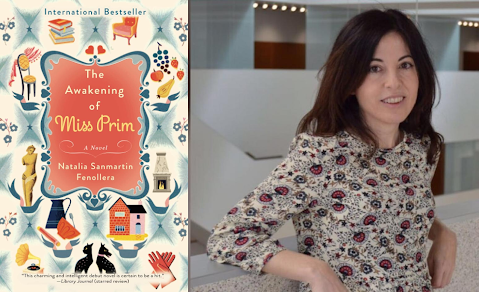
In 2013, a novel by a hitherto unknown Spanish writer was published, and, to the surprise of many, became an international bestseller: “The Awakening of Miss Prim,” written by Natalia Sanmartín Fenollera. I recently came across an interview that was done with Ms. Sanmartín in December of 2021 with the journalist José María Sánchez Galera at the website of El Debate (Spanish original here). Its abundant interest made me wish to share it with NLM readers.—PAK

Few people have not heard of The Awakening of Miss Prim (2013). And those who have read this novel are surprised that its author, the Pontevedra-born Natalia Sanmartín Fenollera, has not made a literary career. She has published another book, A Christmas Carol for Le Barroux, which tells how a child loses his mother and asks God if the story of Bethlehem is true. Sanmartín does not live by producing articles full of scholastic theories, but works in the economic press. Her perspective is marked by various influences: from the Fathers of the Church, St. John Henry Newman, and British intellectuals such as Lewis, Knox, and Chesterton, to John Senior (in fact, thanks to her, La restauración de la cultura cristiana has been published in Spain). All this tradition helps to understand the devotion and deep respect she feels for Benedictine spirituality and carefully celebrated liturgy, as well as her literary passion and her interest in assiduous reading of the Bible. That is why she comments, “The depth of the liturgy and of the divine office teaches us that the tender God is also the warrior God.”

Galera: In A Christmas Carol for Le Barroux and The Awakening of Miss Prim, you speak to us, in a certain way, of a kind of need to get out of the world or the noise. To what extent?

Sanmartín: It’s true that this idea is present in both stories, although in the Christmas story it’s not so much a geographical distance as a spiritual one. But I wouldn’t say that getting away from the world is an absolute necessity, a kind of imperative, and it seems to me that there is a certain misunderstanding in some of the discussions there have been about this question.

All decisions that have to do with one’s state of life are prudential; there is no instruction manual. It would be simpler if there were, but there is not. Any debate about whether a Christian is right or wrong to try to lead a life away from the world must take this into account, that it is a question of prudence: there will be those who believe they should and can do it, there will be those who cannot, even if it seems a good way, and there will be those who conclude that their place is elsewhere.

When we turn to Scripture to defend that the Christian has to be in the midst of the world, we usually quote the passage about the salt of the earth, but the problem with using Scripture to argue about this type of question is that Scripture is very broad and very rich, and we cannot take only a piece of it. The Gospel also says to shake the dust off our sandals wherever the word of God is not received. The Church has always taught that the Christian should have a healthy distance from the world—live in it, but not belong to it, and this is valid whether one lives in the middle of a big city or at a monastery. There are Christians in the world and Christians far from it, some on the ramparts and others in the rearguard. It has always been like that and I think that is the right way to look at this matter. But to both, the Church says the same thing: you are children of God, and that means that you live in this world, but you do not belong to it.

There is also a certain lack of realism in those who say that “distancing oneself from the world to protect the Faith is a mistake.”

Galera: There are those who consider the “beatus ille” [Happy that man who is free from business cares…] to be nothing more than a literary cliché.

Sanmartín: That may be partly true, but, formulated as Horace did, I think it is much more than that. It is also a warning about the dangers of the lust for power and government, about the arrogance of man who concentrates on power. I agree that one can idealize the quiet life and even more the rural life, but one can also idealize life in the big cities, professional success, family, marriage, and even religious life. And in part, it is good that this is so; this idealization has a function, because, if from the beginning one could contemplate the difficulties of a path in all their rawness, one would never choose it.

But it seems to me that there is also a certain lack of realism in those who claim that distancing oneself from the world in order to protect one’s Faith is a mistake or a desertion. Many of these criticisms seem to forget the brutal secularization that has flooded the world, including the Christian world—a secularization that has entered the Church and has broken the chain of transmission of faith between generations. It is very Christian to aspire to be salt in a land hostile to God, but perhaps we must first ask ourselves what is happening within our own walls, what is happening to our own faith, that of our children or grandchildren—to what extent what we believe and what we transmit and what they have received corresponds to the faith of the apostles… or is it rather what Lewis called “watered-down Christianity”?

And finally, it seems to me that some things are indisputable: the fruits of the retreat to the desert and of Christian contemplation have always been great and profound. You have only to look at the history of the Church to see that.

Galera: Pablo d’Ors—who in an interview with me said “turning off the cell phone is at least 50% of the spiritual journey”—recently said that silence, more than the absence of noise, is the absence of ego. But is that enough for silence to be a door to listen to God?

Sanmartín: The absence of ego is not just any old thing; it is an enormous fruit of holiness. The desert fathers always mention this—humility and silence—and they also speak of waiting, of patience. When a young person came to them and asked them how to seek God in prayer, they did not answer with methods or exercises; they taught that the initiative is always God’s, that the grace that allows us to open our hearts and listen comes also from God, and that we are all, so to speak, on the outer side of the door, like beggars before Paradise. That is our real position, with our weaknesses and falls, as being what we are: a wounded race that one day shouts hosanna and another day demands crucifixion. Scripture tells us beautiful and mysterious things, such as that God speaks as a whisper in the breeze, but it also says that his voice shatters the cedars of Lebanon. I am very impressed by a sentence of the desert fathers that recommends the young monk to pray “alone before the Alone.”

Galera: Would the criterion for all the above—silence, isolation, flight from the world, etc.—be God?

Sanmartín: The criterion for a Christian must be the search for God’s will, which is not an easy thing. I am not the “providentialist” type, the type that easily sees in everything a sign of what God wants or does not want; it seems to me that trying to fulfill the commandments, getting up every time one falls down and worshiping God in the highest and holiest way possible, is the way to do His will; everything else is very difficult to know. Newman has a beautiful poem in which he tells God that he does not need Him to show him the horizon, that it’s enough that He guide him to be able to take one more step until the night ends and the morning brings the smile of the angels.

Galera: We speak little today in the Church about the Last Things (Death, Judgment, Heaven, Purgatory, Hell)...

Sanmartín: Yes, it is true that little or practically nothing is preached, that the homilies do not speak of the fact that life on earth is a warfare, as Job says, and that God loves us but He also takes our freedom seriously. But I think it is not only a question of preaching, but also of the depth of the liturgy and of the divine office, which teaches us that the tender God who tried to gather Israel as a hen gathers her chicks under her wings is also the warrior God of the Armies, and who leads us, now in Advent, to a time of penitence before joy. The Church teaches that we believe what we pray. If this is true, consider that a bimillenial liturgy says that death and nature “will be astonished when all creation rises to answer to its Judge,” and makes us say to God: “You who absolved Magdalene and heard the thief’s plea, grant me hope too” (the Dies Irae), while another liturgy [the Novus Ordo] describes in one of its prefaces a “Sunday without sunset” in which “the whole of humanity will enter into rest.”

Galera: A question that we’ve already posed recently to Rémi Brague and Fabrice Hadjadj: Is the Christian world retreating in the face of the secular wave of postmodernity? Are we entering a post-Christian era? Will the Church be confined to ghettos or catacombs?

Sanmartín: I believe that we are already in a post-Christian era, that we live in the midst of a vineyard that has been assaulted from without and from within—a devastated vineyard, as Dietrich Von Hildebrand called it in the book he wrote in 1973. But it is not just any vineyard, for it is protected by an unbreakable promise, even if we do not know how that promise will be kept or whether the result will ultimately resemble what we know now. The Church began small and we are taught that it will end up small again, but it will be recognized because it will preserve what it has kept from the beginning: the faith of the apostles, the sacredness of the liturgy, and the memory of the saints and martyrs.

Visit Dr. Kwasniewski’s Substack “Tradition & Sanity”; personal site; composer site; publishing house Os Justi Press and YouTube, SoundCloud, and Spotify pages.

Tuesday, July 19, 2022

Rite by Rote

Why learning of the texts of the liturgy will transform worship, improve singing, improve art, and renew the culture.

In some ways, I am the product of the new-model education that became trendy in the 1970s and which sought to throw out all tradition. The emphasis on experiential learning meant that I had very little formal training in grammar and punctuation - I once managed to talk my way into a job at the Sunday Times as a sub-editor without knowing how to use speech marks. If you think that my work is full of typos now, you should have seen it before Grammarly told me my errors! And I can’t recite a line of Shelley or Shakespeare to save my life, let alone offer you a coherent exegesis of the text. (I even had to look up “exegesis” on the internet prior to writing this paragraph, as I wasn’t sure if I was using the right word.)

As we were going through this educational revolution, many - including my parents - were critical of the trend and argued for the re-introduction of the traditional methods, most simply characterized by the “three R’s - reading, writing and ’rithmetic.” At the time, I was glad to avoid such horrors (as I saw them), but I have to say that now I am not so sure that my 1970s-style education by osmosis given was a good thing. In fact, I am going to suggest that we not only promote all three of those Rs, but also introduce a fourth, one that I hated even more when I was a teenager - Rote.


The purpose of a great books education is to give us familiarity with certain key texts that characterize the culture and so form us to participate in it. Collectively, they form our story, in which, it is hoped, our own personal stories will participate. The more familiar we are with the story of our nation and our people, the more likely we are to be contributors to and conservers of it.

This aspect of education - inculturation by storytelling - is as old as culture itself. The Greeks had the Iliad and Odyssey, the Romans had the Aeneid, and the Israelites had Sacred Scripture, which itself tells us of this principle of inculturation; the story of the Israelites is to be retold to successive generations in order to preserve their faith. At different junctures, it describes how this was done in order to redirect a straying people; for example, we see Moses, Joshua, and Samuel in the Old Testament, and Stephen and Peter in the New, doing just this.

As Christians, we are Israelites by adoption, and any education that doesn’t focus on the Bible, or does not make it a central part of the education, is not Christian. In our case, we need both the Old Testament, the original Scripture, as referred to by St Paul in his letters, for example, and the addition to this, the inspired Scripture of the New Testament (including Paul’s letters). It is the latter that connects us to the former, bringing the Gentiles into Israel through Christ, which completes the story of salvation for all humanity. I am all for learning other classical texts that typically make up the Great Books curriculum too; they represent good supporting material, but I would say that they are not absolutely necessary. However, an education that has classical texts but little or no Scripture is a waste of time.

You can’t become a doctor by taking the course in a pre-med program, no matter how thoroughly you know the material. Studying Dante, Beowulf or even Greek philosophy is not a bad thing, but it is wrong to place these at the center of our education or to see them as absolutely necessary. The study of salvation history, on the other hand, ought to be mandatory. I don’t regret at all having had little or no exposure to classical texts in my education. I find literature, and poetry especially, incredibly dull. But I do wish I had learned the value of Scripture.

If we were Protestant, the discussion would stop there, but we’re not. The liturgy itself is a living-out of the story of salvation, a drama in which we are participants. The study of salvation history in Scripture prepares us for the worship of God in which our formation as Christians is more profound. The Bible is dependent upon the liturgy for its true meaning - it was written to be proclaimed in a liturgical context (as well as studied outside it), and contains much of the blueprint for it.

Jean Danielou’s book The Bible and the Liturgy explains this well, to quote from the summary of the book written by the publisher:
The Bible and the Liturgy illuminates, better than has ever before been done, the vital and meaningful bond between Bible and liturgy. Father Daniélou aims at bringing clearly before his reader’s minds the fact that the Church’s liturgical rites and feasts are intended, not only to transmit the grace of the sacraments but to instruct the faithful in their meaning as well as the meaning of the whole Christian life. It is through the sacraments in their role as signs that we learn. So that their value will be appreciated, Daniélou attempts to help us rediscover the significance of these rites so that the sacraments may once again be thought of as the prolongation of the great works of God in the Old Testament and the New.
The deepest participation in the liturgy will come from an intimate awareness of the texts, as well as a deep understanding of their meaning and through them, how to engage, body, soul, and spirit with the dynamic exchange of love that is taking place. This is where rote learning comes in.

The more we know and understand the texts and can sing those parts we are required to without having our noses buried in a book, the more we can engage authentically with what is happening. It will allow us, for example, to engage with art. Furthermore, we are likely now to require art that speaks of all the liturgical activity going on, and it is this that will stimulate the reestablishment of an authentic schema of liturgical art in our churches, one that actually nourishes our prayer. This, in turn, could become a powerful driving force for cultural change, for it is the forms and styles that are intimately connected with authentic worship that will drive this.

For those who wish to learn to pray with sacred art, especially in the context of worship, freeing ourselves up to look at the art in the church or icon corner will help; knowing and understanding the texts and their chants, gives us the ability to sing along, so that we are less reliant on the missal and the psalter that will do this. I am not expecting memorization of the whole text of the liturgy, but we should start somewhere if we haven’t already. The more we can do this, starting with those that are repeated most often, I suggest, the freer we will be.

Authentic liturgical art induces right prayer when we take the trouble to look at it during our worship. Currently, in my observation, (thinking now of the pious and orthodox) there is very little engagement with art beyond devotional prayer, and so it becomes too much an internalized, introspective cerebral activity. This contemplative aspect should be there too, make no mistake, but it should not dominate to the degree that it does. I had these same thoughts in mind with previous postings about Baroque art in the Latin Mass and the placement of choirs in the church.

In my opinion, the damage to our culture and our faith through this lack of engagement of the whole person cannot be underestimated. The prospects of cultural renewal are greatly diminished without it, and in my reading of history, this may well have been what caused the dislocation between the culture of faith and contemporary culture that Benedict XVI describes as taking place in the early 19th century, in his book the Spirit of the Liturgy.

I am currently attempting to put this into practice myself. Rote learning is a very difficult process for me - especially as I am now in my late 50s - but I am doing my best. I sing repeatedly the texts of the liturgy so that I can look at my icon corner as I do so. I have set myself the target of learning by heart  the chants of oft-repeated liturgical passages, the hymns, psalms, canticles, prayers and so on.

For a man to start doing this in his late 50s is a difficult task. If I had been given the chance in my first 10 years of life, the riches that it would have given me would have been great. Still, I am where I am...back to the Gloria and the Benedictus!

Wednesday, May 04, 2022

St Joseph and St Helena

This year, the feast of the Finding of the Cross is followed immediately by the Solemnity of St Joseph, Patron of the Universal Church. Although they often come close to each other, this is the first time in thirty years that these two feasts have concurred at Vespers, as the rubrics traditionally describe it. This got me to thinking about some profound reflections on the figure of St Helena by the English writer Evelyn Waugh, and how they also apply to Our Lord’s foster father.
In 1950, Waugh published his only historical novel, Helena, a fictionalized account of the empress’ life, and her discovery of the Cross. His introduction begins with a funny story based on the Latin version of the feast’s title, “Inventio Crucis”, which, in his classic fashion, foreshadows the greater point of the story.
“It is reported (and I, for one, believe it) that some few years ago a lady prominent for her hostility to the Church returned from a visit to Palestine in a state of exultation. ‘I got the real low-down at last,’ she told her friends. ‘The whole story of the crucifixion was made up by a British woman named Ellen. Why, the guide showed me the very place where it happened. Even the priests admit it. They call their chapel “the Invention of the Cross.” ’ ”
The chapel of the Finding of the Cross in the church of the Holy Sepulcher in Jerusalem; photo by Nicola dei Grandi, from an article published in April of 2019.
“a British woman named Ellen” refers to a medieval tradition that Helena was the daughter of a local chieftain in Roman Britain, a tradition which Waugh incorporates into the story. He always regarded it as his best work, a fact which may well surprise those who know him for much more famous books like The Loved One or Brideshead Revisited. The latter was made into a critically acclaimed mini-series, and several of his other works have likewise been brought to film, although none as well or successfully. Helena, on the other, has not only never been filmed, but is the only one of his novels that ever fell out of print.
Two years after its publication, Waugh was invited by Claire Booth Luce, who like him, was a prominent convert to Catholicism, to contribute to a collection of essays called Saints for Now, alongside a number of other Catholic writers. He chose St Helena as his subject, and his essay, essentially a summary of the novel’s theological ideas, is deeply insightful; all the more so, when one considers that he had no pretense of any sort to be a theologian.
Evelyn Waugh in 1940. Public domain image from Wikimedia Commons.
What Waugh correctly understood was that in the 4th century, once Christianity had been legalized, it was in danger of being assimilated to (if not into) the numerous other religions that existed in the ancient Roman world. Many things about it were already very congenial to the Roman religious mind: “(a)nother phase of existence which select souls enjoyed when the body was shed; a priesthood; a sacramental system, even in certain details of eating, anointing and washing – all these had already a shadowy place in fashionable thought. Everything about the new religion (i.e. Christianity) was capable of interpretation, could be refined and diminished…”
The novel is set shortly after the Council of Nicea, the first major defeat of the Arian heresy, but far from the last battle fought over it. This newly fashionable version of the Creed, which most of the emperors for 50 years after Constantine adopted, was just such an interpretation, refinement and diminution: the translation of Christianity into Platonism, with God the Father as Plato’s One, and God the Son as the demiurge of the Timaeus.
But Waugh goes on to clarify that everything about Christianity was capable of being interpreted in such a fashion “except the unreasonable assertion that God became man and died on the Cross; not a myth or an allegory; true God, truly incarnate, tortured to death at a particular moment in time, at a particular geographical place, as a matter of plain historical fact.” And thus, in the novel, St Helena herself (a classically British self-assured older woman, who could well be played by Maggie Smith if it were ever filmed), says to the Pope, St Sylvester I, “Just at this moment when everyone is forgetting it… there’s a solid chunk of wood waiting for them to have their silly heads knocked against. I’m going off to find it.”
St Helena, 1495, by Cima da Conegliano. Public domain image from Wikimedia Commons.
And of course, find it she does, a fact whose importance Waugh underscores by saying in Saints for Now, “It is not fantastic to claim that her discovery entitles her to a place in the Doctorate of the Church, for she was not merely adding one more stupendous trophy to (its) hoard of relics … She was asserting in sensational form a dogma that was in danger of neglect.”
Now it must be stated that the Church’s defense of that dogma was not the argument over abstruse and useless theology that bad historians have long presented it as. It was motivated rather by the gravest possible pastoral concerns, and for this reason, it is very appropriate that the Finding of the Cross should be preceded by the feast of St Athanasius, the great champion of Nicene orthodoxy.
The assertion of Christ’s full divinity is the assertion that it is God Himself who takes such great interest in the salvation of the human race that He joins it, uniting each baptized person to Himself in His mystical body. And since it is God Himself, not a lesser creature, who freely offers redemption and salvation to “every man that cometh into this world”, the Church can truly say to every man, regardless of his status in this world, “God is your salvation.” In this sense, the only sense that ultimately matters, all men are equal before God. From this derives the very concept of personhood, which did not exist in the ancient world before Christianity, and the dignity of the human person.
Waugh beautifully connects this essential point, the unique importance of each individual before God, to the career of St Helena. When Constantine came to power in 306, she had been divorced from his father, Constantius Chlorus, for over 15 years, and was no more than a wealthy but obscure retiree, far from power and the centers of power. Indeed, it was for the sake of consolidating power through political alliances that Constantius had put her aside. But as Waugh writes in Saints for Now, “God had His own use for her. Others faced the lions in the circus; others lived in the caves in the desert. She was to be St Helena Empress, not St Helena Martyr or St Helena Anchorite. She accepted a state of life (i.e. that of dowager empress, after her son’s ascent to power) full of dangers to the soul in which many foundered, and she remained fixed in her purpose … Then came her call to a single peculiar act of service, something unattempted before and unrepeatable – the finding of the True Cross. … What we can learn from Helena is something about the workings of God; that He wants a different thing from each of us, laborious or easy, conspicuous or quite private, but something which only we can do and for which we were each created.”
A catacomb stone of the 3rd century, with the Magi approaching the child Jesus as he sits in the His Mother’s lap; note that St Joseph is standing behind the throne.
This also applies in an especially fitting way to St Joseph. Like St Helena, very little is known about him, although many traditions, some of them very ancient, but historically very uncertain, have sprung up around him. In recent centuries, he has largely taken over St Barbara’s role as patron Saint of a good death, but the canonical Gospels, our only genuinely reliable source of information about him, do not even mention his death. In many early depictions of the Nativity, he is either absent or relegated to a visibly inferior position, standing where the servants stand, behind the throne of the Virgin and Child. His feast day was slow to catch on, not admitted at Rome until the later 15th century.
But like St Helena, he too was chosen for “a single peculiar act of service”, the guardianship of the two holiest persons who have ever lived in this world. And the Church, having long and duly considered his role as Jesus’ earthly foster father and the true spouse of the Virgin Mary, has thus entrusted itself to him as its own guardian under the title “Patron of the Universal Church”, with which he is honored in today’s feast.
Apart from their specific roles in the history of salvation, these two Saints therefore each remind us in their own way of the broader truth stated by Waugh above, also beautifully expressed by one of the more recent Popes who was given Joseph’s name in baptism. “We are not some casual and meaningless product of evolution. Each of us is the result of a thought of God. Each of us is willed, each of us is loved, each of us is necessary.” (Pope Emeritus Benedict XVI, in the homily of his inaugural Mass, April 24, 2005.)
St Joseph as Patron of the Catholic Church. This image was used as the header of his feast under that title in liturgical books printed by the German company Frideric Pustet, from the later 19th to mid 20th century. The crests of Popes Bl. Pius IX, who placed the feast of the Patronage of St Joseph on the universal calendar, and Leo XIII are seen to either side of St Peter’s Basilica.

Tuesday, April 09, 2019

Rite by Rote

Why learning of the texts of the liturgy will transform worship, improve singing, improve art, and renew the culture.

In some ways, I am the product of the new-model education that became trendy in the 1970s and which sought to throw out all tradition. The emphasis on experiential learning meant that I had very little formal training in grammar and punctuation - I once managed to talk my way into a job at the Sunday Times as a sub-editor without knowing how to use speech marks. If you think that my work is full of typos now, you should have seen it before Grammarly told me my errors! And I can’t recite a line of Shelley or Shakespeare to save my life, let alone offer you a coherent exegesis of the text. (I even had to look up “exegesis” on the internet prior to writing this paragraph, as I wasn’t sure if I was using the right word.)

As we were going through this educational revolution, many - including my parents - were critical of the trend and argued for the re-introduction of the traditional methods, most simply characterized by the “three R’s - reading, writing and ’rithmetic.” At the time, I was glad to avoid such horrors (as I saw them), but I have to say that now I am not so sure that my 1970s-style education by osmosis given was a good thing. In fact, I am going to suggest that we not only promote all three of those Rs, but also introduce a fourth, one that I hated even more when I was a teenager - Rote.


The purpose of a great books education is to give us familiarity with certain key texts that characterize the culture and so form us to participate in it. Collectively, they form our story, in which, it is hoped, our own personal stories will participate. The more familiar we are with the story of our nation and our people, the more likely we are to be contributors to and conservers of it.

This aspect of education - inculturation by storytelling - is as old as culture itself. The Greeks had the Iliad and Odyssey, the Romans had the Aeneid, and the Israelites had Sacred Scripture, which itself tells us of this principle of inculturation; the story of the Israelites is to be retold to successive generations in order to preserve their faith. At different junctures, it describes how this was done in order to redirect a straying people; for example, we see Moses, Joshua, and Samuel in the Old Testament, and Stephen and Peter in the New, doing just this.

As Christians, we are Israelites by adoption, and any education that doesn’t focus on the Bible, or does not make it a central part of the education, is not Christian. In our case, we need both the Old Testament, the original Scripture, as referred to by St Paul in his letters, for example, and the addition to this, the inspired Scripture of the New Testament (including Paul’s letters). It is the latter that connects us to the former, bringing the Gentiles into Israel through Christ, which completes the story of salvation for all humanity. I am all for learning other classical texts that typically make up the Great Books curriculum too; they represent good supporting material, but I would say that they are not absolutely necessary. However, an education that has classical texts but little or no Scripture is a waste of time.

You can’t become a doctor by taking the course in a pre-med program, no matter how thoroughly you know the material. Studying Dante, Beowulf or even Greek philosophy is not a bad thing, but it is wrong to place these at the center of our education or to see them as absolutely necessary. The study of salvation history, on the other hand, ought to be mandatory. I don’t regret at all having had little or no exposure to classical texts in my education. I find literature, and poetry especially, incredibly dull. But I do wish I had learned the value of Scripture.

If we were Protestant, the discussion would stop there, but we’re not. The liturgy itself is a living-out of the story of salvation, a drama in which we are participants. The study of salvation history in Scripture prepares us for the worship of God in which our formation as Christians is more profound. The Bible is dependent upon the liturgy for its true meaning - it was written to be proclaimed in a liturgical context (as well as studied outside it), and contains much of the blueprint for it.

Jean Danielou’s book The Bible and the Liturgy explains this well, to quote from the summary of the book written by the publisher:
The Bible and the Liturgy illuminates, better than has ever before been done, the vital and meaningful bond between Bible and liturgy. Father Daniélou aims at bringing clearly before his reader’s minds the fact that the Church’s liturgical rites and feasts are intended, not only to transmit the grace of the sacraments but to instruct the faithful in their meaning as well as the meaning of the whole Christian life. It is through the sacraments in their role as signs that we learn. So that their value will be appreciated, Daniélou attempts to help us rediscover the significance of these rites so that the sacraments may once again be thought of as the prolongation of the great works of God in the Old Testament and the New.
The deepest participation in the liturgy will come from an intimate awareness of the texts, as well as a deep understanding of their meaning and through them, how to engage, body, soul, and spirit with the dynamic exchange of love that is taking place. This is where rote learning comes in.

The more we know and understand the texts and can sing those parts we are required to without having our noses buried in a book, the more we can engage authentically with what is happening. It will allow us, for example, to engage with art. Furthermore, we are likely now to require art that speaks of all the liturgical activity going on, and it is this that will stimulate the reestablishment of an authentic schema of liturgical art in our churches, one that actually nourishes our prayer. This, in turn, could become a powerful driving force for cultural change, for it is the forms and styles that are intimately connected with authentic worship that will drive this.

For those who wish to learn to pray with sacred art, especially in the context of worship, freeing ourselves up to look at the art in the church or icon corner will help; knowing and understanding the texts and their chants, gives us the ability to sing along, so that we are less reliant on the missal and the psalter that will do this. I am not expecting memorization of the whole text of the liturgy, but we should start somewhere if we haven’t already. The more we can do this, starting with those that are repeated most often, I suggest, the freer we will be.

Authentic liturgical art induces right prayer when we take the trouble to look at it during our worship. Currently, in my observation, (thinking now of the pious and orthodox) there is very little engagement with art beyond devotional prayer, and so it becomes too much an internalized, introspective cerebral activity. This contemplative aspect should be there too, make no mistake, but it should not dominate to the degree that it does. I had these same thoughts in mind with recent postings about baroque art in the Latin Mass and the placement of choirs in the church.

In my opinion, the damage to our culture and our faith through this lack of engagement of the whole person cannot be underestimated. The prospects of cultural renewal are greatly diminished without it, and in my reading of history, this may well have been what caused the dislocation between the culture of faith and contemporary culture that Benedict XVI describes as taking place in the early 19th century, in his book the Spirit of the Liturgy.

I am currently attempting to put this into practice myself. Rote learning is a very difficult process for me - especially as I am now in my late 50s - but I am doing my best. I sing repeatedly the texts of the liturgy so that I can look at my icon corner as I do so. I have set myself the target of learning by heart  the chants of oft-repeated liturgical passages, the hymns, psalms, canticles, prayers and so on.

For a man to start doing this in his late 50s is a difficult task. If I had been given the chance in my first 10 years of life, the riches that it would have given me would have been great. Still, I am where I am...back to the Gloria and the Benedictus!

Friday, January 12, 2018

A Powerful Novel Set in Reformation France

I’ve been wanting to mention this book to NLM readers for a long time, but with one thing and another, it's taken me a while to get to it. Angelico Press has recently republished a splendid Catholic novel from the 1940s, The Mass of Brother Michel, that I can highly recommend to those who enjoy historical fiction.

Here is the publisher's description, which I think whets the appetite:
The Mass of Brother Michel, set in the tranquil countryside of southern France during the Reformation, is the story of a young man who “has it all”—until a fateful series of events leads him to a monastery. As Huguenot violence mounts, the characters of the story are pushed to extremes of hatred and love. The reader is swept along by a narrative as twisting and turbulent as a mountain stream, which culminates in a sovereign sacrifice as unforgettable as it was unforeseen. This is a story that shows with utter vividness the power of romantic love to cripple and deform, the power of suffering to undermine illusions and induce the labor of self-discovery, the power of prayer to reassemble the shards of the shattered image of God in the soul, and the power of the priest as the divine Physician’s privileged instrument.
          At the center of the novel is the awesome mystery, scandal, consolation, and provocation of the Holy Sacrifice of the Mass. To it some of the characters are irresistibly drawn; against it, others are violently arrayed. Here is a passionately told tale of their inner struggle and outward confrontation. The Mass of Brother Michel is a gripping story of adventure, renunciation, redemption, and ultimate victory. No reader will fail to be astonished at its outcome and touched by its inspiring and miraculous climax.
The Mass of Brother Michel has been out of print for decades and not always easy to get hold of. In fact, I enjoyed the book so much that I agreed to write the Foreword to this new edition, in which I attempt to say why the novel has such a peculiar shimmering quality to it, such a compelling fascination. There are its intrinsic qualities as a ripping good story with many startling plot twists, but there are also its many theologically penetrating lines on the Holy Sacrifice of the Mass, which read sometimes like the disputes of a medieval scholastic, other times like the diary of a medieval mystic. I have copied down some of my favorite bits. Here are a couple of samples:
Every Crucifix was now a living figure. It was no longer necessary to dwell on the Passion of Our Lord as an essential part of his spiritual exercises. The Passion dwelt in him; engulfed him; possessed him with its agony, as the love of Mass had possessed him with its joy; nor were the two separate, but one, wearing only a different aspect, as light and darkness are both of the same day.
For Michel could no longer be said to possess the love of Mass, but rather the love of Holy Mass possessed him. At first it had risen in his heart like a little stream, clear and singing and beautiful; now it was become a torrent, sweeping him along in full flood.
I'd recommend this book for priests, religious, and laity, and in the last category, especially for high school and college students, and parents who are looking for excellent historical fiction to enrich a homeschool curriculum. It's on my list of the top ten "Catholic novels" (alongside Waugh's Brideshead Revisited, Greene's The Power and the Glory, and Cather's Death Comes for the Archbishop).

The book is available from Amazon.com and affiliates.

Tuesday, October 17, 2017

The Psalms - Unlocking David’s Code for Slaying Cultural Philistines Like Me

Anyone who has read my book The Way of Beauty knows that I consider myself unliterary. I have never much enjoyed reading poetry or “great-book” fiction, and I managed to get through high school and university without doing a single literature class.

Woody Allen was once asked if he had any regrets and replied that he did - he wished that he had never read Beowulf. I am one up on Woody Allen: I have never read Beowulf and have no intention of ever doing so.

I was not always so firm in the conviction that literature isn’t for me. When I left university, I did wonder if I had missed out and decided that I would start to read some literary greats. So, for several years afterward, going to and from work on the Tube, I often pulled out a Penguin Classic and buried my nose in it (and hoped people would notice, of course). I found that if I persevered I might enjoy it to a degree, but in the end, I decided, it wasn’t worth my effort.

The purpose of reading novels and poetry, it seemed to me, was primarily entertainment. Certainly, there were lessons about life, the universe and everything that could be drawn from great literature, but given that there were other ways to learn those lessons, why bother puzzling over a poem that seemed to me to be written to mystify rather than reveal the truth? I found it far more stimulating to read about the important things in life directly in Scripture, or theology or philosophy books, or the Catechism of the Catholic Church, than to winkle them out from some impenetrable text.

So, I gave it a fair go and concluded that high literature isn’t for me. I don’t feel I'm missing out - I can enjoy music, art, architecture, a beautiful garden, a walk in the country, or many other aspects of the culture, high and low (I play the banjo and secretly sing along to 1970s disco greats such as Shalamar and The Real Thing in the car! The Real Thing are the second best band to come out of Liverpool, by the way).

But please, don’t invite me to a poetry recital.

I should say, at this point that I am aware that not everyone is like me, nor should they be. Many people love literature and derive great pleasure from reading it, and provided that the reading contributes in some way to the highest end, the worship of God in the liturgy -  as all human activity should - then I say, follow your passion!

There is one exception to my literary philistinism, and appropriately, that is the poetic form that is associated with the man who defeated the Philistines in battle, David. I love the Book of Psalms and the canticles from Scripture that are sung in the Divine Office. For me, they are a well of wisdom and inspiration that can never run dry and which flows from the pages like honey.

I reflect on this now because I am currently sitting in on Father Sebastian Carnazzo’s course, The Psalms in Words, Images, and Prayer, offered by Pontifex University. (I am teaching too, cover the traditional illumination of Psalters as part of the class). I am only partly through it, but am finding it hugely enriching.

A couple of things have struck me particularly so far. First is that the fact there is no existing pure and unadulterated original text from which all translations derive. The oldest texts we have are themselves three, four or who knows how many more steps removed from the original composition, given to us by the work of scribes or translators. And do we know that the “original” was even written? Perhaps it was first preserved through an oral tradition. This lack of a first text should not be a cause of worry; God can inspire scribes and translators too. He does not reveal anything new by this, but rather, guides them so that their work of inscription and translation can be done well.
So whether it’s St Jerome, Myles Coverdale, Ronald Knox, or Mr. and Ms. Revised Standard Version, each in his own way has polished a facet of the prism that directs the Light to us faithfully. God also inspires us in our prayer and understanding as we read and chant the text, and to the degree that we follow that inspiration, each of us can say “I have more understanding than my teachers, for thy testimonies are my study.” (Psalm 119 (118), verse 99...through the prism of the 1928 Coverdale psalter!)

Second is that the poetic structure of the Psalms is much more related to a thematic pattern than it is to a pattern of the language itself. The Psalms don’t rhyme, for example; they use devices such as synonymous parallelism in which the thought of the first line is repeated in different words in the next line or lines.

Lord, how they are increased that trouble me; many are they that rise up against me. (Ps. 3, 1)

There are a number of other such thematic devices, by which themes are contrasted, reinforced and developed. The great value of this approach is that unlike rhyme, it is relatively easy to bring across into a translation, in a way that allows the translator to express the truth elegantly and beautifully without having to compromise the sense of it.

In the light of this, it occurred to me that there may be lessons for the modern poet who wants to do what a poet ought to do, create noble and accessible work might connect with the millions of literary philistines in the modern world, such as me. (Of course, what he wants to say must also be of interest; it doesn’t matter how noble and accessible the style, of the content is dreary!) So, other things being equal, here is what our modern poet might do:

First, he should use thematic patterns as Scripture does. Not only will this prime people to receive the Word through the Psalms, but also, it will probably be more popular. Just as scripture is inspired by God, so man is made by God to respond to it and to be sensitive to its structure. If the Psalms can appeal even to a philistine like me, then perhaps, so could your poetry could too if you use a similar device!

Second, it will be easily translated, and so potentially reach a much wider market and transcend its own time. Such your writing will speak of God in the four corners of the world; it will declare the works of the Lord amongst all peoples! People of all nations will understand it; and if you declare the truth, generations through all time will delight in its form.


And you might save people like me from cultural destitution by showing them that there is something higher...

More recent articles:

For more articles, see the NLM archives:



