Friday, March 20, 2026

Review of Fr. Robert Bradley’s Our Lady’s Psalter

Robert Ignatius Bradley (1924-2013) was born in Spokane, Washington, into a family of eight children, including three brothers who became priests. He entered the Society of Jesus in 1941 and was ordained a priest in 1955. He had two doctorates, one from Columbia University in New York and the other from the Angelicum in Rome. A careful and rigorous scholar, Bradley taught history and theology at Gonzaga University, Seattle University, the University of Dallas, Christendom College, and the FSSP’s Our Lady of Guadalupe Seminary in Denton, Nebraska. He was also active in pastoral work. For almost ten years Father Bradley was the chaplain of the Poor Clare Nuns in Alexandria, Virginia, whom he affectionately called his “little brown sparrows” on account of the color of their habits. And for thirty years he was chaplain of Catholics United for the Faith, which he helped to found.
Ironically, Father Bradley remained a faithful Jesuit by steering clear of his confreres, once confessing to a friend that he sought assignments apart from the community because living with his fellow Jesuits “would only likely destroy him and his nerves, if not also his faith.” [1] The one happy exception to this rule was when he moved in with two other Jesuit titans of orthodoxy, Fathers John Hardon and Vincent Miceli, while they were all teaching at St. John’s University. Each priest had a telling and amusing reaction to the new dwelling:
Father Hardon immediately wanted to know where they were going to place the Blessed Sacrament; Father Bradley wanted to be sure that there was enough room on the provided book shelves for his military history volumes; and Father Miceli was especially concerned about the space and convenient conformation of the kitchen, so that he might regularly make for them his good pasta “al dente,” which, according to his cherished traditions, required some tossing aloft of the potentially desirable pasta. [2]
I first met Father Bradley when he was the chaplain of the Latin Mass community in Austin, Texas. His homilies were outstanding: thoughtful, orthodox, and geared to shed more light than heat on his traditionalist congregation. The only problem was that this brilliant man never quite mastered modern acoustics, speaking excitedly and quickly about his subject a mere centimeter away from the microphone. And on two occasions when announcing a tragedy, Father Bradley inadvertently forced a smile. In 2004 he asked us to pray for the 230,000 souls lost in the Indian Ocean Tsunami, even though, he confessed, he did not know what a tsunami was. On another Sunday, Father announced the tragic death of a young priest from the diocese who perished while vacationing with his family “on something that is apparently called… a ‘jet ski.’”
Father Bradley was also an extraordinary confessor. There was nothing pro forma about his administration of the sacrament. When he heard your confession, it felt as if you were the only one in the line: he was entirely attentive to your soul. Moreover, he somehow simultaneously made you see how ugly sin is and how much you should love God for forgiving you. Spending time with Father Bradley made you ache to be holy, as he was holy.

Happily, Father Bradley’s writing has the same salutary effect, as is evident in Our Lady’s Psalter: Reflections on the Mysteries of the Traditional Rosary. Published posthumously and lovingly edited by his dedicated niece Dr. Betty Borsage, O.S.F., the volume is unique even among the myriads of sound literature on the rosary, for it consists of a meditation not on each mystery of the rosary, but on each of the 150 Hail Mary’s that are in the decades of the traditional rosary. For example, the chapter on the first Joyful Mystery (the Annunciation) contains ten entries: the Immaculate Conception, the Birth of Mary, the Presentation of Our Lady, the Espousal of Our Lady, Nazareth, the Annunciation, Our Lady’s Discernment, Our Lady’s Fiat, the Incarnation, and the Mystery of the Annunciation. By the time you finish all 150 one-page entries, you have been thoroughly immersed into the Gospels.
The book is a byproduct of Father Bradley’s piety. Bradley had a deep devotion to Our Lady and prayed three rosaries a day (four, after the Luminous Mysteries were added). As Betty Borsage explains in the preface, the Holy Spirit spoke to Father Bradley as he prayed and meditated and, beginning in 1995, he began to take notes. By the time he finished in 2006, he had 150 hand-written reflections on a stack of yellow legal pads (he disliked computers). “Father Bradley considered these short essays to be his personal life-long love letter to our Blessed Mother,” Borsage relates. And as for the quality of this love letter, I would place Bradley in the same high category as Blessed Columba Marmion for his combination of brevity and exquisite profundity.
Before he died, Father asked Betty to promise him that she would get these meditations published because he believed that they would, with the help of our Blessed Mother, lead many souls back to Jesus. After much effort, she finally found the right home with Angelico Press, which is why they are now seeing the light of day twelve years after Bradley’s death. And as one has come to expect from Angelico, the volume is beautiful: handsomely bound, finely illustrated, and elegantly typeset.
In addition to the rich meditations on the lives of Our Lady and Our Lord, Our Lady’s Psalter includes an introduction by Father Bradley entitled “Modern Day Popes and the Holy Rosary: A Quest for Peace in the World.” As the subtitle suggests, Bradley canvases every Pontiff’s praise of the rosary from Leo XIII to Francis, and the one common theme he finds is the teaching that praying the rosary is essential to bringing peace to the modern world. To me, this was a revelation, as I tend to think of the rosary as a weapon against the devil on a personal and familial level, not as a fulcrum to peace on earth. Father Bradley’s introduction added international urgency to my daily recitation.
Our Lady’s Psalter affects everyone who reads it. I have learned from the publisher of Angelico Press that all the editors who worked on the manuscript were moved by its beauty and that she, the publisher, added these readings to her daily rosary. Online reviews show a similar impact:
What a gift this book has been for me! Father Bradley has inspired me to begin praying the Rosary again.
[This book] is really helping my prayer life… I find my mind and soul deeply reflecting on the words Father has written. Yes, these meditations were truly inspired by the Holy Spirit
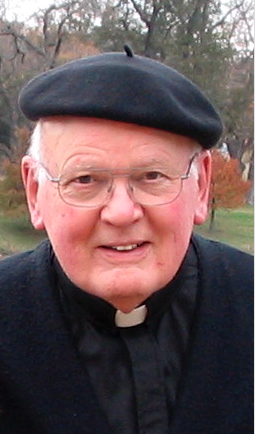
Father Robert I. Bradley died on December 20, 2013, at the Jesuit Center in Los Gatos, California at the age of 89. One hour later, he appeared to one of his many nieces, having possibly spent that hour, and that hour only, in Purgatory. His niece woke up and saw Father at the foot of her bed dressed in his black clerics. “Father Bobby, what are you doing here?” she asked. “You’re supposed to be in California.” He answered, “My body is in California, but I’m in Heaven, and it’s very beautiful and peaceful here.” Then he disappeared. Five hours later, she received a call informing her that her uncle had passed. The niece, who had grown lukewarm in her faith, began going to daily Mass after that.
Later that same day Father Bradley appeared to his niece Betty, the editor of Our Lady’s Psalter, as she was driving her car. Stopped at an intersection, Betty saw two men on donkeys in the middle of the crossing: Saint Joseph on a brown donkey and Father Bradley, dressed in white, on a white donkey. Both smiled at her before disappearing into thin air. When Betty got home, the phone was ringing. Answering it, she learned that her uncle had died hours earlier. Betty speculates that the vision involved donkeys because Father Bradley’s little brother Don died at the age of three from a burst appendix in 1932 on the Feast of the Holy Innocents, but before passing away, Don told his parents that Saint Joseph had visited him and told him he was taking him to Heaven to ride on his donkey.
Quite the family, and quite the man. I am confident that Our Lady’s Psalter will have the same effect on your heart and the hearts of your loved ones as a direct visit from this holy priest.
This review originally appeared in The Latin Mass magazine 34:4 (Christmas 2025), pp. 68-69. Many thanks to its editors for allowing its publication here.
Notes
[1] Hickson, Robert. “Remembering Father Robert Bradley, S.J. and His Distinctive Manner of Prudence.” Catholicism.org, February 8, 2014. Retrieved August 17, 2025 from https://catholicism.org/remembering-fr-bradley.html, p. 3.
[2] Hickson, p. 1.

Saturday, October 18, 2025

Rosary in Chant, Second and Expanded Edition

Back in November 2023, I announced a wonderful new resource: a booklet, Sanctissimum Rosarium in Cantu, that sets the Latin prayers of the Rosary to Gregorian chant psalm tones, in order to make the chanting of it very easy to do. All that would be needed for a chanted Rosary—the Apostles’ Creed, the announcing of the mysteries, the Pater Noster, the Ave Maria, the Gloria Patri, the Salve Regina (simple, solemn, monastic), and the prayer after the Rosary—was included.

The reception was overwhelming. Many found it ideal for long hikes or pilgrimages, a rosary rally, or even the long drive to Mass on Sunday, where the additional time involved in singing the prayers would not feel out of place, as it might in a standard group or individual recitation.

However, certain readers contacted the publisher and suggested a larger selection of chants. We listened carefully to the wish lists, and got to work!

Our newly-released second edition—a conveniently-sized 5” x 7” book with a new cover—has more than twice the content, including:
  • 2 settings of the Apostles’ Creed
  • Latin announcements for the 15 traditional mysteries
  • Psalm-tones for the prayers in all 8 modes plus the Tonus peregrinus and Tonus in directum
  • Four settings of the Salve Regina (simple, solemn, monastic, and Dominican)
  • Gregorian antiphons for each of the 15 mysteries, as an alternative way to announce them and to establish the psalm tone to be used, for variety’s sake
  • The Hymn from the Divine Office on the feast of the Most Holy Rosary
  • The Litany of Loreto in chant
  • Various additional tones for the Pater Noster, the Hail Mary, and the Gloria Patri (include the Chartres Ave Maria)
  • The Fatima prayer in three different Latin versions, set to all 8 psalm tones (thus completing what is necessary for a COMPLETELY SUNG Rosary!)
Lastly, alongside the paperback, we have introduced a hardcover edition for those who prefer that format.

To peak inside or to purchase your copies (including bulk discounts on the paperback), visit the product page at Os Justi Press.

One advantage of ordering from Os Justi (as opposed to Amazon, where the book is also available) is that bulk discounts are available: 10% off for 11-19 copies, 20% off for 20+ copies.
 

Tuesday, October 07, 2025

Pope Leo XIII on the Holy Rosary 2025

As has now been our tradition for several years, we commemorate the feast of the Holy Rosary with some excerpts from one of the encyclicals on the subject by His Holiness Pope Leo XIII (1878-1903). Altogether, he wrote eleven of these, all published in September (except one, at the very end of August), looking forward to the feast, which in his time was kept on the first Sunday of October. In 1911, with the reform of the breviary and liturgical calendar, his successor Pope St Pius X fixed it to October 7, the date of the famous Battle of Lepanto which it commemorates.
The following is an excerpt from the last such encyclical, that of 1898, Diuturni temporis. The pope seems to write as if he expects to die soon, and thus, as if this will be his last opportunity to address a subject so near and dear to his heart. By the autumn of 1898, he was more than half-way through the 21st year of his reign, which had surpassed the length of all but eight previous papacies. For many centuries, it was part of the papal coronation ritual that as soon as the cardinal archbishop of Ostia had placed the crown on the new pope’s head, he would say to him, “Numquam videbis annos Petri. – Thou shalt never see the years of Peter”, since no pope had ever surpassed St Peter’s 25 years as bishop of Rome. However, Leo’s predecessor, Bl. Pius IX, did surpass that mark in 1871, and then continued for more than 6½ beyond that. This custom was removed from the coronation rite, and Leo himself reached exactly 25 years and 4 months.

Looking back over the long space of time which by God’s will we have passed in the supreme pontificate, we cannot but acknowledge that, despite our demerits, we have enjoyed the most powerful protection of divine Providence. This We deem must be attributed principally to the united, and therefore most powerful, prayers, which, as once for Peter (Acts 12, 5), so now also for ourselves, are uninterruptedly poured forth by the universal Church. Wherefore we first of all give the greatest thanks to God, the giver of all good things, and as long as life lasts, we shall cherish in mind and heart all things received from Him. Then there comes to our mind the sweet remembrance of the august Queen of Heaven’s motherly protection; and this memory likewise we shall dutifully preserve inviolate, thanking her and proclaiming her benefits. From her, as from an abundant spring, are derived the streams of heavenly graces. “In her hand are the treasures of the Lord’s mercies” (St John Damascene, sermon 1 on the Nativity of the Virgin). “God wishes her to be the beginning of all good things.” (St Irenaeus, Contra Valen., 1, 3. 33) In the love of this tender mother, which We have constantly striven to foster and increase day by day, we confidently hope to end our days.
For a long time, desiring to place the welfare of human society in an increase of devotion to the Virgin, as in a mighty fortress, we have never ceased to promote the custom of the Marian Rosary the among the Christian faithful, by publishing encyclical letters on this subject since September 1, 1883, … And since God’s merciful counsel once this year again allows us to see the approaching month of October, which we have already consecrated to the Heavenly Queen of the Rosary, we would not refrain from addressing you;

Driven, therefore, by a constant desire that the Christian people should ever be convinced of the power and dignity of Mary’s Rosary, having first recalled that the origin of this prayer is divine rather than human, we showed it to be an admirable garland woven from the Angelic Salutation, interspersed with the Lord’s Prayer, and joined to the observance of meditation, and a form of prayer most powerful and particularly fruitful for the attainment of immortal life. For besides the excellence of the prayers, it affords a suitable protection of the faith, and an outstanding model of virtue through the mysteries proposed for contemplation. (We showed) further how easy the devotion is and how suited to the character of the people, since it offers them an absolutely perfect model of domestic life in consideration of the Holy Family of Nazareth, and that therefore the Christian people has never failed to experience its most salutary power.
The Feast of the Rosary, 1506, by the German painter Albrecht Dürer
For these reasons especially, we have repeatedly encouraged the recitation of the Holy Rosary, and have endeavored to increase its dignity by a more solemn cult, following in this the footsteps of our predecessors. For just as Pope Sixtus V of happy memory approved the ancient custom of reciting the Rosary, and Gregory XIII dedicated a feast to this title, which Clement VIII then inscribed in the martyrology, Clement XI ordered to be kept by the universal Church, and Benedict XIII inserted into the Roman Breviary, so did we, in perpetual testimony of our affection for this devotion, command that the same solemnity with its office should be celebrated in the universal Church as a double of the second class, and will that the entire month of October be consecrated to this devotion. Finally, we ordered that the invocation “Queen of the most Holy Rosary” be added to the Litany of Loreto an augury of victory in our present warfare.

The Pope goes on to say that he intends to publish an apostolic constitution which will enumerate the rights, privileges and indulgences which are enjoyed by the members of the various Rosary sodalities.

Let this constitution of ours be a testimony of our love for the most august Mother of God, and at the same time offer both encouragement to all the Christian faithful and a reward of their piety, so that in the last hour of life they may be relieved by her assistance and able most sweetly to rest in her embrace.
Having heartily besought these things from Almighty God through the Queen of the most Holy Rosary, as an earnest and pledge of heavenly blessings, venerable brethren, to your clergy and to the people entrusted to the care of each one of you, we lovingly impart the apostolic benediction.

Monday, October 06, 2025

Art and Music for First Vespers of the Most Holy Rosary

Just in time for First Vespers of the feast of the Most Holy Rosary, these paintings by an artist I had never heard of before showed up on a social media group about art that I belong to. They are the works of a late Gothic German painter who is traditionally referred to as the Master of the Polling Panels. (Polling is the name of the Bavarian town, about 33½ miles southwest of Munich, where they were originally displayed.) The article about them on German Wikipedia says that this artist has recently been identified as a painter from Munich named Hans Gleismüller, and this identification has generally been accepted; he was active ca. 1440-70. These four panels were most likely originally part of a shrine, which has long since been dismantled. The first panel, as you can see, gives the date 1444.

The Annunciation
The Birth of Christ
The Adoration of the Magi
The Presentation in the Temple
In the Office of the Most Holy Rosary, the hymn for First Vespers has five proper stanzas (plus the standard doxology for feasts of the Virgin), each of which is about one of the Joyful Mysteries. The hymn for Matins covers the Sorrowful Mysteries, and the hymns for Lauds the Glorious Mysteries, while the hymn for Second Vespers summarizes all fifteen. The first three were written by an Italian Dominican friar named Augustine Thomas Ricchini (1695-1779), and the fourth by his confrere Eustachio Sirena; the English translation given here is by Alan McDougall (1895-1964).

Caelestis aulae Nuntius,
arcana pandens Numinis,
plenam salutat gratia
Dei Parentem Virginem.
The Messenger from God’s high throne
his secret counsel making known
hails Mary, child of David’s race,
God’s Virgin Mother, full of grace.
Virgo propinquam sanguine
matrem Ioannis visitat,
qui, clausus alvo, gestiens
adesse Christum nuntiat.
The Mother Maid with joyous feet
her friend, John’s mother, goes to greet;
he, stirring in the enclosing womb,
declares that Christ his Lord has come.
Verbum, quod ante saecula
e mente Patris prodiit,
e Matris alvo Virginis,
mortalis Infans nascitur.
The Word, who ere the worlds began,
from God the Father’s thought forth ran,
of Mary, Virgin undefiled,
for us is born a mortal child.
Templo puellus sistitur,
Legique paret Legifer,
hic se Redemptor paupere
pretio redemptus immolat.
Christ to the Temple courts they bring;
the King’s own law subjects the King;
the world’s Redeemer for a price
is there redeemed, our sacrifice..
Quem iam dolebat perditum,
mox laeta Mater invenit
ignota doctis mentibus
edisserentem Filium.
The joyful Mother finds once more
the Son she mourned as lost before;
while doctors by His speech were shown
the mysteries they had never known.
Jesu, tibi sit gloria,
qui natus es de Virgine,
cum Patre, et almo Spiritu,
in sempiterna saecula. Amen.
All honor laud, and glory be,
o Jesu Virgin-born, to Thee;
all glory, as is ever meet,
to Father and to Paraclete. Amen.

Monday, October 07, 2024

Pope Leo XIII on the Holy Rosary 2024

In the course of his Papacy, the fourth longest in history, Pope Leo XIII (1878-1903) issued eleven encyclicals on the Rosary, in the years 1883, ’84 and ’87, and then each year from 1891-98. All of them were published in September (except one, at the very end of August), looking forward to the feast of the Holy Rosary, which in his time was kept on the first Sunday of October. The feast was later fixed by Pope St Pius X to October 7, the date of the famous Battle of Lepanto which it commemorates, inter alia. Much of what Pope Leo writes is every bit as germane to the condition of the Church and society as it was when it was written over a century ago. In keeping with our custom of several years’ standing, we mark this great feast with an excerpt from one of them, the 1891 Encyclical Octobri mense adventante, in my own corrected translation. (On the Vatican’s website you can read the full text in Latin, and a rather sadly bowdlerized English version of it.)

At the coming of the month of October, which is consecrated and dedicated to the most Blessed Virgin of the Rosary, we are greatly pleased to recall how greatly in preceding years We have commended to you, venerable brethren, our wish that the faithful throughout the world, urged by your authority and by your zeal, should redouble their piety towards the great Mother of God, the mighty helper of the Christian people, and should pray to her throughout the month, and invoke Her by that most holy rite of the Rosary, which the Church, especially in uncertain and most difficult times, has ever used and celebrated for the accomplishment of all desires.
This year once again do We take care to publish Our wishes, once again to encourage you by the same exhortations. We are urged and persuaded to this in love for the Church, whose sufferings, far from being mitigated, increase daily in number and in gravity. Well-known to all are the evils we deplore: war made upon the sacred dogmas which the Church holds and transmits; derision cast upon the integrity of that Christian virtue which she has in keeping; … attack made, with most impudent audacity and criminal malice against Christ Himself, as if to utterly abolish or destroy from its foundation the Divine work of His Redemption – that work which, indeed, no adverse power shall ever destroy.

The Battle of Lepanto, by Paolo Veronese, ca. 1572, now in the Academy Gallery in Venice
No new events are these for the Church militant. Jesus foretold to His disciples that She must enter upon a daily battle and struggle in order to teach men the truth and guide them to eternal salvation. And indeed, throughout the course of ages She fights undaunted, even to martyrdom, rejoicing and glorying in nothing more than the fact that She can dedicate Her own blood along with her Founder’s, wherein She holds the most certain hope of the victory promised to Her. …

Through this storm of evils, in the midst of which the Church struggles so fiercely, all her devout children see by how holy a duty they are bound to pray to God with greater instance, and especially the reason for which they must strive to give to their prayers the greatest possible efficacy. Faithful to the example of our most religious fathers and elders, let us have recourse to Mary, our holy Sovereign. Let us call upon Mary, the Mother of Christ and our own, and with one heart beseech Her, “Show thyself to be a mother; through Thee, may He accept our prayers Who, born for us, consented to be Thine.” (from the Vesper hymn of the Office of the Virgin Mary Ave, Maris Stella) …

Now, among the several rites and manners of paying honor to the Divine Mother, since some are to be preferred, inasmuch as we know them to be more powerful and more pleasing to Her, for this reason We specially mention by name and recommend the Rosary … which recalls to our minds the great mysteries of Jesus and His Mother, their joys, sorrows, and triumphs... As the faithful devoutly call to mind and contemplate these august mysteries, it is wondrous to see how great is the aid they receive in the nourishment of their faith, in defense against ignorance and the disease of error, and in the lifting up and supporting of the mind towards virtue.

Indeed, the thought and memory of him who thus prays, enlightened by the light of the Faith, are drawn towards these mysteries with the greatest joy and zeal, are fixed and absorbed therein, and cannot sufficiently wonder at the ineffable work of the Redemption of mankind, achieved at such a price and by events so great. Then the mind is filled with gratitude and love before these proofs of Divine love; its hope is strengthened and increased; its desire is increased for the heavenly rewards which Christ has prepared for those who have united themselves to Him by the imitation of His example and the sharing of His sufferings. Prayer is poured forth in the midst of these things by words coming from God Himself, from the Archangel Gabriel, and from the Church; full of praise and of saving petitions, it is renewed and continued in an order at once fixed and various, and the fruits of its devotion are ever new and sweet.

Monday, March 25, 2024

New Printing of “The Liturgical Rosary”

I wish that I could wish my readers a blessed feast of the Annunciation, but this year, as happens often enough, the feast is catapulted to the Monday after the Easter Octave, so, April 8. Nevertheless, our Byzantine brethren continue to observe it, and a Marian post does not seem unfitting.

Back in October 2023, I announced at NLM the publication of Arouca Press’ unique devotional book The Liturgical Rosary. (You can read about its contents there.) The popularity of the book was such that within weeks the first printing had been sold out.

Happily, Arouca has done a second printing of the book, but this time, with an imitation leather cover, thin Bible paper, and gold edges. It is more compact than the first edition. Here are some photos.

Order exclusively here from Arouca Press. Shipped from the USA. International shipping available. Bulk discount prices are calculated automatically during checkout.

God bless Arouca Press and the Slaves of the Immaculate Heart of Mary!

Visit Dr. Kwasniewski’s Substack “Tradition & Sanity”; personal site; composer site; publishing house Os Justi Press and YouTube, SoundCloud, and Spotify pages.

Monday, November 06, 2023

The Rosary in Gregorian Chant Psalm-tones


Note to readers: a second, revised and expanded edition of this rosary chant booklet has been released. Read about it here. The remainder of the article below is out of date.

To join the welcome news last month about The Liturgical Rosary from Arouca Press, I am very pleased to be able to share today another wonderful resource just released from Os Justi Press: a booklet that sets the Latin prayers of the Rosary to Gregorian chant psalm tones (all eight modes and the tonus peregrinus), in order to make the chanting of it very easy to do. Everything that would be needed for a chanted Rosary—the Apostles’ Creed, the announcing of the mysteries, the Pater Noster, the Ave Maria, the Gloria Patri, the Salve Regina (simple, solemn, monastic), and the prayer after the Rosary—is present here.

I would think this is optimal for something like a long hike or pilgrimage, a rosary rally, or even a long drive, where the additional time involved in singing the prayers would not feel out of place, as it might in a standard group or individual recitation.

The compiler asked to remain anonymous out of humility, but if you have any reactions or suggestions for the booklet, please send them to me, and I will gladly discuss them with him.

The full booklet, Sanctissimum Rosarium in Cantu, of 46 pages, may be freely downloaded here, formatted for letter-sized (8.5" x 11") paper. The handy 4" x 6" pocket-sized booklet with a simple blue cover may be purchased at $5 from Os Justi Press (here), or from Amazon (here). One advantage of ordering from Os Justi is that bulk discounts are available: 10% off for 11-19 copies, 20% off for 20+ copies.

Some sample images (click to enlarge):


Visit Dr. Kwasniewski’s Substack “Tradition & Sanity”; personal site; composer site; publishing house Os Justi Press and YouTube, SoundCloud, and Spotify pages.

Thursday, October 26, 2023

The Origin of the Carthusian Rosary

After seeing our post earlier this month about the Carthusian Rosary, reader Benjamin Whitworth very kindly sent us this translation of part of a treatise about it. This is an excerpt from the Liber Experientiae, the 15th-century autobiography of a Carthusian monk named Dominic of Prussia, who is credited with inventing the particular manner of saying the Rosary observed by the Order.

The Carthusian Rosary
From the Book of Experience by Dominic of Prussia (1384-1460), Carthusian monk of Trier. ~ From the 38th narration: Concerning the experience of true devotion.
Old man: […] This brother Rupert [this is how Dominic refers to himself], of whom I have spoken, generally used to have a devotion to the humanity of Christ and his cross, except when the Lord drew him towards some deeper theme of meditation. This was because one day, when he was singing the Gloria in excelsis in choir with the others, he lifted up his thoughts to our Lord’s sitting upon the right hand of the Father in heaven, and only with the greatest difficulty was he able to bring his mind back down to earth. For he had arrived at such a dizzy height, that he felt as if his heart were closed up, and as if his access to the cross were shut off, so that only by long effort did he succeed in returning to the state of devotion that he was formerly accustomed to. Unless the Lord draws someone’s mind upwards to himself and in himself, it is risky for that person to raise his attention to the purely divine and heavenly mysteries. Therefore he no longer ventured forward without, as it were, leaning on the staff of the holy Cross. Every day he thought and meditated on the Incarnation and Passion of Christ, and on the things that the Lord Jesus Christ did so humbly in this life for our salvation. He preached and said many good things about these matters. He was the first who added those meditations and clausulæ (little clauses) on the life of Jesus to the Rosary of blessed Mary, which we have used in saying this devotion, and still do.
The apse and altar of the Charterhouse of Garegnano outside Milan, with the Crucifixion, Resurrection and Ascension of Christ, all by Simone Peterzano, 1578. Photo by Nicola de’ Grandi.   
Just how many good things come from this, in heaven and on earth, was revealed on his deathbed to a Vicar of this House (Adolf of Essen, who had previously been Prior of this House, and who had received the same brother Rupert into the Order). He was a devout man and an intimate friend of God, and was often rapt into the heavens, as we discovered after his death from his writings. And among other things that he was shown by God, he once saw in the heavens how the glorious Mother of God, Saint Mary, with all her Virgins, and with all the holy Angels and Saints, sang the Rosary very devoutly, with its clausulæ, before the most high God enthroned, adding Alleluia to every clausula, that is, to all fifty. And each time the name of blessed Mary was named, they all bowed their heads very deeply. When, further, the name of Jesus was named, they all bent their knees very devoutly, according to the exhortation of the Apostle, who said: In the name of the Lord every knee should bow, of those that are in heaven, on earth, etc. (Phil. 2, 10) He both saw and heard that they all gave boundless thanks to almighty God for the universal benefits that flow from this same Rosary, since God and our Lord Jesus Christ are praised and blessed in it, along with his most holy Mother, in all that he did or suffered in this world for the whole human race, as it is always said at the end of the angelical salutation, “Blessed art thou among women and blessed is the fruit of thy womb Jesus Christ,” and there is added: “who did this or that, who suffered this or that,” according as his life is recounted in order from beginning to end.
The Virgin Mary and Saints within a Rosary; German woodcut, ca. 1500. Public domain image from the website of the National Gallery of Art.
Wherefore, not unduly do the Saints themselves dance in the heavens with inexpressible joy, and on earth many, busy with the same exercise, are filled with admirable grace and devotion, for it has been spread now to various parts of the world, and disseminated by our own writings for about thirty years. Indeed the Saints, as that father heard, prayed to the Lord with feelings of great devotion for those who occupy themselves with this Rosary, asking that the Almighty would deign to enlighten and strengthen such devotees with his special grace, so that they might always profit from this or from other good exercises and persevere to a happy end, and especially that they might be happy in heaven after this life. He also saw in the heavens countless, very beautiful, imperishable, flowering, shining and sweet-smelling crowns, resting on those who perform this Rosary to the praise of God and his Mother, Saint Mary. And as often as one of them completed such a thing, so often one of these Crowns was added to the ones already resting on their head, to be kept with them. And that father was told that, of a certainty, any person saying the Rosary in this way, and conforming himself to the power of the Saints in the observances spoken of above, will be given full remission of all his sins, as often as he shall do it. That father had prayed for and obtained bodily strength and courage, and peace of heart, that he might serve God his Maker faithfully. And it was not without great wonderment that we saw him, an old man and full of years, who had borne the burden of the Order for more than 40 years, yet able to work harder than anyone, despite eating and sleeping less than we young ones. Many of us saw in him this extraordinary gift of grace, but we did not understand where he got it from, until after his death we found out from his writings, etc.
So what could we more usefully do in this fleeting time, than to say this Rosary, which might take no longer than it would to celebrate or hear a Mass? For as we read in other revelations, the Lord has told certain devout souls that nothing pleases him as much, as someone devoutly reflecting on the benefits done to himself and to others, and thanking God for each one of them. This is what we are doing succinctly in the present very devout little work, in which, as I have said above, we bless and praise the Lord Jesus Christ in all his deeds, and salute and honour his holy Virgin Mother with blessings.
Young man: I can well believe that we can hardly do anything in this passing hour that is more pleasing to God and useful to ourselves, or that anything can give us more joy and consolation in the doing of it, since the angelical salutation itself is such a sweet utterance, and reflecting on the life of Jesus is fruitful and delightful above all other things. Blessed be God, then, who in these latter days, to stir up our hearts from their numbness, has deigned to pour out so much grace upon us, that if we are not moved to devotion by his present gifts, we might at least be drawn onwards by the greatness of his future promises. Therefore may his name be blessed for ever. Old man: Amen.
Here follows the Rosary of blessed Mary, of which mention was made in the 38th narration, above.
HAIL Mary, full of grace, the Lord is with thee. Blessed art thou among women, and blessed is the fruit of thy womb, Jesus Christ,
  1. Whom thou didst conceive by the Holy Spirit, as the Angel announced. Amen.
  2. Whom having conceived, thou didst go into the hill country to Elizabeth. Amen.
  3. Whom thou didst bear joyfully, ever remaining a holy virgin in mind and body. Amen.
  4. Whom thou didst worship as thy Creator, and didst feed at thy virginal breasts. Amen.
  5. Whom thou didst swaddle in cloths, and didst place in the manger. Amen (this is always added at the end).
  6. Whom the angels praised, singing Glory in the highest, and the shepherds found in Bethlehem.
  7. Who was circumcised on the eighth day and called Jesus.
  8. Who was worshipped by the three wise men reverently offering their threefold gifts.
  9. Whom thou didst carry to the temple in thy motherly arms, and didst present to God his Father.
  10. Whom Simeon the old man took into his arms and blessed, and the widow Anna recognised.
  11. With whom thou didst flee from before the face of Herod into Egypt.
  12. With whom, after seven years, thou didst return to thy homeland, summoned back by an angel.
  13. Whom, in his twelfth year, thou didst lose in Jerusalem, and after seeking him sorrowfully for three days thou didst find him again in the temple.
  14. Who progressed day by day in age, grace and wisdom in the sight of God and of men.
  15. Whom John baptized in the Jordan, pointing him out as the Lamb of God.
  16. Who fasted for forty days in the desert, and whom Satan thrice tempted there.
  17. Who, having gathered disciples from here and there, preached the kingdom of heaven to the world.
  18. Who gave light to the blind, cleansed lepers, cured paralytics and delivered all those who were oppressed by the devil.
  19. Whose feet Mary Magdalene washed with her tears, dried with her hair, kissed and anointed with ointment.
  20. Who resuscitated Lazarus after four days, and other dead people.
  21. Who, on the day of palms, was received by the people with great honour, sitting on a donkey.
  22. Who instituted the worshipful Sacrament of his Body and Blood at his last supper.
  23. Who went into the garden with his disciples, and, praying there at length, sweated a bloody sweat.
  24. Who spontaneously went to meet his enemies, and willingly gave himself up into their hands.
  25. Whom the servants of the Jews roughly tied up, and the chief priests led away bound.
  26. Whom they accused with false testimonies, hooded, spat at, and rained blows and slaps upon.
  27. Whom they proclaimed a criminal malefactor, deserving of crucifixion, before Pilate and Herod.
  28. Whom, having been stripped of his clothes, Pilate had scourged harshly and for a long time.
  29. Whom the servants crowned with thorns, and, his having been dressed in some discarded purple cloth, worshipped in mockery.
  30. Whom they condemned unjustly to a most shameful death, and led out with two unrighteous men.
  31. Whom they nailed to the cross by his hands and feet, and offered wine mixed with myrrh or gall.
  32. Who prayed for those who crucified him, saying: Father, forgive them, for they know not what they do.
  33. Who said to the thief on his right hand: Amen I tell thee: today thou shalt be with me in Paradise.
  34. Who said to thee, his most holy Mother: Woman, behold thy son. And to John: Behold thy mother.
  35. Who cried out: Eli, Eli, lema sabacthani? That is, [My God, my God, why hast thou forsaken me?].
  36. Who said: It is finished.
  37. Who said at last: Father, into thy hands I commit my spirit.
  38. Who died a most bitter and most sacred death for us miserable sinners. Thanks be to God.
  39. Whose side the soldier opened with a lance, and blood and water flowed therefrom for the remission of sins.
  40. Whose most sacred body was taken from the cross, and returned lifeless to thy bosom (as is called the pietà).
  41. Whom righteous and holy men buried, his having been embalmed with spices and wound in a shroud.
  42. Whose grave the Jews sealed up and defended with guards.
  43. Whose most holy soul descended into hell, and comforting the holy fathers led them out with him into Paradise.
  44. Who rose again on the third day, and gladdened thee with inestimable joy. Alleluia.
  45. Who appeared many times to his disciples and faithful believers after his resurrection, and confirmed their hearts in the holy faith.
  46. Who ascended to the heavens in their sight, with thee present and looking on, and sitteth at the right hand of the Father.
  47. Who sent the Holy Spirit to his faithful from the heavens on the day of Pentecost, as he had promised them.
  48. Who at last assumed to himself, called to his right hand, and gloriously crowned thee his most sweet Mother.
  49. Who will deign, at thy intercession, likewise to assume us, his servants and thine, after the course of this wretched life, and settle us in the kingdom of his Father.
  50. Who with the Father and Holy Spirit, and thee, his most glorious Mother, liveth and reigneth an invincible and glorious King, world without end. Amen.
The Coronation of the Virgin, by Jacopo di Mino del Pelliciaio, active in Siena and Umbria in the mid-14th century. Public domain image from Wikimedia Commons.
How the aforesaid Rosary first had its origin, the following exemplum shows.
A CERTAIN man in secular life had the habit of making a chaplet of roses or other flowers, which he would place on an image of blessed Mary with great devotion. Having entered religious life, where he was prevented, by the duty of obedience, from doing this, he was so saddened that he even wished to return to the world. Having thought this over, a certain good man gave him some wholesome advice, namely to remain in the religious life, and to say fifty Ave Marias in place of the previous chaplet, promising him that this would please our Lady more than any material chaplet. When he had been doing this for some time, it happened that the same laybrother was riding through a wood where there were robbers hiding. When he had tied up his horse, and was saying the Rosary of Blessed Mary on his knees, the robbers hastened from afar and would have preyed upon him. But behold! they saw a beautiful virgin standing by him, and after a little while they saw that she was frequently picking up lovely Roses that fell from his mouth, and weaving them into a chaplet. When it was finished, she placed it on her head and ascended into the heavens. They drew near full of wonder, and asked him what he was doing, and who might be the virgin that they had seen. He said that there was no virgin with him, but they forced out of him that he had been making a spiritual chaplet for the Queen of Heaven, as was his wont. Then they related to him what they had seen, and strongly confirmed him in this kind of holy service to the Mother of God. They themselves, as might well be believed, changed their way of life for the better. This miracle being published, as one can read, this Rosary first began to be practised by pious and devout servants of Mary. Later a certain brother of the Carthusian Order, for the sake of greater devotion and attention, added the life of our Lord Jesus Christ, according as it has been set out above. Hence this Rosary is much honoured, and received with great effect by our glorious Lady, her Son, and all the knights of the heavenly court, as is described above in the little book of experience, in the thirty-eighth narration.
The Assumption of the Virgin Mary, by Biagio Bellotti (1714-89), also in the Charterhouse of Garegnano. Photo by Nicola de’ Grandi. 
How is this Rosary to be performed?
Whoever, then, wishes to take up this little exercise so pleasing to God and the Saints, and to carry out this Rosary to the praise and glory of God and the Virgin Mary, his Mother, should say the Angelical salutation fifty times, and after each, add any one of the clausulæ on the life of Christ set out above. It is not necessary to observe the form of words laid out for this Rosary either here or elsewhere, but each person can prolong the theme, shorten it, or change it for the better, according to the grace and devotion that the Lord has given him or her; many people have done so, uttering in words the life of the Saviour or silently meditating upon it in thought, now this way, now another way, according to the grace, ability and time that they have. One could hardly find a better way of spending the present moment than by saying this Rosary, for, as has been said, it is pleasing to God and his Saints in heaven, and for those saying it, it is very useful and fruitful, and finds great favour with God, to the increase of their devotion and the improvement of their life, as experience has shown in many examples both of the living and of those now dead.
It is mentioned in the revelations of some devout souls, that nothing pleases God more than a person’s recollecting frequently the good things the Lord has done for the world, and giving thanks for each one. And we do this in the present brief exercise, when at the end of each angelical salutation we say, “… and blessed is the fruit of thy womb Jesus Christ, who did this or that, or suffered this or that,” as above. Constantly praising and blessing the Lord and his most holy Mother in this way, we are beneficiaries of the promise once pledged to the prophets, for it was about our Lord Jesus Christ, and for us, that the Patriarch Isaac prophesied, saying: let him that blesseth thee be filled with blessings, etc. [Gen 27.29]. And he who soweth in blessings, as the Apostle says, shall also reap eternal life in blessings [2 Cor 9.6]. And whoever will crown Christ the King and the Queen of Heaven with this rosy crown, will deserve to be crowned by them in turn with the unfading crown of life in eternity. Amen.
Blessed be the name of our Lord Jesus Christ, world without end. And may the name of his Mother, the most glorious Virgin Mary, be blessed and remain so in eternity. Amen.

Monday, October 16, 2023

The Liturgical Rosary: A Unique New Devotional Book

A blogger once wrote: “We should liturgize devotion as far as we can, rather than devotionalize the liturgy.”

I was thinking about this sentiment when Alex Barbas of Arouca Press asked me if I would contribute a Foreword to a fascinating manuscript that he sent me. It takes the form of praying the Rosary, but within the framework of the liturgical calendar and the Divine Office, drawing heavily upon their texts as a source of enrichment. The goal is not to change anything about how the Rosary is prayed—all the same prayers are used—but, in the manner of a Scriptural Rosary, to bring it into closer connection with the Missal, the Hours, and even the music of the Roman Rite (since we are given concrete means for singing the Rosary or at least parts of it ad libitum: something I can see have great application in school settings or on pilgrimages).

Once I saw the manuscript, I eagerly agreed. And after a long and involved process of typesetting and publishing with offset printing in India, the book is finally finished:

The Liturgical Rosary: Meditations for Each Hour, Day & Season of the Liturgical Year, edited by the Slaves of the Immaculate Heart of Mary.

An overview of the Contents:

Foreword by Dr. Peter Kwasniewski: Should the Laity Pray the Breviary or the Rosary?
The Prayers of the Rosary in English and Latin
A Simple Method of Chanting the Rosary with Suggested Rubrics and Antiphons
The Fifteen Promises of Our Lady to Those Who Pray the Rosary
The Fifteen Mysteries of the Rosary Synoptically Recounted
Meditations Taken from…
 Each of the Canonical Hours for Each of the Days of the Week
• The Votive Masses for the Days of the Week
• Each of the Feasts of the Sanctoral Cycle
• Each of the Feasts of the Seasonal Cycle: Advent Through Pentecost
• The Common Masses of the Blessed Virgin Mary
• The Common Masses of the Saints
The Votive Masses for Various Occasions, Including…
• For the Defense of the Church
• For Peace
• For the Sick
• For Pilgrims and Travelers
• For Any Necessity
• Of Thanksgiving
• For a Baptism
• For the Reception of Holy Matrimony
• In Preparation for Death

Details: 4.25 x 6.73 trim size | 528 pages | Paper type: 60gsm uncoated white | Black calf-skin cover | Alpha PU (Gold foiling) | Section Sewn | Hard Bound (Round Back) | HT Band & 3 Ribbons: Blue, Red & Black

$39.95 USD per copy (retail)
Bulk discounts applicable at checkout:  5–9 copies: $29.95 USD; 10 or more copies: $22.95 USD
Below are some pages from the book. I encourage lovers of the Rosary and of the traditional liturgy to pick up a copy. You can find a preview at the publisher's website; below are some further examples of pages.
(the 15 Scripture verses line up with the 15 mysteries)


Our Lady of the Most Holy Rosary, pray for us!

Visit Dr. Kwasniewski’s Substack “Tradition & Sanity”; personal site; composer site; publishing house Os Justi Press and YouTube, SoundCloud, and Spotify pages.

Saturday, October 07, 2023

Pope Leo XIII on the Holy Rosary 2023

As has now been our tradition for several years, we commemorate the feast of the Holy Rosary with some excerpts from one of the encyclicals on the subject by His Holiness Pope Leo XIII (1878-1903). Altogether, he wrote eleven of these, all published in September (except one, at the very end of August), looking forward to the feast, which in his time was kept on the first Sunday of October. In 1911, with the reform of the breviary and liturgical calendar, his successor Pope St Pius X fixed it to October 7, the date of the famous Battle of Lepanto which it commemorates. Much of what Pope Leo writes is every bit as germane to the condition of society and the Church as it was when it was written over a century ago. The following is an excerpt from the 1892 Encyclical Magnae Dei Matris, with a few corrections of the English translation given on the Vatican’s website, where you can also read the full text in Latin.

It is now only too plain how many and of what nature are the corrupting agencies by which the wickedness of the world deceitfully strives to weaken and completely uproot from souls their Christian faith and the observance of God’s law on which that faith is fed is brought to fruitfulness. Already the Lord’s fields are everywhere turning into a wilderness abounding in ignorance of the Faith, in error and vice, as though blown upon by a most foul plague. And to add to the anguish of this thought, so far from putting a check on such insolent and destructive depravity, or imposing the punishment deserved, they who can and should correct matters seem in many cases, by their indifference or open connivance, to increase the spirit of evil.

We have good reason to deplore the public institutions in which the teaching of the sciences and arts is purposely so organized that the name of God is passed over in silence or disparaged; to deplore the license - growing more shameless by the day - in publishing or speaking any kind of insult to Christ our God and His Church. And We deplore no less the consequent laxity and apathy in the practice of the Catholic religion which if not quite open apostasy from the Faith, will most certainly lead there, since it is a manner of life having nothing in common with faith. Nobody who ponders this disorder and the surrender of the most fundamental principles will be astonished if afflicted nations everywhere are groaning under the heavy hand of God’s vengeance and stand anxious and trembling in fear of worse calamities.
The Fifteen Mysteries and the Virgin of the Rosary; Netherlandish, ca. 1515-20, possibly by Goswijn van der Weyden (active by 1491, died after 1538). Public domain image from Wikimedia Commons.
Now, to appease the might of an outraged God and to bring that health of soul so needed by those who are sorely afflicted, there is nothing better than devout and persevering prayer, provided it be joined with a love for and practice of Christian life. And we deem that both of these, the spirit of prayer and the practice of Christian life, are best attained through the Mary’s Rosary. ...

When we have recourse to Mary in prayer, we are having recourse to the Mother of mercy, who loves us so well that, whatever the necessity that presses upon us especially in attaining eternal life, She is instantly at our side of her own accord, even though she has not been invoked. She dispenses grace with a generous hand from that treasure with which from the beginning she was divinely endowed in fullest abundance that she might be worthy to be the Mother of God. By the fullness of grace which confers on her the most illustrious of her many titles, the Blessed Virgin is infinitely superior to all the hierarchies of men and angels, the one creature who is closest of all to Christ. “It is a great thing in any saint to have grace sufficient for the salvation of many souls; but to have enough to suffice for the salvation of everybody in the world, is the greatest of all; and this is found in Christ and in the Blessed Virgin.” (St Thomas Aquinas, opus vij de Salutatione Angelica) ...

It is scarcely possible to say how pleasing and gratifying to her it is when we greet her with the Angelic Salutation, “full of grace”; and in repeating it, fashion these words of praise into crowns for her. For every time we say them, we recall the memory of her exalted dignity and of the Redemption of the human race which God began through her. We likewise bring to mind the divine and everlasting bond which links her with the joys and sorrows, the humiliations and triumphs of Christ in directing and helping mankind to eternal life. ...

Therefore, let us approach Mary confidently, wholeheartedly beseeching her by the bonds of her motherhood which unite her so closely to Jesus and at the same time to us. Let us with deepest devotion invoke her constant aid in the prayer which she herself has indicated and which is most acceptable to her. Then with good reason shall we rest with an easy and joyous mind under the protection of the best of mothers.

Friday, October 06, 2023

The Carthusian Rosary

Since today is the feast of St Bruno, and tomorrow is that of the Holy Rosary, it seems like a good day to share an article I stumbled across some time ago on the Carthusian Rosary. Many religious orders have traditionally used a form of rosary different from that of the Dominicans, which is of course the most widely known and practiced; the Franciscans have a Crown of the Seven Joys, the Servites that of the Seven Sorrows. The day after tomorrow is the feast of St Bridget of Sweden, and Tuesday was St Thérèse of Lisieux, both of whose orders have a rosary that is like the Dominican one, but with six mysteries per set; the Immaculate Conception is added as the first Joyful Mystery, the removal of Christ’s body from the Cross as the last Sorrowful, and the Virgin’s Patronage of the Order as the last Glorious.

The Carthusian Rosary, with the austerity which characterizes everything about the Order’s way of life, has 50 Aves, and a different “mystery” for each one. In some places, it is the custom to interpolate into the Hail Mary a few words which refer to the particular mystery, as e.g. “Ave Maria, gratia plena... Jesus, qui resurrexit a mortuis. Sancta Maria etc.” for the Resurrection, or “Jesus, quem Virgo concepisti” for the Annunciation. In the article, you can find a list of fifty such interpolations, along with a bit more history of the Carthusian rosary; here are just the first three.

1. … Jesus, conceived of the Holy Spirit during the Annunciation of the Angel.
2. … Jesus, who together with you who has conceived him, visits Saint Elizabeth.
3. … Jesus, to whom you, virgin in body and soul, have given birth with joy.

From a post in July of 2016, here are a couple of historical images from the Charterhouse of Barcelona, these photos show Carthusians with their rosaries, in choir in the first image, and in the cell in the second.

Friday, October 07, 2022

Pope Leo XIII on the Holy Rosary 2022

As has now been our tradition for several years, we commemorate the feast of the Holy Rosary with some excerpts from one of the encyclicals on the subject by His Holiness Pope Leo XIII (1878-1903). Altogether, he wrote eleven of these, all published in September (except one, at the very end of August), looking forward to the feast, which in his time was kept on the first Sunday of October. In 1911, with the reform of the breviary and liturgical calendar, his successor Pope St Pius X fixed it to October 7, the date of the famous Battle of Lepanto which it commemorates.
The following is an excerpt from the last such encyclical, that of 1898, Diuturni temporis. The pope seems to write as if he expects to die soon, and thus, as if this will be his last opportunity to address a subject so near and dear to his heart. By the autumn of 1898, he was more than half-way through the 21st year of his reign, which had surpassed the length of all but eight previous papacies. For many centuries, it was part of the papal coronation ritual that as soon as the cardinal archbishop of Ostia had placed the crown on the new pope’s head, he would say to him, “Numquam videbis annos Petri. – Thou shalt never see the years of Peter”, since no pope had ever surpassed St Peter’s 25 years as bishop of Rome. However, Leo’s predecessor, Bl. Pius IX, did surpass that mark in 1871, and then continued for more than 6½ beyond that. This custom was removed from the coronation rite, and Leo himself reached exactly 25 years and 4 months.

Looking back over the long space of time which by God’s will we have passed in the supreme pontificate, we cannot but acknowledge that, despite our demerits, we have enjoyed the most powerful protection of divine Providence. This We deem must be attributed principally to the united, and therefore most powerful, prayers, which, as once for Peter (Acts 12, 5), so now also for ourselves, are uninterruptedly poured forth by the universal Church. Wherefore we first of all give the greatest thanks to God, the giver of all good things, and as long as life lasts, we shall cherish in mind and heart all things received from Him. Then there comes to our mind the sweet remembrance of the august Queen of Heaven’s motherly protection; and this memory likewise we shall dutifully preserve inviolate, thanking her and proclaiming her benefits. From her, as from an abundant spring, are derived the streams of heavenly graces. “In her hand are the treasures of the Lord’s mercies” (St John Damascene, sermon 1 on the Nativity of the Virgin). “God wishes her to be the beginning of all good things.” (St Irenaeus, Contra Valen., 1, 3. 33) In the love of this tender mother, which We have constantly striven to foster and increase day by day, we confidently hope to end our days.
For a long time, desiring to place the welfare of human society in an increase of devotion to the Virgin, as in a mighty fortress, we have never ceased to promote the custom of the Marian Rosary the among the Christian faithful, by publishing encyclical letters on this subject since September 1, 1883, … And since God’s merciful counsel once this year again allows us to see the approaching month of October, which we have already consecrated to the Heavenly Queen of the Rosary, we would not refrain from addressing you;

Driven, therefore, by a constant desire that the Christian people should ever be convinced of the power and dignity of Mary’s Rosary, having first recalled that the origin of this prayer is divine rather than human, we showed it to be an admirable garland woven from the Angelic Salutation, interspersed with the Lord’s Prayer, and joined to the observance of meditation, and a form of prayer most powerful and particularly fruitful for the attainment of immortal life. For besides the excellence of the prayers, it affords a suitable protection of the faith, and an outstanding model of virtue through the mysteries proposed for contemplation. (We showed) further how easy the devotion is and how suited to the character of the people, since it offers them an absolutely perfect model of domestic life in consideration of the Holy Family of Nazareth, and that therefore the Christian people has never failed to experience its most salutary power.
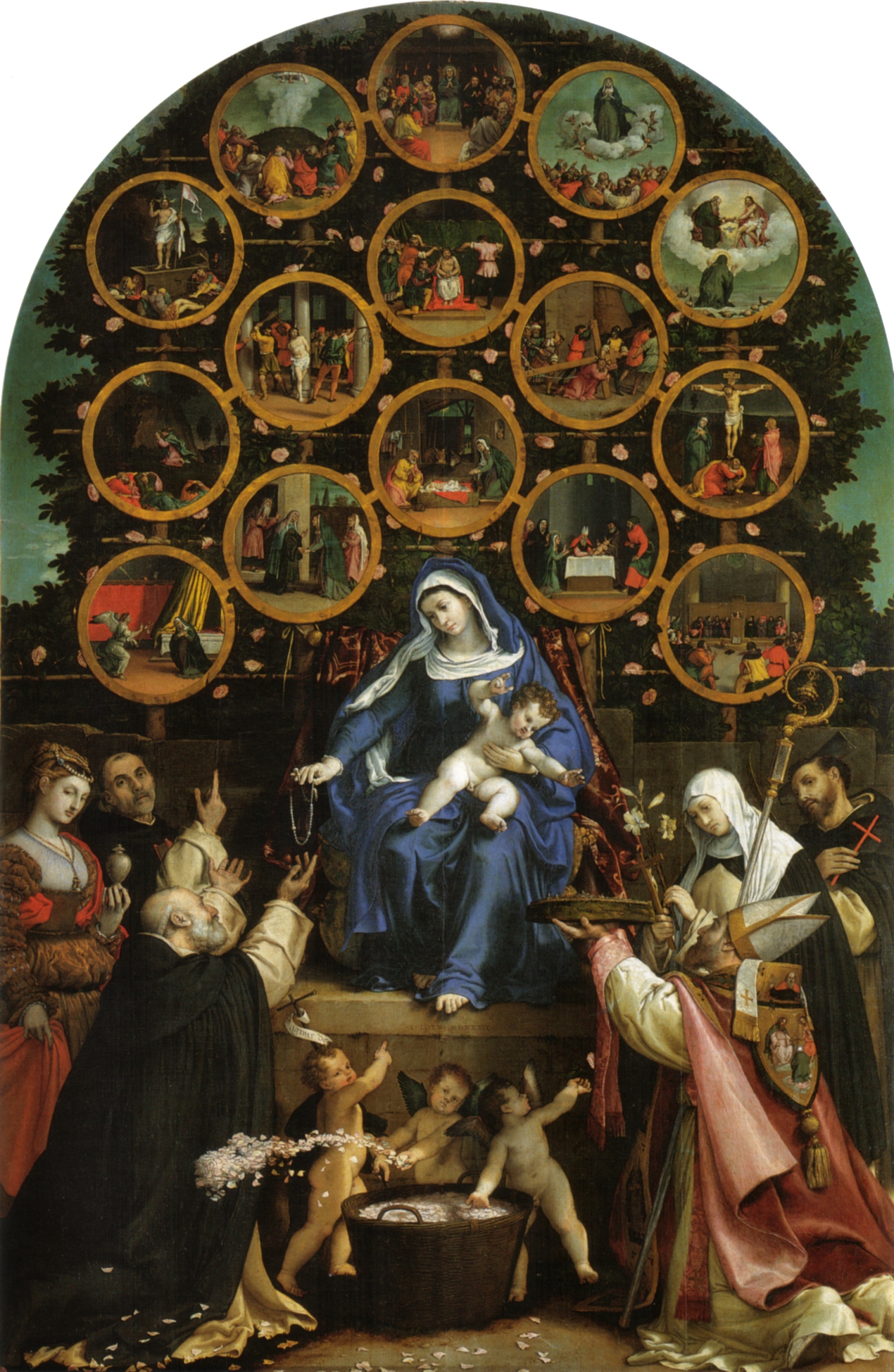
The Madonna of the Rosary, by Lorenzo Lotto, 1539
For these reasons especially, we have repeatedly encouraged the recitation of the Holy Rosary, and have endeavored to increase its dignity by a more solemn cult, following in this the footsteps of our predecessors. For just as Pope Sixtus V of happy memory approved the ancient custom of reciting the Rosary, and Gregory XIII dedicated a feast to this title, which Clement VIII then inscribed in the martyrology, Clement XI ordered to be kept by the universal Church, and Benedict XIII inserted into the Roman Breviary, so did we, in perpetual testimony of our affection for this devotion, command that the same solemnity with its office should be celebrated in the universal Church as a double of the second class, and will that the entire month of October be consecrated to this devotion. Finally, we ordered that the invocation “Queen of the most Holy Rosary” be added to the Litany of Loreto an augury of victory in our present warfare.

The Pope goes on to say that he intends to publish an apostolic constitution which will enumerate the rights, privileges and indulgences which are enjoyed by the members of the various Rosary sodalities.

Let this constitution of ours be a testimony of our love for the most august Mother of God, and at the same time offer both encouragement to all the Christian faithful and a reward of their piety, so that in the last hour of life they may be relieved by her assistance and able most sweetly to rest in her embrace.
Having heartily besought these things from Almighty God through the Queen of the most Holy Rosary, as an earnest and pledge of heavenly blessings, venerable brethren, to your clergy and to the people entrusted to the care of each one of you, we lovingly impart the apostolic benediction.

More recent articles:

For more articles, see the NLM archives: