Friday, February 18, 2022

Sacra Liturgia San Francisco: June 28 - July 1

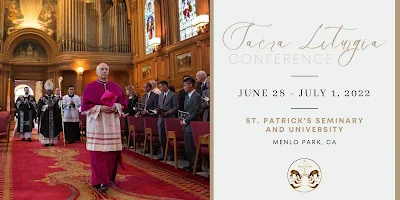
This year’s Sacra Liturgia conference, sponsored by His Excellency Archbishop Salvatore Cordileone, will take place in his episcopal city of San Francisco from June 28 to July 1; registrations are now open via the conference website: https://www.sacraliturgiasf.com/

The Sacra Liturgia conference, founded by Dom Alcuin Reid, is an internationally recognized center of intellectual excellence in liturgical scholarship. Beautiful Masses are celebrated with excellent choirs so Catholics can experience the power of the Eucharist in a new way. The conference will take place from June 28 to July 1 at St Patrick’s Seminary in Menlo Park, close to Stanford University. Among this year’s roster of speakers features Cardinal Robert Sarah, Cardinal George Pell, Bishop Steven Lopes, Dom Alcuin Reid, Father Joseph Fessio, Jennifer Donelson-Nowicka, Msgr. Gerard O’Connor, Duncan Stroik and more. Renowned choral conductor Martin Baker, past president of the British Royal College of Organists and until recently Master of Music at Westminster Cathedral, will conduct singers from the Sacred Music Project in a Mass celebrated by Cardinal Pell. The final Mass will feature new music by Frank La Rocca, composed in honor of St Junipero Serra (Missa Sancti Juniperi Serra), and be celebrated by the conference host, Abp Cordileone, on St Junipero’s feast day, July 1, at the historic Mission Dolores which the Saint founded in 1776. Richard Sparks will conduct the Benedict Sixteen Choir and Orchestra.

The conference schedule can be found here: https://www.sacraliturgiasf.com/schedule
Options before and after the conference include: an tour of beautiful churches of San Francisco, available on the afternoon of the 28th; a reception with Kansas City Chief kicker Harrison Butker after the final Mass; a sacred music concert conducted by Martin Baker featuring the works of living Catholic composers. Ticket holders will be emailed information about these before and after events. Accommodation should be booked separately.

Wednesday, April 28, 2021

Cardinal Pell and Bishop Strickland at Catholic Family Conference, May 1, Irving, Texas (and Online)

The 2nd annual Catholic Family Conference, presented by Regina Caeli Academy and Carmel Communications, will be held on Saturday, May 1, 2021 at the Westin Irving Convention Center, located at 400 West Las Colinas Blvd in Irving, Texas.

Cardinal George Pell and Bishop Joseph Strickland headline this year’s conference. Last year’s fully virtual event attracted over 40,000 people; the 2021 conference offers attendance virtually or in-person. Dr. Ralph Martin, Noelle Mering, Trent Horn, and Steve Ray are among the impressive lineup of speakers.

The purpose of the conference is “to inspire, strengthen and enlighten families with the truths of the Faith.” In this year of St Joseph, the Catholic Family Conference will consider in a special way this patron of the Universal Church and head of the Holy Family. The speakers, both lay leaders and prelates of the Church, will address the concerns, struggles, and joys facing today’s Catholic families in a world and culture that are rapidly changing.

Visit the website to register and learn more about this exciting event!

Thursday, May 26, 2016

St Philip’s Day at the London Oratory Celebrated by Cardinal George Pell

Pontifical High Mass was celebrated by Cardinal George Pell at the London Oratory this evening for the Feast of St Philip Neri. The Choir and Orchestra of the London Oratory sang the Theresienmesse by Haydn and Pangamus Nerio by Wingham. Happy Feast to all Oratorians!


Thursday, November 05, 2015

Card. Burke on the 50th Anniversary of Sacrosanctum Concilium - Fota VI Proceedings Launched in Rome

The St Colman’s Society for Catholic Liturgy has sent us the following press release concerning the recent presentation at the Basilica of St Clement in Rome of the Proceedings of the Sixth Fota International Liturgy Conference. The conference was was held in Cork, Ireland from July 6-8, 2013, to mark the 50th anniversary of the promulgation of Sacrosanctum Concilium, the Second Vatican Council’s Constitution on the Sacred Liturgy. The text was presented by His Eminence Raymond Cardinal Burke, who had a number of very interesting things to say about the implementation of the Constitution; the full text of his presentation is given below.

The Proceedings of the Sixth Fota International Liturgy Conference were launched by His Eminence Raymond Leo Cardinal Burke at the Collegio di San Clemente in Rome on Wednesday evening, 28 October 2015.


The event was introduced and chaired by His Eminence George Cardinal Pell.

An overview of the work of the Fota Conference was presented by Mons. James O’Brien. He noted that the objective of the conference was to promote the liturgical vision of Pope Benedict XVI through its annual gathering and through the publication of the acta of the conference as well as through other studies published through Smenos Publications (www.smenospublications.com). He thanked the editor of the sixth volume in the Fota series, Fr. John Cunningham, OP, prior of San Clemente and professor at the Angelicum for having agreed to act as editor and for the competence with which he carried out his task despite simultaneous work on three other publications.

Sacrosanctum Concilium: The Sacred Liturgy and the Second Vatican Council was envisaged as a commemorative volume to mark the 50th anniversary of the publication of the conciliar constitution on the Sacred Liturgy. Through a range of subjects, it seeks to demonstrate how the hermeneutic of continuity operates in the interpretation of this important document – especially by setting it in its historical and theological context which includes the pre-conciliar magisterium, especially of Popes Pius XII and Pius X and the Council of Trent. Moreover, that same context includes the post conciliar applicative instructions issued by the Holy See and the magisterium of Popes John Paul II and Benedict XVI.

Fr. John Cunningham, OP, referred to the extensive range of topics covered in the collection of essays which makes up the volume Sacrosanctum Concilium: The Sacred Liturgy and the Second Vatican Council. He made particular reference to the assistance the book provided to students of both liturgy and theology through its scholarly critical apparatus which gave ample research opportunities. The editor expressed the wish that the book would be widely read by all who seek to promote the Sacred Liturgy rather than remain an unread classic.

Cardinal Burke’s ample presentation of the Fota VI volume paid particular attention to the objectives of the council Fathers in drawing up Sacrosanctum Concilium and the manner in which they envisaged their task of renewing the Sacred Liturgy in harmony and continuity with the received teaching and practice of the Church. He spoke also of the ecclesial and social context of the early 1960s in which Sacrosanctum Concilium was published and implemented. The Cardinal then turned to the difficulties encountered in attempting to give faithful execution to the constitution’s objectives, and pointed to the abuses of interpretation and application often encountered in the liturgical reform of the 1970s as well as to the critique of some interpretations of the constitution cogently made in the writings of Joseph Ratzinger/Pope Benedict XVI as well as to his call for a recovery of an hermeneutic of continuity in order rightly to understand the conciliar constitution and apply it faithfully. He then gave a short synopsis of the various contributions (see attached text).

H.E. Raymond Cardinal Burke, H.E. George Cardinal Pell, and Fr John Cunningham O.P.
Cardinal Pell closed the proceedings and thanked Fr. John Cunningham for his valuable editorial work and for having brought the volume to a successful conclusion. Copies of the book are available at pre-publication discount from www.smenospublications.com.

Cardinal Burke’s Presentation

Sacrosanctum Concilium: Sacred Liturgy and the Second Vatican Council contains the Proceedings of the Sixth Fota International Liturgical Conference, held at Cork City in Ireland in early July of 2013. The annual conference in 2013 was devoted to the commemoration of the 50th anniversary of the promulgation of the Constitution on the Sacred Liturgy, Sacrosanctum Concilium, of the Second Vatican Ecumenical Council on December 3, 1963. The eleven essays which comprise the volume not only treat the contents of this important document on the highest and most perfect expression of the Christian life, the Sacred Liturgy, but they also seek to recover the true nature of the reform which the Council Fathers intended and to implement it in fidelity to the teaching, not the so-called “spirit,” of the Council. The liturgical theology of Joseph Ratzinger which inspired the inauguration of the Fota International Liturgical Conference clearly points the way to the recovery of the reform desired by the Council.

Pope Benedict XVI manifested the legacy of his teaching on the Sacred Liturgy in a remarkable manner by his Apostolic Letter, given motu proprio, Summorum Pontificum of July 7, 2007, and the subsequent legislation for its implementation, the Instruction Universae Ecclesiae of the Pontifical Commission Ecclesia Dei. Sadly, after the Second Vatican Ecumenical Council, many abuses in the celebration of the Sacred Liturgy took place. Pope Benedict XVI made explicit reference to the situation in his Letter to the Bishops of the world, at the time of the promulgation of the Apostolic Letter. Writing about the desire of some of the faithful for the form of the Sacred Liturgy existing before the post-Conciliar reforms, he affirmed:
Many people who clearly accepted the binding character of the Second Vatican Council, and were faithful to the Pope and the Bishops, nonetheless also desired to recover the form of the sacred liturgy that was dear to them. This occurred above all because in many places celebrations were not faithful to the prescriptions of the new Missal, but the latter actually was understood as authorizing or even requiring creativity, which frequently led to deformations of the liturgy which were hard to bear. I am speaking from experience, since I too lived through that period with all its hopes and its confusion. And I have seen how arbitrary deformations of the liturgy caused deep pain to individuals totally rooted in the faith of the Church.
There is no doubt that, at the time of the post-Conciliar reform of the Sacred Liturgy, in many placesthere was a lack of liturgical discipline, and many abuses were introduced which led the faithful to believe that the Church had abandoned her theocentric liturgical tradition and embraced a totally new anthropocentric approach. From my own experience, as a seminarian during the years of the implementation of the reform mandated by the Council, I, too, can say that the infidelity to the reform gave place to liturgical aberrations which were indeed difficult to bear and were profoundly harmful to the Catholic faith and its practice.

Wednesday, July 08, 2015

Third Report from the Fota Liturgical Conference

Our coverage of the Fota Liturgical Conference in Cork, Ireland, which concluded on Monday, is slightly delayed for the sake of yesterday’s  important anniversary. Here are the official press releases from the St Colman’s Society for Catholic Liturgy, reporting on the two sessions held on Monday, July 6th. (All photos by Mr John Briody.)

The fifth session of the Fota International Liturgy Conference took place on Monday morning, 6 July 2015, chaired by His Eminence George Cardinal Pell and moderated by Professor Manfred Hauke. Two papers were presented, one by His Eminence Raymond Leo Cardinal Burke, the other by Fr. Sven Conrad, FSSP.

H.E. Raymond Cardinal Burke and Fr Sven Conrad F.S.S.P. 
Cardinal Burke’s submission, entitled Selected Canonical Questions regarding the Royal Priesthood of the Baptized, described how canonical discipline offers nothing original to the question of the royal priesthood of the baptised but rather safeguards and fosters the theological reality. The canonical discipline serves, in a particular way, the equal dignity of all the baptised and the distinction of two states of life: the lay state, the consecrated state and the clerical state. The distinction between the lay state and the clerical state belongs to the divinely established hierarchical structure of the Church. The consecrated state does not belong to the hierarchical structure of the Church but to the holiness of the Church. The lay faithful, under the care and direction of the Bishops and Priests, carry out the apostolate for the sanctification of the temporal order. The lay faithful can operate in the exercise of the clerical office but they cannot substitute for it. Such collaboration must carefully avoid any confusion about the irreplaceable service of the ordained. The liturgical expression of the priesthood of the baptised is acturna participatio, the union of heart with the glorious pierced heart of Jesus. In the post-conciliar implementation, a certain confusion of the lay and clerical states has entered into the life of the Church to the serious harm of Church life.

Fr. Conrad’s paper, entitled Ministry as an Expression of the Common Priesthood or of the Ordained Ministry? A Review of the Minor Orders, began by noting that the term ‘ordo’, always used to denote the sacrament in question and its related grades, has much philosophical impact. The term is also important for describing the social structure of the Roman Empire. Both aspects are linked to the Church’s own terminology. Fr. Conrad showed that the peculiar symbiosis between the new Christian ministry and the terminology of the ancient social structure tends to prove that the liturgy was understood as ‘cultus publicus.’

He then summarized the history of the minor orders, which are all mentioned in a letter of Pope Cornelius as early the year 251. The paper then considered the changes made by Pope Paul VI. and with the questions arising from those changes.

In developing some basic points of the theology of minor orders, the paper referred both to the classical meaning of sacramentals and the definition of sacramentals as found in Sacrosanctum Concilium (no. 60). They are sacramentals which ‘in aliquam Sacramentorum imitationem’ refer to the sacrament of the priesthood and not to baptism. Being sacramentals, the minor orders are expressions of the Church’s intention in certain matters (e.g. the struggle against evil). Therefore the existence of the minor orders or their non-existence is linked with the cultic power of the Church in general. Reducing the minor orders weakens the Church’s own cult-power.

The sixth session of the Conference, held in the afternoon, was chaired by His Eminence Raymond Leo Cardinal Burke and moderated by Professor Rodney Lokaj. It commenced with a paper by Professor Manfred Hauke which was followed by submissions from His Eminence George Cardinal Pell and Fr. João-Paolo Mendonça Dantas.

Sunday, July 05, 2015

First Report from Fota VIII

The St Colman Society for Catholic Liturgy has very kindly sent us the following summaries of the papers delivered yesterday at the Fota VIII Liturgical Conference, currently happening in Cork, Ireland. The subject of the conference this year is A chosen race, a royal priesthood, a holy nation: Aspects of the Priesthood of Baptism. This is, of course, a topic of prime importance for consideration of modern liturgical practice and liturgical reform, in light of the many ways in which the “priesthood of all the baptized” has been misused and misconstrued to justify various abuses, and promote dubious ideas about the nature of the Liturgy and the Mass. (All photos by Mr John Briody.)

The eighth Fota International Liturgy Conference was opened this morning by His Eminence Raymond Leo Cardinal Burke.

The initial session of the conference heard two papers on the scriptural aspects of the priesthood of Baptism. The papers were delivered by Fr. Joseph Briody, of St. John’s Seminary, Brighton, Massachusetts, and by Professor Dieter Böhler, SJ, of the Philosophisch-Theologische Hochschule Sankt Georgen, Frankfurt.

Fr. Briody’s paper was entitled The priesthood as a central dimension of biblical revelation:an overview of the royal priesthood of the faithful in Sacred Scripture. In it, he emphasized that the priesthood is not a peripheral biblical theme, but a central dimension of biblical revelation, and gave an overview of the priesthood in Sacred Scripture, with emphasis on the royal priesthood shared by the people of God.

The paper illustrated that from the beginning, man is presented as both priestly and kingly (Genesis 1-2). The priestly system, especially in Leviticus, was about relationship with the Lord and living in the presence of the Holy One. With the disappearance of the monarchy, the intercessory role of kings is taken over by the priests, and then, by all the people, especially in the praying of the royal psalms and transmission of the wisdom tradition. Later post-exilic times look to a messianic figure, both royal and priestly. Exodus 19:5-6 is examined in some detail, since it provides the background for royal priestly texts in the New Testament.

The royal priesthood is what defines the relationship of Christians to God and is what manifests the lordship of the Lamb. Hebrews, 1 Peter and Revelation develop the royal priesthood imagery, indicating that man’s destiny is the holy priesthood around the throne of God in heaven. The Bible concludes with the New Jerusalem where there is no Temple because the Lord God and the Lamb are the Temple and all present there are priests. The communion with God, sought but unachieved by Old Testament sacrifice, is realised. The fulfilment of Christian life is in becoming “priests of God and of Christ.” The royal priesthood is in fact the key to the scroll that is history.

The Old Testament distinction between the priesthood shared by all the people and the divinely willed “ministerial priesthood” of the few is maintained and developed in the New Testament.

Fr Joseph Briody and Fr Thomas McGovern
Professor Böhler’s paper, entitled A Kingdom of Priests: (Ex 19:6). Priesthood and Royalty of God's People in the Old (MT, LXX, Tg) and New Testament compared the Hebrew Text of Exodus 19:6 with its Greek and Aramaic versions (the Septuagint and the Targum respectively) and investigated how the First Letter of Peter in chapter 2: 5,9 adopts the Greek version of the text, while St John’s Revelation seems to follow a kind of Targumic reading.

The Hebrew text calls Israel “a kingdom of priests and a holy nation.” This double expression most probably does not mean two synonyms, but, rather, two complementary entities which together form a whole: namely a priestly government for a sacred people. The Greek translation, however, interprets the Hebrew text in the sense of three synonyms: Israel is to be for God “a kingdom”, where God is king, “a priesthood”, probably mediating between God and the nations, and “a sacred people.” The priestly government of the Hebrew text has become in the Septuagint a priesthood of all Israel as a whole towards humanity. In the New Testament, 1 Peter 2:5,9 takes over the Old Testament expression in its Greek form, and more or less with the sense the Septuagint had given it.

The Aramaic versions of the Old Testament interpret Exodus 19:6 as attributing to the Israelites the dignities of kings and priests. This kingship then is not God’s any more over Israel, but a dignity of the Israelites over the nations. Israel’s priesthood as well becomes in the Targum a dignity of the individual Israelites. It is more or less in this sense that John’s Revelation in 1:6, 5:10 and 20:6 takes over the Old Testament idea of Ex 19:6.

Professor Böhler
Both papers were followed by lengthy discussions moderated by His Eminence George Cardinal Pell.
In the afternoon, two further papers were read by Fr. Thomas McGovern, of Dublin, Ireland, and by Professor Rodney Lokaj of the University of Enna “Kore”, Sicily.

In his paper entitled The Priesthood of the Laity: Holiness in Work, and the Challenge of the Secular, Fr Thomas McGovern emphasized the importance of the of the universal call to holiness in the teaching of the Second Vatican Council and its significance for lay people.

All are called to the fullness of the Christian life. Since the great majority are immersed in temporal activities, they are called to holiness, not in spite of their ordinary circumstances, but indeed precisely in and through their daily commitments.

Sanctity is not something for a privileged few. Since Baptism is a true entry into the holiness of God through incorporation in Christ and the indwelling of his Spirit, it would be a contradiction to settle for a life of mediocrity, marked by a minimalist ethic and a shallow religiosity. The Second Vatican Council emphasized the full implications of Baptism for the laity, of their vocation to holiness in the middle of the world. The vocation of the lay faithful to holiness implies that a life according to the Spirit expresses itself in a particular way in their involvement in temporal affairs and in their participation in earthly activities. Neither family concerns nor other secular affairs should be excluded from their religious programme of life.

The paper pointed to the importance of the sanctification of work as an environment in which the laity can seek holiness. A spirituality of work helps all people to come closer through work, to God, the Creator and Redeemer, to participate in his salvific plan for man and the world, and to deepen their friendship with Christ in their lives.’

The secularity of the laity is what gives them their distinctive characteristic in the Church. It is a state of life that identifies their vocation and mission on the basis of the baptismal consecration common to all. It also specifies the vocation by which they are called to work.

Prof. Rodney Lokaj
Professor Lokaj’s paper was entitled Early Franciscan preaching: an anomaly in canon law. It showed that the Franciscan sources contain many allusions to early preaching practices before and after Francis obtains his verbal authorisation from the Holy See to embrace the vita vere apostolica. These practices were carried out by Francis either on his own or with others who were in turn authorised to preach independently of the founder of the movement. The anomaly in canon law naturally consists in the fact that neither Francis nor many of his early brethren were ordained and yet they freely preached, thus creating what would otherwise seem to be a parallel with the many heretical movements abounding at the time.

The watershed in the founder’s life seems to be the episode recounting his renouncement of his father’s worldly possessions. It was then that, in rather dramatic circumstances and terms, Francis’ nakedness was literally and metaphorically cloaked by bishop Guido of Assisi. The sources and subsequent critical literature universally accept this episode as symbolising the fact that he had been taken in under the aegis of the Church thereby becoming a type of deacon in the service of all Christians. It was as such, furthermore, that the sources also implicitly explain his preaching to Clare. The paper pointed to the early sources indicating that such preaching was carried out in the company of other followers and that only later did successive sources speak of Francis and Clare on their own as if Clare’s conversion had been occasioned exclusively by Francis. The paper explored instances of early preaching practices within the Franciscan movement, then Order, including the initial attempts to preach within the Clarian community at Saint Damian’s.

The ensuing discussion was moderated by His Eminence George Cardinal Pell. The session was closed by His Eminence Raymond Leo Cardinal Burke. The first day of the Conference concluded with the celebration of Pontifical Vespers at Sts. Peter and Paul’s.

Fr McGovern, Card. Pell, Mons, James O’Brien, and Cardinal Burke
Card. Burke. Prof. Lokaj and Mons. O’Brien

Friday, October 18, 2013

Photographs of the ICEL 50th Anniversary Mass at St Peter's

Here are some photographs of ICEL's 50th anniversary Mass which took place yesterday at St Peter's, Rome. The Catholic Herald has a report here which includes Archbishop Arthur Roche's homily. Cardinal Arinze and Cardinal Pell were amongst the concelebrants. The Schola was made up of seminarians from the Venerable English College, some of whom can be seen singing a motet during Holy Communion.


Rome Reports has this video of the Holy Father's address to members of the Commission this morning. The full text of the address is here.

More recent articles:

For more articles, see the NLM archives: