Friday, May 01, 2026

Francis X. Weiser, SJ, the Domestic Heortologist, Part Two: Liturgiology

Soon I discovered that most people have no clear notion of the origin, background, and true meaning of these customs which they observe in their homes. Since the great majority of our Christmas, Easter, Thanksgiving, and other observances actually go back to the inspiration of liturgical thought and symbolism, I judged it a worthwhile subject to explain. Also a priestly subject; for, given the fact that our popular customs contain the radiation of the liturgy, the understanding of this radiation would make the celebration of our Christian feasts within the family warmer, holier, and more truly joyful. At the same time, a better grasp of the religious meaning and message of our family customs would give parents valuable help for the religious training of their little ones.
--Rev. Francis X. Weiser, SJ

Last week, we surveyed the life and writings of Fr. Francis X. Weiser, SJ, whom we have dubbed “The Domestic Heortologist.” This, week, we examine the principles undergirding his work on the liturgical year.

In the paragraph cited above, Weiser outlines four features of his liturgical works that are worth examining in detail (albeit in a different order): 1) an explanation of customs to correct widespread ignorance; 2) the formation of children; 3) the radiation of the liturgy; and 4) an emerging American melting pot of devotional practices. To these we add a fifth: Weiser’s relationship to the Liturgical Movement.
1. Correction of Ignorance
Weiser begins his Holyday Book thus:
“Many people celebrate the holydays and know their names; but of their history, meaning and origin they know nothing … Truly, such ignorance deserves to be blamed and ridiculed” – St. John Chrysostom … This book was written to provide the information which St. John would have wished the faithful to possess.
Like other voices in the Liturgical Movement, Weiser placed a premium on a historical understanding of liturgical and paraliturgical practices, and lamented the lack of historical accuracy in much of the literature on the subject. On one end of the spectrum are “viciously false” attempts to trace every Christian holiday to a pagan source; on the other are pious “etiological” explanations that substitute for careful historical research. Weiser sought a middle ground between these two extremes.
2. Formation of Children
In his publications and in his forty-year pastoral ministry to college students in Austria and the United States, Fr Weiser had an abiding interest in the formation of Catholic youth, and he saw his liturgical writings as a part of that apostolate. In one of his last books on the Church year, he writes:
Happy the children who grow up in a home that is rich in traditional celebrations! Their lives will be more full and radiant through the inspiration of this childhood experience. Faith, culture, emotional security, absorbing joy, satisfaction of mind and heart, a warm spirit of love and union in the family, sound development of character and personality traits, appreciation of true values: these are some of the fruits which a childhood of such joyful family celebrations produces.
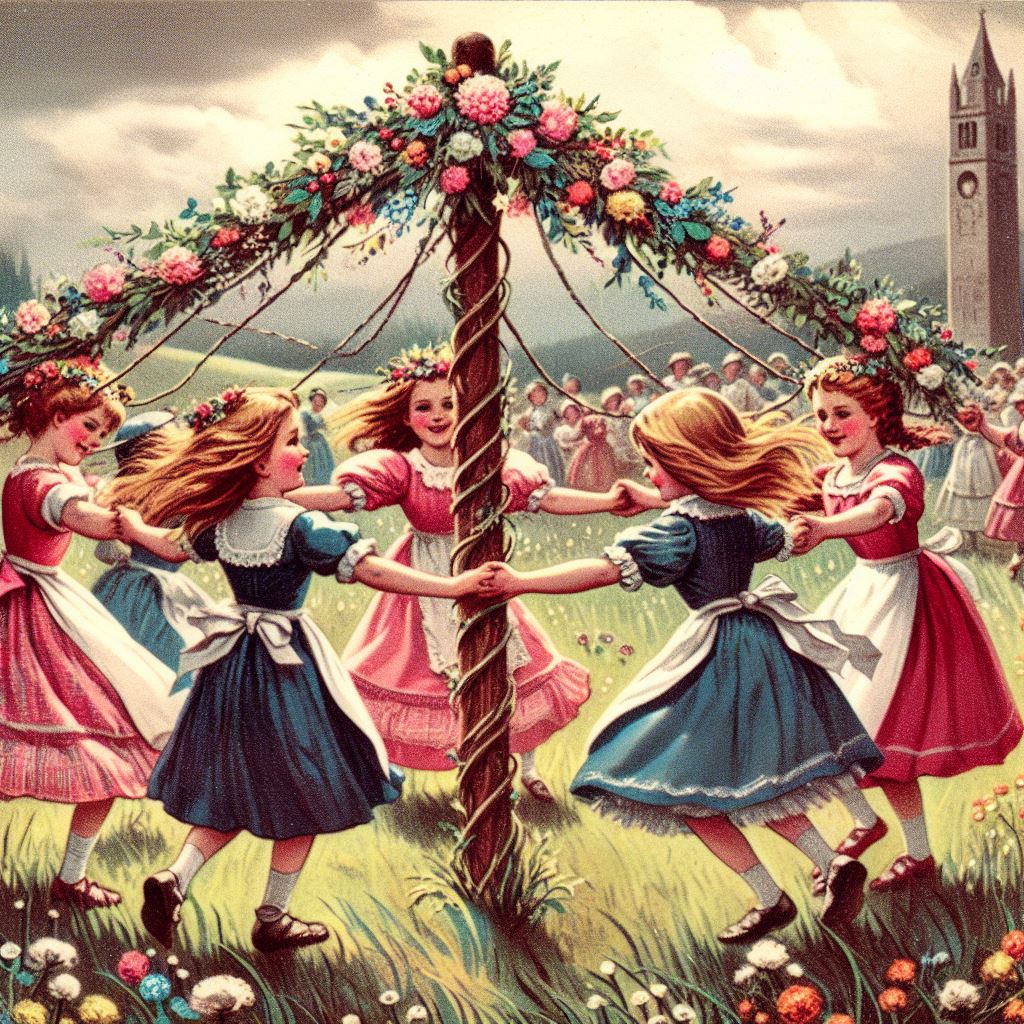
Weiser also believed that filling a home with liturgical joy was a form of evangelization. In his most popular juvenile fiction novel, Das Licht der Berge, the initially agnostic narrator Fritz describes the effect that his cousin’s pious home had on his brother Otto. Their cousin’s family observes a traditional Christmas Eve, which includes elaborately decorating the manger scene. Fritz notes that “Otto went about the job with the utmost interest. I could notice how his soul was opening out as a result of the religious atmosphere he breathed in this house.” Fritz would eventually be caught up by the same breath as well.
3. Radiation of the Liturgy
The religious atmosphere that Weiser describes is one that is informed by sacred liturgy (its rites and calendar) but separate from it. A phrase that he uses to describe the relationship between the Church’s official ceremonies and the laity’s domestic devotions is “the radiation of the liturgy into Catholic homes.” As he explains:
The radiation of liturgy has created many symbols, customs, and traditions that have enriched the observance of festive days and seasons in home and community, and remnants of pre-Christian lore have, in most cases, assumed new meanings and motivations through the influence of liturgical thought and celebration.
Therefore, Weiser concludes, understanding
this radiation would make the celebration of our Christian feasts within the family warmer, holier, and more truly joyful. At the same time, a better grasp of the religious meaning and message of our family customs would give parents valuable help for the religious training of their little ones.
Weiser’s works have been described as a study of the paraliturgical, but since the word, for some at least, denotes practices in opposition to the official liturgy, perhaps the better term is “periliturgical,” that is, customs surrounding the liturgy, like rays around the sun. In any event, his interest in the subject was shared by many Americans in the post-war era. As Msgr. Luigi G. Ligutti, leader of the Catholic rural life movement in the United States, writes in his preface to Florence Berger’s 1949 Cooking for Christ:
This book is an extension of the Missal, Breviary and Ritual because the Christian home is an extension of the Mass, choir and sacramentals. … Liturgical seasons or feast days were intended not merely for church and cloister. To be fully effective and enjoyable, they have to wrap kitchen and commons in their colorful mantle. The motto of the National Catholic Rural Life Conference is “Christ to the Country and the Country to Christ.” We paraphrase it here by saying “Christ to the Kitchen and the Kitchen to Christ.” This is reverent as well as simple.
Berger herself is more succinct: “If I am to carry Christ home with me from the altar, I am afraid He will have to come to the kitchen because much of my time is spent there.” In many respects, Weiser wrote his liturgical books for readers like Florence Berger.
4. The Melting Pot
Weiser describes American holiday life as one that is “molded into one unit out of the best national Christmas lore of various immigrant groups.” Our author wished to contribute to this eclectic molding by making people aware of the Christian meaning behind ethnic lore. His writing is at times nostalgic, but it is not antiquarian or archeologist. Despite his fond boyhood memory of the visit of St. Nicholas, for example, he does not advocate the restoration of this practice but rather “a revival of the veneration and annual celebration of the Saint, who is still patron of little children.”
Weiser was hardly alone in trying to create an American melting pot from international Catholic customs. As early as 1941, fellow emigrees like Therese Mueller published her Family Life in Christ. Of her Claudio Salvucci writes:
Having watched European parents relinquish their children’s Catholic upbringing to religious institutions, only to see the secularization of those institutions, she was keen on giving Catholicism a solid grounding within the home, including celebrating feasts, praying the Office, and maintaining a home altar. Mueller popularized the German Advent Wreath in the United States and helped standardize its violet and pink candles as an antidote to the “horrible, secularized, commercialized Santa Claus, more and more shameful each year.”
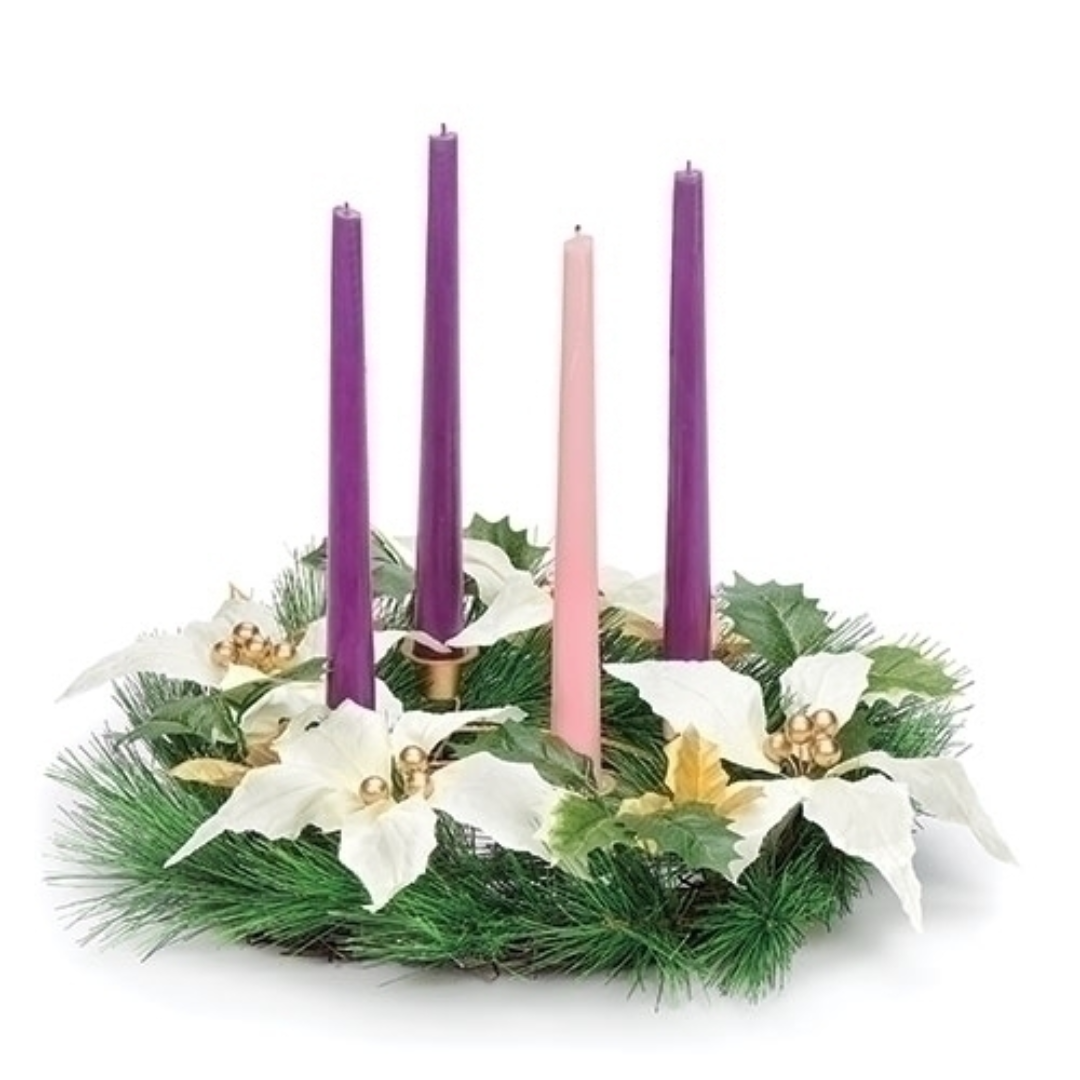
An American development: the violet and rose Advent calendar
Possibly the most famous author of this period was Weiser’s friend Maria von Trapp, who in 1955 wrote Around the Year with the Trapp Family, a compendium of periliturgical devotions. Again Salvucci:
Like Mueller, she was a German-speaking emigrant from the Hitler regime, and she had an existing, deeply Catholic Austrian cultural bank to draw from that her American friends admired. They said to her: “These lovely old folk customs of yours–couldn’t they be introduced in our homes too? They really are not necessarily Austrian or Polish or Italian–they are Catholic, which is universal.”
Kathryn A. Johnson notes that this chapter of American Catholic history was marked by a “shift from ethnic communities with special religious traditions to a ‘melting-pot’ approach to family rituals” and that popular literature was an important catalyst in this transition:
In the mid 1950s, for example, two manuals, Rev. Francis Weiser’s Religious Customs in the Family and Rev. Bernward Stokes’ How to Make Your House a Home, were published as aids “for persons whose duty it is to shape and mold the character of children.” These books covered the teaching of both general customs, like the sign of the cross and the sacraments, and special seasonal rituals, including Christmas traditions, Holy Week, and the customs of Lent. These books, and literally thousands of other books and articles—the Family Life Bureau alone published five books on family liturgical practices—taught Catholic parents “modern” ways to incorporate older customs into their homes.
5. The Liturgical Movement
Just as Weiser was responding to a moment in American history, so too was he capitalizing on and contributing to a moment in Church history. The Liturgical Movement in the United States was enjoying unprecedented popularity, with a growing thirst for the kind of information that Weiser was providing. Weiser himself supported this movement, dedicating his Holyday Book to “the Liturgical Movement in the United States.”
But Weiser was also critical of certain strains of the Liturgical Movement of his time. In an article entitled “Some Observations on Recent Literature,” he warmly welcomes the flood of literature that, like his own, attempts to enrich family life with religious customs. But he also points out three areas of concern:
First, he did not approve of trends that blurred the difference between priest and laity, liturgy and domestic custom. Some contemporary authors were advocating that the father merely repeat the words and actions of the priest at home, even to the extent of blessing an object with holy water and calling it a “sacramental.” Weiser advises caution: “It is possible that Rome will approve this new procedure. On the other hand, it might be advisable to make sure of such approval before spreading the custom too far.” Instead Weiser recommends:
Let liturgy, its thought and symbols, inspire your celebrations in the home; but instead of using liturgical texts and symbols in a mere imitation of what the priest does, create new and different forms for these thoughts and symbols in your home. (This is the way most of our beautiful customs developed centuries ago.) Know the liturgy, explain it to your children, make them love it; but don’t “perform” it vicariously in your home.
Second, Weiser was wary of unwarranted innovation,
It would seem to be of special importance that, above all else, we present the true story of these established customs and make them understood again in their original meaning. Since they exist already in millions of families, it should be comparatively easy to get our population (and not only the Catholics) interested in such explanations. Thus the radiant light of liturgical inspiration and religious thought could be rapidly spread everywhere by explaining the “old” customs before we try to introduce “new” ones.
and especially wary of innovation that arose from ignorance or haste:
Many Catholic writers, not familiar with the true history and meaning of our established festive lore, too quickly propose ready-made changes, substitutions and suppressions. The result is a confusing variety of well-meant suggestions, often advanced with more zeal than knowledge or psychological insight.
As mentioned earlier, Weiser was a student at Innsbruck of the famous Jesuit liturgical historian Josef Andreas Jungmann, to whom he dedicated his Handbook of Christian Customs:
This book is dedicated, as a belated but sincere token of gratitude, to my former professor at the University of Innsbruck (Austria), the Rev. Joseph A. Jungmann, S.J. The lasting influence of his personality and example no less than his masterful teaching inspired me, as it did many others of his former students, to attempt a modest contribution to the great task of making the treasures of holy liturgy better known and appreciated. May this handbook not only be useful to anyone seeking information and understanding of our feasts and folklore, but also help toward a joyful and fruitful celebration in our churches, hearts and homes.
His sincere gratitude, however, should not be mistaken for complete agreement. Jungmann was convinced that liturgy had become a “lifeless act” through clericalization and thus he became an advocate for sweeping liturgical reform. Weiser, as far as I can tell, does not recommend a single change to the liturgy. On the contrary, rather than see the liturgy of his day as lifeless, he saw it as radiating life and continuing to inspire personal, domestic, and cultural development around the world. “The celebration of our Christian feasts within the family [can be] warmer, holier, and more truly joyful” not through liturgical innovation but through a recovery of understanding why we do what we do.
Rev. Josef Andres Jungmann, S.J.
Reception
Weiser’s works were generally well received in the 1950s and 1960s. Nash K. Burger wrote in the New York Times:
Since books about Christmas seem as inevitable as Christmas itself, it would be well if they were all as satisfying as Francis X. Weiser’s “The Christmas Book.” Seldom have so many aspects of the origin, observance and meaning of this important Christian holy season been presented in such attractive form.
America Magazine called Handbook “a very palatable and often engrossing introduction to the liturgy”—nay more, it was “an introduction to Christian culture” that is “engagingly written.” Oxford’s Journal of Bible and Religion voiced a similar sentiment about The Holyday Book, describing it as a “a most informative and at the same time delightful book” written in a “friendly, sympathetic style” by an author who “manifests an extraordinary knowledge of languages, folklore, customs, liturgy, and even of cooking recipes” yet who “wears his scholarship gracefully and lightly.”
Responding to these compliments, Weiser revealed the “secret” of his writing as well as his perennial concern for the youth and his own high standards:
Allow me to tell you a secret. I never had the benefit of “studying” English; never had a teacher or any formal instruction in this language. All the English I know, was-to use a popular expression-just “picked up” by reading good English books. (The word “good” refers to both English and books.) That is the reason why I am now so keenly and sadly aware of the incredible harm which the atrocious language and spelling of our comic books must cause to the minds of children. If reading “good English” books gave me my knowledge of the language, what kind of language habits will the comics produce in our children?
According to the Archivum Historicum Societatis Iesu, Weiser’s biographies of famous Jesuits are brief, accurate, and designed to excite zeal for the missions. They also do a fine job relaying the facts but do not use the critical method of historical scholarship. His liturgical books are “a sketchy but deftly written survey of nativity plays, flowers, symbolic lights and fires, and Christmas foods. Although more comprehensive studies of this fascinating subject have been made by popular writers for a general public, the Christmas Book will find many interested readers among laymen of the Roman Catholic faith.” “Folklorists,” writes one reviewer, “will wish for a more detailed, carefully annotated study. The reference notes serve as a somewhat insufficient guide to the sources used in compiling the data.” “This book [in the genre] of popularization pursues a pastoral goal and includes neither a bibliography nor critical discussion,” writes another.
Aside from his own personal observations or experiences, Weiser depended on the scholarship of others to compile his overview of liturgical customs. One drawback to such a dependence is that one’s “sketches” are only as good as one’s sources; when they err, so do you. In Handbook, for example, Weiser opines that pretzels derive their name from bracellae, a supposed Latin name for “little arms.” The problem is that no such word exists in Latin; it is more probable that pretiola (“little rewards”) is the source of the word “pretzel.”
The Post-Vatican II Era
Weiser’s last monograph on heortology, The Year of the Lord in the Christian Home, appeared in 1964. After that, and aside from some miscellaneous articles on the Church, he returned to German juvenile fiction and biography: between 1966 and 1974, he published seven more books and three biographical entries for New Catholic Encyclopedia. His last book to appear in English was Kateri Tekakwitha in 1971, a translation of his 1970 Das Mädchen der Mohawks, and his last book of all was his 1974 biography of Jesuit priest and explorer Pierre de Smet, In den Bergen von Montana (In the Mountains of Montana).
In 1970 at the age of sixty-nine, Weiser retired from teaching at Boston College and moved to Campion Center in Weston: a Jesuit retirement community, the center is located on the campus of the former Weston College where he had taught twenty years earlier. (Weiser’s retirement may have had something to do with the 1967 Age Discrimination in Retirement Act, which mandated retirement at the age of sixty-five). The year that he retired, “in recognition of his scholarly and literary achievements,” his alma mater the University of Innsbruck awarded him a citation of honor and the Jubilee Medal. Francis X. Weiser, S.J. passed away on October 22, 1986 at the age of eighty-five.
It is not known why such a prolific author stopped writing on the liturgy. There may be several reasons. First, Weiser may have said all that he wanted to say on the subject. The Handbook of Christian Customs is already a thorough compendium of the entire liturgical year, and his subsequent books on periliturgical practices cover all the essentials of domestic devotion.
Second, he may have recognized that the cultural conditions that made his works popular and useful were no longer as strong. The 1950s was a great melting pot moment; the divisive 1960s was not.
But perhaps the greatest reason for Weiser’s abandonment of heortology was the general reform of the Roman Rite that was already taking place in 1964 and that would culminate with the promulgation of a new Missale Romanum in 1969. The new missal included a significantly different calendar that at times makes difficult the implementation of Weiser’s assembled folklore. Gone were the customs surrounding Septuagesima and the customs surrounding saints’ feast days, such as St. Thomas the Apostle, whose feast (once rich in winter customs) was transferred from December 21 to July 3.
That said, Weiser’s work still contains valuable information that is relevant today [even for those observing the Novus Ordo]: almost everything he says about Advent and Christmas, for example, is still applicable, even for his beloved feast of St. Nicholas. Moreover, his work remains a model for us all, whether we are scholars or simply members of the Body of Christ trying to enrich our lives with the Church’s liturgy. As he writes: “When we Catholics write about our own religious feasts and customs, the goal is to present our very best, not only in devotion and inspiration but also in scholarship.”
A version of this article (with full annotation) appeared as “The Domestic Heortologist: An Introduction to Francis X. Weiser, S.J.” in Antiphon: A Journal of Liturgical Renewal 29:2 (2025), pp. 144-171. Many thanks to its editors for allowing its publication here.

Wednesday, May 28, 2025

Why Louis Bouyer Is Delightful and Frustrating to Read

One experience I think many of us have had with liturgical authors who wrote prior to the Council and/or the imposition of the Novus Ordo is that we find in their works so many wonderful insights, mingled with passages of excruciating naivete, baffling optimism about the possibilities of reform-in-continuity, strange flights of reformatory fancy, embarrassingly erroneous theories (such as “the canon of Hippolytus” and “early Christian clergy celebrated versus populum”), and the like. It can feel a bit schizophrenic to go from a glowing paragraph on the glories of tradition to another paragraph about how this and that have to be rethought and reworked. One suffers from intellectual whiplash.

This experienced plays itself out with a wide variety of authors: Romano Guardini, Pius Parsch, Ildefonso Schuster, Joseph Jungmann, Joseph Ratzinger, Yves Congar, Hans Urs von Balthasar, Henri de Lubac, A.-M. Roguet, J.D. Chrichton, and others less famous. But the whiplash author par excellence must surely be Louis Bouyer—a theologian who, let’s say on page 35, was capable of dismissing as buffoons the squadrons of tinkering liturgists, and then on page 37 of declaring that Baroque excrescences had to be purged from the liturgy (presumably, by specialists like himself). His soaring lyricism about traditional aspects of the liturgy is matched only by his acerbic criticism of just about everything to do with the concrete liturgical life of the preconciliar era.

A good example of the mingling of true, dubious, and erroneous may be found in his important 1963 work Rite and Man, recently republished by Cluny Media. In what follows, I will first present an overview of major themes, then look at Bouyer’s take-away for the liturgical reform taking place at the very time he was writing, and lastly, discuss why Bouyer shows the fracture-lines he does.

What Is Required for Ritual Activity
Essentially, this work is an extended prelude to Guardini’s Sacred Signs that tries to explain the natural religious presuppositions of Catholic liturgy. Unless we deeply understand the roots of liturgy in human nature and Christian tradition, we are destined to misunderstand, misappropriate, and deform it even further.

Bouyer draws on recent discoveries of depth psychology and comparative religion to show how man, naturally religious, has expressed his religious experience in history. He shows empirically what we confess in faith: that the Christian religion is the fulfillment of all natural religion. He shows the origin of religious rituals, their relation to divine word, developing notions of sacred time and space, showing in each case how Christian rituals recapitulate and consummate these universal features of natural religion. Finally, he suggests how this study might inform the Liturgical Movement.

Primitive Rites and Natural Sacramentality. In its earliest stages, religious man felt himself surrounded by divine hierophanies: fire, mountains, woods, the rhythmic seasons. Each of these was a manifestation of divine power in which man participated out of reverence and fear. Thus, rites developed spontaneously as man’s attempt to participate in these divine revelations (e.g., fertility rites) and attain union with the divine powers. Each natural object had its hierophanic meaning (water, fire, earth, etc). Men understood these rites to be somehow divinely instituted—actions of the gods in which man was privileged to participate. 
 
Rite and Divine Word. These rites naturally gained expression in priestly prayers and in myths. Myths exist to justify the divine institution of primitive rites—this is a fascinating point: rites actually precede myths and give rise to them, but, at the same, thereby dangerously objectify them. Priestly prayers, too, though necessary for human participation in the ritual, can devolve into mere magic: a human arrogance that believes a set rite or prayer in a sacred language may obligate the deity. One may think of the Carmina Saliaria, the ossified antique Latin prayers used in religious rites even in the Late Republic: no one understood them anymore, but their supposed magical powers made them last.

Thus, the natural relationship between rite and divine word is essential to the survival of genuine cultus. The rite is established by divine word, because it is divine action. Only when clothed in the living divine word can the rite be what it really is: the gratuitous re-enactment for us by God of a divine action. If the divine word does not constitute the rite, then the rite devolves into magic: a collection of formulae and gestures whose validity binds the divine agent to confer certain boons. The Bible makes copious protest against such magic-making, when it insists on the radically conditional presence of God among His people. The sense of divine theophany is lost, and the rites become a mere instrument—a work of human hands.

Here is a marvelous passage that makes for painful reading when we think about the liturgical reform and the extent to which it falls afoul of the fundamental law Bouyer discerned:

This is why at all times and in all places rites are considered to be the work of the gods. The men who celebrate these rites would not celebrate them as they do if they thought that they were themselves their authors. And, in fact, the rites soon cease to be observed when men get the idea that they were instituted by other men before them…. Far from being an exception to this rule, Christianity is a transcendent realization of it…. Where this conviction fails or becomes obscured, the sacraments are emptied of their substance, just as in any case where rites come to be regarded as simple human actions, as pious means of teaching the people invented by theologians. In such a hypothesis, the theologians themselves have no need of these rites since they are supposed to have already been in substantial possession of the religion itself and to have later created the rites as a means of transmitting it to the people…. This aspect of the matter should be pointed up in more detail since it is so fundamental that if sight of it is once lost, the very possibility of a substantially religious ritual is also lost. (p. 69)

Bouyer also tarries for two chapters on the nature of sacred space and sacred time. He concludes by drawing several practical applications for the liturgical movement.

Applications to Liturgical Reform
First, he maintains that a sense of natural religion must be restored. This is where one feels the kinship with Guardini the most: we must “not attempt to rationalize [liturgy], to empty it not only of its mystery but also of its expressions that are not strictly rational. They should, on the contrary, seize again upon the chords in the heart of modern man which respond to these eternal expressions in order to restore to them their maximum efficacy. At the same time, we must do everything in our power to revive modern man’s atrophied faculties…and to bring back to our contemporaries a religious culture….,” that is, one rooted in the natural sacramentality of the world. Otherwise, there is no hope for man to live the liturgy.

A photo I took in Wyoming years ago at a ranch
This point has major implications in all kinds of spheres: family life, parish life, education. For example, ideally, schools should educate in natural religion, in two phases: first, students should be immersed in literature and poetry that fascinate with their beauty and indeed their superintelligibility, which escapes what the rational mind immediately grasps; then, they should be immersed in the wilderness, which will create a great void of silence and a sense of grandeur. (It could go in the other order, too; indeed, best of all would be some alternation between poetry and the wilderness.) With these experiences in place, the traditional liturgy is capable of capturing the soul with its beauty, transcendence, seriousness, and holiness. This is the process all students of the college should go through, because it is the true end of a liberal education: being truly free to worship God as He planned. Everything falls into line behind this supreme final goal!

Second, we should restore the primacy of the divine word. In Bouyer’s view, current liturgical practice—when the congregation stands silently by, either subjected to rationalistic commentaries on the sacred action or devoutly praying their private devotions—is a clear devolution into the sort of white magic that, according to his historical analysis, is an ever recurring danger in established rites when the ceremony is seen as a formulaic means of binding the divinity’s power. The Divine Word in the Eucharist is made present through the divine words of consecration as a consummation of the divine words of Scripture. Thus, according to Bouyer, the faithful should hear the Scripture (and much of the Canon) proclaimed in the vernacular, so that the liturgy is sufficiently manifest as divine word, rather than seeming to be a distant apotropaic relic.

Here, of course, is where red flags should be popping up. It seems like Bouyer, though he cites the dogma of ex opere operato efficacity, does not fully appreciate the objectivity of it; on his own account it might be criticized as magic (a description Sebastian Morello would take as a compliment). Bouyer is right to take a dim view of a liturgical minimalism content with validity and rubrical correctness, but surely there is quite a bit of terrain lying between magical thinking and the view that immediate verbal comprehension is the only way to see the liturgy as God speaking to us and accomplishing His salvation.

Third, purging the rites of “dramatic” substitutes for living rites clothed in the divine word. He is reticent about giving particulars in this book, but elsewhere he complains about certain elements of pomp and circumstance, the accumulation and duplication of ceremonial gestures that could seem fussy or superfluous, the importation of allegories, and other elements that seem to belong to a staged religious drama. This emphasis on “the word” as the be-all and end-all might prompt one to wonder if the old Protestant pastor in Bouyer has not quite let go of his grip.

Fourth, Bouyer approves of a certain adaptation of liturgy to modern man. At the same time, he explicitly condemns rationalizing the liturgy, turning altars around (!), etc. But he remains vague. What does he mean that the liturgy must be “adapted to modern man with his technical and rational outlook”? Is he too confident about the work specialists can do? How exactly is a technical and rational outlook compatible with the wellsprings of natural religion he so eloquently canvased? How is it compatible with spiritual perception of the divine word that brings Christian man into being? One might think, rather, that the Church needs somehow to work against the technical and rational outlook in order to prevent it from undermining liturgy altogether.
 
Modernity does not seem especially conducive to liturgy.

An Insoluble Contradiction
Bouyer was very influential in his day, yet he expressed himself in ways that were easily misconstrued and exaggerated. He regretted all this later when it was much too late; he could have made his own the words of Joseph Ratzinger:
Anyone like myself, who was moved by this perception [viz., that liturgy is a living network of tradition that cannot be torn apart] in the time of the Liturgical Movement on the eve of the Second Vatican Council, can only stand, deeply sorrowing, before the ruins of the very things they were concerned for.
Case in point: Bouyer generally criticizes liturgy from the late medieval period through the Baroque as “theatrical” and “courtly,” but doesn’t seem to recall that Scripture heavily uses the language of God as a King surrounded by His court (as I discuss here). He criticizes the Tridentine liturgy for being too privatized, ritualistic, and intellectual, but does not see that it connected people consistently with the numinous, with the real presence of our Lord, and spoke to their souls—the souls of very common people, of farmers, artisans, laborers, as well as the educated and sophisticated. That is, he was overlooking strengths that are obvious to us in retrospect, now that a banal fabrication has been substituted in its place. Again, he lamented the rationalization and verbalization of the Mass, but all too late.

It seems to me that Bouyer, like Guardini, was trapped in an insoluble contradiction. For them, religion begins in something primeval, natural, essential, vital; and yet modern man is trapped in technology, subjectivism, egoism, calculative reason, and is cut off from his natural roots. So how do we build a bridge? Well, we can either try to awaken man to what is natural and primordial, the mysterium tremendum et fascinans, or we can adapt and modify liturgy to his peculiar condition in an effort to educate him “as he is” and “where he is.”

The problem is that doing the latter—judging and reworking the liturgy, in other words, in contrast to submitting to a liturgy handed down from tradition—puts man in the pseudo-divine position of fabricating rites, when this is contrary to the very notion of a rite; or, one might say it implicitly makes him a god, the measure of all things, even of the sacred. Hence it compounds his alienation from the divine and makes the overall situation even worse. In contrast, the principle of tradition—namely, that one should have immense respect for what is given as a result of long centuries of organic development—has at least the merit of taking a man out of himself, out of his age and its limitations, and connecting him with, or at least confronting him to, something greater, deeper, broader, other than himself and his age.

Bouyer, it seems to me, is caught on the horns of this dilemma, which is why he will say in one chapter the sort of things traditionalists say, and then in the next chapter, the sort of things Bugnini or Lercaro say. Ultimately, I do not think his liturgical theology is altogether coherent, and yet it is extremely thought-provoking. It exercised a seductive power over the minds of men who genuinely wanted the faithful to be enthusiastic participants in the Church’s liturgy. The irony is that, in the effort to move away from “magic” to “word,” we ended up with a Protestantized “liturgy of the word”—and here I include the Canon inasmuch as it is said aloud in the vernacular—that lacks the dimension of mystery at the heart of the authentic notion of the word: the mysterion, the secret both hidden and revealed. Thus, we departed not merely from the Tridentine heritage of the preceding four centuries, but from the most ancient heritage of the Fathers, who already speak of the liturgy as something fearful, awesome, tremendous (as verified in this article).

It is true that Bouyer considered the experts of his day to be well-qualified for the work of revising the liturgical books, but as John Pepino recounts in his superb article “Cassandra’s Curse: Louis Bouyer, the Liturgical Movement, and the Post-Conciliar Reform of the Mass” (Antiphon 18.3 [2014]: 254–300), already as early as the 1950s Bouyer was complaining about would-be reformers impatient to replace the genuine liturgy of the Church with a pastoral construction of utilitarian aims. Like many churchmen, I genuinely believe Bouyer did not think it was possible or conceivable that the liturgy could or would be jettisoned in the manner in which it actually was jettisoned. He would have instinctively viewed it as monolithic, permanent, dominant, almost immovable, so that the reformers would have functioned more like men who were simply cleaning off the old mosaics or repositioning the pillars—not removing or replacing them. When things turned out differently, he was among those most surprised at the wreckage.

It is fair to say that Guardini and Bouyer would have heartily approved of what students at Wyoming Catholic College are doing: climbing mountains, memorizing poems, and learning Latin as a spoken language, among other full-immersion activities. By taking seriously the senses, the imagination, the poetic, the literary, in confrontation with God’s First Book, their souls are opened to receive the powerful divine message of the sacred liturgy. Perhaps this is the principal reform that needs to take place: a reform of our minds and hearts, so that the revelation of God will not fall on deaf ears.

Friday, August 30, 2024

The Feast of Blessed Ildephonse Schuster 2024

Today the Church celebrates the feast of Blessed Cardinal Alfredo Ildefonso Schuster, who served as Archbishop of Milan for just over a quarter of a century, from July of 1929 until his death on this day in 1954. Born in Rome in 1880 to German parents, he entered the Benedictine monastery of St Paul’s Outside-the-Walls at the age of 18, and was professed two years later, taking Ildefonso as his name in religion. Ordained priest four years later, he served as master of novices, prior, abbot, procurator general of the Cassinese Congregation of Benedictines, and president of the Pontifical Oriental Institute. Having made a visitation of the seminaries of Lombardy, Campania and Calabria from 1924 to 1928, in 1929 he was created Archbishop of Milan by Pope Pius XI, his predecessor but one in the venerable See of Saint Ambrose. He was made a Cardinal less than a month after his appointment, and consecrated bishop by the Pope himself in the Sistine Chapel a few days later.

During the difficult years of his episcopacy, the years of Italian Fascism and the Second World War (in which Milan was one of the hardest hit cities in Italy), the Bl. Schuster showed himself truly a worthy successor of St Charles Borromeo, and shepherded his flock in much the same way, visiting every parish of the diocese five times (occasionally riding on a donkey to some of the more remote locations), holding several diocesan synods, and writing innumerable pastoral letters. He passed to eternal life at the seminary of Venegono, which he himself had founded in 1935.

We have had occasion to write of him several times here at NLM, partly in connection with our interest in the Ambrosian liturgy, of which he was a great promoter, but also as one of the most notable scholars of the original Liturgical Movement. His famous work Liber Sacramentorum, known in its English translation as The Sacramentary, was written while he was still a Benedictine monk of the Roman Rite, and although inevitably dated in some respects, remains an invaluable reference point for liturgical scholarship. (It has been republished, in paperback and hardcover, by the indefatigable Arouca Press of Ontario.) Upon his transfer to Milan, he embraced the Ambrosian liturgy wholeheartedly, and as the ex-officio head of the Congregation for the Ambrosian Rite, strongly defended the authentic uses of the Ambrosian tradition. He also oversaw important new editions of the Ambrosian musical books, which are still used in both the Ordinary and Extraordinary Form of the Rite to this day.

Our dear friend Monsignor Amodeo, a canon of the Duomo of Milan who was ordained a subdeacon by the Blessed Schuster, told us many stories about him over the years, among which one has always stood out in my mind in particular; in his lifetime, even the communist newspapers noted his continual presence in the Duomo at all of the most important functions of the liturgical year. Nicola de’ Grandi, our Ambrosian writer, once showed me a video of Cardinal Schuster giving Benediction from the façade of the Duomo, to a crowd that completely filled the huge piazza in front of the church.

When his tomb was opened in 1985, his mortal remains were found to be intact; he was beatified by Pope John Paul II in 1996, and his body was exposed for the veneration of the faithful in one of the side-altars of the Duomo. My first experience of the Ambrosian liturgy was a votive Mass in the traditional rite held in his honor in 1998, at which Monsignor Amodeo and another canon sang the Ambrosian propers of a Confessor Bishop; after Mass, we processed from the altar of the left transept around the church to the altar, and sang the Ambrosian litany of the Saints at his tomb. The Ambrosian manner is for the cantors to sing the name of the Saint (“Sancte Ambrosi”) as in the Roman Rite; the choir responds by repeating it, and adding “pray for us.”

Beate Ildephonse. Beate Ildephonse, ora pro nobis!

The relics of Bl. Cardinal Schuster
His episcopal consecration
A pastoral visit
Preaching from the great elevated pulpit in the Duomo
Corpus Christi
The blessing of a church bell
Pontifical Mass in the Duomo
Surveying bomb damage to the Duomo during World War II

Wednesday, February 08, 2023

Translation of Ratzinger’s Preface to the French Edition of Klaus Gamber

One often comes across references to Cardinal Ratzinger’s famous preface to the French edition of Klaus Gamber’s The Reform of the Roman Rite (La Réforme liturgique en question, éd. Le Barroux: Sainte-Madeleine, 1992). Yet for some reason, this preface was not included in the English edition published by Roman Catholic Books, and it does not appear to be available in English on the internet. When I discovered this lacuna, I decided to search for the French preface (which I found here and checked against a scan of the book) and prepare a translation for NLM. It may be considered an addendum to the “best quotes on liturgy” from Ratzinger/Benedict XVI that were published here on January 2.


Klaus Gamber: The Fearlessness of a True Witness
by Cardinal Joseph Ratzinger

A young priest recently said to me: “Today we need a new liturgical movement.” This was the expression of a concern which, in our day, only the willfully superficial could dismiss.

What mattered to this priest was not to conquer new and daring freedoms: what freedom have we not already arrogated to ourselves? He felt that we needed a new beginning from within the liturgy, as the liturgical movement had wanted when it was at the height of its true nature, when it was not a matter of fabricating texts, inventing actions and forms, but of rediscovering the living center, of penetrating the very fabric of the liturgy, so that the fulfillment of the liturgy would come from its very substance.

The liturgical reform, in its concrete realization, has moved ever further away from this origin. The result has not been a revival but a devastation. On the one hand, we have a liturgy that has degenerated into a show, in which people try to make religion interesting by means of fashionable nonsense and enticing moral maxims, with momentary success in the group of liturgical fabricators, and an attitude of retreat all the more pronounced among those who seek in the liturgy not a spiritual showmaster, but an encounter with the living God before whom all “doing” becomes insignificant; for only this encounter can make us reach the true riches of being. On the other hand, there is the conservation of ritual forms whose greatness is always impressive, but which, pushed to the extreme, manifests an obstinate isolation and finally leaves only sadness.

Certainly, between the two there remain all those priests and their parishioners who celebrate the new liturgy with respect and solemnity; but they are called into question by the contradiction between the two extremes, and the lack of internal unity in the Church finally makes their fidelity seem (wrongly for many of them) to be merely a personal variety of neo-conservatism. Because this is so, a new spiritual impulse is needed to make the liturgy once again a communal activity of the Church for us and to remove it from the arbitrariness of parish priests and their liturgy committees.

One cannot “manufacture” a liturgical movement of this kind — any more than one can “manufacture” something living — but one can contribute to its development by striving to assimilate the spirit of the liturgy anew and by publicly defending what one has thus received. This new beginning needs “fathers” who are models and who do not merely suggest the way forward. Those who are looking for such “fathers” today will inevitably meet the person of Mons. Klaus Gamber, who was unfortunately taken from us too soon, but who perhaps, precisely by leaving us, has become truly present to us in all the strength of the perspectives he opened up for us. Precisely because in leaving us he escaped the quarrel of the parties, he could, in this hour of distress, become the “father” of a new beginning.

Gamber carried with all his heart the hope of the old liturgical movement. Perhaps because he came from a foreign school, he remained an outsider on the German scene, where he was not really accepted; even recently a dissertation ran into serious difficulties because the young researcher had dared to quote Gamber too extensively and with too much benevolence. But perhaps this sidelining was providential, because it forced Gamber to go his own way and spared him the burden of conformity.

It is difficult to express in a few words exactly what, in the liturgists’ quarrel, is essential and what is not. Perhaps the following indication might be helpful. J. A. Jungmann, one of the truly great liturgists of our century, defined liturgy in his time, as it was understood in the West, especially through historical research, as a “liturgy of development”; probably also in contrast to the Eastern notion which does not see in liturgy a process of historical becoming and growth but only the reflection of the eternal liturgy, whose light, through the sacred unfolding, illuminates our changing time with its unchanging beauty and grandeur. Both conceptions are legitimate and are not irreconcilable.

What happened after the Council is quite different: instead of a liturgy that is the fruit of a continuous development, a fabricated liturgy has been put in place. They left the living process of growth and becoming and entered into the manufacturing process. We no longer wanted to continue the organic becoming and maturation of a living thing that lives through the centuries, and we replaced it — in the manner of technical production — by a fabrication, a banal product of the moment.

Gamber, with the vigilance of an authentic seer and the fearlessness of a true witness, opposed this falsification and tirelessly taught us the living fullness of a true liturgy, thanks to his incredibly rich knowledge of the sources. As a man who knew and loved history, he showed us the multiple forms of the development and the path of the liturgy; as a man who saw history from within, he saw in this development and the fruit of this development the intangible reflection of the eternal liturgy, which is not an object of our making, but which can continue to mature and blossom marvelously, if we unite ourselves intimately to its mystery. The death of this eminent man and priest should stimulate us; his work may help us to gain new momentum.

Monday, June 27, 2022

A Beautiful Testimony to the Power of the Original Liturgical Movement

Newly released from Arouca Press in collaboration with Silverstream Priory, NLM followers will no doubt want to make a point of reading a book which combines fine art, hagiography, and sound spiritual advice: For Their Sake I Consecrate Myself. I greatly enjoyed and benefited from reading it and consider it to be one of those precious hidden gems, lost in a world of more superficial entertainment and NYT bestsellers, that readers will still be thinking about years after they read it.

The biography of a young Polish nun of the last century, it is a fascinating snapshot of the fruits of the 1950s Liturgical Movement at its finest. “There is a question of equilibrium, of balance, in the supernatural order, as in the physical universe,” writes Abbot Philip Anderson about this book. “It was the God-Man, Jesus Christ, who re-established this balance on the highest level, after sin had unleashed ruin upon mankind. But some souls are called to fill up those things that are wanting of the sufferings of Christ in their flesh for His Body, as Saint Paul tells us. How can this be? Let the story of Sister Maria Bernadette, who was surely one of those souls, lift a corner of the veil and draw you into the mystery. Maybe you too have a part to play.”

Known in the world as Róża Wolska, she was born in 1927. Reminiscent of Pier Giorgio Frassati in many ways, Róża was an avid athlete. In the early ’40s she was introduced to the monks of the Benedictine Abbey of Tyniec. At that time Tyniec was in the vanguard of the Liturgical Movement, in its healthy phase; under the monks’ guidance, Róża’s spiritual life flourished, as friendship, lectio divina, and the sacred liturgy revealed the beauty of God to her.
 
Somewhat of a surprise even to herself, Róża felt moved to enter the Benedictine Nuns of Perpetual Adoration in Warsaw after graduating from the Academy of Fine Arts in 1951. Those years were very difficult for the monastery, which was being rebuilt after the being bombed in World War II; the Communist yoke weighed heavily on the whole country. During these years, outwardly quiet but inwardly eventful, Sr. Maria Bernadette, as she was known in religion, struggled with how to overocome the old Adam and put on the new; in particular, her secular training in art had to be sublimated to monastic purposes, and in this regard she eventually produced many striking images of various sizes and for varied occasions.
 
After about ten years of living the monastic life, Sister Bernadette’s health began to fail, and in 1963 she was admitted into hospital for surgery. While there, she offered her life in reparation for the sins of apostate priests about whom she had read, particularly the so-called “Patriot Priests” who were supportive of the Communist government. Complications arose but doctors declared them normal symptoms of recovery; they were mistaken. “Both the sick and the doctors cannot get over the fact that a nun can be so cheerful,” she wrote to her parents shortly before her death. “I think that the glory of the Bridegroom grows through this, so I don’t even care anymore that my stitches hurt from laughing.”
 
A prayer card by Sr. Bernadette: "I to my beloved, and my beloved to me, [who feedeth among the lilies]" (Song 6:2)
As her strength failed, the wistful Gregorian melody for the Magnificat antiphon for the Ascension ran through her soul: “O King of glory, Lord of hosts, Who hast this day mounted in triumph above all the heavens, leave us not orphans: but send unto us the promise of the Father, the Spirit of truth, alleluia.” Sister Bernadette died on April 30th, 1963, surrendering her life into the hands of God.
 
Page from a Gospel book illuminated and calligraphed by Sr. Bernadette
Sally Read, poet and author of Night’s Bright Darkness, writes of this book: “The life of Sister Bernadette of the Cross is vividly detailed here. Her role as a child of God, in a world ravaged and abused by war and corruption, comes across as both heroic and ordinary.”

For Their Sake I Consecrate Myself is a new translation and revised edition of a Polish biography of Sister Bernadette. It contains numerous photographs and reproductions of her artwork, and extensive passages from her charming, humorous, and spiritually uplifting letters. “As we go through the pages,” Sally Read continues, “[Sister’s] very soul seems to be honed and polished before our eyes; she is both reduced and glorified by her pains. Her story is an illustration of what it means to suffer in Christ, and for the sins of others, and is given great immediacy and vitality by the examples of her beautiful art. Her words are meat for those who wonder about the role of suffering in life.” An epilogue in the book ponders the lessons of victim souls and how we are to make sense of this “scandal” in a world that has so much lost the understanding of the value of reparation and the practice of abandonment to the Father’s Providence.
 
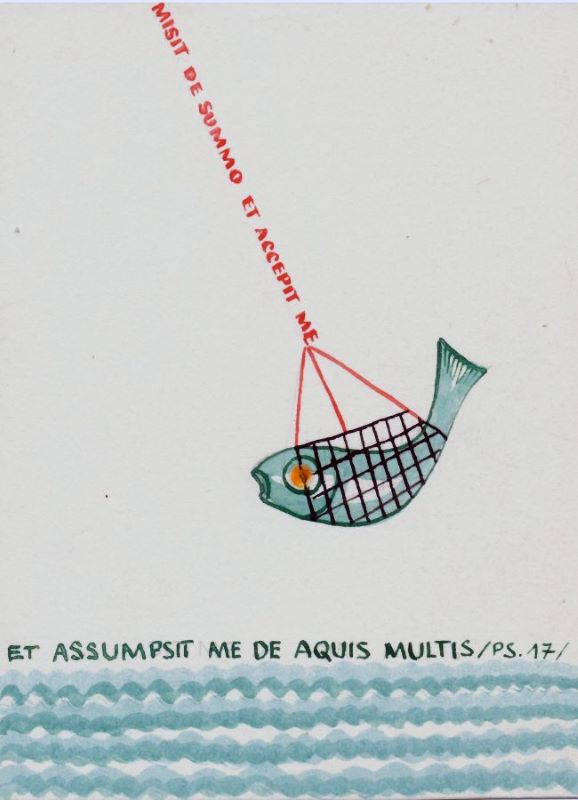
A humorous drawing showing Sister's response to the psalm verse
"And he took me up from the deep waters"
Perhaps the strongest praise comes from Scott Hahn, who writes: “This book is a roadmap to true happiness, not only in the afterlife, but beginning here and now.” Drawing attention to the remarkable cheerfulness that suffused Sister Bernadette’s often difficult life, Dr. Hahn says: “Sister Bernadette was one of those souls who, while living with the Church, the liturgy, and the Scriptures, allow themselves to be led by the Spirit to pray and to suffer—generously and cheerfully. She made an offering of her life, and in these pages we can learn to do the same.”

For Their Sake I Consecrate Myself is available for purchase on Arouca Press’s website, on Silverstream Priory’s shop, as well as Amazon.com, Amazon UK, and other retailers. I hope that many will “take a chance” on this little-known story and find a special blessing in it.

A brief preview of the photos and artwork found in the book is available in a video released by Silverstream Priory: 


Thursday, October 14, 2021

The Liturgical Movement Between Two Centuries: Live Discussion Tomorrow

In his allocution to the Assisi Liturgical Congress in 1956, Pope Pius XII said, among other things, “The liturgical movement is thus shown forth as a sign of the providential dispositions of God for the present time, of the movement of the Holy Ghost in the Church, to draw men more closely to the mysteries of the faith and the riches of grace which flow from the active participation of the faithful in the liturgical life.”

But how we should evaluate the liturgical movement today? Tomorrow, beginning at 9pm Eastern time, musician and author Aurelio Porfiri will host a discussion of this topic with Fr Thomas Kocik, author of “Singing His Song: A Short Introduction to the Liturgical Movement”, Fr Paul Gunter OSB, professor at the Pontifical Liturgical Institute of Rome, and Chris Carstens, editor of Adoremus. The program will be streamed on various social media channels, including the YouTube channel RITORNO A ITACA (https://www.youtube.com/c/RitornoaItaca), Maestro Porfiri’s Facebook page (https://www.facebook.com/MaestroAurelioPorfiri/) and Twitter account (https://twitter.com/AurelioPorfiri).

Monday, September 27, 2021

The Maronite Liturgy’s Corruption under Modern Western Influence

A Maronite altar ad orientem—something rarely seen
It is often assumed by Roman Catholics that the Eastern Catholic rites have been “preserved intact” and that the destructive aspects of the liturgical reform took place only in the sphere of the Latin-rite Church. It is sometimes even suggested that Roman Catholics may find a “refuge” in the East if things in the West continue to go in the downward direction that Pope Francis and his new officers are proposing to enforce. As both Joseph Shaw and I have argued (see here, here, and here), there is no good reason to think that Traditionis Custodes will lead to substantive improvements in the Novus Ordo; on the contrary, it is more likely to lead to the suppression of elements that look anything like the Tridentine rite, in the effort to enforce a progressive liturgical vision.

While it is true that the most wanton destruction did, in fact, take place in the Roman Rite (with similar depradations in the Ambrosian Rite), Western-educated liturgists within Eastern Catholicism have too often shown themselves eager to follow the path of false antiquarianism and modernization, usually in the form of dramatic abbreviations and simplifications, as well as the abolition of traditional features.

The Maronites are perhaps the most notorious example of this Western-influenced self-destruction: their liturgy has evolved into the Novus Ordo of the East. For example, in “The Transfer of Gifts” (which corresponds to the “Great Entrance” in the Byzantine Liturgy), traditionally a deacon or subdeacon transferred the gifts from the side altar to the main altar. In the parishes now, lay people are employed to make the transfer, in imitation of the Novus Ordo offertory procession—a thing that was introduced on antiquarian grounds as a revival of ancient practice, although better scholarship has shown that it is no such thing: the modern offertory has little to do with the ancient one (see here and here).

A knowledgeable correspondent once gave me an outline of the bigger picture, so that I could understand how one kind of Latinization, which had had its positive aspects, had simply given way to another kind, which occasioned severe damage.

“The Maronite Church has gone through several periods of Latinization since the 16th century, most especially at the Synod of Mt Lebanon in 1736 where a papal legate was instructed to ‘correct’ our practices. Adoption of these Latinizations were not uniform or universal, and often were manifested in externals (e.g., vestments); yet we retained our sacral language and the vast corpus of our distinctive liturgy and prayers. In the 1940s, Patriarch Arida wished to restore our tradition and a liturgist by the name of Chorbishop Michel Raji began thorough research to restore our tradition. His sacramentary was the major fruit of his work; it preserved ancient liturgies such as a ca. fifth-century baptismal liturgy.

“The intimate and longstanding connection between France and Lebanon/Syria meant, however, that the liturgists who studied in France began to internalize and imitate the Western Liturgical Movement; Maronites began to hold reformatory ideas, which culminated in a book in 1965 called Avant-messe maronite by Pierre-Edmond Gemayel, who would later become archbishop and chair of the liturgical commission. Gemayel’s approach was essentially that everything he didn’t like was or must have been a fifteenth-century accretion, ‘Jacobite’ or authentic but not pastoral. It is difficult to respond to such baseless and subjective claims charitably; an example of this is Gemayel’s claim that the prothesis (which all Eastern liturgies and some Western liturgies have in common, equivalent to the offertory) is a 15th–16th century accretion; to this, all Baby Varghese (a present-day West Syriac liturgical scholar) can say is that ‘Gemayel’s analysis of the contents of various manuscripts was not always accurate’ (give that man an award for understatement).

“Regarding ‘Jacobite’ elements, Gemayel attacked anything that made us West Syriac, such as the antiphonal doxology that previously began all liturgies—‘P: Glory be to the Father, and to the Son, and to the Holy Spirit from our beginning and until our concluding; R: and may mercy and compassion be poured forth upon us weak sinners in this world and the next. Amen.’ As for supposedly ‘non-pastoral’ elements, an example is the recitation of Psalm 50 at the beginning of the liturgy, which was undeniably the practice of the Maronite Liturgy for a millennium and a half; but they say it is redundant to ask for forgiveness multiple times. Prayers that are ‘self-deprecative’ were also removed—e.g., for the imposition of incense, the priest now says ‘To the glory and honor of the glorious Trinity,’ whereas previously it was ‘My weak sinful hands impose incense for the glory and honor of the holy and glorious Trinity. Let us all ask for mercy and compassion from the Lord’; prayers from the various anaphorae were similarly redacted.

“Given the Lebanese Civil War that lasted from the seventies into the early 90s, a new missal was never promulgated to replace the 1596. In 1992, however, Gemayel finally enacted his Bugninian vision, removing all but three lines of the prothesis and any ideas of sacrifice, cutting the fore-liturgy in half, greatly truncating or entirely removing rubrics, infantilizing language, removing anything that refers to the liturgy as sacrifice, and introducing various Novus Ordo ideas (e.g., whereas previously the lections were all read from the center, two podiums are now mandatory, the southern one for the epistle and the northern one for the Gospel). Laypeople often serve as deacons. The sacerdotal office has no particular significance; prayers from the fraction in which the priest offers the Eucharist back to God were made to be recited by all. A previous trope in Syriac prayer is that priest prays on behalf of all: ‘Lord God, make us worthy to do X...’; before communion and, with the new book of rubrics, before the reading of Scripture, everyone recites these prayers in common. The anamnesis must be recited by all the concelebrants. I have personally asked for sources or evidence of any of these practices, but my requests never meet with a response; rubrics at this point are simply arbitrary. Individuals who have neither studied theology nor gained familiarity with the history of the faith continue to contribute to liturgical reform! An example is Guilnard Moufarrej, who wrote on the reform of our funerary rites. She purports that we removed verses that are exact citations of Ephesians 2:2 because they do not ‘agree with Roman dogmas’ (conveniently not citing which ‘Roman dogmas’ they disagree with).

“Reform continues arbitrarily, and to the denigration of our tradition. There is now a steady stream of proposed rites, which all replace the first half of the Eucharistic liturgy and have an Anaphora tacked on the end because Mass has come to be seen as the only real form of prayer (whereas a sixteenth-century Jesuit commented on how surprised he was at the ubiquitous lay attendance at the divine offices in the Maronite Church). The byword of the liturgical reform continues to be ‘progress,’ though without any definition. Ultimately, the catchall term ‘pastoral’ is given as justification for all changes.

“At least the Novus Ordo is based upon the Latin tradition, however denigrated. The current Maronite Missal from 2005 does things incredible and incomprehensible to the ordo for any Eastern. As mentioned, the Prothesis/Preparatory Rite (equivalent of the offertory) has been completely excised. One of the two canonical hours has been removed. Psalm 50 [51], whose inclusion in the Syriac liturgy is attested to from at least the 6th century, has been removed. The first canonical hour of the Eucharistic liturgy has been replaced with propers ‘inspired’ by offices. The propers for the Season of Pentecost are made up almost wholesale.

“There’s been extreme rubrical simplification; no secret prayers remain. Versus populum is essentially mandated (at this point, I’ve seen more ad orientem Novus Ordos than Maronite ones!). It was introduced to the Maronite Church in the US in the 1960s, around the same time as it entered the mainstream of the Latin Church. It is purely innovative. Many of our traditional prayers refer to facing the rising sun—alluding to both the physical East and the expectation of the eschaton—and these have been excised to accommodate the new (dis)orientation. A dubium on this topic was submitted to the Congregation for Oriental Churches. Archbishop Cyril, the Secretary, responded that Oriental bishops do not even have the competence to permit, let alone mandate, versus populum. This, however, makes no difference, because official internal literature makes it clear that ‘reform’ will be pursued at all costs.

“As in the old Roman rite, in the Maronite liturgy there were many more signs of the cross—one could write a treatise on the sign of the cross in Syriac theology; it is of such utter importance that the East Syriacs include it in the list of sacraments!—and not just during the Institution Narrative. The West Syriac tradition has many special doxologies accompanied by signs of the cross: at the beginning of the Anaphora, the paten, the chalice, then both were signed, each time saying a doxology that professed the indivisibility of the Holy Trinity. There were signs of the cross during the post-Sanctus. There were more signs of the cross during the fraction. They are of such antiquity that St. Jacob of Sarug (5th century) gives us the number of signs of the cross to be made throughout the liturgy. They were all eliminated in virtue of Bugnini’s fixation on eliminating ‘duplication’ and ‘accretion’; this has become a driving force in eliminating lots of different things unique to our Syriac tradition.

“In my view, what underlies this idea of the redundancy of the sign of the cross is simple: the liturgists do not believe the ancient words ‘By Your cross, Your mysteries are accomplished’ which peppers all our prayers. Everything is simply reduced to a pedagogical sign or communal engagement—very Calvinist. However, in Lebanon these things are not seen as Protestant simply because they are done by Maronites, as absurd as that sounds. I have personally expressed my frustrations with their Protestantism to them but it’s completely incomprehensible to them because being ‘Maronite’ is a sociopolitical/ethnic identity as much as (if not more than) it is religious. Perhaps you have seen how the cedar even supersedes the cross at times.

“Polyester vestments are effectively required. Sanctuary veils and ripidia have been prohibited for a long time. The Anaphora has been needlessly changed (e.g., you must sit for the rite of peace); two prayers of peace are moved to after the sign of peace; there is a significant truncation of prayers, removal of diaconal litanies, removal of a fifth-century portion of the fraction rite, removal of rubrics, removal of traditional “major elevation” with accompanying hymn, removal of graded communion (i.e., communion of clergy, faithful, dead). We have even become the freaks of the Apostolic Churches: we removed all hand washings from our liturgy, so we’re the only liturgy of an Apostolic Church without a ritual ablution.

“In all this, the Maronite liturgy was changed to resemble the Latin liturgy. A new offertory was created. The liturgy was split into the Liturgy of the Word and the Liturgy of the Eucharist (not coherent with the traditional Syriac paradigm). Two podiums have been introduced, to mimic the way the Novus Ordo handled readings in the 70s, etc.

“A professor in Lebanon insisted to me (reciting almost verbatim P. Gemayel’s Avant-messe maronite) that there was no manuscript proof before the sixteenth century of a preparation rite beyond just plating a piece of bread and pouring wine into a cup—which is patently false. A few days later I had the opportunity to mention this claim to Sebastian Brock, the foremost Syriac scholar in the world. He responded that it is not only erroneous, it is off by about a millennium (i.e., we have evidence of a larger preparation rite in the sixth century!). But the liturgists will continue to lie and make things up because hardly any of them can actually read Syriac, so they can make any claims they’d like—in fact, they often claim our liturgical language is no longer Syriac, so it’s a moot point.

“The Liturgical Commission is not comprised of educated men. Not one of the persons who contributed to the English missal has any formal training or even understanding of the liturgy. It shows mostly in the hymns they produced, which are often incoherent. Even very basic things like why we used the exact same wording of the Latin Church’s creed (when the Arabic follows the Syriac, such as Christ shall come in great glory, and the Holy Spirit has spoken through the prophets and apostles), the response I received was that uniformity is unity. When I asked why we retained ‘we believe’ in the Creed, the individual just scoffed at me and told me I don’t know what I’m talking about. Likewise, I asked why, in the Lord’s Prayer, we move from hieratic to contemporary English as we go from the main prayer to the doxology, and the individual didn’t understand why that would be an issue. There are a multitude of holes one can poke simply in its language—like the use of sentence fragments as complete sentences in hymns. Our liturgy has been in shambles since we decided the Novus Ordo was the proto-liturgy of all traditions, and its getting exponentially worse. The problem is compounded by the fact that the patriarchal university in Lebanon purposefully doesn’t allow open access to manuscripts, and because Syriac is not as widely studied or translated as Latin. As a result, teachers, scholars, liturgists, bishops, can say whatever they like and there are too few people who can challenge their ignorance and errors. An example would be the uncritical, superficial, revisionist arguments one finds at a blog like ‘livingmaronite.com,’ which today seems to be on the cutting edge—of the 1960s. They are blissfully unaware of any scholarship from the past half-century that challenges their narrative.”

To all of which I, as a Roman Catholic, could only respond: “Sounds awfully familiar.” I was shocked to hear about all of this corruption. It made me realize that authentic Christian liturgy is endangered throughout the entire Christian world to the extent that it is allowed to fall under the influence of the liturgical progressivism of Western educational institutions and, crucially, to be treated as the plaything of any powerful individual, be he a pope or patriarch.

What follows is a comparative chart between the 1908 Maronite missal (which is a reprint of the 1596) nd and the current 2005 missal. There is a lot that can be said about the details, but for our purposes it is enough simply to look at the enormous difference, which is arguably even greater than that between the Tridentine Roman rite and the modern rite of Paul VI.


A downloadable PDF of these four pages may be accessed at this Google drive link.

So, before anyone thinks that “going East” will be a solution, he will need to do some homework in order to find out which Eastern rites have been corrupted by the Novus Ordo influence, and which ones have retained their integral tradition in spite of pressure and temptation from the West.

More recent articles:

For more articles, see the NLM archives: