
Monday, October 21, 2024

A Teen’s Testimony of the Impact of the Latin Mass in Her Life

The following account was a homeschool assignment given to a 15-year-old from California. We are grateful to this remarkable young lady for having shared it with NLM. To me, it speaks more (and more profound) truths than we will ever hear from any Synod. – PAK

I have been going to the Traditional Latin Mass for several years now, and with good reason. It has enriched me spiritually in many ways, and I have felt a stronger love for Jesus Christ in my soul than ever before.

When I was younger, only about five years old, I went to the Novus Ordo Mass every Sunday. My older brother, especially, instilled in me a love for God and for Holy Mass. He told me to meditate on the Mass, and the sacrifice that was taking place, and to spend lots of time contemplating the decades of the rosary.

But to be honest, I never understood how the Mass was a “sacrifice.” At my Novus Ordo church, the priests said it was a celebration. To my younger and smaller self, I had trouble figuring out whether the Mass was a sacrifice or a celebration. Because to me, it certainly could not have been both. A celebration reminded me of parties and happiness, and a sacrifice reminded me of sorrow and pain. A small child does not understand the meaning of true sorrow and deep pain, and so the concept of a “sacrifice” seemed very mysterious to me. I wondered a lot about it, but after not figuring out what a sacrifice really was, I decided to cast those thoughts aside. If I didn’t understand it, then surely it wasn’t important, right?

I lived in a similar way for years, trying to love God but not knowing what loving God really was; trying to pay attention to Mass, but not understanding what was taking place. I knew God was present, but I didn’t know the prayers. When did the bread become the Holy Eucharist? I used to think it was when the band started singing the Holy, Holy, Holy Lord God of Hosts and we all knelt. I even thought that I was already a saint, and that everyone around me was too. Hell was a place reserved for very, very few people, I thought.

As I got older, I started disliking Mass. Why did we have to go every week, sometimes even more frequently than that? I especially disliked when Christmas Day fell on a Saturday, because then we would have to go to Mass two days in a row. I noticed no difference in my spiritual life. I didn’t even know what a spiritual life was. I was told by my brother and mother that it was something very special. But I never knew what it was exactly. How can someone tell if they are advancing in their spiritual life? Since I had felt no change my entire life, I assumed I had reached that point of spiritual perfection long ago. But the saints loved the Mass very much, so if I was a saint, then how come I didn’t like Mass?

One day, though, everything changed. My father announced that we were not going to our regular parish that Sunday, but to a different one. A different parish with a different Mass.

When we arrived, I noticed how quiet it was. How sacred it felt. When the Traditional Latin Mass began to be offered in front of me, I was confused. I didn’t understand a thing, and I didn’t give anyone the sign of peace. It felt very different. I remember particularly disliking kneeling a lot and not being able to talk to people in the pews behind me. It was like something very serious was going on. But I had never thought the Mass to be very serious, so why was everyone so prayerful and reverent? And everyone dressed nice too. It wasn’t like a get-together for everyone to join hands and sing happy songs and chat. It was a beautiful, sacred prayer.

For about the first six months, I disliked both Masses. I didn’t like kneeling for so long. The Novus Ordo Mass was boring enough. Why did we have to go to a different Mass that felt twice as long?

Changes in my soul were slow, but definitely there. Over the years, I learned more and more. I learned that the Mass was a prayer, something I had never known before. I followed along to the prayers in the 1962 Missal and saw people reverently beating their chest at the Agnus Dei, and it seemed so interesting to do that, so I started doing that too. I wore a veil, which obscured some of my sight, making me almost see in tunnel-vision forward to the altar. The Gregorian chants were breathtaking, and I would just kneel there, listening to the beautiful music and watch the incense float up to heaven, and I felt peace.

I went from being a child continuously asking her mother when we could leave, to a child who somehow just knew that she had to be silent. I learned, from the grace of God, that Mass is for praying. Mass is for adoring Christ. When I genuflected in front of the Altar, I really meant it. If I didn’t walk slowly and reverently through the church, I felt like I was disrespecting God’s holy place. Because God was there, and I knew it very well.

I started looking forward to Mass, and to the rosary, like never before. I would take every moment to deeply meditate and pray. I would impatiently wait in the car on the drive to Mass, thinking about kneeling before the altar and pouring out my entire heart to God. He became my confidante, and so easily, with God’s grace aiding me, I would feel infinitely better after praying. It was like a breath of fresh air. When I was a child, I thought God was just this important god that made the world then took a step back. After going to the Latin Mass, I realized how much of a father He is. He did not take a step back from the world, and He listens to our prayers every day. I can put total trust in Him because I know He loves me.

Sometimes I would envision the altar as a throne, and when the priest was consecrating the Eucharist, a king would come and sit on the throne. And at communion, the people were coming to the foot of the throne to beg their king for help, to adore their king and his mightiness, to thank their king for all he has done for them. It was truly special. But, in my mind, people could not go visit their king without a gift! Therefore, it would make sense that people had to give something to God when they went to receive, because God was giving Himself to them. The person receiving needed to have a desire for God and had to be as pure and sinless as possible. A person had to become like an angel from heaven before they could dare receive God. 

As I grew older, I grew alongside a Mass that was never-changing. One that reflected the never-changing nature of God. It became like a home to me. I grew spiritually in ways I cannot even describe.

When I turned fourteen, I traveled to Spain for three months. Spain is an incredible place, really, and I had an amazing time there. But of course, everyone experiences the regular feelings of homesickness for the first week or so. I had never been in Europe before, so it was a very new experience to me.

One of the first things I noticed was my homesickness, and the desire for something familiar. On Sunday I went with my family to the Latin Mass in Madrid, and it patched up my homesick heart. When I knelt there, I poured my heart out to God in contemplative prayer, and I was more than glad that I was not at a Novus Ordo Mass—I didn’t have to respond to prayers aloud or greet people. I could just pray and feel God’s presence. The Traditional Latin Mass was a piece of home, but not like if I were to go to an American restaurant in Spain or see American tourists. What made it feel like home was God. That sacred presence in my church at home was there. That infinite peace, and the feeling of God’s grace coaxing you into deep prayer so delicately. It was all there.

I’m sorry to say, but when I later went to a Novus Ordo Mass in Spain, it wasn’t the same. I tried very, very hard to feel the same, but it was so hard, even though I can speak Spanish. The Mass was too distracting! I could not pray, or prepare myself for communion, or make thanksgiving afterward. I kept telling myself I would save my prayers and my devotions for after Mass, in the period of silence before the candles are blown out and the altar is disassembled. But that defeats the entire purpose of Mass! How can you go to a Mass and tell yourself that you will pray afterward? Mass is a prayer itself. How can you pray Mass after Mass is done?

I went to the Novus Ordo Mass every day in Spain except on Sundays (when we went to the Latin Mass), and I became confused again and again. I didn’t feel at peace or at home. I had been going to the Novus Ordo for half of my life and yet it didn’t feel at all like home. There wasn’t a hint of nostalgia. All I could think was how I wished I could just be in the Latin Mass at that moment.

I’ve even gotten to the point where, when I stand in the pew at a Novus Ordo Mass, a particular thought runs through my mind. I don’t try to think about anything but the Mass, yet, unbidden, this thought keeps returning: Why does this feel so fake? Why am I even here? What am I getting from this?

The only thing that consoles me at a Novus Ordo Mass is receiving the Holy Eucharist. But otherwise, I feel the childhood boredom I had felt for many years in the past, that wishing for it to be over soon.

I cannot fully explain why the Latin Mass has helped me so much. When someone asks me to explain my experience, I’m usually at a loss for words at first. How can you describe the deep movements of your soul in words? It truly is a very beautiful experience, and one that a person can only understand after they have been to the Latin Mass themselves. I proudly say that I will try my very best to attend the Latin Mass as long as it remains available, for the rest of my life if God wills it. I believe that the Latin Mass is the Mass that will truly aid me on the journey to spiritual perfection. And I believe that it will change your life too, just as it did mine.
Friday, July 29, 2022

The Four Most Important Lessons of Childhood

The four principal ends of the Mass are also the four most important things to teach our children—and ourselves.

One of the questions of the old Baltimore Catechism is, "What are the purposes for which the Mass is offered?" The answer given is fourfold:

First, to adore God as our Creator and Lord.
Second, to thank God for His many favors.
Third, to ask God to bestow His blessings on all men.
Fourth, to satisfy the justice of God for the sins committed against Him.[1]
Adoration, thanksgiving, petition, and satisfaction—mention of these four ends found their way into many an old missal and are still a familiar feature of any traditional catechesis on the Mass. What is often overlooked, however, is the relation of these ends to our own concrete lives as human beings. How exactly do these four things relate to our psychological, emotional, and spiritual welfare?
One way to approach this question is to consider the four most important things that we learn to say as children: "I love you," "Thank you," "Please," and "I’m sorry." These four simple sayings are not only capable of putting both young and old onto the path to human happiness, but they also provide a useful analogy for what happens at every Sacrifice of the Mass.
Lessons for Life
Although we speak of the importance of teaching our children to "say" please and thank you, our ultimate goal is really to have them say these things and mean them, to have their words align with their hearts. When a mother makes her son apologize to his sister for pulling her hair, she is usually not content with an icy "sorry" and a defiant, unrepentant glare. Clearly her objective is to make the boy understand that what he did was wrong so that he may feel genuine regret for his action and seek to correct the injustice, not simply to utter a particular sequence of sounds. And this is true for the other three things she instructs her children to "say" as well.
Implicit, then, in the objective to raise children who say "I love you," "thank you," "please," and "I’m sorry" is something more than a trivial habit of politeness, a meaningless conformity to social convention. Somehow, the aim is to form a young mind into the kind of person who is loving, grateful, deferential, and, when necessary, contritely determined to make amends.
Perhaps the reason for this goal is that such qualities are not only choiceworthy in themselves, but they also lead to the acquisition of other virtues. Someone who knows the importance of repentance and has experienced the need for it also knows the importance of offering forgiveness and has greater empathy for someone sharing the same plight. And someone who is truly grateful to one person is more easily inclined to be generous to another. We probably find the Unforgiving Servant in the parable of that name so reprehensible because he grossly violates both these principles (Mt. 18:23–34). The cruel man presumably learned to say “please,” “I’m sorry,” and “thank you” well enough, but he did not let their meaning sink into his life, nor did he show any genuine love.
Behind these four simple expressions, then, lies a sound moral anthropology, a broad outline of the good life.
Ideally speaking, a person who is capable of saying "I love you" and meaning it is capable of commitment, devotion, and self-sacrifice.
A person who is capable of saying "thank you" and meaning it recognizes, as we will see, the unmerited gift of his existence and his debt to a broader world he did not create.
A person who is capable of saying "please" and meaning it confesses his dependence on a reality outside himself and rejects the principle that might makes right, transcending the debilitating egoism that would leave him, to paraphrase Sir Walter Scott, a vile wretch concentered all in self.
And finally, a person who is capable of saying "I’m sorry" (or for more minor offenses, "excuse me") and meaning it makes the difficult but crucial breakthrough into unflattering and unglossed self-knowledge, mustering the courage to acknowledge his faults and the resolve to redress them.
By contrast, a person who has not been brought up on these four dictums has been done a grave injustice, for he was either discouraged from overcoming his selfishness or, what ends up being the same thing, from understanding the reality of the human condition.
The Four Ends of the Mass
This fourfold path to authentic human flourishing, as it were, bears a remarkable similarity to the traditional theology of the Mass. Specifically, saying "I love you" at home is analogous to the act of adoration that takes place in the Mass, "thank you" to thanksgiving, "please" to petition, and "I’m sorry" to satisfaction.
When Our Lord offered Himself on the Cross as a living sacrifice, that sacrifice included an infinite act of adoration of his Father, of thanksgiving to Him, of petition or impetration on our behalf, and of satisfaction (also known as propitiation or expiation) for the sins of mankind. Those four components of this perfect act of worship, in turn, are re-presenced by Christ through the agency of His priest at every Mass. One can even think of the four great prayers of the Ordinary of the Mass, as does Peter Kwasniewski, in terms of these four categories:
The Kyrie corresponds to contrition (“have mercy on us”);
The Gloria to gratitude (“we give thee thanks”);
The Sanctus to adoration (“holy, holy, holy…”);
The Agnus Dei to petition (“grant us peace”).[2]
And we the faithful participate in the Mass in order to partake of and be enriched by these ends. Our own acts of devotion are, to be sure, not identical to Our Lord’s. Christ’s expiation, for example, did not include "I’m sorry" in the way that ours must, for He had nothing to be sorry about. But our meager attempt to make good on our failings in an act of expiation is made efficacious by the infinite liberality of our crucified and risen God, and hence the bond between the two is profound.
The Four Stirrings
One reason why this analogy is significant, then, is that it indicates that the Sacrifice of the Cross—and by extension that of the Altar—contributes powerfully to the supernatural perfection of our natural potential for the good as well as to the restoration of our nature after its fall from perfection.
As a further demonstration of this point, we need only consider man’s basic emotional range in light of the soul’s four "stirrings" (perturbationes): joy, desire, fear, and sorrow. This useful taxonomy was employed by Cicero,[3] who himself borrowed it from the Stoics, and was to be later picked up by Christian thinkers like St. Augustine.[4] The four emotions Cicero cites bear an interesting relationship to the four sayings we have discussed and the four ends of Mass—not that they align neatly with each other in the same way but that truly good acts of adoration, thanksgiving, petition, and contrite restitution bring to perfection our most basic instincts of delight, appetite, fear, and sorrow.
Appetite
On the natural level, raw desire is humanized and sublimated by the simple and sincere act of saying "please." Rather than grabbing what we want, we recognize a boundary of ownership and humbly request that that boundary be redrawn, and in so doing we relinquish the brutality of coercion for the gentility of courtesy. Supplication at its best, then, is a sublimation of desire, not in the bastardized Freudian sense of suppressing libido but in the original sense of making desire sublime or lofty.
It is this sense of sublimation that finds its highest expression in the Mass, where personal desire is perfected supernaturally in the ultimately altruistic petition we make therein not just for ourselves but, as the Baltimore Catechism reminds us, for all men. How far this is from the gussied-up materialism of "the prayer of Jabez" fad, in which Christians are encouraged to pray for the trinkets of this life as if they had no eternal longings at all. The Mass, by contrast, is designed both to expand and reorder our desires so that higher goods take priority over lower on the one hand, and then to transcend even them on the other.
This schooling of desire is particularly obvious in the Collects of the Tridentine Missal. These ingenious orations reflect a recurring focus on retooling and heightening the desire of the faithful. For in addition to asking for a granting of our wishes, they ask for a change in what it is we wish for: "make us love what You command" (Thirteenth Sunday after Pentecost), "graft in our hearts the love of Your name" (Sixth Sunday), "make us ask for things that please You" (Ninth Sunday), etc. And once our desires have been converted or turned to these much greater goods, the Church goes on to assert that God will surpass even these and give us, as it is said in the Collect for the Eleventh Sunday after Pentecost, what "our prayer does not even dare to ask for." This entire theology of desire, petition, and transcendence is perhaps no more beautifully or succinctly expressed than in the collect for the Fifth Sunday after Pentecost:
God, who hast prepared for them that love Thee such good things as pass understanding: pour into our hearts such love towards Thee, that we, loving Thee in all things and above all things, may obtain Thy promises which exceed all that we can desire.
A close contender for title of Master Prayer for the Schooling of Love is the Collect for the Fourth Sunday after Easter:
O God, who makest the minds of the faithful to be of one purpose, grant to Thy people to love that which Thou dost command, to desire that which Thou dost promise; so that, amidst the changing things of this world, our hearts may be there fixed where joys are true. Through our Lord.
The Postcommunion for the Fifth Sunday after Easter also sums it up nicely:
Grant to us, O Lord, that having been satiated by the power of this heavenly table, we may both desire the things that are right and obtain the things we desire. Through our Lord.
A not-infrequent paradox in the Roman Postcommunions is how the Eucharist is a food that increases our hunger. Here we see a contrast between satiation and desire: filled with the Eucharist, we ask to be made hungry for the good.
The petition also adds to our schooling in how to approach the things that are right. Not only our minds and our deeds must be corrected, but our hearts must fall in love with what is right in order to achieve the good life. It is a recurring temptation to think of happiness as simply getting what one wants; if I want a nice house, a nice car, and a nice bank account and get them, I will be happy. But this view overlooks one crucial factor. As Cicero writes:
To want what is not decent is itself the very worst misery. And not obtaining what you want is not so miserable as wanting to obtain what is not right, for depravity of the will brings more evil than fortune brings good to anyone.[5]
Fear and Sorrow
Fear and sorrow, on the other hand, are both accounted for in the act of apologizing and making amends, though only if those acts are genuine. An imperfect apology stems solely from a motive of fear: I am apologizing to you not because I am truly sorry but because I am afraid of what you will do to me if I do not apologize. Perfect apology, by contrast, is concomitant with the emotion of sorrow: I see that I have hurt you in some way and I in turn am truly saddened by this fact.
But a perfect apology also involves fear, not the fear of reprisal as in the previous case but the fear of being alienated from a loved one. St. Thomas distinguishes two kinds of fear: servile fear, like that of a slave afraid of being punished by his master; and a noble or filial fear,[6] like that of a husband afraid of doing something to his wife for fear that she will lose respect for him, not for fear that she will beat him for what he has done. While servile fear has its place in this life (it is even sufficient for making an act of contrition, albeit an imperfect one), it is clearly inferior to that filial fear which is motivated by a love higher than mere self-preservation.
Rosa Sweninger, "The Apology," ca. 1918
And so it is with propitiation in divine worship, which presupposes a sorrow for the injustices we have committed and a fear that we offended the God whom we love and who has done so much for us. True, the fear involved may sometimes be merely that of going to Hell, that presentiment that if I sleep in on Sunday instead of going to Mass I am committing a mortal sin; and that fear, base though it may be, may succeed in getting me to Mass and even opening me up to the graces that can be obtained there. But as St. Augustine once wryly observed, "people who are afraid of sinning because of Hell are afraid, not of sinning, but of burning." Just as the emotionally mature man is motivated by noble rather than servile fear, so too is the spiritually mature man more afraid of the intrinsic destructiveness of sin and the effect that it has on his close friendship with his Lord and Master than of the extrinsic judgment awaiting him at the end of his life.
Delight
Finally, the stirring of joy accompanies the genuine acts of saying "I love you" and "thank you." True, love is not always accompanied by the elation of gladness, as often love’s commitments bring with it sorrow and hardship. Nevertheless, in an odd sort of way even love’s pain is better than love’s absence (assuming that we are speaking of well-ordered and not concupiscible love), and it is only through love that genuine joy is ever experienced.
The same is true for gratitude, though this is not as easy for us to recognize as it used to be. For thinkers like Immanuel Kant, having to say thank you is more an occasion of sorrow than of joy, for by his reckoning, gratitude betokens indebtedness, and indebtedness is a threat to personal autonomy, the bedrock of Kantian philosophy and modern liberal democracy to boot.
Yet as Fr. Paul McNellis, S.J., has pointed out, such a legalistic mindset ignores the liberating effect that extensive human ties have on the individual.[7] For the ancients, the proper response to the wickerwork of human interdependence was pietas, that noble devotion to one’s family, one’s country and, ultimately, one’s God. This was a "debt" one was happy to have, for it rested on a superfluity of goods one had undeservedly received. The act of remembering these benefits, in turn, was a source of gladsome gratitude. In the words of Seneca:
The most ungrateful man of all is the man who has forgotten a benefit . . . there is no possibility of a man’s ever becoming grateful if he has lost all memory.
[8]

Gratitude, therefore, is not only an important component of one’s moral character, it is a symptom of one’s hold on reality, that is, of one’s ability to remember accurately the real benefits one has received from real beneficiaries and to react to these realities accordingly.

And needless to say, all of this bears poignantly on giving thanks to God in the Mass, that supreme, divinely-initiated act of anamnesis, of remembering and thus re-presenting the greatest good ever given in human history. No wonder that Aquinas sees gratitude as a virtue rooted in love, one that is not unreasonably without limit. And how appropriate and how beautiful it is that the last words of the Mass, in both the old rite and the new, are simply, "Thanks be to God."[9]

Old and New
Reflecting on these themes, Peter Kwasniewski sees a difference between the usus antiquior and the Novus Ordo:
[W]hat do you suppose would happen if the spiritual fathers of the Church, the bishops and priests, failed to form their spiritual children in the proper habits of saying “I’m sorry” and “thank you,” “I love you” and “please” to Almighty God in the Holy Sacrifice of the Mass? What if, instead of ensuring a true discipline of self-denigrating sorrow, prompt thanks, adoring love, silent respect, and humble petition, they provided a relaxed, casual environment, where the priest and people face each other in a self-congratulatory and self-celebrating circle, to the accompaniment of folksy, trite, sentimental, trendy music? Would the children of the Church ever learn how to worship God that way? Or would they become little self-centered spiritual barbarians, over-confident toward their heavenly Father, chummy with their neighbors, and altogether bereft of the “fear of the Lord” that is the beginning of wisdom? [10]
Conclusion
Our comparison between the four ends of the Mass and the four great things we learn as children also gives one final insight into the importance of the Eucharistic sacrifice. To think of Mass "attendance" as a legalistic burden imposed on us by the Church is as impoverishing as thinking of manners as mere extensions of parental power and caprice. Though by no means sufficient, manners are nevertheless instrumental in orienting us to the created order, and when they are appropriated properly, they help actuate our full potential as human beings. Similarly, the adoration, thanksgiving, petitions, and satisfaction we make at Mass orient us to the Creator of our nature, actuating not simply our native potential, but our capacity to participate in the very Godhead itself.
To be able to say "I’m sorry," "I love you," "please," and "thank you" to our Heavenly Father through the mediation of His Son and under the guidance of His Spirit is not only a unique privilege for a lowly creature; it is a steadily transformative act. And to that we can only say, Deo gratias. [11]

Notes
[1] The New Saint Joseph Baltimore Catechism no. 2, explained by Rev. Bennet Kelly, C.P. (NY: Catholic Book Publishing Co., 1969) no. 361, p. 173.
[2] Bad Liturgical Parenting,” November 8, 2018, https://onepeterfive.com/bad-liturgical-parenting>.
[3] 3.10.35; Disputationes Tusculanae 4.6.11.
[4] Confessions 10.13.22.
[5] Hortensius frg. 39 (Muller), trans. mine.
[6] Cf Summa Theologiae II-II.19.4f, also I-II.67.4.ad 2; II-II.7.1.
[7] "Rights, Duties, and the Problem of Humility," in Gladly to Learn and Gladly to Teach: Essays on Religion and Political Philosophy in Honor of Ernest L. Fortin, A.A., eds. Michael P. Foley and Douglas Kries (Lanham, MD: Lexington Books, 2002), pp. 125–143. The following paragraphs on gratitude are deeply indebted to Fr. McNellis’ article.
[8] De beneficiis 3.1, trans. John W. Basore, Loeb Classical Library (Cambridge, MA: Harvard University Press, 1935), pp. 128–9.
[9] Summa Theologiae II-II.106.6.ad 2.
[10] Bad Liturgical Parenting.”
[11] An earlier version of this article appeared in Lay Witness Online (Nov/Dec. 2006), http://www.cuf.org/Laywitness/LWonline/ND06Foley.asp. The latest version appeared as “The Mass and the Four Most Important Lessons of Childhood,” in The Latin Mass magazine 31:2 (Summer 2022), pp. 52-56. Many thanks to the editors for allowing its republication here.

Monday, March 28, 2022

A Tale of Three Holy Cards

One of the most hackneyed of all clichés is that “a picture is worth a thousand words.” But there’s a reason certain familiar sayings arise in the first place, and that’s because they express a truth beyond gainsaying.

Some time ago, as I was visiting with a dear Benedictine friend of mine, I happened to notice two holy cards in his monastic breviary. The first was a card with nutty looking geometric shapes and a font that screamed 1970s. The other was a card that could have been from the 19th century.

I told the monk I’m a collector of vintage holy cards (sometime I’ll have to put pictures of some of them up on NLM), and that I’d enjoy giving these two a closer look. My guess of the 1970s was off just a little. The card featuring geometric shapes and the saying “The Creator has made the world…Come and see it” from the Pima Indians was an ordination holy card from May 30, 1965.

Ordination Holy Card (1965)
The other card, once I held it, felt surprisingly new. It turned out to be an ordination holy card from May 24, 2014. The text on the back of this card (not shown here) was not taken from the Pima Indians but from Hebrews 5, in the Knox translation no less:
The purpose for which any high priest is chosen from among his fellow men, and made a representative of men in their dealings with God, is to offer gifts and sacrifices in expiation of their sins. He is qualified for this by being able to feel for them when they are ignorant and make mistakes, since he, too, is all beset with humiliations, and, for that reason, must needs present sin-offerings for himself, just as he does for the people. His vocation comes from God, as Aaron’s did; nobody can take on himself such a privilege as this. … Thou art a priest for ever, in the line of Melchisedech.
Ordination Holy Card (2014)
I went to my holy card collection and pulled out a holy card from 1909, printed in Csákova, Romania, for the first Mass of a German priest. This card is smaller and narrower, as is often the case with older cards, and says at the bottom: “Das Himmelsbrod will ich empfangen und anrufen den Namen des Herrn. – I will receive the bread of heaven and call upon the Name of the Lord.” On the back, it says: “Heiliges Herz Jesu, ich vertaue auf dich! – Sacred Heart of Jesus, I trust in Thee!”

First Mass Holy Card (1909)
What do we notice when we look at this progression—1909, 1965, 2014?

The 1909 card, with sensitive rendering, evokes the natural order elevated to the supernatural through the liturgy, with the wheat and grapes yielding themselves into the chalice surrounded by light, mounted on an altar book that is wrapped in a stole embroidered with crosses, the whole graced by a Eucharistic text. Two world wars and fifty-six years later, the 1965 card lacks any Christian symbols or texts, any indication that it has anything to do with the priesthood, or even any representational art to speak of. Forty-nine years later, the 2014 card shows a priest bowing humbly before the altar, where, in mystic vision, the High Priest blesses him as he mediates for the people, in the midst of a great church. Light—the light of grace and truth—cascades from Jesus, the Head of the Mystical Body, to the priest and people, in that hierarchical order. The 2014 card, with different imagery, is saying the same thing as the 1909 card: here is the source of light and life; here is the elevation of nature by grace; here is the special work of the ordained minister.

When we look with pained embarrassment at the 1965 card, we cannot help feeling that the 1960s are, with rare exceptions, thoroughly dead—and never was a death so welcome. Like the priests of centuries past, today’s youthful clergy have surrendered themselves to a genuine priestly vocation, with a spirit of awe, reverence, and veneration for the sacred mysteries. They are (just as the Letter to the Hebrews teaches) chosen mediators who offer gifts and sacrifices. The luminous liturgical theology of Pope Benedict XVI and the joyful rediscovery of the ancient Roman Rite of Mass have had much to do with this renewal. May they continue to bring in a harvest of vocations, men who wish to serve in union with, and in imitation of, the Heart of Jesus.

Monday, March 14, 2022

“The Sacrifice of Praise and the Ecstatic Orientation of Man”: Dr. Kwasniewski’s Davenport Lecture

The following lecture was given in Davenport, Iowa, on March 2, 2022, at the invitation of Una Voce Quad City. I am grateful to the organizers for making a video, which is now on my YouTube page.

I am convinced that one of the greatest errors we are facing in the Church today—and one that, in a hidden way, drives a lot of other problems we are suffering under—is the dominance of an activist, utilitarian, this-worldly notion of what Christianity is all about. It’s taken for granted that religion is for the sake of social justice and improvement of quality of life, that it’s a matter of being busy with charitable projects, of making ourselves “useful,” and so forth—quite as if God is not very good at ruling His universe and needs a lot of help from us (“excuse me, Lord, let me step in and take care of this disaster”). At its extreme, as we see it too often in Vatican documents and activities, Catholicism looks like an interreligious, humanitarian social services operation, the “chaplain to the United Nations” as some wags have put it.

In my talk this evening I would like to present to you a totally different way of thinking of the meaning of Christianity and of the purpose of human life. I will offer you the traditional vision, which, needless to say, is not well understood. And I will do so starting from a book of the Bible that used to be at the heart of all of theology but has suffered enormous neglect in the modern Church, namely, the Epistle to the Hebrews, which is all about priesthood, sacrifice, and heaven, and the very title of which underlines the profound continuity between the worship of Israel instituted by God through Moses and its fulfillment in the worship of the New Israel instituted by the God-man Jesus Christ.

In this Epistle, whose author I will take to be St. Paul or certainly of St. Paul’s circle, a climactic verse of chapter 13 exhorts us: “By Him [our Lord Jesus Christ], therefore, let us continually offer the sacrifice of praise to God, that is to say, the fruit of lips confessing to His Name” (Heb 13:15). Given the relative paucity of explicit references in Hebrews to the Christian liturgy and how it is to be conducted here on earth,[1] this exhortation rings out all the more loudly, summoning us to a certain way of life: one in which we offer unto God, continually, the “sacrifice of praise,” which is the fruit of interior faith and its verbal confession. One might ask: Why does St. Paul sum up the Christian religion as a sacrificium laudis? What might we learn from the emphasis on praise?

Before digging into that question, it is worthwhile to point out how frequently Sacred Scripture uses this language. Apart from Hebrews 13:15, here are some other instances:

Offer to God the sacrifice of praise: and pay thy vows to the most High. (Psalm 49:14)

The sacrifice of praise shall glorify me: and there is the way by which I will shew him the salvation of God. (Psalm 49:23)

And let them sacrifice the sacrifice of praise: and declare his works with joy. (Psalm 106:22 )

I will sacrifice to thee the sacrifice of praise, and I will call upon the name of the Lord. (Psalm 115:8)

And offer a sacrifice of praise with leaven: and call free offerings, and proclaim it: for so you would do, O children of Israel, saith the Lord God. (Amos 4:5)

But I with the voice of praise will sacrifice to thee: I will pay whatsoever I have vowed for my salvation to the Lord. (Jonah 2:10)

And thou hast taken pity upon two only children. Make them, O Lord, bless thee more fully: and to offer up to thee a sacrifice of thy praise, and of their health, that all nations may know, that thou alone art God in all the earth. (Tobit 8:19)[2]
And there are countless verses that suggest the same in different language. We have, for instance, Psalm 70:8: “Let my mouth be filled with praise, that I may sing thy glory, thy greatness, all the day long”—a verse, incidentally, that is sung in the Divine Liturgy of St. John Chrysostom immediately after the reception of Holy Communion, in a way identifying Our Lord with the very act of praise: “Let my mouth be filled with praise.”[3] The Prophet Jeremiah says: quoniam laus mea tu es, “for Thou art my praise” (Jer 17:14).

Of all forms of prayer, praise is the one most “for its own sake.” In a sense, it is useless, in that it has no further ulterior motive or result we are seeking out of it.[4] Praise looks to the greatness, glory, beauty, and worthiness of the one praised and seeks to render to him a selfless homage; in the words of the Gloria, propter magnam gloriam tuam, or in the words of the final Psalm: laudate eum secundum multitudinem magnitudinis eius, “praise him according to his exceeding greatness!” (Ps 150:2). All forms of prayer, of course, are directed towards God, this being part of the very definition of prayer. That explains why the publican in the parable went home justified rather than the Pharisee, since the publican actually turned to God in self-abnegating repentance, whereas the Pharisee turned to himself in admiration of his own excellence.

All the same, other forms of prayer besides praise are unavoidably wrapped up with oneself. When we give thanks to God, we are recalling the good things He has done for us. When we supplicate Him, it’s about our own needs or the needs of others, and that’s perfectly fine; we are needy creatures, and the worst thing we can do is to pretend otherwise. When we accuse ourselves of wrongdoing and repent of it, we are recognizing that we have failed to live up to God’s just expectations of us, that we are at fault and deserving of punishment, and we beg for pardon. But when we praise, we are lifting up our hands, our voices, our minds, towards God who is almighty, all-glorious, awe-inspiring, worthy in Himself of the homage of the entire cosmos for all eternity, worthy of the total surrender of myself to Him. In a short story called “The Castle: A Parable,” George MacDonald gives us this magnificent prayer:
We thank Thee for Thyself.
Be what Thou art—our root and life,
our beginning and end, our all in all.
Thou livest; therefore we live.
Thou art—that is all our song.[5]
In order to have a concrete model in front of us, we might think of the sequence of psalms in the office of Lauds in the monastic tradition. On Sundays of Paschaltide, on Sundays in special seasons, and on Solemnities, Lauds is a time of prayer given over entirely to the pure praise of God: Psalms 66, 62, 92, 99, the Benedicite, and Psalms 148 to 150 (from which Laudate psalms the office derives its very name).[6] In contrast, when we look at Prime or the Little Hours, we can see how concerned they are with the labors and trials of the day, the ongoing struggle with our enemies who seek to surprise us and capture us, the need for help, mercy, and consolation in a time of exile or pilgrimage. While not excluding these themes, Lauds is principally a “sacrifice of praise,” a burning up of the incense of our time and of the fruit of our lips. It is an office we perform not in order to “get” something, but propter magnam gloriam tuam. May all the earth praise the Lord: every creature, every order of being, every man, woman, and child. We will stand in for them, voicing the praises of creation; we will announce and obey the divine imperative, laudate Dominum; we will give utterance to a sleeping world on its behalf.

As with the religious life in general, Lauds is not concerned with going out into the streets, knocking on doors, engaging in conversations, making the Gospel relevant or intelligible. Those things are important and have their place, but first comes praise, the precondition and promise of the fruitfulness of anything else we may do.[7] A priest once wrote to me these words:
I know of no great thinker, no great advocate of justice or mercy or great keeper of an institution, who was not first an ardent laudator (giver of praise). I also do not know true intercessors who did not do this ministry in the context of praise. Self-forgetting praise is our foretaste of Heaven.[8]
This is the message we modern Christians need to hear in the expression “sacrifice of praise.” We are steeped in a world of pragmatism, utilitarianism, and activism, where we place such a high premium on doing and making, where we ask “what good is it” and “what’s in it for me,” where we look for results, the bottom line, the cash value, the pay-off. It is so interesting to see how Our Lord in the Gospels repeatedly refuses to lower Himself to the level of quick victories over the roiling crowds, how He insists on the disciples taking time off to recollect themselves and to pray, and, most mysteriously of all, how He Himself spends whole nights in “the prayer of God,” as St. Luke says.[9] He who, as God, could not pray to Himself; He who, as man, was hypostatically united to the Word and therefore perpetually and perfectly communing with the Most Blessed Trinity in His human mind and heart, nevertheless really and truly exercised all the acts of prayer, including praise.

In this way He revealed to us that prayer is not something superficial and optional to man but, rather, is constitutive of his inmost identity as a rational creature fashioned by God, dependent on God, and destined for God. The one who does not pray is not living as a man; in any case, he cannot inherit the kingdom that a saint—that is, a man of prayer—is competent to receive. Jesus showed His disciples that prayer is an activity as necessary and as refreshing as eating and drinking when the body needs nourishment, as vital and fundamental as breathing in oxygen and breathing out carbon dioxide.[10] The poignant little prayer before the Divine Office brings out this point: “O Lord, in union with that divine intention with which You Yourself praised God while on earth, I offer You this hour.” This short prayer addresses Our Lord as the one who first lived and always lives the sacrificium laudis with utter completeness, with inexhaustible superabundance; we wish to unite our will to His pure, lofty, all-sufficient intention.

Monday, March 30, 2020

The Central Point in the History of Mankind

Mikhail Vasilievich Nesterov, Crucifixion (1908)

THE DEATH OF A GOD, dying for the salvation of men, is the central point in the history of mankind. All ages bear witness to and converge towards it: the preceding centuries point to its coming, the others are destined to harvest its fruits.

The death of Christ is the centre of history, and also the centre of the life of each man in particular. In the eyes of God every man will be great in proportion as he takes part in that deed; for the only true and eternal dignity is that belonging to the divine Priest. The degree of each one’s holiness will be in exact proportion as he participates in that bloody immolation. For the Lamb of God alone is holy.

But although Jesus Christ the divine High Priest appeared only once on earth, to offer up His great sacrifice on Calvary; yet, every day He appears in the person of each one of His ministers, to renew His sacrifice on the altar. In every altar, then, Calvary is seen: every altar becomes an august place, the Holy of holies, the source of all holiness. Thither all must go to seek Life, and thither all must continually return, as to the source of God’s mercies.

Those who are the Master’s privileged ones, never leave this holy place, but there they “find a dwelling,” near to the altar, so that they never need go far from it; such are monks, whose first care it is to raise temples worthy to contain altars. Making their home by the Sanctuary, they consecrate their life to the divine worship, and every day sees them grouped around the altar for the holy sacrifice. This is the event of the day, the centre to which the Hours, like the centuries, all converge: some as Hours of preparation and awaiting in the recollection of the divine praise — these begin with Lauds and Prime continued by Terce, the third Hour of the day; the others, Sext, None, Vespers, and Compline, flow on in the joys of thanksgiving until sunset when the monks chant the closing in of night.

Thus the days of life pass, at the foot of the altar; thus the life of man finds its greatness and its holiness in flowing out, so to say, upon the altar, there to mingle with that Precious Blood which is daily shed in that hallowed place: for, if the life of man is as a valueless drop of water, when lost in the Blood of Christ it acquires an infinite value and can merit the divine mercy for us.

He who knows what the altar is, from it learns to live; to live by the altar is to be holy, pleasing to God, — and to go up to the altar to perform the sacred Mysteries is to be clothed upon with the most sublime of all dignities after that of the Son of God and His holy Mother.

Meditation by Dom Pius de Hemptinne (1879–1907), a discipline of Dom Columba Marmion.

Monday, December 16, 2019

The Possibly Dubious Liturgical Legacy of Leonardo’s Last Supper

While I was kneeling in a church recently, I started to look more closely at its Gothic high altar, and noticed that the bas relief scene on the front of the altar just below the mensa reproduced, with a high degree of exactitude, the famous, possibly too famous, Last Supper painting by Leonardo da Vinci (1452–1519), the 500th anniversary of whose death has been celebrated throughout 2019.

Leonardo’s Last Supper and many others paintings like it — Ghirlandaio’s at San Marco and Andrea del Castagno’s at the convent of St Apollonia, both in Florence; Giovan Pietro da Cemmo’s in the convent of St Augustine in Crema, etc. — were painted for the refectories of religious houses; they were not intended as images for churches, much less for sanctuaries of churches. The open, longitudinal arrangement was designed to place Christ at the center, to make the action at the table clearly visible, and to separate Judas more evidently from the rest of the Apostles. The spiritual lesson of such refectory paintings was manifold: that one should see the figure of Christ in one’s religious superior at the head table; that one should decide to be among the good apostles by being a good and obedient religious, and not faithless like Judas; that one should remember how every meal shared with the brethren bears a likeness to this banquet of supreme charity, which explains why the refectory service is a little liturgy in its own right.

Regarding the Rule of St. Benedict, Dom Mark Kirby, OSB, comments:
The liturgy of the refectory is sacred; the rubrics that govern it safeguard its Eucharistic character so that the words of the Apostle may be rightly fulfilled in the monastery day after day: “Whether you eat or drink, or whatsoever else you do, do all to the glory of God” (1 Corinthians 10:31). All are to come to refectory without delay and in time for the verse and the prayer, and all, says Saint Benedict, are to sit down together at table. A Benedictine monk never “grabs a bite” or eats in an individualistic manner. He enters into the liturgical order of the refectory, before, during, and after the meal, taking care to conform to the corporate actions of the whole community. One who despises the liturgy of the common table will be separated from it and even deprived of his portion of wine — a terrible punishment for the Mediterranean man — in order to be brought to his senses.
Benedictines honour the liturgy of eating and drinking in the refectory, and see the refectory as a kind of mirror of the Oratory. Even the disposition is same as in the choir: the tables facing each other; the Prior’s table with the crucifix behind it; the image of the Blessed Virgin Mary; and the reader’s desk. Twice daily the refectory resounds with the chanting of psalms and prayers. Like the Oratory, the refectory is a place of silence. It is also a place of joy, according to what Saint Luke writes in the Book of Acts: “They took their share of food with gladness and simplicity of heart” (Acts 2:46).
Because Leonardo’s Last Supper was in a refectory, it was not really intended for “public consumption.” Therefore, the hypothesis I will float concerns not so much this great artist’s intentions for his piece as it does deleterious consequences of an overuse of replications of it in modern churches.

Returning now to the altar sculpture: the figure of Christ dominated in the center, looking squarely out at me, with His disciples gathered round. Although I have seen this image a thousand times, I was suddenly struck by the impression that, placed front and center at the altar, this might look somewhat like a priest celebrating Mass versus populum:


In his superb overview of the history, form, and theology of the classical Roman rite (due to appear soon from Angelico Press), Michael Fiedrowicz offers a gentle critique of Leonardo:
Luther had already invoked the Last Supper practice of Jesus for his corresponding demand [that the Eucharist should be celebrated versus populum]. A new type of visual representation that began to be implemented during the thirteenth century must have been formative for his notion of the events of that time. This representation is familiar in Leonardo Da Vinci’s Last Supper: Jesus sitting on the rear side of a table in the middle of the Apostles, turned toward the observer of the scene. If Mass were made to correspond to this artistic presentation, the priest should stand at the altar across from the people and turn his gaze on them. This argument, however, is based on a misapprehension of ancient table manners as they would have been practiced at the Last Supper. There was at that time either a round or a semicircular table at whose open front side the food would be brought, while those partaking of the meal sat or reclined at the rear semicircle of the table. The place of honor was not in the middle, but rather on the right side. The one presiding over a meal never had another partaker across from his place. These original arrangements are shown in the oldest representations of the Last Supper until the Middle Ages. If this finding alone prevents the derivation of celebrating versus populum from Jesus’ practice at the Last Supper, a look at the historical beginnings of the Eucharistic celebration demonstrates yet more that the primitive Church’s congregation in no way repeated the Last Supper as such and did not consider the meal as the ritual original form of the Eucharist.
It is more than a little chilling to read the following words of Martin Luther and to reflect on the current situation of Roman Catholic worship: “But in the true Mass among genuine Christians, the altar would not have to remain so [sc. facing east], and the priest would always turn to the people, as without doubt Christ did at the Lord’s Supper. Well, that will be so in good time” (Deutsche Messe und Ordnung des Gottesdienstes, 1526 [WA 19, 80]).


In his book No Trifling Matter: On the Inviolability of the Sacraments (Angelico, 2018), Msgr. Nicola Bux makes a similar point:
Not a few people hold that it was only in late antiquity or the early Middle Ages that the Churches of the East and the West began to prefer administering it directly in the mouth. But did Jesus give communion to the apostles on the hand or asking them to take it with their own hands? Visiting an exhibition of Tintoretto in Rome, I observed some “Last Suppers” in which Jesus gives communion to the apostles in the mouth. One could think that this has to do with an interpretation by the painter after the fact, a little like the posture of Jesus and the apostles at table, in the cenacle of Leonardo, which “updates” in the Western manner the Jewish custom, which was, instead, to be reclining at table. Reflecting further on this, the custom of giving communion to the faithful directly in the mouth can be considered not only as a Jewish tradition, and therefore apostolic, but also as going back to the Lord Jesus. The Jews and the peoples of the East in general had and today still have the custom of taking food with one’s hands and placing it directly in the mouth of the lover or the friend. In the West this is done between couples in love and by the mother toward her little one, who is still inexperienced. The text of John is understood in this way: “Jesus then answered him [John]: ‘It is he to whom I shall give a morsel of dipped bread.’ Then, having dipped a morsel of bread, he gave it to Judas, son of Simon Iscariot. And as soon as he had taken the mouthful Satan entered into him” (13:26–27). But what should be said about the invitation of Jesus: “Take and eat. . . . Take and drink”? Take (in Greek, labete; in Latin, accipite) also means receive. If the mouthful is dipped, it cannot be taken with the hands; rather it is received directly into the mouth. It is true that Jesus consecrated bread and wine separately. But if during the “mystic supper” (as the East calls it) or Last Supper, the two consecrating gestures happened, so it seems, in different phases of the Paschal supper, nevertheless after Pentecost the apostles, aided by Jewish priests who had converted (cf. Acts 6:7), and who were, as we would say, experts in religious worship, united the gestures within the great Eucharistic prayer. (94–95)
My experience has been that a lot of Catholic church altars — especially the less expensive ones in the United States that were trying to look “traditional,” from the late 19th century up to the middle of the 20th — feature exactly this image of Leonardo’s Last Supper carved into the front, where the priest and people would see it day after day after day. (Note, however, that according to older rubrics, such art should be visible only between the stripping of the altar on Maundy Thursday and the Easter Vigil; for the remaining 362/3 days of the year, it would be masked by the antependium. Alas, antependia tended to go the way of all flesh and are making a slow return at best.) Here is another example:


I wonder . . . Might this have something to do with slowly disposing everyone to reimagine the Mass as an imitation of the Last Supper, and not even as a Jewish meal, but as a banquet fictitiously depicted by Leonardo? Perhaps the near-ubiquity of the faux supper made it easier, when the time came, to justify the dismantling of a high altar that bore upon itself an image seemingly in contradiction with it, while at the same time installing a free-standing table that permitted the “presider” to imitate Leonardo’s Christ, and perhaps the concelebrating clergy to imitate Leonard’s apostles circled round the table.

Now, if we look at churches with much older altars, or Liturgical Movement altars, we will see a far greater variety of iconographical images carved into the fronts of altars: the Lamb, especially; wreaths, palms, and other arborial designs; angels; cosmatesque patterns; etc. It seems much more appropriate for an altar to have such symbolic designs or to be dressed in cloth altar frontals in liturgical colors than to bear the by-now overdone Leonardo spin-off. It just goes to show how a work of artistic but ahistorical genius can intersect with commercial demand to flood the market with well-intentioned but conceptually harmful kitsch.

I am not an art historian but simply someone keenly interested in the fine arts and in ecclesiastical art in particular. I would therefore be grateful if any readers have more thoughts or information pertinent to this theory of a possible relationship between the introduction of versus populum and the emblazoning of modern church altars with decontextualized Last Suppers.

One can find images of Christ standing at the other side of the altar (over against the viewer) in Byzantine iconography as well, but this depiction does not, to my eye, suggest versus populum as a manner of celebrating, if only because the cross and book seem set up for ad orientem worship; certainly the iconographic style makes it easier to see such an image rather as the expression of a mysterious present reality, the Lord coming into our midst through the liturgy we offer to Him and He offers through us, than of an historical event, a Jewish Passover meal, in dramatic reenactment, as the Leonardo so strongly (but misleadingly) conveys.

Visit Dr. Kwasniewski’s website for articles, sacred music, and classics reprinted by Os Justi Press (e.g., Newman, Benson, Scheeben, Parsch, Guardini, Chaignon, Leen, Roguet, Croegaert), his SoundCloud page for lectures and interviews, and his YouTube channel for talks and sacred music.

Monday, November 11, 2019

The National Catholic Reporter’s New Resolve to Promote the Traditional Latin Mass

Which bespeaketh clericalism?
As many readers no doubt have seen or caught word of, Zita Ballinger Fletcher’s article at the National Catholic Reporter, “The Latin Mass becomes a cult of toxic tradition” — the title really captures her entire message about how terrible-awful-no good the TLM is, which she develops ad nauseam and with impressive though unintentional poetic license — has opened up a fountain of responses, both sober and humorous. It seems that the Reporter, not content to ignore usus antiquior enthusiasts, has decided to take the new editorial tack of promoting the cause of Summorum Pontificum.

To my knowledge, there have been five earnest replies and two satirical ones. I have enjoyed all of them. In the first category:
And in the second category:
In light of all this discussion (which, in general, seems to me a good thing: there are common misconceptions to be dismantled and now decades-old arguments that still need to be addressed for the ever-growing number who are awakening to the questions), I found myself thinking again about Fletcher’s claim that the old liturgy is clericalist, which was repeated as a mantra in the 60s and 70s, and is now being warmed up again in the microwave.

It seems to me really obvious, having attending both the NO and the TLM for decades, that the old Mass is far less clerico-centric, precisely because it is so ritualistic, formal, dictated, and prayerful. There is very little room at all for the “personality” of the priest.

Then I saw, while working on a book by Michael Fiedrowicz, a beautiful passage in Fr. Engelbert Recktenwald, FSSP. Now, Fr. Recktenwald and I have exchanged a few jabs on another aspect of the liturgy (namely, the use of the vernacular for readings and the postures to be observed in giving the readings at Mass), but here we are absolutely of one mind. He writes:
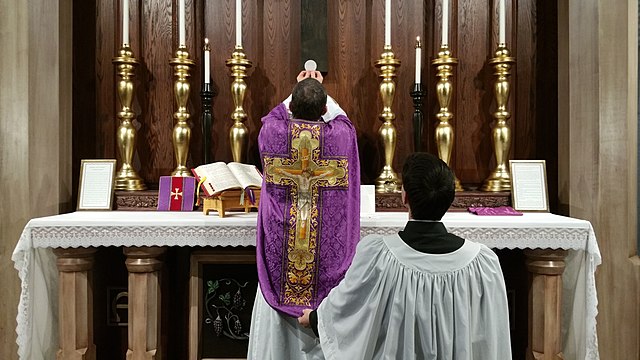
This retreat [into the ritual] serves to visualize the divine reality that comes from God—the earthly liturgy is the image of the heavenly liturgy—and to make way for the action of the main celebrant, namely, Christ himself—the priest acts in persona Christi. The celebrating priest becomes the more unimportant in his individual personality the more priestly his action is. In the heart of the Holy Mass, during the Canon, in which the transubstantiation and thus the descent of the one eternal High Priest occurs, the priest no longer has a face: he stands—yes!—with his back to the people, he speaks what every other priest speaks at this point, he becomes in his person completely unimportant and replaceable, because he makes room for the One for whose sake alone the believer takes part in the sacred liturgy. To emphasize eye contact with the priest at this point therefore means the utmost misunderstanding of the priestly function in its proper sense. In the highest priestly act, the priest is pure instrument and perviousness for the One.
Let’s have a look at a few contrasting photos and ask ourselves how the necessarily unique and irreducible function of the priest in Catholic worship (for there will never be a Mass without a priest) translates phenomenologically into a perception of his role within the Mystical Body.

In the following photos of the traditional High Mass, one sees, on the one hand, a certain separation of the priest from the people and a surrounding of his office with great solemnity and decorum, but on the other hand, the overall impression given is that of a whole community united in prayer, intently focused on worshiping God, each in his or her own way.


If I had to give a name to what I see in the foregoing photos, I would call it “hierarchically differentiated co-participation.”

In the following photos of the Novus Ordo Mass as celebrated nearly universally, one sees, in conjunction with the separate standing of the priest (which, as I mentioned, is unavoidable in any case), a sense of the clergy being over-against the people, in charge of their act of worship, and lording it over the faithful as if the faithful did not enjoy their own equal dignity versus Deum.

I regret to say that in this next photo of a Mass concelebrated by a bishop, newly-ordained priests, and presbyterate, the overwhelming impression is one of a bunch of concessionaires in the limelight, saying grace over the snackbar. If that last cluster of metaphors is jarring, I submit it’s no more jarring than the aesthetic reality we are dealing with. (I say this with no disrespect intended to individual persons, who may interiorly hold the Catholic faith in its integrity, but who are compelled to use ritual forms that do not express this faith.)


Due to the virtually obligatory versus populum stance and other ceremonial elements and lacunae, the overall impression given is that of a clerical caste intent on doing something in sight of the people and to them, while the people are focused on the clerical caste, because it catches the eye. The personal interaction has become the rite. If I had to give it a name, I would call it “hierarchically confrontational codependency.”

Thus there is a confused sense of what exactly the common action is or where it is directed: is it primarily to God? Or to one another? Or maybe we don’t know? In any case, there is a serious ambivalence and ambiguity about what exactly is being done, by whom, for whom, and why. This, of course, plays into the whole question of understanding the Mass as being primarily a sacrifice or primarily a meal (and, since it is both, how they relate to one another). A sacrifice can also be a meal, by way of the sacrificial victim being shared in by the ones offering; it is much harder to see how a meal, as such, would also be a sacrifice, except in the very generic sense that it costs something to put on a meal.

I’m perfectly well aware that a Novus Ordo Mass can be celebrated to look somewhat like the solemn Mass, as in this fine photo from a past CMAA Colloquium:


But three points must be made.

(1) This happens about as often as it snows in Jamaica, and every possible factor in the Church is against it at this time.

(2) If the new Mass can, due to its flexi-rubrics, be made to look somewhat like the old Mass, the old Mass, for its part, can never be celebrated to look like the jamboree version of the new Mass. This is the same objection that has been made many times to the ROTR at this blog and elsewhere: a liturgy that need not be celebrated properly, with the correct orientation and priorities, is a liturgy defective at its core. It is no surprise that the moral and institutional evil of clericalism, by which individual personalities abuse their offices, would find its corresponding lex orandi and external image in just such a liturgy. It is no surprise that the traditional lex orandi, though it cannot prevent moral and institutional evils, runs decisively against clericalism in the exacting humility, precision, and anonymity of its ritual form.

(3) The differences between the two are not only on the surface, as important as surface beauty is; they run much deeper. As a result, even if a new pope came along who suddenly declared that all Novus Ordo Masses had to be offered ad orientem, in Latin, with chant, starting the first Sunday of Advent, it would solve only the external problems — not the internal ones. It would be like repairing the face of a crash victim with plastic surgery while neglecting the more harmful damage to the internal organs.

Needless to say, this article is not the place to go further. We can, at least, be grateful to the National Catholic Reporter for stirring up such important discussions.

Visit www.peterkwasniewski.com for articles, sacred music, and classics reprinted by Os Justi Press (e.g., Newman, Benson, Scheeben, Parsch, Guardini, Chaignon, Leen).

Monday, August 20, 2018

Mass “Facing the People” as Counter-Catechesis and Irreligion

The essence of the Mass is not that it is a communal gathering, for there are many sorts of communal gatherings that are not Masses, and, as the Church has consistently taught, a Mass celebrated privately by a priest and a server, or even in a case of necessity, by a priest alone, is still a true and proper Mass. No, the essence of the Mass is the sacrifice of Jesus Christ on Calvary, made present anew in the immolation of the Victim under the species of bread and wine, and offered again to the Father as a sweet-smelling oblation for the salvation of the world. This, and not the circle of people who may or may not gather around the table, is the essence of the Mass.

As a consequence, the Mass is a theocentric prayer. It is ordered to God. As the Gloria sings: propter magnam gloriam tuam, for the sake of Thy great glory; or in the words of the doxology at the end of the Canon: “All glory and honor are Thine, Almighty Father…” Yes, the Mass was given to us by Our Lord at the Last Supper for our benefit, but it benefits us precisely by ordering us to God first, giving Him the primacy that is His by nature and by conquest. We are benefited by being subordinated to God, yielding ourselves to Him as a rational sacrifice (cf. Rom 12:1); we profit from being decentered on ourselves and recentered on Him, our first beginning and last end.

It is exactly for these reasons that celebration of the Mass versus populum or “facing the people” is not merely an unfortunate aberration based on poor scholarship and democratic-socialist habits of thought endemic to modern Westerners. It is a contradiction of the essence of the Mass and a distortion of the proper relationship of man to God. Because of its inversion of the proper directionality of the worshiping community, people and priest alike, to the uncreated Font and Origin, it functions as a sort of “immunization” against the rational self-sacrifice that turns our souls and our bodies towards the Father, in union with His beloved Son, whose meat is to do the Father’s will, not His own as a man (cf Jn 4:34; Jn 6:38).

To privilege a partial, secondary truth over the fundamental truth is to inculcate untruth.

We can see this if we look at the history of Christian heresy. When the Arians privileged the truth that the Son is in some sense less than the Father (cf Jn 14:28) but neglected the more fundamental truth that He is God—God from God, Light from Light, true God from true God—they inculcated an untruth, for the Son is not less than the Father simply speaking.

When the Pelagians privileged the truth that man is not saved without his own effort, but neglected the more fundamental truth that even our efforts are God’s gift and that without His aid we can do nothing, they inculcated an untruth, for we are saved not by works simply speaking.

When the Protestants privileged the truth that Jesus Christ is our Savior but neglected the truth that He saves us in and through a visible body, the Church, of which we must become members in order to benefit from His saving action, they inculcated an untruth, for there is no salvation outside of the body of the Savior. A subjective conviction that “I am saved” has nothing to do with what we see happening in the New Testament, let alone the history of the early Church.

When modern-day European liberals privilege the truth that man has innate dignity but neglect the truth that his dignity is not absolute or independent of his social nature with its ensuing obligations towards society and its susceptibility to just punishment up to and including death, they inculcate an untruth, for neither death nor the punitive sovereignty of civil authority is contrary to human dignity simply speaking.

In all of these examples (and of course they could be multiplied almost indefinitely), we see how the emphasis of a partial truth taken out of the context of the network of truths that give it meaning results in the establishment of a false system of belief, an -ism that separates itself from Catholicism.

I maintain that the same is true of versus populum. When liturgical reformers privileged the idea of a communal gathering for table fellowship, but neglected the more fundamental truth (recognized as de fide dogma by Trent) that the Mass is the unbloody representation of the bloody Sacrifice of the Cross, they inculcated an untruth, for the Mass is not first and foremost a group doing something together, but Jesus Christ offering Himself in sacrifice and granting us the opportunity to unite ourselves to this perfect, all-sufficient offering, in which our very salvation consists. It is the man who has, over his lifetime, become one with Jesus on the Cross who will be saved, not the man who gets together with friends to reminisce about the itinerant preacher of kindness from Nazareth. The emphasis of a partial truth (that the Mass is a social or communal event involving edible refreshment), when taken out of the context of the larger dogma that gives this event its meaning and power (that the Mass is the sacrifice of Christ, Head and members), falsifies the partial truth and in fact makes it to be harmful, in the same way as Arianism, Pelagianism, and Protestantism are harmful, although each is built upon a truth.

Celebration of the Liturgy of the Eucharist facing the people necessarily decontextualizes and falsifies the social nature of the Mass and unavoidably (even if, in many instances, contrary to the devout wishes of its celebrant) suppresses its theocentric essence. For this reason, it inculcates a false understanding of the Mass, effectively decatechizing the faithful as to its true nature. It does not simply tilt the emphasis to one side or the other; it cancels out the orientation that is demanded by the very meaning of sacrifice, which is to be offered manifestly to God alone. He alone, moreover, deserves and demands our adoration, and if it is not clear that we are united together in adoration of the One who alone is worthy of latreia or divine worship, then the unique right of God to such worship in spirit and in truth has been compromised or canceled out.

If we recall that “religion” names for St. Thomas Aquinas the moral virtue by which we offer to God what is owed to Him by means of external signs and rites (cf. Summa theologiae II-II, q. 81), it would be accurate to say that ad orientem worship and versus populum ‘worship’ are the expression of different “religions,” at least in the sense that something different is being displayed and given.

The problem, then, is not merely that the practice of celebrating Mass “towards the people” has no foundation whatsoever in the history of Catholic or Orthodox worship. No, it is much worse than an unfortunate sociological aberration, like the current fashion of body-piercing. The use of versus populum erodes and corrupts the faith of the people as to the very essence of the Mass and the adoration of God propter magnam gloriam eius — the absolute primacy of God over man, and the corresponding duty of man to subordinate himself to God, as opposed to the ancient sophists and enlightened moderns who unite in the error that “man is the measure of all things.”

The "Benedictine altar arrangement" in a Mass versus populum
Years ago, I used to think that the “Benedictine altar arrangement,” whereby six candles and a crucifix are placed on the front of the altar between the congregation and the celebrant (with the crucifix facing the celebrant as a resting point for his gaze), was an imperfect but valid temporary solution to the dramatic pastoral crisis of the anthropocentric inversion of the Mass. I still believe it is better, all things considered, if only to break up the closed circle and offer visual respite from the tête-à-tête, but I can no longer see it as adequate to the magnitude of the problem.

The placement of six candles and a crucifix on the west side of the altar, useful though it may seem as an “instant fix,” creates two major problems of its own. First, it leaves the false orientation intact, as the priest is still standing with his back to the East (and, in a church with a centrally-located tabernacle, his back to the Lord!), towards the West which — as indicated in the Byzantine rite of baptism — symbolizes the kingdom of darkness. The idea of a “virtual East” represented by the crucifix, while clever, is too cerebral; it is contradicted by the “body language” of the sanctuary, the altar, and the priest.

Second, it throws up an arbitrary barrier between the celebrant and the people, in a way that never happens in ad orientem worship, where everyone faces the same direction and feels the unity of this common orientation.  That is, it could subtly accentuate the “priest over against people” mood that is already such an annoying characteristic of the Novus Ordo, which was composed by clericalists masquerading as populists.

I am not at all opposed to the existence of real, permanent barriers in a church whenever they make sense liturgically and ceremonially: the ancient curtains around the baldachin, the chancel screen or rood screen, the iconostasis, the communion rail. Such barriers articulate liturgical space and provide for a meaningful progression of ministers and actions, while catechizing the faithful about hierarchy, sacredness, and eschatology. But introducing a line of furnishings on the western end of an altar in order to make up (somehow) for the lack of a proper common orientation is arbitrary. It looks temporary and temporizing, as it is, and more often than not, marks an awkward caesura in the sanctuary, like a divider between office cubicles.

In versus populum is symbolized and promoted the anthropocentrism of modernity; its forgetfulness of God; its refusal to order all created reality to the uncreated source; its humanistic this-worldliness, which does not decisively subordinate the here and now to the Lord, the Orient, who has come and who will come again to judge the living and the dead. With this change alone, the liturgical ethos or consciousness of Christianity was shattered. If the old Mass were suddenly to be celebrated versus populum, in the manner in which the Novus Ordo generally is, it would be totally undermined by this one change; if the reformed Mass were to be celebrated ad orientem, this liturgical prodigal son would, by that metanoia, have already begun its journey back to the father’s house.

So much depends on the priest and the people facing east together, that it would be no exaggeration to say that orthodox Christianity will thrive only where public prayer is thus offered, and will suffer attrition wherever it has been abandoned.

The eastward stance and all that it symbolizes and implies is not a mere accident, an incidental feature that we can take or leave, like this or that style of chasuble. It is a constitutive element of the rite of the Holy Sacrifice. We should stop pretending that this is a matter of “six or one-half dozen,” a case of de gustibus non disputandum. A Mass that refuses to orient itself in continuity with the universal tradition and theology of Christian worship is irregular, harmful to the priest and people whom it malforms in an anthropocentric mentality, harmful to the Mystical Body in which it perpetuates rupture and discontinuity, and less pleasing to God whom it deprives of due adoration.

More recent articles:

For more articles, see the NLM archives:



