Tuesday, January 24, 2023

Respect for Tradition is Vital if We Want a Culture of Beauty

Without it we have nothing to guide us

The traditional assumption is that when we apprehend beauty in the world around us, we are discerning a property that belongs to the objects regarded. Consistent with this, we call beauty an objective quality. This is to distinguish it from the subject - the person who views the object and makes a judgement on its beauty.

The strongest argument in favor of this assertion, I would say, is that when the assumption of the objectivity of beauty was broadly accepted, the culture that emerged from that society was more beautiful that it is today. Each of you ask yourself: which art, architecture or music is the most beautiful? Most people pick something from the past when people believed this. Similarly, I might ask which part of Oxford do the 10 million visitors visit each year? Or which part of Florence do similar number of tourists go to look at? Is it the part of town with the old buildings with designs rooted in the assumption of objective beauty and incorporating traditional harmony and proportion, or the new buildings built sine WW2 by architects who abandoned the old principles. It is the former. If you do not agree with me on this, you are entitled to your opinion, and you are very unlikely to accept the rest of my argument.

Would you rather pay for a holiday in Florence to see the Duomo…?

….or this 21st century student accommodation?

To categorize beauty as an objective quality is not to say that everyone makes the same judgements. Clearly there is a subjective element too, because we see differences in opinion from person to person on what is beautiful.

When there is a difference of opinion, one might ask, how do we know who is right? What standard is there to help us make such a judgement?

This is not an easy question to answer. In another context, if we were considering the morality of someone’s action for example, we might look to the Magisterium or to Scripture directly for an authoritative judgement. We can know that murder is wrong because Scripture tells us so!

However, there are no equivalent ‘Ten Commandments of beauty’ that God has revealed to us. As a consequence, it is usually fruitless to attempt to make rational arguments that one thing is more beautiful than another, or that my judgment is more accurate than yours, because there is no accepted visible standard that we can use to back up such a claim.

What about those criteria already mentioned - integrity, clarity and due proportion - some might ask? Can’t I apply these criteria to get a definitive answer?

These can help to a degree, but the difficulty here is that we still have to make a personal judgment on the degree of integrity, clarity and due proportion that the object possesses, and so are effectively left with the same difficulty, except multiplied by three!

The capacity of unaided human reason to judge beauty is so variable that we cannot be sure of the validity of any single judgment.

All is not lost, however; just because it is difficult to be sure that any single human judgement is good, it doesn’t mean that we have no measure at all. We know that human nature is drawn to beauty just as it is drawn to the common good, and so we can look at the broad pattern of likes and dislikes of most people over time in a society to consider what is beautiful. We might term this the ‘common taste’ and it is analogous to concepts such as common sense, common law and the highest of these, the common good.

This ‘common taste’ or, put another way, the common sense of what is beautiful, is that standard that emerges over time, and in the consideration of most people in a society. Another word for this common taste over generations is tradition. As an aspect of the culture, the artistic traditions of a society can vary from society to society even while retaining universal principles. So, for example, within the iconographic tradition of sacred art, each national church will tend to develop it’s own style: Greek icons are distinct from Russian icons, which are in turn distinct from English Romanesque icons.

The best way to decide if a piece of art is beautiful, therefore, is to ask what tradition tells us about it. If something has been considered beautiful by many people for a long period of time, there is a greater chance that it is beautiful than for those objects which only a few people appreciate for a short period of time. Tradition is not an infallible guide, but more reliable than a panel of elite intellectuals in a university art department!

In consulting tradition, we consider the society for whom a beautiful object was intended. So we would say that the cosmos was made for all men to behold and so if we want to consider whether or not the cosmos is objectively beautiful we ask ourselves if generally, men have thought that it was.

Similarly, when we look at sacred art, the best guide to the goodness of the style is consideration of the impact that it has on the worshipers in the churches for whom it was intended. Does it on the whole draw people to God as hoped? The pool of people to draw on in this latter category is much smaller than ‘all men’ and so the reliability of the judgment of the effect will be less certain, but nevertheless it is still the best that we have.

Popular culture vs tradition
This appeal to general opinion is likely to disturb some readers who, sensing that popular art and culture is low-brow and superficial, worry about an overreliance on democracy and popularity. However, if we give at least as much weight to the past as to the present, we have a good chance of overcoming the vagaries of fashion. Much of what is popular today will not even be known by the next generation. Some popular items will remain known and appreciated in subsequent generations, however, and it is these are more likely to be truly beautiful. Chesterton called this approach of considering both past and present opinion, the ‘democracy of the dead’. The more we look at the art that transcends its own time and has been considered beautiful by many people in the society for whom it was intended, the greater chance we have of being able to choose the best.

I would argue that we should be so respectful of tradition that in judging the best art we should adopt a general principle referred to by Benedict XVI as a ‘hermeneutic of continuity.’ By this principle, the default position is always with tradition. We assume that tradition has the best answer, the best content, the best style, unless we have compelling evidence that it does not. If current needs are identical to those of the past, we conform to tradition. Where needs are different, it must respond in accordance with the needs of the community (not to the mere whim of the artist). This principle was articulated in a different way by Pius XII in the encyclical Mediator Dei when he said the following:
What we have said about music, applies to the other fine arts, especially to architecture, sculpture and painting. Recent works of art which lend themselves to the materials of modern composition, should not be universally despised and rejected through prejudice. Modern art should be given free scope in the due and reverent service of the church and the sacred rites, provided that they preserve a correct balance between styles tending neither to extreme realism nor to excessive “symbolism,” and that the needs of the Christian community are taken into consideration rather than the particular taste or talent of the individual artist. (195)
These principles guide our judgment. There is room for much variation, and individual expression and taste even while remaining in conformity to the principles that Pius articulates. This is true of all artistic traditions. They conform to principles which can be applied differently according to different needs. This is not the same thing as having unbending rules that cannot be adapted to different situations. Indeed it is the mark of a living tradition that it can always adapt to contemporary needs without contravening the principles that define it. It is clear that Pius XII understood this.

Would you be more excited about studying here, Magdalen College, Oxford?

...or here, at Oxford’s 20th century Mathematical Institute, on the right?

Thursday, October 28, 2021

Change for Change’s Sake? The Orations for Ss Simon and Jude in the Traditional and Reformed Roman Missals

Today’s feast of Saints Simon and Jude, inscribed in both the traditional and reformed Roman calendars on October 28th, provides more insight into the general spirit of the post-Vatican II liturgical reforms, as well as the freedom the members of the Consilium ad exsequendam felt they had when it came to changing the liturgy. In a comparative index of first lines, it would appear as though no changes were made to the prayers of this feast in the course of the reform. However, as we will see, this is far from the case.

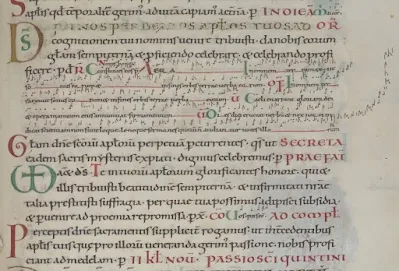
The source for today’s Collect in the usus antiquior is as follows: [1]
Deus, qui nos per beatos apostolos tuos
ad cognitionem tui nominis venire tribuisti, 
da nobis eorum gloriam sempiternam
et proficiendo celebrare et celebrando proficere. (CO 1906)
The Mass of Ss Simon and Jude in a Missal produced in the mid-11th century, and long used at the Abbey of St Denis in Paris. This manuscript represents an intermediate stage between the more ancient sacramentaries and the later medieval missals; the Gregorian propers have been integrated into the text alongside the prayers, but the Scriptural lessons have not. Note the interesting way the neume of the Communio strays into the margin. (Bibliothèque nationale de France. Département des Manuscrits. Latin 9436, folio 110r)
This prayer, extant since at least the eighth century, has been used in Masses of the Apostles (seven manuscripts) and, more frequently, specifically for Saints Simon and Jude (thirty-eight manuscripts, twenty-six of which insert Simonem et Iudam after apostolos tuos). [2] Its textual transmission is remarkably stable, with the only recorded variations being as follows:
  • two manuscripts of the seven where this prayer is used in Masses of the Apostles omit the word tuos;
  • one manuscript where this prayer is used for Saints Simon and Jude reads tui sancti nominis instead of tui nominis;
  • twelve manuscripts where this prayer is used for Saints Simon and Jude lack any specific mention of the two apostles.
These are all very minor variations. The text as it appears in the 1962 Missale Romanum also differs in one other very minor way from its source, reading agnitionem in place of cognitionem. This change seems to have been consolidated at the time of the first printed Missals. [3] It should be noted, however, that cognitionem is the better-attested and original reading. So, in the course of a reform of the liturgy that claimed to be a “restoration”, [4] one might have expected agnitionem to be adjusted back to cognitionem. Not only did this not happen, but the prayer was changed by the Consilium in a way unknown in liturgical history. 
As it appears in the 1970/2008 Missale Romanum, the Collect is as follows: 
Deus, qui nos per beátos Apóstolos 
ad agnitiónem tui nóminis veníre tribuísti, 
intercedéntibus sanctis Simóne et Iuda, 
concéde propítius, ut semper augeátur Ecclésia
increméntis in te credéntium populórum.
Far from restoring this particular oration, Coetus XVIII bis of the Consilium decided to completely rewrite the second half of the prayer in an entirely novel way, loosely based on Acts 5:14 (Magis autem augebatur credentium in Domino multitudo virorum ac mulierum…) and also adding the intercession of Saints Simon and Jude, who have been moved to slightly further on in the Collect. Curiously, the Consilium decided to omit tuos, following the Gelasianum Vetus (probably the earliest manuscript to contain this prayer), but did not restore agnitionem back to cognitionem. Like we see in many other places in the reformed Missal, the best textual witnesses have only been half-used.
More curious, perhaps, is the change to the second half of the prayer, where the striking (and rather lovely) chiastic phrase et proficiendo celebrare, et celebrando proficere has been replaced with what is, in my opinion, a substantially less striking paraphrase of Acts 5:14. This changes the Collect’s petition somewhat: in the traditional Missal we ask, in a symbiotic way cooperating with God’s grace, to be made more holy through our own participation as members of the Church in today's feast day. It is perfectly possible – indeed, in order to cultivate a proper balance between ‘private’ devotion and ‘public’ prayer, it is necessary – to interpret this petition in both an individual and corporate sense. In the reformed Missal, on the other hand, everything is subsumed into the wider Church: we ask “that the Church may constantly grow by increase of the peoples who believe in you” (2011 ICEL), but there is now little sense in the revised Collect that this actually requires anything of us as individual Christians. 
Suffice it to say, there is nothing in Sacrosanctum Concilium that justifies the Consilium’s novel changes to this well-attested and textually very stable prayer. In fact, the intention of Coetus XVIII bis, at least to begin with, was to keep the traditional Collect for today’s feast intact, along with its Secret and Postcommunion. [5] 
Schema 287, with the proposal for the unchanged propers
for Saints Simon and Jude highlighted 
Speaking of which, how did these other prayers fare in the reform? Well, the source for the 1962 Missal’s Secret prayer is as follows:
Gloriam, domine, sanctorum apostolorum
perpetuam praecurrentes,
quaesumus, ut eandem, sacris mysteriis expiati,
dignius celebremus. (CO 2711)
This prayer is extant in six manuscripts for Masses of the Apostles, and in forty manuscripts for the Mass of Saints Simon and Jude. [6] In the 1962 Missal, tuorum Simonis et Iudæ has been added (as variously in seventeen manuscripts [7]), praecurrentes has been changed to venerantes (as in twelve manuscripts), and eandem changed to eam (as in seven manuscripts). It should be noted that there is no extant textual variation in this prayer’s concluding clause, sacris mysteriis expiati, dignius celebremus.
In the reformed Missal, the first half of the super oblata is identical to the 1962 Missal, but the second half of the prayer has been changed to read ut vota nostra suscípias et ad sacra mystéria celebránda nos digne perdúcas. We now ask the Lord to “receive our prayers and lead us to worthily celebrate the sacred mysteries” (2011 ICEL), rather than asking to be “purified by these sacred mysteries”. This change, without precedent in the manuscript tradition, was made by the Consilium presumably as part of the general drive to get rid of any “anticipatory” sacrificial language from the offertory. [8]
The source for the Postcommunion in the usus antiquior is as follows:
Perceptis, domine, sacramentis, suppliciter rogamus, 
ut, intercedentibus beatis apostolis tuis, 
quae pro illorum veneranda gerimus passione, 
nobis proficiant ad medelam. (CO 4200 d)
The Corpus orationum records eight different variants of this prayer (CO 4200 a-h). The ultimate source (CO 4200 a) is the Leonine Sacramentary, where it is a postcommunion for the June feast of Saints Peter and Paul. From there, it is used quite widely for Masses of apostles generally and individually, especially Saints Andrew (CO 4200 cA, and 4200 h), and Saints Simon and Jude (CO 4200 dA). It is also attested as being used for St Benedict (CO 4200 g). The variant for Saints Simon and Jude is extant in thirty-three manuscripts, with fifteen of them adding Simone et Iuda after tuis, and six reading exoramus in place of rogamus, as the 1962 Missal also does. There is no attested variation in the end of this prayer (nobis proficiant ad medelam) when used for Saints Simon and Jude; in fact, across all its different variations and uses, this postcommunion ends with either nobis proficiant ad medelam or nobis proficiant ad salutem.
In the post-Vatican II Missal, this postcommunion now reads as follows:
Percéptis, Dómine, sacraméntis,
súpplices in Spíritu Sancto deprecámur,
ut, quæ pro apostolórum Simónis et Iudæ
veneránda gérimus passióne,
nos in tua dilectióne consérvent.
A completely new ending has been given to this prayer: nobis proficiant ad medelam from the 1962 Missal is changed to nos in tua dilectióne consérvent, a change without precedent in its entire manuscript history across its many and varied uses. I am at a loss as to why this particular change has been made; possibly medelam was considered to have ‘negative’ connotations, but this vocabulary is used elsewhere in the reformed Missal [9] (although nowhere near as often as in the 1962 Missal). The new ending could be seen as an exceptionally vague reference to Jude 21 (vosmetipsos in dilectione Dei servate, exspectantes misericordiam Domini nostri Jesu Christi in vitam æternam), though I think this is a bit of a stretch. Mention of the Holy Spirit has also been added, and the intercession of Saints Simon and Jude deleted, both further changes that are completely without precedent in the liturgical tradition.
All this means that today's feast is, sadly, yet another example of questionable, novel changes being made to long-standing prayers, as part of a claimed “restoration” of the Roman Rite that the evidence increasingly points towards being nothing of the sort. It is difficult to avoid the conclusion that what we have for today’s feast is change for change’s sake, something that cannot be justified in any way by the Second Vatican Council’s Constitution on the Sacred Liturgy (see especially n. 23: Innovationes, demum, ne fiant nisi vera et certa utilitas Ecclesiae id exigat…).
NOTES
[1] In what follows, the abbreviation CO refers to E. Moeller, J.M. Clément, B.C. ’t Wallant & L.-M. Couillaud (eds.), Corpus orationum (CCSL 160-160M; Brepols, 1992-2020, 15 vols.).
[2] There is an overlap of three manuscripts where this prayer is used in both of these ways.
[3] See, for example, the 1474 Missale Romanum Mediolani (ed. R. Lippe; HBS 17; London: Harrison & Sons, 1899), which reads agnitionem.
[4] For example, see Schema 186 (De Missali, 27), 19 September 1966, p. 2; English translation from M.P. Hazell, The Proper of Time in the Post-Vatican II Liturgical Reforms (Lectionary Study Press, 2018), pp. 220-227, at p. 222:
Permulti textus, decursu temporum, vitiati sunt.
Non agitur hic de aliquo archaeologismo, quo lectio antiquior, ipso facto melior aestimaretur. Sed quibusdam mutationibus textus antiqui, sub aspectu theologico vel pastorali, reapse imminuti vel corrupti sunt…
Placetne Patribus, ut, sensu quo modo de his locuti sumus, textus orationum recognoscatur, vel in casu, emendetur? 
[Many texts, over the course of time, have become corrupted.
There is no question here of any archeologism, where older readings are considered better by that fact alone. However, certain alterations of ancient texts, carried out for theological or pastoral reasons, are in truth impairments or corruptions…
Does it please the Fathers that, in the way indicated about which we have spoken, the text of orations is to be revised or, in certain cases, amended?]
[5] See Schema 287 (De Missali, 50), 11 April 1968, p. 35.
[6] There is an overlap of two manuscripts where this prayer is used in both ways.
[7] Five manuscripts add only tuorum, another five add only Simonis et Iudæ, and seven add both.
[9] Namely: the Postcommunion for Ash Wednesday; the Collect for Monday in Week 2 of Lent; the super oblata for the Easter Vigil; and the super oblata for Saint Luke (18 October). It also occurs in the second option for the priest’s prayer before Communion in the Order of Mass (Percéptio Córporis et Sánguinis tui, Dómine Iesu Christe…), as well as in the hymn Crux fidelis on Good Friday.

Friday, October 01, 2021

“All the Elements of the Roman Rite”? Mythbusting, Part II

Over the last decade in particular, the figure of 17% has been quoted as the proportion of prayers that survived intact from the traditional Roman Missal into the novus ordo of Paul VI. [1] However, in the wake of Traditionis custodes, with renewed attention being given to the comparison of ‘forms’ of the Roman Rite as well as the canonical and theological controversy over what counts as its lex orandi, [2] it seemed opportune to build on my previous efforts and revisit this percentage through a careful and exhaustive analysis of all the orations. By doing this, not only can we arrive at a definitive number, but we can also now have all the relevant data freely and easily accessible in the public domain, so that everyone can see which prayers were preserved, edited or discarded. [3]

The result of this work not only vindicates the labours of those such as the late Rev Fr Anthony Cekada, but it also shows the figure to be too generous. For the actual number, unbelievably, is only 13%.
Yes, a mere 13% (165) of the 1,273 prayers of the usus antiquior [4] found their way unchanged into the reformed Missal of Paul VI. Another 24.1% (307) were edited in some way before their inclusion. A further 16.2% (206) were centonised with other prayers - effectively combining parts of multiple prayers together into a new oration. Fully 52.6% (669) of the prayers in the traditional Roman Rite have been excised from the modern liturgy, memory-holed by the Consilium ad exsequendam. [5] How has this happened? And how did so few notice at the time?
Figure 1: Orations of the 1951/1962 Missal in the 1970/2008 Missal
(duplicates excluded)
Since its promulgation, the Catholic faithful have frequently been assured by popes and scholars that the post-Vatican II Missale Romanum is an enrichment, enhancement and fulfilment of the Missal that came before it. In addition, it is often claimed that the liturgical reform has faithfully preserved almost all of the preceding tradition, revising and correcting the texts of prayers on the basis of our much-improved knowledge of the sources while only introducing new prayers for modern needs. A few examples, with my emphases:
[I]t has similarly become clear that the formulas of the Roman Missal need both to be somewhat revised and also to be enriched with additions… In this restoration of the Missale Romanum, not only have the three parts We have already mentioned been changed, namely the Eucharistic Prayer, the Order of Mass, and the Order of Readings, but the others in which it consists have been revised and notably modified, that is: the Temporal, the Sanctoral, the Common of Saints, the Ritual Masses, and the Votive Masses, as they are called. Among these, particular care has been taken with the orations, which have not only been increased in number, so that new prayers respond to the new needs of these times, but also the most ancient prayers have been revised to accord with the ancient texts. [Paul VI, Apostolic Constitution Missale Romanum, 3 April 1969]
What has always been true throughout the varied and progressive development of the Roman liturgy, from the ancient sacramentaries to the revered post-Tridentine Missal of St Pius V, is true also of the new Roman Missal. While preserving the treasure of tradition, it has been rearranged and enhanced in consequence of the directives of Vatican Council II. [Jean-Marie Cardinal Villot, Letter to Bishop Carlo Rossi on the occasion of the 22nd National Liturgical Week of Italy, 30 August 1971]
What exactly is the Missal of Paul VI, if not that of St Pius V adapted, enriched, completed? If we were to engage in a line-by-line comparison, we would find in the Missal of Paul VI three-quarters if not nine-tenths of the content of the original Missal of St Pius V. [Dom Guy Oury, La Messe de S. Pie V à Paul VI (Solesmes, 1975), p. 30]
Lest there be any misunderstanding, let me add that as far as its content is concerned (apart from a few criticisms), I am very grateful for the new Missal, for the way it has enriched the treasury of prayers and prefaces, for the new eucharistic prayers and the increased number of texts for use on weekdays, etc., quite apart from the availability of the vernacular. But I do regard it as unfortunate that we have been presented with the idea of a new book rather than with that of continuity within a single liturgical history. In my view, a new edition will need to make it quite clear that the so-called Missal of Paul VI is nothing other than a renewed form of the same Missal to which Pius X, Urban VIII, Pius V and their predecessors have contributed, right from the Church’s earliest history. [Joseph Ratzinger, The Feast of Faith: Approaches to a Theology of the Liturgy (San Francisco, CA: Ignatius Press, 1986), p. 87]
The new Missal has eighty-one prefaces and sixteen hundred prayers, or more than twice as many as in the old Missal. Almost all the texts of the old Missal have been used, revised if need be to harmonize them with the reform and the teaching of Vatican II. [Annibale Bugnini, The Reform of the Liturgy 1948-1975 (Collegeville, MN: Liturgical Press, 1990), p. 398]
While at the Council’s behest further texts were to be added in order to reflect better the riches of the Church's tradition and in response to the needs of the people, and while some existing texts were to be corrected to reflect more accurately the gains of textual scholarship, the lines and substance of the missal of 1970 remain unmistakably those of 1962. The missal of 1970 is the missal of 1962, reinvigorated, enriched, and endowed with new lustre, like a precious stone whose perennial beauty is enhanced by being ensconced in a new setting. [Cuthbert Johnson & Anthony Ward (eds.), Missale Romanum anno 1962 promulgatum (Rome: Centro Liturgico Vincenziano, 1994), p. vi]
[I]t can be noted how the two Roman Missals, although four centuries have intervened, embrace one and the same tradition. Furthermore, if the inner elements of this tradition are reflected upon, it is also understood how outstandingly and felicitously the older Roman Missal is brought to fulfilment in the later one. [General Instruction of the Roman Missal, 3rd edition, 2002, n. 6]
The desire of both the Council Fathers and Saint Paul VI was that the liturgy should be simplified in order to make it more accessible. While the Missal retains the basic structure of that of Saint Pius V, together with ninety percent of the texts of that Missal, it removes a number of repetitions and accretions and simplifies the language and the gestures of the liturgy. At the same time, it uses more sacrificial vocabulary than was the case in the 1570 Missal. Opinions to the contrary are false. [Archbishop Arthur Roche, “The Roman Missal of Saint Paul VI: A witness to unchanging faith and uninterrupted tradition”, Notitiae 597 (2020), pp. 248-258, at p. 251]
Such quotations could quite easily continue to be piled up. However, for the most part, they can be summarised as follows: even if parts of it could be improved, the reformed Missal is one of the major pastoral and scholarly triumphs of the Second Vatican Council. After all, if it is a faithful enrichment of the traditional Roman Rite, preserving almost all of it yet also carefully adapting it for modern times, how could it be anything but a triumph? Indeed, in his accompanying letter to Traditionis custodes (16 July 2021), which itself claims the novus ordo is “the unique expression of the lex orandi of the Roman Rite” (art. 1), Pope Francis describes this liturgical reform as “willed by Vatican Council II”, going as far to say that:
[T]he instrumental use of Missale Romanum of 1962 is often characterized by a rejection not only of the liturgical reform, but of the Vatican Council II itself, claiming, with unfounded and unsustainable assertions, that it betrayed the Tradition and the “true Church”… To doubt the Council is to doubt the intentions of those very Fathers who exercised their collegial power in a solemn manner cum Petro et sub Petro in an ecumenical council, and, in the final analysis, to doubt the Holy Spirit himself who guides the Church… Whoever wishes to celebrate with devotion according to earlier forms of the liturgy can find in the reformed Roman Missal according to Vatican Council II all the elements of the Roman Rite
In a sense, these words of the Pope are the culmination of all the claims made about the reformed Missal – claims which, it should be noted, have rarely if ever been substantiated with any evidence. Dom Hugh Somerville-Knapman refers to this “elephant in the room” of the liturgical reform, asking the question:
[H]ow truly do the current liturgical books conform to Vatican II’s decrees? Rather than blindly accepting, in post hoc ergo propter hoc fashion, that simply because this is what the Consilium ended up producing they must necessarily express the lex orandi articulated by the Council, let this be demonstrated clearly and plainly. If Rome wants people to accept with willing heart the liturgical reform as delivered, let it demonstrate how it expresses the will of the Council. It is not self-evident.
Sadly, post-Traditionis custodes, the likelihood of the Holy See or the Roman Curia doing this is basically nil. Rather, it almost seems in some circles as if any critical examination of the reformed rites is now synonymous with the “rejection” of an ecumenical (and pastoral) Council. Those who have legitimate questions and concerns about the reform are dismissed out of hand as “radical traditionalists”, “quasi-schismatics”, “extremists”, and so forth.
Yet, as Dom Alcuin Reid has reminded us, legal positivism cannot change historical facts. An assertion that is not true cannot just be declared to be true by fiat, even if it is the Pope himself who attempts to do so.
The welcome pack given to each peritus of the Consilium
(artist’s impression)
So, are “all the elements of the Roman Rite” present in the reformed books? Faced with the statistics and data about the prayers in the reformed Missal as compared to its predecessor, it is exceptionally difficult to see how this assertion can possibly be accurate. It is, in truth, an oft-repeated myth about the reform, and one that the Church urgently needs to leave behind. [6] To reiterate:
  • 52.6% (669) of the prayers in the Missal of the usus antiquior do not occur in the Missal of Paul VI at all;
  • 24.1% (307) of them have been used somewhere in the reformed Missal, but edited in some manner - with 86 of these prayers receiving only minor edits;
  • 16.2% (206) have been ‘centonised’: this was the term used by the Consilium to refer to the combining of parts of two or more orations to create what is effectively a newly-composed prayer; [7]
  • only 13% (165) of the prayers of the usus antiquior made it through the process of reform intact.
It should also be stated that these figures, stark as they are, still do not give the full scale of the changes made by the Consilium ad exsequendam in the name of Vatican II. Even for those prayers that have been retained intact, there is often a change in where they are used in the reformed Missal. For example:
  • Br 7: previously the collect for the 23rd Sunday after Pentecost, this prayer was moved to Friday in Week 5 of Lent, as one of two options for the collect;
  • Br 154: previously the collect for the 14th Sunday after Pentecost, this prayer was also moved to a Lenten weekday - this time, Tuesday in Week 2;
  • Br 183: previously the collect for the 17th Sunday after Pentecost, it has been moved to the “Masses and Prayers for Various Needs and Occasions” section of the reformed Missal, acting as one of two options for the third formulary of the Mass “In Any Need” (n. 48);
  • Br 661: previously the collect for the 20th Sunday after Pentecost, this prayer does not occur in the first (1970) or second (1975) editions of the reformed Missal, only appearing in the third edition (2002/08) as the sixth option for the super populum prayers given in the appendix to the ordo Missae;
  • Br 893: previously the secret for the 23rd Sunday after Pentecost, this prayer was moved to the “Masses and Prayers for Various Needs and Occasions” section, becoming the super oblata for the third Mass formulary “For the Priest Himself” (n. 7), which is the one given for use on the anniversary of ordination.
For the prayers edited before their inclusion in the reformed Missal, there are some definite patterns that can be seen, some quite concerning. For example:
  • “Fasting” language is frequently removed from Lenten orations, due to the changes in discipline made by Paul VI in the wake of Vatican II: e.g. ieiunium quadragesimale (Br 143: Monday in Week 1 of Lent) becomes opus quadragesimale in the reformed prayer (used on the same day); Inchoata ieiunia (Br 643: Friday after Ash Wednesday) has been changed to Inchoata poenitentiae opera (used on the same day), etc.
  • The intercession and merits of the saints are often edited out: e.g. angelico pro nobis interveniente suffragio (Br 623: St Michael, 8 May and 29 September) is changed to angelico ministerio in conspectum tuae maiestatis delatas (Ss Michael, Gabriel & Raphael, 29 September); eius intercessione from the pre-1950 postcommunion for the Assumption of the B.V.M. (Br 676) was deleted before this prayer was used on the Vigil of the Assumption in the reformed Missal; the gloriosa merita of St Mary Magdalene (Br 697: 22 July) are omitted amidst the numerous changes to this prayer in the reformed Missal (used on the same day), etc.
  • The word anima is frequently deleted from the prayers used in Masses for the Dead: e.g. animabus patris et matris meae becomes only patri et matri meae in both the collect (Br 407) and postcommunion (Br 106) of the Mass for the priest’s parents; animabus is deleted from the collect for the first Mass on All Souls (Br 567), which the reformers also moved to the fourth formulary in the “Masses for the Dead: Various Commemorations (For Several Deceased)” section of the reformed Missal, etc.
  • Some notable changes have been made to language that could be considered “negative”, whether to eliminate it entirely or soften it in some way: e.g. in tot adversis is deleted from the collect of Monday in Holy Week (Br 192), used on the same day in the reformed Missal; quos perpetuae mortis eripuisti casibus (Br 364: 2nd Sunday after Easter) is changed to quos eripuisti a servitute peccati (14th Sunday per annum); humanis non sinas subiacere periculis, the end of the postcommunion for the 23rd Sunday after Pentecost (Br 947) now reads a te numquam separari permittas (34th Week per annum), etc.
Many more examples are highlighted in the full document. Some edits and changes can be justified when one looks at the manuscript history of the prayer, and to facilitate this research, reference numbers for the Corpus orationum have been given where possible. For example, the change from misericordiam (Br 418: 10th Sunday after Pentecost) to gratiam (26th Sunday per annum, collect) is a restoration of the Gelasianum Vetus text and, in this instance, the majority of manuscripts. However, more often than not, the changes made by the Consilium are entirely novel, with no basis in the manuscript tradition – all of the above examples of changes, for instance, are entirely without precedent!
In an address to the Consilium on 13 October 1966, Paul VI advised its members that:
No predisposition to change everything without reason must govern this investigation [into the liturgy], nor a hastiness, typical of the iconoclast, to emend and revise everything. The guides must be a devout prudence and a reverence combined with wisdom.
Had the post-conciliar liturgical reforms stayed within these bounds, perhaps we would be having very different debates and conversations in the present day. But among themselves, the periti of the Consilium were quite candid about their intentions. For example:
It is often impossible to preserve either orations that are found in the [current] Roman Missal or to borrow suitable orations from the treasury of ancient euchology. Indeed, prayer ought to express the mind of our current age... [Coetus XIII, Schema 306 (De Missali, 52), 9 September 1968, p. 7]
Revising the pre-existing text becomes more delicate when faced with a need to update content of language, and when all this affects not only the form, but also doctrinal reality. This is called for in light of the new view of human values, considered in relation to and as a way to supernatural goods. The Council clearly proposes this, and it was kept in mind when the temporal cycle was revised. It could not have been ignored in the revision of the sanctoral cycle... An entirely new foundation of eucharistic theology has superseded devotional points of view or of a particular way of venerating and invoking the saints. Retouching the text, moreover, was deemed necessary to bring to light new values and new perspectives. [Carlo Braga, “Il ‘Proprium de Sanctis’ ”, Ephemerides Liturgicae 84 (1970), pp. 401-431, at p. 419]
Suffice it to say, this is not the language of continuity, or fulfilment, or even authentic renewal. The data and statistics for the orations in each Missal - which are now possible for any interested party to easily see and compare - do not justify the assertions that the older Missal is substantially contained in the newer one; in fact, if anything, the situation is closer to the opposite.
In conclusion, if only 13% of the orations in the Missal of the traditional Roman Rite have been kept intact with more than half of them completely discarded, it does not seem possible to say in anything approaching a meaningful way that “all the elements of the Roman Rite” are present in the reformed liturgical books, let alone that the lex orandi of this rite has been properly preserved. There are a number of serious issues present and questions that need to be answered about the supposedly “irreversible” liturgical reform, and they cannot continue to be ignored. In the final analysis, as Dom Alcuin Reid reminds us:
Questioning the continuity of the modern liturgical books with liturgical tradition, and with the sound principles laid down by the Council is not denying the Council or its authority. It is, rather, to seek to defend the Council from those who distorted its stated intentions.
NOTES
[1] Rev Fr Anthony Cekada, whose 17% figure has been cited numerous times over the years, was the pioneer in this regard: see The Problems with the Prayers of the Modern Mass (Rockford, IL: TAN Books, 1991) and Work of Human Hands: A Theological Critique of the Mass of Paul VI (West Chester, OH: Philothea Press, 2010), pp. 219-245.
[2] Lists of the many and varied reactions to the motu proprio can be found here and here on NLM.
[3] It should be noted that much of the underlying work, such as compiling lists of sources, examining the prayers of each Missal side-by-side, etc., was done in the 1970s and 1980s, before the Internet, before most people had access to personal computers, and also before vital tools such as the Corpus orationum existed. We are fortunate enough to live in an age where, thanks to the work of many diligent scholars as well as huge improvements in technology, this kind of research is easier than it has ever been before!
[4] The figure of 1,273 orations has been slightly revised and corrected from my previous article. It is made up of all the prayers in the Missale Romanum as it was in 1951 (1,191), plus those orations added between 1951 and 1962 (82). Due to the Holy Week and calendar reforms of 1955 onwards, this number is not exactly representative of the 1962 Missal, but as prayers from some suppressed celebrations were repurposed in the post-Vatican II Missal, it seemed fairer to include them in the overall total. I am also defining “orations” as the collects, secrets/super oblata, postcommunions and super populum, as well as other orationes contained in the Missal (e.g. the solemn intercessions on Good Friday, those that follow the readings at the Easter and Pentecost Vigils, blessings on particular days such as Palm Sunday, Candlemas, etc.). All the prefaces, as well as hymns and sequences, are excluded from this analysis.
[5] These percentages total more than 100% because some orations are duplicated in each category. For example, Br 120 (9th Sunday after Pentecost, Secret) is preserved intact but is also used in a centonisation; Br 235 (Wednesday in Week 2 of Lent, super populum) is preserved intact and also edited for use elsewhere.
[6] In what follows, the abbreviation “Br” refers to the “Bruylants number” of a given prayer. As part of the reference system for his workLes oraisons du Missel Romain: texte et histoire (Louvain: Centre de Documentation et d’Information Liturgiques, 1952, 2 vols.), Dom Placide Bruylants arranged all the prayers of the Missale Romanum in alphabetical order, then progressively numbered them starting from 1. This reference system is still often used by scholars and liturgists. A useful online list and concordance, minus Dom Bruylants’ text-critical and source information, can be found here.
[7] For the purposes of this analysis, I have kept edited and centonised prayers in separate categories, and have made no attempt to examine centonised orations. Though centonisation would count as “using” an oration, the way in which parts of different prayers were stitched together by the reformers can be quite complicated, and deserves its own dedicated analysis in the future.

Monday, January 08, 2018

Two Attitudes toward Ordinary Form Rubrics: Kantian Duty and Aristotelian Epikeia

Over the years at NLM, various authors have published articles concerning how the Ordinary Form might be “enriched” or “improved,” usually by way of adapting or importing practices of the traditional Roman rite. Sometimes this has taken the modest form of recommending that the OF’s own rubrics be actually followed (e.g., on the ad orientem stance, or on the use of Propers), and that a celebrant exercise a well-informed liturgical phronesis (prudence or practical wisdom) in the choice of options. At other times, the proposals have been more comprehensive, as in Fr. Richard Cipolla’s “A Primer for a Tradition-Minded Celebration of the OF Mass.” Such proposals tend to be greeted with two strongly contrasting reactions: a warm welcome from proponents of “mutual enrichment,” or a stern rebuke from those who see them as fomenting disobedience to the new liturgical books and the documents that control their use.

I submit that we can find a way forward in this debate by considering the contrast between the Kantian notion of duty and the Aristotelian notion of epikeia, often translated “equity.”

For Kant, duty is something absolute: in Germanic fashion, one ought never to swerve from the strict provisions of the law. In fact, the only way we can know that we are virtuous is by suppressing any subjective motivation or personal judgment about what is right to do and submitting to the objectivity of legal dictates. In this perspective, there is no room for going beyond the letter of the law to achieve more perfectly the law’s own intention of promoting the common good. If a traffic light or crosswalk signal is red, one must always stop at it, regardless of the circumstances.

For Aristotle, in contrast, formulated laws, as necessary as they are for social life, suffer from the inherent flaw of having been universally framed (as if to embody a timeless and placeless rational perspective), and thus incapable of responding to certain immediate needs. While justice is surely founded on law-abidingness, it is perfected by an additional virtue called epikeia, whereby one judges well of when and how to adapt the law to specific circumstances. Epikeia is the virtue of seeing past the phrasing of the law to the good it intends to safeguard or promote, so that one may do that which will best safeguard or promote that very good — even if at times it involves stepping aside from the literal dictate of the law. Hence, if the traffic light is red, but one has a seriously injured person as a passenger, one looks both ways and then drives straight through the red light to reach the hospital.[1]

In light of this brief sketch, it seems to me that people come at liturgical law and rubrics from one of two positions:

1. The Kantian: “Say the Black, Do the Red.” No more and no less.

2. The Aristotelian: “Say the Black, Do the Red, in accord with the requirements of liturgy and the pattern of tradition.” In other words, you must do and say the things that are directed, and refrain from doing or saying the things that are prohibited, but beyond this there is a wise liberty to practice unity with one’s Catholic tradition, letting it dictate the way the liturgy should be offered. A priest friend described this view as “classical liberal traditionalism.”[2]

(For the sake of completeness, there is a third position one might identify: the Liberal or Progressive. The clergy who espouse it, however well-intentioned they may be, neither consistently say the black nor do the red, but abuse their positions to improvise and make stuff up as they go along — e.g., arbitrarily speaking aloud prayers that are supposed to be silent.)

Now it seems to me that the Kantian position lines up with those who would see themselves as, or whom others would call, “conservatives,” while the Aristotelian view lines up with those who might are more likely to be characterized as “traditionalists,” whatever we may make of these inadequate labels. Each of these views seems to line up with a fundamental commitment. The Kantian values authority and its dictates over all other considerations, including Tradition, which is not regarded as having normative and probative value. The Aristotelian works with multiple criteria, regarding the moral act as a complex of internal and external elements, which include, to be sure, authority and law, but also extend beyond them to natural law, precedent, custom, and discretion in a Benedictine sense. (The progressive, for his part, takes as a first principle the superiority of the future over the past: he assumes the inferiority, crudity, or corruptness of tradition, exalts the value of human science as a guide to original purity and contemporary need, and therefore tends to chafe at, if he does not violently attack, the restraints of former custom and current law.)

The first or Kantian approach suffers from a kind of mechanistic hollowness: one acknowledges a strict duty to an extrinsic principle but makes no room for the intrinsic principle of intelligence to interpret the situation and act appropriately.[3] That this cannot possibly work for the OF is evidenced by the fact that all kinds of decisions have to be made for which there is no provision in the rubrics (unlike in the usus antiquior, where the Church, drawing on the wisdom of centuries, has carefully specified what is to be done, allowing the celebrant to yield himself more freely to the rite in its perfection). This is why Msgr. Elliott’s Ceremonies of the Modern Roman Rite and Ceremonies of the Liturgical Year are such helpful books — and so hated by liberals. It draws upon the wealth of classical rubrics in order to give more dignity to the OF’s celebration. While it is nowhere near as daring as the Primer published at NLM, it still presupposes the same “classical liberal” attitude of doing what is in line with tradition.

Let me offer a concrete example. Whether the architects of the Novus Ordo disbelieved in transubstantiation or whether they understood the Real Presence in a heretical manner is a moot point; what is beyond dispute is that they suppressed practices that centuries of reverence for the Blessed Sacrament had prompted, and that this suppression has had the effect, in practice, of lessening both the clergy’s awareness of the awesomeness of the sacred mysteries they enact and the people’s faith in the Real Presence. A priest, therefore, possessed of good liturgical sense, understanding why a genuflection should be made immediately after the consecration, why the fingers are thenceforward to be held together, and why, during the ablutions, the fingers should be washed over the chalice with wine and water, will simply do all this as dignum et justum, the right and just thing to do. In this way he is more in keeping with the mind and will of the supreme legislator, who is obligated ex officio to preserve and promote both the liturgical tradition and maximum reverence towards the Body and Blood of Christ. In this way the legislator’s authentic intention is taken up and strengthened, whatever a particular legislator may have been thinking in his human frailty.

All this being said, the Aristotelian approach is advisable for a priest who is steeped in the tradition and thus will know how and when to bring traditional elements to the OF. In contrast, it is dangerous, one might say, for a priest who is operating from a flawed or piecemeal liturgical formation to attempt to apply epikeia, for he may introduce untraditional, unliturgical elements, again with the best of intentions.[4] To put the matter practically, the priest who will be most capable of exercising epikeia in the OF will be the one who is well-versed in the celebration and rubrics of the usus antiquior. Indeed, this was precisely the source of the Primer: its author is a priest who for years has offered both the traditional Mass in all three of its forms (Low, High, and Solemn) and the Ordinary Form within a hermeneutic of continuity.

There is no magisterial document on this “meta-question.” The Instruction Redemptionis Sacramentum and other documents say, of course, that the priest must be obedient to the rubrics, and that the faithful have a right to a liturgy that is celebrated according to them, etc., but both the Kantian and Aristotelian approaches already concur on this point. The confusion in the Latin Church today results, at least in part, from the importation of the antinomian culture of the 1960s into the very sanctuary, in the form of an open-ended liturgy with options, inculturations, adaptations, and a vastly impoverished code of rubrics. Whatever may be its social merits or demerits, antinomianism is an unsustainable liturgical philosophy. This is precisely why young clergy are eager for the kind of guidance offered them in Msgr. Elliott’s books and NLM’s Primer.

Ezekiel’s depiction of Israel — “you were cast out on the open field, for you were abhorred on the day that you were born; and when I passed by you, and saw you weltering in your blood, I said to you in your blood, ‘Live, and grow up like a plant of the field’” (Ezek 16:5–6) — might well remind us of the sorry spectacle of a liturgy so much depleted of sacrality, so much in need of growing up and joining the world of actual historical liturgies (if such a reunification is even possible — a theoretical question better left for another occasion). Naturally, clergy and laity who love Catholic tradition, and who are, in one way or another, confined to the use of the Ordinary Form, wish to do something about this problem of the loss of sacredness and the lack of appropriate rites and rubrics. We ought to recognize that there are various plausible and defensible solutions. One of them, as this article has argued, is to Say the Black and Do the Red with an epikeia that avails itself of traditional means by which the Black acquires a fuller resonance and the Red achieves a fuller dignity.

NOTES

[1] See Nicomachean Ethics, Book V, ch. 10, for Aristotle’s most complete treatment of this virtue.

[2] I say this somewhat tongue-in-cheek; my actual views on classical liberalism as a socio-political philosophy are well known. Suffice it to say that, following in the line of Gregory XVI, Pius IX, and Leo XIII, I am not a fan of it.

[3] The priest is an instrument or tool, but he is, as Aquinas says, an intelligent tool. That is, the Lord makes use of him according to his own nature as a rational animal.

[4] There are larger theoretical issues here, as well, that go beyond the scope of this article. On the one hand, those who designed the OF presumably wanted to revive some fantasy of a free-wheeling early Church liturgy with ex tempore prayers, but there was no thought of the liturgical formation that would be necessary for such virtuosity. Then, formation itself presupposes a specific liturgical tradition, whereas the OF and its options are eclectic between traditions. How is anyone supposed to know if this (mangled) set of Roman orations goes best with that (bowdlerized) Alexandrian Preface, or this or another chant in Latin, English, or Spanish? Prudent choice makes sense within a stable, coherent structure. This, again, is why the usus antiquior is the only possible guide to stabilizing and harmonizing the usus recentior.

Friday, July 07, 2017

The Glorious Revolution Overthrown: On the Tenth Anniversary of Summorum Pontificum

If one reads a lot of Catholic literature from the late sixties and throughout the seventies and eighties, one encounters a peculiar smugness in the authors, a self-satisfaction at the success of what they could easily have dubbed their own “Glorious Revolution.” They believe that they have sung a new Church into being, just like that, built on the ruins of centuries of fortress-mentality Counter-Reformation Catholicism, now safely leveled to the dust.

But as the years roll on, and especially with the unexpected advent of Benedict XVI, a new note begins to be sounded in the magazines, journals, and newspapers of the regnant party — a note of anxiety about the increasingly undeniable fact that there is now an alternative to the prevailing paradigm. There is, surprisingly, competition in the open market. Suddenly one hears the former partisans of diversity and experimentation thunderously condemning the presence of the Other, because it simply does not belong. Alterity is all fine and good until it is really significant alterity. Then it has to be melted down and poured into the popsicle tray of institutional uniformity. The promoters of diversity suddenly sound like those who support a “free market” as long as it favors big government and big corporations.

Wherever it springs up, the traditional Roman Rite attracts God-thirsting souls, and Catholic culture starts to spring up again alongside of it, or rather, within it and from it. Yet in many places, this new opening to grace is not tolerated by the establishment. The fallacy of a petitio principii rears its head: “Because people aren’t interested, and no one will come, therefore we won’t make it available.” This is a desperate maneuver of one who is afraid of something — afraid, perhaps, that what was sacred and great for past generations of Catholics might be found to be sacred and great by Catholics today who never knew it before.

One would think churchmen would and should do anything that promised to win souls for Christ, including the strange experiment of Tradition. Salus animarum suprema lex. When an institution is bleeding its members, when a local church is facing a catastrophic collapse in sacramental practice, one would expect its leaders to attempt even desperate and unlikely expedients, such as the revival of traditional Catholic practice. The passage of time has taught us, alas, that there are some, including far too many high-ranking clerics, who would rather lose Catholics than give up the aggiornamento. An empty church is at least a church with no Latin Mass, and empty pews will at least have no large homeschooling families that study Latin, wear veils, and give the Church vocations. Potential disaster averted.

A sign of contradiction and a thorn in the side: this is the vocation of the traditionalist in the Church of today. Maybe someday it will be different, and the traditionalist can once more be the Catholic, without an uncomfortable distinctiveness, without the duty of criticism and opposition. After all, for long stretches of Church history, every believing Catholic was ipso facto a traditionalist. There was not a perilous choice between being a Catholic in obvious communion with all of one’s forebears and being a Catholic who is aggiornamentoed and avant-garde.

Summorum Pontificum has been insightfully described as the single greatest proof — and guarantee — of the hermeneutic of continuity. Perhaps it may prove, in the long run, to be the only incontrovertible evidence of continuity. How do we know that the Church of today is the same as the Church of yesterday and of every age? Because she celebrates the same liturgy, one characterized by slow development under the influence of the Holy Spirit. This is the very badge and banner of Catholicity.

(This article is an excerpt from my new book, Noble Beauty, Transcendent Holiness: Why the Modern Age Needs the Mass of Ages [Kettering, OH: Angelico Press, 2017], 149–51.)

Wednesday, June 28, 2017

Recovering the Christian Psalter: A Talk by Dom Benedict Andersen

I strongly commend to our readers’ attention this excellent talk delivered to the recent Colloquium of the Church Music Association of America by Dom Benedict Maria Andersen OSB, a monk of Silverstream Priory in Ireland. It is entitled “Fulfilled is all that David told”: Recovering the Christian Psalter; by “Christian”, Dom Andersen here means the Psalms according to the Septuagint translation, which was used in the New Testament itself, and received by the Church from the very beginning for liturgical use. He offers a particularly interesting discussion of the importance of certain readings of the Septuagint for Christian theology and liturgy, also noting how the modern presumption in favor of the later Hebrew Massoretic text has led to a significant (and largely unjustified) break with tradition in the recasting of many liturgical texts for use in the Ordinary Form.

Listen to the talk at Silverstream Priory’s Soundcloud channel: https://soundcloud.com/cenacleosb/christian-psalter

h/t to Mr Brian McCord!

The first page of a Psalterium Triplex, with the three versions of the Latin Psalms in parallel columns, plus glosses and commentaries. Paris BNF Ms. Latin 8846, ca. 1190.

Monday, January 30, 2017

A Defense of Liturgy as “Carolingian Court Ritual”

Fr. Anthony Ruff, O.S.B., regnant spirit of PrayTell and heir to Collegeville’s long line of liturgical iconoclasts and modernizers, has this to say about the “paradigm shifts” inaugurated by the Second Vatican Council:
The Council fathers didn’t get into all the specifics of the reform of the liturgy. They left most of that to a future commission under the pope. The fathers approved a major paradigm shift — from liturgy as Carolingian clerical drama to liturgy as act of all the people — and then left open what the implications of that shift would be. No doubt some or many of the fathers didn’t yet have in mind all the possible implications of the paradigm shift. Nor did they need to.
One wonders how many of the fathers of the Council would have said that the traditional liturgy as they knew it was “Carolingian clerical drama” and that they wanted to shift liturgy to an “act of all the people” in such a way that they expected no limitations on how the liturgy would be modified in order to achieve this nebulous vision. This would not match the historical records as we have them, but rewriting or ignoring history has been a speciality of the progressives for a long time now. Fr. Ruff again:
It’s time to say it: the so-called “hermeneutic of continuity” proposed by Benedict XVI in 2005 has outlived its usefulness as a tool for understanding the Second Vatican Council. Its proponents, who frequently carry the proposal further than Benedict ever did, have shown in abundance that the proposal obscures rather than clarifies the paradigm shifts clearly called for by the Council. For liturgy, the paradigm shift is from Carolingian clericalized sacred drama to an act of the entire community. Just let the full weight of that shift sink in, including all the possible implications for liturgical practice. There is a reason why the Fathers of Vatican II decided that the 1962 missal would not remain in use in its unreformed state.
This “hermeneutic of continuity” was and is, in fact, one of Pope Benedict XVI’s great contributions to the Church, and to the healing of so many rifts. Indeed, we might note that the hermeneutic of continuity is already present as a matter of principle in John XXIII’s opening speech, when he states that the Council is based on a serene acceptance of all that has come before, in all the Councils (mentioning Trent and Vatican I by name), and aims to share the riches of the Catholic Faith with the modern world. If this Johannine-Benedictine claim is true, it undermines the progressive modus operandi, which introduces a deep rift between preconciliar and postconciliar Catholicism. Were it false, however, it would undermine the Council itself, because there cannot be a valid Council that seeks to separate itself from the inheritance of nineteen centuries of Catholicism, including all of its ecumenical councils and its liturgical tradition.

But leaving aside the abrasive nuisance of truth for a moment, let us look at Fr. Ruff’s mention of the Carolingians. The Carolingians are so useful as a conceptual reference point that even if they had not existed we would have had to invent them. The simple fact is that we know so little about the liturgy of the pre-Carolingian period that liturgists can attribute almost anything they want, i.e., anything they personally dislike, to the Carolingians, as an excuse to say that it is not “primitive,” and must therefore be expunged. References to the Carolingians and the supposed “purer” worship of their predecessors is to be taken with a Malta-sized grain of salt.

Moreover, if “clericalism” is supposed to be the problem, the Novus Ordo is a thousand times more clericalist than the old Mass could ever be. “Participation” in the new liturgy is effectively defined by lay usurpation of historically clerical roles, such as reading the Scriptures, and giving out Communion. The clerical nature of these roles is underlined by the fact that is still illicit for a layman to read the Gospel and for the celebrant to not distribute Communion. Lay participation in good music, in meditation and prayer, have been effectively obliterated by a noisy showmanship which is encouraged and well-nigh universal.

It is often said that the old liturgy is characterized by courtliness or court etiquette, that it is mixed up with (and corrupted by) expressions of Baroque secular politics. For partisans of this view, the traditional Mass — think especially the Pontifical Mass — is an elaborate show of deference towards a prince or king, indebted more to secular high culture than to sacred precedent, and detracts from the humility, simplicity, authenticity, and immediacy of the presence of Christ in the community, the brotherhood gathered around the table. Sounds plausible, does it not? But there are some nagging counterindications that deserve the attention of honest inquirers.

In The Treasure of the Church, J. B. Bagshaw argues to the intimate connection between royalism or royalty and temple liturgy, and how, as a result, the image of “the court of the great king” was early adapted to Christian liturgy and everywhere accepted as a normative, though not exclusive, conceptual framework — something it obviously already is in both the Old and New Testaments. In Bagshaw’s words:
The very fabric of the church suggests the presence of God, and the adornment of the altar carries out the same idea. In principle it is very like the splendour and ceremonial of the king’s court. It is impossible for men to have royalty amongst them, and yet not have some external sign by which the king is pointed out and honoured. The ceremonial has, of course, differed widely at different times, but from the earliest king that ever ruled amongst men down to our own time, there has always been a royal display of some kind. It is impossible, in the same way, for men to believe that our Lord is amongst them and not to lavish on Him their most precious treasures, just as it was impossible for St. Mary Magdalen not to pour out her precious ointment on His feet (Jn 12:3). 
The church is His palace, and the altar is His throne. We take that glorious court of Heaven described to us in Holy Scripture, and try feebly to imitate it on earth. The candles, and the incense, and the flowers — the vestments and the ceremonial of priests — what are they, but an earthly image of that “great multitude which no man could number … clothed with white robes, and palms in their hands,” and of “all the angels who stood about the throne, and the ancients and the four living creatures, and they fell down before the throne upon their faces and adored God”? (Rev 7:9–11)
We cannot dismiss this language or imagery, pervasive in Scripture and the Patristic period, as a mere epiphenomenon of ancient near Eastern courts and kings, a superficial mood-setting backdrop quickly or easily left behind by “emancipated” minds. For the same reality, and therefore the same conceptual world, extends throughout the Byzantine emperors who reigned for over a thousand years after Constantine the Great; it embraces medieval courts, Renaissance courts, Baroque courts, and the professedly Catholic governments that existed well into the twentieth century.

Monarchy or princedom, the oldest and arguably the most natural form of political organization, has been a far more consistent part of the human experience and of the formation of Christian culture than the democratic/egalitarian ideology of “self-evident truths” of which we have persuaded ourselves in modernity. Regardless of whether we think democracy can be made to work or not,  in the realm of supernatural mysteries, Christianity is purely and entirely monarchical. Against the backdrop of the Old Testament revelation of God as the (one and only) great King over all the earth, and of the people of Israel as a kingly, priestly people ruled by prophets, judges, and ultimately the Davidic dynasty, we profess that Christ is our King, the Lord of heaven and earth, of all times, past, present, and to come, of this world and of the next; that His angels and saints are His royal court; that He deigns to call us His friends and brethren, yes, but such that we know that we never cease to be His servants. We long for His courts and tabernacles. The thick “politicism” of the imagery points to the real, sovereign polity of the Mystical Body, subsisting in the Roman Catholic Church as a societas perfecta and altogether perfected in the heavenly Jerusalem, the city of the great King. Our ecclesial sacrifice, the Most Holy Eucharist, is a kingly and high-priestly oblation.

Consequently, the modern fixation on democracy, as if it were the best or the only good form of government, not only does not abolish our need for the language of kingship and courtliness, but makes it far more needed than ever before, in order to impress on our minds the way things really stand in the definitive reality of the kingdom of God. All of our democratic and egalitarian experiments will fall away at the end of time, as the glorious reign of Christ the King is revealed to all the nations, and those who have submitted to His gentle yoke will be raised to eternal life in glorified flesh while those who have rejected Him will wail and gnash their teeth, condemned to eternal fire in unending torment. The liturgy should reflect the truth of God — His absolute monarchy, His paternal rule, His hierarchical court in the unspeakable splendor of the heavenly Jerusalem — and not the passing truths of our modern provisional political organizations, or, in other words, that continual redesign of the liturgy, in language and ceremonies and ministers, for which the noveltymongers are agitating.

In short, to conduct the liturgy so that it appears to be less courtly, less regal, less splendid, less hieratic, is to make it appear to be that which it is not — to make it less truthful, less heavenly, less real. In this way it deceives the People of God, who are led further away from an encounter with the God whom no hands have fashioned, no mind fathomed. It is one of many ironies of our time that, in the new regime inaugurated by the “spirit of Vatican II,” the only “courtiers” are those who prance about in their vernacular theater in the round, turning a sublime sacrifice into a sorry spectacle from which the angels avert their gaze.

If the way the liturgy is conducted allows people to think that the Mass is about them; that they are its primary protagonists; that the priests are somewhat like hired public servants who administer, in the name of the community, the business which actually belongs to it, such a liturgy is inculcating a pernicious lie.[1] The liturgy is not “of the people, by the people, and for the people.” It is the saving act of Christ, done by Him first and always, and by the ordained ministers who act in His name and by His authority; it is done for the glorification of God and only for that reason does it sanctify the people. One can say the liturgy is for us in the same way that one can say we ought to love ourselves, namely, by loving God first and foremost, with the sacrificial offering of ourselves in mind and body, which is how we truly love ourselves.

One of the greatest blessings of the traditional Latin liturgy, therefore, is its pure, open, unembarrassed representation of the court of the great King of all the earth, in all of its prayers, rubrics, and ceremonies, and in the magnificent art forms that emerged from its “courtliness” and reinforce the “drama” of the holy mysteries of our redemption. We find in it an uncompromised and unapologetic expression of the divine monarchy as it radiates through the panoply of sacred symbols and the ecclesiastical hierarchy endowed with fatherly potency. We are wrapped in an atmosphere of spiritual aristocracy, namely, the world of the saints, who reign with Christ as his vicegerents. After all, this liturgy was not produced by a committee of experts, as laws and bills are manufactured in contemporary parliaments or congresses, but emerged slowly over time from innumerable currents of doctrine and devotion espoused by an elite of pious souls and assimilated by God-fearing laity. The traditional liturgy, in short, challenges everything modern man has come to take for granted, everything he has persuaded himself to believe “self-evident.” It throws down the gauntlet to our modern assumptions, routines, and expectations. It is an enormous challenge to our collective social hubris and cultural pride. This is why it is hated and feared by those who embrace modernity as a primary value, giving value to all else; this is why it is passionately loved by those who recognize in it a call to a higher, deeper, and better way of thinking, loving, and living.
NOTE

[1] Ratzinger saw all this very clearly. In his seminal essay “The Ecclesiology of Lumen Gentium,” he noted that the phrase “the People of God” quickly gave rise to a fundamental and dangerous misconception of the nature of the Church. He saw, too, the liturgical implications of this politicized (Marxist or democratic) ecclesiology; see especially “The Image of the World and of Human Beings in the Liturgy and Its Expression in Church Music,” in A New Song for the Lord, trans. Martha M. Matesich (New York: Crossroad, 1997), 111–27; also in Collected Works, vol. XI, Theology of the Liturgy (San Francisco: Ignatius Press, 2014), 443–60.

Monday, May 16, 2016

On Needlessly Problematizing Our Situation

Are we orphans? In the Gospel for the Vigil of Pentecost (EF), Jesus assured us He would not leave us so: “I will not leave you orphans: I will come to you.” By His Spirit He will lead us, the Church, into the fullness of truth.

But if this is not to be a mere pious platitude, it must actually mean something, namely, that the Spirit really does bless the Church with gifts at each stage of her pilgrimage. These gifts, moreover, are cumulative: their effects linger in time even as they echo in eternity. Each age inherits the gifts of the saints who have gone before (and, regrettably, suffers from the crimes and vices of the sinners who have also gone before). We do not honor the Holy Spirit or our Lord Jesus Christ if we consider any age to be so different, so great, so new, so chaotic, that it must start afresh, cut the ropes that bind it to the past, reject or push away the gifts of tradition, in a bid to “modernize,” which is to say, to make orphans or strangers of ourselves within our own household. Indeed, such an approach is the only one that could not possibly be a gift of the Holy Spirit.

One day while I was driving around, I was listening to NPR on the radio, and heard them play a clip of the rock band that happened to be performing before the start of a papal Mass in Mexico. The incident seemed to me to speak volumes as to where we are in general. Here was a visit of the Vicar of Christ, Successor of St. Peter, heir of the fisherman, about to offer the Most Holy Sacrifice of the Mass, the supreme act of worship on the face of the earth, the font and apex of our entire Christian life, the axis on which the cosmos revolves until the Day of Judgment. It is the most awesome thing that ever happens or could ever happen — “the divine, holy, most pure, immortal, heavenly, life-creating, and awesome mysteries of Christ,” as our Eastern brethren ecstatically exclaim. And… it was being introduced by a rock concert, which was probably not a whole lot different from the music (weep, o Muses, at the abuse of your sweet name!) performed at the Mass itself. This kind of surreal contradiction, this towering absurdism, is so typical of our age that it almost ceases to attract notice.

Among some highly educated Catholics today, particularly those who study liberal arts and Great Books and therefore spend a lot of their time pondering the past, I have noticed a strange phenomenon, a sort of tormented or self-doubting relationship with tradition, as if they admire it and feel a longing to recover it, while at the same time fearing it is quite impossible to have this tradition any more. They will tell you at one moment how beautiful and how fraught with meaning are certain customs, prayers, or liturgies, and in the next moment will shake their heads about “those misguided people who want to bring all this back, when the Church is doing something different now” — as if the maintenance of laudable tradition always amounted to “turning back the clock,” which, as Charles Taylor assures us, is impossible.

So, in spite of the healthy wound of beauty and the sting of nostalgia that, on behalf of God, beckons us into the wide open spaces of Christian tradition, we end up feeling trapped in the shell of our late modern garbage. We try to console ourselves with the cold comfort of knowing that, even if what we’ve got is second-rate, at least it’s our own. Somehow this is supposed to be reassuring, and somehow it will guard against the temptation of escapism or elitism.

I submit, however, that this attitude is a manifestation of discouragement, which, as St. Thérèse teaches, is a form of pride. While it looks like humility to say we are stuck with our second-best and should not aspire to greatness, the attitude sharply contrasts with the true humility of an artisan who says: “This old chair is lovely. I’m going to copy it as well as I can.” Is there a rule written down somewhere that a great artist should not begin by copying the work of his predecessors? On the contrary, as anyone who studies art history realizes, that is exactly how all great artists have begun: as humble apprentices, learning, absorbing, imitating, drinking deeply from the fountain of the past.

Neither, of course, is there any rule that says we cannot believe, say, and do what our forefathers believed, said, and did. In fact, we would be fools to act otherwise. Our Catholicism would become somewhat like the sun of Heraclitus, which dies each day so that a new one can be born the next morning.

In reality, there is either continuity with our tradition, which guarantees abundant fruit, or there is rupture and severance from it, which brings exponentially compounding problems. So much that has taken place in the past half-century has diluted, distorted, divided, or otherwise needlessly complicated Catholicism by pretending it must change, catch up, try on new garb, shut out the past, and say goodbye to dogmatic certainties. The neo-Catholic perspective abandons us to groping confusion, within which our faith can offer us only mantras of kindness, mutual aid, and generic religiosity.

Such sins against truth and tradition yield the wages of death — death to liturgy and prayer, death to priestly and religious vocations, death to missionary work, death to marriage and family, death to education, death to a culture of beauty. Life, the vitality of the Church in her own nature, will come from our humble embrace of truth and tradition, or it will never come at all.

Reflecting on all of this, I have to wonder where the phenomenon of proudly clinging to our modern mediocrity comes from. Why do otherwise intelligent people needlessly problematize the situation of the Church and of the Catholic in the modern world, wringing their hands at insoluble problems, feeling tempted to rush along with fads and fashions, and resisting the still, small voice that calls them back to the potent treasury of the ages?

One cannot help wondering if this habit of inventing problems or excuses is not an unconscious or semi-conscious defense against taking the single sane action available, namely, immersing oneself deeply and humbly in Catholic tradition — in all those practices, customs, rituals, prayers, arts, and sciences that were handed down from century to century prior to the revolution at the time of the Second Vatican Council and its aftermath. Perhaps there is fear, anxiety, an unwillingness to break free from certain assumptions, comforts, alliances, or mythologies. Perhaps there have been bad experiences with traditionalists who are shell-shocked and radiate glumness instead of joy.

Whatever the case may be, let us pray and work, breaking through and breaking down this ennervating tendency to problematize what is obviously good, holy, noble, and sublime, rather than surrendering to it and embracing it wholeheartedly. It is understandable that the devil would do all he can to thwart this conversion. For in each and every soul that undergoes it, tradition lives again in our midst, and brings new life to a world out of date.

More recent articles:

For more articles, see the NLM archives: