Monday, June 19, 2023

Taking Music Seriously — Inside and Outside of Church

Our Western art-music is the loftiest of God’s gifts to us in the natural order, the greatest artistic treasure the world has ever known, and, in its specifically liturgical manifestations, a vital, indispensable bearer of the theology, spirituality, meaning, and identity of the Catholic religion. We cannot live well without it; we will not pray well without it either.

Music is the language of the soul, its most intimate and exalted expression. Music goes deeply into the soul, into its passions and emotions; it affects us at the intersection of spirit and flesh, it gets “under the skin,” it goes into the very sense-appetites and shapes them by motion, by repetition. Just as habits of virtue or vice are formed in the sense-appetites by repeated action, so too are certain habits formed in the same appetites by repeated sensual stimulation. What we listen to does not remain “outside” of us but enters into us and changes our way of feeling, reacting, perceiving. We cannot help being affected morally by long-term exposure to any kind of music.

The sound that is language comes from our unique mode of being in this world—as being in the world, due to our physicality, but not of it, due to our being rational creatures made in the image of God. The sound that is music, for its part, is the finest flowering of language. No wonder it is the province of worship, loss and lamentation, exultation and joy! For it is a wonder past all other wonders that proceed from the heart of man. Christians, inasmuch as we are “priests, prophets, and kings” by our baptism into Christ the High Priest, Word of God, and King of Kings, deserve and require a diet of the most artistically beautiful, most emotionally satisfying, most intellectually stimulating, and most spiritually beneficial music. In short: we need, for our human and Christian perfection, music that is both good and great. Surrounding it, sustaining it, we need prayer-saturated silence.

Such is the fundamental thesis of my new book Good Music, Sacred Music, and Silence: Three Gifts of God for Liturgy and for Life, which has just been released by TAN Books of Gastonia, North Carolina. Born of decades of experience, study, and reflection as a singer, choir director, composer, and teacher, and seasoned by countless conversations with college students in particular, this work urges readers to take the art of music as seriously as it ought to be taken.
 
The first part, “Music Fit for Kings: The Role of Good Music in the Christian’s Life,” deals with the corrosive cultural and psychological effects of a lot of modern popular music, contrasted with the numerous benefits of a lifelong apprenticeship to the great music of the Western tradition (including the many excellent composers working today). Here, I draw upon thinkers such as Plato, Aristotle, Aquinas, Pieper, and Ratzinger, and offer concrete strategies for acquiring or deepening a love of beautiful music.

The second part, “Music Fit for the King of Kings: The Role of Sacred Music in the Church’s Life,” provides a thorough philosophical and theological account of what is right about Gregorian chant, polyphony, and pipe organ, and what is wrong with, say, folksy guitar-and-piano or peppy Praise & Worship genres at Mass. I do not hesitate to name names and to pursue my argument to the nitty-gritty level.

In the last and (appropriately) shortest part, I speak of the ways in which silence is both the origin and the fulfillment of music. The book ends with a thorough defense of the more-than-thousand-year-old custom of the silent Canon in the Mass, the fittingness of which Cardinal Ratzinger praised, more recently joined by Cardinal Sarah.

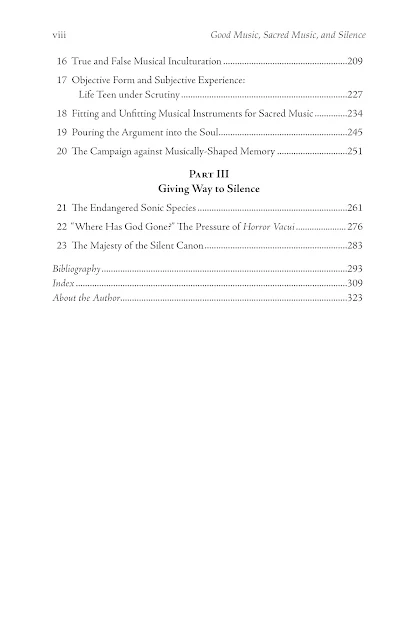
Here’s the Table of Contents:
 
Good Music, Sacred Music, and Silence was written for the benefit of pastors, seminarians, church musicians, homeschooling families, classical curriculum advocates, and everyone who is already in love with music or is seeking to develop a better knowledge of it. To musicians particularly, I would add: in my meandering journey from

  • a childhood liberal parish and contemporary youth group (all the while listening to prog rock, heavy rock, rap, and other, dare I call them, genres), to
  • a charismatic prayer group (when my listening incorporated some “Christian pop” artists), to
  • a Latin Novus Ordo with a chant schola (by which time I had switched over entirely to “classical” music), to
  • immersion in the Byzantine liturgy in Austria, to
  • a mixed old-and-new-Mass chaplaincy in Wyoming, to
  • life in parishes run by the Institute of Christ the King Sovereign Priest and the Priestly Fraternity of Saint Peter,
it is highly likely that I have been, for some portion of my life, in a situation similar to that in which any Catholic musician, music director, or music lover may ever find himself; so I believe my book will carry the force of conviction born of experience, and will be able to say something relevant and beneficial to readers from a wide range of backgrounds.

Nowadays I am singing in a fine men’s schola every Sunday and most holy days, and look forward — if anything, ever more as time goes on — to the joy of singing these incomparably wonderful ancient plainchant melodies, so perfectly suited for the rites to which they give musical utterance and shape. Their beauty elevates my mind to God; their tranquility comforts my heart. This is a joy in the beautiful that we should eagerly share with everyone, until they too can know it and benefit from it.

Nothing could be better than the flourishing, everywhere, and to the fullest extent, of great secular music and of the finest sacred music in the liturgy. That is why I have written my latest book, and I hope you’ll check it out.

Good Music, Sacred Music, and Silence: Three Gifts of God for Liturgy and for Life (hardcover, 344 pp., $29.95, ISBN 978-1505122282) is available from the publisher, from Amazon, and from the author if you would like a signed copy.

*   *   *
Mary Harrell of TAN Books conducted a 26-minute interview with me about the book, for those who might be interested:
 

Saturday, March 13, 2021

Restore Our Choirs for Easter and Save Our Choral Tradition

Last June I wrote a post advocating for common sense in our approach to choirs during the pandemic. Nine months later, choirs in the United Kingdom are still not able to sing in churches, and in fact since January, have been subject to the most restrictive measures under which they have been placed at any time throughout the pandemic. These measures, allowing a maximum of three singers, appear to be completely at odds both with the receding medical situation and the scientific evidence concerning choirs. No account is taken of the proven mitigations we previously had in place, in particular ventilation, on which the UK Government has placed increasing emphasis.

Following the return of our schools, choir directors who train collegiate or cathedral-type choirs, including boys or girls, now find ourselves in an extraordinary situation: we are able to sing and rehearse in school, but not allowed to sing in church. To keep the repertory alive, many of us are maintaining the seasonal rehearsal schedule despite not being able to sing in the liturgical context. For younger singers, rehearsing without a liturgical performance to aim for is dispiriting, to say nothing of the detrimental effect on the Liturgy itself. It is therefore a somewhat equivocal joy to be rehearsing the Introit for Laetare Sunday in such circumstances, and indeed the Tract which contains a wonderful aural depiction of mountains (montes), one of the best examples of word-painting in the entire Gregorian repertory.

The UK Government's ‘road-map’ sets out dates on which lockdown measures will be lifted over the next three months, however there has been no provision made at all for our liturgical choirs, which remain effectively banned, only allowed to sing in numbers greater than three inside a locked church, with no congregation present. Despite attempts by professional bodies to raise the issue, there seems to be a lack of concern for the British choral tradition. Professional singers have already suffered immensely, while pleas for consideration of the particular issues surrounding children's choirs have not been addressed.

The damage being done to the choral tradition is significant and is becoming more difficult to counter. Choir directors are constantly being asked by their choristers “when can we sing in church again?” The feeling of loss and anxiety will be particularly acute amongst those up and down the country who are set to miss their final Passiontide and Easter and maybe even their final term as choristers or choral scholars. It would be a terrible injustice for the culmination of their time to be blighted by such apparently indifferent intransigence. A reversal is needed now to right the damage already done to the young who have shown such extraordinary patience. And who could deny such a wonderful opportunity to breathe new life into our churches again in time for Easter?

Monday, March 08, 2021

Are Women Permitted to Sing the Propers of the Mass?

In the wider Catholic world, the question posed in the title is not even on the radar screen. If you can have altar girls and female lectors — indeed, apparently, acolytesses and lectresses, in a veritable salmagundi of sanctuary servants — then why not women singing music for the Mass? (Never mind the fact that the concept of “propers” has more or less disappeared outside the world of the usus antiquior.) However, traditionalists, myself included, reject both altar girls and female lectors, arguing that it is only appropriate for males to fill these roles, and, in general, that the patronizing and vocationally deviant clericalization of the laity should be avoided. It might therefore be thought that, as a matter of logical consistency, we ought to maintain that women should not form a chant schola to execute the propers of the Mass. Yet this conclusion does not follow.

While I am an adamant opponent of feminism, I am no less staunch an opponent of chauvinism wherever I see it — and I do see it reappearing in the traditional movement, along with other -isms (e.g., antisemitism, libertarianism, sedevacantism) that are incompatible with Catholic tradition. The revival of traditional liturgical practice has permitted the reappearance of some extreme points of view that deserve refutation. For example, not only have I heard traditionalists argue against women singing the propers; I’ve heard them argue that none of the laity whatsoever should sing any of the Mass Ordinary or responses. (On that last point, see here, here, and here.)

The point of departure for the question on women chanters is the rather blunt statement of Pope St. Pius X in his famous 1903 motu proprio Tra le Sollecitudini:
With the exception of the melodies proper to the celebrant at the altar and to the ministers, which must be always sung in Gregorian chant, and without accompaniment of the organ, all the rest of the liturgical chant belongs to the choir of levites, and, therefore, singers in the church, even when they are laymen, are really taking the place of the ecclesiastical choir…. On the same principle it follows that singers in church have a real liturgical office, and that therefore women, being incapable of exercising such office, cannot be admitted to form part of the choir. Whenever, then, it is desired to employ the acute voices of sopranos and contraltos, these parts must be taken by boys, according to the most ancient usage of the Church.

Stated thus, it sounds cut and dried. But is it self-evident that “all the rest of the liturgical chant” (would this include the Ordinary?) “belongs to the choir of levites” (whatever that means exactly)? It seems that Pius X has in view singers in the sanctuary or the “choir” area of a transept of a monastic-style church, where their placement and vesture suggest that they are performing a ministerial function. The operative conception here, it seems to me, is that of a cathedral, seminary, or boys’ school.

If singers are, in contrast, somewhere in the nave, whether on the floor or up in a loft, it is more difficult to see that they constitute a “choir of levites” with a “real liturgical office.” Just as laywomen were not forbidden to sing the Ordinary of the Mass (indeed Pius X and his successors encouraged this) even though the Ordinary is manifestly a liturgical text also said by ordained ministers, by the same logic women would be competent to sing the propers.

To make the situation clearer, Pius XII in his encyclical Musicae Sacrae of 1955 lifted the ban for lay women as long as they were not in the sanctuary (the internal quotations are from three earlier decisions of the Sacred Congregation of Rites):
Where it is impossible to have schools of singers [scholae cantorum] or where there are not enough choir boys, it is allowed that “a group of men and women or girls, located in a place outside the sanctuary set apart for the exclusive use of this group, can sing the liturgical texts at Solemn Mass, as long as the men are completely separated from the women and girls and everything unbecoming is avoided. The Ordinary is bound in conscience in this matter.”
Granted, Pacelli’s words are not exactly a resounding encouragement to have women, but it shows that there is no ban on women singing, as long as they are outside the sanctuary.

Let’s think this through, with attention to the symbolism of church architecture. The development of choir lofts, which can certainly be said to be the norm in most churches built in the century prior to Vatican II, perfectly accords with the role of the choir as a body that provides chant and polyphony for the liturgy, with mixed voices as needed or desired, and in a way that does not involve the singers in the ceremonies taking place below. This preserves the anonymity of the choir and bypasses the danger of distraction for the congregation, since the musicians do not so easily risk “putting on a show.” If the propers can be sung polyphonically with men and women, does that not establish that women may sing the propers by themselves?

Admittedly there is a longstanding tradition of having only men singing, inasmuch as the choir was seen as fulfilling a properly liturgical role. Yet just as it is possible for altar boys to substitute for acolytes, and even for any laity (such as girls in a girls’ school) to make the responses at Mass provided they are in the pews and not in the sanctuary, so too it is possible for non-vested laity to substitute for a properly liturgical choir. Put differently, lay people from outside the choir area can fulfill a liturgical function, but not in a properly liturgical manner, which would involve their being vested and being more closely associated with the ritual action in or near the sanctuary, as we see in solemn Vespers when the singers in cassock and surplice process into the sanctuary, genuflect, bow to each other, and split off to their seats on the sides for the chanting of the psalmody. (It also seems clear enough that whenever there is a schola of clergy or male religious singing the propers, as Pius X envisioned, women should not join them.)

We should also take into account the not inconsiderable witness of centuries of women religious singing the sacred liturgy, and doing so not because there are no men around to do it (although that will usually be true), but because it is proper to themselves: it is a requirement of their consecrated life, expected and indeed demanded of them by the Church. They do not “substitute” for anyone else but do it by a right proper to and inherent in them. Moreover, depending on the order or congregation, the nuns might perform this opus Dei in the choir area of a monastery church (still with a symbolic separation from the sanctuary), chanting all the parts of the Mass except those of the major ministers. It is true that this fact in and of itself does not establish an analogous right for unconsecrated lay women to do the same, but it does establish, once and for all, that women as such are not disqualified from singing the chants of the liturgy, provided that good order is maintained.

Once again we can see what a fine and helpful development the choir loft was, and why it should be present in every Catholic church. How many blessed hours of my life have been spent in choir lofts, leading or singing with scholas and choirs of men and women, in Santa Paula, California; in Washington, D.C., and Silver Spring, Maryland; in Gaming and Vienna, Austria; in Lander, Wyoming and in Lincoln, Nebraska!

We cannot leave history and prudence behind. There has been an evolution in the attitudes toward women in the Church, even while we still hold fast to the ancient truth, now contradicted by Pope Francis, that women should not be vested and serving in ministerial roles (cf. 1 Cor 14:34). One need look no further than the redoubtable Justine Ward to see that women were heavily involved in the resurgence of Gregorian chant in the twentieth century and taught people how to sing it, which means that they were in the lay schola.

It’s not clear to me what we could possibly gain by trying to prevent women from singing the propers, provided the singers are musically qualified (and the same holds, obviously, for men — no one’s sex makes him or her more adept for the art of singing). Unlike the minor orders of acolyte and lector, there has never been a minor order of cantor/singer. It is therefore impossible to classify women singers along with altar girls/acolytesses and female readers/lectresses as part of the same progressive “slippery slope” for the ordination of women as deacons or priests. Musicologists and musicians are free to argue about whether a higher-pitched or lower-pitched rendering of chant works better from the point of view of liturgical aesthetics, and sociologists or anthropologists of religion could argue about cultural expectations and associations, etc., but none of this pertains to the question at hand.

On a practical level, unless there is some extenuating circumstance like a CMAA Sacred Music Colloquium with its pedagogical aims, it would be strange to have a men’s schola and a women’s schola dividing up tasks at the same liturgy; this is best avoided. When only men or only women are singing the propers, the worshiper can more easily forget about it and pay attention to the chants, the texts, and the ceremonies. When the two scholas go back and forth, it draws attention to the octave difference between men and women — that is, it draws attention to the performers, which is not ideal. Similarly, chant sung by men and women simultaneously is sometimes an unavoidable necessity, but chant tends to sound best in a true unison, not in organum of parallel octaves. If a chapel or parish has two scholas, a men’s and a women’s, it would be better to have one or the other sing all the propers at Mass. This is what I did at Wyoming Catholic College. The men’s schola sang multiple times a week; at a certain point, a women’s schola was created to give the women a chance to immerse themselves more fully in the chant and to give the men a much-needed rest. Here, too, a certain complementarity developed that was beneficial for all.

Visit Dr. Kwasniewski’s websiteSoundCloud page, and YouTube channel.

Monday, March 01, 2021

The Ultimate Communion Antiphon Book for the Usus Antiquior

Most singers of chant will be familiar with the old workhorse Communio by Richard Rice (CMAA, 2008), my own copy of which is so well-thumbed and beaten up it’s a wonder it still holds together. Others may be familiar with the Solesmes publication Versus Psalmorum et Canticorum (repr. CMAA, 2008), which contains pointed psalm texts for the Introits and Communions of the entire liturgical year. Although I used both of these books for many years as a choir director, I have discovered a new volume that definitively surpasses them for Sundays and Holy Days.

In November of 2019, I visited Houston to give four lectures, and while there, I decided to “crash” the Schola practice on Sunday at the FSSP parish, Regina Caeli. The singers were gracious and let me join them for the High Mass. At one point, the director, Kyle Lartigue, handed me a book: Ad Communionem: Antiphons and Psalms (Justitias Books, 2016), which, I discovered, was Mr. Lartigue’s own production.

Unlike the other communion books available, which either lack the antiphons and full musical notation (Versus Psalmorum) or utilize the awkward and untraditional Nova Vulgata for the psalm texts, Ad Communionem includes the antiphons for all Sundays and first-class Holy Days, followed by the pertinent psalm from the preconciliar Vulgate, notated in square notes. (The old Vulgate verses are a breeze to sing for those who are familiar with the Missale Romanum and the Breviarium Romanum or the Breviarium Monasticum.) Ad Communionem also includes Psalm 33 and the Gloria Patri in all modes, and an appendix with the Adoro Te and Ubi Caritas. The antiphons are organized not alphabetically (as in Rice’s book, where one must rely on the index) but by Sunday and feastday in chronological order, which makes it much easier to use. While the Solesmes book is more comprehensive, it merely “points” the texts rather than musically notating them, and both the poor quality of the reproduction (many times removed from its original) and the typographical conventions contribute to confusion and stumbling performances.

It’s exactly what I’d want my own schola to have, and in fact when I returned from Houston I asked the pastor in my town if he would buy a bunch of copies for our choir loft. This book deserves to be standard issue for every TLM schola in the English-speaking world. (I should mention that the antiphons and verses are accompanied by an inline English translation from the Douay-Rheims, which closely matches the Latin sense.)
 
Having a Communion antiphon book with psalm verses (regardless of which of the above three options is used) allows the cantors and/or schola to sing however many verses may be needed to prolong or shorten the music for a particular occasion. Sometimes more than one priest is distributing communion and it goes quickly; at others times perhaps there is an overflow crowd and only one priest distributing, which can take quite some time. The chanting of psalm verses has many benefits: the texts are liturgically appropriate and the music is very much in the background, as it should be; the overall effect is calming and prayerful, but the recurrence of the antiphon adds a welcome contrast to the simplicity of the psalm tones, and impresses the repeated text and melody in the minds of all who listen to it. The format also allows for maximum flexibility in musical forces. One can arrange it this way: antiphon (sung by all); verse (begun by cantor and completed by schola); antiphon; etc. Or: antiphon (sung by all); odd verse (sung by cantor); even verse (sung by all); antiphon; etc. Or instead of cantor and tutti, the schola may be divided into two halves. The simple format allows for a ready use of isons and organum.

Now that the TLM is coming back all over the place, Ad Communionem: Antiphons and Psalms is, I would maintain, a required tool for everyone who sings the proper chants. It is one of two books I always carry with me to the choir loft (the other being my Liber Usualis). The book is available in paperback and hardcover. A large sample of the pages may be found here. An index may be found here.

Mr. Lartigue has also produced a number of other books: a newly-typeset Latin edition of the traditional Martyrologium Romanum (updated through 1961, with an appendix of saints canonized after that year); a two-volume edition of traditional Sunday Vespers; Holy Week chants and a complete Kyriale. All of these books are newly typeset and more affordable than their competitors.

Pay a visit to his website: https://justitiasbooks.com/.

Sunday, June 28, 2020

Choirs: An Appeal for Common Sense

Choirs throughout the world face extraordinary challenges at present. Effectively silenced for several months, they have been unable to sing together in rehearsal or in the context of liturgical or concert performance. Even as countries begin, ever so cautiously, to emerge from lockdown, a considerable amount of debate has arisen surrounding the circumstances of viral transmission through singing. This panic was initially precipitated by the spread of the virus in a choir in the USA, pre-lockdown, with the assumption that it was the singing, rather than the lack of social-distancing, which caused this. A number of preliminary studies, including two carried out in Freiburg and Munich, demonstrate that singing is perfectly safe as long as sensible precautions are put in place.

However, Britain’s choral tradition is now under major threat due to the UK government’s proposed guidance which will make it difficult or impossible for choirs to meaningfully rehearse or perform. Even though there is no scientific evidence to prove the dangers of singing, the negative narrative means that the onus is now on us to prove that singing is safe: so much for ‘innocent until proven guilty’. However in a world which seems unable to accept any risk at all, the UK government’s response is ultimately driven by concerns about liability.

Aside from the obvious impoverishment of the Liturgy and the wider cultural heritage, many professional musicians now face very bleak times. Amateur musicians will suffer too. However in the case of children’s choirs, and those which include children such as cathedral choirs, this situation is nothing short of catastrophic.

Children’s choirs are in a constant state of flux and development and boys’ voices undergo pronounced change which requires particular management. Throughout a choir, individuals are at different stages of sight-reading proficiency, pitching ability and general musical awareness. The younger ones apprentice from the older ones, with every child at a different stage on the journey. Through this process the transmission of the choral tradition itself takes place, encompassing the shared musical experiences, the collegiate knowledge of specific repertoire, and the choir’s unique sound itself, melded by the building in which it sings.

None of this can be simply put on hold; it has to be active in order to exist. This is certainly the case for the two choirs which I direct, the London Oratory Junior Choir and the London Oratory Schola, on whose behalf I wrote to Oliver Dowden MP, the Secretary of State for Digital, Culture, Media and Sport to express these concerns. Over a week later his department has yet to respond; however, a number of other Members of Parliament including Sir Edward Leigh have contacted me to assure me of their support.

In my letter I wrote that, unlike adult choirs, a boys’ or children’s choir cannot simply pick up where it left off. The process of nurturing and developing cannot be put on ice and then resumed at a later date without significant consequences. It could take three to five years to recover the damage and rebuild, and a generation of singers could easily be lost. Time is of the essence, and the clock is always ticking for a boy treble.

Science is not absolute, even when preceded by the definite article. The risks to the young are absolutely minute. Will institutions such as Nine Lessons and Carols from King’s College disappear from the landscape? Will there be no choir at the next coronation in Westminster Abbey? Of course not – common sense will prevail in the end, but the sooner the better.

UPDATE: Today (Fri 3 July 2020) I received a response to my letter to Oliver Dowden MP. The response came from Caroline Dinenage MP, Minister of State, DCMS. The letter does not address any of my concerns nor does it make any mention, specific or otherwise, of Children's Choirs.

Thursday, June 18, 2020

Choir Instructions from Westminster Cathedral, 1930

We are grateful to Mr Richard Hawker, the head sacristan of Westminster Cathedral, for sharing with us these photos of a book which he recently found there, “Instructions for the Choir, the Cantors, and the Hebdomadarius”, printed in 1930. Thanks also to Mr Daniel Williams, who has made the book available as a pdf which is free to download. (https://gofile.io/d/929myW) These instructions are really a perfect model of precision, written very concisely, and therefore easy to consult; anyone who has to organize a ceremony with clergy in attendance with certainly find them quite useful. It is partcularly interesting to note that instructions are given for the celebration of the full round of the Divine Office, including Matins.

Tuesday, March 12, 2019

Lofty Arguments! Should the Choir Be In Front of Us or Up High Behind Us?

We all know the horror story. You are away from home and have to go to a local church for Mass. Without any additional information about the church’s liturgical leanings, you assume the worst - that the music will be dismal - and so choose the 7am in the hope that it will be spoken. Then as you enter the church your heart sinks when you see that even for this one, the drum kit, amplifiers, and electric guitars are in there, between the sanctuary and the congregation, ready for their enthusiastic owners to entertain us at Mass (perhaps even bathed in pale blue electric light). Then what seals the nightmare is when several nuns stroll over and start playing!

But this does raise the question in my mind: where should the choir be - even when the music and liturgy are properly ordered? There are some who advocate for the choir loft only, in order to preserve the humility of the singers so that they do not become performers. I do not. In fact, I think that the choir should be just where that rock group currently resides.

Without knowing the history of the choir loft in church architecture I am guessing that this is a relatively recent development, perhaps post-Baroque, or even a Protestant innovation?

I can't think of a single Gothic church with one, for example. If there is a choir as an architectural feature, then it is beyond the altar in the sanctuary. You can’t get more front and center than that!
I haven’t examined the oldest churches in Rome, but I am guessing that they do not have choir lofts either? Readers can no doubt help me here.

If the choir - talking now of the body of people - is giving a performance, then it makes sense that they be out of sight. However, I think the answer is to stop the tendency to attention-grabbing performance, rather than accommodate it, which is what the choir loft might do. Just as with the problem of the showman priest facing the congregation, in which the answer would be to turn him around, so also with the choir. Let’s make them visible, but turn them around too, ad orientem. In both cases, catechesis helps too!

If the choir is worshiping, ad orientem, or facing inwards as in a monastic arrangement, then I would say that they should be visible to the congregation as models of dignified lay worship in front of them, quite literally leading the congregational worship.

There is a difficulty in that I wouldn’t want women in the sanctuary, but I would want women in the choir. You could have the readers in the sanctuary and the non-readers outside with the altar rail running through the center of the cluster of people. Preferable to this, (again assuming we have women in the choir) would be to move the whole choir outside the sanctuary, between the celebrant and the congregation, where the piano, guitars, and drums currently sit.

If the members of the choir are the leaders in worship, then it would very likely need a modification - probably a simplification - of the musical repertoire, so that congregations could sing at least some parts of it. It would not work to sing a full polyphonic Mass every week for example. I would encourage them also to adopt the appropriate postures and engage with the sacred art as they worship in the manner that I have described in earlier posts, again in a way that the congregation sees them and so is inclined to join in.

As far as possible, the men in the choir might be ordained as Readers (I recently met someone who held this position in a Latin Mass in the San Francisco Bay Area). These men would wear cassocks and so would be, quite visibly, leading the choir. Every member of the choir should be catechized to worship as they sing and be in communion with the Church.

And if you don’t think this can work, this is exactly what I have seen in Eastern Rite churches and the effect on the congregational worship is always beneficial, in my observation.

Wednesday, December 20, 2017

A New CNS Series about Gregorian Chant

Catholic News Service has posted over the last couple of days a great series of videos about Gregorian chant and its place in the Church and the liturgy. Here is a particularly interesting one about the experience of St John the Beloved, a parish in McLean, Virginia, that decided to embrace chant as the normative music for all its Masses, exactly as Vatican II wanted. The parish, which has four different choirs, has successfully made chant an important part of the educational program at its school as well, and the music is embraced by the students.
And another about the nature of chant as prayer...
and how it elevates the worship of the Church.
You can find the rest of this excellent and useful series at the CNS Youtube channel.

Thursday, January 05, 2017

Interview on the Role of Choirs in the Catholic Church

Earlier this week, Aleteia published a two-part interview with me "all about choirs" — their historical origin and role in the liturgy, the special qualities of polyphonic music, the pro-choir teaching of the Second Vatican Council, the commentary of John Paul II on the real meaning of active participation, Benedict XVI's teaching on sacred music, congregational singing, orchestral Masses, children’s choirs, and resources for budding groups.

Part I, "Sacred Music: Echoing on Earth the Heavenly Choirs"
Part II, "Church Choirs: The Good, the Bad, and the Ugly"

Here are some excerpts:
Over a few centuries this acorn grew into the majestic oak tree that we call Renaissance polyphony — from the School of Notre Dame to Machaut, Ockeghem to Du Fay, Josquin to Palestrina, Victoria to Byrd. The resulting body of work, comprising thousands upon thousands of Masses, motets, and other choral works, is unlike anything the world had ever known before or has ever known since. It is music of spiritual peace and sensuous beauty, prayerful intensity, spacious thought, purified emotions, lofty aspirations, modesty and naturalness. It flows along with the gentle rhythmic pulse of chant, it sparkles with the suppleness of the medieval modes. As music of the highest artistic excellence, inspired by centuries of Catholic faith and nurtured in an age of liturgy in its full splendor, Renaissance polyphony is second only to chant itself in its perfect suitability for the public, formal, solemn worship of God. It is music wholly in service of the sacred text and of the sacred liturgy. It is sanctified and sanctifying music.

The popes from St. Pius X onwards, concerned about the replacement of congregational chanting with second-rate concert performances, urged the faithful to be instructed in chant so that they could sing the parts of the Mass that pertain to them. (Vatican II stated explicitly: “Steps should be taken so that the faithful may also be able to say or to sing together in Latin those parts of the Ordinary of the Mass which pertain to them,” Sacrosanctum Concilium [SC] 54.) The healthy instinct of the Church has always been for a wise balance between liturgical singing in which everyone can participate and liturgical singing that is rightly entrusted to choirs or scholas. As John Paul II and Benedict XVI taught, choirs dedicated to this more exalted repertoire perform a genuine service for the faithful themselves, by lifting their minds to the sublime beauty of God and prompting interior acts of praise, blessing, adoration, glorification, contrition, and thanksgiving.

John Paul II speaks here of how important it is for the faithful to learn the art of “active listening.” Here is where some soul-searching is necessary. How often do we let the words of the liturgy float right over our heads, while our minds are a thousand miles away? How often do we say the words of the liturgy without even being conscious we have said them? The vernacularization of the Mass had a lot to do with this problem, since it fostered the illusion that as long as something is in your native language, you’ll pay attention to it and make it your own. Not only is this not necessarily true, but experience has often shown the opposite. The vernacular is our comfort zone, where we can take much for granted, where “half-listening” is terribly easy. On the other hand, when people encounter Latin in the liturgy, this strange and hieratic language often compels them to sit up and pay attention, to wonder what is being said and why. The very language proclaims that we are engaged in an act that is not an ordinary affair, that we are entering a time and space set aside, consecrated to God alone.

[T]he faithful may internalize the chants and music of the liturgy, so that the message they carry, particularly through the beauty of the melodies and harmonies, become the seed of meditation and contemplation, drawing us more intimately into the mystery of God. I would go further and argue that we are more in need of the earnest beauty of traditional sacred music today than ever. For many who are trapped within the narrow and artificial confines of modernity, great sacred music—especially from past centuries—can help us break free and reach beyond those confines, to catch a glimpse of the wonder of God, the enchanted cosmos, and the promise of a new heavens and a new earth. It is a potent aid to reverence, devotion, recollection, and self-transcendence.

Pope Benedict says somewhere that it is not enough to have music that “works,” that supplies a certain function, in the manner of a commercial ditty; it has to be better than that. It needs to be suitable for God by being worthy of Him, as much as we can make it. The Church’s tradition is overflowing with such worthy offerings and, although we can and should add to this treasury (otherwise I myself would not be a composer of church music), we would be fools if we did not continue to value what we have inherited from the past. Who but a fool would say that gold from yesterday is worth less than gold from today, or that a diamond a thousand years old is no longer up-to-date and relevant? Beautiful things are never outdated; they are always valid, always suitable, always worthy, always new.
Read more here (Part I) and here (Part II).

More recent articles:

For more articles, see the NLM archives: