Friday, May 24, 2024

Bankrupting the Banquet: Reflections on the Distribution of Holy Communion

Among other things, the National Eucharistic Revival launched by the USCCB is an invitation to reflect on our treatment of the Holy Eucharist and the way it may influence our beliefs. Two decades ago the Reverend Massimo Salani made international news by accusing fast food of being Protestant. Characterizing the popular form of eating as the complete oblivion of food’s “sacred nature,” the Italian Patristics scholar went on to opine that fast food “reflects the individualistic relation between man and God introduced by Luther” and is thus “the fruit of a Protestant culture.”[1] While Salani’s theory won praise from the Italian Minister for Agricultural Resources, both the German Lutheran community and the McDonalds Corporation were quick to issue letters of rebuttal, almost as if both were equally insulted by association with the other.

Regardless of where one stands on the value of fast food, the topic raises a question about the relationship between dining and the Catholic sacramental life. Indeed, Fr. Salani could just as easily have asked not whether fast food is Protestant, but whether fast food is now, thanks to the way we currently administer Holy Communion, Catholic.
Specifically, while the rite of communion in the traditional Latin Mass (and in all other historic apostolic rites) takes on the form of a high banquet or feast, communion in the typical Novus Ordo Mass celebrated in the U.S. today generally resembles the experience of eating at a fast-food restaurant. I stress “today,” for it would be simplistic and misleading to lay blame on the 1969 Missal per se.[2] But we can at least suggest the following. Even when the communion rite of the traditional Latin Mass is celebrated poorly by a hasty priest, the form of it remains unmistakably that of a grand banquet. On the other hand, the more negotiable form of the Novus Ordo communion rite, together with the implementations of the USCCB and the guidance of some American liturgists, have clearly made possible a number of practices that more often than not sell our banqueting birthright for a bowl of McPottage.
At the Lamb’s High Feast
In a traditional Latin Mass, everything about the communion rite betokens participation in a great feast. Only the choicest vessels, made out of silver or gold, are used and only the finest linens. The atmosphere, even when there is only a single priest in somewhat of a hurry, is one of solemn leisure. The communicant stops, kneels, and waits. He is honored by the approach of the priest himself, not a lower minister and certainly not a fellow layman, just as diners at a fine restaurant are particularly honored when the chef comes out and visits their table (I apologize for the profane comparisons here and throughout, but they are necessary for the argument).
When the priest arrives, accompanied by his “waiter,” a formally-dressed acolyte, precious dishware (a gold paten) is placed under the communicant’s chin and he is treated to three things: a beautiful invocation directed specifically to him, “May the body of Our Lord Jesus Christ keep thy soul unto eternal life. Amen”; a mini-Benediction (for the priest makes the sign of the cross with the Host in his hand before distributing it); and the sacred Host itself. The prayer is particularly relevant to our discussion. The chef at a fine restaurant is likely to “pray” that his patrons obtain the intended effects of the fare he has served: hence he says something like, “Enjoy your meal.” The purpose of Holy Communion, on the other hand, is not pleasure for the body but bliss for the soul: hence the priest’s precise yet succinct prayer to each and every communicant.
The communicant then usually lingers for a little while in gratitude. In some parishes, kneelers even wait until everyone on their side of the aisle has received before rising and returning to their pews, both to prolong their adoration but also to show good manners in not rising from the table until everyone has finished.
Of particular importance throughout this ritual feasting is the communion rail. Its opponents depict it not only as a barrier between God and man but as an impediment to the Lord’s supper, for it keeps the congregation segregated from the altar, which in the great tradition has been understood as both the locus of sacrifice and a mensa, a table on which a meal is shared. Yet they overlook how the chancel rail, like the Byzantine iconostasis, is not a partition separating but a seam uniting heaven and earth, sacred and profane; and subsequently, it is more of a window than a wall. Moreover, the communion rail is a table, a banquet setting for the communion of God and His children in the congregation. Underscoring this function was the custom in some parishes of placing a fine white linen communion cloth—a tablecloth, if you will—on the chancel rail.
The Happy Meal
The ethos for Holy Communion at the average American Nouvs Ordo is noticeably different. The communion rail now gone and the striking descent of the priest from the high altar now ameliorated by architectural changes to the sanctuary and by the team of Eucharistic ministers diluting his distributive office, the communicants form a single file line from which they never fully escape. As they hasten forward (in my experience, the line usually moves quickly), they are advised to make some gesture of reverence as they approach the Blessed Sacrament as long as it is not the traditional genuflection—presumably because it might impede efficiency.[3] In the traditional communion rite, the line breaks as individual communicants find a place at the rail and then prepare for Holy Communion. In the most common current dispensation, by contrast, there is no local (and possibly no psychological) transition from reaching the head of the line to receiving the Eucharist.
All of this smacks of a fast-food arrangement, with its focus on speed and efficiency. Customers form single file lines either in the restaurant or in the drive thru, and their food is ready for them before they are seated.
Instead of receiving from a priest, chances are that the communicant will be receiving from an “extraordinary minister of Holy Communion,” often located at various points throughout the church (again to aid efficiency). As has been mentioned already, it is an honor to receive one’s fare from the chef himself (the “high priest,” as it were, of the dinner), but in a decent restaurant one can at least expect to be served by a duly-uniformed waiter. What one would not expect is to have diners from the next table suddenly stand up and serve you your food. Yet this is precisely what happens with lay Eucharistic ministers. They are not priests, they are not members of a minor order (acolyte), and they are not even laymen performing the function of a minor order (altar boys).[4] They are fellow diners who may or may not have taken a workshop on how to distribute God.
Instead of a precious vessel made out of gold or silver, the priest or Eucharistic minister may be holding in his or her hand cheap earthenware. From it he/she proffers a Host and says, “The Body of Christ.” This brief declarative statement, no longer than “Have a nice day,” replaces the beautiful prayer addressed to the individual for his eternal salvation as well as the mini-Benediction. Gone too are the gold patens and the communion cloth that add to the festive splendor and that reinforce belief in the Real Presence of every particle of the Host.
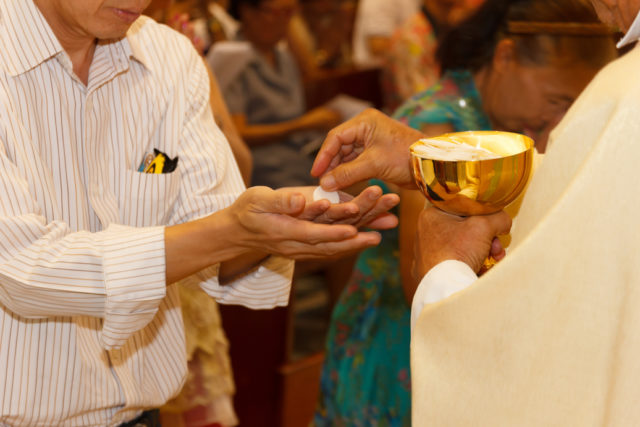
Although one is still permitted to receive on the tongue, it is more common for communicants to receive on the hand, a practice that further facilitates a fast-food mentality. Under this arrangement, it is easy to begin the return to one’s pew before the Host is actually in one’s mouth. Such an impatient action, should it occur (and it does), is roughly comparable to the fast-food customer who pops some fries into his mouth as he takes his tray and finds a table. McDonalds refers to the counter area where orders are picked up as the “grab and go” zone. The term is also a fitting description of Holy Communion at the average Novus Ordo parish. And should the communicant try to slow things down by kneeling down and receiving on the tongue, he may be denied Holy Communion. 
It is not difficult to see, incidentally, which of the two dining paradigms we have described better accords with the Eucharistic passages of the Bible. With the exception of the miracle of the fish and loaves (a picnic setting, so to speak, necessitated by the circumstances), scriptural foreshadowings of the Eucharist tend to involve grand or traditional feasts, such as the Wedding of Cana or the Parable of the Prodigal Son. Moreover, the Last Supper itself took place during no mere meal but the Seder, the highest and most solemn banquet of the Hebrew year, with every its dimension steeped in ritual and ceremony. Finally, the earthly liturgy that Christ instituted in the cenacle is itself a participation in His heavenly wedding feast described in the Book of Revelation. Since every Mass not only synthesizes all of the just sacrifices from Abel on but anticipates this great eschatological banquet in Heaven, it is fitting to have this hidden reality reflected in signs and gestures that are suitably august.
Reply to Objections
Two objections can be raised against our thesis, the first being that, despite the “grab and go” temptation, Communion in the hand as well as Communion standing up remain closer in form to that of a banquet. Few people at a feast, after all, are either spoon-fed by another or take their food on their knees. Yet this is precisely where the analogy—as all analogies eventually do—begins to fail. At an earthly banquet, an adult must indeed be somewhat active in taking food to his mouth. At the heavenly banquet, however, we are more like what St. Paul refers to as “little ones”—helpless infants seeking sustenance from our Parent. The gesture that a communicant takes in the traditional Roman rite is one of perfect receptivity (which is not to be confused with passivity).[5] He is like a fledgling chick, head tilted back, mouth open, pleading for Life.
The pelican, a type for the Eucharistic Christ, on a tabernacle door
This image may be mildly insulting to those who think of themselves as all grown up, but it is evocative of the gala logikos, the “rational milk” (or “milk of the Word”) that St. Peter admonishes us to receive as newborn babes (1 Pet. 2:2); and it hearkens to the ancient association of Christus passus with the mythical pelican. According to a Greek legend, a male pelican returned to the nest after a three-day absence to find his young killed by a serpent. To bring them back to life, he tore open his breast and let his blood trickle onto them. Church Fathers like St. Jerome saw in this tale an allegory of the Eucharist, which is why in Eucharistic hymns like St. Thomas Aquinas’ Adoro Te, Devote, Jesus is addressed with the words, Pie Pelicane, and why tabernacle doors sometimes contain the relief of a pelican immolating itself. And if Jesus is the Pelican whose blood is life-giving Logos-milk, then we are certainly His newborn babes, smitten by the old serpent of sin and recumbent before Him.[6]
The pelican’s affinity with Our Lord also puts into perspective the inappropriateness of recent experiments in intinction, where the communicant takes the Host and then dunks it in the Precious Cup. This chips-’n’-dip motion of the layman is far removed from the practice of several Eastern rites, where the communicant receives both species (the Body intincted in the Blood) from the priest in a fledgling manner similar to that of the believer at a Tridentine Mass. And, of course, it gives the rite of communion an additional air of nonchalant informality, at least in cultures affected by the habits of Super Bowl Sunday snacking.
Second, it may be objected that Communion under both kinds is more banquet-like, since obviously banquets involve drink as well as food. As with Communion in the hand, there is an ancient Roman precedent for this practice, though likewise it is debatable that what we are doing today actually restores the tradition. Few proponents of the former, for example, seem to realize that the original practice, in some places at least, required a woman’s hands to be covered by a cloth when she received the Host.
The issue with Communion under both species is not so much that the Precious Blood is shared (which is theologically unproblematic and even in some respects commendable), but how it is shared. The answer to that question today is, again, fast-food-like. The communicant moves to a second station, almost always staffed by a lay Eucharistic minister, as if he were driving up to the second window of a drive thru. There he takes the Chalice in his hands (further undermining his fledgling orientation), imbibes his share, and goes. Having this second station can also undermine respect for the Eucharist, for invariably—in order not to hold up “traffic”—other communicants pass by the Chalice without acknowledging the presence of their Eucharistic Lord. And it hardly resembles the ancient practice, where only the deacon (the sous-chef of the Sacrifice, so to speak) took a golden straw called a fistula, lowered it in the Chalice, and put his finger over one end so that it would hold the Precious Blood. Then, moving to the communicant (not vice versa), he would suspend the fistula over the person’s open mouth and release his finger so that the Blood would empty into it, pelican-like.
two fistulae
Conclusion
Entitling this article “Bankrupting the Banquet” is not intended to be sensationalist or to suggest that when Mass is celebrated in a fast-food manner the Sacrament loses any of its efficacy. Both “bankrupt” and “banquet” come from bancus (the Latin for bench), the former in reference to a banker’s counter, the latter to a dining table. Keeping this etymology in mind sets into relief the content of our critique: by removing the communion rail and all the other elements of grand feasting, we have literally bankrupted the Roman rite, ruptured or broken the banquet bench on which the communion between God and man appropriately takes place.
Consequently, nature abhorring the vacuum that it does, an ethos of efficient consumption comparable to that of the American fast-food industry has crept into our solemn worship. The result is an atmosphere and an etiquette at odds not only with the sacrificial, regal, and divine character of the Eucharistic liturgy but with its festive, leisurely nature. Exorcizing the spirit of Burger King from the banquet of the Heavenly King remains an urgent and pastorally pressing task. If, as National Eucharistic Revival would suggest, the Church is serious about restoring a sense of reverence for the Eucharist, she may wish to reconsider how she distributes It.
An earlier version of this essay appeared in The Latin Mass magazine 16:3 (Summer 2007), pp. 38-41. Many thanks to the editors for allowing its publication here.
Notes
[1] From an interview that appeared in Avvenire, November 8, 2000. English translation from 2000 Religion News Service Star Telegram, Ft. Worth, Texas.
[2] Indeed, many of the features of a contemporary American Mass I am about to describe are not at all mandated by the 1969 Missal. On the other hand, it must be acknowledged that the new Missal and many post-conciliar directives either permit or insufficiently guard against the encroachment of “fast-food” practices in the liturgy.
[3] While the American adaptations to the General Instructions for the Roman Missal discourage kneeling or genuflecting during the reception of Communion (the bishops’ effort to forbid the practice outright was rejected by the Vatican), they do not state why these practices are now so objectionable. One respected liturgical scholar once suggested to me that the motive was purely logistical: kneeling and genuflecting interrupt the flow of the communion line.
[4] Even tonsured clerics were not permitted to distribute Holy Communion: only the major order of priest (for the Body) and the major order of deacon (for the Precious Blood) had such privileges.
[5] The Blessed Virgin Mary, for instance, was utterly receptive to the Angel Gabriel’s announcement, not utterly passive.
[6] The pelican metaphor also underscores the inappropriateness of Eucharistic ministers whose activity alienates the priest—acting in persona Pelicani, as it were—from the Divine Pelican’s blood and brood. For the pelican does not ask some other bird to revive his young after his act of self-sacrifice but carries the act through to its completion himself.

Monday, May 11, 2020

Communion on the Tongue: Episcopal Oversight, the Common Good, and Useful Lessons from Tradition

A number of people online have been promoting the idea that Canon 223 of the 1983 Code of Canon Law gives bishops the authority to deny the Catholic faithful communion on the tongue and to require communion in the hand for anyone receiving.

Let’s have a look at the canon.
Can. 223 §1. In exercising their rights, the Christian faithful, both as individuals and gathered together in associations, must take into account the common good of the Church, the rights of others, and their own duties toward others.
§2. In view of the common good, ecclesiastical authority can direct the exercise of rights which are proper to the Christian faithful.
As I mentioned in my last article, “Contempt for Communion and the Mechanization of Mass,” the notion of “the common good” can be too breezily invoked to cover a multitude of sins.

The first thing we need to consider is a theological fact that has more authority than any canon law or any interpretation thereof: that, as St. Thomas Aquinas teaches [1], the common good of the entire universe is found in Christ, and Christ is really present in the Holy Eucharist, as the same saint memorably conveys in the Magnificat antiphon for Vespers of Corpus Christi:
O sacrum convivium, in quo Christus sumitur: recolitur memoria passionis eius: mens impletur gratia: et futurae gloriae nobis pignus datur. Alleluia. (O sacred banquet, in which Christ is received, the memory of his Passion is renewed, the mind is filled with grace, and a pledge of future glory is given to us. Alleluia.)
This means the Holy Eucharist IS the common good of the entire universe. Therefore, when we are considering how Communion ought to be distributed, the first and last consideration must be what we owe to God in loving Him above all others; we owe Him fitting reverence in all that we do and say. The Blessed Sacrament is not just “one more thing” over which a bishop has control, even if there is a limited sense in which he may establish norms for his diocese not contrary to universal norms (unless expressly permitted to do so; and even then, we should recall the statement of the Apostle: “all things are lawful to me, but all things are not expedient,” 1 Cor. 6, 12).

If we take seriously the truth of which Aquinas reminds us, we will see that Can. 223 §1 is obliging us to “take into account the common good of the Church” — above all, Christ Himself in the Eucharist — and, in that light, “the rights of others, and their own duties toward others.” The faithful have the right to see the Eucharist properly treated by all; our duties include building up the Body of Christ in holiness, which is incompatible with any kind of irreverence or unworthy experimentation, such as the German methods of Coronacommunion depicted in my last article.

Inevitably, the question arises: What is and what is not reverent? It seems to me very dangerous to say that bishops, all by themselves, get to determine the answer to this question, in a positivist vacuum. That is an anti-traditional nominalism that Catholics should not abide. Meanwhile, it is clear that the current situation will show which bishops have a supernatural perspective and which ones have a merely natural perspective.

More interesting is Can. 223 §2: “In view of the common good, ecclesiastical authority can direct the exercise of rights which are proper to the Christian faithful.” This canon suffers more than usually from the vagueness that is a necessary fault (as it were) of any code of law, but it is clear that it must be interpreted in light of the general norms of the law. Thus, for instance, Can. 135 §2 states, in part: “A lower legislator cannot validly issue a law contrary to higher law.” Given no provision for overruling the liturgical norms in force — which norms are extremely clear, repeated numerous times, as I and others have demonstrated (most recently in this article) — any bishop’s attempt to deny the right to receive Holy Communion on the tongue is unlawful on its face. [2]

Beyond this more theoretical consideration, we may note — as countless bloggers and online commenters have already done — that the USCCB has quasi-adopted a set of guidelines from the Thomistic Institute that state: “We believe that, with the precautions listed here, it is possible to distribute on the tongue without unreasonable risk.” [3] Although I do not agree with many of the Thomistic Institute’s precautions (for the reasons given in my last article), they at least recognize, as have various dioceses here and there (Portland being the best known), that there is no unreasonable risk in proceeding with the method that is still the Church’s universal norm.

Archbishop Chaput giving Holy Communion:
note optimal height relationship
Practical Issues with Communion on the Tongue

However, here I must speak plainly, and cut through the rigmarole. It is time for the hierarchy of the Church to recognize that the bishops themselves have caused the problem with sanitary communion on the tongue precisely by abolishing (or, at any rate, discouraging for decades) the traditional manner of receiving — namely, kneeling shoulder-to-shoulder along an altar rail, with a server holding a chin paten. [4] This method became universal for good reason. Quite apart from its superior reverence,[5] it is highly practical, for three reasons:

First, it was normally done only by a priest, who had gained expertise from daily experience, as opposed to the rotating schedules of Extraordinary Ministers of Holy Communion who may or may not know how to place the host properly on the tongue, and who often come across as hesitant, embarrassed, perplexed, or irritated at having to do so.

Second, the priest walking along the communion rail stands at an optimal height at which to place the host easily on the communicant’s tongue. It is vastly more awkward to try to give communion on the tongue to someone standing in front of you, especially if he or she is taller. The traditional method makes it far more likely that a priest will not have any immediate physical contact with the faithful, as opposed to communion in the hand where he will touch many, many germy hands — unless he follows the proposal to drop the host into the hand like a payload from a bomber, which brings with it problems of its own.

Third, because the faithful come up to the altar rail in waves, they have a chance to settle themselves on their knees and can calmly prepare for the priest coming to them. By the time he arrives, the communicant can have his or her head tilted back and be ready. There’s no unseemly rushing. (In the traditional form of communion, the priest says the prayer: “Corpus Domini nostri…” and concludes with the “Amen”; the recipient does not have to move his lips and risk either discharging saliva or accidentally touching the priest’s hand. In other words, it works perfectly in a time of epidemic.)

Bishop Ronald Gainer distributing Holy Communion in the traditional manner
All Catholics should be aware that if they wish to receive on the tongue, they should kneel — regardless of which form of the Mass they are attending or whom they are receiving from. They should kneel, first, because it is the Lord God before whom the angels fall on their faces; and second, because, when they kneel, tilt back their head, and protrude their tongue, it will be very easy for the host to be placed on it.

A seasoned priest who celebrates both forms of the Mass, Fr. Allan J. McDonald, shares some excellent thoughts at his blog Southern Orders [6]:
I know because I celebrate both forms of the one Roman Rite that kneeling for Holy Communion makes it easier for me not to touch the tongue of the communicant in the EF Mass if the communicant does what I was taught about receiving Holy Communion as a second grader. You tilt your head slightly back, stick out your tongue in a natural not exaggerated way and wait for the priest to withdraw his hand prior to retracting one’s tongue or moving one’s head forward.
       In the EF Mass the priest responds amen for the communicant thus neutralizing any spittle from becoming aerosolized and attaching to the priest’s fingers while these are close to the communicant’s mouth.
       Other temporal life-saving aspects of the Extraordinary Form of the Mass are these, which the Ordinary Form is recovering for the temporal health of the laity and priest(s):
       1. Ad orientem, the priest’s aerosolized words go toward the wall not the congregation.
       2. Hymn books are now deemed a deadly device if Coronavirus attaches to them and are being removed from pews. Thus the choir or cantor needs to chant the entrance chant, hopefully the official Introit and the laity actually participate by meditating on what is chanted rather than joining in and aerosolizing the air with their viruses.
       3. The offertory gifts are not touched by anyone, similar to the EF Mass where only the priest touches the sacred vessels — except in the EF it is out of reverence, [while] in the OF it will be out of fear of contagion or viruses attaching to the vessels carried by the laity.
       4. Kneeling for Holy Communion will finally be seen by bishops as the only healthy way to receive Holy Communion without hand-to-hand contact or hand-to-tongue contact, unfortunately not because it is more reverent to receive in the EF manner.
       5. The Common Chalice will never return to the laity out an abundance of fear that Coronavirus will live on and in the chalice and the Precious Blood diluted with copious amounts of numerous communicants’ saliva. Unfortunately the concerning of profanation of the Precious Blood by contaminants or spilling it is not the major concern as it should be.
       6. Priests will no longer be glad-handing the laity before and after Mass; although unlikely, this may lead to priests praying privately to God before and after Mass, which is a custom of the EF Mass.
       7. To prevent aerosolizing of speech with Coronavirus in the floating spittle, silence will be demanded in the church before and after Mass and physical distancing amidst the silence not because the Blessed Sacrament is there and demands silent adoration, but out of a concern for temporal health.
       8. Of course the handshake/hug of peace will disappear out of fear of offending social distancing civil law — not because it is a horrible distraction during the Communion Rite.
Bishop Joseph Perry gives Holy Communion at St. John Cantius
As Fr. McDonald frequently points out on his blog, the Extraordinary Form in fact has better customs in everything that concerns the Blessed Sacrament: its preparation, its consecration, its distribution, its reservation. Many of these will end up being adopted again in Coronatide, not (alas) because Catholics are awakening to the Real Presence and what is most fitting for our approach to the Lord, but out of fear of contamination or sickness. Sadly, this motive is even less noble than imperfect contrition — fear of hell — as a motivation for going to Confession. That, at least, is a concern for one’s immortal destiny after this life, rather than a fixation on this fleeting mortal life that we will all one day have to give up, whether from a virus or from one of ten thousand other natural or violent causes that threaten the poor, banished children of Eve.

It is appropriate for us to ask how we can mitigate risks, but not with the secular mentality of agnostic utilitarians who do not remember and do not take to heart the Lord with Whom we are dealing in the Most Blessed Sacrament. Ironically, it is Catholic tradition, not postconciliar praxis, that holds an array of useful approaches in a time of epidemic. These are ready to be implemented — if anyone cares about the common good of the entire universe and our sacramental participation in it.


NOTES

[1] See Super I ad Cor., cap. 12, lec. 3.

[2] As a side-note: since we know that canon law can, at times, be poorly formulated — criticisms have been freely made by canonists on certain points of both the 1917 and the 1983 codes — I will take this occasion to state that the formulation of Can. 223 §2 is disturbing. How far can it be taken? “Direct the exercise of rights which are proper to the Christian faithful.” All such rights? For example, could a bishop say “I direct you not to get married” or “I direct you to enter religious life”? After all, those are rights proper to the faithful… Without a layman having committed a serious public fault, it is difficult to see how any such directive could be legitimate.

[3] The Thomistic Institute states: “Opinions on this point are varied within the medical and scientific community: some believe Communion on the tongue involves an elevated and, in the light of all the circumstances, an unreasonable risk; others disagree. If Communion on the tongue is provided, one could consider using hand sanitizer after each communicant who receives on the tongue.” This last is a deplorable suggestion, deservedly ridiculed by Fr. Zuhlsdorf.

[4] As demonstrated in “Why We Should Retain or Reintroduce the Communion Plate (‘Chin Paten’),” this practice is called for even by the General Instruction of the Roman Missal that governs the Ordinary Form.

[5] See the article “‘Eat That Which I Will Give You’: Why We Receive Communion in the Mouth.”

[6] I have edited the text slightly.

Visit Dr. Kwasniewski’s website, SoundCloud page, and YouTube channel.

Thursday, March 19, 2020

Restoring Liturgical Tradition after the Pandemic

Even as Catholics continue to suffer from the difficult situation in which we find ourselves, with an absence of public liturgies and restricted sacramental access, the virtue of supernatural hope already prompts us to see many ways in which God may bring forth great good from this evil — or, to speak more truthfully, may be calling us to collaborate in bringing forth great good by a prudent response to circumstances. In particular, we can envision several ways in which the liturgical life of the Church could be improved by far-seeing pastors.

1. Increase frequency of private TLMs. With a large number of priests now consigned to the private celebration of Mass (which is legitimate and praiseworthy according to the mind of the Church), priests will be free to offer the traditional Latin Mass on a daily basis. For priests relatively new at it, this makes possible the perfecting of the celebration through frequent practice. For priests who have been wanting to learn it, now would be a God-sent opportunity to put in the time and practice necessary. For all priests, it could be viewed as an enforced “retreat” at which they can pray freely and fervently for the needs of the Church and the world.

2. Offer Masses ad orientem. Even priests who are not offering or not planning to offer Mass in its traditional form can begin to offer their Masses ad orientem, as is just and right. After several weeks (potentially) of saying Mass facing geographical or liturgical east, these priests will have a perfect excuse to say to their congregations: “In these weeks of the pandemic, when I have been praying Mass for you and your needs every day, I have grown accustomed to offering it facing east, in accord with the long tradition of the Church. I have discovered how much more prayerful it is, how it enables me to pray more fervently to God and for all the intentions for which the Mass is offered. As a result, I would like to keep doing this now that our public celebrations are permitted again.”

With the chaos of paperwork and re-planning that will be engulfing chanceries everywhere, and the sheer gratitude of the faithful who will have returned to church, there could never be a more opportune moment to introduce ad orientem. A simple explanation will put it in context, and Catholic life will go on — only better than it was before.

3. Enrich or tweak the parish Mass schedule. When the public Mass schedule is re-announced, priests will have an ideal opportunity to add to the parish schedule a TLM if it has not been present before, or shift around times to give the TLM a better time slot, or add more TLMs during the week or month. Again, this expansion of sacramental access will be appreciated on its own terms after a long period of instability and inaccessibility, and the Catholics who come back will be prepared for new terrain.

4. Abolish bad custom and abuse. Dubious liturgical customs and liturgical abuses, which have already de facto come to an end with the coronavirus shutdown, could be stopped indefinitely. This has been proposed by an anonymous priest who noted that, even after bishops had banned the sign of peace, holding hands during the Lord’s Prayer, and Communion from the chalice, the Mass still went on and people still attended. In other words, the faithful — or at least the most faithful of the faithful — are more interested in going to Mass than they are in shaking hands, holding hands, or receiving “the cup.” It is more important to go to Mass, period, than to “get” to be an extraordinary minister of Holy Communion. Now is a truly God-given moment to start afresh with better customs:
Together with “turning over a new leaf,” priests can preach about:
  • the fullness of Christ’s presence under each species — thereby defending the traditional reception of the host alone;
  • the essential difference between the ordained priesthood and the common priesthood of the faithful, and thus, why it is appropriate for only the clergy to distribute Communion;
  • why Communion in the hand was a mistake (not, as some try to argue, the revival of ancient practice) that we have many reasons to regret, and why it is best to follow the tradition of the Church, reaffirmed by Paul VI, of receiving on the tongue while kneeling — a posture not only palpably reverent and hallowed by centuries of Catholic custom, but also more efficient and convenient for the minister who is distributing the hosts.
5. Rework the parish music program. Choirs will have been disbanded for weeks. It would therefore be an opportune moment for reassigning responsibilities. A newly-formed schola that sings Gregorian chant could be assigned to a Mass to provide truly sacred music. Another group might be allowed to remain disbanded because of “new pastoral exigencies and priorities.”

It may seem strange to be thinking ahead when we don’t even know what each new day will bring, but we must follow Our Lord’s advice to be “wise as serpents and simple as doves” (Mt 10:16) as we reconquer lost territory for the Kingdom of God. The Lord is gesturing at rich harvests to be reaped. Let us put our hands to the plough and not look back (cf. Lk 9:62).

All of us are being stretched by Divine Providence, so let’s take advantage of the newfound elasticity!

Visit Dr. Kwasniewski’s website, SoundCloud page, and YouTube videos.

Saturday, October 06, 2018

Clericalism, True and False

I do not deny that there are forms of clericalism that have plagued the Western Church in periods of its history, and I would not deny that traditionalists must be on their guard against the reemergence of such forms. Nevertheless, it has been my conviction for a long time that the worst manifestations of clericalism have, in fact, been those that followed the Second Vatican Council.

In my column today at LifeSiteNews, I attempted to describe six of the ways in which "clericalism" rears its ugly head in the postconciliar world. Some excerpts:
1. When a priest, contradicting nearly 2,000 years of unanimous tradition in the apostolic churches of the East and the West, faces the people at Mass (versus populum), he unavoidably imposes himself on them as the principal actor in the liturgy, standing “over against” the passive congregation. In this way the message is transmitted—whether the priest intends it or not—that he is the center of attention, the facilitator and even the validator of the assembled faithful. This is an efficacious sign of clericalism if ever there has been one. ...
2. When a priest says “call me Fr. Jimmy,” acts casually, tells lots of jokes and stories from the pulpit, and “doesn’t stand on ceremony,” he is in fact promoting a cult of the individual personality, the cult of Jimmy, rather than humbly accepting his God-given office or role in the Church as the impersonal minister of the Lord Jesus, one of a million that God will make use of in the span of history. ...
3. On the other hand, when clergy extend traditionally clerical ministries to lay people (e.g., extraordinary ministers of holy communion), they are perpetuating the false view that the only worthwhile, validating “work” for a Catholic is to be busy in the sanctuary. This is one of the worst manifestations of clericalism. The proper role of the laity is not to substitute as “straw ministers” but to sanctify the world outside of the church building...
4. When priests, bishops, and even the pope ignore or hold in contempt the legitimate aspirations and needs of the faithful or of their subordinate clergy; when only the pope, only his collaborators, only his allies, know what is best for everyone else, regardless of education, competency, or expertise — we are facing another notorious form of clericalism, which could be summed up as: “My way or the highway.” ...
5. When bishops or priests want to intrude their personal theological opinions into their preaching and writing, rather than following and handing down the common and traditional teaching of the Church, we are certainly dealing with a particularly acidic form of clericalism.
6. When the pope appoints ambitious men as bishops and curial officials instead of imitating great reforming popes who scoured observant monasteries and parishes for humble, holy, orthodox candidates, or when people entrusted with proposing episcopal candidates fail in their grave charge, they are flexing the muscles of a clericalism that becomes mightier the more successful the ambitious are. ...
Read the full article over at LifeSite. (See here for an archive of my blog posts there, a number of which concern liturgical matters.)

Monday, January 02, 2017

Six Years Ago, Prospects for the ROTR Looked Bright: A Letter from January 2011

Back when men were men and mitres were mitres
I was going through some papers recently and discovered a copy of a letter I had written to His Eminence Antonio Cañizares Llovera on January 3, 2011 -- so, almost exactly six years ago. It brought back to mind in a powerful way the difference between our situation then and our situation now. In 2011, one could really believe (with a tinge of youthful optimism) that the combination of a pope of restorative liturgical vision and a sympathetic prefect of the CDWDS could give traction to a long-overdue "Reform of the Reform." It seemed as if we were just around the corner from correcting a host of abuses and missteps. Perhaps in that period lovers of the sacred liturgy were just too sanguine about the magnitude and solubility of the crisis and too reliant on top-down action. It has been good for us to be weaned of illusions and false expectations, even as we are being weaned, more and more, from whatever residual hyperultramontanism we might have imbibed from our neoconservative catechesis. At the same time, as so many recent photoposts have shown, the ROTR at the grassroots level continues to gain ground, if painfully slowly, as the usus antiquior and a more "Oratorian" ars celebrandi win over more and more of the young clergy and the people who are still interested in going to church.

I would like to share this letter because it may be of help to those who are involved in the real conversations that are still taking place at the local level -- conversations we must continue to strive to influence as much as we can.

*          *          *
January 3, 2011

Your Eminence:

Pax Domini. As a Thomist theologian, a long-time student of the sacred liturgy, a choir director, and a Catholic who goes to Mass daily, I have pondered certain issues for years that I now wish to put before you in a formal way, knowing that I am not alone in my hopes that your Congregation will be able to find effective ways to address these issues in the years to come. Although nothing I mention will be unfamiliar to you, perhaps the combination of growing discontent among the faithful and the favorable time of Pope Benedict’s pontificate suggest that the kairos for action has at last arrived—as well as the need for stronger measures to ensure adherence to common norms.

Orientation of Worship

Those who are well-informed about the sacred liturgy know that the practice of celebrating Mass ad orientem is an unbroken tradition of all churches, Eastern and Western, until the custom was abruptly changed in the 1960s and 1970s. It has also been demonstrated that the adoption of the versus populum stance was never mandated, and that, as a matter of fact, the rubrics of the Missal of the Ordinary Form presuppose that the priest is celebrating ad orientem. Our Holy Father has written about this issue, and, of course, he makes an explicit reference to the definitive study, Turning Towards the Lord, by your Congregation’s own Fr. U. Michael Lang. All of this is no longer a matter of any doubt.

What remains doubtful is how we can recover this apostolic, praiseworthy, and reasonable tradition. It seems that the Congregation owes to the Catholic world a clarification that both explains the meaning and history of the ad orientem stance and clearly underlines that any priest may, at any time, celebrate Mass ad orientem. It seems that many priests are uncertain about whether they are allowed to do so; certainly many bishops do not seem to understand that this is practice is compatible with, and even preferred for, the Roman Rite in either of its forms.

The Roman Canon

The Fathers of the Council of Trent had this to say about the Roman Canon:
Since it is fitting for holy things to be administered in a holy way, and this sacrifice is the holiest of all things, the Catholic Church—in order that it might be offered and received worthily and reverently—has for many centuries fixed a sacred canon, free from all error, and containing nothing that does not savour in the highest degree of that holiness and devotion which raises the minds of those offering to God. For it contains both the Lord’s very own words and elements from apostolic tradition and the devout enactments of saintly popes. (Session XXII, On the Most Holy Sacrifice of the Mass, chapter 4)
In spite of those solemn words, the venerable Roman Canon has nearly disappeared from the life of the Church today. There are many parishes where it is rarely or never heard, and as a result, many Catholics are unacquainted with its riches. Many priests automatically use Eucharistic Prayer II because it is the shortest, or, if they are not so concerned about speed, Eucharistic Prayer III because they like it best. The virtual abandonment of the Roman Canon, contrary to the judgment of the Fathers of the Council of Trent, is a novelty without parallel in the entire history of the Latin-rite liturgy; it is a manifest example of the hermeneutic of rupture and discontinuity.

As a solution, could not the use of the Roman Canon be mandated for certain days, e.g., solemnities of Our Lord and Our Lady, or even the principal Mass of every Sunday? And could not Eucharistic Prayer II be limited to ferial days when there is no commemoration of a saint?

Extraordinary Ministers of Holy Communion

Once again, the Council of Trent bore eloquent witness to the Church’s longstanding tradition:
In the reception of the sacrament, there has always been a custom in the Church of God that the laity receive communion from priests, but that priests, when celebrating, administer communion to themselves; this custom, coming down as from apostolic tradition, should rightly and deservedly be retained. (Session XIII, On the Most Holy Sacrament of the Eucharist, chapter 8)
Earlier, St. Francis of Assisi, in his Testament, had written these remarkable words, which bear witness to an unbroken tradition:
The Lord gave me, and gives me still, such faith in priests who live according to the rite of the holy Roman Church because of their orders that, were they to persecute me, I would still want to have recourse to them…..And I act in this way because, in this world, I see nothing physically of the most high Son of God except His most holy Body and Blood which they receive and they alone administer to others. I want to have these most holy mysteries honoured and venerated above all things and I want to reserve them in precious places.
According to a long series of unequivocal magisterial documents—including Fidei custos (1969), Immensae caritatis (1973), Holy Communion and the Worship of the Eucharist (also 1973), Domenicae Coenae (1980), Inaestimabile Donum (1980), On Certain Questions Regarding the Collaboration of the Non-Ordained Faithful (1997), and Redemptionis Sacramentum (2005)—extraordinary ministers of holy communion are to be used for one of three reasons only: when there is no ordinary minister; when the ordinary ministers are impeded by ill health, advanced age, or demands of another pastoral ministry; when the number of the faithful requesting holy communion is so large that the celebration of Mass would be unduly prolonged. These are the only reasons ever mentioned in official documents.

The 1997 Instruction On Certain Questions Regarding the Collaboration of the Non-Ordained Faithful listed, among practices “to be avoided and eliminated where such have emerged in particular churches,” “the habitual use of extraordinary ministers of holy communion at Mass, thus arbitrarily extending the concept of ‘a great number of the faithful.” This document specifies that
Extraordinary ministers may distribute Holy Communion at eucharistic celebrations only when there are no ordained ministers present or when those ordained ministers present at a liturgical celebration are truly unable to distribute Holy Communion. They may also exercise this function at eucharistic celebrations where there are particularly large numbers of the faithful and which would be excessively prolonged because of an insufficient number of ordained ministers to distribute Holy Communion.
The Church’s documents are clear. In spite of such clarity, however, the practice of habitually employing extraordinary ministers of holy communion has become a fixed rule, almost a requirement, certainly in the United States, but also elsewhere. The prescribed rule is consistently violated around the world. Why? Because apparently many believe that communion must or should be offered under both species as a rule.

It therefore seems to be the right time to establish a policy about the non-necessity and even non-advisability of communion under both species except for special circumstances (as envisioned by Sacrosanctum Concilium, n. 55), as well as the impropriety and illegitimacy of employing extraordinary ministers on an ordinary basis, and to require bishops to enforce this throughout their dioceses. It should also be required that wherever there is more than one ordinary minister residing at a parish or chapel, all of them, and only they, should distribute holy communion (cf. SC, n. 28), as was once the universal custom.

The aforementioned magisterial documents speak of limited circumstances when extraordinary ministers might be employed. Today in many dioceses, there is no longer any limitation on the use of EMHCs, to the point where typical Catholics could be forgiven for thinking that there is no connection at all between holy orders and the distribution of the Holy Eucharist—in other words, that anyone has the right and business to handle the most holy things. The results are plain to see: presumption, casualness, desacralization, laicization, democratization, loss of belief in the Real Presence, and loss of awareness of the essential distinction between the ministerial priesthood and the universal priesthood of the baptized, which St. Thomas sees as consisting, respectively, in the bestowal and the reception of divine things. The minister bestows in the person of Christ, while the Christian, as such (including the minister qua baptized) receives gifts from Him. This vital and fundamental truth about the order of redemption is being broken down and watered down continually with the passing of each year. The longer this abuse lasts, the greater will be the spiritual damage to Catholics, and the more difficult it will be to ensure orthodox Eucharistic faith.

Reception of Communion

Bishop Athanasius Schneider’s book Dominus Est! pleads for the reconsideration and reacceptance of the once-universal custom of receiving the Blessed Sacrament on the tongue and on one’s knees, as we see the Holy Father doing at his Masses. I realize that the Pope wishes to lead rather by example than by legislation, but it remains a scandal that the vast majority of Catholics do not know that communion on the tongue is the ordinary manner of receiving, one that should be preferred for theological reasons and pastoral reasons—not least of which are the increasing dangers of profanation by Satanists, militant social activists, and ignorant visitors. It is scandalous that the faithful do not know that kneeling is the traditional posture of the Latin Church and one that is always and everywhere permitted to the faithful. It is a scandal that communion rails continue to be torn out of old churches undergoing renovation, when they should be retained and utilized.

In general, one must ask: Is there nothing that can be done “from the top down” to help revitalize the important customs that ought to surround the Holy Eucharist, as part of our cultus of latria for this Most Holy Sacrament?

Female Altar Servers

While it is true that in theory any lay person may substitute for the role of an instituted acolyte, there are huge reasons of convenientia or fittingness as to why this substitutional ministry should be exercised by men only and not by women. It is unfitting for women to minister in the sanctuary, the sacred space par excellence where our Lord’s ministers, who represent Him as living “icons,” perform their service. It is unfitting for women to serve in a ministry that so closely points to and pertains to the ministerial priesthood—so much so that it was once seen as an effective way to awaken in the souls of boys and young men vocations to the priesthood, through intimacy with the Church’s liturgical life. It is unfitting, and very sad, to see how boys are now much less willing to serve when there are so many girls of the same age, with whom they do not wish to associate for well-understood psychological reasons.

In short, this practice has increased the ongoing “feminization” of the Church, which was exactly what its feminist proponents intended it to do. It has caused immense damage that will eventually need to be repaired if the Church’s worship is to become healthy again. It is admittedly a difficult problem, but denying that it is a problem or ignoring the urgent need for a solution will only allow the situation to worsen.

Sacred Music

So many people today are writing about the serious crisis in sacred music that there is no need to say much. We all know that the teaching of the Second Vatican Council on the primacy of Gregorian chant as well as the retention of the Latin language in the Church’s liturgy has been ignored and even treated with contempt. Indeed, one of the most obvious examples of rupture and discontinuity in Catholic life is the loss of both Latin and plainchant.

Accordingly, any genuine renewal of the liturgy, any organic process of improving the Ordinary Form, demands a rediscovery of the Church’s own mother tongue and her own special form of sacred song (which could include vernacular plainchant as well). It would seem that, as time goes on, these treasures, though by no means completely buried, are in danger of being marginalized as the peculiar tastes of a cultural elite. Firm and decisive action would be required to re-introduce and normalize their presence in the life of each and every parish on the face of the earth, precisely to guarantee that “the substantial unity of the Roman Rite is preserved” (SC, n. 38).

Could not the use of Latin for certain parts of the Mass, as envisioned by Sacrosanctum Concilium, be mandated for particular solemnities or occasions? Could not the training of seminarians be required to include not only a general introduction to Latin (still absent in some places, in violation of Canon Law) but a specific practicum for celebrating the Ordinary Form in Latin, in addition to training in the celebration of the Extraordinary Form? There are now, and I say it with gratitude, quite a number of good bishops who would be open to such programs, but perhaps they are waiting for someone in a higher position of authority to give them a signal.

Your Eminence, I thank you for taking time to consider this heartfelt plea of a son of the Church, who, in return, will offer up prayers for you. I wish you a blessed New Year of Our Lord.

Sincerely yours in Christ,
Peter A. Kwasniewski, Ph.D.

More recent articles:

For more articles, see the NLM archives: