Saturday, July 11, 2026

The Protestant Our Father

In his post yesterday on the embolism, the prayer which follows the Lord’s Prayer in the Mass, and builds off its concluding words, Dr Foley noted that something of the sort is found in all Western liturgies, and several Eastern ones. For example, the ancient liturgy of Jerusalem, known as the liturgy of St James, or Hagiopolite Rite, has the priest say in the analogous place, “And lead us not into temptation, o Lord, Lord of hosts, who knowest our weakness, but deliver us from the evil one, and from his works and his every assault and devising, though Thy holy name, that hath been invoked upon our low estate.”

He then concludes with this doxology: “for thine is the kingdom and the power and the glory, Father, Son and Holy Spirit, now and forever, and unto the ages of ages. Amen.” This latter part is also said in the Byzantine Rite, not only at the Divine Liturgy, but also at the many occasions when the Lord’s Prayer is said in the Office. Partly under Byzantine influence, it has been adopted by various other Eastern rites as well.

This addition is extremely ancient, already attested in germinal form (“for Thine is the power and the glory forever”,) in the Didache, ca. 100 A.D. The names of the three Divine Persons were added to this formula later, in the wake of the Christological controversies of the 4th and 5th centuries. Likewise the word “kingdom”, for the same reason that the words “whose kingdom shall have no end” were added to the Nicene Creed, in response to the heretic Marcellus of Ancyra, who taught that Christ would cease to be after He had delivered the eternal kingdom to God the Father.
Matthew 6, 9-13, the Lord’s Prayer with the doxology, in a Greek manuscript of the Gospels with interlinear Latin translation, commonly known as Codex Δ; originally written ca. 850 AD at the monastery of Bobbio in northern Italy, now in the library of the monastery of San Gallen in Switzerland. (Cod. Sang. 48, p. 33; https://www.e-codices.unifr.ch/en/list/one/csg/0048, CC BY-NC 4.0)
There is an interesting story of how this Eastern liturgical addition became part of the standard way of saying the Lord’s Prayer among English-speaking protestants. There are many manuscripts of the Gospel of St Matthew which include one version of it or another at chapter 6, verse 13. This is found not just in Greek, but also in a few manuscripts of the Old Latin versions, three of the four Syriac translations, in Armenian and Coptic, etc. On the other hand, it is missing from the oldest and most important witnesses to the text of the New Testament, such as the codexes Sinaiticus and Vaticanus, and one of the most important ancient translations, St Jerome’s revision of the Old Latin. The first Latin commentary on the Lord’s Prayer, that of St Cyprian, also makes no mention of it. The consensus of modern scholarship recognizes that it is a later addition, most likely made because the scribes who produced the manuscripts were used to hearing it so often in the liturgy.  
The first printed Greek New Testament was put together by the famous humanist scholar Erasmus of Rotterdam (1466-1536), issued in 1516, and revised four times over the following 19 years. But the manuscripts which he and his collaborators had to work with were few, late, and by modern standards bad. The great uncials codices such as the two named above were completely unknown to the West, nor had any of the Egyptian papyri yet been discovered which in more recent times have proved such valuable witnesses to the original text. Erasmus, judging from what he had in his manuscripts, included the doxology at Matthew 6, 13 in his edition, from which it passed into various protestant versions, including the King James Bible, and from that to the Book of Common Prayer. And thus an eastern liturgical interpolation came to be commonly said as if it were part of the prayer itself.
In the movie Master and Commander: The Far Side of the World, there is a scene in which the main character, Capt. Jack Aubrey, leads a funeral service for sailors killed in a battle on an English military vessel. At approximately 2:00:45, the whole company recites the Lord’s Prayer together; at the words “give us this day,” the camera moves to show the other main character, Aubrey’s friend and the ship’s doctor, Stephen Maturin, who is Catholic. When they reach “for thine is the kingdom”, Maturin stops speaking, since the addition of those words was a protestant custom which he would not observe. I am certain that this must have been deliberate, even though Maturin’s Catholicism isn’t noted in the film, since the actor who plays him, Paul Bettany, is English, was raised Catholic, and would have known this. (I am not the first person to have noticed this. In this excerpt, Maturin appears at 00:44.)

Friday, July 03, 2026

The Lord’s Prayer

Lost in Translation #164

After saying the Praeceptis salutaribus, the priest recites or intones the Lord’s Prayer:

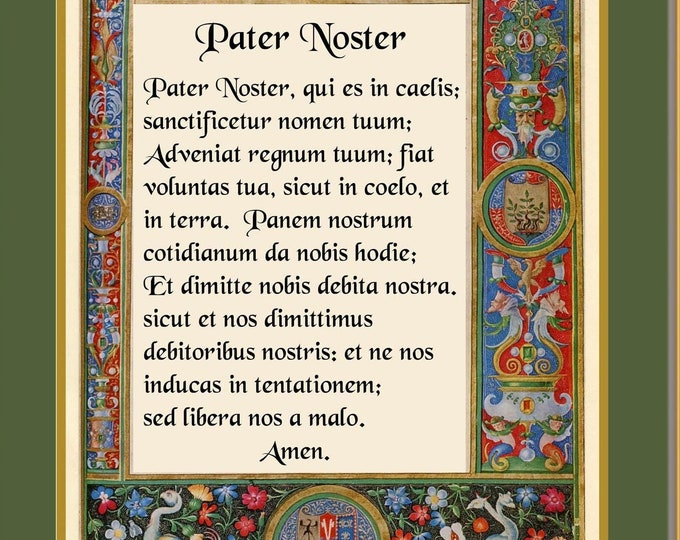
Pater noster, qui es in cælis, sanctificetur nomen tuum. Adveniat regnum tuum. Fiat voluntas tua, sicut in cælo et in terra. Panem nostrum quotidianum da nobis hodie, et dimitte nobis debita nostra sicut et nos dimittimus debitoribus nostris. Et ne nos inducas in tentationem.
℟. Sed libera nos a malo.
Which is traditionally translated as:
Our Father, Who art in Heaven, hallowed be Thy name; Thy kingdom come; Thy will be done on earth as it it is in Heaven. Give us this day our daily bread, and forgive us our trespasses, as we forgive those who trespass against us. And lead us not into temptation.
℟. But deliver us from evil.
It is beyond the pale of this little study to examine the long and robust tradition of commentaries on the Lord’s Prayer by the Church Fathers and medieval Doctors. Here, we limit our concerns to two: The placement of the prayer after the Canon, and how that placement shapes our reception of it.
Post Canon
In defending his decision to follow the Eastern custom of reciting the Our Father after the Canon, Pope St. Gregory the Great argues that it would be inappropriate to have any other prayer besides the one composed by Our Lord Himself follow the [manmade] Canon. The pairing is also appropriate when one considers an alternative name for the Canon used in the Middle Ages: “The Dangerous Lord’s Prayer.”
The Lord’s Prayer is related to the Canon in other ways as well: just as the Preface is the prologue to the Canon, the Lord’s Prayer is its epilogue. One can see this in the similarities between the Preface and the Lord’s Prayer. Both are introduced after a period of silence with the priest saying or intoning aloud, per omnia saecula saeculorum. Both have beautiful chant settings that are sung by the priest alone, both have responses from the congregation (the Sanctus and Sed libera nos a malo), and both use the word salutare. One could say that the Preface is the pro-logos, the Lord’s Prayer is the epi-logos, and in between is the Logos, made flesh and now dwelling sacramentally among us on the altar. In the words of Fr. Pius Parsch:
According to the great Pope [Gregory the Great], the Our Father is not so much a preparation for the Holy Banquet, as a consecration prayer, in the ancient sense of a prayer for the offering of the sacrifice. For this reason, in the Roman liturgy, it is recited by the celebrant alone, whereas in the Greek liturgy it is considered the table prayer of the congregation, who therefore recite it in common as a family about to approach the sacred banquet. According to Gregory I, therefore, the Our Father should be considered the completion of the Canon, corresponding to the Preface, in such wise that the Preface and the Our Father mark the beginning and the end of the Canon, which is recited in mystical silence. [1]
Needless to say, this ancient arrangement in the Roman Rite is undermined when the entire congregation sings the Our Father, a practice that reduces the similarity between the prologue and the epilogue. The practice is also a violation of a tradition as old as the Our Father itself in the Roman Rite, for Gregory the Great states that in contradistinction to the Greeks, at Rome the Lord’s Prayer is said a solo sacerdote.

St Gregory the Great, 1626/7, by the Spanish painter Francisco de Zurbarán. 
Another indication, incidentally, that the Canon and the Lord’s Prayer are meant to function together is the placement of the Solemn Nuptial Blessing over the bride and groom at a nuptial Mass. The intention seems to have been to place the prayer close to the Consecration at the nearest possible liturgical juncture. That the blessing was placed after the Lord’s Prayer rather than after the Great Amen suggests that the Canon and the Lord’s Prayers were seen as a practically indivisible unit.
Contextual Meaning
The Lord’s Prayer is also, of course, the beginning of the Communion Rite, thus forming a bridge between the Consecration and the reception of the Eucharist. It is when we view the Lord’s Prayer as a preparation for Holy Communion that its petitions take on added meaning.
“Our Father, who art in Heaven.” When the priest says these words, he is supposed to be staring at the Host. There is something almost ironic addressing the Father while looking at the Son and saying that God is in Heaven when He is also right before your eyes. But in a way the Eucharist, albeit in a veiled manner, is the fulfillment of John 14, 9: “He that seeth Me seeth the Father also.”
“Hallowed by Thy name.” The prayer does not say “Holy is your name” (although it certainly is), but “May your name be made holy or sanctified” (sanctificetur nomen tuum), as if we could increase the holiness of God’s name. God is maximally holy, and nothing on earth can change that. But His name can be rendered less holy by being “profaned” insofar as His chosen people, who are in a sense His representatives on earth, give Him a “bad name” by their behavior. In Ezekiel 43, 8 we read: “And they profaned My holy name by the abominations which they committed: for which reason I consumed them in My wrath.” The key, then, is to “hallow” God’s name by good behavior, but how can we be good without God? We cannot, and so we pray for help. As St. Cyprian of Carthage notes, when we say, “Hallowed be Thy name,” we mean, “May Thy name be hallowed in us”—that is, may we be transformed by sanctifying grace or holiness in order not to besmirch God’s name. [2] And to become further transfomred by sanctifying grace, we partake of the Eucharist.
“Thy kingdom come. Thy will be done, on earth as it is in Heaven.” Both of these petitions can be seen in light of what has gone before and in light of what is about to happen. When the priest turned bread and wine into Body and Blood, there is a way in which he already brought the Kingdom of God to earth, and there is a way in which He already did God’s will—namely, he obeyed the command, “Do this in memory of Me.” But when he and we receive Holy Communion, we also do God’s will and we also strengthen the bond between Him and us and each other, the Mystical Body of Christ, perhaps contributing to the coming of the Kingdom.
“Give us this day our daily bread.” Not surprisingly, this petition was interpreted by the Church Fathers to refer to the Eucharist, even when the Lord’s Prayer was said outside of Mass. The Eucharistic connection is even stronger in the version of the Our Father mentioned in St. Matthew’s Gospel: “Give us this day our supersubstantial bread.” (6, 11). With Holy Communion God is about to grant this petition of ours.
“Forgive us our trespasses.” Before the days of the second Confiteor, reciting this line before receiving Holy Communion was thought to absolve venial sins. In a sermon St. Augustine says:
If perchance, in consequence of human frailty, our thought seized on something indecent, if our tongue spoke something unjust, if our eye was turned to something unseemly, if our ear listened complacently to something unnecessary, it is blotted out by the Lord’s Prayer in the passage: “Forgive us our trespasses,” so that we may approach in peace and so we may not eat or drink what we receive unto judgment. [3]
“Lead us not into temptation.” This is one of the most fascinating verses of the New Testament to ponder because it ties into so many other verses. Here, we ask the Father not to do the very thing He did to His Son, “who was led by the Spirit into the desert, to be tempted by the devil” (Mt. 4, 1) (Yes, it was the Spirit who led Jesus, but who sent the Spirit if not the Father?) And yet we also read that God “will not suffer you to be tempted above that which you are able” and will help you “be able to bear it.” (I Cor. 10, 13) “Lead us not into temptation” is surely one of the “hard sayings” of Scripture (see Jn. 6, 61), and rather than grimace at it, we should embrace the challenge of wrestling with it.
Alas, not everyone agrees. In 1969, the Consilium for Constitution on Liturgy published Comme le Prévoit On The Translation of Liturgical Texts for Celebrations with a Congregation, which contains the following statement:
The correct biblical or Christian meaning of certain words and ideas will always need explanation and instruction. Nevertheless, no special literary training should be required of the people; liturgical texts should normally be intelligible to all, even to the less educated. For example, temptation as a translation of tentatio in the Lord’s Prayer is inaccurate and can only be misleading to people who are not biblical scholars. [4]
The assumptions of the authors are debatable, namely, that “temptation” is inaccurate and that only biblical scholars can understand the Lord’s Prayer (we wonder if the Lord would agree: would He command all of His disciples to use this prayer forever, knowing that only an elite would ever understand it?). Perhaps it is for these reasons that none of the official “vernacular” translations followed the advice of this document—not, that is, until 2019, when Pope Francis approved a request from the Italian bishops to change e non ci indurre in tentazione to non abbandonarci alla tentazione or “do not abandon us to temptation.” The allegedly problematic word “temptation” remains, but the ne nos inducas (Mē eisenkēs hēmas in the Greek) has been altered, despite the fact that the Greek verb in question eispherói (eis+phero, to lead into) is unambiguous. The decision prompted a not surprising backlash (see here and here and here and here).
“But deliver us from evil.” One petition that does admit of valid different interpretations is this one. Since Latin lacks a definitive article, libera nos a malo can mean “deliver us from evil” or “deliver us from the Evil One.” The original Greek has the definitive article in this verse, which is why Eastern churches use the latter translation. The Eastern versions, therefore, have the advantage of being more faithful to the biblical text, more vivid, and more evocative of Christ’s temptation in the desert, when He overcame the Evil One. The Latin, on the other hand, is more expansive, asking for protection not only from the Evil One, but all evils: sin, misfortune, illness, etc.
The fact that “But deliver us from evil” is a response from the people (respondentibus omnibus, as John the Arch-chanter says in the eighth century) gives this moment a special meaning. The lay faithful, listening to the Our Father as they did to the Preface, now affirm all that they have heard. “Basically, therefore,” Josef Jungmann concludes, “the people say the Our Father along with the celebrant. It is the people’s Communion prayer.” [5]
Notes
[1] Parsch, The Liturgy of the Mass, trans. Frederic C. Eckhoff (St. Louis, Missouri: Herder, 1940), 284. See Michael Fiedrowicz, The Traditional Mass: History, Form, & Theology of the Classical Roman Rite, trans. Rose Pfeifer (Brooklyn: Angelico Press, 2020), 107.
[2] Cyprian of Carthage, Treatise IV.12.
[3] Augustine, Sermo Denis 6 (229): Quia, sicut est humana fragilitas, si forte aliquid quod non decebat cogitatio nostra concepit, si aliquid lingua quod non oportebat effudit, si aliquid oculus sicut non decebat aspexit, si aliquid auris blandius quod non oportebat audiuit, si forte aliqua talia contracta sunt de huius mundi temptatione et uitae humanae fragilitate, tergitur dominica oratione, ubi dicitur dimitte nobis debita nostra; ut securi accedamus, ne quod accipimus in iudicium nobis manducemus et bibamus.
[4] [Comme le prevoit 15. a.
[5] Josef Jungmann, S.J., The Mass of the Roman Rite: Its Origins and Development, vol. 2 (New York: Benzinger Brothers, 1951), 288.

Friday, June 26, 2026

The Praeceptis salutaribus

Lost in Translation #163

After finishing the Canon, the priest introduces the Lord’s Prayer. He calls the assembly to pray with the familiar Oremus and then says or intones:

Praeceptis salutaribus moniti,
Et divina institutione formati,
Audemus dicere.
Which I translate as:
Taught by salutary precepts,
And formed by divine instruction,
We dare to say:
Transformative Teachings
The exhortation’s structure is redolent of the synonymous parallelisms found in the Psalms, whereby the second line reinstates or reiterates the first. For example, in Psalm 2, 1, the Psalmist cries out:
Why have the Gentiles raged,
And why have the people devised vain things?
The diction of the exhortation goes back to the third century. In his commentary on the Lord’s Prayer (appropriately enough), St. Cyprian of Carthage (d. 258) writes:
Qui inter cetera salutaria sua monita et praecepta divina, quibus populo suo consulit ad salutem, etiam orandi ipse formam dedit: ipse quid precaremur monuit et instruxit. [1]
Which I translate as:
Among His other salutary teachings and divine precepts with which He counsels His people for their salvation, He Himself also gave a form of prayer: He Himself taught and instructed what we should pray for.
Jungmann surmises that the Praeceptis salutaribus has the same fourth-century editor or author as the Roman Canon, whoever he may be. [2]
And the wording is somewhat distinctive. Instead of more obvious choices for the verb “to teach” such as docere or erudire or praecipere, the text has monere. Derived from mens, the Latin word for mind, it means “to call to mind,” but it is often used to admonish or warn. That fits well with Our Lord’s precepts, for as with the Ten Commandments, not choosing to embrace them is ominously choosing curse and death. (see Deut. 30, 19) Fittingly as well, these precepts are called “salutary,” for they bring health and salvation to all who follow them.
The second line also uses a distinctive word for teaching. The word institutio poses a challenge to translators, for it is not an “institution” in the sense of a corporate or legal establishment, but an education or induction into a higher mode.
And the effect of this induction is transformative, for we are formed (formati) by it. In our previous study of the Roman orations, we noted on several occasions how the prayers constitute what Pope Benedict XVI calls a “school of love” that reshapes and reorients our desires (see here and here). Now, in the Ordinary of the Mass, we see the same powerful claim being said about Christ’s teachings in general, and about the Lord’s Prayer in particular. Oddly, not a single pre-conciliar hand Missal that I consulted translates the past particle formati correctly, opting instead for “following” – as if the emphasis were on obedience rather than formation. [3] Happily, the 2011 English translation of the new Mass has “And formed by divine teaching.”
The Novus Ordo
There are two curious aspects to the Praeceptis salutaribus in the 1970 Missal. The first is the omission of Oremus at the beginning. When Pope Paul VI saw the first draft of the new Mass, he asked: “Why omit the ‘Let us pray’ before the Our Father?” Bugnini writes that the Consilium rejected the Holy Father’s “implied suggestion” on the grounds that “ ‘Let us pray’ is an invitation to prayer, but such an invitation is already contained in the exhortation that precedes the Our Father.” [4]
Second, although the original wording of the exhortation remains unchanged, there appears to be a strange international collusion against translating it accurately. Specifically, no official “vernacular” translation that I consulted keeps the text’s synonymous parallelism (with a past participle as the backbone of each clause) or makes an effort to convey its unusual diction; and every official translation that I consulted changes the adjective “saving” or “salutary” to the noun “Savior” or even, as in the German, “Lord and Redeemer” (see the Appendix of Modern Translations below). I do not know the origin of the latter preference, except to note that a Fr. Bonifatius Fischer wrote an obscure article in 1950 arguing that praeceptis salutaribus can also mean praeceptis Salvatoris (“precepts of the Savior”) [5], and that in his 1960 proposed “sample Mass,” Fr. H.A. Reinhold recommends the following:
Let us pray:
Obeying our Saviour’s command
And taught by his divine institution,
We dare to say: [6]
There is no mention of the issue by the Second Vatican Council, in the documents of the Magisterium, or in Annibale Bugnini’s memoir. Whatever the reason, the new formulation is accurate but unfortunate: accurate because our Savior did indeed command us to say the Lord’s prayer; unfortunate because it erases a verbal link between the Our Father and the Preface, which uses the same word (salutare). And as we will see in a later essay, the two prayers stand in a complementary relationship with each other.
Moreover, the replacement flattens the very Christian concept of a salutary, root-and-branch, transformative observance of a precept into a mere act of obedience. In the words of Fr. Ernest Fortin,
The truth which the Christian is persuaded to accept is not a truth in any ordinary sense of the word but… a beatifying or saving truth, which is fully appropriated only when it issues in those deeds to which it points as its fulfillment. [7]
All the new translations that I reviewed follow this turn in other ways as well, choosing words like “obedience” and “following” instead of words that more robustly point to teaching and formation. The problem with this shift is that in moving away from a transformative view of justification, it creates a vacuum for the Lutheran forensic view of justification, the so-called doctrine of imputed righteous.
One translation is egregious for a different reason. The Spanish in the Missal for Mexico is:
Fieles a la recomendación del Salvador,
y siguiendo su divina enseñanza,
nos atrevemos a decir: [8]
Which I translate as:
Faithful to the Savior’s recommendation,
And following his divine teaching,
We dare to say:
As we have seen, moniti can mean “advise” insofar as it connotes rebuking or admonishing, but the Biblical context rules out this possibility. Introducing the Lord’s Prayer, Jesus says to His disciples, “When you pray, say…” with “say” in the imperative voice. (Luke 11, 2) For that matter, how many times in the Gospels does Jesus Christ “recommend”? Conversely, how many times does He say: “Amen, Amen, I say unto you” or “Others have said, ‘Do this,’ but I say unto you, “Do that’”?
Giusto di Menabuoi, The Creation of the World; detail of the dome fresco in the Baptistery of Padua, 1378. (Image from Wikimedia Commons by Yukio Sanjo, CC BY-SA 3.0.)
The Audacity
Thankfully, every one of the consulted translations faithfully renders the final line, audemus dicere or “we dare to say.” The notion that praying the Our Father is a daring act comes from the Patristic era.
“Daily we dare to say (audemus quotidie dicere),” Augustine says in a sermon: “‘Thy kingdom come.’” [9] And Jerome writes:
[Our Lord] so instructed His Apostles that, daily at the sacrifice of His body, believers may be bold enough to say [audeant loqui], “Our Father, who art in Heaven, hallowed be Thy name…” [10]
The audacity of reciting the Lord’s Prayer lies chiefly in its first two words. As Blessed Columba Marmion explains, out of sheer love and generosity the First Person of the Holy Trinity has willed for all eternity to extend to us His Paternity, to recognize us as His adopted sons so that we can be filled with holiness and share in His eternal happiness. But although it is in accordance with our nature to call God our Creator, it is not natural for a creature to call his Creator “Father.” That privilege is the result of a purely supernatural act of adoption. “By nature God has only one Son,” Marmion observes; “by love He wills to have an innumerable multitude.” [11]
Thus, in calling God “our Father,” we accept the calling of divine adoption and the obligations that it entails. And hence, we should approach this divine intimacy with a healthy sense of fear and trembling. In the words of the Apostolic Constitutions (ca. 400):
Pray [the Lord’s Prayer] thrice in a day, preparing yourselves beforehand, that you may be worthy of the adoption of the Father; lest, when you call Him Father unworthily, you be reproached by Him, as Israel once His first-born son was told: “If I be a Father, where is my glory? And if I be a Lord, where is my fear?” (Malachi 1, 6) For the glory of fathers is the holiness of their children, and the honour of masters is the fear of their servants, as the contrary is dishonour and confusion. For says He: “Through you my name is blasphemed among the Gentiles.” (Is. 52, 5) [12]
“The glory of fathers is the holiness of their children.” If we wish to call God our Father, then we need to resemble Him like a son who is the spitting image of his dad. And the more we resemble Him, the worthier we are to receive His Son in Holy Communion.

Appendix of Modern Translations
The official French translation is:
Comme nous l’avons appris du Sauveur,
et selon son commandement,
nous osons dire: [13]
Which I translate as:
As we have learned it from the Savior,
And according to His commandment,
We dare to say:
The official Italian is:
Obedienti alla parola del Salvatore
e formati al suo divino insegnamento,
osiamo dire: [14]
Which I translate as:
Obedient to the word of the Savior,
And formed by His divine teaching,
We dare to say:
The German translation is:
Dem Wort unseres Herm uns Erlösers gehorsam,
Und getreu seiner Auftrag,
Wagen wir zu sprechen:
Which I translate as:
Obedient to the word of our Lord and Redeemer,
And faithful to His command,
We dare to say:
And the 2011 English translation is:
At the Savior’s command,
And formed by divine teaching,
We dare to say: [15]
Michael Foley is the author of Lost in Translation: Meditating on the Orations of the Traditional Roman Rite (Angelico Press, 2023).
Notes
[1] Cyprian, Treatise IV.2.
[2] Jungmann, vol. 2, 56-57.
[3] That includes the Father Lasance Missal, the St. Andrew’s Daily Missal, the Abbot Cabrol Missal, the Saint Joseph Daily Missal, the Baronius Press Missal, and the Marian Missal.
[4] Bugnini, 380.
[5] Bonifatius Fischer, O.S.B., “Praeceptis salutaribus moniti,” Archiv für Liturgiewissenschaft 1 (1950), 124-127.
[6] Reinhold, 96.
[7] Ernest L. Fortin, “Augustine and the Problem of Christian Rhetoric,” in Collected Essays, vol. 1 (Lanham, MD: Rowman & Littlefield Publishers, 1996), 85.
[8] Misal Romano (2017), 118.
[9] Augustine, Sermon 110.5.
[10 Jerome, Against the Pelagians III.15.
[11] Bl. Columba Marmion, Christ the Life of the Soul (Tacoma, WA: Angelico Press, 2012), 24, emphases added.
[12] Apostolic Constitutions 7.24.
[13] Missel Romain, 3rd. ed. [MAME Desclée, 2001], 512.
[14] Messale Romano, 3rd ed. [Fond.Ne Di Religione Santi Francesco D'assisi E Ca, 2020], 444.
[15] The Roman Missal, 3rd ed. (Washington, DC: USCCB Publishing, 2011), 336.

More recent articles:

For more articles, see the NLM archives: