Tuesday, March 17, 2026

A Model Schema for Liturgical Art for All Catholic Churches

The Exciting and Beautiful Re-Ordering of St Mary’s Cathedral, Aberdeen, Scotland

All Roman Catholics should take note of what is happening at St Mary’s Cathedral in Aberdeen: the creation of a sacred space where art and architecture work together with a deep understanding of how both support worship. Drawing on both the Roman and Byzantine traditions, the reordering integrates imagery, materials, and form into a single Eucharistic vision – one rooted in the Church’s heritage, yet particular to its place. When complete, the harmony achieved here will, I believe, make St Mary’s a destination of pilgrimage for generations, and a model that churches of the Roman Rite elsewhere would do well to study closely.

Above: mock-ups of the proposed re-ordering; below: the cathedral as it is now.

This major project builds on Martin Earle’s award-winning Crucifixion, and establishes a well-conceived template for the layout of sacred art that could serve for churches of the Roman Rite elsewhere. The result is a proposal that is a harmony of imagery, form, and materials, rooted in the Church’s ancient traditions, yet particular to its place.

Read more about this project, and see images of the proposed art and reordering, at www.beautyforgod.org. The images of the proposed reordering come from this website. The key elements are:

  • A redesigned altar, ambo (lectern), and bishop’s chair crafted from Scottish elm and stone

  • A new tabernacle in wood, metal, and stone as the devotional focal point behind the altar

  • A new painted mural on the East Wall by award-winning artist Martin Earle

  • A new sanctuary floor with colored granite from across North-East Scotland

  • Conservation of the Rose Window

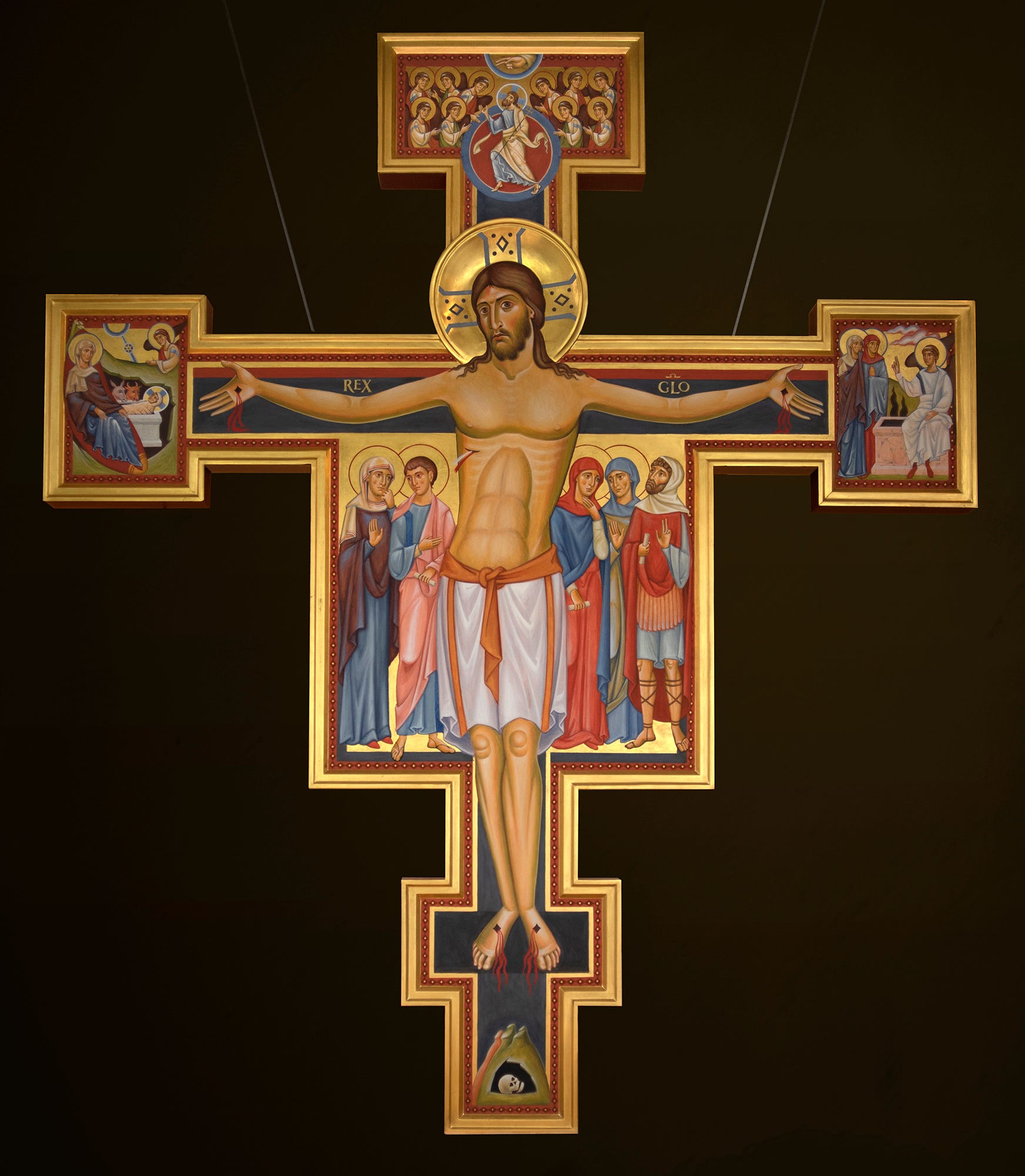
I came to know Bishop Hugh of Aberdeen, who commissioned this work, during his years as abbot of Pluscarden, a community of Catholic Benedictine monks which is in the diocese of Aberdeen, and of which I am an oblate. (The abbey has a daughter house in Petersham, Massachusetts, also named St Mary’s.) Abbot Hugh was called to the episcopate by Pope Benedict in 2011. I am delighted to see what he has planned here. Many years ago, he commissioned a double-sided San Damiano crucifixion from me, which still hangs in the abbey. More recently, when he asked me to repeat the commission for St Mary’s in Aberdeen, I told him I was unable to take it on, but recommended Martin Earle as the best artist I know for such a commission. And what a spectacular job he did!

Many of you will already know Martin’s work (martinearle.com). He is an English Catholic iconographer who works in fresco, egg tempera, gilding, wood and stone carving, and mosaic. The nine-foot hanging Crucifix he completed for St Mary’s – the first phase of this grand vision – was awarded the Grand Prize in the Catholic Art Institute’s international sacred art competition in Chicago in 2023. Phase 2 now builds upon that foundation.

When I talked to Martin about it, he was at pains to emphasize how a team is working together on this project. First of all, he spoke of Bishop Hugh’s vision and initiative in bringing it about. Then Martin worked with fellow UK artist Jim Blackstone (dunstanicons.com, another old friend of the Scala Foundation), on the design of the wall painting. He also told me how important it was to work closely with the architect, David Chouman (dcarchitect.co.uk), who leads and coordinates all the moving parts in the project, and even the stone masons who worked hard to comb the diocese for suitable and interesting stone to create the inlaid pattern work on the floor, altar, and ambo.

Emphasizing the team is important. In a project like this, all these people contribute creatively to the final outcome. The lesson here is that such a commission is rarely simply the vision of one person.

At the heart of the new composition on the east wall behind the altar will be a large-scale wall painting of Pentecost. The design creates a single vertical axis that visually connects Christ on the cross, Our Lady, the tabernacle, and the altar, which represents the Body of Christ and bears the Agnus Dei on its front face. High up on the wall, the Trinitarian symbolism of the design at the center of the rose window crowns the whole. Notice how the arc of the arrangement of the Apostles echoes that of the lower curve of the rose window, creating a resonance between the artistic and architectural forms. The tabernacle doors bear the image of the Annunciation, echoing, albeit on a smaller scale, the typical imagery of the Royal Doors of the iconostasis in the Byzantine tradition, which are opened during the Divine Liturgy to reveal the altar. A procession of sheep moves toward the tabernacle, recalling the famous mosaic program at San Clemente in Rome, and integrating naturally with the Agnus Dei below it on the front of the altar.
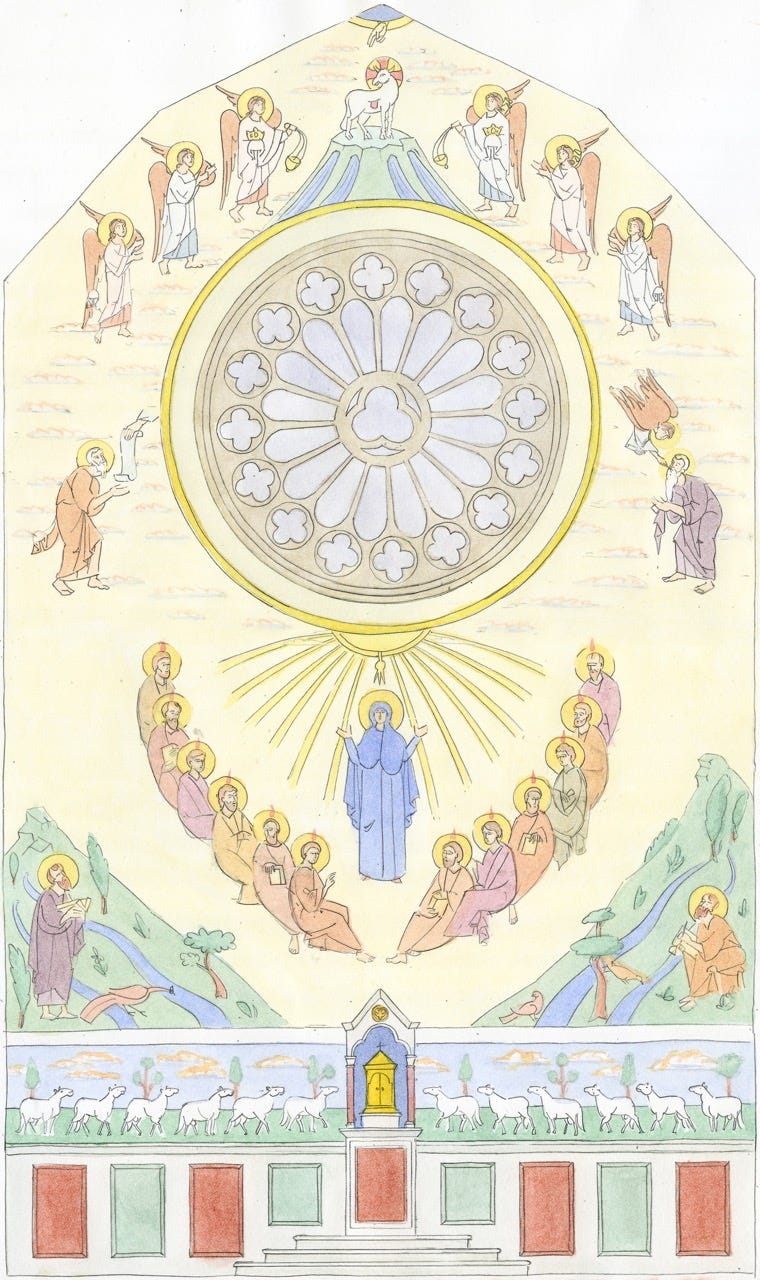
Considering the composition in more detail (and drawing heavily here on the write up on the website, beautyforgod.org), we begin to see how it mirrors the Liturgy itself – making visible what happens invisibly when the Word is proclaimed, and the Eucharist is celebrated. We begin with the Church on earth, gathered at Pentecost: Mary at the center, the Apostles around her, the descent of the Spirit visually linked to the Crucifix above the altar, and Christ’s final giving up of his Spirit. Moving upward, we see the heavenly liturgy: the Lamb of God standing on the mountain from which flow the four rivers of Paradise, angels ministering around him, and the hand of the Father blessing from above. The depiction of the Lamb on the heavenly mountain is reminiscent of the Ghent Altarpiece, where the Adoration of the Mystic Lamb unites the heavenly and earthly realms in a single act of worship. By such visual devices, the point is made By such visual devices, the point is made that the earthly liturgy does not stand alone – it is the Church’s participation in the ideal and unceasing worship of her heavenly worship, so that what is offered at the altar below and what is offered before the Throne above are not two acts of worship but one: the single, unbroken sacrifice of the whole Church, in heaven and on earth..

The Prophets and Apostles frame this mystery. Isaiah receives the burning coal; Ezekiel eats the scroll – each prefiguring the Eucharist and the proclaimed Word. Paul and John carry the mission forward after Pentecost, and one could say that rivers of grace flow through their books, nourishing the faithful as the lambs below process toward the tabernacle.
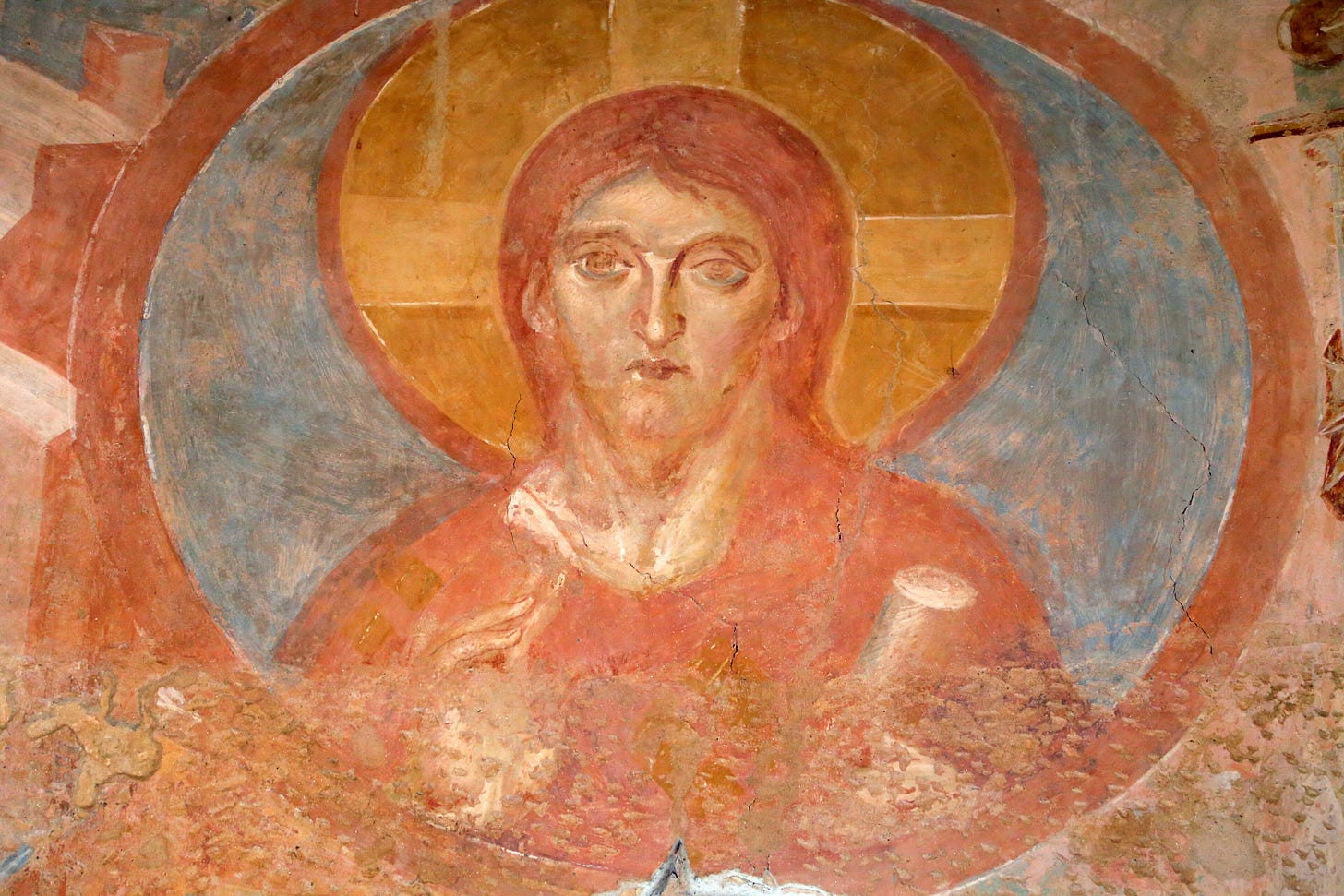
A word about the images: do not be misled by the light, pastel tones of the watercolor mockup. Martin’s finished palette will be rich and vibrant. However, the description of form will be by color rather than by tonal contrast. The Crucifixion, which is intended to be at the heart of the schema, uses both color and tonal contrast. To explain, imagine a grayscale photo of the final color image. The grayscale image of the painting that uses tonal contrast as well as color contrast will be discernible as a black-and-white photo; whereas the greyscale image of the painting that relies on color contrast alone will not, so red and blue, for example, will be barely distinguishable in the black-and-white version. In this context, as Martin told me, the image on the east wall will rely “more towards a Castelseprio style, where forms are gently described and modeled using contrasting cool and warm colors (rather than leaning into tone). And not all forms will be outlined with dark lines. The idea is that the east wall will set off, rather than overwhelm, the cross, which will remain the central image of the sanctuary, with the altar the true axis mundi that connects heaven and earth. All other images in the sanctuary are derived from and direct us to the meaning of the cross and altar.”
undefined
An Italo-Byzantine fresco of Christ from perhaps the 9th century. AD) Image from Wikimedia Commons by Sailko, CC BY 3.0.

What emerges, taken as a whole, is a layout that is distinctly Roman and Eucharistic in its logic, yet one that will be familiar to anyone who has prayed before the image program of a Byzantine Catholic or Orthodox church, in which we see angels, prophets, apostles, Our Lady and Our Lord (both in glory and suffering), ordered to the same theological and liturgical principles. This makes the design not merely an image appropriate for Aberdeen, but also genuinely Catholic in the fullest sense.

The reordering also addresses the architecture itself. The bishop’s cathedra will be moved from its current position in the center. The floor will be laid in different colors of Aberdeen granite, a fitting material for a city known as the Granite City, and one that speaks also of the permanence of the Rock upon which the Church itself is built.

When complete, the harmony of art and architecture at St Mary’s will, I believe, make the cathedral a worthy site of artistic pilgrimage for generations.

As a postscript, for those who think that the strong visual emphasis on Christ suffering on the cross is much more a Roman than a Byzantine presentation: it is true that the traditional schema of the Eastern iconostasis plays down emphasis of Christ on the cross visually is the sense that it is of a small size compared to what we seen in Roman Rite churches. However, the cross is typically placed centrally and at the apex of the iconostasis, thereby ordering the whole schema in the mystery of redemption. Further, the emphasis in the liturgy on the importance of the cross in our redemption is stressed very strongly in other ways: by playing down the size of the cross visually, the impact of the sacrifice, the passion, death, and resurrection as re-presented on the altar becomes stronger; and through the repetition of troparia (liturgical hymns that emphasize the Holy Cross. Both approaches are sound, differing in emphasis in the means by which the same end is achieved.

I am also reminded of the brilliant book by the Chair of Theology at Notre Dame University, Khaled Anatolious, who is Melkite Catholic (one of the Byzantine Catholic churches), called Deification Through the Cross: An Eastern Christian Theology of Salvation.

Wednesday, December 20, 2023

Martin Earle of the Chichester Liturgical Art Workshop Wins Major Award in US

I was delighted to learn recently that Martin Earle, of the Chichester Workshop of Liturgical Art in the UK (which I have been energetically promoting in this blog), has been awarded first prize in the annual competition of the Catholic Art Institute.

The award was given for this Franciscan-style cross commissioned by the Rev. Hugh Gilbert, Bishop of Aberdeen in Scotland. Martin was keen to emphasize the important part that his colleague at the workshop, Jim Blackstone, had to play in the creation of this monumental piece of work. There were also many highly skilled apprentices who contributed, all under Martin’s expert direction, and many of whom I was privileged to meet on a recent visit to the studio in Chichester.

Bishop Hugh, incidentally, has a great love for the San Damiano Crucifix at the church of St Clara in Assisi, which inspired both this commission and one another done about 20 years ago for Pluscarden Abbey, where he was formerly a Benedictine monk and served as abbot. The diocese is currently raising the money for the project, so I encourage readers contribute at the gofundme here.
It is especially gratifying to see work in the iconographic and Gothic style featuring so prominently in the awards and mentions made by the Catholic Art Institute. It is my conviction that Catholic traditions from the pre-Renaissance period are the most likely springboard for a new flourishing of contemporary styles of sacred arts in the Church, and the Catholic Art Institute is doing sterling work, in my opinion, in showcasing projects that are simultaneously traditional and of the 21st century.
Second prize went to an icon by Orthodox monk, Fr. Silouan Justiniano, whom I met at the Scala Foundation Conference in Princeton last spring.
Juror comments from the Institute were as follows: The San Damiano Crucifix is a new, beautiful and highly-skilled contribution to a centuries-long Franciscan tradition of depicting Christ’s Sacrifice, while expounding on its deeper meanings in the adjacent, appended panels. This work combines the fine and allied arts to achieve a radiant, magnificent, unified whole. 
St. Mary of the Assumption Catholic Cathedral in Aberdeen is currently fundraising to be able to install this crucifix as part of a project to re-order the sanctuary. If you are able to help, please visit: https://www.gofundme.com/f/37i9ff1mnc
This crucifix was painted at the Chichester Workshop of Liturgical Art. Alongside providing a space for artists to undertake commissions across a broad range of traditional media, the Chichester Workshop offers an education programme that includes both practical artistic training and theological engagement with the principles of Christian iconography. Find out more at http://www.chichesterworkshop.org

Tuesday, May 24, 2022

Six Talks on the Eucharist: A Mystagogical Catechesis by Bishop Hugh Gilbert of Aberdeen, Scotland

I am grateful to the monks at Pluscarden Abbey, the Benedictine Monastery situated near Elgin in Scotland, for alerting me to the publication on YouTube of a series of talks by Bishop Hugh Gilbert of Aberdeen on the Eucharist.

Bishop Hugh was previously the abbot of Pluscarden Abbey, where I am an oblate (although I haven’t visited for a long time now, as I live in the United States). Anything from Bishop Hugh is worthy of note and I encourage all readers to investigate.

These talks are intended as a mystagogical catechesis for the faithful of the diocese of Aberdeen, and apply equally well to all forms of the Roman Rite. I have watched the first five and they are a rare treat.

Each link below will take you to a recorded video for the dates in the past. The talk for the future dates will be broadcast live on the day, and then the recording will be uploaded immediately after that. You can access that through the link either live or when posted as a recording.

21 April: The Eucharist in the Christian Worldview

28th April: The Origins of the Eucharist in the Last Supper and Paschal Mystery

5th May: The Introductory Rites of the Mass

12th May: The Liturgy of the Word

19th May: The Eucharistic Prayer

26th May: Holy Communion

2nd June: Living the Mystery

Here is the first recording, an introduction to the series, as a visual link:

Allegory of the Eucharist: anonymous, 18th century
Pluscarden Abbey, Elgin, Scotland

Tuesday, September 21, 2021

How Do Friendships Endure? by a Monk of Pluscarden Abbey

Here is an essay on the nature of friendship by a monk of the community of Pluscarden Abbey in Scotland, reproduced with permission from the Pentecost edition of their magazine, Pluscarden Benedictines. Friendship is an important aspect of the life of Benedictine monks, who are, in principle, bound to live in community with the same people for may well turn out to be several decades. As such, their lives as celibates in long-lasting and stable communities puts them in a position to consider the nature of human friendship and its relation to friendship with God. The bond that unites the community is the noble call of their common work of the worship of God, the opus Dei.

This essay is similar in theme, but at the same time in stark contrast to the series of three, I posted recently on the pictorial allegories of love as described in the Song of Songs: part 1, part 2, and part 3. Whereas the Song is a romantic and passionate love poem in which spousal love is portrayed as analogous to and participating in our love of God and God’s love for us, caritas, our wise Benedictine focuses on friendship (philia, amicitia), in which is there is no romantic component, and makes the argument that this too, if authentic, is a participation in ‘divine friendship’, which is an alternative way of referring to that same caritas. Caritas is a love which is simultaneously multi-faceted, superabundant and yet, paradoxically simple. Friendships, as with the spousal relationship in marriage, are therefore a training ground for heaven.

While the writer’s focus is primarily (though not exclusively) on deep and lasting friendships, my thoughts ran as I read it to the significance of superficial and temporary friendships. One thing that the last 18 months of enforced wearing of face-hiding masks and social isolation has taught me is how important regular and superficial contact with people is. For the most part, in the time of COVID, I have managed to maintain in some form at least my close friendships, but the number of regular face-to-face contacts with strangers has reduced dramatically, and I can feel the difference. Saying, ‘hello’ to strangers or to a person only seen in that one context regularly, say at the checkout of the local store, and who then returns the greeting with a smile, has a part to play in relieving loneliness too. Perhaps even these simple short interactions can also be small but significant occasions that lead us and others to heaven!
Photos by Peter Chalmers
There is a scene in the film About a Boy in which a couple asks the protagonist, played by Hugh Grant, to be godfather to their new baby girl. Grant plays an aging pop star who is drifting in life, and has for years been living off the royalties of the only hit single of his career. Though capable of personal charm, he is a cynic who claims he delights in a life of selfishness and irresponsibility in his personal relationships. At the beginning of the story, when asked to be a godfather he immediately refuses. The parents respond by suggesting that maybe he has hidden depths to his personality and that taking on this responsibility might help to bring them out. ‘Now that’s where you’re wrong,’ he replies, ‘I really am this shallow.’
However, in the course of the film, he meets a boy who draws him into friendship by stimulating his latent instincts to be a father. This in turn opens him up to other deeper and more satisfying loving relationships that he previously claimed he did not need. Its ring of truth for me was that it was not presented as a story of transition from misery to ecstasy, but rather, from relative contentedness to a far richer and more joyful life: from grayscale to glorious technicolor. It’s not that the friendships he had were nothing, rather, they were not enough, and he didn’t realize it until one of them developed into the life-changing friendship between himself and the boy.
I am not suggesting that shallowness and superficiality are all we need in our personal interactions, but I am going to say that shallow and superficial human interactions are underrated! Most of us need the full spectrum ranging from superficial and temporary to deep and permanent; one might say that God’s love is a single utterance that draws all loves, grey and colored, into itself.
Here then, is the essay.
HOW DO FRIENDSHIPS ENDURE?
How do friendships endure? It is certainly an interesting question. Both classical philosophy and St Thomas Aquinas applied the term friendship (philia, amicitia) to a wider range of human relationships than we are used to doing. Or rather, to be more precise, the Greek and Latin words which they used covered a wider range of meanings. Still, these terms obviously included our ordinary friendships. I cannot help but think of my best friend Paul in this context. We have known each other for over twenty years now. Our friendship endures and thrives, even though twelve years ago I entered a contemplative Benedictine monastery, while he has since become a husband and a father of four. That, plus a busy professional life, consumes more than 100% of his physical, mental and spiritual energies. We see each other a couple of times a year, at best, and yet the bond between us is stronger than ever, I would say. Why is this? Basing myself solely on Aristotle, I could already say a great deal: true human friendship is based on virtue, on worth; there has to be a certain equality between friends and the attachment must be mutual, but once it exists, friendship provides an ideal setting for growth in virtue; this growth in its turn strengthens the bond, and so it goes...
For St Thomas, this is how we prepare “the ground” for charity, which alone can carry us to God and life everlasting. Still, Aquinas would obviously want me to move beyond these basic truths and see my natural love for a friend itself as (with the help of grace) charity – so not just a mere setting for something greater, but the privileged means of achieving life everlasting. This is how we make our way to heaven: “not by bodily movements but by the soul's affections”, by enlarging the scope and the intensity of our human loves (2a2ae.24,4). Even though there can be no “natural” equality between God and man, charity (what God is in his essence and that thing “with which” we love him in our turn) is a kind of friendship! Charity “is our friendship for God arising from our sharing in eternal happiness” (2a2ae.24,2). It “is not based principally on human virtue, but on the divine goodness” 10 (2a2ae.23,3), expressed in “his sharing his happiness with us”.
In this present life, we can only experience it within our souls where “we have intercourse with God and the angels, though imperfectly” (2a2ae.23,1). My friendship with Paul then is ultimately a participation in this “divine friendship” – a unique virtue, the highest of all virtues, which alone “attains God himself so as to rest in him without looking for any gain” (2a2ae.23,6). Let me take a few steps back and start again. I could say that my friendship with Paul has endured because somehow we found each other equal in worth (more or less), and we mutually affirmed one another with (more or less again) the same intensity. Before that could happen, “life” somehow had to throw us together. We started off as what people would call “colleagues” nowadays (as students in the same department of the University of Warsaw) and teammates (representing our university in volleyball), not friends as such. But Aristotle would already apply the term philia to both of these fairly superficial connections, and St Thomas took up this broad understanding: “the chief concern of any friendship is with the main source of that shared good on which it is based” (2a2ae.26,2).
In other words, any shared good can become the basis of an amicitia. Yet I had studied and played volleyball with dozens, if not hundreds of people over those five years, and the vast majority of these “friendships” lasted only as long as the shared good on which they were based lasted, that is, only as long as we had the same preoccupations. Moreover, I had been in relationships with women which, at the time, seemed deeper and stronger than anything else in my life – but they all ended. Not so with Paul. Our friendship has survived all sorts of losses of lesser goods over the years. Why? Because we found each other good somehow, I think.
Man always aims at some good, Aristotle would say, even when in the middle of making a complete mess of his life. We love and desire “goodness” naturally, wherever we see it, even when we are deluded and the good is only apparent. So I can love the genuine good that comes with playing volleyball and, by extension, “love” all those who share this experience with me, especially when they are on my team and play well. But it is 11 slightly different when it comes to good people as such, because the “shared good” is hardly separable from them. What is more, it is also hardly separable from me, as I want to be good too. Not in some flat, moralistic sense; I just want to be a good instance of man, or even simply a good me. What happens when I see a man who appears good? “There are two things that we love in friendship,” wrote Aquinas, “our friend himself, for whom we desire good things; and the very good itself that we desire for him” (2a2ae.25,2). This “very good” in the case of people has to do with virtue, according to the classical tradition: a good man is a virtuous man; his virtue constitutes his worth as a man.
Our friendship began because Paul’s goodness somehow manifested itself to me through the dispositions which constitute his character, and vice versa – though back then we would never think of it this way. It endured because these dispositions are stable, repeatedly manifest themselves in what he does, and so they tend to strengthen the initial affirmation. This provides an ideal setting for growth in virtue for both of us; these “two things that we love in friendship” – we love them more and more, as the “two loves” and the two friends reinforce one another. St Thomas went further by placing friendship in the grandest of all possible schemes of things – “within” the theological virtue of charity, which then, in its turn, takes it right “into” God. I am able to love other people, including my friend Paul, because God loved me first – and that, for Aquinas, is specifically by sharing his eternal happiness with me. This is how God's love manifested itself, this is “God's virtue”, so to speak, through which I am able to know what he is like, to know his “character”.
Astoundingly, since eternal life is what I have in common with God now, I am able to have a personal relationship with a Being utterly beyond my reach otherwise. And this, in turn, enables me to love others (with various types of love and degrees of intensity), even my personal enemies and grave sinners, ultimately as also belonging to God, as his (potential) friends. Love, says Aquinas, “derives its species from its object, but its intensity from the lover” (2a2ae.26,7). Therefore, I will naturally desire greater good for 12 people whom I consider nearer to God, but the nearer the person is to me, the more intense this desire. No two relationships in my life will be the same then; their quality will depend on people's nearness to God and their nearness to me. Or perhaps, more precisely, on my inevitably skewed perceptions of these “nearnesses”. So really, in the final analysis, my friendship with Paul endures because, to a large extent, it has eternal life as the shared good on which it is based. Consequently, our friendship provides us with an ideal setting not merely for further growth in virtue, though it does – it is rather a training ground for heaven. In eternity “the entire order of love will be determined with reference to God, so that the closer another is to God the more dearly will we love him and see him as our own,” says St Thomas (2a2ae.26,13). In other words, the closeness to God will be the same as nearness to me. There is therefore no form of amicitia better than true friendship in approximating what will go on in heaven.
This is the best “simulator” available, if you like. But it does not stop at this, there is one more final consolation: Paul and I will still be friends “up there”, according to Aquinas (providing we both make it, of course, one can never presume that). True, closeness to God will be by far the most important factor in determining the order of our loves in heaven, but our earthly attachments will survive also – grace does not supplant nature, it perfects nature.

Tuesday, July 09, 2019

Monastic Experience Weekend at Pluscarden Abbey in Elgin, Scotland, Aug. 2-5

The monks of Pluscarden Abbey, a Benedictine monastery in northern Scotland, are offering an exceptional opportunity to experience first-hand what monastic life is about. It takes place during the weekend of Friday, August 2nd to Monday, August 5th. (Pluscarden Abbey is featured by this site in the Vocations column, bottom left.)

There will be no charge. The invitation is extended to single young men, Catholics who practice their faith, aged 18-35 years. Anyone interested is invited to contact Fr Benedict Hardy OSB by email, novicemaster@pluscardenabbey.org. You can find out more about the abbey and the event itself at www.pluscardenabbey.org.

More recent articles:

For more articles, see the NLM archives: