
Monday, August 15, 2022

50 Years Ago Today: Paul VI’s (Attempted) Abolition of the Subdiaconate and Minor Orders

Today is the fiftieth anniversary of one of the most tragic of the ruptures introduced into the Church by Paul VI: the abolition and distorted reconfiguration of the minor orders and subdiaconate by means of the apostolic letter Ministeria Quaedam released on this date in 1972, and bearing no relationship whatsoever to anything that had been said in Sacrosanctum Concilium.

Or, we should say, the attempted abolition, for the minor ordines and subdiaconate, which have belonged to the heritage of the Church for at least 1,700 years (their actual origin, like that of many other ancient things, remains hidden to our eyes), have never ceased to be used in the liturgy of the Latin rite, even after Paul VI’s document. Archbishop Lefebvre continued to confer them in the 1970s and beyond, and all communities that took their origin from him or allied with him did the same. The Priestly Fraternity of St. Peter, the Institute of Christ the King Sovereign Priest, and the Institute of the Good Shepherd have done and do likewise. There have even been occasional diocesan ordinaries who have conferred these minor orders on diocesan seminarians and clergy, especially under the beneficent influence of Summorum Pontificum.

The liturgical ministries of the minor orders and the subdiaconate are not rooted simply in baptism (as some have speciously claimed) but rather in are extensions or distributions of the servanthood of the diaconate, as Bishop Athanasius Schneider demonstrates so well (here and here). [1] In the absence of the traditional sacramental-liturgical account, the ministries of lector and acolyte cease to have any rationale other than providing jobs for the unemployed, avenues of “active participation” that instantly divide the congregation into gold stars and silver stars and bronze stars and black dots.

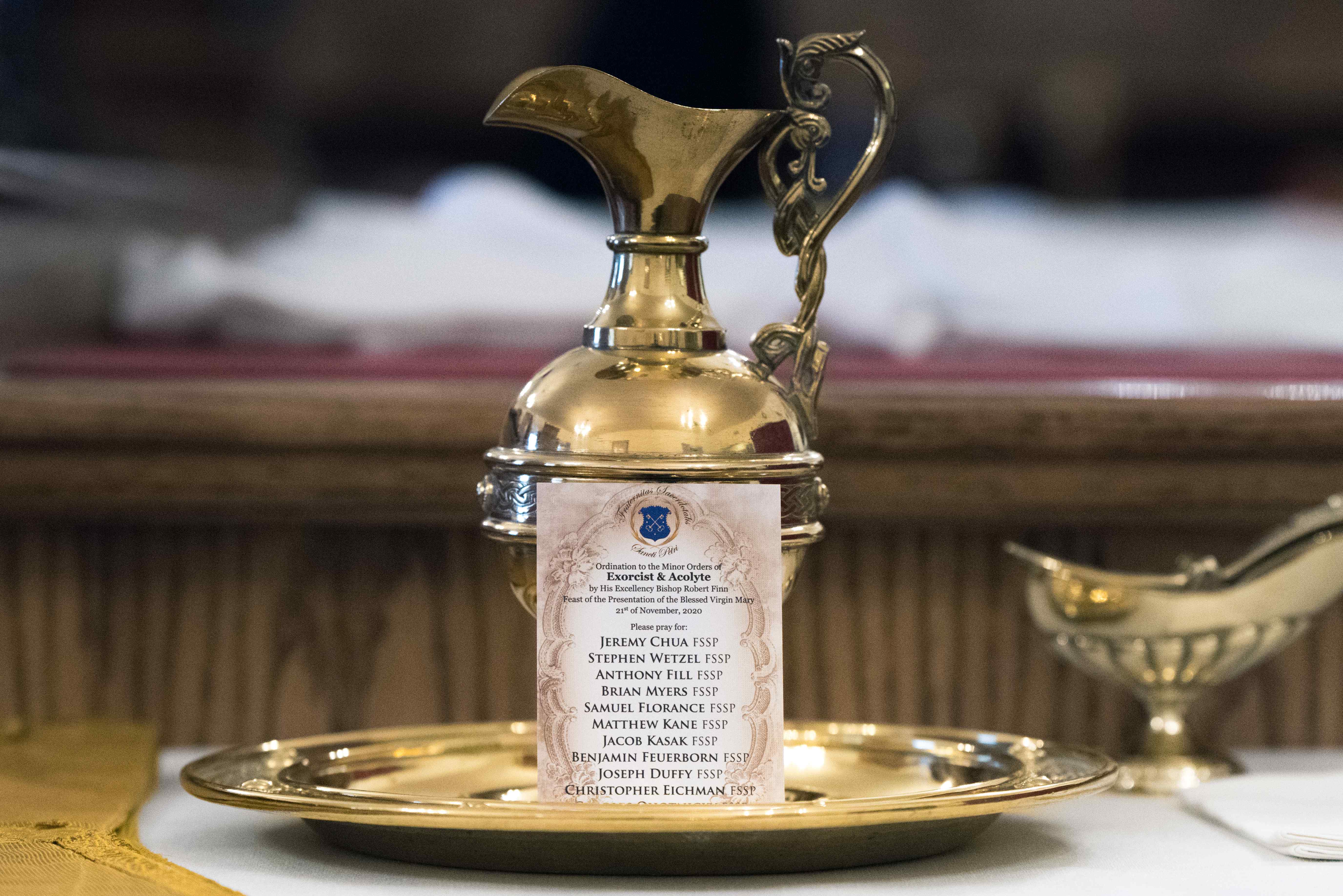
Ordination of acolytes
It may well be believed that a pope has no authority to abolish a bimillennial approved and received tradition. This had already been recognized regarding the venerable Roman Mass when Benedict XVI stated in Summorum Pontificum and Con Grande Fiducia that the old missal was never abrogated — even though nearly everyone, except a tiny number of traditionalists, acted as if it had been. In light of the perennial doctrinal principles declared in the motu proprio Summorum Pontificum and its accompanying letter, the subdiaconate and minor orders have no more been abolished than has the ancient usage of the Roman Rite itself, nor could they be. The old rites, when used today, confer the minor orders and the subdiaconate that they intend to confer.

Catholics have long been told that they should engage in ecumenism, but the one ecumenism that was oddly forbidden was respecting the traditions we hold in common with the Eastern Churches. The lectorate and the subdiaconate still abide in the East. Rather than thinking they have somehow vanished into thin air, it is far more plausible to assume that they abide — and must abide — in the Roman Church as well, albeit in a condition of widespread underappreciation and underuse.

Blessing of a reader in the Eastern rite
A beautiful culture and highly practical asceticism goes with the minor orders: they set their recipient apart for liturgical offices and activities and prepare a man step by step, through lower forms of ministry, to receive the higher forms of the major orders (subdiaconate, diaconate, and priesthood), by which he is decisively inserted into the servanthood and priesthood of Jesus Christ.

The conferral of the minor orders is more than a mere delegation but less than a sacramental ordination in the full sense, which inscribes an indelible mark or character on the soul. If (as in the most common theological opinion) the minor orders do not confer a character and are not part of the sacrament of order but are instituted by the Church, they should be classified as sacramentals. [2] This seems in keeping with the definition of sacramentals given in the 1917 Code: “things or actions which the Church uses in a certain imitation of the sacraments, in order, in virtue of her prayers, to achieve effects, above all of a spiritual nature.” [3]

Specifically, the ceremonies are constitutive blessings that permanently depute persons to divine service by imparting to them some sacred identity, by which they assume a new and distinct spiritual relationship. These blessings entitle their recipients to actual graces for the performance of their ministries, much like the sacramental graces associated with the reception of the sacraments, and similar to the blessing of an abbot. [4] This makes the men in minor orders to be sacramentalia permanentia — blessed and consecrated objects of a sort! For instance, the blessing of a rosary is a sacramental; the blessed rosary itself is a sacramental; the use of the blessed rosary is a sacramental. Likewise, we can say that the ceremonies conferring the minor orders are sacramentals, those in minor orders are sacramentals, and the exercises of their offices are sacramentals.

Wijding van mensen binnen de rooms-katholieke kerk, Bernard Picart (atelier van), 1722 [Note that "porter" is called here "sacristan"]
So the ceremonies of the minor orders and of the subdiaconate confer both the right to perform the ministries and also the promise of actual graces in carrying them out. [5] If we humbly allow ourselves to be guided by the traditional rites of the Pontifical, we can see that there is a solemn imparting of new responsibilities and the assurance of graces to fulfill them worthily. The Church has always endeavored to follow the exhortation of St. Paul: “Let all things [in public worship] be done to edification. . . . Let all things be done decently, and according to order.” [6]

Following apostolic and ancient discipline in regard to the ordines or ranked ministers of the Church ought to matter to us. To hold it as a thing of no worth would be an imperfection, even a vice, for we must never treat longstanding ecclesiastical tradition as deserving of contempt or rejection. As St. Thomas Aquinas wrote in the thirteenth century, a time when minor orders would already have seemed extremely ancient: “The various customs of the Church in the divine worship are in no way contrary to the truth: wherefore we must observe them, and to disregard them is unlawful.” [7]

In a magnificent passage from the Summa theologiae, the Angelic Doctor holds forth on the appropriateness of the Church’s manifesting an orderly diversity of offices and ways of life, as she did throughout her history and well into modern times, and as she will continue to do, wherever sound theology prevails. The vision presented here is at the furthest possible remove from the democratic egalitarianism, traffic of interchangeable functionaries, and lack of architectural and ministerial boundaries characteristic of the postconciliar era. Thomas writes that the differences of states and duties in the Church regards three things:

In the first place, it regards the perfection of the Church. For even as in the order of natural things, perfection, which in God is simple and uniform, is not to be found in the created universe except in a multiform and manifold manner, so too, the fullness of grace, which is centered in Christ as head, flows forth to His members in various ways, for the perfecting of the body of the Church. This is the meaning of the Apostle’s words (Eph. 4:11–12): “He gave some apostles, and some prophets, and other some evangelists, and other some pastors and doctors for the perfecting of the saints.”
          Secondly, it regards the need of those actions which are necessary in the Church. For a diversity of actions requires a diversity of men appointed to them, in order that all things may be accomplished without delay or confusion; and this is indicated by the Apostle (Rom. 12:4–5), “As in one body we have many members, but all the members have not the same office, so we being many are one body in Christ.”
          Thirdly, this belongs to the dignity and beauty of the Church, which consist in a certain order; wherefore it is written (1 Kings 10:4–5) that “when the queen of Saba saw all the wisdom of Solomon . . . and the apartments of his servants, and the order of his ministers . . . she had no longer any spirit in her.” Hence the Apostle says (2 Tim. 2:20) that “in a great house there are not only vessels of gold and silver, but also of wood and of earth.”[8]
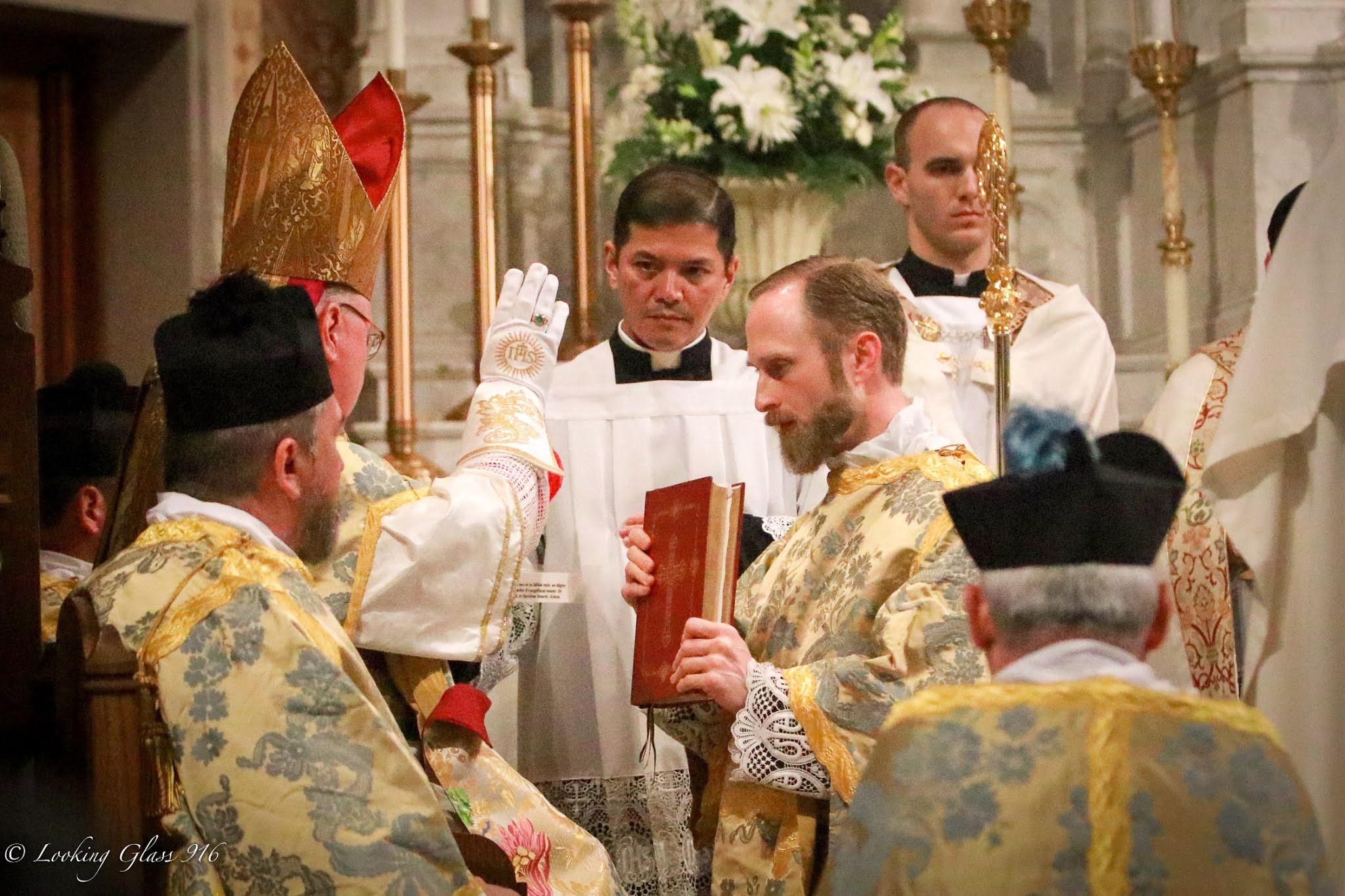
The beauty of hierarchical order

Thursday, July 14, 2022

“The Rupturist Rubric”: The Attempt to Cut Off the Liturgy from Tradition

At the “Defense of the Immemorial Roman Rite: Traditionis Custodes v. Summorum Pontificum” Facebook group, our founding editor Shawn Tribe posted the following insightful text, which I reproduce here with his permission. (Shawn is the administrator of the group, and Gregory DiPippo and I are both moderators with him.)

*   *   *   *   *
The Rupturist Rubric
A problem that many have identified is that frequently in practice we find in operation what we might term the “rupturist rubric.”

What is the rupturist rubric? The rupturist rubric is an approach to matters liturgical and otherwise which seemingly adopts the principle that any approach to the liturgical rites is generally acceptable or at least tolerable so long as it is not the ‘traditional’ (i.e. “pre-conciliar”) approach.

Some examples of the rupturist rubric in action:

1. You can wear no clericals at all should you like, or any kind of hat you like as a cleric, but if you adopt the cassock or biretta or a Cappello Romano, etc. this is intolerable.

A dangerous restorationist caught in the act of undoing the Council’s good work!
2. Clerics may wear sandals or sneakers or even buckled monkstrap shoes if they like, but if you adopt the traditional buckled clerical shoe that was in force until the later 1960s this is ‘verboten.’

3. Playing with and improvising the liturgical texts and rites is openly tolerated, but should you adopt exclusively the most traditional options within the Pauline rite, this is considered suspicious at best, a “rejection of Vatican II” at worst.

4. Use of Jazz or other contemporary secular forms of music within a liturgical context, while not common is tolerable, even desirable, while use of sacred polyphony of Gregorian chant is considered “elitist art music.”

5. A priest might freely roam the church during the liturgy, might ‘bless’ with a guitar, but the adoption of ad orientem is intolerable.

These are purely examples and while they might vary in specific form and degree, the basic gist of the rupturist rubric is that anything that is different from the tradition is more often than not either tolerated or viewed in a positive light, while those things that adhere to the patrimony and tradition of the Latin rite are considered suspect or even openly criticized and censured.

The rupturist rubric is ultimately an expression of a rejection of Catholic patrimony and identity.

*    *    *    *   *

Together with this text, Shawn posted the following amusing photograph:


This aptly ballooned photo can be linked to two incisive remarks from recent articles. The first, “Further thoughts on ‘inculturation’: Why ignore the liturgy that sustained the evangelization of the entire globe?”, quotes Monika Rheinschmitt:
If there is anything we can learn from considering (a) the diversity already allowed by the Novus Ordo’s own rubrics, (b) the diversity added on top of this by official or unofficial attempts at “inculturation,” and (c) the further diversity created by rampant abuse and bad custom, about which the Vatican pretends to care but never takes concrete action, we are justified in reaching the following conclusion: The unity of the Novus Ordo consists exclusively in not being the traditional liturgy.
As if continuing the train of thought, Michael Charlier, in a piece entitled “The amorphous ‘Roman rite’ and the authentic Roman Rite,” states:
Everything that has been promulgated and will be promulgated after THE COUNCIL is a valid expression of the Roman Rite—everything that was before is not (anymore).... Apparently, the view of Francis and the Sant’ Anselmo liturgical school behind him is that everything under the immediate jurisdiction of the Roman See belongs to the Roman Rite.... This is how one can regard it—if one takes a legal positivist standpoint and, incidentally, wants to follow Francis’s hyperpapalistic fantasies of omnipotence. In terms of liturgical history, this inflation of the term Roman rite rather implies the dissolution of the Roman rite into a series of individual rites, which only show a loose agreement in some basic elements and are connected above all by the fact of approval by the central office....

Let us try to put these three observations together.

According to the pope, the Roman Rite has no objective meaning other than what he himself declares to be the Roman Rite. Because “the Council” has radically changed ecclesiology, and the liturgy must give expression to theology (the inversion of the lex orandi, lex credendi axiom), therefore only the liturgy after the Council can be the Church’s lawful liturgy. Since this liturgy calls for variation and welcomes extensive inculturation, it has no inherent formal unity; its unity consists in being not something definite or something preconciliar (the two of course go together in this way of thinking), but rather in being indefinite and anti-preconciliar. Thence arises the necessity to tolerate (at best) or eliminate (at worst) any remnant of preconciliar practice -- even the most accidental, and even that which is technically still allowed, just as one can find some texts in the Council that do not reflect the spirit of the Council, and must therefore be sidelined or overcome by development (cf. Benedict XVI, Address on December 22, 2005).

In a lengthy article last April, Massimo Faggioli wrote:
But the most disturbing phenomenon [in our day] is the transition from a crisis of ecclesial authority to a crisis of the authority of Vatican II and therefore a collapse of a healthy sense of the tradition: a dynamic and organic idea of the tradition; the letter of the tradition not as a paradigm of understanding, but as an expression of the act of understanding; a shift from cognitive and propositional to a personalist and dialogical understanding of revelation.
The subjectivist and evolutionary language here is unmistakable: if we were to take him at his word, it would mark the end of a religion founded on truths that can be formulated with precision and defined as true always and everywhere. (Consider what the Pontifical Academy for Life is attempting to do now with reversing the Church’s perennial teaching on contraception and in vitro fertilization.) In fact, the parallel between the old view of dogma and the old view of liturgy is quite exact: formal, objective, definite, knowable in se, stable, and a source of transformation of cultures, rather than something informal, subjective, indefinite, solely reliant on external authority, ever-changing, a kind of material substrate that must be shaped by cultures that take it up.

We are dealing here with a major epistemological and ecclesiological crisis, the general outline of which has long been acknowledged in traditionalist and sometimes in conservative circles, but the actual magnitude of which has only begun to be clear to us, thanks to the rupturist actions and documents of Pope Francis. It is all the more urgent to adopt a minimalist account of papal authority together with a robust account of the rights of tradition and the limits of obedience, so that we may reject the nominalist, voluntarist, and Hegelian interpretation of liturgy that is now being put forward.

Thursday, December 30, 2021

Guest Article: Who Actually Delegitimizes the “Novus Ordo Missae”?

The following detailed analysis of the Responsa ad dubia of the Congregation for Divine Worship by Clemens Victor Oldendorf was published in two parts, “The Fundamental Theoretical Question” and “The Preparedness for Concelebration,” on December 25 and 29, at kathnews.de (here and here). The following translation, prepared by Peter Kwasniewski, has been approved by the author.

The fundamental theoretical question

If one recalls the motives for which the Motu Proprio Summorum Pontificum legally established a bifurcation of the one Roman Rite, and stated that the older of these expressions had never been abrogated by Pope Paul VI or any of his successors, and had therefore always remained permitted in principle, it is clear that there was an abstract theoretical construct and legal fiction aimed precisely at justifying, formally and above all substantively, the post-conciliar liturgical reform of 1969 and Pope Paul VI, who had decreed and implemented it.

For my own part, I have often argued that the coexistence of different editiones typicae of the Missale Romanum (and other liturgical books) need not in itself pose a compelling problem if, as in our specific case, one edition is the latest one based on the reform mandate of the Council of Trent (1545–1563), and the other is the most recent one based on or following the liturgical reform of the Second Vatican Council (1962–1965). Here, an evaluation of the origins and liturgical structure of the rite in each case remains out of consideration for the time being, as do the advantages or disadvantages in the rite’s expression of Eucharistic dogma.

Traditionis Custodes, however, now says that the liturgical books promulgated by Paul VI and John Paul II after the Second Vatican Council are the “sole expression” of the lex orandi in the Roman Rite. Note: this is to say more than just that the Missale Romanum of Paul VI replaced the Missale Romanum of 1962, and replaced it completely. What is says is that the Tridentine missal or celebrations according to it are no longer even part of the Roman Rite; above all, that they are no longer an expression of the Latin-rite Church’s lex orandi.

At this point, it is not merely about the problem that, if this were true, then—despite protestations to the contrary—logically the Church’s lex credendi must have changed. But if the Tridentine rite is no longer Roman, and the rite resulting from the liturgical reform of Paul VI binds the entire Latin Church, a Tridentine Mass celebrated after July 16, 2021, finds itself in an ecclesiastical vacuum, both in terms of its ritual affiliation, and ultimately, in terms of ecclesiology.

It must be made very clear that given the nature of such claims, it will not be possible to comply with the new regulations in force from July 16 if one desires to hold on to the liturgical tradition with deliberation and conviction or to maintain one’s connection to it.

Funeral of Paul VI
Rome now openly claims the post-conciliar liturgical reform as a breach

It is not the traditionalists who are using Traditionis Custodes to question the legitimacy of Paul VI’s post-conciliar liturgical reform. Quite apart from the fact that Benedict XVI had built golden bridges to this legitimacy in Summorum Pontificum, one could easily concede—even without necessarily having to use the new liturgical books oneself on account of this concession—that a newer usus of the Roman Rite, where it has meanwhile been observed for decades in a manner faithful to its own prescriptions, could develop some legitimacy and a justification of its own, even if one thinks that it did not originally possess them, or at least is open to the possibility that it might have lacked them at the start.

All previous old-rite indults, and likewise the Motu Proprio of 2007, could be understood in a such a way that one could make these concessions if it was important to be in tension-free agreement with the ecclesiastical authorities, despite one’s own adherence to the Tridentine Mass and liturgy, and if one wanted to do everything correctly in purely formal canonical terms.

The premises that have now been established with Traditionis Custodes and reaffirmed by the Responsa of the Congregation for Divine Worship are for the first time clearly unacceptable to anyone who has hitherto preferred the liturgical books of 1962 for reasons other than preference or a sympathy of mentality. Indeed, now the liturgical tradition up to the Second Vatican Council is quite blatantly relegated to an allegedly deficient, even lacking, conformity with the Church’s lex orandi, and pushed out of the realm of what is to be henceforth considered the Roman Rite.

Thus, the liturgical reform of Paul VI is claimed, not by obscure or extremist critics of Vatican II, but by the highest authority itself, to be a rupture. This must, at least in strict theory, deprive it of the legitimacy it may have originally had formally, or may have gained in the meantime through long-continued use in the numerically predominant part of the Church.

Those who felt obliged by ecclesiastical obedience to accept the post-Conciliar liturgical reform, and yet endeavored not to make use of the new rite of Mass in conscious opposition to the previous one, are equally challenged, by the interpretation given to the liturgical reform in Traditionis Custodis and the related explanations from the Congregation for Divine Worship, to reconsider their previous attitude and liturgical practice.

Concelebration: an indispensable gesture of communion or of acceptance of the liturgical reform?

From its treatment in the Responsa ad dubia, it is quite clear that this document of the Congregation for Divine Worship is by no means addressed only to local bishops in whose dioceses Masses have already been celebrated according to the Missale Romanum of 1962, nor only to diocesan priests who have already celebrated them, those who are to be commissioned to do so in the future, or those who would like to celebrate in the future according to this missal. The answers clearly also concern the former “Ecclesia Dei” communities and the priests who belong or will belong to them. In this regard, it is worth recalling what Pope Benedict XVI wrote in 2007 in the letter accompanying his Motu Proprio Summorum Pontificum: “In order to experience full communion, the priests of the communities adhering to the former usage cannot, as a matter of principle, exclude celebrating according to the new books. The total exclusion of the new rite would not in fact be consistent with the recognition of its value and holiness.”

This willingness in principle, however, has until now been a purely theoretical one that has never materialized or had to be demonstrated in practice. Incidentally, it is striking in Benedict XVI’s formulation that it is not even specifically about concelebration according to the new liturgical books. The dubium here under examination asks: “If a priest who has been permitted to use the 1962 Missale Romanum does not recognize the validity and legitimacy of concelebration—refuses to concelebrate, especially at the Chrism Mass—can he continue to avail himself of this permission?” The answer to this question of doubt is a resounding no.

But priests of the former Ecclesia Dei communities are obviously among those who have been “permitted to use the 1962 Missale Romanum.” What is interesting in the wording of the question is the talk of recognizing the validity and legitimacy of concelebration, and the implicit presupposition that such recognition can consist only in occasionally concelebrating in person, and especially at the Chrism Mass with the local bishop in whose diocese one resides and ministers. The explanatory note speaks of the validity and legitimacy of the liturgical reform, so “concelebration” and Pope Paul VI’s post-conciliar “liturgical reform” are, as it were, used synonymously. In other words, the practice of concelebration is seen as an exquisite achievement of this liturgical reform, like an emblem. And although current canon law guarantees the right to individual celebration, as is well known, one should not be surprised at such an interpretation, since in St. Peter’s itself, individual celebrations even according to the post-conciliar missal have been de facto abolished in favor of concelebration.

In this dubium on concelebration in particular, with the answer and explanatory note, it is therefore clearly a question of priests who up to now have exclusively used the old Missal and were allowed to do so.

Evidently, the vast majority of diocesan priests or religious priests who celebrated indult Masses or, after 2007, have used the 1962 Missale Romanum on the basis of Summorum Pontificum, have predominantly celebrated (and, where appropriate, concelebrated) in the post-conciliar renewed rite of Paul VI, and have already thereby sufficiently demonstrated that they recognize the validity and legitimacy of the post-conciliar liturgical reform.

The members of the earlier Ecclesia Dei communities also did so in theory, for, like all others who made use of Summorum Pontificum, they thereby accepted, at least by implication, that the one Roman Rite had two forms and even, de iure, that the newer form enjoys a certain primacy of place, as it had emerged from Paul VI’s liturgical reform following the Second Vatican Council.

But if one now considers that Traditionis Custodes can logically address itself only to traditionalists who have already claimed, as the basis of their adherence to the liturgical tradition, the papal indults or the preceding motu proprio of Benedict XVI, and who, with the local bishops’ approval, have developed and continue to develop their activity mostly in regular places of worship where they have celebrated and continue to celebrate as guests with the approval of the pastor, then it is once again questionable why they should have to offer additional proofs of the validity and legitimacy of the liturgical reform by concelebrating in person.

Although there is the exception of the Archdiocese of Vaduz, where the diocesan bishop has celebrated the Chrism Mass according to the old liturgical books for several years in the past (which will no longer be possible in the future, unless he is willing to ignore the prohibition), concelebration is not the only way to express one’s hierarchical communion with the bishop.

Practical signs of accepting the validity and legitimacy of the reformed rites

By receiving from the local ordinary the sacred oils consecrated in the new rite, a priest also accepts its validity, and furthermore—with the exception of the Apostolic Administration of the Holy Curé of Ars in Campos, Brazil—none of the former Ecclesia Dei communities have their own bishops, consecrated according to the old Pontifical. Even if the priests themselves have been ordained according to the old Pontifical up to now, from this point of view, none of the priests of these communities is, so to speak, “purely Tridentine” because the prelates ordaining them were ordained using the 1968 Pontifical; and even the SSPX accepts into its ranks priests ordained in the new rite, or at least collaborates with them. (Only if there are doubts about validity in a concrete individual case and the priest in question explicitly draws attention to the possible problems can there sometimes be a discreet conditional re-ordination, at the priest’s explicit request.)

Furthermore, it can be pointed out that probably the majority of the Masses celebrated on the basis of Summorum Pontificum using the Tridentine Missal were celebrated in churches and chapels where otherwise the post-conciliar Missal is predominantly used, and moreover, that at such Masses, in the Vetus Ordo, Communion for the faithful may be taken from ciboria in the tabernacle whose hosts were consecrated in celebrations according to the new missal. Such a thing would certainly not be possible if there was a denial of the validity and legitimacy of the new rite.

In the dubium about concelebration under closer consideration here, therefore, an unrealistic construct is present, one which, strictly speaking, cannot have existed in the case of anyone who has ever applied to benefit from an old-rite indult, or who, from September 14, 2007 to July 16, 2021, celebrated Masses on the basis of Summorum Pontificum according to the Missale Romanum of 1962, or assisted at Masses celebrated on this legal basis. In short: a much higher threshold of evidence than could possibly be necessary has been introduced, which gives the response a punitive character.

The traditionalists whom Traditionis Custodes is targeting have never asked for “permission” to hold on to the traditional liturgy—they consider it a patrimony prior to and deeper than the whim of the pope—and will not now suddenly allow it to be taken away and forbidden by Pope Francis. However, many of those who, until now, have attached importance to the requesting and receipt of such permission may now start to think it over again, and, possibly even more, to rethink the basic legitimacy of the liturgical reform, including the Pauline Pontificale Romanum of 1968 and the Pauline Novus Ordo of 1969—especially since the post-conciliar liturgical books have now been claimed to be the sole (!) expression of the lex orandi of the Roman Rite. Such unreality handicaps this declaration that it compels a re-examination of the delicate (and, some might say, unsustainable) peace on which Summorum Pontificum was constructed.

The faithful who feel committed to the liturgical tradition of the Latin Church and who want to be nothing but Roman Catholics are thus pushed out, and it becomes clear: Pope Francis and the Congregation for Divine Worship are obviously not really concerned with the high good of genuine ecclesial unity, but at most with a positivist loyalty to authority.

Monday, January 29, 2018

Who’s Afraid of Predestination?

Not the Roman Catholic Church, who prays in her central prayer, the Roman Canon:
Hanc igitur oblationem servitutis nostrae, sed et cunctae familiae tua, quaesumus, Domine, ut placatus accipias: diesque nostros in tua pace disponas, atque ab aeterna damnatione nos eripi, et in electorum tuorum jubeas grege numerari. 

We therefore beseech Thee, O Lord, to be appeased and accept this oblation of our service, as also of Thy whole family; and to dispose our days in Thy peace, and command that we be rescued from eternal damnation and numbered among the flock of Thine elect.
This petition is a liturgical distillation of the teaching of the Apostle Paul, as found especially in Romans 8 and Ephesians 1.
Who hath predestinated us unto the adoption of children through Jesus Christ unto himself: according to the purpose of his will … In whom we also are called by lot, being predestinated according to the purpose of him who worketh all things according to the counsel of his will. (Eph 1:5, 1:11).

For whom he foreknew, he also predestinated to be made conformable to the image of his Son; that he might be the firstborn amongst many brethren. And whom he predestinated, them he also called. And whom he called, them he also justified. And whom he justified, them he also glorified. (Rom 8:29–30).
Verifying yet again the Golden Axiom lex orandi, lex credendi, we find this truth perfectly enshrined in a number of places in the usus antiquior, such as the Dies Irae Sequence of the Requiem Mass, and in the following Secret from the Twenty-Third Sunday after Pentecost:
Pro nostrae servitutis augmento sacrificium tibi, Domine, laudis offerimus: ut, quod immeritis contulisti, propitius exsequaris.

May this sacrifice of praise that we offer to Thee, O Lord, be for an increase of our servitude [i.e., our service to Thee]: that what Thou hast begun without our merits Thou mayest mercifully bring to completion.
In what is perhaps the most beautiful of all such liturgical testimonies, the Postcommunion for the usus antiquior Feast of the Holy Name of Jesus, a relatively recent addition from the 16th century (and incorporated into the general calendar in the 18th), reads thus:
Omnipotens æterne Deus, qui creasti et redemisti nos, respice propitius vota nostra: et sacrificium salutaris hostiæ, quod in honorem nominis Filii tui, Domini nostri Jesu Christi, majestati tuæ obtulimus, placido et benigno vultu suscipere digneris; ut gratia tua nobis infusa, sub glorioso nomine Jesu, æternæ prædestinationis titulo gaudeamus nomina nostra scripta esse in cælis.
O almighty and everlasting God Who didst create and redeem us, look graciously upon our prayer, and with a favourable and benign countenance deign to accept the sacrifice of the saving Victim, which we have offered to Thy Majesty in honour of the Name of Thy Son, our Lord Jesus Christ: that through the infusion of Thy grace we may rejoice that our names are written in heaven, under the glorious Name of Jesus, the pledge of eternal predestination.[1]
The doctrine of predestination (with varying accents and nuances) was taught without embarrassment by all the Fathers of the Church, and received its definitive account in Question 23 of the Prima Pars of the Summa theologiae of St. Thomas Aquinas. In the twentieth century, Réginald Garrigou-Lagrange devoted much of his labor to explicating and defending the Angelic Doctor’s teaching on just this point, as, for example, in his excellent (if unimaginatively titled) book Predestination.

If anyone doubts that the Catholic Church has always taught and still teaches the doctrine of predestination — obviously, not an erroneous Protestant version of it, but the true notion — he may satisfy himself by consulting the Catechism of the Catholic Church, nn. 257, 600, 2012, 2782, and 2823. The Catechism deftly steers clear of the Dominican-Molinist controversy by merely repeating multiple times the statements of St. Paul, and adding only this gloss: “To God, all moments of time are present in their immediacy. When therefore he established his eternal plan of ‘predestination,’ he includes in it each person’s free response to his grace” (n. 600).

From the main portal of Notre Dame cathedral, Paris

Command that we be rescued from eternal damnation and numbered among the flock of Thine elect. With this pair of entreaties, the Roman Canon repudiates the universalist mentality of our age, which assumes that men will be saved unless they conscientiously and egregiously reject God. On the contrary, the Canon embodies the truth of the Catholic Faith as taught by the Fathers, Doctors, and premodern Popes of the Church, for whom man, due to his inheritance of original sin, cannot enter into the kingdom of heaven unless he dies and rises with Christ in baptism.

Without entering here into subtle exegesis of John 3, we can say as a matter of fact that the consensus of Catholic theologians from ancient times until the early twentieth century was that mankind is a massa damnata (“condemned crowd”) and that Christ came into the world to save sinners from the destruction due to our sins, inherited and actual. The sole path of salvation is to be clothed with Christ,[2] incorporated into His Mystical Body, and to die in a state of sanctifying grace. As Scott Hahn says in a lecture on the Gospel of John, “the history of salvation is also the history of damnation”: Christ came into the world for judgment, to cause separation by revealing the truth and exposing darkness.[3] This is why the Roman Martyrology carefully records not only the names of each martyr, but the names of their persecutors as well.

Moreover, in utter opposition to Pelagianism, the Church teaches that God, not man, takes the first step in the renewal of our life; that all our sufficiency is from Him (2 Cor 3:5); that no man comes to Jesus unless the Father draws him (Jn 6:44); that we become adopted sons of God by His predestinating purpose (Eph 1:5); that we persevere by His gift, not by our own efforts. In short, God must number us in the flock of His chosen ones; He knowingly and lovingly chooses us to be the “rational sheep” (as the Akathist hymn says) of His flock. He does not, as it were, happen to find us there in the sheepfold and express pleasant surprise; He brings us there and keeps us there.

All this the Roman Canon succinctly transmits in words as simple as they are sobering: Command that we be rescued from eternal damnation and numbered among the flock of Thine elect.

But why is this doctrine important to us spiritually?

In modern times we are constantly told how good we are, how well-intentioned, and how much we are victims of our environment or upbringing, entitled to various compensations. We are reassured of the greatness of man, of his dignity and rights. But we are in sore danger of forgetting fundamental truths about our condition. We are fallen beings alienated from God, from our neighbors, even from our very selves. We have no rights to stand on before God; we are like “filthy rags,” as Isaiah says (Is 64:4). We are utterly dependent on the divine Mercy at every moment — for our very existence, for our conversion to good, for our repentance from evil, for our escape from damnation, and above all, for the gift of eternal life in Christ Jesus.

We stand at the edge of an abyss of neverending misery into which we may fall at any moment by mortal sin, if our life is snuffed out before we have repented of it, or if the Lord does not, in His mercy, prevent us from falling or, after we have fallen, grant us the gift of repentance. “Lead us not into temptation…” Lead us not into the abyss. Command that we be rescued from eternal damnation. This is reality, as opposed to the shallow fantasy of egoism, the “broad path that leads to destruction,” with which our contemporary culture envelops us.

We stand, too, at the edge of an upward abyss, that of the neverending bliss of heaven, into which we are drawn up out of ourselves, in reverse gravity, to the supernatural grandeur of the sons of God. This, too, is a gift we could never have merited; Christ alone won it for us by shedding His Precious Blood upon the Cross, in the one supreme sacrifice that is made present at every offering of the Holy Mass. It is precisely on the verge of making this sacrifice newly present in our midst that we humbly beseech the Lord: Command that we be numbered among the flock of Thine elect. Number us, O Lord, with the good thief to whom Thou didst say: “This day thou shalt be with Me in paradise.”

The doctrine of predestination has as its positive spiritual effects a deep and abiding thanksgiving to the Lord for His mercies without number, since He died for us while we were yet His enemies, that we might become His friends; a profound humility at having been chosen by God for no beauty of our own but solely that He might make us beautiful in His sight; a sober watchfulness and earnestness, lest our names be erased from the Book of Life; and, most of all, a constant recourse to prayer, that we will be established more and more in Christ, and not in ourselves, for it is by “being made conformable to the image of His Son” (Rom 8:29), and in no other way, that our predestination is actually accomplished.

In response to so great a mercy, the Church places the words of the Psalmist on the lips of her priests as they receive the Precious Blood, price of our souls:
What shall I render to the Lord for all the things that He hath rendered to me? I will take the chalice of salvation, and I will call upon the Name of the Lord. Praising I will call upon the Lord, and I shall be saved from mine enemies.
It is therefore of immense importance for nourishing the right faith of the people that the doctrine of predestination, transmitted pure and entire in the Roman Canon, be present to priests in their celebration of the Mass and to the people in their participation in it.[4]


NOTES

[1] In yet another display of theological “neutralization,” the Novus Ordo — from whose calendar the feast of the Holy Name had initially been purged by Paul VI, no doubt because it was a Baroque accretion, only to be replaced later under John Paul II as an “optional memorial” — politely trims down this postcommunion to an acceptable banality: “May the sacrificial gifts offered to your majesty, O Lord, to honor Christ's Name and which we have now received, fill us, we pray, with your abundant grace, so that we may come to rejoice that our names, too, are written in heaven.” The doctrine is there, but as if muffled beneath several layers of sterile cotton.

[2] Cf. Rom 13:14, Gal 3:27; cf. Mt 22:12.

[3] Cf. Jn 9:39; cf. Jn 3:16–21, 5:24–29; Lk 12:51.

[4] Although not intended to be the focus of this article, it surely ought to be disturbing from the point of view of lex orandi, lex credendi that the sole anaphora of the Western Church, prayed every day at every Mass from ancient times until the 1960s, was displaced by alternative Eucharistic prayers in 1970 — a novelty and rupture the magnitude of which had never been seen in the history of any liturgical rite. See Fr. Cassian Folsom, O.S.B., “From One Eucharistic Prayer to Many: How it Happened and Why,” first published in the Adoremus Bulletin 2.4, 2.5, and 2.6 (September, October, and November 1996). Fr. Cassian quotes an Italian liturgist on the Roman Canon: “its use today is so minimal as to be statistically irrelevant.” (This was more true of the nineties than it is today, when we are enjoying some fruits of Benedict XVI's pontificate.) This rupture best illustrates the untenability of asserting that the usus antiquior and the usus recentior are merely two versions of the same thing, namely, the Roman Rite. It makes little difference that the passages from Ephesians 1 and Romans 8 are contained in the new lectionary (e.g., Weds of week 30 per annum, year I; 17th Sunday per annum, Year A; Thurs of week 28 per annum, year II; Immaculate Conception, 2nd reading), since readings come and go, like birds at a bird-feeder, whereas the danger of damnation and the divine mercy of predestination are woven into the very fabric of the traditional Roman rite. Moreover, most of the prayers that point to predestination in the usus antiquior have been either removed or toned down in the usus recentior, so that it would be much more difficult to establish that the revised liturgy teaches clearly and unambiguously this Scriptural and traditional doctrine.

Friday, November 03, 2017

“What Were They Smoking?”: Liturgical Reform Edition

Earlier this week, Dr Peter Kwasniewski shared some examples of liturgical art from the 1970s, rightly saying that: 

You need to know what people were thinking when they destroyed the liturgy. We can make all the guesses we want, but if we don’t actually read the authors of the fifties, sixties, and seventies, we won’t be able to get into their mindset and see what makes them tick.
Of course, occasionally one comes across ideas from this period so cringe-worthy and horrifying that it becomes a genuine struggle to get into the mindset of the author. Earlier this month, on a research trip to the British Library in London, I happened to come across such an idea from the immediate post-Vatican II period. The following extract dealing with the Liturgy of the Word is one of the more extreme examples of what Dom Alcuin Reid has previously called the it-seemed-like-a-good-idea principle of liturgical reform (cf. Sacrosanctum concilium and the Reform of the Ordo Missae, Antiphon 10.3 [2006] 277-295, p. 291) – from which may the Lord preserve us!

It is worth noting that the book from which this extract comes contains the proceedings of the 1966 Conference on Practical Liturgy held at Spode House (Staffordshire, UK), at the time owned by the Dominicans. (The Order left Spode in 1988, and the house is now known as Hawkesyard Hall.) The conference included papers given by the influential British liturgist J.D. Crichton and the Protestant biblical scholar C.H. Dodd.

I will leave NLM readers to discuss the extract if they wish to, but I have emphasized in bold the parts I found most interesting – so, caveat lector!

Extract from Oliver Pratt, “The Word—Preparation and Response” in Paulinus Milner (ed.), The Ministry of the Word (London: Burns & Oates, 1967), pp. 98-122

[p. 117] The future

Now I want, finally, to let my imagination run ahead a few years and describe what I feel may be one possible form in which the Ministry of the Word will develop in the future. Mass has just begun in the church of an urban industrial parish on one of the first few Sundays after Pentecost.

The Celebrant says: The Jews knew that they were God’s chosen people but in this passage we see that the prophets were concerned to make clear to them that Jahveh’s plan of salvation was intended ultimately for the whole of mankind.

A laywoman comes forward and reads the Lesson: [Isaiah 49:1-6] [...]

[p. 118] The Celebrant says: The first Christians were made up of Gentiles of many different races together with Jewish converts. This mixing together led to trouble and some groups tried to set themselves up as better than others. St Paul makes clear here that all have put on Christ by their baptism and therefore all are equal before God. There can be no second-class citizens in the Christian fellowship.

Then a Pakistani layman comes forward to read the epistle: [Galatians 3:23-29] [...]

[p. 119] All of this will have only taken a minute or so apart from the actual Scripture readings themselves. In case anyone is finding it difficult to place which Sunday it is, it should be explained that the calendar has already been revised and enriched. There is a regular reading from the Old Testament added, a much wider range of Scripture is covered over a longer cycle and the texts are often grouped together in such a way that they can be made more meaningful.

The Celebrant says: This passage explains the meaning of Christian fellowship in terms of how our actions will be judged by Christ at his second coming.

A deacon comes forward and reads the gospel: [Matthew 25:31-40] [...]

[p. 120] Now another layman comes forward and draws the attention of the congregation to a display of pictures and diagrams that have been put up on the wall of a side chapel. (It is an old-fashioned church built in the 1960’s.) He takes a couple of minutes to explain what is there, that is the findings of a study made by a small group of lay people of the conditions of Afro-Asians living in the locality. A panel of professional people was asked to look at the qualifications and training of a mixed sample of Afro-Asian and European workers and to place them blindly, i.e. without knowing their race, into the jobs that they ought to have. The speaker points out that over 80% of the Afro-Asians were found to have actual jobs that were well below their proper grade according to the assessment. He goes on to give a couple of examples of personal humiliation that the work has unearthed and concludes by asking us if through doing this we are not continuing to humiliate Christ himself?

The Celebrant says: Not only must we accept these people fully into our own fellowship as equals in Christ but we must each of us decide what the Gospel means in the witness of our own personal lives. It may be anything from welcoming the promotion of an Indian fellow worker to seeing the marriage of your daughter to an African as pioneering a new multiracial society. Above all we must come to know and love the strangers of another race as persons for, as Christ himself has told us in the Gospel, anything that we can do to lessen their sufferings lessens his own.

The Mass continues with the creed and special bidding prayers that have been composed for the occasion. After Mass the people crowd around the display at the side of the [p. 121] church and the people who did the study are answering questions about it. Soon people are dotted around the church in little groups asking one another what they can do to help the Afro-Asians. This is a little different from the acts of solemn silent private devotion to which we are accustomed today but it is difficult to think that God finds it the least bit out of place in his house.

There has hardly been a homily in the form that we would know it today at all. The time taken up by the liturgy of the word has been no longer than that needed for the actual readings from Scripture plus another five or ten minutes, the time usually given over to the homily today. Not only has the job that we usually expect the homily to do been done but because of all the preparatory work put in by some of the laity, it has actually been done in a really meaningful way and indeed in such a manner as to more or less guarantee some sort of constructive response. The priest is still the custodian of the word and responsible for its preaching but to be responsible for something does not always mean doing all the job oneself. [...]

[p. 122] There is almost unlimited scope for variations upon this sort of treatment of the liturgy of the word and it seems clear that it need not be restricted only to a very occasional special event. Of course, a start would have to be made by an occasional venture. A lot would depend upon developing a real sense of engagement in the work of the Church throughout a large proportion of the people. If so, this sort of treatment of the Ministry of the Word could take place fairly frequently even if not always in quite such a spectacular manner as that described above. It is to be hoped that the forthcoming revision of the Scripture readings will be done in such a way as to provide full scope for the development of more effective approaches to the Ministry of the Word along such lines as these. Also perhaps use will be made of visual aids, like projecting a single scriptural phrase onto a screen, a phrase pregnant with meaning that the preacher returns to again and again. Perhaps religious art and drama can be brought into play.

What seems to be most important is that these new experiments should be tried out in a number of parishes as soon as possible, for the results will have a bearing upon the function of liturgy as a whole. If such results can be obtained before the Commission working on the liturgy completes the major recasting of the eucharistic worship, they may be of considerable assistance to the Commission in its work.
The cover of a contemporaneous book (1967) by Oliver and Ianthe Pratt,
demonstrating their vision of liturgical “reform” for “modern man”.
(A quick word about the author of this extract: Dr Oliver Pratt was involved in the Newman Association in the UK (from 1963-65 he was its President), and at the time was Chairman of its Theological Studies Committee and Vice-Chairman of its Liturgy Committee. Shortly after the publication of this paper, he and his wife, Ianthe, would become prominent in the UK for their vocal dissent from Humanae Vitae. They were also heavily involved in the Catholic Renewal Movement (known as Catholics for a Changing Church since 1993 to avoid confusion with the Catholic Charismatic Renewal), and Ianthe Pratt would later be a founding member of the dissident group Catholic Women’s Ordination.)

Monday, July 03, 2017

The Long Shadow of Neoscholastic Reductionism

In liturgical discussions, a major premise of the progressivist side is, ironically, what might be called neoscholastic reductionism, which defines the “essence” of the Mass as having a valid consecration. In almost any conversation about whether and to what extent the rite of the Mass can change or should change, the proponent of tradition is immediately challenged with: “But you can’t prove that the Novus Ordo [or any fabricated, experimental liturgy] is bad. It has the words of consecration.”

The problem with this approach, of course, is that it falsifies the reality of a liturgical rite as a definite embodiment of apostolic tradition existing over the course of history. Each rite has its own deep characteristics that make it irreducibly itself. No one would dream of defining the Byzantine rite as “essentially” a valid consecration, with which a lot of florid prayers and hymns are accidentally associated. Nor should anyone with a modicum of sense try to define the Roman rite of Mass apart from the Roman Canon, which is its defining feature, or attempt to import an epiclesis into the Roman Canon, when, properly speaking, it has none and needs none. These rites are what they are—and thanks be to God for that.

Reducing the Mass to a valid consecration is like reducing the nuptial act to a successful conception of a child. I sincerely hope no one is foolish enough to define the nuptial act as the conception of a child. The nuptial act is ordered to the conception of a child, to be sure, but it has its own reality, its own meaning, that comprises more than conception; it is an expression of spousal love, which is designed to culminate in new life. By God’s institution, life is supposed to proceed from love; both elements are involved in defining the act. This is why the Church opposes in vitro fertilization, which otherwise she could not do if the sole meaning or value of the union of man and woman were a viable zygote.

In like manner, the Mass is a privileged microcosm of unitive prayer with a Eucharistic finality. The presence of the sacrificial victim who is to be our divine food is conceived, as it were, by the liturgy in its totality; even if the consecration takes place at a certain moment, it has been prepared for and will be followed by a manifestation of love that suits us to receive the Lord and rejoice in His presence. When this does not happen, we are dealing with the specter of in vitro transubstantiation.

Unfortunately, since nearly everyone who came to Vatican II or who worked for the Consilium had been brought up on this superficial neoscholastic reductionism, they felt free to rip apart and reconfigure the Roman Rite as long as they kept the words of consecration (more or less) intact. In this regard they were lab technicians committed all along to the result of a valid Mass but not feeling themselves ethically bound to any particular content or process.

Indeed, the arrogance of the reformers could not stop at the threshold of the holy of holies, but went so far as to tamper with the very formula of the consecration of the wine by removing the phrase mysterium fidei from within it — a phrase already so well known and so venerable in the Middle Ages that St. Thomas Aquinas in the 13th century could plausibly attribute it to the Apostles.

Unquestionably, therefore, we need to start all over again with better questions. We should not ask: What is it that makes transsubstantiation happen,[1] but: What is it that makes a liturgy a Christian liturgy? Even more importantly, what makes this liturgical rite to be itself (Roman, Ambrosian, Byzantine, Syro-Malabar, etc.) and no other? When these are the questions we pursue, we find rich answers that show us the fittingness, the beautiful complexity and sufficiency, of each rite in itself, and therefore, shows us the dramatically anti-liturgical, anti-ritual, anti-historical, and ultimately anti-Catholic nature of the reforms.

Obviously, there are elements more and less central to a given rite. But it cannot escape our attention that elements truly fundamental and constitutive of the Roman Rite have been abandoned by nearly everyone—including by the supposed guardians of the rite.

What belongs to this inner core of the Roman Rite?
  • Most importantly, the Roman Canon, its sole anaphora for 1,500 years, going back in its elements to the first centuries.
  • The ad orientem stance. We do not know how early on this stance became universally normative, but we know that already in the first centuries of the Faith it had become universal in East and West, which could never have happened were it not apostolic in origin, as St. Basil the Great takes for granted in his treatise On the Holy Spirit. It belongs to the original configuration of all of the great historic rites of Christianity. Without it, a liturgy is no longer in actual continuity with apostolic tradition, however much it may enjoy a technical licitness of the reductive sort mentioned above.
  • The liturgical “vesture” of the Latin chant, which is not a mere add-on or ornament, but the very liturgy-as-sung. The Proper and Ordinary chants articulate the shape of the rite, fill its content, sustain its spirituality, and guarantee its substantial continuity over time and space. Without them, we are not looking at the Roman Rite any more.[2]
  • The cursus of readings, namely, the set of Epistles and Gospels. This is a topic on which much has been written elsewhere; here it suffices to note that the Roman lectionary, almost as venerable in its antiquity and universality as the Roman Canon, was supplanted by the novelty of a multi-year lectionary constructed for the Missal of Paul VI. The old and new lectionaries have very little overlap at all.
  • The calendar with its particular clusters of Roman saints and its rhythm of Sundays, Holy Days, vigils, octaves, Ember and Rogation days, etc. It is true that, as Dom Gregory Dix shows, the calendar had a lengthy development, but it did develop organically in certain ways distinctively Roman and always preserved until the revolution of the 1960s.
  • In light of the principle of organic development, one may argue that the offertory (as in all the traditional offertory prayers), which developed in the Middle Ages and spread to all Western rites, had fused with the core of the Roman Rite. The offertory may be compared with a branch successfully grafted into a tree so that it loses all foreignness and becomes a major part of the flourishing organism. Its removal was not a haircut but the amputation of an arm or a leg.
Now, it cannot escape the notice of anyone that in most or all of these ways, the modern “Roman Rite” is a striking departure from the Roman Rite. It is possible for it to be celebrated in a way that follows some of the rite’s precedents, but it is also possible for it to be celebrated in a way that is utterly at variance with all of them. A very great number of celebrations, certainly the vast majority, are at variance with the Roman tradition, because
  • the Roman Canon is not used;
  • Mass is said versus populum;
  • liturgical texts are not recited or chanted, e.g., the Propers and Ordinary are absent, mangled, or delivered in a way inconsistent with their origins;
  • that novelty of novelties, the multi-year lectionary, is employed;
  • a severely reduced calendar is followed;
  • the traditional offertory is lacking, de iure as well as de facto.
In other words, when Roman Catholics attend such liturgies, they are getting a Mass, but not the Mass of the Roman Rite in its essential constitution. They are getting what might be called “the Modern Rite,” as liturgical scholar Msgr. Klaus Gamber would have it.

The damage wrought by neoscholastic reductionism is all too real and very extensive. It is the only atmosphere in which the outrageous enterprise of creating a Modern Rite in the late 1960s could have sprung up. The same mentality has, over time, propagated itself to other aspects of Catholic life as well. For example, that there are people today who are seriously asking the question of whether public sinners may receive Holy Communion shows that the Eucharist has been reduced, in the minds of many, to a mere sign of belonging or of table fellowship — not a supernatural mystery that requires the full commitment of one’s mind, heart, soul, and strength to Jesus Christ really present, against whom one mortally sins by unworthily receiving Him.[3] Such moral and disciplinary reductionism is not, however, surprising against the backdrop of the wave of liturgical reductionism that went before. Our age has provided a nearly scientific demonstration of the axiom lex orandi, lex credendi, lex vivendi.

The traditional movement in Catholicism simultaneously pursues two great goods: the recovery of a sound Eucharistic theology and the reestablishment of the actual Roman Rite of the Mass. Good theology and authentic liturgy work together to unveil to the eyes of faith the presence of Our Lord Jesus Christ in the entire liturgy and, above all, in the miracle of the host and chalice, in such a way that Catholics will be able to experience once more the terrible beauty and challenging joy of Eucharistic communion, and will strive to order our lives and our societies according to Its demands.


NOTES

[1] As a Thomist, I certainly accept that there is a moment of consecration, as I have defended here and elsewhere. But if one looks at Summa theologiae III, q. 83, one will see that St. Thomas is far from being a liturgical reductionist. He sees the complexity of the Roman Rite, the meaning and value of each of its parts, and the respect with which it ought to be treated by those who worship in it. Scholastic precision does not have to devolve into neoscholastic reductionism.

[2] Even the Low Mass bears witness to this normativity of the chants of High Mass by requiring the recitation of the texts of the chants, although this is somewhat like a two-dimensional drawing versus a three-dimensional sculpture.

[3] See my article on 1 Cor 11:27-29. Again, “worthy reception” here does not mean that we are already perfect, but, as John Paul II explained in Ecclesia de Eucharistia, that we have renounced mortal sin and have an intention of living according to all the commandments of God.

Monday, May 02, 2016

The Law of Liturgical Entropy

Caspar David Friedrich, The Wanderer
It feels easier to walk downhill than to walk uphill, but it’s much harder on the knees. It feels harder to climb uphill, but the beautiful view at the top is always worth the effort.

As hikers often experience, you will be walking along on a narrow trail, perhaps in the midst of crowded trees, thinking the small thoughts that go with one step after another, and you turn a bend and suddenly the whole world opens up in a breathtaking vista that almost makes you feel dizzy, as if the beauty might subvert your muscles. That beauty was put there by God, not by you, and yet it took your effort to reach it. We make the trails, we walk on them, but the beauty is from above; it was there before we existed and it will long outlast our mortality.

The same is true of the liturgical tradition: it is God’s gift to us, it comes before us and goes beyond us, but we must work hard to preserve it and to be worthy of it. What we absolutely must not do is think that it would be better to create an alternative “tradition” and attempt to rejoice in it — that would be like planting a giant flat screen at the end of the trail and looking at a filmed sunset.

The notion that we need to make ourselves worthy of our liturgical tradition is one that is, I’m afraid, quite unfamiliar today, because of the decades-long bad habits induced by reformers, revisers, translators, and other committee members who place themselves over and above the tradition as its superiors, its judges, its improvers, its improvisers. This is not and cannot be the attitude of one who, conscious of his own limitations and of the narrowness of any age, people, or culture in and of itself, gratefully and humbly receives a noble inheritance, rejoices in its prayer-saturated beauty and stability, and delivers it integrally to his successors — perhaps embellished with additional signs of reverence and devotion, if he has been prompted to originate them.

A Catholic who is aware of himself, who senses the smallness of his vision and the greatness of the tradition that precedes and carries him, is, in fact, relieved that he does not have to make things up as he goes along; he need not second-guess the river along which he floats. He lets himself be the ready instrument of a far greater actor, the mouth through which the same word continues to sound, the hand or foot that executes the head’s bidding. He does not fear messing up that which was whole and safe and salvific before he even came to be and which will continue long after he is gone.

Nevertheless, there is something very important that the individual, the bishop, the priest, the deacon, the religious, the layman, must contribute in order that the tradition will not die out or shrivel up. True, he does not have to invent the tradition, but neither can he ignore it or treat it lightly. He must embrace it or else it will cease to exist.[1] In a famous interview published in The Latin Mass magazine, Alice von Hildebrand addressed this issue head on:
TLM: I cannot end the interview without asking your reaction to a well-worn canard. There are those critics of the ancient Latin Mass who point out that the crisis in the Church developed at a time when the Mass was offered throughout the world. Why should we then think its revival is intrinsic to the solution?
AVH: The devil hates the ancient Mass. He hates it because it is the most perfect reformulation of all the teachings of the Church. It was my husband who gave me this insight about the Mass. The problem that ushered in the present crisis was not the traditional Mass. The problem was that priests who offered it had already lost the sense of the supernatural and the transcendent. They rushed through the prayers, they mumbled and didn’t enunciate them. That is a sign that they had brought to the Mass their growing secularism. The ancient Mass does not abide irreverence, and that was why so many priests were just as happy to see it go.[2]
The law of entropy states that, left to itself, any system will lose order, will devolve or unwind. The tendency of the material world is towards unraveling. If order cannot somehow be re-introduced, decay is unavoidable.[3]

In the little universe of the liturgy, that necessary principle of order is reverence for traditional texts, music, rubrics, and decorum, sustained by Church authority properly exercised. These things can be contributed only by living human beings who correspond with the grace of the Holy Spirit. As long as they are supplied, and where they are present, the liturgy thrives and continues along its way, undiminished. Without them, however, it is doomed to disintegration.

Liturgical decadence, deviation, and disorder are, like the natural tendency of entropy, a downhill walk for fallen man. Left to himself, left without the guidance of the tradition willed by the Holy Spirit and the example of many saints who have shown us how to walk the often grueling uphill path of fidelity, fallen man will make liturgy conform to his own whims and wants, his own programs and purposes — something easier and more damaging. It is the uphill climb that leads to the magnificent vista, the glimpse of a vast and humbling beauty that can only come from the mind of the Creator.

NOTES
[1] Along these lines, see the superb article of Joseph Shaw, "Does Tradition preserve us, or we the Tradition?"
[2] For the full text, see here; for some highlights, see here.
[3] I am aware that there is a lot more to the concept than this simplistic layman's version of it: see here. But in the popular imagination, entropy means a continuing decrease in order, and that is the rough sense in which I am using it.

Saturday, June 27, 2015

Concelebration Tomorrow - From Dom Alcuin Reid’s Foreword to “The Holy Eucharist - The World’s Salvation”

Peter Kwasniewski just published a notice and review of “The Holy Eucharist—The World’s Salvation. Studies on the Holy Sacrifice of the Mass, its Celebration, and its Concelebration,” by Fr. Joseph de Sainte Marie OCD. This is the long-awaited translation of a work originally published over thirty years ago, not long before the author’s death, which Peter describes as “the most important book ever to appear in English on the subject of concelebration.” It appears in this new edition from Gracewing Publishers with a foreword by Dom Alcuin Reid, OSB, entitled “Concelebration Today, Yesterday and Tomorrow”.

In the first part of this foreword, under the subtitle Concelebration Today, Dom Alcuin outlines the many (and sadly common) abuses which have become almost part and parcel of the practice of concelebration as done in the modern Roman Rite. The second part, Concelebration Yesterday, summarizes Fr de Sainte Marie’s extensive research into the history of concelebration, and particularly “his identification of the profound historical error on the origins and practice of sacramental concelebration that was contained in the materials and draft texts presented to the Fathers of the Council.” This would lead to the approval of paragraph 57 of Sacrosanctum Concilium, of which Dom Alcuin writes, “the historical error in respect of both Eastern and Western liturgical history contained in article 57 § 1, which forms part of the premise for the reform authorised, is an embarrassment of the first order (as Father de Sainte-Marie makes perfectly clear). It was, nevertheless, an error that was widely accepted and promoted.”

We here reproduce the final section, Concelebration Tomorrow, with the kind permission of Dom Alcuin and Gracewing.
Father de Sainte-Marie’s principal concern is the theological and pastoral impoverishment of the life of priests and of the Church through the reduction of the number of Masses offered as a direct result of the unforeseen spread of concelebration. “Which manner of celebrating the Holy Sacrifice of the Mass can be the source for the greatest glory of God and for the greatest treasury of redeeming graces for the Church?” he asks, insisting that “the need for the latter in today’s world explains the urgency of this question.”

His questions, surely, remain pertinent. So too, his exegesis of the conciliar reform and text is sound. Father de Sainte Marie is not opposed to the Council’s permission for concelebration on more occasions, indeed he himself made appropriate use of it in his priestly life. What concerns him profoundly is the radical reduction in the number of Masses being offered. For:
Each Mass, being the very sacrifice of Christ, the one redemptive sacrifice of Calvary, has an infinite value. Each Mass is an act of the entire Church; for, she is present there both in Christ, Who offers Himself for her as her Head, and in the priest, who represents her, and prays for her and in her name… It is this which establishes the value of Masses said ‘privately,’ that is, those celebrated by a priest in the absence of any assistants: each Mass pours the redemptive Blood of Christ upon the Church and the whole world.
While each Mass has in itself an infinite value, the dispositions of men for receiving its fruits are always imperfect and in this sense limited. For this reason the number of celebrations of the Mass is so important for multiplying the fruits of salvation.
If he is right  both historically and theologically  it is high time that we look again at the practice of concelebration as it has become today. Before it is asserted that ‘universal concelebration’ is now customary, let us remember Saint Cyprian of Carthage’s adage, consuetudo sine veritate vetustas erroris est (custom without truth is simply error grown old. Letter to Pompeius, 73/9). Before this error grows too old, it is necessary to revisit it with theological, historical and liturgical truth.

This The Holy Eucharist  The World’s Salvation most certainly does. Since its original publication there has been much talk of a “reform of the liturgical reform,” and of a “new liturgical movement.” That the practice of concelebration be reviewed in the light of the abuses to which it has given rise and which the Fathers of the Second Vatican Council most certainly could not have imagined they were authorising  most especially large-scale concelebrations which situate priests at great distances from the altar, and the indignity and indecorous behaviours in priests which such events often bring forth  is surely an important element of such liturgical renewal.

In such a review competent authority may wish to consider the implications of the erroneous historical assumptions in article 57 § 1 of Sacrosanctum Concilium. Experience of concelebration since the Council, and theological arguments such as those of Father de Sainte-Marie, might even suggest a prudent restriction of its practice in the future. Formation “in the spirit and power of the liturgy” itself, and specifically on why and how priests can and should offer Mass privately and on how they can assist at Mass when not concelebrating, would seem urgently to be necessary in many places. It may even be appropriate for the competent authority to modify the rite of the ordination of priests and the blessing of abbots in the Pontificale of the usus antiquior of the Roman rite to ensure sacramental concelebration on those occasions.

Let concelebration in the Roman rite tomorrow be what the Council truly intended: an occasional, edifying and dignified rite by modest or at least manageable numbers of priests. And let the Church of today and tomorrow continue to benefit from more and more devout and, where necessary, individual celebrations of Holy Mass  something the Second Vatican Council never intended to abolish  for the Holy Eucharist is indeed the world’s salvation.

Joseph de Sainte-Marie, OCD. The Holy Eucharist—The World’s Salvation. Studies on the Holy Sacrifice of the Mass, its Celebration, and its Concelebration. With a Foreword by Dom Alcuin Reid, OSB. Leominster: Gracewing, 2015. xxxix + 557 pp. Available from Amazon (USA $40, UK £25, Germany €38) or the publisher.

Thursday, June 25, 2015

Book Notice: The Definitive Study of Concelebration

Joseph de Sainte-Marie, OCD. The Holy Eucharist—The World’s Salvation. Studies on the Holy Sacrifice of the Mass, its Celebration, and its Concelebration. With a Foreword by Dom Alcuin Reid, OSB. Leominster: Gracewing, 2015. xxxix + 557 pp. Available from Amazon (USA $40, UK £25, Germany €38) or the publisher.

Let me begin with the bottom line. This is the most important book ever to appear in English on the subject of concelebration. It ought to be read by every bishop, priest, religious, teacher of liturgy, and seminary formator, and absolutely anyone with a desire to learn about this complex and sometimes contentious issue.

Fr. Joseph de Sainte-Marie (1931–1985), a professor and specialist in Carmelite spirituality at the Pontifical Theological Faculty ‘Teresianum’ in Rome, published this substantial collection of his writings in 1982, only a few years before his death. One may regret that it has taken over 30 years for an English translation to appear — or better, one may rejoice that it has finally come out for the benefit of those who do not read French. Lest a nearly 600-page tome prompt any dismay, I hasten to repeat that this is a gathering together of a dozen finely-chiseled essays on the Mass and the Holy Eucharist, with special attention to concelebration. Most of the essays could be read in one sitting; the lovely style of writing and the vigorous argumentation make the book hard to put down once begun!

While this book contains eloquent essays on the Mass as a true and proper sacrifice, the sacramental system, and the relationship of sacrifice and banquet, far the greater part of its bulk is given over to a careful, systematic, and exhaustive study of concelebration under every aspect — historical, liturgical, theological, pastoral, magisterial. For example, Fr. Joseph de Sainte-Marie provides a detailed synopsis of the elements of the question as they make their appearance in the ancient and medieval periods down through the twentieth century Liturgical Movement and into the Second Vatican Council; he sifts all the pertinent texts of and interventions at the Council to establish just what was being proposed, debated, changed, agreed to, and subsequently applied or misapplied; he compares and contrasts Eastern and Western practices; he patiently gathers evidence to show the ways in which agenda-driven reasoning and sleight-of-hand were employed to put across a novel reinterpretation of concelebration and to ensure its enforcement.

The author reaches many important conclusions in this work of highly readable scholarship. Among the more immediately practical conclusions are: (1) although concelebration is licit and occasionally opportune, particularly when the presbyterate is led in worship by the bishop, it was never historically, and should not now be, the normal or default mode of offering the Mass; (2) much of our contemporary theory and praxis are based on a fundamentally flawed concept of what concelebration historically was—a flaw that found its way into the Council debates and subsequent implementation; (3) in either sacramental or ceremonial concelebration, no differently than in a ‘private’ Mass, one sole Mass is offered to God; (4) because “each Mass pours the redemptive Blood of Christ upon the Church and the whole world,” the Church and the world benefit from a multiplication of Masses and suffer loss from their reduction; (5) it can be demonstrated from documents of Tradition and of the Magisterium that the Church herself greatly desires that Masses be thus multiplied; (6) habitual reliance on or presumed choice of concelebration constitutes a genuine liturgical abuse. These statements are, of course, conclusions, and therefore they must emerge from valid argumentation based on thoroughly evaluated evidence. Fr. Joseph de Sainte-Marie takes nothing for granted and establishes each of these conclusions with rigorous research and argumentation that goes far beyond anything I have seen when reading on this question.[1]

It is an exhilarating, sometimes distressing, and always enlightening work, one that is written by a priest who is deeply in love with our Lord Jesus Christ in the most Blessed Sacrament of the Altar. Indeed, he makes it clear that his motivation for the painstaking work that went into his studies is a desire to give glory to God and sanctify souls through the sacrifice of the Mass, coupled with an anxiety (quite legitimate, as anyone who takes up the book will discover) that leaders in the Church had been both deceiving and deceived as they walked down a path of innovation, inversion, and incoherence.

Let me sum up my enthusiasm for The Holy Eucharist—The World’s Salvation: if you have any interest at all in the question of concelebration or in the manner of its current practice in the Latin Rite, you would do yourself an immense favor to get this book and read, for starters, the Foreword by Dom Alcuin Reid (pp. xvii–xxxix) and chapter 1 by the author (pp. 3–27). As you find yourself brought to a greater depth of awareness of the issues, an appropriate subtlety of discernment, and a new strength of practical judgment, you will wonder how we managed to get anywhere before this book was in our hands.

TABLE OF CONTENTS

Introduction (xi)
Foreword (xvii)

Part I: A Disputed Question
1. Reflections and Questions on the Subject of Concelebration (3)
2. A Critical Note on a ‘Theology of Concelebration’ (29)
3. Concelebration: Sensus Fidei and Theology (81)

Part II: The Historical Inquiry
4. Concelebration: The History of a History (123)
5. Concelebration: An Historical Summary (179)
6. Eucharistic Concelebration in the Magisterium of the Second Vatican Council (203)
7. ‘Useless and Superfluous Masses’ (273)
8. The Church Asks for the Multiplication of Masses (297)

Part III: Theological Reflection
9. ‘Sacrificium Missae’ (323)
10. The Liturgy: Mystery, Symbol, and Sacrament (355)
11. The Mass: Meal, ‘Blessing’, Congregation, or Sacrifice? (425)
12. The Celebration and Multiplication of the Sacrifice (483)

Conclusion (539)

The back cover
Sample pages
NOTE

[1] Having given much thought to this matter (see "The Loss of Graces: Private Masses and Concelebration" in Resurgent in the Midst of Crisis, and the NLM article "Celebration versus Concelebration: Theological Considerations"), I was overjoyed to find in Fr. Joseph de Sainte-Marie an author who pursues the inquiry with an unprecedented breadth and depth.

More recent articles:

For more articles, see the NLM archives:



