
Notre Dame Cathedral has once again been in the news quite a bit. (I promise my readers that this article will come around to the subject on all of our minds, namely, the attack on the Roman Rite that was intensified by the CDW document released this past Saturday.) On the side of good news, Sharon Kabel at OnePeterFive takes us through the wondrous things happening in the course of Notre Dame’s painstaking structural restoration, in the categories of wood, acoustics, metal, glass, stone, structure, digital, and emotion. What a building and what a project! The artisans, art historians, and craftsmen obviously love the medieval masterpiece that they are privileged to study and repair. On the side of bad news, Auguste Meyrat at Crisis tells us that (surprise, surprise) Catholic churchmen are in cahoots with liturgical and artistic modernists to produce an interior of hair-raising horror. Jeanne Smits, the Paris correspondent of LifeSiteNews, furnishes details about the plan, which apparently has received preliminary approval, in spite of the impassioned protest of over a hundred major French cultural figures. One can only hope and pray that better counsels will prevail, as they did for the replacement of the spire and the outside renovation.
In an interesting article published last April at PrayTell, James Hadley made a brilliant case for architectural traditionalism and against artistic modernism. He quotes Jorge Otero-Pailos, Director and Professor of Historic Preservation at Columbia University Graduate School of Architecture, Planning and Preservation, who said that “heritage is a social process of making and remaking culture by interacting in and with sites and objects inherited with previous generations.” Hadley comments:
It is therefore the very same instinct to wish to see Notre Dame restored to her glory and to wish to see the Roman liturgy restored to its glory; the same intuition that tells us there is something radically wrong with deconstructing and reconstructing our central act of prayer according to modernist or post-modernist proclivities.
In an interesting article published last April at PrayTell, James Hadley made a brilliant case for architectural traditionalism and against artistic modernism. He quotes Jorge Otero-Pailos, Director and Professor of Historic Preservation at Columbia University Graduate School of Architecture, Planning and Preservation, who said that “heritage is a social process of making and remaking culture by interacting in and with sites and objects inherited with previous generations.” Hadley comments:
While this in part is true, it also wrongly gives the impression that both heritage and culture are things we create based upon what we value or dis-value at any given moment. It implies that heritage has no inherent force or stability by which we “should” value it. As a result, contemporary society is left unfettered to destroy or remake past monuments as we see fit. We are simply playing at making new transient meanings and values based upon our shifting priorities and allegiances at the moment.He then turns to the Vatican’s Pontificia Commissione per i Beni Culturali della Chiesa for guidance. The commission’s body of directives on how old ecclesiastical buildings should be treated
understands ecclesiastical heritage not firstly as high artistic achievement, but as material witness to Christian belief. The object itself (be it a sculpture or building) expresses Christian belief, but more importantly, it records and projects the faith of the community which created it – it is the witness of the witnesses. Christian heritage is theologically rooted therefore in those who have seen and confessed Christ as Lord, and is theologically oriented to continuing that witness in the present. In this way, the pertinent question for church heritage is not how may we act upon it to our own ends, but how may we become present to its inner world of meaning, what in Italian is known as valorizzazione. In this paradigm there is a very real sense of communio with and between the present church, the object, and the Christian community of the past. To tamper with the material object, is to change the record of witness. A communion suggests respect, listening, and investigation. Not hubris, hegemony, and alteration. Oddly, no one would contend that in order to understand the past and make it relevant one should enter an archive and rewrite, erase or destroy documents. But this is exactly what we continuously do in the built environment (our church buildings bearing the brunt), and in so doing we falsify and destroy the underlying witness. In this process of alteration we ultimately erase ourselves since we are constantly born out of our pasts.Hadley notes that most of the proponents of super-modern renovations to Notre Dame (thankfully all rejected) believe that moderns are inescapably stuck in modernity and cannot relate any more to past styles as if they were present languages. Citing Catholics who believe that the right approach is to “innovate for God,” to show that the community has something “new” to say, he remarks:
In a post-Christian West the necessary reflection called for by the Notre-Dame tragedy is not a question of “innovation” but of reclamation and witness. Reclaiming and fortifying our witness by understanding our past. When the fire broke out at the cathedral, the nearby monastic Fraternité de Jérusalem began signing the Litany of Saints in their church invoking the aid of French Christians of old whose faith had built Notre-Dame. They continued the litany until the flames were extinguished…. What I see at stake now is the preservation of the very possibility of religious imagination. It seems to me that what Christianity should be proposing at this time is not “innovation” but deep engagement with our past, by calling upon the people, faith, and wisdom, that created that which we postmodernists are now playing at. After all, the term innovate in its earlier Latin form meant more to “renew” than to “change.” One is hard pressed to innovate with empty hands. We need our architectural and artistic past and we need to relearn it urgently.The end of Hadley’s article is an eloquent appeal to abandon modern hubris and to sit at the feet of our ancestors in the Faith, who have something to teach us, who have indeed much to tell us that we have forgotten, to our impoverishment. Perhaps most of all, we need to be broken out of our temporal snobbery and the hidden heresy of perpetual progress. Every age is an age of progress, regress, and stasis, in different respects; and yet the most important truths, the truths by which we live and die, remain the same.
It now must be said again explicitly; Our ancestors, histories, material cultures, and built environments, have the right to be what they are. To not be re-interpreted, or reinvented. To exist today in their integrity without our pushy or hubristic updates, additions, and re-contextualization meant to sooth, temporarily mesmerize, or aggrandize ourselves… What this demands of us is humility, recognition that we are not inherently progressive in any positive way, that modernity is not innately better, that the junk we flood the earth with today, is not more enduring and meaningful than the artistry and faith of our past. We like the Russian Orthodox reformer of the 19th century, Ivan Kireevsky, cannot insist that the way forward is to change a past because we have forgotten it (Kireevsky, Fragments, 248-43). We must instead go to that place our ancestors built and learn to see it as they did, and thus bear testimony to it as eyewitnesses. And such is the case of Notre-Dame in Paris. Its restoration lies not in our changes to it, but in our submission to its form, wisdom, and witness.
Could anyone read this impassioned plea for preserving the architectural integrity of Notre Dame cathedral and not think immediately of the even greater claim made on us by the greatest work of art known to the Western world—the Roman Rite of the Mass, and its panoply of attendant rites—whose integrity was so violently assaulted after the Second Vatican Council? Just go back and re-read the quotations from Hadley, but having in mind the liturgy instead of Notre Dame. There is a nearly one-for-one equivalency of concept and praxis.
This, in turn, reminds me of one of the most splendid passages in the writings of John Senior:
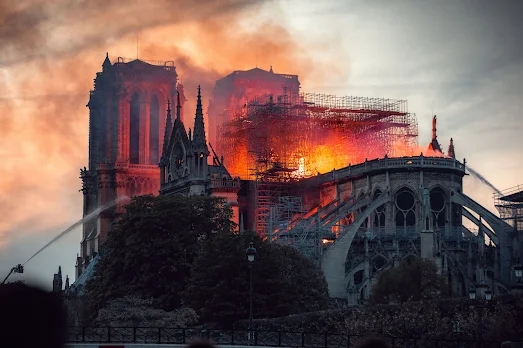
Whatever we do in the political or social order, the indispensable foundation is prayer, the heart of which is the Holy Sacrifice of the Mass, the perfect prayer of Christ Himself, Priest and Victim, recreating in an unbloody manner the bloody, selfsame Sacrifice of Calvary. What is Christian culture? It is essentially the Mass.The raging flames that burned up the spire and roof of the great medieval masterpiece of Notre-Dame in Paris, the fire that gutted its harmonious additions and renovations, provided us with a palpable image of what was done to that even greater masterpiece of medieval art (so to speak), the traditional Roman Rite, in the decade from about 1963 to 1973. The cathedral, after all, was created to house the Host and to provide a worthy space for the sacred liturgy. There would be no Notre Dame, no Chartres, not a single one of the great cathedrals, without the usus antiquior, as Marcel Proust recognized (see his important 1904 essay Death Comes for the Cathedrals, recently published by Wiseblood Books with commentary by John Pepino and me, tying it in to the traditionalist movement today).
That is not my or anyone’s opinion or theory or wish but the central fact of 2,000 years of history. Christendom, what secularists call Western Civilization, is the Mass and the paraphernalia which protect and facilitate it. All architecture, art, political and social forms, economics, the way people live and feel and think, music, literature―all these things, when they are right, are ways of fostering and protecting the Holy Sacrifice of the Mass.
To enact a sacrifice, there must be an altar, an altar has to have a roof over it in case it rains; to reserve the Blessed Sacrament, we build a little House of Gold and over it a Tower of Ivory with a bell and a garden round it with the roses and lilies of purity, emblems of the Virgin Mary ―Rosa Mystica, Turris Davidica, Turris Eburnea, Domus Aurea, who carried His Body and His Blood in her womb, Body of her body, Blood of her blood.
And around the church and garden, where we bury the faithful dead, the caretakers live, the priests and religious whose work is prayer, who keep the Mystery of Faith in its tabernacle of music and words in the Office of the Church; and around them, the faithful who gather to worship and divide the other work that must be done in order to make the perpetuation of the Sacrifice possible—to raise the food and make the clothes and build and keep the peace so that generations to come may live for Him, so that the Sacrifice goes on even until the consummation of the world.
It is therefore the very same instinct to wish to see Notre Dame restored to her glory and to wish to see the Roman liturgy restored to its glory; the same intuition that tells us there is something radically wrong with deconstructing and reconstructing our central act of prayer according to modernist or post-modernist proclivities.





