Thursday, November 25, 2021

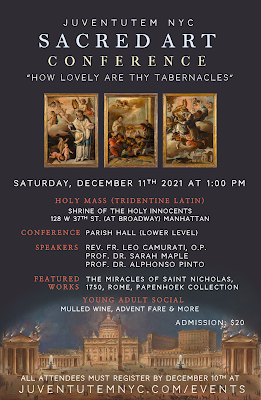
Sacred Art Conference for Young Adults in Manhattan, Dec. 11

On Saturday, December 11, Juventutem NYC will host a Sacred Art Conference at the church of the Holy Innocents in New York City. The event will begin at 1:00pm with Holy Mass in the traditional Roman Rite, followed by talks on topics such as “Sanctifying Grace and Sacred Beauty” and “Churches as sacred spaces that consecrate and defend the consecrated.” The conference is held in honor of St Nicholas, and seven notable Italian Baroque paintings of the Miracles of Saint Nicholas from the private Papenhoek Collection will be presented for private devotion. The afternoon will round off with a young adult social with refreshments. Register by December 10th at JuventutemNYC.com/Events. Admission is $20 to help defray some of the costs and additional donations are gratefully appreciated. The Shrine of the Holy Innocents is located at 128 West 37th Street (at Broadway) in Manhattan. The parish is readily accessible by regional transit and is at walking distance from Penn Station.

About Juventutem: The Fœderatio Internationalis Juventutem, based in Switzerland, promotes the True, the Good, and the Beautiful, and, in particular, the offering of the Traditional Latin Mass. Based at Holy Innocents in Manhattan, Juventutem NYC is the local chapter of this global movement and network of Catholic young adults, ages 18-40, fostering the sanctification of youth worldwide according to the Roman traditions of the Church. Visit JuventutemNYC.com for more information.

Thursday, August 15, 2019

Abp Chaput Visits FSSP Parish

This past Sunday, His Excellency Charles Chaput, the Archbishop of Philadelphia, visited the FSSP parish of St Mary in Conshohocken, Pennsylvania, which he established last year as a quasi-parish for those attached to the Extraordinary Form of the Roman Rite. The Archbishop confirmed several members of the parish, and then attended the solemn Mass in choir. Our thanks once again to Mrs Allison Girone for sharing with us some of her photos of the event.

The famous Confirmation slap!

Wednesday, June 12, 2019

Irish Juventutem Chapter Celebrates FIJ Anniversary

Our thanks to Mr Peter O’Riordan for sending us this account of a Mass recently organized by the Juventutem chapter of Cork, Ireland.

On May 24th, Juventutem Corcaigh (Cork) celebrated a Missa cantata at Kilcrea Friary, Ovens, Co. Cork, Ireland, in conjunction with celebrations held by Juventutem chapters around the world to mark the 15th anniversary of the foundation of Fœderatio Internationalis Juventutem (FIJ).

Kilcrea Friary is located near Ovens, Co. Cork, in an isolated area south of the river Bride. The name Kilcrea means the Church of Cré, a woman who founded a hermitage here before the time of the Franciscians. The friary is a fine example of an Irish Franciscian monastery, and much of it survives in good condition. The church features a fine, slender tower, which was used as a belfry.

The Mass was celebrated by Fr Damien Lynch CC Inniscarra, with the permission of Fr Liam Ó hIcí, the parish priest of Ovens, and we wish to express out deepest gratitude to both. Once permission had been obtained and the celebrant secured, preparations could being in earnest. The event was weather dependent; as can be seen from photographs, it just about held for the duration of the open air Mass.

Firstly, the matter of a suitable altar had to be contended with; Juventutem Corcaigh member Peter O’Riordan set about the task of designing, constructing and dressing the altar, all of which was completed in a timely fashion without the loss of any members - Deo gratias!

Fr Patrick MacCarthy, the parish priest of Ss Peter & Paul’s in Cork, which hosts the annual Fota Liturgical Conference, very kindly supplied many of the accoutrements necessary for a Missa cantata. Joe McGinty, stalwart server at Ss Peter & Paul’s, acted as MC for the mass, carefully navigating unusual obstacles such as gravestones and kerbings.

May 24th is the feast of Our Lady Help of Christians; although this feast is not observed in Ireland, Fr Damien celebrated it as a Votive mass given the occasion. This day is the 13th anniversary of Juventutem’s foundation at Berne, Switzerland in 2006; it was also the first anniversary of a referendum which led to the deletion of the 8th amendment from the Irish constitution. As such the setting in which the Mass took place was rather fitting. Until very recently Ireland was regarded as a ‘Catholic’ country. However, the result of the aforementioned referendum has shown clearly that this is no longer the case.

However, I believe that the small group of faithful that gathered in the ruins of Kilrea Friary to celebrate mass according to the Usus Antiquior represents something significant. Matthew Lavelle, Patrick Williams and Bertrand Thiebault established Juventutem Corcaigh three years ago; since then, the chapter has grown significantly. The aim of the FIJ is to promulgate a Catholic network fostering the sanctification of youth worldwide according to the Roman traditions of the Church. As was sung in the processional hymn on the night, “Christus vincit! Christus regnat! Christus imperat!” Despite the challenges presented by contemporary Irish society, we in Juventutem Corcaigh and those who attend our events have found that “neither death, nor life, nor angels, nor principalities, nor powers, nor things present, nor things to come, nor might, Nor height, nor depth, nor any other creature, shall be able to separate us from the love of God, which is in Christ Jesus our Lord.”

Tuesday, September 13, 2016

Juventutem at WYD Krakow - Official Report

The Juventutem International Federation has just recently published on its website an official report of their participation in the World Youth Day held in Krakow, Poland from July 26th-31st, written by Fr Armand de Mallery of the Fraternity of St Peter. The report can be read in full and downloaded in pdf format by clicking this link. Here is one of the eight sections into which it is divided, in which members of the group from several different countries recount some of their experience. (Reproduced with permission.)


Juventutem youths in their own words

(L)et our young adults themselves tell you their impressions. As a sample, we now quote Issac, who leads a polyphonic choir for the Traditional Latin Mass in Malaysia; Ríona, a Remote Sensing Surveyor in England; Simon is a student from the north of Sweden, where the nearest Catholic Mass is several hours away; Mathieu is a choirmaster from France: he attended the Masses and catecheses in the second church, with the French-speaking Juventutem groups; Aldo is from South Italy; and Dan is a photographer in England.

How did the Extraordinary Form liturgy with Juventutem add to your WYD experience?

Dan: Having the traditional rite gave me something solemn and prayerful to balance with the social time, meals, and tours of the city (and all the queuing in hot weather!)
Issac: Juventutem is what attracted me.
Simon: The Extraordinary Form liturgy with surrounding spirituality and mindset, did not add anything to my WYD, it was instead the very reason I decided to go on this trip. I was not left disappointed on this behalf, since all celebrations were utterly beautiful. The setting was well made, with a fine church and skilled musicians.

Pontifical Mass celebrated by His Excellency Diarmuid Martin, Archbishop of Dublin
Mathieu: I will rather speak in reference to my « Sequentiae Choir » with which I came. Several singers were not Catholic at all, and in any case not practising. They discovered the Extraordinary Form during that week. They all head back after the week asking themselves deep questions about the faith and the Extraordinary Form. “Beauty”, which they had not encountered in this context, was decisive.
Janice, a young woman from Malaysia: Coming from Malaysia where the TLM is not available daily in the diocese, I can’t tell you how much it meant for me (and some of us) to have daily Mass in the traditional form every day for almost 2 weeks. It was even more so during the Pontifical Masses that took place in the Church of Conversion of St. Paul, Krakow. Enraptured in the beauty of the Mass of All Ages with all its decorum and reverence, I could only hide myself under my veil awe-struck and captivated by the Love our Blessed Lord was offering for us on the altar.
Jerome, from Singapore: The liturgy of the universal Church connected, presented and brought to life Salvation History and man’s history, (which WYD Krakow 2016 is part of).


Did you find it a good experience?
Dan: Yes, very good. I enjoyed being with the group and the people I met from all over the world and will definitely be keeping in touch with each of them. The whole thing was well organised, and had a good balance between planned and spontaneous arrangements. It was also good to be among people who had come together with a shared motive or interest.
Issac: Yes. Because of the quality of the catecheses and the frequency of the celebrations of Pontifical Masses, Missa Cantata, Private Masses, etc.
Ríona: I really enjoyed experiencing the contrast between the vibrant festival atmosphere on the streets and the beautiful peace of the Extraordinary Form liturgy; this combined with the frequent thunderstorms, made for an intense, exciting experience!
Simon: A pontifical high mass almost every day for a week is a buffet of grace one cannot even wish for. How grateful we should be for this!
Janice: It was my first experience at WYD and I couldn’t have made a better choice than to join Juventutem. The biggest impression that I carried home with me to Malaysia is of the many witnesses of our Catholic Faith. Besides Fr Michal, I met new friends who gave up an existing romantic relationship to join the seminary, friends who are considering religious vocation and also friends who desired greatly and went out of their way to assist at Holy Mass as altar servers – and suddenly, I don’t feel as alone in this journey of Faith.
Jerome: Yes it was good. In the Asian Church, especially coming from South-East Asia, there is presently no clergy of the episcopate that celebrates the ancient form of the Roman-rite liturgy. So participating in the various kinds of the EF liturgy, in particular the Pontifical High Masses is a dream come true and experience-of-a-lifetime!

What did you like best?
Dan: Hard to say, but several things: the group bond by the end of the week; the time to pray; the solid talks from priests and bishops; the fact that many people came for a Mass or talk who weren't part of Juventutem but just wanted to experience it, even for the first time, was good to see; I thought it was good that no one wasted time critiquing other aspects of WYD that were not exactly traditional (!) – everyone in the group were happy to be there, and to participate in the other WYD events as much as they wanted.
Issac: The venues and their proximity with each other. The presence of 'good' prelates.
Ríona: The catechesis was a great opportunity to be informed in living the day-to-day life as a Catholic.
Simon: The best experience from this week will be the last (and only) low mass I heard at a side altar on the final Sunday. This thanks to its beautiful intimacy with the sacred sacrifice of our Lord. I found the trip a very good experience as well as a help to deepen my faith and the understanding for the will of the Lord in my life.
Mathieu: The Masses of course, and the catecheses of our three excellent bishops.


What did you like least?
Dan: I guess all the queuing, but that is part and parcel of a WYD so nothing major or unreasonable.
Issac: The choir could have been better organised and perhaps a bigger church so that people of different language groups can mix.
Ríona: What I liked the least was the time spent in queues for food!
Simon: The thing I liked the least was to see the crowd being so stressed and bumpy. How the eagerness of each individual to, get food, see the Holy Father, or another thing was placed above proper behaviour in public. Even though this was the thing I liked the least, I'm aware of the fact that this situation might have been much worse if there would have been more alcohol or drugs in the picture. Things still got on sufficiently well, without major catastrophes.
Mathieu: The digressions after the papal Vigil, and before the Sunday Mass.

Share an anecdote.
Dan: I think it has to be the marriage proposal on Friday after Mass, in front of a large group of people! Very nice indeed. Our chaplain having a forthright and kind chat with a young Jehovah Witness girl while two evangelicals stood next to him trying to give he some of the literature was a sight! I also thought it was nice that our group were all people at their first WYD, and had just met, but made the effort to have conversations, arrange meals together. Seeing the smiles on the girls’ faces when I suggested going to a cake shop! I ended up eating herring two days in a row, despite my best efforts to try different things. Feeling proud that lots of the group (not me though!) did the long trek to the vigil and back, and some even camped overnight – well done them! Also, I was edified by the commitment to personal prayer shown by several of the group. They didn’t mean to, of course, but I noticed, and it had a good effect on me.


Issac: A chat with Bishop Schneider, when he said that the beauty of the liturgy is what makes it attractive to the youth. I think these words need to be taken seriously as a yardstick by which we establish the higher standard that is expected from international meetings like these. They must exceed what we are used to having in the majority of places.
Simon: An anecdote to share is when a smaller group of us were searching for a place to pray our rosary an afternoon. We went from church to church without finding a place before we ended at the market square ready to give up. We made the queue to get in to the basilica of the Assumption of the Blessed Virgin where we were supposed to pray in silence, individually. After taking a small tour in the church one of us found an empty chapel dedicated to St Anthony. We borrowed it to say our rosary and foreigners joined as the decades went on. We ended by praying for the conversion of each of our home countries as well as for the papal intentions in order to get the indulgence, finishing by thanking St Anthony for helping us to find this place for prayer.

Bishop Athanasius Schneider celebrating Pontifical Vespers
What about someone you met: staff, pilgrim, clergy?
Ríona: I laughed a lot and enjoyed talking with all the people I met in the Juventutem group.
Dan: It was great to have a mix of priests and seminarians, made for good conversation and jokes over breakfast, lunch, and dinner. It was nice to chat to some of the WYD volunteers from Canada and Germany about their motives for giving up their time, and what they thought about experiencing the traditional Mass and good catechesis.
Simon: I will also carry the catechesis of the most reverend Bishop Schneider as well as those of the reverend Father de Malleray in my mind for a long time. Thanks be to all concerned in making this week in Cracow possible!
Aldo, from Italy, added: Meeting traditional Catholics from all around the globe it’s been amazing: and when it was time for praying the rosary together...well, no complications with foreign languages, because Latin helped us and made us feel united. Also the words of Msgr. Schneider have proven to be illuminating: out there the world is struggling with denial of God, but Our Lady guides us and at some point will triumph. For a youth international meeting, this is a great hope to rely on.
Mathieu: We travelled by car with the Choir, calling twice en route for musical performances: once in Prague on our way there, and another time in Leipzig on the way back. On Saturday midday in Krakow, we decided to park near Campus Misericordiae. But despite various attempts, we found ourselves surrounded by the crowd. A Polish family rescued us and we were able to park our car. They offered us drinks and coffee. The hospitality of the Poles was splendid. They even awaited us on Sunday afternoon to welcome us!
Janice: Starting the journey during the Days in Diocese in Lgin, Fr Michal Graczyk who was in charge of our group did not only show such ardent charity to everyone around him, but even more, the 28-year-old priest in his black cassock, just by his life was already the perfect exemplar of a witness of Christ to us all by the dedication of his life to the priesthood at such a young age. He certainly left an imprint on many of our hearts – for me particularly, that one can have such courage to leave everything behind and follow Christ even as a teenager then. The group that we had in the Days in Diocese also saw us who came from the different parts of the world forming unique friendship. The one thing that we had in common – our love for the Traditional Latin Mass, was enough to knit us all together as a ‘wspólnota’ (which means ‘community’ in Polish).
Jerome: I set off for Poland, the land rich in history of a nation, people and its (Catholic) faith. Thinking I knew much, I realised how little I did. I came back filled and receiving more than I could have ever asked or expected. The people, places and soul of the Polish nation is forever etched in my heart. Truly God is Merciful, Błogosławieni Miłosierni and Misericordes sicut Pater!

And here are a few more photos from the same report.


Thursday, May 05, 2016

Juventutem Slovenia Holds Its First Public Pilgrimage Event

Juventutem Slovenia, established in 2014, organised their first pilgrimage on April 30th, culminating with the first public Traditional Latin Mass at the National Shrine Mary Help of Christian at Brezje. The Mass was celebrated in the side chapel where an image of the Virgin welcomes pilgrims from all over the world. A low Mass was said, accompanied by traditional Slovenian folk songs, with many pilgrims coming from distant places for the occasion and experiencing their first Latin Mass. Here are some pictures.


Friday, February 26, 2016

Lenten Exercises at Princeton

Last weekend, Fr Carlos Hamel of the Fraternity of St Joseph the Guardian, a community based in the French Diocese of Frèjus-Toulon, was at the Church of St John the Baptist in Allentown, Pennsylvania, to preach an Ignatian Retreat; the participants were able to attend a number of sung Masses, with a Solemn Mass on Sunday, as well as the singing of Prime, Vespers and Compline, and Adoration of the Blessed Sacrament. Fr Hamel also celebrated a Mass at the chapel of Princeton University, shown in the first several pictures below from the Facebook page of the FSJG; the rest are from the church in Allentown.


Tuesday, January 12, 2016

Epiphany Photopost 2016 (Updated)

As always, we are very grateful to all those who sent in photos of their Epiphany liturgies and blessings. We have a few photos of the Blessing of the Waters in the Maronite Rite, and I am also including, at Fr Kocik’s suggestion, a video of the Byzantine version of the same blessing, filmed by a river in Slovakia. The next photopost will be for the feast of the Purification/Presentation on February 2nd. Evangelize through beauty!

(This post has been updated with some photographs sent in by Father Zuhlsdorf, from the church of St Mary’s Pine Bluff in Wisconsin - gratias, optime Pater!)

Our Lady of the Assumption & St Gregory - London, England
Organized by Juventutem London, and sung by their schola. Follows these links to visit their blog, Facebook page and Flickr stream.


Genuflection at the words of the Gospel “...and falling down they adored Him.”
Proclamation of the Movable Feasts

Blessing of Chalk

Saturday, November 14, 2015

Juventutem Slovenia Welcomes Bp Athanasius Schneider

Juventutem Slovenia will welcome Bishop Athanasius Schneider to the Church of St Roch in Ljubljana (Sveti Rok in Ljubljana - Dravlje) for a lecture and two EF Masses, one low and one solemn, this coming Wednesday and Thursday. Bishop Schneider’s book Corpus Christi was translated in Slovenian and published there at their behest a few months ago.


Wednesday, November 18, 17:00 lecture “Corpus Christi” in the parish hall, followed by Low Mass at 19:00
Thursday, November 19, 17:00 Solemn Pontifical Mass

Tuesday, October 20, 2015

Good News from Juventutem London - A Weekly Sung Mass Starting Tomorrow

The London Chapter of Juventutem has recently announced a new, regularly scheduled weekly sung Mass on their blog. The first of these will be celebrated tomorrow.

“By kind permission of the Rector, we are delighted to announce that as of the 21st October, we will be having a weekly Sung Mass in the Extraordinary Form at Our Lady of the Assumption and St Gregory, Warwick Street, just off Piccadilly.

Mass begins at 7, with confessions beforehand, from 6.30, and we’ll even have a stab at saying the Rosary beforehand too, since it’s October. We will then retire to some nearby hostelry to partake of some small libation. Do come along and bring your friends. All are most welcome, both the young and the young at heart. Obviously we encourage those aged 18-35 to partake in the conviviality, but we wouldn’t dream of excluding people from the Mass! Please note that this does not replace our monthly High Masses, but is a welcome addition! Further details may be found on our Facebook.”

On October 31st will be held the third annual pilgrimage to the Shrine of  Our Lady of Willesden, which Juventutem London is organizing for the first time, together with the Latin Mass Society of England and Wales. Details of the events in the poster below. Click here for more information about the shrine.


Monday, September 14, 2015

Guest Article: Taking Summorum Pontificum Out of the Trenches

(Today New Liturgical Movement is happy to share with our readers an article submitted to us by Juventutem DC in commemoration of this anniversary.--PAK)

Here we are, eight years after Pope Benedict XVI’s motu proprio, Summorum Pontificum, came into effect. This is an extraordinary day, both for those who endured long years without the clarity that Summorum provides, as well as for younger Catholics (like those in Juventutem DC) who grew up after Vatican II and were — to the surprise of many — drawn to tradition. So where are we eight years after Summorum took effect?

For context, let’s reflect on some typical comments Juventutem DC has heard.

1. “At our parish, we have had an Indult for nearly 20 years!”

2. Summorum Pontificum has been around for years, but my bishop/diocese/pastor won’t implement it.”

3. “If only the FSSP would be given a parish here, everything would be better.”

As far as Juventutem DC is concerned, Summorum is the biggest thing since the responsorial psalm in E-flat major. A total game changer, it is classic Pope Benedict — pragmatic, intelligent, well reasoned, and has the force of law. Moreover, it presupposes that lay Catholics possess a certain competence, energy, and endurance. It does not, however, promote an “Indult-mentality.”

The Indult was the mechanism to get the traditional Mass before Summorum was issued. The general consensus is that those who didn’t like the traditional Mass used the Indult to limit its celebration. It was a flawed licensing system — completely at the discretion of the bishop. Pope Benedict XVI called out its weaknesses in his letter introducing Summorum. In fact, the very first article of Summorum explains that the documents that created the Indult system are replaced by Summorum. That’s a big deal: eight years ago on this day, the 1984 Indult became a legal nullity.

Yet, to this day, some diocesan authorities have been slow or unwilling to move beyond Indult-style restrictions. It’s wrong. It’s not healthy or helpful, but it’s not really all that surprising.

But what’s with all the laity who still have an Indult-mentality? The three comments above are emblematic and probably, there are a number of reasons for this mentality. Many laity and clergy simply assume that Church law prescribes this state of affairs. Even the focus on obtaining clergy from an Ecclesia Dei priestly society to run local parishes is understandable: they do amazing work and even Juventutem International’s chaplain is an FSSP priest! But the assumption that the Extraordinary Form begins and ends with these societies and orders is a false one. Summorum is meant for everyone, for all parishes and dioceses.

Above all, we think that this mentality is the result of a vague familiarity with certain concepts, but not an in-depth knowledge of Summorum and the 2011 explanatory Instruction of the Ecclesia Dei Commission. Mastery of these two documents will equip laity and priests with the confidence to cease being treated as second-class Catholics as they seek to discover or promote traditional Catholic life in the Church. Summorum is the law, and the Instruction confirms that Summorum is to be given a liberal construction and generous application. In effect, these two documents are the current tools for the restoration of liturgical tradition.

So let’s take a step back, gain our bearings, and once and for all, master Summorum.

Summorum lays out a simple timeline for anyone in a parish to restore the traditional Mass to its altars. Reading the provisions that pertain to parishes in the order in which they appear in the document reveals a robust framework that empowers priests and the laity alike.

Step 1: the lonely priest in a parish. Under Art. 2, any priest can privately (i.e., “without a congregation”) say the traditional Mass. He doesn’t need any permission from the Holy See or his bishop or pastor to do so. Imagine a priest, probably with a server, saying Mass at an unscheduled time in his parish church occasionally. Arguably, this is a low Mass.

Step 2: the not-so lonely priest. Lay faithful see that the priest is saying an Art. 2 Mass in the parish. They say, “Father, thank you! May we assist at this Mass?” Under Art. 4, those lay faithful may assist at the priest’s Art. 2 Mass, and no matter how many people there are, it remains a private Mass and does not require anyone’s permission (neither the pastor nor the bishop may forbid it). Very pragmatic!

Step 3: the popular priest. It turns out that, after steps 1 and 2, a group of faithful stably exists in that parish and wants to assist at the traditional Mass. Under Art. 5, the pastor should “willingly accede to their requests to celebrate Holy Mass according to the rite of the 1962 Roman Missal.” A few points:

That, of course, presupposes that the faithful are requesting it! Have you asked your priest to implement Summorum? Have you told him you’d help him do so?

There's no minimum number of people required to be a group and it doesn't matter how long it's been around as a group – the people don’t even have to be from the same parish. Just go for it!

The careful reader will note a shift from Art. 2 that only mentions Masses “without a congregation” (arguably, a low Mass) to Art. 5 where now we can choose from all the various forms of “Holy Mass according to the rite of the 1962 Roman Missal.” That’s a lot of options beyond a low Mass—pick a Mass, any Mass—Missa cantata? Solemn Mass? Go for it!

These Art. 5 Masses can be said on any feria, Sunday, or feast day. Again, when requested, they are permitted for marriages, funerals, or other reasons, including pilgrimages. In each case, Summorum says that the pastor should grant the request of the faithful.

Step 4: if the pastor doesn’t grant the request. Let’s say things go poorly. If the pastor doesn’t grant the group’s request, then under Art. 7, the group “should inform the diocesan bishop [and] [t]he bishop is earnestly requested to satisfy their desire.” If the bishop doesn’t do so, then the group can petition the Pontifical Commission Ecclesia Dei in Rome to help find a solution. The laity does not need any permission from an unsympathetic chancery to do so—Summorum has a check where the Indult system was lacking.

So you see, there is a real framework and there are real protections, at least for the laity. But someone has to ask a priest for the Mass—ask for it! Keep asking for it! Invite your friends, even those who go to Mass in the Ordinary Form. Share your faith with them; help them discover tradition. Buy your priest a 1962 Roman Missal—you’d be surprised how effective that is. If you can’t afford a Missal, find someone who can. Amass a talent pool of singers and servers, even if you have to train people. And if an aging hold-out in the diocese doesn’t like what your priest is doing, be ready to defend him. Zealously advocate for him and for your spiritual needs, keeping charity in your hearts while you do so.

Just as the logic of Summorum is incompatible with the crummy Indult system, it is completely inconsistent with lay inertia, slactivism, and complacency with the status quo ante.

We recommend using the tools of Summorum to your full advantage, with contagious joy and unwavering enthusiasm. Have courage, have guts, and be prepared to talk to a lot of people who have no idea what Summorum says. Help them understand it—both friend and foe. And, lest we forget, birotā vehimini!

*          *          *

Juventutem DC is the local chapter in Washington, DC of the Foederatio Internationalis Juventutem, a Catholic network fostering the sanctification of the young adults and youth worldwide according to the Roman traditions of the Church. If you are interested in starting a Juventutem chapter, please visit www.juventutem.org for more details. (It’s easier than you think.)

FOR THOSE IN THE WASHINGTON, D.C. AREA --
NOTE THIS EVENT TONIGHT:


Monday, July 13, 2015

Is the Youth of Today Necessarily “Modern Man”?

One of many choirs at this year's Colloquium
Recently my son and I participated in the Sacred Music Colloquium XXV of the Church Music Association of America, held at Duquesne University in Pittsburgh. As with the Sacra Liturgia 2015 Conference, a large portion of the participants were young adults who love beautiful music that is obviously sacred in its stylistic qualities, cultural associations, and avowed liturgical purpose.

People from my generation (born in the 1970s) and younger know, without need for much explanation, that Gregorian chant, Renaissance polyphony, and post-Renaissance choral works of grand and intimate scale are the music of the Catholic liturgy.[1] Such music says “Catholic” the moment you hear it, which is why Hollywood always reaches for it when depicting anything Catholic. This vast repertoire, “a treasure of inestimable value, greater even than that of any other art” (Sacrosanctum Concilium 112) was written expressly for ecclesiastical ceremonies. At its best, it is not trying to compete with or emulate popular styles of music; it is not serving two masters; it is not a multi-purpose Swiss Army knife. It is church music, sacred music, pure and simple, and that is why it is so singularly effective and lovable. We admire what is pure and simple, because it fits its function to a T. It works. What isn’t broken doesn’t need to be fixed.

In connection with the Colloquium, I would like to develop an idea I’ve been thinking about ever since I read the following paragraph in the FIUV Position Paper n. 25, “The Extraordinary Form and Sub-Saharan Africa.”
This conflict between the traditional principles of African spirituality and Western cultural influence creates an unfamiliar context for many liturgical progressives, who have often explicitly seen their proposals as attempts to come to terms with the triumph of post-Enlightenment culture, a triumph which, in their view, can no longer be contested. However we might assess this project in the context of the developed world, the proposal to make concessions to Rationalism, for example, by excluding silence and complex ceremonial from the liturgy, or to make concessions to Romanticism, by promoting informality and spontaneity, take on very different appearance in the African context. There is a real danger of such tendencies assisting the neo-colonial attack on indigenous African spirituality.
This observation certainly seems like a persuasive argument in regard to Africa (or, for that matter, any non-Western society that has its own native religious traditions). But what intrigues me is the general claim that Rationalism and Romanticism — the two great counterforces of modernity, each an extreme reacting against the other — are the two slave-drivers behind the liturgical reform.[2]

Rationalism cracks the whip and shouts: “No silence! Everything must be SAID and UNDERSTOOD! No complexity! Stop all that intricate symbolic stuff! Stop all that lugubrious chanting! Modern man has no patience, no time, no ability, no need for it! It promotes an aristocracy of clerics! Let the light of objective reason shine!” But then Romanticism sneaks in, elbows an unsuspecting Rationalism aside, and, with a voice all the more poisonous for seeming friendly: “Relax! Go with the flow! You are too formal, uptight, rigid, and cerebral! Let go of the rubrics, find your inner child, feel it in your bones, be yourself! Everything’s about YOU, your feelings, your neediness — this is your moment!” Each struggles for supremacy; in a weird sort of way, they are codependent and collaborative. They stop at nothing to eviscerate the tradition that precedes them, until all that is left is a disembodied reason of empty structures and a derationalized self-indulgent sentimentalism.

Be that as it may, what we see at work in the liturgical reform is a peculiarly self-centered assumption that the preoccupations of modern Western man — rationalism and romanticism being characteristic -isms of an imbalanced worldview and an inadequate philosophy — are the preoccupations of all of humanity, including Africa and Asia and the poor of other countries, not to mention all generations. As a result, the new liturgy is going to be imposed on every nation, every people, every culture, and every generation, regardless of whether or not they meet the hyper-modern Eurocentric criteria on the basis of which it was designed. The absurdity of such an assumption is obvious, but it becomes even more obvious when one considers generational shifts.

It seems to me that just as there is a problem with assuming that African Catholics need the new Mass when the old Mass was and is, in fact, more suited to their culture, there is an analogous problem with assuming that today’s young Catholics, especially those who have been raised in a more traditional manner and homeschooled, automatically carry the same modernist or postmodernist burdens that the rest of Western society bears. Of course, we’re all moderns in a whole host of subtle and obvious ways, but since a good deal of the modern mentality is a flight from reality and a sort of self-invited neurosis, it seems distinctly possible — and my decades of experience as a student and then as an undergraduate and graduate-level teacher have confirmed this over and over — that young people today might actually be free of a lot of the existential baggage of their elders. The problems of the sixties and seventies are just not the same as our problems. And young faithful Catholics have not necessarily problematized their existence, or the concept of tradition, or the concept of authority, or the concept of the sacred and the mystical.

We are still struggling with the fallout of rationalism and romanticism, but we are not as naïvely optimistic about the power of human reason and of sincere feelings to lead us into an Edenic new world of human brotherhood. That strikes us as pretty vomitous, and we are looking for something a lot more serious, something real and realistic, which, paradoxically, we know will have to be something very different and, I would dare to say, transcendent. Otherwise it is fake; it is looking at a mirror and falling in love with our own image. We are looking for the original, the One from whom we come and to whom we are going.

At Sacra Liturgia 2015 and Colloquium XXV, one sees ample evidence that we are turning a corner. The rebels of yesteryear look embarrassingly old-fashioned, and the youth who still want to practice their Faith need more, desire more, and deserve more than the Church’s hierarchy has been willing (or even able?) to give them until now. And these young men and women are figuring out how to find their way back to the Tradition, in spite of all obstacles, detours, traps, and poor signage. This movement—this hunger for Catholic Tradition—cannot be stopped. But it can be somewhat delayed by obstructionists or actively promoted by shepherds who care for the eternal destiny of their sheep. I am reminded in this connection of a butler's speech from a P. G. Wodehouse novel:
It is my experience that opposition in matters of the ’eart is useless, feedin’, as it so to speak does, the flame. Young people, your lordship, if I may be pardoned for employing the expression in the present case, are naturally romantic and if you keep ’em away from a thing they sit and pity themselves and want it all the more. And in the end you may be sure they get it. There’s no way of stoppin’ them.[3]
Indeed: the traditional movement is not going away. Meanwhile, our shepherds stand to gain glory or shame, depending on how they react to this impetus of the Holy Spirit. Let us pray for them daily.


NOTES

[1] The CD Benedicta of the Monks of Norcia made it right to the top of the classical billboard, showing once again that the prayerful yearning for peace and transcendence expressed by Gregorian chant is not a passing fad but a constant need of our society. It would be helpful if prelates and pastors would pay attention to actual cultural trends like this one, instead of paying attention to what seemed to be trends several decades ago.

[2] The position paper states this explicitly elsewhere: “the Novus Ordo reflects the passage through European thinking of Rationalism and Romanticism.”

[3] P. G. Wodehouse, A Damsel in Distress, Collector's Wodehouse ed., p. 238.

Tuesday, June 16, 2015

A Mass of Thanksgiving for Ordination, Sunday June 21, in Louisville, Kentucky

From the local Juventutem chapter: Fr Jason Stone will celebrate an EF Mass at the Church of St Martin of Tours in Lousiville, Kentucky, this coming Sunday, in thanksgiving for his recent ordination to the priesthood. Full information in the poster.

Wednesday, November 26, 2014

Solemn High Mass at St Mary Moorfields, London

Wednesday, November 05, 2014

Pontifical High Mass for the Feast of All Saints at Norwich Cathedral

These photographs were taken at Pontifical High Mass at Norwich Cathedral on Saturday. Bishop Alan Hopes was the celebrant, and made history by being the first bishop to celebrate Pontifical High Mass at the throne in the Extraordinary Form in his own cathedral since the council. Furthermore, as the see of East Anglia was only restored in the 1970s, this was the first Pontifical High Mass celebrated there since 1558. Thank you to Juventutem London for the photographs - you can see the full set here. [Photos: Rebecca Keane]


Friday, October 31, 2014

“Zeal for the Liturgy” - All Saints and All Souls Events: Long Island and San Diego

The indefatigable Ben recently noted in foro privato the following quote from Sacrosanctum Concilium : “Zeal for the promotion and restoration of the liturgy is rightly held to be a sign of the providential dispositions of God in our time, as a movement of the Holy Spirit in His Church. It is today a distinguishing mark of the Church’s life, indeed of the whole tenor of contemporary religious thought and action.” (no. 43) These words were written in 1963 with an optimism that for many turned to bitter disappointment very quickly; I was raised in a very Catholic part of the United States, but one where there was almost no decent liturgical music to be heard at all. So it seems to me at least that our most recent set of posts here on NLM are a sign of something very positive happening in the Church today. We have had an unusual number of requests to publicize liturgical events for All Saints’ and All Souls’, events which will feature the music of Palestrina, Victoria, and Byrd, just to name a few. Of course, such events are still exceptional, but they are less so than they were 30 years ago, and will continue to become more common. If you have the opportunity to go to such a liturgy this weekend, remember to say a pray for those who would love to attend something like it and cannot.

Here are two notices from places with special events for both All Saints’ and All Souls’; there will be another post later today for events just on All Souls’.

Long Island, New York

Events sponsored by the St Agnes Institute and Juventutem; see poster below, and the website of the St Agnes Institute here and here.


San Diego, California

The Brothers of the Little Oratory in San Diego will be singing First Vespers of the Feast of All Saints at Our Lady of the Rosary Church, Little Italy, San Diego at 7:00 pm on October 31, 2014. Fr. Joseph Tabigue, C.R.S.P. will be hebdom. and will give Benediction. On Monday November 3 at 7:00 pm, the Brothers will sing and serve a Sung Requiem (Missa Cantata) at St. Charles Catholic Church in Imperial Beach, CA. These services are conducted according to the 1962 missal. The public is welcome. Further information on the facebook event page.

More recent articles:

For more articles, see the NLM archives: