
 |
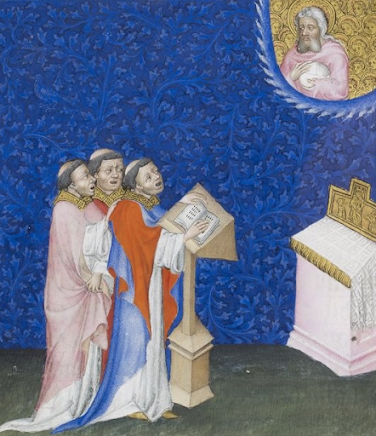
| Psalter of Jean, Duc de Berry (Paris, Bib. N., MS. fr. 13091), 14th cent. |
Those who have studied the history of spirituality are aware of the mighty shift that occurs in the West between what might be called devotio antiqua or devotio monastica and devotio moderna (originating in 14th-15th centuries). The former is, to speak colloquially, a “bread-and-butter” spirituality: liturgy and lectio divina are the main courses — public divine worship and private reading (of Scripture, of Church Fathers, of commentaries on the Psalms) accompanied by vocal prayer, as kindling for contemplation; and all of it tightly surrounded with bodily asceticism. This, broadly speaking, just is monastic spirituality.[1]
Once the shift toward a new spirituality began, it was, one might say, destined to arrive at the modern concept of “mental prayer” and, more particularly, something like Ignatian exercises. In this brief study I have no intention of attacking devotio moderna as such, much less Jesuit or Carmelite trends, but rather would like to consider what happens when a certain kind of attitude toward mental prayer begins to detract from and ultimately undermines the value of vocal and therefore liturgical prayer. It seems to me that this is a key development for understanding the progressive neglect and denigration of the liturgy until it became seen as more or less raw material for devotional exploitation.[2]
The recently deceased Greek Orthodox theologian Kallistos Ware (1934–2022), may he rest in the Lord’s peace, makes an excellent point about why the early monks of the Church undertook such extreme, and to us often shocking, austerities:
Works on spiritual theology from at least the sixteenth century onwards have a grave disadvantage. At some point, the understanding of the connection between prayer and the saying of the Divine Office seems to have been lost. The standard approach in these works is to distinguish between vocal prayer and mental prayer; to treat these two forms of prayer as mutually exclusive, by defining vocal prayer as prayer vocally expressed in outward words, and mental prayer as prayer expressed purely mentally without any sounds or words; and to describe mental rather than vocal prayer as the way through which a religious attains perfection.
In this schema, vocal prayer is seen as valuable a) as prayer for beginners, b) as being a keeping of the regulations of religious societies that require forms of vocal prayer and thus as being a necessary exercise of obedience, c) as fulfilling the obligation of the Church to offer a corporate worship to God. The saying of the Divine Office by monks is classified as vocal prayer; and in consequence it ceases to be seen as the main form of monastic prayer, the opus Dei, and the principal path to monastic perfection. Mental prayer practiced outside the Divine Office is described as the prayer in which perfection is attained.
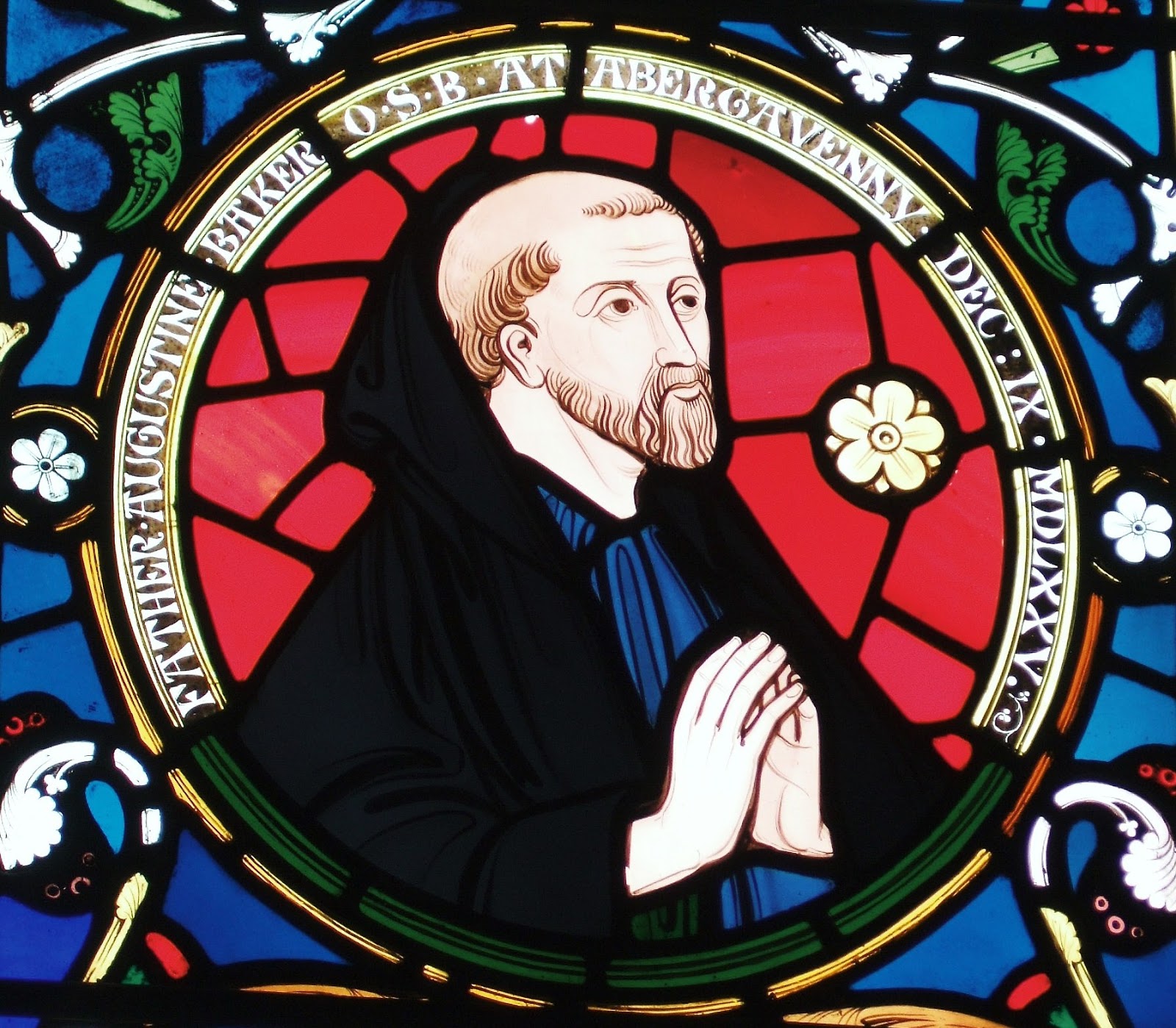
A lamentable example of this attitude can be found in Dom Augustine Baker’s Holy Wisdom, a work of spiritual guidance written specifically for Benedictine monks that is in many other respects excellent. Dom Augustine makes these comments on the prayer of the first monks:

A curious form of argument: since we moderns are rather lazy, averse to solitude, abstinence, and assiduity, and vocal prayer is much too time-consuming, we have to find a form of prayer that is more like a concentrated vitamin.
The actual verbal content is indifferent to the internal affection, and one should stop paying attention to the words in order to cultivate the interior state for as long as possible. Words in this analysis are nothing more than timber, chopped up and fed into the furnace of the heart. It sounds wonderfully pious, but so profoundly anti-intellectual a stance finds its eventual outlet in what Knox calls “enthusiasm” and what we are familiar with in the charismatic movement’s cultivation of an exalted state. Why did God bother to reveal “the sense of the present passage” or even to use “words” at all? Baker continues:
The catastrophic effects of this understanding of the Divine Office are evident: as soon as one can find, or thinks one has found, a better and quicker route to divine affection or a better method for sparking mental prayer, one will drop the breviary like a hot potato. And yet Baker’s position is a standard one for Counter-Reformation spiritual writers. Its value to us today should be to give a clear exposition of what not to believe about the recitation of the Divine Office, and to educate us in the value of that recitation through accepting the opposite of what it says.
The ancient fathers were not able to get spiritual benefit from vocal prayer because of their great austerities; rather, they were given the grace to carry out these austerities because of their devotion to praying the Psalms. The vocal recitation of prayers strengthens our mental understanding and assent to them, rather than the opposite, so vocal prayer is in fact a higher form of mental prayer than silent prayer. It is also a public confession of faith and a public praise and petition to God, which are superior to private acts of the same character. The content of vocal prayer of the Office is higher than the content of the mental prayers that we elaborate for ourselves, even if this elaboration is done under the guidance of the Holy Spirit, because what we are praying is divinely revealed.
For all these reasons, vocal prayer of the Divine Office is better suited to lead us to perfection than purely mental prayer, and is in fact the main path to perfection, as the early monastic Fathers understood it to be. I can speak from a certain amount of experience here; starting to pray the Psalms in the Monastic Diurnal radically changed my understanding of prayer and the Christian life for the better, because I was praying what God had to say, not what I had to say. When we pray the Office, we should therefore work at understanding it and meaning it; that is the main way to pray. That is why St. Benedict says monks should devote time consistently to the study of the psalms, so that they may understand what they are praying and therefore pray better.
It is striking that biographies of St. Thérèse will state in one sentence that she greatly loved saying the office, and then proceed to summarize her sanctity by saying she put up with difficult nuns, did mental prayer, and so forth. All that is true enough; yet saying the Office was her job, so to speak, within the Church! That was the point of the kind of religious life she had chosen, and it took up a great deal of her time. Nor did she try to shirk it; nor has any of the great spiritual masters shirked it. If anything, they took it for granted as the backdrop.
Today it cannot be taken for granted. Indeed, there is evidence that, outside of the traditionalist world, the Divine Office has fallen on hard times, if not fallen into oblivion. It does not require an extensive knowledge of the history of the Church to recognize that the renewal of religious life will take place in and through the Divine Office, or it will not happen at all.
I would like to thank Dr. John Lamont for his collaboration on this article, and especially for sharing the text from Augustine Baker.
NOTES
[1] For those who wish to follow the devotio antiqua or devotio monastica way, here is a simple plan for it. First, visit an observant Benedictine monastery and spend as much time there as you can, ideally on annual retreat. Together with such a visit, get a copy of the Benedictine office (such as the Monastic Diurnal) and learn how to pray it in Latin. Second, adopt a rule of fasting and poverty. To Love Fasting: The Monastic Experience by Adalbert de Voguë OSB is a good guide. Third, be aware of the context and limitations of the books of spiritual guidance that you will read. The traditional classic works, like those by St. John Climacus and St. John Cassian, are excellent, but one has to keep in mind that they were written for men who were already living the monastic life, and that as a result they take for granted the main features of this life. They do not say a lot about fasting, following the rule, and liturgical prayer, because their readers would get instruction on this from another source; they are meant to be a supplement to the monastic life, not a guide to the whole of it. This is why time spent with the monks or nuns is so important. For more, see my articles “What a visit to an observant Benedictine monastery can teach us”; “Even if you can’t be a monk, you can still benefit from monastic life. Here’s how”; and “Looking for a new examination of conscience? Try the Rule of St. Benedict.”
[2] I speak about this in two earlier NLM articles: “The Ironic Outcome of the Benedictine-Jesuit Controversy” and “Objective Form and Subjective Experience: The Benedictine/Jesuit Controversy, Revisited.” The former was revised and published as a chapter in my book Noble Beauty, Transcendent Holiness.
[3] Preface to The Ladder of Divine Ascent by St. John Climacus, Classics of Western Spirituality, pp. xvi–xvii.
Once the shift toward a new spirituality began, it was, one might say, destined to arrive at the modern concept of “mental prayer” and, more particularly, something like Ignatian exercises. In this brief study I have no intention of attacking devotio moderna as such, much less Jesuit or Carmelite trends, but rather would like to consider what happens when a certain kind of attitude toward mental prayer begins to detract from and ultimately undermines the value of vocal and therefore liturgical prayer. It seems to me that this is a key development for understanding the progressive neglect and denigration of the liturgy until it became seen as more or less raw material for devotional exploitation.[2]
The recently deceased Greek Orthodox theologian Kallistos Ware (1934–2022), may he rest in the Lord’s peace, makes an excellent point about why the early monks of the Church undertook such extreme, and to us often shocking, austerities:
There is one feature of the unrelaxed severity and discipline of early monastic life that certainly ought to be adverted to and that offers a clue to the reasons why some men resolve to join a religious community; namely, the undeniable correlation between hardship and an intense marshalling of inner, and frequently unsuspected, resources. Words cannot really encompass what happens here. But the fact seems well established. In the evidence of the Gulag Archipelago, in the testimony of men like Solzhenitsyn, Tertz, Panin, and Shifrin, in the records of the tidal wave of misery let loose by German Nazism, there is a persistent and humbling proof of the capacity of individuals, trapped amidst the worst conditions of deprivation, to unlock an inner dynamism, which often is manifested as a commanding faith in God and which must never be confused with the understandable motive of escapism. It has happened too often in the twentieth century to be trivialized or explained away; and somewhere within it lies a common bond with the ordeals, voluntarily undertaken, and the achievements of the first monks of the Church. Sharp differences of time and circumstance do not alter the shared character of the early saint and the prisoner of our day who has climbed beyond gross suffering and oppression to arrive at a level of richness beyond all common imagining.”[3]This, of course, is only a partial view of the nature and motivation of monastic austerities. But the very limitations of this view enable it to convey a clearer message. How many people think of the religious life in this way, as a voluntary self-sentencing to a lifetime of the Gulag (as it were), in order to reap the spiritual harvest that such a sentence will bring? But that is clearly what the first monks understood themselves to be doing. They did not think of the sufferings involved as an initial stage that would eventually be left behind; they thought that these sufferings would come to seem less troubling and significant simply because of the growth of a love of God that would put them in the shade, even as the sufferings themselves continued or increased.
 |
| Velazquez, St Anthony Abbot and St Paul the Hermit (ca. 1634) |
Works on spiritual theology from at least the sixteenth century onwards have a grave disadvantage. At some point, the understanding of the connection between prayer and the saying of the Divine Office seems to have been lost. The standard approach in these works is to distinguish between vocal prayer and mental prayer; to treat these two forms of prayer as mutually exclusive, by defining vocal prayer as prayer vocally expressed in outward words, and mental prayer as prayer expressed purely mentally without any sounds or words; and to describe mental rather than vocal prayer as the way through which a religious attains perfection.
In this schema, vocal prayer is seen as valuable a) as prayer for beginners, b) as being a keeping of the regulations of religious societies that require forms of vocal prayer and thus as being a necessary exercise of obedience, c) as fulfilling the obligation of the Church to offer a corporate worship to God. The saying of the Divine Office by monks is classified as vocal prayer; and in consequence it ceases to be seen as the main form of monastic prayer, the opus Dei, and the principal path to monastic perfection. Mental prayer practiced outside the Divine Office is described as the prayer in which perfection is attained.
A lamentable example of this attitude can be found in Dom Augustine Baker’s Holy Wisdom, a work of spiritual guidance written specifically for Benedictine monks that is in many other respects excellent. Dom Augustine makes these comments on the prayer of the first monks:
Now to the end that, by comparing the manner of living observed anciently by religious persons with the modern in these days, it may appear what great advantages they enjoyed towards the attaining of perfection of prayer beyond us, we may consider: 1. their set devotions, what they were; and, 2. their daily employments during the remainder of the day. As concerning the first, their appointed devotions, either in public or private, was only reciting the psalter, to which they sometimes enjoined a little reading of other parts of scripture. For as for the aforementioned conventual mental exercise of prayer, it was very short, being only such short aspirations as God’s Spirit did suggest unto them in particular, as it were the flower of their public vocal prayers. Yea, and in private, when they did purposely apply themselves to prayer, they seldom varied from the manner of their public devotions; for then they also used the psalter.So far, so good! But then he goes on:
It cannot be denied but that in ancient times many holy souls did attain to perfect contemplation by the mere use of vocal prayer; the which likewise would have the same effect upon us if we would or could imitate them both in such wonderful solitude or abstraction, rigorous abstinences, and incredible assiduity in praying. But for a supply of such wants, and inability to support such undistracted long attention to God, we are driven to help ourselves by daily set exercises of internal prayer to procure an habitual constant state of recollectedness, by such exercises repairing and making amends for the distractions that we live in all the rest of the day.
A curious form of argument: since we moderns are rather lazy, averse to solitude, abstinence, and assiduity, and vocal prayer is much too time-consuming, we have to find a form of prayer that is more like a concentrated vitamin.
Notwithstanding God’s hand is not shortened, but that if He please He may now also call souls to contemplation by the way of vocal prayer, so as that they are their general and ordinary exercise; which, if He do, it will be necessary that such souls should, in their course, observe these following conditions:The desert fathers, St. Benedict, and the great monastic figures of Catholic history would have been quite surprised to discover that the public, formal, solemn, corporate vocal prayer of the Church has less efficacy than a (somewhat solipsistic) “internal prayer.”
The first is, that they must use a greater measure of abstraction and mortification than is necessary for those that exercise mental prayer. The reason is, because internal prayer, being far more profound and inward, affords a far greater light and grace to discover and cure the inordinate affections; it brings the soul likewise to a greater simplicity and facility to recollect itself, &c., and therefore vocal prayer, to make amends, had need be accompanied with greater abstraction, &c.
The second condition is, that those who use vocal prayer must oblige themselves to spend a greater time at their daily exercises than is necessary for the others, to the end thereby to supply for the less efficacy that is in vocal prayer.
The third is, that in case they do find themselves at any time invited by God internally to a pure internal prayer (which is likely to be of the nature of aspirations), they then must yield to such an invitation, and for the time interrupt or cease their voluntary vocal exercises for as long time as they find themselves enabled to exercise internally. These conditions are to be observed of all those who, either in religion or in the world, desire to lead spiritual lives, and cannot without extreme difficulty be brought to begin a spiritual course with any kind of mere menial prayer....Vocal prayer is either something to occupy the “weaker sex” or a set of training wheels for the bicycle.
The use of voluntary vocal prayer in order to contemplation may, in the beginning of a spiritual course, be proper: 1. For such simple and unlearned persons (especially women) as are not at all fit for discursive prayer; 2. yea, even for the more learned, if it be used as a means to raise and better their attention to God; yet so that it must always give place to internal prayer when they find themselves disposed for it.
But as for that vocal prayer, either in public or private, which is by the laws of the Church of obligation, no manner of pretenses of finding more profit by internal exercises ought to be esteemed a sufficient ground for any to neglect or disparage it; for though some souls of the best dispositions might perhaps more advance themselves towards perfection by internal exercises alone, yet, since generally, even in religion, souls are so tepid and negligent that if they were left to their own voluntary devotions they would scarce ever exercise either vocal or mental prayer; therefore, inasmuch as a manifest distinction cannot be made between the particular dispositions of persons, it was requisite and necessary that all should be obliged to a public external performance of divine service, praising God with the tongues also (which were for that end given us), that so an order and decorum might be observed in God’s Church, to the end it might imitate the employment of angels and glorified saints in a solemn united joining of hearts and tongues to glorify God. This was necessary also for the edification and invitation of those who are not obliged to the office, who perhaps would never think of God, were they not encouraged thereto by seeing good souls spend the greatest part of their time in such solemn and almost hourly praying to and praising God.The utilitarianism in the foregoing argument is a most remarkable thing, and even more remarkable that it was thought appropriate by Baker’s contemporaries that one might argue in such a manner.
Now, whereas to all manner of prayer, as hath been said, there is necessarily required an attention of the mind, without which it is not prayer, we must know that there are several kinds and degrees of attention, all of them good, but yet one more perfect and profitable than another; for, first, there is an attention or express reflection on the words and sense of the sentence pronounced by the tongue or revolved in the mind. Now this attention being, in vocal prayer, necessarily to vary and change according as sentences in the Psalms, &c., do succeed one another, cannot so powerfully and efficaciously fix the mind or affections on God, because they are presently to be recalled to new considerations or succeeding affections. This is the lowest and most imperfect degree of attention, of which all souls are in some measure capable, and the more imperfect they are the less difficulty there is in yielding it; for souls that have good and established affections to God can hardly quit a good affection by which they are united to God, and which they find gustful and profitable for them, to exchange it for a new one succeeding in the Office; and if they should, it would be to their prejudice.The varied and successive meanings of psalm verses is here described as a distraction to union with God. In some way, this is true, but Baker’s approach is strangely dualistic. Surely, the point of the repeated vocal prayer is to praise God as He wishes, to form the nous of the praiser in a certain way, to prepare the soul for God, and indeed, to encounter Him in His word?
The second degree [of attention] is that of souls indifferently well practised in internal prayer, who, coming to the reciting of the Office, and either bringing with them or by occasion of such reciting raising in themselves an efficacious affection to God, do desire without variation to continue it with as profound a recollectedness as they may, not at all heeding whether it be suitable to the sense of the present passage which they pronounce. This is an attention to God, though not to the words; and is far more beneficial than the former. And therefore to oblige any souls to quit such an attention for the former would be both prejudicial and unreasonable. For since all vocal prayers, in Scripture or otherwise, were ordained only to this end, to supply and furnish the soul that needs with good matter of affection, by which it may be united to God, a soul that hath already attained to that end, which is union as long as it lasts, ought not to be separated therefrom, and be obliged to seek a new means till the virtue of the former be spent.
 |
| King David in Prayer: Master of the Ingeborg Psalter (French, after 1205) |
The actual verbal content is indifferent to the internal affection, and one should stop paying attention to the words in order to cultivate the interior state for as long as possible. Words in this analysis are nothing more than timber, chopped up and fed into the furnace of the heart. It sounds wonderfully pious, but so profoundly anti-intellectual a stance finds its eventual outlet in what Knox calls “enthusiasm” and what we are familiar with in the charismatic movement’s cultivation of an exalted state. Why did God bother to reveal “the sense of the present passage” or even to use “words” at all? Baker continues:
A third and most sublime degree of attention to the divine Office is that whereby vocal prayers do become mental; that is, whereby souls most profoundly and with a perfect simplicity united to God can yet, without any prejudice to such union, attend also to the sense and spirit of each passage that they pronounce, yea, thereby find their affection, adhesion, and union increased and more simplified. This attention comes not till a soul be arrived to perfect contemplation, by means of which the spirit is so habitually united to God, and besides, the imagination so subdued to the spirit that it cannot rest upon anything that will distract it. Happy are those souls (of which God knows the number is very small) that have attained to this third degree, the which must be ascended to by a careful practice of the two former in their order, especially of a second degree! And therefore in reciting of the Office even the more imperfect souls may do well, whensoever they find themselves in a good measure recollected, to continue so long as they well can, preserving as much stability in their imagination as may be.Yet it is hard to see how one will reach the third stage — of uniting internal affection and exterior awareness of the “sense and spirit of each passage” — by denigrating the text, seeing it as something of a distraction, and encouraging a utilitarian indifference to or exploitation of it.
 |
| A once-common sight in the Catholic world: monks devoted to the opus Dei |
The catastrophic effects of this understanding of the Divine Office are evident: as soon as one can find, or thinks one has found, a better and quicker route to divine affection or a better method for sparking mental prayer, one will drop the breviary like a hot potato. And yet Baker’s position is a standard one for Counter-Reformation spiritual writers. Its value to us today should be to give a clear exposition of what not to believe about the recitation of the Divine Office, and to educate us in the value of that recitation through accepting the opposite of what it says.
The ancient fathers were not able to get spiritual benefit from vocal prayer because of their great austerities; rather, they were given the grace to carry out these austerities because of their devotion to praying the Psalms. The vocal recitation of prayers strengthens our mental understanding and assent to them, rather than the opposite, so vocal prayer is in fact a higher form of mental prayer than silent prayer. It is also a public confession of faith and a public praise and petition to God, which are superior to private acts of the same character. The content of vocal prayer of the Office is higher than the content of the mental prayers that we elaborate for ourselves, even if this elaboration is done under the guidance of the Holy Spirit, because what we are praying is divinely revealed.
For all these reasons, vocal prayer of the Divine Office is better suited to lead us to perfection than purely mental prayer, and is in fact the main path to perfection, as the early monastic Fathers understood it to be. I can speak from a certain amount of experience here; starting to pray the Psalms in the Monastic Diurnal radically changed my understanding of prayer and the Christian life for the better, because I was praying what God had to say, not what I had to say. When we pray the Office, we should therefore work at understanding it and meaning it; that is the main way to pray. That is why St. Benedict says monks should devote time consistently to the study of the psalms, so that they may understand what they are praying and therefore pray better.
It is striking that biographies of St. Thérèse will state in one sentence that she greatly loved saying the office, and then proceed to summarize her sanctity by saying she put up with difficult nuns, did mental prayer, and so forth. All that is true enough; yet saying the Office was her job, so to speak, within the Church! That was the point of the kind of religious life she had chosen, and it took up a great deal of her time. Nor did she try to shirk it; nor has any of the great spiritual masters shirked it. If anything, they took it for granted as the backdrop.
Today it cannot be taken for granted. Indeed, there is evidence that, outside of the traditionalist world, the Divine Office has fallen on hard times, if not fallen into oblivion. It does not require an extensive knowledge of the history of the Church to recognize that the renewal of religious life will take place in and through the Divine Office, or it will not happen at all.
 |
| St Teresa, like St Thérèse, was devoted to the Psalms |
I would like to thank Dr. John Lamont for his collaboration on this article, and especially for sharing the text from Augustine Baker.
NOTES
[1] For those who wish to follow the devotio antiqua or devotio monastica way, here is a simple plan for it. First, visit an observant Benedictine monastery and spend as much time there as you can, ideally on annual retreat. Together with such a visit, get a copy of the Benedictine office (such as the Monastic Diurnal) and learn how to pray it in Latin. Second, adopt a rule of fasting and poverty. To Love Fasting: The Monastic Experience by Adalbert de Voguë OSB is a good guide. Third, be aware of the context and limitations of the books of spiritual guidance that you will read. The traditional classic works, like those by St. John Climacus and St. John Cassian, are excellent, but one has to keep in mind that they were written for men who were already living the monastic life, and that as a result they take for granted the main features of this life. They do not say a lot about fasting, following the rule, and liturgical prayer, because their readers would get instruction on this from another source; they are meant to be a supplement to the monastic life, not a guide to the whole of it. This is why time spent with the monks or nuns is so important. For more, see my articles “What a visit to an observant Benedictine monastery can teach us”; “Even if you can’t be a monk, you can still benefit from monastic life. Here’s how”; and “Looking for a new examination of conscience? Try the Rule of St. Benedict.”
[2] I speak about this in two earlier NLM articles: “The Ironic Outcome of the Benedictine-Jesuit Controversy” and “Objective Form and Subjective Experience: The Benedictine/Jesuit Controversy, Revisited.” The former was revised and published as a chapter in my book Noble Beauty, Transcendent Holiness.
[3] Preface to The Ladder of Divine Ascent by St. John Climacus, Classics of Western Spirituality, pp. xvi–xvii.





