Saturday, November 08, 2025

Gregorian Chants in Chinese

A friend recently brought to my attention a Taiwan-based YouTube channel called “The Heritage of Chinese Sacred Music by Fr Vincent Lebbe.” Fr Frédéric-Vincent Lebbe (1877 – 1940) was a Belgian, born in the Flemish city of Ghent, who entered the Congregations of the Mission (a.k.a. Lazarists) in 1895, and spent much of his life in China, from 1901-20, and again from 1928 until his death in 1940.

A photograph of Fr Lebbe taken in Paris during the period of his seminary studies. (Public domain image from Wikimedia Commons.)
One of the great challenges for missionary work in a country with such a proud and ancient history, but then in the throes of a decades-long series of civils wars and political crises, was to present the Christian faith not as an instrument to further the domination and exploitation of China by foreign powers, but as a call to salvation in Christ valid for all nations and cultures. Fr Lebbe’s views on this subject were expressed by a slogan he promoted through the Chinese-language newspaper he founded, “Return China to the Chinese and the Chinese will go to Christ.” They were the cause of much controversy within his congregation, and with the French government, leading to his recall to Europe for a period of about 8 years. But he was thoroughly vindicated by the publication in 1919 of Benedict XV’s apostolic letter Maximum illud, which among other things, says (paragraph 20):
We have been deeply saddened by some recent accounts of missionary life, accounts that displayed more zeal for the profit of some particular nation than for the growth of the kingdom of God. We have been astonished at the indifference of their authors to the amount of hostility these works stir up in the minds of unbelievers. This is not the way of the Catholic missionary, not if he is worthy of the name. No, the true missionary is always aware that he is not working as an agent of his country, but as an ambassador of Christ. And his conduct is such that it is perfectly obvious to anyone watching him that he represents a Faith that is alien to no nation on earth, since it embraces all who worship God in spirit and in truth, a Faith in which “there is neither Gentile, nor Jew, neither circumcised nor uncircumcised, no barbarian, no Scythian, no slave, no free man, but Christ is all in all.” (Col. 3, 11).
The enduring importance of this letter as a charter for missionary work may be noted in the fact that it is the only one of Benedict XV’s apostolic letters which is available on the Vatican website in any language other than Latin. While in Europe, Fr Lebbe continued to promote the cause of reform of the missions, and in no small part because of his influence, the first native Chinese bishops, six of them, were consecrated by Pope Pius XI personally in St Peter’s basilica on October 28, 1926. (It is surely not a coincidence that Maximum illud was issued on the feast of the St Andrew, and these consecrations were done on the feast of Ss Simon and Jude, three Apostles known for evangelizing lands to the east of Europe and the Roman Empire, and whose relics are (or were) kept in St Peter’s.)
The first six native Chinese bishops of modern times, photographed outside St Peter’s basilica after their episcopal consecration. On the left, Bishops Joseph Hu Ruoshan, Simon Zhu Kaimin, and Philip Zhao Huaiyi; in the middle, Bp (later Cardinal) Francesco Marchetti, then Secretary of Propaganda Fide, Willem Cardinal Van Rossum, Prefect of Propaganda Fide, and Abp Celso Costantini, then the papal delegate to China, (later cardinal, and secretary of Propaganda Fidei); on the right, Bishops Melchior Sun Dezhen, Odoric Cheng Hede, and Aloysius Chen Guodi. (Copyright of the Société des Auxiliaires des Missions, with permission for educational use.)
In Fr Lebbe’s time, the Church had not yet made the great leap forward into the deleterious modern understanding of inculturation, in which the liturgy is absorbed by the culture of the surrounding society. Rather, the culture of each society, the best of it, was put into the service of the liturgy, but it was a given, as it always had been, that the liturgy itself was received by the local church along with the Faith from the church that evangelized it. Fr Lebbe therefore set a large portion of the Roman liturgy to Chinese, while retaining the original liturgical forms, literary content and music as far as possible. (I am given to understand, however, that the Chinese language represents a unique challenge for translation from any European language, and that many Chinese Catholics were opposed to the use of their native tongue in the liturgy, on the grounds that it was simply incapable of expressing the full and true sense of the original texts. If anyone can comment further on this, I would be interested to hear from you in the combox.)
Here then is a selection of just a few videos from among the more than 300 on the channel. Since it is Saturday, Our Lady’s day, I have chosen the hymns of Her Little Office; the fact that they were all set to music in more than one version indicates that the Little Office was in fact being sung in the churches of these missions, and often enough that some variety was felt to be desirable in the music, since the text changes very little from day to day for most of the year.
The hymn for Vespers, Ave, Maris Stella.
For Compline and the other little Hours, Memento, rerum Conditor.
The antiphon Sub tuum praesidium, one of the oldest Marian liturgical texts that exists, with the canticle Nunc dimittis.
At Matins, Quem terra, pontus, sidera.
At Lauds, O gloriosa virginum.
The solemn Salve, Regina.
I have also recently become acquainted via YouTube with the work of Dr Sarah Paine, who teaches history at the US Naval War College in Newport, Rhode Island; there are several of her lectures on this channel, https://www.youtube.com/@DwarkeshPatel, and her presentation style is witty and very engaging. Although she doesn’t talk about the Church in China, these two lectures will give you a good sense of the context, and the extraordinary difficulties, faced by Fr Lebbe and other missionaries in that country in the later 19th and early 20th centuries, and particularly of the resentments which the Chinese felt against the foreign powers operating on their soil.

Wednesday, February 16, 2022

Requiem Mass for Ignatius Card. Kung in Washington DC, Febr. 26

The church of St Anthony of Padua in Washngton, D.C., will have a Solemn High Requiem Mass for Ignatius Cardinal Kung, in solidarity with the persecuted Church in China on Saturday, February 26th, at 11:00 AM. The church is located at 1029 Monroe Street NE.

Ignatius Cardinal Kung was consecrated Bishop of Shanghai in 1950 and in 1955 was imprisoned by the Chinese Communist Party for 33 years as punishment for refusing to join the Patriotic Association. In 1986 he was named a cardinal in secret by St. John Paul II. In 1986 he was released from prison and settled in America. His courageous example of resisting tyranny and standing up for the truth inspires Catholics around the world. When receiving his cardinal red hat from John Paul II, the audience gave him a 7-minute standing ovation. Cardinal Kung died in March 2000 at the age of 98 in Connecticut.

Persecutions of Catholics in China and around the world still take place on a daily basis. As Catholics living in the free world, it is imperative that we pray for persecuted Christians, especially those who live under totalitarian regimes.

Thursday, July 29, 2021

Gregorian Chants in Chinese

Here are some videos from a very interesting YouTube channel started about eight months ago, dedicated to sacred music for the Roman Rite sung in Chinese. According to the channel’s description, these adaptations of the traditional Gregorian chants are the works of Fr Vincent Lebbe (1877-1940), a Belgian priest of the Congregation of the Mission (also known as the Lazarists, from the title of their mother-church in Paris), who dedicated his life to the evangelization of China. Commenting in the forum in which I found them, a native Chinese-speaker notes that they are written in classical Mandarin, which would not necessarily be easily understood by most Chinese people today. This is, of course, fully consonant with the Church’s authentic custom, which has always been to use (or create) an elegant and literarily elevated form of whatever language She prays in.
There are about 80 more videos on the channel itself. It goes without saying that if this can be done in Chinese, which has very little in common with Latin, there is no good excuse for not doing something similar in other vernacular languages that are far closer to Latin.

The simpler form of the Salve Regina.
The responsory Duo Seraphim from Sunday Matins of the seasons after Epiphany and Pentecost.
The Te Deum.
The Vidi Aquam.
The introit of the Requiem Mass.

Monday, July 06, 2020

Did the Reformed Liturgical Rites Cause a Boom in Missionary Lands?

This recent letter exchange may be of interest to NLM readers, as a sort of follow-up to my article last month “How the Traditional Liturgy Contributes to Racial and Ethnic Integration.”

Dear Professor Kwasniewski,

In my many discussions with fellow Catholics about the subject of the 20th century liturgical reforms, the objection often comes up that they directly coincide with the incredible explosion of Catholic faith in many parts of Africa and Asia.

I generally respond by saying that just because the totality of reforms may have had such positive impacts doesn’t justify any particular one of them, and a dispensation could have been allowed to use some vernacular in the Mass in mission territories without the enormous overhaul that was taken. However, I’m not sure this is a massively convincing response and wondered if you had ever given the idea some thought yourself? It seems like a gap in pro-Traditonal Liturgy discourse to me. It seems that for the legitimate points to be made about reverence, attendance, understanding, and so on deteriorating after the promulgation of the 1969/1970 Missal, one also has to take into account the positive fruits of the post-Conciliar era.

In Christ Jesus,
N.
*       *       *
Procession in China in the 1950s
Dear N.,

African missions were experiencing considerable growth throughout the 20th century, including (as I’m sure you know) the missions of the Holy Ghost Fathers under the guidance of Archbishop Lefebvre. There is every reason to believe that this upward trajectory would have continued, quite possibly even stronger, had tradition not been derailed. There was no proof that the traditional Roman rite was incapable of being introduced and cultivated among natives of many lands, together with a reserved and sensible approach to inculturation, and some use of the vernacular, especially for readings and music.

On a darker note, the loosening up of doctrine and worship after the Council has allowed abuses to flourish in missionary lands, since a patient and persistent will to curtail and correct them was no longer operative: the mingling of pagan and Christian rituals and beliefs, polygamy, clerical concubinage, and so forth.

+Lefebvre in the Congo
The growth witnessed in recent decades can be accounted for demographically without the need to invoke Vatican II or the reformed liturgy as a primary cause. This would seem to be a classic case where the fallacy post hoc ergo propter hoc might be operative — a fallacy that has often been thrown in the faces of traditionalists when they argue that Vatican II and/or the liturgical reform caused, or prompted, a massive decline in religious practice, at least in the Western nations. The latter claim, however, is at this point beyond dispute, whereas the claim that Vatican II and its reforms prompted the growth of churches in other parts of the world is by no means easy to argue. (Indeed, whether any good can be attributed to this Council has been the subject of intense conversation lately, prompted by writings of Archbishop Viganò and Bishop Schneider; links and discussion may be found here.)

Catholicism in Asia was generally experiencing steady growth in the 20th century with traditional modes of worship intact. Case in point: in China, the persecuted underground Church remained strong with the TLM until the late 1980s, when the Novus Ordo was first introduced with the collusion of the Communist Party. The situation in China today certainly cannot be said to be superior to what is was before. The Vietnamese were just as devout and single-minded in their Catholicism under tradition as under novelty, and today many who have rediscovered the TLM love it.

Chinese Trappists, 1947
As the book The Case for Liturgical Restoration argues (see especially chapters 25, 31, and 32), the Far Eastern mentality, broadly speaking, is well-suited to the contemplative ceremoniality and symbolism of the TLM (one need only think of the famous Japanese tea ceremony). Put differently, the novel aspects of the Novus Ordo that some modern people find appealing are the same aspects they will find — albeit usually more successfully — in Protestant Evangelicals and Pentecostals. It is therefore hardly surprising that Third World countries have experienced an explosion in conversions to (and, tragically, Catholic defections to) such Protestant sects. There are, needless to say, many other factors as well, such as a drift away from preaching the Word of God and fostering sound popular devotions, into alignment with socialist political programs. For those who are seeking God, for those who want to be saved by Christ, this will be a major turn-off.

It is true that a concession for some use of the vernacular was sought by some missionaries (although we may note that a large number of bishops at Vatican II spoke up against vernacularization), and there is no particular reason to think that this concession is necessarily a bad idea. However, there is much in the Catholic liturgy that remains constant from day to day; that content should certainly remain in Latin (for further argumentation, see, e.g., here, here, and here).

In my new book Reclaiming Our Roman Catholic Birthright, I say the following (p. 12, n. 3), which I think is relevant to the topic at hand:
That there have been a few saints after and under the Novus Ordo does not prove that it is equal in its sanctifying power to the traditional Latin Mass, just as the fact that some demons can be expelled by the new rite of exorcism does not contradict the general agreement of exorcists that the traditional Latin rite of exorcism is far more effective. At most, such things prove that God will not be thwarted by churchmen or their reforms. As theologians teach, God is not bound to His ordinances: He can sanctify souls outside of the use of sacraments, even though we are duty-bound to use the sacraments He has given us. Analogously, He can sanctify a loving soul through a liturgy deficient in tradition, reverence, beauty, and other qualities that ought to belong to it by natural and divine law, although in the normal course souls ought to avail themselves of these powerful aids to sanctity.
One might say something similar about “good fruits” after the liturgical reform. Are they precisely because of that reform, or are they rather in spite of it? God wills the salvation of mankind, so He will use whatever instrument the Church provides Him: a sharp knife or a blunt knife. The sharp knife will cut better, but the blunt knife will still serve in many cases. Yet it would be far better to have kept the sharp one, or to get it back as soon as possible.

Cordially in Christ,
Dr. Kwasniewski
A missionary bishop in China: traditional Catholicism inculturated
Visit Dr. Kwasniewski’s website, SoundCloud page, and YouTube channel.

Tuesday, July 30, 2019

A Chinese Book That Offers Inspiration to Sacred Artists

Several years ago, I was interested in learning how to paint landscapes, and I noticed that the style and composition of traditional Chinese landscape painting had influenced the best landscape painters in the West. With my curiosity piqued, I read through a manual of traditional Chinese landscape painting, The Mustard Seed Garden Manual of Painting, written in the 17th century. To my surprise, I found that the method of painting instruction used by the Chinese is the same as that of the West, but also that the Daoist understanding of the created world, which has formed the style of Chinese landscape, was compatible with Christianity. I wrote about this in a post from 2014 called Chinese Baroque!


Part of my openness to looking back at Chinese art relates to an even earlier time when I was taking icon painting classes from Aidan Hart. He often spoke of the importance of line in describing form in icon painting, and how describing line beautifully is part of the skill of the iconographer. I can still remember him talking of the “calligraphic flow” of Celtic art or of a Gregory Krug icon (see below); it is precisely this aspect of the description of form that attracts me so strongly to the illuminations of the English Gothic artist Matthew Paris and the School of St Albans. I recently did a lecture for the Institute of Catholic Culture on the Book of Kells and spoke of this, which you can listen to here.


I was interested to read a recent article in the excellent Orthodox Arts Journal (run by Jonathan Pageau and Andrew Gould) that was written by Aidan Hart about The Mustard Seed Garden Manual of Painting. Aidan’s focus is on the direct connection between the methods and the philosophy of painting used and their similarity to those of icon painting. In his article, he digs more deeply than I have done and draws out some striking similarities, and wonderfully poetic excerpts. I would recommend to everyone to read his piece, but most especially anyone interested in pursuing sacred art.

For example, he talks of the importance of method and copying with understanding in the training process, which leads to an intuitive mastery of the technique which the artist can apply in new and different situations.

Aidan writes:
Here some excerpts that have meant a lot to me over the years, followed by my own commentary:
To be without method is deplorable, but to depend entirely on method is worse.’ (page 17).
The dominant weakness of icon painting in the West is the lack of method, the lack of skill. We have no long-term icon schools, and our art schools rarely train people in the traditional skills of drawing to any depth. Inevitably, therefore, a DIY approach dominates. By contrast, icons in traditionally Orthodox countries often suffer from the opposite problem: too much dependence on skillful copying. Accurate and analytical coping of masterpieces is certainly an excellent way to learn iconography, but should remain a means to an end. To equate Tradition with copying is a return to the Law and to depart from Grace. It betrays a spirit of fear rather than humility.
You must learn first to observe the rules faithfully; afterwards, modify them according to your intelligence and capacity. The end of all method is to seem to have no method.’ (p17)
Read the full article here.

Plum and Bamboo, Wu Zhen, 13th Century
A detail from the Book of Kells

Wednesday, May 22, 2019

A Pilgrimage to Our Lady of Sheshan in China

This past Saturday, Mass was celebrated in the Extraordinary Form for the first time in 30 years at the shrine of Our Lady of Sheshan in Shanghai, one of the oldest and most important pilgrimage shrines in China. The Virgin Mary is also venerated there with the title Our Lady, Help of Christians; Her feast day under that title is this Friday, May 24th, and this seems to be the principal “local” Marian feast in China, analogous to Our Lady of Guadalupe in Mexico, Our Lady of Loreto in Italy, etc. After suffering great damage during the Cultural Revolution, the church has slowly been restored; in 2000, a new statue of the Virgin and Child was installed over the main altar to replace one destroyed in 1976. On May 24th of 2008, which is also kept as the World Day of Prayer for the Church in China, Pope Benedict XVI published a special prayer to Our Lady of Sheshan, which concludes as follows. “In the statue overlooking the Shrine you lift your Son on high, offering him to the world with open arms in a gesture of love. Help Catholics always to be credible witnesses to this love, ever clinging to the rock of Peter on which the Church is built. Mother of China and all Asia, pray for us, now and for ever. Amen.” (Note the Marian blue vestments!)

Friday, November 23, 2018

The Life and Work of Mgr. Li Jingfeng, Bishop of Fengxiang (Part 2)

The first part of this article offered a brief biography of the late Mgr. Li Jingfeng, Bishop of Fengxiang, China, together with his letter to the general synod of 2012 and his preface to a Chinese-Latin textbook. Today we will look at what this good bishop did to promote the usus antiquior in China, and his rather sharp criticisms of the deleterious effects of the introduction of the Novus Ordo in his country.

Traditional Liturgy
Paradoxically, as if facing persecution by the Communist Party was not enough, Bishop Li also had to defend his diocese against what he perceived to be the harmful influences of Western missionaries, who began to enter China in greater numbers in the 1980s after the “opening-up” policy went into effect. He blamed some of these religious for bringing with them a “corrupt faith” and a “liberal” attitude toward Church law and tradition.

In particular, he worked energetically to oppose the liberal liturgical reforms that were brought into China by these religious. As a clandestine Church, China had had restricted communication with the Vatican, and thus the great changes of the ‘70s and ‘80s had mostly passed them by, and many dioceses did not yet celebrate the Novus Ordo Missae.

His Pastoral Letter for the Year of Faith (15 August, 2012) blames a flawed interpretation of the “spirit of Vatican II” for creating a “Protestant” attitude toward liturgical law. Most of all, it blames the influence of liberal western missionaries for disrupting the sound traditional piety of Chinese Catholics in the name of “progress” and “inculturation.”

“In the 1980s, after the opening-up policy, foreigners started coming to mainland China and brought with them the pollution of the West. When the government discovered this, it took action to correct it. But who was keeping watch over the corruption brought by people into the Church? At that time, some Western religious came to China. When they saw Chinese Catholics piously kneeling on the ground and praying the Rosary and Stations of the Cross before the liturgy, they said: ‘You are all so behind the times, acting like that, kneeling and saying so many prayers. We stopped doing that a long time ago!’ Not wanting to witness this, they would leave the church and go back home until the Mass began and our Catholics had stopped saying their prayers. Moreover, during Mass they always either stood or sat, which our priests and lay Catholics despised.

I once wrote a letter to the Apostolic Delegate in Hong Kong: ‘The rubbish brought into civil society has been cleaned up by the state. But whose duty it is to clean out the trash brought into the Church? Your religious who came here, they walked out because they disapproved of our way of praying. Their influence is extremely dangerous. I urge you not to let this kind of religious come to mainland China.’ But the Apostolic Delegate did nothing. So this kind of religious kept coming as before, and always protested against our way of praying. Now that several decades have passed, finally we have come to understand that the faith of certain people overseas was corrupted long ago.”

The same pastoral letter addresses the question of inculturation. He points out that recent efforts at “inculturation” often turned out to be merely an imposition of Western liberal values:

“Some people make use of the fashionable word ‘inculturation’ to argue that everything should be localized. But how should we understand inculturation? We may well ask whether we still see a genuine Chinese culture in China. But putting aside the question of Chinese culture for the moment, the meaning of the word ‘inculturation’ is ambiguous. It is a new word that became common after the Vatican II, derived from the Latin word ‘inculturatio.’ ‘Cultura’ means culture, but the meaning of the prefix in- added before it is hard to tell clearly. ‘In’ has two meanings: ‘in something’ and ‘into something.’ Therefore the choice to render it in Chinese as ‘localization’ is not necessarily appropriate.

Some people think that inculturation entails assimilation to local things. But a small error can lead to a great misconception. ‘To enter into a culture’ and ‘to become like that culture’ are two absolutely different things. As for Chinese culture, can it still be seen in our modern society? Customs, ways of thinking, food, clothing, living arrangements, travel, and morality, is there any of these domains in which we do not imitate the West? Are the cornerstones of Chinese culture, such as the Three Obediences and the Four Virtues, the Three Principles and the Five Moralities, [1]  still seen and practiced in today’s China? To the contrary, in the eyes of modern Chinese people, this whole culture can be summarized in one phrase: undesirable feudalistic doctrines. What is desirable is Western culture. The Western people wear camisole dresses at weddings, and so we are imitating it. Western people practice homosexuality, and we are starting to imitate it. Is this Chinese culture?

A classic example of inculturation in a Chinese context: altar boys wearing the jijin, the hat worn by the clergy when saying Mass in China, where it was traditionally considered a matter of shame for a man to appear in public without a hat. (From an article we originally published last August.)
In 2011, there was a local Church feast celebrated in an Asian country, and the Pope sent a cardinal as his representative to participate in the opening ceremony. The cardinal only saw benches and chairs but no kneelers, so he asked: ‘Does your Eastern culture not believe it is important to kneel to venerate and worship God? Why is there not a single kneeler in the church? Is this your inculturation of the Gospel?’ This should come as a great rebuke to us! [....]

We can see how Buddhism has entered into local culture. For example, there are many Buddhist ideas and phrases in our language; in this case there was a real entering into Chinese culture. Can we do as Matteo Ricci and Xu Guangqi did, who made the Gospel of Jesus Christ enter into Chinese culture, so that everyone will know the salvation of Jesus? Can we make the Gospel of Christ become part of Chinese culture? This is the real meaning of inculturatio.”

On 10 Oct 2011, Bishop Li published called “The Inviolability of the Sanctity and Dignity of the Church’s Liturgy,” (Chinese text here), in which he instructed Catholics on the nature of the sacred liturgy. Citing decades of conciliar and papal teaching, he forcefully urges the necessity of obeying liturgical law, and warns against the dangers of the liberal “reform” movement imported by Western clergy. Here are a few excerpts:

“9. What can we do to help correct liberalism?

Here I want to quote some words from the introduction of Pope Benedict XVI’s encyclical Caritas in Veritate, as the basis of an answer to this question. ‘Love — caritas — is an extraordinary force which leads people to opt for courageous and generous engagement in the field of justice and peace… ‘Caritas in veritate’ is the principle around which the Church’s social doctrine turns, a principle that takes on practical form in the criteria that govern moral action...: justice and the common good.

Justice: Ubi societas, ibi ius… Love is to give, to offer what is ‘mine’ to the other; ... justice [is] to give the other what is ‘his’... I cannot ‘give’ what is mine to the other, without first giving him what pertains to him in justice.

The common good: To love someone is to desire that person’s good and to take effective steps to secure it… It is a good that is sought not for its own sake, but for the people who belong to the social community and who can only really and effectively pursue their good within it.’

‘The social community’ the Pope mentions certainly includes the Church, and the appearance of liberalism in the Church is precisely what the Pope meant by a ‘lack of love’.

As pastors of souls, if priests do not celebrate according to liturgical rubrics, then as the Holy See pointed out, they ‘insult the dignity of the believer’ (Liturgicae Instaurationes). The Pope said: ‘To love someone is to desire that person’s good and to take effective steps to secure it.’ Now let us look at these priests, who lack love. Can they say they desire the good of lay Catholics and that they take effective steps to secure it? … The reason why the clergy who disobey the liturgical regulations do not care about justice and the common good, and choose to insult the dignity of believers, is that they do not have the love mentioned above. [....]

Now let’s see how to correct liberalism in the liturgy. It is simple: the priest must love the Lord with his whole heart, and the Church, lay Catholics, the Sacrament and the liturgy, justice, the common good, his own vocation, and his priestly identity, imitating the Apostle Matthew who left the tax-collector’s desk at the call of Christ, imitating Zacchaeus who gave up worldly thoughts and climbed into the sycamore tree of love to see our sorrowing Lord Jesus. In this way we can overcome liberalism without difficulty, conform our actions to the Church’s teaching, restore respect for the sacred and sublime character of the priest, and console our sorrowing Mother Church and her vulnerable flock of believers.”

The same letter puts forward the traditional Roman liturgy, with its strictly regulated ceremonies, as a powerful antidote against liturgical liberalism:

“I feel it is necessary to talk about a very realistic fact. Pope Benedict has granted the whole Church freedom to celebrate the Tridentine Mass. The rituals of this form are complicated and difficult. But priests around the world, in ancient and modern times, in China and overseas, have been able to celebrate this Mass in exactly the same way according to the liturgical rubrics, without exception. How can we explain this? Recently, our priests and seminarians watched videos of the Tridentine Mass being celebrated in different places around the world (the United States, Ireland, Britain, Rome, the SSPX). They exclaimed afterwards: ‘This is amazing! These priests from different places and differents times celebrate the same ritual with exactly the same gestures, and their rite is also identical to the Tridentine Mass we celebrate here! How can this be?’ I said: ‘It is simple: that they all love the Lord and the Church with their whole hearts, and love to obey Church teaching. There is nothing else.”

Roman Missal

While forming his priests for a correct celebration of the new rites in conformity with the mind of the Church, Bishop Li also fostered in his priests devotion to the traditional Latin liturgical tradition, which was used generally by the Church in China until the 1980s and 90s.

Bishop Li’s devotion to the old rite led him, in 2012, to publish a Chinese-Latin edition of the Missale Romanum 1962, (Parvum Missale Tridentinum 1962 Sinice Explicatum - A Small Tridentine Missal, 1962, Explained in Chinese) whose use he encouraged in his diocese. This Missal is used in several dioceses of mainland China where the traditional Mass is offered. It may be the only edition on the mainland, though there is another printed in Hong Kong.


Bishop Jingfeng made it clear in his writings that he saw Summorum Pontificum not merely as a permission, but as a challenge to all priests of the Roman rite: “As priests of the Church, if we are not able to celebrate the sacrifice and to venerate God in the official language of the Church, what does that say about our identity as priests!” The Missal was accompanied soon after by a volume of liturgical instruction for priests, published on Dec. 1, 2012. These and all his books can be found here.


Conclusion

Bishop Li died on 17 November, 2017, at the age of 95. A young Catholic who witnessed his holy death had this to say. (http://www.asianews.it/news-en/Msgr.-Lucas-Li-Jingfeng-has-died.-The-memory-of-a-young-Catholic-42344.html)

“Our beloved bishop loved God in his whole life. For his steadfastness in faith, he had been jailed for years. Even though he was under all kinds of pressures and suffered injustices, his love for God was not shaken. He was firm in his faith, never changed, even until the last moment of his life on earth.

His firmness in the principle of faith, his love and seriousness in Church liturgy and Church traditions have deeply influenced my faith and vocation.

We were happy our beloved bishop had received the Precious Blood at 6:50 am this morning, before he departed at 7:20 am. In the prayers of priests and the faithful, our Lao Zhujiao rested in peace!”

[1]The Three Obediences (obedience to the father before marriage, to the husband in marriage, and to sons in widowhood) and the Four Virtues (morality, proper speech, modest manner, and diligent work) apply to women. The Three Principles express the hierarchical order of society: the monarch is the principle of the subject; the father is the principle of the son; the husband is the principle of the wife. The Five Moral Rules are: charity, gratitude, humility, prudence, and honesty. 

Thursday, November 22, 2018

The Life and Work of Mgr. Li Jingfeng, Bishop of Fengxiang (Part 1)

Saturday, November 17, marked the first anniversary of the death of Mgr. Li Jingfeng, Bishop of Fengxiang, a heroic confessor of the Church in China, who throughout the tribulations of his long episcopate gave a glorious witness to the Catholic faith. In tribute to his memory, we offer a brief biography and, thanks to the diligence of a Chinese reader, publish an exemplary selection of his writings for the first time in English. Requiescat in pace. (Our thanks to Zachary Thomas and Theresa Shen for sharing this with our readers.)


Biography
Msgr Li was born into a Catholic family in Gaoling County (Shaanxi) in 1922. He became a priest in 1947 and performed various duties in the diocese until he was arrested in 1959 and sentenced to forced labor, from which he was released only in 1980.

After his release, he dedicated himself to rebuilding the Catholic communities of his province of Shaanxi. In 1980, when he was secretly consecrated the bishop of Fengxiang, he became the head of a Catholic community that obstinately refused to join the “official” structures of the Church, despite the efforts of the local authorities to impose the Patriotic Association on Chinese Catholics. For this reason, the cathedral, churches, seminary, and the various organizations of his diocese remained “clandestine” for a long time, though physically visible to everyone. In 2004, at the advice of Mgr. Li Du’an, “official” bishop of Xi’an, Mgr. Li decided that, for the sake of the unity of the Church in Shaanxi, it was necessary to “surface,” i.e. to obtain from the government recognition of his episcopal rank. He obtained it, but nevertheless, always refused any membership in the Patriotic Association and any affiliation to the “official” episcopal conference. In May 2011, aged but still in good physical and intellectual health, he organized the election of his successor, thus assuring the continuity of apostolic succession in his diocese.

Letter to the General Synod

On 16 October 2012, the 13th Ordinal General Assembly of the Synod of Bishops began its first session in Rome to address themes relating to the “New Evangelization.” Beijing refused to grant the bishops of continental China permission to attend the synod. Instead, Bishop Li addressed a letter to the assembled fathers, boldly urging them to take inspiration from Chinese Catholics, whose fervor he contrasts with the “lukewarmness” and “infidelity” of Christians in the West. Here is a translation of the letter:

Most Reverend and Esteemed Fathers of the Synod, I am grateful that you are able to attend the synod and visit the tomb of St. Peter, but I am grieved that you are not able to hear any voice from the Church in China. In my desire that our voice should be heard among you and especially by our Pope Benedict XVI, I send You today this short letter.

I want to tell you that our Church in China, and especially the Christian laity, still keep the piety, faithfulness, sincerity, and devotion of the ancient Christians, even while suffering under fifty years of persecution. I also want to tell you that I am always offering prayers to the All Powerful God, that our piety, fidelity, sincerity, and our devotion can heal the lukewarmness, infidelity, and worldliness of Christians outside China, which have arisen out of an unrestrained liberty and openness. In the Year of Faith, in our discussions in the Synod you may address the reasons why our faith has remained strong in China. The reason is, as a maxim of the great Chinese philosopher Laozi says: “Prosperity is born in calamity, and calamity lies concealed in satisfaction.” In the foreign churches, the lukewarmness, infidelity, and worldliness of Christians has affected many of the clergy. But in the Chinese Church the Christian laity are more devout than the clergy. Can the piety, fidelity, sincerity, and devotion of the lay Christians of China have an effect on clergy outside China? I have found the lament of Pope Benedict XVI very moving: “As we know, in vast areas of the earth faith risks being extinguished, like a flame that is no longer fed. We are facing a profound crisis of faith, a loss of the religious sense that constitutes the greatest challenge to the church today. The renewal of faith must therefore take priority in the commitment of the entire Church in our time” (See the review “Christ to the world” vol. 59, p.167). Nevertheless, I believe that the Pope may find consolation in the faith of us, the Christians of China. I say nothing of the political situation, which is a transitory thing. (A version of the original text, which I have amended, can be found here. The Vatican’s reply can be found here.)
Latin Studies
During his ministry, Bishop Li Jingfeng promoted the study of Latin. He prepared and published a Chinese-Latin textbook Grammatica Figurificata Linguae Latinae (Second Edition May 1, 2010), which has been used to instruct seminarians and priests of his diocese. The Chinese preface to this work follows Veterum Sapientia, defending the study of Latin as a vital element in clerical formation. It notes especially the importance for the clergy of being able to read, translate, and explain classic Christian texts to lay Catholics in China:


It is common knowledge that Latin is the official language of the Church. Consider for example this statement of Pope John XXIII: ‘The Catholic Church has a dignity far surpassing that of every merely human society, for it was founded by Christ the Lord...The language it uses should be noble, majestic, and non-vernacular. The Church’s language must be not only universal but also immutable...If the truths of the Catholic Church were entrusted to an unspecified number of them, the meaning of these truths, varied as they are, would not be manifested to everyone with sufficient clarity and precision’ (Veterum Sapientia). And Pope John Paul II says: ‘Countless works of the Church are written in Latin. Without a sound knowledge of Latin, it is impossible to read them directly and unearth their treasure. One has to access them through another’s translation. But the correctness of the translation is not certain.’

The Latin language itself has many features that deserve attention. ‘There can be no doubt as to the formative and educational value either of the language of the Romans or of great literature generally. It is a most effective training for the pliant minds of youth. It exercises, matures, and perfects the principal faculties of mind and spirit. It sharpens the wits and gives keenness of judgment. It helps the young mind to grasp things accurately and develop a true sense of values. It is also a means for teaching highly intelligent thought and speech’ (Veterum Sapientia). There is good reason for this. The declensions, conjugations, and grammatical structure of the Latin language are highly logical, demanding a clear mind, memory, and precise judgment, all of which are helpful to the exercise and testing of intelligence.

There is still another feature of Latin, as the Pope says: ‘Its concise, varied and harmonious style, full of majesty and dignity makes for singular clarity and impressiveness of expression.’ Thus the value and importance for Catholics to learn Latin is clear.

These facts suggest the importance of learning Latin for the clergy of China. In addition, many precious Church documents have been translated into Chinese by people outside of the Church, such as Fides quaerens intellectum by St. Anselm, Civitas Dei and the Confessiones of St. Augustine, etc. These works have all been translated into Chinese by non-Catholics, which is a great irony for our Catholic clergy! This reality should be a warning: not to learn Latin is to lag behind and remain passive. Is our Chinese Church willing to languish forever at the margins of the universal Church?

Moreover, in 2007 Pope Benedict XVI issued the motu proprio Summorum Pontificum to grant the wish of many of the faithful who ‘continued to be attached with such love and affection to the earlier liturgical forms.’ Its intention is that all priests be able to celebrate Tridentine Mass in the forma extraordinaria. This is a great challenge to every priest. Are we capable of doing it? As priests of the Church, if we are not able to celebrate the sacrifice and to venerate God in the official language of the Church, what does that say about our identity as priests! The Holy See further suggests that ‘Gregorian chant be preserved and be sung in monasteries, other religious houses and seminaries, as a special form of chanted prayer and as something of high cultural and pedagogic value’ (Voluntati Obsequens, April 1974).

Latin is not only the special language of the Church. It has also been used as an international language of science and culture by scholars up until the present day. For hundreds of years, many great works of science were published in Latin. Countless famous people such as Bacon, Newton, Descartes, Spencer, Copernicus, etc. have written in Latin. Even the doctoral dissertation of Karl Marx was written in Latin; in 1955, the Convention of Mayors of the World’s Capital Cities, held in Florence, Italy, issued its peace pact in Latin.

(Part 2 will discuss Bishop Li Jingfeng’s support of the traditional Latin liturgy.)

Friday, August 17, 2018

More Photos of the Chinese Sacrificial Hat

A couple of days ago, we published a guest article by a Chinese reader about the tsikin (also transcribed as jijin), the liturgical hat worn by priests in China, where traditionally it was considered a matter of shame for a man to appear in public without a hat. Here are some additions photos from our guest author of the hat being used during various liturgical function. The first four of these pictures were taken by an Italian priest, Fr Leone Nani, between 1905-1914, in Hanzong, Shanxi.

Consecration of a new bell in the cathedral by the Apostolic Vicar Bishop Pio Giuseppe Passerini, PIME, in the Vicariate Apostolic of Scen-Si Meridionale, China.

Priests wearing the tsikin during the liturgy.
Also worn by altar-servers - tradition will always be for the young!
Vestments and embroidery made at the school of the Canossian Sisters, with a tsikin in the middle background.
A priest celebrating Mass in the chapel of Xujiahui (Zi Ka Wei) Cathedral, Shanghai, in the 1870s. (Public domain image from the Chinese Wikipedia.)
His Excellency Théodore-Herman Rutjes, C.I.C.M, the first bishop of the Vicariate Apostolic of Eastern Mongolia.

Wednesday, August 15, 2018

The Chinese Sacrificial Hat, and Reflections on Inculturation in China

We are very grateful to a Chinese reader for sharing with us this article about the tsikin (also transcribed jijin), the Chinese-style hat formerly worn by priests in China. This was also the subject of one of our NLM quizzes.

The early Jesuit missionaries to China obtained many concessions from the Holy See to adapt Catholic rites and customs to the genius of the Chinese people. Beginning with Pope Paul V’s bull of 1615, permission was granted for a translation of the Roman Missal and Breviary into Chinese, for the continuation of ancestor worship (considered a merely political, social, and cultural practice, not a religious ceremony), and for other unique customs aimed at local inculturation.

The Chinese Rites Controversy that ensued and conflicts of interest between the missionaries’ national sponsors blocked many of those concessions from being carried out, but one permission was applied from the very beginning, and stayed in use for more than 300 years, a considerably long tradition for a place where the Church is merely 400 years old: the use of a distinctive Chinese biretta.
From the Thirteen Emperors Scroll, by Yan Liben (7th century), now in the Museum of Fine Arts, Boston.
The Chinese considered a bare-headed man a disgrace and always appeared covered before a superior. Therefore, all their sacred rituals involved an often ornate sacrificial headwear. Furthermore, Chinese sacrificial vestments were covered with sacred symbols with allegorical meaning, as in the image below. In consideration of this fact, the Jesuits invented a special, symbolic, sacrificial hat for Chinese clergy, the Tsikin (祭巾). Chinese clergy were permitted to wear the Tsikin not only outside choir in place of the Roman biretta, but also during Mass and all sacred functions.

Ming Emperor Shenzong (1563-1620) wearing the most formal Royal Robe of Twelve Ornaments. One of the occasions to wear this robe was to offer sacrifice to heaven. You can see the hat also has a square top and a round bottom. The hat for sacrifice was usually black. The origin of the twelve ornaments on the robe can be traced back to pre-historic period. (https://en.wikipedia.org/wiki/Twelve_Ornaments)
The following text, our translation from a classic Chinese explanation of the Mass, the Sacrificii Missae Explicatio 《彌撒祭義》(1629), written by the Jesuit missionary priest Giulio Aleni, explains the tsikin, and gives the hat a mystical significance:

“Besides the six pieces of the vestment of the priest, currently in China the Pope has permitted the use of a black hat. It has a square top, a round bottom, and four faces. To the top of each face an embroidered square panel is fixed, with three strings hanging from each top corner. One corner faces the front, and from the back hang two long ribbons. This is the sacrificial hat [literally “sacrificial cloth”, pronounced as Jijin or Tsikin 祭巾], signifying the immobility of the uppermost layer of the celestial bodies created by God and the unceasing rotation of those beneath it. The panels of the sacrificial hat face east, west, south, and north, and each face [with its three strings] represents the Trinity of our Lord. Since man is vacillating and not completely faithful, he is not able to enter heaven directly, therefore it also resembles the image of one who is inconstant and errant. Nevertheless, the Holy Cross always rules from above. The whole world has the same origin, and in the beginning there was no difference between one another. Only when man has the constant virtue of humility and the love for both God and man will our Lord grant him to ascend into heaven. The sacrificial hat also represents the crown of thorns worn by our Lord in His passion.” [1]

While Alenio explains that the three strings of the sacrificial hat represent the Trinity, a French Jesuit priest of the 17th c., Théophile Raynaud, in his book Tractatus de Pileo (pp. 148-149) claims that all twelve together represent the twelve gates of Jerusalem. Raynaud further explains why a unique sacrificial hat was so necessary for the Chinese:

“Here we should recall what I mentioned above, that among the Chinese it is a taboo, or at least extremely impolite, ever to leave one’s head uncovered, since this is the way criminals are taken to the gibbet. For this reason Chinese Christians only bare their heads when they confess their sins, to show that they are guilty and worthy of punishment. Since it would have been a scandal for a sacrificing priest to appear without a head covering, they pleaded with Paul V to permit them to respect local custom and not command them to disgrace the sacrifice by allowing the priest to be bareheaded. The pope gave his assent, as long as the head covering was suitable for the sacred and divine action, and differed from a profane hat.” [2]

http://philippi-collection.blogspot.com/2011/07/chinese-jijin-tsikin-tsikim-tsi-kim.html
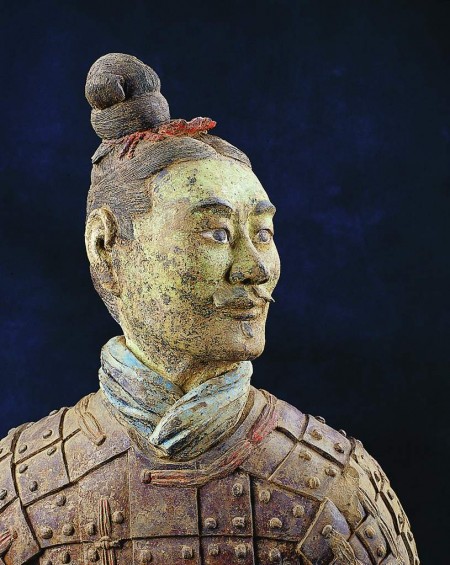
In an article “Une Pratique Liturgique propre à la Chine” published in Bulletin Catholique de Pekin in 1924, the author repeats the same reasons justifying the concession for the use of the sacrificial hat, saying that according to the traditional Chinese view, the uncovering of head is a sign of contempt and humiliation. He also proposes another reason: the cold winter in China, a problem for a people who typically wore their heads completely shaven besides a pigtail. This reason can be discounted, however, since the hairstyle in question was imposed on the Chinese people by the Manchus in 1644, while the sacrificial hat was permitted decades before, in 1615.

Terracotta Warrior from the Mausoleum of the First Qin Emperor, with typical traditional Chinese hairstyle, 3rd. century BC. (http://i.epochtimes.com/assets/uploads/2006/11/611090949241665-450x565.jpg)
The priests kept the same Manchu haircut as the local people, for the convenience of their mission.(https://bbs.voc.com.cn/viewthread.php?action=printable&tid=5245533)
For the Chinese Christians, the sacrificial hat was more than a simple vestment; it was a potent symbol of their people’s veneration for sacred sacrifice handed down through 3000 years of civilization, vindicated for Christ. Permitting a Chinese form of the sacrificial hat allowed the missionaries to capture this spirit of veneration, fulfilling the Apostle’s mandate to “lead every thought captive to obey Christ” (2 Corinthians 10, 5), much as early Christians in Rome assigned the clergy vestments and signs of veneration usually reserved for the Roman Emperor.

The Tsikin was used in China until the early 20th century, by which time many of the ancient concessions requested by the Jesuits had finally been withdrawn or phased out and a uniform Romanization was enforced by the First Chinese Council of 1924. To Roman officials and local clergy alike, it appeared that the original moral reason for the hat’s introduction had disappeared along with the introduction of European civilization and etiquette into the cities and even the interior of the country. Therefore, the time had come for more rigorous Romanization. From this point of view, as a contemporary author observes, “the sacrificial hat had fallen victim to the social evolution of the Chinese.” [3]

The “social evolution” in question was the advent of western modernism. The 1920s, when the use of the sacrificial hat was officially terminated, was a time of radical social change in China. The spread of western ideas and the overthrow of feudalism began a period of voluntary abandonment of traditional manners by the Chinese themselves. Caught up in this spirit, Catholic priests voluntarily abandoned the ancient hat, so that by the time the order for Romanization came down, there were few who still used it.

Chinese men in western clothes in the 1920s (http://blog.wenxuecity.com/blog/frontend.php?act=articlePrint&blogId=46868&date=201605&postId=936917)
In its social context, therefore, official Romanization actually fell in step with the march toward total westernization in China. As a result, it impoverished the local ecclesial tradition and left the Church less able to face the coming storms. The Church and society both were swept into the violent revolutions of the 20th century, with little traditional culture left to resist.

As mentioned above, the Tsikin was more than a simple vestment. It was one of the most visible ways in which the Church redeemed what was good in Chinese culture: its deep and ancient veneration for divine sacrifice. Since sacrifice was the essence of civilization, the removal of the hat when offering sacrifice was, so to speak, a beheading of the spirit of ancient Chinese culture, a decision not to redeem this beautiful element of its ancient civilization. Moreover, de-Sinisation left the Church even more vulnerable to the Communist charge that the Roman Catholic Church was an instrument of the western powers.

We may suppose that, if the sacrificial hat had been preserved, it would have acted as a living reminder to modern Chinese people of their own splendid tradition, and could have been a rallying symbol for cultural resistance, first to modernism, then to the Cultural Revolution. Instead, tradition was abandoned both by the larger society and by the Church together, and the Church missed the opportunity to play its accustomed role as the defender of civilization. In this respect, what happened in China somewhat resembles the situation in the West, where a misguided aggiornamento divested the Western Church of the very resources needed to combat the philistinism and cultural revolution of the post-conciliar period.

[1] Pp. 28-29 of the PDF linked above
[2] [...] In quam rem est recolendum quod supra attigi, apud Seres, sive Sinas, nefas, et saltem apprime inurbanum esse, capite unquam esse nudo. Is enim est habitus eorum qui ad patibulum rapiunter. Itaque Sinae Christiani, tunc tantum capita aperiunt, cum de peccatis confitentur. Tunc enim ut se criminosos ac reos profiteantur, nudant capita. Cum ergo esset apud eos probrosum, quod sacerdos sacrificans, esset aperto capite, insistere apud Paulum V ut pateretur eos servire consuetudini, nec sacrificium dehonestari vellet nudatione capitis, sacerdotis sacrificantis. Annuit Pontifex, dummodo tegmen capitis, super sacrum dumtaxat et rem divinam, usui esset, et a profano discreparet (Raynaud, 148-149).
[3] “Mais la raison morale, d’autre part, semble bien disparaître au fur et à mesure que la civilisation et la politesse européenes s’introduisent dans les villes et à l’intérieur même des campagnes. A ce point de vue, le bonnet de Messe aura été une victim de l’évolution sociale des Chinois” (Bulletin Catholique, 405).

Friday, August 29, 2008

JT on: Sunday Vespers in the Universal Catholic Tongue

Here is a neat thing: Sunday Vespers, Latin/Chinese

More recent articles:

For more articles, see the NLM archives: