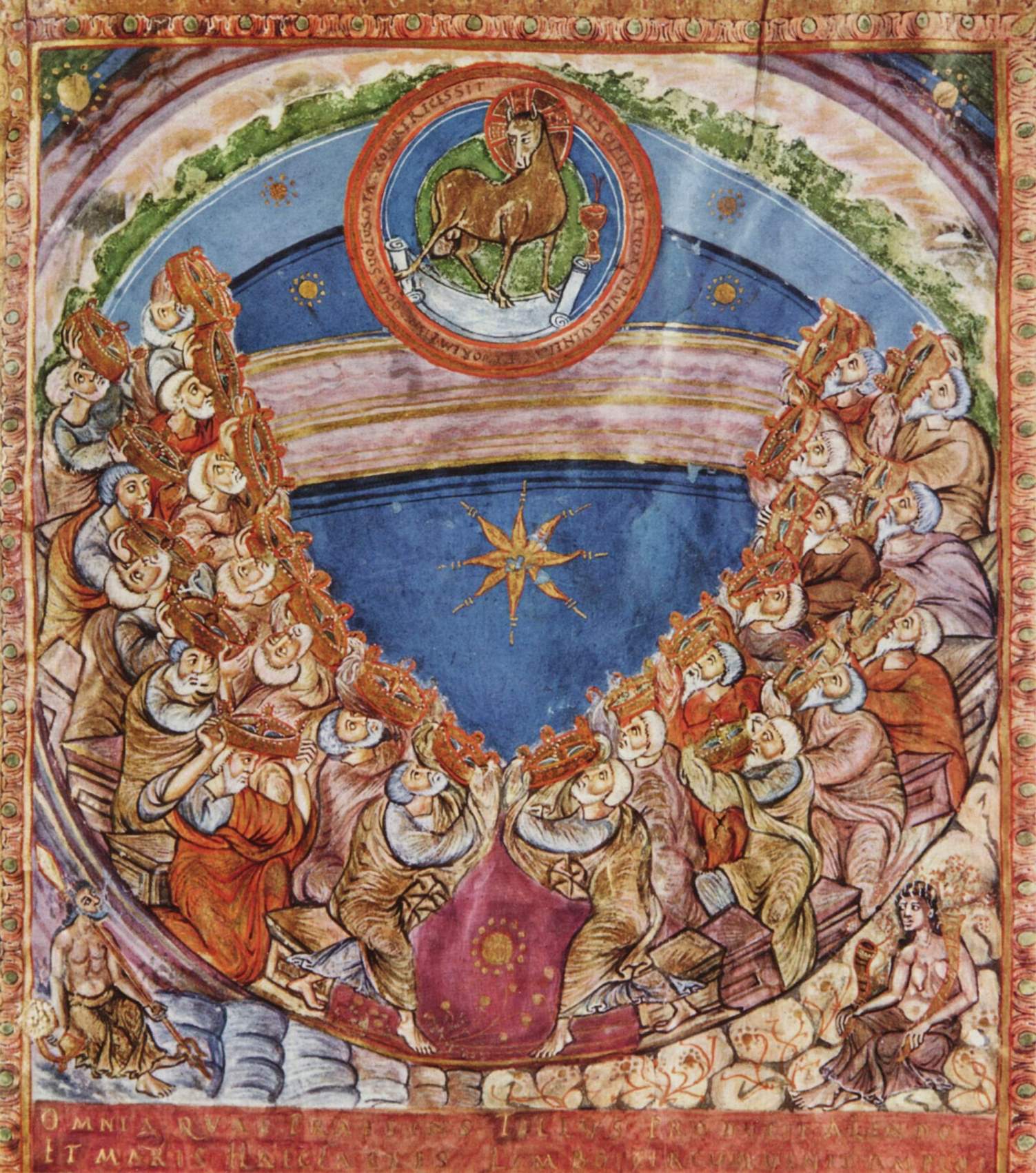
From the Breviary according to the use of the Roman Curia, 1529, the end of the sermon for the second day in the Octave of All Saints.
We believe that this day’s festivity also belongs to the priests of Christ, to the doctors, levites and other confessors and monks; in whose hearts virtue flourished, because the world had faded away. Because the will of the flesh was mortified, true charity was fervent in them, and because they were dead to the world, they lived within in it as the Saints live in Heaven. For the more a man takes delight in this world below, the more is he separated from the love of the things of Heaven. Therefore, these holy men, fleeing the world that passes and the corrupting passions of the soul, had God before them and the Angels at their sides, and so merited to be brought by the Angels into the kingdom of Heaven.
Scenes from the Lives of the Holy Hermits, or “Thebaid”, by Paolo Uccello, 1460s; now in the Academia Gallery in Florence. (Public domainimage from Wikimedia Commons.)
From the Breviary of St Pius V, 1568, a passage from the fifth sermon on the feast of All Saints by St. Bernard of Clairvaux, Abbot and Doctor of the Church, read on November 6th. (In the painting above, St Bernard is represented in the lower left hand corner as the Virgin Mary appears to him.)
What does it profit the Saints that we should praise them or glorify them? What does this solemnity of ours benefit them? What are earthly honors to them whom, according to faithful promise of the Son, the heavenly Father honors? What are our commendations to them? They are full. It is indeed so, dearly beloved; the Saints have no need of our goods, and our devotion gives them nothing. It is for our sake, and not for theirs, that we honor their memory. … It is commonly said, “Out of sight, out of mind”. (literally “What the eye sees not, the heart does not long for.”) The memory is a kind of sight, and to think of the Saints, is to see them in a certain way. Such is our portion in the land of the living; no small portion, indeed, if love accompany remembrance as it ought. And so I say, our dwelling is in heaven, though in manner very different from theirs. For they are truly there, where we long to be; they are there in presence, we only in thought.
The Glory of All the Saints, by the Tuscan painter Giovanni da San Giovanni, 1630; fresco in the apse of the church of the Four Crowned Martyrs, Rome; the titular Saints of this church share their feast day with the octave of All Saints.
For many years now, the Fraternity of St Peter’s church in Rome, Santissima Trinità dei Pellegrini, has had the custom of exposing all its relics for the veneration of the faithful on All Saints’ day. In the evening, before Vespers, each reliquary is presented before the congregation, and the name of the Saint or Saints whose relics in it are read out. On the side altar of St Matthew, St Phillip Neri, who founded the confraternity that built the church, is given special prominence. (The bronze reliquary seen to the left side of the altar here is also of St Phillip, but is not held up before the faithful, since it is incredibly heavy.) Our thanks once again for the pictures to Don Elvir Tabaković, a former professional photographer from Croatia who is now in religious life, and using his skills to celebrate the beauty of the liturgy.
The sacristan returns one of the relics to its place on the altar.
Relics on the high altar.
At the end, the church’s piece of the True Cross is processed down and up the central aisle, before the faithful are blessed with it.
From the Breviary according to the use of the Roman Curia, 1529, the continuation of the sermon for the second day in the Octave of All Saints.
It is well-known that at first this day’s glorious solemnity honored the triumphal name of the holy martyrs, for the church whose dedication we recall was first called Saint Mary of the Martyrs, and the feasts of holy martyrs alone were celebrated therein. There are many Saints before those times who passed from this present life without shedding their blood; nevertheless they are honored with the title of martyrdom, because they suffered in some way, namely, by exile, by the loss of their goods, by long imprisonment, or harsh beatings, though at last they died in peace. Therefore, no outward savagery of the wicked was strong enough to disturb the spiritual tranquility of these and all the other holy martyrs, even though their members were tormented with every sort of torture, and to every degree. In these the Lord has given use both a defense and an example, so that we may be helped by the protection of their prayers, and be encouraged by the perseverance of their constant faith to overcome all temptations.
The chapel of St Eusebius in the cathedral of Vercelli, Italy, where he served as bishop from 340-71. Eusebius was one of the very first Western Saints to be venerated as a martyr because of the lengthy exile he suffered, although he did not die by shedding his blood. (Below, a closer view of the reliquary above the main altar.)
From the Breviary according to the use of the Roman Curia, 1529, the continuation of the sermon for the second day in the Octave of All Saints.
But now let us turn to those in the New Testament whom the waters of baptism and the shedding of the Christ’s Blood washed clean from the error of their fathers’ sin, and from the squalor of the ancient manner of the gentiles, by the grace of the Holy Spirit. Blessed are the eyes of those who merited to see Christ coming in the flesh (Luke 10, 23). The blessed Apostles and disciples had their share in this happy vision and the redemption that was wrought by the precious blood, and imparted it to others. As princes of the Church and founders of the faith, models of the saints and judges of the earth, they have illuminated the whole world with the holiness, their teaching, and their miracles. So great did they show themselves to the world in their holiness, their miracles and their suffering, that they drew every sort of men to hear and wonder at them.
Christ and the Twelve Apostles, by the Master of Seu d’Urgell, ca. 1100. Altar panel, now in the Museu Nacional d’Art de Catalunya in Barcelona. (Public domainimage from Wikimedia Commons.)
From the Breviary according to the use of the Roman Curia, 1529, the continuation of the sermon for the second day in the Octave of All Saints.
And because this venerable day is dedicated to all the Saints that have been born since the beginning of the world, we must not think it unknown to the ancient fathers, who shone forth with many signs and wonders, curing men of their infirmities, delivering them from every evil, and raising their bodies from the dead. They closed heaven, holding back the rains, and in mercy opened it again. They wept for the sins of the people, setting themselves against the avenging thereof, placating and appeasing the Lord’s wrath. Taught by the Lord, they foretold the Birth of Christ from the Virgin, His Passion and Resurrection, His Ascension unto Heaven, the coming of the Holy Spirit, and the judgment that shall come to pass at the end of the world. And most assuredly do we believe them to also partake in this venerable festivity, and have a share therein.
A relief sculpture of the prophet Isaiah, holding a scroll with the first two words of the prophecy “Behold a virgin shall conceive” (7, 14); on the pulpit of the cathedral of St Clement in Teano, Italy. (Image from Wikimedia Commons by Pufui PcPifpef, CC BY-SA 4.0)
From the Breviary according to the use of the Roman Curia, 1529, the continuation of the sermon for the second day in the Octave of All Saints.
Since the fall of the holy Angels was to be made good by their dealings with men, and for this reason they rejoice in the conversion of sinners, longing for the salvation of men, and willingly submit themselves to the will (of men), we must likewise raise our prayers up to them. Oh! if someone had his eyes open, as the prophet by praying opened up those of his servant (4 Kings 6, 17-20), he would see how princes go forth joined with singers (Psalm 67, 26), he would see with what care and solemnity they dance among them, are present to their prayers, are in the midst of their meditations, surround them as they rest, guide those that rule and serve. Therefore, since we know that they so graciously visit those who lie in dung and mud, and joyfully gather them into the heavenly fatherland, it is worthy that we strive to invite them to the joy of our solemnity.
The Assumption of the Virgin Mary, with Music-making Angels, 1340, by the Sienese painter Lippo Memmi (1291 ca. - 1365)
This somewhat opaque passage seems to require a brief translator’s note, since the very clever rhetoric of the Latin original does not translate well into English. The words of Psalm 67, “Praevenerunt principes conjuncti psallentibus – Princes went before joined with singers ” are understood to mean Angels joined to the choirs of men as the latter sing God’s praises. In Latin, each of the verbs that follows, describing the actions of the Angels (“they dance… guide them”) is a compound of the verb “esse – to be”: “intersint cantantibus, adsint orationibus, insint meditantibus, supersint quiescentibus, ordinantibus et procurantibus praesint.” This beautifully expresses the idea that in every aspect of our religious life, we accompanied by the presence of the Holy Angels.
From the Breviary according to the use of the Roman Curia, 1529, the continuation of the sermon for the second day in the Octave of All Saints.
Since the most blessed Virgin Mary, by a miracle beyond our understanding, became the handmaid of man through the divinity, and the mother of the Word through the flesh, and since She is accordingly our most sure refuge, and also has made ready for us our eternal reward, She merits the constant and everlasting love of our devotion. Taught by Her example, holy virgins strive with great zeal to conform themselves to Her in their actions. Not only in regards to the purity of virginity, but also in the richness of their progeny have they sought to follow Mary, as by the seed of the Divine Word, which is watered by sacred discourse, and by fervent and fruitful prayer, they bear spiritual children, and thus have they gathered a fruitful harvest into the granary of the Lord.
The Virgin and Child with Ss Catherine and Barbara, early 1480s, by Hans Memling (1433 ca. - 1494)
From the Breviary according to the use of the Roman Curia, 1529, the continuation of the sermon for the second day in the Octave of All Saints.
As we venerate the Saints with this special festivity, it is worthy that we begin our praise with Him Who adorned the heavens with the Angels, and the earth with His other creatures, that He might be praised by all. Indeed, because He is in Himself the fount of goodness, needing not our goods, (Psalm 15, 2) excluding no one from a share in His light, in order that He might be known, He made the rational creation to understand Him as the greatest good, and so understanding to love Him, so loving Him to possess Him, so possessing Him to delight in Him; and in this course, it not God Himself, but the creature that benefits. Therefore as we praise Him, though we cannot yet reach what we long for in joy, and know not how to do what we ought, let us offer our prayers with confidence, since the Lord God, giving greater thought to our desires than to our deeds, looks kindly upon the strength of our good intentions as He receives our service.
The Holy Trinity Crowns the Virgin, with Ss Luke, Dominic and John the Evangelist, ca. 1580, by the Bolognese painter Bartolomeo Passerotti (1529-92)
Here is a very beautiful setting of Christe, Redemptor omnium, the hymn for Matins and both Vespers of the feast of All Saints, by the mighty Tomás Luis de Victoria (1548-1611), in alternating chant and polyphony. The text is the original version, traditionally attributed to the great Benedictine scholar Bl Rabanus Maurus (780 ca. - 856), since Victoria’s work predates the revision of the Office hymnal promulgated by Pope Urban VIII in 1629. (Both hymns for All Saints were so drastically altered by this revision as to effectively be completely new.) The text can be read in Latin and English at the following link: https://www.liturgies.net/saints/allsaints/eveningprayeri.htm.
The original version was restored in the Liturgy of the Hours, but with one notable exception. The sixth stanza of the original reads as follows:
Gentem auferte perfidam Credentium de finibus, Ut Christo laudes debitas Persolvamus alacriter.
“Remove the unbelieving nation / from the lands of the believers, / that readily we may offer / due praises to Christ.” With that sad naivety by which so many people in the later 1960s deceived themselves into believing that the peaceable settlement of post-WW2 western Europe would last forever, the first two lines of this stanza were suppressed, and the other two moved to the end as part of a new doxology.
Sit Trinitati gloria, Vestrasque voces jungite, Ut Christo laudes debitas Persolvamus alacriter.
“To the Trinity be glory / and join your voices, / that readily we may offer / due praises to Christ.”
The Magnificat antiphon for Second Vespers.
AñaO quam gloriósum est regnum*in quo cum Christo gaudent omnes Sancti, amicti stolis albis sequuntur Agnum quocumque íerit! (O how glorious is the kingdom in which all the Saints rejoice with Christ; clothed in white robes, they follow the Lamb whithersoever he goeth.)
A very impressive setting of this text as a motet by William Byrd.
This same text is one of Victoria’s most famous motets, and the basis of one of his best “parody” Masses, the Missa O quam gloriosum. (The term “parody” does not of course mean mockery, but that the motet is used as the thematic basis of the Mass.)
From the Breviary according to the use of the Roman Curia, 1529, the beginning of the sermon for the second day in the Octave of All Saints.
Worthily we recall this day that the place once called the Pantheon, a place full of filth, was consecrated to God and to all the Saints, so that where sin abounded, there grace might also abound. (Romans 5, 20) So one that was mighty, and cruelly held possession of nearly all things in miserable peace, was overwhelmed and conquered by One mightier still; who, rifling his goods, (Matthew 12, 29) dedicated to His own worship the other’s temples. By this fact, perceptible to our senses, we are taught spiritually that Man, who in Adam had become by original sin the dwelling place and possession of the devil, the servant of sin, the son of death, by baptism becomes the temple of God, and is brought over to the liberty of the sons of God, and through grace reborn as a son of adoption. Worthily therefore do we celebrate the dedication of the temple, by which we recall to mind these benefits conferred upon us, and are advised to consecrate our hearts as a temple to the Lord, casting out all the idols of the demons, that is, our sins.
The interior of the Pantheon, by Giovanni Paolo Panini (1692-1765) Over the architrave are quotations from Psalm 149, “His praise is in the church of the Saints”, and Psalm 150, “Praise the Lord in His Saints”, words that were formerly sung every single day in the psalmody of Lauds. This inscription has been removed by modern restorations.
In the Middle Ages, the sermon read at Matins on the feast of All Saints was the same in almost every Use of the Roman Rite, called from its first words Legimus in ecclesiasticis historiis; the real author is unknown, although it was frequently attributed to St Rabanus Maurus. The first lesson refers to the institution of the feast of All Saints, and the dedication of the Pantheon as a church. The second lesson is about God, while the six lessons that follow descend through the hierarchy of the Saints: the Virgin Mary, the Angels, the Patriarchs and Prophets, the Apostles, the Martyrs, and the various types of Confessors. The holy Virgins and other female Saints are mentioned in the same lesson as the Virgin Mary, the model of consecrated life; the ninth lesson is taken from a homily of St. Augustine on the Sermon on the Mount, the beginning of which is the Gospel of the feast. When All Saints was granted an octave by Pope Sixtus IV in the early 1480s, each day of the octave was assigned a different sermon with the same structure, covering the first eight of the nine lessons at Matins. Last year, we commemorated All Saints with the sermon for the feast day itself; this year, we will follow the Matins lessons from the very beautiful sermon assigned to be read on November 2nd.
In the Roman Rite, the term “vigilia – vigil” traditionally means a penitential day of preparation for one of the more important feasts. The Mass of a Saint’s vigil is celebrated after None, as are the Masses of the ferias of Lent or the Ember Days, and in violet vestments; however, the deacon and subdeacon do not wear folded chasubles, as they do in Lent, but the dalmatic and tunicle. The Mass has neither the Gloria nor the Creed, the Alleluja is omitted before the Gospel, and not replaced with a Tract, and Benedicamus Domino is said at the end in place of Ite, missa est.
A folio of the Echternach Sacramentary, 895 AD, with the Mass of the vigil of All Saints, and the collect of the feast. (Bibliothèque nationale de France, Département des manuscrits, Latin 9433)
Before the Tridentine reform, the vigil of a Saint consisted solely of the Mass, and had no presence in either the Roman version of the Divine Office, or in that of most other Uses. A minority custom, which seems to have been predominantly German, gave an Office to the vigils of Saints, which consisted of a homily at Matins, and the use of the collect of the vigil as the principal collect of the day; the rest of the Office was that of the feria. The Breviary of St Pius V adopted this latter custom for the vigils of Saints, a rare example of change in an otherwise extremely conservative reform; but even for the Roman Rite, this was not an absolute novelty. Historically, the vigils of the major feasts of the Lord (Christmas, Epiphany etc.) did include the Office, and the change in 1568 simply extended the scope of a well-established custom.
The feast of All Saints was not definitively established as a major solemnity of the Roman Rite until the mid- to late 9th century, but in every book in which it is attested, it is accompanied by such a vigil. It seems reasonable to assume, therefore, that they were instituted at the same time. Because of the preeminent position of the martyrs in Christian devotion as the first and most widely venerated Saints after those who appear in the New Testament, the liturgical texts of All Saints are often borrowed or imitated from those of the feasts of martyrs, and the same is true of its vigil.
The Introit of the vigil is taken from the third chapter of the book of Wisdom, the source of many liturgical texts of all kinds for the feasts of martyrs. “Júdicant Sancti gentes et dominantur pópulis: et regnábit Dóminus, Deus illórum, in perpétuum. Ps. 32 Exsultáte, justi, in Dómino: rectos decet collaudatio. Gloria Patri. Judicant. – The Saints judge nations, and rule over peoples, and the Lord their God shall reign for ever. Ps. Rejoice in the Lord, O ye just: praise becometh the righteous. Glory be. The Saints.”
The Epistle is taken from the Apocalypse, chapter 5, 6-12; this part of the book, St John’s vision of God on His throne with the heavenly court and the Saints standing before Him, has long been a favorite source for artistic depictions of Heaven. This specific passage contains the first mention of Christ as “the Lamb that was slain”, and the book’s first occurrence of the word “Saints”.
“In those days, behold I, John, saw in the midst of the throne and of the four living creatures, and in the midst of the elders, a Lamb standing as it were slain, having seven horns and seven eyes: which are the seven Spirits of God, sent forth into all the earth. And he came and took the book out of the right hand of him that sat on the throne. And when he had opened the book, the four living creatures, and the four and twenty ancients fell down before the Lamb, having every one of them harps, and golden vials full of odours, which are the prayers of saints: And they sung a new canticle, saying: Thou art worthy, O Lord, to take the book, and to open the seals thereof; because thou wast slain, and hast redeemed us to God, in thy blood, out of every tribe, and tongue, and people, and nation. And hast made us to our God a kingdom and priests, and we shall reign on the earth. And I beheld, and I heard the voice of many angels round about the throne, and the living creatures, and the ancients; and the number of them was thousands of thousands, saying with a loud voice, ‘The Lamb that was slain is worthy to receive power, and divinity, and wisdom, and strength, and honour, and glory, and benediction.’ ”
As I described in an article eight years ago, the feast of All Saints was instituted in part as a response to the iconoclast heresy which the Byzantine Emperors invented, and enforced with a brutal persecution. Roughly a generation before iconoclasm began in 726, the Emperor Justinian II had called a synod now known as either “the Synod in Trullo” or “the Quinisext Council”, which among other things forbade any representation of Christ as an animal. In response, Pope St Sergius I (687-701) added the Agnus Dei to the Mass, and the church of Rome began regularly depicting Christ as a lamb in art. This Epistle, in which the Bible itself calls Him a lamb, was most likely chosen in reference to this; likewise the Epistle of the feast itself, chapter 7, 2-12, in which John sees “a great multitude, which no man could number, of all nations, and tribes, and peoples, and tongues, standing before the throne, and in sight of the Lamb, clothed with white robes, and palms in their hands. And they cried with a loud voice, saying, ‘Salvation to our God, who sitteth upon the throne, and to the Lamb.’ ” In the same vein, the Magnificat antiphon for Second Vespers of the feast says “O how glorious is the kingdom where all the Saints rejoice with Christ; clothed in white robes, they follow the Lamb wheresoever he goeth!”
In the church of Ss Cosmas and Damian in Rome, Pope Sergius added the gold-background mosaic on the proscenium arch, filled with images from the book of the Apocalypse, including the Lamb of God on His throne. (Photo by Fr Lawrence Lew.)
The Gradual is taken from Psalm 149, “Exsultabunt sancti in gloria; laetabuntur in cubilibus suis. V. Cantate Domino canticum novum; laus ejus in ecclesia sanctorum. – The Saints shall rejoice in glory: they shall be joyful in their resting places. V. Sing ye to the Lord a new canticle: let his praise be in the church of the Saints.” The first part of this is frequently said in the Office of Several Martyrs, and was chosen in reference to the fact that the original focus of devotion to the Saints was always at the place of their burial. (There is no recording of it available on YouTube, but it is very similar to the Gradual Tecum principium of the First Mass of Christmas.)
The Gospel, Luke 6, 17-23, is taken from the beginning of the Sermon on the Plain; this is St Luke’s shorter version of the Beatitudes with which St Matthew’s Sermon on the Mount begins (chap. 5, 1-12), the latter being the Gospel of the feast. As St Ambrose explains in the breviary sermon on this Gospel, “Saint Luke sets out only four of the Lord’s Beatitudes, while Saint Matthew gives eight; but in those eight are contained these four, and in these four those eight. For the former in these four embraced the cardinal virtues, and the letter in those eight set forth a number full of mystery. … For as the eighth beatitude names the perfection of what we hope for (i.e., the kingdom of Heaven), so it is also the sum of the virtues.”
The Offertory is taken from the same Psalm as the Gradual, and includes a small variant from the Old Latin version, rather than the Vulgate version of St Jerome. “Exsultabunt sancti in gloria; lætabuntur in cubilibus suis. Exaltationes Dei in faucibus (“gutture” in the Vulgate) eorum. – The Saints shall rejoice in glory: they shall be joyful in their resting places. The high praises of God shall be in their mouth.”
Finally, the Communion also comes from Wisdom 3, and in fact has the same text as the Offertory of the feast, without the Alleluja at the end; the music, however, is completely different.
“Justórum ánimae in manu Dei sunt, et non tanget illos tormentum malitiae: visi sunt óculis insipientium mori: illi autem sunt in pace. – The souls of the just are in the hand of God, and the torment of malice shall not touch them. In the sight of the unwise they seemed to die: but they are in peace.”
In the Middle Ages, October 31 was also celebrated in England, France and the Low Countries as the feast of St Quintinus (“Quentin” in English), a Roman who came to Gaul, preached in the area of Amiens, and was martyred at a town which is now named for him. In many parts of Germany, it was the feast of St Wolfgang, bishop of Regensburg in Bavaria. Where one of these or some other feast was kept, two Masses would be celebrated on the day, one of the Saint after Terce, and the other of the vigil after None, with First Vespers of the feast normally following immediately after the second Mass. The vigil of All Saints receives little attention from medieval liturgical commentators such as Sicard of Cremona or William Durandus, but they do note that it was supposed to be kept with a fast, which was not to be broken until after None and Mass, and was not to be dispensed with because of the occurring feast.
From the Roman Breviary of 1529, the conclusion of the sermon for the feast of All Saints.
We believe that this day’s festivity is also made renowned by the priests, doctors, and confessors of Christ, who spiritually nourish the hearts of the faithful, like heavenly waters, so that they may be able to bring forth in abundance the incorruptible fruit of good works. They have taken care not only to give back the talents entrusted to them, but also to increase them with interest, … ; for the good which they learned and understood through the grace of the Holy Spirit, they strove to impart not only to themselves, but to the minds of those subject to them. … Celebrating the sacred and holy mysteries of the Body and Blood of Christ upon the altar, in the depths of their heart they cease not to offer a living sacrifice, and pleasing to God, that is, themselves, without blemish or admixture of any evil deed. And although they did not feel the sword of the persecutors, yet through the merit of their lives, they are worthy of God and not deprived of martyrdom. For martyrdom is accomplished not only by the shedding of blood, but also by abstaining from sins, and the practice of God’s commandments. … Very many have shone forth with signs and wonders, restoring sight to the blind, strengthening the steps of the lame, giving hearing to the deaf, conquering demons, and raising the dead.
All Saints in Glory, by Giovanni da San Giovanni, 1630, in the apse of the church of the Four Crowned Martyrs in Rome.
Therefore, dearest brethren, with the full intention of our minds let us ask for the protection of the mighty intercessors of whom we have spoken, so that through the temporal feast which we keep, by their merits interceding, we may be able to come to eternal joy. All things pass away that are celebrated in time. Take care, all that take part in these solemnities, lest you be cut off from the eternal solemnity. For what profiteth it to take part in the feasts of men, if it befall you to miss the feasts of the Angels? (The words from “All things pass away...” to the end are added from a homily of Saint Gregory of Great for the Octave Day of Easter.)
From the Breviary of St. Pius V, 1568, the end of the treatise on mortality by St. Cyprian of Carthage, bishop and martyr, read on the Octave Day of All Saints.
We must consider, most beloved brethren, and continually reflect upon the fact that we have renounced the world, and in the meanwhile live here as guests and pilgrims. Let us embrace the day which assigns each of us to his own home, which restores us to paradise and the heavenly kingdom, delivered hence and freed from the snares of the world. What man that has been placed in foreign lands would not hasten to return to his own country? What man that is hastening to sail back to his friends desireth not the more eagerly a prosperous wind, that he might the sooner be able to embrace those dear to him?
We regard paradise as our country, already we begin to deem the patriarchs as our parents: why do we not hasten and run, that we may see our country, that we may greet our parents? There a great number of our dear ones awaits us, and a dense crowd of parents, brothers, children, longs for us, already assured of their own immortality, and still solicitous for our salvation. To attain to their sight and their embrace, what gladness both for them and for us in common! What delight there is in the heavenly kingdom, without fear of death; and how lofty and perpetual the happiness with eternity of living!
There the glorious choir of the apostles, there the host of the prophets rejoicing, there the innumerable multitude of the martyrs, crowned for the victory of their struggle and passion; there the triumphant virgins, who subdued the desire of the flesh and of the body by the strength of their continency. There are the merciful rewarded, who by feeding and helping the poor have done the works of justice, they who, in keeping precepts of the Lord, have transformed their earthly patrimonies into the heavenly treasures. To these, beloved brethren, let us hasten with eager desire; let us long quickly to be with them, that quickly we may come to Christ.
November 8th is also the feast of the Four Crowned Martyrs, the titular Saints of a very ancient but much-rebuilt church on the Caelian Hill in Rome. Every year on the feast, the altar is covered with a very beautiful frontal, and silver reliquary busts of the martyrs are displayed in the sanctuary.
Among the many inscriptions preserved in the church, this one records that Pope Leo IV (847-55) placed under the church’s altar the relics of the Four Crowned Martyrs, and a great many others; in addition to those listed by name here, he placed “many other bodies of Saints whose names are known to God.”
From the Roman Breviary of 1529, the continuation of the sermon for the feast of All Saints.
After the Apostles) is added the triumphal title of the Martyrs, who through diverse sorts of torments imitated the passion of Christ, offering no provocation in their minds or hearts. Some were killed with the sword, some burnt, some beaten, some pierced with bolts, some crucified, … it is they that celebrate the triumph, and are the friends of God, who, defying the orders of criminal rulers, are now crowned, and receive the reward of their labors, because they were founded upon the firm rock, that is, Christ. … The blessed Gregory says of the warriors of this sort, in his explanation of one of the Gospels, “Behold, the elect of God subdue the flesh, strengthen the spirit, gain mastery over the devils, shine brightly with virtues, despise the present world, and speak of the eternal fatherland in their words and in their manners. And even as they die, they love, and so they come there through their torments. They can be killed, but they cannot be bent, “and though in the sight of men they suffered torments, their hope is full of immortality. Afflicted in few things, in many they shall be well rewarded: because God hath tried them, and found them worthy of himself. As gold in the furnace he hath proved them, and as a victim of a holocaust he hath received them.” Now therefore, we have heard of the contests and victories of the martyrs of Christ. To them, certainly, we hold this day to be sanctified, insomuch as they did not cease to labor within themselves, that they might be sanctified through their sufferings.
The Ten Thousand Martyrs on Mt Ararat, by Vittore Carpaccio, 1515
From the Roman Breviary of 1529, the continuation of the sermon for the feast of All Saints.
From among all those whom the world contains, divine providence chose the twelve Apostles… to lay down the foundation of the new faith, and to raise up the state of the Church while it was still young, so that the sound of their preaching might go out unto all the world, and their words go forth unto the ends of the earth. They clung to the true vine, that is to Christ, like branches, whose fruit, abiding forever, corrupts not; to whom the Lord Himself spoke, saying, “You are the light of the world. A city seated on a mountain cannot be hid. Neither do men light a candle and put it under a bushel, but upon a candlestick, that it may shine to all that are in the house. So let your light shine before men, that they may see your good works, and glorify your Father who is in heaven” And again: “I will not now call you servants: for the servant knoweth not what his lord doth. But I have called you friends: because all things whatsoever I have heard of my Father, I have made known to you.” And whatsoever you shall bind upon earth, shall be bound also in heaven; and whatsoever you shall loose upon earth, shall be loosed also in heaven.” And again He foretold that when He should come to judge the world, that they would sit on twelve thrones, and with Him judge the world. To such patrons, as we believe, this day is declared to be exalted.
The Last Judgment by Giotto, in the Scrovegni Chapel in Padua, 1306
This is the second part of a guest article by Mr Thomas Neal on the chants of the ongoing feast of All Saints; the first part was published on Friday. Mr Neal is a teacher, musicologist, and church musician based in Oxford (UK), where inter alia he serves as the Director of Music at New College School. Our thanks to him once again for sharing with us the interesting results of his research.
Alleluia
Allelúia, allelúia. Veníte ad me, omnes, qui laborátis et oneráti estis: et ego refíciam vos. Allelúia. (Come to Me, all you who labour and are burdened, and I will give you rest.)
The Alleluia verse is a quotation from the Gospel of St. Matthew 11, verse 28. More research is required to determine the sources of this melody. In my (admittedly brief) searches, the earliest chant manuscript I could find with this text is the 11th-century Cantatorium of the Use of St. Martial de Limoges; among the later sources are a 15th-century Graduale from Maastricht; but both transmit other melodies that are markedly different from that in the Liber usualis.
This text was set by composers such as Palestrina, Andrea Gabrieli, Jacobus de Kerle, Orlando di Lasso, and Jacob Regnart. But it is perhaps Felice Anerio’s glorious setting for double choir (Selectae cantiones octonis vocibus concinendae, 1614) that is best known today:
I would also commend the slightly later setting by Heinrich Schütz, which was published in the first volume of his groundbreaking collection Symphoniae sacrae (1629):
However, Venite ad me is not the only text associated with the Alleluia for the feast of All Saints. Many chant manuscripts from the 10th through to the 14th centuries have the verse Vox exsultationis [4], while one 10th-century tropaire has the verse as O quam gloriosum, adapted from the Book of the Apocalypse (7, verse 9). [5] This text is still to be found as the Magnificat antiphon at Second Vespers of All Saints, and was set to polyphony by numerous sixteenth-century composers, most famously by Tomás Luis de Victoria (Motecta, 1572):
Offertory
Justórum ánimæ in manu Dei sunt, et non tanget illos torméntum malítiae: visi sunt óculis insipiéntium mori: illi autem sunt in pace, allelúia. (The souls of the just are in the hand of God, and no torment shall touch them. They seemed, in the view of the foolish, to be dead: but they are in peace. Alleluia.)
Several early liturgical manuscripts (such as the twelfth-century Gradual of Bellay Abbey) give Mirabilis Deus as the Offertory for the Mass of All Saints, while manuscripts of Old Roman chant specify the widely used chant Laetamini. [6] It is unclear when it was changed to Justorum animae, although this must have occurred at a comparatively early stage. The text comprises the first three verses of the third chapter of the Book of Wisdom, a passage that had already had a long association with the feast of All Saints, appearing in various forms in the texts of the Office.
The melody for the new Offertory text was adapted from the Offertory chant for the feast of St. Michael, Stetit angelus, the earliest source for which appears to be the Graduel de Laon. (Bibliothèque municipale Ms 0239, f.73v.) This famous manuscript was copied for use at the cathedral of Laon in the final quarter of the ninth century, making it one of the very oldest surviving examples of Western musical notation. Perhaps the earliest copy of the chant adapted to the Justorum animae text is that found in the Graduale Narbonese, a manuscript copied at the cathedral of Arles in the tenth century, using so-called ‘Aquitaine’ notation. [7]
Justorum animae has been set many times by composers. The versions by Palestrina (Offertoria, 1593) and Byrd (Gradualia, 1605) are among the most well-known, but this one by Orlando di Lasso (Sacrae cantiones, 1582) remains my personal favourite:
With a nod to Anglican patrimony, the setting by Charles Villiers Stanford is also extremely attractive and deserves to be better known:
Communion
Beáti mundo corde, quóniam ipsi Deum vidébunt; beáti pacífici, quóniam filii Dei vocabúntur: beáti, qui persecutiónem patiúntur propter iustítiam, quóniam ipsórum est regnum caelórum. (Blessed are the clean of heart, for they shall see God. Blessed are the peacemakers, for they shall be called children of God. Blessed are they who suffer persecution for justice’ sake, for theirs is the kingdom of heaven.)
The text is taken from the Gospel of the feast, the Beatitudes in the Gospel of St. Matthew, chapter 5, verses 8-10. The earliest surviving source for this chant appears to be the Laon Graduale (f.71r), where it appears as a proper Communion for the feast of Ss. Felix and Adauctus (30 August).
Among the few polyphonic settings of this text is Byrd’s, from the Gradualia (1605):
Exitus
A vast amount of music has been composed for this important feast. However, one composition frequently omitted from music programmes is Palestrina’s six-voice Missa Ecce ego Johannes. Even among that composer’s incomparable corpus of Masses, this exquisite setting surely ranks near the top. The model for this Mass has yet to be identified, but the title suggests a motet setting the Chapter at First and Second Vespers of All Saints. It survives in only one source: a choirbook copied for use by the Cappella Sistina around the time of the composer’s death in 1594:
NOTES:
[4] Among the earliest sources with this verse are the 10th-century Gradual from St Gallen (St Gallen, Stiftsbibliothek, Cod 0342, f.195) and the Gradual copied for the Abbaye Saint-Sauveur de Prüm around 990 (Paris, Bibliothèque nationale de France, MS Lat. 9448, f.76r). [5] Bibliothèque nationale de France, Lat. 1118, f.94v.
[6] Roberto J. Snow, ‘The Old-Roman Chant,’ Gregorian Chant, ed. Willi Apel (London: Burns & Oates, 1958), pp.484-505: at 468.
[7] If I am correct, then Dom. Johner’s statement that the chant was adapted to the new text during the twelfth century, is inaccurate. See: Dom. Johner, The Chants of the Vatican Gradual, p.470.
From the Roman Breviary of 1529, the continuation of the sermon for the feast of All Saints.
This is also the feast of all the Saints who have been begotten in honor upon the earth from the beginning of the world; of whom the first were the patriarchs, reverent men, the fathers of the prophets and apostles, whose memory shall not be forsaken, and their name shall abide forever, … The descent of their rule ceased not until from their offspring Christ, through the womb of the untouched Virgin, He that is the hope of all nations, being born in the world appeared in glory, and retained to Himself the dominance and sole rule of the entire world. Upon these follow the chosen prophets, with whom God spoke, and showed them His secrets, so that they, enlightened by the Holy Spirit, might be able to know things which were to come as if they were present, and declare them, having become the princes of the people by foretelling the future. Some were known to God and sanctified in the womb, some in their youth, some as young men, some as old. They were found to be full of faith, greatest in devotion, …constant in holy meditation, fearless in the sight of death.
The mosaic over the altar in the Baptistery of Florence, 13th or 14th century. In the middle, the Lamb of God surrounded by the words “Hic Deus est magnus, mitis, quem denotat Agnus. - Here (or ‘This’) is the great God, but gentle, whom the Lamb signifieth.” Around him, clockwise from upper left, the Prophets Daniel, Ezekiel, Jeremiah, Isaiah, Moses, Abraham, Isaac and Jacob. On the left of the central wheel, St John the Baptist, to whom the Baptistery is dedicated, to the right, the Virgin and Child. (Click to enlarge. Public domain image from Wikipedia.)
From the Roman Breviary of 1529, the continuation of the sermon for the feast of All Saints.
It is God who placed the supernal kingdoms of the Heavens for the angelic spirits, to the praise and glory and honor of His name and of His majesty, in wondrous order forever. We grow afraid to say too much about them, because it belongs to God alone to know how their nature, which is invisible to us, without contamination or decrease stands firm in its purity. Yet from the witness of the Sacred Scriptures we know that there are nine orders of Angels, to fulfill the judgments and service of God; whose principalities and powers are subtly and marvelously distinguished by the will of God omnipotent. Some of them are sent to us in this world, and come to foretell future events. Others are set for this purpose, that through them signs and wonders may frequently be done. … Other armies of the Angels are so joined to God that between Him and them there are no others; the more plainly they behold the glory of His divinity, the more do they burn with love. To all these ranks of Angels, dearest brethren, so beautiful and beloved of God, we believe this solemnity is also consecrated. But behold, as we pry into the secrets of the citizens of Heaven, we have digressed beyond the measure of our frailty. Let us keep silent in the meanwhile concerning the secrets of Heaven; but before the eyes of our Creator, let us wipe away the stain of sins with our tears, that we may be able to come one day to those of whom we speak.
The Nine Choirs of Angels. In the central circle are God the Father, Christ, and the Virgin Mary in prayer; in the band around them the Sanctus is written three time; in the broader band, six each of the Cherubim, Seraphim, and Thrones. In the middle, three each of the Dominations, Principalities, and Powers, with the beginning of the Gloria above them, repeated three times. At the bottom, three each of the Virtues, Archangels, and Angels, with the words “Salus Deo nostro qui sedet super tronum et Agno” (salvation to our God, who sitteth upon the throne, and to the Lamb - Apoc. 7, 10) above their heads, three times. (From the Breviari d’Amour by Matfré Ermengau of Béziers; British Library Yates Thompson 31, folio 40v.)
From the Roman Breviary of 1529, the continuation of the sermon for the feast of All Saints.
We must certainly believe that the blessed Mother of God and ever-Virgin Mary, the temple of God, the shrine of the Holy Spirit, Virgin before, during and after the birth (of Her son), has a part in the present solemnity, along with the (other) virgins. By her actions she admonished the people of God to disdain the luxuries of the world that passeth away, to turn aside from the allurements of our mortal nature, to preserve within the heart the purity of the body with the honor of virginity; and by her examples she affirms that she is the queen of all virtues, the delight of perpetual salvation, and the companion of the Angels. And thus an innumerable multitude of both sexes has followed in Her footsteps, and abandoning the union of matrimony and the begetting of children, have chosen to be joined to the eternal Spouse in Heaven in mind and action, habit and deed, devoting themselves to prayers, keeping fasts, loving the sacred vigils, offering alms, refreshing the poor, clothing the naked, visiting the sick, rejoicing in tribulation, suffering from words of calumny and insult, humble in the increase of their (religious) profession, giving thanks to God in the loss of temporal things. For the desire of the kingdom of Heaven, and because of the hope of eternal reward, with most fervent love they pursue these and like things, unfailingly and willingly. And thus, persevering in the love of God and of their neighbors, they rejoice to end their life for God alone.
Virgo inter Virgines, by Gerard David, ca. 1509; Musée des Beaux Arts de Rouen. From left to right: St Dorothy with a basket of roses and the painter behind her; St Catherine of Alexandria, with her wheel worked into her crown as a decoration; St Agnes, with a lamb, and her foster-sister St Emerentiana behind her; St Fausta with a saw, (the instrument of her martyrdom); St Apollonia with the tongs used to pull out her teeth; St Godelina with the scarf her husband used to have her strangled; St Cecilia beside an organ; St Barbara, with her tower worked into her hat as a decoration; Cornelia Cnoop, the painter’s wife; St Lucy holding her eyes. (A high resolution image with close-up is available here on the museum’s website.)
We are very grateful to Mr Thomas Neal for sharing with us this excellent article on the chants of today’s feast. Mr Neal is a teacher, musicologist, and church musician based in Oxford (UK). He read music to postgraduate level at Clare College, University of Cambridge, where he was the John Stewart of Rannoch Scholar in Sacred Music. His research focuses on the sources of sacred music in sixteenth-century Rome, with a particular focus on the life and works of Giovanni Pierluigi da Palestrina. Thomas has over fifteen years of experience directing music for the traditional Latin liturgy, in addition to conducting numerous choirs and period instrument ensembles in repertoire from Josquin to Haydn. Since 2018 he has been the Director of Music at New College School, Oxford; he lives in Oxford with his wife, Catherine, and their three children.
The origins of the feast of All Saints have traditionally been traced to the most ancient custom of marking the anniversary of a martyr’s death. By the fourth century, adjacent dioceses would commemorate the feasts of each other’s martyr-saints, divide and transfer their relics, and coordinate common feasts. However, the persecutions under Diocletian (r.284-305) created so many martyrs that commemorations began to be grouped together. Eventually, a common day for all saints was appointed: the first trace of this feast is at Antioch, when it was observed on the Sunday after Pentecost. Reference to this or a similar feast appears in the writings of St. Ephrem the Syrian (d.373) and St. John Chrystostom (c.347-407).
In an article published here in 2017, Gregory DiPippo proposed an attractive theory that the feast of All Saints on 1 November has its origins in the iconoclast heresies of the eighth and ninth centuries. [1] Pope St. Gregory II (r.715-31) was quick to condemn the perpetrators of the iconoclasm that broke out in 726, and publicly reprimanded emperor Leo III for his role the destruction. His immediate successor, Pope St. Gregory III (r.731-41), convoked a synod at Rome on 1 November 731, during which he decreed the excommunication of all who committed iconoclasm against images of Our Lord, the Mother of God, the Apostles and all the saints. He dedicated a chapel in Old St. Peter’s basilica to All Saints and designated 1 November as its feast day. Recent research has demonstrated that this chapel was situated in front of the martyrium of St. Peter, on the south side of the nave and within the pars virorum. One of the texts inscribed in stone at the time of Gregory III can be seen in the crypt of the new basilica, left of the tomb of Emperor Otto II. The pope planned for a Mass to be offered in the chapel daily, commemorating not only the saints in the calendar or whose relics were kept in the chapel, but for all saints, including those known only to God. [2]
A cross-section drawing of the old basilica of St Peter as it was at the end of the 15th century.
In a follow-up to his first article, DiPippo further proposed that the construction of the oratory of St. Lawrence in the Lateran Palace (known as the Sancta Sanctorum), with its unique collection of relics and the icon of the Saviour, may have been constructed partly in response to the iconoclast heresies. (Vittorio Lanzani, Le grotte vaticane: memorie storiche, devozioni, tombe dei papi (Rome: De Rosa, 2010), p.242) The chapel is first mentioned in the life of Pope Stephen III (r.768-72) in the Liber Pontificalis, while the icon is known to have been in Rome by 753 when Pope Stephen II (r.752-57) carried it through the streets to implore Divine assistance against the threat of the Lombard invasion.
Nearly a century after the synod at Rome, during another wave of iconoclasm, Pope Gregory IV (r.827-844) extended this feast to the universal church. In so doing, DiPippo suggests, he upheld both the cult of the Saints and the Church’s true teaching on sacred images.
As the feast was introduced into the universal calendar only in the mid-ninth century, it does not feature in the more ancient manuscripts of liturgical chant. Some of the chants were borrowed and adapted from older feasts, while others appear for the first time in connection with the feast of All Saints.
Introit
Gaudeámus omnes in Dómino, diem festum celebrántes sub honóre Sanctórum ómnium: de quorum sollemnitáte gaudent Angeli et colláudant Fílium Dei. Exsultáte, iusti, in Dómino: rectos decet collaudátio. Glória Patri… Gaudeámus omnes…
Let us all rejoice in the Lord, celebrating a feast day in honour of all the Saints, on whose solemnity the angels rejoice, and join in praising the Son of God. Exult, you just, in the Lord; praise from the upright is fitting. Glory be to the Father… Let us all rejoice…
The Introit comprises a general text calling on the assembly to rejoice in the feast, with the verse(s) taken from Psalm 32. To my knowledge, no other Introit has been recorded in connection with this feast. The melody is of such ancient origins that several of the oldest surviving chant manuscripts do not even provide notation. [3] According to Dom. Johner, it was originally composed for a Greek text for the feast of St. Agatha; it gained popularity and was gradually assigned to a range of other feasts, including (until the 1951 reforms) the Assumption. The earliest surviving source for this chant in relation to the feast of All Saints is the manuscript Missal copied by the Benedictine monks of Andechs Abbey between 900 and 930.
The text’s lively call to rejoice is wonderfully reflected in William Byrd’s setting, found in his monumental collection Gradualia (1605):
Gradual
Timéte Dóminum, omnes Sancti eius: quóniam nihil deest timéntibus eum. Inquiréntes autem Dóminum, non defícient omni bono.
Fear the Lord, you His holy ones, for nought is lacking to those who fear Him. But those who seek the Lord want for no good thing.
The text of the Gradual is taken from Psalm 33, verses 10-11. One of the earliest surviving musical sources for this chant is the late tenth-century manuscript copied between 960 and 970 at the abbey of Einsiedeln (Einsiedeln, Stiftsbibliothek, Codex 121), in which it is notated in adiastematic neumes. According to the Graduale Triplex, the chant also survives in the ninth-century Gradual of Compiègne (Paris, Bibliothèque nationale de France, MS Lat.17436, f.128). In that source and other ancient manuscripts, it is assigned to the feast of St. Cyriacus and his companions (8 August). The twelfth-century Gradual from Bellelay Abbey (Porrentruy, Bibliothèque cantonale jurassienne, MS 18) provides perhaps the earliest version in diastematic neumes, and is notated so clearly that an experienced schola might easily sing from its pages today.
In 1777, Michael Haydn (brother of Joseph) composed this glorious setting, which ingeniously plays on the contours of the plainchant melody:
NOTES
[1] Traditionally, the feast has been somewhat loosely connected with the consecration of the basilica Santa Maria ad Martyres (the Pantheon) at Rome by Pope Boniface IV (r.608-615) on 13 May 609 (the same date mentioned by St. Ephrem). Such an interpretation requires an equation of the martyrs with all saints—a point that DiPippo convincingly refutes by looking at the practice of the stational churches at Rome in the Octave of Easter.
[2] See the literature cited in: Éamonn Ó Carragáin, ‘Interactions between liturgy and politics in Old Saint Peter’s, 670-741. John the Archcantor, Sergius I amd Gregory III,’ Old Saint Peter’s, Rome, eds. Rosamond McKitterick, John Osborne, Carol M. Richardson, and Joanna Story. British School at Rome Studies (Cambridge: Cambridge University Press, 2013), pp.177-189: at 188-189. See also: Charles B. McClendon, ‘Old Saint Peter’s and the Iconoclastic Controversy,’ pp.214-228.
[3] The twelfth-century Premonstratensian Gradual from Bellelay Abbey (Porrentruy, Bibliothèque cantonale jurassienne, MS 18), for example, assigns this Introit melody to five separate feasts (The Assumption, St. Mary Magdalen, The Nativity of Our Lady, All Saints, and the Common of Many Virgins), but gives only the text incipit for each. At this point, I would like to acknowledge the incredible work of Dominique Gatté, Jan Koláček, and all the team involved in producing and maintaining the Medieval Music Manuscripts Online Database (https://musmed.eu/), without which much of the basic research for this article would have been impossible
From the Roman Breviary of 1529, the beginning of the sermon for the feast of All Saints.
We read in the histories of the Church that Saint Boniface, who was the fourth bishop of Rome after the blessed Gregory, by his entreaties obtained from the Caesar Phocas that the temple of Rome which was called the Pantheon by the ancients should be given to the Church of Christ, since it seemed to be be as it were the image of all of the gods. In this temple, having cleaned away all the filth, he made a church in honor of the holy Mother of God and of all the holy Martyrs of Christ, so that, the multitude of demons being shut out, the multitude of Saints might be held in memory there by the faithful, and the whole people on the first of November might come together to the church consecrated in honor of all the Saints…therefore, from this custom of the Roman church, as the Christian religion grew, it was decreed that in the church of God built through the length and breadth of the world, the honor and memory of the Saints should be kept in the day we have mentioned, so that whatever human frailty by ignorance or negligence or occupation with the affairs of this world did less fully on the solemnities of the Saints, might be completed by this holy observance, and so that, protected by their patronage, we may be able to come to the joys of Heaven.
Mass celebrated in the Pantheon on May 13, 2009, the fourteenth centenary of the building's dedication as a Christian church. Photo courtesy of John Sonnen.
In the Middle Ages, the sermon read at Matins on the feast of All Saints was the same in almost every Use of the Roman Rite, called from its first words “Legimus in ecclesiasticis historiis”; the real author is unknown, although it was frequently attributed to St Rabanus Maurus. The first lesson refers to the institution of the feast of All Saints, and the dedication of the Pantheon as a church. The second lesson is about God, while the six lessons that follow descend through the hierarchy of the Saints: the Virgin Mary, the Angels, the Patriarchs and Prophets, the Apostles, the Martyrs, and the various types of Confessors. The holy Virgins and other female Saints are mentioned in the same lesson as the Virgin Mary, the model of consecrated life; the ninth lesson is taken from a homily of St. Augustine on the Sermon on the Mount, the beginning of which is the Gospel of the feast.
When the octave of All Saints was instituted in the later 15th century, each day within the octave was assigned a sermon arranged in the same fashion. For fifteen years, it has been our custom to read through one of these sermons day by day, so we now return for the second time to that of the feast itself.
O quam gloriósum est regnum in quo cum Christo gaudent omnes Sancti, amicti stolis albis sequuntur Agnum quocumque íerit! - O how glorious is the kingdom where all the Saints rejoice with Christ; clothed in white robes, they follow the Lamb wherever he goeth! (The antiphon of the Magnificat at Second Vespers of All Saints, setting by Tomás Luis de Victoria.)



.jpg)
.jpg)
.jpg)
.jpg)
.jpg)
.jpg)
.jpg)
.jpg)


.jpg)