St Edward the Confessor, the last Anglo-Saxon king of England, died on January 5th of the year 1066. His body was buried the following day in the church of a Benedictine abbey which he himself had built, in a tomb right in front of the altar. When he was canonized 95 years later by Pope Alexander III, a shrine was built for his relics, but this no longer exists, since the whole abbey, originally titled to St Peter, but known simply known as Westminster Abbey, was completely rebuilt in subsequent centuries. His feast day, October 13, is the date of this translation, which took place in 1163, under St Thomas Becket, who would also be canonized by the same Pope.
The shrine of St Edward is one of two such shrines in all of England which were not destroyed by the impiety of Henry VIII and his successors. (The other is of a Saint called Wite of whom nothing is known.) A few days ago, I stumbled across this very interesting video about it on the YouTube channel of a man named Allan Barton, which gives a nice summary of the history of his cultus, and of shrine chapel as it now stands in the abbey, and the relics which it preserves. The second video talks about the tombs of the Plantagenet monarchs which were later added to the chapel.Monday, January 05, 2026
Thursday, October 19, 2023
The Shrine of Our Lady of the Rocks in Montenegro
Our thanks to long-time reader Mario Glibić, who has very kindly shared with us this account of an important popular Marian shrine in Montenegro, on an island in the southern part of the Adriatic Sea.
It is impossible to pass through the Bay of Kotor in the southern Adriatic, off the coast of Montenegro, without noticing two small islands nestled in its center, in front of the city of Perast. One of them is a natural formation, covered with cypress trees and other vegetation, bearing the name of St. George; in the past, it was the seat of a Benedictine abbey founded in the 12th century. The other island is man-made, paved with stone slabs and adorned with a church featuring a distinctive blue dome, called Our Lady of the Rocks (Gospa od Škrpjela).
The church of Our Lady of the Rocks

The two islands seen from Perast

The island of St George

Perast seen from one of the islands


Wednesday, September 06, 2023
The Shrine of Bl. Stanley Rother in Oklahoma City
A reader recently visited the shrine of the Bl. Stanley Rother in Oklahoma City, Oklahoma, and kindly shared these pictures with us. Blessed Stanley was a priest of the archdiocese of Oklahoma City, who was murdered in 1981 while serving at a mission in Guatemala run by his diocese; he was beatified in September of 2017, and his feast is kept on July 28. Construction of the shrine began in November of 2019, and the church was dedicated in February of this year by the local ordinary, His Excellency Archbishop Paul Coakly.


The main altar contains the Blessed Stanley’s relics.


Wednesday, December 11, 2019
The Treasury of the Holy House of Loreto
As mentioned yesterday, the famous shrine of the Holy House of Loreto has an interesting treasury with many very beautiful liturgical objects. Here is a selection of photos taken by our Ambrosian correspondent Nicola de’ Grandi.
Altar decorations made in the Sicilian city of Trapani, and given to the Holy House by the Prince Caracciolo d’Avellino in 1722. The cross and candle set is made of silver and coral, the frontal of silk and satin, with gold and silk threads. Only the best for Our Lady!
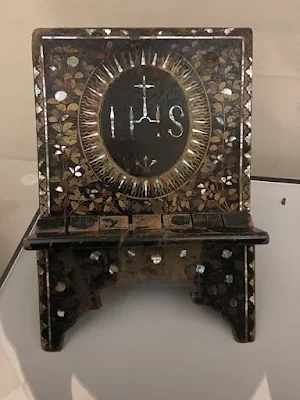
 Altar lectern made in Kyoto, Japan at the end of the 16th or beginning of the 17 century, with the monogram of the Jesuit order.
 Another from the beginning of the 17th century, from the island of Macao.


Altar decorations made in the Sicilian city of Trapani, and given to the Holy House by the Prince Caracciolo d’Avellino in 1722. The cross and candle set is made of silver and coral, the frontal of silk and satin, with gold and silk threads. Only the best for Our Lady!


A floral decoration made entirely from bird feathers.

A reliquary containing a shoe of St Charles Borromeo, end 18th century.

Tuesday, December 10, 2019
The Holy House of Loreto
Every Catholic country has a shrine which may be regarded as its national shrine of the Virgin Mary par excellence, such as Lourdes in France and Czestochowa in Poland; for Italy, that shrine is the Holy House of Loreto, which keeps its principal feast today. The traditional story recounts that the Virgin Mary’s house in Nazareth, where the Incarnation took place, was carried by angels from the Holy Land when the Crusader states fell, and brought first to Croatia in 1291, then three years later across the Adriatic to the area of Loreto. (There is some evidence that the angels in question may have actually been an aristocratic family of the Italian Marches named “Angeli.”) By the mid-15th century, it had become a very important pilgrimage shrine, and a project was begun to construct a large church around the Holy House, as well as a pilgrim hospice; this was completed in 1587, during the papacy of Sixtus V, a native son of the region who was famous for promoting important building works.
The house itself is a fairly small plain stone structure, certainly very ancient, and certainly made from materials commonly used for simple houses in the Holy Land, but not in Italy. It is now enclosed in a large rectangular marble box, commissioned by Pope Julius II in 1509 from the architect Donatello Bramante, whose design was completed from 1513 to 1527 by Antonio Sangallo the Younger; the importance of the Holy House is also indicated by the fact that both of these men served as chief architect for the rebuilding of St Peter’s, before Michelangelo took over in 1545. The box is beautifully decorated on the outside with sculpted relief panels of the life of the Virgin, works of very high quality. A 14th century statue of the Madonna long venerated in the Holy House was destroyed by fire in 1921, and replaced by a copy; it is traditionally clothed over with an elaborate jeweled garment. Many Italian churches have relics of the “veil of the Virgin Mary”, which are actually pieces of previous versions of this garment.
On the evening of December 9th, many towns in the area build bonfires in their public squares, to light the way for the angels as they fly the Holy House to Loreto, while at midnight precisely, church bells ring to commemorate their arrival. The feast was traditionally referred to as the “Translation of the Holy House” in pre-Conciliar liturgical books, and celebrated in every diocese of Italy; it is popularly known as the “festa della venuta – the feast of the arrival” in Italian. In 1920, Pope Benedict declared Our Lady of Loreto to be Patron Saint of aviators, then still a very new and dangerous profession. The feast was recently extended to the General Calendar as an optional memorial.
Here are some photos of the Basilica taken by Nicola de’ Grandi. The church also has a treasury with some very nice liturgical objects; I will make a separate post with his photographs of it tomorrow.
 Three views of the marble box which encloses the Holy House; the third photo also shows the dome, which was completed in 1500, and at the time, second in size only to that of the Duomo of Florence.


 |
| The façade of the basilica at Loreto at night; photo by Nicola de’ Grandi. |
Here are some photos of the Basilica taken by Nicola de’ Grandi. The church also has a treasury with some very nice liturgical objects; I will make a separate post with his photographs of it tomorrow.


Thursday, July 25, 2019
The Shrine of Santa Maria del Fonte in Caravaggio, Italy
In the year 1432, the northern Italian city of Caravaggio, about 22 miles to the east of Milan, was at the center of a long-running conflict between the Duchy of Milan and the Venetian Republic, a conflict attended by frequent seiges and sacks, violent faction-fighting within the cities and towns of the whole area, and plundering by bands of mercenaries roving the countryside. On May 26th of that year, the Virgin Mary appeared to a peasant girl named Gianetta de’ Vacchi as she was kneeling in a field to say the evening Angelus. In tears, the Virgin consoled Gianetta for the ill-treatment she was then suffering at the hands of her alcoholic husband, and asked her to deliver a message aimed at putting an end to the conflict. The words of the Virgin were as follows: “The Most High and Almighty, My Son, intended to destroy this land, because of the iniquities of men, since they do evil every day, and fall from sin to sin. But for seven years, I have implored My Son for mercy for their sins. Therefore, I wish you to tell each and all to fast on bread and water every Friday, in honor of My Son, and after Vespers, out of devotion to me, to keep every Saturday as a feast day. They must dedicate half of that day to me, in gratitude for the many and great favors obtained from My Son through My intercession.” In accordance with this charge, Giannetta did as she was asked, and implored the civil authorities to make a permanent peace settlement.
As would later happen at Lourdes, a spring of water rose up out of the ground, in which many people were healed of various infirmities; a hospice and church were erected on the site very shortly thereafter. In 1575, St Charles Borromeo began a new and far grander church, according to a design by the architect Pellegrino Tebaldi, but the project was only completed in the early decades of the 18th century; the site of the apparition is directly behind the high altar. It is now the second most visited Marian shrine in Italy after the Holy House of Loreto; here are some recent pictures from our Ambrosian writer Nicola de’ Grandi. (By the way, the painter Michelangelo Merisi was born in Milan in 1571 to a couple from Caravaggio, and used the name of their native place as his nom de plume to distinguish himself from the other, more famous Michelangelo.)

 The church is set at the center of a wide piazza, and surrounded by symmetrical tree-lined porticos on all four sides. The fountain of water runs through a corridor underneath the church (photos below), then passes out into this area on the side of the building, and is collected in a large pool surrounded by a marble balustrade.


As would later happen at Lourdes, a spring of water rose up out of the ground, in which many people were healed of various infirmities; a hospice and church were erected on the site very shortly thereafter. In 1575, St Charles Borromeo began a new and far grander church, according to a design by the architect Pellegrino Tebaldi, but the project was only completed in the early decades of the 18th century; the site of the apparition is directly behind the high altar. It is now the second most visited Marian shrine in Italy after the Holy House of Loreto; here are some recent pictures from our Ambrosian writer Nicola de’ Grandi. (By the way, the painter Michelangelo Merisi was born in Milan in 1571 to a couple from Caravaggio, and used the name of their native place as his nom de plume to distinguish himself from the other, more famous Michelangelo.)


The site of the apparition, known as “Il Sacro Speco” in Italian, “the Holy Cave.” (The same term is used for the shrine of St Benedict at Subiaco.) The wooden statues of the Virgin Mary and Giannetta (who has never been canonized, but is popularly called a Blessed), the work of Ortisei Moroder, were inaugurated in 1932, during the celebration of the fifth centenary of the apparition. The Blessed Card. Ildephonse Schuster, as Papal Legate, personally crowned the statue of the Virgin.

The nave and high altar.

Saturday, March 23, 2019
The Shrine of Our Lady of the Rosary in Fontanellato, Italy
Our Ambrosian writer Nicola de’ Grandi recently visited one of the major pilgrimage shrines of the Emilia-Romagna region, Our Lady of the Rosary at Fontanellato, about 11 miles north-west of Parma. The church was founded at the beginning of the 16th century, and became particularly famous after a plague in the region in 1630, which hit the town itself very lightly. Surprising at it may seem, this monumental Baroque façade is very new, constructed between 1913 and 1920.
 The Blessed Andrea Ferrari, archbishop of Milan from 1894 to 1921, was brought to the shrine as a child by his mother, and miraculously healed of a serious illness. He maintained a special devotion to the Madonna of Fontanellato all his life, coming each year as a pilgrim; he celebrated his first Mass at the church’s main altar in 1873, and 25 years later, as archbishop, his silver jubilee of priestly ordination. This statue was erected to commemorate him in 1925.
 I normally start these kinds of posts with the high altar, and work my way through the main body of the church and the side altars. In this case, however, the most impressive decorative features is this collection of altar frontals, made with a technique called “scagliola” in Italian, a composite of selenite, glue and natural pigments that imitates the appearance of inlaid marbles. (The Emilia-Romagna is poorly supplied with marble, and has come up with quite a few clever ways to decorate churches very beautifully, at considerably less expense than it would have taken to import marble from abroad.)


Wednesday, November 07, 2018
St Charles’ Final Retreat: The Monte Sacro di Varallo (Part 2)
Last Sunday, on the feast of St Charles, we posted some photos of the Monte Sacro di Varallo, where he spent some time in retreat in October of 1584, shortly before returning to Milan to die. Since there are 44 shrines on this “sacred mountain”, as the Italians called them, representing episodes the life of Christ, we couldn’t show the whole series in a single post; here are some of Nicolas’ photos, from the “Ecce homo” to the Holy Sepulcher. At the end are photos of the main church, dedicated to the Assumption of the Virgin Mary.


“Ecce homo” (John 19, 5)

Pilate washes his hands


Christ is condemned to death


The carrying of the Cross; Christ meets Veronica

Sunday, November 04, 2018
St Charles’ Final Retreat: The Monte Sacro di Varallo
In the Breviary lessons for the feast of St Charles Borromeo, whose feast is today, it is stated that towards the end of his life, “he withdrew to the solitude of Monte Varallo, where the mysteries of the Lord’s Passion (inter alia) are represented in life-size sculptures; and there for some days, lived a life made harsh by voluntary penances, but sweetened by meditation on Christ’s sufferings.” This was in October of 1584; he then returned to Milan, and died there on the night between the 3rd and 4th of November.
Monte Varallo is one of the group of nine pilgrimage shrines in the northern Italian provinces of Lombardy and the Piedmont (three in the former, six in the latter) known as the “Sacri Monti - Sacred Mountains.” It is also the most elaborate, with 44 chapels representing the life of Christ from the Annunciation to His burial, and the Fall of Man as a prelude. Inside each chapel, one of the sacred episodes is represented by a group of life-sized painted statues, and frescoes on the walls; some of these are quite small and simple, others very large indeed. Here are some photos taken by Nicola, which get us up to the Scala Sancta, the stairs that Christ climbed on the way to his trial before Pilate. A second set will be posted later in the week. (The chapels, by the way, are so called because of their architectural structure, but they don’t have altars and are not set up for the celebration of Mass.)


 |
| A representation of St Charles praying at the chapel of Christ’s Agony in the Garden. |
The Fall of Man

The Annunciation

The Visitation

The Arrival of the Three Kings

The Adoration of the Shepherds

Friday, August 31, 2018
The Glorious Mysteries at the Sacro Monte di Varese
Here is the last set of photos from the Sacro Monte di Varese, one of northern Italy’s most beloved pilgrimage shrines, which I visited last week with the Schola Sainte Cécile. The mysteries of the Rosary are represented with life-sized painted statues and frescoes on the walls of a series of “chapels”, with the church at the top of the mountain representing the Coronation. Be sure to listen to the recording of the Schola singing Victoria’s Ave Maria! (The Joyful and Sorrowful Mysteries were posted earlier this week.)
Each group of mysteries begins with a gate; the last one is dedicated to the Patron Saint of Milan, St Ambrose.


Each group of mysteries begins with a gate; the last one is dedicated to the Patron Saint of Milan, St Ambrose.

The Resurrection


The Ascension


Pentecost

currently under restoration... (ahem...)





