Monday, July 27, 2026

A Richer Table

That a richer table of the word of God may be provided for the faithful, let the treasures of the Bible be opened up more plentifully. - Sacrosanctum Concilium 51 (my own, corrected translation)

The LORD said to me: Go buy yourself a linen loincloth; wear it on your loins, but do not put it in water. I bought the loincloth, as the LORD commanded, and put it on. A second time the word of the LORD came to me thus: Take the loincloth which you bought and are wearing, and go now to the Parath (the name of a river); there hide it in a cleft of the rock. Obedient to the LORD’s command, I went to the Parath and buried the loincloth. After a long interval, the LORD said to me: Go now to the Parath and fetch the loincloth which I told you to hide there. Again I went to the Parath, sought out and took the loincloth from the place where I had hid it. But it was rotted, good for nothing!

courtesy of a friend of a friend
Then the message came to me from the LORD: Thus says the LORD: So also I will allow the pride of Judah to rot, the great pride of Jerusalem. This wicked people who refuse to obey my words, who walk in the stubbornness of their hearts, and follow strange gods to serve and adore them, shall be like this loincloth which is good for nothing. For, as close as the loincloth clings to a man’s loins, so had I made the whole house of Israel and the whole house of Judah cling to me, says the LORD; to be my people, my renown, my praise, my beauty. But they did not listen. (Jeremiah 13, 1-11, in the colorless, odorless, gaseous paraphrase known as the New American Bible, the reading for today, Monday of week 17 of Ordinary Time in the post-Conciliar Rite.)

Wednesday, December 10, 2025

Proposal for the Revised Apostolic Liturgy (RAL) of John Chrysostom - Part 2

Following the principles outlined in the first part of this article, here is the text of the Divine Liturgy of St John Chrysostom, revised according to all the ideas applied 60 years ago so fruitfully and beneficially to the reform of the Roman Rite, shared with us by intrepid scholar and reporter Petruk von Batavia. (Since more than one person seems to think that both the editor and I have suddenly, inexplicably and completely lost our minds, this is a satire, intended to demonstrate what an appalling mess the principles of the Roman liturgical reform would make if applied to another ancient and venerable rite.)

Model sanctuary

Text and Rubrics for Sunday Liturgy

[The proskomedia liturgy is abolished]

Liturgy of the Word


Invocation

Deacon: Reverend, give the blessing.
Priest: Happy is the realm of the + Father, Son, and Holy Spirit, now and forever.
All: Amen.

Great litany

[ Up to 12 lay readers may form a long, cycling queue for their turn to say a line from the great litany, to which all shall respond with “Lord, You are merciful”. ]

  • Reader 1: In peace, let us pray to the Lord.
  • Reader 2: For peace from above and for the salvation of all, let us pray to the Lord.
  • Reader 3: For world peace, for the well-being of all and for unity, let us pray to the Lord.
  • Reader 4: For this congregation, let us pray to the Lord.
  • Reader 5: For the most holy universal pontiff, N., Pope of Rome, let us pray to the Lord.
  • Reader 6: For our Major Archbishop N., the clergy and people, let us pray to the Lord.
  • Reader 7: For this country, the government, and the world, let us pray to the Lord.
  • Reader 8: For the original custodians of the land on which this temple stands, let us pray to the Lord.
  • Reader 9: For the prevention of climate change, for Sister Earth and all creation, let us pray to the Lord.
  • Reader 10: For travelers, for migrants and minorities, for women and the oppressed, let us pray to the Lord.
  • Reader 11: That we may always be a Synodal Church, let us pray to the Lord.
  • Reader 12: Remembering all the saints, let us commend ourselves and one another and our whole lives to Christ, our Lord.
All: To You, O Lord.
Priest: For all happiness, love and worship befit You, Father, Son and Spirit, now and forever.
All: Amen.

First antiphon

[ The term “soul” may express an imprecise notion of a disembodied mind and will, which had been undermined by modern neuroscience, hence we shall use the term “life” for the sake of intellectual honesty. ]

Psalm 102
All:
Bless the Lord, O my life, and all that is within me bless His holy name.
Bless the Lord, O my life, and forget not all His benefits.
He forgives all sins, heals all diseases.
He guides you away from corruption, crowning you with mercy.
Compassionate and merciful is God, abounding in mercy.
Bless the Lord, O my life, and all that is within me bless His holy name.
Blessed are you, O Lord.

[ Small litany is abolished ]

[ Second antiphon and Justinian’s hymn are abolished ]


The happy ones

Matt 5, 3-11
All:
Remember us, O Lord, in Your realm.
Happy are the poor, for theirs is paradise.
Happy are the mourners, for they will be comforted.
Happy are the meek, for they will inherit Sister Earth.
Happy are they who desire righteousness, for they will be satisfied.
Happy are the merciful, for they will be shown mercy.
Happy are the pure, for they see God.
Happy are the peacemakers, for they are children of God.
Happy are the marginalised and minorities, for they shall have paradise.
Happy are you when they oppress you and accuse you because of me.
Be happy for your reward will be great.

Small entrance

[ The altar servers may optionally perform a joyful dance accompanying laypeople in the small entrance procession. ]

Deacon: Wisdom! Stand up.
All: Come, let us worship Christ. Son of God, You arose, guide us who sing to You: Alleluia.

Troparia and kontakia

<Refer to the propers for the day>

Thrice-happy song

Deacon: Bless, Reverend, the time of the thrice-happy song.
Priest: For You, our God, are holy and we make You happy, Father, Son, and Spirit, now and forever.
All: Amen.
All: Holy, mighty, and immortal God, you are compassionate to us.

Prokeimenon

Deacon: Let us pay attention.
Priest: Peace to all.
Deacon: Wisdom! Pay attention!
<prokeimenon here>

Epistle

Deacon: Wisdom.
Reader: A reading from ...
Deacon: Let us pay attention.
Reader: Siblings, ...
<reading here>

Priest: Peace to all.
Reader: Thanks. You also.
Deacon: Wisdom! Pay attention!

Alleluia

All: Alleluia, alleluia, alleluia.

Gospel

Priest: Wisdom! Stand up! Let us listen to the gospel! Peace to all.
All: Thanks. You also.
Deacon: A reading from the gospel according to <name>.
All: Glory to you, O Lord, glory to you.
Deacon: Let us pay attention.
<gospel here>
All: Glory to you, O Lord, glory to you.

[ Insistent litany is abolished ]

Liturgy of the Eucharist


Cherubic hymn

[ Historically, handwashing takes place when a bishop presides before the great entrance, wherein, a subdeacon pours an ewer containing rose water for washing the bishop’s hands, all while the deacon censes the altar, iconostasis and congregation.

However, this may scandalise the faithful by appearing to diminish the dignity of the subdeacon and deacon with manual labour. Instead, the bishop may use a hand sanitiser from his pocket, or the temple may be installed with a faucet and an automatic hand dryer for the bishop to use, while the deacon simply burns incense on a bowl. ]


All:
Let us who represent the cherubim and sing the thrice-happy song to the liberating Trinity, now lay aside all prejudices.

Great entrance

[ The altar servers may optionally perform a joyful dance accompanying laypeople in the great entrance procession, bringing the gifts. ]

Deacon: May the Lord remember in His realm all you people, always, now and forever.
Priest: May the Lord remember in His country the most holy universal Pontiff, N., the Pope of Rome, all clergy, our country, and everyone, always, now and forever.
All: Amen. That we may receive the Word of God, who became human. Alleluia, alleluia, alleluia.

[ Litany of offerings is abolished ]

Sign of peace

Priest: Peace to all.
All: Thanks. You also.
Deacon: Let us love each other, that we may confess:
All: Father, Son and Spirit, the Trinity one in being and undivided.

[ The clergy and congregation shall give each other the sign of peace by a simple nod. Making physical contact should be avoided to maintain hygiene standards. The congregants shall reverence each other, in the Christian spirit of love and charity towards neighbour with: Namaste. ]

Nicene creed

[ All recite the creed. Historically, the priest will hold the Aër above the Gifts and waive it slowly, indicating the activity of the Holy Spirit. However, this is superstitious and the use of any veils, including the Aër, will now be forbidden. ]

Deacon: In wisdom, let us pay attention.
All: We believe in one God, …

Anaphora

Deacon: Let us stand up, let us stand with respect, let us awake to offer in peace the holy offering.
All: A mercy of peace, an offering of praise.
Priest: The kindness of Jesus Christ, the love of God the Father, and the friendship of the Spirit is with you all.
All: Thanks. You also.
Priest: Let us lift up our hearts.
All: We lift them up to the Lord.
Priest: Let us thank the Lord.
All: It is correct and good.
Priest: It is correct and good to bless, praise, thank, worship You everywhere; for You are God. You created the universe. So, we thank You, even though there stand before you many angels, singing, crying, shouting, and saying the happy song:
All: Holy, holy, holy is the Sovereign wonderful and powerful. The universe is filled with your glory. Happy is the Person who comes in the name of God. Hosanna in the highest.
Priest: With these angels, O God, who loves people, we say: Happy are You – truly, all happy – You and Your only-begotten Son and Your Spirit. Happy are You – truly all happy – and great is your happiness. You so loved Your world as to give Your Son, that whoever follows Him shall be happy. After He had come and taught us with His teachings, He was given over – or rather, gave Himself over for the world. He took bread into His hands, gave it to His friends, saying:

<usual words>

All: Amen.
Priest: When the meal was ended, He took the cup in the same way, saying:

<usual words>

All: Amen.
Priest: Remembering the love, example and teachings of Jesus Christ, our beloved Lord: We offer to You, Yours of Your own, in behalf of all and for all.
All: We sing, bless, praise, and thank You, and pray to You, our God.

Epiclesis

[ The priest may not make the sign of the cross over the bread and wine, as this fosters superstition; instead, he gently touches the bread and cup. ]

Priest: Further, look with your tender eyes how thankful we are for this bread and wine, the fruits of Sister Earth, and work of comrade’s hands: And send Your Spirit upon us and these gifts present,
And make this bread the body of Your Christ <touch the bread>,
And that inside this cup the blood of Your Christ <touch the cup>,
Changing them by your Holy Spirit,
So that they may be for recipients, nourishment and medicine, friendship with the Spirit, guide to happiness, and confidence before You.

Diptychs

Priest: Further, we offer you this good and sanitary worship for those who have gone to sleep before us: ancestors, parents, teachers, saints, and especially for the most Holy Mary, who actively chose to carry on with gestation by her own volition.
All: It is correct and good to bless you, the biological parent of Christ. Greater than the cherubim and happier than the seraphim; you gave birth to Christ our Lord, O true Theotokos, we honour your choice!
Priest: Among the first, remember, O God, the most holy universal Pontiff, N., Pope of Rome, and all the clergy. For the sake of your churches grant that they may live peacefully and happily for many years.
All: And remember all people.
Priest: And grant that with one voice and heart, we may praise and worship Your name, Father, Son and Holy Spirit, now and forever.
All: Amen.
Priest: And may the mercies of our great Guide and Lord, Jesus Christ, be with you all.
All: Thanks. You also.

[ Litany for the sanctified gifts is abolished ]
[ Litany of supplication is abolished ]


The Prayer

Priest: As Christ taught us, we say:
All: Father in heaven,
Holy is your name,
Your realm come,
Your will is done,
On earth and sky.
Give us this day our daily bread,
And pardon our sins,
As we pardon them that sin against us.
And do not allow us to be tempted,
But deliver us from evil.
Priest: For the realm, sovereignty, and happiness are yours, Father, Son, and Holy Spirit, now and forever.
All: Amen.
Priest: Peace to all.
All: Thanks. You also.
Deacon: Bow to the Lord.
All: To You, O Lord.
Priest: We give you thanks, O Lord, through the kindness, mercies and compassion of Your only-begotten Son with Whom You are happy together with Your holy, good, and liberating Spirit, now and forever.
All: Amen.

Communion

Deacon: Let us pay attention.
Priest: The happy things for the happy.
All: One is happy, one is Lord, Jesus Christ, to the gladness of the Father. Amen.
Praise the Lord from heaven: praise Him in the highest. Alleluia, alleluia, alleluia.

[ “I believe, O Lord, and confess that You are truly Christ ... ” is abolished. ]

Communion of the people

Deacon: Approach, all you people.
All: Happy is the person who comes in the name of the Word who appeared to us.

[ Communion is either received on the hand or taken directly from the diskos by the recipient. The recipient will then dip the bread into the wine and consume immediately. The use of liturgical spoon is discouraged to prevent the spread of bacteria or viruses.

Recipients come relaxed, without the requirement to cross their arms over their chest.

The priest distributing the eucharist says:
The bread of life and our spiritual drink. ]

Blessing with the gifts

Priest: Save all people, O Lord, and bless your inheritance.
All: We have seen the light. We have received the teaching. We have found happiness. We worship the undivided Trinity for guiding us.
Priest: Happy is God, now and forever.
All: Amen.

Thanksgiving hymn

Give thanks with a grateful heart
Give thanks to the Holy One
Give thanks because He's given
Jesus Christ His Son
And now let the weak say I am strong
Let the poor say I am rich
Because of what the Lord has done for us
Give thanks
We give thanks

[ Thanksgiving litany is abolished ]

Ambo prayer

Deacon: Let us go in peace.
All: In the name of the Lord.
Deacon: Let us pray to the Lord.
All: The Lord is merciful.
Priest: You bless those who bless You, O Lord, and make happy those who trust in your guidance. And we give glory, thanks, and worship to You, Father, Son, and Holy Spirit, now and forever.
All: Amen. Happy is the name of the Lord, now and forever.

Final blessing

Priest: May the blessing of God be on you with His kindness and love for people, always, now and forever.
All: Amen.

Dismissal

Priest: Glory to You, Christ our Lord, Glory to You.
All: Glory to the Father, Son, and Spirit, now and forever. Amen. The Lord is merciful. Give the blessing.
Priest: Christ + our Lord, through the prayers of Mary, His mother, of John Chrysostom, Archbishop of Istanbul, and of all the saints, will guide us, for He is good and loves all people.
All: Amen.

Thursday, December 04, 2025

Proposal for the Revised Apostolic Liturgy (RAL) of John Chrysostom - Part 1

Since the post-Conciliar reform of the Roman liturgy has been such an outstanding pastoral success, and such a monument of scholarly erudition, well might one wonder why the Eastern churches have not availed themself of its wisdom and similarly renewed their liturgies. Wonder no longer! As reported here by Petruk von Batavia, a consortium of liturgical scholars has final come together to bring all the benefits of the great renewal to the Byzantine Rite. This first post provides an outline of the general principles of renewal; a second post next week will give us the text of the “Divina Liturgia Normativa”, as it is currently being called, following the principles outlined here. (Since more than one person seems to think that both the editor and I have suddenly, inexplicably and completely lost our minds, this is a satire, intended to demonstrate what an appalling mess the principles of the Roman liturgical reform would make if applied to another ancient and venerable rite.)

Regalia of this sort have been abolished
MOTIVATION
We, the liturgical scholars of the Pisti Kai Agapi Synodal Committee (PIKASCO), have developed the Revised Apostolic Liturgy (RAL) as a standardisation and reform of early, diverse, apostolic Eastern Roman worship forms that were celebrated at the present Ayasofya Grand Mosque in 4th to 5th century Istanbul. We prioritise forms codified with the anaphora attributed to John Chrysostom.

Now, it is simply not the case that recensions after the 5th century are less valid. Rather, they represent forms of worship that had become excessively intertwined with secular expressions, worldly expressions that may have forgotten about the poor, the sick, and the suffering, and that have forgotten how to look with the merciful and loving eyes of Jesus Christ.

We have sought to de-Latinise the Ukrainian-Rusyn recension of the Liturgy of St John Chrysostom, as well as to decolonise and prune centuries upon centuries of imperialist and nationalist accretions. Some of these accidentally resulted from efforts to de-Latinise the Ukrainian-Rusyn liturgy in the 1900s through liberal insertions of Polish-Lithuanian sources by Archbishop Andrey Sheptytsky (born Count Roman Aleksander Maria Szeptycki) of the Ukrainian Greek Catholic Church, who was a highly-educated nobleman.

We should never hesitate to acknowledge and praise Sheptytsky’s contributions to the Ukrainian identity, state, and culture; however, it would do no one justice to view any person of wealth and influence uncritically.

Now, it may be true that St Pius X allegedly told Sheptytsky, who was also in charge of the Russian Greek Catholic Church at the time, that the Nikonian and pre-Nikonian rites should be celebrated “Nec plus, nec minus, nec aliter.” (Neither less, nor more, nor other.) However, this was a non-magisterial, non-binding remark which Sheptytsky conveniently adopted, enabling Russian rite prelates under him such as Mykolai Charnetsky to celebrate hierarchical divine liturgies that were identical to imperialist Russian Orthodox forms.

Ultimately his tolerance for imperialist forms, whether the Tsarist Russian recensions or his own native Habsburg Ruthenian/Galician recensions, is insufficiently apostolic. We should also acknowledge the tragedy of the refusal of countless Ukrainian Greek Catholic clergy and laypeople to dialogue, listen, and discern with the lawful Marxist authorities. This rigidity and stubborn adherence to human traditions ultimately led to needless conflict and casualties on both sides.

And of course there were limitations in the resources, geopolitical conditions and sciences of the time that ultimately led to thicker layers upon layers of Habsburg and Tsarist accretion. Thus, we conservatively adhere to sources before the 5th century. Careful pruning and reconstructions were implemented based on extensive, advanced research and the scholarship of liturgists from top pontifical institutions.

Nevertheless, there were necessary adaptations and accommodations made in keeping with modern sciences and ethics. However, aggiornamento is permitted only for improvement. And there were some simplifications made to enable the purpose and message of the liturgy to be made clearer. In the end, the spirit of the original Liturgy of St John Chrysostom at its zenith and in all its splendour is fully intact in the RAL, even more powerfully and vigorously than in the imperialistic and ethnocentric Nikonian, pre-Nikonian, Greek, Antiochian, or Ruthenian recensions.

Having codified the RAL, we shall humbly defer to the lawful authorities, namely the Dicastery for the Eastern Churches, Dicastery for Divine Worship, Dicastery for the Doctrine of the Faith, and ultimately the Roman Pontiff himself for their wise counsel and decision. We pray for successful implementation of the RAL in the Ukrainian Greek Catholic Church, the largest Eastern Catholic body, to gradually replace their current Ukrainian-Rusyn recension of the Divine Liturgy of St John Chrysostom, which we advise should eventually be pastorally restricted for the purpose of a more faithful adherence to the teachings of the Second Vatican Council.

Most importantly, the RAL is a labour of love, it is the fruit of a committee which understands that love and obedience towards the Holy Father and the Magisterium are necessary in order to truly appreciate and worship according to the Eastern patrimony. Our passion for synodality drove us to deeper study, discernment, and listening to the Spirit. As a result, we feel an intensely strong conviction to humbly assist the Ukrainian Greek Catholic Church in recovering its venerable traditions.

GUIDELINES
Prayers
To foster active participation and improve catechesis, no prayer is allowed to be said silently, repetitions are removed, lengthy prayers are shortened for clarity, and late accretions are deleted for purity. Prayers that require excessive explanation and context are either removed or simplified. For example, the prayer “O Heavenly King” prayer is removed for potentially insensitive language.

Any non-essential exaggerations of supernatural events in the liturgy are corrected or removed to maintain a high standard of intellectual honesty.

Orders
The minor orders obscure the priesthood of the lay faithful, instead there should be more emphasis on laypeople leading several liturgical parts. Hence this liturgy will assume that the minor orders are abolished in the Ukrainian Greek Catholic Church, which they should be.

Architecture
The holy table or altar should be free standing and always oriented versus populum, as per early Eastern Christian practice. Instead of a cube-shaped altar, a lower hemisphere would convey tenderness and care for our common home. Likewise, the iconostasis should be absent as per early Christian practice.

This altar set up for World Youth Day in Lisbon in early August of 2023 represents the best of the original and apostolic tradition. “Two spritzes and a G&T, please.”
Images
Traditional iconography is only allowed when it does not obscure the altar, become an object of worship, nor have convoluted theology. Its use should be extremely limited. Instead of venerating icons, congregants are advised to acknowledge each other as living icons of the Imago Dei.

Icons such as Rublev’s Trinity require extensive explanation and catechesis to understand, hence they should not be displayed.

Needlessly obscure.
Icons of the Theotokos tend to overemphasize her role as a mother, which may alienate people of diverse backgrounds. Instead, pastorally sensitive depictions of Mary should promote feminine strength.

Domes that have the Christ Pantocrator image often depict Jesus with toxic masculinity, instead our Lord should be depicted as a tender, loving, inclusive rabbi who embraces all.

Incense
Burning incense on a bowl is permitted, however the use of swinging thuribles, especially the Eastern Orthodox form with twelve bells, can become noisy spectacle and distract, thus all thuribles are highly discouraged.

Candles and liturgical fans
Few candles are permitted around the altar, but not on top of the altar. Over-decoration by candles should be avoided to prevent distraction.

The trikirion and dikirion are later innovations, and liturgical fans are excessive decorations; it is better to not utilise those ornate objects. Baroque decadence does not express solidarity with the poor.

Liturgical crucifix and blessings
The liturgical use of the crucifix for blessing is a later pious innovation. However, priests are consecrated to act In Persona Christi, to confect the gifts. And the use of the liturgical crucifix for blessings, however pious the intention, may obscure the Church’s true teachings about consecrated hands.

Instead, priests should bless with a relaxed right hand, with an open palm, without forced contortions of the fingers to spell out IC XC, which can foster superstition.
Rightly consigned to the museum.
Oblations
Wine and unleavened hosts are used for the RAL. While the Eastern Orthodox use leavened prosphora to symbolise the risen Christ and the presence of the Holy Spirit within the Eucharist, the proskomedia service associated with its preparation is needlessly convoluted, full of nonessentials, and superstitious. Hence, we remove the proskomedia liturgy completely, and use unleavened hosts to minimise the spread of crumbs.

Pontificals
It is inappropriate for bishops to vest in sakkos and mitre, as these accretions originated as the regalia of the Eastern Roman Emperor. The epigonation originated as a thigh shield awarded to officials, thus it should also be done away with. The liturgy is not meant to be a pompous, decadent, secular court ceremony, but a simple communal meal wherein all the people of God actively participate in solidarity with the poor and those in the peripheries.

An undecorated phelonion with plain omophorion that is sewn into shape is preferred for bishops. The full ceremonial omophorion that requires it to be passed around the neck, folded in the front, and hung down past the knees in both the front and the back should not be worn, as it has become excessively decorative and time-consuming to put on, failing to convey the symbol of the Good Shepherd, who should smell of the sheep.

If there are no such omophoria available, bishops can instead wear their epitrachelion on top of their phelonion. For the hands, liturgical cuffs may restrict movement, so they should be discarded.

Attire outside of liturgy
Bishops who enter the temple vested in monastic habit must not wear the klobuk or mantiya, as these kinds of attire may indirectly foster clericalism.

All religious should be encouraged to be clean-shaven, as beards may contribute to clericalism.

The preferred habit for monks and hieromonks should be determined by the principle of the via media. In this day and age that may even manifest in wearing a modest semi-casual suit with jeans.
Fr Karl Rahner SJ, a great Western leader in the synodal path of renewal, photographed during an interview in 1974. (Image from Wikimedia Commons by Jesromtel, CC BY 3.0)
Music
The use of Eastern Roman, Kyivan, Galician, and Prostopinije chants for the more melismatic lines are unsuited and unpalatable to modern ears, hence inconducive to discerning, responding, and listening to the Spirit. Instead, simpler chant is preferred for active participation and intelligibility.

Furthermore, classical compositions such as those by Bortniansky, Leontovych, Stetsenko, etc., may reflect an unhealthy obsession with imitating Western European styles. And, their complex harmonies may distract, becoming more of an idolatrous spectacle.
The Cherubic Hymn (“Let us who mystically represent the Cherubim”) in a setting by the Ukrainian composter Dmitry Bortniansky (1751-1825). Insufficiently fostering of active participation.

Any song in the liturgy must have simple, singable melodies to encourage active participation. Musical instruments (piano, guitar, keyboard) as accompaniment should be permitted.

Gestures
Making excessive signs of the cross is potentially superstitious and vain repetition, thus we reduced its frequency in the RAL to emphasize sobriety, solemnity and foster healthy catechetical formation.

Instead of the usual Eastern sign of the cross with three fingers, a small sign on the forehead with the thumb is made as per early Christian practice, and will be rubrically indicated by a within the liturgical text. If  is not indicated, then it is spiritually dangerous and possibly prideful to make the sign of the cross.

The normative way to worship in the East is always to stand up with confidence, as humans are made in the image and likeness of God. Bowing and prostrating were historically understood to have been penitential gestures, however these may appear to undermine human dignity, and may even be weaponised for performative piety by those struggling with spiritual pride. Thus, only sitting and standing are permitted throughout the liturgy. And we can express penitence through our own interior disposition.

Kissing icons, diskos, chalice and altar may spread germs, so such gestures are better avoided.

Monday, May 19, 2025

Palestrina’s Motet for Papal Coronations, “Hic Nunc Est”

This was spotted on Twitter yesterday, a set of photos from the Mass which formally inaugurated the ministry of the newly-elected Pope Leo XIV, feliciter nunc regnantis.

The learned Dominican and the learned Jesuit are speaking about one of the old rituals that was removed from the papal coronation Mass by the post-Conciliar reform. When the faithful had gathered in St Peter’s basilica, before the Mass began, the Cardinal Bishop of Albano would gesture first towards the clergy in choir, and then towards the crowd in the nave, and solemnly intone the motet “Hic nunc est”, which the choir would then continue, “circus tuus, hae nunc sunt simiae tuae!” Palestrina’s polyphonic setting of it, composed for the coronation of Pope Marcellus II in 1555, is pretty amazing, and came to be used as a matter of routine, so that the Gregorian original was lost. Unfortunately, there is no recording of it on YouTube, but an old friend managed to find a version of it on this platform. (The recording is not embeddable, but the external link is safe, I promise.)
The Latin scholars among our readers will recognize these words as a reference to a Polish expression which has become somewhat popular in English in recent years, “Not my circus, not my monkeys”, a way of saying, “This is not my problem.” And in point of fact, it was originally a privilege of the ranking Polish cardinal or archbishop to intone the motet, IF any of them happened to be in Rome for the coronation. But Gniezno, the primatial see of Poland, is 975 miles from Rome, and most of the other important episcopal sees of that nation are even further away. Before trains and telegraphs, it usually worked out that by the time they got the news of the death of the old pope, the new one had already been elected and crowned, so over time, the custom devolved onto Albano.

The full text of the antiphon as given in the recording is as follows:

“Hic nunc est circus tuus, hae nunc sunt simiae tuae,
quas Dominus in sapientia sua Petro tradidit,
et per manus eius nunc tibi commendat.
Gaude in stultitia sanctorum,
laetare in tumultu gratiae,
nam per hos clamosos
regnum caelorum patefit.

This is now your circus, these are now your monkeys,
Whom the Lord in His wisdom handed over to Peter,
and though his hands, now commends to you.
Rejoice in the foolishness of the Saints (cf. 1 Cor. 3, 18-19),
be glad in the tumult of grace,
for through these noisy ones
the kingdom of heaven is laid open.”
And I therefore also make bold to remind our readers of these prayers for the Pope which are traditionally said at services like Benediction, and can of course be said privately any time.

Wednesday, April 23, 2025

The Last Service of Easter

Following up on Monday’s post about the service known as the Paschal Hour in Byzantine Rite, here is the text of another special rite, which is done after Vespers on Easter day itself. It is brief enough to show the whole of it with just one photograph from the Pentecostarion, the service book which contains all the proper texts of the Easter season. Christ is risen!

Friday, February 14, 2025

Mutual Enrichment

Your translation’s divine,
Your preaching melodious;
Won’t you be
My Cyril and Methodius?

This Valentine’s Day joke is here reproduced by the kind permission of the author, Fr Dominic Holtz, of the Order of Friars Preachers. Facetus et sagax, docendi semper ac jocandi capax!

Wednesday, October 30, 2024

Introducing the Newest Jubilee Mascot: Tenebro

I am sure that by now, all of our readers have met Luce, the official mascot of the upcoming Jubilee, who was introduced to the world on Monday as an expression of the Church’s desire “to live even within the pop culture so beloved by our youth.” However, as many have noted, the style of the new mascot seems geared to appeal to those who are so young that they are just as likely to fall asleep under a pew as to sit in one, leaving the unfortunate impression that the Faith is something to be grown out of. Rightly might one suspect that she holds little interest for groups within the Church whose numbers are growing, such as young men, and those who love traditional forms of worship

To meet this problem, the wise men of the Sacred Congregation for the Propagation of the Faith have decided that the Jubilee of 2025 will have a whole range of mascots, designed to appeal to a variety of demographics. New Liturgical Movement is very proud to have been chosen as the outlet for introducing the world to the first new character in the Luce expanded universe, her putative (n.b.!) nemesis Tenebro.

The official backstory of Tenebro is that he is one of the Rigidicons, a group who are reputed to have the dark power to gradually extinguish all the lights of progress that have been lit within the Church over the last 60 years. (This power is suggested by the fact that they dress primarily in black.) In early episodes of the upcoming animated series, it will appear to many that Tenebro is trying to hinder Luce from completing her pilgrimage to Rome.

But, as is so often the case, the real story is a lot more complicated. (Spoiler alert!) It will be gradually revealed that another character, the Pontiff Supreme Benedicto, transformed the power of the Rigidicons, such that the lights which they extinguish come blazing back to life and illuminate the whole Church. Tenebro is one of a growing faction among the Rigidicons who have embraced this transformation of their power for good, which is conveyed through the diadem on his chest. (It will also be Tenebro who teaches the young Luce that a rosary is not a necklace...)
New Liturgical Movement will be the first to let you know as each of a whole spate of new Jubilee mascot characters is brought out to an eagerly waiting Church and world.

Wednesday, March 06, 2024

Lost Customs of Military Chaplains, Restored on TV

We recently highlighted Matthew Plese’s book “Restoring Lost Customs of Christendom,” a compendium of articles about Catholic customs which have fallen into desuetude, and in some cases been almost wholly forgotten. We were therefore very pleased to see how the currently running show Masters of the Air, about bomber pilots in the European theater of World War II, has documented an old lost custom of Catholic Air Force chaplains. (Episode 3, at the 6:10 mark.) When blessing the men before they departed on a mission, they would wear an alb with no cincture, and a chasuble turned backwards. One of the things which the show highlights is how dangerous bombing missions were, and so the backwards chasuble symbolizes the intention of the blessing, that the men come back safe and sound.

The chaplains also wore a stole on the outside of the chasuble, in reference to the words of the vesting prayer which calls it “the stole of immortality”, since the mortality rates of bombing missions were often very high.
(A bit more than two years ago, we noted a similar revival of the odd use of vestments, an even more thoroughly disused custom of the Sarum Rite, on the BBC’s Father Brown series.)

By the way, I would add that this series is genuinely very well done, an Air Force iteration of the deservedly famous Band of Brothers from 2001, and while it is not a major feature, the religiosity of the characters is really portrayed with sincere respect.

Saturday, September 16, 2023

Laudato Si’, Laudato No

In function of that peculiar charism (and, in the telling of some, very peculiar) by which the god of surprises goes about his business, the Sacred Congregation for Rites has just announced the promulgation of a novel liturgical tradition. In order to remind us in a more profound and meaningful way that we celebrate every liturgy as a liturgy of creation, it is now permitted to replace the traditional scheme of liturgical colors with the skins of extinct or endangered species, according to the International Union for Conservation of Nature’s “Conservation Status” scheme. NLM is very honored to be chosen once again by the Sacred Congregation as the medium of promulgation for this important new tradition. Here is an outline of the scheme:

Extinct – funerals
Extinct in the wild – Ash Wednesday and Good Friday
Critically endangered – Lent
Endangered – Advent
Vulnerable – Confessors, Virgins
Near threatened – Apostles, Martyrs
Least concern – feasts of Our Lord, Our Lady and the Angels.
The official Latin text is still being composed (it will be called Risu dignum et justum), but a special note has already been released, which recommends the black-and-white striped hide of the quagga as a profound and meaningful expression of the unity of the Paschal mystery, and therefore especially appropriate for funerals. (It is left to the local episcopal conferences to determine which extinct animals’ hides will be most profoundly significant and meaningful for use in funeral liturgies; they are, however, strictly forbidden from making any such determination without the approval of the Sacred Congregation for Rites, to be requested in writing.)
Public domain image from Wikimedia Commons.
The Italian church, always especially forwardist when it comes to matters liturgical, has already put the new tradition to good use, for a celebration of the optional memorial of St Tarzanius. (Courtesy of the Facebook page of the Italian blog Messa in Latino.) 
Laudato Si’...
Laudato No!
NLM asked Mons. Giovanni Boidenio, pontifical cerimoniere and titular archbishop of Amafratria, for his comments on the new tradition. He wrote: “I would love to see the orphreys of a Requiem set done in Great Auk, which has a very rich sheen. Less pliable hides such as those of the Sumatran elephant may represent a challenge for vestment design companies. Could they be employed in a mitre? or perhaps the footwear? I think incorporation of each category is important: nothing would raise environmental awareness more than, say, an alb appareled with Pernambuco pygmy owl, or perhaps some California condor.

This raises another question: is the employment of such endangered/extinct species limited to seasonal vestments? What about liturgicalia that are not season-indicated, such as sacred vessels? For example, the Hawaiian gastropod laminella sanguinea is critically endangered/possibly extinct, so it would qualify as decoration. It has a gorgeous deep red shell and would look really nice inset on the base or cup of a chalice or ciborium. Would this be possible? Or is the new custom limited to vestments?”

Of course, with the emergence of new gene-splicing and cloning technologies, it is possible that some extinct species may become unextinct in the not-too-distant future, in which case, the new liturgical market could provide an important incentive for breeding them. NLM will be the first to let you know about any exciting developments in this new tradition.

Saturday, September 02, 2023

The Kids Are Old Rite

Our heartfelt thanks to Fr Timothy Ferguson for allowing us to share this brilliant song parody which he wrote. It is based on the title of an article by Matthew Schmidt published in the Catholic Herald just over six years ago, which in turn takes its title from the song “The Kids Are Alright” by The Who. (For a sense of chronological perspective, by the way, this song is older than the post-Conciliar Rite, although not as dated.) Feliciter tibi, optime pater!

I don’t mind a little Latin in my Mass,
that’s fine, in fact it gives a little gravitas,
But to turn to the altar with candles alight,
seems to draw families in, the kids are Old Rite,
the kids are Old Rite.

Sometimes, I think the revolution’s lost,
bells chime, and burlaps banners all are tossed,
and I shed a few tears for those lost wasted years,
‘Cuz despite all we’ve done, the kids are Old Rite,
the kids are Old Rite.

I know I should go to the Lord and confess,
for the plans that we laid have just made a big mess.

I don’t mind some incense and a little lace,
But these kids are turning up in every place,
if you shut down one Old Mass, there’s five other sites,
best to leave them alone, the kids are Old Rite,
the kids are Old Rite.

Sometimes, I worry that the Council’s failed,
our Spes, and our Gaudium have been derailed,
then I read all the texts, and it’s in black and white,
the kids are the future, and they’re all Old Rite,
the kids are Old Rite,
the kids are Old Rite.

Saturday, February 25, 2023

New Liturgical Anathemas for the Post-Conciliar Rite

Yesterday, we looked at the Byzantine Rite’s liturgical reading on the first Sunday of Lent (tomorrow on the Gregorian calendar, next Sunday on the Julian) of the Synodikon of Orthodoxy, a decree of the Seventh Ecumenical Council that anathematizes the iconoclasts and various other heretics. Since the post-Conciliar Rite adopted into itself so many oriental customs wholly extraneous to the Roman Rite, well might one wonder why this custom was not among them.
The frontispiece of a Byzantine Catholic Rite archieratikon, the liturgy book containing the bishop’s parts of the major liturgies, printed at Supraśl, Poland in 1716.
Wonder no longer. With a decree issued on Tuesday, the Sacred Congregation for Rites has finally closed this gap, promulgating a set of liturgical anathemas that admirably reflect the most exciting new developments in ecclesiology and liturgical theology. NLM is very honored to be the medium by which the Sacred Congregation has chosen to divulge these, while we wait for the official Latin text of the decree, which will be titled Ludens feci, to be officially published in the Acta Sanctae Sedis.
The very first encyclical letter of the current pontificate warned the Church against the temptation to self-referentiality, and as more recent events have shown us, the best possible way to combat this temptation is for the Church to spend four years talking to itself about itself. This will explain the fact that these anathemas are all, as it were, inward-looking, a part of the necessary process of self-reflection by which the Church will shake itself free of that temptation. In the finest tradition of the post-Conciliar liturgy, these anathemas may be adapted to local realities, but never, of course, to local ideas, and indeed, the careful reader will immediately note that it is only ideas that are anathematized, and not realities. Of course, we cannot but admit that we were very surprised to see where some of these ideas that are now being anathematized come from, but such is the way of the god of surprises.
The beginning of the Synodikon of Orthodoxy in that same edition.
It is foreseen that the text will be re-written continually, year by year, as the process of liturgical inculturation initiated by the Council continues to bear ever more mature fruits which even the Council itself never envisioned.
Rubrics for the proclamation of the new anathemas.
1. Following the Byzantine tradition, these anathemas may be proclaimed on the first Sunday of Lent, but also on any other Sunday of Lent, or a Sunday of another season, or on any other day. The authority to determine another appropriate day for their proclamation rests with the local bishops’ conferences, which, however, are strictly forbidden from making any such determination without the approval of the Sacred Congregation for Rites, to be requested in writing.
2. As in the Byzantine tradition, the ordinary minister of the anathemas is the deacon, but if there is no deacon, they may be proclaimed by a lay person, who, for this occasion only, may also wear a dalmatic if one is available. Whether worn by a deacon or a lay person, the color of the dalmatic may be violet, since the traditional day for their proclamation is the first Sunday of Lent, in which the liturgical color is violet, in order to symbolize in a more profound and meaningful way that the season is Lent. However, it may also be white, to symbolize the purity of intention with which the Church proclaims them; red, to symbolize the fervor with which She proclaims them; or green, to symbolize the flourishing of the Faith that comes from proclaiming them. The authority to determine the liturgical color for the proclamation of the anathemas rests with the local bishops’ conferences, which, however, are strictly forbidden from making any such determination without the approval of the Sacred Congregation for Rites, to be requested in writing.
Copes for the proclamation of the anathemas at the cathedral of Namur in Belgium. The authority to determine the use of a cope rather than a dalmatic for their proclamation rests with the local bishops’ conferences, which, however, are strictly forbidden from making any such determination without the approval of the Sacred Congregation for Rites, to be requested in writing. (Photo courtesy of Liturgical Arts Journal.)
3. The anathemas are to be proclaimed from the same pulpit from which the Scriptural readings, general intercessions, sermons, and announcements are proclaimed. But they may also be proclaimed during a procession, after the Mass, before the Mass, or in a separate “service of the Word” to be held apart from the Eucharistic celebration, if local pastoral realities determine this to be useful. The authority to determine another appropriate occasion for their proclamation rests with the local bishops’ conferences, which, however, are strictly forbidden from making any such determination without the approval of the Sacred Congregation for Rites, to be requested in writing.
4. In keeping with the Byzantine tradition, the response of the people to the anathemas may be “Anathema, anathema, anathema.” However, other responses more appropriate to local pastoral realities may be used instead, such as a verse from Scripture. A brief period of meditation may also follow the proclamation of each anathema, in place of a vocal response. The authority to determine another appropriate response rests with the local bishops’ conferences, which, however, are strictly forbidden from making any such determination without the approval of the Sacred Congregation for Rites, to be requested in writing.
The anathemas.
1. If anyone shall say that the bishops of the Catholic Church “have the sacred right and the duty before the Lord to make laws for their subjects, to pass judgment on them and to moderate everything pertaining to the ordering of worship and the apostolate”, let him be anathema.
2. If anyone shall say that the bishops of the Catholic Church are “(not) to be regarded as vicars of the Roman Pontiffs, for they exercise an authority that is proper to them, and are quite correctly called ‘prelates,’ heads of the people whom they govern”, let him be anathema.
3. If anyone shall say that it is “up to the bishop, as moderator, promoter, and guardian of the liturgical life of the Church of which he is the principle of unity, to regulate the liturgical celebrations, to authorize in his churches, as local Ordinaries, the use of the Missale Romanum of 1962, applying the norms of the motu proprio ‘Traditionis custodes’, and to determine case by case the reality of the groups which celebrate with this Missale Romanum”, let him be anathema.
4. If anyone shall say that authority over the liturgy in a diocese resides with the local bishops rather than with the Roman Curia, let him be anathema.
5. If anyone shall say that “there must be no innovations (made to the liturgy) unless the good of the Church genuinely and certainly requires them; and care must be taken that any new forms adopted should in some way grow organically from forms already existing”, let him be anathema.
6. If anyone shall say that “the use of the Latin language is to be preserved in the Latin rites” or that “Gregorian chant, being especially suited to the Roman liturgy, should have the chief place in liturgical services”, let him be anathema.
7. If anyone shall say that “that holy Mother Church holds all lawfully acknowledged rites to be of equal right and dignity”, or “that she wishes to preserve them in the future and to foster them in every way”, let him be anathema.
8. If anyone shall say that “What earlier generations held as sacred, remains sacred and great for us too, and it cannot be all of a sudden entirely forbidden or even considered harmful”, let him be anathema.
9. If anyone shall say that the Holy See should “guarantee respect for the rightful aspirations of all those Catholic faithful who feel attached to some previous liturgical and disciplinary forms of the Latin tradition”, let him be anathema.
10. If anyone shall broaden his tent to include those who love the traditional Roman Rite, show them mercy, accompany them, dialogue with them, or listen to them, let him be anathema.
(NLM editor’s note: this is the place where, in keeping with the spirit of the Byzantine Synodikon of Orthodoxy, there should be a commendation of the inventors of the post-Conciliar Rite, as the Synodikon commemorates the defenders of the orthodox faith. But of course, despite the magnificence of their achievements, the Holy See has traditionally drawn a veil of humility over them. If thou seekest their monument, look around...)

Thursday, September 22, 2022

The Liturgical Triathlon

It might have seemed like this was just another summer of the Italian Church’s long and humid New Pentecost™, between the Mass celebrated by a priest in a bathing suit on a pool lounger...

and another celebrated more recently by a priest on a biking tour, and dressed for it,
but I think our friends at Messa in Latino have rightly guessed that what we are actually witnessing is the invention of the Liturgical Triathlon. Keep an eye on social media for a Mass celebrated for a congregation of joggers, with the priest accompanying them, as it were, on their journey...

As an old Italian proverb says, Si ride per non piangere - we laugh so as not to weep.

Saturday, January 08, 2022

Sarum Revivalism on the BBC

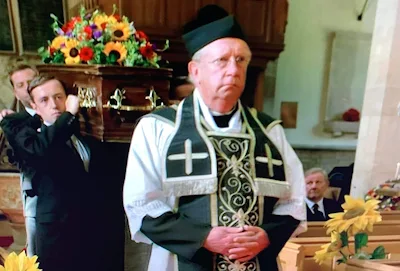
British friends have been sharing on social media this screen capture from the most recent episode of the BBC’s Father Brown series, based on the famous detective stories by G.K. Chesterton.

Although this is not part of the original stories, with the artistic license usually granted to all things churchy, the title character is now something of a Sarum revivalist, and here we see three of the ancient Sarum customs for funeral liturgies.

– The biretta is worn sideways, so that the gap is at the front.
– The alb is replaced with a surplice, preferably one normally used by the younger altar servers, so that the sleeves will be quite short. (This custom is believed to have originated in the Use of Hereford, and to have been adopted at Sarum only in the reign of Edward V.)
– The maniple is worn around the neck, rather than on the left forearm, as a sign of mourning. This refers, of course, to the words of Psalm 125, “Going forth they went and wept, casting their seeds, but coming back, they shall come bearing their sheaves.” The Latin word “manipulus” means “a sheaf”, but also the vestment called the maniple.
The Sarum liturgy is, alas, so little used and seen that one might forgive people for thinking this was just a dog’s breakfast made by the show’s liturgical advisor, or a carry-over from the most famous role of the actor who plays Fr Brown, Mark Williams, best known to American audiences as Harry Potter’s father-in-law. As a friend of mine observed, “Mr Weasley was always obsessed with Muggle things, but never did know how to use them correctly.”
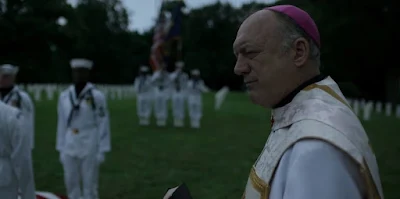
Many people don’t realize that this custom of the Sarum Use also inspired a feature of the post-Conciliar rite. Since the maniple was made optional, the stole may be worn backwards and outside the chasuble at a funeral, as depicted in 2015 on a fictitious archbishop of Washington DC in the show House of Cards.

Wednesday, December 22, 2021

Announcing the New Congregation for Monitoring Church Bulletins

As we all know, in recent days and months, the sacred dicasteries have taken some important steps to preserve the legacy of the Second Vatican Council. For explanation of how this is so, you can hardly do better than this article from The Pillar (https://www.pillarcatholic.com/p/roches-rules-does-the-new-extraordinary). It elucidates how, in the spirit of collegiality, the CDW has pretended to arrogate to itself all kinds of prerogatives that would normally belong to the local bishop, in fulfillment of Vatican II’s dogmatic constitution on the Church, Lumen gentium; specifically, of its statements that “The pastoral office, or the habitual and daily care of their sheep, is entrusted to [the local bishops] completely, nor are they to be regarded as vicars of the Roman Pontiffs, for they exercise an authority that is proper to them. ... In virtue of this power, bishops have the sacred right and the duty before the Lord to make laws for their subjects, to pass judgment on them and to moderate everything pertaining to the ordering of worship and the apostolate.” (LG 27)

One of the most notable ways in which the new responsa fulfill this is that they take away from the bishops jurisdiction over what may be printed in local church bulletins. (As a wise young priest noted, “At some point we went from ‘We have to modernize the liturgy so that young people will show up.’ to ‘If we don’t publish Latin Mass times, we will keep young people from showing up.’ ”) However, this presents an obvious logistic problem: how to monitor the world’s church bulletins to make sure no one is advertising a Mass that young people want to go to.

In response to this pressing pastoral need, a new Congregation has been swiftly established, the Congregation for the Bulletins of the World. (Congregatio pro Bulletin Mundi. Sadly, Latin standards are still falling; that should really be ‘Bulletinis’ or ‘Bulletinibus’.) As of yet, there is no official website, but that hardly matters. In keeping with Inter Mirifica, Vatican II’s Decree on the Media of Social Communication, all of the new Congregation’s business is being done solely via Twitter. (https://twitter.com/BulletinMundi) And mirabile dictu! we already have some wonderful examples of the efficiency of this new way of exercising the Church’s pastoral charity. Within less than 24 hours from the appearance of the responsa, people were already eagerly delating parishes to the new Congregation for failing to update their bulletins accordingly. So, if you know of any parish that has yet to begin the important work of driving the young faithful away from the Mass, just tweet it out, and include the user-name @BulletinMundi. As noted in the pinned tweet at top, you can also delate people to the authorities for mocking their work. Although this has not yet been formalized, a curial insider informs me that the new Congregation’s official motto will be taken from St Paul’s Second Letter to the Corinthians, 5, 14: “the charity of Christ compels us.”

(You may scoff that Inter Mirifica can hardly have supposed any such thing, given that Twitter only came into existence 43 years after it was issued. Woe to thee, o scoffer! It was issued on the very same day as Sacrosanctum Concilium, which certainly did not suppose any such thing as the reform which came after it, so all is well.)

Tuesday, May 05, 2020

Traditional Latin Mass Server Quarantine Workout

This very funny video has been making the rounds on social media... a great way to stay healthy, and stay in practice for serving at Mass once the churches reopen, quod Deus celeriter praestet!

Tuesday, April 28, 2020

Another Update to The Liturgy

...for the year of the virus: how to dismiss the catechumens when the liturgy is live-streamed.

Saturday, April 18, 2020

Everybody’s Favorite Easter Ritual 2020

Further proof that God disapproves of loud microphones in church...

Wednesday, July 31, 2019

A Drinking Song in Honor of St Germanus, by Hilaire Belloc

Most places which use the Roman Rite keep today as the feast of St Ignatius of Loyola, the founder of the Jesuits, who died on July 31, 1556. But in the Middle Ages, July 31st was kept in France, England and some other places (although not at Rome) as the feast of St Germanus of Auxerre; Ignatius himself would have celebrated this feast during his years as a student in Paris, along with the earliest members of the Company. A 7th-century church dedicated to St Germanus sits directly in front of the Louvre; his feast is also on the calendars of liturgical books of the medieval French and English Uses.

A state of St Germanus in the Parisian church of St Germain l’Auxerrois (Image from Wikimedia Commons by Mbzt, CC BY-SA 3.0)
Although devotion to him is not as widespread now, St Germanus may well be described as the St Ambrose of the fifth century. Like the great archbishop of Milan, he came from a family of high rank, and after studying law in Rome, served as the civil governor of a Roman province. Like St Ambrose, when the bishop of his provincial capital died, he was chosen to succeed him by popular acclamation, and embraced his new state of life completely; and in that role, he revealed himself as fierce an opponent of the 5th century’s dominant heresy, Pelagianism, as St Ambrose had been to Arianism in the 4th.

Pelagius himself was a Briton, and in the early 5th century his heresy was flourishing in his native place. In 429 Pope St Celestine I and the bishops of Gaul sent Germanus, accompanied by St Lupus of Troyes, to Britain, to combat the heresy; they reduced Pelagius’ followers to silence not only by their overwhelming success in a public debate, but also by their example of holiness and various miracles. St Germanus’ triumph would be capped by a second visit to Britain in 440 to stop a new outbreak of the heresy, after which, (as St Bede will note with pride in the 8th century), Britain remained true to the Catholic Faith until the Reformation.

During his first visit to Britain, the Romanized Britons, whose province had been abandoned by the Roman Empire in 410, were threatened with invasion by the Picts and Saxons. After Easter, as the weather grew milder and an enemy attack seemed imminent, Germanus led the forces of the Britons’ to a place between two mountains with a strong echo. As the Saxons drew near, he had them all shout “Alleluia” as loudly as they could; the resulting noise terrified the Saxons into thinking the Britons’ army was much larger than it really was, and they threw down their arms and fled. In the neo-Gallican Missal of Paris, the Alleluia verse for his feast is chosen based on this story. “Alleluia, I heard the voice of many people, saying: Alleluia. Salvation, and glory, and power is to our God. And again they said: Alleluia.”

The great Catholic writer and apologist Hilaire Belloc, who was French on his father’s side and English on his mother’s, wrote a very funny drinking song in honor of St Germanus and his defeat of the Pelagian heresy; it is included in his novel “The Four Men – A Farrago”, first published in 1911.
Pelagius lived at Kardanoel
And taught a doctrine there
How, whether you went to heaven or to hell
It was your own affair.
It had nothing to do with the Church, my boy,
But was your own affair.

No, he didn’t believe in Adam and Eve
He put no faith therein!
His doubts began with the Fall of Man
And he laughed at Original Sin.
With my row-ti-tow
Ti-oodly-ow
He laughed at original sin.

Then came the bishop of old Auxerre
Germanus was his name;
He tore great handfuls out of his hair
And he called Pelagius shame.
And with his stout episcopal staff
So thoroughly whacked and banged
The heretics all, both short and tall,
They rather had been hanged.

Oh he whacked them hard,
And he banged them long
Upon each and all occasions,
Till they bellowed in chorus, loud and strong
Their orthodox persuasions.
With my row-ti-tow
Ti-oodly-ow
Their orthodox persuasions.

Now the faith is old and the Devil bold,
Exceedingly bold indeed,
And the masses of doubt that are floating about
Would smother a mortal creed;
But we that sit in a sturdy youth
And still can drink strong ale,
Let us put it away to infallible truth
That always shall prevail,

And thank the Lord
For the temporal sword,
And howling heretics too,
And all good things
our Christendom brings,
But especially barley brew!
With my row-ti-tow
Ti-oodly-ow
Especially barley brew!


More recent articles:

For more articles, see the NLM archives: