
Wednesday, May 28, 2025

Why Louis Bouyer Is Delightful and Frustrating to Read

One experience I think many of us have had with liturgical authors who wrote prior to the Council and/or the imposition of the Novus Ordo is that we find in their works so many wonderful insights, mingled with passages of excruciating naivete, baffling optimism about the possibilities of reform-in-continuity, strange flights of reformatory fancy, embarrassingly erroneous theories (such as “the canon of Hippolytus” and “early Christian clergy celebrated versus populum”), and the like. It can feel a bit schizophrenic to go from a glowing paragraph on the glories of tradition to another paragraph about how this and that have to be rethought and reworked. One suffers from intellectual whiplash.

This experienced plays itself out with a wide variety of authors: Romano Guardini, Pius Parsch, Ildefonso Schuster, Joseph Jungmann, Joseph Ratzinger, Yves Congar, Hans Urs von Balthasar, Henri de Lubac, A.-M. Roguet, J.D. Chrichton, and others less famous. But the whiplash author par excellence must surely be Louis Bouyer—a theologian who, let’s say on page 35, was capable of dismissing as buffoons the squadrons of tinkering liturgists, and then on page 37 of declaring that Baroque excrescences had to be purged from the liturgy (presumably, by specialists like himself). His soaring lyricism about traditional aspects of the liturgy is matched only by his acerbic criticism of just about everything to do with the concrete liturgical life of the preconciliar era.

A good example of the mingling of true, dubious, and erroneous may be found in his important 1963 work Rite and Man, recently republished by Cluny Media. In what follows, I will first present an overview of major themes, then look at Bouyer’s take-away for the liturgical reform taking place at the very time he was writing, and lastly, discuss why Bouyer shows the fracture-lines he does.

What Is Required for Ritual Activity
Essentially, this work is an extended prelude to Guardini’s Sacred Signs that tries to explain the natural religious presuppositions of Catholic liturgy. Unless we deeply understand the roots of liturgy in human nature and Christian tradition, we are destined to misunderstand, misappropriate, and deform it even further.

Bouyer draws on recent discoveries of depth psychology and comparative religion to show how man, naturally religious, has expressed his religious experience in history. He shows empirically what we confess in faith: that the Christian religion is the fulfillment of all natural religion. He shows the origin of religious rituals, their relation to divine word, developing notions of sacred time and space, showing in each case how Christian rituals recapitulate and consummate these universal features of natural religion. Finally, he suggests how this study might inform the Liturgical Movement.

Primitive Rites and Natural Sacramentality. In its earliest stages, religious man felt himself surrounded by divine hierophanies: fire, mountains, woods, the rhythmic seasons. Each of these was a manifestation of divine power in which man participated out of reverence and fear. Thus, rites developed spontaneously as man’s attempt to participate in these divine revelations (e.g., fertility rites) and attain union with the divine powers. Each natural object had its hierophanic meaning (water, fire, earth, etc). Men understood these rites to be somehow divinely instituted—actions of the gods in which man was privileged to participate. 
 
Rite and Divine Word. These rites naturally gained expression in priestly prayers and in myths. Myths exist to justify the divine institution of primitive rites—this is a fascinating point: rites actually precede myths and give rise to them, but, at the same, thereby dangerously objectify them. Priestly prayers, too, though necessary for human participation in the ritual, can devolve into mere magic: a human arrogance that believes a set rite or prayer in a sacred language may obligate the deity. One may think of the Carmina Saliaria, the ossified antique Latin prayers used in religious rites even in the Late Republic: no one understood them anymore, but their supposed magical powers made them last.

Thus, the natural relationship between rite and divine word is essential to the survival of genuine cultus. The rite is established by divine word, because it is divine action. Only when clothed in the living divine word can the rite be what it really is: the gratuitous re-enactment for us by God of a divine action. If the divine word does not constitute the rite, then the rite devolves into magic: a collection of formulae and gestures whose validity binds the divine agent to confer certain boons. The Bible makes copious protest against such magic-making, when it insists on the radically conditional presence of God among His people. The sense of divine theophany is lost, and the rites become a mere instrument—a work of human hands.

Here is a marvelous passage that makes for painful reading when we think about the liturgical reform and the extent to which it falls afoul of the fundamental law Bouyer discerned:

This is why at all times and in all places rites are considered to be the work of the gods. The men who celebrate these rites would not celebrate them as they do if they thought that they were themselves their authors. And, in fact, the rites soon cease to be observed when men get the idea that they were instituted by other men before them…. Far from being an exception to this rule, Christianity is a transcendent realization of it…. Where this conviction fails or becomes obscured, the sacraments are emptied of their substance, just as in any case where rites come to be regarded as simple human actions, as pious means of teaching the people invented by theologians. In such a hypothesis, the theologians themselves have no need of these rites since they are supposed to have already been in substantial possession of the religion itself and to have later created the rites as a means of transmitting it to the people…. This aspect of the matter should be pointed up in more detail since it is so fundamental that if sight of it is once lost, the very possibility of a substantially religious ritual is also lost. (p. 69)

Bouyer also tarries for two chapters on the nature of sacred space and sacred time. He concludes by drawing several practical applications for the liturgical movement.

Applications to Liturgical Reform
First, he maintains that a sense of natural religion must be restored. This is where one feels the kinship with Guardini the most: we must “not attempt to rationalize [liturgy], to empty it not only of its mystery but also of its expressions that are not strictly rational. They should, on the contrary, seize again upon the chords in the heart of modern man which respond to these eternal expressions in order to restore to them their maximum efficacy. At the same time, we must do everything in our power to revive modern man’s atrophied faculties…and to bring back to our contemporaries a religious culture….,” that is, one rooted in the natural sacramentality of the world. Otherwise, there is no hope for man to live the liturgy.

A photo I took in Wyoming years ago at a ranch
This point has major implications in all kinds of spheres: family life, parish life, education. For example, ideally, schools should educate in natural religion, in two phases: first, students should be immersed in literature and poetry that fascinate with their beauty and indeed their superintelligibility, which escapes what the rational mind immediately grasps; then, they should be immersed in the wilderness, which will create a great void of silence and a sense of grandeur. (It could go in the other order, too; indeed, best of all would be some alternation between poetry and the wilderness.) With these experiences in place, the traditional liturgy is capable of capturing the soul with its beauty, transcendence, seriousness, and holiness. This is the process all students of the college should go through, because it is the true end of a liberal education: being truly free to worship God as He planned. Everything falls into line behind this supreme final goal!

Second, we should restore the primacy of the divine word. In Bouyer’s view, current liturgical practice—when the congregation stands silently by, either subjected to rationalistic commentaries on the sacred action or devoutly praying their private devotions—is a clear devolution into the sort of white magic that, according to his historical analysis, is an ever recurring danger in established rites when the ceremony is seen as a formulaic means of binding the divinity’s power. The Divine Word in the Eucharist is made present through the divine words of consecration as a consummation of the divine words of Scripture. Thus, according to Bouyer, the faithful should hear the Scripture (and much of the Canon) proclaimed in the vernacular, so that the liturgy is sufficiently manifest as divine word, rather than seeming to be a distant apotropaic relic.

Here, of course, is where red flags should be popping up. It seems like Bouyer, though he cites the dogma of ex opere operato efficacity, does not fully appreciate the objectivity of it; on his own account it might be criticized as magic (a description Sebastian Morello would take as a compliment). Bouyer is right to take a dim view of a liturgical minimalism content with validity and rubrical correctness, but surely there is quite a bit of terrain lying between magical thinking and the view that immediate verbal comprehension is the only way to see the liturgy as God speaking to us and accomplishing His salvation.

Third, purging the rites of “dramatic” substitutes for living rites clothed in the divine word. He is reticent about giving particulars in this book, but elsewhere he complains about certain elements of pomp and circumstance, the accumulation and duplication of ceremonial gestures that could seem fussy or superfluous, the importation of allegories, and other elements that seem to belong to a staged religious drama. This emphasis on “the word” as the be-all and end-all might prompt one to wonder if the old Protestant pastor in Bouyer has not quite let go of his grip.

Fourth, Bouyer approves of a certain adaptation of liturgy to modern man. At the same time, he explicitly condemns rationalizing the liturgy, turning altars around (!), etc. But he remains vague. What does he mean that the liturgy must be “adapted to modern man with his technical and rational outlook”? Is he too confident about the work specialists can do? How exactly is a technical and rational outlook compatible with the wellsprings of natural religion he so eloquently canvased? How is it compatible with spiritual perception of the divine word that brings Christian man into being? One might think, rather, that the Church needs somehow to work against the technical and rational outlook in order to prevent it from undermining liturgy altogether.
 
Modernity does not seem especially conducive to liturgy.

An Insoluble Contradiction
Bouyer was very influential in his day, yet he expressed himself in ways that were easily misconstrued and exaggerated. He regretted all this later when it was much too late; he could have made his own the words of Joseph Ratzinger:
Anyone like myself, who was moved by this perception [viz., that liturgy is a living network of tradition that cannot be torn apart] in the time of the Liturgical Movement on the eve of the Second Vatican Council, can only stand, deeply sorrowing, before the ruins of the very things they were concerned for.
Case in point: Bouyer generally criticizes liturgy from the late medieval period through the Baroque as “theatrical” and “courtly,” but doesn’t seem to recall that Scripture heavily uses the language of God as a King surrounded by His court (as I discuss here). He criticizes the Tridentine liturgy for being too privatized, ritualistic, and intellectual, but does not see that it connected people consistently with the numinous, with the real presence of our Lord, and spoke to their souls—the souls of very common people, of farmers, artisans, laborers, as well as the educated and sophisticated. That is, he was overlooking strengths that are obvious to us in retrospect, now that a banal fabrication has been substituted in its place. Again, he lamented the rationalization and verbalization of the Mass, but all too late.

It seems to me that Bouyer, like Guardini, was trapped in an insoluble contradiction. For them, religion begins in something primeval, natural, essential, vital; and yet modern man is trapped in technology, subjectivism, egoism, calculative reason, and is cut off from his natural roots. So how do we build a bridge? Well, we can either try to awaken man to what is natural and primordial, the mysterium tremendum et fascinans, or we can adapt and modify liturgy to his peculiar condition in an effort to educate him “as he is” and “where he is.”

The problem is that doing the latter—judging and reworking the liturgy, in other words, in contrast to submitting to a liturgy handed down from tradition—puts man in the pseudo-divine position of fabricating rites, when this is contrary to the very notion of a rite; or, one might say it implicitly makes him a god, the measure of all things, even of the sacred. Hence it compounds his alienation from the divine and makes the overall situation even worse. In contrast, the principle of tradition—namely, that one should have immense respect for what is given as a result of long centuries of organic development—has at least the merit of taking a man out of himself, out of his age and its limitations, and connecting him with, or at least confronting him to, something greater, deeper, broader, other than himself and his age.

Bouyer, it seems to me, is caught on the horns of this dilemma, which is why he will say in one chapter the sort of things traditionalists say, and then in the next chapter, the sort of things Bugnini or Lercaro say. Ultimately, I do not think his liturgical theology is altogether coherent, and yet it is extremely thought-provoking. It exercised a seductive power over the minds of men who genuinely wanted the faithful to be enthusiastic participants in the Church’s liturgy. The irony is that, in the effort to move away from “magic” to “word,” we ended up with a Protestantized “liturgy of the word”—and here I include the Canon inasmuch as it is said aloud in the vernacular—that lacks the dimension of mystery at the heart of the authentic notion of the word: the mysterion, the secret both hidden and revealed. Thus, we departed not merely from the Tridentine heritage of the preceding four centuries, but from the most ancient heritage of the Fathers, who already speak of the liturgy as something fearful, awesome, tremendous (as verified in this article).

It is true that Bouyer considered the experts of his day to be well-qualified for the work of revising the liturgical books, but as John Pepino recounts in his superb article “Cassandra’s Curse: Louis Bouyer, the Liturgical Movement, and the Post-Conciliar Reform of the Mass” (Antiphon 18.3 [2014]: 254–300), already as early as the 1950s Bouyer was complaining about would-be reformers impatient to replace the genuine liturgy of the Church with a pastoral construction of utilitarian aims. Like many churchmen, I genuinely believe Bouyer did not think it was possible or conceivable that the liturgy could or would be jettisoned in the manner in which it actually was jettisoned. He would have instinctively viewed it as monolithic, permanent, dominant, almost immovable, so that the reformers would have functioned more like men who were simply cleaning off the old mosaics or repositioning the pillars—not removing or replacing them. When things turned out differently, he was among those most surprised at the wreckage.

It is fair to say that Guardini and Bouyer would have heartily approved of what students at Wyoming Catholic College are doing: climbing mountains, memorizing poems, and learning Latin as a spoken language, among other full-immersion activities. By taking seriously the senses, the imagination, the poetic, the literary, in confrontation with God’s First Book, their souls are opened to receive the powerful divine message of the sacred liturgy. Perhaps this is the principal reform that needs to take place: a reform of our minds and hearts, so that the revelation of God will not fall on deaf ears.

Monday, December 19, 2022

Leaving Church: Who Would Have Thought This Would Be Such a Popular Artistic Subject?

Those who enjoy looking at the wealth of religious paintings from past centuries will find an almost endless array of paintings of the sacred liturgy, the churches in which it takes place, and the people who come and go there.

Sometimes we see a vast cathedral with a Mass taking place at a side altar. Other times we see a solemn Mass at the high altar surrounded by dignitaries of Church and State. Still other scenes might show processions, first communions, weddings, exequies, coronations, professions, consecrations, troops being blessed before combat. The number and variety of such works of art remind us of the centrality of divine worship in the history of the West and its eminent aesthetic appeal.

As I was searching once for a particular image, I stumbled across a painting of layfolk leaving a church building on a sunny Sunday, and thought: "How quaint!" And then I saw another... and another... and another! Further searching revealed that the moment of leaving church after Mass (or some analogous religious service) is among the most popular artistic subjects, especially in the nineteenth century.

One might speculate about why this should be the case. Was it that, as rationalist, materialist, skeptical perspectives gained ground, churchgoing itself began to be more noticed and more appealing as a distinctive subject, perhaps for reasons of nostalgia or from an appreciation of a dimension of life in danger of slipping away? It seems plausible that in an age when churchgoing was taken for granted, artists would turn their attention elsewhere. Could it be something more superficial, like the painter's delight in portraying lovely ladies and dapper gentlemen dressed in their "Sunday best"? Sometimes there seems to be a social statement, as when exiting worshipers are shown interacting with (or failing to interact with) beggars.

Whatever the explanation might be, I decided to collect a portfolio of such paintings and share them here in one place, as I have not found anything like that elsewhere. I realized, once I began the project, that there would be far too many to include, so I have picked a representative selection, including both very famous painters (Sargent, Alma-Tadema, Van Gogh, Picasso) and some utterly obscure minor figures. Most of the images are from Catholic countries; a few show Protestants; and a couple of them show Eastern Orthodox.

I cannot help asking myself: If we had painters who were interested in a humble human subject like this, what would they find if they stood outside churches today and painted the emerging congregation? Would a modern congregation wearing sweatpants or jeans, T-shirts, sneakers, ponchos, hoodies, etc., be worth painting? Would it make a difference if our imaginary painter set up his easel over at an Institute of Christ the King parish? Should he perhaps paint shuttered churches where no faithful gather? How about the gymnasium or unmarked chapel to which the TLM has been banished by Francis? Or maybe the main steps of Chicago's cathedral would offer a dramatic scene.

Well, let us not get lost in such mental byways. In the midst of wintry desolation, enjoy the riot of color and shape offered to us by these wonderful paintings. (Click on any image to see it enlarged.)

Jose Benlliure Ortiz (1884-1916), “La salida de misa en Rocafort”

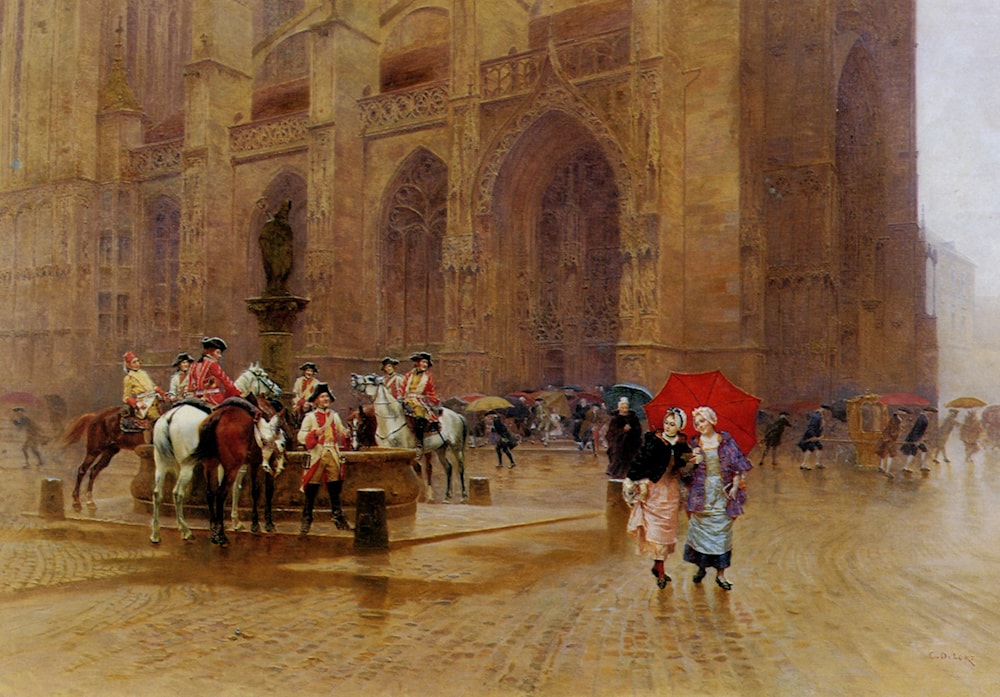
Charles Edouard Edmond Delort (1841-1895), “La Sortie de la Messe”

Enrico Gamba (Italian, 1831–1883), “L’uscita dalla messa”

Francisco Gras (b. 1878-?), “The Return from Mass, Valencia, Spain” (1920)

Wednesday, July 29, 2020

The Prodigal Church, by Brandon McGinley: Review by Urban Hannon

Our thanks to Mr Urban Hannon for sharing with us this review of The Prodigal Church: Restoring Catholic Tradition in an Age of Deception by Brandon McGinley, recently issued by Sophia Institute Press. Mr Hannon studies theology at the Pontifical Faculty of the Immaculate Conception at the Dominican House of Studies in Washington, DC, and has previously written for The Lamp and First Things, inter alia. He is also celebrating his name day today, the feast of Pope Bl. Urban II, and will be grateful for the prayers of our readers.

“The book you are reading is not a Vatican II book. In fact, it is anything but a Vatican II book.” And frankly, thank God. With all due respect for Benedict XVI’s hermeneutic of continuity—which is true as far as it goes and obviously preferable to the heresy-adjacent hermeneutic of rupture—I like to joke that I advocate instead for the hermeneutic of talking about something else. It’s 2020. My millennial peers and I did not live through the Second Vatican Council, nor the collapse of the Church’s midcentury structures in its aftermath. We were born in the ruins. And to be honest, we’re sick of talking about it. How I long for a day when someone will use the phrase “The Council,” and everyone will have to ask, “Which?” Consider: We are about to be as far removed in time from Gaudium et Spes as Gaudium et Spes is from Pascendi. Vatican II was an ecumenical council, to be sure, ratified by the holy father and protected by the Holy Spirit—and when random Twitter accounts show up in my mentions to suggest otherwise, I answer with an eyeroll, an “okay boomer,” and a block. But that said, Vatican II was also an ecumenical council which sought to address itself to the particular contingent problems of a world that no longer exists. Whether it did so with utmost prudence or not, we do not need to keep relitigating disputes that are over half a century old and increasingly irrelevant to our circumstances. That’s a pointless distraction. It is time to talk about something else.

This is what makes my friend Brandon McGinley’s new book The Prodigal Church so refreshing: its serene focus on the present moment, its gracefulness, its hope. “There are two basic prerequisites to allowing God’s grace to renew the Church,” says McGinley: “We have to want it, and we have to believe it is possible.” This excellent book checks both boxes. It asserts that grace is real, that God is in control, and that true renewal is achievable. Love is stronger than death, and grace is stronger than postmodernity. Thus does McGinley insist on “seeing in millennial and Gen-Z frustration, rebellion, and alienation an opportunity for evangelization rather than for mockery.” Right now, he says, “people are looking for big solutions to big problems, and big answers to big questions. This is our moment—if only we have the godly confidence to seize it by embracing the transcendent, incandescent authenticity of the Cross.” The Prodigal Church sets the example for such godly confidence.

Of course, McGinley is under no illusions about the challenges we Catholics face today, or about the sins and failings that have brought us to this point. But he is not especially shocked or scandalized by our apparently failing Church—remember it’s the only one we millennials have ever known—and he refuses to give sin the last word. The world as it is is a mess, but, he insists: “We don’t have to accept the world ‘as it is.’ This is a completely secular framing of human affairs, one that denies anything beyond wallowing in our brutishness. . . . Indeed, there is no greater acquiescence in secular ideology than to reject the truth that grace can and will elevate our possibilities.” McGinley knows how far we have fallen, that at this point ours is truly “a dissipated Church.” But he does not harbor a spirit of criticism, and he will not give up on God. Appropriately, John 6:68 is his favorite verse in the Scriptures: “Lord, to whom shall we go? You have the words of eternal life.”

The Prodigal Church is a book in five parts: How We Got Here, The Church, The Parish, The Family, and Friendship and Community.

1. How We Got Here
St Adalbert’s Church in the South Side neighborhood of Pittsburgh, Pennsylvania; photo by Brendan McGinley
McGinley’s retrospective on the Church in America takes an it-was-the-best-of-times–it-was-the-worst-of-times angle on the 1950s. On the one hand: “Sacraments galore! Priests and kids everywhere! Ministries and societies and sodalities, oh my! Silver screen hero priests! Hollywood beholden to Catholic principles! An archbishop in full regalia on prime-time TV! This was it! What else could we ask for?” On the other hand, it turns out that last wasn’t a rhetorical question: What else we could have asked for was faith, fidelity to the Church and her traditions before conformity to the mainstream American culture. “If midcentury truly was the heyday of American Catholicism,” says McGinley, “then we must say that it was also the triumph of the adjective over the noun—the moment Catholicism went native.” Or, as an older Fulton Sheen (the aforementioned prime-time pontiff) commented in hindsight, “[Religion in this period] began to give not theological insights into the meaning of life, but rather psychological and sociological views to accommodate the bourgeois good life to religion.” Material prosperity and social respectability replaced the sacraments and sanctity as the where-your-treasure-is of the American Catholic heart. In McGinley’s words: “We have dissipated our distinctive traditions in order to please the surrounding culture, but have lost both our patrimony and our position in the process.”

Thus the title of this book: Like the prodigal son, the Church in America has taken her inheritance and squandered it, and she’s starving. But that isn’t the end of the parable: The boundless generosity of our God before his repentant children is. This book is meant as an encouragement for us to return to our Father’s house.

2. The Church

Faithful Catholics may mock the “spiritual but not religious” line thrown out by so many of our secular contemporaries. But there is an insidious version of this same error to which the devout themselves often fall prey. “It is in vogue now,” says McGinley, “even and especially among Catholics, to speak of the institutional Church in the same way a civil libertarian speaks of the federal government: at best a necessary evil, a leviathan that needs to be reined in, even a threat to genuine faith and conscience.” (Or as he puts it elsewhere: “No one likes the United States Conference of Catholic Bishops,” heh.) Against this temptation, The Prodigal Church recommends a rediscovery of the true identity of our holy mother the Church: “anchored in heaven but bound to earth, united to Christ but a vessel of sinners.” McGinley also celebrates the integral and consistent witness of the Church’s moral tradition—not focusing, for example, on sexual morality to the exclusion of economic justice or vice versa—for “a renewed Church is a consistent Church.” Regarding the economic libertarianism which plagues our society, McGinley calls the Church to speak out once more against usury and for just wages. Regarding the sexual revolution and its bitter fruits, he says, “It would be tragic indeed if the Church acquiesced to the new bourgeois just as it fell into disrepute, and just as her steadfastness might be rewarded.”
St Stanislaus Kostka, the mother of the Polish ethnic parishes in Pittsburgh; photo by Brendan McGinley
McGinley quotes St. John Chrysostom to great effect on the awesome responsibility of bishops for the salvation of souls, and reminds us that, “in the same way that the Church shouldn’t act like a corporation or an NGO, the bishops shouldn’t seem like CEOs or executive directors.” Especially important, in our moment, will be the willingness of bishops “to give up some secular respectability for the sake of the kingdom.” Here he recalls the witness of St. Ambrose condemning the emperor Theodosius, lest he should lose both the emperor’s own soul and those of his subjects. “I wonder what might have happened,” writes McGinley, “at that time and ever since, if a bishop had rebuked President Kennedy for his public and private scandals. But that would have threatened the mainstream acceptance we had worked so long to achieve. Ambrose weeps.” Yet rather than succumbing to impious disparagement of our local ordinaries, the successors of the apostles, McGinley invites us to prayer: “And so let all of us pray for our bishops, and for the elevation of good men to the episcopacy, and for the grace to recognize genuine holiness when it might not be obvious.”

The rest of McGinley’s treatment of Holy Church is a reminder that chancery bureaucracy is not her summit: Heaven is. “The invisible Church is our celestial anchor of holiness, the perfection to which we are called that is not a theoretical future possibility, but an ongoing present reality. There is no better cure for ecclesial despair than remembering, honoring, and relating to this cloud of witnesses.”

Tuesday, August 06, 2019

Using Sacred Art to Help Memorize the Words of the Liturgy

I have a problem. I recently recommended that we should commit passages of the liturgy to memory, in order to deepen our participation and to free us to engage with imagery. You can read about this here, in the article Rite by Rote,

The problem I have is that I struggle to commit anything to memory. This is genuinely difficult for me. I have often wondered if I missed a class I should have attended at some point in my formative years. I did quite well in classes requiring a high level of understanding such as physics, but poorly where memorization of facts or words was necessary. I’m pretty sure I could never have been a doctor, for example. The painful boredom - and I do mean painful - entailed in trying to commit lists of anatomical details to memory would have defeated me. I was a trainee accountant for about 2 months once, and left when I realized I was going to fail all my exams. I have always been hopeless at learning languages, I never managed to memorize the poems we were supposed to be able to recite, and I couldn’t take part in school plays because I knew I would forget my lines. For me, walking into a room and then forgetting what I wanted to do is not senility; it’s been happening to me since I was 10 years old.

This can even affect your social life. My parents and my grandparents were avid Bridge players, but the game was beyond me. At various stages in my life, I have tried to learn to dance with a partner, and tried Ceroc jive, for example. Being reasonably coordinated, I could manage most of the steps, but as the man is supposed to lead, and I couldn’t remember those steps five minutes after the lesson. It seems that even my muscle memory is lacking. And don’t ask me to remember your name. I regularly embarrass myself at social events when I’m unable to introduce people I’ve known for years.

I would use mnemonics, but I forget those too. I’m at the level of needing a mnemonic to help me remember my mnemonic. For example, I thought I’d found the answer when I saw a book that explained the secret of St Thomas Aquinas’ remarkable memory. Apparently, the technique involved associating names and facts with the visual memory of articles in different rooms of a house that I was familiar with. The problem for me was that I didn’t have the layout of any house committed to memory sufficiently well to enable me to do it. Now at age 57, I’m at the stage where most of the time I even forget what it is I’m supposed to remember. I live permanently in the realm of Donald Rumsfeld’s “unknown unknowns.”

So here’s what I have decided to do so that I can gradually learn some psalm and canticles by heart. If anyone out there has a better system, I am open to suggestion.

I memorize short sections of text, maybe a psalm verse at a time, so that if I see the first word, I know what’s coming, and then I sing the verse while looking at one of the images in my icon corner. I try to make the image appropriate in some way to the text. I have a print of the Ghent altarpiece in the center of my icon corner, along with the core images of Christ on the Cross, the Risen Christ and Our Lady. Between these and a few other personal Saints and festal icons, I can find connections with many of the themes of salvation history that run through so much of Scripture. This means that I then follow a set path with my eyes, which through repetition becomes a habit as I go through the canticle, and the visual memory helps prompt the linguistic memory.

Once I know the separate sections, I connect them by memorizing two at a time, as a new longer single passage. In practice, this means that I connect the last word of one passage with the first word of the next; if I have remembered each, then the longer one flows. I do often need to look and remind myself, but with repetition, it does come to me. I’m pretty sure that the fact that I sing my prayers helps too.

The next step is to connect these longer passages together until the whole is memorized. This is still a slow process for me, but I am getting there. My goal is to engage the aural, linguistic and visual components of memory in such a way that I can always recite the skeleton of a generic office even if I don’t have any liturgical books or my cell phone, with me. It occurs to me that in the process, it will help my approach to worship by developing my instincts for using all my senses in conjunction with the imagination that connects perceptible realities to those that are imperceptible.

I wonder, have I stumbled onto something which everyone does anyway? I’d love to know how you commit facts to memory.

Tuesday, January 15, 2019

A Meditation after Epiphany: The Transfiguration Icon and What It Tells Us About Christian Culture

Here is a painting of the Transfiguration. It is a 16th-century Russian icon from the Spaso-Preobrazhensky Monastery in Yaroslavl, which is to the northeast of Moscow.


Readers will be familiar with the scene. Christ is on the mountain flanked by the two prophets, and the three disciples are stunned by the sight of the transfigured Christ. This is a glimpse of his heavenly glory, hitherto unseen by the disciples. The nimbus that surrounds Christ in this picture is called a “mandorla”, the Italian word for “almond”, from its elliptical shape. The season of the Epiphany (also known as Theophany) is the time in which the first manifestations of God’s glory are commemorated, and especially the Baptism in the Jordan; in the East, the feast is wholly focused on the latter, and the Adoration of the Magi is commemorated at Christmas. As such, they all point to this moment as the fulfillment of all epiphanies.

The mandorla surrounding Christ usually shows concentric bands of shading which get darker toward the center, rather than lighter. It is painted in this way so as to communicate to us, pictorially, the fact that we must pass through stages of increasing mystery in order to encounter the person of Jesus Christ. This encounter, which takes place in the Mass with the Eucharist at its heart, is one that transforms me supernaturally, so that I can begin to grasp the glory of Christ more directly.

This encounter is made possible by my baptism, confirmation, and communion so that I have ‘put on Christ’ as St Paul says in Galatians. God’s actions are not in any way restricted by the Sacraments, of course, but as a general rule, until I become Catholic I am going to be dazzled into blindness by the transfigured Christ, and the mandorla will look like a jet-black envelope with a heart of darkness.

Nevertheless, prior to being fully part of the body of Christ, I was able to perceive, those outer rings of the mandorla. In this context they represent the Light of Christ reflected in the cosmos, and Christian culture and art. This tells me there is more to know and love and I yearn for it. This is the power of beauty, and of art in particular, and is why the rejuvenation of Catholic culture and Catholic art, in particular, are so necessary. We need them to speak powerfully to people today of Christ and draw people into the Church.

Beauty is a perceptible sign of something which we cannot see, Almighty God. It calls us to itself, and then beyond to Him who inspired it, and who is Beauty itself. Creation is beautiful because it bears the mark of the Creator; and the culture or any aspect of it, whether mundane, sacred or high art can speak of it too. Even everyday Christian activity is beautiful - graceful - if it is inspired by God and will draw people to God.

The Christian life well lived is one in which every discernible aspect our lives contributes to the brightness of the outer rings of the mandorla through inspired contributions to the culture. This is because we are part of the mystical body of Christ, the Church, which is the transfigured Christ of the painting above. Each of us is a pixel of supernatural light in the heart of darkness! The artist is called to contribute to the culture by his painting, but each of us contributes in our own way.

The most powerful formation that will enable us to be contributors to a beautiful Catholic culture that bears this cosmic beauty is the central activity of the Church, the worship of God. Christian culture permeates the life of the Church and of the world - the sacred and the profane - and so is an important part of the sign of Christ and of the world to come. It is a principle that potentially permeates all human activity.

Below is the Transfiguration mosaic from St Catherine’s Monastery, Mt Sinai.

Monday, January 14, 2019

Interview with Dr Kwasniewski on “Beauty—God’s Messenger”

NLM readers may wish to know about a new magazine, Calx Mariaepublished four times a year by Voice of the Family in the U.K. The editor, Maria Madise, invited me to do an interview on the theme of “Beauty—God’s Messenger,” for the third issue, which recently appeared in print. I hope I am allowed to say, in spite of being a contributor myself, that I find the content and the production values extremely high. It is truly one of the nicest publications I’ve seen in a long time, and a sight for sore eyes in these days of internet-dominated news and features. For subscriptions and copies of individual issues, visit this link.

With the editor’s permission, the full interview is reproduced below.

Maria Madise: Throughout history, the Church has sought out beautiful music, art, architecture and the finest craftsmanship. Why do these things play a crucial role in Catholic spirituality and formation? 

Peter Kwasniewski: The reason is simple: we were made by God as creatures of flesh and blood. We learn through our senses. When God revealed the Law to Moses, He made use of a lofty mountain, lightning, thunder, dark clouds, blood, and stone tablets. When He commanded the building of the tabernacle, He showed the pattern of it in fine detail, demanding the most expensive materials. When God spoke to Elijah, He first made a lot of noise, and then revealed Himself in a “soft, small voice.” When Our Lord wished to give Himself most intimately to His disciples, He used bread and wine, in the midst of a highly structured religious ritual. We can think of thousands of examples from divine revelation of “theophanies,” that is, the manifestation of God in various signs and figures. The Jewish liturgy in temple and synagogue continued this pattern, and obviously Christian liturgy did as well, moved above all by the miracle of the Son of God Himself taking on flesh and blood. The Catholic Faith, with the power of the Incarnation behind it, developed the richest and most beautiful culture the world has ever known—but all in the service of pointing beyond itself, to God.

What is the purpose of beauty? Is it practical or functional?

Beauty is God’s first, last, and most effective messenger. We learn that the world is good and orderly because of the beauty of nature, which we only later come to understand intellectually. And just as we come to know God through His divine artistry, we see the inner beauty of the human person most of all in the great works of human art. A painter like Rembrandt helps us to see the immense, almost heartbreaking beauty of an old man or old woman’s face, which we might otherwise rush past or even find ugly. Christ Himself is “the fairest of the sons of men,” as Scripture says, but He allowed Himself to become “a man of sorrows,” marred beyond belief, to tell us something unforgettable about the invisible Beauty of love, of sacrifice for love. The Church therefore cannot and must not flee from her role of introducing mankind to this immortal Lover, both in the beauties that appeal to our senses, and in the deeper mystery that no sense can reach.

What is the role of beauty in the formation of children and young people? 

The first thing a baby notices in the world is his mother’s face, which establishes a first and permanent vision of beauty—not necessarily as the world sees it, but because love discloses the truth.

As a child grows in the family, his parents have the serious obligation to train him or her in a love of the beautiful by reading good stories, memorizing poetry, putting up good artwork, making art together, and attending liturgy that is outwardly very beautiful, if at all possible. All these things are part of a subtle and pervasive education of taste, sensibility, instinct, and intuition. When we are brought up with beauty, we have a sense of propriety, respect, nobility, dignity. These things are proto-religious or para-religious attitudes that heavily influence the course of one’s life. Without them, we are much more vulnerable to the winds of false doctrine and shoddy excuses.

A typical European street corner
How would you explain to someone what exactly culture is and what is Catholic culture? 

It is not easy to define culture. In a recent lecture I tried my hand at it: culture is “the shared ways in which a society or people is accustomed to expressing, celebrating, and inculcating its vision of reality.” Maybe that’s too broad. Culture is always concerned with the concrete expression of ideas and values. How we eat our food, what we drink and when and why, how we dress and speak, what our buildings and vehicles look like, all this is culture, and does, in fact, express a worldview (or perhaps an eclectic mingling of worldviews).

In Europe above all, Catholics developed an extremely rich culture in which even the littlest objects of daily use were decorated beautifully and often with explicit reference to the doctrines of the Faith. In this way, there was a continuum from the cup at home to the chalice on the altar, from the dinner bell to the cathedral bell, from the tablecloth to the houseling cloth. The images of Our Lady and the saints presided over everything—our familiar companions in this world, but as a reminder that “we have here no abiding city: we seek one that is to come.”

A Catholic culture, then, is what a society inspired by the Faith will produce and cherish: an environment that turns the mind to God gently and frequently, making full use of the high beauties of fine art and the rugged genius of folk art, the impressive pageantry of ceremonial and the stabilizing force of rituals. The result is a joyful impregnation of the whole of life with the immense reality of God, too great to be limited to any domain or any one expression.

Should there be an overlap in liturgical and popular culture? If yes, in what form? If no, why not? 

I think, in fact, it has been a tragedy that high culture and popular culture have parted ways almost completely, and that the liturgy is no longer the driving force of culture, as it had been for well over a thousand years. Today’s “inculturation” is often cheap, random, and secular, because it is not guided by strong and clear thinking rooted in divine revelation and Church tradition.

For example, people try to take contemporary pop music and bring it into the liturgy. This is a giant mistake, because this music is saturated with emotionalism, strongly associated with the liberal anti-culture and its sexual promiscuity. It does exactly the opposite of what church music is supposed to do: raise the mind up to God, purify the heart of disordered affection, discipline the body. Instead of assisting in our assimilation of the Word of God, it rather promotes the secularization of religion.

But it is possible to do inculturation well. The missionaries of Europe who came to the New World often incorporated external features of the evangelized cultures into music, devotions, and visual arts. For instance, Spanish missionaries in Mexico taught the natives how to compose in the style of Renaissance polyphony, but allowed or even encouraged the addition of native flutes and percussion. The result still sounds ecclesiastical, yet with a Central American flavor to it. (If you are interested in listening to some of it, just look up the San Antonio Vocal Arts Ensemble, or SAVAE.)

Prodigal son as metaphor (detail from Rembrandt)
What is our duty as the heirs of Catholic tradition? Do we need to reform, preserve, or recreate? 

This is an important question. Here is what Our Lord Himself teaches us in the parable of the prodigal son. What we do to, or with, our family inheritance shows what we think of our father and of our entire family. Now, no one can deny that things like Latin, Gregorian chant, and offering Mass ad orientem are central, constitutive, and characteristic treasures of our Catholic patrimony. The liturgical reform suppressed them or marginalized them, acting just like the prodigal son who squandered his family wealth on loose living and ended up impoverished and miserable. The only way out of this bad situation is what the parable shows: conversion, repentance, return, and reestablishment in the house of the father.

The right attitude towards our inheritance is to protect it, preserve it, defend it, and make use of it to the greatest extent possible. To do this, we must know it, and the better we come to know it, the more we will love it. This love, in turn, will inspire new works of beauty in continuity with what has come before. That is the experience of every serious Catholic artist—architect, painter, iconographer, sculptor, composer, poet. Knowing our tradition, we imitate it, emulate it, develop it, and carry it forward into the 21st century. There is no need to seek originality. The only fully original person is God the Father, since He has no origin from anyone else; even the Son is not original, but originated; and the Holy Spirit from the Father and the Son. God Himself teaches us that the perfection of all persons after the Father consists in their derivation from another. The creature who tried to be wholly original was Lucifer, of whom Our Lord says that he is “the father of lies” because he “speaks from himself.” That’s where sheer originality will get you: into hell. And that, of course, is what we see in so many modern artists.

Incidentally, Martin Mosebach has made the observation that the notion of reform makes sense only if one takes the word itself seriously: it is a return to form, a re-forming of that which has lost good form. Reform doesn’t mean loosening up, wandering off, or blowing things up. It means more discipline, more attachment to good models, more self-control, more humility in the service of greatness. That’s the kind of reform that the Church always needs, not the “reform” we have gotten in the past half-century, which should more truthfully be called deformation.

How would you describe your own discovery of Catholic tradition and what effect did it have on your formation and work? 

For me, the discovery of Gregorian chant was a huge revelation. I can’t say why I was so fascinated by it at the tender age of 17, but then again, the chant really is mesmerizing and haunting in a way that no other music is. By listening to recordings of the Wiener Hofburgkapelle, I taught myself to read the neumes in an old Graduale Romanum that had been discarded by the Benedictine boys’ school I was attending at the time. I think my study of composition—being introduced to J. S. Bach’s chorales and trying to imitate them in my exercises—also played a role: there is something about this kind of discipline that helps the mind to perceive beauty not as something vague, fluffy, and sentimental, but as the result of labor, craft, rule.

Other important influences at the end of high school included the reading of Plato’s dialogues and Ludwig Ott’s Fundamentals of Catholic Dogma. At the time, I felt that Plato, though a pagan, was really “one of us”—a sort of “closet Catholic”—and that to be educated meant to read Plato, and authors like him. All this made me want to go to a college where I could be steeped in the riches of Catholicism that I had begun to taste. That’s why I went to Thomas Aquinas College in California, where I could study the “Great Books.”

Attending TAC introduced me to a world of immense depth and beauty. This included the traditional Latin Mass, where all that is purest, loftiest, and loveliest in the Catholic Faith comes to roost. I think of that psalm verse: “Even the sparrow finds herself a home, and the swallow a nest for herself, where she may lay her young: Thy altars, O Lord of hosts, my King and my God” (Ps 83:4 [84:3]). The Mass truly was and must once again become the inspiring force of Catholic culture. Certainly for me and my family, it has been the place where we can make a spiritual home, and where we may bring up our young in the peace and fragrance of Christ.

A prayer corner
So much of modern culture is ugly, even grotesque, many people have a real hunger for what is beautiful and good. Can you suggest how we may satisfy this hunger? 

I strongly believe, as I hinted earlier, that we need to surround ourselves with beauty. I don’t mean in a cluttered or kitschy way, but by suitable decorations, by investing if we can in works of art, by listening to really good music (and by this, I do not mean any particular period, but certainly not pop, rock, rap, techno, or any of that barbaric stuff, which is the musical equivalent of junk food or drugs), and by seeking to understand the greatest art that European and Catholic civilization has bequeathed to us. I would recommend several practical steps.

First, find the most beautiful celebration of the liturgy you can, and go to it. If it’s in a beautiful church, even better! The liturgy is where most of the fine arts blossomed and where they are meant to be experienced: as offerings to God, caught up in (and ideally assisting in) the ascending movement of prayer. The liturgy is not just the “source and summit” of the Christian life, it is also—or it has been and should once again be—the source and summit of Christian culture as well.

Second, think about the rooms you are living and working in, and how you might elevate them with prints, watercolors, engravings, etc. It takes time to find works of ‘original’ art, but in the mean time, or supplementally, a good quality giclee reproduction of a Fra Angelico or a Giotto, a Rembrandt or a Vermeer can make a big difference in the ambience, encouraging a more contemplative spirit. (I recommend The Catholic Art Company, which has a fine selection. They don’t sell junk, and they don’t support immoral causes.)

Third, pick a place in your home and make it the “prayer corner,” with icons or holy images, a candle, holy water, rosaries, flowers. This should be a place around which it is natural to gather for morning or evening prayers. (You can read more about this in David Clayton and Leila Lawler’s The Little Oratory: A Beginner’s Guide to Praying in the Home. Other beautiful customs can develop from this center point; see Mary Reed Newland’s We and Our Children: How to Make a Catholic Home.)

Fourth, acquire some good recordings of sacred and “classical” music, and take time to listen to them, to develop your ear and your soul. (At LifeSite News, I’ve written some pertinent articles: “What makes Gregorian chant uniquely itself—with recommended recordings” and “These new recordings of sacred music will transport you to the courts of the King.”)

Fifth, make time for ongoing education. I cannot recommend highly enough the lectures by art historian William Kloss available from The Great Courses: such eye-opening and fascinating explorations of the genius of the greatest artists, who have a special gift for seeing—and thus, for helping us to see—the luminous depths of reality. Obviously, if one can visit a good or great museum, one should do this on a fairly regular basis.

Sixth, at least once a year, go on pilgrimage. The pilgrim, too, gets to enjoy the sights and sounds of the journey and the destination, but he has a higher purpose than the mere tourist. Aesthetic experience becomes more meaningful when united to the love of God, the practice of religion, and the expression of devotion to a saint and to Our Lord Himself. This is what I loved, by the way, about attending the All Souls Pontifical Requiem Mass at St. John Cantius in Chicago this past November 2nd: the choir and orchestra performed Mozart’s Requiem in its authentic liturgical context. Somehow, hearing it in the right place and at the right time made the music even better.

Seventh, if we have the means, or if we are in a position to influence people of means, we should try to patronize new works of art that are truly beautiful, and if intended for the Church, truly sacred also. I admire clergy and laity who, when a special occasion is coming in the future, commission a piece of music or a painting for the occasion. Obviously, as a composer myself, I recognize that if Catholics stop asking for and expecting good art for the Church, good artists will starve and disappear. The same can be said of supporting music programs and the right kind of church restorations (often undoing the damage wrought by postconciliar iconoclasts).

In your new book Tradition and Sanity you make a number of compelling arguments in favour of returning to the traditional liturgy—not for liturgical or aesthetic reasons alone, but also because the way we live the Sacrifice of the Mass lies at the heart of every aspect of our lives. Could you explain this a little?

In keeping with what I was saying earlier about how a grateful son should approach his father’s house and his family patrimony, I would say that worshiping God with the Roman Catholic liturgy in the form in which it organically developed for a period of over 1,500 years is crucial to having (or, for many, to recovering) a stable identity, a profound spirituality, a sound doctrinal foundation, and a compass for the moral life—this, in addition to the obvious literary and artistic merits that the old liturgy has in itself and has inspired for so many centuries.

Given that Catholicism is inherently a religion of tradition, it should strike us as quite troubling that Catholics of today pray in a manner terribly different from, and even at odds with, how our ancestors prayed, including the vast majority of saints. Either they were wrong and we are the enlightened ones—or, rather more likely, we have gone off the rails in our quest for modernization and need to get back on if we would reach our destination safely. Liturgy is not something that each age needs to redesign and recreate in its own image. On the contrary, the vicissitudes of history are to a large extent transcended in a still point, an immovable center, a pole star from which we can always take our bearings. You could apply to the Mass the Carthusian motto: Stat crux dum volvitur orbis, “the Cross is steady while the world is turning.” This, to my mind, is the reason why the old liturgy is winning so many “converts” today. The world is turning at a mad pace, careening out of control, and unfortunately, because of the conciliar prejudice for aggiornamento, the world has pulled the postconciliar liturgy in its wake, like a moon orbiting a planet. The classic Roman liturgy abides in its grandeur, and seems, perhaps not too surprisingly, more “relevant” to us today than something devised by a committee in the 1960s.

My book goes into all this, but also into the crisis in the papacy and in evangelization, which I believe are linked with this tragic decision to “re-orient” Catholicism along new lines. This has led not to renewal but to accelerating deformation and irrelevance. Thanks be to God, we see a countermovement gaining strength across the world, and characterized by its opposition, point for point, to the official program. That will be the drama of the next decades: how this massive “civil war” inside the Church plays out under the hand of Divine Providence.


The Table of Contents of this third issue:


Thursday, November 01, 2018

Brian Holdsworth on “Keeping Youth in the Church”

Here is another great video from Brian Holdsworth which needs to be shared around as widely as possible. He very rightly points out the folly of attempts by some people within the Church to hold the interest of the young by “relating” to them. “I would much rather someone be themselves authentically than project my own characteristics back at me. If the Church wants young people to follow the message of Christ... they’re really undermining their own efforts by using tactics that provoke people to look down on the messenger...” He then brilliantly sums up why beauty and solemnity in the liturgy (and elsewhere) are necessary for the evangelization of all peoples, young and old. “These people took (Vatican II) as a license to vandalize all the outward expressions of our faith... in the hopes of making it more culturally relevant, and accessible. And the result if that the Church is less relevant than ever. ... This experiment has failed catastrophically. ... The way we present the message of Jesus should be like nothing of this world, because it’s not of this world ” Watch the whole thing, it is well worth your time, and if you have the opportunity, share it with your pastor, bishop, youth ministry coordinator etc. Kudos, Mr Holdsworth!


Saturday, August 18, 2018

Josias Podcast on Liturgy and the Common Good

Peter recently participated in an episode of the Josias Podcast, a discussion of the deep and essential connection between the liturgy and the common good, along with the regular hosts, and Mr Jonathan Culbreath, whose published an interesting article in April on Liturgy and the Common Good at Peregrine Magazine. Along the way, they discuss the liturgy as focal point for the common good in the Church and in secular society, public versus private devotion, and compare Charles de Koninck’s defense of the common good against personalists and totalitarians with Erik Peterson and Romano Guardini’s defense of the liturgy against certain members of the liturgical reform movement. Several links to further reading on the topic are given over at their website.

An allegory of St Francis Xavier as the patron of Lucerne, Switerland, on the ceiling of the church dedicated to him in that city. At the top, he is shown riding a chariot like the prophet Elijah, which is pulled by exotic animals (an elephant, a cheetah and a camel), symbolizing the various parts of the world reached by his missionary activities. On the white and blue banner of the city is written “To St Francis Xavier, Protector of the City and Region.” To the left, the citizens, led by the bishop, look to him in heaven; the façade of the church is seen at the bottom.

Tuesday, August 07, 2018

Devotion, Design and Decoration - How Liturgical Art Influences the Wider Culture

What is so interesting about the work of iconographers Philip Davydov and Olga Shalamova, as seen on their website sacredmurals.com, is how they are experimenting with style and medium. The icons and murals are in accord with the tradition, albeit with a very 21st-century look to them, but they are also prepared also to move into derivative art that might not considered iconographic, but is nevertheless influenced by it. They use unusual media and draw on modern compositional design style as one might see in book illustration, for example. At this point, they don’t move very far from the iconographic prototype; some might still consider them to be within the tradition, but pushing the envelope.

I am guessing that they refer to this art as decoration and “graphic works” because they are aware that they might be going beyond the bounds into places where some purists night hold their noses. However, I am excited by this trend. I think this is not only interesting artistically, but it is actually a necessary part of the development of a Christian culture.

While I am interested in creativity and innovation in the application of the principles of any authentic artistic liturgical tradition, I am most certainly not interested in undermining the principles themselves. This is why I think that the best approach is to be conservative in regard to the art we put in churches. We are playing with people’s souls if we experiment in church.

However, there is room for art that is devotional, illustrative and simply decorative that is not liturgical, and so should not be in church. We need art that is clearly derived from the liturgical forms, but is distinct from it and directs us to the purest form, so to speak, by being part of the wider culture of faith. This is the beginning of the process by which the liturgy, which is a source of its own culture, begins to push out into the wider culture and transform it into a Christian culture.

I think it is a sign that the recently reestablished iconographic tradition is flourishing and reaching a maturity that we can see this happening. May it continue to happen!

So in the pictures I show below, I give you first some of the more conventional icons, and then items referred to as “graphic designs.”


And graphic works:

Wednesday, May 09, 2018

Catholic Imagination and Catholic Dementia

The great advantage of the blog as a medium is the ease with which one can include pictures, videos and hyperlinks in an article; and a picture, as they say, is worth 1000 words. I am not, however, going to include here any pictures, videos and hyperlinks of the spectacle which recently took place in New York; you can find them easily enough on the internet, along with a variety of articles about it. The funniest take on it I have seen thus far comes from a priest friend who wrote on Facebook that the whole thing looked like a party in District One during the Hunger Games.

I will, however, hyperlink and quote this superb piece by Ross Douthat, opinion columnist at the New York Times, “Make Catholicism Weird Again.”
It was the church’s own leadership that decided, in the years following the Second Vatican Council, that the attachment to the church as culture had become an impediment to the mission of preaching the gospel in the modern world. It was the leadership that embraced a different approach, in which Catholic Christianity would seek to enter more fully into modern culture, adopting its styles and habits — modernist and even brutalist church architecture, casual dress, guitar music, a general suburban and Protestant affect, etc. — in order to effectively transform it from within. It was the leadership that decided that much of … Catholicism’s cultural glory — the old Mass above all, but also a host of customs and costumes and rituals — needed to be retired in order to reach people in a more disenchanted age.”
This reminds me of a video published several years ago by Catholic News Service, an interview with Fr Joseph Kramer FSSP. At 0:35, he notes that “Paul VI talked about the sacrifice that we’d have to make of many things that we love in our own Catholic culture, as part of the process of adapting to the world in the ’60s. Now we’re on fifty years later, we’re realizing that it’s time to recuperate something of our heritage.”


The peculiar (and, let me say, extremely clever) title of Douthat’s article refers to the fact that our modern reforms effectively removed or downplayed a great deal of what made Catholicism “weird” in the eyes of the world: the use of a sacred language and a sacred form of music, relics, exorcisms, decidedly old-fashioned looking vestments and habits, etc. Ordinary Catholics who watched these reforms take place with trepidation, whether clergy or laity, were solemnly assured that these “sacrifices” would indeed have the most salutary effect of bringing the world back to Christ. Those who dared to pointed out that not only had the world rejected this overture, but Catholics themselves were giving up the practice of the Faith in droves, were solemnly assured that this was certainly not happening. Once it became impossible to deny, they were solemnly assured that this was all quite unavoidable in our modern secular world, as if the reforms themselves had not been enacted precisely on the grounds that they were necessary to evangelize the modern secular world.

But, as Douthat very rightly points out, it is precisely the “weird” parts of Catholicism, the parts that speak of the mysterious and transcendent, and that were ditched, which have lost none of their fascination for the modern secular world. The costumes at this gala were unquestionably exaggerations, many of them grotesquely so, such that charges of mockery are inevitable, whether mockery was intended or not. But what was exaggerated was all the best of Catholicism, the parts that speak of things which are holy and mysterious: “all the weirder parts of Catholicism that were supposedly a stumbling block to modernity’s conversion.” The worst of modern Catholicism, the ugly, prosaic, banal and boring which we as a Church inflict upon ourselves to no good purpose, was very decidely not on display. A long dress was printed with Michelangelo’s paintings in the Sistine Chapel; there was no print of the blank retable over the altar of the award-winning Iglesia di Iesu.

A pop singer was dressed as the Mother of Sorrows (a costume which completely justifies Douthat’s use of the verb “blasphemed”), but she wasn’t dressed like Karl Rahner. Another singer wore a tall mitre made to look like it was covered in diamonds, (perhaps in reference to the title of one of her songs); she did not wear one of the stumpy little polyester boxes on which outlandish sums of money are now spent to achieve the appearance of poverty. Or, as this wag on Twitter put it:

People instinctively know that beauty is proper to the things of God. If you go to the Gesù in Rome, you can watch all day as tourists and pilgrims alike remain fascinated by this magnificent side altar, which houses the relics of St Ignatius,

while most of them barely notice (thank God) this horror show.
The brutalist pulpit and altar of the Gesù, installed a number of years ago, also came with a very slightly less brutal presider’s chair (not pictured.) The mouse-grey platform was installed at the same time - previously, there was a plexiglass table in the real sanctuary. The shwarma under the Paschal candle is more recent.
It is high time for the Church to take this lesson to heart. Aggiornamento, which had already grown old by the early 1970s, is now in the final stage of its decrepitude, “and that which decayeth and groweth old is near its end.” Ross Douthat concludes his piece by writing that “The path forward for the Catholic Church in the modern world is extraordinarily uncertain. But there is no plausible path that does not involve more of what was displayed and appropriated and blasphemed against in New York City Monday night, more of what once made Catholicism both great and weird, and could yet make it both again.” To deny this is to keep the Church in a state of senile dementia.

More recent articles:

For more articles, see the NLM archives:



