Wednesday, June 24, 2026

What Were the Rites “Older Than 200 Years” for Which Pius V Made Exception?

The following letter exchange is published here for the interest of NLM readers.

Dear Dr. Kwasniewski,

I found my way into saying the Traditional Latin Mass a year after my ordination in 2018. Saying the TLM has changed my life and drawn me closer into our Lord’s sacrifice. I have suggested your book Reclaiming Our Roman Catholic Birthright and the documentary Mass of the Ages as resources to educate others about the significance of the TLM. The motu proprio Traditionis Custodes has certainly shown people’s true colors when it comes to the liturgical life of the Church.

In an interview you did with Cameron O’Hearn, you mentioned that there were liturgical rites older than 200 years that Quo Primum did not suppress, but that most of them died out over time. Do you have a list of these liturgical rites that were not suppressed by Quo Primum but which eventually dissolved anyway? Is there also a comprehensive list of liturgical rites that Quo Primum actually did effectively suppress because they were younger than the two-century span he posited?

I would also love to read any academic sources on this subject to educate others on what a liturgical rite actually is. Most people do not realize how many liturgical rites exist or have existed. My hope is that the Traditional Latin Mass will not have to compete for the title “Roman Rite” and will someday simply be acknowledged as the Roman Rite bequeathed to us from across the centuries. Indeed, I have pondered the idea of the Novus Ordo just dissolving over time, as apparently did some of these local liturgical rites, instead of a Pope someday strictly banning it. Most Catholics start scratching their heads when I suggest that the Novus Ordo is likely to lose its hold and dissolve over time, but I really believe this is true.

Yours in Christ,
Father Fiddleback

Dear Father,

You are one of many priests I know who have been so seized with “Eucharistic amazement” through the traditional Latin Mass that they seek to join a fully traditional society of apostolic life or religious order. You may have seen the article I wrote about a priest’s crisis of conscience; many are they who have experienced similar awakenings.

I’m not aware of a simple list of suppressed or defunct rites (or, in most cases, more accurately “uses”), but we can say that there were many in England alone that the Reformation tragically swept away. Sarum was only the most famous. Similarly, the Mozarabic rite was nearly extinguished throughout Spain, surviving eventually only in Toledo, so in a way it can be considered a rite that died away and would have disappeared had not Cardinal Cisneros personally intervened. The rites of Lyons and of Braga were once quite prominent yet barely survive today, with just a handful of clergy who know how to do them.

It would have been ideal had Pope Francis left alone the “Pax Benedictina” of the two “forms.” Yes, one can object to the coherence of the idea, but on the ground it was working as a modus operandi. The “market forces,” so to speak, would have slowly but surely increased the share of the TLM, and the NOM would eventually have peacefully given up the ghost—especially because younger clergy would keep nudging it closer and closer to the TLM until a smooth adoption of the old rite would, in fact, be the logical and pastorally appropriate step. But the late pope allowed himself to be persuaded (or maybe he really believed it) that an all-out war against the TLM was necessary to rid the Church of the last impediment to the glorious revolution marked by Vatican II and its (putative) reforms, and so, now, we will be in the trenches for a while, and the stakes will be higher. Somehow this too is in God’s plan.

I posed your question to another learned fellow, who wrote this interesting reply:

“Basically, every diocese in Latin Christendom had its own use, plus independent monasteries and monastic congregations, plus religious orders, plus some important collegiate churches. Look at the list of uses at Usuarium: it’s huge! Of course, often several dioceses would share the same use, differing only in patronal feasts, and some of the newer dioceses such as in Finland and the Baltic just copied the Dominican use (also adding patronal feasts), so one would have to determine what constitutes an independent “use” and by what standards one may differentiate between uses—a question that exercises many a fine mind. Another difficulty is that a large number of pre-Tridentine books have not survived the ravages of time, especially in smaller dioceses, so we have precious little information about how the liturgy was celebrated there. Generally, no diocese outside of Italy imported their books from Rome, prior to Quo Primum; smaller and poorer dioceses imported them from bigger neighboring dioceses, almost always the metropolitan See.

“To carry out the project, one would have to determine when and why each diocese adopted the Roman rite, and what it means concretely to adopt the Roman rite—as many French dioceses at least amended their books ad Romani formam or ex decreto concilii Tridentini without actually outright adopting the Breviarium Romanum. But at any rate, any diocese that was itself older than 200 years would have been free to keep its own use. St Pius V’s bull was probably aimed at novelties such as the Quiñones breviary and the Ferrari hymnal (both of which, nota bene, had received papal approbation from his predecessors!) rather than against any local use as such.

“The only scholar I know who has even attempted an overview of this transition to the Roman rite is Dom Guéranger in his Institutions liturgiques: he not only gives detailed information about the French dioceses but also discusses, in more general terms, dioceses in the rest of Christendom. (Happily, Os Justi Press has published the meatiest parts of Gueranger’s Liturgical Institutions.)

“Based on Guéranger’s research, I’d say one of the most important reasons many dioceses changed to the Roman rite was financial considerations; it was cheaper to buy the Tridentine books than to publish their own, although it is surprising how many non-French dioceses did not adopt the Roman books until as late as the 19th century, such as the city and region of Cologne. On the other hand, it cannot be denied that many dioceses and religious orders experienced pressure to adopt the Roman books, despite what St Pius V actually said. (The ‘Spirit of the Trent,’ if you will!)

“An attempt to list all the proper uses would therefore be almost impossible without a lot of research, and in any case it would end up being mostly a list of all the dioceses that existed in the late Middle Ages.

“A final note about the term ‘uses’: liturgical uses are probably comparable to languages, in the sense that before the erection of firm borders between European nation-states there were seldom strict boundaries between languages, but rather a continuum existed that makes it difficult to mark where exactly one language stops and another one begins. And like languages, there were several ‘dialects’ of what one might classify as a single liturgical use. But no one has yet ventured to identify and classify all the liturgical dialects of Latin Christendom.”

With my very best regards,
Dr. Kwasniewski

From a Sarum Rite Mass in Illinois, 2025, done with local episcopal permission

Dear Dr. K,

Your colleague has provided much insight about the defunct liturgical rites. I realize that finding a complete list of former rites would be difficult considering that Latin Christendom had many dioceses and religious orders. Taking a look at Dom Gueranger’s Institutions liturgiques should provide some insight into what content these former rites contained. I’m delighted to hear that a translation has finally been published. It sounds like a keeper for my liturgical library.

I do believe St. Pius V was correct in promulgating his bull Quo Primum, considering how many local rites or uses there were. The Protestant Revolution was wreaking havoc in Europe and there was a need to make sure the liturgy was teaching Catholics what the Church actually believed. Making possible the adoption of a unified way of worship was crucial for handing down the Faith in the midst of this religious revolution spreading across Europe. Studying the content of the defunct liturgical rites might give us insight into why certain parts of Europe were better able to, or more eager to, accept the Missal of St. Pius V than others. Did these rites already look similar to the TLM? Were there unworthy novelties that needed to be rooted out? Were certain regions able to adapt quicker than others?

The late Msgr. Klaus Gamber hints in his book The Reform of the Roman Liturgy: Its Problems and Background that the Novus Ordo essentially fosters a creation of multiple rites due to the vast amount of options in the missal: “As we all know, we now have an abundance of individual ‘rites,’ since so many priests now design their own liturgy, just as they please. In this environment, can we really talk about a unity of a liturgical rite?” (p. 95).

I believe that studying the vast number of defunct liturgical rites can teach us about how to promote the TLM amidst a myriad of local “rites” that the Novus Ordo has de facto created. The options of the Novus Ordo create multiple variations of the sacred liturgy that Catholics deal with on a regular basis; this, added to linguistic differences, yields a confusing and chaotic map. Perhaps studying how the TLM conquered (as it were) a plethora of local rites would yield strategies beneficial to us today.

Yours in Christ,
Father Fiddleback

(I must say, Father raises here a very interesting parallel I hadn’t thought of before: how today’s situation of plurality might be compared to that of the late medieval period, suggesting the desirability of a new imposition of the once and future Roman Rite. May God someday bestow this immense gift on us by the hands of a future St. Pius V!)

Wednesday, May 13, 2026

Why at a Nuptial Mass the Couple May, and Should, Kneel Inside the Sanctuary

Now that we are on the threshold of peak wedding season, it is opportune to publish the following letter, which makes a case for the restoration of a longstanding traditional practice that, in the confusion of recent decades, has fallen by the wayside but deserves to be recovered. We publish it here with minor edits to make it more universal than its original epistolary form. – PAK

Dear Reverend Fathers,

Allow me to present a case to allow spouses at their wedding to make their vows and hear Mass in the sanctuary, in keeping with the immemorial English Catholic custom. This practice, rooted in the Sarum and Gallican traditions, was preserved in English-speaking lands long after Trent and was in continuous use until recently. In just a couple of decades it has disappeared from our churches. It’s restoration would not only honour legitimate tradition but also instruct the faithful in the sacred symbolism of Christian marriage.

I. Personal and Pastoral Context

As the father of 13 children, with one engaged to be married next year, and also a goddaughter scheduled to marry around the same time, this has become a prescient matter. In recent years it has become the practice in our churches for the vows to be exchanged at the communion rail and for the bride and groom to remain outside the communion rail to hear the Nuptial Mass. While this may be normal for the Roman Rite in other parts of the world, it has never been the norm in English speaking countries.

The tradition in Britain, Ireland, USA, Canada, Australia, New Zealand and other English speaking countries was for the bride and groom to make their vows at the altar itself and then to remain in the sanctuary for the whole nuptial Mass, returning to the altar for the nuptial blessing and to receive Communion. These practices derive from the Sarum Rite, and prior to that, from ancient Gallican (French) practices. Thus, we are dealing with a tradition that is centuries old.

When I was a boy in the late 70s and 80s, my mother, a simple lady, with a solid, convent school faith, taught my brothers and me catechism herself before school every morning. When teaching about the sacrament of marriage she made a point of explaining that this unique honour, the only time lay people are the ordinary ministers of a sacrament, rightly takes place at the altar from which all graces flow.

When my wife and I were married in 1998, we continued this unbroken practice as our parents and forebears had done for untold generations.

Vows at the Altar, 1998
Nuptial Mass begins; note the prie-dieus for the bride and groom
Another example at our church, this time from 1999:
This custom wasn’t isolated to the antipodes. Below is a picture of Bishop Fulton Sheen witnessing a marriage in 1962. Note the communion rail behind the couple:

Thursday, April 02, 2026

The Reconciliation of the Public Penitents on Holy Thursday at Sarum

At the end of February, I published an article about the use of the Penitential Psalms in Lent, in which I mentioned that they were generally said at the beginning of the season, at the ceremony by which the public penitents were symbolically expelled from the church, and again on Holy Thursday, when they were brought back in. These ceremonies were particularly elaborate in the Use of Sarum, but similar rites were observed in a great many other places. Here then is the promised description of the rite of the reconciliation of the public penitents, taken from WG Henderson’s 1882 edition of the Sarum Processional.

An illustration from a Sarum Processional of the Ash Wednesday procession; the captions reads “The station on the day of ashes, when the bishop expels the penitents.” The ash-colored banner is seen up top. Reproduced from Henderson’s edition.
After None of Holy Thursday, the bishop or his substitute goes to the west door of the church, wearing a red silk cope, and accompanied by two deacons, led by the same “ash-colored” banner used in the procession of Ash Wednesday. The penitents await them in the narthex. If the bishop himself performs the ritual, the archdeacon, also in silk cope, stands near the penitents and delivers a rather lengthy address to the bishop, of which I give here only the beginning.

“The time is present, venerable bishop, prayed for by the afflicted, meet for the penitent, desired by those in tribulation. Your sons are present, father, whom their true Mother the Church bore unto God with joy; but again, She mourns with new grief every day that at the devil’s suasion, they became corrupt, and wretched, and exiled. For these, all who have happily remained in Her bosom do humbly pray, and who have remained strong in their faith under the protection of divine clemency. Spare them today, father, and with all the force of thy goodness, let that fountain of David be open to us (Zach. 13, 1), and flow forth unto the cleansing of the woman with the issue of blood, reproving none, rejecting none, excluding none. For although no season lacketh the riches of divine mercy, still, now is the forgiveness of sins more abundant through indulgence, and more copious the acceptance of those reborn through grace. …”

The bishop then intones three times the first word of an antiphon, “Venite, Venite, Venite! – Come! Come! Come!”, beckoning to the penitents with his hand as he does, as if to invite them into the church. One of the two deacons, standing near the penitents, says “Let us kneel”; the other, standing near the bishop, says “Rise.” This is all done a second time, then the bishop repeats “Venite” a third time, at which the choir finishes the antiphon “(Come) ye sons, hear ye me, I will teach you the fear of the Lord.” The whole of Psalm 33 from which it is taken is sung, with the antiphon repeated after each verse. In the meanwhile, priests conduct the penitents by hand to the archdeacon, who brings them to the bishop, who then brings them into the church.

An illustration from a 1595 edition of the Roman Pontifical, showing the reception of the public penitents on Holy Thursday. (Courtesy of the Pitts Theological Library, Candler School of Theology at Emory University.)
When all have entered the church, and the clergy have processed into the choir, they kneel, and say the seven Penitential Psalms; these are accompanied as usual by the antiphon Ne reminiscaris, Kyrie eleison, the Lord’s prayer, and a series of versicles, followed by three prayers. Here is the third one.

“O Lord, Holy Father, almighty and eternal God, who deigned to heal our wounds, we Thy lowly servants and priests humbly beseech and ask of Thee, that Thou may deign to incline the ears of Thy compassion to our prayers, and be moved by confession at (this) penance; and forgive all crimes, and remit every sin; and grant these Thy servants, o Lord, forgiveness in accord with their humble prayers, rejoicing in place of grief, life in place of death; so that those who have come to so great a hope of the height of heaven, trusting in Thy mercy, may merit to come to the goods of Thy peaceable promise and the gifts of heaven.”

He then turns to the penitents, and makes the sign of the Cross over them, saying: “We absolve you by the authority of the blessed Peter, prince of the Apostles, to whom was given by the Lord power to bind and loose; and in so far as any accusation falleth to you, and forgiveness thereof to us, may God almighty be unto you life and salvation, and the merciful forgiver of all your sins.” He gives the usual blessing “May almighty God bless you…”, and the Mass of the Lord’s Supper begins.

Saturday, February 28, 2026

The Ember Saturday of Lent at Sarum and St Peter’s

In the Roman Missal, the fifth prophecy is the same on all four of the Saturday Ember Days, Daniel 3, 47-51, with a few of the verses re-ordered. The words that follow in the Biblical text (verses 52-57) are sung as a canticle, according to a very beautiful melody; the text is from the so-called Old Latin translation of the Bible which was used before St Jerome’s version, and contains several more verses than are found in the Vulgate. In the Roman Use, the canticle is sung on the Ember Saturdays of Advent, Lent and September, but supplanted by a very short Alleluja on the Ember Saturday of Pentecost week.

The Sarum Use arranges both the reading and the canticle that follows differently on each of the four Ember Days. In Advent, it is basically the same as the Roman, with a few small variants. In Lent, on the other hand, the words of the Roman canticle are sung as part of the Lesson; the canticle of Sunday Lauds, the Benedicite (Daniel 3, 57-88) is then sung in a special arrangement, alternating between two cantors who sing the verses, and the choir singing the response.
The fifth lesson and canticle of the Ember Saturday of Lent in Sarum Missal printed at London in 1500. The lesson begins in the lower part of the second column.
The Lesson
The Angel of the Lord went down with Azariah and his companions into the furnace, and he drove the flame of the fire out of the furnace, and made the midst of the furnace like the blowing of a wind bringing dew. And the flame mounted up above the furnace nine and forty cubits, and burnt such of the Chaldeans as it found near the furnace, the ministers of the king who kindled the fire. And the fire touched them not at all, nor troubled them, nor did them any harm. Then these three as with one mouth praised, and glorified, and blessed God in the furnace, saying: (Here Sarum continues to read as part of the Lesson the words which are sung as the Canticle in the Roman Use.) Blessed art thou, O Lord the God of our fathers: and worthy to be praised, and glorified, and exalted above all for ever: and blessed is the name of thy glory, which is holy: and worthy to be praised, and exalted above all in all ages. Blessed art thou in the holy temple of thy glory: and exceedingly to be praised, and exceeding glorious for ever. Blessed art thou on the throne of thy kingdom, and exceedingly to be praised, and exalted above all for ever. (Here 3 verses are added from the old Latin text.) Blessed art thou upon the scepter of thy divinity: and exceedingly to be praised, and exceeding glorious for ever. Blessed art thou, that beholdest the depths, and sittest upon the cherubims: and worthy to be praised and exalted above all for ever. Blessed art thou, who walkest upon the wings of the winds, and upon the waves of the sea: and worthy to be praised and exalted above all for ever.
Here the canticle begins, alternating between two cantors and the choir.
V. Blessed art thou in the firmament of heaven, and praiseworthy and glorious forever. R. Blessed art thou in the firmament of heaven, and praiseworthy and glorious forever.
V. All ye works of the Lord, bless the Lord. O ye heavens, bless the Lord. O ye angels of the Lord, bless the Lord. R. Sing ye a hymn, and exalt him above all for ever. (This response is repeated by the choir after each verse.)
V. O all ye waters that are above the heavens, bless the Lord. O all ye powers of the Lord, bless the Lord. O ye sun and moon, bless the Lord. R. Sing ye...
V. O all ye waters that are above the heavens, bless the Lord. O all ye powers of the Lord, bless the Lord. O ye sun and moon, bless the Lord. R. Sing ye...
V. O ye stars of heaven, bless the Lord. O every shower and dew, bless ye the Lord. O all ye spirits of God, bless the Lord. R. Sing ye...
V. O ye fire and heat, bless the Lord. O ye nights and days, bless the Lord. O ye darkness and light, bless the Lord. R. Sing ye...
V. O ye cold and heat, bless the Lord. O ye frost and snows, bless the Lord. O ye lightnings and clouds, bless the Lord. R. Sing ye...
V. O let the earth bless the Lord. O all ye mountains and hills, bless the Lord. O ye that are born of the earth, bless the Lord. R. Sing ye...
V. O all ye seas and rivers, bless the Lord. O ye fountains, bless the Lord. O ye whales, and all that move in the waters, bless the Lord. R. Sing ye...
V. O all ye fowls of the air, bless the Lord. O ye beasts and cattle, bless the Lord. O ye sons of men, bless the Lord. R. Sing ye...
V. O let Israel bless the Lord. O ye priests of the Lord, bless the Lord. O servants of the Lord, bless the Lord. R. Sing ye...
V. O spirits and souls of the just, bless the Lord. O ye holy and humble of heart, bless the Lord. R. Sing ye.
V. O Ananiah, Azariah, Misael, bless the Lord. R. Sing ye...
The Cantors repeat the beginning: Blessed art thou in the firmament of heaven. and the choir finishes: And praiseworthy and glorious forever.

O ye holy and humble of heart, bless the Lord!
When the Lenten station is held at St Peter’s Basilica, on Ember Saturday and Passion Sunday, the Papal altar is decorated with relics according to a particular arrangement. The relics of martyrs are placed closer to the edge of the mensa, and those of other Saints further in; the four corners are decorated with reliquaries shaped like obelisks, with long bones (tibias and such) in them. On each of the two short sides of the altar is set a rectangular panel containing relics of 35 Popes, between them, all of the Sainted Popes except the most recent.
On the long side facing the apse, a bust reliquary of Pope St Damasus I (366-84, feast on December 11), containing the relics of his skull, is placed in the middle. This is a particularly appropriate choice, since Damasus was a great promoter of devotion to the saints and the cult of the relics, particularly those of the Roman martyrs. Within many catacombs, he rearranged the spaces around the tombs of the martyrs to make it easier for pilgrims to find and visit them, decorating the tombs themselves with elaborately carved inscriptions written by himself in classical poetic meter. For this reason, he is honored as the patron Saint of archeologists.

Wednesday, September 17, 2025

Liturgical Notes on the Ember Days of September

The origin of the English term “Ember Days” seems to be disputed. Some scholars claim it is merely a corruption of the Latin name “Quattuor Temporum – of the four times (or ‘seasons’)”, through the German “Quatember”, while others derive it from the Anglo-Saxon words “ymb-ryne”, meaning “regularly occurring.” English-speakers used also to refer to them as “Quarter tense”, another corruption of the Latin name. In German liturgical books of the Middle Ages, they are often called with an entirely different word, “angaria”; for example, the index of the 1498 Missal of Salzburg calls the Ember Days of Advent the “angaria hiemalis”, (i.e. of winter), those of Lent the “angaria vernalis” etc.

This word derives from the verb “angariare – to press someone into service”, which occurs three times in the Latin New Testament. The first occurrence is in the Sermon on the Mount (Matthew 5, 41), “And whosoever will force thee one mile, go with him other two.” The other two are when Simon of Cyrene is forced to help the Lord carry His Cross, Matthew 27, 32 and its parallel in Mark 15, 21. The noun “angaria” therefore means “a pressing into service” or “exaction”; according to DuCange’s Medieval Latin Glossary, it was used in Germany to refer to a quarterly tax that was collected at the Ember Days. Missals and breviaries printed for use in Germany do however also regularly use the Latin “Quattuor Tempora”.
The index of the Missal of Salzburg, printed at Nuremburg in 1498. At the bottom of the left column are read “angaria hiemalis” etc. From the website of the Bayerische Staatsbibliothek in Munich.
One of the most beautiful features of the Masses of Ember Saturday is the canticle Benedictus es which follows the fifth prophecy from the Book of Daniel in Advent, Lent and September. (During the octave of Pentecost, the reading is the same, but the canticle is substituted by an Alleluia with one versicle.) Medieval liturgical commentators offer a clever explanation as to why the prayers which precede the first four prophecies are introduced by “Oremus. Flectamus genua. Levate.”, but the fifth one is introduced by “Dominus vobiscum.” In his Summa de Ecclesiasticis Officiis, Johannes Beleth writes in the mid-12th century that “Among these (prophecies) there is one which as it is being sung, no one ought to sit. This is the song of the three children, who contend for the faith of the Trinity, and so were cast into the furnace. Therefore at this song it is not good to genuflect, because the children would not genuflect before the statue of Nebuchadnezzar, although many princes did.”

As I have noted previously, the Missal of Sarum has a different arrangement for this reading and its canticle on each of the four Ember Days. On Pentecost, the reading found in the Roman Missal, Daniel 3, 47-51, is lengthened by the addition of the Biblical canticle, chapter 3, 52-88; the addition is sung by the reader as part of the lesson, and not with the proper melody of the Benedictus es. As is often the case with the lessons in medieval missals, the text does not correspond exactly to the wording of the Vulgate; there are a number of variants which derive from the Old Latin version of the Bible. Furthermore, several of the repetitions of “praise and exalt him above all forever” are omitted. The reading is then followed by the Alleluia and its verse as in the Roman Missal.

In September, Sarum has the same reading as at Pentecost. It is followed, however by a canticle composed by the German monk, poet and scholar Walafrid Strabo, a student of Rabanus Maurus at the famous abbey of Fulda in the first half of the 9th century. This canticle is a poetic paraphrase of the Benedicite, each verse of which is followed by a refrain, “Let them ever adore the Almighty, and bless him through every age.” At Sarum, the refrain was sung with the verbs in the indicative, “They ever adore the Almighty, and bless him in every age.”; it is split into two parts, which are sung after alternate verses. There are a few other minor variants from Walafrid’s original version.

Omnipotentem
semper adorant,
Et benedicunt
omne per aevum.
They ever adore
the Almighty
and bless Him
through every age.
Astra polorum,
cuncta hominum gens
Solque sororque,
lumina caeli
Omnipotentem
semper adorant.
The stars of heaven,
every sort of men,
and the sun and his sister,
the lights of heaven.
They ever adore
the Almighty.
Sic quoque lymphae
quaeque supernae
Ros pluviaeque,
spiritus omnis.
Et benedicunt
omne per aevum.
So also all the waters
in heaven above,
the dew and the rains,
and every wind.
And bless Him
through every age.
Ignis et aestus,
cauma geluque
Frigus et ardor
atque pruina.
Omnipotentem etc.
Fire and heat,
warmth and cold,
chill and burning
and the frost.
They adore etc.
Nix glaciesque,
noxque diesque
Lux tenebraeque,
fulgura, nubes.
Snow and ice,
night and day,
light and darkness,
lightnings and clouds.
Arida montes,
germina, colles,
Flumina, fontes,
pontus et undae.
Deserts, mountains,
plants, hills,
rivers, springs,
the seas and the waves.
Omnia viva,
quae vehit aequor,
vegetat aer,
terraque nutrit
All things that live
and are born on the waters,
that the air quickens,
and the earth nourishes.
Cuncta hominum gens,
Israel ipse
Christicolaeque,
servuli quique.
Every sort of men,
Israel itself,
and the worshipers of Christ,
and all His servants.
Sancti humilesque,
corde benigno
Tresque pusilli
exsuperantes.
The holy, the humble,
the gentle of heart,
and the three little ones
in their triumph.
Rite camini
ignei flammas
jussa tyranni
temnere prompti.
Justly ready
to disdain the flames
of the fiery furnace,
and the tyrant’s orders.
Sit Genitori
laus, Genitoque
lausque beato
Flamini sacro.
Praise to the Father,
and to the Son,
and praise to the blessed
Holy Spirit.

The Three Children in the Furnace, as depicted in the Catacomb of Priscilla in Rome ca. 275 A.D.
The Ember Days are often said to be connected with the agricultural seasons, especially in reference to the harvest seasons of the Italian peninsula, since they originated in Rome. In point of fact, there are only a few references to harvests and harvest-offerings at Pentecost, only one in Lent (the first prophecy) and none at all in Advent. In September, on the other hand, the references to the harvest are very clear, especially in the Epistles of the Masses. On Wednesday, Amos 9, 13-15, on Friday, the end of the book of Hosea (14, 2-10) and the second reading from Leviticus on Saturday (23, 39-43) all speak of harvests and the fruits of the earth. The last of these prescribes that they be kept “starting on the fifteenth of the seventh month”; according to the Roman tradition, September was originally the seventh month of the calendar, and indeed, September 15th is the earliest day on which the first Ember Day can occur.

To the medieval liturgist William Durandus, however, as probably to most of his contemporaries in the clergy, the most prominent feature of the Ember Days was not thanksgiving for the bounty of God in the harvest, but rather the traditional celebration of these days as the proper time for ordinations. He therefore offers the following allegorical reflections on the three Masses, explaining them in reference to season of the ordinands.  (Rationale Divinorum Officiorum, Liber VI, capp. 132-134)
On Wednesday is read the Gospel (Mark 9, 16-28) … about the deaf and mute (boy) whom the Apostles could not heal, since “that kind of demons is not cast out except in fasting and prayer”; which is fitting to this day. For today is the fast of the four times, and therefore two readings are read, so that the ordinands may be taught in the two precepts of charity, or in the two laws.
The Mass of Friday expresses the penitence of the ordinands, whence in the Gospel… they are instructed unto conversion, and in the introit they are invited to seek the Lord. (“Let the heart of them that seek the Lord rejoice. Seek ye the Lord, and be strengthened, seek ye ever His face.”)
The Mass of Saturday is all said for the teaching of the ordinands, lest they be sterile, like the fruitless fig tree, of which the Gospel is read (Luke 13, 6-17), and lest their lives be caught up in earthly matters, like the bent over woman. In the Epistle (Hebrews 9, 2-12), which treats of the first and second tabernacles, they are admonished to serve in the tabernacle of the Church Militant in such wise that they may be presented to the Lord in the tabernacle of the Church Triumphant. … Rightly in this month are the ordinations of clerics done, since in this month took place (in the Old Testament) the celebration of (the feast of) Tabernacles. Now the ordained are the ministers of the Church, established in the seven orders on the day of tabernacles through seven-fold grace.

Monday, July 07, 2025

The Translation of St Thomas Becket

On this day in the year 1220, the relics of St Thomas Becket were translated from the crypt of Canterbury Cathedral to a splendid new shrine in the main body of the church. This was one of the major religious events of the era, celebrated in the presence of King Henry III and many leading churchmen; in the Use of Sarum, it was commemorated by its own feast on July 7th, with the feast of the Holy Relics assigned to the following Sunday. It was of course the presence of St Thomas’ relics that made Canterbury such an important place of pilgrimage in medieval England, famously noted in the prologue of Chaucer’s Canterbury Tales (verses 15-18): “And specially from every shire’s ende / Of Engelond to Caunterbury they wende (went), / The hooly blisful martir for to seke (seek), / That (t)hem hath holpen (helped) whan that they were seeke (sick).”

Because Thomas had given his life to defend the independence of the Church from undue interference by the civil power, King Henry VIII had the shrine destroyed in 1538, and forbade all devotion to him, even requiring that every church and chapel named for him be rededicated to the Apostle Thomas. The place within Canterbury Cathedral where the shrine formerly stood has been empty ever since; this video offers us a very nice digital recreation. Like the nearly contemporary shrine of St Peter Martyr and several others, the casket with the relics rests on top of an open arched structure, so that pilgrims can reach up and touch or kiss it from beneath, without damaging the metal reliquary itself.

The same source provides another video which shows sick persons praying at the original burial site in the crypt, which continued to attract pilgrims even after the relics themselves had been moved to the upper church. (The same is true of the church of San Pietro in Ciel d’Oro in Pavia, where the original sarcophagus which held the relics of St Augustine is kept, although the relics were long ago moved to the main sanctuary.)

Wednesday, December 25, 2024

St Ambrose’s Christmas Hymn Veni, Redemptor Gentium

The Roman Breviary traditionally has only two proper hymns for Christmas, Jesu Redemptor omnium, which is said at Vespers and Matins, and A solis ortus cardine at Lauds. The church of Rome took a long time to accept the use of hymns in the Office at all, and in its habitual liturgical conservatism, adopted fewer of them than other medieval Uses did; although the major liturgical seasons have three proper hymns, one for Matins, one for Lauds and one for Vespers, most feasts have only two, that of either Vespers or Lauds being sung also at Matins.

One of the gems which is therefore not found in the historical Roman Use is the Christmas hymn Veni, Redemptor gentium, which is attributed on strong evidence to St Ambrose himself. It is quoted by Ss Augustine and Pope Celestine I (422-32), both of whom knew Ambrose personally, the latter attributing it to him explicitly, as does Cassiodorus in the following century. It was sung at Vespers of Christmas in the Ambrosian Rite, of course, in the Sarum Use, and by the religious orders which retained their proper liturgical Uses after Trent, the Dominicans, Carmelites, and Premonstratensians.

In many parts of Germany, it was sung in Advent, rather than Christmas; the last stanza before the doxology “Praesepe jam fulget tuum – Thy cradle here shall glitter bright” was omitted, however, until it was sung for the last time at First Vespers of Christmas. In the post-Conciliar Office, it is sung in Advent without the German variant, and without the stanza “Egressus ejus a Patre.”

Here are two versions, one in plainchant, and a second in alternating chant and polyphony. The English translation by John Mason Neale (1851) is one of his finest such efforts, both for its literary merit as English and its exactitude as a translation.


Veni, Redemptor gentium,         Come, Thou Redeemer of the earth,
Ostende partum Vírginis:           And manifest Thy virgin birth:
Mirétur omne saeculum:            Let every age adoring fall;
Talis decet partus Deum.           Such birth befits the God of all.

Non ex viríli sémine,                   Begotten of no human will,
Sed mýstico spirámine               But of the Spirit, Thou art still
Verbum Dei factum caro,           The Word of God in flesh arrayed
Fructusque ventris flóruit.        The promised Fruit to man displayed.

Alvus tumescit Vírginis,             The virgin womb that burden gained
Claustra pudóris pérmanent,    With virgin honor all unstained;
Vexilla virtútum micant,            The banners there of virtue glow;
Versátur in templo Deus.           God in His temple dwells below.

Procédens de thálamo suo,       Forth from His chamber goeth He,
Pudóris aulo regia,                     That royal home of purity,
Géminae gigans substantiae     A giant in twofold substance one,
Alácris ut currat viam.               Rejoicing now His course to run.

Egressus ejus a Patre,                From God the Father He proceeds,
Regressus ejus ad Patrem:        To God the Father back He speeds;
Excursus usque ad ínferos        His course He runs to death and hell,
Recursus ad sedem Dei.            Returning on God’s throne to dwell.

Aequális aeterno Patri,              O equal to the Father, Thou!
Carnis trophaeo accíngere:      Gird on Thy fleshly mantle now;
Infirma nostri córporis             The weakness of our mortal state
Virtúte firmans pérpeti.            With deathless might invigorate.

Praesépe jam fulget tuum,        Thy cradle here shall glitter bright,
Lumenque nox spirat novum,   And darkness breathe a newer light,
Quod nulla nox intérpolet,        Where endless faith shall shine serene,
Fidéque jugi lúceat.                    And twilight never intervene.

Gloria tibi, Dómine,                   O Jesu, Virgin-born, to thee
Qui natus es de Vírgine,            Eternal praise and glory be,
Cum Patre et sancto Spíritu,    Whom with the Father we adore
In sempiterna sæcula. Amen.    And Holy Spirit, evermore.


Wednesday, December 20, 2023

Ember Wednesday of Advent at Sarum

The Ember Wednesday of December is a particularly special day in the liturgy of Advent, since it is the day on which the Gospel of the Annunciation is traditionally read for the first time in the ecclesiastical year. (It is also read at the Votive Mass of the Virgin in Advent, the famous Rorate Mass, and is quoted repeatedly in the Divine Office.) The Use of Sarum highlighted its importance by a very lovely ceremony, one of the rare examples of a special rite being added to the celebration of Matins.

After the invitatory, hymn and psalms, when it is time to read the homily on the day’s Gospel, “the deacon proceeds with the subdeacon, (both) dressed in white,…bearing a palm from the Holy Land in his hand, with the thurifers and torch-bearers…and he incenses the altar. And so he proceeds through the middle of the choir to the pulpit, to proclaim the Exposition of the Gospel, …with the torch-bearers standing to either side of (him), …and he holds the palm in his hand while he reads the lesson.” (rubric of the Sarum Breviary) As usual, the beginning of the Gospel is read, followed by a long treatise from the Venerable Bede’s Sermon on the Annunciation, of which I here give an excerpt; the Roman Breviary traditionally gives a fairly brief passage from St Ambrose, but the English very often preferred the writings of their fellow-countryman.

Salisbury Cathedral, from the choir looking west towards the nave. (Photo from Wikimedia Commons by David Iliff. License: CC-BY-SA 3.0. Click to see the original in very high resolution.)
“Today’s reading of the holy Gospel, dearest brethren, commends to us the beginning of our redemption; it tells us that an angel was sent by God from heaven to the Virgin, to announce the new birth of the Son of God in the flesh, so that through it, we may be able to be renewed, our ancient guilt being taken away, and counted among the sons of God. Therefore, that we may merit to obtain the gifts of the promised salvation, let us take care to listen carefully to its beginning.

‘The Angel Gabriel was sent by God to a city of Galilee called Nazareth, to a virgin betrothed to a man whose name was Joseph.’ It is certainly a fit beginning for humanity’s restoration, that an Angel should be sent by God to a Virgin, who would be consecrated by the birth of God, since the first cause of humanity’s ruin was when a serpent was sent by the devil to deceive a woman in a spirit of pride. Nay rather, the devil himself came in the serpent, that he might strip the human race of the glory of immortality by the deception of our first parents. Therefore, because death entered (the world) through a woman, rightly did life also return through a woman. The former, led astray by the devil through a serpent, offered the taste of death to a man; the latter, taught by God through an Angel, brought forth the Author of our salvation to the world.

The Annunciation, from a Book of Hours according to the Use of Sarum made for Lady Margaret Beaufort (1443-1509), the mother of King Henry VII. (From the website of the British Library.)
Therefore, the Angel Gabriel was sent by God. Rarely do we read that Angels are given a name when they appear to men. But when this does happen, it is for this reason, so that from the name itself, they may make known what they are coming to do in God’s service. For Gabriel means “the might of God”, and rightly does he stand out with such a name, who bears witness to God when He is to be born in the flesh; of whom the prophet says in the Psalm, ‘the Lord strong and mighty, the Lord mighty in battle,’ that battle, to wit, in which He came to make war against the spiritual powers, and deliver the world from their sway.

And going in unto Her, the Angel said, ‘Hail, that art full of grace, the Lord is with thee; blessed art Thou among women.’ And this greeting was as fitting to the dignity of the blessed Mary as it was unheard of in the dealings of men. For indeed she was truly full of grace, to whom it was given by divine favor that first among women, She might offer to God the most glorious gift of virginity. For this reason, She rightly merited to delight in the appearance and speech of the Angel, since She sought to imitate the angelic life. Truly was She full of grace, to whom it was given to bear Jesus Christ, through whom came grace and truth.”

Thursday, April 06, 2023

The Reconciliation of the Public Penitents on Holy Thursday at Sarum

Just over a month ago, I published an article about the use of the Penitential Psalms in Lent, in which I mentioned that they were generally said at the beginning of the season, at the ceremony by which the public penitents were symbolically expelled from the church, and again on Holy Thursday, when they were brought back in. These ceremonies were particularly elaborate in the Use of Sarum, but similar rites were observed in a great many other places. Here then is the promised description of the rite of the reconciliation of the public penitents, taken from WG Henderson’s 1882 edition of the Sarum Processional.

An illustration from a Sarum Processional of the Ash Wednesday procession; the captions reads “The station on the day of ashes, when the bishop expels the penitents.” The ash-colored banner is seen up top. Reproduced from Henderson’s edition.
After None of Holy Thursday, the bishop or his substitute goes to the west door of the church, wearing a red silk cope, and accompanied by two deacons, led by the same “ash-colored” banner used in the procession of Ash Wednesday. The penitents await them in the narthex. If the bishop himself performs the ritual, the archdeacon, also in silk cope, stands near the penitents and delivers a rather lengthy address to the bishop, of which I give here only the beginning.

“The time is present, venerable bishop, prayed for by the afflicted, meet for the penitent, desired by those in tribulation. Your sons are present, father, whom their true Mother the Church bore unto God with joy; but again, She mourns with new grief every day that at the devil’s suasion, they became corrupt, and wretched, and exiled. For these, all who have happily remained in Her bosom do humbly pray, and who have remained strong in their faith under the protection of divine clemency. Spare them today, father, and with all the force of thy goodness, let that fountain of David be open to us (Zach. 13, 1), and flow forth unto the cleansing of the woman with the issue of blood, reproving none, rejecting none, excluding none. For although no season lacketh the riches of divine mercy, still, now is the forgiveness of sins more abundant through indulgence, and more copious the acceptance of those reborn through grace. …”

The bishop then intones three times the first word of an antiphon, “Venite, Venite, Venite! – Come! Come! Come!”, beckoning to the penitents with his hand as he does, as if to invite them into the church. One of the two deacons, standing near the penitents, says “Let us kneel”; the other, standing near the bishop, says “Rise.” This is all done a second time, then the bishop repeats “Venite” a third time, at which the choir finishes the antiphon “(Come) ye sons, hear ye me, I will teach you the fear of the Lord.” The whole of Psalm 33 from which it is taken is sung, with the antiphon repeated after each verse. In the meanwhile, priests conduct the penitents by hand to the archdeacon, who brings them to the bishop, who then brings them into the church.

An illustration from a 1595 edition of the Roman Pontifical, showing the reception of the public penitents on Holy Thursday. (Courtesy of the Pitts Theological Library, Candler School of Theology at Emory University.)
When all have entered the church, and the clergy have processed into the choir, they kneel, and say the seven Penitential Psalms; these are accompanied as usual by the antiphon Ne reminiscaris, Kyrie eleison, the Lord’s prayer, and a series of versicles, followed by three prayers. Here is the third one.

“O Lord, Holy Father, almighty and eternal God, who deigned to heal our wounds, we Thy lowly servants and priests humbly beseech and ask of Thee, that Thou may deign to incline the ears of Thy compassion to our prayers, and be moved by confession at (this) penance; and forgive all crimes, and remit every sin; and grant these Thy servants, o Lord, forgiveness in accord with their humble prayers, rejoicing in place of grief, life in place of death; so that those who have come to so great a hope of the height of heaven, trusting in Thy mercy, may merit to come to the goods of Thy peaceable promise and the gifts of heaven.”

He then turns to the penitents, and makes the sign of the Cross over them, saying: “We absolve you by the authority of the blessed Peter, prince of the Apostles, to whom was given by the Lord power to bind and loose; and in so far as any accusation falleth to you, and forgiveness thereof to us, may God almighty be unto you life and salvation, and the merciful forgiver of all your sins.” He gives the usual blessing “May almighty God bless you…”, and the Mass of the Lord’s Supper begins.

Saturday, March 04, 2023

The Ember Saturday of Lent at Sarum and St Peter’s

In the Roman Missal, the fifth prophecy is the same on all four of the Saturday Ember Days, Daniel 3, 47-51, with a few of the verses re-ordered. The words that follow in the Biblical text (verses 52-57) are sung as a canticle, according to a very beautiful melody. This canticle is one of the oldest pieces in the repertoire of Gregorian chant; the text follows the so-called Old Latin translation of the Bible which was used before St Jerome’s Vulgate, and contains several more verses than are found in the Vulgate version. In the Roman Use, the canticle is sung on the Ember Saturdays of Advent, Lent and September, but supplanted by a very short Alleluja on the Ember Saturday of Pentecost week.

The Sarum Use arranges both the reading and the canticle that follows differently on each of the four Ember Days. In Advent, it is basically the same as the Roman, with a few small variants. In Lent, on the other hand, the words of the Roman canticle are sung as part of the Lesson; the canticle of Sunday Lauds, the Benedicite (Daniel 3, 57-88) is then sung in a special arrangement, alternating between two cantors who sing the verses, and the choir singing the response.

The Lesson
The Angel of the Lord went down with Azariah and his companions into the furnace, and he drove the flame of the fire out of the furnace, and made the midst of the furnace like the blowing of a wind bringing dew. And the flame mounted up above the furnace nine and forty cubits, and burnt such of the Chaldeans as it found near the furnace, the ministers of the king who kindled the fire. And the fire touched them not at all, nor troubled them, nor did them any harm. Then these three as with one mouth praised, and glorified, and blessed God in the furnace, saying: (Here Sarum continues to read as part of the Lesson the words which are sung as the Canticle in the Roman Use.) Blessed art thou, O Lord the God of our fathers: and worthy to be praised, and glorified, and exalted above all for ever: and blessed is the name of thy glory, which is holy: and worthy to be praised, and exalted above all in all ages. Blessed art thou in the holy temple of thy glory: and exceedingly to be praised, and exceeding glorious for ever. Blessed art thou on the throne of thy kingdom, and exceedingly to be praised, and exalted above all for ever. (Here 3 verses are added from the old Latin text.) Blessed art thou upon the scepter of thy divinity: and exceedingly to be praised, and exceeding glorious for ever. Blessed art thou, that beholdest the depths, and sittest upon the cherubims: and worthy to be praised and exalted above all for ever. Blessed art thou, who walkest upon the wings of the winds, and upon the waves of the sea: and worthy to be praised and exalted above all for ever.
Here the canticle begins, alternating between two cantors and the choir.
V. Blessed art thou in the firmament of heaven, and praiseworthy and glorious forever. R. Blessed art thou in the firmament of heaven, and praiseworthy and glorious forever.
V. All ye works of the Lord, bless the Lord. O ye heavens, bless the Lord. O ye angels of the Lord, bless the Lord. R. Sing ye a hymn, and exalt him above all for ever. (This response is repeated by the choir after each verse.)
V. O all ye waters that are above the heavens, bless the Lord. O all ye powers of the Lord, bless the Lord. O ye sun and moon, bless the Lord. R. Sing ye...
V. O all ye waters that are above the heavens, bless the Lord. O all ye powers of the Lord, bless the Lord. O ye sun and moon, bless the Lord. R. Sing ye...
V. O ye stars of heaven, bless the Lord. O every shower and dew, bless ye the Lord. O all ye spirits of God, bless the Lord. R. Sing ye...
V. O ye fire and heat, bless the Lord. O ye nights and days, bless the Lord. O ye darkness and light, bless the Lord. R. Sing ye...
V. O ye cold and heat, bless the Lord. O ye frost and snows, bless the Lord. O ye lightnings and clouds, bless the Lord. R. Sing ye...
V. O let the earth bless the Lord. O all ye mountains and hills, bless the Lord. O ye that are born of the earth, bless the Lord. R. Sing ye...
V. O all ye seas and rivers, bless the Lord. O ye fountains, bless the Lord. O ye whales, and all that move in the waters, bless the Lord. R. Sing ye...
V. O all ye fowls of the air, bless the Lord. O ye beasts and cattle, bless the Lord. O ye sons of men, bless the Lord. R. Sing ye...
V. O let Israel bless the Lord. O ye priests of the Lord, bless the Lord. O servants of the Lord, bless the Lord. R. Sing ye...
V. O spirits and souls of the just, bless the Lord. O ye holy and humble of heart, bless the Lord. R. Sing ye.
V. O Ananiah, Azariah, Misael, bless the Lord. R. Sing ye...
The Cantors repeat the beginning: Blessed art thou in the firmament of heaven. and the choir finishes: And praiseworthy and glorious forever.

O ye holy and humble of heart, bless the Lord!
When the Lenten station is held at St Peter’s Basilica, on Ember Saturday and Passion Sunday, the Papal altar is decorated with relics according to a particular arrangement. The relics of martyrs are placed closer to the edge of the mensa, and those of other Saints further in; the four corners are decorated with reliquaries shaped like obelisks, with long bones (tibias and such) in them. On each of the two short sides of the altar is set a rectangular panel containing relics of 35 Popes, between them, all of the Sainted Popes except the most recent.
On the long side facing the apse, a bust reliquary of Pope St Damasus I (366-84, feast on December 11), containing the relics of his skull, is placed in the middle. This is a particularly appropriate choice, since Damasus was a great promoter of devotion to the saints and the cult of the relics, particularly those of the Roman martyrs. Within many catacombs, he rearranged the spaces around the tombs of the martyrs to make it easier for pilgrims to find and visit them, decorating the tombs themselves with elaborately carved inscriptions written by himself in classical poetic meter. For this reason, he is honored as the patron Saint of archeologists.

Saturday, January 08, 2022

Sarum Revivalism on the BBC

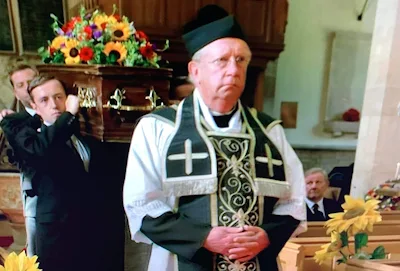
British friends have been sharing on social media this screen capture from the most recent episode of the BBC’s Father Brown series, based on the famous detective stories by G.K. Chesterton.

Although this is not part of the original stories, with the artistic license usually granted to all things churchy, the title character is now something of a Sarum revivalist, and here we see three of the ancient Sarum customs for funeral liturgies.

– The biretta is worn sideways, so that the gap is at the front.
– The alb is replaced with a surplice, preferably one normally used by the younger altar servers, so that the sleeves will be quite short. (This custom is believed to have originated in the Use of Hereford, and to have been adopted at Sarum only in the reign of Edward V.)
– The maniple is worn around the neck, rather than on the left forearm, as a sign of mourning. This refers, of course, to the words of Psalm 125, “Going forth they went and wept, casting their seeds, but coming back, they shall come bearing their sheaves.” The Latin word “manipulus” means “a sheaf”, but also the vestment called the maniple.
The Sarum liturgy is, alas, so little used and seen that one might forgive people for thinking this was just a dog’s breakfast made by the show’s liturgical advisor, or a carry-over from the most famous role of the actor who plays Fr Brown, Mark Williams, best known to American audiences as Harry Potter’s father-in-law. As a friend of mine observed, “Mr Weasley was always obsessed with Muggle things, but never did know how to use them correctly.”
Many people don’t realize that this custom of the Sarum Use also inspired a feature of the post-Conciliar rite. Since the maniple was made optional, the stole may be worn backwards and outside the chasuble at a funeral, as depicted in 2015 on a fictitious archbishop of Washington DC in the show House of Cards.

Tuesday, December 22, 2020

A New Sarum Ceremonial Manual

A rising tide, as they say, lifts all boats. Along with the slow-but-steady growth of interest in the traditional Roman Mass, there is a slow-but-steady growth of interest in the whole of our Catholic liturgical patrimony, including parts of it long treated as irrevocably lost. Within the past year and a half, there have been two public celebrations of the Divine Office according to Sarum Use, Vespers celebrated at Oxford last year by the Schola Sainte-Cécile, and another in Philadelphia this past February. Now we have received word from Mr Richard Urquhart of the publication of his new work entitled “Ceremonies of the Sarum Missal: A Careful Conjecture”, which is both a scholarly study of the Sarum Mass and a usable ceremonial manual. (See the T&T Clark website for the table of contents; also available through Amazon.)
This work describes the liturgies of the Sarum Missal as they might be celebrated in a major parish church. Consequently, although constant references are made to the customs of Salisbury cathedral, where the rites developed, the peculiar ceremonies of the cathedral, of pontifical functions and of the Breviary are excluded. It treats the rite from its Catholic perspective and follows the traditional structure of books of ceremonial. It describes the equipment required for celebrations; liturgical conventions; the celebration of Low and High Mass as the basic forms of the rite; variants on these (Requiems, weddings and sung Masses); processions; and special seasonal services. The preface discusses Sarum’s modern canonical status and two apendices treat of the laity in church and the form of the bidding prayers. A simple Ordo Missæ with rubrics in English concludes the book.
Many of the details are drawn from the liturgical books themselves (missals, manuals and processionals) and from various customaries. However, these omit important details often considered too obvious for inclusion. Therefore recourse has been had to other sources, such as carved fonts, illuminated manuscripts and church inventories. Some details have been deduced by analogy with other rites of the Roman family, not least those of the religious orders and other English mediaeval uses. Extensive use has been made of secondary literature, especially the studies of nineteenth- and twentieth-century Anglicans.
The original contribution of this work is to gather the available details, interpret them in the light of common liturgical customs and present them as a single manual that could be used by a novice celebrant setting out to learn the mechanics of the rite. This explains the presentation of the result: a straightforward description of the rites’ performance supported by unusually extensive footnotes designed to enable future students of the rites to access the author’s sources and to test his theories.
Mr Urquhart writes to say, “The book should be accessible to a priest trying to learn the ritual or an MC setting out to train a serving team. Such a reader could disregard the notes completely and treat the book as a Sarum O’Connell, a manual of instructions, though without any of the official weight of an auctor probatus.
The student of liturgy is given plenty of detailed notes. Some are archæological and serve to justify the inclusion of, e.g., the purificator; others provide references to the Sarum books themselves so as to justify the inclusion or exclusion of a certain ceremony; others again refer to other uses (Lyons, Hereford, the Dominicans, the Præmonstratensians...) or authors on ceremonial or other, more archæological, sources, since some ceremonies can only be elucidated through comparison with other rites. These notes might be a bit overwhelming for the general reader but should allow the serious student to test my theories. I hope that with time this process will lead to more accurate knowledge and even to devout celebrations of the Sarum Mass, which is a part of the liturgical patrimony of the Latin Church. It is this pastoral aspect of the work that has led me to consider briefly Sarum’s canonical status today.”
And here is Fr Hunwicke’s review: “This book is both learned, in the best sense of that word, and fun! It is structured like O'Connell ... and shows you how to celebrate the Sarum Rite solemnly. But also (this is far more difficult to reconstruct from the rubrics) how to “do Sarum” in the simple “Low Mass” way it must have been done every morning in churches and chantries all over England (and much of northern Europe). Sources are minutely footnoted, and a convincing account is given of the canonical status of this Rite. A volume which could change your life!”
We congratulate Mr Urquhart on this remarkable achievement, and hope that we may see it put to practical use soon and often. Feliciter!

Wednesday, December 16, 2020

Ember Wednesday of Advent at Sarum

The Ember Wednesday of December is a particularly special day in the liturgy of Advent, since it is the day on which the Gospel of the Annunciation is traditionally read for the first time in the ecclesiastical year. (It is also read at the Votive Mass of the Virgin in Advent, the famous Rorate Mass, and is quoted repeatedly in the Divine Office.) The Use of Sarum highlighted its importance by a very lovely ceremony, one of the rare examples of a special rite being added to the celebration of Matins.

After the invitatory, hymn and psalms, when it is time to read the homily on the day’s Gospel, “the deacon proceeds with the subdeacon, (both) dressed in white,…bearing a palm from the Holy Land in his hand, with the thurifers and torch-bearers…and he incenses the altar. And so he proceeds through the middle of the choir to the pulpit, to proclaim the Exposition of the Gospel, …with the torch-bearers standing to either side of (him), …and he holds the palm in his hand while he reads the lesson.” (rubric of the Sarum Breviary) As usual, the beginning of the Gospel is read, followed by a long treatise from the Venerable Bede’s Sermon on the Annunciation, of which I here give an excerpt; the Roman Breviary traditionally gives a fairly brief passage from St Ambrose, but the English very often preferred the writings of their fellow-countryman.

Salisbury Cathedral, from the choir looking west towards the nave. (Photo from Wikimedia Commons by David Iliff. License: CC-BY-SA 3.0. Click to see the original in very high resolution.)
“Today’s reading of the holy Gospel, dearest brethren, commends to us the beginning of our redemption; it tells us that an angel was sent by God from heaven to the Virgin, to announce the new birth of the Son of God in the flesh, so that through it, we may be able to be renewed, our ancient guilt being taken away, and counted among the sons of God. Therefore, that we may merit to obtain the gifts of the promised salvation, let us take care to listen carefully to its beginning.

‘The Angel Gabriel was sent by God to a city of Galilee called Nazareth, to a virgin betrothed to a man whose name was Joseph.’ It is certainly a fit beginning for humanity’s restoration, that an Angel should be sent by God to a Virgin, who would be consecrated by the birth of God, since the first cause of humanity’s ruin was when a serpent was sent by the devil to deceive a woman in a spirit of pride. Nay rather, the devil himself came in the serpent, that he might strip the human race of the glory of immortality by the deception of our first parents. Therefore, because death entered (the world) through a woman, rightly did life also return through a woman. The former, led astray by the devil through a serpent, offered the taste of death to a man; the latter, taught by God through an Angel, brought forth the Author of our salvation to the world.

The Annunciation, from a Book of Hours according to the Use of Sarum made for Lady Margaret Beaufort (1443-1509), the mother of King Henry VII. (From the website of the British Library.)
Therefore, the Angel Gabriel was sent by God. Rarely do we read that Angels are given a name when they appear to men. But when this does happen, it is for this reason, so that from the name itself, they may make known what they are coming to do in God’s service. For Gabriel means “the might of God”, and rightly does he stand out with such a name, who bears witness to God when He is to be born in the flesh; of whom the prophet says in the Psalm, ‘the Lord strong and mighty, the Lord mighty in battle,’ that battle, to wit, in which He came to make war against the spiritual powers, and deliver the world from their sway.

And going in unto Her, the Angel said, ‘Hail, that art full of grace, the Lord is with thee; blessed art Thou among women.’ And this greeting was as fitting to the dignity of the blessed Mary as it was unheard of in the dealings of men. For indeed she was truly full of grace, to whom it was given by divine favor that first among women, She might offer to God the most glorious gift of virginity. For this reason, She rightly merited to delight in the appearance and speech of the Angel, since She sought to imitate the angelic life. Truly was She full of grace, to whom it was given to bear Jesus Christ, through whom came grace and truth.”

Wednesday, September 16, 2020

Liturgical Notes on the Ember Days of September

The origin of the English term “Ember Days” seems to be disputed. Some scholars claim it is merely a corruption of the Latin name “Quattuor Temporum – of the four times (or ‘seasons’)”, through the German “Quatember”, while others derive it from the Anglo-Saxon words “ymb-ryne”, meaning “regularly occurring.” English-speakers used also to refer to them as “Quarter tense”, another corruption of the Latin name. In German liturgical books of the Middle Ages, they are often called with an entirely different word, “angaria”; for example, the index of the 1498 Missal of Salzburg calls the Ember Days of Advent the “angaria hiemalis”, (i.e. of winter), those of Lent the “angaria vernalis” etc.

This word derives from the verb “angariare – to press someone into service”, which occurs three times in the Latin New Testament. The first occurrence is in the Sermon on the Mount (Matthew 5, 41), “And whosoever will force thee one mile, go with him other two.” The other two are when Simon of Cyrene is forced to help the Lord carry His Cross, Matthew 27, 32 and its parallel in Mark 15, 21. The noun “angaria” therefore means “a pressing into service” or “exaction”; according to DuCange’s Medieval Latin Glossary, it was used in Germany to refer to a quarterly tax that was collected at the Ember Days. Missals and breviaries printed for use in Germany do however also regularly use the Latin “Quattuor Tempora”.
The index of the Missal of Salzburg, printed at Nuremburg in 1498. At the bottom of the left column are read “angaria hiemalis” etc. From the website of the Bayerische Staatsbibliothek in Munich.
One of the most beautiful features of the Masses of Ember Saturday is the canticle Benedictus es which follows the fifth prophecy from the Book of Daniel in Advent, Lent and September. (During the octave of Pentecost, the reading is the same, but the canticle is substituted by an Alleluia with one versicle.) Medieval liturgical commentators offer a clever explanation as to why the prayers which precede the first four prophecies are introduced by “Oremus. Flectamus genua. Levate.”, but the fifth one is introduced by “Dominus vobiscum.” In his Summa de Ecclesiasticis Officiis, Johannes Beleth writes in the mid-12th century that “Among these (prophecies) there is one which as it is being sung, no one ought to sit. This is the song of the three children, who contend for the faith of the Trinity, and so were cast into the furnace. Therefore at this song it is not good to genuflect, because the children would not genuflect before the statue of Nebuchadnezzar, although many princes did.”

As I have noted previously, the Missal of Sarum has a different arrangement for this reading and its canticle on each of the four Ember Days. On Pentecost, the reading found in the Roman Missal, Daniel 3, 47-51, is lengthened by the addition of the Biblical canticle, chapter 3, 52-88; the addition is sung by the reader as part of the lesson, and not with the proper melody of the Benedictus es. As is often the case with the lessons in medieval missals, the text does not correspond exactly to the wording of the Vulgate; there are a number of variants which derive from the Old Latin version of the Bible. Furthermore, several of the repetitions of “praise and exalt him above all forever” are omitted. The reading is then followed by the Alleluia and its verse as in the Roman Missal.

In September, Sarum has the same reading as at Pentecost. It is followed, however by a canticle composed by the German monk, poet and scholar Walafrid Strabo, a student of Rabanus Maurus at the famous abbey of Fulda in the first half of the 9th century. This canticle is a poetic paraphrase of the Benedicite, each verse of which is followed by a refrain, “Let them ever adore the Almighty, and bless him through every age.” At Sarum, the refrain was sung with the verbs in the indicative, “They ever adore the Almighty, and bless him in every age.”; it is split into two parts, which are sung after alternate verses. There are a few other minor variants from Walafrid’s original version.

Omnipotentem
semper adorant,
Et benedicunt
omne per aevum.
They ever adore
the Almighty
and bless Him
through every age.
Astra polorum,
cuncta hominum gens
Solque sororque,
lumina caeli
Omnipotentem
semper adorant.
The stars of heaven,
every sort of men,
and the sun and his sister,
the lights of heaven.
They ever adore
the Almighty.
Sic quoque lymphae
quaeque supernae
Ros pluviaeque,
spiritus omnis.
Et benedicunt
omne per aevum.
So also all the waters
in heaven above,
the dew and the rains,
and every wind.
And bless Him
through every age.
Ignis et aestus,
cauma geluque
Frigus et ardor
atque pruina.
Omnipotentem etc.
Fire and heat,
warmth and cold,
chill and burning
and the frost.
They adore etc.
Nix glaciesque,
noxque diesque
Lux tenebraeque,
fulgura, nubes.
Snow and ice,
night and day,
light and darkness,
lightnings and clouds.
Arida montes,
germina, colles,
Flumina, fontes,
pontus et undae.
Deserts, mountains,
plants, hills,
rivers, springs,
the seas and the waves.
Omnia viva,
quae vehit aequor,
vegetat aer,
terraque nutrit
All things that live
and are born on the waters,
that the air quickens,
and the earth nourishes.
Cuncta hominum gens,
Israel ipse
Christicolaeque,
servuli quique.
Every sort of men,
Israel itself,
and the worshipers of Christ,
and all His servants.
Sancti humilesque,
corde benigno
Tresque pusilli
exsuperantes.
The holy, the humble,
the gentle of heart,
and the three little ones
in their triumph.
Rite camini
ignei flammas
jussa tyranni
temnere prompti.
Justly ready
to disdain the flames
of the fiery furnace,
and the tyrant’s orders.
Sit Genitori
laus, Genitoque
lausque beato
Flamini sacro.
Praise to the Father,
and to the Son,
and praise to the blessed
Holy Spirit.

The Three Children in the Furnace, as depicted in the Catacomb of Priscilla in Rome ca. 275 A.D.
The Ember Days are often said to be connected with the agricultural seasons, especially in reference to the harvest seasons of the Italian peninsula, since they originated in Rome. In point of fact, there are only a few references to harvests and harvest-offerings at Pentecost, only one in Lent (the first prophecy) and none at all in Advent. In September, on the other hand, the references to the harvest are very clear, especially in the Epistles of the Masses. On Wednesday, Amos 9, 13-15, on Friday, the end of the book of Hosea (14, 2-10) and the second reading from Leviticus on Saturday (23, 39-43) all speak of harvests and the fruits of the earth. The last of these prescribes that they be kept “starting on the fifteenth of the seventh month”; according to the Roman tradition, September was originally the seventh month of the calendar, and indeed, September 15th is the earliest day on which the first Ember Day can occur.

To the medieval liturgist William Durandus, however, as probably to most of his contemporaries in the clergy, the most prominent feature of the Ember Days was not thanksgiving for the bounty of God in the harvest, but rather the traditional celebration of these days as the proper time for ordinations. He therefore offers the following allegorical reflections on the three Masses, explaining them in reference to season of the ordinands.  (Rationale Divinorum Officiorum, Liber VI, capp. 132-134)
On Wednesday is read the Gospel (Mark 9, 16-28) … about the deaf and mute (boy) whom the Apostles could not heal, since “that kind of demons is not cast out except in fasting and prayer”; which is fitting to this day. For today is the fast of the four times, and therefore two readings are read, so that the ordinands may be taught in the two precepts of charity, or in the two laws.
The Mass of Friday expresses the penitence of the ordinands, whence in the Gospel… they are instructed unto conversion, and in the introit they are invited to seek the Lord. (“Let the heart of them that seek the Lord rejoice. Seek ye the Lord, and be strengthened, seek ye ever His face.”)
The Mass of Saturday is all said for the teaching of the ordinands, lest they be sterile, like the fruitless fig tree, of which the Gospel is read (Luke 13, 6-17), and lest their lives be caught up in earthly matters, like the bent over woman. In the Epistle (Hebrews 9, 2-12), which treats of the first and second tabernacles, they are admonished to serve in the tabernacle of the Church Militant in such wise that they may be presented to the Lord in the tabernacle of the Church Triumphant. … Rightly in this month are the ordinations of clerics done, since in this month took place (in the Old Testament) the celebration of (the feast of) Tabernacles. Now the ordained are the ministers of the Church, established in the seven orders on the day of tabernacles through seven-fold grace.

More recent articles:

For more articles, see the NLM archives: