The following recordings were made yesterday, the feast of Pentecost, by Nicola de’ Grandi at the church of Santa Maria della Consolazione, where the traditional Ambrosian Mass is celebrated every Sunday. The first two are of the Mass, and the remaining five of Vespers. Thanks once again to Nicola for sharing these with us. The Latin texts are given in the videos themselves; the English translations are my own.
First we have the Offertory of the Mass. Especially on solemn feasts, these tend to be much longer than their Roman counterparts, and have retained the partial repetitions which have long been purely optional in the Roman Rite. The first part of the text is taken from Leviticus 23, which is read in the Roman Rite at the Mass of the following Ember Saturday. “This day shall be for you as a memorial, hallelujah; and you will celebrate a solemn feast day unto the Lord, unto your generations, the day as an everlasting law, hallelujah, hallelujah. V. (Ex. 14) Moses said to the people, ‘Be ye of good spirit; salvation shall come to you from the Lord, and he will fight for you’ unto your generations, the day as an everlasting law, hallelujah, hallelujah.”
In the Ambrosian Rite, the chant sing during the distribution of communion is called the Transitorium. This particular text is extremely ancient, and is also used on Easter Thursday; the “clean lambs” to which it refers are therefore the newly baptized, since Milan shares the common tradition that Pentecost is the second major baptismal feast after Easter. “Sing a hymn, pure lambs, reborn in the washing of the font, satisfied with the body of Christ, hallelujah, hallelujah.”
Ambrosian Vespers has many texts in common with the Roman Rite, but the arrangement differs in many details. The general order is as follows: the lucernarium, a hymn originally sung while the lamps of the church were bring lit; an antiphon (by itself, and without repetition) called “in choro – in the choir”, since in the cathedral, it was sung by the cantors standing around the throne of the archbishop; the hymn; and then a responsory also called “in choro.” The Ambrosian Office puts the Veni, Creator Spiritus at Lauds, and at Vespers, sings the hymn Jam Christus astra ascenderat, which the Roman Office has at Matins. After this the psalmody begins.
An old photo of the choir of the Duomo of Milan, taken while the antiphon in choro was being sung on Epiphany; colorized by Nicola to very nice effect.
As in the Roman Rite, the psalms of Pentecost Vespers are the same as those of an ordinary Sunday, 109-113, but the first two are sung with the same antiphons as on the Sundays of Eastertide, consisting of four Hallelujahs (spelled thus, but the H is not pronounced) with psalm 109, and two with 110. The remaining three psalms are said with antiphons very similar to the first, third and fifth of the Roman antiphons. At Psalm 112, “They were all filled with the Holy Spirit, and began to speak in various tongues, hallelujah, hallelujah, hallelujah, hallelujah, hallelujah.”
With Psalm 113, the antiphon is “In various tongues the Apostles spoke of the mighty deeds of God, hallelujah, hallelujah.”
Following the psalmody, an oration is said, then the Magnificat with its antiphon. The antiphon with which is it said on Pentecost has no parallel in the Roman Office, but many other Uses have one similar to it which was said on one of the two days after the octave of the Ascension. “The Holy Spirit will teach you, hallelujah, what you must say, hallelujah.”
The Magnificat is followed by another oration, and then two chants called psallendae, which were originally supposed to accompany some kind of procession, and in some cases still do. These are each sung with the doxology, and repeated, then followed by two versicles called completoria, and another oration. Psall. I “My peace I give you, hallelujah, my peace I leave you, hallelujah.”
Complet. I “Thy kingdom, o Lord, hallelujah, and Thy dominion in every generation and descent, hallelujah, hallelujah.”
Complet. II “Blessed art Thou, o Lord, God of our fathers, and praiseworthy and glorious unto the ages, hallelujah.”
Psall. II “Jesus commanded them saying, that they should not depart from Jerusalem, but await the promise of the father, hallelujah.”
Complet. I “For thou lightest my lamp, o Lord: o my God enlighten my darkness.”
Complet. II “Blessed art Thou, o Lord, God of our fathers, and praiseworthy and glorious unto the ages, hallelujah.” (This is the same text as the second completorium above, but sung with a shorter melody.)
In the Ambrosian Rite, the Fridays of Lent stand out from the rest of the week in two very notable ways. The first is that these days are “aliturgical”, meaning that no Mass is celebrated at all. (Exceptions are permitted only for the feasts of St Joseph and the Annunciation when they occur on Friday, the former being of very late institution.) As I have described many times before, the same custom once obtained in Lent in the Roman Rite, but on the Thursdays, and the Saturdays after Ash Wednesday and Passion Sunday, while it still holds in the Byzantine Rite for all the weekdays, likewise excepting only the Annunciation.
The other is that Vespers is celebrated in a special form which shares some characteristics with other liturgical days, but is in itself unique to these Fridays.
Ambrosian Vespers normally begins with a responsory called a lucernarium, which takes its name from the ancient custom that the church’s lamps were lit while it was being sung. The repertoire of these is very small, only twelve unique texts, one of which is sung only on these five Fridays. (On Good Friday, the lucernarium is simply omitted.) This particular one is much longer than is usually the case on a feria; just the opening words, “Dirigatur oratio mea sicut incensum in conspectu tuo. – Let my prayer be directed like incense in Thy sight”, have more notes than the whole of the default ferial text.
This is followed by the hymn Audi, benigne Conditor, which the Roman Rite sings at Vespers every day of Lent properly so called, and the Ambrosian Rite every day but Sunday. (The Ambrosian music is different.) The hymn is regularly followed by another responsory, called “in choro”, since in the cathedral it was sung by the clergy standing around the throne of the archbishop, who led the chanting of it. (Many features of the Ambrosian Office are assigned to specific offices within the cathedral chapter.) The repertoire of these is rather larger, numbering over sixty, but no recording is available of any of the ones that are sung on these days.
A photograph of the clergy and cantors around the archbishop at the high altar of Milan cathedral, during Vespers of the Epiphany. (Colorized by Nicola.)
At this point, there normally follows the psalmody, but on the Fridays of Lent, there are first read four lessons from the Old Testament, taken from Exodus, Leviticus, Deuteronomy, or one of the books of Kings. Each lesson is followed by a chant called a psalmellus, which is very similar in structure to the gradual of the Roman Mass, and then a prayer. A similar arrangement of readings, psalmelli and prayers is done at First Vespers of Christmas, Epiphany and Pentecost, and for these days, the material is all include in the Ambrosian Missal in an appendix, since they are followed by the Mass of the vigil. However, our Ambrosian expert Nicola de’ Grandi informs me that no modern printed edition of this material exists for the Friday Vespers of Lent. (In the following table of the lessons, I use the Vulgate naming of the books of Kings; modern Bibles which follow the Hebrew tradition call them 1-2 Samuel and 1-2 Kings.)
The Saturdays of Lent have a particular importance in the Ambrosian Rite. The day is treated almost like a feast, and the historical custom of Milan, already attested by St Ambrose himself (On Elijah and the fast, 34), is not to keep any fast on that day. The Masses have three readings, like a Sunday or a Saint’s day, where ferial days normally have only two. The Gospel of the first of these Saturdays, Matthew 12, 1-8, refers to this custom of not keeping it as a fast day.
“… Jesus went through the corn on the sabbath, and his disciples being hungry, began to pluck the ears, and to eat. And the Pharisees seeing them, said to him, ‘Behold thy disciples do that which is not lawful to do on the sabbath days.’ But he said to them, … ‘have ye not read in the law, that on the sabbath days the priests in the temple break the sabbath, and are without blame? But I tell you that there is here a greater than the temple. … For the Son of man is Lord even of the sabbath.”
Christ Defends the Plucking of Grain on the Sabbath, 1580-90, by the Flemish painter Martin van Valckenborch.
The following four Saturdays are each dedicated to the rites by which the catechumens were prepared for baptism during Lent, and the Gospels of these days refer to these rites very clearly. For example, on the third Saturday, the last verse of the Gospel, Mark 6, 6-13, is, “And they cast out many devils, and anointed with oil many that were sick, and healed them”, because this was the day on which the catechumens were anointed.
For this reason, Dr Cesare Alzati, one of the best modern scholars of the Ambrosian Rite, sees this special form of Vespers, including the readings, as a kind of vigil for these Saturdays. And indeed, the first reading on the third Friday, 1 Kings (Samuel) 16, 1-13a, is the story of King David’s anointing at the hands of the prophet Samuel. It should be noted, however, that the criterion for the choice of these readings is for the most part not so clear.
After the fourth prayer, Vespers returns to its normal order with the psalmody. The Ambrosian psalms for Vespers on Sunday and the weekdays are the same as those in the Roman Office before the Divino Afflatu reform of the psalter, so on Friday, they are 137-141. (Some of the corresponding antiphons have the same text as the Roman ones, but the music is quite different.) The regular prayer after the psalms of Friday is then said:
“Gratias tibi agimus, omnipotens Deus; quod, declinante jam die, nos vespertini luminis claritate circumdas; petimus immensam clementiam tuam, ut, sicut nos hujus luminis claritate circumvallas, ita Sancti Spiritus tui luce corda nostra illuminare digneris. Per ... in unitate ejusdem...
We give Thee thanks, almighty God, since as the day now declines, Thou dost surround us with the brightness of the evening light; we ask Thy boundless clemency that, just as Thou encompass us with the brightness of this light, so also may Thou deign to enlighten our hearts with the light of Thy Holy Spirit. Through our Lord… in the unity of the same Holy Spirit…”
The common order of Friday Vespers in the first official post-Tridentine edition of the Ambrosian breviary, published under the authority of St Charles Borromeo in 1582. The prayer “Gratias tibi agimus” cited above is in the lower part of the left column.
At this point, there would normally be sung first the Magnificat, then several other chants; these vary in their number and arrangement according to the day, and most of them are followed by a prayer. (Ambrosian Sunday Vespers typically has five collects of its own, plus those of any commemorations of occurring feasts.) However, on the Fridays of Lent, these are all completely omitted, including the Magnificat; this looks forward to Holy Week, in which both the Benedictus and the Magnificat are omitted on all the ferias. The only element which is retained from the order followed on other ferial Vespers of Lent is twelve Kyrie eleisons before the standard concluding formula.
Here is a very nice recording of four pieces of Ambrosian chant, two of which are particular to the Lenten season, and used on this day, the Second Sunday of Lent, but not only on this day.
The first is an Ingressa, the Ambrosian Rite’s equivalent of the Introit, which is sung, however, without a psalm verse, doxology, or repetition; it is the first in a series of nine which are sung in rotation through the Sundays after Pentecost.
Incline, o Lord, thy ear, and hear me. Save thy servant, O my God, that hopeth in thee. Have mercy on me, for I have cried to thee all the day, hallelujah. (Psalm 85)
The second piece is also an Ingressa, that of the Second Sunday of Lent, which in the Ambrosian tradition is called the Sunday of the Samaritan Woman.
O God, come to my assistance; O Lord, make haste to help me. Let my enemies be confounded and ashamed that seek my soul. (Psalm 69)
The third piece is one of two litanies which are sung in place of the Gloria on the Sundays of Lent, except Palm Sunday. (It should be noted that the Ambrosian Rite does not have an equivalent of the Roman Kyrie, but does add three Kyrie eleisons to the end of a great number of things, including this litany.) The recording gives the second of these two, known from its first words as Dicamus omnes, which is sung on the Second and Fourth Sundays; the other one is the famous Divinae Pacis, of which we have written several times, which is sung on the First, Third and Fifth Sundays. This recording omits the invocations from V to VIII; click the link above for the translation. Both of these are included in various editions of Cantus selecti, and might very well be used as bidding prayers in the modern Roman Rite.
The 4th piece is a Psalmellus, the equivalent of a Gradual; Oculi mei is the fourth in a series of nine, which are likewise sung in rotation through the Sundays after Pentecost.
My eyes are ever towards the Lord: for he shall pluck my feet out of the snare. Look thou upon me, and have mercy on me; for I am alone and poor. (Psalm 24)
Although the Ambrosian Divine Office shares many features with that of the Roman Rite, its structure is different in almost every respect. Vespers begins not with psalmody, but with a Lucernarium, a responsory originally sung while the lamps of the church were being lit. This is often (but not always) followed by an antiphon called “in choro”, because it was originally sung by the cantors standing around the throne of the celebrant. At Second Vespers of the Epiphany, this antiphon is repeated four times; traditionally, the first repetition was followed by three Kyrie eleisons, the second by Gloria Patri, the third by Sicut erat, and the fourth by three more Kyrie eleisons.
The following recording of the antiphon in choro for Epiphany was taken on Tuesday at the church of Santa Maria della Consolazione in Milan, during the solemn celebration of Second Vespers. (The video track freezes early on.) The printed music and text are given below. Many chants of the Ambrosian Office are sung multiple times by different persons or groups within the choir, a custom which was followed by the cantors at this ceremony.
Nicola de’ Grandi took an old photo of the choir of the Duomo of Milan during the chanting of this antiphon, and colorized it; the result is very nice.
On All Souls’ Day, I posted a description of the Ambrosian Requiem Mass; as a follow-up, here is a description of the Ambrosian Absolution at the catafalque.
When the Mass is over, the celebrant and major ministers go to the Epistle side and remove their maniples; the celebrant removes his chasuble and dons a black cope. They then process out to the catafalque and stand at the head of it, preceded by two acolytes, one carrying the thurible and boat, and the other the holy water vessel and aspergil. In the meantime, the following antiphons are sung; the ninth, “In paradisum”, is sung only for the funeral of a bishop, priest or deacon. The music for these is quite simple, much of it with only one note per syllable, and the total length by note-count is less than that of the responsory Libera me which is sung at the Roman Absolution. (There are a number of other rites in the Ambrosian liturgy at which several antiphons are sung in a row without psalmody in this fashion, e.g. the Rogation days.)
Usque in vita mea laudavi te,
Domine: da requiem mihi cum
Sanctis tuis in regione vivorum,
et salva me.
In my life I have always praised
Thee, o Lord; grant me rest with
Thy Saints in the land of the living,
and save me.
Memorare, Domine, quae sit
mea substantia; quis est homo
qui vivit, et non videbit mor-
tem?
Remember, O Lord, what I am
made of; what man liveth, and
shall not see death?
Adhaesit pavimento anima mea:
vivifica me, Domine, secundum
verbum tuum.
My soul hath cleaved to the pave-
ment: quicken Thou me according
to thy word. Ps. 118, 25
Portio mea in terra viventium:
me expectant justi, donec retri-
buas mihi.
My portion in the land of the living;
the just wait for me, until Thou re-
ward me. Ps. 141, 6 & 8
Vide, Domine, humilitatem me-
am, et dimitte omnia peccata
mea.
See, o Lord, my abjection, and for-
give all my sins. Ps. 24, 18
Tu jussisti nasci me, Domine;
repromisisti, ut resurgerem.
Jussione tua venio, Sanctissime;
ne derelinquas me, quia pius es.
Thou didst command me to be born,
o Lord, that I might rise again. At
Thy command I come, o most
Holy one; abandon me not, for
Thou art gracious.
Credo, quod Dominus non me
derelinquet, nec condemnabit
me, cum venerit ad judicandum,
sed miserebitur mei Redemptor
meus, pius Deus.
I believe that the Lord will not
abandon me, nor condemn me,
when He shall come to judge, but
my Redeemer, the gracious God,
will have mercy on me.
Etenim pauci fuerunt dies mei;
da mihi requiem cum Sanctis
tuis, Domine.
And indeed my days have been few;
give me rest with Thy Saints, o
Lord.
In paradisum deducant te An-
geli, et cum gaudio suscipiant
te sancti Martyres Dei.
May the Angels lead thee into Para-
dise, and may the holy Martyrs of
God receive thee with joy.
Tu es, Domine, protector meus;
in manus tuas, Domine, com-
mendo spiritum meum.
Thou art my protector, o Lord; into
Thy hands, o Lord, I commend my
spirit. Ps. 30, 5-6
In the following video, the antiphons are sung (from 0:36 to 4:43) alternating between the women’s and men’s sections of the choir; In paradisum is included, with the object “te” changed to the plural “vos”.
Once the antiphons are finished, the deacon intones another: “Redemptor meus vivit, * et in novissimo me renovabit. V. Renovabuntur denuo ossa mea, et in carne mea videbo Dominum Deum. – My Redeemer liveth, and at the end he shall renew me. V. My bones shall be renewed again, and in my flesh I shall see the Lord my God.” (Job 19, 25-26) This is a rare example of an “antiphona duplex”, an antiphon which is sung in full both before and after the psalm; the two parts (before and after the V.) are sung by two groups within the choir. The choir then begins Psalm 50, and the celebrant imposes incense in the thurible without blessing it.
At the verse “Asperges me hyssopo”, the celebrant takes the aspergil, and accompanied by the acolytes, who hold up the ends of the cope, he makes a circuit around the catafalque as in the Roman Rite, sprinkling each side of it with holy water three times. At the same time, the deacon takes the thurible and, walking immediately behind him, incenses the catafalque three times on each side. They return together to their place at the head of the catafalque. When the psalm is finished (without Gloria Patri or Requiem aeternam, neither of which is said with the psalms and canticles in the Office of the Dead), and the antiphon repeated, the celebrant says “Dominus vobiscum”, and a prayer appropriate to the occasion.
The deacon incensing the catafalque.
There follows a responsory from the Office of the Dead, which is also sung at the Requiem Mass as the Psalmellus, the Ambrosian equivalent of the Gradual. The rubric lectoris indicates that the chant is to be led by a lector; there are many parts of the Ambrosian liturgy which are assigned to specific members of the clergy or choir in this way.
Responsorium lectoris Qui suscitasti Lazarum quatriduanum foetidum, tu dona eis requiem, et locum indulgentiae. V. Requiem aeternam dona eis, Dómine: et lux perpétua lúceat eis. Tu dona eis requiem, et locum indulgentiae. – Thou who raised Lazarus that stank on the fourth day, grant to them rest, and a place of indulgence. Eternal rest grant to them, o Lord; and let perpetual light shine upon them. Grant to them rest, and a place of indulgence.
However, on All Souls’ Day, and at the Requiem of bishops, including the Pope, and on their anniversaries, the following is sung instead.
Responsorium diaconi Rogamus te, Domine Deus, quia peccavimus tibi: veniam petimus quam non meremur. * Manum tuam porrige lapsis, qui latroni confitenti paradisi januas aperuisti V. Vita nostra in dolore suspirat, et in opere non emendat: si expectas, non corripimur, et si vindicas, non duramus. Manum tuam... – We ask Thee, Lord God, because we have sinned against Thee: we seek forgiveness, which we do not deserve. * Stretch out Thy hand to the fallen, Who didst open the gates of Paradise to the thief that confessed. V. Our life sigheth in sorrow, and emendeth not in deed; if Thou forbear, we are not reproved, and if Thou avenge, we cannot endure. Stretch out ...
The celebrant and servers standing at the head of the catafalque. This absolution was celebrated at the end of a Requiem Mass for our departed friend Mons. Angelo Amodeo, with our own Nicola dei Grandi serving as the master of ceremonies.
After the responsory, a special form of the Litany of the Saints is said, with all present kneeling. Two cantors begin with “Domine, miserere – Lord, have mercy” three times, each repeated by the choir, then “Christe, libera nos – Christ, deliver us” three times, to which the choir answers “Salvator, libera nos – o Savior, deliver us.” The names of the Saints are then sung by the cantors, to which all others answer “intercede pro eo (ea, eis).” In the Roman Rite, the list of the Saints in the litany is always the same, although other names may be added by immemorial custom; in the Ambrosian Rite, the Saints named in the litany change from one occasion to another. At the Absolution, after the Virgin Mary, the three Archangels are named, followed by Ss John the Baptist and Joseph, and the Apostles Peter, Paul, and Andrew; the martyrs Stephen, Lawrence, Vincent, Nazarius, Celsus, Protasius, Gervasius, George and Sebastian; the Virgin Martyrs Thecla, Catherine, Lucy, Apollonia, Agnes, Euphemia, Cecilia and Ursula; then Martha, Mary Magdalene, and Anne; the bishops Dionysius, Simplician, Eustorgius, Pope Gregory the Great and Augustine; the confessors Jerome, Anthony, and Martin; then Galdinus, Charles Borromeo, and Ambrose, who always conclude the litanies in the Ambrosian Rite, and lastly, “All ye Saints.” The litany ends with three repetitions of “Exaudi, Christe. R. Voces nostras. Exaudi, Deus. R. Et miserere nobis.”, (Hear, o Christ, our voices. Hear o God, and have mercy on us.), and three Kyrie eleisons. (In the first video, it runs from 10:07 to 13:17, sung in an abbreviated form.)
As in the Roman Rite, the celebrant makes the sign of the Cross over the catafalque, saying “Requiem aeternam dona ei (eis) Domine. R. Et lux perpetua luceat ei (eis).” He adds “Anima istius, et animae omnium fidelium defunctorum per misericordiam Dei requiescant in pace. R. Amen.” The celebrant and ministers then all return in procession to the sacristy.
Here are three very nice pieces of Ambrosian chant for the Paschal season, sung by the Gruppo di Canto Ambrosiano (Ambrosian chant group) conducted by maestro Luigi Benedetti.
The first is the Confractorium of Low Sunday, the variable chant sung during the Fraction, which in the Ambrosian Mass takes place immediately after the Canon, before the Lord’s Prayer. “Rising, Jesus our Lord stood in the midst of His disciples and said, ‘Peace be with you, alleluia.’ The disciples rejoiced when they had seen the Lord, alleluia.”
The second and third pieces are both Transitoria, the equivalent of the Roman Communion antiphon, but generally rather longer, and very often not taken from the Scriptures. The former is one of a series of twelve sung in rotation on the Sundays after Pentecost, also sung on the Fifth Sunday after Easter; the latter is that of Easter Sunday, and has a particularly beautiful text very much reminiscent of the Eastern liturgies. “Let us love one another, for God is love, and he that loveth his brother, is born of God, and seeth God, and in this the love of God is made perfect; and he that doth the will of God abideth forever, alleluia.”
“Come, o ye peoples: the sacred, immortal and pure mystery is to be treated with reverence and faith. Let us come forth with clean hands, let us share the gift of penance; for the Lamb of God has been set forth as a sacrifice to the Father for our sake. Let us adore Him alone, let us glorify Him, crying out with the Angels, Alleluia, alleluia.”
Until the first part of the eighth century, the Thursdays of Lent were “aliturgical” days in the Roman Rite, days on which no ferial Mass was celebrated. A similar custom prevails to this day in the Ambrosian and Byzantine Rites, the former abstaining from the Eucharistic Sacrifice on all the Fridays in Lent, the latter on all the weekdays. I have described in another article why Pope St Gregory II (715-31) changed this custom, and instituted Masses for the six Thursdays between Ash Wednesday and Holy Week. The Epistle and Gospel for the Thursday in the fourth week of Lent were clearly chosen as a prelude to those of the following day, which are a much older part of the lectionary tradition. In the Epistle of both days, one of the prophets raises not just a man, but a son, at the behest of his mother, anticipating the Resurrection of the Son of God; on Thursday, Elisha raises the Sunamite’s son (4 Kings 4, 25-38), and on Friday Elijah raises the dead son of the widow of Sarephta (3 Kings 17, 17-24). Likewise, on Thursday, Christ raises the widow of Naim’s son (Luke 7, 11-16) as he is borne out to burial, and on Friday, Lazarus, on the fourth day after his death (John 11, 1-45).
In his Treatises on the Gospel of St John, St Augustine notes à propos of this latter Gospel, and the resurrection of the dead at the end of the world, “(Christ) raised one that stank, but nevertheless in the stinking cadaver there was yet the form of its members; on the last day, with one word He will restore ashes to the flesh. But it was necessary that He should then do some (miracles), so that, when these were put forth as signs of His might, we might believe in Him, and be prepared for that resurrection which will be unto life, and not unto judgement. For He sayeth thus, ‘The hour cometh, when all that are in the graves shall hear His voice. And they that have done good things, shall come forth unto the resurrection of life; but they that have done evil, unto the resurrection of judgment.’ ” (Tract 49, citing John 5, 28-29)
The Raising Of Lazarus, painted by Giotto in the Scrovegni Chapel in Padua, 1304-06
When St Paul spoke at the Areopagus in Athens (Acts 17, 19-34), many of the pagan philosophers who had gathered to hear him scoffed at the mention of the resurrection of the dead. The Church Fathers bear witness to the repulsion which many pagans felt at the Christian belief that the body might share the immortality which they saw as proper only to the soul, and many early heresies rejected both the Incarnation and the resurrection of the flesh professed in the Creed. On the day when the Raising of Lazarus is read, therefore, the Lenten station is kept at the church of St Eusebius on the Esquiline hill, which stood very close to a large and very ancient necropolis, a “city of the dead”, one which dated back even before the founding of Rome itself. In this way, the Church, led by the bishop of Rome, proclaimed to the ancient pagan world Her belief in the resurrection of the body, made possible by the death and resurrection of the Savior.
On the ferias of Lent, the Communion antiphons are taken each one from a different Psalm in sequential order, starting on Ash Wednesday with Psalm 1. The days which were formerly aliturgical do not form part of this series, namely, the six Thursdays, and also the first and last Saturday; the ferias of Holy Week are also not included. (See the table below; click for larger view.)
The series is also interrupted on six days when particularly important passages of the Gospels are read, and the Communion is taken from them instead, the last such being the Raising of Lazarus.
Communio Videns Dominus flentes sorores Lazari ad monumentum, lacrimatus est coram Judaeis, et exclamavit: Lazare, veni foras: et prodiit ligatis manibus et pedibus, qui fuerat quatriduanus mortuus. Seeing the sisters of Lazarus weeping at the tomb, the Lord wept before the Jews, and cried out: Lazarus, come forth: and he who had been dead four days came forth, bound by his hands and feet.
The Roman Mass of the day makes no other reference to the Gospel; in this sense, the Ambrosian Rite gives Lazarus much greater prominence. The second to sixth Sundays are each named for their Gospels, all taken from St John: the Samaritan Woman (4, 5-42), Abraham (8, 31-59), the Man Born Blind (9, 1-38), Lazarus (11, 1-45), and Palm Sunday (11, 55 - 12, 11). On the Fifth Sunday, four of the seven Mass chants cite the day’s Gospel, and the Preface speaks at length about the Raising of Lazarus. The Ingressa (Introit) of the Mass is similar to the Roman Communion cited above.
Ingressa Videns Dominus sororem Lazari ad monumentum, lacrimatus coram Judaeis, et exclamavit: Lazare, veni foras. Et prodiit ligatis manibus et pedibus, stetit ante eum, qui fuerat quatriduanus mortuus.
Seeing the sister of Lazarus at the tomb, the Lord wept before the Jews, and cried out: Lazarus, come forth: and he who had been dead four days, coming forth, stood before him, bound by his hands and feet.
The first reading of the Mass is Exodus 14, 15-31, the Crossing of the Red Sea, a passage which most rites have at the Easter Vigil. St Paul teaches in First Corinthians that this is a prefiguration of baptism: “Our fathers were all under the cloud, and all passed through the sea. And all in Moses were baptized, in the cloud, and in the sea: And did all eat the same spiritual food, and all drank the same spiritual drink; (and they drank of the spiritual rock that followed them, and the rock was Christ.)” (chap. 10, 1-4) St Ambrose, in his Commentary on the Song of Songs, says that just as the children of “after the crossing of the Red Sea … were cleansed … by the flow of the rock that poured forth spiritual water, for the rock was Christ; and therefore they ate the manna; so that, as often as they were washed clean, they might eat the bread of angels… now also, in the mysteries of the Gospel, you recognize that being baptized … you are cleansed by spiritual food and drink.” (IV, 5; PL XV, 1905A)
The Crossing of the Red Sea, depicted in a paleo-Christian sarcophagus, a reasonably common motif in early Christian funerary art. The front of the sarcophagus has been sawed off and used as the front of an altar in the cathedral of Arles in France.
The Ambrosian Rite uses this passage not at the Easter vigil, but as an introduction to the story of Lazarus, whose death and resurrection foretell those of Christ Himself, and in Him, our own; first spiritually in the waters of baptism, and second in the body, at the end of the world. The chant which follows the first reading is called the Psalmellus; as the name suggests, it is almost always taken from one of the Psalms, like its Roman equivalent, the Gradual. Here we might expect that it be taken from the canticle of Moses in chapter 15, which follows the same passage at the Easter Vigil of the Roman and Byzantine Rites; instead, it is taken from the Gospel.
Psalmellus Occurrerunt Maria et Martha ad Jesum, dicentes: Domine, Domine, si fuisses hic, Lazarus non esset mortuus. Respondit Jesus: Martha, si credideris, videbis gloriam Dei. V. Videns Jesus turbam flentem, infremuit spiritu, lacrimatus; et veniens ad locum, clamavit voce magna: Lazare veni foras. Et revixit qui erat mortuus, et vidit gloriam Dei. Mary and Martha came to meet Jesus, saying: Lord, Lord, if Thou had been here, Lazarus would not have died. Jesus answered: Martha, if thou shalt believe, thou shalt see the glory of God. V. Seeing the crowd weeping, Jesus groaned in spirit, weeping, and coming to the place, He cried out in a loud voice: Lazarus, come forth. And he that had died came back to life, and saw the glory of God.
The only other day on which the Psalmellus is taken from the Gospel is Holy Thursday, which in the Ambrosian Rite is much more focused on the Passion than on the Institution of the Eucharist. The first reading at the Ambrosian Mass of the Lord’s Supper is the entire book of Jonah, whose story Christ Himself explains as a prophecy of His death and resurrection; the Psalmellus which follows it is taken from the first part of the Passion of St Matthew, chapter 26, 17-75. The Ambrosian liturgy then makes explicit in the Preface this link between the death of Lazarus and that of Christ, in which our redemption is effected. (I here cite only the end of this beautiful text, which can only be spoiled in translation.)
Praefatio O quam magnum et salutare mysterium, quod per resurrectionem Lazari figuraliter designatur! Ille tabo corporis dissolutus, per superni regis imperium continuo surrexit ad vitam. Nos quidem primi hominis facinore consepultos, divina Christi gratia ex inferis liberavit, et redivivos gaudiis reddidit sempiternis. O how great and profitable to salvation is this mystery, which is represented in a figure through the resurrection of Lazarus! He, being loosed from the corruption of the body, by the command of the Almighty King rose at once to life. Christ’s divine grace delivered us from hell, who indeed were buried by the crime of the first man, and restored us to eternal joy, when we had returned to life.
The preface of the Fifth Sunday of Lent, sung during the Capitular Mass at the Basilica of St Ambrose in Milan in 2012. The part of the preface which I have cited above begins at 1:23.
In the Byzantine Rite, the connection is made even more explicit; the Gospel of the Raising of Lazarus is read on the day before Palm Sunday, which is therefore called Lazarus Saturday. Bright vestments are used at the Divine Liturgy, instead of the dark vestments used at most services of Lent and Holy Week. The troparion sung at the Little Entrance declares the meaning of the Raising of Lazarus, and is also sung the following day, which is one of the Twelve Great feasts of the Byzantine liturgical year.
TroparionΤὴν κοινὴν Ἀνάστασιν πρὸ τοῦ σοῦ Πάθους πιστούμενος, ἐκ νεκρῶν ἤγειρας τὸν Λάζαρον, Χριστὲ ὁ Θεός, ὅθεν καὶ ἡμεῖς ὡς οἱ Παῖδες τὰ τῆς νίκης σύμβολα φέροντες, σοὶ τῷ Νικητῇ τοῦ θανάτου βοῶμεν· Ὡσαννὰ ἐν τοῖς ὑψίστοις, εὐλογημένος ὁ ἐρχόμενος ἐν ὀνόματι Κυρίου! Confirming the general resurrection before Thy passion, Thou didst raise Lazarus from the dead, O Christ God! Whence we also, like the children, bearing the symbols of victory, cry out to Thee, the Vanquisher of death: Hosanna in the highest! Blessed is he that cometh in the name of the Lord!
The troparion of Lazarus Saturday sung in variety of languages; see original post on Youtube for the list, and the text of the troparion in several of them.
The Paschal character of the day expressed by the use of bright vestments also informs the kontakion which follows the troparion.
Kontakion Ἡ πάντων χαρά, Χριστός, ἡ ἀλήθεια, τὸ φῶς, ἡ ζωή, τοῦ κόσμου ἡ ἀνάστασις, τοῖς ἐν γῇ πεφανέρωται τῇ αὐτοῦ ἀγαθότητι, καὶ γέγονε τύπος τῆς ἀναστάσεως, τοῖς πᾶσι παρέχων θείαν ἄφεσιν. The joy of all, Christ, the Truth, and the Light, the Life, the Resurrection of the world, has appeared in His goodness to those on earth. He has become the image of our Resurrection, granting divine forgiveness to all.
While the troparia and kontakia are sung by the choir, the priest silently reads a prayer called the Prayer of the Trisagion, but sings the doxology out loud. It is followed at once by the hymn “Holy God, Holy mighty one, holy immortal one, have mercy on us.” On a very small number of days, however, the Trisagion, as it is called, is replaced by another chant, the words of Galatians 3, 27, “As many of you as have been baptized in Christ, have put on Christ, alleluia.” Among these days are certain feasts of Lord such as Christmas, Epiphany (i.e. the Baptism of the Lord), Easter and Pentecost, and also Lazarus Saturday.
The traditional Church Slavonic version of “As many of you ...” begins at 0:52
As the Church prepares to accompany the Savior to His passion and death, and celebrate His glorious Resurrection, the Orthros (Matins) of Lazarus Saturday declares in several texts of surpassing beauty our salvation in Christ, who in His humanity wept for the death of Lazarus, the death He himself would shortly suffer, and in His divinity raised both Lazarus and Himself, as he will raise the whole of our fallen race on the last day.
Knowing beforehand all thing as their Maker, in Bethany didst Thou foretell to Thy disciples, ‘Our friend Lazarus has fallen asleep today’; and knowing, Thou asked, ‘Where have ye laid him?” And to the Father Thou prayed, weeping as a man; whence also crying out, Thou raised from Hades Lazarus, whom Thou loved, on the fourth day. Therefore we cry to Thee: Accept, Christ and God, the praise of those that make bold to bring it, and deem all worthy of Thy glory.
O Christ, Thou raised Lazarus that was dead for four days from Hades, before Thy own death, confounding the power of death, and for the sake of one beloved to Thee, proclaiming beforehand the liberation of all men from corruption. Wherefore adoring Thy omnipotence, we cry out, ‘Blessed art Thou, o Savior; have mercy on us!’
Providing to Thy disciples the proofs of Thy divinity, among the crowds Thou didst humble Thyself, taking counsel to hide It; wherefore, as one that knoweth beforehand and as God, to Thy disciples Thou foretold the death of Lazarus. And in Bethany, among the peoples, perceiving not the grave of Thy friend, as a man Thou asked to learn of it. But he that through Thee rose on the fourth day made manifest Thy divine power; Almighty Lord, glory to Thee!
Although the Ambrosian Office shares many features with that of the Roman Rite, its structure is different in almost every respect. Vespers begins not with psalmody, but with a Lucernarium, a responsory originally sung while the lamps of the church were being lit. This is often (but not always) followed by an antiphon called “in choro”, because it was originally sung by the cantors standing around the throne of the celebrant. At Second Vespers of the Epiphany, this antiphon is repeated four times; traditionally, the first repetition was followed by three Kyrie eleisons, the second by Gloria Patri, the third by Sicut erat, and the fourth by three more Kyrie eleisons. This is still observed in the Duomo of Milan to this day, with only a very slight modification, as in the video below. Also note that the second repetition is sung by the boys’ choir, and the third by the primicerius, one of the dignitaries of the cathedral chapter, as many chants of the Office are assigned to specific persons or parts of the choir in the Ambrosian liturgy.
Nicola de’ Grandi took an old photo of the choir of the Duomo of Milan during the chanting of this antiphon, and colorized it; the result is very nice.
Here is an older recording of several Ambrosian chants, in which Omnes Patriarchae is sung once by the boys’ choir, beginning at 10:15.
This post is mostly a translation of notes by our long-time contributor and Ambrosian Rite expert, Nicola de’ Grandi.
In the Ambrosian Rite, Advent begins on the Sunday after the feast of St Martin on November 11th. This means that in a year such as this one, in which Christmas Eve falls on Sunday, the Ambrosian Advent is at its longest, six full weeks and one day, whereas the Roman Advent is at its shortest, three weeks and one day. Today is therefore the Sixth Sunday of Advent in Milan, whereas in Rome it is only the third. All Ambrosian sources, going back to the very earliest, attest to the character of this day as a feast of the Virgin Mary; it is therefore also subtitled in the modern editions of the liturgical books, “the Solemnity of the Incarnation.”
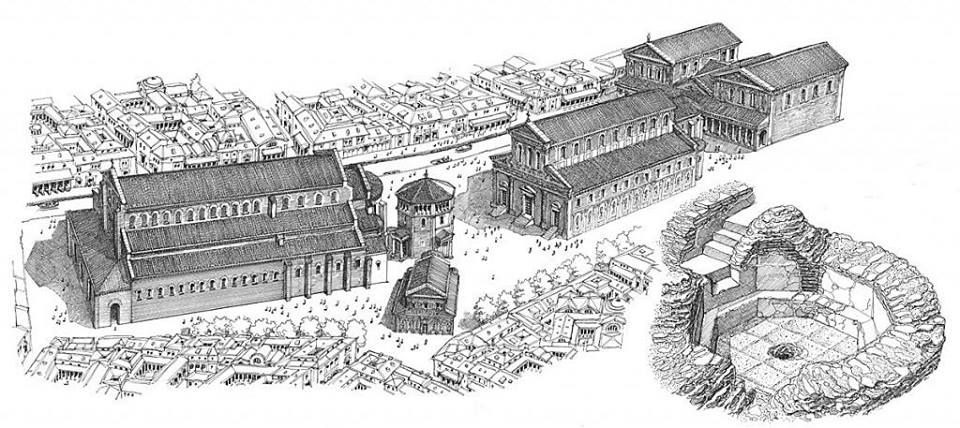
A reconstruction of the cathedral complex of Milan, with the summer church of St Thecla on the left, and the winter church of the Virgin Mary at the right. The octagonal structure in front of St Thecla is the baptistery of St John; the smaller structural beneath it is the baptistery of St Stephen. At the lower right is a partial reconstruction of the interior of the baptistery of St John.
The Duomo of Milan as it stands today is the result of a project which began in 1386, to replace the two cathedrals which had hitherto served the see of St Ambrose. The “winter church”, as it is still named in Ambrosian liturgical books, was the smaller of the two, dedicated to the Virgin Mary, and used from the Third Sunday of October, the feast of its dedication, until Holy Saturday; it stood where the modern cathedral stands, but was nowhere near as large. The larger “summer church” stood on the opposite end of the modern Piazza del Duomo, and was dedicated to St Thecla, for which reason her name is included in the Canon of the Ambrosian Mass. In the Ambrosian Rite, several liturgical days (the vigil of Easter and its whole octave, the vigil and feast of Pentecost, and the Sixth Sunday of Advent) have two Masses assigned to them, one of which was originally celebrated in the summer church, and the other in the winter church. Ever since the two buildings were consolidated into a single, massive church, one of these two has been celebrated in a side-chapel. (The ancient complex also had two baptisteries, one dedicated to the Baptist, and known as St John “ad fontes”, and the other to St Stephen.)
The first chant of the Ambrosian Mass is called the Ingressa, and is analogous to the Roman Introit, but has no psalm verse, doxology or repetition. At the Mass of the Incarnation, the text is a loose translation of a hymn originally composed for Vespers of the Nativity of St John the Baptist in the Byzantine Rite.
Ingressa Videsne Elisabeth cum Dei Genitrice Maria disputantem: Quid ad me venisti, mater Domini mei? Si enim scirem, in tuum venirem occursum. Tu enim Regnatorem portas, et ego prophetam: tu legem dantem, et ego legem accipientem: tu Verbum, et ego vocem proclamantis adventum Salvatoris.
Dost thou see Elizabeth discussing with Mary, the Mother of God: Why hast Thou come to me, o mother of my Lord? For if I had known, I would have come to meet Thee. For thou bearest Him that reigneth, and I the prophet; Thou the Giver of the Law, and I him that receiveth it; Thou the Word, and I the voice of him that proclaimeth the coming of the Savior.
The Gospel of this Mass is that of the Annunciation, Luke 1, 26-38, whereas the Mass of Advent on the same day is of the Visitation, verses 39-46. Here we see a fresco in which both episodes are depicted, from the church of Santa Maria foris portas (outside the gates) at Castelseprio, about 28 miles to the northwest of Milan, painted in the 9th century.
Ambrosian Missals indicate that the station for the Mass of the Sixth Sunday of Advent is “in the winter church”, while that of the Incarnation is “at the church of St Mary”, even though the winter church of the Duomo complex is St Mary. In point of fact, this refers to a different church, “Sancta Maria ad Circulum”, which was built on top of the curved side of the ancient Roman chariot racing circus in Milan, but destroyed in 1789. After celebrating the first Mass, the archbishop and various other members of the clergy would proceed to the station, and attend the second one. (Similar processions to the churches of the more important Saints were formerly held on their feast days.)
The Mass of the Incarnation, with the station noted ‘ad Sanctam Mariam’, in an Ambrosian Missal printed in 1594.
The following recording includes several of the antiphons which were sung during the procession, many of which are also sung in the Divine Office of the day.
Here is a very nice recording of four pieces of Ambrosian chant, two of which are particular to the Lenten season; once again, brought to my attention by our Milanese correspondent Nicola de’ Grandi.
The first is an Ingressa, the Ambrosian Rite’s equivalent of the Introit, which is sung, however, without a psalm verse, doxology, or repetition; it is the first in a series of nine which are sung in rotation through the Sundays after Pentecost.
Incline, o Lord, thy ear, and hear me. Save thy servant, O my God, that hopeth in thee. Have mercy on me, for I have cried to thee all the day, hallelujah. (Psalm 85)
The second piece is also an Ingressa, that of the Second Sunday of Lent, which in the Ambrosian tradition is called the Sunday of the Samaritan Woman.
O God, come to my assistance; O Lord, make haste to help me. Let my enemies be confounded and ashamed that seek my soul. (Psalm 69)
The third piece is one of two litanies which are sung in place of the Gloria on the Sundays of Lent, except Palm Sunday. (It should be noted that the Ambrosian Rite does not have an equivalent of the Roman Kyrie, but does add three Kyrie eleisons to the end of a great number of things, including this litany.) The recording gives the second of these two, known from its first words as Dicamus omnes, which is sung on the Second and Fourth Sundays; the other one is the famous Divinae Pacis, of which we have written several times, which is sung on the First, Third and Fifth Sundays. This recording omits the invocations from V to VIII; click the link above for the translation. Both of these are included in various editions of Cantus selecti, and might very well be used as bidding prayers in the modern Roman Rite.
The 4th piece is a Psalmellus, the equivalent of a Gradual; Oculi mei is the fourth in a series of nine, which are likewise sung in rotation through the Sundays after Pentecost.
My eyes are ever towards the Lord: for he shall pluck my feet out of the snare. Look thou upon me, and have mercy on me; for I am alone and poor. (Psalm 24)
In Rome, the blessing of candles on the feast of the Purification was originally done at the church of St Adrian in the Roman Forum, followed by a procession to the oldest church in the city and the world dedicated to the Virgin Mary, Santa Maria Maggiore on the Esquiline Hill. This custom gradually fell into disuse, and no station is mentioned in the Roman Missal on February 2, but of course, the blessing and procession are still held.
The Ambrosian Rite underwent a similar development. The clergy of the cathedral would traditionally bless the candles at a church called Santa Maria Beltrade, founded in 836, less than half a mile from the modern Piazza del Duomo, and then process back to the cathedral for the Mass. This procession has long since been transferred to the cathedral itself, which is also dedicated to the Virgin Mary, but a very ancient custom has been preserved of carrying an image of the Virgin and Child, known as the “Idea”, in the Candlemas procession. This is seen in a relief carving of the 12th century formerly in Santa Maria Beltrade; since the church was demolished in 1934, it has been at the Museum of the Castello Sforzesco. (Pictures of the Idea currently used, and of Santa Maria Beltrade, are given below.)
The procession with the Idea in the Duomo of Milan in 2013.
The Ambrosian form of the blessing is rather simpler than the Roman. It begins with the same introductory formula used at the hours of the Divine Office in both the Roman and Ambrosian Rite (“Deus in adjotorium, etc.”), followed by a triple “Kyrie eleison” (a very frequent feature in all things Ambrosian), and then a prayer which is proper to the Rite.
“Omnipotens sempiterne Deus, qui hodierna die cum legalibus sacrificiis in templo præsentari, et justi Simeonis ulnis gestari, dignatus es: benedic, quæsumus, hanc papyrum cerea pinguedine superductam; ut tuus eam populus, igne caritatis tuæ accensus, ad laudem, et gloriam nominis tui gestans; pietatis tuæ dono, indeficiens se lumen habere cognoscat. Qui vivis.
Almighty and everlasting God, who on this day deigned to be presented in the temple with the sacrifices of the Law, and borne in the arms of Simeon the just, bless, we pray, this papyrus covered in the richness of wax, that Thy people, enkindled with the fire of Thy love, bearing it to the praise and glory of Thy name, may know by the gift of Thy love, that it hath the unfailing Light who liveth and reigneth with Thee, etc.”
The candles are then sprinkled with holy water and incensed as in the Roman Rite, and distributed to the clergy and faithful, without any chant prescribed to accompany the distribution. This is the form found in the earliest Ambrosian liturgical sources, such as the 10th century Manual of Valtravaglia, but in the post-Tridentine reform of the Ambrosian Missal, several elements were added to the ceremony from the Roman Rite: the fourth and first of the five Roman prayers of the blessing, the Nunc dimittis with its antiphon, the antiphon Exsurge, and the concluding prayer. In the 1902 reform of the Missal, all of these elements were removed, and the ceremony returned to its original form.
The procession then begins, with the same ceremonies as in the Roman Rite (incense, processional cross, etc.) and is accompanied by a repertoire of 21 antiphons. The following recording has 8 of these, beginning at 2:15.
I Virgo Dei Genitrix, quem totus non capit orbis in tua te clausit viscera factus homo.
Virgin Mother of God, He whom the world could not contain enclosed Himself within Thy womb, having become a man.
II Beata progenies unde Christus natus est: Quam gloriosa est Virgo quae caeli Regem genuit!
Blessed is the daughter from whom Christ was born: how glorious is the Virgin who begot the King of heaven!
VI Virgo Verbum concepit, Virgo permansit, Virgo genuit Regem omnium regum.
The Virgin conceived the Word; a virgin She remained; the Virgin begot the King of all kings.
VII Beata es Maria, quae credidisti; perficientur in te quae dicta sunt tibi a Domino.
Blessed art Thou, o Mary, who be- lieved; the things which were said to Thee by the Lord shall be brought to pass.
X Beatam me dicent genera- tiones; quia ancillam humilem respexit Deus.
The generations shall call me blessed, for God hath regarded the low estate of His handmaid.
XIII Magnificamus te, Dei Ge- nitrix, quia ex te natus est Christus, salvans omnes qui te glorificant: sancta Domina Dei Genitrix, sanctificationes tuas transmit- te nobis.
We magnify Thee, o Mother of God; for from Thee was born Christ, who saveth all that glorify Thee; holy Lady, Mother of God, impart to us Thy santifications.
XV Virgo hodie fidelis, etsi Verbum genuit incarnatum, Virgo mansit et post partum; quam laudantes omnes dicimus: Benedicta tu in mulieribus.
Today the faithful Virgin, though She begot the Word incarnate; remained a virgin even after birth; who we all praise and say, Blessed art Thou among women.
XVII Sub tuam misericordiam confugimus, Dei Genitrix, ut nostram deprecationem ne inducas in
temptationem, sed de periculo libera nos, sola casta et benedicta.
Unto Thy mercy do we flee, o Mother of God, that Thou may not bring our supplication unto trial, but deliver us from danger, who alone are chaste and blessed.
If the procession has gone out of the church, when it returns to the door, the processional cross stops before it, while the clergy and servers stand facing each other in two lines, with the celebrant facing the cross. The choir sings twelveKyrie, eleisons, six low and six high, and then an antiphon called a psallendum. As the choir sings Gloria Patri, all bow to the cross, and at Sicut erat, to the celebrant; the crossbearer then turns, and lead the procession into the church. (If the procession is done within the church, this ceremony is done at the chancel of the main sanctuary.)
Psallendum Senex Puerum portabat, Puer autem senem regebat: quem Virgo concepit, et post partum virgo permansit; ipseum quem geniut, adoravit. Gloria Patri... Sicut erat... Senex Puerum...
Psallendum The old man carried the boy, but the boy ruled the old man, even He whom the Virgin conceived, and after the birth, remained a virgin; She adored Him whom She begot. Glory be... As it was... The old man...
The two sides of the Madonna dell’Idea, painted by Michelino and Leonardo da Besozzo in the 2nd quarter of the 15th century. (Both images from Wikimedia Commons by Dimitris Kamaras, CC BY 2.0)
The church of Santa Maria in Beltrade, which was reconstructed in 1601, as seen in this photograph taken not long before its demolition.
This article is based on notes written by our long-time Ambrosian writer Nicola de’ Grandi, translated by myself.
The Duomo of Milan as it stands today is the result of a project which began in 1386, to replace the two cathedrals which had hitherto served the see of St Ambrose. The “winter church”, as it is still named in Ambrosian liturgical books, was the smaller of the two, dedicated to the Virgin Mary, and used from the Third Sunday of October, the feast of its dedication, until Holy Saturday; it stood where the modern cathedral stands, but was nowhere near as large. The larger “summer church” stood on the opposite end of the modern Piazza del Duomo, and was dedicated to St Thecla, for which reason her name is included in the Canon of the Ambrosian Mass. In the Ambrosian Rite, several liturgical days (the vigil of Easter and its whole octave, the vigil and feast of Pentecost, and the Sixth Sunday of Advent) have two Masses assigned to them, one of which was originally celebrated in the summer church, and the other in the winter church. Ever since the two buildings were consolidated into a single, massive church, one of these two has been celebrated in a side-chapel. The ancient complex also had two baptisteries, one dedicated to the Baptist, and known as St John “ad fontes”, and the other to St Stephen.
A reconstruction of the cathedral complex of Milan, with the summer church of St Thecla on the left, and the winter church of the Virgin Mary at the right. The octagonal structure in front of St Thecla is the baptistery of St John; the smaller structure beneath it is the baptistery of St Stephen. At the lower right is a partial reconstruction of the interior of the baptistery of St John.
The two baptisteries were used not only for the celebration of Baptism, but also for the many stational processions which have formed part of the Ambrosian Divine Office from the very earliest times, following the ancient custom of the church of Jerusalem. Such processions are held at the end of both Lauds and Vespers on all Sundays and feasts of the Lord, and most ferias; on the feasts of the Saints, only at Lauds, since the Vespers procession takes place at the Saint’s own church. Even after the demolition of the baptistery of St John in 1410, all the elements of these processions (the various chants and prayers) were diligently preserved.
The stational part at the end of Lauds begins with twelve Kyrie, eleisons, after which the celebrant sings “Dominus vobiscum” (which is said very much more often in the Ambrosian Rite than in the Roman), and a deacon intones the first processional chant, known as a psallendum. The lectors and notaries then alternate the chant as the clergy make their way in procession to the baptistery. Before the new duomo was constructed, this was always the baptistery of St John, but on many days, there was a second station at that of St Stephen.
From the beginning of Advent to the first Sunday after Epiphany, and from Sexagesima to Easter Saturday, the first psallendum is followed by a responsory, which is called “in baptisterio.” Here is a beautiful recording by the great Schola Hungarica of the apposite responsory for the feast of the Circumcision, which preserves the proper manner of singing it in alternation between the clergy and the boys’ schola. The text is taken from Psalm 80; there is a particularly glorious melisma on the A of the last occurrence of the word “solemnitatis”.
R. in bapt. Canite in initio mensis tuba, * in die insignis solemnitatis vestrae. V. I Exultate Deo adjutori nostro, jubilate Deo Jacob, in die insignis solemnitatis vestrae. V. II Sumite psalmum, et date tympanum, psalterium cum cithara, in die insignis solemnitatis vestrae.
R. in bapt. Sing at the beginning of the month with a trumpet, * on the day of your great solemnity. V. I Rejoice to God our helper, sing aloud to the God of Jacob, on the day of your great solemnity. V. II Take up the psalm, and bring forth the timbrel, the psaltery with the harp on the day of your great solemnity.
This first part of the stational liturgy concludes with a prayer, which in this case, is the same as that anciently said in the Roman Rite as the main Collect of the Circumcision. “Deus, qui nobis nati Salvatóris diem celebráre concédis octávum: fac nos, quáesumus, ejus perpétua divinitáte muníri, cujus sumus carnáli commercio reparáti. – O God, who grant us to celebrate the eighth day of the Savior’s Birth; strengthen us by the everlasting divinity of Him, by whose dealing in the flesh we have been restored.”
At both Vespers of the Circumcision, there are two psallenda; the second of these would originally have been sung while processing from the baptistery of St John to that of St Stephen. It is also sung at the Mass as the Transitorium, the Ambrosian equivalent of the Roman Communion antiphon. The same chant appears as one of the many processional antiphons sung on the feast of the Purification, and formerly also on the Sixth Sunday of Advent, which in the Ambrosian Rite is a feast of the Virgin Mary, the solemn commemoration of the Annunciation and Incarnation. In the following video, it begins at 5:19.
Virgo hodie fidelis, etsi Verbum genuit incarnatum, Virgo mansit et post partum; Quam laudantes omnes dicimus: Benedicta tu in mulieribus. (Today the faithful Virgin, although She begot the incarnate Word, remained a virgin even after birth; and praising Her, we all say, Blessed art thou among women.)



.jpg)


%2B-%2BResurrectio%2BLazari%2C%2BGiotto.jpg)