Monday, February 02, 2026

The Five Prayers of the Candlemas Blessing and the Five Books of Moses

The Gospel of the feast of the Purification, St Luke 2, 22-32, says in its first verse that the Christ Child was presented in the temple in Jerusalem “according to the Law of Moses.” This refers to Leviticus 12, which states that “(i)f a woman having received seed shall bear a man child, she shall be unclean seven days … and on the eighth day the infant shall be circumcised, but she shall remain three and thirty days in the blood of her purification. … And when the days of her purification are expired, … she shall bring to the door of the tabernacle of the testimony, a lamb of a year old for a holocaust, and a young pigeon or a turtledove for sin, and shall deliver them to the priest, who shall offer them before the Lord, and shall pray for her…” In the Tridentine reform of the Roman Breviary, this chapter was made the second and third reading of Matins on February 2nd.

The Presentation of Christ in the Temple, 1620, by the Flemish painter Cornelis de Vos (1584-1621). Public domain image from Wikimedia Commons.
From the very beginning, as the Church wrestled with the question of whether the observances of the Mosaic law remained valid for its members, one of the strongest arguments in favor of them was that Christ Himself, who said that “not one jot or tittle should pass away from the Law” (Matt. 5, 18), had observed them. The Church Fathers, therefore, emphasize that He did so in order to indicate to us the true meaning of the Law of Moses, as a prefiguration of the new Law of the Gospel. In the mid-3rd century, the great Biblical scholar and commenter Origen, who was very influential on subsequent generations of the Fathers, writes that Christ “ ‘was made under the Law to redeem those who were under the Law’, and subject them to another Law.” (Homily 14 on Luke, citing Gal. 4, 5) In St Ambrose’s time, the Presentation of Christ in the temple was celebrated on January 1st along with the Circumcision, and he comments on this passage of St Luke, “he that is circumcised of vices was judged worthy of the sight of the Lord… you see that the whole succession of the old Law was a figure of the future, for even circumcision signifies the purification of sins.” (Exposition on the Gospel of Luke, II, 56)

St Cyril of Alexandria also comments on the two episodes, the Circumcision and Presentation, at the same time. “(T)oday we have seen Him obedient to the laws of Moses, or rather we have seen Him Who as God is the Legislator, subject to His own decrees…” But the sacrifice of the birds that accompanied the latter has a mystical significance. “The (turtledove)... is the noisiest of the birds of the field: but the (pigeon) is a mild and gentle creature. And such did the Savior of all become towards us, showing the most perfect gentleness, and like a turtledove moreover soothing the world, and filling His own vineyard, even us who believe in Him, with the sweet sound of His voice. For it is written in the Song of Songs, ‘The voice of the turtledove has been heard in our land.’ (Cant. 2, 12) For Christ has spoken to us the divine message of the Gospel, which is for the salvation of the whole world.” (Sermon III on the Gospel of St Luke, ad finem.)

Finally, we may note the words of St Bede the Venerable, that neither Christ nor His Mother were subject to the conditions of the Law. Moses writes that a woman shall do these things when “she has received seed,” and borne a child, to distinguish from Her that conceived and bore a Son as a Virgin. Christ “was free from the condition of the Law, but deigned to accept it for this reason, that He might approve it as holy, just and good, and by the grace of Faith, free us from the service and fear thereof.” (Exposition on the Gospel of Luke, Liber I in cap. 2)

In the Byzantine Rite, the feast of the Purification is called “the Meeting of the Lord with Simeon”, and the liturgical texts of the feast lay great emphasis on Christ as the giver of the Law which He obeys, and from the observance of which He then releases the Church. This hymn from Vespers typifies the motif: “Today Simeon receiveth the Lord of glory in his arms, even He whom Moses saw of old beneath the darkness on Mount Sinai, giving him the tablets. This is the One who spoke in the Prophets, and the Maker of the Law; this is the One whom David proclaimeth, feared of all, that hath great and rich mercy.”
A painting in the cathedral of Holy Wisdom in Kyiv, Ukraine, based on Proverbs 9, 1-11, the first words of which are written in Greek on the building’s cornice. God the Father, with the seven great archangels to either side sends the Holy Spirit down upon the Virgin Mary, who stands in the middle of Wisdom’s house, with the Christ Child in a halo on Her chest, the icon type known as the “Virgin of the Sign.” The steps ascending towards Her are labelled “Faith (cut off by the frame), Hope, Love, Purity, Humility, Grace, Glory”; to the left are shown David, Aaron, and closest to Her, Moses, to the right, the four Major Prophets. (Public domain image from Wikimedia Commons.)
Several other texts on the feast and during its Afterfeast (the Byzantine equivalent of an octave) refer to the darkness that enveloped Mt Sinai when Moses went up to receive the Law, which is implicitly contrasted with the “light unto the revelation of the gentiles” of which Simeon speaks in the Nunc dimittis. Thus, the old Law, including the rites of circumcision and the sacrifice of purification, was revealed in darkness, and applicable only to the Jewish people. But it was intended to serve as a figure of the new Law, in which circumcision is replaced with baptism, which is applicable to all, “male and female, Jew and Gentile.” And thus, the feast on January 6th, which celebrates the Baptism of the Lord, is called the Theophany, but also simply “the lights.”

The Roman Rite prefers great simplicity and subtlety in its rhetoric. In the context of this feast, it asserts this relationship between the Lawgiver and the Law, and the passage from the Old Law to the New, through the five prayers of the candle blessing, each of which refers, in order, to one of the five books of the Law of Moses.

The first prayer, corresponding to Genesis, begins with the words “Lord, … who created all things from nothing…”, a reference to the creation of the world. This also explains the statement that candles are made for the use of men, and the health of their body and souls, “whether on land or at sea”, since Moses’ account of creation includes the division of the land from the waters, and the creation of man “as a living soul.” (Gen. 2, 7) This is the only one of the five prayers that mentions the Virgin Mary, the new Eve; it asks for the prayers of “all Thy Saints”, perhaps in reference to the holy Patriarchs of the Old Testament. The last part asks that that God “be merciful to all those who cry out to Thee, whom Thou hast redeemed by the precious blood of Thy Son”, a reference to the blood of the just Abel that cries to God from the earth.

The second prayer, which corresponds to Exodus, states that the faithful received the blessed candles “unto the magnificence of Thy name.” This refers to the Canticle of Moses in chapter 15, a passage familiar to all Christians from its presence among the prophecies of the Easter vigil. “Let us sing to the Lord: for he is gloriously magnified… The Lord is my strength and my praise, and he is become salvation to me: he is my God and I will glorify him: the God of my father, and I will exalt him. The Lord is as a man of war, Almighty is his name.”

(Exodus 14, 24 -15, 1, followed by the Tract from chapter 15, verses 1 and 2, sung at the vigil of Pentecost.)
The third prayer corresponds to Leviticus, and asks that the faithful may “be without the blindness of all vices, so that… we may be able to see those things which are pleasing to Thee and useful to our salvation.” This refers to the Church’s distinction between the perennially valid precepts of the moral law contained in Leviticus, and in the Law generally, and the ritual prescriptions to which She is no longer bound. Notice also here the contrast between light and darkness of which the Byzantine liturgy speaks: “so that after the dark ‘discrimina’ (both ‘hazards’ and ‘decisions’) of this age, we may merit to come to the light unfailing.”

The fourth prayer begins with a reference to God’s command to Moses to prepare oil for the lights that burn before Him in the tabernacle of the covenant. In St Jerome’s Latin translation of the Hebrew Bible, this is mentioned three times in Exodus, and twice more in Numbers, the fourth book of the Law, with the verb “concinnare – to make, prepare”, which is also used in this prayer. The prayer that “the light of Thy spirit not be lacking inwardly to our minds” refers, perhaps, to the sharing of Moses’ spirit with the seventy elders of Israel described in chapter 11.

Finally, the fifth prayer, which corresponds to Deuteronomy, asks that we may be “enlightened and taught by the Holy Spirit.” This refers to the canticle of Moses in chapter 32, which begins with the words, “Let my doctrine gather as the rain, … I will invoke the name of the Lord: give ye magnificence to our God.” At the Easter vigil, after these words are sung in the Tract after the eleventh prophecy, the Church states in the prayer that follows that God “willed to teach the people by the singing of His holy song.” The prayer concludes with the petition that “we may truly know and faithfully love” God, a reference to the words of chapter 6, “Thou shalt love the Lord thy God with thy whole heart, and with thy whole soul, and with thy whole strength.” This commandment appears nowhere else in the Law of Moses, and is, of course, commended by the Lord Himself as the first and greatest commandment. (Matt. 22, 37)

Thursday, February 13, 2025

Video and Pictures of an Anglican Sarum Liturgy in London

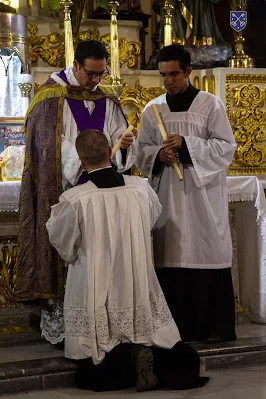
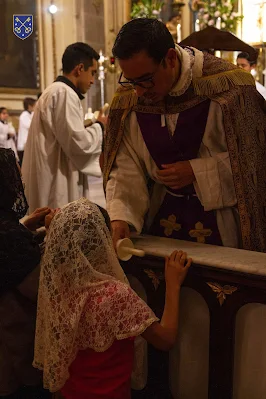
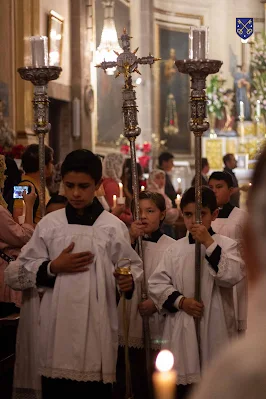
On Saturday, February 1st, the Oxford-based early music group Antiquum Documentum sang a celebration of Candlemas according to the Use of Sarum at the Anglican church of Great St Bartholomew in London. The church’s YouTube channel has posted a video of the complete ceremony; our thanks to Antiquum Documentum for sharing these pictures with us as well. We have previously shared a video which they made of Vespers and Compline in the Sarum Rite for the feast of St Cecilia.

The beginning of the liturgy; as in many medieval uses, the blessing of the candles and the procession are done white (or gold) vestments, rather than in violet as in the Roman Use.
The chant is led by four ministers in cope, called the “rectors chori - the rulers of the choir”; this custom or something like it was also observed in many other medieval uses of the Roman Rite.
The blessing of candles at the Lady Altar.
The procession.

Sunday, February 02, 2025

Liturgical Notes on the Purification of the Virgin Mary

The medieval liturgical commentator William Durandus, writing at the end of the 13th century, describes the Purification as a “double feast.”
In regard to Him that is born, the feast is called “Hypapante”, that is “the meeting” (in Greek), because in that solemnity Anna the prophetess and Simeon met the blessed Mary as She came into the temple to offer Her Son, Christ. … The Lord’s coming into the temple signifies His coming into the Church, and into the mind of each faithful soul, which is a spiritual temple. The Lord foretold this coming through the prophet Malachi, “Behold, I send my Angel before thy face etc.” (chap. 3, 1-4, the epistle of the feast.) Secondly, in regard to Her that gave birth, it is also called the feast of the Purification, because the Blessed Virgin, although She had no need of purification, and was not held liable to the law of purification, … wished nevertheless to fulfill the precept of the Law (in Leviticus 12, 1-8). – Rationale Divinorum Officiorum 7.7
This precept states that 40 days after giving birth, a woman “shall bring to the door of the tabernacle of the testimony, a lamb of a year old for a holocaust, and a young pigeon or a turtle for sin, and shall deliver them to the priest, who shall offer them before the Lord.” For this reason, the Purification serves as the formal end of the Christmas season, being celebrated exactly forty days after it.

The Presentation in the Temple, by Pieter Jozef Verhaghen, 1767; Museum voor Schone Kunsten, Ghent, Belgium
Its connection with Christmas is expressed most clearly at First Vespers, at which the antiphons are repeated from the Octave of Christmas. Each of them speaks of the Virgin specifically in reference to the Savior’s birth, as for example the second, “When Thou wast born ineffably of a Virgin, then were the Scriptures fulfilled; Thou camest down like the dew upon the fleece of wool, to save the human race; we praise thee, our God!” In the Breviary of St Pius V, these are sung with the Vesper psalms for feasts of the Virgin, but in other places, the psalms of Christmas Vespers were used instead. At Liège and elsewhere, the Lauds hymn from the Office of Christmas, A solis ortus cardine, was sung at these Vespers in place of the Marian hymn Ave Maris Stella. In many churches, the liturgical color of the Christmas season, white, was used in the Masses of the season for the period between the octave of Epiphany and the Purification, and the use of green began only after February 2nd. (At Paris, this custom continued until 1870.)

The liturgy also formally marks the Purification as the end of the whole cycle of celebrations that form the first part of the Church’s year. On the first Sunday of Advent, the Postcommunion begins with the words, “May we receive (suscipiamus) Thy mercy, Lord, in the midst of Thy temple”, while the Introit of the Purification, citing Psalm 47 more exactly, begins with the verb in the indicative: “We have received (suscepimus), o God, Thy mercy, in the midst of Thy temple.” This change indicates that what we asked for and awaited in Advent has been fully received in the Birth of Christ.


It should also be noted that the earliest possible date for Ash Wednesday is February 4th. (This has not occurred since 1818, and will not occur again until 2285.) The Christmas cycle, including the preparatory season of Advent, will therefore always be separated from the Easter cycle, including the preparatory season of Lent, by an interval of at least one day.

In the later 4th century, the pilgrim Egeria wrote, in her famous account of her visit to the Holy Land, that the Meeting of the Lord with Simeon in the Temple was celebrated there with particular solemnity, “just as at Easter”, forty days after Epiphany. In her time, the Epiphany commemorated all the events of the Lord’s birth, and the Meeting was therefore originally kept on February 14th; this arrangement is still observed to this day in the Armenian Rite. When the feast of Christmas was adopted in the East shortly after (and in some places, even before), the eastern Epiphany was made to focus on the Lord’s Baptism; the Meeting, as an event of His infancy, was then moved back to February 2nd, counting the forty days from December 25th.
A 14th century miniature of the Presentation in the Menologion of Demetrios I Palaiologos, despot of Thessalonike.
It is often stated that when it was introduced to the West in the mid-to-late 7th-century, the Meeting became a Marian feast, whereas the East continued to observe it as a feast of the Lord. (See, for example, the relevant entries in the old Catholic Encyclopedia, the 1956 revisions of Butler’s Lives, vol. 1, p. 235 and Bl. Schuster’s The Sacramentary, vol. 3, p. 397; the last refers quite incorrectly to its “predominantly Marian character.”) This arises from a rather superficial analysis of its liturgical title and texts. It is true that its Latin name appears very early as “the Purification of the Virgin Mary”, as, for example, in the Gelasian Sacramentary and the Murbach lectionary, both of the mid-8th century. It is also true that it was considered a Marian feast in the Middle Ages. But its character as a “double feast”, and one of Greek origin, was never forgotten; about a century before Durandus, Sicard of Cremona wrote, “Today’s is therefore a double solemnity, of Her that gives birth, and of Him that is born, that is of the Mother and the Son; in regards to the Mother, it is called ‘the Purification’, in regard to the Son, ‘Hypapante’, which is interpreted ‘the Meeting.’ ” (Mitrale 5.11)

The traditional Roman Mass of the Purification refers to the Virgin only where She is mentioned in the Gospel, and almost parenthetically in the Postcommunion. Likewise, the rites that precede the Mass refer to Her once in the first prayer for the blessing of candles, again, almost parenthetically, and twice in the processional antiphons. The double character of the feast noted by Sicard and Durandus is more clearly expressed in the Office, many parts of which are taken from the common for feasts of the Virgin. However, even here, the invitatory, lessons and responsories of Matins, and the Lauds antiphons, (also used at the following Hours), all refer to the Meeting of Christ with Simeon.

According to the Liber Pontificalis, Pope St Sergius I (687-701) established a procession from the church of St Adrian in the Roman Forum to Saint Mary Major, to be held on the Annunciation, the Dormition and Nativity of the Virgin, and the “feast of St Simeon”. Born in Sicily, but of Syrian origin, this Pope was certainly familiar from his youth with the liturgies of both the Byzantine and Latin tradition. There is good evidence that a procession with candles was associated with the feast from an early date, as Butler’s Lives also notes, but it died out entirely in the East; where it is done today in a few Eastern churches, it is a fairly recent Latinization. There is no mention of candles in the Liber Pontificalis’ words about Pope Sergius, nor in the early Roman liturgical books; the first reference to a blessing of candles on February 2nd is found in the late 10th century.

The church of Saint Adrian in the Roman Forum, shown here on the right in a 16th century print. The church was built in the 7th century inside the long-abandoned Roman senate house known as the Curia Julia, but almost every trace of the building’s history as a church was removed in a restoration from 1935-38. 
The Roman blessing is characteristically simple, following a pattern similar to that of the blessing of palms. Five prayers are said over the candles, after which they are sprinkled with holy water and incensed, and then distributed, as the canticle of Simeon Nunc dimittis is sung with the antiphon after every verse, “A light to the revelation of the gentiles, and the glory of thy people Israel.” After a second antiphon and a brief collect comes a procession, accompanied by the singing of two long antiphons. The first of these is borrowed from the Byzantine Liturgy; the second is from the day’s Gospel.

Aña Adorn thy bridal chamber, o Sion, and receive Christ the King. Embrace Mary, who is the gate of heaven, for she bears the glorious King of the new light. She remains a virgin, as she brings forth in Her hands the Son, begotten before the day-star; whom Simeon taking into his arms, proclaimed to peoples to be is the Lord of life and death and the Savior of the world.
Aña Simeon had received an answer from the Holy Ghost, that he would not see death, before he had seen the Anointed of the Lord; and when they were bringing the Child into the temple, he received Him in his arms, and blessed God, saying, “Now dost thou dismiss thy servant, O Lord, in peace. V. When His parents were bringing Jesus, to do according to the custom of the Law for Him, he took Him in his arms.

As the procession enters the church, one of the responsories of Matins is sung; note the clever way the repetition of the verse completes the doxology at the end.

R. They offered for Him unto the Lord a pair of turtle-doves, or two young pigeons * As it is written in the law of the Lord. V. And after the days of Mary’s purification were fulfilled, according to the law of Moses, they brought Him to Jerusalem, to present Him to the Lord. As it is written. Glory be. As it is written.

The historical Roman tradition was to use violet vestments for the procession, and white for the Mass which follows on returning to the church. Lit candles are held by the clergy and faithful (as much as may be practically allowed) during the procession, at the singing of the Gospel, and from the Canon to communion.

Many improbable attempts have been made to connect the Candlemas blessing and procession with the ancient Roman purification rite of the Lupercalia. The Venerable Bede, writing in roughly the year 720, says that the Roman King Numa dedicated February to the god Februus, another name for Pluto, “who was believed to have power over rites of purification,” and established it as a month of various rites to religiously purify the city. (The name of both the month and the god derive from “februare – to purify.”) Bede then says that the Christian religion changed “this custom” for the better, without mentioning the Lupercalia specifically, by instituting a procession with candles in its place “in the same month, on the day of St Mary.” (De temporum ratione XII; P.L. XC, col. 351)

The Lupercalia are mentioned repeatedly by other Church Fathers, and even at the end of the fifth century, Pope St Gelasius I felt the need to combat some vestiges of its celebration. A race though the city that formed part of the festival was still being run, and the Pope sarcastically suggests in a letter to a Roman senator who defended the practice that the runners should return to the more ancient practice, and go naked. Bede’s idea becomes more tempting as an explanation for the procession’s origins when one considers that the Lupercalia were celebrated from February 13th to the 15th, coinciding with the Purification’s original Eastern date; and further, that the name of the Christian feast that begins the ancient Roman month of purification was changed to “the Purification” in Rome.

For all this, however, it is extremely unlikely that any vestiges of the pagan rite remained in the time of Pope Sergius, who instituted the procession almost two centuries after Gelasius, and not for the Purification alone, but for all the Marian feasts. Rome had suffered in the meantime a significant depopulation during the plagues and wars of the sixth century, which dealt a massive blow to the city’s ancient customs and institutions. Furthermore, there is no reason to believe that the feast was ever kept in the West on any date other than February 2nd.
The Presentation of Christ in the Temple, mosaic by Jacopo Torriti, 1296, Santa Maria Maggiore, Rome

Friday, February 02, 2024

The Presentation of Christ and Purification of the Virgin Mary 2024

It was revealed to Simeon by the Holy Ghost that he would not see death before he had seen the annointed of the Lord; * and when they brought the Child into the temple, he took Him into his arms, and blessed God, and said: Now lettest Thou thy servant depart, Lord, in peace. V. When His parents brought in the Child Jesus, to do for Him after the custom of the law, he took Him up in his arms. (The second responsory for the procession of Candlemas.)

The Presentation of the Christ Child in the Temple, by Pietro Cavallini, 1295-1300; apsidal mosaic of the basilica of Santa Maria in Trastevere, Rome.
R. Responsum accépit Símeon a Spíritu Sancto, non visúrum se mortem, nisi vidéret Christum Dómini: * et cum inducerent Puerum in templum, accépit eum in ulnas suas, et benedíxit Deum, et dixit: Nunc dimíttis servum tuum, Dómine, in pace. V. Cum indúcerent púerum Jesum paréntes ejus, ut fácerent secúndum consuetúdinem legis pro eo, ipse accépit eum in ulnas suas.
The first part of this responsory in Gregorian chant.

The beginning of this same text is the same as the Communion of the Mass; here is a particuarly good polyphonic setting of it by Luca Marenzio (1553-99).

Thursday, January 18, 2024

Pontifical Vespers and Benediction in New York City on Feb. 2

The Durandus Institute for Sacred Liturgy and Music is sponsoring a special event for the Purification of the Blessed Virgin Mary and Presentation of the Lord: pontifical Vespers in Latin, followed by Benediction of the Blessed Sacrament, will be in candlelight by candlelight at Old St Patrick’s Cathedral in New York City. A chamber orchestra will play Antonio Vivaldi’s settings of the psalms and Magnificat. The ceremony will begin at 7pm on Friday, February 2; the church is located at 263 Mulberry Street.

Thursday, February 23, 2023

Candlemas 2023 Photopost (Part 2)

As always, we are very grateful to all those who contributed these photos of recent Candlemas liturgies, a final look back at the beauty of the Christmas solemnities as we embark on the austerities of Lent. As with the previous post, we include two sets of pictures of Requiem Masses said for Pope Benedict XVI, one of which was said with the Requiem Mass of Mozart.

Santissima Trinità dei Pellegrini – Rome, Italy (FSSP)

Sunday, February 19, 2023

Candlemas 2023 Photopost (Part 1)

First of all, I’d like to apologize for the delay in getting to these, caused in part by several other work commitments. With these we are including some spontaneous contributions of photos of Requiem Masses celebrated for His Holiness Pope Benedict XVI. As always, our thanks go to everyone who sent these in, and we wish all our readers a holy and spiritually profitable Lent.

St Joseph – Troy, New York (O. Carm.)
Blessing of Candles and Procession celebrated in the traditional Use of the Carmelite Order, which has the pastoral charge of this church. Candlemas is one of the feasts on which a stational procession is held, along with Palm Sunday, the Ascension and the Assumption, as described in a post from 2019. As in many medieval Uses, the first part of the ceremony is done in white, where the traditional Roman color is violet.


Saturday, February 04, 2023

The Five Prayers of the Candlemas Blessing and the Five Books of Moses

The Gospel of the feast of the Purification, St Luke 2, 22-32, says in its first verse that the Christ Child was presented in the temple in Jerusalem “according to the Law of Moses.” This refers to Leviticus 12, which states that “(i)f a woman having received seed shall bear a man child, she shall be unclean seven days … and on the eighth day the infant shall be circumcised, but she shall remain three and thirty days in the blood of her purification. … And when the days of her purification are expired, … she shall bring to the door of the tabernacle of the testimony, a lamb of a year old for a holocaust, and a young pigeon or a turtledove for sin, and shall deliver them to the priest, who shall offer them before the Lord, and shall pray for her…” In the Tridentine reform of the Roman Breviary, this chapter was made the second and third reading of Matins on February 2nd.

The Presentation of Christ in the Temple, 1620, by the Flemish painter Cornelis de Vos (1584-1621). Public domain image from Wikimedia Commons.
From the very beginning, as the Church wrestled with the question of whether the observances of the Mosaic law remained valid for its members, one of the strongest arguments in favor of them was that Christ Himself, who said that “not one jot or tittle should pass away from the Law” (Matt. 5, 18), had observed them. The Church Fathers, therefore, emphasize that He did so in order to indicate to us the true meaning of the Law of Moses, as a prefiguration of the new Law of the Gospel. In the mid-3rd century, the great Biblical scholar and commenter Origen, who was very influential on subsequent generations of the Fathers, writes that Christ “ ‘was made under the Law to redeem those who were under the Law’, and subject them to another Law.” (Homily 14 on Luke, citing Gal. 4, 5) In St Ambrose’s time, the Presentation of Christ in the temple was celebrated on January 1st along with the Circumcision, and he comments on this passage of St Luke, “he that is circumcised of vices was judged worthy of the sight of the Lord… you see that the whole succession of the old Law was a figure of the future, for even circumcision signifies the purification of sins.” (Exposition on the Gospel of Luke, II, 56)

St Cyril of Alexandria also comments on the two episodes, the Circumcision and Presentation, at the same time. “(T)oday we have seen Him obedient to the laws of Moses, or rather we have seen Him Who as God is the Legislator, subject to His own decrees…” But the sacrifice of the birds that accompanied the latter has a mystical significance. “The (turtledove)... is the noisiest of the birds of the field: but the (pigeon) is a mild and gentle creature. And such did the Savior of all become towards us, showing the most perfect gentleness, and like a turtledove moreover soothing the world, and filling His own vineyard, even us who believe in Him, with the sweet sound of His voice. For it is written in the Song of Songs, ‘The voice of the turtledove has been heard in our land.’ (Cant. 2, 12) For Christ has spoken to us the divine message of the Gospel, which is for the salvation of the whole world.” (Sermon III on the Gospel of St Luke, ad finem.)

Finally, we may note the words of St Bede the Venerable, that neither Christ nor His Mother were subject to the conditions of the Law. Moses writes that a woman shall do these things when “she has received seed,” and borne a child, to distinguish from Her that conceived and bore a Son as a Virgin. Christ “was free from the condition of the Law, but deigned to accept it for this reason, that He might approve it as holy, just and good, and by the grace of Faith, free us from the service and fear thereof.” (Exposition on the Gospel of Luke, Liber I in cap. 2)

In the Byzantine Rite, the feast of the Purification is called “the Meeting of the Lord with Simeon”, and the liturgical texts of the feast lay great emphasis on Christ as the giver of the Law which He obeys, and from the observance of which He then releases the Church. This hymn from Vespers typifies the motif: “Today Simeon receiveth the Lord of glory in his arms, even He whom Moses saw of old beneath the darkness on Mount Sinai, giving him the tablets. This is the One who spoke in the Prophets, and the Maker of the Law; this is the One whom David proclaimeth, feared of all, that hath great and rich mercy.”
A painting in the cathedral of Holy Wisdom in Kyiv, Ukraine, based on Proverbs 9, 1-11, the first words of which are written in Greek on the building’s cornice. God the Father, with the seven great archangels to either side sends the Holy Spirit down upon the Virgin Mary, who stands in the middle of Wisdom’s house, with the Christ Child in a halo on Her chest, the icon type known as the “Virgin of the Sign.” The steps ascending towards Her are labelled “Faith (cut off by the frame), Hope, Love, Purity, Humility, Grace, Glory”; to the left are shown David, Aaron, and closest to Her, Moses, to the right, the four Major Prophets. (Public domain image from Wikimedia Commons.)
Several other texts on the feast and during its Afterfeast (the Byzantine equivalent of an octave) refer to the darkness that enveloped Mt Sinai when Moses went up to receive the Law, which is implicitly contrasted with the “light unto the revelation of the gentiles” of which Simeon speaks in the Nunc dimittis. Thus, the old Law, including the rites of circumcision and the sacrifice of purification, was revealed in darkness, and applicable only to the Jewish people. But it was intended to serve as a figure of the new Law, in which circumcision is replaced with baptism, which is applicable to all, “male and female, Jew and Gentile.” And thus, the feast on January 6th, which celebrates the Baptism of the Lord, is called the Theophany, but also simply “the lights.”

The Roman Rite prefers great simplicity and subtlety in its rhetoric. In the context of this feast, it asserts this relationship between the Lawgiver and the Law, and the passage from the Old Law to the New, through the five prayers of the candle blessing, each of which refers, in order, to one of the five books of the Law of Moses.

The first prayer, corresponding to Genesis, begins with the words “Lord, … who created all things from nothing…”, a reference to the creation of the world. This also explains the statement that candles are made for the use of men, and the health of their body and souls, “whether on land or at sea”, since Moses’ account of creation includes the division of the land from the waters, and the creation of man “as a living soul.” (Gen. 2, 7) This is the only one of the five prayers that mentions the Virgin Mary, the new Eve; it asks for the prayers of “all Thy Saints”, perhaps in reference to the holy Patriarchs of the Old Testament. The last part asks that that God “be merciful to all those who cry out to Thee, whom Thou hast redeemed by the precious blood of Thy Son”, a reference to the blood of the just Abel that cries to God from the earth.

The second prayer, which corresponds to Exodus, states that the faithful received the blessed candles “unto the magnificence of Thy name.” This refers to the Canticle of Moses in chapter 15, a passage familiar to all Christians from its presence among the prophecies of the Easter vigil. “Let us sing to the Lord: for he is gloriously magnified… The Lord is my strength and my praise, and he is become salvation to me: he is my God and I will glorify him: the God of my father, and I will exalt him. The Lord is as a man of war, Almighty is his name.”

(Exodus 14, 24 -15, 1, followed by the Tract from chapter 15, verses 1 and 2, sung at the vigil of Pentecost.)
The third prayer corresponds to Leviticus, and asks that the faithful may “be without the blindness of all vices, so that… we may be able to see those things which are pleasing to Thee and useful to our salvation.” This refers to the Church’s distinction between the perennially valid precepts of the moral law contained in Leviticus, and in the Law generally, and the ritual prescriptions to which She is no longer bound. Notice also here the contrast between light and darkness of which the Byzantine liturgy speaks: “so that after the dark ‘discrimina’ (both ‘hazards’ and ‘decisions’) of this age, we may merit to come to the light unfailing.”

The fourth prayer begins with a reference to God’s command to Moses to prepare oil for the lights that burn before Him in the tabernacle of the covenant. In St Jerome’s Latin translation of the Hebrew Bible, this is mentioned three times in Exodus, and twice more in Numbers, the fourth book of the Law, with the verb “concinnare – to make, prepare”, which is also used in this prayer. The prayer that “the light of Thy spirit not be lacking inwardly to our minds” refers, perhaps, to the sharing of Moses’ spirit with the seventy elders of Israel described in chapter 11.

Finally, the fifth prayer, which corresponds to Deuteronomy, asks that we may be “enlightened and taught by the Holy Spirit.” This refers to the canticle of Moses in chapter 32, which begins with the words, “Let my doctrine gather as the rain, … I will invoke the name of the Lord: give ye magnificence to our God.” At the Easter vigil, after these words are sung in the Tract after the eleventh prophecy, the Church states in the prayer that follows that God “willed to teach the people by the singing of His holy song.” The prayer concludes with the petition that “we may truly know and faithfully love” God, a reference to the words of chapter 6, “Thou shalt love the Lord thy God with thy whole heart, and with thy whole soul, and with thy whole strength.” This commandment appears nowhere else in the Law of Moses, and is, of course, commended by the Lord Himself as the first and greatest commandment. (Matt. 22, 37)

Thursday, February 02, 2023

Ambrosian Processional Chants for the Purification

In Rome, the blessing of candles on the feast of the Purification was originally done at the church of St Adrian in the Roman Forum, followed by a procession to the oldest church in the city and the world dedicated to the Virgin Mary, Santa Maria Maggiore on the Esquiline Hill. This custom gradually fell into disuse, and no station is mentioned in the Roman Missal on February 2, but of course, the blessing and procession are still held.

The Ambrosian Rite underwent a similar development. The clergy of the cathedral would traditionally bless the candles at a church called Santa Maria Beltrade, founded in 836, less than half a mile from the modern Piazza del Duomo, and then process back to the cathedral for the Mass. This procession has long since been transferred to the cathedral itself, which is also dedicated to the Virgin Mary, but a very ancient custom has been preserved of carrying an image of the Virgin and Child, known as the “Idea”, in the Candlemas procession. This is seen in a relief carving of the 12th century formerly in Santa Maria Beltrade; since the church was demolished in 1934, it has been at the Museum of the Castello Sforzesco. (Pictures of the Idea currently used, and of Santa Maria Beltrade, are given below.) 
The procession with the Idea in the Duomo of Milan in 2013.
The Ambrosian form of the blessing is rather simpler than the Roman. It begins with the same introductory formula used at the hours of the Divine Office in both the Roman and Ambrosian Rite (“Deus in adjotorium, etc.”), followed by a triple “Kyrie eleison” (a very frequent feature in all things Ambrosian), and then a prayer which is proper to the Rite.

“Omnipotens sempiterne Deus, qui hodierna die cum legalibus sacrificiis in templo præsentari, et justi Simeonis ulnis gestari, dignatus es: benedic, quæsumus, hanc papyrum cerea pinguedine superductam; ut tuus eam populus, igne caritatis tuæ accensus, ad laudem, et gloriam nominis tui gestans; pietatis tuæ dono, indeficiens se lumen habere cognoscat. Qui vivis.
Almighty and everlasting God, who on this day deigned to be presented in the temple with the sacrifices of the Law, and borne in the arms of Simeon the just, bless, we pray, this papyrus covered in the richness of wax, that Thy people, enkindled with the fire of Thy love, bearing it to the praise and glory of Thy name, may know by the gift of Thy love, that it hath the unfailing Light who liveth and reigneth with Thee, etc.”
The candles are then sprinkled with holy water and incensed as in the Roman Rite, and distributed to the clergy and faithful, without any chant prescribed to accompany the distribution. This is the form found in the earliest Ambrosian liturgical sources, such as the 10th century Manual of Valtravaglia, but in the post-Tridentine reform of the Ambrosian Missal, several elements were added to the ceremony from the Roman Rite: the fourth and first of the five Roman prayers of the blessing, the Nunc dimittis with its antiphon, the antiphon Exsurge, and the concluding prayer. In the 1902 reform of the Missal, all of these elements were removed, and the ceremony returned to its original form.
The procession then begins, with the same ceremonies as in the Roman Rite (incense, processional cross, etc.) and is accompanied by a repertoire of 21 antiphons. The following recording has 8 of these, beginning at 2:15.
I Virgo Dei Genitrix,
quem totus non capit orbis
in tua te clausit viscera
factus homo.
Virgin Mother of God, He whom
the world could not contain enclosed
Himself within Thy womb, having
become a man.
II Beata progenies
unde Christus natus est:
Quam gloriosa est Virgo
quae caeli Regem genuit!
Blessed is the daughter from whom
Christ was born: how glorious is
the Virgin who begot the King of
heaven!
VI Virgo Verbum concepit,
Virgo permansit,
Virgo genuit Regem
omnium regum.
The Virgin conceived the Word;
a virgin She remained;
the Virgin begot the King of all kings.
VII Beata es Maria,
quae credidisti;
perficientur in te
quae dicta sunt tibi a Domino.
Blessed art Thou, o Mary, who be-
lieved; the things which were said to
Thee by the Lord shall be brought
to pass.
X Beatam me dicent genera-
   tiones;
quia ancillam humilem
respexit Deus.
The generations shall call me blessed,
for God hath regarded the low estate
of His handmaid.
XIII Magnificamus te, Dei Ge-
   nitrix,
quia ex te natus est Christus,
salvans omnes qui te glorificant:
sancta Domina Dei Genitrix,
sanctificationes tuas transmit-
   te nobis.
We magnify Thee, o Mother of God;
for from Thee was born Christ, who
saveth all that glorify Thee; holy Lady,
Mother of God, impart to us Thy
santifications.
XV Virgo hodie fidelis,
etsi Verbum genuit incarnatum,
Virgo mansit et post partum;
quam laudantes omnes dicimus:
Benedicta tu in mulieribus.
Today the faithful Virgin, though She
begot the Word incarnate; remained a
virgin even after birth; who we all
praise and say, Blessed art Thou
among women.
XVII Sub tuam misericordiam
confugimus, Dei Genitrix,
ut nostram deprecationem
ne inducas in temptationem,
sed de periculo libera nos,
sola casta et benedicta.
Unto Thy mercy do we flee, o Mother
of God, that Thou may not bring our
supplication unto trial, but deliver us
from danger, who alone are chaste and
blessed.

If the procession has gone out of the church, when it returns to the door, the processional cross stops before it, while the clergy and servers stand facing each other in two lines, with the celebrant facing the cross. The choir sings 
twelve Kyrie, eleisons, six low and six high, and then an antiphon called a psallendum. As the choir sings Gloria Patri, all bow to the cross, and at Sicut erat, to the celebrant; the crossbearer then turns, and lead the procession into the church. (If the procession is done within the church, this ceremony is done at the chancel of the main sanctuary.)  

Psallendum Senex Puerum portabat, Puer autem senem regebat: quem Virgo concepit, et post partum virgo permansit; ipseum quem geniut, adoravit. Gloria Patri... Sicut erat... Senex Puerum...

Psallendum The old man carried the boy, but the boy ruled the old man, even He whom the Virgin conceived, and after the birth, remained a virgin; She adored Him whom She begot. Glory be... As it was... The old man...

The two sides of the Madonna dell’Idea, painted by Michelino and Leonardo da Besozzo in the 2nd quarter of the 15th century. (Both images from Wikimedia Commons by Dimitris Kamaras, 
CC BY 2.0)
The church of Santa Maria in Beltrade, which was reconstructed in 1601, as seen in this photograph taken not long before its demolition. 

Wednesday, February 01, 2023

Photopost Request: Candlemas 2023

Our next major photopost will be for tomorrow’s feast of Candlemas; please send your photos of the blessing of candles, the procession and the Mass, Vespers etc. to photopost@newliturgicalmovement.org for inclusion. As always, we will be very glad to receive photographs of celebrations in either Form of the Roman Rite, any of the Eastern rites, the Ordinariate Use, etc. We will also include photos of the blessing of throats in honor of St Blase, whether it is done on the feast itself, or anticipated on February 2nd. Please be sure to include the name and location of the church, and always feel free to add any other information you think important. Evangelize through beauty!

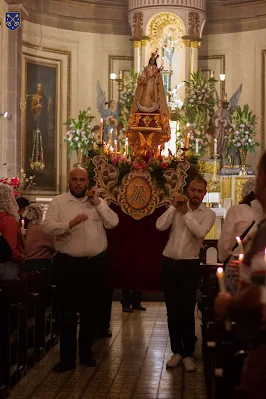
From our first Candlemas photopost of last year: a statue of the Virgin Mary carried in procession at the church of Nuestra Señora del Pilar, home of the FSSP apostolate in Guadalajara, Mexico.

The blessing of throats in honor of St Blase at the Oratory of St Mary in Wausau, Wisconsin, a church of the Institute of Christ the King.

From the second post: the festal icon is brought out to the nave of St Basil the Great Byzantine Catholic Church in Los Gatos, California.

The Gospel at Mass in the Ordinariate Rite at the church of St John the Baptist in Bridgeport, Pennsylvania.

Tuesday, January 31, 2023

Candlemas with the St Ann Choir in Palo Alto, California

On Thursday, February 2nd, the St Ann Choir will sing a Latin Mass for the feast of the Presentation of the Lord and the Purification of the Virgin Mary at the church of St Thomas Aquinas, located at 751 Waverly St (at Homer) in Palo Alto, California. The ceremony begins at 8pm with the blessing of candles and a procession; the music will include the Mass O magnum mysterium by Tomas Luis de Victoria, and the proper Gregorian chants.

Friday, January 20, 2023

Candlemas in the Ordinariate Rite in Louisville, KY

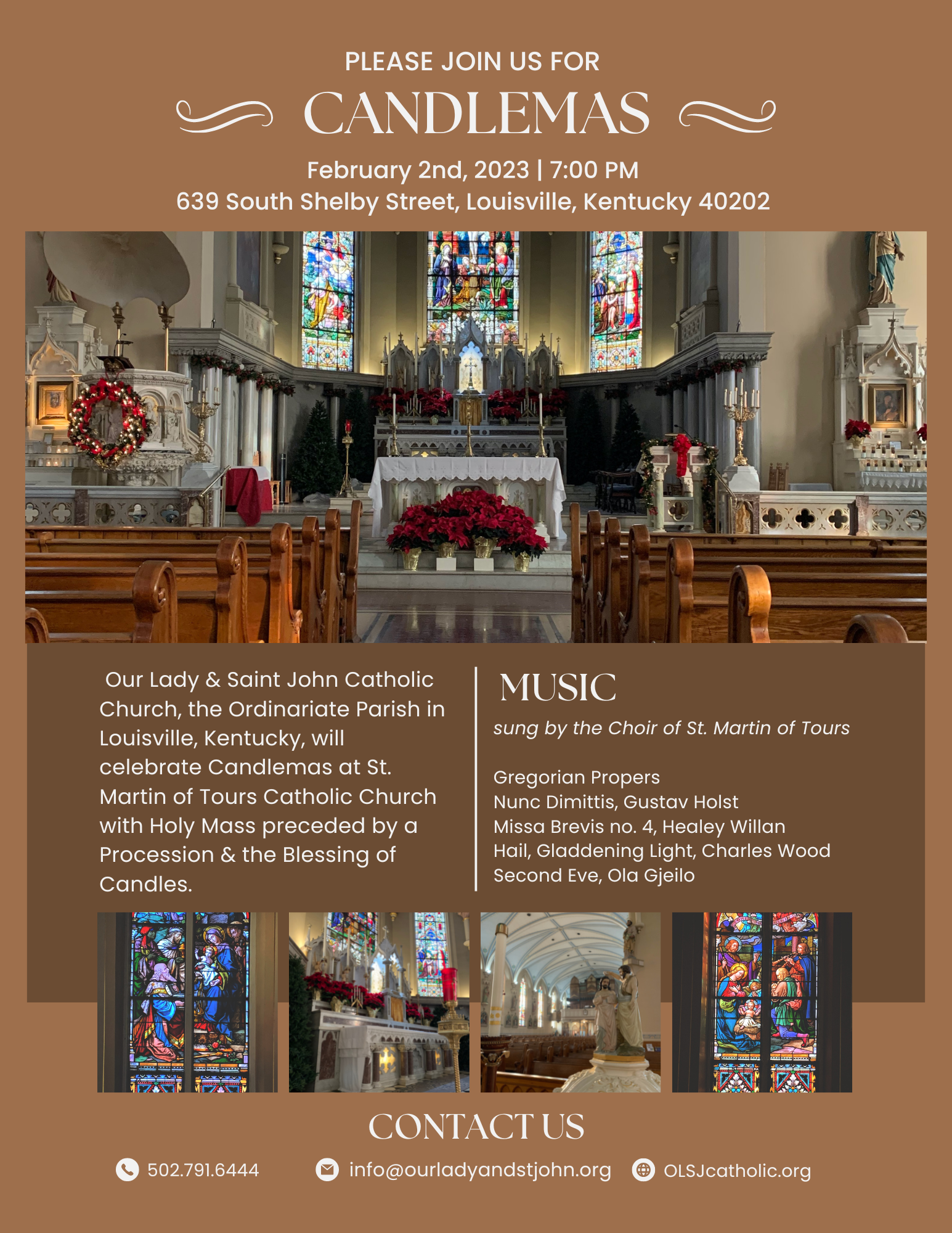
On Thursday, February 2nd, at 7:00pm Our Lady & Saint John Catholic Church, the Ordinariate Parish in Louisville, Kentucky, will celebrate Candlemas at St Martin of Tours Catholic Church, with Holy Mass preceded by a procession and the blessing of candles. Music will include Gustav Holst’s setting of the Nunc Dimittis, Hail, Gladdening Light by Charles Wood, Second Eve by Ola Gjeilo, and Healey Willan’s Missa Brevis no. 4 “Corde natus.” The church is located downtown at 639 South Shelby Street.

Thursday, February 10, 2022

Candlemas 2022 Photopost (Part 2)

Our second Candlemas photopost features a nice variety of ceremonies, including the Byzantine and Ordinariate Rites, and some recent confirmations. As always, our thanks to everyone who sent these in. Keep mind that we are always happy to share photos of beautiful liturgies, apart from the major feasts and seasons which we regularly feature, since it is always the right season to evangelize through beauty!

St John the Baptist – Bridgeport, Pennsylvania (Ordinariate Rite)
 Photos by Peter Tulay

Wednesday, February 09, 2022

Candlemas 2022 Photopost (Part 1)

This will be the first of two posts of Candlemas liturgies, so there is still time to send yours in if you haven’t already done so (photopost@newliturgicalmovement.org). As always, we are very grateful to all of our readers who contributed; know that you are doing great work to inspire and encourage others to better and more beautiful celebrations of the sacred liturgy. Evangelize through beauty!

Nuestra Señora del Pilar – Guadalajara, Mexico (FSSP)
Tradition will always be for the young!

Wednesday, February 02, 2022

Liturgical Notes on the Purification of the Virgin Mary

The medieval liturgical commentator William Durandus, writing at the end of the 13th century, describes the Purification as a “double feast.”
In regard to Him that is born, the feast is called “Hypapante”, that is “the meeting” (in Greek), because in that solemnity Anna the prophetess and Simeon met the blessed Mary as She came into the temple to offer Her Son, Christ. … The Lord’s coming into the temple signifies His coming into the Church, and into the mind of each faithful soul, which is a spiritual temple. The Lord foretold this coming through the prophet Malachi, “Behold, I send my Angel before thy face etc.” (chap. 3, 1-4, the epistle of the feast.) Secondly, in regard to Her that gave birth, it is also called the feast of the Purification, because the Blessed Virgin, although She had no need of purification, and was not held liable to the law of purification, … wished nevertheless to fulfill the precept of the Law (in Leviticus 12, 1-8). – Rationale Divinorum Officiorum 7.7
This precept states that 40 days after giving birth, a woman “shall bring to the door of the tabernacle of the testimony, a lamb of a year old for a holocaust, and a young pigeon or a turtle for sin, and shall deliver them to the priest, who shall offer them before the Lord.” For this reason, the Purification serves as the formal end of the Christmas season, being celebrated exactly forty days after it.

The Presentation in the Temple, by Pieter Jozef Verhaghen, 1767; Museum voor Schone Kunsten, Ghent, Belgium
Its connection with Christmas is expressed most clearly at First Vespers, at which the antiphons are repeated from the Octave of Christmas. Each of them speaks of the Virgin specifically in reference to the Savior’s birth, as for example the second, “When Thou wast born ineffably of a Virgin, then were the Scriptures fulfilled; Thou camest down like the dew upon the fleece of wool, to save the human race; we praise thee, our God!” In the Breviary of St Pius V, these are sung with the Vesper psalms for feasts of the Virgin, but in other places, the psalms of Christmas Vespers were used instead. At Liège and elsewhere, the Lauds hymn from the Office of Christmas, A solis ortus cardine, was sung at these Vespers in place of the Marian hymn Ave Maris Stella. In many churches, the liturgical color of the Christmas season, white, was used in the Masses of the season for the period between the octave of Epiphany and the Purification, and the use of green began only after February 2nd. (At Paris, this custom continued until 1870.)

The liturgy also formally marks the Purification as the end of the whole cycle of celebrations that form the first part of the Church’s year. On the first Sunday of Advent, the Postcommunion begins with the words, “May we receive (suscipiamus) Thy mercy, Lord, in the midst of Thy temple”, while the Introit of the Purification, citing Psalm 47 more exactly, begins with the verb in the indicative: “We have received (suscepimus), o God, Thy mercy, in the midst of Thy temple.” This change indicates that what we asked for and awaited in Advent has been fully received in the Birth of Christ.


It should also be noted that the earliest possible date for Ash Wednesday is February 4th. (This has not occurred since 1818, and will not occur again until 2285.) The Christmas cycle, including the preparatory season of Advent, will therefore always be separated from the Easter cycle, including the preparatory season of Lent, by an interval of at least one day.

In the later 4th century, the pilgrim Egeria wrote, in her famous account of her visit to the Holy Land, that the Meeting of the Lord with Simeon in the Temple was celebrated there with particular solemnity, “just as at Easter”, forty days after Epiphany. In her time, the Epiphany commemorated all the events of the Lord’s birth, and the Meeting was therefore originally kept on February 14th; this arrangement is still observed to this day in the Armenian Rite. When the feast of Christmas was adopted in the East shortly after (and in some places, even before), the eastern Epiphany was made to focus on the Lord’s Baptism; the Meeting, as an event of His infancy, was then moved back to February 2nd, counting the forty days from December 25th.

A 15th-century Russian icon of the Presentation of Christ in the Temple
It is often stated that when it was introduced to the West in the mid-to-late 7th-century, the Meeting became a Marian feast, whereas the East continued to observe it as a feast of the Lord. (See, for example, the relevant entries in the old Catholic Encyclopedia, the 1956 revisions of Butler’s Lives, vol. 1, p. 235 and Bl. Schuster’s The Sacramentary, vol. 3, p. 397; the last refers quite incorrectly to its “predominantly Marian character.”) This arises from a rather superficial analysis of its liturgical title and texts. It is true that its Latin name appears very early as “the Purification of the Virgin Mary”, as, for example, in the Gelasian Sacramentary and the Murbach lectionary, both of the mid-8th century. It is also true that it was considered a Marian feast in the Middle Ages. But its character as a “double feast”, and one of Greek origin, was never forgotten; about a century before Durandus, Sicard of Cremona wrote, “Today’s is therefore a double solemnity, of Her that gives birth, and of Him that is born, that is of the Mother and the Son; in regards to the Mother, it is called ‘the Purification’, in regard to the Son, ‘Hypapante’, which is interpreted ‘the Meeting.’ ” (Mitrale 5.11)

The traditional Roman Mass of the Purification refers to the Virgin only where She is mentioned in the Gospel, and almost parenthetically in the Postcommunion. Likewise, the rites that precede the Mass refer to Her once in the first prayer for the blessing of candles, again, almost parenthetically, and twice in the processional antiphons. The double character of the feast noted by Sicard and Durandus is more clearly expressed in the Office, many parts of which are taken from the common for feasts of the Virgin. However, even here, the invitatory, lessons and responsories of Matins, and the Lauds antiphons, (also used at the following Hours), all refer to the Meeting of Christ with Simeon.

According to the Liber Pontificalis, Pope St Sergius I (687-701) established a procession from the church of St Adrian in the Roman Forum to Saint Mary Major, to be held on the Annunciation, the Dormition and Nativity of the Virgin, and the “feast of St Simeon”. Born in Sicily, but of Syrian origin, this Pope was certainly familiar from his youth with the liturgies of both the Byzantine and Latin tradition. There is good evidence that a procession with candles was associated with the feast from an early date, as Butler’s Lives also notes, but it died out entirely in the East; where it is done today in a few Eastern churches, it is a fairly recent Latinization. There is no mention of candles in the Liber Pontificalis’ words about Pope Sergius, nor in the early Roman liturgical books; the first reference to a blessing of candles on February 2nd is found in the late 10th century.

The church of Saint Adrian in the Roman Forum, shown here on the right in a 16th century print. The church was built in the 7th century inside the long-abandoned Roman senate house known as the Curia Julia, but almost every trace of the building’s history as a church was removed in a restoration from 1935-38. 
The Roman blessing is characteristically simple, following a pattern similar to that of the blessing of palms. Five prayers are said over the candles, after which they are sprinkled with holy water and incensed, and then distributed, as the canticle of Simeon Nunc dimittis is sung with the antiphon after every verse, “A light to the revelation of the gentiles, and the glory of thy people Israel.” After a second antiphon and a brief collect comes a procession, accompanied by the singing of two long antiphons. The first of these is borrowed from the Byzantine Liturgy; the second is from the day’s Gospel.

Aña Adorn thy bridal chamber, o Sion, and receive Christ the King. Embrace Mary, who is the gate of heaven, for she bears the glorious King of the new light. She remains a virgin, as she brings forth in Her hands the Son, begotten before the day-star; whom Simeon taking into his arms, proclaimed to peoples to be is the Lord of life and death and the Savior of the world.
Aña Simeon had received an answer from the Holy Ghost, that he would not see death, before he had seen the Anointed of the Lord; and when they were bringing the Child into the temple, he received Him in his arms, and blessed God, saying, “Now dost thou dismiss thy servant, O Lord, in peace. V. When His parents were bringing Jesus, to do according to the custom of the Law for Him, he took Him in his arms.

As the procession enters the church, one of the responsories of Matins is sung; note the clever way the repetition of the verse completes the doxology at the end.

R. They offered for Him unto the Lord a pair of turtle-doves, or two young pigeons * As it is written in the law of the Lord. V. And after the days of Mary’s purification were fulfilled, according to the law of Moses, they brought Him to Jerusalem, to present Him to the Lord. As it is written. Glory be. As it is written.

The historical Roman tradition was to use violet vestments for the procession, and white for the Mass which follows on returning to the church. Lit candles are held by the clergy and faithful (as much as may be practically allowed) during the procession, at the singing of the Gospel, and from the Canon to communion.

Many improbable attempts have been made to connect the Candlemas blessing and procession with the ancient Roman purification rite of the Lupercalia. The Venerable Bede, writing in roughly the year 720, says that the Roman King Numa dedicated February to the god Februus, another name for Pluto, “who was believed to have power over rites of purification,” and established it as a month of various rites to religiously purify the city. (The name of both the month and the god derive from “februare – to purify.”) Bede then says that the Christian religion changed “this custom” for the better, without mentioning the Lupercalia specifically, by instituting a procession with candles in its place “in the same month, on the day of St Mary.” (De temporum ratione XII; P.L. XC, col. 351)

The Lupercalia are mentioned repeatedly by other Church Fathers, and even at the end of the fifth century, Pope St Gelasius I felt the need to combat some vestiges of its celebration. A race though the city that formed part of the festival was still being run, and the Pope sarcastically suggests in a letter to a Roman senator who defended the practice that the runners should return to the more ancient practice, and go naked. Bede’s idea becomes more tempting as an explanation for the procession’s origins when one considers that the Lupercalia were celebrated from February 13th to the 15th, coinciding with the Purification’s original Eastern date; and further, that the name of the Christian feast that begins the ancient Roman month of purification was changed to “the Purification” in Rome.

For all this, however, it is extremely unlikely that any vestiges of the pagan rite remained in the time of Pope Sergius, who instituted the procession almost two centuries after Gelasius, and not for the Purification alone, but for all the Marian feasts. Rome had suffered in the meantime a significant depopulation during the plagues and wars of the sixth century, which dealt a massive blow to the city’s ancient customs and institutions. Furthermore, there is no reason to believe that the feast was ever kept in the West on any date other than February 2nd.
The Presentation of Christ in the Temple, mosaic by Jacopo Torriti, 1296, Santa Maria Maggiore, Rome

More recent articles:

For more articles, see the NLM archives: