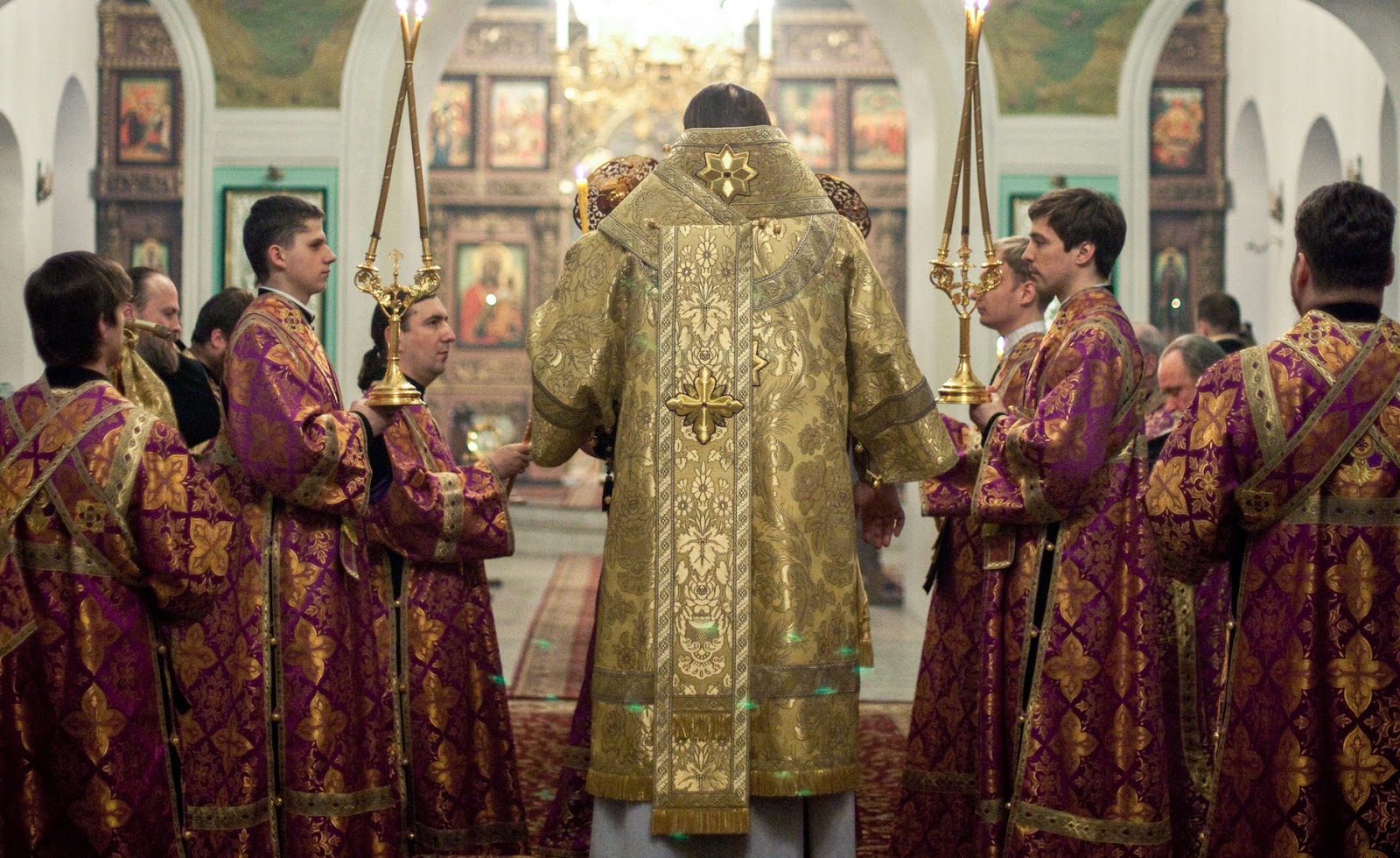
Monday, October 23, 2023

“Where to look for genuine ecumenism?” — Guest Article by Eastern Orthodox Theologian

NLM is grateful to Bishop Athanasius Schneider for giving us permission to publish this English translation of the following essay, written by a theologian with whom he is in friendly contact. It goes without saying that we do not endorse some of the ecclesiological claims contained herein, but the perspective is one that NLM is broadly sympathetic with. —PAK

“Where to look for genuine ecumenism?”
A reflection on the Roman Catholic Church’s liturgical reforms in an ecumenical perspective

Alexander Adomenas, Master of Theology

“That they may all be one” (John 17, 21)—these words of our Divine Teacher have been resounding with pain in the hearts of Christians for many centuries. Unfortunately, we did not fulfill the commandment of our Lord and were divided. The twentieth century showed that it is now the time, according to the word of Ecclesiastes, to “gather stones” (3, 5), the stones we Christians have scattered for twenty centuries. The holy Pope Gregory the Great (who in the East bears the name Dialogos) explains these words as follows: “The more the end of the world approaches, the more necessary it is that living stones be gathered for a heavenly building, until the building of our Jerusalem reaches its measure.” [1] For St. Gregory, “gathering stones” means gathering the people into the one Church of Christ.

However, we are well aware that one can “gather stones” in different ways, and, by trying to take up everything, one can be overburdened by their weight and lose even what one has collected. This article in the form of a reflection is a modest attempt by an Orthodox theologian to think about what path can be chosen for this “gathering of stones.”

The history of relations between Catholicism and Orthodoxy, unfortunately, is very sad. Mutual accusations, divergence at times in petty issues—all this happened. I will not give a theological assessment of these disagreements and centuries-old disputes. Let me just say that what unites us is much more than what divides us. And now is precisely the time when, in the face of the ever-increasing secularization of mankind and the challenges the modern world poses to believers, we must find common ground so that everyone knows that we are disciples of Christ—Love Incarnate (cf. John 13, 35).

Over the past one hundred years, this attempt to reconcile Orthodoxy and Catholicism has received the name of the “ecumenical movement.” Many models of dialogue within this movement have been proposed, but all of them, unfortunately, have either reached or are reaching a dead end. The problem, in my opinion, is the wrong approach to the problem as such. Or rather, there is no core around which a dialogue can be built. And it seems to me that the ideal solution here is to appeal to a common heritage: the living history of the Church in the Holy Spirit.

Both Catholicism and Orthodoxy have a common root: the teaching of Christ and the Apostles. We have preserved the image of the Church established by the Apostles and their successors: the apostolic succession in the priesthood, the hierarchical structure of the Church, the holy sacraments, our way of church life. That is exactly what can and should unite us; it is not for nothing that we recognize almost all of each other’s sacraments, [2] including the sacrament of the priesthood, which also speaks of the recognition of each other’s hierarchy.

Thus, the way to “gather stones” can and should be our connection with what, in both the Orthodox Church and in the Catholic Church, is called Sacred Tradition. The age-old heritage, the heritage of the Church, is really what unites us and makes it possible to realize unity. The Second Vatican Council emphasized: “The teaching office is not above the word of God, but serves it, teaching only what has been handed on.…  It is clear, therefore, that sacred tradition, Sacred Scripture and the teaching authority of the Church, in accord with God’s most wise design, are so linked and joined together that one cannot stand without the others.” [3]

However, my many years of acquaintance with Catholicism, with the current situation in the Catholic Church, suggests that, unfortunately, the Catholicism of our day does not want to choose the path of following the Sacred Tradition. I don’t mean to say that the Catholic Church does this deliberately. Not at all. But by many of her actions, she really pushes away a possible unity with the Orthodox churches. For some reason, dialogue with various Protestant denominations is more important for the Catholic Church, although they deliberately oppose themselves to the historical Churches that have preserved the Sacred Tradition. In no way do I want to offend Protestants, but both Orthodox and Catholic teachings say that Orthodoxy and Catholicism are much closer to each other than either is to Protestantism. Moreover, we must state that most Protestant denominations consciously oppose themselves to the historic churches with apostolic succession; they say that their theology is different from ours in everything, and our adherence to Sacred Tradition often becomes the subject of at least a condescending smile, if not derision and contempt on the part of Protestants. [4]

From that premise, the attempt to unite Orthodox and Catholics would seem to have been the ideal way forward. Yet Catholicism, it seems to me, went the opposite way. And this is visible in everything. However, to explain my thoughts, I would like to consider several aspects. And among them the main one is the liturgical aspect.

The sacred Liturgy, divine worship, is the foundation of the Church. Without worship, without the Eucharist, the Church cannot exist. In fact, throughout history, the Church has gathered around the Eucharistic sacrifice. Of course, all historical churches with apostolic succession have created their own liturgical rites around the Eucharist, on the compilation of which the Church has worked through its members for many centuries, organically accepting the sound new aspects and discarding what is foreign. The liturgy is the appearance, the manifestation, of the Church, its visible incarnation in the world.

Any forcible, inorganic change can lead to very large upheavals. The Russian Orthodox Church had a tragic experience of this. In the seventeenth century, the Russian Orthodox Patriarch Nikon decided to break the Russian liturgical tradition that had developed over 500 years, forcibly imposing a Greek one that was similar but formed in a different historical context. The state and church authorities of those times carried out these reforms by force, arresting and killing all those who disagreed. This led to one third of the Russian Church going into schism—a schism that has still not been healed to this day. Moreover, since there were few bishops in the Russian church at that moment—only one did not agree with the reform, and eventually separated—the Old Believers were marginalized, and some of them lost the priesthood and the sacraments. [5]

The bitter experience of the Russian Orthodox Church was either unknown or ignored by the Catholic Church in the twentieth century. For some reason, the Catholic Church authorities of our time decided to change the liturgy. There is nothing wrong with making some changes in a rite. Those who are more or less familiar with the principles of Anton Baumstark’s comparative liturgy [6] know that changes in any rite are the norm of the life of the Church. But ritual change only works well when, firstly, it is necessary, that is, when these changes are called upon to more fully illuminate one or another aspect of the life of the Church, and secondly, and most importantly, when this happens within the framework of the teaching of the Church and the existing valid liturgical rite.

The goal of the liturgical reforms of the 1960s was lofty: to revive the participation of the people of God in the Holy Eucharist. The purpose is good and, indeed, necessary. Yet instead of attracting the people of God to a more lively and active participation in the Eucharist—through common singing, responses to the exclamations of the priest, even slightly and organically changing the Order of the Holy Mass—the ecclesiastical authority of the Catholic Church decided to radically change both the Order of the Mass and the Latin rite altogether. This, in spite of the fact that the decisions of the Second Vatican Council themselves indicated that the changes must be very balanced and deliberate: “That sound tradition may be retained, and yet the way remain open to legitimate progress, careful investigation is always to be made into each part of the liturgy which is to be revised. This investigation should be theological, historical, and pastoral… There must be no innovations unless the good of the Church genuinely and certainly requires them; and care must be taken that any new forms adopted should in some way grow organically from forms already existing.” [7]

Has this norm of the Conciliar Constitution Sacrosanctum Concilium been carried out correctly? The facts themselves say otherwise. Take, for example, the Offertory (a part of the Order of the Mass during which bread and wine are brought to the altar with prayers in view of the consecration). It has been completely reformed. I still can’t imagine why it had to be done. Looking at the new Offertory rite, it is not at all clear what kind of “theological, historical and pastoral research” was carried out on the direct instructions of the Council to introduce that change. Why not turn to the ancient Roman missals, where there are various ancient forms practiced in the Latin Rite? Why compose new prayers, obviously borrowed from Jewish Berakhot? To show the connection between the Old and New Testaments? I’m sure that every priest who celebrates the liturgy knows about this connection. To revive the elements of Jewish worship? Except for the elements brought over in the first generations after the apostles, the Church never in her history had such a Judaizing tendency. [8] To recognize the importance of Judaism and begin to honor the Jews as their “elder brothers”? I fear that 99.9% of the Jews have no idea that there is this element in the Catholic Mass. That is to say, we simply do not see any pastoral, theological, or historical basis for this change in the Offertory rite; nor did it emerge organically from something already there; nor was it genuinely and certainly required.

Further, the central prayer of the Mass is the Eucharistic Canon. In the Byzantine rite, two Eucharistic canons are used as the standard—that of St. Basil the Great and that of St. John Chrysostom. These Eucharistic Canons have been used by the Church for over 1,500 years. The West had the Roman Canon, of similar antiquity and centrality. The Catholic Church took now in our day a completely different path—the path of composing new texts for the Eucharistic Canon. At the same time, supporters of the New Rite point out that the new Eucharistic Prayers were written on the basis of ancient Eastern texts. [9] But any person who is more or less versed in liturgical science will see that this similarity is in fact quite distant and that the new Eucharistic Prayers in the Roman Rite are new texts that are not sanctified either by having been used in tradition or by the teaching of the Church, and sometimes even seem to go against it. [10] Why was this done? I remain silent about the completely redrawn Lectionary and liturgical calendar and the changed system of the Divine Office and the Propers—texts to some extent written by Saints and sanctified by time, yet ceasing to sound during the Catholic liturgy. They simply did not find a place in the New Rite.

Why was it done? Why was the reform so radical? We will find the answer if we look at the authors of the reform and to what inspired them. In executing the reform of the liturgical books, the Commission openly relied on the experience of Protestant worship, drawing inspiration from the Protestant theology of the Eucharist (Last Supper, meal, community…) for introducing changes. The Catholic Church thereby deliberately rejected its own experience, its heritage, rejected the experience of the Eastern Churches wherein a living understanding of the Eucharist as the liturgy of the Body and Blood of the Savior was preserved, and instead went along the Protestant theological path, the followers of which not only do not believe in the true and real Eucharistic Presence of the Body and Blood of Christ, but even created their own worship rites in opposition to the Catholic Mass.

Often this shift is explained by the idea of ecumenism, saying: “Behold, our liturgy has become more like that of the Protestants and now we are closer to them.” Is it really so? Do Protestants believe that Catholics have now become closer to them because of the similar outward approach to the Liturgy? Hardly. Thank God, despite the deficient outward form, the essence of the Eucharist as the Real Presence of the Body and Blood of Jesus Christ in the sacrament has remained firm in the official doctrine of the Catholic Church. For a Protestant, the Eucharistic celebration is just a memorial of the Last Supper, in contrast to the Eastern Churches, where there has always been a belief that we really partake of the Body and Blood of Christ. Every Orthodox priest and faithful says before Holy Communion: “I believe that what is in the Chalice is your true Blood.” [11] And the Protestants understand this difference, so the liturgical reform of the Catholic Church did not bring any real rapprochement. That is to say, the Catholics did not gain anything, but they lost a lot.

Not only did the authorities of the Catholic Church create a new rite of the Mass, but they immediately and incredibly banned the use of the old, time-honored Rite. Indeed, the last fifty years have been a struggle of people who want to use the old rite, which originates from before the time of St. Gregory the Great, which was lived and experienced by nearly all the Saints in the West since then. It had been a struggle for achieving the right to be faithful to this rite of the Saints. Fifty years of humiliation, derision, and attempts to somehow stay afloat. The current pontificate basically stated that the Old Rite has no right to exist, and the fact that it is now allowed to be used is but a temporary measure. How, conceptually, are the authorities in the Catholic Church in our day any different from those who forced the marginalization of the Old Believers in Russia?

The current authorities in the Catholic Church say that Catholics have only one Mass, only one rite. They are trying even to pervert and “diversify” this one rite to please the current age. Often one can see that many priests in the Catholic Church celebrate the new rite of the Mass ad libitum, inserting changes and additions on their own initiative, appealing to alleged pastoral goals; they can change the Mass in one way or another, not to mention the liturgy in the Neocatechumenal Way and the Charismatic Movement, or the proposed inculturations. [12]

What do we have, all in all? Liturgically, Catholicism has gone astray. It went to meet the Protestants, stretching out its arms towards them, and the Protestants turned away and went further—towards female priesthood and, in general, diluting the very idea of Christianity. And Catholicism was left with outstretched empty arms. It did not come close to the Protestants (although even from the start, it should have been clear that this approach was unrealistic). Simultaneously, Catholicism moved far away from the East, which relies on Tradition; indeed, it went so far that the red line between Protestantism and Catholicism is in our day diluted in the minds of the Orthodox, both theologians and ordinary believers.

Of course, I do not call for any specific action; that would be too presumptuous. I simply wished to share the pain that an Orthodox believer whose faith is based on Sacred Tradition experiences when he looks at the Catholic Church today. Yet, I want to believe that Christ, who desires the unity of His disciples, will bring back into communion the historical churches of the East and West with Apostolic succession, will unite them with the love that the Saints had who created this treasury of faith and liturgy—the eternal and imperishable life of the Church, based on Sacred Tradition in the Holy Spirit. 

[1] Dial., 37.

[2] In Orthodoxy there are two divergent approaches to this problem, but recognizing the sacraments of the Catholic Church, is much more rooted in the tradition, which is also reflected in the liturgical texts.

[3] Dei Verbum, 10.

[4] In order not to be unfounded, it is enough to remember that the first Protestants immediately began to call the Catholic Church "The Whore of Babylon", see J. Pelikan/H. Lehmann, Luther’s Works 39:102.

[5] One can read about this in detail: P. Meyendorff Russia, Ritual and Reform: The Liturgical Reforms of Nikon in the 17th Century. St Vladimir’s Press (1991), and Russian: Каптерев Н.Ф.: Патриарх Никон и его противники в деле исправления церковныx обрядов, Москва, 1913

[6] Baumstark А. On the historical development of the liturgy (Vom geschichtlichen Werden der Liturgie, 1923); intr., transl. by Fritz West; foreword by Robert F. Taft. Collegeville, Minn.: Liturgical Press 2011.

[7] Sacrosanctum Concilium, 23

[8] Even in these first two Christian generations, there are very few parallels with the synagogue worship, except that the Didache bears some traces.

[9] Although any mixing of rituals looks very ugly.

[10] The Latin Rite throughout history has emphasized the Eucharist-sacrifice connection, and this in fact forms the basis of the understanding of the Eucharist in the West.

[11] The rite of the Byzantine Liturgy of St. John Chrysostom. Prayer before Holy Communion.

[12] The charismatic movement, speaking in tongues in the Church, died in the 2nd century, we don’t even know what type of speaking it was. And what do we see now in our day? A group of people are convinced that they speak in tongues, and the Catholic hierarchs are not afraid to sin against the Holy Spirit (see Mark 3, 22-30) supporting such a practice. I have not come across a single serious theological work that, based on the history of the Church, the consensus Patrum in favor of supporting the possibility of speaking in tongues in the Church. The extreme caution against such charismatic practices is also confirmed by many Saints in the Church.

Wednesday, September 04, 2019

Counterpoints to the Hieromonk’s Letter

My publication earlier this week of a letter written by a Greek Orthodox monk to a Benedictine monk concerning the plight of the Catholic Church was meant to stimulate thought and conversation. Dr. Pepino and I felt that this anonymous heir of the East made a number of valid points, eloquently and persuasively. We also saw that he indulged in some of the all-too-familiar Orthodox gibes and generalities that gloss over a much more complicated picture for the convenience of those who are settled in mind.

I posted the letter in the spirit of “if the shoe fits, wear it,” taking from the monk his good points — above all, that the West has a solemn obligation to reconnect with and restore its own tradition — and rolling eyes at his unfair points. But I see now that I should engage it in greater detail, indicating where I agree and where I disagree. Indeed, I must engage it, because at least one reader was prompted by the post to ask me: “Are you planning to convert to Orthodoxy?”

I will begin with two reactions that were sent to me privately, which I share here with permission, because I find them expressive of my own view:
There are three kinds of ecumenism.
       1. Stupid Ecumenism, which is what Roman Catholics do: all the worst of us compared to all the best of you.
       2. Mean Ecumenism, which is what Orthodox do: all the best of us compared to all the worst of you.
       3. Real Ecumenism, of which the sole known practitioner among Christian prelates was Pope Benedict XVI: the whole of us, the best, the worst, and everything in-between, compared to the whole of you, the best, the worst, and everything in-between.
       Our Orthodox monk friend from yesterday proved to be no exception to this assessment. “Your roots go no further back than the 12th century.” This is a gross and grotesque exaggeration, as if people like St Theresa of Jesus or St John of the Cross brought nothing to the table; as if the Orthodox had none of their own fashionable spiritual gurus; as if every word spoken by every Orthodox priest or monk were drawn straight and solely from the Holy Fathers; as if pure stasis in the 5th or 6th or 7th or 8th century would be a good thing, a guarantee of fidelity. It is painfully easy to point out that the West has its lunatics like Chardin and Rahner, as if there were none to be found in the East. It is painfully easy to point out that the West will tolerate any amount of heresy, but no schism, while ignoring the fact that the East will tolerate any amount of schism, but no heresy. The former is without question a very bad thing, but the latter is certainly not a sign of “a rather incredible period of spiritual renewal.” Both churches have beams in their eyes.
Another similar reaction, though more mildly stated:
Interesting letter from the Orthodox monk, but I am always a bit leery of their heavy-handed apologetics (which, to be fair, we can be guilty of, too). While a calm person can see that the grass isn’t greener on the other side, there is a certain kind of nervous Trad — beaten down for years by the establishment, reading too many sensationalist blogs, and sick of gay clergy — who wants to live in a holistically solid Church now rather than take the long, less rewarding task of building the blocks of reform. In other words, jump on board an apparently tidy trireme in the bright blue Aegean rather than bail water and repair sails on the barque of Peter. I’ve witnessed two defections in my time to Orthodoxy (though I have also sponsored two Orthodox to come into the Catholic Church), and in both cases they were highly discouraged Trads who weren’t interested in waiting things out past their own life times; of course there were other issues at hand (they lived in places where traditional Catholicism was more or less non-existent), but the highly distilled brand of Orthodoxy touted in the West — devoid of all their liturgical development, medieval and dogmatic theology, and history of caesaropapism by emperors and dictators — greatly appeals to these vulnerable people.
       Like you, I pray for the reunion of the Churches. I believe we are the answer to each other’s shortcomings and that we need to be honest with ourselves about what they are. I disabuse Catholics who speak ill of the Orthodox in public and happily rebuke Orthodox when they do the same to us. It’s an all-round sticky situation. We have until eternity to figure it out though.
Now for my own observations.

Like the West, the East has its “black boxes” into which people are not supposed to look too closely, lest they find tensions, contradictions, reversals, laxities, and other odds and ends. Above all, their systematic theology and moral theology are a mess, because they have no authoritative framework for interpreting the Fathers. Their own version of scholasticism, a bit like Islam’s, imploded and fell apart, unlike the West’s, which with figures like Bonaventure and Thomas attained a rare perfection and magnificence. Above all, there is no one in the East who is as biblical, patristic, ecumenical, synthetic, broad-minded, and comprehensive as the Angelic Doctor. Aquinas makes frequent, sympathetic, incisive use of dozens of Western and Eastern Fathers — indeed, more Eastern authors than Western — so it’s a bit silly to say our theology starts in the 12th century. It would be just as silly to say that the theology of the East stops after the Seventh Ecumenical Council.

Moreover, what the hieromonk doesn’t seem to grasp, or perhaps doesn’t wish to acknowledge, is the many great spiritual figures the West has always had, and still has. He does not mention figures like St. Thérèse of Lisieux, Bd. Charles de Foucauld, St. Elizabeth of the Trinity, St. Maximilian Kolbe, and Bd. Columba Marmion, let alone countless martyrs and saints of every state in life. He mentions St. Pio of Pietrelcina only to suggest that he was opposed by the Church, which is only partially true. The writings of Fr. Jacques Philippe are every bit the equal of many contemporary books published by the Orthodox. One might also take a look at the pre-Reformation volumes of the Classics of Western Spirituality series from Paulist Press to get a rough sense of the richness of our mystical tradition.

Perhaps it is felt on the Eastern side that elders or spiritual guides must be distinguished by the length of their beards. We have some impressive “graybeards” on our side, as well, as one can experience by visiting places in the West where the Catholic faith is still believed and lived in its integrity — places like Le Barroux, Fontgombault, Clear Creek, Silverstream, or Norcia. (I privilege Benedictine monasteries only because, as a Benedictine oblate, I know them well.) I have heard or spoken with monks at nearly all of these houses whose wisdom reminds me of the spirit I encounter when reading the lives of the desert fathers. Anyone from the East would fit right in, liturgically and spiritually.

Admittedly, the number of such islands of sanity, outposts of civilization, is not huge; but they do exist and are attracting vocations — they are not in danger of disappearing altogether. Yes, theoretically, popes can try to crush all of this under foot, but popes have limited lifespans, and so do their plans and projects. “Man proposes, God disposes.” The pope can stack the deck all he wants, but God will have the last laugh. There is no chance, for example, that the old Roman liturgy will ever disappear. There are still priests, more with each passing decade, who are willing to risk everything and suffer anything rather than give up the traditional rite. When you have a handful of people like this, you have permanence. Progressivism will die the first and the second death. It has no intrinsic principle of life; it lives as a parasite on the scraps of tradition it still retains.

Vetus Ordo
On the subject of liturgy: I have joyfully participated in many Byzantine Divine Liturgies celebrated by Greek Catholics — offered in Slavonic, Ukrainian, Romanian, German, and English. I learned to cantor and have done it frequently. I’ve prepared choirs to sing the congregational prayers in three-part harmony. I have studied and continue to study the Eastern Fathers, including Athanasius, the Cappadocians, Dionysius, and St. Maximus the Confessor. But . . . I am Roman to the core. There is nothing I love more than a solemn High Mass in the Roman Rite (obviously the Vetus Ordo — there is no other Roman rite worthy of the name, as the hieromonk recognizes). For sheer melodic beauty and variety, the Gregorian chant is a musical form unequaled by any chant in the East. On weekdays, I will take a quiet Low Mass at a side altar over any Divine Liturgy. Again, there is no doubt that the East has preserved its liturgical tradition well, whereas the West has squandered it like Esau selling his birthright for a mess of pottage. But the West has a liturgical tradition that is profound and beautiful, and those of us who have delved deeply into it are nourished by it, “fed with the fat of wheat, and filled with honey out of the rock” (cf. Ps 80:17).

The most important and seductive error of proponents of Orthodoxy is their claim, which we may assume is made more in ignorance than in malice, to be believing and doing only what is ancient. A little study of history handily dispenses with that myth. While there isn’t as much theological diversification and liturgical pluralism, there is still a process of development over the centuries that continues past the first half-millennium, past the first millennium, down to the present. In fact, the almost hyperventilating insistence on “fidelity to the early Church” is more a feature of Orthodoxy from the early 20th century onwards, especially as one finds it among the Russian émigrés in Paris who gave us such dreadful pseudo-scholarship as Lossky’s The Mystical Theology of the Eastern Church, which is a masterpiece of imaginary polemics or polemical imagination.

There is genuine growth in doctrine, liturgy, and devotion, for all Churches that remain alive. We see this across the entire Christian spectrum, East and West. There should be growth, amplification, variation, as long as it is not deviation or corruption. How do we know the difference? Not by a mathematical formula, that’s for sure, or a Geiger counter. It will often end up being a messy question of how something is received, perceived, accepted. Sometimes devotions come in and they are taken up right away with joy; other times, things sputter out and disappear. History is not tidy, but it’s not completely chaotic, either. There are patterns. One can see the difference between wheat and weeds if one has enough distance and perspective. On this point, the East will have to say the same thing as the West: much of what we do is not from the apostolic period, or even from the patristic golden age, but from the Middle Ages, or in the case of the Slavic tradition, even later.

Female acolytes: an example of corruption entering into the East
At the NLM post last week, there was an interesting exchange along these lines. One commenter objected that “the current Eastern iconostasis (or ‘holy wall’) . . . is not very traditional.” A hieromonk responded:
The point of tradition is that it develops and praxis changes over the centuries. We do not indulge in liturgical archeology, but are part of a continuum as the Holy Spirit guides the Church (though Catholic and Orthodox renovationists love doing this in a Protestant critical manner, believing they are scraping away centuries of accretion to find a somehow pristine and pure practice — of their own making!)
       In the early Church, communion was given in the hands and the Holy Gifts reserved in domestic settings. As Byzantines, we do not do this today, nor do we seek to do so, as tradition has developed so that things are now done differently.
       The services have grown in richness and solemnity as tradition unfolds. The development of Byzantine hymnography has brought new textual layers and features to the Liturgy and offices; the musical tradition has also seen great growth, with new genres of hymns over the millenia; the development of iconography has seen the portrayal of new themes and the development of the ikonstas; the arrangement of the temple has developed to what we see and know today.
       So... we need to be cautious about saying things are not traditional if they were not earlier practices.
He is right. We are not antiquarians, but at the same time, we will not assume that any and every possible change will be a good one. Growth is inevitable, as Newman says, but we still have to compare any new practice or idea against the background out of which it emerged to ensure that it is moving in a straight line rather than off at some bizarre angle. Plenty of examples come to mind, such as we discuss here regularly at NLM. To take only a most obvious one: communion on the tongue to people kneeling is a development that comes straight out of increasing awareness of the adorable mystery of Our Lord’s presence in the Eucharist and of the special consecration of His ministers at the altar. It is just not hard to see that this development is a deepening expression of what the Church already believed, but of which it had not yet found the fullest or most emphatic expression. Many more examples can be given in the realms of clerical vestments, church architecture, and liturgical hymns and orations. And then there will be simply issues of pluralism: some churches give the sacraments of initiation all at once to infants, while others spread them out in acknowledgment of the role of reason and free will. Is one necessarily right and the other wrong? Couldn’t they both be right, because they’re looking from different legitimate angles?

Thus, it stretches credulity for any Orthodox to claim “we’re doing things just like they were done in the ancient Church.” No, you’re not. All legitimate living churches show development; indeed, all must struggle with and against corruption — liturgical, theological, ethical, political, or what have you. All must welcome reform movements and distinguish them from revolutions. All must pray for conversion, personal and institutional. The moment we stop doing these things, on any side, in any community, we have truly give up the Holy Ghost.

The Holy Ghost has not abandoned any of the apostolic-sacramental churches, since all of them give abundant evidence of the operations of the Spirit: faith, hope, charity, the gifts and fruits, miracles. But I do think that (1) there has been a widespread deliberate rejection of charismatic graces on the part of the Church’s hierarchy; (2) God in His Providence has permitted this period of hard and soft apostasy to test, purify, and animate us, without reneging on His promise that the gates of hell will not prevail; (3) we will see either a dramatic restoration of Catholicism or the end of the world — one or the other.

Of all apocalyptic fiction I have read, the most convincing to me is the “Short Story of the Antichrist” by Vladimir Soloviev. At the end of time, in the face of mass defection of Christians, the last pope, the last patriarch, and the last pastor come together in the Catholic Church to face the enemy and to welcome the King.

Let us pray and pray often for the reunion of the churches in truth and in charity.

“Holy Father, I know you want to breathe with both lungs, but surely…”
Visit www.peterkwasniewski.com for articles, sacred music, and classics reprinted by Os Justi Press (e.g., Benson, Scheeben, Parsch, Guardini, Chaignon, Leen).

Monday, June 03, 2019

Let Latins Be Latins, and Greeks Greeks: On Remaining Faithful to Distinctive Identities

The following is a real exchange of letters.

Dear Dr. Kwasniewski,

I’ve asked versions of the following questions of many excellent Latins for years, and have never gotten a satisfying reply. I’m wondering if you can shed any light.

In human terms, there is a trade-off between optimization and flexibility. The human side of liturgy is the same. Generally, systems optimize for certain conditions until they crystallize, and if all of the flexibility has been optimized out, eventually the tiniest change in conditions knocks the whole thing over. Organizations and communities prepare for this through system redundancies (e.g., back-up plans), subsidiarity, and so on.

There is a type of flexibility in the Greek Rite that I think works against “tinkeritis.” Daily commemorations pile up, and patriarchates, eparchies, and even parishes have latitude about which to celebrate. Certain canons and litanies find favor here or there, certain recensions and uses vary, even the logic of vestment colors. Decentralized and sometimes even competitive overlapping liturgical authorities have helped the Greek Rite ecosystem stay very conservative — by and large, and certainly by comparison to the Roman Rite.

When I listen to my Latin traditionalist (an honorable phrase in my mind) friends saying things like “You can’t have a solemn Mass without a subdeacon,” it just blows my mind. If the barriers of entry to progressive levels of liturgical excellence are too great at the local level, the traditioning process is given over to specialists, and, what’s worse, bishops. [1]

On the contrary, when one of my children was initiated, my parish hadn’t been using the rite of tonsure, probably ever. I asked my priest for the full ceremony, and so . . . he downloaded a perfectly excellent version from the internet. Similarly, we’ve had to have our people translate specific texts when need be from the original languages into English. I know that part of this is a de facto blessing of what you might call “the innocence of the rudeness” of the Eastern Church in the USA, and a lot of it is also the difference in how authority and tradition interplay in the Greek and Latin churches.

I can’t help but wonder, doesn’t a lot of the Roman Rite’s current liturgical crisis stem from a certain type of hyper-regulation, and then a preposterous reaction to it? Wouldn’t the Roman Rite benefit from a certain type of flexibility? Certainly not the one you got, unfortunately. Would the truly stupid ideas like versus populum have been heard of, if (for example) some dioceses could have “blown off steam” by using liturgical blue (or whatever)? I’ve never been able to penetrate the Latin Trad mindset in this regard, even though I am their biggest supporter otherwise. Small is beautiful. Big is always a temptation to mediocrity. Sameness is brittle. The strongest fabrics are cross-woven.

That is my personal and admittedly partial working theory of the human side of the Latin liturgical tragedy.

God bless,
Greek Catholic

Dear Greek Catholic,

I admire and love the Byzantine Divine Liturgy. I was blessed to be able to attend it several times a week while teaching at the International Theological Institute in Austria. I learned to cantor, which came in handy later on in Wyoming when we had weekly or monthly Divine Liturgies and I was the only one who knew how to chant the Troparion, Kontakion, Prokeimenon, etc. Even today, at every Roman Mass, I privately pray the great Byzantine prayer: “O Lord, I firmly believe and profess that you are truly the Christ, the Son of the living God, who came into the world to save sinners, of whom I am the first…” My son and my daughter both received the “holy mystery of penance” and Holy Communion in the Byzantine rite (for circumstantial and personal reasons). As a family we are traditionally Roman to the core, but precisely for that reason, we love our Eastern brethren and their rites.

What I think is so perplexing to people is how very different the mentalities of East and West are. This difference has its roots in the contrast between the Western Roman empire (and the way it developed into Europe), and the Eastern Roman empire (and the way it developed into Byzantium, later moving into the Slavic realm). To speak in generalities, the Western mind is logical, linear, efficient, succinct, and focused; the Byzantine mind is circular, effusive, redundant, poetic, and diffuse. The strengths of each are also the source of their weaknesses, or at least their temptations. [2]

The liturgical reformers of the 1960s tore out their hair over this difference. In one sense, they wanted all liturgy to look the same, because, well, somehow there ought to be a “right liturgy” that everyone could subscribe to, like a sort of Esperanto. Ultimately, in a savage irony, the postconciliar liturgical reform created a set of rites that, so far from taking inspiration from the East or approaching more nearly to unity with it, amounted to an antithesis on almost every point of magnitude: respect for existing tradition; internal continuity in readings, prayers, antiphons, hymns; the inversion of the orientation of the priest; the dissolution of reverence in receiving the holy mysteries; the abolition of distinctions between clerical and lay, sanctuary and nave; and much else besides. [3] As many have pointed out, the only ecumenism that mattered to the liturgical reformers was accommodation to Protestantism; they could have cared less what the Eastern Orthodox or the Eastern Catholics thought.

Pope Paul VI endorsed a surrender to the Enlightenment rationalism represented by the Jansenist Synod of Pistoia, which had failed in the 18th century, but with his aid triumphed in the 20th. This reformist-constructivist mentality yielded rotten fruits at various moments in the last century, but its final and supreme fruit was the postconciliar reform, which finished stripping the Latin Church of all that was magnificent, orderly, and decorous, substituting in its place all that was industrial, modular, verbose, and hip. The East would never toy with liturgy this way, but neither would the West had it not fallen under the spell of Pistoia.

In place of the Protestantizing and rationalizing work of the Consilium, Catholics owe it to Our Lord and the providential guidance of His Spirit to respect rigorously the irreducible complexity and distinctness of the two lungs of the Church, and remain true to the originating genius, spirit, and traditions of each. The Western approach is good if, and only if, it remains true to itself. As long as we keep our inherited rituals — our concisely chiseled orations bristling with layers of meaning, our military but ravishing ceremonial, our unsurpassable Gregorian melodies, our special love of silence, our penchant for kneeling not so much as a sign of penance as a sign of humble adoration — we will be healthy. We will be decisively Roman, not making a sorry embarrassment of ourselves by second- or third-rate imitations of the secular world, of Eastern Christianity, or of evangelical Protestantism. We can be who we are, and do it brilliantly; that is all, and that is more than enough to keep us happily busy. We cannot be someone else and should not try, for failure waits at the door of rivalries and envies.

This much is obvious to me: one of the perfections of the East is the calmness, smoothness, and relaxedness (if that’s a word) with which the clergy perform the services. They know what they are supposed to do, and they do it effortlessly, without fuss, and without rubrical elaborateness. Still, it is done reverently, ceremonially, not at all casually or randomly. In the West, centuries of rubrical development brought about a situation where every motion, posture, position, and interaction was carefully orchestrated and regulated. I happen to think this is a perfection peculiar to the Latin tradition, and again, if done well, it is magnificent to behold, like a sacred dance, like Japanese Noh theatre, like Her Majesty’s guard on parade, like a flock of birds in geometric formation. It is a science and a study, a form of asceticism, an offering of the body in sacrifice. The moment one loses the meaning of it — that it is an outward expression and offering to God of a mind well-disciplined and subordinate to Him — it can become regimentation, formalism, rubricism. In other words, it becomes ripe for caricature, rejection, and replacement with a desperately bad attempt at naturalness.

The West cannot succeed except by being Western in the best possible way, just as the East cannot succeed except by being Eastern in the best possible way.

For many centuries the Latin liturgy had the deacons, subdeacons, acolytes, and other ministers it needed, at least at the cathedrals and monasteries, and in smaller places on special occasions. It was all done according to local customs and expectations, which are good things to have in play. As Roman centralization asserted itself more and more, the local customs evaporated, and the age of legalism began. This, I would agree with you, has been a scourge on doing the liturgy well, because it places the same set of ideal standards on every locality, which rather discourages than encourages solemnity. Ultimately, the root of all of our woes is Roman centralization. Once the bishop of Rome thinks he is the absolute master of the Latin liturgy, it’s all over. I would not say this of Pope Pius V, who codified an existing liturgy; but once we see Pius X radically changing the Divine Office, Pius XII radically changing Holy Week, and Paul VI radically changing everything, there is no longer any paradosis worthy of the name. It is, as Eastern Christians have rightly recognized (and as we should be humble enough to admit), the sacrifice of tradition by and for pastoral authoritarianism. I think more and more people are recognizing this deviation and seeking to do what they can about it — at least those who have an orthodox conception of what liturgy is and how it has always been handed down, not without development, of course, but never put on the chopping block of academic theory or pastoral expediency.

On the other hand, and I hope you won’t mind my saying so, it seems to me that the Eastern tradition can be so loose that it is difficult to say what “ought” to be done. What ought to be done is what’s fitting, yes; but who decides what’s fitting? The local priest? The faithful? The eparchy? Why do certain customs vanish from whole territories, while variations creep in that may over time separate national churches from each other and work against mutual recognition? Why are some Easterners so against development that they would wish to abolish devotions cherished and loved by the faithful, out of an archaic purism? Of course you are far healthier than we, in general; I am simply raising some questions.

Thank you again for writing to me. I very much enjoy this sort of dialogue.

Yours in Christ,
Peter Kwasniewski

NOTES

[1] I take it that my correspondent, by this unusual phrase, means the process by which the content of tradition is handed down, that is, inculcated in practice. He seems to be arguing that if it is too difficult for a local community to take hold of and implement the liturgical tradition, they will not be able to live it or pass it on; it will become a domain of specialists only.

[2] I go into this matter in greater depth in this article: “Byzantine Splendor and Roman Sobriety.”

[3] For more on these points, see my article: “The Byzantine Liturgy, the Traditional Latin Mass, and the Novus Ordo — Two Brothers and a Stranger,” and the related piece “For the Liturgical Progressives, Dialogue Means ‘Agreeing With.’

Visit www.peterkwasniewski.com for events, articles, sacred music, and classics reprinted by Os Justi Press (e.g., Benson, Scheeben, Parsch, Guardini, Chaignon, Leen).

More recent articles:

For more articles, see the NLM archives: