Saturday, August 29, 2026

An Admission Against Interest: “We Still Do Not Know How to Celebrate the Liturgy.”

At his Wednesday audience this week, the Holy Father Pope Leo XIV delivered the last in a series of eight discourses on Sacrosanctum Concilium, the most recent ecumenical council’s Constitution on the Sacred Liturgy. This is part of an ongoing program which began in January, and intends to cover all the documents of Vatican II; His Holiness has previously spoken at length about Dei Verbum and Lumen gentium.

Until now, the series has been fairly anodyne, as such things are wont to be. This week’s discourse, however, contains a statement that has raised perhaps more than a few eyebrows. “The liturgical reform promoted by the Second Vatican Council is thus firmly rooted in the living tradition of the Church.” The Italian word “dunque”, translated here as “thus” in English (from the Vatican’s website) could also be rendered “therefore.”

Now one should always be cautious about making too much of such discourses. Popes say a great many things which turn out not to be very meaningful in the long run, or even in the short run. For example, speaking on this very topic in 1964, Paul VI assured a group of teachers of plain chant that there would be no general eclipse of Gregorian chant, precisely because Vatican II had specifically stated that it was to retain pride of place in the Roman liturgy. Only five-and-a-half years later, he admitted that the arrival of the new liturgy would indeed bring about the very eclipse that he had previously declared would not take place. “We (i.e. the Church) will lose a great part of that stupendous and incomparable artistic and spiritual thing, the Gregorian chant.”
From the Catholic Transcript, an official publication of the Archdiocese of Hartford, Connecticut, printed on April 6, 1964; originally brought to my attention by Sharon Kabel.
Nevertheless, prima facie, the pope has formally endorsed the view that the liturgical reform that came after Vatican II was promoted by Vatican II, and stands “firmly rooted in the living tradition of the Church.” And of course, this view cannot be squared with the single most basic and obvious fact about the liturgical reform which came after Vatican II; namely, that its very essence is the rejection of what the Council Fathers asked for, and what they thought they were going to get, when they put their signatures to Sacrosanctum Concilium.
Fortunately, we can always turn for some wise and reassuring words on matters liturgical to Dom Alcuin Reid OSB. On the same day, he published a commentary on the text via the Substack of the Rome-based journalist Diane Montagna. Dom Alcuin is right to note that the text was almost certainly prepared for the pope by members of the Dicastery for Divine Worship, and that on a variety of scores, His Holiness has not been well-served by their work. E.g., it refers to “the need … to streamline (“rendere più lineare”, lit. “make more linear”) the order of the celebration” of the Mass, which is, of course, not stated anywhere in Sacrosanctum Concilium. As I have noted before more than once, someday, the Church will simply have to have an honest reckoning with the fact that most of its current liturgical practice derives from things which are not stated anywhere in Sacrosanctum Concilium.
As always, I encourage our readers to read the whole article; in the meantime, I make bold to note this statement from the pope’s discourse which follows the one cited above: “A correct understanding of (the reform) also enables us to reject the abuses that occurred in certain sectors of the Church (a polite circumlocution for ‘everywhere’) during the post-Conciliar period, and which, unfortunately, still occur from time to time (a polite circumlocution for ‘constantly’) today, where some of the principles underlying the reform itself have been taken to extremes or misunderstood.”
Enter Claudio Maniago, archbishop of Catanzaro and Squillace in the southern Italian region of Calabria, and president of the Centro Azione Liturgica (“Center for Liturgical Action”), an entity of the Italian Bishops’ Conference. The CAL’s annual “Liturgy Week” ended on Thursday, and in his closing discourse, delivered one day after the pope’s audience cited above, His Excellency informed his listeners that “we still do not know how to celebrate in such a way as to bring forth the splendor of the liturgy.”
This is what is known in law as an “admission against interest”, a statement which is accepted as true because the party who makes it has nothing to gain, and possibly something to lose, by making it. And His Excellency is right, as anyone who has suffered through the post-Conciliar Mass as it is practiced almost everywhere in Italy knows full well. With almost no exceptions, the peninsula is the liturgical equivalent of the surface of Mars: lots of dust, but very little light or air. The closing Mass of the conference itself is absolutely typical of what the liturgy has become there. And remember as you watch (if you can bear to) that this is a national conference which has been recurring annually since 1950, an event that by definition should showcase the liturgy at its best. 
“We” also still do not know how to manage a live-stream on YouTube, so this video begins with nearly 48 minutes of dead air. The Mass finally begins with a hymn, the singing of which is almost totally dominated by one man’s voice. When the camera pans around to the pews, we see a thin and aging congregation, clearly rather smaller than the crowd of concelebrants. The introductory rites are spoken, not sung, and followed by an exchange of pleasantries between Abp Maniago and the celebrant, an official of the above-mentioned dicastery, “as is necessary on such occasions.” The celebrant then makes some introductory remarks on the Saint of the day, Monica, as a lead-in to the penitential rite, after which the soloist leads the assembly in doing something very… unusual to the Kyrie. And so on.
Does it need to be said that none of this is “firmly rooted in the living tradition of the Church”? And can we ask if this is why “we” don’t know how to celebrate it, or care?

Friday, January 16, 2026

What Killed Sacrosanctum Concilium

There have been many laws, decrees, constitutions and such in the Church’s long history which, without ever being formally revoked, simply faded into disuse and obscurity. Very often, it is impossible to say when such laws became dead letters. But in the case of Sacrosanctum Concilium, the Second Vatican Council’s constitution on the liturgy, we know the exact day on which it became a dead letter. That day was September 26, 1964, when the Sacred Congregation for Rites published the decree Inter Oecumenici, billed, falsely, as a step towards its implementation, but in reality, a guarantee that it would not be implemented, but rejected.

I say this because it was the decree that enshrined the celebration of the Mass versus populum. “The main altar should preferably be freestanding, to permit walking around it and celebration facing the people.” (parag. 91) The problem with this was not principally that it was based on an egregious scholarly error, one of many that marred the process of liturgical reform well before Vatican II was even thought of. It is rather that there is not one word of Sacrosanctum Concilium that hints in any way that this should be done, and yet it was done in the name of implementing said constitution. The document was signed by Giacomo Cardinal Lercaro (archbishop of Bologna, and an avowed liturgical revolutionary), the first president of the “Consilium ad exsequendam – the committee for implementing” SC. Its 2nd paragraph contains the statement that “(t)he Consilium … has promptly taken up its two appointed tasks: to carry out the directives of the constitution,” and yet it declared as “preferable” a novelty which the constitution in no way envisioned.

I have no doubt that this part of the post-Conciliar litany of failure is well-known to our readers. I repeat it nonetheless as a reminder of something essential, which I also stated in my recent assessment of the oddly forgetful liturgical memorandum shared by Cardinal Roche with his fellow Eminences during the recent consistory. The liturgical reform was not born out of Sacrosanctum Concilium, as was stated incorrectly in Pope Francis’ apostolic letter Desiderio desideravi (quoted by His Eminence). It was born out of the rejection of Sacrosanctum Concilium.
Enter Gianmarco Busca, who was appointed bishop of the northern Italian city of Mantua on June 3, 2016. By an interesting coincidence, this date is the anniversary of the death of Pope John XXIII, initiator of the Second Vatican Council, and one of the patron Saints of unintended consequences. After nearly ten years of his episcopate, His Grace has decided to involve his beautiful cathedral, which is dedicated to St Peter the Apostle, in a year-long pastoral “experiment”, to update the building to the “Conciliar (sic) liturgical reform.” These pictures were taken by a friend during a recent visit.
Here is the official explanation of it, posted on a placard in the cathedral.
Diocese of Mantua - Cathedral of St Peter the Apostle
Experimental interventions for updating to the conciliar liturgical reform.
“Dear pilgrim, tourist, or whoever you are. (This is just as weird and rude in Italian as it would be in any other language.)
As you enter this cathedral, you will find yourself a little disoriented compared with the traditional arrangement. In fact, you find yourself in a space that is hosting a process of liturgical updating, inspired by the criteria of Vatican II. ...
This important council in the 1960s dedicated one of its principal documents to the theme of the liturgy, as an expression of the Church’s highest prayer. This is the Constitution called Sacrosanctum Concilium.
In light of the criteria of the liturgical reform, a team of men and women, specialists, liturgists, and pastoral operators have worked together for months, with the goal of thinking up an effective way to re-order the liturgical space of the cathedral. The objective of their work has been to translate into the cathedral (n.b. here) the indications of the Council, the intent of which, we must not forget, is to favor the rediscovery of the deep sense of the liturgy, and the people of God’s participation in it.”
It goes on to explain that this is only an experiment, and the faithful will be invited to express their opinions of it, with a view to a more definitive project in the future. It also explained that these graceless wooden lumps squatting in the nave are “temporary models”, and that they were not expensive. But sadly, if past experience with these kinds of projects has taught us anything, we can guess that A. the project will be done as we see it here with some minor adjustment; B. the completely negative assessment which the ordinary faithful give of it will be ignored, and C., the permanent furnishing which are finally commissioned and installed will be just as ugly, and shockingly expensive.

On the rare occasions when I write about these kinds of things, I have been wont to use rhetorical phrases that begin with something like, “It hardly needs to be said…” or “It hardly bears repeating…” But in this case, it does need to be said, and it does bear repeating: this is a betrayal of what Sacrosanctum Concilium asked for, and has nothing to do with what the bishops at Vatican II asked for, or expected to come out of a reform of the liturgy.
I ended my previous commentary by stating that sooner or later, the Church is simply going to have to start asking itself a lot of hard questions about the failure of the post-Conciliar reforms. Since Pope Leo has determined that there will be now consistories on a regular basis, and since consistories are exactly the forum in which such questions are meant to be asked and answered, I make bold to formula one as follows:
More than six decades have passed since Sacrosanctum Concilium was issued, and bishops are still claiming to “implement Sacrosanctum Concilium” by doing something that it in no way envisioned, or even mentioned. Is there any realistic possibility left of untangling what that council actually said from these ubiquitous, willful falsehoods?
The answer, Your Eminences, is No. We pray that you will find the courage to recognize this, and act accordingly.
Some more pictures of the hitherto beautiful cathedral of Mantua, to cleanse your palate...

Wednesday, January 14, 2026

Cardinal Roche is Very, Very Worried

I am sure that by now, most of our readers have heard about the document circulated by His Eminence Arthur Cardinal Roche, prefect of the Dicastery for Divine Worship, during the recent consistory of all the cardinals called by Pope Leo. It was published yesterday on the Substack of Diane Montagna, who is also, I am sure, well-known to our readers as one of the best reporters on Church-related matters in Rome. Within a few hours of its publication, I had a message from Peter saying that it needs a thorough fisking; this was done immediately, and very ably, as always, by Fr Zuhlsdorf, and likewise, by Dr Gavin Ashenden and Dr Joseph Shaw. I thank them all for sparing me the necessity of doing it myself, and strongly recommend their commentary to all our readers.

But there are a few things about the text which I found striking, and on which I make bold to offer some commentary of my own.

The document begins with the general premise that “the history of the Liturgy ... is the history of its continuous ‘reforming’ in a process of organic development.” This is the kind of statement for which the legal term “suppressio veri” (suppression, i.e. omission or concealment, of something which is true) was invented. Because while it is true that there have been many reforms in the history of the liturgy, it is also true that the history of the liturgy is a history of strong continuity, as His Holiness Benedict XVI reminded us time and time again. And it was precisely the savage rupture in this continuity within the Roman Rite, brought about by the post-Conciliar reform, that moved him to issue Summorum Pontificum as a necessary step towards healing that rupture.

This, in turn, makes it very difficult to see how His Eminence can be correct when he states that “the use of the liturgical books that the Council sought to reform was, from St John Paul II to Francis, a concession that in no way envisaged their promotion.” Is it possible that His Eminence has wholly forgotten the reign of Pope Benedict XVI? (Prima facie, this seems unlikely, since it was the latter who appointed him to the Congregation, as it was then called, for Divine Worship.) Can he have wholly forgotten statements such as this one made by His Eminence Dario Cardinal Castrillon-Hoyos? who, as President of the Ecclesia Dei Commission, said in an address to the Latin Mass Society of England and Wales:

“(Summorum Pontificum) gives rights to the ordinary faithful and to priests which must be respected by those in authority. The Holy Father is aware that in different places around the world many requests from priests and lay faithful who desired to celebrate according to the ancient rites were often not acted upon. That is why he has now authoritatively established that to celebrate according to the more ancient form of the liturgy – the Holy Sacrifice of the Mass as well the sacraments and other liturgical rites – is a juridical right, and not just a privilege, accorded to all.

Certainly this must be done in harmony with both ecclesiastical law and ecclesiastical superiors, but superiors also must recognise that these rights are now firmly established in the law of the Church by the Vicar of Christ himself. It is a treasure that belongs to the whole Catholic Church and which should be widely available to all of Christ’s faithful. (my emphasis) This means that parish priests and bishops must accept the petitions and the requests of the faithful who ask for it and that priests and bishops must do all that they can to provide this great liturgical treasure of the Church’s tradition for the faithful.”

Cardinal Hoyos preaching during a Mass celebrated in the Sacrament chapel of St Peter’s Basilica in November of 2011.
Can His Eminence also have forgotten his predecessor-but-one in his current job, Antonio Cardinal Cañizares? who said, “Summorum Pontificum is of great value which we should all appreciate; it has not only to do with the liturgy, but with the whole of the Church’s being and what it means to tradition, without which the Church is converted into a changing human institution, and of course, also has an application to the reading and interpretation that is made of Vatican II.”

Can he have forgotten statements from Pope Benedict himself such as this one, that he issued Summorum Pontificum to favor “... the unity of the Church with itself, in its interior, with its past; that that which was holy for Her before should not be in any way an evil now”? How could this possibly be, if it were not his intention to promote the continued use of the traditional liturgy? Can he have forgotten that St John Paul II urged the bishops to a “wide and generous application” of the permission to celebrate the traditional liturgy under the Ecclesia Dei indult?

Perhaps he can, and far be it from me, of course, to suggest that His Eminence, in writing and circulating this document during a consistory, was trying to persuade his fellow Eminences of things he himself knows to be untrue. At the same time, as we pray that His Eminence recover from whatever injury or illness has compromised his memories of the previous pontificate but one, we may trust that such specific lapses of memory are rare, and it is unlikely that any other Eminences suffer from them.

This Ratzinger-specific lapse of memory would also explain how His Eminence has managed to forget the interview which he himself gave last year in which he repudiated TC, and admitted that Pope Benedict had been right all along. For example, he said (this is a direct quote), “There is nothing wrong with attending the Mass celebrated with the 1962 missal.” This was, of course, the very point which Pope Benedict himself made in his letter to the bishops of the world accompanying Summorum Pontificum, one of his most famous quotes, because one of his wisest: “What earlier generations held as sacred, remains sacred and great for us too.”

This repudiation of TC was, of course, hardly surprising, and not only because by March of last year, it was obvious that there would soon be a new sheriff in town. As His Eminence has cause to know better than most, from the day it came out, its apologists have struggled to explain why it was in any way necessary or beneficial to the Church. At the time of last year’s interview, he made no mention whatsoever of the original and unapologetically specious justification of it, the threat of a looming schism. In his telling, “(w)hat Pope Francis said in Traditionis Custodes is that (the traditional rite) is not the norm.” Again, this was the very same point that Pope Benedict himself had made by calling the traditional Roman Rite, “the Extraordinary Form.” And indeed, His Eminence downplayed the problem of the supposedly looming schism by stating that “The numbers devoted to the Traditional Latin Mass are, in reality, quite small, ...”

And yet, he is clearly back to being very, very worried about them. The post-Conciliar Rite holds a near total sway in the Roman part of the Catholic Church, the part which outnumbers all the other parts combined by well over 1¼ billion members. But as long as there are any faithful left who cling to the traditional rite, the unity of the Faith and of the Church are in mortal danger. And therefore, His Eminence reminds his fellow Eminences that “Pope Francis ... pointed the way to unity in the use of the liturgical books promulgated by the holy Popes Paul VI and John Paul II, in accordance (sic) with the decrees of the Second Vatican Council, the sole expression of the lex orandi of the Roman Rite.”

Dangerous counter-revolutionaries threatening the unity of the Faith!
His Eminence ends by quoting Pope Francis again, from the apostolic letter Desiderio desideravi: “I do not see how it is possible to say that one recognizes the validity of the Council ... and at the same time not accept the liturgical reform born out of Sacrosanctum Concilium.” And here lies the crux of the matter. It is in point of fact perfectly easy to see how this is possible, for those who have eyes to see. One simply has to be willing to recognize the obvious truth, that the liturgical reform was not born out of Sacrosanctum Concilium. It was born out of the rejection of Sacrosanctum Concilium.

The Church has paid an appallingly steep price for this rejection. Earlier in his document, His Eminence quotes Pope Francis quoting the opening paragraph of SC, and calling them “words which do not cease to enthuse.” Paraphrasing slightly, the late Pope stated, “They are objectives that describe a precise desire to reform the Church in her fundamental dimensions: to make the Christian life of the faithful grow more and more every day; to adapt more suitably to the needs of our own times those institutions which are subject to change; to foster whatever can promote union among all who believe in Christ; to reinvigorate that which serves to call all to the bosom of the Church (cf. SC I).”

None of this has happened. The post-Conciliar revolution has not made the Christian life of the faithful grow more and more every day. It has not made the Church’s institutions more suitable to the needs of our times. It has not fostered whatever can promote union among all who believe in Christ. It has not reinvigorated that which serves to call all to the bosom of the Church.

When does this start?
At the consistory, the cardinals were given four topics for discussion, and asked to choose two. Liturgy was one of the four, and was not chosen, but Pope Leo has determined not only that there will be another consistory in June, but that they will be, for the time at least, annual events. Presumably, it will be brought up at the next one.

And sooner or later, some very hard questions will have to be asked at these events. There are now only four bishops alive who were at Vatican II; the youngest of them, Francis Cardinal Arinze (another of His Eminence’s predecessors at Divine Worship) is 93. So one of those questions might well be, “Whom does the opening paragraph of Sacrosanctum Concilium ‘still enthuse’?” Another might well be, “Whom does the statement ‘there must be no innovations (in the liturgy) unless the good of the Church genuinely and certainly requires them’ ‘still enthuse’?”, or, harder still, “Did it ever really enthuse anyone?”

The asking of such questions is a necessary first step to getting over the enthusiasms of the post-Conciliar revolution, and redressing its many failures. Let us pray unceasingly that the Holy Father and the cardinals have the courage to take it.

Friday, April 18, 2025

Desacralizing Lent

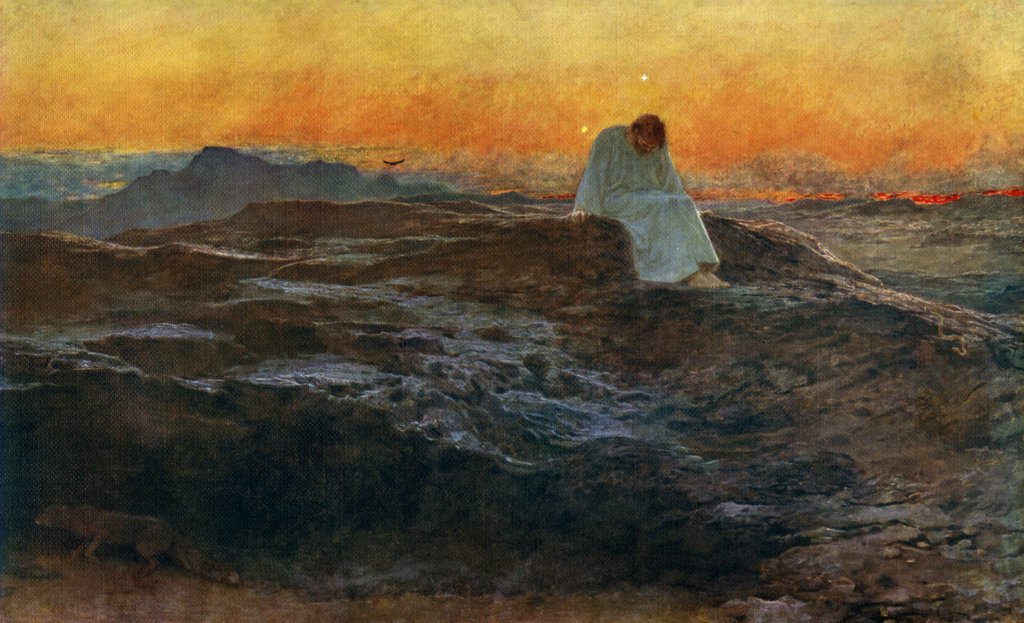
Christ in the Desert, 1898, by Breton Rivière

I have been enjoying Peter Kwasniewski’s new book Close the Workshop, which argues that the old rite did not need to be fixed and that the new rite cannot be fixed. To support his argument, Kwasniewski begins with an analysis of the Second Vatican Council’s Constitution on the Liturgy, Sacrosanctum Concilium (SC), arguing that the document was not kidnapped later on but contains within itself timebombs that were then detonated by Archbishop Bugnini and his colleagues.

One of the fruitful ways that Kwasniewski proceeds in his task is by assembling several statements from SC that, when stripped of their reassuring context and laid bare, can be seen in a new and rather startling light. In the same spirit, and on this solemn day of Good Friday, I would like to call our attention to Article 110 of this document:
Paenitentia temporis quadragesimalis non tantum sit interna et individualis, sed quoque externa et socialis. Praxis vero paenitentialis, juxta nostrae aetatis et diversarum regionum possibilitates necnon fidelium condiciones, foveatur, et ab auctoritatibus, de quibus in art. 22, commendetur.
Sacrum tamen esto jejunium paschale, feria VI in Passione et Morte Domini ubique celebrandum et, juxta opportunitatem, etiam Sabbato sancto producendum, ut ita, elato et aperto animo, ad gaudia dominicae Resurrectionis perveniatur.
The English translation for which is:
During Lent penance should not be only internal and individual, but also external and social. The practice of penance should be fostered in ways that are possible in our own times and in different regions, and according to the circumstances of the faithful; it should be encouraged by the authorities mentioned in Art. 22.
Nevertheless, let the paschal fast be kept sacred. Let it be celebrated everywhere on Good Friday and, where possible, prolonged throughout Holy Saturday, so that the joys of the Sunday of the resurrection may be attained with uplifted and clear mind.
The first paragraph affirms the traditional teaching that corporate Lenten penances are good and that the Church has the capacity to make prudential adjustments to these penances according to place and time. But it stops short of declaring that the Church has the right to mandate fasts, using the language of encouragement (foveatur and commendetur) rather than prescription. One of the controversies of the Protestant Reformation was whether the Church has the authority to tell the faithful that they must fast on pain of sin, with figures like Zwingli vehemently maintaining that she does not. The first paragraph of SC 110 seems hesitant to condemn Zwingli’s error. It also omits any reference to the guidance of the Holy Spirit in shaping the Church’s penitential practices, which could give the impression that such practices are purely manmade or positivist.
If the first paragraph shies away from declaring all of the Church’s authority, the second paragraph swings in the opposite direction by implying that the Church, or more specifically, the Council Fathers, have the power to desecrate or de-sacralize Lent. The sentence, “Nevertheless, let the paschal fast be kept sacred,” is filled with implications. “Nevertheless” (tamen) is a disjunction that separates the “paschal fast” of Good Friday from the forty-day Lenten fast. The paschal fast alone is here deemed sacred, thereby insinuating that the Lenten fast is no longer sacred. The original Latin is even more voluntaristic than the official English translation: whereas the English “let the paschal fast be kept sacred” presumes that the paschal fast is already sacred and that the Council Fathers have graciously decided to keep it that way, the Latin original “let the paschal fast be sacred” depicts a world in which nothing is sacred unless so deemed by recognition of the Council.
The logic undergirding “Nevertheless, let the paschal fast be kept sacred” is the following. The sacred is what is set apart and generally not subject to human tinkering. But the first paragraph of SC 110, which affirms the Church’s ability to change Lenten penances, is apparently going to be used to make radical changes to the Lenten fast; instead of approaching the fast with awe and respect, the liturgical reformers plan to be aggressive and gut it. The fast’s protected status as sacred must therefore be removed before such a gutting can take place. A sacred custom that defined the season of Lent for 1,6000 years old shall be sacred no more.
That the Lenten fast was universally considered sacred prior to SC 110 there is no doubt. Every Roman-rite bishop at the Council was obliged to recite or sing during the Lenten Office of Vespers the hymn Audi Benigne Conditor, the opening verse of which is:
Audi, benigne Conditor,
Nostras preces cum fletibus,
In hoc sacro jejunio
Fusas quadragenario.
Which I translate as:
Hearken, O kind Creator,
To our prayers with our tears,
During this sacred fast,
Spread out over forty days.
Unless a High-ranking feast day intervened, every member of the Roman Rite clergy had to read these words every day from the first Saturday of Lent until the Friday of the Fourth Week of Lent, approximately twenty-eight times. Multiply this by the number of years that a man has been obliged to recite the Divine Office (since his days in the seminary), and it is not a stretch to imagine that the majority of the voting bishops knew this hymn by heart.
And if they did not, the daily orations of Lent were there to reinforce the doctrine that the fast is sacred or (which amounts to the same thing) that God and not man instituted the Lenten fast. Of the several I could have chosen, here are four:
Be mindful, O Lord, of our supplications: and grant that we may keep with devout service this solemn fast, which Thou hast wholesomely ordained for the healing of our souls and bodies. Through. –Collect, Saturday after Ash Wednesday
Of Thy goodness, we beseech Thee, O Lord, continue to help us in the observance of this holy fast, that having learned our duties from Thee, we may carry them out by the help of Thy grace. Through. –Collect, Tuesday of the Second Week in Lent
Grant, we beseech Thee, almighty God, that cleansed by this sacred fast, we may be brought by Thee with pure hearts to the holy season which is to come. Through. –Collect, Friday of the Second Week of Lent
Grant, we beseech Thee, almighty God, as year by year we keep this sacred fast with devotion, we may please Thee both in body and soul. Through. –Collect, Monday of the Fourth Week of Lent
I draw attention to this liturgical evidence not in order to condemn the 2,158 bishops who approved Sacrosanctum Concilium, but to marvel at the ingenuity of the document’s drafters, who were able to convince an overwhelming majority to turn their backs on a tradition they knew without knowing for the most part that they were doing so.
SC 110 is also important as part of the broader debate about the plight of the sacred in the wake of Vatican II. Does the new liturgy renew the sacred or undermine it? Paul VI himself seems to have been of two minds. On one hand, in a remarkable speech in 1966, he finger-wagged the Consilium in charge of the changes about reverencing the sacred, respecting tradition and a sense of history, and searching for what is best rather than what is new. And a friend of the Pope, Cardinal Antonelli, wrote in 1967 that Paul VI was “pained by a certain tendency to de-sacralize the liturgy.” On the other hand, when introducing liturgy in the vernacular, the Pope defended the innovation even though, he admitted, it means that we have become “profane intruders in the literary preserve of sacred utterance” and have sacrificed “the beauty, the power, and the expressive sacrality of Latin” (General Audience, November 26, 1969).
The liturgical reformers, incidentally, were true to the inuendoes of SC 110. In his 1966 Paenitemini, Paul VI eliminated the mandatory Lenten fast but kept the Good Friday fast “sacred.” The reformers’ new edition of the Missal reflects the new Lent that they invented. The 1962 Missal mentions, explains, and prays for the practice of fasting on every day of Lent prior to Holy Week: the traditional rite’s Preface for Lent, which is used daily from Ash Wednesday until Passiontide, is supplemented almost daily with additional references to fasting in the proper prayers. The 1969 Missal, on the other hand, retains several references to fasting on Ash Wednesday (the other mandatory fast day), but there are only two required references to the fasts of the faithful for the rest of the season. Consequently, with the exception of Ash Wednesday, the new Missal offers very little guidance on fasting and almost no prayers for its success.
“The practice of penance,” Sacrosanctum Concilium states, “should be fostered.” But if one wants regular instruction on the nature and meaning of fasting, and if, moreover, one wants priests and congregations daily praying and offering up the Holy Sacrifice for the efficacy of one’s fasts, one is better off turning to the Missal used during Vatican II rather than the one that followed it.

Thursday, February 27, 2025

“Close the Workshop: Why the Old Mass Isn’t Broken and the New Mass Can’t Be Fixed” — New Book by Peter Kwasniewski

hardcover on the left, paperback on the right
I am delighted to announce to NLM readers that my new book from Angelico Press, Close the Workshop: Why the Old Mass Isn’t Broken and the New Mass Can’t Be Fixed, has just been released.

As the title and subtitle suggest, the book replies to the cancer-phase Liturgical Movement arguments in favor of massively overhauling the old rite, explaining why it did not need the Consilium’s extreme makeover; and then refutes the idea that the new rite can be “reformed” or “done well” so that it might someday be the right thing. Instead, the old rite is fine the way it is, as long as it is well celebrated; and the new rite, regardless of good intentions, is irreparable.

The argument of this book is particularly important at a time when a lot of clergy and laity, feeling discouraged by various and sundry restrictions, are tempted to take the line that “As long as we do the new rite well, that will suffice.” The dangers of this approach are enormous, though seldom highlighted. I shine a giant floodlight on them.

What is more, it’s very possible we’ll see an attempt made in the coming years to impose “reforms” on the old rite: if you can’t beat ’em, beat ’em up in some other way. The enemies of tradition see that the TLM is not going to disappear entirely, so they will launch a campaign of “death by a thousand cuts”: “You can keep the TLM as long as you adopt the new lectionary, the new calendar, the new prefaces,” etc. etc.—basically, an attempt to force Sacrosanctum Concilium on recalcitrant trads 60+ years later. (And we mustn’t be naive: a “conservative” pope might throw his weight behind this campaign just as much as a progressive one would do, under the mistaken impression that it would offer “the best of both worlds.”)

My book explains why all of this is a non-starter, a dead end, a ruse, and a means of destroying the perfections of the old rite, which I describe and defend. What we love, we fight for; and to love it better, we must understand it deeply. That is the purpose of this book: to equip the reader with the deepest understand of why the old Mass isn’t broken and doesn’t need fixing, and why the new Mass is a mess that cannot be fixed but must be set aside for good.

A Foreword by Fr. Thomas M. Kocik, world expert on the reform of the reform, graces the volume.


Publishers Description

The Mass of Paul VI is so deeply flawed that it cannot be repaired from within, whether by copious helpings of smells and bells, by arbitrary attempts at traditionalizing, or by an official “reform of the reform”; and the Roman Mass inherited from the Age of Faith did not (and does not) need to be “reformed” along antiquarian or pastoral-utilitarian lines, as it fulfills the highest act of religion in a fitting manner perfected over many centuries of prayerful practice. The liturgical revolution, driven by ideology, culminated in balkanization, banality, and boredom; its fabrications must be retired from use, and the traditional rite must be restored to its rightful place of honor in the Church of the Latin rite.

Such are the bold claims defended in Close the Workshop: Why the Old Mass Isn’t Broken and the New Mass Can’t Be Fixed, in which Peter Kwasniewski refutes the reformers’ own case for reforming the old rite and illustrates the subtle dangers to which clergy and laity are exposed by attempts at “doing the new rite reverently.” Simultaneously he reminds traditionalists that they should aspire to the noblest possible celebration of the Mass, always faithfully observing the rubrics and resisting bad habits that interfere with the rite’s full splendor and efficacy: unseemly haste, minimalism, ineptitude, and the itch for pastoral experimentation.

If the Catholic Church in the West is ever to recover her internal soundness and external cultural influence, her shepherds and her flocks must let the ill-advised Council of the 1960s and the Bauhaus liturgy fabricated in its name lapse into obsolescence, so that the perennially fresh theology of the Council of Trent and the immortally beautiful liturgy of the Roman Church may once again flourish unfettered.

What Readers Are Saying

“We are grateful to Dr. Kwasniewski for showing to the readers of our day the inestimable treasure of the Catholic liturgical tradition, which, in its prayers and rites, most perfectly reflects the integrity and the ineffable mystery of the Faith, and at the same time for exposing patiently and no less thoroughly the severe flaws of its attempted replacement.” —Most Rev. Athanasius Schneider

“David slaying Goliath is the only apt metaphor for Dr. Kwasniewski. At the Goliath of systematic lies perpetuated about the traditional Mass, he has aimed the five shiny stones of his prodigious scholarship. He has mortally wounded the giant of liturgical mendacity; it is hard to see how any thinking Catholic could ever grant it credibility again.” —Fr. John A. Perricone

“Dr. Kwasniewski has produced a volume that demands a verdict. Agree or disagree with this work as you see fit—but it cannot with integrity be dismissed or ignored.” —Fr. Robert McTeigue, S.J.

“Most of Kwasniewski’s conclusions in this volume are diametrically opposed to those of the Vatican, which is all the more reason they should be read—not as a proud act of dissent but in order to gain a different perspective, one that raises serious questions about a matter vital to the Church.” —Michael P. Foley

“An impassioned, uncompromising defense of the traditional Latin Mass…. An encyclopedic review of the current issues in the Catholic traditionalist movement, both clarifying fundamental theological principles and offering practical advice on celebrating the TLM today.” —Stuart Chessman

“The author makes an important contribution to a question that has become only more urgent over time: Did we certainly and genuinely need a substantial reconfiguration of liturgical rites that exchanged a venerable patrimony for a manufactured product that was (or was at least intended to be) adapted to ourselves and to the zeitgeist—or do we actually need to reform ourselves and our culture, adopting as our own a tradition passed down from time immemorial?” —Shawn Tribe

Table of Contents

Close the Workshop is available in paperback or hardcover:
• from the publisher;
• from any Amazon site;
• or via the Os Justi Press website.

Wednesday, December 18, 2024

Historical Falsehoods about Active Participation: A Response to Dr Brant Pitre (Part 1)

Just over two weeks ago, on the anniversary of Sacrosanctum Concilium, the YouTube channel of Catholic Productions published a video by Dr Brant Pitre, who is the Distinguished Research Professor of Scripture at the Augustine Institute Graduate School. The video is part of a series called “The Mass Explained”, which was published a bit over a year ago through the Catholic Productions website. This specific video is now being offered on YouTube as an encouragement to explore the full series; its subject is the much-debated concept of active participation in the liturgy.

Dr Pitre is a Biblical scholar, and by far the most successful part of this video is his attempt to give a solid Scriptural foundation to the concept; a useful endeavor, given the hopeless ambiguity of so much of Sacrosanctum Concilium. Unfortunately, his presentation is marred by a considerable number of really drastic historical errors, including one on which the whole narrative arc, so to speak, of his presentation rests. The errors are in fact too many to describe in a single post, and this response will have to be presented in more than one part.

I wish to be clear that I certainly do not ascribe to Dr Pitre any conscious dishonesty. There are plenty of liturgists and people who have written about the liturgy who can be excused of the charge of deliberate lying only if one grants that before attempting to deceive others, they have first gone to enormous pains to deceive themselves. (I wish I could take credit for this bon mot, but it comes from Sir Peter Medawar’s brilliantly savage review of Teilhard de Chardin’s The Phenomenon of Man.) I see no reason to think that Dr Pitre is among them; indeed, I think it very likely that he himself is among those whom others have deceived.
Nor does he fall into the fatuous excesses that so many others have fallen into when writing or speaking about this topic specifically, and claim that “active participation”, however defined, is incompatible with the historical Roman Rite. Indeed, he acknowledges that active participation of the lay faithful has been a part of it in the past. His gigantic historical error lies in his would-be description of when, how, why and to what degree this changed, leading the Second Vatican Council to call for its restoration. (I will cover most of what he says about this in part 2 of this article.)
He begins (2:55) with the first occurrence of the term “actuosa participatio – active participation” in Sacrosanctum Concilium, paragraph 14, saying that it is “arguably the most important topic of the Second Vatican Council.” Unfortunately, the translation of Sacrosanctum Concilium which he cites contains a very significant mistake, which is no less of a mistake for being repeated on the Vatican’s own website. The English version which he gives is as follows: “In the restoration and promotion of the sacred liturgy, this full and active participation by all the people is the aim to be considered before all else.” (His emphasis.)
But the Latin original does not say that active participation “is to be considered before all else,” which would be a license for doing anything and everything in the liturgy, provided the claim were made that it fostered active participation. And of course, in the so-called “spirit” of Vatican II, many people, including the very men who invented the post-Conciliar Rite, have taken it as just such a license, in order to excuse their ignoring significant parts of Sacrosanctum Concilium itself, and all of the Church’s earlier magisterial teaching on the liturgy, to say nothing of others justifying the most appalling abuses in the actual celebration of the liturgy.
Much active. Very participation.
The Latin words of the Constitution are “actuosa participatio … summopere attendenda est”, which would be properly rendered “active participation … is to be given the greatest attention.” And it is in fact so rendered in the Italian, French, Spanish and German translations also available via the Vatican’s website. (I cannot vouch for the Arabic, Chinese, Swahili or various Slavic versions.)
This would have also been the perfect place to add that there is a solid case to be made that “actual participation” is a better translation of the words “actuosa participatio” than “active participation.” This case was laid out very thoroughly by Fr Peter Stravinskas in a paper which he delivered to the CIEL conference in Paris in 2003, and graciously allowed NLM to reprint in 2016. (Part 1; Part 2) For of course, as we all know, the word “active” has deceived many within the Church into confusing activity with achievement, and thus taking it for granted that as long as the laity are doing something, they are actively participating, and it doesn’t much matter what exactly they are doing or how they are doing it.
In regard to the Council’s statement that the people’s participation in the liturgy should be “full”, Dr Pitre very rightly points out (6:45) that this means fully participating in the parts which properly belong to them, “and only those parts which belong to them, and the people shouldn’t be doing what is exclusive to the priest, and vice versa.” For of course, it was the furthest thing from the Council Fathers’ minds to foster the participation of the laity by blurring this necessary distinction. This would have been a good place, therefore, to point out that “active” participation in the modern liturgy has been brought about in no small part by redefining “what is exclusive to the priest”, and giving to the laity liturgical roles that the tradition of the Church has always given to the clergy: the reading of the Scriptures, and the distribution of Communion. Perhaps this comes up elsewhere in the series.
At 7:50, Dr Pitre very rightly notes that the phrase “actuosa participatio” goes back to St Pius X’s famous motu proprio Tra le sollicitudini on sacred music in the liturgy, and that singing the parts proper to them is above all the most important way in which the faithful actively participate in the liturgy. Perhaps some other part of the series points out that in practical terms, Tra le sollicitudini has been completely overthrown by the post-Conciliar reform, since the confusion between activity and achievement, a confusion which the word “active” positively invites, often leads to the replacement of good music with bad music or no music, because it is easier for the congregation to sing bad music than good, and easier still to recite than to sing.
It would also be worth mentioning somewhere along the line that Sacrosanctum Concilium itself does not cite Tra le sollecitudini, because in the last phase of its redaction, the numerous citations of the Church’s prior magisterial teaching on the liturgy qua liturgy, and particularly those related to sacred music, were expunged. This includes not only multiple references to Tra le sollecitudini, but also to Pius XI’s 1928 Apostolic Constitution Divini cultus, Pius XII’s encyclicals Mediator Dei (1947) and Musicae sacrae disciplina (1955) as well as the instruction issued by the Sacred Congregation for Rites in 1958, De musica sacra et sacra liturgia. (This removal was documented by Susan J. Benofy in an article entitled “Footnotes for a Hermeneutic of Continuity: Sacrosanctum Concilium’s Vanishing Citations”, published in the Adoremus Bulletin in 2015.)
At 9:30, Dr Pitre introduces a few key Biblical texts that refer to active participation in the liturgy, and as I stated earlier, this really is the strongest part of the video. The first of these is a description of the assembly in Nehemiah 8, which he describes as “actively listening” to the word of God read to them by the priests. This passage occupies a prominent and very ancient place in the historical Roman Rite, as the second reading of the Ember Wednesday of September. With the suppression of the Ember days in the post-Conciliar Rite, it has been assigned to a Sunday of Ordinary time in year C, and a Thursday in year 1. (This might have been the place to mention that the books of Ezra and Nehemiah refer much more often to the organization of trained cantors among the ministerial orders of the Temple, since the use of professional choirs will later be noted as one of the developments within the Church which putatively detracted from the participation of the laity.)
The second quotation is a foundational passage for the priesthood of all the baptized, 1 Peter 2, 9, which is cited in the aforementioned paragraph 14, and this is followed by the passages which describe the heavenly liturgy in the Apocalypse, and the various ways in which all of the different orders of the Church participate, including silent participation. And since the “heavenly model provide(s) the template for what worship should look like on earth, if all of the members of the mystical body of Christ are actively engaged (in the liturgy) in heaven, then the same thing should be true of the liturgy on earth.”
At 18:00, Dr Pitre begins to adduce examples from the history of the Church which show that “for the first thousand years or so of Christian worship, this is precisely what we’re going to find.” Unfortunately, this is precisely the point where he begins to run his ship aground. For his reference to the “first thousand years or so” implies that a change took place after that point, a change which he will later explicate very wrongly; wrongly enough that, as I said earlier, I will need a second part of this article to explain it all. (The words “or so” are also being made to do far too much work here.)
There follow six examples of things in which the people fully participated in the liturgy during those first thousand years: in his order, the Sanctus, the giving of the peace, the responsorial psalm (sic), the Amen at the end of the prayers, including the Canon, the Creed and the Our Father. Regarding the last of these, he correctly acknowledges that it has always been the Roman custom for the priest to sing it alone (except, of course, for the final words), and just as correctly notes that in some other Western liturgies, it was sung by everyone, as it still is in the Byzantine Rite.
First of all, I note that with four of these, the Sanctus, the Amens, the Creed and Our Father (i.e. the end of it), it has always been possible for the faithful to sing them. It has always been possible for the faithful to pray the Our Father silently along with the priest. There are of course ways of singing them in which not all the faithful can participate, such as the very rich polyphonic settings of the Lord’s Prayer composed for the Byzantine Divine Liturgy. There have been specific sociocultural and historical circumstances in which the faithful did not sing them, although apologists for the post-Conciliar reform have habitually exaggerated the degree to which this is true, and regrettably, Dr Pitre falls into this trap. Nevertheless, the faithful have never been excluded from singing them in principle.
A polyphonic setting of The Lord’s Prayer in Church Slavonic, by the Ukrainian composer Maxim Berezovsky (1745 ca. - 1777).
Concerning the Sanctus, he cites the statement of the Liber Pontificalis that it was instituted by the eighth Pope, St Sixtus I, who reigned from roughly 115-125. But the liturgical notices in the Liber Pontificalis, the statements that “Pope so-and-so instituted such-and-such a custom”, are notoriously anachronistic, the more so the earlier they go. For example, the very next entry attributes the institution of Christmas to Sixtus’ successor St Telesphorus (125-36 ca.); all scholars recognize that the feast dates to about two centuries later. It is not per se impossible that St Sixtus instituted the Sanctus, but we have no real evidence that he did in fact do so.
Secondly, the Liber Pontificalis has come down to us in very rough condition, and is full of textual problems. The relevant part of the entry for St Sixtus says, “Hic constituit ut intra actionem, sacerdos incipiens populo hymnum decantare, ‘Sanctus, sanctus, sanctus, Dominus Deus Sabahot’, et cetera.” As written, the infinitive “decantare” (to sing) is a grammatical error, and the passage is marked in modern editions as corrupt; an easy emendation has been proposed, “decantaret.” If this is correct, the passage would mean, “This one (viz. Pope Sixtus) established that within the action (i.e. the saying of the canon, as is written above the Hanc igitur in the Missal) the priest as he begins should sing to the people (‘populo’ in the dative case; my emphasis) the hymn ‘Sanctus…’ ” etc.
One might object that it makes no sense to say that the priest sang the Sanctus and the people did not. But there is some evidence that this was in fact a custom of the Ambrosian Rite on certain penitential days, on which the priest alone sang the Sanctus as part of the preface. But even if this custom was never observed in the Roman Rite, this text does not say that the people sang the Sanctus; quite the opposite.
After references to the giving of the peace, Dr Pitre goes on to say that “in the fifth century, St Augustine tells us that the people would sing the responsorial psalm,” and the video cites The Confessions, book 9, 8.15, as given in Lawrence Johnson’s Worship in the Early Church: An Anthology of Historical Sources (3:12). But this passage does not refer to the people’s participation in the Mass. It refers to an event of St Ambrose’s episcopacy for which Augustine and his mother were present, when the Empress Justina planned to turn one of the basilicas in Milan over to the Arians. The Catholic faithful occupied the church, and the custom was therefore established that the people should hymns and psalms “after the manner of the eastern regions, lest the people pine away in the tediousness of sorrow…”
Augustine does go on to say that this custom, “retained from then till now, is now imitated by many, and nearly all of (the Lord’s) flocks throughout the rest of the world.” But nothing about it suggests that it was a specifically liturgical custom, much less that it involved anything like what we now call a responsorial psalm.
After a mention of what St Isidore of Seville says about the readings being for the instruction of the people, i.e., that they are meant to be actively listened to by the faithful, Dr Pitre now turns (at 20:50) to a text known as the Ordo Romanus Primus, the “First Roman Order”, an ancient description of a Roman stational liturgy. This text is presented to set up a supposed contrast with the later medieval manner of celebrating the liturgy in the papal chapel which gave us the so-called Tridentine Missal. This contrast, however, is so thoroughly and so badly misconstrued that it must be described in another part of this article.

Monday, November 04, 2024

From the Complete Psalter to the Easier Psalter: An Insight into the Dynamics of Liturgical Reform in the 20th Century (Part 2)

Today we publish the second and concluding part of Dr. Paweł Milcarek’s study of the history of the psalter in the Roman divine office. Part 1 may be found here. —PAK 

A commemorative medallion for the second session of Vatican II (source), at the end of which, the document on the liturgy was promulgated.
The Psalter according to the Second Vatican Council: less is better

On the eve of the Second Vatican Council, the planned reform of the breviary – and hence also the introduction of a new arrangement of the Psalter – was one of the most widely discussed issues. In 1957, Pius XII had appointed a commission that surveyed a number of bishops on this matter. The Roman liturgical congregation had already had some concrete projects in its closets, waiting to make use of them.

The Council’s constitution Sacrosanctum concilium, promulgated on 4th December 1963, in its fourth chapter, devoted to the Roman Breviary, states that the restoration of this liturgical book, “so happily begun by the Apostolic See”, is introduced “in order that the Divine Office may be better and more perfectly prayed in existing circumstances, whether by priests or by other members of the Church”, which – in turn – is meant “to sanctify the day”. The Council Fathers were clearly motivated by the wish formulated by the commission appointed by Pius XII: “the traditional sequence of the hours is to be restored so that once again they may be genuinely related to the time of the day when they are prayed”, taking the pastoral conditions into account.

As far as the above mentioned “traditional sequence of the hours” is concerned, the Council decided to accept a compromise: the emphasis was put on Lauds and Vespers, while Compline and Matins were preserved, the latter losing its nocturnal character, with the exception of cases when celebrated in choir. In the case of daytime prayers, double standards were accepted - one for for celebration in choir, and another for celebration outside choir - and the hour of Prime was suppressed. 

Having defined the Hours, the constitution moves on to the directives meant to enable the faithful to celebrate the Office “better and more perfectly”, though afterwards it happened out that the Council described this celebration also with two other adjectives: “more extensively and easily”.

Here we come to the regulation that is directly related to the issue analyzed in this lecture. Article 91 of Sacrosanctum concilium says:

Ut cursus Horarum, in art. 89 propositus, reapse observari possit, psalmi non amplius per unam hebdomadam, sed per longius temporis spatium distribuantur.
     Opus recognitionis Psalterii, feliciter inchoatum, quamprimum perducatur ad finem, respectu habito latinitatis christianae, usus liturgici etiam in cantu, necnon totius traditionis latinae Ecclesiae.
     [So that it may really be possible in practice to observe the course of the hours proposed in Art. 89, the psalms are no longer to be distributed throughout one week, but through some longer period of time.
     The work of revising the psalter, already happily begun, is to be finished as soon as possible, and is to take into account the style of Christian Latin, the liturgical use of psalms, also when sung, and the entire tradition of the Latin Church.]

Those two statements – concerning the change of distribution of Psalms and the revision of the text – further defined the frame of reference for the reform of the breviary Psalter.


Ordo ex machina: the Psalter of the Liturgy of the Hours of 1971

Although during the 20th century, the reform of the breviary had been the engine for the reform of other liturgical books, the post-Vatican reform of this very book took rather long, and was completed only after the reform of the Missal and many rites from the Pontifical and Ritual. The decree of the Congregation for Divine Worship, promulgating the typical edition of the Liturgy of the Hours according to the Roman Rite [1], was issued on 11th April 1971. Together with Liturgy of the Hours, which was the new book of the Office, also newly arranged Psalter was introduced.

It is worth noting that already before, in 1969, the Pontifical Commission for the New Vulgate, headed by Card. Augustin Bea S.J., had published a revised Latin translation of the Book of Psalms, destined for the new Office book. Without here going into the comparative analysis of the three Latin versions of Psalms (that of Vulgate, that of the Pian Commission, and that of Neo-Vulgate), we can simply say that the Neo-Vulgate translation turned out to be in a way conciliatory toward the ancient tradition – much more so than the translation issued by the Pian Commission.

Let us now move on to discuss the new order of the Psalter.

Due to changes in the arrangement of the Hours [2], it was a specific wish of the Council to distribute Psalms not “throughout one week, but through some longer period of time” [3]. Behind this statement there was a recurring thought of the Psalter distributed over two weeks, as, for example, in the Ambrosian rite. But in the end the Psalter, was arranged into a four-week cycle, [4] on the model of the Anglican Book of Common Prayer [5], which means that in practice, that the majority of the Psalms is used in prayer once a month – while previously, each of them had recurred once a week.

The Liturgy of the Hours retained the custom of dividing some of the longer Psalms introduced by the Roman Breviary of 1911, and to a similar extent, but in many cases the Psalms have been divided differently.

The New Psalter, however, not complete. A few Psalms were eliminated entirely (57, 82 and 108), along with parts of nineteen other Psalms that due to their “imprecatory nature” could have created a “certain psychological difficulty” [6]. Such a move had had no precedent in the history of the Roman Breviary, though it is known among the reformed communities.

Each Psalm in the Liturgy of the Hours has been given a caption, explaining “its meaning and its import for the personal life of the believer”, accompanied also by a quotation from the New Testament or the Fathers of the Church, “to foster prayer in the light of Christ’s new revelation” [7]. Though the latter addition was some novelty, it had been deeply rooted in Christian tradition of understanding the Psalms [8].

The number of the canticles from the Old Testament has been significantly increased, from 17 to 26. Many of those already used at Lauds have been modified – their texts have been shortened or elaborately cut up. As a novelty, canticles from the New Testament have been introduced to Vespers.

Of course, the fundamentally new arrangement of the Psalter has caused new distribution of Psalms among particular offices.

As in case of the Roman Breviary of 1911, Matins – renamed now to the Office of Readings – underwent the biggest changes. The number of Psalms within each celebration has been reduced from 9 to 3. The arrangement of Psalms has been completely changed. The same may be said of Lauds, that from now have comprised not 5, but 3 Psalms, selected on a completely different basis.

The structure of the Minor Hours has remained the same, consisting of three Psalms. But the selection of Psalms is brand new.

While the reform of 1911 changed an earlier arrangement of the Vespers Psalms only to a very limited extent, in the Liturgy of the Hours of 1971, a true revolution has been made. The number of Psalms in each Vespers has been diminished from 5 to 2 (or to 3, if we count also the canticle from the New Testament). They have been distributed among the days of the week in a way that was unfamiliar both to the earlier tradition, and to the reform of 1911.

In short, the Psalter of the Liturgy of the Hours has little in common with earlier tradition of the prayer of the Church, both in terms of distribution of Psalms over the time, in relation to the number of Psalms within particular offices, and in regards to its completeness.
 

Attempted summary: Modifications of psalmody throughout the centuries

Let us now attempt to summarize briefly the historical evolution of the Psalter used in the Office of the Roman rite[9].

From the earliest times, the Roman rite preserved the principle of reciting the entire Psalter within one week – meaning that each Psalm was to be recited principally once a week, with many exceptiond for those recited more often, even daily (4, 50, 53, 62, 66, 90, 94, 118, 133, 148, 149, 150). A one-week cycle of the Psalter was retained in the RB 1911, though in such a way that actually excluded the possibility of saying some Psalms more often than once a week. Meanwhile, in case of the LH 1971, due to the distribution of the Psalter over the course of four weeks, the majority of the Psalms is recited once a month, with the exception of a few that recur weekly in Compline.

From the earliest times there were 8 Canonical Hours within the Psalter of the Office of the Roman rite: Matin, Lauds, Prime, Terce, Sext, None, Vespers and Compline. This was changed only in LH 1971, when Prime has been suppressed and the rest of the Minor Hours can be – if recited outside choir – substituted with one prayer, so called Middle Hour. Hence, in practice, the Office may be narrowed down to five Canonical Hours.

From the earliest times each and every Psalm had had its place within the Office, including those texts that had been the most likely to raise some reluctance or evoke questions.

From the earliest times there was no practice of dividing the Psalms in the Roman rite, with the exception of Psalm 118 – in all other cases they were recited in their entirety. Meanwhile, since RB 1911 division of Psalms has become a frequent solution, leading to situations where one Psalm, divided into three parts, may fill out the whole Hour.

Psalmody of Matins

From the earliest times, the number of Psalms on weekdays was never lower than 12, while on Sundays it was even higher: in the beginning it was twice as much (24), while from the 6th century to 1911 there were 18 Psalms in this office. Only RB 1911 equalized the number of Psalms on Sundays and ferias, , diminishing it to 9. Such an equality has been sustained in LH 1971, however the number of Psalms in Matins was further lowered to 3 Psalms (or to 3 units).

From the earliest times, up to RB 1911, nothing had changed in selection of Psalms assigned to particular days of the week. But in the 20th century this selection was changed practically completely twice (in RB 1911 and LH 1971). (Click on any image to enlarge.)


Psalmody of Lauds

From the earliest times the psalmody of Lauds always comprised 5 Psalms, but in practice there were 7 Psalms and canticles, divided into five groups: 1, 1, 2, C, 3). BR 1911 lowers this number to the actual 5, while LH 1971 to .

From the earliest times the psalmody of Lauds was daily concluded with the three last Psalms from the Book of Psalms – but this custom was abolished in BR 1911. It was also then that the earlier way of distributing the Psalms among particular days of the week was severely changed – though it was not until LH 1971 when it was completely shattered.

One can note that the exceptional significance of Psalm 50 (acquired by it in the 6th century) has been preserved also in the 20th century, though the frequency of its use is constantly changing.
 

Psalmody of Prime

The long tradition standing behind Prime does not change the fact that its psalmody was subjected to numerous modifications throughout the centuries. Nevertheless, some of its characteristic features (concerning the selection of Psalms) had been generally preserved either until BR 1911, or even until the reform of 1971. But elimination of Prime, ordered by the Second Vatican Council, has ended its career within Liturgia Horarum.
 

Psalmody of the Minor Hours

Up until 1911, Terce, Sext and None consisted in daily recitation of subsequent parts of Psalm 118. In BR 1911 this particular Psalm was preserved only in case of Sunday office, while on weekdays other Psalms (previously used in Matins) were introduced. Meanwhile, in LH 1971 both so called “additional psalmody” and the current psalmody for particular hora media are based on such a selection of Psalms that was utterly unfamiliar to the tradition of the Roman rite[10].
 

Psalmody of Vespers

Throughout the centuries – from the oldest sources to BR 1568 – there was some kind of admirable changelessness in the structure and selection of the psalmody of Vespers. Also BR 1911 to a larger extent preserved this tradition. But LH 1971 has introduced a sudden and multidimensional change: number of the elements of the psalmody has been lowered down from 5 to 3; one of Psalms has been substituted with a canticle from the New Testament; selection of Psalms has ceased to show any continuity with previous, outstandingly long tradition – exceptional is the case of Sunday, where – among others – the primacy of Messianic Psalm 109 has been preserved.
 

Psalmody of Compline

The structure and selection of psalmody of Compline remained the same for a good many centuries and was interrupted only in the 20th century; but while in BR 1911 traditional selection of Psalms was preserved at least for Sunday, it has been finally disintegrated in LH 1971, and only traces of it can be traced in the offices after the First and Second Vespers of Sundays and Feasts.
  

NOTES

[1] Officium divinum ex decreto Ss. Oecumenici Concilii Vatricani II instauratum auctoritate Pauli Pp. VI promulgatum: Liturgia horarum iuxta ritum romanum

[2] Cf. SC, 89.

[3] Cf. SC, 91: „psalmi non amplius per unam hebdomadam, sed per longius temporis spatium distribuantur”.

[4] Cf. Institutio generalis de Liturgia Horarum (IGLH), 126.

[5] Cf. Bugnini, 1990, p. 499.

[6] Cf. IGLH, 131: „Tres vero psalmi 57, 82 et 108, in quibus præponderat indoles imprecatoria, omittuntur in Psalterio currente. Item aliqui versus nonnullorum psalmorum prætermissi sunt… Quorum textuum omissio fit ob quandam difficultatem psychologicam, etsi psalmi ipsi imprecatorii in pietate Novi Testamenti occurrunt, exempli gratia Ap 6, 10, nulloque modo intendunt ad maledicendum inducere”.

[7] Cf. IGLH, 111.

[8] Cf. IGLH, 109.

[9] In relation to the Psalmody of the Roman rite of the 5th and the 6th centuries, I refer here to the works by Joseph Pascher, as cited in: Robert F. Taft SJ, Liturgy of the hours in East and West, Collegeville 1993, p. 136.

[10] However, so called additional psalmody is almost completely consistent with so called Gradual Psalms.

More recent articles:

For more articles, see the NLM archives: