
Tuesday, August 29, 2023

A Contemporary Hiberno-Saxon Style Illumination of the Chi-Rho

Work from a Graduating Student at the Pontifex University Master of Sacred Arts Program

I am excited to show you the work of one of our students, Daniela Diz, who submitted this for her capstone portfolio, the final stage of the Masters program. Daniela specializes in illumination and decorative and geometric patterns in the Christian tradition.

She based this work on the Chi-Rho of the Book of Kells, a manuscript which was created in the 7th century in what is referred to as the “Hiberno-Saxon” style. Chi and rho are the first two Greek letters of the word for Christ, ΧΡΙΣΤΟΣ (Christos).
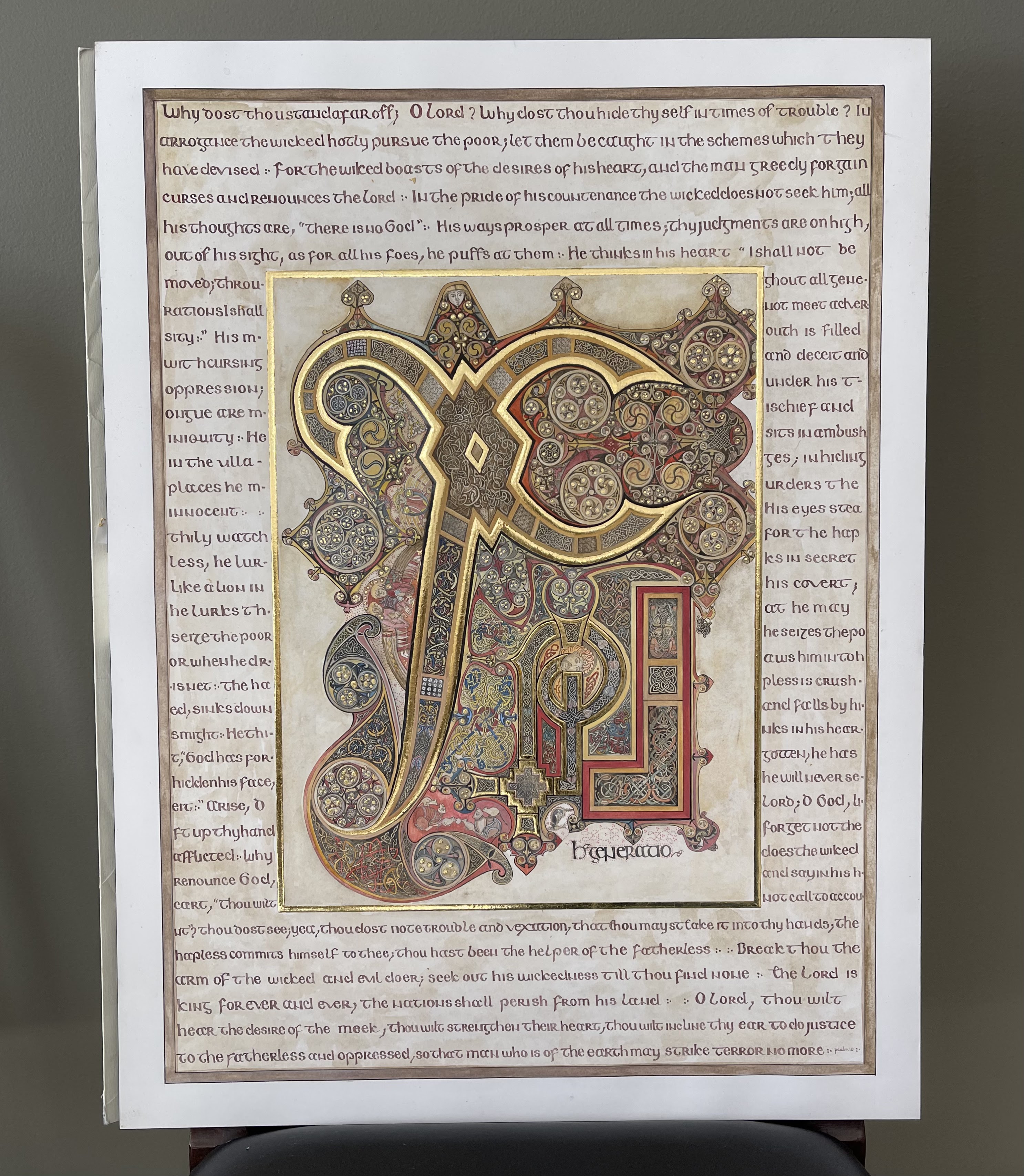
The Master of Sacred Arts program capstone gives students a choice of either a research and writing option, or the submission of a portfolio of art work. The goal of the MSA overall is to offer to students the formation and Catholic inculturation that might have been offered to artists in the past. This is of interest, therefore, to artists in any creative discipline; to potential patrons of the arts who wish to understand Catholic tradition and how artists work; as well as the many people who have a deep interest in Catholic art and culture and want to know more. 
The practical content is not high. Aside from the option of submitting an art portfolio as part of the capstone, there other practical requirement is to create some geometric constructions as part of my Mathematics of Beauty course. As you can probably guess, Daniela came to us already equipped with a high level of skill, but enrolled with us because she wished to know more deeply how to direct her talents to the service of the Church. Some readers may remember, incidentally, that I featured the same student’s work for that Mathematics of Beauty course, a beautiful intricate floor designs in a Romanesque style.
Here are more photographs, showing the work in progress on the Chi-Rho. Note that she gilds the page as well as drawing and inking it.

Tuesday, July 30, 2019

A Chinese Book That Offers Inspiration to Sacred Artists

Several years ago, I was interested in learning how to paint landscapes, and I noticed that the style and composition of traditional Chinese landscape painting had influenced the best landscape painters in the West. With my curiosity piqued, I read through a manual of traditional Chinese landscape painting, The Mustard Seed Garden Manual of Painting, written in the 17th century. To my surprise, I found that the method of painting instruction used by the Chinese is the same as that of the West, but also that the Daoist understanding of the created world, which has formed the style of Chinese landscape, was compatible with Christianity. I wrote about this in a post from 2014 called Chinese Baroque!


Part of my openness to looking back at Chinese art relates to an even earlier time when I was taking icon painting classes from Aidan Hart. He often spoke of the importance of line in describing form in icon painting, and how describing line beautifully is part of the skill of the iconographer. I can still remember him talking of the “calligraphic flow” of Celtic art or of a Gregory Krug icon (see below); it is precisely this aspect of the description of form that attracts me so strongly to the illuminations of the English Gothic artist Matthew Paris and the School of St Albans. I recently did a lecture for the Institute of Catholic Culture on the Book of Kells and spoke of this, which you can listen to here.


I was interested to read a recent article in the excellent Orthodox Arts Journal (run by Jonathan Pageau and Andrew Gould) that was written by Aidan Hart about The Mustard Seed Garden Manual of Painting. Aidan’s focus is on the direct connection between the methods and the philosophy of painting used and their similarity to those of icon painting. In his article, he digs more deeply than I have done and draws out some striking similarities, and wonderfully poetic excerpts. I would recommend to everyone to read his piece, but most especially anyone interested in pursuing sacred art.

For example, he talks of the importance of method and copying with understanding in the training process, which leads to an intuitive mastery of the technique which the artist can apply in new and different situations.

Aidan writes:
Here some excerpts that have meant a lot to me over the years, followed by my own commentary:
To be without method is deplorable, but to depend entirely on method is worse.’ (page 17).
The dominant weakness of icon painting in the West is the lack of method, the lack of skill. We have no long-term icon schools, and our art schools rarely train people in the traditional skills of drawing to any depth. Inevitably, therefore, a DIY approach dominates. By contrast, icons in traditionally Orthodox countries often suffer from the opposite problem: too much dependence on skillful copying. Accurate and analytical coping of masterpieces is certainly an excellent way to learn iconography, but should remain a means to an end. To equate Tradition with copying is a return to the Law and to depart from Grace. It betrays a spirit of fear rather than humility.
You must learn first to observe the rules faithfully; afterwards, modify them according to your intelligence and capacity. The end of all method is to seem to have no method.’ (p17)
Read the full article here.

Plum and Bamboo, Wu Zhen, 13th Century
A detail from the Book of Kells

More recent articles:

For more articles, see the NLM archives:



