Tuesday, February 11, 2025

The Surprising Philosophical Sophistication of the Art of Paleolithic Man

...And Lessons that Could Be Learned From Them by the Neandertals in Our Universities

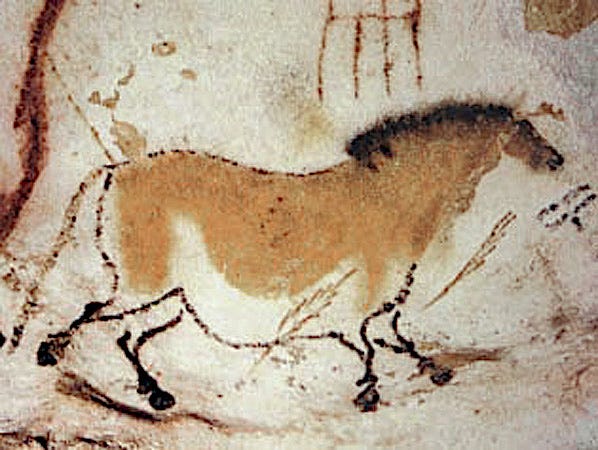
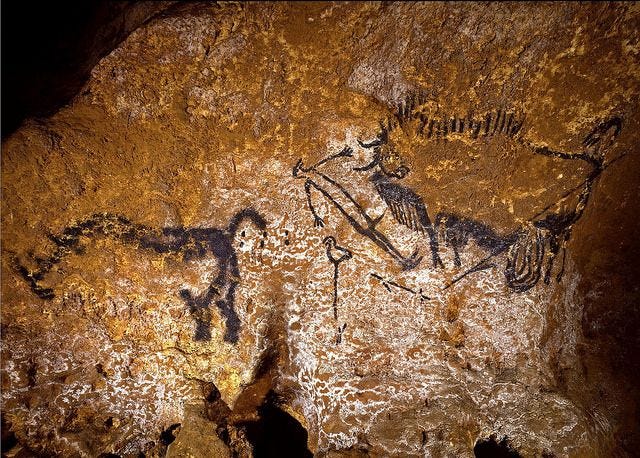
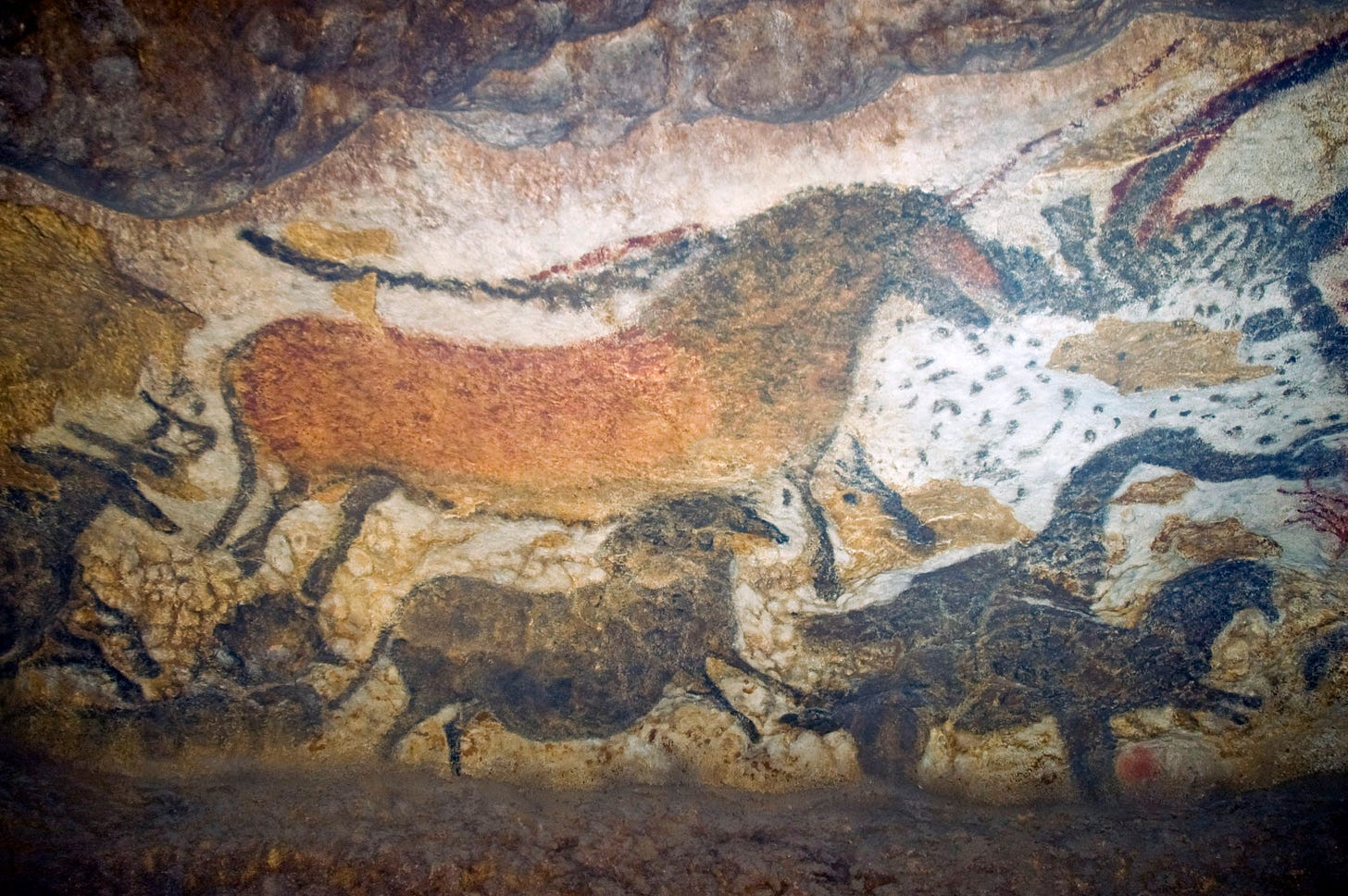
Here are wall paintings from underground caverns in Lascaux in the Dordogne region of southwest France, east of Bordeaux. Around 600 paintings exist in a network of underground caverns; archeologists estimate that they were painted during the Upper Paleolithic period, about 15,000 years ago. They were discovered in 1940 by an 18-year-old boy taking his dog for a walk, when the dog wandered into a hole in the ground leading to the cavern system. The paintings depict animals, plants, and one humanoid form—a man with a bird’s head. Although the exact reason for their creation is unknown, it is speculated that they hold some spiritual significance and are connected to ritualized worship.

Man with bird head (somewhat reminiscent of Ancient Egyptian god, Horus!
The idea that these paintings are linked to religious rituals is likely speculative but strikes me as reasonable. Traditional Catholic teaching tells us that man’s desire for God is natural. Although Paleolithic man would likely have had a dim and somewhat distorted sense of what God is like, it would have been as natural for Paleolithic society as for any other human society to develop and express through worship this desire for what they did know of Him. This being the case, it is also natural for them to desire to create images that help connect them with a higher being or beings in the context of their worship.

The Natural Desire for God

The generally accepted view amongst theologians today is, as I understand it, that man’s desire for God is natural but not innate. (1) There is an important distinction here. It is considered natural because it arises from the power of natural reason. However, it is not innate, meaning that the inclination to worship God is not an instinct we are born with. This inclination arises instead from our observation and reflection upon the nature of the world around us.

When they observe the world and see its vastness, beauty, order, and grandeur, many different people have, over millennia, concluded that a divine being (or beings) created and orchestrates it, and that any being capable of doing such a wonderful thing is greater than us and worthy of worship.

The powers of unaided human reason are limited, however. Thus, those without the benefit of Revelation will likely develop an incomplete, fractured or distorted picture of the deity. Through the power of natural reason alone, God will not be perceived, for example, as the one Triune God whom Christians know through Christ and the Gospel. Nevertheless, most societies, going back to the cavemen, it seems, have been at least philosophically sophisticated enough to conceive of a higher form of existence than human life, and have worshipped higher beings, often a series of pagan gods. Typically, this inspires artistic creation, and they create images of those gods to represent them gods, which are a focus of their worship.

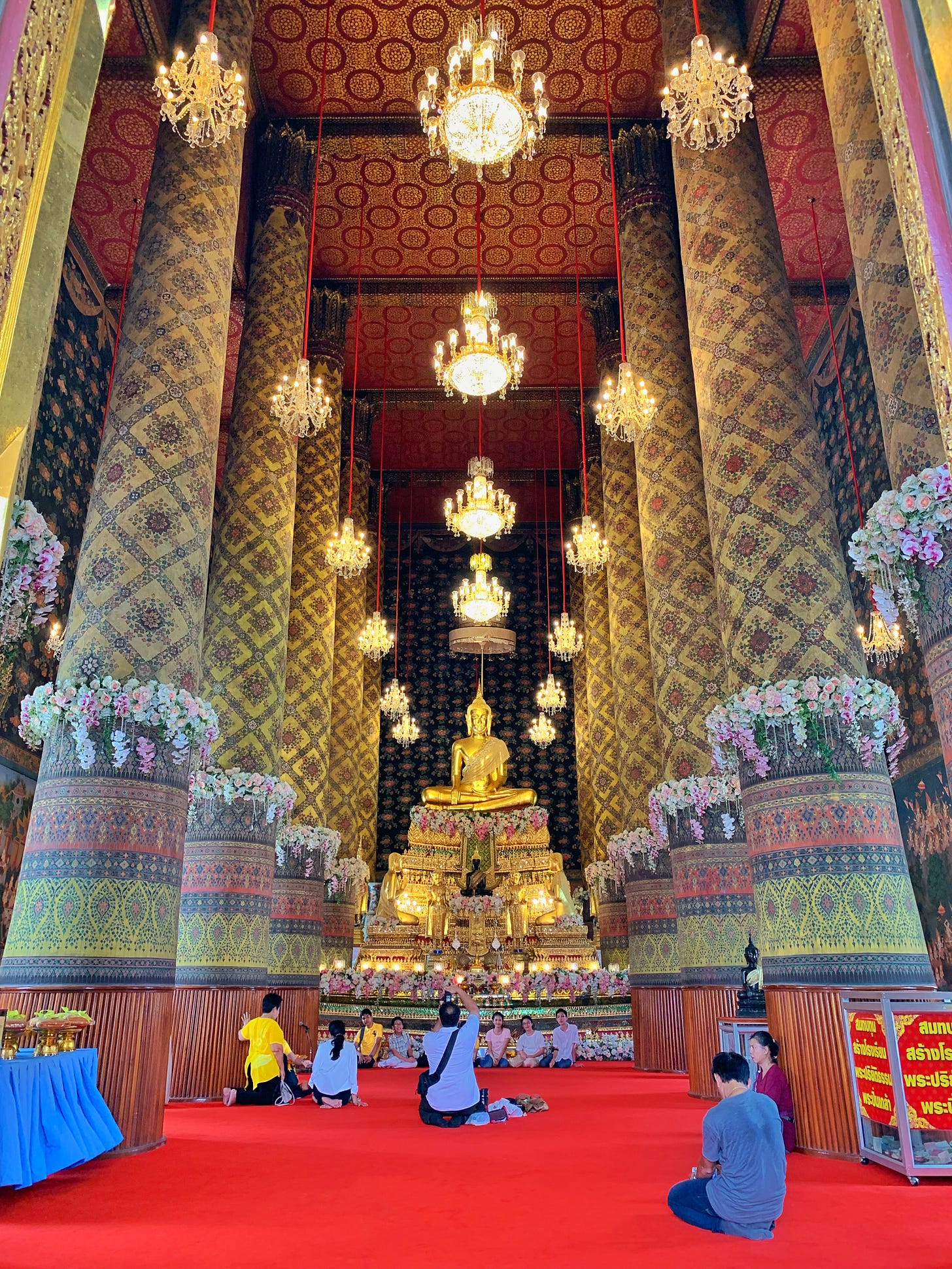
Some, even without Revelation, would get close to the truth. Ancient Greeks, like Socrates, Plato, Aristotle, and their successors, even deduced the existence of a single god or supreme Good—what one might call the “god of the philosophers”. But these are exceptions. While, as St. Thomas tells us, it is theoretically possible to use natural reason alone to deduce the existence of a single, all-powerful, all-good, and all-loving God, most societies throughout history did not reach this conclusion. Typically, they fashioned false deities, and their forms of worship were flawed. Yet, at its core, for all that, such paganism is an expression, albeit imperfect, of man’s natural desire for God. As we have stated, human reason is weak, and it is not a given that people can reflect upon the natural world and get as far, even, as concluding that there is a God or gods. Some fall at the first hurdle and reach the opposite conclusion. Accordingly, atheistic systems of thought have also arisen, often, although not always, as parallel streams of thought in predominantly religious societies and as a reaction to the religious mainstream. Even where there is no supernatural being posited in the core teachings of a system of thought, such as in Buddhism, supernatural and metaphysical elements do creep into their practices and beliefs informed by local cultures. In traditional Buddhist societies, there is mention of devas and spirits in their literature, and there are temples, which are places of quasi-religious activity such as chanting, meditation and the study of Buddhist texts. And this also inspires the creation of art - we see statues of the Buddha in Buddhist temples.
The interior of a Buddhist temple in Bangkok (Image from Wikimedia Commons by Chainwit, CC BY-SA 4.0)
From the Christian point of view, the act of worshipping any false god is a misdirected participation in its ideal, which is the act of worshipping God as part of His Church. St. Thomas Aquinas considered this act of worshipping God to arise from a virtue, which he called the virtue of religion and which he believed was the highest virtue. The virtue of religion, as defined by St. Thomas, has the purpose of rendering God the worship due to Him as the source of all being and the principle of all government of things. (2)

As we have said, neither the desire for God nor the virtue of religion are instinctive. Therefore, it is not instinctive for us to worship anything. Both arise from the use of natural reason. However, even pre-historic man was capable, it appears, of sophisticated rational thought, as evidenced by this art linked to his worship. It is one of the oddities of the modern age that so many people do not worship any god or gods and are, in this respect, one might argue, more primitive in their worldview than Upper Paleolithic man. We might describe the contemporary atheist materialist, somewhat mischievously perhaps, as philosophically sub-Paleolithic!

As followers of Christ, we are privileged to have the gift of Revelation. God has revealed Himself to us in the person of Christ, who established the Church and the patterns of authentic worship in the liturgy. To be a practising Christian is not a sign of philosophical sophistication - though philosophically sophisticated some may be - but of an openness to the gift of faith.
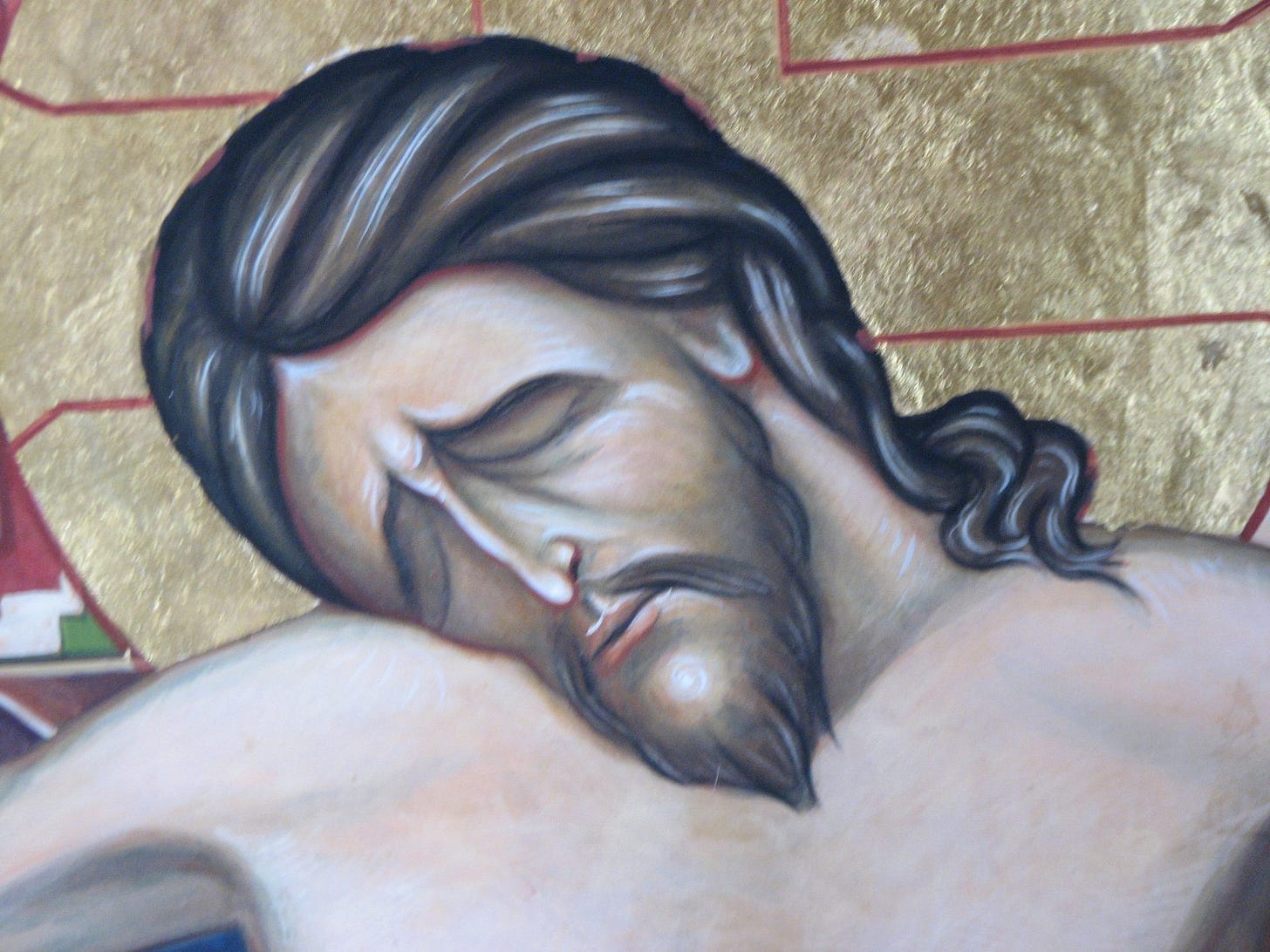
The face of the suffering Christ in the Franciscan Gothic style, painted by me.

The same may be said about the use of art in worship. Through his Church, Christ has informed us that the veneration of sacred art, which portrays the person of Christ, the Mother of God, and the Saints, is not merely allowed, but is an essential part of our worship and the practice of our faith. (3) This understanding helps us discern that even the simplest artistic depictions of divinity, as shown here, are a natural and wise anticipation of what God would later reveal to us personally and through His Church.

Education and Propaganda

Education and formation can cultivate this natural desire for God and help direct it to its proper end: Christian worship. This supernatural end is the prime goal of all sound education. Pope Benedict spoke of this and the need for good catechesis for initiates in the Faith, young and old. He also spoke of the need for a continuing formation in right worship after the rites of initiation, which he termed mystagogical catechesis directed to a deepening of the mysteries of the Faith. This would include teaching people to understand and value sacred art and venerate holy images appropriately.

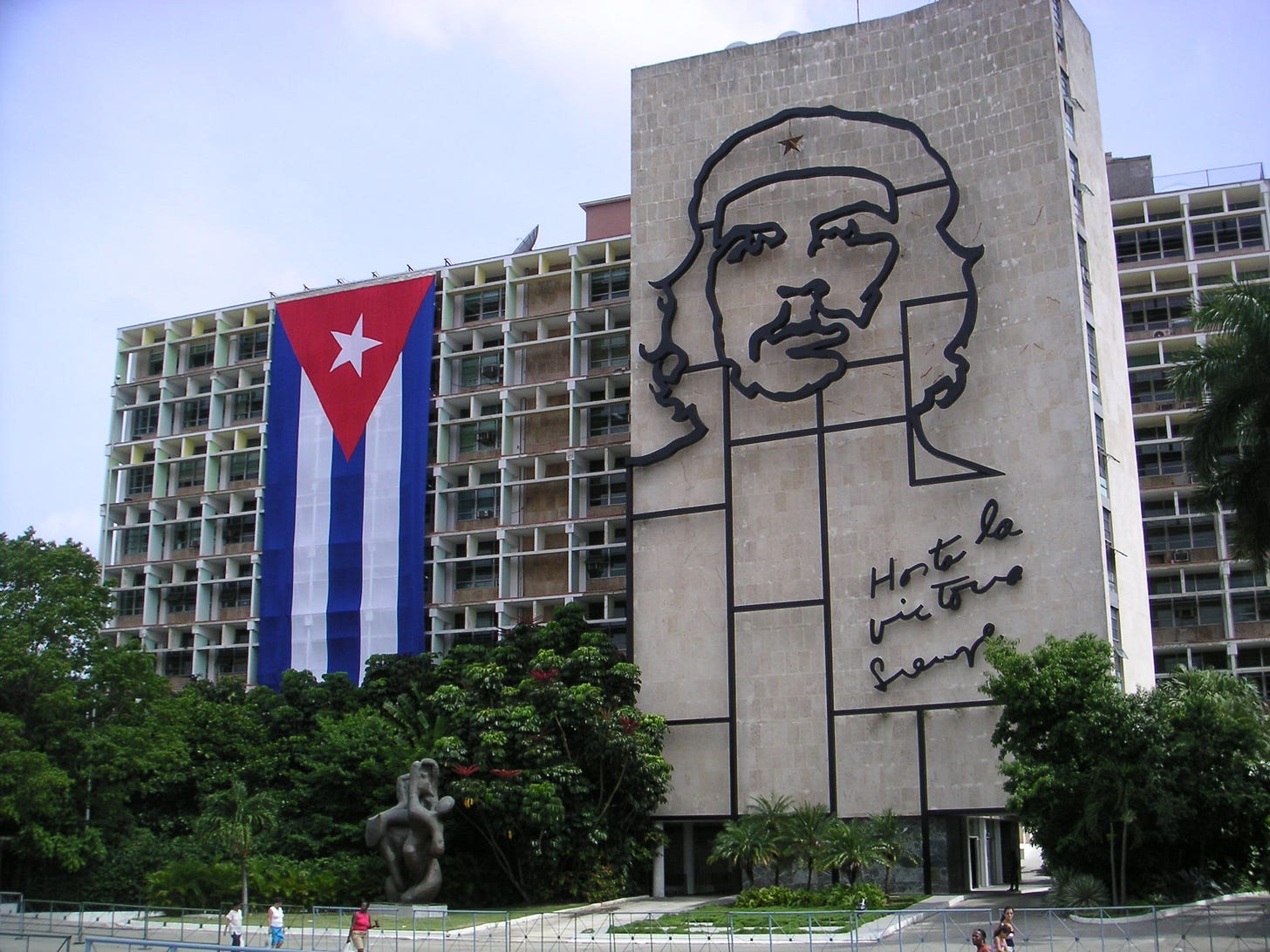
Conversely, external influences can erase or misdirect that natural desire for God. One of the sad facts of contemporary society is that much of contemporary education is anti-Christian propaganda and is at the heart of the ‘sub-Paleolithic’ contemporary mainstream in this regard, and is an ideology that dominates our elite universities. We see the propagation of atheist Marxist ideologies through the schools and universities and the cultural institutions of Western culture such as Hollywood. Marxists typically seek to eradicate any inclination toward ritual or veneration of the divine as part of their mission to destroy the West as we know it. The very act of worship implies, at the very least, the existence of the metaphysical—a notion antithetical to their atheistic, materialist philosophies. However, these ideologies do require complete subservience to, if not actual worship of, the false god of the state, so undermining human freedom and stifling our chance of happiness by exercising that freedom in the pursuit of God.

Even the Marxists realised the importance of art in this mission. To this end, Marxists have always engaged with the popular and intellectual culture; as part of their propaganda, they create images that further their goals.

Image from Wikimedia Commons by Mark Scott Johnson, CC BY 2.0
and right worship….
1. Cf, The Natural Desire for God According to St Thomas and His Interpreters, by Lawrence Feingold, Sapientia Press, Ave Maria Univ, 2004

2. Summa Theologica, II-II, Q. l xxxi.

3. Cf, The Seventh Ecumenical Council, 787 AD.

Tuesday, May 03, 2022

St Philip and St James by Peter Paul Rubens

Today is the modern feast of the Apostles of Ss Philip and James the Lesser. These two images of them are from a series of all 12 Apostles painted by Peter Paul Rubens in the 17th century, which is now in the Prado museum in Madrid, Spain. They were painted between 1610 and 1612, and conform well to the Baroque style of liturgical art. 

St James the Less
St Philip
The two Apostles are celebrated together because their relics were transported to Rome and brought to the same Church, now dedicated to all 12 Apostles. 
James, the son of Alphaeus and “brother of Lord” is called “the Less” to distinguish him from the brother of St John and son of Zebedee; he who ruled the Church at Jerusalem, wrote one of the Catholic Epistles; he was well known for his austere life, and converted many Jews to the Faith. The other James, known as “the Greater”, was crowned with martyrdom in the year 62.
Philip was born at Bethsaida and was originally as a disciple of John the Baptist, after whose death he followed Christ. 
Philip and James the Less are two Apostles about whom little is known and not much is spoken. However, on reflecting on the day, an account of an exchange between Philip and Our Lord caught my interest. In John 14, 6-9 (Knox translation) we read: 
Jesus said to him, ‘I am the way; I am truth and life; nobody can come to the Father, except through me. If you had learned to recognize me, you would have learned to recognize my Father too. From now onwards you are to recognize him; you have seen him.’ At this, Philip said to him, ‘Lord, let us see the Father; that is all we ask.’ ‘What, Philip,’ Jesus said to him, ‘here am I, who have been all this while in your company; hast thou not learned to recognize me yet? Whoever has seen me, has seen the Father; what dost thou mean by saying, Let us see the Father? Do you not believe that I am in the Father, and the Father is in me? The words I speak to you are not my own words; and the Father, who dwells continually in me, achieves in me his own acts of power. If you cannot trust my word, when I tell you that I am in the Father, and the Father is in me.’
This passage the source of one of the main arguments for the use of images in churches, which is mandated by the Seventh Ecumenical Council as a necessary means by which we come to know, recognize and trust those whom we cannot see in recognizable form otherwise: Christ, the Saints, and the angels, and through Christ, the Father. One justification for this argument was that Our Lord was the image of the Father, and it was by recognizing Our Lord, whom they could see as a result of the incarnation, that the Apostles could also recognize the Father, whom they could not see.

St Paul tells us in Colossians that Christ is “the true likeness of the God we cannot see”, but here we have it from Our Lord’s own lips.

Here is St James the Greater from the same set of twelve painted by Rubens.

Tuesday, February 08, 2022

When We Love, We Want to Know Names and Faces

What a man who has brain damage has taught me about love; and what it reveals about the 9th-century theology of sacred art.

I have a friend named Mike who knows me and likes me (or at least he regularly tells me that he does) but, and here’s the paradox, he knows virtually nothing about me. Mike used to be a Presbyterian minister, and before that he was a practicing lawyer. However, six years ago he had a heart attack. His brain was deprived of oxygen for several minutes, and suffered serious damage which resulted in severe memory loss. He can remember very little from his past, and his ability to recall the detail of experiences since the heart attack is greatly impaired, so that typically he can’t remember what happened even 10 minutes ago. I met him for the first time two years ago, and each time he sees me he has barely any recollection of our previous conversations. He is so uncertain of what he knows about me that the first thing he says to me each time we meet is, ‘David Clayton, professor? Right?’. ‘That’s right Mike,’ I say. ‘I am David Clayton the professor.’. About 25% of the occasions on which he sees me, he gets the name or my profession wrong and I correct him. 

His memory is so impaired that mid-way through an interaction, perhaps after just five minutes, he will stop mid-sentence and ask me again, ‘David Clayton, professor? Right?’ We can only conduct conversations at all because he can recall some random details from his life, and we can talk, for example, about the Bible, which he knows that he views as authoritative (although he can’t remember much detail) or he might tell me about his father and I will tell him some things about myself and my life. The content of one conversation can sometimes be almost exactly the same one we had the previous day.

Yet, for all that he knows very little about me, he knows me and knows he likes me. Each time we meet, he is obviously pleased to see me (which pleases me too!) and from the perceptibly steady, if incremental, growth in the warmth of the greeting he gives me, he likes me more and more. Even when he can’t remember my name, it seems that he knows me more each time he sees me, and (I feel sure these are connected) he loves me more. He has, it seems, a developing sense of the whole, but little recall of the parts that contributed to his knowledge of the whole. Or, to put it another way, he knows he likes me, but doesn’t know why.

And it is my face that triggers this reaction. This makes me recall the article I wrote about how it is conventional in Christian art to associate facelessness with the devil, here. And another on the detrimental effects of mask-wearing entitled the Facelessness of Tyranny and the Tyranny of Facelessness

The Son of Man by Rene Magritte, 1942. I am hoping, at least, that the title was meant to be ironic.
I described my observations of the pattern of Mike’s interaction with me to his wife, Maria, and asked her if this pattern described his interaction with people generally. She said that she thought this was correct. He always wanted to know the name and one defining characteristic of the person, and even though he might forget these from one conversation to the next, he had nevertheless an accumulating sense of whether or not he liked the person. She told me that the reason he repeated the name and profession during the conversation was that he was afraid that it was slipping from his memory and he wanted to lock it in there before he lost it again.

What does this indicate? The following is highly speculative, given that it is based upon the observation of just one person. It would be interesting to know if my thoughts resonate with readers who have had more contact with mentally handicapped people.

To me, this seems to indicate that the faculty for retaining information about a person, the memory, and the faculty for loving and for the retention of the love of the person, reside in two different places. One explanation might be that each operation takes place in different parts of the brain and only one part, that which relates to the memory of facts, is damaged.

Alternatively, and I would love to think that this is the explanation, there are two different sorts of knowing that occur here, and to know a person for themselves, as distinct from knowing about them, is really to love them. And Mike’s faculty of loving is intact because it does not reside in the brain at all, but rather in the spirit. The spirit is the highest aspect of the soul, which is, by definition, spiritual and not material and therefore unaffected by brain damage.

When we love someone, we see them as they are, and that person is encountered as a unique object of love. The key characteristics that need to be grasped in order to love the person are, in Mike’s case, to judge from his questions, the face, the name, and the main pre-occupation of the person.

Mike is a neighbor of mine whom I see pretty much daily. One time, however, I was away for a month and when I saw him on my return, I wondered if he would recall me at all. To my surprise, he was just as pleased to see me as he had been the last time, a month earlier, and he said, ‘David Clayton, the professor? Right?’, pronouncing my name with perhaps a slightly longer hesitation than normal.

With Mike, it seemed to me by observing this pattern that when he sees a person who is known, simply yet deeply as an object of love, that love is not so much remembered as it is re-lived, fully and truly. It is a temporal participation in a love that is permanent and does not decay with time, for it resides in the spirit.

There is an interesting parallel with the theology of icons here.

The Seventh Ecumenical Council (781) addressed the issue of images, and stated that images of the person of Christ as man, of Our Lady, and of the Saints must be created and be venerated. For as we can love the Father through the love of Christ, who is a man that is the image of the Father, so we can love a saint in heaven through their image in the icon. This tells us that, in the estimation of the Fathers of the Council at least, the human capacity for love is stimulated strongly by seeing the person, whether viewed through an image or directly.

However, it was found out subsequently that the Council had only partly dealt with the problem, for the iconoclast controversy was not fully and immediately resolved, and the destruction of images and rejection of their use continued. The iconoclast controversy was only finally resolved in the 9th century through the theological contribution of St Theodore the Studite, who stated that the necessary conditions for the veneration of a sacred image were, in addition to an image of the person, a clear statement of their name and essential characteristics. By essential characteristics he meant the key attributes that define the person for those who know him; so for example, an icon of St Isaias the Prophet would show a person with a gray beard and long gray hair, his name, and tongs with a lump of hot coal. St Theodore argued that this is the minimum of information that people need to love the person authentically through the image.
The icon of a feast or biblical scene, incidentally, would have a title written on the icon and not necessarily every person present within the scene. The one below is for the Visitation in a Gothic style.
When the practice of including the characteristics and the name of the person, as proposed by St Theodore, was adopted, the iconoclastic controversy was finally resolved. I suggest that the decline of iconoclasm was not so much that Theodore presented a compelling theological sound bite that convinced the masses, but rather that when artists incorporated all of these features into the icons that they painted, those icons now inspired in those who saw them an authentic love for the saint portrayed and the desire to destroy the image diminished. His theology was as much a reflection of insight into human nature as it was the product of great learning.

Similarly, when Mike sees me, he seems to follow the 9th-century ‘Theodoran’ pattern of thinking. He sees me - not as an image, but as a person - then he knows he loves me, but his instincts tell him that for this love to be fully manifested, which is what he desires, he needs the essential truths that define me for him, that is my name and my profession. Then he knows me - David Clayton, professor - in love.

There is a lesson that artists might learn today. If you want people to be attracted to your art, follow Theodore’s advice and write the name on it. Aside from helping to stop those who see your work from smashing it to pieces with a hammer, it might even induce them to pay for it! I have resolved to try to remember to include the name in every piece of work I do in the future - I will admit that occasionally I have neglected to do so in the past.

It is interesting to note, further, that in the more recent periods of iconoclasm, such as those of Protestant reformers in the 16th and 17th centuries, or by Catholic bishops in the mid-20th century, the practice of naming sacred art in the Theodoran manner had fallen by the wayside. So Sir Anthony van Dyke did not tell us that he was painting the Crowning with Thorns on the painting itself.

Also, a common method of destroying the effectiveness of a painting or sculpture was to de-face it, as we see in this 15th century retable in the Jan van Arkel chapel of Utrecht Cathedral (Domkerk), which was found behind a false plaster wall during restoration activities in 1919.

All this suggests to me that if we don’t incorporate the use of names and key characteristics in our sacred art today we will struggle to re-establish a Catholic tradition in sacred art, and therefore, will struggle to establish a wider contemporary culture that is a reflection of it.

Tuesday, August 24, 2021

Sacred Art Is Not For Teaching Scripture to the Illiterate (Part 2)

Sacred art is not meant, primarily, to help people to know good things, rather it is to inspire us to do good things, through beauty.

If we were to believe what some say, especially professional art historians, it seems, then the main purpose for the creation of Catholic art of the past (for example, the stained glass windows of Gothic cathedrals), was to teach Scripture to the illiterate. Some might broaden this slightly and tell us that it is to teach Catholic doctrine, but again, to the illiterate. This can, in turn, be asserted by Catholics who think that it is a good thing, and occasionally, Eastern Rite Christians who criticize Catholic art for this reason, and tell us that the iconographic tradition forms the hearts of those who worship, while they worship, in contrast to what they would argue are degenerate naturalistic forms. I explain why I suspect the historians are wrong, and doubt that has been the main goal of Roman Catholics in the past, but even if the historians are correct, then this narrow defined didacticism should not have been the main purpose for Catholic sacred art, because the Roman Catholic Church has consistently told us otherwise. This posting is the second in a two-part article.

The Council of Trent, in the 16th century, did refer to art and its role as an aid to the teaching role of the bishops, but this is only after reiterating the words of the Seventh Ecumenical Council of 787AD:
Moreover, that the images of Christ, of the Virgin Mother of God, and of the other saints, are to be had and retained particularly in temples, and that due honour and veneration are to be given them; not that any divinity, or virtue, is believed to be in them, on account of which they are to be worshipped; or that anything is to be asked of them; or, that trust is to be reposed in images, as was of old done by the Gentiles who placed their hope in idols; but because the honour which is shown them is referred to the prototypes which those images represent; in such wise that by the images which we kiss, and before which we uncover the head, and prostrate ourselves, we adore Christ; and we venerate the saints, whose similitude they bear: as, by the decrees of Councils, and especially of the second Synod of Nicaea, has been defined against the opponents of images. (The Council of Trent, Twenty-fifth Session, On the Invocation, Veneration, and Relics, of Saints, and on Sacred mages.)
St Joseph and the Child Jesus, ca. 1620, painted in the Baroque style which developed in the wake of the Council of Trent, about 60 years after the close of the Council.
The Council then went on to advise bishops to teach: 
...that, by means of the histories of the mysteries of our Redemption, portrayed by paintings or other representations, the people is instructed, and confirmed in (the habit of) remembering, and continually revolving in mind the articles of faith; as also that great profit is derived from all sacred images, not only because the people are thereby admonished of the benefits and gifts bestowed upon them by Christ, but also because the miracles which God has performed by means of the saints, and their salutary examples, are set before the eyes of the faithful; that so they may give God thanks for those things; may order their own lives and manners in imitation of the saints; and may be excited to adore and love God, and to cultivate piety. But if any one shall teach, or entertain sentiments, contrary to these decrees; let him be anathema.
This is not, it seems to me, describing a simple Scripture lesson for the illiterate; rather it is an additional tool at the disposal of those who are (or at least ought to be) the primary teachers of the Church. One could as easily interpret what is being described (especially in light of the effect that the Council later had on sacred art ) as mystagogical catechesis that is directed towards orthopraxis. That is, art is there to inspire prayer and right worship, and people can be instructed on how to engage with it so that this happens when they do so.

The Council concluded its remarks on sacred art by cautioning against images that could lead the viewer away from the teachings of the Church:
And if any abuses have crept in amongst these holy and salutary observances, the holy Synod ardently desires that they be utterly abolished; in such wise that no images, (suggestive) of false doctrine, and furnishing occasion of dangerous error to the uneducated, be set up. And if at times, when expedient for the unlettered people; it happen that the facts and narratives of sacred Scripture are portrayed and represented; the people shall be taught, that not thereby is the Divinity represented, as though it could be seen by the eyes of the body, or be portrayed by colors or figures.
Moreover, in the invocation of saints, the veneration of relics, and the sacred use of images, every superstition shall be removed, all filthy lucre be abolished; finally, all lasciviousness be avoided; in such wise that figures shall not be painted or adorned with a beauty exciting to lust; nor the celebration of the saints and the visitation of relics be by any perverted into revelings and drunkenness; as if festivals are celebrated to the honor of the saints by luxury and wantonness.

Finally, let so great care and diligence be used herein by bishops, as that there be nothing seen that is disorderly, or that is unbecomingly or confusedly arranged, nothing that is profane, nothing indecorous, seeing that holiness becometh the house of God. And that these things may be the more faithfully observed, the holy Synod ordains, that no one be allowed to place, or cause to be placed, any unusual image, in any place, or church, howsoever exempted, except that image have been approved of by the bishop.
Agnus Dei c. 1635–1640, by Francisco de Zurbarán, another work in the Baroque style, painted 80 years after the Council.
More recently, in the 20th century the constitution of Vatican II, Sacrosanctum concilium (SC 127) suggests the following:
All artists who, prompted by their talents, desire to serve God's glory in holy Church, should ever bear in mind that they are engaged in a kind of sacred imitation of God the Creator, and are concerned with works destined to be used in Catholic worship, to edify the faithful, and to foster their piety and their religious formation.
Formation can include the imparting of information and knowledge of Scripture, but a religious formation is, as stated before, primarily directed to the end of guiding us to right worship.

The Catechism of the Catholic Church is similar (CCC 2502):
Sacred art is true and beautiful when its form corresponds to its particular vocation: evoking and glorifying, in faith and adoration, the transcendent mystery of God—the surpassing invisible beauty of truth and love visible in Christ, who "reflects the glory of God and bears the very stamp of his nature," in whom "the whole fullness of deity dwells bodily." This spiritual beauty of God is reflected in the most holy Virgin Mother of God, the angels, and saints. Genuine sacred art draws man to adoration, to prayer, and to the love of God, Creator and Savior, the Holy One and Sanctifier.
The Adoration of the Magi, by Martin Earle; 21st-century art by a Roman Catholic artist following the Second Vatican Council, painted 60 years after it closure.

As we know, Catholics do not always follow the guidance of Mother Church! If the art historians are right and the role of art has been primarily a narrow didactic role, then it means that consistently and through the centuries, artists have been ignorant of, deliberately ignoring, or at least unable to fulfill what the Church has been telling them about sacred art.

There is another point to make, in regard to the recent period in Church history. Since at least the beginning of the 19th-century, in my opinion, the art created by Catholic artists began to decline in quality and, generally speaking, failed more and more in its purpose of ‘drawing man to adoration, prayer, and the love of God.’ (I have made the argument in other articles on this blog, as to how and why stylistic changes in this period led to this decline, and more generally to a decline in Catholic culture). This, it occurs to me might explain why there is a focus today on the didactic purpose of sacred art, for if it fails to inspire through beauty then that is all you have. Furthermore, if it lacks divine beauty, as nearly all modern art does in my opinion, then ultimately it will fail in this lesser purpose as well for people will not be so inclined to look at it. If art is as vital to the cultivation of faith as the Seventh Ecumenical Council tells us, no wonder we have seen a decline in faith. 

Stained glass in a French church, created in the 1950s, 10 years before Vatican II
A carved capital at Clear Creek Abbey, 21st century, by Catholic artist Andrew Wilson Smith.

Tuesday, August 17, 2021

Sacred Art Is Not For Teaching Scripture to the Illiterate (Part 1)

Sacred art is not meant primarily to help people to know good things; rather it is to inspire us through beauty to do good things.

If we were to believe what some say, especially professional art historians, it would seem that the main purpose for the creation of Catholic art of the past, for example in the stained glass windows of Gothic cathedrals, was to teach Scripture to the illiterate. Some might broaden this slightly, and tell us that it was to teach Catholic doctrine, but again, to the illiterate. This can, in turn, be asserted by Catholics who think that it is a good thing, and occasionally, Eastern Rite Christians, who criticize Catholic art for this reason, and tell us that the iconographic tradition forms the hearts of those who worship, while they worship, in contrast to what they would argue are degenerate naturalistic forms. I explain here why I suspect the historians are wrong, and doubt that this has been the main goal of Roman Catholics in the past. But even if the historians are correct, this narrowly defined didactic purpose would not have been the main purpose or Catholic sacred art, because the Roman Catholic Church has consistently told us otherwise. This posting is the first in a two-part article.

While being happy to concede that this is part of the story, I have never been convinced that the main reason for the presence of art in Roman Catholic churches is purely or even primarily didactic.

First, I would contend that while art can aid instruction, it simply cannot be read like a book without explanation. Assuming the illiterate of the past weren’t also deaf or unable to comprehend the spoken word, people learned primarily by oral tradition: through hearing the Word being read by those who were literate, through homilies, personal instruction, and through the words and actions of the liturgy. If this were the case, then art certainly has a part to play, perhaps through reminding and reinforcing those lessons in the minds of the faithful.

For example, would anyone be able to tell what was happening here if they didn’t already know the story? There is obviously something pretty gruesome going on, but would anyone understand its meaning and context without explanation? Perhaps, we might think, it is inspiring us to kill babies - an abortionist’s manifesto!

Giotto - The Massacre of the Innocents
If, however, this is viewed during the liturgy on the feast of the Holy Innocents in the Christmas season, then we have some context, and it will impart an understanding of the feast and its place in Salvation History and in the Sacred Liturgy, and thus enrich the worship of all those present, literate and illiterate alike.
To limit the purpose of art to a narrow didactic role seems to me to miss the whole point of the Christian faith, which is union with God, most powerfully through our worship of Him in the liturgy. This is the end to which all those lessons are, or at least ought to be, directed. Certainly, art can be a teaching aid for those learning Scripture or Catholic doctrine, but that is not its main purpose, for knowledge of Scripture and Catholic doctrine serve the Catholic life, of which the high point is liturgy. The Catholic faith is not primarily about knowing things, it is about doing things - praxis - and worship is at the heart of what we do. Art can enrich our worship and our prayer directly, for we can worship and pray better while looking at good sacred art, which forms us to be better worshipers through form (meaning the style in which it is painted) and beauty as much as content.
The most important role of art is in stimulating and directing prayer in the course of our worship in the liturgy, and it does this in a way that deepens the participation in the worship as we look at it. In this case, the result, if it is well chosen for the purpose, is not so much a lesson learned, but a love enriched and deepened.

What does the Church say about the purpose of art?

St Gregory the Great, writing at the turn of the 7th century to the Bishop of Marseille, is often quoted to back up the assertion that sacred art has primarily a didactic purpose. “For a picture is displayed in churches on this account, in order that those who do not know letters may at least read by seeing on the walls what they are unable to read in books.”

Gregory the Great
Gregory was not writing dogmatically here, so we do not know if this point of view represented the sole argument in the Roman Church, let alone of Gregory himself, for having art in churches. He was after all writing to a particular person on a particular issue for pastoral reasons, and we would need to know more about the context to be sure. Furthermore, just 178 years later, the Seventh Ecumenical Council, which did articulate dogma, told us something different: the purpose of art is to inspire and stimulate our capacity for the right worship of God and the veneration of the Saints. Art does this through form and beauty and it informs our hearts as much as it gives information to the intellect through content:
We, therefore, following the royal pathway and the divinely inspired authority of our Holy Fathers and the traditions of the catholic church (for, as we all know, the Holy Spirit indwells her), define with all certitude and accuracy that just as the figure of the precious and life-giving cross, so also the venerable and holy images, as well in painting and mosaic as of other fit materials, should be set forth in the holy churches of God, and on the sacred vessels and on the vestments and on hangings and in pictures both in houses and by the wayside, to wit, the figure of our Lord God and Saviour Jesus Christ, of our spotless Lady, the Mother of God, of the honorable Angels, of all Saints and of all pious people. For by so much more frequently as they are seen in artistic representation, by so much more readily are men lifted up to the memory of their prototypes, and to a longing after them; and to these should be given due salutation and honorable reverence, not indeed that true worship of faith which pertains alone to the divine nature; but to these, as to the figure of the precious and life-giving Cross and to the Book of the Gospels and to the other holy objects, incense and lights may be offered according to ancient pious custom. For the honor which is paid to the image passes on to that which the image represents, and he who reveres the image reveres in it the subject represented. For thus the teaching of our holy Fathers, that is the tradition of the Catholic Church, which from one end of the earth to the other hath received the Gospel, is strengthened. Thus we follow Paul, who spake in Christ, and the whole divine Apostolic company and the holy Fathers, holding fast the traditions which we have received. (Percival 1955:).
In short, art is for all, and it inspires as well as instructs.
Next week, I will look at what the Council of Trent had to say on the matter and how this cannot be used to support the assertion of a narrowly didactic role for art in churches.
An 8th-century Coptic painting of St Anne, Mother of Our Lady

Tuesday, November 19, 2019

3,000-Years-Old Newsflash! God Commanded the Use of Graven Images

Last month, on Sunday, October 13th, the Eastern Catholic Church celebrated the Feast of the Fathers of the Seventh Ecumenical Council. I am happy to share with our readers the text that was the basis of the homily given by Fr Sebastian Carnazzo, pastor of St Elias Melkite Catholic Church in Los Gatos California, on that day.

There are several points that we of the Roman Church can take from this.

First, is the content. Contrary to what is commonly believed, the 10 commandments do not forbid graven images. The relevant commandment, often quoted by iconoclastic Protestants and out of context, does not condemn the making and use of religious imagery, but rather idolatry, which is very different. Graven, incidentally, means “made by hand.” Fr Sebastian (a Scripture scholar who is a colleague of mine on the faculty at www.Pontifex.University) explains why this is the case.

Second is the fact that Fr Sebastian thought this point is important enough to make it the central subject of his homily, and to send out a summary of his points in the church bulletin which he encouraged his parishioners to take home and study. In this homily, while he did mention in passing the many contemporary forms of idolatry in our neo-pagan or secular world, (a subject that many priests today are more likely to discuss in this context), he focused primarily on the use of images in the context of worship.

As Roman Catholics, we cannot afford to be smug about this. The general situation in my observation is that images are not incorporated in worship at all. And I am not referring here to the liberal, impious parishes with whitewashed, modern churches that reflect modern iconoclasm and are barely distinguishable from a puritanical Protestant church. I am thinking of your parish and mine, that of the orthodox, pious and religious who appreciate beauty, and very likely agree in principle with the need for sacred art in churches. They might have beautiful art in their churches, and Mass at such parishes might be dignified and beautiful, with expert choirs singing chant or polyphony, but I have never yet seen liturgical imagery used in the context of worship in the way that I see it in every Eastern Divine Liturgy. The understanding of the place of liturgical imagery in the actual process of worship is so small that, in my experience, Roman Catholics simply don’t know what I am referring to when I mention it. At Roman Catholic churches, the art is reduced to contributing to a beautiful backdrop that is incidental to the process of worship, which is an eyes-closed affair that involves us having our noses buried in Missals. Most of the art is devotional, and if it is engaged with at all, it is not in the context of the liturgy. Until we remedy this situation in the Roman Church, we cannot, in my estimation, revitalize the culture powerfully. I wrote about this specifically and in detail in the following article: The Good, the Better and the Sunday Best - Using St Thomas’ 4th Way to Evangelize the Culture.

The third is the importance of this feast in the Church calendar in the Eastern Church. Of the seven Councils recognized by the Eastern Church, the first six are celebrated together, but the Seventh Ecumenical is given its own day. This is a reflection of the history of the Eastern Church and its fight against iconoclasm. There are martyrs from the period, over 1,000 years ago, people who were prepared to die rather than concede the point. We have been through our own period of iconoclasm in the West (we are not out of it yet), but in contrast with its Eastern equivalent, it is marked not by resistance from the Catholic faithful and hierarchy, but by quiet acquiescence. Greater the fools we!

Images are the stepping stones by which the spirit of man can move from contemplation of the material world to contemplation of God. We neglect them at our peril, as the history of Church in the West for the last 200 years demonstrates. I don’t think it is an exaggeration to say that until we once again incorporate imagery directly into our worship, we will continue to lose the culture wars with the anti-Christian secular forces, and Mass ayyendance will continue to decline.

The Adoration of the Golden Calf – Picture from the Hortus deliciarum of Herrad of Landsberg (12th century)
Here is Fr Carnazzo’s recorded Bible study on the topic.
And here is the written text, which was the starting point for his homily, made available at my request:

The Holy Fathers of the Seventh Ecumenical Council declared: “We, therefore...define with all certitude and accuracy that just as the figure of the precious and life-giving Cross, so also the venerable and holy images, as well in painting and mosaic as of other fit materials, should be set forth in the holy churches of God, and on the sacred vessels and on the vestments and on hangings and in pictures both in houses and by the wayside, to wit, the figure of our Lord God and Savior Jesus Christ, of our spotless Lady, the Mother of God, of the honorable Angels, of all Saints and of all pious people. For by so much more frequently as they are seen in artistic representation, by so much more readily are men lifted up to the memory of their prototypes, and to a longing after them; and to these should be given due salutation and honorable reverence not indeed that true worship of faith which pertains alone to the divine nature...but...according to ancient and pious custom” (NPNF, vol 14).

The Seventh Ecumenical Council made this declaration in AD 787, against the heresy of Iconoclasm, a heresy that had labeled the making and use of religious imagery in the Church as idolatry. The council condemned the heresy of iconoclasm on the grounds that it contradicted the Orthodox and Apostolic Faith. For the Church had used sacred images in both its liturgical life and catechesis from the earliest days, just as Israel had in both its synagogues and places of worship in the OT. And although the declaration of the venerable Council officially ended the problem for the One, Holy, Catholic, and Apostolic Church, the heresy lives on even to today.

Iconoclasm is found implicitly in the architecture and decor and explicitly in the doctrine of the vast majority of Protestant sects. These sects teach that the Bible forbids the making and use of religious imagery, such as statues and icons. The passage they most commonly cite is from the Ten Commandments given through Moses at Sinai: “You shall not make for yourself a graven image, or any likeness of anything that is in heaven above, or that is in the earth beneath, or that is in the water under the earth; 5 you shall not bow down to them or serve them...”(Exod 20:4-5). When this passage is read out of context, it can appear that the Protestant position has some support and that the Bible really does condemn the making and use of religious imagery.

However, if one reads the passage in its original context, one can see that the commandment does not condemn the making of a graven image as such (“graven” simply means ‘fashioned by hand’), but rather the making of an image to be worshiped as a god. This is made clear by a careful reading of the words which appear immediately before and after the passage in question: “I am the Lord your God....You shall have no other gods before me.....for I the Lord your God am a jealous God....” Later on in the same chapter, God repeated his commandment in one succinct statement, “You shall not make gods of silver to be with me, nor shall you make for yourselves gods of gold” (Exod 20:23). Therefore the passage, usually quoted by Protestants and often out of context, does not condemn the making and use of religious imagery, but rather idolatry, that is the making and use of an image of a created thing to bow down and worship it as a god.

An examination of the broader context further supports this conclusion, since there are a number of passages, even in the very same book of Exodus, where God actually commands that religious imagery be made. For example, just a few chapters later, God began to describe to Moses how to build the Ark of the Covenant and the Sanctuary that would be God’s dwelling place among Israel (Exod 25:10-22). In this passage God told Moses to make an ark (a box about the dimensions of a bath tub) out of wood and to cover it with gold. Then he was to put two cherubim (a cherub is a type of angel) on the lid at either end, facing each other, wings out-spread, and touching in the middle. In this box, Moses was to place the Ten Commandments, and above this box God would sit enthroned on the outstretched wings of the graven images of golden angels (cf. 1 Sam 4:4; Ps 99:1, etc.), and from there speak to Moses about all of his commandments to Israel. Continuing on in the book of Exodus, one finds that from chapter 25 to the end of the book, the majority of the text is spent describing how God wants Moses to build the Sanctuary, and how he is to cover it with images of cherubim, palm trees, flowers, and fruit (cf. Exod 25: 31-40; 26:1,30-31; 28:31-34), all according to God’s command (cf. Exod 25:40; 26:30; 27:8; 39:43; 40:33-38). As one can see, God did not condemn the making or use of religious imagery; on the contrary, he actually commanded it for his most holy Sanctuary where he would dwell among Israel. Similar imagery appears later in the Old Testament, when Solomon built the Temple.

Like Moses before him, Solomon was appointed to build a place for God to dwell among His people. And like the Sanctuary Moses was commanded to build, Solomon built the Temple in accordance with the pattern he had been shown by God (1 Chron 28:18-19; Wis 9:8; cp. Exod 25:40). In the inner sanctuary of the Temple, Solomon put the Ark that Moses had built, and at the entrance he put two 15-foot (1 cubit = 1 ½ feet) statues of cherubim to guard the way (1 Kings 6:14-32). The Temple’s inner sanctuary was covered in gold and the rest of the Temple walls were lined in cedar and carved with images of cherubim, open flowers, gourds, palm trees, lilies, and lions (cf. 1 Kings 6:33-35; 7:28,36). Twelve life-sized statues of oxen supported a 10,000-gallon bath for liturgical washing (cf. 1 Kings 7:25-26). Hundreds and hundreds of golden pomegranates (a type of fruit) hanging from lengths upon lengths of golden chains draped from every pillar (cf. 1 Kg 7:15-22,42). What Moses had made for ease of travel through the wilderness, Solomon made for permanence in Jerusalem. As with the sanctuary built by Moses, Solomon’s Temple contained numerous examples of God’s command to make and use religious imagery for both catechetical decoration and liturgical function.

Another example of God commanding the making of graven imagery appears in an episode of Israel’s wandering in the wilderness when they were stricken by deadly serpents Here God commanded the making of a graven image in the form of a serpent as a medium through which he would save his people (Num 21:8-9; cp. 2 Kings 18:4).

Therefore, the common Protestant claim that the Ten Commandments condemn the making and use of graven religious imagery is clearly refuted, not only in the immediate context as already addressed, but by numerous other passages in the Bible, as the above examples demonstrate. God did not condemn the making and use of religious imagery in the Ten Commandments, but rather the sin of idolatry. Idolatry is the act of making or using an image to be worshiped as a god. One can see the difference by an examination of the well-known biblical account of idolatry, when Israel made a golden calf (cf. Exod 32). But notice what was at issue here. It was not the fact that Israel decided to make an image of a calf, Solomon had made twelve life-size statues of oxen to be used in the Temple he built (cf. 1 Kings 7:25-26), rather the issue here was the making of an image of a calf to be worshiped as a god (cf. Exod 32:1,4).

Another example of idolatry appears in the book of Daniel, when King Nebuchadnezzar built a 90-foot tall golden image (Dan 3). He then commanded all in his kingdom to come and worship it as a god (cf. Dan 3:6,11,14,18). Here again, notice that the problem was not that Nebuchadnezzar built a large golden statue, indeed Solomon had built two 15-foot golden statues of cherubim in the Temple (cf. 1 Kings 6:23), rather the issue here was that Nebuchadnezzar had built his statue to be worshiped as a god.

So we see how Protestantism’s erroneous interpretation of God’s teaching regarding graven images in the Ten Commandments, is not only contradicted by a careful examination of the immediate context, but also in numerous examples throughout the rest of Sacred Scripture. Let us recall the golden cherubim on top of the Ark of the Covenant, whose wings formed the very throne of God upon the earth, the two 15-foot golden cherubim who guarded the way into the Temple’s sanctuary, the twelve life-size statues of oxen which supported the bath of purity in the Temple, the cherubim, lions, palm trees, gourds, pomegranates, and open flowers that decorated the Temple, and the bronze serpent, fashioned that the people of God might live. Thus it is obvious from even the ‘Bible alone’, that God did not condemn the making of religious imagery in the Ten Commandments, but rather the sin of idolatry. And so while we renounce the idolatrous making of a graven image to be worshiped as a god, we also uphold the ancient and honorable practice of the making and use of religious imagery in the Church, received from Israel of Old, since as the Council Fathers taught: “For by so much more frequently as they are seen in artistic representation, by so much more readily are men lifted up to the memory of their prototypes, and to a longing after them....” Therefore, let us proclaim with the great and venerable Fathers of that most blessed and glorious Council concerning the Iconoclasts of the past and their modern adherents today among the Protestant sects: “they have failed to distinguish between holy and profane, styling the images of our Lord and of his Saints by the same name as the statues of diabolical idols....[applying] to the venerable images the things said in Holy Scripture about idols.”

Here is the bulletin which is not only distributed to all who attend the Divine Liturgy but is emailed out to any who have ever attended the church. This contains a truncated version of the above. Again, this indicates the seriousness with which this topic is taken in the Eastern Church.

More recent articles:

For more articles, see the NLM archives: