

The nature of the Offertory Rite is a recurring topic on this website. What follows is a summary of sorts in two parts. In part one, we survey the Offertory in the pre-conciliar Roman Missal and ascertain whether or not it constitutes a sacrifice. In part two, we examine the new Offertory Rite in the 1970 Roman Missal and ascertain whether or not it constitutes a sacrifice.
One of the more contentious areas of the liturgical reform was over the function and nature of the Offertory. An earlier generation of liturgists had hailed the Roman Offertory Rite as “a most appropriate… preparation for the sacrificial action accomplished at the moment of Consecration.” [1] In the days of St. Justin Martyr (100-165), bread and a cup of water and wine were simply “brought to the president of the brethren.” [2] But as Adrian Fortescue notes,
Very soon the idea developed that as [these elements] are brought they should be offered to God at once, before they are consecrated. This is only one case of the universal practice of blessing, dedicating to God anything that is to be used for his service. We dedicate churches, altars, chalices, so in the same way we bless the water to be used for baptism and offer to God the bread and wine to be consecrated. [3]
The Traditional Offertory
The fruit of this idea in the 1570 Roman Missal is the following.
The Offertory begins with the priest removing the chalice veil. This small act is of great significance, for it begins the Mass of the Faithful. Anyone who is not present for this unveiling does not fulfill his obligation to assist at Mass (if he has one), the implication being that if a lay believer is to assist, his presence at and participation in the Offertory are crucial for him.
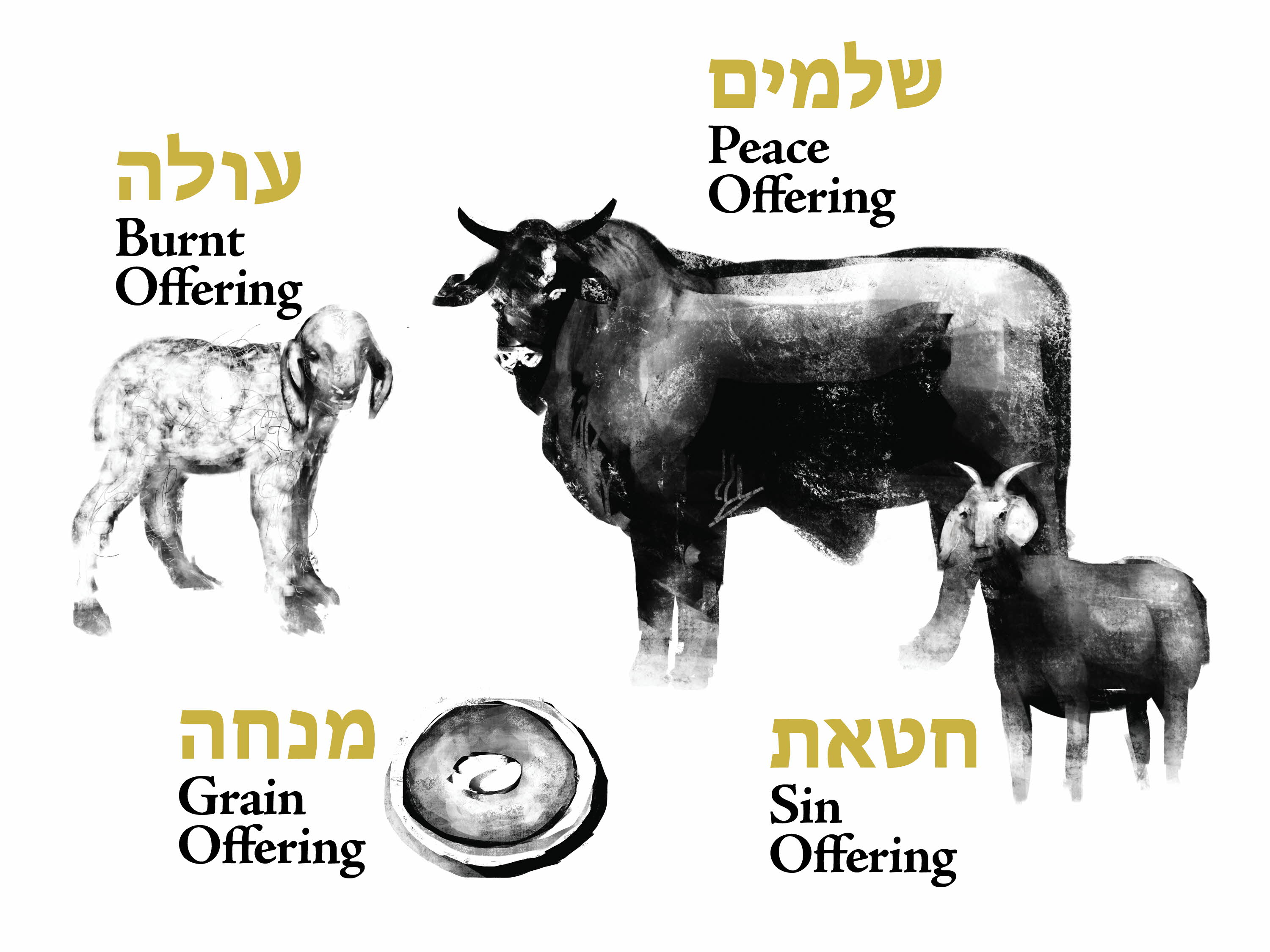
The priest takes the unconsecrated host and prays the Suscipe, Sancte Pater in which he calls the host “this unspotted victim (hostia).” The language is arresting. Only the object of a bloody immolation was called a victim in the Old Testament; grain offerings were not. We do see in this prayer shades of the Grain Offering (Minchah) since bread is being offered, but with the reference to an unspotted victim we also see an allusion to the Peace Offering (Shelem), which required an animal without defect, an “unspotted” animal, for the sacrifice. The Peace Offering, in turn, could be used as a Purification Offering (Chattah), which purported to purge the offerer of sin, and which, according to this prayer, is the purpose of the priest’s offering of bread. The priest concludes the prayer by making the sign of the cross with it as he lays it on the corporal—a blessing.
The priest then prepares the chalice by mixing water and wine while reciting the Deus qui humanae, a beautiful prayer that links the dignity of human nature to its creation and the Incarnation and then to the Sacrifice of the Mass. Fr. James McEvoy and Dr. Mette Lebech argue that the Deus qui humanae substantiae made a significant contribution to the Western conceptualization of human dignity even before its use at the Offertory, and that after it was included in the Rite during the Middle Ages, it created an association between human dignity and the holy exchange of gifts. “In this way,” McEvoy and Lebech conclude, “the prayer significantly shaped the Christian concept of human dignity as the holy ‘place’ of commerce with God.” [4] All human dignity, in other words, is forever linked not just to our creation in His image and likeness and not just to God’s assumption of our humanity in the person of Jesus Christ but to Jesus Christ in the Eucharist. Human dignity is Eucharistic.
The Deus qui humanae substantiae also has distinctive language. The combination of water and wine is not called a mixing but a mystery, the traditional explanation (which goes back to Cyprian of Carthage (210-85)) [5] being that it is a symbol of the Incarnation: wine represents Christ’s divinity and water His humanity. The rest of the prayer confirms this incarnational interpretation.
Finally, before the priest adds water to the wine, he blesses it—another blessing.

The priest then offers the mixture to God, saying the prayer Offerimus tibi. But instead of calling this offering “wine and water” (which it is), he refers to it as “the chalice of salvation,” which it is not yet. The priest makes the sign of the cross with the chalice before he places it on the corporal, again another blessing.
After the priest offers up the bread and wine together, he offers up himself and others with the prayer In spiritu humilitatis, asking we may be made acceptable to God and that “our sacrifice” be pleasing to Him. But how is this offering a sacrifice?
The same question about sacrifice is posed with the Veni Sanctificator. The priest makes the sign of the cross over the bread and wine (in other words, blessing it) while he invokes the Holy Spirit:
Come, O Sanctifier, almighty, eternal God, and bless this sacrifice prepared for Thy holy name.
At a High Mass, the priest now blesses incense and likewise offers it to God before blessing the crucifix, the gifts, and the altar with it. When addressing God about the incense, the priest uses the Latin pronoun iste, meaning “this thing of yours.” Ascribing incense to God (even though it is a human, manufactured good) ties into the central paradox of the entire Offertory, namely, that we are offering to God what already belongs to Him, or as the Byzantine Divine Liturgy puts it, “We offer to Thee Thine own of Thine own, in all and for all.” The priest first asks God to bless this incense of His and then asks God to make this blessed incense of His ascend to Heaven in order for mercy to descend to earth. Instead of construing incense as the “work of human hands,” the priest omits the secondary causes of human agency and focuses on the Primary Cause in an act of gratitude.
What and who are incensed is also noteworthy: the bread and wine; the cross, relics, and altar; and the priest and everyone else, including the congregation. The laity should be especially grateful for being included in this rite: besides being a sign that they are one of the oblations being offered, it is also a sign that they are one of the offerers. For in their own way and by virtue of their royal priesthood in baptism, the lay faithful are agents in the offertory: expendable agents to be sure (Mass can be celebrated without them), but agents nonetheless.
The priest then washes his fingers while praying the Lavabo, a psalm with the theme of innocence. The action and the words together call to mind Pilate’s washing his hands and declaring his innocence before “sacrificing” Christ to an angry mob. Here, the priest washes his hands praying for innocence before he enters into the Canon, when the sacrifice of the altar will occur.
The priest addressed the Father in the Suscipe Sancte Pater, alluded to the son in the Deus qui humanae substantiae, and invoked the Holy Spirit in the Veni Sanctificator. Now, he concludes by addressing the Holy Trinity with the Suscipe Sancte Trinitas, a prayer that marvelously and concisely summarizes the orthodox theology of offertory:
Receive, O holy Trinity, this oblation which we offer to Thee in memory of the Passion, Resurrection and Ascension of our Lord Jesus Christ, and in honor of Blessed Mary ever Virgin, blessed John the Baptist, the holy Apostles Peter and Paul, these Saints of yours here, and all the Saints, that there may be an increase of honor for them and of salvation for us, and may they deign to intercede for us in Heaven, whose memory we celebrate on earth. Through the same Christ our Lord. Amen.
Finally, the priest addresses the congregation with the Orate fratres:
Brethren, pray that my sacrifice and yours may be acceptable to God the Father almighty.
To which the servers or congregation respond:
May the Lord receive the sacrifice from thy hands, for the praise and glory of His name, for our benefit and that of all His holy Church.

The priest makes an important distinction: instead of saying “our sacrifice,” he says “my sacrifice and yours.” The sacrifice of priest and congregation are different insofar as one is sacrificing according to his holy orders (confecting the Eucharist) and the other is sacrificing by virtue of their baptism into the common priesthood. But the latter, this prayer affirms, are sacrificing nonetheless.
And yet, how can this offering (in the case of the laity, saying a few prayers and throwing a couple of bucks into the usher’s basket) be considered a sacrifice?
Solution
There are two classical—and complementary—answers to this nagging question. The first is that the oblational and sacrificial language in the Rite is “proleptic”: [6] it anticipates a thing as existing before it actually comes into being. An unconsecrated host is just a piece of unleavened bread, but once I know that it has been chosen to become the Body of Our Lord, I think of it differently and view it with increased reverence. In support of the “proleptic” explanation is its strong presence in both Eastern and Western Christendom. In the Byzantine Rite, for example, all bow before the unconsecrated gifts of bread and wine when they are processed to the altar during the Great Entrance.
Further supporting this explanation is biblical usage. During their journey to Mount Moriah for what is supposed to Abraham’s sacrifice of Isaac, an ignorant Isaac asks his father: “Behold… fire and wood: where is the victim for the holocaust?” (Gen. 22, 7) The central sacrificial act of shedding blood and throwing the slain creature onto a fire is days away from happening, but Isaac is already referring to the designated creature as the “victim,” which until the seventeenth century only referred to something immolated and offered to God in a religious sacrifice.
Second, the Offertory is not just the anticipation of the sacrifice but its commencement. Summing up centuries of theological reflection on the subject, Manfred Hauke writes, “The offertory is only the beginning of the sacrifice, which is completed in the consecration.” [7] One may think of the bread and wine as having three possible modes of existence. First, it is simply bread and wine: even bread that has been shaped into eucharistic wafers and made specifically for the celebration of Mass can be eaten as a snack, as we see in the case of the German cookie lebkuchen. But the moment the priest says the Suscipe Sancte Pater over the bread and the Offerimus tibi over the wine, these elements are now sacred—set aside for divine use. In this second stage, they may not have the Real Presence yet, but neither should they be used in making cookies: they now belong to God. And third, the bread and wine cease to be bread and wine when the Words of Institution are said over them during the Canon. In the Offertory, the gifts are sacralized; in the Canon, they are transubstantiated into Christ’s Body and Blood.
Further supporting this thesis is the witness of Old Testament sacrifices, several of which involved three stages: 1) lay persons bring to the priest a sacrificial victim and in some cases slay it themselves; 2) the priest places some or all of the victim on a fire to be destroyed; and 3) if some is left over, it is consumed by priest and people. In this threefold act we see a foreshadowing of our Offertory, Canon, and Holy Communion.
Notes
[1] Nicholas Gihr, The Holy Sacrifice of the Mass, 5th ed. (Herder, 1918), 494.
[2] I Apol. 65.3; see also 67.5.
[3] Adrian Fortescue, The Mass: A Study of the Roman Liturgy (Longmans, Green, and Co, 1912), 296.
[4] James McEvoy and Mette Lebech, “Deus qui humanae substantiae dignitatem: A Latin Liturgical Source Contributing to the Conceptualization History of Human Dignity,” Maynooth Philosophical Papers 10 (2020), 117-33, 117.
[5] See Epistle 62.13.
[6] See Jungmann, The Mass of the Roman Rite, vol. 2 (Benziger Brothers, 1951), 37. Fortescue uses the term “dramatic misplacement” (Ibid., 305).
[7] Manfred Hauke, “The Offertory as a Challenge to Liturgical Reforms in History,” in The Sacrifice of the Mass, ed. Matthew Hazell (Smenos, 2023), 153.
An earlier version of this article appeared as “The Offertory: Preparation of the Gifts or a Sacrifice to God?” in The Latin Mass magazine 34:3 (Fall 2025), pp. 42-46. Many thanks to the editors of TLM for allowing its publication here.




