
Monday, November 02, 2020

Do We Pray for “the Dead” or for “the Faithful Departed”?


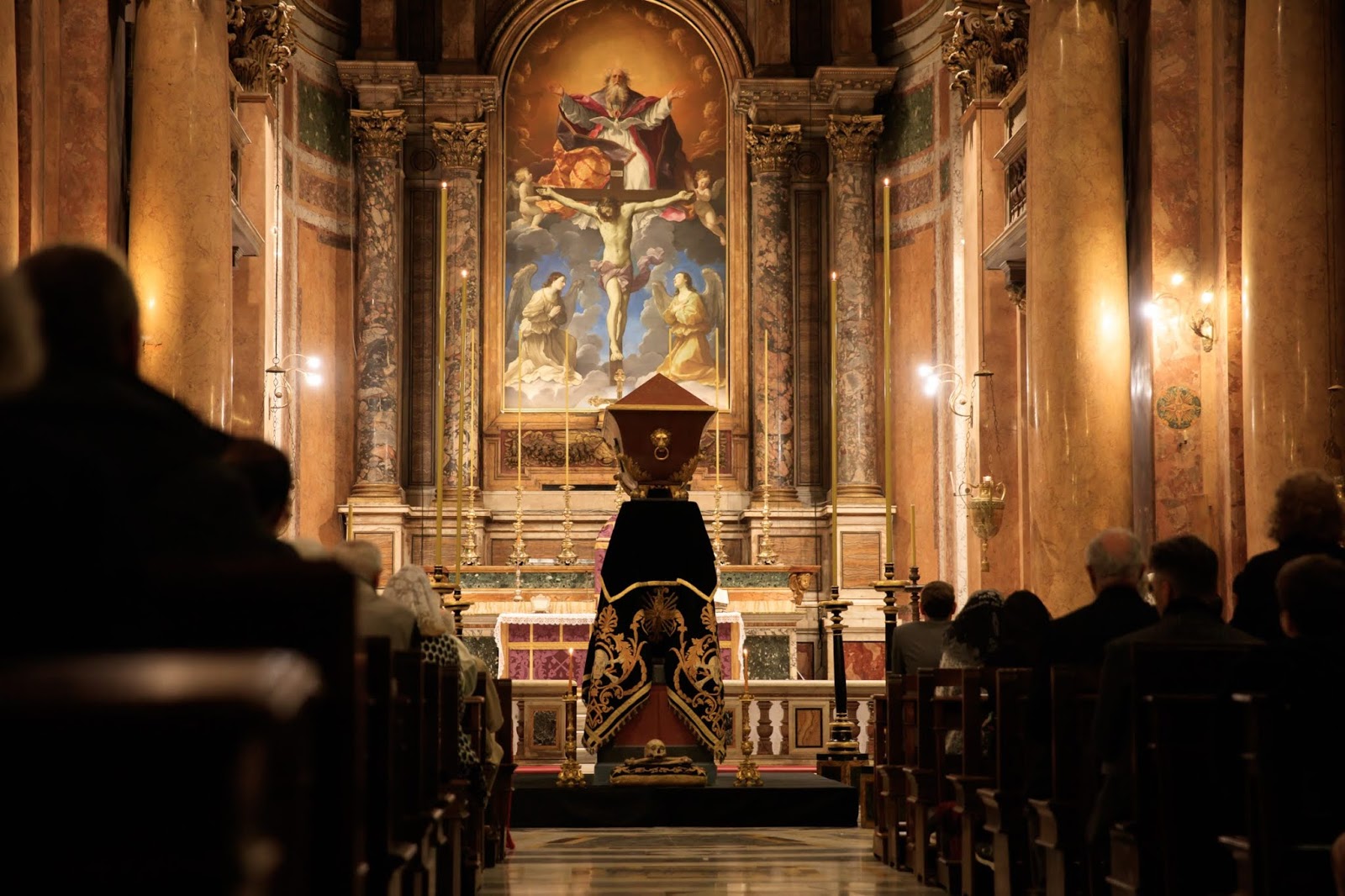
This article was originally published at NLM on October 28, 2013, and is republished for the Commemoration of All Souls.

On this day and in a month dedicated to praying for All Souls, it seems pertinent to raise the question: Are we in danger of a slow corruption of our understanding of liturgical prayer for the dead? Put differently, for which souls are we praying at Mass?

If one examines liturgical formulae to see how Catholics pray for the dead, one is struck by the specificity of intention, the delimited subject of these prayers — namely, baptized Christians. A much-loved prayer expresses it thus: “May the souls of the faithful departed (fidelium animae defunctorum), through the mercy of God, rest in peace.” As will be demonstrated below, the official liturgical books offer overwhelming evidence for this claim. First, however, let us consider what might be called the problem on the ground.

The Problem on the Ground
In many Ordinary Form Masses, communities pray for the dead in an entirely generic or undifferentiated manner. Consider an otherwise excellent book, Prayers of the Faithful for All Sundays, Solemnities, Major Feasts and Other Occasions, edited by Bishop Peter J. Elliott (New Jersey: Catholic Book Publishing, 2009). Throughout the book, petitions are announced on behalf not only of the “faithful departed” (or variations on that theme: “all who have died in faith,” “all who sleep in Christ,” “the dead who have entered a state of purification,” “our dead,” “our departed brothers and sisters”), as is traditional, but also on behalf of “the dead” or “those who have died” with no specifying language whatsoever:
That the dead may rejoice forever in the house of the Lord… (p. 1); That the Son of Man may grant his salvation to those who have died… (p. 3); That the eternal light of salvation may shine upon those who have died (p. 6); That those who have died may find eternal rest… (p. 7); For our deceased relatives and friends, and all the departed, that they may be gathered into the eternal joy of their heavenly home… (p. 16); That the dead may be cleansed from all their sins… (p. 28); That the departed may taste and see the eternal goodness of God… (p. 39); That those who have died may live for ever in the God who is love (p. 66); That the dead may be called to perfect union with God for ever (p. 67); etc.
Although I have not tabulated the hundreds of petitions for the dead included in this volume, my impression from using the book is that the language goes about half of the time in the traditional direction and the other half of the time in the generic/undifferentiated direction.

An older book, The Prayer of the Faithful for Weekdays, ed. Eltin Griffin, O.Carm. (Dublin: Dominican Publications, 1985; repr. 2003), exhibits a bigger problem in that it rarely has the living faithful praying for the faithful departed at all. When it does, the language tends to be elegant and specific, but with occasional lapses into vapid inclusivism:
Bring all the dead into the light that no darkness can quench; may we all meet in joy with you (p. 59); That Jesus, who is our resurrection and life, may give peace for ever to all who have died (p. 292).
The problem was brought home to me when I was attending Mass at the Cathedral of the Madeleine in Salt Lake City one Sunday morning, and the deacon offered a public prayer for the deceased wife of the head of the Mormon church. This was, on any reading of it, an absurd petition to make, since the true Church of Jesus Christ has already defined that Mormons are not confessionally Christian and that their “baptism” is null and void.

In summary, at a Novus Ordo Mass we will frequently hear something like: “Let us pray for the dead…” or “For all who have died this week…” or “For all our departed loved ones… ”— with no specificity or delineation that we are praying for Christians or faithful who have died.
What’s the Big Deal?
To pray at the liturgy for someone who is either not known to have been a baptized Christian or known to have not been a baptized Christian, or to offer prayers “for the dead” in a completely generic way, without specifying that we are praying for departed brethren and servants of God, is not just a departure from custom; it implies and leads to theological error.

Those who are not Christian when they die cannot be saved; and the only people we know to be Christians in such a manner that we may publicly pray for them are those who were baptized or were formally seeking baptism (e.g., RCIA candidates). Someone who is neither baptized nor known to have been seeking baptism is simply not someone for whom we can publicly pray, as he or she is not known to be a member of the Mystical Body of Christ, and the liturgy of the Church is the prayer of the Mystical Body of Christ, the prayer of the Head and of the members in union with the Head. It is not the prayer of the non-members and it is only a prayer for non-members who have not yet departed from this world. Once non-members depart from this life, they are eternally non-members and they are never prayed for, either on earth or in heaven.

In short, we can and should pray for the living who are not yet joined with us, but we cannot pray for the dead who are not joined with us. This, it seems to me, is the fundamental reason why the Church’s formulas of prayer, stretching back as far as we have records and continuing right into the official liturgical books in use today, nearly always qualify the dead for whom we pray by indicating those who are servants or handmaids of God, those who are baptized, those who are united with the Son in a death like his (another reference to baptism), those who have faith (meaning at very least a votum implicitum for baptism), those on whom God has had mercy (in that they have received the effect of baptism prior to death), etc. — whatever the formula may be, it is never merely, without qualification, “the dead.”

Establishing the Fact
We can establish this fact by reviewing a number of liturgical texts from both the Extraordinary Form and the Ordinary Form of the Roman Rite, since they agree on this theological point, although the usus antiquior expresses it with greater clarity and frequency.
The Usus Antiquior We begin with the usus antiquior, giving translations from the Baronius Missal.
Offertory. Accept, O holy Father, almighty and eternal God, this unspotted host, which I, Thine unworthy servant, offer to Thee . . . for all faithful Christians, both living and dead . . .
Roman Canon. Remember also, O Lord, Thy servants and handmaidens N. and N., who are gone before us with the sign of faith, and rest in the sleep of peace. To these, O Lord, and to all that rest in Christ, grant, we beseech Thee, a place of refreshing coolness, light, and peace.
From the Requiem Mass on All Souls:
Collect. O God, the Creator and Redeemer of all the faithful: grant to the souls of Thy servants and handmaidens the remission of all their sins: that through pious supplications, they may obtain that pardon, which they have always desired.
Tract. Absolve, O Lord, the souls of all the faithful departed from every bond of sin. And by the help of Thy grace may they be enabled to escape the avenging judgment: and enjoy the bliss of everlasting light. 
Offertory. O Lord Jesus Christ, King of glory, deliver the souls of all the faithful departed from the pains of hell and from the bottomless pit: deliver them from the lion’s mouth, that hell swallow them not up, that they fall not into darkness, but let the standard-bearer Holy Michael lead them into that holy light, which Thou didst promise to Abraham and to his seed. . . . 
Secret. Mercifully regard, we beseech Thee, O Lord, the Sacrifice which we offer Thee for the souls of Thy servants and handmaidens: that to those to whom Thou didst grant the favour of the Christian Faith, Thou wouldst also grant due reward. 
Preface. For to Thy faithful people, Lord, life is changed, not taken away; and when the home of this earthly sojourn is dissolved, an eternal dwelling is made ready in heaven.
From the Absolution and Burial:
Wherefore suffer not, we beseech Thee, the sentence Thou pronouncest in judgment upon one whom the faithful prayer of Christian people commends to Thee, to be a doom which shall crush him utterly. Rather succour him by Thy gracious favour, that he may escape Thine avenging justice who, in his lifetime, was signed with the seal of the holy Trinity.
Grant to Thy servant departed, O Lord, we beseech Thee, this favour, that he who desired to do Thy will may not receive punishment for his deeds; and that even as here on earth the true faith joined him to the ranks of the faithful, so in heaven by Thy mercy he may have fellowship with the choirs of Angels.
Other prayers could be cited, but that’s plenty to establish the point. From the earliest liturgical records down to the 1962 editio typica of the Missale Romanum, when Catholics of all places and times prayed for the dead, this is how they prayed.
The Ordinary Form Drawing from the current ICEL translation of the Novus Ordo Missae:
Preface I for the Dead. Indeed for your faithful, Lord, life is changed not ended, and, when this earthly dwelling turns to dust, an eternal dwelling is made ready for them in heaven.
Eucharistic Prayer I. Remember also, Lord, your servants N. and N., who have gone before us with the sign of faith and rest in the sleep of peace. Grant them, O Lord, we pray, and all who sleep in Christ, a place of refreshment, light and peace.
Eucharistic Prayer II. Remember also our brothers and sisters who have fallen asleep in the hope of the resurrection, and all who have died in your mercy: welcome them into the light of your face.
Eucharistic Prayer II (in Masses for the Dead). Remember your servant N., whom you have called (today) from this world to yourself. Grant that he (she) who was united with your Son in a death like his, may also be one with him in his Resurrection.
Eucharistic Prayer III. To our departed brothers and sisters and to all who were pleasing to you at their passing from this life, give kind admittance to your kingdom. There we hope to enjoy for ever the fullness of your glory through Christ our Lord, through whom you bestow on the world all that is good.
Eucharistic Prayer III (in Masses for the Dead). Remember your servant N. whom you have called (today) from this world to yourself. Grant that he (she) who was united with your Son in a death like his, may also be one with him in his Resurrection, when from the earth he will raise up in the flesh those who have died, and transform our lowly body after the pattern of his own glorious body.
Eucharistic Prayer IV. Remember also those who have died in the peace of your Christ and all the dead, whose faith you alone have known.
The last text, from E.P. IV, is the most ambiguous of the lot, but inasmuch as it mentions the faith of the departed, it is asserting (in line with defined Catholic doctrine) that God knows if a man or woman died with a sufficiently explicit and living faith in Christ the Redeemer to have been a sharer in the fruits of Redemption. “All who have died in your mercy,” from E.P. II, is a similar kind of formula.

On November 2nd, All Souls:
Second Mass, Collect. O God, glory of the faithful and life of the just, by the Death and Resurrection of whose Son we have been redeemed, look mercifully on your departed servants, that, just as they professed the mystery of our resurrection, so they may merit to receive the joys of eternal happiness. 
Second Mass, Prayer over the Offerings. Almighty and merciful God, by means of these sacrificial offerings wash away, we pray, in the Blood of Christ, the sins of your departed servants, for you purify unceasingly by your merciful forgiveness those you once cleansed in the waters of Baptism.
Third Mass, Postcommunion. Through these sacrificial gifts which we have received, O Lord, bestow on your departed servants your great mercy and, to those you have endowed with the grace of Baptism, grant also the fullness of eternal joy.
Again, other texts could be cited, but it is enough to point out that one can see two general trends. In the usus antiquior, the prayers for the dead are worded in such a way that there can be no doubt that the one being prayed for was a member of the Church through baptism. In the Novus Ordo, by contrast, most of the texts use qualifying language, either mentioning baptism explicitly or using words like “servant” or “handmaid,” but some texts are more generic and vague, although one can argue that the meaning is discernible from the context. In any case, the General Instruction of the Roman Missal removes all doubt when it says:
379. The Church offers the Eucharistic Sacrifice of Christ’s Pasch for the dead so that, since all the members of Christ’s Body are in communion with one another, what implores spiritual help for some, may bring comforting hope to others.
In order to benefit from the Eucharistic Sacrifice or any other liturgical action of Christ and His Church, a departed soul must already be in communion with Christ and His Church. This is the reason we pray for those souls.

What’s At Stake and What We Should Do
If one has followed the earlier theological reasoning about the very nature of the liturgy, one can see that the question of whom we pray for, and under what aspect or title, is a far from trivial matter. It goes the very heart of what it means to be a Christian, to be sanctified, to be graced with the very ability to reach heaven. It is not enough that Christ accomplished our Redemption on the Cross (objectively, one can say); we ourselves, each one of us, must actually (or subjectively) participate in it through faith and the sacraments, especially baptism. Without that actual participation in His Death and Resurrection, there is no salvation for us; and we do not, we cannot, find that participation apart from His Mystical Body, the Church, which, in her inner identity, is nothing other than perfect communion with Christ.

Thus, to ask what difference it makes whether we pray for (e.g.) “the dead” or “our dead,” “the departed” or “the faithful departed,” is precisely a test case of whether we adhere to the de fide doctrine extra ecclesiam nulla salus, “outside of the Church there is no salvation,” or have instead imbibed the poison of indifferentism, latitudinarianism, and false ecumenism, all of which involve a denial of Jesus Christ as the one Savior of mankind and the Catholic Church as His very Body in which all will be saved who are to be saved.

Two courses of action therefore suggest themselves. First, at a minimum, the Prayer of the Faithful or General Intercessions in an Ordinary Form liturgy must be written out with care so that we are raising up prayers for “the faithful departed,” “our brothers and sisters in Christ,” etc., and if a published version is used, it should be reviewed ahead of time (and corrected, if need be).

Second, we desperately need a renewal of catechesis in this area, because it touches on fundamentals of the Catholic Faith such as the necessity of belonging to Christ and the Church for salvation, the necessity of dying in a state of sanctifying grace in order to be admitted to the beatific vision (whether immediately or after purgation), the eternity of hell and the impenitence of the damned. These truths are not sufficiently known or preached nowadays, and given the truth of the axiom lex orandi, lex credendi, the way we are praying for the dead, week in and week out, will either confirm true doctrine or reinforce false doctrine.

Animae omnium fidelium defunctorum, per misericordiam Dei, requiescant in pace. Amen.

Monday, March 11, 2019

Islam in the Lex Orandi of the Old Roman Martyrology

As Catholics, the sacred liturgy is our theologia prima, our first and foundational knowledge of God and service of Him. That is why the axiom lex orandi, lex credendi is so basic to Catholicism: the “law of prayer” (how and what we pray) contains, expresses, and instills the “law of believing” (the faith we profess). It is true that creeds are drawn up outside of the liturgy at crisis moments, but those creeds formulate what is already received and venerated in the holy rites of the Church. [1]

The crisis of the modern Catholic Church has been fueled by massive changes to the lex orandi, the way we pray as a body. In the decade from about 1963 to 1973, the changes to the Mass, the other sacramental rites, the blessings, were immeasurably greater in quantity and quality than any others ever witnessed in the history of Christian liturgy. [2] Liturgy until the 20th century had generally developed slowly and in small steps, and almost always in the direction of augmentation or expansion. The 20th century reforms, on the other hand, were rapid and far-reaching, and almost always in the direction of abbreviation, simplification, or reduction. This was dictated by theories about how worship should be either restored to ancient “simplicity” or modernized to suit a new era. As a result, Catholics have been given a much less adequate, much smaller lex orandi on the basis of which to internalize the lex credendi; and, moreover, the intended lex credendi seems to be divergent, at least as regards systematic omissions.

Many Catholics in our days are aware of the kinds of changes that took place in connection with the Mass and who was the driving force behind them; some may be aware of the changes that were made to other sacramental rites, blessings, and the Divine Office. Rarer are those who know what was done to more specialized liturgical books, such as rites of profession for religious and the consecration of virgins, the rite of exorcism, and — my interest in this article — the Roman Martyrology.

The Roman Martyrology began as an ancient listing of the names of martyrs on their “dies natalis,” that is, their birthday into heavenly glory. It was added to, century after century, as confessors, doctors, monks, hermits, friars, virgins, widows, kings, queens, and others joined the procession of martyrs through the ages. This book is indeed a liturgical book because it is recited or chanted as part of the equally ancient office of Prime. (It is customary to read the following day’s list of saints, which mentally prepares us for First Vespers of any great feast that may be coming, and in general, puts us in mind ahead of time of the Saints we wish to remember.) It also transmits the Faith of the Church, and continues to be used by religious, clergy, and laity who adhere to the usus antiquior of the Roman Rite.

Regrettably, in spite of its antiquity and its integral role in the sevenfold daily praises of God, the office of Prime was summarily abolished, without explanation, at the Second Vatican Council — an astonishing decision about which Wolfram Schrems has written a fine article. The liturgical reform, which left no stone unturned, produced a new version of the Martyrology that bears about as much, or as little, connection with its predecessor of 1956 as the Novus Ordo Missae of 1969 does with its predecessor, the Missale Romanum of 1962. Due, moreover, to the abolition of Prime, the new Martyrology has never found a secure foothold, and is extremely rarely used today — one sign of which is the rarity of the Latin editio typica and the lack, even today, of an English translation. Ironically, the old Martyrology in its last edition from 1956 is widely available in multiple English editions (like this one, pictured here).

As a catalogue of victors, the Martyrology loudly proclaims the truth of the communion of Saints, exalts states of life lived with heroic virtue, and testifies to the prevalence of miracles in the life of the Church. Moreover, in a manner highly pertinent to the confusion in which we find ourselves today, the traditional Roman Martyrology bears witness to beliefs or attitudes that have become “forbidden” in the ecumenism and interreligious miasma of postconciliar ecclesiastical correctness. A notable example is the severe judgment on Islam found in its pages.

Today’s date, March 11, puts forward the following example of heroic virtue:
At Cordova in Spain, St Eulogius, Priest and Martyr. On account of his fearless and outstanding confession of Christ, he was scourged and beaten with rods, and finally beheaded in the Saracen persecution. He merited to have part with the martyrs of the city for he had written of their fight for the faith and wished to join them.
The most perfect of all such entries is that found under the date of February 21:
At Damascus, St Peter Mavimenus, who said to certain Arabs who came to him in his sickness: “Every man who does not embrace the Catholic Christian faith is damned as Mohammed, your false prophet, was.” and was slain by them. 
Unlike Pope Francis, who co-signed with a Moslem leader a declaration that asserts, inter alia, that God wills a plurality of religions, St Peter Mavimenus spoke the truth with simplicity and fortitude. In his words are condensed the only proper Christian attitude towards Islam: an unequivocal repudiation of its errors, which are all the more dangerous to the degree that some truths of natural religion and some fragmentary truths of revelation are mingled in with them. [3]

February 21’s entry is one among many entries that proclaim the necessary conflict between believing Catholics and Muslims committed to any standard form of Islam. [4] Indeed, every month of the year brings its reminders in the old Martyrology: Catholic Martyrs to Islam are commemorated on January 14, January 16, February 19, March 11, March 15, April 17, April 18, May 16, June 5, June 7, June 13, June 26, June 28, July 11, July 16, July 19, July 20, July 22, July 27, August 6, August 20, September 15, September 19, September 27, October 10, October 11, October 22, November 6, November 24, and December 17. Still other entries speak of Catholics who resisted the Saracens or the Arabs but did not lose their heads for it.

Here are the passages in order from January through December:
  • On Mount Sinai, thirty-eight holy monks, slain by the Saracens for the faith of Christ. (January 14)
  • In Morocco, Africa, the passion of five proto-martyrs of the Order of Friars Minor, namely, Berard, Peter and Otho, priests, and Accursius and Adjutus, lay-brethren; for preaching the Catholic faith and because of their rejection of Mohammedan Law, after divers torments and mockeries, were beheaded by the Saracen king. (January 16)
  • In the town of Amatrice, in the diocese of Rieti, the death of St Joseph of Leonissa, Priest of the Order of Friars Minor Capuchin, who, for his preaching of the faith, suffered patiently torments inflicted by the Mohammedans. (February 4)
  • In Palestine, the commemoration of the holy monks and other martyrs who were cruelly slain for the faith of Christ by the Saracens, under their duke Alamundar. (February 19)
St. Eulogius
  • At Cordova in Spain, St Eulogius, Priest and Martyr. On account of his fearless and outstanding confession of Christ, he was scourged and beaten with rods, and finally beheaded in the Saracen persecution. He merited to have part with the martyrs of the city for he had written of their fight for the faith and wished to join them. (March 11)
  • At Cordova in Spain, St Leocritia, Virgin and Martyr; she was subjected to different torments and beheaded in the Arabian persecution for the faith of Christ. (March 15)
  • At Cordova in Spain, the holy martyrs Elias, a priest, Paul and Isidore, monks, who were slain in the Arab persecution on account of their profession of the Christian faith. (April 17)
  • At Cordova in Spain, St Perfectus, Priest and Martyr, who was beheaded by the Moors for disputing against sect of Mohammed, and courageously professing his faith in Christ. (April 18)
  • In Palestine, the passion of the holy monks slain by the Saracens at the laura of St Sabbas. (May 16)
  • At Cordova in Spain, blessed Sancho, a youth who, although brought up at the royal court, yet hesitated not to undergo martyrdom for Christ’s faith in the Arab persecution. (June 5)
  • At Cordova in Spain, the holy martyr monks Peter, a priest, Wallabonsus, a deacon, Sabinian, Wistremund, Habentius and Jeremias, who for Christ’s sake were slain in the Arab persecution. (June 7)
  • At Cordova, St Fandila, Priest and monk, who underwent martyrdom for Christ’s faith in the Arab persecution by decapitation. (June 13)
  • At Cordova in Spain, the birthday of St Pelagius, a youth, who for his confession of the faith, at the command of Abderrahman, King of the Saracens, was torn limb from limb by iron pincers, and consummated his glorious martyrdom. (June 26)
  • At Cordova in Spain, St Argymirus, monk and Martyr, who was racked and slain by the sword for Christ’s faith in the Arab persecution. (June 28)
  • At Cordova in Spain, St Abundius, Priest, who was crowned with martyrdom in the Arab persecution for preaching against the sect of Mohammed. (July 11)
  • At Cordova in Spain, St Sisenand, Cleric and Martyr, whose throat was cut by the Saracens for the faith of Christ. (July 16)
  • At Cordova in Spain, St Aurea, Virgin, sister of the holy martyrs Adulf and John; for a while she apostatized through the persuasion of a Mohammedan judge, but, quickly repenting of what she had done, she overcame the enemy in a second contest by the shedding of her blood. (July 19)
  • At Cordova in Spain, St Paul, Deacon and Martyr, who rebuked the heathen princes for Mohammedan impiety and cruelty, and preached Christ with great courage: by their command he was slain, and passed to his reward in heaven. (July 20)
  • In Cyprus, St Theophilus, Praetor, who was taken by the Arabs, and as he could neither by gifts nor by threats be brought to deny Christ, was slain with the sword. (July 22)
  • At Cordova in Spain, the holy martyrs George, a Deacon, Aurelius and his wife, Natalia, Felix and his wife, Liliosa, in the Arab persecution. (July 27)
  • At Burgos in Spain, in the Benedictine monastery of St Peter of Cardegna, the passion of 200 monks and their Abbot, Stephen, who were slain by the Saracens for the faith of Jesus Christ, and buried there in the cloister by the Christians. (August 6)
  • At Cordova, Spain, the holy martyrs Leovigild and Christopher, monks, who were cast into prison for their belief in Christ during the Arab persecution, at once had their necks broken and were then burned and so obtained the crown of martyrdom. (August 20)
  • At Thessalonica, St Fantin, Confessor, who suffered much at the hands of the Saracens and was driven from the monastery where he had lived in amazing abstinence. After he had brought many to the way of salvation, at last he died at a good old age. (August 30)
  • At Cordova in Spain, the holy martyrs Emilas, Deacon, and Jeremy, who after long enfeeblement in prison suffered martyrdom for Christ’s sake in the Arab persecution. (September 15)
  • At Monte Cassino, blessed Pope Victor III, who as the successor of Pope St Gregory VII shed a fresh lustre on the Apostolic See, and with God’s help gained a famous victory over the Saracens. (September 16)
  • At Cordova in Spain, St Pomposa, Virgin and Martyr. In the Arab persecution she was beheaded because of her fearless witness to Christ and so obtained the palm of martyrdom. (September 19)
  • At Cordova in Spain, the holy martyrs Adulf and John, brothers, who were crowned with martyrdom for Christ’s sake in the Arab persecution. Their sister, the blessed Virgin Aurea, was inspired by their example to return to the faith, and later suffered martyrdom bravely on July 19. (September 27)
  • Near Ceuta in Morocco, the passion of the seven holy martyrs of the Order of Friars Minor, namely, Daniel, Samuel, Angelus, Leo, Nicholas, Ugolino and Domnus, all of whom were priests except Domnus. There they suffered insults, bonds and stripes from the Saracens because they preached the Gospel and put to silence the sect of Mahomet [Mohammed]; finally, they were beheaded and thus obtained the palm of martyrdom. (October 10)
  • In the Thebaid, St Sarmatus, a disciple of St Antony the Abbot, who was slain for Christ’s sake by the Saracens. (October 11)
  • At Huesca in Spain, the holy virgins Nunilo and Alodia, sisters, who were punished by death by the Saracens for confessing the faith, and consummated martyrdom. (October 22)
  • At Theopolis, that is Antioch, ten holy martyrs who are said to have suffered at the hands of the Saracens. (November 6)
  • At Cordova in Spain, the holy virgins and martyrs Flora and Mary, who after long imprisonment were slain by the sword in the Arab persecution. (November 24)
  • At Eleutheropolis in Palestine, the holy martyrs Florian, Calanicus, and their fifty-eight companions, who were slain by the Saracens on account of their faith in Christ in the reign of the Emperor Heraclius. (December 17)

Perhaps most haunting of all of the above, given current circumstances, is the entry for September 16:
At Monte Cassino, blessed Pope Victor III, who as the successor of Pope St Gregory VII shed a fresh lustre on the Apostolic See, and with God’s help gained a famous victory over the Saracens. 
Like St Pius V, Bl. Victor III fought the Moslems, rather than capitulating to them as his successor Francis does with his attitudes on European immigration and his willingness to enter into agreements that only cause more confuse to Catholics who are already pickled to the gills in religious indifferentism. [5]

In Robert Reilly’s The Closing of the Muslim Mind: How Intellectual Suicide Created the Modern Islamist Crisis, we learn of the great struggle within Islam from the 9th to the 11th centuries between the Hellenized Muslims who valued the role of reason or Logos and the fundamentalists (as we would recognize them today) who held it in suspicion or denigrated it. The latter prevailed, and since then, the phrase en sha’Allah denotes everything in Islam — “if God wills it.” As Pope Benedict XVI argued in his Regensburg Address, God is reduced to nothing but pure will.

There is a curious and disturbing connection here, as we watch the same reductionism happening to the office and role of the Pope. Instead of being seen as a voice of the Logos, a witness to reason and revelation as they echo through time in the Church, the papacy becomes a sheer exercise of volition: authority reduced to will-power. As in Islam, God is reduced from loving wisdom to almighty will, so in the Vatican, the Pope is reduced from a servant of perennial doctrine to a domineering engineer of change. No one, then, should be surprised that this Pope was able to sign the document on human fraternity in Abu Dhabi: a papacy of will enters smoothly into agreement with a religion of voluntarism.

We enter into dangerous waters indeed when our faith, founded upon Sacred Scripture, Sacred Tradition, and the confident use of reason, is made subject to the will of an individual with an agenda, and treated as a commodity that can be negotiated at the table of interreligious dialogue.

Here we have an obvious clash between the Faith of the Church, represented by the lex orandi of her  traditional Martyrology, and the novelties propounded by Pope Francis, who endeavors to introduce a new lex credendi on adultery, sacramental access, capital punishment, and religious pluralism — and who finds his triumphal march obstructed by a growing resistance that adheres to the older Roman liturgical books, which, like their Eastern Christian counterparts, faithfully inculcate the spirit of Catholicism.

(A condensed version of this article appeared at LifeSite News on Thursday, February 22. The present article adds a substantial introduction and many more examples.)

NOTES

[1] Even when Pius XII in a moment of weakness tried to flip the axiom and say that the Church’s lex credendi determines her lex orandi, his argument fails to deliver the goods, since even the new feasts instituted by the Church — such as Corpus Christi, instituted in 1264 by Pope Urban IV and, in point of fact, the first feast instituted by papal fiat, or the Kingship of Christ, instituted in 1925 by Pope Pius XI — are merely giving added emphasis to dogmas universally held by the faithful and already present in the liturgy.

[2] It is true, as I have argued, in line with many others, that the Pius X revision of the Roman breviary was also a major change in the lex orandi and a rupture with tradition. Nevertheless, it retained four crucial features of the Roman tradition that were abandoned by Paul VI: the structure of seven day hours and one night office; the principle of the weekly cursus of 150 psalms; the retention of the Latin language (and of chant if the office is sung); and a high degree of textual overlap with the preceding breviary. The Liturgy of the Hours fails in regard to all four of these, and therefore, like the Novus Ordo, is a rupture in the lex orandi of an entirely different order of magnitude than Pius X’s reform.

[3] The assertion to which Francis placed his signature is erroneous and heretical, as Dr John Lamont and Bishop Athanasius Schneider have shown.

[4] As opposed to those who have modified the Islamic religion to the extent of muting or dissenting from passages in the Koran deemed no longer true or applicable. Among Catholics, of course, we have the same problem with people — including, again, the pope — who seem to think that certain teachings of Christ, such as the prohibition of divorce and remarriage, are no longer true or applicable.

[5] It might be objected to my argument that, inasmuch as Pope Francis has canonized the 800 martyrs of Otranto, he has explicitly confirmed the principle that it is better to die than to embrace Islam. It is, of course, true that he did so, and that this message may be inferred; but it is utterly characteristic of this pope, as of Modernists in general (as Pius X explains in Pascendi), to say and do contradictory things, in order to sow further confusion and make the path of doctrinal change easier. More to the point, the old Martyrology shaped the prayer and belief of the Church in a far more profound way than most of the enormous numbers of canonizations from recent decades, which, with a few exceptions, have minimal liturgical impact, as explained above.

Monday, April 02, 2018

Announcing Liturgy Outside Liturgy: The Liturgical Theology of Fr. Alexander Schmemann by David Fagerberg

Chorabooks has just released what looks like a fascinating book, pertinent to readers of NLM.

FROM THE PUBLISHER

David W. Fagerberg, Liturgy outside Liturgy. The Liturgical Theology of Fr. Alexander Schmemann.
Hong Kong: Chorabooks, 2018.
Paperback $ 24.60            ISBN 9789887851547
EBook (Kindle) $ 9.83     ISBN 9789887851509
EBook (Epub) Euro 6.99  ISBN 9789887851585

Available immediately in all the Amazon stores in Kindle and paperback format, and in more than 100 online stores in Epub format (Feltrinelli, Rizzoli, Mondadori, hoepli, Book Republic, Libreria universitaria, San Paolo store, Il fatto quotidiano, Il giardino dei libri, Google play, Ibooks store, Kobobooks, Tolino, Casa del libro, Bajalibros, Nookstore, Weltbild, El corte inglés, Barnes and Nobles, etc.)

DESCRIPTION

"Does liturgy only matter to members of the Jesus Club when they get together to kill a Sunday morning? Is liturgy basically nothing more than temple etiquette, inessential to the mundane world? Should liturgy matter outside the Church?"

This is an important question that David W. Fagerberg, Theology Professor at Notre Dame University asks himself and us. And to answer this question, he is presenting the thought of Fr. Alexander Schmemann (1921-1983), who was a leading theologian in the Orthodox Church in America and one of the foremost thinkers in liturgical theology. The material is based on careful scholarship, but presented in such a way that the common reader will also benefit from the many powerful insights that can be found in it.

Schmemann made powerful statements to make readers think seriously. For example, about the world he says, “We seem to forget that in the New Testament and in the whole Christian tradition the ‘world’ is the object of two apparently contradicting attitudes: an emphatic acceptance, a yes, but also an equally emphatic rejection, a no.” And about the relationship of theology and the Church he writes, “[Theology] today constitutes within the Church a self-centered world, virtually isolated from the Church’s life. It lives in itself and by itself in tranquil academic quarters, well defended against profane intrusions and curiosities by a highly technical language. Theologians avoid discussing the trivial reality of the Church’s life, and do not even dream about influencing it in any way. In turn the Church, i.e., the bishops, priests and laity, are supremely indifferent to the writings of the theologians, even when they do not regard them with open suspicion. … Theology simply fails to reach anybody but professionals, to provoke anything but esoteric controversies in academic periodicals.”

Against the dangers of a liturgy that is auto referential, Fagerberg observes that “Liturgical reform should not, therefore, be self-serving; liturgical reform is a matter of empowering the Church’s leitourgia, which is the work of a few on behalf of the many.” He summarizes the conclusion his book in this way: “Let me conclude with a glance back over all three investigations: should liturgy matter, where is theology done, and does liturgy enter our life? In these three questions we were only following Schmemann’s own definition of the goal of liturgical theology, which is to overcome the fateful divorce between theology, liturgy, and piety. This breakup deprived liturgy of its proper understanding, theology of its living source, and piety of its living content. … The liturgical cult does not exist for itself, but for the sake of the world, for the sake of understanding and transforming the world.”

This book is not only for academic theologians, but also for all those who love the liturgy and are willing to be challenged with a fresh perspective on this fundamental topic for our Christian life.

AUTHOR

David W. Fagerberg is a theology professor at the University of Notre Dame (Indiana, USA). Fagerberg’s area of study is liturgical theology: its definition and methodology, and how the Church’s lex orandi (law of prayer) is the foundation for her lex credendi  (law of belief). Lately he has been working on how liturgy, theology, and asceticism interrelate. He also has interests in sacramental theology, Eastern Orthodoxy, linguistic philosophy, scholasticism, G. K. Chesterton and C. S. Lewis. He is the author of several books, including Consecrating the World: On Mundane Liturgical Theology (Angelico Press, 2016).

*          *          *
A COMMENT FROM DR. KWASNIEWSKI

Reading the sentence quoted above, "The liturgical cult does not exist for itself, but for the sake of the world, for the sake of understanding and transforming the world,” one might feel a slight misgiving. Apart from the obvious sense in which this is true, namely, that liturgy is not a club activity, like a game, could it not be dangerous to say that the cultus of God is for understanding and transforming the world? This may sound like a Marxist redirection of worship away from the divine towards the mundane and immanent? Do not the Orthodox rightly say that liturgy is doxology, the acknowledgment and praise of God in His greatness and for Himself -- which then spills over (or can and should spill over) into the rest of our lives?

But we have to understand the sense in which Fagerberg -- and Schmemann and Kavanaugh, if I construe them rightly -- understand this world-liturgy dialectic. This trio of authors has to be understood as offering a creative, redemptive response to religion's headlong rush into the arms of Marxism. When the whole world was deserting "organized religion" and "dogmas" as "irrelevant" to the world-changing processes going on, they argued that the liturgy was "the world done right." When the denominations were being suburbanized, taken away from the center of life in the city, they proposed bringing liturgy "back to the city." Against the psychologists who said religion was "abnormal," they said liturgy was the only way to be "normal." So, the world-transforming aspect should be understood as a corrective of Marxism, which thinks that the world can be understood and transformed by human action alone. Liturgy is the real revolution, if you will, and the real psycho-therapy, precisely because it is not reducible to horizontal political and economic relationships or psychological categories, but is inherently from above and ordered beyond itself.

Christ came as an epiphany in order to transform the world for the Father's glory, which is revealed in and through creation, embodied in man rescued from sin and death. As the extension of the Incarnation, the sacred liturgy participates in this mission, for the life of the world, to hasten it on its reditus to the Creator. The liturgy is therefore meant to be the axis of human culture, the pole star around which the constellation of all human endeavors circles, the vital center of civilization. It is a fleshly, sensible regime of worship proportioned, like the Incarnation, to man's bodily nature, given to us to draw our attention and devotion to God, granting us a dramatic vision of the universe gathered in worship of its Final End. This vision allows us to coordinate all our activity toward our End, thus fulfilling our role as high priests in bringing all things to God.

From what I have read over the years, it seems that Fr. Schmemann, whatever his limitations from a traditional Catholic perspective, is well positioned to help us work through these points, with a combination of mystical penetration and no-nonsense critique. I am therefore happy to see this new book by Fagerberg and look forward to digging into it.

Monday, January 29, 2018

Who’s Afraid of Predestination?

Not the Roman Catholic Church, who prays in her central prayer, the Roman Canon:
Hanc igitur oblationem servitutis nostrae, sed et cunctae familiae tua, quaesumus, Domine, ut placatus accipias: diesque nostros in tua pace disponas, atque ab aeterna damnatione nos eripi, et in electorum tuorum jubeas grege numerari. 

We therefore beseech Thee, O Lord, to be appeased and accept this oblation of our service, as also of Thy whole family; and to dispose our days in Thy peace, and command that we be rescued from eternal damnation and numbered among the flock of Thine elect.
This petition is a liturgical distillation of the teaching of the Apostle Paul, as found especially in Romans 8 and Ephesians 1.
Who hath predestinated us unto the adoption of children through Jesus Christ unto himself: according to the purpose of his will … In whom we also are called by lot, being predestinated according to the purpose of him who worketh all things according to the counsel of his will. (Eph 1:5, 1:11).

For whom he foreknew, he also predestinated to be made conformable to the image of his Son; that he might be the firstborn amongst many brethren. And whom he predestinated, them he also called. And whom he called, them he also justified. And whom he justified, them he also glorified. (Rom 8:29–30).
Verifying yet again the Golden Axiom lex orandi, lex credendi, we find this truth perfectly enshrined in a number of places in the usus antiquior, such as the Dies Irae Sequence of the Requiem Mass, and in the following Secret from the Twenty-Third Sunday after Pentecost:
Pro nostrae servitutis augmento sacrificium tibi, Domine, laudis offerimus: ut, quod immeritis contulisti, propitius exsequaris.

May this sacrifice of praise that we offer to Thee, O Lord, be for an increase of our servitude [i.e., our service to Thee]: that what Thou hast begun without our merits Thou mayest mercifully bring to completion.
In what is perhaps the most beautiful of all such liturgical testimonies, the Postcommunion for the usus antiquior Feast of the Holy Name of Jesus, a relatively recent addition from the 16th century (and incorporated into the general calendar in the 18th), reads thus:
Omnipotens æterne Deus, qui creasti et redemisti nos, respice propitius vota nostra: et sacrificium salutaris hostiæ, quod in honorem nominis Filii tui, Domini nostri Jesu Christi, majestati tuæ obtulimus, placido et benigno vultu suscipere digneris; ut gratia tua nobis infusa, sub glorioso nomine Jesu, æternæ prædestinationis titulo gaudeamus nomina nostra scripta esse in cælis.
O almighty and everlasting God Who didst create and redeem us, look graciously upon our prayer, and with a favourable and benign countenance deign to accept the sacrifice of the saving Victim, which we have offered to Thy Majesty in honour of the Name of Thy Son, our Lord Jesus Christ: that through the infusion of Thy grace we may rejoice that our names are written in heaven, under the glorious Name of Jesus, the pledge of eternal predestination.[1]
The doctrine of predestination (with varying accents and nuances) was taught without embarrassment by all the Fathers of the Church, and received its definitive account in Question 23 of the Prima Pars of the Summa theologiae of St. Thomas Aquinas. In the twentieth century, Réginald Garrigou-Lagrange devoted much of his labor to explicating and defending the Angelic Doctor’s teaching on just this point, as, for example, in his excellent (if unimaginatively titled) book Predestination.

If anyone doubts that the Catholic Church has always taught and still teaches the doctrine of predestination — obviously, not an erroneous Protestant version of it, but the true notion — he may satisfy himself by consulting the Catechism of the Catholic Church, nn. 257, 600, 2012, 2782, and 2823. The Catechism deftly steers clear of the Dominican-Molinist controversy by merely repeating multiple times the statements of St. Paul, and adding only this gloss: “To God, all moments of time are present in their immediacy. When therefore he established his eternal plan of ‘predestination,’ he includes in it each person’s free response to his grace” (n. 600).

From the main portal of Notre Dame cathedral, Paris

Command that we be rescued from eternal damnation and numbered among the flock of Thine elect. With this pair of entreaties, the Roman Canon repudiates the universalist mentality of our age, which assumes that men will be saved unless they conscientiously and egregiously reject God. On the contrary, the Canon embodies the truth of the Catholic Faith as taught by the Fathers, Doctors, and premodern Popes of the Church, for whom man, due to his inheritance of original sin, cannot enter into the kingdom of heaven unless he dies and rises with Christ in baptism.

Without entering here into subtle exegesis of John 3, we can say as a matter of fact that the consensus of Catholic theologians from ancient times until the early twentieth century was that mankind is a massa damnata (“condemned crowd”) and that Christ came into the world to save sinners from the destruction due to our sins, inherited and actual. The sole path of salvation is to be clothed with Christ,[2] incorporated into His Mystical Body, and to die in a state of sanctifying grace. As Scott Hahn says in a lecture on the Gospel of John, “the history of salvation is also the history of damnation”: Christ came into the world for judgment, to cause separation by revealing the truth and exposing darkness.[3] This is why the Roman Martyrology carefully records not only the names of each martyr, but the names of their persecutors as well.

Moreover, in utter opposition to Pelagianism, the Church teaches that God, not man, takes the first step in the renewal of our life; that all our sufficiency is from Him (2 Cor 3:5); that no man comes to Jesus unless the Father draws him (Jn 6:44); that we become adopted sons of God by His predestinating purpose (Eph 1:5); that we persevere by His gift, not by our own efforts. In short, God must number us in the flock of His chosen ones; He knowingly and lovingly chooses us to be the “rational sheep” (as the Akathist hymn says) of His flock. He does not, as it were, happen to find us there in the sheepfold and express pleasant surprise; He brings us there and keeps us there.

All this the Roman Canon succinctly transmits in words as simple as they are sobering: Command that we be rescued from eternal damnation and numbered among the flock of Thine elect.

But why is this doctrine important to us spiritually?

In modern times we are constantly told how good we are, how well-intentioned, and how much we are victims of our environment or upbringing, entitled to various compensations. We are reassured of the greatness of man, of his dignity and rights. But we are in sore danger of forgetting fundamental truths about our condition. We are fallen beings alienated from God, from our neighbors, even from our very selves. We have no rights to stand on before God; we are like “filthy rags,” as Isaiah says (Is 64:4). We are utterly dependent on the divine Mercy at every moment — for our very existence, for our conversion to good, for our repentance from evil, for our escape from damnation, and above all, for the gift of eternal life in Christ Jesus.

We stand at the edge of an abyss of neverending misery into which we may fall at any moment by mortal sin, if our life is snuffed out before we have repented of it, or if the Lord does not, in His mercy, prevent us from falling or, after we have fallen, grant us the gift of repentance. “Lead us not into temptation…” Lead us not into the abyss. Command that we be rescued from eternal damnation. This is reality, as opposed to the shallow fantasy of egoism, the “broad path that leads to destruction,” with which our contemporary culture envelops us.

We stand, too, at the edge of an upward abyss, that of the neverending bliss of heaven, into which we are drawn up out of ourselves, in reverse gravity, to the supernatural grandeur of the sons of God. This, too, is a gift we could never have merited; Christ alone won it for us by shedding His Precious Blood upon the Cross, in the one supreme sacrifice that is made present at every offering of the Holy Mass. It is precisely on the verge of making this sacrifice newly present in our midst that we humbly beseech the Lord: Command that we be numbered among the flock of Thine elect. Number us, O Lord, with the good thief to whom Thou didst say: “This day thou shalt be with Me in paradise.”

The doctrine of predestination has as its positive spiritual effects a deep and abiding thanksgiving to the Lord for His mercies without number, since He died for us while we were yet His enemies, that we might become His friends; a profound humility at having been chosen by God for no beauty of our own but solely that He might make us beautiful in His sight; a sober watchfulness and earnestness, lest our names be erased from the Book of Life; and, most of all, a constant recourse to prayer, that we will be established more and more in Christ, and not in ourselves, for it is by “being made conformable to the image of His Son” (Rom 8:29), and in no other way, that our predestination is actually accomplished.

In response to so great a mercy, the Church places the words of the Psalmist on the lips of her priests as they receive the Precious Blood, price of our souls:
What shall I render to the Lord for all the things that He hath rendered to me? I will take the chalice of salvation, and I will call upon the Name of the Lord. Praising I will call upon the Lord, and I shall be saved from mine enemies.
It is therefore of immense importance for nourishing the right faith of the people that the doctrine of predestination, transmitted pure and entire in the Roman Canon, be present to priests in their celebration of the Mass and to the people in their participation in it.[4]


NOTES

[1] In yet another display of theological “neutralization,” the Novus Ordo — from whose calendar the feast of the Holy Name had initially been purged by Paul VI, no doubt because it was a Baroque accretion, only to be replaced later under John Paul II as an “optional memorial” — politely trims down this postcommunion to an acceptable banality: “May the sacrificial gifts offered to your majesty, O Lord, to honor Christ's Name and which we have now received, fill us, we pray, with your abundant grace, so that we may come to rejoice that our names, too, are written in heaven.” The doctrine is there, but as if muffled beneath several layers of sterile cotton.

[2] Cf. Rom 13:14, Gal 3:27; cf. Mt 22:12.

[3] Cf. Jn 9:39; cf. Jn 3:16–21, 5:24–29; Lk 12:51.

[4] Although not intended to be the focus of this article, it surely ought to be disturbing from the point of view of lex orandi, lex credendi that the sole anaphora of the Western Church, prayed every day at every Mass from ancient times until the 1960s, was displaced by alternative Eucharistic prayers in 1970 — a novelty and rupture the magnitude of which had never been seen in the history of any liturgical rite. See Fr. Cassian Folsom, O.S.B., “From One Eucharistic Prayer to Many: How it Happened and Why,” first published in the Adoremus Bulletin 2.4, 2.5, and 2.6 (September, October, and November 1996). Fr. Cassian quotes an Italian liturgist on the Roman Canon: “its use today is so minimal as to be statistically irrelevant.” (This was more true of the nineties than it is today, when we are enjoying some fruits of Benedict XVI's pontificate.) This rupture best illustrates the untenability of asserting that the usus antiquior and the usus recentior are merely two versions of the same thing, namely, the Roman Rite. It makes little difference that the passages from Ephesians 1 and Romans 8 are contained in the new lectionary (e.g., Weds of week 30 per annum, year I; 17th Sunday per annum, Year A; Thurs of week 28 per annum, year II; Immaculate Conception, 2nd reading), since readings come and go, like birds at a bird-feeder, whereas the danger of damnation and the divine mercy of predestination are woven into the very fabric of the traditional Roman rite. Moreover, most of the prayers that point to predestination in the usus antiquior have been either removed or toned down in the usus recentior, so that it would be much more difficult to establish that the revised liturgy teaches clearly and unambiguously this Scriptural and traditional doctrine.

Monday, June 05, 2017

At the Vanguard of Catholic Renewal

Pope John Paul II and Pope Benedict XVI frequently acknowledged that the Church is in a state of serious crisis.[1] Not all is well, nor should we pretend that it is — even if this means abandoning the “new Pentecost” narrative of Vatican II that supplied meaning to the lives of countless gullible people. (A claim that could never have been made without hubris deserves to be retired without regret.) The main cause of the crisis, said Ratzinger, is the vain attempt to accommodate Christianity to the modern world and its distorted values. A major casualty of this process has been the liturgy, which has suffered desacralization.

Lex orandi, lex credendi, lex vivendi: how we pray shows what we believe, and what we believe informs how we live. Orthodoxy in fact originally means right worship as well as right doctrine. Being an orthodox Catholic is far more than just adhering to the most recent Catechism promulgated by Petrine authority. It means turning one’s life into a liturgical offering of praise. To doxologize in the company of the saints, allowing time-honored forms of prayer to shape one’s mind and heart, is to be orthodox. To throw one’s hat in with a committee document, the fruit of countless compromises between progressives and conservatives, is not necessarily to be orthodox.[2]

To a Church suffering from rampant anthropocentrism, horizontalism, liberalism, banality, and boredom, traditional Catholics can and must bring the witness of a life shot through with the primacy of God, the primacy of divine worship, the primacy of dogmatic truth. The more unpopular this triple commitment, the more we shall throw ourselves behind it, ready to suffer and die for it. We embrace whatever is authentic, noble, and profound, and fight mediocrity wherever it rears its ugly head.

“The True, the Good, the Beautiful”: how often do we hear this trio invoked, especially in the circles of the Newman Guide colleges? This popular motto corresponds to the classic threefold division St. Thomas Aquinas follows when expounding the Catholic Faith: first, the articles of the creed; second, the commandments; third, prayer and the sacraments.

1. The Creed, which defines us as believers, proclaims the priority of dogma or doctrinal truth in the Catholic Faith. Without dogma we are nothing, we have no existence, we are non-entities grasping at straws. A church without immutable, determinate, knowable dogma is no church at all. A church with ever-evolving dogma, vague around the edges, is a human construct that deserves our contempt and pity rather than our adherence unto death. The modern experiment of a religion of morality alone has collapsed into babbling incoherence. The faith of the saints is far different: it is at once inflexibly dogmatic and inexhaustibly loving. Our tendency to think these traits incompatible proves our small-mindedness and lack of charity.

2. The Commandments and the Beatitudes put before us the template, and make upon us the demand, of a morally consistent Christian life, especially in controversial or difficult matters such as liturgical offices and sexual ethics (two areas intimately conjoined, even if political correctness seeks to dissever them). In any case, the morality of the Gospel is more demanding than any code of ethics the human race has ever known, and it brings no benefit to anyone to say otherwise. Living it day in and day out would be an absolute impossibility without the grace of Christ — grace Our Lord is prepared to give us in abundance. This is the teaching of St. Paul, St. Augustine, St. Thomas Aquinas, St. John Paul II, and a few thousand other Catholic theologians of the past twenty centuries.

3. In regard to the third area, prayer and the sacraments, suffice it to say that the sacred liturgy, which has the power to unite us with Our Lord and to fill us with His grace, deserves to be celebrated in its full integrity, with reverence and beauty. We are sanctified not like machines into which coins are deposited but as living flesh-and-blood creatures who must be engaged in our senses, imaginations, memories, wills, and intellects. The liturgy is done for the honor of God and for our sanctification; it is therefore no small matter whether it is conducted well or poorly, nobly or shabbily, beautifully or hideously. In the liturgy, our Creed is either believably embodied or not, and our fundamental willingness to lead a life of holiness is put to the test. Every Sunday, indeed every day, God gives His Church an opportunity to say what she believes and act it out. What actually happens in many places reminds one of St. Pius X’s strong words in Tra le Sollecitudini: “It is vain to hope that the blessing of heaven will descend abundantly upon us, when our homage to the Most High, instead of ascending in the odor of sweetness, puts into the hand of the Lord the scourges wherewith of old the Divine Redeemer drove the unworthy profaners from the Temple.”

This threefold exposition will help us to answer a question that often arises. Young practicing Catholics (think of recent college graduates from the Newman Guide schools), with generosity of spirit and pugnacious zeal, ask themselves and one another: “Where should we go next? What should we be doing? Are we not supposed to be salt and leaven, going into bad situations and improving them? We mustn’t clump together into groups at places that are already doing well.” With reasoning like this, Rod Dreher’s Benedict Option is put in brackets or swept aside.

I think we ought to be careful in this matter. St. Thomas Aquinas teaches that we have to consider the “order of charity.” In the order of charity, God comes absolutely first — and this includes offering to Him due worship so that we may live out the virtue of religion, foremost of the moral virtues. Second comes oneself: we actually have a duty to ourselves to find a good parish where liturgy is taken seriously, where worship is offered beautifully to God, as He deserves and desires, and as we need for our spiritual health. Once a person is married and has a family, this duty extends to all of one’s dependents, for whom the same goods are to be sought and provided. One should not decide where to live solely based on work, family, convenience — or a potentially reckless missionary complex. One’s faith should take first place, and, within the faith, the sacred liturgy is the foundation and center. To the extent that one is free to weight and choose factors, one may not subordinate the liturgy to any other consideration without convicting oneself of agnosticism or even practical atheism. To place human and social goods before divine ones violates the first tablet of the Law.

What, then, should a young Catholic single, or a newly-married couple, or a growing family, be doing?

Realistically, they could either seek out a community that is already strongly built up, like a Priestly Fraternity of St. Peter parish, an Institute of Christ the King parish, or a regular parish with an excellent liturgical ethos (would that more of them existed!), or they could join a parish where people have their heads basically screwed on, but where a fair amount of work still needs to be done. This latter path is steeper and requires a number of virtues: patience, generosity, longsuffering, prudence, meekness. It is not a path that should be taken unless one could discern at the start that the pastor is open to the fullness of Catholicism. If he is not really open to positive change, one is only setting oneself up for enormous aches and pains.[3]

In spite of the prevailing mediocrity, there are, if one counts them all up, many Catholic communities — regular parishes, traditional parishes, college chaplaincies, religious houses — that are joyfully committed to the liturgical renewal inaugurated by Pope Benedict XVI. Some are anchored in the traditional Roman Rite, others in a “Reform of the Reform” approach to the modern rite, still others in the traditions of the Christian East. Wherever we happen to be, we are consoled by the knowledge that others, too, are fighting the good fight. There is a movement for the restoration of traditional Catholicism whose participants may be found in practically every diocese of the world. And if we must leave one place and settle in another, we need to set our sights on communities that are striving to pursue noble beauty in the liturgy, rigorous doctrinal truth, and moral heroism. So far from being “selfish,” this the natural way in God’s Providence for good things to grow organically, gain internal strength, and radiate a powerful influence on the surrounding world.

If this is the “Benedict Option,” I’m all in favor of it. But to me it just sounds like Catholic common sense.

NOTES

[1] John Paul II famously said in his Ecclesia in Europa that the Faith was nearly extinguished in Europe. Benedict was never shy about referring to the massive collapse after the Council, although he continued optimistically to avoid attributing any share of blame to the Council itself, preferring to see the collapse as the work of villains, cowards, and compromisers (not that he would have used exactly those words).

[2] It is a peculiar feature of our democratic times that so many are inclined to trust the work of councils, synods, and committees. A more realistic assessment of human nature expects the worst from such group efforts, or at least something well beneath what an heroically virtuous individual could have done. This we see constantly illustrated in the lives of the saints. All the great reform movements in Church history are spearheaded by individuals, raised up by God and fighting against tremendous odds.

[3] On correcting abuses, see my article "Fidelity to Liturgical Law and the Rights of the Faithful" at OnePeterFive.

(Photo courtesy of Fr. Lawrence Lew.)

Monday, April 20, 2015

Liturgy as the Primary Embodiment of Tradition

Walter Cardinal Brandmüller kisses the Gospel during Solemn Mass

In the Dogmatic Constitution on Divine Revelation Dei Verbum, the Second Vatican Council teaches us about the relationship between Scripture and Tradition:
There exists a close connection and communication between Sacred Tradition and Sacred Scripture. For both of them, flowing from the same divine wellspring, in a certain way merge into a unity and tend toward the same end. For Sacred Scripture is the word of God inasmuch as it is consigned to writing under the inspiration of the divine Spirit, while Sacred Tradition takes the word of God entrusted by Christ the Lord and the Holy Spirit to the Apostles, and hands it on to their successors in its full purity, so that led by the light of the Spirit of truth, they may in proclaiming it preserve this word of God faithfully, explain it, and make it more widely known. Consequently, it is not from Sacred Scripture alone that the Church draws her certainty about everything which has been revealed. Therefore both Sacred Tradition and Sacred Scripture are to be accepted and venerated with the same sense of loyalty and reverence. Sacred Tradition and Sacred Scripture form one sacred deposit of the word of God, committed to the Church.[1]
When we speak of Scripture, it’s clear (or clear enough) what we are referring to: the contents of the Bible, the canon of writings established by the Church. But when we speak of Tradition, what exactly are we referring to? Where, to put it more concretely, do we meet up with or run into Tradition? When do we find ourselves in its presence? How do we know we’re dealing with “Sacred Tradition”—which the Council says is part of the very word of God!—and not with mere “traditions of men” that may or may not be from Christ the Lord?

Dom Mark Kirby, Prior of Our Lady of the Cenacle Monastery in Ireland, speaks of “the age-old law that grounds and shapes both Catholic doctrine and the Catholic moral life: Lex orandi, lex credendi, lex vivendi.[2] This is a pithy way of saying that “the law of praying” (how we pray) shapes “the law of believing” (what we believe), which in turn informs “the law of living” (how we actually lead our lives).

LEX ORANDI


Dom Mark comments on the first of these components:
The lex orandi is the enactment of the sacred liturgy; it is composed not only of texts, but also of the whole complexus of sacred signs, gestures, and rites by which, through the mediating priesthood of Jesus Christ, men are sanctified and God is glorified. The sacred liturgy itself—being the Holy Sacrifice of the Mass, the other sacraments, the Divine Office, and the various rites and sacramentals found in the Church’s official liturgical books—is the Church’s theologia prima. ... The Church’s primary theology is not something invented by learned men; it is found in the givenness of the liturgy, the primary organ of the Church’s authentic tradition.
This conclusion is echoed in the eloquent statement of Fr. Louis Bouyer:
It is in the celebration of the liturgy’s mysteries, and in all of the new, mystical, and communal life flowing from it, that the Church maintains in unity the perpetual and perpetually living consciousness of the immutable deposit of faith entrusted to her.
More succinctly still, Pope Pius XI declares: “The liturgy is the principal organ of the Church’s ordinary Magisterium.”[3] A contemporary anonymous writer draws out the implications of this special status:
The liturgy is the primary font or source of our knowledge of revelation. … [I]t is the ordinary, normal context wherein Christian worshipers encounter the divine realities in such a way as to participate in them contemplatively and prayerfully. Encyclicals and councils serve the primarily didactic purpose of informing the intellect of the individual truths of faith—a necessary thing in the Christian life. But the liturgy does this and more. The liturgy is where this formation of the intellect bears its fruit in the living out of faith. The liturgy is faith in practice. It is where Christians receive revelation, believe in it, and act upon that belief by directly worshiping their Creator. … The liturgy, too, is a medium through which revelation is communicated. Indeed, as stated before, it is the definitive and primary context wherein this communication and reception of revelation occurs for Christians, precisely because it is the central act of Christian worship. Worship is the principal act of religion; all other acts are vain unless directed to the act of worship.[4]
Because of this intimate connection between how we pray, what we believe, and how we lead our lives, the saints have always shown a burning love for the liturgy and everything connected with it. Its phrases and gestures fill their imaginations. They feel a sense of awe, reverence, and humility before this holy inheritance and they counsel caution in tampering with it. A learned Benedictine of our time, Dom Bernard Capelle (1884–1961), when asked by a Vatican commission to share his opinion about liturgical reform, wrote in 1949:
Nothing is to be changed unless it is a case of indispensable necessity. This rule is most wise, for the Liturgy is truly a sacred testament and monument—not so much written but living—of Tradition, to be reckoned with as a locus of theology and a most pure font of piety and of the Christian spirit.[5]
Here, too, we can start to see connections between what I argued concerning the Book of Revelation (the cosmic centrality of worship and the heavenly liturgy of the Church Triumphant as paradigmatic for the Church Militant on earth) and what one learns from Romano Guardini’s Sacred Signs on the language of symbols, through which we come to understand and relate with God, and by which we express what is most inward and most exalted in ourselves.

Tying together the preceding points, Dom Daniel Augustine Oppenheimer shows the ethical and spiritual demands placed on the believer by the sacred liturgy:
Before all else … the primary antecedent is humility before the source itself. Already the ascetic principle of faith is operative, understanding that the liturgical traditio is not “some old piece of cloth,” to use a famous phrase of Cardinal Ottaviani, open to free flight or arbitrary incisions and repiecing. The texts, gestures, signs, symbols, music, the full panoply of the liturgical culture, all have together an internal cohesion, sense, depth, and character. The thing itself deserves reverence because it is holy and the principal font of revelation.[6]


LEX CREDENDI & LEX VIVENDI


Coming now to the second and third members of our “age-old law,” Dom Mark writes:
The lex credendi is the articulation of what is already given, contemplated, and celebrated in the lex orandi. The Church’s doctrine emerges in all its shining purity—in the veritatis splendor—from the wellspring of her liturgy. Catholic doctrine, the Church’s theologia secunda, is the fruit of her liturgical experience. … The lex vivendi is the Catholic moral life, a life quickened by the theological virtues, a life in obedience to the divine commandments, characterized by the cardinal virtues, illumined by the Beatitudes, enriched by the Seven Gifts of the Holy Spirit, and displayed in the Holy Spirit’s Twelve Fruits. The lex vivendi pertains to all that teaches men to live rightly, to every ethical and social question, and to the pursuit of that holiness that already we contemplate in the saints set before us by the Church.
The order of the three elements is by no means accidental: as we have seen, the liturgy delivers to us the faith we profess, or put differently, we profess our faith in and through the liturgy. Divine worship, as handed down from the apostles and their successors, comes first, fills our minds and hearts, and shows us the way; the theological articulation and explication of the faith comes second, as an internalization of and reflection upon what we are doing when we celebrate the sacred mysteries. Once we have turned in prayer to the living God, who is Alpha and Omega, the First and the Last, giving Him the primacy that is His due (the lex orandi)—and once we have received the truth from His lips and His hands, giving truth the primacy in our souls (the lex credendi)—then we will have our “marching orders” for life in the world, the fulfillment of righteousness in virtuous love of ourselves and of our neighbor (the lex vivendi). Dom Mark captures this order nicely:
The restoration of Catholic doctrine in all its beauty and richness, and the consequent reclaiming of Catholic discipline as something both healing and life-giving, will begin with the restoration of the sacred liturgy.
Another pseudonymous author offers us a powerful meditation on the super-realism of the liturgy, which, by really containing what it represents, puts us in direct, immediate contact with the ultimate realities:
Liturgy does not merely teach belief and transmit grace. It revives and renews the sacred mysteries of Christ in time for the faithful. In doing so, one encounters Christ, the angels and saints, and glimpses the greater spiritual reality of the Lord while remaining on earth, blurring the lines which separate the eternal and the temporal. One leaves the liturgy and the “mystical supper” of Christ not only having learned what to believe, but also how to believe when he returns to the world outside the temple. … How does one orient one’s self to God and away from sin? How does one see the world and God as He wishes? The liturgy shows us this, in conjunction with being the setting for the Sacraments, wherein the Holy Spirit acts and makes the work of Christ immediately accessible to the believer. … The purpose of the liturgy, especially during the great periods of the year, is to unite the faithful to God so that they might know Him and save their souls. He gathers them to Himself and to His new Jerusalem, the Church, and to His Body, again, the Church.[7]


NOTES

[1] Dei Verbum, n. 9.

[2] All the quotations of Dom Mark are from his article “Liturgy, Doctrine, and Discipline: The Right Order." See also Joyce Little's article "Lex Orandi, Lex Credendi: Many Young Catholics Find Liturgy Incomprehensible and Irrelevant. Is It?"

[3] Cited in George Cardinal Pell's "The Translation of Liturgical Texts" (and by many other authors).

[4] The Maestro, "Liturgy, Revelation, and Tradition."

[5] Cited in Paweł Milcarek's excellent article “Balance Instead of Harmony."

[6] Dom Daniel Augustine Oppenheimer, "Asceticism and Tradition."

[7] The Rad Trad, "Liturgy & Tradition: Sensus Fidelium."

Monday, September 14, 2009

From Fr. Kocik: What's wrong with this prayer?

Today, 14 September, in both forms of the Roman Rite, is the Feast of the Exaltation of the Holy Cross. The Post-communion prayer in the ordinary form reads:

Refectione tua sancta enutriti, Domine Iesu Christe, supplices deprecamur, ut, quos per lignum crucis vivificæ redemisti, ad resurrectionis gloriam perducas. Qui vivis et regnas in sæcula sæculorum.
The English translation currently in use renders the prayer as follows:
Lord Jesus Christ, you are the holy bread of life. Bring to the glory of the resurrection the people you have redeemed by the wood of the cross. We ask this through Christ our Lord.
Other than the poor translation of the body of the prayer, what else is wrong? (I expect most readers have already caught it.)

Ordinarily, the prayers of the Sacred Liturgy are addressed to God the Father. This is one of those rare instances when a "presidential prayer" is addressed to the Son. Fine. But one might understandably ask whether the translators (and the Roman officials who approved the translation) were asleep at the switch, especially on this one. I know: mistakes crop up from time to time, despite the unflagging efforts of translators and proofreaders. But concluding a prayer addressed to the Son with the phrase "through Christ our Lord" is just plain asinine. So, why make an issue of it, when a new and improved translation is forthcoming?

Trinitarian attentiveness, that's why. (At least, that's what I like to call it.) The late Jesuit theologian Karl Rahner once observed that Christians, despite their professed faith in God as a Trinity, are "practical unitarians" who do not understand or live trinitarian faith. For most Christians, "God" means God the Father, even if they would never consciously deny the deity of the Son and Holy Spirit. It probably has something to do with that fact that, in the liturgy of the Western Church, it is nearly always the Father who is invoked as Deus (God) or Domine (Lord), with the default conclusion "through [our Lord Jesus] Christ...". Prayers addressed to the Son are few; where they do occur, the conclusion is: "You who live and reign [with the Father in the unity of the Holy Spirit]...".

The fact that the liturgical books vary the conclusion according to which divine Person is invoked is evidence of trinitarian attentiveness. On the other hand, the conclusion of today's Post-communion (the English translation, that is) is a glaring example of editorial oversight (at best) or trinitarian oblivion (at worst).

I cannot help but think that such carelessness was somehow facilitated by the omission, in the Missal of 1970, of one little word. In the extraordinary form, when reference to the Son is made at the beginning or in the body of a prayer, or when mention is made of the Person of the Holy Spirit, the word "same" (eiusdem or eundem) appears in the conclusion, just before the reference to the aforementioned divine Person. Take, for example, the Collect of the Mass of Pentecost Sunday:
Deus, qui hodierna die corda fidelium Sancti Spiritus illustratione docuisti.... Per Dominum nostrum Iesum Christum filium tuum, qui tecum vivit et regnat in unitate eiusdem Spiritus Sancti, Deus, per omnia sæcula sæculorum... (O God, who this day hast taught the hearts of the faithful by the light of the Holy Spirit.... [We ask this] through our Lord Jesus Christ your Son, who lives and reigns with you in the unity of the same Holy Spirit, God, forever and ever.)
The eiusdem recalls the mention of the Paraclete in the body of the prayer. Trinitarian attentiveness is enhanced by that single word. Granted, without the eiusdem it is still obvious that the Spirit mentioned in the prayer and the Spirit mentioned in the conclusion are one and the same Holy Spirit. Nevertheless, the eiusdem implicitly acknowledges that the Spirit has already been referred to. Similarly, in prayers referring to the Son, the eundem in Per eundem D. N. Iesum Christum underscores the fact that Christ has already been mentioned. This, to me, suggests a great deal of attentiveness, not only to Whom we are praying, but also to what we have prayed about.

Maybe I'm making too much of it. Still, I would be interested to know why the postconciliar liturgical reformers thought it expedient to discontinue the use of eiusdem/eundem. And I wonder whether others share my suspicion that this omission has weakened an already weak trinitarian consciousness in the West. (I would welcome a scholarly paper on this subject for possible publication in Antiphon.)

More recent articles:

For more articles, see the NLM archives:



