The latest issue of
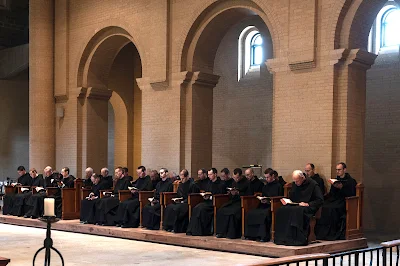
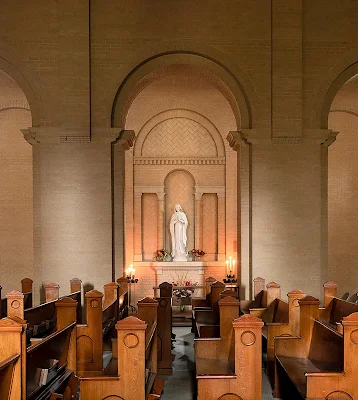
Religious Life (September-October 2013) carries an article entitled “Priestly Fraternity of St. Peter Celebrates 25 Years.” The eye is drawn to the page by a photograph of the lovely chapel of the Fraternity’s seminary in Denton, Nebraska. Renowned classical architect Thomas Gordon Smith designed this chapel in a traditional style: spacious lines, harmonious proportions, and, most of all, a pervasive Catholicity that immediately impresses itself upon the viewer. When you see a chapel or a church like this, you
know, without the need for a sign or an explanation, that it is a temple of God, a place where the divine presence dwells.
As I read the article, however, I was struck most of all by a quotation from Father Bisig, one of the original founders of the Fraternity 25 years ago, and its first superior general. He reflected:
The Priestly Fraternity of St. Peter serves the faithful by retaining Latin liturgical traditions, the Church’s source of continuity. This is done, not out of nostalgia or a reactionary disposition, but out of humility. At the same time, we are called to live joyfully under the paternal authority of the successor of Saint Peter. This is done out of humility as well.
There is profound wisdom in this statement. First, Fr. Bisig notes the plain but so often forgotten fact that the Latin liturgical tradition embodied in the
usus antiquior or Extraordinary Form (as well as the Roman Breviary and the sacramental rites and a whole host of related devotions and customs) is “the Church’s source of continuity.” The mission of worship and sanctification entrusted by our Lord Jesus Christ to His Church on earth was faithfully carried out over centuries, even millennia, through the very forms we have now come to call ‘traditional.’ These are the handiwork of the living Spirit of Christ, the repository of His wisdom and power, the participation of His majesty and beauty, and they will for all eternity be, in God’s eyes, the way in which the Catholic Church carried out her one and only mission of salvation.
Hence, whatever changes have been made, for better or for worse, these changes
rest upon and
have their meaning from the liturgical traditions that preceded them. To adapt an analogy from the Epistle to the Romans, just as the Gentiles are like a wild olive branch grafted onto the olive tree of Israel, so too, the Novus Ordo is like a branch grafted into the traditional Roman liturgical tree. If that strong tree had not existed and did not exist, and if its sap were not still and always capable of bearing fruit, neither could any new branch live and bear fruit. To change metaphors, the work of the Fraternity and other societies and communities dedicated to preserving the Latin liturgical traditions is like that of master gardeners who care for the oldest, most exquisitely beautiful, most precious trees in the orchard of the Lord. As apple and tomato growers know, heirloom varieties give the tastiest fruit.
Fr. Bisig goes on to say that the Fraternity does what it does not because of nostalgia or a reactionary disposition, but “out of humility.” Often traditionalists are accused of being arrogant, of looking down their noses on Catholics who are not holy enough or enlightened enough to prefer the traditional liturgy to the modern one. No doubt such attitudes can be found. But it has been my experience in many different communities and countries that the deepest motiviation of a traditionalist is the humility of being able to
receive the wonderfully rich tradition of the Church with gratitude, appreciation, docility, and love—the humility to want to be shaped by what the ages and the saints have passed down to us. This stands in stark contrast to the pride of wanting to shape what we do to match ourselves and our age, as if we were the measure of all things. Is the sacred liturgy the potter and we the clay, or is it the other way around? It is, indeed, far more disturbing that so many in the last half-century thought that they were such expert judges of their (and our) spiritual needs that they could massively alter the centuries-old ways of worshiping bequeathed to us by the Church of our ancestors. Anyone who can feel easy in his mind about liquidating or tearing up vast swathes of orchards, farmlands, homesteads, in favor of sleek and efficient modern structures and methods, is the one really lacking in humility.

Some time ago, Rorate Caeli described the careful researches of an expert in the quondam papal liturgy of Rome as a “sorrowful” task because nearly everything he was documenting, “the slow ceremonial growth of twenty centuries,” had been cast off:
[T]he little quirks naturally added and eliminated in such a development were cut off and burned. What generations of popes, bishops, priests, monks carefully pruned and watered was cut by misinformed ‘liturgists’ filled with utmost ahistorical arrogance and anachronistic condescension, who cut off the roots instead.
Where is our ability to receive gently, gratefully, humbly, as did the Blessed Virgin Mary?
There is a great humility in preserving what our Lord,
through His Church, has given us, yes; but there is also a great humility in submitting to what our Lord,
in His Church, has established over us. The love of the Latin liturgical traditions can never, in principle, be opposed to communion with and rightful obedience to the Sovereign Pontiff, the successor of Saint Peter, just as the Pope himself can never, in principle, abrogate a longstanding liturgical rite, which is “sacred and great” for all generations. I say “in principle,” of course, because history shows us moments of tension
in fact, and we may be living in one such moment right now; but difficulties of season, circumstance, or temperament never touch the essential duties and obligations of both pastor and people. Put differently, the relationship between fidelity to tradition and obedience to authority may be serene and joyful at one time, perplexing and troubled at another, but it is an unbreakable relationship that stands at the very center of Catholic identity. If a Catholic gives up either element, in that very act he betrays the unity of the Church.
Fr. Bisig, then, has said three very important things, the importance of which I hope and pray will become ever more apparent to Catholics as time goes on, in whatever way, or from whatever source, they come into contact with these truths.
First, preserving the liturgical tradition benefits
all the faithful, because it keeps alive and active in our midst the very source of the continuity of the new with the old, the development with the origin. Whenever and wherever the new liturgy benefits from this presence of its predecessor, that will be a sign that it is not, in fact, opposed to it. If, on the other hand, the reformed liturgy is viewed and celebrated as totally
other, as a kind of contradiction, that is a sign that something seriously wrong has occurred, a sign of material heresy and incipient schism.
Second, we retain the Roman liturgical tradition out of humility (the humility of loving what has been given to us), not out of pride (the pride of rejecting what is new or rejecting the authority that can give us new things as well as old—but never the new without the old).
Third, we remain obedient to the legitimate authority of the successor of Saint Peter, again out of humility. For humility recognizes that there would not be a Church, and we could not receive her treasures, were there not a visible body with a visible head—and this, in spite of any tensions or difficulties there have been and will be. It’s not for nothing, after all, that the emblem of the Fraternity is the keys of Saint Peter with tears falling over them. That is an emblem that all of us can relate to.