
Friday, January 03, 2025

Epiphany and Its Customs

The Adoration of the Magi, 1525-30, by Girolamo da Santacroce 

Epiphany is a great feast in both East and West, albeit with different inflections. In the Byzantine and other Eastern rites, Christmas begins a holy period that culminates with Epiphany; Epiphany, therefore, is the greatest feast of the Christmas season. In the Roman and other Western rites, Christmas begins a holy period that plateaus and ends with Epiphany. Christmas and Epiphany are on par with each other. The Western understanding is reflected in a rare word for Epiphany once used in Scotland. Uphalimass (pronounced up-HAL-ee-muss) designates the Mass that wraps up the holidays, for “up” can denote completion as well as what is above.

“Epiphany” is the Greek word for manifestation and refers to Christ’s manifestation of His divinity: understandably, then, the Byzantine Rite prefers the word “Theophany” or “Manifestation of God.” The feast celebrates three manifestations in particular: the manifestation of Christ to the Magi, the first manifestation of His miraculous power at the Wedding of Cana, and the manifestation of His sonship when He was baptized by St. John in the Jordan River. The Benedictus antiphon for Lauds is a marvelous fusion of these three miracles:
Hodie caelesti Sponso juncta est Ecclesia, quoniam in Jordane lavit Christus ejus crimina; currunt cum muneribus Magi ad regales nuptiales, et ex aqua facto vino laetantur convivae, alleluja.
Which I translate as:
Today the Church was joined to her heavenly Spouse, because her Anointed One washed away her sins in the Jordan; Magi run to the royal wedding with gifts, and the guests rejoice with wine made from water, alleluia.
Although all three miracles are honored by both East and West, for most Protestants and Western-rite Catholics, the manifestation to the Magi takes center stage on this day while among Eastern Christians it is Christ’s baptism. Several Roman Catholic cultures attest to this preference with the name they give Epiphany, such as “King’s Day” in Mexico.

Proclamation of Feasts
Today we take our calendars for granted, but in former ages it was not so. Early Christians relied on the calculations of scholars from Alexandria (considered the most competent) to determine the date of Easter, which falls on the first Sunday after the vernal equinox. Those calculations would be solemnly announced on the Epiphany, which was a sensible choice since the feast celebrates an astronomical event, and it is not far from the seasons of Lent and Easter. The chant used for the proclamation, which is the same as that of the Easter Vigil Exultet, is called the Noveritis.
Magi Plays
Did you know that the theater in the Western world, after it died out in ancient Greece and Rome, was brought back to life by the worship of the Church? The earliest medieval plays began as theatrical reenactments of Gospel passages of the day (Easter, Good Friday, etc). Epiphany had an “Office of the Star” tied to the liturgy of the feast and staged in the sanctuary of the church, but over time it grew out of hand. The character Herod was portrayed as a raging lunatic, overthrowing furniture and beating clergy and laity alike with a wooden stick. Church officials decided to ban the play from the sanctuary, at which point it moved outside and became a popular medieval entertainment. William Shakespeare remembered these plays from his childhood, before they were banned by England’s Protestant leaders. In Hamlet, the young prince declares that overacting “out-Herods Herod” (III.ii.13). Tamer versions of the medieval Epiphany play continue to exist in the German tradition of Sternsingen and the Spanish tradition of the festival of Los Tres Rejes.
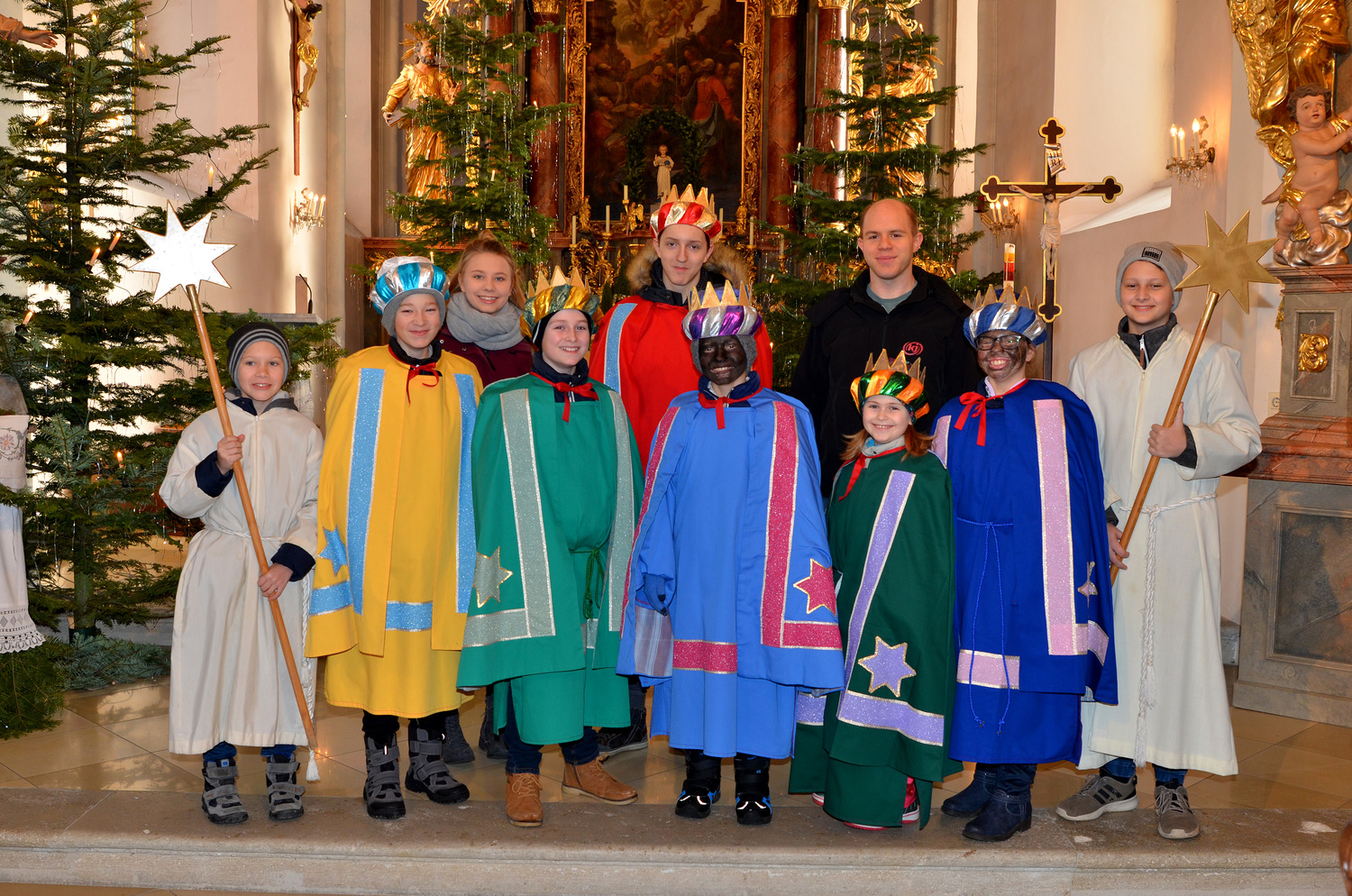
Sternsingen 2019 (Blackface not recommended)
Blessing of Homes
An even older custom is the blessing of one’s home on the Epiphany. A priest comes to the house, sprinkles each room with holy water, and incenses them.
But the more common practice is the blessing of one’s house with chalk. At church the priest blesses chalk and sprinkles it with holy water, saying:
Bless, O Lord God, this creature chalk, that it may be salutary for mankind; and, through the invocation of Thy most holy name, grant that whoever obtains some of it or writes with it upon the doors of their home the names of Thy saints, Caspar, Melchior and Balthasar, may, through their intercession and merits, receive health of body and protection of soul. Through Christ our Lord. ℟. Amen.
The faithful then take the chalk home with them and write on the lintel of their doors the current year along with the letters C, M, and B, interspersed by crosses—e.g., 20+C+M+B+22.
Because it is a product of clay, chalk is a fitting symbol for the human nature assumed by the Word whose incarnation we celebrate this season. The year signifies the time that has elapsed since the Savior’s birth into human history, the crosses represent Christ Himself and the holiness of the Magi, and the letters represent the initials of the three kings: Caspar, Melchior, and Balthasar. These same letters can also stand for Christus mansionem benedicat—May Christ bless this house.
Blessing the home on Epiphany is appropriate. Just as the wise men visited the temporary home of the Infant Jesus and brought Him gifts of gold, frankincense, and myrrh (symbols of His kingship, divinity, and burial), so too do we pray that Christ may visit our temporary (earthly) home with gifts of grace and peace for ourselves and our guests.
Epiphany Carols
People are (or at least used to be) still in a caroling mood on Epiphany. One noteworthy custom is the star carol. From the fourteenth century to the Reformation, groups would go from house to house holding the Star of Bethlehem and announcing through song that they were the Magi telling of their adventures. The custom, which was a simplified form of the medieval Epiphany play, still exists in Austria and Bavaria (where it is called Sternsingen) and in Slavic countries.
We suspect that the author of the most popular Epiphany carol in the English language and perhaps the world was aware of this tradition. John Henry Hopkins, Jr. was rector of Christ Episcopal Church in Williamsport, Pennsylvania and the music teacher at the General Theological Seminary in New York City. For his final year of teaching at the seminary (1857), he wrote “We Three Kings” for a Christmas pageant they were having. Hopkins wrote both the music and the lyrics for the song which was rare: usually, the lyrics were written by one person and the tune by another. The carol also holds the honor of being the first Christmas-Epiphany carol from the United States achieving worldwide popularity: even the British and the French like it. The song aptly impersonates all three kings in the first verse, Melchior in the second, Balthasar in the third, and Caspar in the fourth, while the chorus praises the Christmas Star. By the time the carol is over, the singer or hearer knows who the three kings are, what gifts they brought, and what deeper meaning the gifts have. Written in the distinctive Aeolian mode, it smacks of music from the Middle Ages and Middle East. The first verse is:
We three kings of Orient are;
Bearing gifts we traverse afar,
Field and fountain,
Moor and mountain,
Following yonder star.
Gift-Giving
In Italy and Spanish-speaking countries, Epiphany rather than Christmas is the occasion for exchanging gifts. In Italy, the old woman Befana brings the presents; in Spanish-speaking countries, is the Magi.
Some cultures split the difference and exchange gifts on both Christmas and Epiphany. In French Canada, Epiphany was nicknamed “Little Christmas.” The practice of opening presents over a period of days makes sense, since children who open all their gifts in a mad frenzy on Christmas morning often become unappreciative and lethargic afterwards.
Befana, a corruption of the word “Epiphany,” gives gifts to children in Italy on her feast day
Blessing of Water
As we mentioned earlier, Epiphany also celebrates the Baptism of Jesus in the Jordan, which according to Catholic and Orthodox belief is the moment when Christ sanctified water, making it capable of communicating the grace of the sacrament of baptism. It is therefore customary to bless water on this day. The Roman Catholic Church has a traditional and elaborate blessing of water that takes place on the eve of Epiphany and requires, among other things, several exorcisms and infusing the water with a little salt.
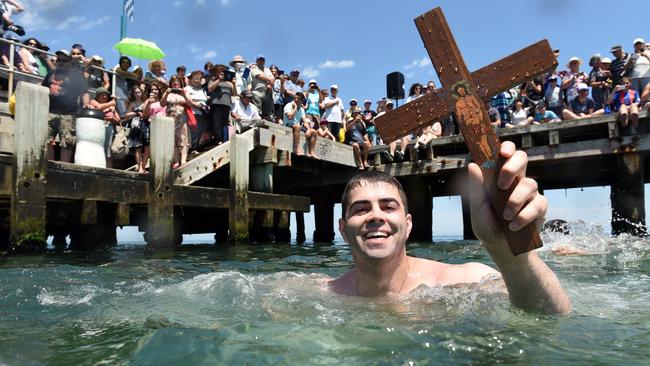
Other Christian churches use this occasion to bless natural bodies of water. In the Holy Land, after the River Jordan is blessed, thousands plunge themselves into the water three times to receive a blessing. In Egypt, the same thing traditionally happens in the Nile; locals also lead their domestic animals into the river for a blessing and dip their religious objects into the river for the same reason. After the priest blesses a body of water, he throws a cross into it. The men of the town then compete to retrieve it; the one who does has good luck for the year. And the blessing has the added advantage of driving away the Christmas demons. The Greeks also use occasion to bless their boats and ships.
Food and Drink
The signature food for Epiphany (or, sometimes, the night before) is King’s Cake. A small object is put in a cake. Traditionally, it was a coin; more recently, it is a small figurine of the Infant Jesus. Whoever finds the object in their piece of the cake is king of the merry party. In Austria, Germany, France, England, and Canada, the King’s Cake contained a bean and a pea; finding the bean made one a king while the pea made one a queen.
The custom was also tied to charity. In France a piece of cake was put aside “for our Lord” and given to a poor person. Another French tradition required each person to pay for his piece of cake. The money collected, called “the gold of the Magi,” would be given to the poor or to help pay for the education of a promising but disadvantaged youth.
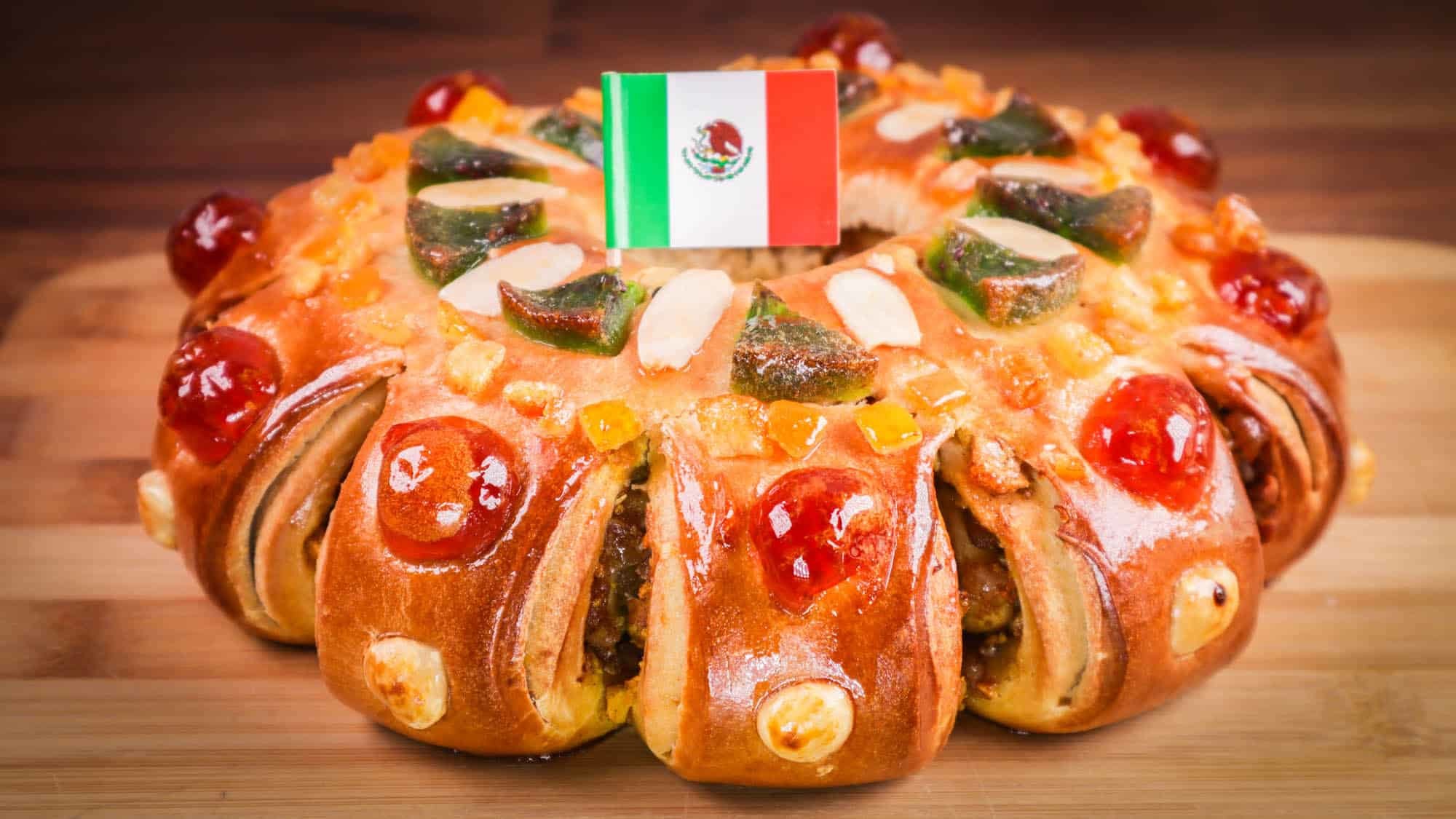
In Mexico, rosca de Reyes or Kings’ Day Bread is a wreath-shaped loaf with cinnamon, anise seed, vanilla extract, and dried fruit. The dinner guest who finds the Baby Jesus in his slice must make the tamales for the next gathering. A similar custom exists in Spain. Roscón de Reyes is a delicious oval, cream-filled pastry with a hidden bean and a surprise. Whoever finds the surprise gets good luck for the year; whoever finds the bean has to buy the next roscón.

Thursday, April 25, 2024

“Aquae Sanctae Terrae”: The Spiritual Signification of the Waters of the Holy Land (Part 2)

Joshua passing the River Jordan with the Ark of the Covenant, 1800, by Benjamin West, (source).

“Aquae Sanctae Terrae”: The Spiritual Signification of the Waters of the Holy Land

A Seminarian from the Midwest

Part 2: The Sea of Galilee and the Jordan River

(Part 1 may be read here.)

The Sea of Galilee

The Jordan’s next stop is at the Sea of Galilee, which lies ten miles south of Lake Hula and sits nearly 1,000 feet lower at about 700 feet below sea level. The Sea of Galilee, and all the land north of the Dead Sea in the Holy Land up to the Jordan headwaters, but excluding Lake Hula, represent the earth on the spiritual map. Within this region, Christ became man to redeem the world. There are many stories within the Old and New Testament, especially at the Jordan River and the Sea of Galilee, which highlight God’s intervention on earth. These episodes are primarily associated with the importance of Baptism and the necessity of being part of the Church. The region is also culturally diverse despite its small size, enhancing its global character.

Beginning in the Old Testament, the first major reference to the Jordan River comes in the book of Joshua. The Israelites are finally taking the Promised Land. God commands Joshua to have priests of the tribe of Levi carry the Ark of the Covenant into the Jordan River. [20] When the priests enter the swollen Jordan with the Ark, it parts like the Red Sea, and the Israelites cross safely. Joshua then has twelve men, one from each tribe, carry twelve stones out of the river to commemorate the miraculous crossing. [21] He also has them put twelve stones into the river where the priests held the Ark. [22] The Ark of the Covenant’s presence in the Jordan is a sign of God’s power and blessing coming over the river. This event prefigures Christ’s baptism, which forever sanctified the Jordan. To this day, water taken from the Jordan River is treated as ready to use baptismal water and does not need to be exorcised or blessed like regular baptismal water.

The episode also has implications for the priesthood of the Old and New Covenant. The Levites carrying the Ark into the river represent the priests of the old covenant. The twelve men from the twelve tribes represent the Apostles and the New Covenant priesthood. The twelve stones they take from the river also represent the Apostles and are like the twelve precious foundation stones on which God will build the heavenly city in the book of the Apocalypse. [23] The twelve stones that get put into the river represent the burying of the Old Covenant priesthood, indicated by the verse, “And they are there until this present day.” [24] Once everyone has safely crossed the river, the priests lead the Israelites into the Promised Land, “And when they had all passed over, the ark also of the Lord passed over, and the priests went before the people.” [25] This image is also similar to the New Testament sacrament of baptism. Through baptism, a priest leads a soul dead from original sin, into the spiritual promised land of life with Christ.

Naaman the leper

Another Old Testament story featuring the Jordan occurs in the Fourth Book of Kings. As mentioned before, here we read about, Naaman, the leprous Syrian army commander. Desperately Seeking a cure, Naaman takes the advice of a captured Hebrew girl, and visits the prophet Elisha. Elisha tells Naaman to wash in the Jordan seven times. [26] Naaman is unimpressed, but after some convincing from his retinue, he relents and does as Elisha asks. [27]Naaman is cleansed while washing, “And his flesh was restored, like the flesh of a little child, and he was made clean.” [28] The connection between this story and baptism is obvious. The leprosy represents sin. The sacrament of baptism washes away every trace of sin and bestows sanctifying grace on a soul.

Now is an appropriate time to answer Naaman’s original objection. Why must he wash in the Jordan? It is not on account of the Jordan’s physical properties, but because of what the river signifies. The Jordan, flowing down from its mountainous sources, is a physical manifestation of how God’s grace flows down from Heaven to us in the valley of earth below. The Jordan is like a spiritual highway or a channel of grace. Through the sacrament of baptism, invisible and spiritual realities are joined with the visible and material world. By God’s power, men receive sanctifying grace through water. The Jordan and the waters of the Holy Land are the place where God chose to create this unique union and institute the sacrament of baptism. Looking back with New Testament eyes, it is obvious why God had Namaan wash in the Jordan. The cleansing was a prefiguration of baptism. For Naaman, however, this sign was not apparent. Naaman receives a visible and physical healing, yet he is baffled by the means. He only sees the physical reality, the Jordan, a little line on the physical map. Like everything in the Old Testament, Naaman’s story only finds its fulfillment in the New Testament. The sacrament of baptism, which Christ institutes in the New Testament, provides a spiritual and invisible healing. A healing superior to Naaman’s physical healing. Naaman’s story also shows how the Gentiles will eventually come into covenant with God. Therefore, when we look at the Jordan River on the spiritual map, we see it is not just a little line, but is also a symbol of the invisible grace that is flowing down from Heaven in the sacrament of baptism.

Nicolas Poussin, Saint John Baptizing in the River Jordan, 1630s (source)
John the Baptist and Christ

The Jordan also features prominently in the New Testament. In Matthew’s gospel, John the Baptist is in the desert outside Jerusalem, preaching the baptism of repentance to the Jews. It is possible that John was baptizing in the exact same place that Joshua and the Israelites crossed the Jordan River centuries earlier. Joshua crossed the Jordan opposite of Jericho which is the same area where John was baptizing. [29] One can find evidence for this theory in Matthew’s gospel. When the Pharisees and Sadducees come out to investigate what is going on, John chastises them, saying, “Ye brood of vipers, who hath showed you to flee from the wrath to come? Bring forth therefore fruit worthy of penance.” [30] The Pharisees and Sadducees represent the rottenness of what the Jewish people have become. John, perhaps looking at the same twelve stones which Joshua removed from the river, continues, “For I tell you that God is able of these stones to raise up children to Abraham.” [31] These stones symbolize the Apostles and their mission of making believers of all nations. He also warns of the passing of the Old Covenant when he says, “For now the axe is laid to the root of the trees. Every tree therefore that doth not yield good fruit, shall be cut down, and cast into the fire.” [32] John’s baptisms link the Old and the New Covenant. John’s baptisms were only a representation of the true effect of baptism. They were a ritual cleansing for Jews, which represented the cleansing of sins. John himself says, “I indeed baptize you in water unto penance, but he that shall come after me, is mightier than I, whose shoes I am not worthy to bear; he shall baptize you in the Holy Ghost and fire.” [33] It is the baptism of the New Covenant therefore, which will be truly efficacious and wipe out sins.

It is in this context that Christ also comes to John to receive baptism. Since Christ was sinless, He was not coming to be figuratively cleansed of sins. The Catechism of Trent, citing Saint Augustine, argues that Christ received baptism in order to institute it as a sacrament. [34] Saint Augustine writes, “From the moment that Christ is immersed in water, water washes away all sins” and, “The Lord is baptized, not because He had need to be cleansed, but in order that, by the contact of His pure flesh, He might purify the waters and impart to them the power of cleansing.” [35] Christ’s submerging under water also signifies the time He would spend in the tomb between His death and resurrection. Likewise, when men are baptized, there is also an element of death, burial, and resurrection present. The old man, dead to sin, is buried; and the new man, alive in Christ, rises. This new life in Christ is symbolized by a shining white garment which the Church gives to the newly baptized man.

Mosaic from Sant’Apollinare Nuovo in Ravenna (source)
Calling of the disciples

After Christ’s baptism, he retires into Galilee. [36] In Christ’s time, the region around the Sea of Galilee was a cross section of the major cultures of the world. Greeks, Romans, and Jews all lived in the region. Travelers from all over the world also passed through Galilee on the Via Maris, a Roman highway connecting the Nile Delta with Damascus. [37] This cultural mishmash is reflected by the names of the different cities and villages found around the Sea of Galilee. There are the Greek names of the Decapolis district (on the southeast shore of the sea) including, Philadelphia, Hippos, and Pella. There are the Latin names of Caesarea Philippi and Tiberias. And of course there are the Hebrew names such as, Chorazin, Capharnaum, Tabgha, and Magdala. The sea itself also goes by different names. In the Old Testament it is called, the Sea of Chinneroth, Kinerot, or Kineret (Hebrew). Saint Luke gives it the Hellenized name, Lake Gennesaret (Lk 5:1). Matthew and Mark refer to it as the Sea of Galilee (Hebrew), naming if after the district it is in. John calls it both the Sea of Galilee and the Sea of Tiberias (Latin).

In Mark’s gospel, we read of Christ famously calling Peter, Andrew, James, and John to be His Apostles while they are fishing. When viewing the Sea of Galilee as a symbol of the earth or the world, the calling gains added significance. In addition to Christ’s words indicating their new vocation, “Come after to me, and I will make you to become fishers of men”, there is also the physical element of Christ calling His first priests to step away from the noise and distractions of the world so they can devote themselves to serving and being with Him. [38]

Perhaps the most famous incident at the Sea of Galilee is the storm at sea depicted in Mark 4 and Matthew 8. Christ is asleep in the boat while His Apostles battle the storm. The boat, the barque of Peter, represents the Church. The stormy sea represents the dangers of the world. Saint Peter Chrysologus gives his vivid interpretation of the scene:

When Christ embarked, in the boat of His Church, to cross the sea of the world, the blasts of the Gentiles, the whirlwinds of the Jews, the tempests of persecutors, the storm clouds of the mob, and the foggy mists of the devils all descended in a fury to make one storm over all the world. [39]

The Apostles, in the midst of their peril, wake our Lord. Christ rises and rebukes the wind and sea. Through this rebuke, Jesus proves He is the master of the world. Evil has no real power. It is only permitted by God to serve some greater purpose. In this passage, Christ uses the storm to test the faith of the Apostles and manifest His power.

Our Lord and Saint Peter’s night time walk on the sea, recounted in Matthew 14, is another classic story. At first, Peter confidently walks out to Christ, but then he sinks into the water. Our Lord quickly comes to the rescue, and gently chides Peter, “O thou of little faith, why didst thou doubt?” [40] This story teaches us that like Peter, we too can rise above the world and master its perils if we keep our focus on Christ; but when we take our eyes off of Christ, we will sink back into the mire of the world just as Peter did. Jesus, however, is always ready to save us when we call on Him.

Circle of Tintoretto (Lambert Sustris?), Christ at the Sea of Galilee, c. 1570s (source)
Resurrection appearance

The last great event to happen at the Sea of Galilee occurs in John’s gospel after the resurrection. Seven of the Apostles are out fishing on the sea. They have had a bad night, managing to catch no fish. Their fortunes change, however, as night turns to day, and Christ appears on the shore. Our Lord commands them to drop their nets on the right side of the boat. The apostles do as He asks, and immediately their nets are filled with 153 fish. Once they have landed this miraculous catch, John realizes that it is Jesus who is on the beach, and says to Peter, “It is the Lord.” [41] Peter then puts on his tunic, for he was naked (Jh 21:7), and swims to meet Christ on the shore. The rest of the Apostles follow by boat with the miraculous catch. On the beach, Peter proves his three-fold love for Christ, redeeming his three denials. This whole event is rich in meaning and merits unpacking.

The first point of interest is that the Apostles have returned to their old way of life. There is nothing inherently wrong with fishing, but Christ called the Apostles away from this profession for a higher purpose which they seem to have forgotten. Their work is not blessed by God, indicated by the empty night of fishing. Christ, however, brings the morning rays of sun and grace with Him. He tells the Apostles to try dropping their nets on the right side of the boat. When they do so, they catch 153 fish. Our Lord is reminding them of their true vocation, which is to be fishers of men.

Saint Jerome believed the number 153 was significant because that was the number of known fish species at the time. [42] The fish represent all the nations of the world that the Apostles are called to baptize. This idea also aligns with the verse in Matthew which reads, “Again the kingdom of heaven is like to a net cast into the sea, and gathering together all kinds of fishes.” [43] Casting the net on the right side indicates the way of salvation, while the left side indicates the way of damnation. [44] When Peter hears that it is Christ on the beach, he puts on his tunic and swims to meet him. This is another image for baptism. By the submersion in water at baptism, a man is purified and prepared to receive Christ. He then receives a white garment to show that He has been clothed by Christ. Both the submersion and the garment are present in this story (Jh 21:7). This is also an undoing of the incident in Genesis where Adam and Eve, unlike Peter, hide from God in the garden because they are ashamed of their nakedness. [45]

All these stories of the Old and New Testaments provide evidence for how the Jordan River and the Sea of Galilee are symbols for the world. The events that take place at these bodies of water are also usually associated with images of baptism and the Church, which is fitting because these are the means which aid us on earth in our quest for Heaven.

NOTES

[20] Joshua 3:3

[21] Joshua 4:8

[22] Joshua 4:9

[23] Apocalypse 21:19-20

[24] Joshua 4:9

[25] Joshua4:12

[26] 4 Kings 5:10

[27] 4 Kings 5:11-14

[28] 4 Kings 5:14

[29] Joshua 4:13

[30] Matthew 3:7-8

[31] Matthew 3:9

[32] Matthew 3:10

[33] Matthew 3:11

[34] The Catechism of the Council of Trent, (Charlotte, NC: Tan Books, 2017), 179.

[35] The Catechism of the Council of Trent, 179.

[36] Matthew 4:12-13

[37] Rev. Bargil Pixner, Paths of the Messiah, trans. Keith Myrick, Sam Randall, and Miriam Randal, ed. Ranier Riesner, (San Francisco, CA: Ignatius Press, 1991), 55.

[38] Mark 1:17

[39] Saint Peter Chrysologus, Fathers of the Church: Saint Peter Chrysologus Selected Sermons and Saint Valerian Homilies, Vol.17, trans. George E. Ganss, S.J. (New York, NY: Father of the Church, Inc., 1953), 62.

[40] Matthew 14:31

[41] John 21:7

[42] George R. Beasley-Murray, World Biblical Commentary: John, Vol. 36, (Waco, TX: Word Books, 1987), 401-402.

[43] Matthew 13:47

[44] Matthew 25:34, 25:41

[45] Genesis 3:10

Monday, April 22, 2024

“Aquae Sanctae Terrae”: The Spiritual Signification of the Waters of the Holy Land (Part 1)

NLM is grateful to S.K., a seminarian from the Midwest, for sharing this recent paper with us. – PAK

Jordan River as it runs through northern Israel

“Aquae Sanctae Terrae”: The Spiritual Signification of the Waters of the Holy Land


Part 1: The Jordan’s Sources and Lake Hula

Introduction

In the Fourth Book of Kings, Naaman the Syrian, derides the Jordan River when Elisha tells him to wash in it. He declares, “Are not the Abana, and the Pharphar, rivers of Damascus, better than all the waters of Israel, that I may wash in them, and be made clean?” [1]

At first glance, Naaman’s assessment seems accurate. Although the Jordan River, the springs that feed it, and the Sea of Galilee, are attractive bodies of water, they are not physically impressive. The Jordan is only 223 miles long. In comparison, the Tigris and Euphrates rivers each measure well over 1,000 miles. The Nile flows over 4,000 miles from its source in Lake Victoria. The Sea of Galilee at thirteen miles long and eight miles wide is equally unimpressive. It could fit into Lake Michigan 350 times. The other Holy Land lakes have even less to speak of. In most biblical maps, one will notice a small lake ten miles to the north of the Sea of Galilee. This is Lake Hula, or the Waters of Merom. At about three miles long and three miles wide, it is barely noted in the scriptures at all. The last lake, the Dead Sea, is the largest, but also the most repulsive. It is about three times larger than the Sea of Galilee. The sea’s water is so salty it cannot support any forms of life and is bitter to the taste. After a few minutes, it will also sting the flesh of those who swim in it.

Thus, if the waters of the Holy Land are not that special, why must Naaman wash in the Jordan? What makes this river and the waters of the Holy Land significant? The answer can be found on a map, but not a physical one. Hiding beneath the underwhelming marks these waters make on a physical map, is another map — a spiritual one. In this essay, I will do some spiritual cartography and map out the spiritual places these waters represent — revealing their true significance.

Water is one of the richest symbols in the scriptures. The Bible is packed with stories set in or around water. In the Old Testament, a few examples include: the gathering of the oceans during the creation narrative, the great flood, the crossing of the Red Sea, Moses striking the rock, and the crossing of the Jordan in the book of Joshua. In the New Testament, we read of Christ’s baptism in the Jordan, the miracle at the wedding in Cana, Christ sleeping in the boat during the storm on the Sea of Galilee, Christ walking on the Sea of Galilee, and water flowing from Christ’s side during the passion. Since I cannot cover every reference to water in this essay, I will limit myself primarily to the major events that occurred at the Jordan River and its lakes (Lake Hula, the Sea of Galilee, and the Dead Sea). Water is an important element because it is a symbol of life. Water by its purity also signifies cleanliness and innocence. Finally, water is the matter used in the sacrament of baptism, which means there is a real material connection between water and sanctifying grace. These are the main attributes of water that will be covered in this essay.

Photo by Lawrence Lew OP (source)
Sources of the Jordan

The first place to pin on the spiritual map is Heaven. Where does this overlap with the physical map of the Holy Land? The answer is at the sources of the Jordan River.

The Jordan is formed by three small spring fed rivers that converge in the Hula Valley to form the Jordan River. [2] The three springs are located at an elevation of around 1,800 feet and are all near the foot of Mount Hermon in Lebanon. With their constant outflow of water, springs have an everlasting character, which reminds us of God, eternity, and Heaven.

There are also several places in the scriptures where we see springs and rivers flowing out of Heaven or places that resemble Heaven. In Genesis, we read that the Garden of Eden, a type of proto-heaven, was watered by a spring, “But a spring rose out of the earth, watering all the surface of the earth.” [3] This spring forms a river several verses later, “And a river went out of the place of pleasure to water paradise.” [4] Adam and Eve lost paradise through their sin. God, however, promises to make a new Heaven, which is symbolized by Ezekiel’s vision of a rebuilt Jerusalem. [5] The exiled Israelites returning to their home represent all believers (of the Old and New Testaments) returning to their true home of Heaven.

A life-giving spring is also depicted as flowing from the temple of this new Jerusalem. We know this does not represent a physical place, because no such spring flows or has ever flowed from the temple in Jerusalem, which means this is a depiction of something spiritual, such as spiritual temple or heavenly temple. This spiritual temple is Christ’s own body which was pierced on the right side and released a flow of purifying water. The verse from Ezekiel predicts this, “And behold there ran out waters on the right side.” [6] We read further that the spring forms a river which heals wherever it flows. The waters represent the healing effects of sanctifying grace which was merited by Christ’s passion and death. There is one place, however, that cannot be healed — Hell. This is signified by the verse, “But on the shore thereof, and in the fenny places they shall not be healed, because they shall be turned into saltpits.” [7] The springs in Eden, the temple of the new Jerusalem, and Christ’s side, all provide support for the idea that the three springs of the Jordan River represent Heaven.

Since there are three springs, a connection can be made between them and the three persons of the Holy Trinity. The formula for the sacrament of Baptism can also be linked with the three springs. In the sacrament, the minister pours a separate stream of water as he names each member of the Holy Trinity, one pour for each spring.

On a map, the three springs roughly form an inverted triangle. In the northwest, there is the spring which feeds the Hasbani River, in the middle/south, there is the spring which supplies the Dan River, and in the northeast, there is the spring which turns into the Baniyas River. All of the springs are renowned for their purity and natural beauty. The eastern spring and river get their names from the Greek nature god, Pan, who had a shrine located in a niche outside the cave where the spring begins. Above the cave is a massive rock wall about 200 feet high and 500 feet wide. [8] Located within sight of the cave, Philip the tetrarch, built the city of Caeserea Philippi in honor of Caesar Augustus. [9] On top of the rock wall, there was a white marble temple dedicated to Caesar. [10]

Father Stanley Jaki, a contemporary Bible scholar, argues that this was the location where Christ chose Saint Peter to be the head of the Church. He bases his theory on the verses from Matthew beginning with, “And Jesus came into the quarters of Cesarea Philippi: and asked his disciples, saying: Whom do men say that the Son of man is?” [11] Peter replies, “Thou art Christ, the Son of the living God.” [12] To which our Lord responds,

Blessed art thou, Simon Bar-Jona: because flesh and blood hath not revealed it to thee, but my Father who is in heaven. And I say to thee: That thou art Peter; and upon this rock I will build my church, and the gates of hell shall not prevail against it. And I will give to thee the keys of the kingdom of heaven. [13]

Father Jaki proposes that this scene took place outside of Pan’s cave under the large rock wall. Jesus and the Apostles would not have gone right up to the spring because of the presence of the pagan shrine. [14] He writes, “Standing at a distance, Jesus and the Twelve must have been impressed by the massive wall of rock rising over the source of the Jordan.” [15] The rock wall provides an appropriate background for Christ to speak these words to Peter. In the presence of the pagan temples and false gods, who vie conspicuously close to Christ and the source of the holy Jordan River, Peter boldly declares Jesus as the true God. The symbolism is obvious. Peter (whose name means rock) is likened to the massive rock wall. Christ rewards Peter’s faith by promising to build the Church on top of him. Christ is asserting His power over the false gods that dwell above and below the physical rock wall that they are standing in front of. Any remnants of these pagan images will be washed away by the Jordan.

If Father Jaki’s theory is correct, it would also fit with the theory that the source of the Jordan represents Heaven. The Church is erected as the gate through which believers must enter Heaven. Christ appoints Peter as the gatekeeper of this gate and gives Him the keys. It is also interesting that this particular spring is the one that flows from the east. Throughout the scriptures, God and His power are always depicted as coming from the east.

Lake Hula

Following the Jordan River south, we come to the Jordan’s first lake, Lake Hula, also referred to as the Waters of Merom. Historically it measured about three miles by three miles, and was five to ten feet deep. [16] The lake was drained in the 1950’s because it was a breeding ground for malarial mosquitoes. [17] Today only a small wetland remains.

On the spiritual map, Lake Hula represents Purgatory. At an elevation of about 230 feet, it is nestled between the Jordan headwaters at around 1,800 feet in elevation and the next lake down, the Sea of Galilee, which sits about 700 feet below sea level. Lake Hula is only mentioned once in the scriptures, and is referred to as the Waters of Merom in the book of Joshua. The lake is the sight of a major battle between the Israelites and a coalition of pagan nations. God promises Joshua that he will be victorious in battle and commands him to take no quarter. [18] Joshua is a figure for Jesus. We know that Jesus’ victory on the cross merited enough grace for all to be saved, but the grace is only efficacious for those who believe in God and do His will. The strict command to annihilate all of the enemies is a warning to all those who reject God’s grace. There is no salvation for those who oppose God. After the battle, Joshua purges the area of all pagan influence. We read of Joshua capturing Asor, “Now Asor of old was the head of of all these kingdoms. And he cut off all the souls that abode there: he left not in it any remains, but utterly destroyed all, and burned the city itself with fire.” [19]

Like the land around Asor and Lake Hula, Purgatory is also a place of fiery purification. It is the place where God’s refining fire cleanses souls of any remaining earthly attachments. This fire, however, is deadly for God’s enemies. The historical presence of malaria around this lake also points to additional suffering for those who dwell around it. Lake Hula then is a fitting spot for Purgatory. It is a place of painful purgation where only the saved can go, but one which they would rather bypass.

NOTES

[1] 4 Kings 5, 12 (All Bible quotes are from the Douay-Rheims translation)

[2] “Jordan River.” Encyclopedia Britannica, Encyclopedia Britannica, inc., 25 Nov. 2023, www.britannica.com/place/Jordan-River.

[3] Genesis 2, 6

[4] Genesis 2, 10

[5] Ezekiel 47

[6] Ezekiel 47, 2

[7] Ezekiel 47, 11

[8] Rev. Stanley Jaki, And on This Rock, (Front Royal, VA: Christendom Press, 1997), 10.

[9] Rev. Stanley Jaki, And on This Rock, 10.

[10] Rev. Stanley Jaki, And on This Rock, 15.

[11] Matthew 16, 13

[12] Matthew 16, 16

[13] Matthew 16, 17-19

[14] Rev. Stanley Jaki, And on This Rock, 77.

[15] Ibid. 77.

[16] “Jordan River.” Encyclopedia Britannica, Encyclopedia Britannica, inc., 25 Nov. 2023, www.britannica.com/place/Jordan-River.

[17] Ibid.

[18] Joshua 11, 6

[19] Joshua 11, 10-11

Monday, February 22, 2021

Advice to Singers: Drink Some Water After Receiving Holy Communion

In talking to Catholics over the years, I’ve sometimes encountered odd ideas about what’s reverent or not. To be fair, the biggest problem is the lack of any conception of reverence whatsoever, but that’s not my focus in the present article. Here, I am thinking of devout Catholics who may think that a certain practice is irreverent when it’s simply not. A classic example is when Catholic schoolchildren of yore were taught that it would be wrong to masticate the host; it had to be allowed to dissolve. One can appreciate that religious sisters were in the business of teaching much-needed manners to children (especially boys) and did not want to see them “munching” on their way back from communion, but the way I’ve heard it told, it sounds like they might have gone overboard in the emphasis given on this or similar points of decorum.

So, too, it seems that some choir members are uncomfortable with drinking water from a water bottle immediately after communion, as if somehow this were not appropriate. But I would make the case that not only is there nothing wrong with it, but on the contrary, it can be a very good idea. I think what might be happening psychologically is a kind of assumption that because it is fitting to fast before communion, we should also fast (as it were) after communion.

It is indeed a big deal to fast before Holy Communion, and the reduction of the fast from all night to three hours to one hour is a poster child example of the colossal prudential error frequently made by churchmen in modern times, namely, that if we relax our disciplines we will somehow retain or attract more believers. This is demonstrably false; the ancient discipline was eminently wise. In his commentary on the Sentences, St. Thomas writes as follows:

This sacrament should only be received by those who are fasting, unless out of necessity because of imminent death, lest it happen that someone should have to exit this life without viaticum. Fasting must be established in reverence for such a sacrament, for three reasons in particular. First, because of the very sanctity of the sacrament; so that the mouth of a Christian, by which it is to be consumed, would not be first drenched with other food, but would be reserved for its reception as something new and pure. Second, because of the devotion that is required on the part of the one receiving, and the attention that could be distracted by having taken food, with gases rising from the stomach to the head. Third, because of the danger of vomiting, and other things like that. (In IV Sent. d. 8, q. 1, a. 4, qa. 1)

On the other hand, even if it is highly fitting for worshipers to remain after Mass for a time of thanksgiving rather than immediately leaving the church building and tucking into regular food and drink, doing so would not carry the same gravity, since a time of thanksgiving is (at least theoretically) built into the Mass itself. Again St. Thomas:

According to the custom of the Church, out of reverence for so great a sacrament, after having received it, a man should remain in thanksgiving; and the prayer of thanksgiving after Communion in the Mass is also said, and the priests after celebrating Mass have special prayers for thanksgiving. And so it is fitting that there should be a certain interval between consuming the Eucharist and other foods. But since a great interval is not required, and what lacks something small seems to lack nothing, as it says in Physics 2, for this reason we might concede that in this sense a person can take other food immediately after receiving the Eucharist.

After all, the priest himself, in receiving the unconsecrated wine and water during the ablutions, is already consuming non-consecrated elements, at times only moments after having received Holy Communion. Obviously the vessels have to be cleansed, and there is no more efficient way to do it; but we should also not overlook the practical benefit to the priest in being able to clear his mouth of any fragments of the host that might have remained there. A sign that this concern is real may be gleaned from the Holy Rule of St. Benedict. In chapter 38, the legislator prescribes concerning the weekly reader during the meals: “Let the brother who is reader for the week take a little bread and wine before he begin to read, on account of the Holy Communion, and lest it be hard for him to fast so long. Afterwards let him take his meal with the weekly cooks and other servers.” On this passage, a commentator writes:

Saint Benedict prescribes “a little bread and wine before he begin to read, on account of the Holy Communion.” This is not only because the reader, if he waits until after the meal, risks a headache and weakness from too prolonged a fast; it is also out of reverence for the Most Holy Sacrament. The “little bread and wine” serve as an ablution of the mouth, lest in reading or chanting, the reader inadvertently expectorate particles of the Sacred Host in his saliva. The custom of an ablution of the mouth after receiving Holy Communion is very ancient; traces of the custom have perdured, not only among certain Orthodox faithful, but even in some places in the West. I remember very well that my paternal grandmother, who received her First Holy Communion in County Leitrim in about 1909, was taught to cleanse her mouth with water immediately upon returning home from Holy Mass and before eating or drinking anything. I can still see her coming in from the early morning Mass. She would, without removing her hat and coat, light the burner under the kettle for tea and, then, go straight to her pantry for the traditional post-Holy Communion glass of water. It is interesting that such a custom was still practiced in early 20th century rural Ireland.

Like readers, singers are aware of the “inadvertent expectoration” mentioned above, however rare it might be that it would contain a crumb of the divine manna. It only took one such experience to convince me of the benefit of taking a drink of water in the choir loft upon returning from communion and before beginning to sing the communion antiphon or motets. Later on, when I read the passage in the Holy Rule, and connected it with the ablutions, I realized that this awareness has long been present in the mind of the Church, if in an understated way.

Visit Dr. Kwasniewski’s website, SoundCloud page, and YouTube channel.

The monastic reader in the refectory

More recent articles:

For more articles, see the NLM archives:



