Sunday, July 07, 2024

What Does Opposition to the Traditional Mass Really Signify?

Editor’s note: on this day in the year 2007, Pope Benedict XVI promulgated the motu proprio Summorum Pontificum, one of the most important acts of his pontificate, the fruit of his long and thoughtful consideration of the theological and pastoral problems which arose from the post-Conciliar liturgical revolution. This column on the opposition to it was originally published ten years ago, and although the landscape has changed since then, very much for the worse, its analysis of that opposition remains just as pertinent as it was a decade ago. Let us not allow this day to pass without a prayer of thanksgiving to God for the many benefits that have accrued to the Church from Summorum Pontificum, asking Him to hasten the day of its restoration; and likewise, pray for the eternal repose of His good and faithful servant, Pope Benedict XVI.

At the ordination of priests dedicated to the
usus antiquior: Bp. Marc Aillet, June 28, 2014
In the post-Summorum world, the ancient Roman Rite can no longer be considered forbidden, dubious, marginal, or obsolete. It enjoys equal rights of citizenship with the Novus Ordo: two forms of the Roman Rite—one called Ordinary because most recently promulgated and more widely used, the other called Extraordinary, the usus antiquior, deserving respect for its venerable use—with each able to be freely celebrated by any priest of the Roman Rite, no special permission needed. One would think that, as a gesture of reconciliation at the heart of the Church, the two forms would be flourishing side by side, with Catholics everywhere privileged to experience both of them offered reverently and beautifully.

But this is still far from the reality, and, sadly, there are still far too many bishops and priests who oppose the traditional Mass, tether it with burdensome conditions, or resort to power politics to ensure that its supporters are duly warned and penalized for their rash embrace of our Catholic heritage.

As we commemorate today the seventh anniversary of the implementation of Summorum Pontificum, whose provisions went into effect on September 14, 2007, it will be both edifying and sobering to consider the meaning Joseph Ratzinger himself attached to opposition to the traditional Mass. What does it mean when someone opposes this Mass, or those who celebrate it, or those who cherish it as a form of prayer dear to them?

In the book-length interview Salt of the Earth, published in 1997, Ratzinger said:
I am of the opinion, to be sure, that the old rite should be granted much more generously to all those who desire it. It’s impossible to see what could be dangerous or unacceptable about that. A community is calling its very being into question when it suddenly declares that what until now was its holiest and highest possession is strictly forbidden, and when it makes the longing for it seem downright indecent. Can it be trusted any more about anything else? Won’t it proscribe tomorrow what it prescribes today?  (176-77)
Ten years prior to Summorum, he was placing his finger on the crux of the matter. If the liturgy that was the Church’s holiest and highest possession for centuries, the object of total reverence and honor, the means of sanctification for countless Catholics, is suddenly forbidden, and if the desire to worship as our forefathers did is treated as wrong, what does that say about the Church herself, about her past, her tradition, her very saints? Truly, her credibility vanishes entirely, her proclamations become arbitrary diktats. Was there something fatally flawed, all this time, with our central act of worship? Were all the popes of the past who lovingly cultivated this liturgy mistaken, were all the missionaries who brought it around the globe misguided? Could they say, in the words of Gatherer, son of Vomiter, “I have not learned wisdom, and have not known the science of saints”? (Prov 30:1, 3, Douay).

In God and the World (2002), another of those splendidly insightful and doctrinally robust interviews which now, in retrospect, make for such wistful reading, Ratzinger returned to the point:
For fostering a true consciousness in liturgical matters, it is also important that the proscription against the form of liturgy in valid use up to 1970 should be lifted. Anyone who nowadays advocates the continuing existence of this liturgy or takes part in it is treated like a leper; all tolerance ends here. There has never been anything like this in history; in doing this we are despising and proscribing the Church’s whole past. How can one trust her present if things are that way? I must say, quite openly, that I don’t understand why so many of my episcopal brethren have to a great extent submitted to this rule of intolerance, which for no apparent reason is opposed to making the necessary inner reconciliations within the Church.  (416)
Here we have language strikingly akin to what we will find five years later in Pope Benedict’s Letter to the Bishops that accompanied Summorum Pontificum. Once again, we find the telltale insistence on possessing the right attitude towards the undying and life-giving heritage of the Church. The liturgical rites that arise from apostolic seeds in the Church’s sojourn through history are the fruits of Him who is the Lord and Giver of Life, and they cannot, in themselves, either die or bring death—nor can they be legitimately prohibited.

This would explain why Pope Benedict XVI, in Summorum Pontificum, says that the traditional Latin Mass “must be given due honor for its venerable and ancient usage” and, in the Letter to the Bishops, adds:
What earlier generations held as sacred remains sacred and great for us too, and it cannot be all of a sudden entirely forbidden or even considered harmful. It behooves all of us to preserve the riches which have developed in the Church’s faith and prayer, and to give them their proper place.
The giving of due honor, which translates into the actual celebration of the rite, is not an optional matter, and this is why we should politely refuse to allow ourselves or our fellow Catholics to be categorized as people with certain “preferences”: “Oh, you prefer the old and I prefer the new.” No, it goes beyond preferences to the very structure of the Catholic Faith: those things that are venerable and ancient must be given due honor; what earlier generations held as sacred must be sacred—and great!—for us, too; it is incumbent on us to preserve these riches and to make sure that they occupy their proper place in the life of the Church today.

Again, a sign that we are reading Pope Benedict correctly is that the clarifying instruction Universae Ecclesiae goes out of its way to emphasize these points. In fact, section 8 of this document is striking in its uncompromising simplicity, its total lack of hedging qualifications or loopholes:
The Motu Proprio Summorum Pontificum constitutes an important expression of the Magisterium of the Roman Pontiff and of his munus of regulating and ordering the Church’s Sacred Liturgy. The Motu Proprio manifests his solicitude as Vicar of Christ and Supreme Pastor of the Universal Church, and has the aim of: (a) offering to all the faithful the Roman Liturgy in the Usus Antiquior, considered as a precious treasure to be preserved; (b) effectively guaranteeing and ensuring the use of the forma extraordinaria for all who ask for it, given that the use of the 1962 Roman Liturgy is a faculty generously granted for the good of the faithful and therefore is to be interpreted in a sense favorable to the faithful who are its principal addressees; (c) promoting reconciliation at the heart of the Church.
*            *            *
At the ordination of priests dedicated to the usus antiquior:
Bishop James Conley, June 14, 2014
With these points established, we can readily see why any move to obstruct or diminish the presence of the usus antiquior in the Church today would only cause great harm and long-term damage.

First, it would be an act and a symptom of disobedience, which is never blessed by God and always punished by Him. More specifically, it would constitute disobedience to Pope Benedict XVI’s legal provisions in Summorum Pontificum (and their clarifications in Universae Ecclesiae), as well as to St. John Paul II’s well-known statement that “respect must everywhere be shown for the feelings of all those who are attached to the Latin liturgical tradition, by a wide and generous application of the directives already issued some time ago by the Apostolic See for the use of the Roman Missal according to the typical edition of 1962.” As has been demonstrated above, it is not enough to refrain from bad mouthing the traditional sacramental rites; they must be known and loved, re-introduced and promoted, studied in seminaries, offered generously to the faithful as a precious treasure.

Second, and more profoundly, divine worship goes to the heart of a person’s spiritual life, that which is most intimate and cherished. Any refusal to share the treasures of the Church, any heavy-handed restrictions on what is already available (or should be available), can only provoke anger, disappointment, and mistrust, hurting the Church’s unity, which is a fragile good of enormous value. Certain bishops, priests, and laymen may have no great love for the Extraordinary Form themselves, but they ought to recognize and respect the sizeable minority of Catholics who do, and appreciate that depriving them of it, or begrudging it to them, is pretty nearly the most offensive thing that could be done—rather like slapping a man’s wife, mother, or grandmother. To be blunt, those who sincerely want peace and mutual understanding had better act generously or they may end up with another ecclesiastical Cold War on their hands. Who wants that?

It does not require a degree in nuclear physics to see that a significant and growing number of Catholics are flocking to parishes and chapels where the traditional Mass is being celebrated, and with their (on average) very large families and strong commitment to homeschooling, the future belongs to them. In 1988 there were about 20 weekly Sunday TLMs; today there are over 500. There is no reason to fight this movement, and every reason to support it.

In spite of the anxieties of some who find it difficult to give peace and mutual coexistence a chance, the Extraordinary Form is not a problem for the Church, and, as Ratzinger/Benedict helps us to see, never could be a problem in and of itself. Instead, one may encounter unfortunate traditionalist attitudes that alienate or provoke—and, to be quite fair, this cuts both ways, since the promoters of the Novus Ordo frequently exhibit offensive attitudes of their own, such as a peculiar fusion of theoretical liberalism and practical totalitarianism. The thing to do is not jealously to limit and control the usus antiquior as if it were a dangerous addictive substance, an approach that only fuels those unfortunate attitudes, but to teach and model a right attitude, receiving with open arms, with humility and childlike simplicity, all that the Church herself gives, so that it becomes something normal and natural, not something forbidden (and thus, perhaps, more alluring?), controversial, or divisive.

Let us give the final word to Pope Benedict, from his Letter to the Bishops of July 7, 2007:
I think of a sentence in the Second Letter to the Corinthians, where Paul writes: “Our mouth is open to you, Corinthians; our heart is wide. You are not restricted by us, but you are restricted in your own affections. In return … widen your hearts also!” (2 Cor 6:11-13). Paul was certainly speaking in another context, but his exhortation can and must touch us too, precisely on this subject. Let us generously open our hearts and make room for everything that the faith itself allows.

Monday, June 20, 2022

Communion under the Species of Wine for Health Reasons and the Traditional Latin Mass

During this octave of Corpus Christi, and just before the feast of the Most Precious Blood on July 1st, it seems appropriate to publish the following letter, which I wrote in response to an inquiry from a person burdened with an extreme wheat allergy, whereby any exposure to wheat, even gluten-free, causes strong adverse reactions. Since this question comes up more and more often nowadays, it is well that it be dealt with in a principled and practical way. I am aware, of course, that opinions vary a lot, and I would be particularly interested in hearing from clergy in the comments. Let me clarify at the outset that I am not at all in favor, in the Latin rite, of a blanket policy of “communion under both kinds” for the laity (see here for a good explanation of the traditional viewpoint) and that I see the use of the chalice, as described in the letter, as a reasonable concession to be made only for those who cannot communicate with low-gluten hosts, which already have the Church's approval.

June 15, 2022

Dear N.,

It was good to meet you recently at the Washington, DC premiere of Episode 2 of Mass of the Ages. Thank you for sharing a little of your story with me, including your struggles with severe wheat and gluten allergies. The question of the laity receiving from the chalice in case of grave necessity can be considered an open question; it is surely one that requires amicable and serious discussion.

My attention was first drawn to the problem of celiac Catholics close to home, since my wife was diagnosed years ago with celiac and we had to address how best to handle sacramental Communion. The phenomenon of allergies to gluten and/or to wheat is a reality. [1] There are a number of theories as to why we are seeing more of it at this time in history. Some think it has to do with hybridizations and genetic modifications of crops, others that it has to do with food quality and modern life strains. Whatever the exact etiology, the condition is real and far from imaginary or exaggerated. People can get very sick from foods or drinks contaminated with allergens; I’ve seen it firsthand.

As we know, the miracle of transubstantiation changes the substance of the bread and the wine into the substance of the Body and Blood of Christ, but it leaves intact the accidents, the quantity and qualities, of the substances that were once present. The remaining accidents affect the body as if they were still present in a natural substance.

For this reason, the Church has deemed it just and reasonable that celiacs should be accommodated, as long as the divinely instituted matter of the sacrament is respected. [2] It is easy enough to see how this may be done in the traditional Roman Rite with those who can tolerate a low-gluten host, for it is easy to ensure that some such hosts are consecrated and available. The difficulty arises rather with those whose sensitivity is such that they can receive only under the form of wine.

The rubrics of the old missal do not prohibit the giving of the chalice to the laity for the simple reason that they do not envision it at all; it is not even mentioned. It is entirely ignored, since it long ago ceased to be the custom to share the chalice with the faithful on any occasion, with the rather peculiar exception of Catholic emperors and monarchs. However, there is no inherent reason why the Precious Blood could not be shared with a member of the faithful in a case of true necessity, as long as all due precautions were taken into account.

The fact that the rubrics of the old rite do not anticipate or envision such a thing is not logically or canonically tantamount to the exclusion or forbiddance of such a thing in a case of true necessity. Necessity is, after all, the mother of invention, and it could be assumed that in a healthy situation in which the Congregation for Divine Worship was properly functioning to support the organic development of tradition rather than acting as a policeman to suppress it, a solution would have been worked out sooner or later, as adumbrated in note 1. Unfortunately, now is not the time to be submitting new dubia to the CDW or any other Vatican dicastery! It is rather the time to use common sense, historical precedents, and sound sacramental principles to arrive at a reverent practical solution consistent with the nature of the Roman Rite.

Historically, there are two relevant precedents for communicating the laity with the Precious Blood: first, the fistula or liturgical metal straw, which was mentioned as recently as the Latin edition of the 1969 General Instruction of the Roman Missal, but which is not, perhaps, very practical anymore, and in any case difficult to obtain; second, the spoon, as used in the Byzantine tradition, which is readily available. [3]

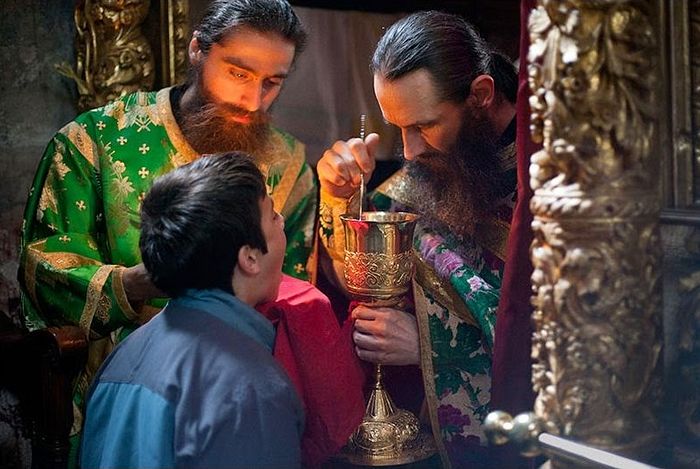
The procedure would be as follows. The priest consecrates, in addition to the large chalice, a small chalice with a little wine in it, which has been placed on the corporal as would a ciborium. [4] At communion time, after everyone else has received the host, the communicant in need of the chalice approaches and kneels. The priest brings down the small chalice from the altar, with the spoon, and gently places a few drops of the Precious Blood into the mouth of the communicant, who holds a purifactor under her mouth as a precaution. The priest then takes the purificator and returns to the altar to perform the usual ablutions, in the course of which the small chalice and spoon are rinsed as well, and dried with the purificator. [5]

Alternatively, the spoon could be skipped, and the priest tilts the chalice gently to the communicant’s lips, himself holding a purificator under the rim of the chalice. I have seen this done and it presents no difficulties. Any spillage is prevented by the purificator being present.

A last alternative — though the least desirable, because it moves into a practice stemming from and associated with the Novus Ordo — is that the communicant take the small chalice from the priest, drink its content, and return it to him. If this were to be done, the communicant should wear a pair of gloves, as is the normal respectful way for the non-ordained to handle sacred vessels.

Once accustomed to the procedure, the adding of a little wine to a small chalice, the bringing of that chalice to the person who needs it, and the cleansing of it afterward along with the other vessels should not add more than one minute to the duration of Mass. Again, I have seen all this done with my own eyes, otherwise I would not be able to speak about it with confidence. In one case, it was a diocesan priest who brought the small chalice and tilted it to the communicant’s mouth; in two other cases I have seen it done by members of the Priestly Fraternity of St. Peter. As note 2 indicates, I recently learned of an SSPX priest who uses the spoon method. Suffice it to say that this accommodation can be made and is being made.

Some may question whether it is ever necessary for a member of the faithful to receive Communion. Surely this question should answer itself. Our Lord urged His disciples to eat and drink His Flesh and Blood, and said that we would have no life within us if we failed to do so; Scripture and Tradition alike teach that baptism orders the baptized to sacramental participation in the Eucharist. This is the revealed basis for the canonical requirement that the faithful receive at least once a year, having duly cleansed their souls in Confession. Due to concomitance (Our Lord being fully present under either species), this requirement is fulfilled by receiving either the host or the chalice. If there were an extremely rare case of a person who was simply unable to receive under either species, he would have no choice, sadly, but to resign himself to the inscrutable decrees of Providence and to make fervent spiritual communions. It seems unnecessarily harsh, however, to deprive a member of the faithful of sacramental Communion simply on account of an allergy to wheat, when there is an alternative at hand.

Communion may not be denied to a properly-disposed member of the faithful, as canon 843 (CIC 1983) §1 states: “Sacred ministers cannot deny the sacraments to those who seek them at appropriate times, are properly disposed, and are not prohibited by law from receiving them.” It would seem unreasonable and unkind to say to a celiac who can commune only under the species of wine: “You are not allowed to do that at the Latin Mass, you must go instead to the Novus Ordo Mass.” This would be setting up a strange conflict or competition between forms of the Mass, when in reality the faithful should be able to satisfy their obligations and receive sacramental nourishment at either one.

Yours in Christ,

Peter Kwasniewski

ADDENDUM (6/27/22)

I should have said in the above letter that it is important to be considerate about making the request to a priest to accommodate a special need, since doing so does involve a certain inconvenience and adds a bit of time, which affects everyone present at Mass. It's not enough, in other words, to speculate that, since one is feeling unwell and can't find another cause, it must be or could be this particular food allergy. Rather, someone must be medically certain that he has this problem before bothering a priest about it; a scientific test result would seem to be appropriate in this case, for the ease of everyone's conscience.

NOTES

[1] Some priests seem to be unaware that a wheat allergy is distinct from a gluten allergy, even if they often go together. Someone who suffers from the former cannot receive even a low-gluten host without negative consequences.

[2] See “Circular Letter to all Presidents of the Episcopal Conferences concerning the use of low-gluten altar breads and mustum as matter for the celebration of the Eucharist,” sent by Joseph Cardinal Ratzinger as Prefect of the Congregation for the Doctrine of the Faith on 24 July 2003 (text here), B1: “A layperson affected by celiac disease, who is not able to receive Communion under the species of bread, including low-gluten hosts, may receive Communion under the species of wine only.”

[3] It seems that the Vatican was already thinking along these lines in a 1959 ruling from the Holy Office (Canon Law Digest on Canon 852): “The Holy Office has received the petition of Anne T., who desires to receive Holy Communion but finds it difficult to so because she suffers from a severe allergy to wheat in all its forms. After careful consideration of all the circumstances of the case, this Supreme Sacred Tribunal has decreed: ‘Favor granted whereby the petitioner may receive Holy Communion in the Oriental rite under the species of wine only; opportune safeguards are to be used to avoid wonderment on the part of the faithful.’” It seems to me that if things had evolved naturally over the next decade instead of the upheaval of the 1960s, this question would eventually have been dealt with and the same logic applied to the Roman Rite. After all, Sacrosanctum Concilium proposed a modest increase in the number and circumstances of those who could receive under both kinds, which logically includes receiving under either kind. The fact that this practice was subsequently extended indiscriminately, contrary to the Council’s provisions, does not rule out a reasonable use of it.

[4] It would be appropriate that a drop of water be added to this chalice, and that it be covered with a (small) pall.

[5] A world-famous expert on usus antiquior rubrics, Louis Tofari of Romanitas Press, wrote the following to me when I asked him for his thoughts on this matter: “Yes, I am familiar with this situation, and in fact, we had a similar one several years ago with a gentleman who also suffered from an adverse reaction from low-gluten hosts, despite several trials. So the pastor ended up doing this instead: he would consecrate a small portion of Precious Blood in another chalice and then communicate It with an Eastern Rite golden spoon and using a purificator held by the gentleman as a safeguard — thus imitating the Byzantine practice; this was also done after everyone else had received normally. This being said, the gentleman was not a daily Mass-goer, so this was done only on Sundays usually, and with advance notice from him (and not every Sunday at that, either). So this is certainly an extraordinary option for an extraordinary situation and to my mind, perfectly legitimate. Note also, Fr. N. is an older priest and a former district superior, thus had quite a great deal of pastoral experience.”

Monday, November 29, 2021

The Collects of Advent: Who is Being Addressed, and What Difference Does It Make?

Some time ago, when my duties with two different choirs had me attending both the traditional and post-Conciliar rites, I noticed a striking difference in content and tone in the Advent Collects of the two rites, so I decided to look into the contrast between the totality of their Advent Collects. [1]

In the traditional rite, the Collects of the first, third, and fourth Sundays of Advent address the Second Person of the Blessed Trinity:
Stir up Thy power, we beseech Thee, O Lord, and come: that from the threatening dangers of our sins we may deserve to be rescued by Thy protection, and to be saved by Thy deliverance: Who livest and reignest with God the Father… (Collect, Sunday I, MR 1962)
Incline Thine ear, we beseech Thee, O Lord, to our petitions: and, by the grace of Thy visitation, enlighten the darkness of our minds: Who livest and reignest with God the Father… (Collect, Sunday III, MR 1962)
Stir up Thy power, we beseech Thee, O Lord, and come, and with great might succour us: that by the help of Thy grace that which is hindered by our sins may be hastened by Thy merciful forgiveness: Who livest and reignest with God the Father… (Collect, Sunday IV, MR 1962)
On the Second Sunday, the Father is addressed:
Stir up our hearts, O Lord, to prepare the ways of Thine only-begotten Son: that through His coming we may deserve to serve Thee with purified minds: Who liveth and reigneth with Thee in the unity of the Holy Ghost… (Collect, Sunday II, MR 1962)
If we look at the Ember days, the picture is more complex. Ember Wednesday’s first Collect addresses the Father (“Grant, we beseech Thee, Almighty God … through our Lord”) while its second Collect addresses the Son (“Hasten, we beseech Thee, O Lord, tarry not”). Ember Saturday’s six different Collects address the Father four times — namely, the second through the fifth Collects — but the first and last are to the Son:
O God, who seest that we are afflicted because of our iniquity, mercifully grant that we may be comforted by Thy visitation. Who livest and reignest with God the Father… (Ember Saturday, first Collect, MR 1962)
Mercifully hear, O Lord, we beseech Thee, the prayers of Thy people: that we who are justly afflicted for our sins may be comforted by the visitation of Thy loving kindness: Who livest and reignest with God the Father… (Ember Saturday, last [sixth] Collect, MR 1962)
The Collect on Ember Friday likewise addresses the Son:
Stir up Thy might, we beseech Thee, O Lord, and come: that they who trust in Thy loving kindness may be the more speedily freed from all adversity: Who livest and reignest with God the Father… (Ember Friday, MR 1962)
Apart from special Collects for certain feast days (e.g., the Immaculate Conception), these are the only Collects found in the traditional Roman Missal for the Advent season as such (and, importantly, they are never omitted, because even on feasts, the Advent feria is always commemorated). Therefore the missal furnishes a total of 7 distinct collects addressed to the Son, and 6 to the Father, in the following pattern:

          First Sunday – SON
          Second Sunday – FATHER
          Third Sunday – SON
          Ember Wednesday – FATHER, SON
          Ember Friday – SON
          Ember Saturday – SON, FATHER, FATHER, FATHER, FATHER, SON
          Fourth Sunday – SON

Going out on an allegorical limb with my betters, such as William Durandus, I would note that, according to the Fathers of the Church, the number 6 represents creation, because of the 6 days in Genesis, and because 6 is one of those rare numbers whose component parts, 1, 2, and 3, are equal whether they are added (1+2+3) or multipled (1x2x3), suggesting the relative integrity and solidity of the created order: “God saw all that He had made, and behold, it was very good.” At the same time, six falls one short of the number seven, the number of perfection and of rest, indicating that creation, particularly the rational creature, is incomplete until it rests in God — and that, after the fall of Adam, it is groaning for redemption from sin. Jesus Christ, in other words, is the One who, “added” to creation, brings it to its perfection and ultimate rest in the beatific vision. Thus, a group of six Collects for the Father, to whom is appropriated the power of creating the universe, and a group of seven collects for the Son, to whom is appropriated the wisdom and mercy of redemption, appears beautifully fitting.

In the post-Conciliar redaction, on the other hand, many of the ancient Advent Collects were scrapped or reconfigured, and nearly all of the Collects were forced into the Patricentric mold so favored by reformers in the grip of archaeologism or antiquarianism, who removed prayers directed to the Son whenever and wherever possible. [2] We have this new series of Sunday Collects, none of which addresses the Son:
Grant your faithful, we pray, almighty God, the resolve to run forth to meet your Christ with righteous deeds at his coming, so that, gathered at his right hand, they may be worthy to possess the heavenly Kingdom. Through our Lord Jesus Christ… (Sunday I, Collect, MR 1970/2002)
Almighty and merciful God, may no earthly undertaking hinder those who set out in haste to meet your Son, but may our learning of heavenly wisdom gain us admittance to his company. Who lives and reigns with you… (Sunday II, Collect, MR 1970/2002)
O God, who see how your people faithfully await the feast of the Lord’s Nativity, enable us, we pray, to attain the joys of so great a salvation and to celebrate them always with solemn worship and glad rejoicing. Through our Lord Jesus Christ… (Sunday III, Collect, MR 1970/2002)
Pour forth, we beseech you, O Lord, your grace into our hearts, that we, to whom the Incarnation of Christ your Son was made known by the message of an Angel, may by his Passion and Cross be brought to the glory of his Resurrection. Who lives and reigns with you… (Sunday IV, Collect, MR 1970/2002) [3]
The ferial Collects added to the new missal also follow the same subordinating pattern, with only two exceptions addressed to the Second Person: Friday of the first week uses the same prayer as the first Sunday of Advent in MR 1962, and the Collect of the morning Mass on December 24 uses a version of the second collect for Ember Wednesday in MR 1962. Because there is a different Collect every day in the MR 1970/2002, while the MR 1962 uses certain prayers again and again, a little math will give us telling results. Of all the Advent Collects in the usus recentior, 27 are addressed to the Father, and only 2 to the Son. During the same season, the usus antiquior will have prayed Collects addressed to the Son as God 21 times, and to the Father 12 times.

What do we make of this difference?

These Christocentric Collects of the usus antiquior, both in their addressee and in their repetition, emphasize the urgency of the Church’s cry during the Advent season, the cry of all mankind and of all creation longing for its very Lord to come, by an ineffable miracle, into its bosom, to heal it and elevate it from within: VENI, DOMINE — Come, Lord Jesus, do not delay. Maranatha. Rise up and save a fallen race. Come to rescue us from our misery and sin. We are calling out to the Messiah, the Christ of Israel, who has already come to earth, whom we wish to invite again into our hearts, and who will return to judge the living and the dead. Advent is the season of expecting the long-awaited Redeemer and Savior, and we, in our holy impatience, cannot resist calling out to Him. EXCITA, we boldly say, over and over: Stir up Thy power and come, do not delay, do not be silent, do not be invisible, do not leave us to our wretchedness. O Word, eternal Life, take on flesh and touch us with Thy flesh. Only Holy Mother Church, filled with the Spirit of God, could dare to pray thus, placing these words on the lips of our ancestors and of so many saints who worshiped with the traditional Roman Rite.

In short, the usus antiquior missal presents us with a spirituality of Advent that is distinctive and fitting to it, whereas the usus recentior missal conforms its prayers to a generic rule prescribed by academic liturgists. The old Collects are highly expressive, emotionally charged, as of the longing of the bride for her Bridegroom, to whom she sings and whispers directly. In her passionate love she is more caught up in beseeching Him whose face she longs to see than in politely asking His Father to send Him when the time is right (though, of course, with her gentle courtesy, she also speaks humbly to His Father, since the two are inseparable in their Godhead). It is the fervor of the Song of Songs carried over into liturgical prayer. [4]

Modern liturgists approach liturgy as if it were an a priori science: you start with principles and deduce consequences. Therefore you have to change around the Collects (for instance) if they don’t conform to your particular set of principles. In reality, liturgy is thoroughly a posteriori: it is an historical testament to which countless individuals contributed, a massive organic complexus of particulars that could have been otherwise but are the way they are, a river running down the ages into which innumerable streams have flowed. Thus, we must look to the liturgy as it is and seek to understand why it unfolded in this manner, rather than doing violence to it by forcing it to embody one’s mental presuppositions.

The change to the Advent Collects is a good example of the cold rationalism of the reformers. It would be one thing if a liturgical rite had always addressed prayers to the Father on a certain feast or in a certain season. No one, obviously, is saying there is anything wrong with doing that, for it is the customary mode of address in all historic missals. But it is quite another thing if one’s actual liturgy for many centuries, perhaps for as long as we have records (and, moreover, the liturgy that one had prayed oneself!) always prayed to the Son on certain days, marking them out as special and deserving of a special devotion to the Lamb of God. To care little or nothing about the fact that, by a series of committee decisions, one would be cutting out and ceasing to utter those hallowed prayers to Our Lord in the weeks running up to His Nativity shows the extent to which the liturgy, for these men, must have already ceased to be something deeply felt and lived. It had become, instead, the prey and sport of their theories of improvement, and in this sense, something believed to be inferior to their wills and intellects. This is perhaps the worst indictment of their entire modus operandi: that prayers for which Catholics would in former ages have been prepared to lay down their lives were treated as so many raw ingredients to be chopped and mixed in an industrial kitchen.

Indeed, it is more than a little ironic that the Epistle for the Fourth Sunday of Advent in the traditional Roman Rite is 1 Corinthians 4, 1-5, wherein St. Paul says, in words that are repeated four times in the Divine Office:
Brethren: Let a man so account us, as ministers of Christ and stewards of the mysteries of God. Now here it is required in stewards that a man be found faithful/trustworthy.
St. Paul is telling us that the minister of Christ, the steward of His mysteries, is required to be faithful to that which he is dispensing or administering, namely, the sacraments, the liturgy, the heritage he receives from another, in regard to which he is not a master but a servant. Of course, this reading, too, disappeared from Advent in the sack of the Roman Rite, no doubt because it was deemed seasonally inappropriate.

These final days of Advent, when we address the Son of God in the great “O Antiphons” at Vespers, let us cherish the many subtle and obvious blessings He has given to us through the traditional liturgy. Let us thank Him for the countless ways it forms and nourishes our souls in the school of the Lord’s service. And let us seek its return on the widest possible scale to churches everywhere. For this intention, too, we pray to our Sovereign King and Eternal High Priest: Excita, quaesumus, Domine, potentiam tuam, et veni.

NOTES

[1] Lauren Pristas is naturally the preeminent scholar on all such questions. See chapter 3 of her The Collects of the Roman Missals.

[2] I discuss the many instances of this subordinating tendency and their implications in chapter 6 of my book Resurgent in the Midst of Crisis.

[3] I am aware that much of the language in these prayers is drawn from historical sources, but their placement and arrangement here, and the corresponding displacement of the customary prayers, is, for the Roman Rite, an innovation pure and simple.

[4] Readings and antiphons from the Song of Songs are found much more often in the traditional Missal and Divine Office than in the Novus Ordo books, but to explore the reasons behind that anti-medieval shift would require a separate article.

Tuesday, April 06, 2021

In Praise of Irregularity

No, this article is not a plea for bending and breaking the Church’s matrimonial rules. In fact, it has almost nothing to do with the subject of marriage — except perhaps in a sense to which I will return at the end.

The irregularity to which I refer is none other than the many beautiful differences that characterize the various seasons of the liturgical year in the usus antiquior. The traditional rubrics, texts, and chants of Lent and Easter bring the contrasting characters of their seasons strongly to the fore: in Lent we suppress the Alleluia while in Paschaltide we sing it repeatedly; the Gloria disappears and then returns with exultation; the Gloria Patri drops away in Passiontide and enters the liturgy anew with Easter. There are many such elements and structures of differentiation, and while the Ordinary Form retains some of them, many, even most, were abandoned.

The traditional Latin Mass and Divine Office display a plethora of differences between seasons as well as on certain special days of the year, be it Ember Days, Rogation Days, All Souls, Candlemas, or what have you. These irregularities or deliberate departures from the “standard” approach magnify the psychological power of the rites and augment their spiritual impact. They also help worshipers enter more deeply into particular mysteries, seasons, or feasts by, on the one hand, startling them out of rote habit, and, on the other hand, building up over the years subliminal associations that reinforce the particular graces besought by the Church at that time.

Three of my favorite distinctive marks take place in Masses around and after Easter. First, there is the use of the Gradual Haec dies during the entire Octave, albeit with changing verses for each day.[1] The constant refrain in the Mass (and in the Office, too) of “THIS is the day that the Lord has made” strongly reinforces the idea of the Octave as one gigantic celebration, and therefore paves the way to experiencing it thus. Moreover, the liturgy preserves the important formulation: “exultemus et laetemur in ea,” let us rejoice and be glad in it, that is, in this wonderful Day of the Lord, the Dayspring from on high, the New Song, the Risen Christ Himself. The postconciliar translation “Let us rejoice and be glad,” period, sounds like a generic exhortation to be happy. “Let us rejoice and be glad in it” points us to the object of our rejoicing, the cause of our gladness, which is none other than the Easter mystery itself, in the Person of the ever-living Christ. While the Haec diesis an option for every day of Easter Week in the Ordinary Form (simply consult the Graduale Romanum of 1974), it is almost never met with in the wild. When the responsorial psalm of year-round familiarity is chosen, an opportunity is lost — from a textual and structural point of view — for emphasizing the differentness, uniqueness, and unity of the Octave by means of the interlectional psalm.

A second distinctive mark in the usus antiquior is the addition of “alleluia” to almost everything: the versicles of Mass and Office (e.g., “V. Ostende nobis…alleluia / R. Et salutare tuum…alleluia”) and all the antiphons at Mass, not to mention the word’s prominence in the Vidi aquam, the Regina caeli, and other Paschal chants and hymns. The sequence Victimae Paschali, which is required to be used every day of the octave, ends with an intense “Amen, alleluia.” Holy Mother Church, the immaculate bride, cannot contain her joy at the resurrection of her Lord, and sings this word of jubilation whenever and wherever she can. Again, it makes a difference that these numerous Alleluias are required to be said or sung in the usus antiquior, whereas they are rarely exercised options in the Ordinary Form. The usus antiquiorpours forth a joyous flood of alleluias — indeed, like water flowing from the temple — enacting with potent literalness the well-known line from St. Augustine, “we are an Easter people and Alleluia is our song.”
This brings me to a third distinctive mark of the ancient Roman liturgy in Easter season, and my personal favorite: the use of a double Alleluia before the Gospel during the weeks of Paschaltide. When the priest or subdeacon finishes chanting the Epistle, the Schola begins to sing — not a Gradual as throughout the year, nor a Tract as in Lent, but a special Alleluia with a verse of its own, followed by another Alleluia and verse, both drawing more heavily than usual upon New Testament texts (e.g., Mt 28:7 and Jn 20:26 on Low Sunday, Lk 24:35 on Good Shepherd Sunday, Lk 24:46 on the Third Sunday after Easter, etc.). The chanted alleluias for the Sundays after Pentecost are already lavish in their contemplative splendor; add another of the same character, and you are starting to swim in the shallows of the Eighth Day. There is a kind of suspension of time and place in these great Paschal alleluias, as if one would wish to linger forever in the more-than-mortal joy of the Resurrection, in the sober inebriation of the Spirit, remembering and resting in the victory of our King, before resuming the fight against the world, the flesh, and the devil.

Traditionally, the Gradual, Tract, and Alleluia are all fairly lengthy interlectional chants, written in a melismatic style for the sake of meditating on the Word of God, allowing it to soak in, and preparing the ground for the Gospel as by the application of a long, slow dripline. Although the twin chanted Alleluias are an option in the Ordinary Form (see once more the Graduale Romanum of 1974), they are rarely used, for two simple reasons. First, in the reformed liturgy, the Responsorial Psalm was introduced as an opportunity for verbal participation and the Alleluia changed into a short and easily-repeatable acclamation that rouses people to stand for the Gospel. In this way the historic character and liturgical function of the interlectional chants were fundamentally altered, and with them, the requisite aesthetic forms. If the expectation is that people will speak or sing the psalm and the alleluia (and stand up for the latter), it is obvious that two melismatic Alleluias back to back will not serve the purpose. Of course, this is not to say that Alleluia acclamations cannot be done beautifully—my own choir, when assisting at the Ordinary Form, sings either a Bach setting or a Mozart setting at this juncture, either of which comes across nobly—but we must recognize that we are dealing with a different thing from what the Alleluia had been for most of the history of the liturgy.[2]

The double Alleluia from the Fourth Sunday after Easter (EF)

In the traditional Latin Mass, such beautiful Paschal “touches” or “flourishes” are built into the liturgy itself, and no choice is given about whether to exercise them or not. It offers us a privileged spiritual freedom of experiencing more sharply, more actively, the mysteries of the Lord by demanding of us that we modify certain musical habits, adjust our singing and praying according to the seasons, and in all things submit ourselves to a certain cosmic and sacramental rhythm that is far greater than ourselves and our generation.

The foregoing examples (and there are more as we range across the liturgical year and its celebrations — particular during Holy Week) show how, in the name of a certain drive towards simplification and ease of access, some of the inner riches, one might even say the well-regulated irregularities, of the sacred liturgy were lost. As Catherine Pickstock has pointed out, it is ironic that on the cusp of postmodernity and its (at least purported) appreciation for otherness, difference, and pluralism, institutional choices valorized sameness, uniformity, standardization. This is certainly one legacy that the recovery of the usus antiquior can help the Church to move decisively beyond, as we seek to reconnect with the history and anthropology of Catholic worship. Thus, learning about the origin and meaning of special Paschal elements in the usus antiquior will awaken clergy and musicians to the desirability of exercising them in the Ordinary Form as the permissible and choiceworthy options they are, in this way not only rebuilding fallen bridges between old and new, but, more importantly, offering Catholics today a more intense and memorable experience of the bright victory of Easter.

I said at the start that this post had little to do with marriage, but there is one parallel worth pointing out. In a healthy marriage, the spouses make an effort to do things that are out of the ordinary for one another. On special occasions like anniversaries or birthdays, flowers or chocolates may enter the home, or the couple may go out on a date. Married people do this sort of thing because they know that a uniform monotonous routine, which takes too much for granted, is a recipe for mental and emotional stagnation. They know, in other words, that sometimes the best rule is to have a certain irregularity. Christ’s beautiful Bride, the Church, has known and lived the same secret: her liturgical traditions are the evidence. It will be wise for us to know and live this secret, too.

NOTES

[1] The Roman liturgy is fairly austere and reserved in its Easter celebrations as compared with the Eastern rites or even the other medieval Western rites (as Gregory DiPippo discussed in connection with Vespers of the Easter octave two years ago), and yet it still has its own treasures that must not be allowed to vanish owing to the pressure of “market forces.” An example would be the distinctive sections of the Roman Canon for Easter week, which, of course, are printed in the OF altar missal, but will be heard only by those fortunate enough to have a priest who chooses the venerable Roman Canon during the Octave.

[2] For discussion of the meaning and importance of interlectional chants, see William Mahrt’s The Musical Shape of the Liturgy.

Monday, February 01, 2021

A Comparison of the Old and New Blessing of Candles on Candlemas

Coped priest blessing candles at the side of the altar (usus antiquior)
Of late, comparing and contrasting the prayers of the Pauline modern missal with those of the traditional Roman missal has been a passionate avocation of mine. Taking my cue from Lauren Pristas and Matthew Hazell, true masters of this labor, I find that simply placing the old and new texts beside one another and pondering their differences can be an extraordinarily enlightening exercise. It tends to confirm, time and time again, the doctrinal richness, ascetical realism, and poetic flair of the old prayers and the absense of these qualities in the new.

In this article I shall compare the prayers for the blessing of candles on February 2nd, Candlemas day, known in the old calendar as the Purification of the Blessed Virgin Mary, and in the new calendar, with a Grecophilic nod, as the Presentation of the Lord.

The first and most obvious difference is that the traditional Roman rite blesses the candles by means of a sequence of five prayers, in which is expressed a well-developed theology of candles as sacramentals; of how they relate to the order of creation and the order of redemption; of the liturgical reenactment and mystical participation in Christ’s own entrance into the temple; of Jesus Christ as the light of the world and His Spirit as the internal fire/light that guides us through the “perilous darkness of this life to the never-failing light” of heaven; of Simeon as a model of one so guided, whom we should imitate as we receive Jesus in the substance of our flesh; and of the connection between the oil Moses commanded to be prepared so that lamps might burn continuously in the Lord’s presence and the blessed candles we now burn as symbols of the “lumen Spiritus” in our inward minds. The prayers are particularly outstanding for their pneumatology.

A second obvious difference is the repetition of the act of blessing the candles, which is similar to the many signs of blessing to be found in the traditional rite of Mass (think of the Roman Canon!), the rite of blessing of holy water, the rite of baptism, and so forth. Precisely seven times the priest makes the sign of the cross over the candles, using the language “bless and sanctify” in the first, second, and third prayers, and asking one last time for “the grace of Thy blessing” in the fifth prayer.

First prayer

DOMINE sancte, Pater omnipotens, æterne Deus, qui omnia ex nihilo creasti, et jussu tuo per opera apum, hunc liquorem ad perfectionem cerei venire fecisti: et qui hodierna die petitionem justi Simeonis implesti: te humiliter deprecamur; ut has candelas ad usus hominem, et sanitatem corporum et animarum, sive in terra, sive in aquis, per invocationem tui sanctissimi nominis, et per intercessionem beatæ Mariæ semper Virginis, cujus hodie festa devote celebrantur, et per preces omnium Sanctorum tuorum benedicere, et sanctificare digneris: et hujus plebis tuæ, quæ illas honorifice inmanibus desiderat portare, teque cantando laudare, exaudias voces de cælo sancto tuo, et de sede majestatis tuæ: et propitius sis omnibus clamantibus ad te, quos redemisti pretioso Sanguine Filii tui: Qui tecum vivit et regnat in unitate Spiritus Sancti Deus, per omnia sæcula sæculorum. R. Amen.

(Holy Lord, Father almighty, everlasting God, who hast created all things out of nothing, and by Thy command hast caused this liquid to become perfect wax by the labour of bees: and who, on this day didst fulfil the petition of the righteous man, Simeon: we humbly entreat Thee, that by the invocation of Thy most holy Name and through the intercession of Blessed Mary ever Virgin whose feast is today devoutly observed, and by the prayers of all Thy Saints, Thou wouldst vouchsafe to bless ✠ and sancti✠fy these candles for the service of men and for the health of their bodies and souls, whether on land or on sea: and that Thou wouldst hear from Thy holy heaven, and from the throne of Thy Majesty the voices of this Thy people, who desire to carry them in their hands with honour, and to sing Your praises; and that You would look with favour on all who call upon You, whom You have redeemed with the precious Blood of Your Son, who being God, lives and reigns with You in the unity of the Holy Ghost, world without end. R. Amen.)

Monday, November 09, 2020

The Four Qualities of Liturgy: Validity, Licitness, Fittingness, and Authenticity

Below is the full text of the lecture I gave at Queen of Peace Parish in Patton, Pennsylvania, on September 21, 2020, a video of which has also been posted at YouTube (here). Although certain ideas in this talk have been discussed in other articles of mine, the synthesis offered here represents, for me at least, an intellectual breakthrough in responding to what I have increasingly come to see as the impoverished state of liturgical discourse, which is typically limited to only two categories (validity and liceity). Although much attention is paid to fittingness in the realm of sacred art, it deserves to be considered a liturgical category alongside the aforementioned pair; and finally, joining these must be the category of authenticity or legitimacy, as an irreducibly distinct perfection. Only by considering all four qualities can we arrive at an adequate assessment. [UPDATED ON 11/12/20 with an improved version of the chart.]

The celebration of the traditional Mass of the Roman Rite is becoming more and more common; it seems that its popularity has been an unintended consequence of both the chaos of the current pontificate and the disappointment of many Catholics with their pastors and parishes during the COVID pandemic. “Enough is enough!” is a frequently heard reaction. People are looking for worship that is reverent, prayerful, God-oriented, and deeply refreshing, and for priests who are truly committed to the care of souls. This, of course, is the work of the Holy Spirit, tugging at the heartstrings of baptized and confirmed Catholics, in whom there was planted the seed of Trinitarian life, which urges us to enter into the divine mystery.

However, there are certain difficulties in our situation, too. A vast amount of information, good, bad, indifferent, and inaccurate, circulates on the internet. Lay Catholics are seldom equipped to be able to understand what they’re reading about, especially when we get “into the weeds” of liturgical history and reform. How are blogs going to equip us with the ability to navigate thorny questions about the pope’s authority, the Church’s fidelity to tradition, the duty of obedience (and the limits thereof), and so on? There is a great need for careful, thoughtful, well-informed presentations on liturgical matters, so that we can deepen our understanding of the complex issues involved, without losing the simplicity of our faith, or the spontaneity of our interior life as we strive to be the saints Our Lord is calling us to be.

After many years, I have come to the realization that a lot of the time, people are talking past one another in liturgical discussions, and that is because they are talking about different aspects or properties of the liturgy, while failing to make the necessary distinctions. There are, in fact, four properties that are always supposed to belong to any liturgy: validity; licitness; fittingness; and authenticity. All of them are important, none of them is dispensable. They are meant to work together, in harmony, to bring us the fullness of divine worship intended by Christ for His Church. The problems we have experienced in recent decades have a lot to do with an exaggerated emphasis on one or another of these qualities, at the expense of the rest. I will begin by defining each one, and then talk about how they are related.

Validity

First, validity. With validity we are looking at a fairly straightforward question: does a sacrament happen or not? At the Council of Florence, the Church officially adopted the scholastic language of “matter and form” to indicate the two parts of any sacrament — the material things it uses and the words spoken in connection with them. [1] This Council taught: “All these Sacraments are accomplished by three elements, namely, by things as the matter; by words as the form; and by the person of the minister who confers the Sacrament with the intention of doing that which the Church does. If any of these is lacking, the Sacrament is not accomplished.” [2]

So, for example, in baptism the water is poured over the person’s head, while the minister speaks the words: “I baptize you in the name of the Father, and of the Son, and of the Holy Spirit.” St. Augustine wrote: “Take away the words, what then is the water but water? The words are added to the element, and the Sacrament emerges.” The washing with water in the name of the Trinity then accomplishes spiritually what washing with water does physically, namely, cleanses and refreshes. That is why we say a sacrament “effects what it signifies.” And we can go through each of the seven sacraments this way, seeing what the material thing used is, and what the words are, and what effects are signified by the combination of the matter and form. This is a very rich topic but for my purposes, we are looking at validity, that is, why baptism happens, and our answer is: the correct words were said, with the correct matter, by someone capable of performing the action, who intends to do what the Catholic Church does, even if he doesn’t fully understand what that might be.

Sometimes Catholic theology strikes observers as arcane and esoteric, but in point of fact, problems with validity arise from time to time in Church history, and we need to be equipped to deal with them. The notorious recent case of Fr. Matthew Hood comes to mind. Fr. Hood, serving as a priest in the archdiocese of Detroit, discovered early last August that he had been baptized by a deacon who used the formula “We baptize you,” which was judged invalid by a decision of the Congregation for the Doctrine of the Faith published on August 6th. As a result, Hood realized he had never been baptized, and therefore had never been confirmed or ordained to the priesthood, since each subsequent sacrament rests on the foundation of the preceding ones. He had to receive all these sacraments for the first time — and then deal with the messy fallout that resulted for other people who had depended on his ministry. For example, all the confirmations he had done, all the marriages, all the absolutions, all the last rites — all of these were absolutely null and utterly void. Do we have need for any further proof that the words we say and the actions we perform make a difference?

I mentioned a moment ago that the one who performs the sacrament has to have the right intention. Some Catholics get themselves tied up in knots about what intention is necessary, and they tend to exaggerate the explicitness and orthodoxy of the required intention. All that is required is that the priest have a virtual (not even an explicit) intention to perform a ritual of the Catholic Church by following the words and actions of the rite as given in the liturgical book. He does not need to have a good theological grasp of what he is doing, and he might even have an heretical understanding of it, as, unfortunately, a lot of clergy may have nowadays, due to their poor seminary training. He might be doing the sacrament for money, or for personal vanity, or to get promoted to a better position, etc. Still, if he thinks he is doing what the Church does — though he misunderstands it, or sins because of personal unworthiness — that intention suffices for validity.

If a priest’s theological competence, subjective motivations, or personal sanctity were necessary components of a valid sacrament, we would be thrown into constant doubts about whether the sacraments are efficacious, which is clearly not what Our Lord desires, or what He instituted. He planned better than that. As the Church teaches, Christ Himself is the primary agent in every sacrament: He is the one who baptizes, who confirms, who absolves, who transubstantiates. The priest is an intelligent instrument — intelligent, yes, which is why intentionality is required; but still an instrument, like a hammer or a saw. [3]

(That, by the way, is why the Detroit deacon’s baptisms were invalid, as Matthew Hood discovered to his horror: the deacon was saying “We baptize you,” referring to the Christian community, which precisely contradicts the fundamental truth: “It is I, Jesus Christ, who am baptizing you through my visible minister, who lends his voice and hands to Me.” Interestingly, the Byzantine tradition uses a completely different formula in the passive voice: “The servant of God, N., is baptized in the name of the Father, and of the Son, and of the Holy Spirit.” Although so very different, this formula makes it clear that it is not the local community or any individual man by himself who incorporates a person into Christ; rather, this happens by God’s gracious action: “The servant of God is baptized,” with Christ implied as the one baptizing.)

To sum up this point, I will quote from theologian Roger Nutt:

[A] sacramental celebration is understood to be “valid” if it is executed by the proper minister in such a way that the sacrament is truly brought into being. Invalidity happens when the celebration is executed by an unauthorized minister or when the matter and form are so defective that the sign is not brought about. An invalid celebration indicates, precisely, that a sacrament was never brought into being and thus, absent the sacrament, none of the sacramental effects are conferred. [4]
Now, who gets to determine what counts for validity? Canon law states that “the sacraments of the New Testament were instituted by Christ the Lord and entrusted to the Church” [5] (indeed, this is a de fide dogma), and then in Canon 841 draws this conclusion: “Since the sacraments are the same for the whole Church and belong to the divine deposit, it is only for the supreme authority of the Church to approve or define the requirements for their validity.” Hence, we can say without any doubt that what counts as a valid sacramental rite, and the conditions for its performance, are solely the competence of the supreme authority of the Church, which means either the Pope by himself, or the Pope together with the college of bishops, as at an ecumenical council.

It is not possible, if we hold to the Catholic Faith, to call into question or to doubt the validity of a sacramental rite duly and correctly promulgated. This means, for example, that the Novus Ordo Missae, or the other postconciliar sacramental rites, insofar as they have been duly promulgated by the authority of the Church, are valid, no matter how much their deficiencies or their discontinuities with age-old Catholic tradition deserve to be critiqued, and no matter how much better the traditional rites may be. Validity is not about better and worse, more beautiful and less beautiful, more worthy or less worthy; it is a binary switch with two settings: on or off. Thus, either baptism happens, or it does not; either transubstantiation happens, or it does not.

But beyond saying whether something happened or not, we must also ask whether it happened rightly or correctly. That is what the other three qualities concern.

Licitness

Second, then, there is the licitness or legality of a sacrament. On this quality, I will again quote Roger Nutt, who says right after the passage I quoted a moment ago:
A licit celebration is one that is performed according to the prescribed rite of the Church, while an illicit celebration is one that directly deviates in some way from the prescribed rite. An illicit sacramental celebration does not vitiate the validity and therefore reality of the sacrament… [6]

Fr. Bernard Leeming says, more precisely:

Valid is often used as distinct from licit, which is said of a sacrament in whose administration and reception no law is broken; for unlawful administration of a sacrament does not ipso facto render it invalid. Thus a priest who is suspended or excommunicated can validly administer all sacraments except Penance, which requires jurisdiction, but he sins by so doing, if he acts contumaciously, and the faithful sin if they receive sacraments from him without some justifying reason. [7]

The term “licit” comes from the Latin verb licére, which means to allow. Licitness or liceity has to do with what is permitted, and, by extension, what is required or forbidden to Christians. In the domain of the sacraments and the liturgy, it primarily concerns the questions: Who is allowed to perform or to receive a given sacrament, and under what circumstances? If a priest or bishop in good standing, following all the conditions set forth in canon law, celebrates a liturgical rite according to the books promulgated by the supreme authority of the Church, saying the black and doing the red (in other words, reading just the texts that are printed, and following the rubrics without deviation), then he celebrates licitly. He has done, in other words, that which he had permission to do; that which he was required to do; and nothing that he is forbidden to do.

On the other hand, it is not licit for a Latin-rite priest to celebrate a Byzantine liturgy, unless he has first received canonical permission to do so; it is not licit for a laicized or degraded priest to offer Mass; it is not licit for a priest in a state of mortal sin to offer Mass; it is not licit to celebrate Mass with rice crackers and sake instead of wheat bread and wine from grapes (and that would also make it invalid); it is not licit to ad lib the opening prayer, or to play a John Lennon song in place of the psalm, or to read from a binder a Eucharistic Prayer written by liberation theologians from Nicaragua. As a matter of fact, any intentional deviation from the liturgical books, either in their texts or in their rubrics, is illicit, and makes the liturgy illicit to a greater or lesser extent. Moreover, it is not licit to receive Communion without having fasted for at least one hour beforehand; and, above all, it is not licit for anyone to receive Holy Communion in a state of mortal sin.

Two things will be immediately obvious from the foregoing list of examples.

First, some of these things are matters of mere canon law, that is, positive law created by the Church and changeable by her, while some things are matters of divine or natural law, which the Church can articulate, but does not originate and therefore can never alter. [8] The rule that we must fast for a certain period of time before Communion is a positive ecclesiastical law that can change and has changed a lot; not very long ago, the requirement was three hours (which in many ways would be much better), and not long before that, the rule was to fast from midnight onwards. But the rule that we must — so far as we can ascertain by examining our consciences — be in a state of grace in order to receive Communion is a matter of divine law, which is clear from chapter 11 of St. Paul’s Letter to the Corinthians, where he says that someone who eats the Body of Christ unworthily eats damnation, and that a man should examine his conscience accordingly. No council or pope could ever change this rule.

Second, the Church today, at least in Western nations, is in grave trouble, since the vast majority of liturgies are illicit in one way or another; both ministers and recipients of sacraments have become habituated to illicitness. The crisis in the Church is, as Joseph Ratzinger said, in large part caused by the crisis in the liturgy.

The main point with the category of licitness (or liceity, as some prefer to call it) is that the sacred liturgy or divine worship, and with it, our sanctification by the mysteries of Christ, is a communal, ecclesial, hierarchical activity. Christ entrusted the work and the means of sanctification to His Church, and therefore, to her authorized heads. It is not something “between Jesus and me,” as our individualistic, atomistic age might think of it, a matter of convenience or personal choice, but rather, something between Christ and the Church, into which we are privileged to be inserted, as recipients and subordinates. Back in 2004, the Congregation for Divine Worship and the Discipline of the Sacraments issued an instruction called Redemptionis Sacramentum, which addressed many of the most common liturgical problems and abuses of the Novus Ordo. In words that are of universal application, the document eloquently says:

The Mystery of the Eucharist “is too great for anyone to permit himself to treat it according to his own whim, so that its sacredness and its universal ordering would be obscured.” On the contrary, anyone who acts thus by giving free reign to his own inclinations, even if he is a Priest, injures the substantial unity of the Roman Rite, which ought to be vigorously preserved, and becomes responsible for actions that are in no way consistent with the hunger and thirst for the living God that is experienced by the people today. Nor do such actions serve authentic pastoral care or proper liturgical renewal; instead, they deprive Christ’s faithful of their patrimony and their heritage. For arbitrary actions are not conducive to true renewal, but are detrimental to the right of Christ’s faithful to a liturgical celebration that is an expression of the Church’s life in accordance with her tradition and discipline. In the end, they introduce elements of distortion and disharmony into the very celebration of the Eucharist, which is oriented in its own lofty way and by its very nature to signifying and wondrously bringing about the communion of divine life and the unity of the People of God. The result is uncertainty in matters of doctrine, perplexity and scandal on the part of the People of God, and, almost as a necessary consequence, vigorous opposition, all of which greatly confuse and sadden many of Christ’s faithful...
          On the contrary, it is the right of all of Christ’s faithful that the Liturgy, and in particular the celebration of Holy Mass, should truly be as the Church wishes, according to her stipulations as prescribed in the liturgical books and in the other laws and norms. Likewise, the Catholic people have the right that the Sacrifice of the Holy Mass should be celebrated for them in an integral manner, according to the entire doctrine of the Church’s Magisterium. [9]
The same document says later on:

In an altogether particular manner, let everyone do all that is in their power to ensure that the Most Holy Sacrament of the Eucharist will be protected from any and every irreverence or distortion and that all abuses be thoroughly corrected. This is a most serious duty incumbent upon each and every one, and all are bound to carry it out without any favoritism. [10]

Sadly, Redemptionis Sacramentum seems to have gone to that special place in the sky, or over the seas, or under the earth, where all unwelcome Vatican documents go for their eternal rest, and where it has been forgotten like the unremembered dead. In the current COVID-19 situation, we have seen how readily bishops and priests, in their frenzy to avoid contamination with or transmission of the virus, are violating liturgical law in the most scandalous ways. In fact, Dr. Joseph Shaw makes a very important point here about clergy who are willing to experiment with or manipulate the liturgy:

The reason they feel free to play fast and loose with the liturgy is not because they feel strongly about sacramental validity and don’t care about anything else, but because they don’t care very much about sacramental validity either. They may be influenced by the idea that bishops and the Holy See feel strongly about validity, and they may allow us to comfort ourselves with the thought, when it is possible, that the sacrament was in this or that case valid. But if they really cared about validity, they would take the liturgy seriously, and that is something they are manifestly not doing.
          Liturgical abuses are an offense against God, as the abuse of something holy. They are also an offense against the faithful, whose spiritual engagement in the liturgy is impeded. Again, they are an offense against our Lord, who instituted the sacraments for our salvation, and [against] Holy Mother Church, who has surrounded them with ceremonies and texts intended to give God glory and to assist us in our participation. Finally, they are an offense against the priesthood itself, which should protect the liturgy from profanation, and whose function is to provide it to others for the good of souls.

The mention of “ceremonies and texts intended to give God glory and to assist us in our participation” is a perfect segue to the third quality, fittingness.

Fittingness

Consider the following statement: “All that matters at Mass is that Jesus is present; everything else is secondary.” Or, more succinctly, “the Mass is the Mass.” Undoubtedly it matters a great deal that Jesus is present, for otherwise we are eating no more than ordinary food. But the liturgy has a greater purpose than putting on a meal for us, and even Our Lord’s presence has a greater scope and purpose than sacramental communion. The Mass is the solemn, public, formal act of adoration, thanksgiving, and supplication offered by Christ the High Priest to the Father, and by His entire Mystical Body in union with Him. It is the foremost act of the virtue of religion, by which we offer to God a sacrifice of praise worthy of His glory. It is the chief expression of the theological virtues of faith, hope, and charity. It is the kingdom of heaven breaking into our earthly time and space. It is the nuptial feast of the King of Kings. It is the recapitulation of the entire created universe in its Alpha and Omega.

Because it is all these things, the Church down through the ages has spared no effort and no expense to augment the beauty and elevate the solemnity of her liturgical rites. As John Paul II rightly said: “Like the woman who anointed Jesus in Bethany, the Church has feared no ‘extravagance,’ devoting the best of her resources to expressing her wonder and adoration before the unsurpassable gift of the Eucharist.” [11] So while it may be true that the only things necessary for a valid Mass in the Roman Rite are unleavened bread made from wheat and wine made from grapes, a priest, and the words of consecration, to see this as sufficient for the offering of the Holy Sacrifice of the Mass would betray a reductive, minimalist, and parsimonious view of things. Glorifying God and sanctifying our souls cannot be detached from the fittingness of the worship we offer Him. What the Council of Trent declares about the Roman Canon can be applied more generally to the whole of the Church’s liturgical life:

Since it is fitting that holy things be administered in a holy manner, and of all things this sacrifice is the most holy, the Catholic Church, to the end that it might be worthily and reverently offered and received, instituted many centuries ago the holy canon, which is so free from error that it contains nothing that does not in the highest degree savor of a certain holiness and piety and raise up to God the minds of those who offer. For it consists partly of the very words of the Lord, partly of the traditions of the Apostles, and also of pious regulations of holy pontiffs.
The essence of the Church’s liturgy is simple: it is precontained in the Heart of Christ, our Eternal High Priest, where all worthy worship perpetually exists. But the “clothing” of that worship is of decisive importance to us, who interact with Our Lord through His visible Body, the Church, and her visible rites. How these rites are structured, performed, and participated in will inevitably influence our understanding of the mysteries of the Faith and our ability to live them out. The clothing draped over the body of our prayers is, if anything, of far greater importance than any clothing a human being puts on.

When someone is attracted to the traditional Latin liturgy for its beauty to the eye and to the ear, it is not because he is stuck on these things, but because these things coalesce around the reality, the Sacrifice of the Cross, and make it stand forth with a satisfying clarity. The sensible or perceptible qualities so harmonize with the nature of the mystery that the result is the splendor of the truth. For men as body-soul composites, for Christians as disciples of the Word-made-flesh, there must be both elements: the truth and the splendor. Dom Gerard Calvet offers the perfect commentary:
One enters the Church by two doors: the door of the intelligence and the door of beauty. The narrow door...is that of intelligence; it is open to intellectuals and scholars. The wider door is that of beauty. The Church in her impenetrable mystery...has need of an earthly epiphany accessible to all: this is the majesty of her temples, the splendour of her liturgy and the sweetness of her chants.
          Take a group of Japanese tourists visiting Notre Dame Cathedral in Paris. They look at the height of the stained-glass windows, the harmony of the proportions. Suppose that at that moment, sacred ministers dressed in orphried velvet copes enter in procession for solemn Vespers. The visitors watch in silence; they are entranced: beauty has opened its doors to them. Now the Summa Theologiae of St. Thomas Aquinas and Notre Dame in Paris are products of the same era. They say the same thing. But who among the visitors has read the Summa of St. Thomas? The same phenomenon is found at all levels. The tourists who visit the Acropolis in Athens are confronted with a civilisation of beauty. But who among them can understand Aristotle?
          And so it is with the beauty of the liturgy. More than anything else it deserves to be called the splendour of the truth. It opens to the small and the great alike the treasures of its magnificence: the beauty of psalmody, sacred chants and texts, candles, harmony of movement and dignity of bearing. With sovereign art the liturgy exercises a truly seductive influence on souls, whom it touches directly, even before the spirit perceives its influence. [12]

For this very reason — that the externals are meant to tell us something about the reality to which they are in service, and draw us towards it — we must take care that they harmonize, that the outward aspect does not openly or subtly contradict the inward. It would be unfitting to put a king’s robes on a pauper, or a gold ring in a pig’s snout: there is discordance between the decoration and the thing decorated. The same holds in the other direction: a king does not wear dirty rags nor his horse a cheap saddle. Putting the king’s robes on the king, and bedecking his mount in regal fashion: this is dignum et justum. The surface should correspond to the thing’s nature and lead us directly into it. This is not to be “caught up in” the externals, but to be caught up by the externals into the inner meaning. [13]

In other words: although it is not necessary for validity or licitness that a liturgy should look and sound as if we are entering the realm of the transcendent God and that He is accomplishing something divine and transformative among us, it is nevertheless highly fitting or suitable that it be done in this manner. And, as a matter of fact, the whole history of the liturgy cannot be understood unless we have grasped this essential fact: nearly all of its development can be attributed to the demands of fittingness.

Nor should we be surprised at the role it plays. Fittingness or suitability — convenientia in the language of theologians — is one of the central concepts of dogmatic theology, as we can see in the writings of St. Anselm and St. Thomas Aquinas. Convenientia is a kind of necessity, a necessity based on what is appropriate for a given situation, what is decorous, proper, harmonious, corresponding to all the factors in play, or to the being about whom one is inquiring. When St. Thomas takes up the question “Must God create a world?,” he answers: “No, not by absolute necessity, for God, as infinite good, is self-sufficient and needs nothing else; but it is fitting that He share His goodness by causing finite good things to exist.” This immediately prompts another question: “Once God creates, must he create a rational or intellectual creature?” And the answer, again, is: “God is free to create any world He wishes; but it is fitting that He crown the order of creation with creatures that are as like to Him as possible, which means, beings possessed of intellect and will.” Much later on, when St. Thomas comes to the question: “Was the Incarnation necessary for the salvation of mankind?,” he again answers in this manner: “It was not simply necessary, since God could have saved man by willing it in His omnipotence. Nevertheless, it was most fitting that the Son of God become man, for many reasons: since man had sinned, it was fitting that man should make reparation; but only a sinless man of infinite merit could repair for the sin of Adam and all subsequent sins; moreover, man withdrew from spiritual goods to bodily goods, so it was right that he be restored to spiritual life by the bodily life of Christ; because the dignity of human nature consists in the image of God in the soul, it was appropriate for the Word, the perfect image of God, to restore that reflected image in man; nothing could show forth God’s extravagant love better than for His Son to lower Himself to human estate, suffer, and die in exchange for slaves; and so forth (Aquinas gives many such arguments for the fittingness of the Incarnation and the Passion). [14]

My point here is that, as the eminent Thomist Fr. Gilbert Narcisse maintains, convenientia is the central driving principle of Thomistic theology; without it, theology would be almost barren of development. So, too, the liturgy of the Church would have been barren had it not been for an ever-increasing awareness, prompted by the Holy Spirit, of the many ways in which the sacramental mysteries can be more fully expressed in words and gestures, in vestments and vessels, in music and architecture — in everything that pertains to the senses, the imagination, the memory, and the intellect’s capacity for symbolism. Fittingness is connected intimately with beauty, including moral beauty or honestas, a Latin word that refers to the condition of being reputable, honorable, upright, worthy.

Genealogy of Christ

More recent articles:

For more articles, see the NLM archives: