Tuesday, July 16, 2024

The Feast of Our Lady of Mt Carmel

Seen above is the central panel of the altarpiece painted by Pietro Lorenzetti (ca. 1280 - 1347) for the Carmelite church of his native city of Siena, San Niccolò del Carmine. The altarpiece is now dismembered and removed from its original frame; most of the surviving pieces are in the National Gallery of Siena, but the two narrower panels originally on either side of the central one are in the Norton Simon Museum in Pasadena, California, and a smaller piece from the top is at Yale University.

To the left of the Virgin stands St Nicholas, to whom the church is dedicated; to the right is the prophet Elijah. On the scroll in his hands are written the words which he speaks in 3 Kings 18, 19: “Nevertheless send now, and gather unto me all Israel, unto Mount Carmel, and the prophets of Baal four hundred and fifty.” The Carmelites have traditionally honored the prophet Elijah and his disciple Elisha as their founders; in the liturgical books of both the Old Observance and the Discalced, they are each given the title “Our Father”, as is St Dominic in the Dominican Use, St Benedict in the Monastic Use, etc. Both orders also add the name of Elijah to the Confiteor, the Discalced even before that of St Theresa of Avila. Their feasts were kept with octaves, a traditional privilege of patronal feasts, even before an octave was given to the feast of Our Lady of Mount Carmel on July 16th.

The tradition behind this is recorded in the lessons of the Roman Breviary for the latter feast, with the cautionary parenthetical note “ut fertur – as the story goes” added at the beginning. In the Books of Kings, there are several references to a group of holy men called “the sons of the prophets”. They foretell to Elisha that Elijah is to be taken away by the Lord, although Elisha already knows this, and afterwards bear witness that “the spirit of Elijah resteth upon Elisha,” who then works several miracles on their behalf. The traditional Carmelite legend claims that a group of men dedicated to God remained on Mount Carmel until the days of the New Testament, when they were “prepared by the preaching of John the Baptist for the coming of Christ”, and “at once embraced the faith of the Gospel.” They are also said to be the first Christians to build a chapel in honor of the Virgin Mary, on the very spot on Mount Carmel where Elijah had seen the “little cloud”, understood as a symbol of the Virgin Mary.

One of the two pieces now in Pasadena shows St John the Baptist; it was originally placed to the right of the central panel, so that he would be next to Elijah, since John went before the Lord “in the spirit and power of Elijah”, and the Lord Himself said in reference to him, “Elijah has already returned.” On the left was the panel of Elisha, looking very much like an Eastern monk, despite his Carmelite habit; on his scroll is written “Elijah went up by a whirlwind into heaven. And Elisha saw him, and cried: My father, my father, the chariot of I[srael, and the driver thereof.]” (4 Kings 2, 11-12)

Even for an age in which the veneration of the Virgin Mary may truly be described as omnipresent, the city of Siena stood out as a place of particular devotion to Her. In 1260, before the crucial battle of Montaperti, the city placed herself by a special vow under the protection of the Virgin, and proceeded to heavily defeat her long-time rival Florence, whose army was nearly twice as large as her own. Both the cathedral and the city hall were prominently decorated with famous paintings of the Virgin enthroned, of the type known as a “Maestà”; the former had that of Duccio di Buoninsegna, commissioned less than twenty years before Lorenzetti’s Carmelite altarpiece, and the latter that of Simone Martini from just twelve years before. When Lorenzetti’s work was finished, the mendicant Carmelites could not afford to pay for it, and so the artist’s fee was provided by the city itself.

Despite all this, the panels at the bottom of the altarpiece are not dedicated to the principal subject of the main panel, as they would normally be, but rather to the prophet Elijah. In the first, an angel appears to his father, with a prophecy of his son’s future greatness, just as an angel would later appear to the father of St John the Baptist.

In the second, we see hermits in the desert around a fountain, which was said to have been built for them by Elijah. These would be the spiritual ancestors of the Carmelite Order, men who lived as monks in the Greek tradition in the Holy Land, before being organized under a rule during the period of the Crusader kingdoms.

The striped mantle which they are wearing is part of the habit worn by the Carmelites when they still lived in the Holy Land; because of it they were often called in Latin “fratres barrati – barred friars”, or “fratres virgulati – striped friars.” A tradition of the medieval Carmelites held that these stripes represented the tracks of the chariot that took Elijah into heaven, and had been inherited as part of their habit from Elisha.

When the Carmelites were forced to abandon the Holy Land at the fall of the Latin kingdoms, they brought their traditions, including the habit, with them to Western Europe, where the striped mantle was considered completely outlandish for religious of any kind, but especially for medicants. Many of the universities refused to admit them dressed that way; hence, the decision of a general chapter held at Montpelier in 1287 to replace it with the white mantle still worn to this day. This was a matter of some controversy within the order at the time, and the prophets are shown by Lorenzetti in the “new” habit probably as a gesture to persuade the friars to accept it.

Thursday, July 16, 2020

The Feast of Our Lady of Mt Carmel

Seen above is the central panel of the altarpiece painted by Pietro Lorenzetti (ca. 1280 - 1347) for the Carmelite church of his native city of Siena, San Niccolò del Carmine. The altarpiece is now dismembered and removed from its original frame; most of the surviving pieces are in the National Gallery of Siena, but the two narrower panels originally on either side of the central one are in the Norton Simon Museum in Pasadena, California, and a smaller piece from the top is at Yale University.

To the left of the Virgin stands St Nicholas, to whom the church is dedicated; to the right is the prophet Elijah. On the scroll in his hands are written the words which he speaks in 3 Kings 18, 19: “Nevertheless send now, and gather unto me all Israel, unto Mount Carmel, and the prophets of Baal four hundred and fifty.” The Carmelites have traditionally honored the prophet Elijah and his disciple Elisha as their founders; in the liturgical books of both the Old Observance and the Discalced, they are each given the title “Our Father”, as is St Dominic in the Dominican Use, St Benedict in the Monastic Use, etc. Both orders also add the name of Elijah to the Confiteor, the Discalced even before that of St Theresa of Avila. Their feasts were kept with octaves, a traditional privilege of patronal feasts, even before an octave was given to the feast of Our Lady of Mount Carmel on July 16th.

The tradition behind this is recorded in the lessons of the Roman Breviary for the latter feast, with the cautionary parenthetical note “ut fertur – as the story goes” added at the beginning. In the Books of Kings, there are several references to a group of holy men called “the sons of the prophets”. They foretell to Elisha that Elijah is to be taken away by the Lord, although Elisha already knows this, and afterwards bear witness that “the spirit of Elijah resteth upon Elisha,” who then works several miracles on their behalf. The traditional Carmelite legend claims that a group of men dedicated to God remained on Mount Carmel until the days of the New Testament, when they were “prepared by the preaching of John the Baptist for the coming of Christ”, and “at once embraced the faith of the Gospel.” They are also said to be the first Christians to build a chapel in honor of the Virgin Mary, on the very spot on Mount Carmel where Elijah had seen the “little cloud”, understood as a symbol of the Virgin Mary.

One of the two pieces now in Pasadena shows St John the Baptist; it was originally placed to the right of the central panel, so that he would be next to Elijah, since John went before the Lord “in the spirit and power of Elijah”, and the Lord Himself said in reference to him, “Elijah has already returned.” On the left was the panel of Elisha, looking very much like an Eastern monk, despite his Carmelite habit; on his scroll is written “Elijah went up by a whirlwind into heaven. And Elisha saw him, and cried: My father, my father, the chariot of I[srael, and the driver thereof.]” (4 Kings 2, 11-12)
Even for an age in which the veneration of the Virgin Mary may truly be described as omnipresent, the city of Siena stood out as a place of particular devotion to Her. In 1260, before the crucial battle of Montaperti, the city placed herself by a special vow under the protection of the Virgin, and proceeded to heavily defeat her long-time rival Florence, whose army was nearly twice as large as her own. Both the cathedral and the city hall were prominently decorated with famous paintings of the Virgin enthroned, of the type known as a “Maestà”; the former had that of Duccio di Buoninsegna, commissioned less than twenty years before Lorenzetti’s Carmelite altarpiece, and the latter that of Simone Martini from just twelve years before. When Lorenzetti’s work was finished, the mendicant Carmelites could not afford to pay for it, and so the artist’s fee was provided by the city itself.

Despite all this, the panels at the bottom of the altarpiece are not dedicated to the principal subject of the main panel, as they would normally be, but rather to the prophet Elijah. In the first, an angel appears to his father, with a prophecy of his son’s future greatness, just as an angel would later appear to the father of St John the Baptist.
In the second, we see hermits in the desert around a fountain, which was said to have been built for them by Elijah. These would be the spiritual ancestors of the Carmelite Order, men who lived as monks in the Greek tradition in the Holy Land, before being organized under a rule during the period of the Crusader kingdoms.
The striped mantle which they are wearing is part of the habit worn by the Carmelites when they still lived in the Holy Land; because of it they were often called in Latin “fratres barrati – barred friars”, or “fratres virgulati – striped friars.” A tradition of the medieval Carmelites held that these stripes represented the tracks of the chariot that took Elijah into heaven, and had been inherited as part of their habit from Elisha.

When the Carmelites were forced to abandon the Holy Land at the fall of the Latin kingdoms, they brought their traditions, including the habit, with them to Western Europe, where the striped mantle was considered completely outlandish for religious of any kind, but especially for medicants. Many of the universities refused to admit them dressed that way; hence, the decision of a general chapter held at Montpelier in 1287 to replace it with the white mantle still worn to this day. This was a matter of some controversy within the order at the time, and the prophets are shown by Lorenzetti in the “new” habit probably as a gesture to persuade the friars to accept it.

Monday, October 01, 2018

St. Thérèse of Lisieux on the Sacristans of Her Convent

Many readers will be familiar with this wonderful photograph of St. Thérèse, shown posing in her work of filling the ciborium with hosts (among other typical functions of a sacristan) for the daily conventual Mass:
This, of course, is much in keeping with the usual customs of women’s monasteries, where the sisters perform many of the tasks that would otherwise be assigned to clerics, such as leading the entire Divine Office and chanting its readings and prayers; making the responses at low Mass from outside the sanctuary in situations where no servers are available; and, in some rare cases, chanting the epistle at Mass (see Shawn Tribe’s “Carthusian Nuns and the Use of the Maniple and Stole”).

A photo that is much less known, and which I myself saw only for the first time recently, shows Thérèse with, if I may so say, her liturgical assistants in November 1896. Three of them are her blood sisters Marie, Pauline, and Céline (Sr. Marie of the Sacred Heart, Mother Agnes of Jesus, and St. Geneviève of the Holy Face) and one is her aunt Marie Guérin (Sr. Marie of the Eucharist). Sr. Marie of the Eucharist, Sr. Marie of the Angels (not in the photo), and St. Thérèse were the sacristans, while her three blood sisters were altar bread bakers[1]:

St. Thérèse was a gifted amateur poet and playwright who composed a surprising amount of literary work in her spare moments during her nine years as a Carmelite nun. Some of her work was intended for public occasions such as recreations, birthdays, and feastdays, while other pieces were more private, sent to one or a few of her religious sisters.

In the same month of November 1896, she wrote a poem called “The Sacristans of Carmel,” in rhyming octosyllabic verse, which I wish to share with readers in honor of the Little Flower’s feast (whether you are celebrating it today on the new calendar or two days from now on the old calendar).

The poem was written for Sr. Marie Philomena, who had asked Thérèse for something she could sing while baking; but it was first read by her aunt. Later, all of the sacristans and altar bread bakers got to know the poem, and apparently sang it regularly in their work, to whatever familiar tune they chose that would match the meter. In this we see a splendid example of the genre of a “work song” that has nearly disappeared from the world of mass-marketed and passively consumed entertainment. One may hope such work songs still survive in the Carmels.

The religious and theological content of the song are quite worth of attention. Here is the ICS translation, slightly modified to make it more literal[2]:
1. Here below our sweet office
Is to prepare for the altar
The bread and wine of the Sacrifice
Which brings to earth—“Heaven”!

2. Heaven, O supreme mystery!,
Hides itself under humble bread,
For Heaven, it is Jesus Himself,
Coming to us each morning.

3. There are no queens on earth
Who are happier than we.
Our office is a prayer
Which unites us to our Spouse.

4. This greatest honors of this world
Cannot compare
To the peace, profound and heavenly,
Which Jesus lets us savor.

5. We bring a holy envy
For the work of our hands,
For the little white host
Which is to veil our divine Lamb.

6. But his love has chosen us.
He is our Spouse, our Friend.
We are also hosts
Which Jesus wants to change into Himself.

7. Sublime mission of the Priest,
You become our mission here below.
Transformed by the Divine Master,
It is He who guides our steps.

8. We must help the apostles
By our prayers, our love.
Their battlefields are ours.
For them we fight each day.

9. The hidden God of the tabernacle
Who also hides in our hearts,
O what a miracle! at our voice
Deigns to pardon sinners!

10. Our happiness and our glory
Is to work for Jesus.
His beautiful Heaven is the ciborium
We want to fill with souls!...
The original draft
I heartily agree with the Carmelite commentators who find this poem both charming and insightful:
The sacristans are the untiring agents of this mysterious exchange [between heaven and earth]. In this poem, they readily call to mind something like Jacob’s ladder. These stanzas are full of “gentleness.” There is the discreet gentleness of the “housewife,” if we dare call it that: of the spouse “happier than a queen” whose heart remains attentive to her Husband, while her hands are diligently working for Him. There is also the discreet gentleness of the Carmelite nun, who is associated with the apostle at the altar in the role that is hers, that of the hidden companion. In both cases, the assistant becomes like the one she assists. …
       Here she [Thérèse] sings of her concrete way of sharing immediately in the “sublime mission of the Priest.” “Transformed” into Jesus by the Eucharist, “changed” into Him, does she not then also become an “alter Christus”…? She cannot leave her cloister to “preach the Gospel,” but Jesus, the first Missionary, walks in her and through her. He “guides her steps,” as He does those of the apostles she prays for, loves, and struggles for.
       She cannot absolve from sins. But Jesus present in her through the Eucharist gives her a share in his ministry of reconciling sinners.
       She will never fill the ciborium with consecrated hosts. But she is spending her life “filling Heaven with souls”—living hosts in which Christ lives alone from then on. …
       So Thérèse has no inferiority complex toward “men” or priests. She has no presumption either. For her, it is Jesus who acts in collaboration with men—and women. Even in 1892, she wrote to Céline: “I find that our share is really beautiful; what have we to envy in priests?”[3]
In fact, if we may use the awkward expression “holy envy,” it will always be the case that each Christian vocation has reason to admire the goods of every other, since these goods are not, simply speaking, compatible with one another. The priest may well “envy” the female religious her total and silent dedication to prayer, which he will almost never attain in his active ministry; the married man or woman may “envy” the consecrated soul its undivided attentiveness or availability for the things of the Lord (cf. 1 Cor 7); the consecrated man or woman may “envy” the married their sacramental realization of the faithful, fruitful union of Christ and the Church, which brings new immortal souls into the world, to complete the number of the elect. In the Mother of God alone do we find united that which nature cannot unite, combining and exceeding all Christian states of life: she is the wife unwed, the child-bearing virgin, mother inviolate, mediatrix of all grace as the inseparable minister of the High Priest. In her all vocations are at one, like white light before it splinters into a spectrum of colors. For the rest of us, the individual colors are distinct, complementary, and beautiful, as they are intended to be, for our individual benefit and for the common good of the Church.

St. Thérèse’s poem serves as a profitable meditation on several intertwined mysteries: the unique, exalted, and irreplaceable nature of the ministerial priesthood; the lofty participation in Christ the High Priest enjoyed by all who are baptized into His sacerdotal and royal dignity; the special position of consecrated religious, who follow the priestly and sacrificial Lamb whithersoever He goeth; and the value in God’s sight of the quiet, humble work done by sacristans whenever they reverently prepare the materials and environs required for worthily offering the sacrifice of praise.

NOTES

[1] For this and other details, I am indebted to the excellent commentary in The Poetry of Saint Thérèse of Lisieux, trans. Donald Kinney, OCD (Washington, DC: ICS Publications, 1996), 169–70.

[2] The translation is found in Kinney, Poetry, 170–71, as well as at this website. The French is contained in Kinney, pp. 301–302.

[3] Kinney, Poetry, 169–70.

The fair copy

Thursday, August 30, 2018

Bishop Gainer Interview on the TLM and Vocations

Back in May, we posted an item about a new Carmel which has been founded in Fairfield, Pennsylvania, in the diocese of Harrisburg, which uses the traditional Mass and Office, and is undergoing a surge in vocations. Last month, on the feast of St James the Apostle, His Excellency Ronald Gainer, the bishop of Harrisburg, celebrated a Pontifical High Mass in the Extraordinary Form to officially open the monastery and bless the new buildings, still, as you will see, very much under construction. After the Mass, he gave this interview in which he speaks among other things of the traditional liturgy as a powerful source of religious vocations. For more information about the Fairfield Carmel, see their website here: https://www.fairfieldcarmelites.org/. We thank and congratulate Bishop Gainer for his support of this important initiative, and pray that it will bear much fruit for the Church in his diocese.

Wednesday, May 30, 2018

In the Heart of the Church, a New Carmel and Center of Traditional Liturgy

New Liturgical Movement is pleased to make this announcement on behalf of the Carmelite sisters of Fairfield. Their noble project will be of great interest to many of our readers. Pray for God's blessings on their worthy endeavors.

A New Carmel
To continue and perpetuate the vital work of love in the heart of the Church, a new beautiful Monastery of Discalced Carmelite Nuns is being constructed (http://fairfieldcarmelites.org) in the quiet rural farmland of Fairfield, Pennsylvania. This beautiful new property will provide a fitting home for an interior blossoming of monastic life and will be ready to receive a constant stream of vocations zealous for God and His Church.
“In the heart of the Church, my mother, I will be love, and thus I will be all things!” (St. Therese of Lisieux)
The Carmelite in the Heart of the Church
The Carmelite Nun is a consecrated bride of Christ who is called to give herself unreservedly to the work of her Divine Bridegroom: the salvation of the world. In union with the Savior and imitating the Blessed Virgin Mary, Carmelites are hidden away in the heart of the Church, beating day and night with the rhythm of continuous prayer and sacrifice, in order to bring the vital flow of divine grace to the other members of the Mystical Body of Christ. Like the heart concealed in the chest, behind grilles, turnstiles, and high enclosure walls, they joyfully pursue a life of prayer and sacrifice so that they might glorify and love God—even for those who do not—and make reparation for sin, obtain heavenly aid for the clergy, support the labors of missionaries, preserve the unity of families, and increase divine charity in all the faithful for their eternal benefit.
“The smallest act of pure love is of greater value in the eyes of God, and more profitable to the Church, than the greatest works.” (St. John of the Cross)
The new Carmel in Fairfield is a daughter of the vibrant and growing Carmels in Valparaiso, Nebraska and Elysburg, Pennsylvania. The Nuns pray the full traditional Divine Office and have the Traditional Latin Mass daily, which is open to the public.
Making History
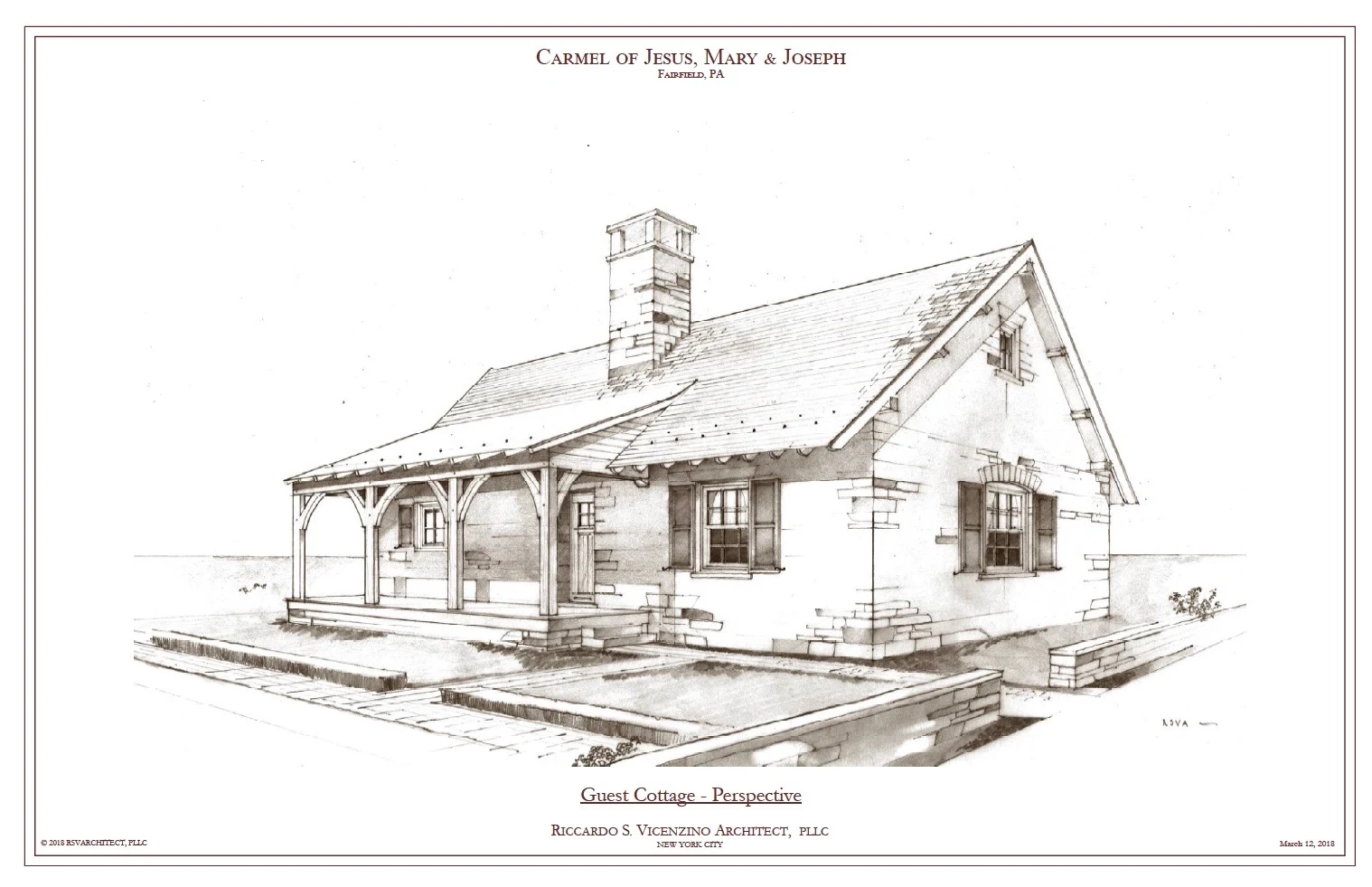
This Carmel of Jesus, Mary, and Joseph in Fairfield is being built according to the traditional style of an original 16th Century Spanish monastery, not merely for its aesthetic value, but for the quality and integrity of religious observance that is fostered by the beauty and simplicity of traditional monastic architecture. As the Nuns draw from the riches of their Spanish Carmelite architectural heritage, this new monastery will also be built using traditional building methods. Thus, stone masonry, timber framing, slate, plaster, and reclaimed wood for flooring will be used to recreate the simple but edifying style of an original 16th Century Carmel, for a shining example of the beauty of the Catholic Religion and a testimony to the world of the glory of God.
Visitors to the Carmel will be able to be immersed in the graces of the prayer of Nuns, which reverberates within their cloister walls in the silence of holy contemplation, echoes in their devout recitation of the Divine Office, and resounds on high in the sublimest chant at the Holy Sacrifice of the Mass. Furthermore, the contemplative religious brothers and priests of the Hermits of Our Lady of Mount Carmel in the area will help provide the Sacraments to visitors and a place of hospitality in a guest and retreat house near the Carmel of Jesus, Mary, and Joseph, helping to make Fairfield, within driving distance of many Catholics on the East Coast, a center of prayerful retreat and spiritual refreshment for priests, religious, and the lay faithful coming from the region and around the country.
Going on now and until July 25th, 2018, a series of stone and timber framing workshops will be held by professional craftsmen from Europe to begin construction on some of the initial facilities for the Carmel. These and future workshops are aimed at cultivating a workforce comprised of both volunteers and professionals. No previous experience or training is required. Both volunteers and professionals are invited to participate and can gain new certifications through this project. There is no charge for the course, and those who are interested in registering may call the Carmel of Jesus, Mary and Joseph at 570-672-2122 to learn more.


“Build the house: and it shall be acceptable to me, and I shall be glorified, saith the Lord.” (Haggai 1:8)
How You Can Help Make History
As these Carmelite Nuns offer their spiritual labors day and night for the eternal benefit of souls, this unique and historic work for Our Lord and Our Lady depends on the material support of the faithful in the construction of this house of God for generations to come. Organizations, families, and individuals are welcome to contribute or volunteer in a variety of ways in the construction and support of the Carmel, at any time of year. Also, your generous financial donation is much appreciated to realize in Fairfield a center of beautiful traditional liturgy for the enduring benefit of many souls. The St. Teresa of Jesus insisted to her religious daughters: “we live upon alms.”
For more information and to support this Carmel in making history, please visit http://fairfieldcarmelites.org. May God reward you!

More recent articles:

For more articles, see the NLM archives: