Tuesday, April 07, 2026

A Papal Latinist Comments on the Victimae Paschali

A friend on social media recently shared this link to a recording of Fr Reginald Foster OCD, one of the great Latin scholars of our age, commenting on the Latinity of the Easter sequence Victimae Paschali. This was originally broadcast on Vatican Radio as part of a program in which he regularly participated called The Latin Lover. The link is one of dozens hosted on a website run by Fr Gary Coulter; the program was originally broadcast on Good Friday of 2007.

https://www.frcoulter.com/latin/latinlover/latin_04_06_07.mp3

Fr Foster was a American priest of the Discalced Carmelite Order who worked at the Vatican for 41 years (1968-2009) in the office that produces the official Latin text of all kinds of ecclesiastical documents. For most of that period, he also taught Latin at the Gregorian University during the regular academic year, and offered a summer intensive course (8 weeks, 6 days a week, plus excursions on most Sundays) that was frequented by students from all over the world. The breadth and depth of his knowledge of Latin were truly astonishing, and he was one of the most talented, generous and patient teachers one could ever hope to meet. His health declined quite badly in his later years, but he continued to teach as much as he could for as long as he could, until he passed away on Christmas day of 2020. Gaudeat in Paschate sempiterno!

Wednesday, May 07, 2025

Why the Traditional Mass Should Remain In Latin

In spite of attempts to suppress it, the traditional Latin Mass is here to stay. It may not be as widespread as it was in the halcyon days of Summorum Pontificum, but neither is it exactly hidden under a bushel, as the early Christians were during the Roman persecutions. In many cites, gigantic parishes run by former Ecclesia Dei institutes are packed with faithful every Sunday. No, this is not going away; and the sooner a future pope comes to terms with the reality on the ground, the better off we’ll all be.

Unfortunately, due to the way the internet encourages the spontaneous expression of feelings and ideas (or some mixture of the two), a lot of premature and undercooked opinions tend to be expressed. One of the most frequent proposals I see being floated is this one: “Wouldn’t it be just grand if we could have the TLM in the vernacular? This would kill two birds with one stone: We get the traditional liturgy, but without the language barrier! Everyone would flock to it and the breach between old and new could be healed at last!” Even prominent figures among the Oratorians are not hesitate about expressing this opinion.

An NLM reader once wrote to me:

I have read certain articles of yours in which you treat of the question of introducing the vernacular into the traditional rites in a limited fashion and come out decidedly against it. I myself prefer an entirely Latin liturgy in all respects, lessons included—indeed my daughter’s (old rite) baptism was entirely in Latin, including the godparents’ responses. The only vernacular was the Pater and Credo in the procession to the sanctuary (per custom). I think that there is a certain dissonance in “mixing” languages liturgically, with the obvious exceptions of the Greek Kyrie and various Hebrew words, especially if I am saying “and with your spirit” at one point and “et cum spiritu tuo” at another point. There is an imbalance there that I can’t precisely explain.
       Yet, I was reading Dobszay’s treatment of the issue in which he argues that the introduction of certain vernacular elements alongside, not in place of, the Latin would be highly beneficial for the simple reason that the entirely Latin liturgy is, truly, a stumbling block for many who are otherwise friendly to the tradition. Yes, I understand that man is to be formed into the image of the liturgy, and not vice versa—St. Benedict, after all, urges ut mens concordet voci—that the mind harmonize with the voice—which, in addition to sounding “quaint,” actually is quite radical when compared to the modern emphasis on “authenticity” (wrongly identified with virtual formlessness). And, with the necessary reservations, viz. the Orations, Canon, and silent prayers remaining in Latin, Dobszay nevertheless suggests the possibility of not only the lessons, but also at times the proper chants and Mass ordinary being authorized in a hieratic vernacular. (And for this purpose, let us assume that the principal parish Mass would be required to be fully in Latin, so the totally-Latin liturgy would still play a truly primary role in the Church’s liturgical life.)
       Don’t misunderstand me: I am not saying that the introduction of the vernacular is “necessary” from a liturgical standpoint. But I am haunted by Dobszay’s point that a moderate introduction of the occasional hieratic vernacular would serve to de-ghettoize the classical Roman liturgy and thereby increase its appeal. In this way, the ancient heritage would enter the ecclesial mainstream instead of remaining on the relative margins.
       To put it bluntly: is an unbending adherence to the exclusive use of Latin semper et ubique in the liturgy ultimately wise, if the price to pay is that the authentic tradition (form and content) remains a marginalized minority? Would not a moderate use of a hieratic vernacular be a small price to pay for the greater expansion of the Roman heritage? Is this not a legitimate instance of the perfect being the enemy of the good? Moderate vernacular usage for the lessons seems to be one of those things that, for better or worse, we are stuck with permanently, and I worry that we might lose too many lives battling on this hill while losing the mountain.

I remain unconvinced. Just as Marshall McLuhan maintained that bringing microphones into churches would undermine the numinous character of the liturgy (and how right he was), I am equally convinced that de-Latinization would spell the end of the Roman rite in its distinctive character, as much as abolishing icons would do to the Byzantine liturgy. Here I would like to offer some reasons why I think this.

A Fundamental Argument
Among the Eastern Christian churches, we find considerable linguistic diversity, which has led in some cases to the development of sacral languages and in others to almost total vernacularization. In the Western church, however, we find an impressive and almost monolithic unity: Latin is the language par excellence for all Western rites and uses.

Now, this monumental linguistic unity is either the work of Divine Providence and of the Holy Spirit, or a huge error, deviation, and problem to be overcome. I maintain that the only acceptable Roman Catholic mentality is the former; the latter leads necessarily to the overthrowing of all liturgical standards: if not even Latin is safe, then neither is ad orientem, communion under one kind, plainchant and polyphony, a proleptic Offertory, etc.

And, in point of fact, this is exactly what we saw in the liturgical reform, whose proponents and implementers tended to reject all of those so-called “medieval” features (even though many are properly ancient).

An Aesthetic Argument
Martin Mosebach maintains that the use of Latin is primarily responsible for the creation of a sacral atmosphere from start to finish in the traditional Mass. The moment it begins, one knows one is in a different “place,” one is moving on a different level; the workaday world has been left behind, and one is entering the divine domain. The vernacular, no matter how well translated, or how archaic in sound, does not have this requisite otherness. As Michael Fiedrowicz says, the Latin reminds us that we are seeking something else in worship than what we find everywhere else.

As for alternating between Latin and vernacular, it is no more coherent than a man with a tuxedo jacket on top and blue jeans on the bottom.

A Pastoral Argument
There is already an insidious tendency for Catholics to splinter into factions the moment someone decides to move the flowers above the altar one inch to the left or the right. We are all rather high-strung at this point, and, in addition to the need to relax a bit, we also need to supply as few incentives for division as possible. Changing the language that has been part and parcel of the liturgy for over 1,600 years would be a nuclear bomb in that regard: instantly, there would be all-Latin communities and mixed-language communities. Indeed, we already have that, because of the “two forms”; the last thing we need is further balkanization.

Moreover, use of the vernacular, so far from uniting people who speak a common language, instantly segregates the faithful into categories. Some would prefer an archaic translation such as the Douay-Rheims; others would agitate for the Revised Standard Version or (God forbid) the New American Bible. And if the Vatican or the USCCB got involved, it would all go south in five minutes. With Latin, no one can complain: we are using the language that all the saints before us prayed with. Each person can then pick up whatever hand missal suits him best.

One difficulty with modern languages is that they do not possess sufficient “alterity” and “elevation” to serve as liturgical languages. The traditional Anglicans and the Ordinariates use Elizabethan English, which I’m sure sounded normal back in Shakespeare’s day but now sounds formal, elevated, and a little strange. To have liturgy in the vernacular requires a sacral register, which, it seems, today’s Church is incapable of producing. Moreover, the Byzantine Divine Liturgy is not a good example because it achieves its effects in a totally different way, through waves and waves of poetic speech and singing. The Roman liturgy is austere and slender; much of its affective power depends on Latin, silence, and chant—the three elements of the sonic iconostasis.

Additional Theological Arguments
In general, we overestimate the primacy of verbal comprehension. It is often non-verbal signs and behaviors that affect us more deeply. I think this is above all true for acquiring the spirit of reverence and prayer at liturgy.

As people know from experience, there are many ways to participate in a Latin liturgy. It takes many years to grasp it—which is appropriate for the greatest mystery on earth. One starts with simple steps, like a “child’s missal,” and eventually works up to an adult’s missal with all the translations—and finally, one knows it so well that one can put aside the missal and simply yield oneself to the liturgy. This can happen more easily with the Tridentine rite because it has fewer options and fewer texts that become familiar over time. It takes a long time to enter fully into it, and it ought to be this way.

One learns to swim by starting in the shallow end and eventually venturing into the deep end. The traditional liturgy in its richness of symbolism, its pageantry of ceremony, its beautiful musical patrimony, offers many “handles” to grab on to. I remember my son being fascinating with the coordinated movements of the servers in their sacred choreography. Another little boy I know loves watching the thurifer handle the thurible, with the hot coals and clouds of smoke. One does not have to be a genius to appreciate the Latin Mass; one simply has to use the eyes in one’s head, the ears, the nostrils; one watches, listens, ponders, and prays. The best thing we can do at Mass is to pray earnestly; this is worth more than any amount of rational understanding.

The sacral language of the Mass, its totally untranslatable poetry, deserves to be left intact. We laity have many ways of accessing its meaning, including: learning Latin; following in a missal (where the translation doesn’t have to bear the weight of being the actual rite that is offered); or just watching and absorbing and praying in our own words inspired by the liturgy.

The key is letting the rich ceremonies of the Mass themselves be the first message it conveys. The text is not absolute and exclusive, nor is it primary from the point of view of lay participation. It is something one grows into over time. We are so impatient nowadays: we want an “instant fix.” Well, it took God several thousand years to prepare humanity for the Incarnation, and it took him 1,500 years to bring the Roman rite to perfection among us. He’s apparently not in a huge rush to get things over and done with, and neither should we be. Certainly, our lives are short, but not usually so short that we cannot acquire the habit proper to the rite.

C. du Plessis d’Argentré writes:

It is perfectly clear that the benefit of the liturgical prayer consists not only in the understanding of the words; it is a dangerous error to think that vocal prayer serves only to educate the intellect. On the contrary, such prayer mainly contributes to inflame the affections, so that the worshipper, rising up to God with a pious and devout heart, will be edified, and, obtaining his wishes, he will not be frustrated in his intentions; and in addition, the intellect acquires illumination together with other useful or necessary things, all of which benefits are far more abundant than the understanding of the words alone, which does not achieve much advantage without the arousal of the affection for God. (Collectio iudiciorum de novis erroribus II [Paris: Cailleau, 1728], 62, quoted in Guéranger, Institutions liturgiques III, 164)


Musical Inheritance
With all due respect to the great Prof. Dobszay, vernacular plainchant is an ugly duckling compared to its Latin paradigm. It can be done decently, but it remains rather awkward. No two languages function the same, and the peculiar sound of each is very different. Latin and chant are like a body-soul composite. Again, Byzantine chant tends to work better, because—and I intend no offense to our Eastern brethren—it is generally quite a bit simpler and plainer than Gregorian chant. It is more in the nature of harmonized psalm tones that can suit any language. Latin chant, on the other hand, is a highly refined musical form that grew up for a thousand years with its Latin text.

Composer Mark Nowakowski observed in an interview:

Latin is a language I keep returning to in my writing not only because it is still the Church’s language, but also because it is a singularly beautiful language. It is inherently sing-able and seems to have the necessary structure and gravitas to bear the full weight of both liturgical solemnity and spiritual contemplation. Let’s be honest: “Lamb of God, you take away the sins of the world” is just not as beautiful or sing-able as “Agnus Dei, qui tollis peccata mundi…” – and we have an entire failed post-conciliar repertoire to prove it. And now that composers are in an age where English settings are still the Church standard, they mostly want to compose in Latin! That should speak for itself.

False Centrality
Every time someone proposes translating the Latin Mass, they immediately add: “But of course the principal Mass would remain in Latin,” or “Naturally, for those who love Latin, it would still be available.”

I think this is a false hope.

However much better an usus antiquior in the vernacular would be than an usus recentior in Latin, ultimately I fear that such a move would begin a slow-motion marginalization of Latin and chant, with almost no hope of their recover. Once people are convinced that they “ought” to understand this or that part of the liturgy immediately, good luck trying to have a solemn Mass where that’s not the operative assumption. These treasures would become like animal or plant species that are driven out of their native environment by more aggressive foreign organisms introduced into the ecosystem.

Perhaps the most decisive observation is that the Latin texts have a dense web of intraliturgical and extraliturgical associations that no vernacular, regardless of its refinement, could carry—at least not without having its own arc of 2,000 years of development. I do not wish to sound like I am defending a sort of “magical” property of Latin, but I do think it’s worth pondering why exorcists consistently report more success when they use the old rites in Latin.

Priorities
Finally, can we not say that a religion that took itself seriously would ask its members to study it seriously? Serious Jews ask their boys to learn Hebrew; serious Moslems ask them to learn classical Arabic; the Copts figure out Egyptian; the Russians must get down some Slavonic; and so forth. The Catholic Church will become stronger again when it actually demands more of its people than it currently does (the realm of fasting is perhaps the most obvious place to begin).

There are thousands of Catholic schools that could be teaching Latin. They do not, because it has been deemed of little or no worth. This ignorance, skepticism, or rejection of our tradition is the real problem; this is the attitude that has to change. Otherwise, we are trying to cram a beautiful liturgy into people who could care less whether it is high, low, right, wrong, old, new, Latin, or English.

In short: Latin’s not some outlying hill, remote from the fortress, but part of the foundation rock in the mountain fastness we are defending.

Wednesday, October 23, 2024

“The Latin Mass and Youth: Young Catholics Speak About the Mass of the Ages” - A New Collection of Essays

Back in April, we published notice of a book project about young people and their love for the traditional Latin Mass, put together by Mr Phillip Campbell, the author of the blog Unam Sanctam Catholicam, and of a lot of books. We are pleased to announce that the result of this project, a book titled “The Latin Mass and Youth: Young Catholics Speak About the Mass of the Ages”, is now available for pre-order from Cruachan Hill Press, and expected to ship in the first or second week of November. A pre-order discounted price of $16.95 is offered through the end of the month.

The book contains 42 essays written by young people ages 12-25 from all over the world, including the USA and Europe, Philippines and Nigeria, Southeast Asia and Central America. The authors come from all backgrounds and walks of life; some are diocesan Latin Mass goers, others Institute/Fraternity, and some SSPX. I make bold to suggest that this collection might make a useful Christmas gift to priests and bishops who are curious to know why the traditional rite is so attractive to so many young people. These essays will certainly open their eyes to an important pastoral reality in the Church today, one which is not going to become any less real, or less fruitful, for recent acts of official disapproval.

“The venerable Roman liturgy as well as the desire of the people to worship God through it are both from the Holy Spirit. In that sense, traditionalism is the new ‘charismatic movement’ in the Church. Our shepherds will gain or lose much from how they react to this unexpected renewal, which, as this book potently demonstrates, is especially prevalent among Catholic youth.” – Dr. Peter A. Kwasniewski, author of Reclaiming Our Roman Catholic Birthright
“This book shatters the stereotype—sadly still common among some—of cold, harsh, ‘rigid’ traditionalists. On the contrary, the warmth, vitality and joy of the Catholic faith shine brightly through the eloquent testimonies of these young people from across the world. Each, in their own way, bear witness to the priceless treasure of beauty, reverence and truth that, by the grace of God, they have discovered in the traditional Latin Mass, the ‘strong meat’ (Hebrews 5, 14) that gives them peace and strength to withstand the pressures of the modern world. The Latin Mass and the Youth offers a deeply hopeful and encouraging glimpse into the future of the Church, especially for those who may be curious about why more and more young Catholics are drawn to and fall in love with the Mass of the Ages.” – Matthew P. Hazell, author of Index Lectionum: A Comparative Table of Readings for the Ordinary and Extraordinary Forms of the Roman Rite
“In his Confessions, the great St. Augustine exclaims, ‘Late have I loved Thee, o Beauty ever ancient, ever new!’ The famous convert was addressing God Himself, of course, but his words can be applied in an analogous way to the Church’s liturgy and faith, both of which are ‘ever ancient’ in their sources (Scripture and Tradition) and ‘ever new’ in their ability to convey the truth, beauty, goodness, and majesty of God to all men of all time. The essays in this book are a testimony to the power of the Traditional Latin Mass to attract and transform souls in our time by immersing them in divine truth, beauty, goodness, and majesty – all of which have been obscured in recent decades by various ‘profane novelties’ (1 Tim. 6, 20). Thanks be to God for raising up a multitude of ‘little ones’ (Matt. 11, 25) in our time and revealing to them the precious treasures hidden in the Traditional Latin Mass. – Matt Gaspers, Inside the Vatican

Monday, October 07, 2024

“The Reactionary Vernacular”, by Erik von Kuehnelt-Leddhin

Here is a marvelous article written by distinguished political philosopher Erik von Kuehnelt-Leddhin and published in January 1968 in Triumph magazine. To my knowledge, it has never before been available online, so we have transcribed it. While some claims he makes are dated, overall the wisdom of his words has aged well. Here is another witness, ignored of course by the leaders of the day, who saw through the glittering rhetoric to the shallowness of its foundations. - PAK
(source)

The Reactionary Vernacular

By Erik von Kuehnelt-Leddhin
January 1968
Triumph Magazine
The blithe hopes for what the vernacular Mass would do for Catholic worship is a beautiful illustration of de Tocqueville’s une fausse idée claire. For, unfortunately, it was ‘‘a clear but wrong idea’’ that once the Mass was translated into the language of the people it would at long last be really understood: that a genuine and vocal participation would drive hordes of men, women and children to the nearest church. After all, the argument ran, Latin was ‘known to only a few Catholics; the majority were subjected to watching the sacred ritual in a state of bored passivity. And at Vatican II, this argument prevailed.

But ironically enough, the move to the vernacular, like most of the Conciliar innovations, was a revival. Our Latin Mass is the result of an early vernacular movement, when Greek, the language of educated persons, was supplanted by the more popular Latin. (The Kyrie Eleison, as well as a short Good Friday text, are remnants of the Greek liturgy.) After the adoption of Latin, Greek unfortunately fell into total oblivion in the Western Church; even St. Thomas Aquinas was unable to read the Scriptures in the original. It was the Humanists who rediscovered the language of early Christianity—a language that is indispensable to any serious theological study and discussion.

Latin, in time, also died as a vernacular; but it remained the language of the liturgy. This was hardly unusual; after all not only Catholicism, but every great religion has its sacred language—and a large number of them are ‘‘dead.’” Almost all of the Eastern Rites, for example, use a dead language—Old Slavonic, classic Greek, Syriac, etc.; the Hindus use Sanskrit; the Buddhists, Pali; and the Moslems a classic Arabic which is neither spoken nor easily understood by the Arab masses, let alone by the vast majority of non-Arabic Moslems. All of these faiths use dead languages not only because they impart a sense of the sacred and the sublime, but because they imply permanence.

But beyond its attribute (actually an advantage) of being ‘‘dead,’’ Latin was a unifying influence in the Church, a common bond for Catholics on six continents. In Europe alone it has been used by people of Celtic, Romance, Germanic, Slavic, Iberian, Greek, Baltic, Finno-Ugric and Semitic stock—which means that the Mass was celebrated in the same language by nations as different from each other as the Irish and the Flemings, the Poles and the Maltese. Luther himself, in his preface to the ‘‘German Mass,’’ insisted that his translation into the vernacular was only for the young and the uneducated, and that Latin would and should retain its place.

Nevertheless (according to today’s enthusiasts for the vernacular Mass), the Church must accommodate herself to the modern age! The enthusiasts overlook at least one important aspect of the modern age. Yesterday’s nationalism, born of the French Revolution and German Romanticism, though by no means dead, is yielding to an internationalism fostered by technology—the new fast means of transportation and communication. Nationalism is a dividing, internationalism a unifying force; and their mutually opposed action in the world should certainly make us ponder.

The experience of Hungary comes to mind in this connection. The official language of that country until 1844 was Latin. It was then replaced by Magyar, and this proved to be Hungary’s undoing. The Magyars, of course, knew their own idiom, but it was alien to the other ‘‘nationalities’’ in the country—Slovaks, Vallakhs, Serbs, Germans, Carpatho-Ukrainians and Croats—and deeply resented. The result was disunity and, finally, the catastrophic fall of one of Europe’s most ancient realms.

The idea of a unifying sacred language brings up an old and still raging question. Since Latin is the classic language only of Western civilization, why should the Church—being catholic, world-wide and encompassing all cultures—choose this Western tongue as the universal sacred language? Anti-Latinists still bemoan the defeat of the Jesuits on this point in the eighteenth- century quarrel over the Rites of Eastern Asia. Had the Jesuit position then prevailed, they say, that crucial part of the globe might have been won for the Church. It follows that this opportunity, once ruined by a narrow Europeanism, must be attended to right now!

I must confess that before I became a world traveller I thought this a very sensible argument. It is perfectly true that the eighteenth-century Jesuits were right, and it is a real tragedy that Jansenist intrigues ruined their chances. But it is part of the wisdom of the Church that she restrain herself from adopting immediately, unhesitatingly and unthinkingly every passing fad and fashion. Every idea, it is true, has its kairos, its ‘‘right time.’’ The question now is: Is this the time for the Church to accommodate herself to the various, still-existing, independent cultures? There are actually only a few areas left on the globe devoid of a desperate craving for total and utter Westernization. This is deplorable, in a way, but it is nonetheless true. China has adopted the ideas of an unbalanced son of a Prussian lawyer. In Japan the surgical removal of the Mongol lid is now the feminine rage. Even prior to World War II, Japanese Catholics furiously boycotted a church in Nara built in the style of a tera, a Buddhist temple. India, though struggling to preserve its own culture, will be linguistically English in a few generations. And the main African complaint against the European colonial powers is their failure to do a thorough job of Europeanizing them. Western manners, languages, customs, political institutions, technical inventions, philosophies, ideologies and religions are sweeping the world. In the past, the Latin liturgy might have been considered a Western imposition. But no longer. (Significantly, at the Munich Eucharistic World Congress in 1960 it was the white bishops of Africa, not the native bishops, who opted for the vernacular. The latter understood, among other things, that many Christian concepts do not exist in African vocabularies.)

The world is moving toward a common civilization which will inevitably have, in many significant respects, a Western character. (Whether it is the great Christian values or merely the West’s fecal matter which shall prevail is moot.) The world is shrinking. There are millions of expatriates; millions of Europeans work in foreign countries; and millions of tourists swarm all over the Continent. In my own small Tyrolean village, which is not a resort, about one fifth of the Sunday congregation in the summer are foreigners; in the next village they amount to more than one half. Should they all be exposed to a strange tongue, rather than to Latin which, at least, is familiar to them?

And what about dialects and dialectical inflections? Americans should not forget that German, for instance, is an artificial language; German humor is essentially rooted in the local dialects, and literary German is as different from either the Tyrolean, the Rhenish or the Low German idioms as English is from Saxon. The vernacular in southern France is not French, but the langue d’oc; the German-Swiss speak Schwyzerdutsch among themselves, and their accent, carried into literary German, is quite frankly funny to non-Swiss ears. To attend a vernacular Mass with devotion in that region is almost impossible for a non-Swiss. In short, in ancient and diversified nations the vernacular and the mother tongue are by no means the same.

To make matters worse, ethnic and national animosities are still creating havoc, as in the aforementioned case of Hungary. True, a number of countries are fairly uniform insofar as their literary language goes. This was true of Germany before the invasion of foreign workers, and remains true of large parts of Italy, France and the Netherlands. But many other countries, in and out of Europe, are multi-lingual, and quite often the various nationalities do not particularly like each other. Formerly, though sermons were a problem, these mutual antipathies were kept out of the churches, thanks to the Latin liturgy which united the warring factions. This, of course, is no longer the case.

The difficulties are intensified when politics come into play. For instance, in Catalonia the introduction of the vernacular has been called a ‘political time bomb.’ Mass in Spanish? Mass in Catalan? (The tourists understand neither.) What a sorry spectacle it is to see politics dragged to the steps of the altar—not simply ideological politics, but ethnic animosities and rancor, which can be a great deal more bitter.

Outside of Europe the vernacular presents even worse problems. The homesick Spanish worker in the Ruhr Valley who, upon entering a church, hears the same alien tongue which has irritated him all day long, is merely pathetic. In Africa and Asia, the situation can be tragic.

I do not wish to bore my readers needlessly with my own experiences, but my annual travels around the world have given me a global perspective. Surely all the practical problems of the Church should be viewed from this vantage point. For to respond to allegedly Roman provincialism with American, Dutch or New Zealand provincialism is a sorry way to solve the burning questions of a truly universal Faith. On my travels in the past, I could use my Missal as a linguistic passport for the entire world. Whether in Saigon, Nairobi, Poona, Sydney, Punta Arenas, Oslo, Chicago or Antwerp, I always heard Mass in Latin, a language which, I must admit, I never particularly liked, but which I understood, which was familiar to me—the language of the Church. Had I not had a classical education I still would have been able to get along with my bilingual missal. (My sister, who never learned Latin, picked it up by sheer osmosis, and there are many like her who came to understand almost every word in the Latin Mass.)

Nowadays, though I am truly multilingual, I feel stranded. Nor do my extensive travels make me a special case. Though there are not, as yet, a great many world travellers, the signs that there soon will be are apparent; and surely we should anticipate the future. I will be forgiven, I hope, if I consider myself only a prefiguration of the man of tomorrow who will think nothing of hopping over the weekend from Djakarta to Kankakee, or from Kalamazoo to Teheran. All signs point to future peripatetic generations. Will they, should they, have to endure my experiences?

Take, for instance, my travels in Vietnam. On my third visit to Saigon I hurried to the Cathedral one Sunday for the 8:00 Mass. A pleasant young man told me in French that “my Mass’” was at ten. He took me first for a Phat, a Frenchman, then for a My, an American. But I had no choice, a helicopter was waiting to take me inland. The dialogue Mass I had enjoyed in the past became a torture because a monosyllabic language with a specific pitch for each word made it impossible to pray or to meditate. For a Westerner each word is like a pin-prick. After Mass I spoke to an elderly Vietnamese and expressed my regret at the loss of a linguistic bond. To my surprise he was equally dismayed. It seems the priest had been a Tonkinese refugee and his accent grated on southern ears! I wonder what is being done in the back country where the so-called Montagnards speak languages that have no similarity whatsoever with Vietnamese; and I shudder at the complications for the Church if the Viets ever try to ‘‘denationalize’’ these aboriginal tribesmen.

In Kenya, the language of communication for Africans is Kisuaheli, the official language is English, and the most important tribal languages are Kikuyu, Luo and Massai. Most Catholics in Nairobi, however, are immigrated Goans, who speak Portuguese and Konkani. What, then, is the vernacular? The present solution is to say the Mass in English, the language of the former colonial power; but this is hardly ideal. The linguistic picture in Nigeria, and further west in Africa, is equally complex; and in Nigeria fierce tribal hatreds have led to the disruption of the republic. A few years ago I attended Mass in Kano. The Mass itself was in Latin, but the sermon in English, and each paragraph was translated twice—into Ibo and Yoruba. The priest later told me that these two languages were spoken by immigrants from the south, and that if the Haussas should join the Church, a third translation would be added. In Ghana this spring I was informed by the Fathers of the Society of the Divine Word that they are clinging to Latin—the only feasible and conducive way to peace and mutual understanding. Analogous problems exist in the Congo where the tribal rivalries are lethal, and in the Cameroons; they exist in the Fiji Islands, wracked with racial tensions, at the other end of the world; and they exist in Ceylon where Singhalese and Tamils are engaged in a bitter language fight which has resulted in manslaughter and murder.

The English ‘‘solution’’ has been adopted in India where that language is increasingly used; but in no way is it a language that comes from the “heart of the people.’’ Language is a most delicate subject in India where, only a few years ago, thousands of men and women were slaughtered during the frightful language riots in the Bombay region. To introduce such an issue into the Church is the height of folly.

The situation is equally delicate on the eastern islands of Indonesia where the government is pushing Bahasa Indonesia, the somewhat artificial Indonesian language which, however, is not the popular language of the Mollucca Islands.

Who’s a Reactionary?

Reviewing the entire situation, not on a local but on a global basis, one can hardly call the introduction of the vernacular a success. It is not only that the hopes for the innovation have not materialized; numerous drawbacks, even dangers, have cropped up, whose nature and implications have not yet been fully revealed. The vernacular movement might have made sense in the past, but it will become increasingly obsolete as the twenty-first century draws near, as we enter a conformist, anti-pluralistic age. (The notion that our present age, as compared with past centuries, is pluralistic can be maintained only by those ignorant of history and sociology, or who lack intellectual competence.)

All of this is not to say that the old order was perfect; but the strong support for a Latin liturgy that existed until very recently was not baseless. Where the vernacular was introduced by the bishops one is tempted to suspect that they were swayed partly by an urge to democratize and popularize; and partly by strong pressure from intellectual leaders, both lay and clerical. The Constitution on Sacred Liturgy (Article 54) clearly leaves the decision in each case to the bishops, most of whom stood in fear of being labeled ‘‘reactionary.’’ In fact, a truly forward-looking bishop would have been one who sought out the broader, international solution to the language problem of the Church.

Up from Babylon

It would be silly to deny that a problem did exist in the past. Here in Europe we were about to solve it through the widespread use of missals; those who really wanted to follow the Mass always had the means to do so. Moreover, liturgical Latin could and should have been taught to every Catholic. In this connection, the Austrian Una Voce society has established a quick course in Latin which is proving quite popular and effective. Even a German, whose language is not rooted in Latin, can acquire enough Latin in a few lessons to understand the Ordinary of the Mass. How much easier for a Latin, or an Anglo-Saxon!

Nor is Latin an obstacle to reunion; after all, most of the great works of the Reformers were written in that language. Whatever happens to Christianity, it can neither deny nor forget its Mediterranean roots. This is true of Christianity in Northern Europe, in the Western Hemisphere, and no less among the Afro-Americans. Origins are hard facts; and the past can never be unmade. Nor can we deny our Jewish heritage. Yet there are people among us who unconsciously continue the old Nazi warfare against Jerusalem, Athens and Rome. It is the Tower of Babel with all its linguistic confusions which they desperately want to rebuild. Against them we need courageous bishops—bishops who will unify the diverse, who will make order out of chaos.

Since the French Revolution the West has been obsessed by a neurotic fear of not being up to date. The chains of time are a characteristic worry of a godless, geocentric and materialistic outlook. But it is especially amusing today to see how our progressive neurotics, brandishing the banner of liturgical democratization, are pushing for the nationalization of the Mass in an increasingly international world. Our scientific age is in many ways ruled not by cold reason but by emotional fads; ruled, that is, by fausses idées claires.

Monday, September 16, 2024

“The Liturgy Has Been Dismantled”: Portland Archbishop Robert Dwyer’s Assessment in 1971

Robert Joseph Dwyer (1908-76)

Those who read the works of Michael Davies will come across quotations from a wide variety of sources, and will sometimes wonder just who these people are, and what their full views might be (since Davies, like any author, seldom quotes more than a few sentences). One such figure is the American Robert Joseph Dwyer (1908-76), who was the second bishop of Reno, Nevada from 1952-66 (and in this capacity participated in all four sessions of the Council), and the fifth Archbishop of Portland, Oregon from 1966 to 1974.

Dwyer was a prolific writer, as the fine collection recently published by Arouca Press, Ecclesiastes: The Book of Archbishop Robert Dwyer—A Selection of His Writings, edited by Albert J. Steiss, makes plain: we find articles on European history and American history, lives of major Catholic figures, a fairly detailed account of his time at the Council (deserving to be mined: see pages 131–206), apologetics on behalf of the Faith, critiques of liturgical reform, reflections on the fine arts, pastoral letters, and bagatelles. In fact, he’s like a quieter version of Archbishop Fulton Sheen.


Where he differs decisively from Sheen is in his increasingly outspoken critiques of the liturgical reform. The famous quotes are those shared by Michael Davies:

The great mistake of the Council Fathers was to allow the implementation of the Constitution to fall into the hands of men who were either unscrupulous or incompetent. This is the so-called Liturgical Establishment, a Sacred Cow which acts more like a white elephant as it tramples the shards of a shattered liturgy with ponderous abandon.
And:
Who dreamed on that day that within a few years, far less than a decade, the Latin past of the Church would be all but expunged, that it would be reduced to a memory fading into the middle distance? The thought of it would have horrified us, but it seemed so far beyond the realm of the possible as to be ridiculous. So we laughed it off.
Could a bishop really have written such things? Or might this be a case of mistaken attribution or misquotation?

For the first quotation, Davies cites The Tidings of July 9, 1971 (see Pope Paul’s New Mass [Kansas City, MO: Angelus Press, 2009], 651). For the second, he cites the Twin Circle, October 26, 1973 (see Liturgical Timebombs in Vatican II [Rockford, IL: TAN Books, 2003], 65). In order to hunt the original articles down, I did what any sensible person would do: I hired Sharon Kabel as my research assistant!

Sure enough, she located both articles, and since our searching online indicates that these have never been transcribed and made available, I took the time to type them out, while attaching the originals below. If only we had a few more bold bishops like this today! (And can you imagine the newspaper of the archdiocese of Los Angeles—or any Catholic diocesan newspaper—publishing something like this today?) A piece like this, from 1971, counts as good evidence that at least some public figures were willing to state the obvious: the Catholic liturgy had, in fact, been dismantled past recognition, and this was an evil deed. Moreover, this bishop’s presence at all four sessions of the Council makes his claims about what the Council Fathers intended—at least to the extent that any on-the-ground participant could know the mens patrum from conversations, meetings, and documents—credible.

In any case, enjoy the crisp and piquant style of the good archbishop.
 
(Click to enlarge)

The Liturgy Has Been Dismantled
Archbishop Robert Dwyer
The Tidings (Catholic Newspaper of Los Angeles)
July 9, 1971
In the remote caverns of memory the image flickers in the candlelight: Marius on the Ruins of Carthage. What somber text of Ancient History this was designed to illustrate we have long forgotten, but the figure of the Roman general, triumphant at last over the Punic power, contemplating the wreckage of war, meditating upon the Dead Sea fruits of victory, has never quite faded.

The other day the image was refreshed by a re-telling of the familiar jest at the expense of a gun-and-camera tourist: “Mrs. C. Humphrey Jones on the Ruins of Carthage (the ruins are to the left).”

But another image, alas, overlays that of the baffled conqueror in our contemporary illustration. It is that of Mother Church seated amid the ruins of the liturgy. No less disconsolate is she, no less sorrowfully pensive.

Some six years ago she had reached that point in her Renewal where it seemed beyond question or cavil that she could summon to her aid, in her monumental task of re-interpreting the Christian message to the modern world, all the services of liturgical art and drama, all the treasures of biblical science and patristic lore, all the riches of music and sacred literature, to enhance the supreme act of divine worship, the Holy Sacrifice of the Mass. Surely that was the confident expectation of the Council Fathers when they hailed with overwhelming affirmation the Constitution on the Liturgy.

In the euphoria of that moment cankerous doubt and cantankerous misgivings were cavalierly set aside. All would be well, we assured ourselves, and all things would be well, as Blessed Juliana of Norwich had so calmly predicted. All that was needed was a touch of genius to muster all the arts of expression and exposition to achieve the perfect rendering of the liturgy in every language under the sun, and for every living culture known to man. We all devoutly made our act of faith in the immediate availability of that touch of genius.

Documents Insipid

Wherein, under the blessing of hindsight undoubtedly we made our first mistake. For there are times and seasons in man’s history, the history of his culture, when genius touches the liturgy, and times, alack, when it simply does not. It is as though the lines of communication, faithfully relaying its messages, were abruptly to be cut off.

It is not necessary, in our reading of the liturgical texts which have been foisted upon us, to suspect the poisoned pen of the heretic or the velvet glove covering the mailed fist of the Communist conspiracy working through the channels of the Sacred Congregation for Divine Worship. It is enough to note that the touch of genius has so far absented itself from these documents which reach us with such monotonous regularity and insipidity, as to suggest a total substitution of dross for gold.

It was not so in ages past when Basil and John Chrysostom and Gregory formulated the texts and set the patterns for the prayer of the Church, East and West. It was not so when those unknown masters of rhythmic melody devised and developed the liturgical chant, the noblest music man has ever sung, nor was it so when the flowering of polyphony enriched the musical treasury of the liturgy with works of classic dignity and grace.

The Renaissance and Trent hardened the liturgy into molds perhaps too rigid and ungiving, but the authentic note of dignity and greatness was by no means wanting. With the Baroque the liturgy left the austere confines of the sanctuary to mingle with the multitudes crowding the nave and aisles, to undergo, at least in some aspects, a process of vulgarization, but however much the liturgy stood in need of refurbishing and reform as our day approached, it was still recognizable as an original work of religious genius. It was by no means a shambles.

The malady must be reported of the rendering of the liturgy into the vernacular. To focus exclusively here upon our English experience, it is commonly recognized that only once or twice in a millennium have we any right to expect a translator of such power as Thomas Cranmer. Whatever his other merits or demerits, he possessed the gift of noble expression and haunting phrase, so as to mold the language our forebears have spoken these 400 years and more. And while he had no Catholic rivals to contest his mastery, he set a standard to which they must needs approximate or publicly confess their inadequacy.

Liturgists Incompetent

And for the most part, those commissioned or inspired to render the liturgy into the vernacular for the English-speaking Catholic world had done a commendable if not a brilliant job. [1] Why their work, present and available, was ignored and set aside, and even spoken of with contumely by the current generation of Martin Mar-Texts [2] is a mystery beyond our ken.

The liturgy needed reform by 1965; there was no call for dismantling it. It was intended that the vernacular would enhance the Latin, not supplant it. It was not, emphatically, the mind of the Council Fathers to jettison Gregorian Chant, or to encourage the banal secularization of Church music, so as now to surpass in crudity the worst aberrations of the Howling Pentecostals.

It was anticipated that the liturgical texts, along with the Biblical readings for the Mass and the Divine Office, would be so translated as to reflect the beauty and suppleness of our tongue in the praise and worship of God. If any Council Father—for this we can vouch—leaving the aula of St. Peter’s on that day when the Constitution on the Liturgy was proclaimed, had seen in vision the liturgical calamities which have befallen us in this short span of time, it is conceivable that he would have had a heart attack, then and there.

The first mistake, then, was dependence upon the Dabitur Vobis [3], a brash confidence that the touch of genius would not be lacking. The second, in uncomfortably close alliance, was to allow the interpretation and implementation of the Constitution on the Sacred Liturgy to fall into the hands of men who were either unscrupulous or incompetent. This is the so-called “Liturgical Establishment,” a Sacred Cow which acts more like a White Elephant as it tramples the shards of a shattered liturgy with ponderous abandon. [4]

The third mistake, fully as destructive as either of the foregoing, was the genial supposition that widespread “experimentation” could be sanctioned, with any hope of holding the line thereafter. This is not to condemn experimentation; it is useful and necessary from time to time, under certain controlled circumstances.

But the broad permissiveness granted or even encouraged by the Sacred Congregation and by various Episcopal Conference committees, has led to what must be described, without exaggeration, as a state of chaos. Everyman is now his own liturgist, just as he is his own pope; the Parish Liturgical Commission, made up, for the most part, of good and well-meaning folk whose liturgical competence is on the kindergarten level, legislates for all the world as though it were the Sacred Congregation itself. Or perhaps, what is by no means unthinkable, with far greater assurance and authority.

How long, do you suppose, will it take for another Hercules to clean up these Augean Stables?

Next week, we will publish the transcription of His Exellency’s 1973 article. 

NOTES

[1] Dwyer is referring here to the first translations from the 1960s, which were all replaced by the tawdry claptrap of ICEL when the Novus Ordo was rolled out. He may also be referring to the many translations that existed in hand missals for many decades prior to the Council.

[2] This seems to be a reference to “Martin Mar-prelate,” “the name used by the anonymous author or authors of the seven Marprelate tracts that circulated illegally in England in the years 1588 and 1589. Their principal focus was an attack on the episcopacy of the Anglican Church” (source).

[3] See Luke 11, 9: “Petite, et dabitur vobis” (Ask, and it shall be given).

[4] This is the paragraph quoted by Davies, with some minor differences that do not alter the meaning.

A young Dwyer holding a model of a church (backstory unknown)

Visit Dr. Kwasniewski’s Substack “Tradition & Sanity”; personal site; composer site; publishing house Os Justi Press and YouTube, SoundCloud, and Spotify pages.

Monday, May 27, 2024

The Lie That Was Told to Over 2,000 Council Fathers at Vatican II

One of the most debated questions at the Second Vatican Council was the language in which the Mass and other rites would be celebrated for Western (aka Latin) Catholics. Everyone who was at the Council testified that there was a battle royale over this topic; there’s no one who disputes that fact. I have collected abundant testimonials in two articles here at NLM:

The majority opinion was certainly against total vernacularization; when someone said that Latin was in danger of disappearing, everyone burst out laughing. In all of the drafts of Sacrosanctum Concilium, the normativity of Latin was always stressed: that’s how we ended up with SC 36:
1. Particular law remaining in force, the use of the Latin language is to be preserved in the Latin rites. 2. But since the use of the mother tongue, whether in the Mass, the administration of the sacraments, or other parts of the liturgy, frequently may be of great advantage to the people, the limits of its employment may be extended. This will apply in the first place to the readings and directives, and to some of the prayers and chants, according to the regulations on this matter to be laid down separately in subsequent chapters.
Some Council Fathers were worried about the loopholes. But the relator, that is, the rapporteur tasked with speaking to the assembly on behalf of the committee working on the document, reassured them that total vernacularization was out of the question.

Here is where the research of Fr. Gabriel Díaz-Patri is invaluable. In his essay “Cristina Campo and the Petition of 1966” (chapter 9 in the immensely fascinating book The Latin Mass and the Intellectuals: Petitions to Save the Ancient Mass from 1966 to 2007 edited by Joseph Shaw and published by Arouca Press towards the end of last year), Fr. Díaz-Patri pulls together the relevant passages buried in the gigantic tomes of the acts of Vatican II. [1]
 
Fr. Díaz-Patri writes (pp. 114–18):

« The Council, which, in fact, was still in session [when Inter Oecumenici appeared in 1964], had clearly decided on the preservation of the Latin language for the liturgy of the Latin rites. Indeed, from the very beginning the normative place of Latin in the liturgy was reiterated in no. 24 of the Schema (the official draft of the Constitution), which received the approval of the Council and became article 36 §1 of Sacrosanctum Concilium. The expression is clear: “Linguae latinae usus . . . in Ritibus latinis servetur” (“the use of the Latin language in the Latin rites must be preserved”). The subjunctive “servetur” clearly expresses a command, and not a mere recommendation.

The Acta synodalia Sacrosancti Concilii Oecumenici Vaticani Secundi, where the minutes of all the discussions that took place in the conciliar hall are officially transcribed, records that some of the Council Fathers suggested changes in the wording to weaken the principle, but their proposals were defeated. The clarity of the principle is confirmed both by the later commentary of Fr. Carlo Braga, and by the official rapporteur, Bishop Jesus Enciso Viana of Mallorca, whose task was to clarify for the Council Fathers the meaning of the texts, who stated in a later debate: “To completely exclude the Latin language from the Mass would contradict the principle already established [by the Council] in Article 36.”

Nevertheless, the Constitution then goes on to state that “since it is not unusual for the use of the vernacular language to be very useful to the people,” it may be given an appropriate place.

There are important nuances in this text that are worth considering with the help of the Acta Synodalia. The initial schema stated categorically “amplior locus ipsi in liturgia tribuatur” (“a wider place must be given”) [no. 24 §2] to the vernacular, but, contrary to what happened in the previous case, this time the Council decided to correct the subjunctive of the expression that had originally been proposed by the drafters, replacing it with the more moderate form “amplior locus ipsi tribui valeat” (“a wider place may be given”), which was approved by the Council Fathers as paragraph §2 of art. 36 of the Conciliar Constitution.

A little further on, in a parallel context, the same procedure was followed with the subjunctive of the expression “congruus locus tribuatur” (“a congruent place must be given,” sc. to the vernacular languages), proposed in that case by the drafters of the schema, which was changed by the Council to the weaker “congruus locus tribui possit” (“it may be given an appropriate place”), as we find in §54 of the document officially approved by the Council Fathers.

The incorporation of these modifications into the original schema was explained in the following way by the rapporteur in the Conciliar Hall so that the meaning of the points upon which they had to vote would be clear to participants.
We have wished to express it in such a way that those who wish to celebrate the whole Mass in the Latin language do not impose their opinion on the others; but that, in the same way, those who wish to use the vernacular in some parts of the Mass do not oblige the former to do so. [!] Therefore, according to what had already been established in no. 36, we have granted a suitable place for the vernacular languages; but we do not say “must be given,” but “may be given,” which we had already taken care to do in the aforementioned no. 36.
On the other hand, the above-mentioned term “congruus” used in no. 54 is not accidental either: if the conference of bishops decide to permit the use of the vernacular, the place and mode of application were to be clearly delimited: first, it is clear that the vernacular was to be used only in Masses with the people (“in Missis cum populo celebratis”), and secondly, the use of the vernacular language was to be limited to certain parts of the celebration, and these parts should be specifically enumerated in each case.

These parts could be, in principle (“imprimis”), the readings and admonitions (“in lectionibus, admonitionibus”), the “common prayer” or “prayer of the faithful” which had just been reincorporated into the Roman Mass, as well as some prayers and chants (“in nonnullis orationibus et cantibus”). In addition, when local conditions made it advisable (“pro condicione locorum”), this could also be extended to those parts of the Mass that pertain to the people (“etiam in partibus quae ad populum spectant”). However, the enumeration of various possibilities in no way implied a universal authorization whose application could be decided individually by the celebrant, but it was up to the competent territorial authority (and, if applicable, after having heard the opinion of the bishops of neighboring regions speaking the same language) to establish, first of all, whether the vernacular language would be allowed or not, and if it was allowed, to what degree, after approval and confirmation by the Apostolic See.

On the other hand, the enumeration of the various possibilities for the use of the vernacular in the Instruction does not mean that all must be authorized; rather, it represents the limits within which the competent authority may authorize.

Fr. Braga also explains that, if we follow the Conciliar Constitution, the parts that are sung or said by the celebrant should be only in Latin. However, the same Constitution adds that if, in some place (“sicubi”), after careful and prudent consideration (“sedulo et prudenter”), it seems opportune to allow an even wider use of the vernacular to include also some of the parts (“aliquae ex his partibus”) said by the priest, an indult should be requested from the Holy See according to the norms given in no. 40. However, prayers recited in secret by the priest are always excluded [“semper excluduntur”]: these must be only in Latin.

When the language issue was discussed again, in the Congregatio Generalis XLIII, the rapporteur explained the proposed text:
We are therefore leaving open two doors: the door is not closed to anyone who wishes to celebrate the whole Mass in the Latin language; and the door is not closed to anyone to use the vernacular language in specific parts of the Mass.
In this way, the only door that was completely closed by the Council, according to the text approved and in light of this explanation given by the rapporteur, is that of being able to say the whole Mass in the vernacular. On the other hand, as the rapporteur points out, the only thing that is commanded in this article is to be found in a text added to the original schema by the Council Fathers, namely, that the faithful should be taught to say or sing in Latin the parts of the Mass that correspond to them. »
Print by Mathieu Lauweriks, 1935 (source)

Let us summarize in five points what SC teaches according to the official relator:

  1. Latin must be kept in the liturgy; this is not optional.
  2. A liturgy in Latin only will always be possible.
  3. The vernacular may be used, at the discretion of episcopal conferences and with the Holy See's approval.
  4. But the vernacular is to be used for only some portions of the liturgy, not for all.
  5. The people must be instructed in Latin Gregorian chant.

Thus, at a busy urban parish in England or the USA one might envision a Sunday schedule something like this (not that I'm recommending it, but merely envisioning what might follow from the foregoing norms):
  • two low Masses in Latin, one of them a dialogue Mass;
  • one low Mass with the changing parts in the vernacular;
  • a high Mass chanted in Latin by the choir trained on Ward Method;
  • a high Mass in Latin, with English hymns and readings.
That, I suggest, is the mental picture that most closely resembles what all the bishops and superiors of the Catholic Church voted in favor of. As Fr. Díaz-Patri shows, the Council Fathers were solemnly assured, prior to voting on the text, that its meaning could not be construed as endorsing or even allowing total vernacularization, and that the rights of Latin would be respected to such an extent that some part of the Mass would always remain in Latin, and the whole of it could remain in Latin for those who wished it. And Paul VI promulgated this document as thus presented.

In the meetings of the Central Preparatory Commission prior to the Council, Cardinal Montini gave a speech in which, after appealing to the other members of the CPC to broaden the use of the vernacular for certain parts of Mass, he then stated: “In the rest of the Mass, the Latin language will be kept, except perhaps for the Lord’s Prayer (Our Father), which is, as it were, the summit of public prayer, and is the best preparation of souls for Communion.” At the Council itself, Cardinal Montini stated even more clearly: “Especially when it comes to the language to be used in worship, the use of the ancient language handed down by our forefathers, namely, the Latin language, should for the Latin Church be firm and stable in those parts of the rite which are sacramental and properly and truly priestly.

All the while, the main advocates of liturgical reform—and their leader, Cardinal Montini, with his new friend Annibale Bugnini, whom he quickly sized up as the right man for the job, as Yves Chiron narrates in his biographies of both figures—had no intention of honoring this stipulation. Msgr. Bugnini was an enemy of Latin liturgy all his life. Famously, in a 1969 response to Hubert Jedin who had lamented the damage to Church unity from the almost total disappearance of Latin, Bugnini showed his cards: “Do you believe there is a deep and heartfelt unity amid lack of understanding, ignorance, and the ‘dark of night’ of a worship that lacks a face and light, at least for those out in the nave?”

It would appear that many who worked with Bugnini to draft Sacrosanctum Concilium and later staffed the Consilium felt the same way. Yet they knew they could not ask for too much, too fast. This is why Bugnini said, in what is among his most notorious utterance (speaking to a small number of fellow SC drafters on November 11, 1961):

It would be most inconvenient for the articles of our Constitution to be rejected by the Central Commission or by the Council itself. That is why we must tread carefully and discreetly. Carefully, so that proposals be made in an acceptable manner (modo acceptabile), or, in my opinion, formulated in such a way that much is said without seeming to say anything: let many things be said in embryo (in nuce) and in this way let the door remain open to legitimate and possible postconciliar deductions and applications: let nothing be said that suggests excessive novelty and might invalidate all the rest, even what is straightforward and harmless (ingenua et innocentia). We must proceed discreetly. Not everything is to be asked or demanded from the Council—but the essentials, the fundamental principles [are].
Part of what he already had in mind here was total vernacularization, which he knew would have been massively voted down by the Council Fathers. So, we mustn't tell them that... we must utter some "fundamental principles"... and, if needed, grease the wheels with a few untruths... it wouldn't be the first time that one had to tell a noble lie for the good of the people...

After the Council, the moves toward this goal were rapid, as Fr. Díaz-Patri well documents in the aforementioned book. There was Inter Oecumenici of 1964; the first Italian Mass by none other than Paul VI in March of 1965; the Missa Normativa of 1967; the infamous papal general audiences of 1965 (March 17) and 1969 (November 19 and November 26), in which Paul VI bare farewell to Latin and Gregorian chant. [3]

If we step back and view this whole elaborate picture, what do we see?

Quite simply this. Montini, Bugnini, and all who belonged to their camp wanted to move away from Latin into the vernacular long before the Council. But they made sure to present to the Council a document sufficiently conservative and sufficiently vague to allow over 2,000 bishops to sign off on it—and, what is more, made sure everyone was given the false assurance that Latin would remain in place, even though their actions immediately after the Council make it abundantly clear they never had any intention of honoring these reassurances. Within a few short years, Latin was nearly entirely gone from the Church’s public worship—or rather, it had been actively excluded, banished.

How then can one attempt to justify this gigantic bait-and-switch?

Well, predictably, it is turned into pious hagiography, an unexpected victory of Divine Providence over minds as yet insufficiently enlightened at the Council. In the words of Cavadini, Healy, and Weinandy:

As we have seen, the Council Fathers desired that the Latin language be preserved, especially in the people’s responses, although they readily acknowledged that the vernacular was frequently advantageous to the people. What they did not anticipate was the enthusiasm with which the vernacular was accepted by clergy and laity alike. Bishops’ conferences around the world voted to expand the use of the vernacular and requested and received permission to do so from Rome….
        The vox populi had spoken and had been affirmed by the Church—vernacular it would be. This ecclesial affirmation undercuts one of the most common arguments against the Novus Ordo: that the wholesale adoption of the vernacular, and the reformed liturgy more broadly, is illegitimate because it went beyond what the Council intended. What this fails to note is that Church’s magisterium, in the persons of Paul VI and John Paul II, confirmed these developments, judging them to be authentic liturgical developments that were in accord with the aims of the Council, even if the Council had not explicitly called for them.
Given all that we have seen, this interpretation is the very height of tendentiousness. Such an approach, where the vox populi plus the papal rubberstamp equals “legitimate development,” is really no different from the move of progressives who say that “the Spirit” outstripped the limited mental faculties and theological categories of the Council Fathers and paved the way for outcomes that far exceeded their wildest dreams (or nightmares, as the case may be). In both cases, the past is left behind, buried beneath the rubble of its own deconstruction, and replaced with a “new Catholicism” that must sound different, look different, be different, than it was for every prior century of its existence. [4]

One cannot learn about a bait-and-switch of this magnitude without souring on the Council-as-event, the governance of Paul VI, the ideology of Bugnini, and the good faith of the entire Consilium. There is no room for a naively optimistic narrative. There was deviancy, plotting, mendacity, and betrayal. That is the milieu out of which the liturgical reform arose. As children bear the traits of their parents, so the reform bears the traits of its treacherous origins, and carries them forward with daily ruptures, like a garment torn inch by inch.

This is why I say in my books that the difficulties in the reform are not cosmetic but genetic: they have to do with the principles of its construction, design, and execution, not the superficially mutable aspects of its instantiation here or there. And this is why restoration, not reform, is the only path to a satisfactory and stable liturgical future for the Catholic Church.

NOTES

[1] In the interests of space, I will leave out the extensive footnotes—a good reason to make sure you pick up a copy of this book, among the best books I read in the whole of 2023.

[2] For both quotations, and their Latin originals, see this article by Matthew Hazell.

[3] For the texts with commentary, see this lecture. These speeches are the reason why it is impossible to claim that "the Novus Ordo was meant to be done in Latin, with chant, but it was hijacked," etc. See this article.

[4] For a thorough refutation of the Cavadini, Healy, and Weinandy series, see the anthology Illusions of Reform.

Monday, November 13, 2023

The Incomparable Latinity of the Church’s Prayer: Two Newly-Released Books

It is characteristic of our strange in-between times that, while officialdom in the Church frowns severely upon all manifestations of tradition, be it in the wearing of cassocks and lace or the use of a bimillennial liturgy or the defense of the decalogue, “on the ground” there is a never-ending stream of indications that tradition is seeping in everywhere and saturating the rising generations who still believe in Christ. Nowhere is this more apparent than in the world of publishing, where nine out of ten books appearing on liturgy, sacraments, spirituality, and the like are either markedly conservative or defiantly traditional in approach.

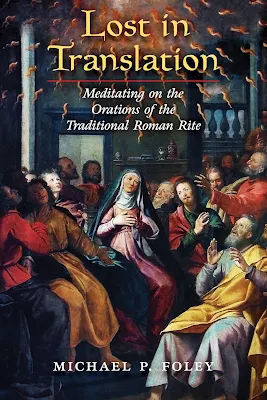
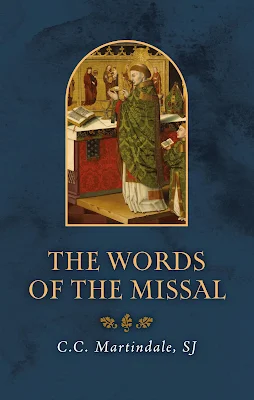
Today I am pleased to announce the nearly simultaneous release of two books—the one by a living writer familiar to all NLM readers, namely, Dr. Michael Foley; the other a reprint, after many decades, of a valuable preconciliar work by Fr. C.C. Martindale—that have, in their distinctive ways, very similar concerns. Both are written to expound and exult in the enormous riches, the world of subtlety, the colorful details, of the Church’s specifically Latin orations, which no vernacular language can convey or capture.

The New Book


Michael P. Foley. Lost in Translation: Meditating on the Orations of the Traditional Roman Rite. Brooklyn: Angelico Press, 2023. 302 pages. Paper $21.95; Cloth $32.
Publisher’s Description: At every celebration of the traditional Latin Mass, one of the greatest achievements of Christian culture passes by virtually unnoticed. The orations of the Roman Rite—the Collect, Secret, and Postcommunion—are literary masterpieces: a unique species of rhetoric, they ingeniously combine tight structure, poetic rhythm, literary order, succinct imagery, and a panoply of human experience. These brilliant gems are underappreciated because much of their splendor comes from their deft exploitation of Latin, which, like any other language, has its own ecosystem and way of doing things. As a result, even the best translations will leave something out.

Lost in Translation was written to introduce readers to these gems even if they do not know Latin. In its pages Michael Foley explains one or more orations for every Sunday of the Church year and for a number of Saints’ feast days, unearthing the subtle nuances and vivid images that make these prayers such a delight. The result is a new portal into the beauty of sacred liturgy and the mystery of our redemption.
Praise for “Lost in Translation
“The orations of the classical Roman Rite are rich and illuminating, especially when placed in their proper context: the days and seasons of the liturgical year. Acting as missal mystagogue, Michael Foley takes us on a delightful tour from Advent to Apocalypse, unpacking the prayers’ dense content, reveling in their linguistic finesse, and applying their lessons to our spiritual life hic et nunc. Food for prayer and kindling for homilies, Lost in Translation is guaranteed to intensify the reader’s astonishment at the treasure-chest of tradition, with the orations as its diamonds, emeralds, and rubies.” —PETER A. KWASNIEWSKI

“In this excellent book, Michael Foley skillfully guides us through the liturgical year using the Collects, Secrets and Postcommunions of the traditional Roman Rite. These liturgical prayers of the Church are crammed full of theological, biblical, and patristic insights as well as poetry, imagery, and wordplay, all of which can often be overlooked in vernacular translations. Dr. Foley’s valuable insights are sure to prove spiritually fruitful for laity and clergy alike, and will no doubt be a source of fresh inspiration for those entering into the Church’s traditional liturgy.” —MATTHEW P. HAZELL

“In clear, conversational prose, Michael Foley attentively studies the orations of select Masses of the 1962 Roman Missal in their context. His meditations foster personal inner appropriation of the Church’s common prayer and teach us how the prayers school our desires. Foley’s work is pleasantly enriched by the pertinent inclusion of words from Fathers and Doctors of the Church and of historical facts and customs that tell us about a feast’s celebration or highlight theological and spiritual truths presented in its Mass texts.” —LAUREN PRISTAS

Available directly from the publisher here or from Amazon (here, or at any other country’s site).

The Reprint


C.C. Martindale, SJ. The Words of the Missal. Lincoln, NE: Os Justi Press, 2023 (originally published by the Macmillan Company in 1932). 226 pages. Paperback $17.95.
For those unfamiliar with him, Cyril Charlie Martindale (1879–1963) was a Catholic priest, scholar, and writer, who, with fellow Jesuit Martin D’Arcy, was among England’s foremost Catholics of the first half of the twentieth century. He kept up a correspondence with such figures as Ronald Knox, Evelyn Waugh, and Graham Greene. In 1931, Fr Martindale wrote a fine and accessible study of key Latin words in the Missale Romanum, with this admirable goal: “All I want is that this book may help people to pray still better, and to love the Missal still better, so that what is old and familiar shall reveal new beauty and lovableness.”

The resulting book, accurately (if not excitingly) entitled The Words of the Missal, long out of print, has now been reprinted by Os Justi. Here are some words from the Introduction:
If you read St. John or St. Paul, you are almost sure to love their works, or at least some parts of them. But if you take real trouble to find out what exactly their words mean—Faith, for example; Justice; Fulness; Spirit; Light—their value begins to glow forth from within, and the page becomes transfigured and quite different from what it was before you took the pains to pause, compare, ponder, and to catch all manner of elusive shades and depths of meaning in such words. When you re-read those writers you will not any more have to spend time over such details, nor find yourself pulled up or committed to any complicated work, but the flow and the glory of the inspired pages will be a new thing for you.
          Something similar can be done with the Roman Missal. The Latin words in the Missal at times float and waver, and require care before they perfectly yield up their sense. Others have so definitely "Latin" a flavour that it is very difficult to translate them exactly into English; still, the attempt should be made, along with a little explanation. Others may seem so ordinary that we might take them for granted and not notice some of the richer meaning that is theirs.
          The method of this book, then, is quite simply to take a few of the words which come often in the Missal so as to be in a certain sense “favourite” words in the Liturgy, or else, other words that we might not notice; to collect several instances of their use (for isolated instances prove little; many exercise a cumulative effect); and then, to “worry” them until a kind of valuable juice of meaning is crushed out of them. Certainly no reader would be expected to attend to such details during Mass itself; but, having done it outside of Mass, he will find that Mass becomes full of added delight.
The Table of Contents:

Introduction
1 “Rejoice in the Lord”
2 Human Fragility
3 The Divine Initiative
4 God’s Hand of Power
5 God’s Largesse
6 Man’s Transformation
7 Drastic Discipline
8 How the Church Speaks to God and How We Should Think of Him
9 The Wording of Our Payers
10 The Mysticism of the Missal
11 The Light of Life
12 Newness of Life
13 Charity, Unity, Peace
14 Lights and Shades of Meaning
15 Delicacies of Meaning
Appendix: Latin and English
Postscript

Available directly from the publisher here or from Amazon (here, or at any other country's site).

Although Fr. Martindale speaks generally of “the missal,” in fact nearly all of his examples are drawn from the orations. That makes the Foley book and the Martindale book wonderfully complementary to each other, as each covers different parts of this vast territory and by different methods: Foley looking one by one at particular days or feasts in the Church calendar, Martindale exploring themes across the entire missal.

May books like these restore among eager Catholics the knowledge, appreciation, and savor of the wisdom of our inherited tradition—and may they help to bury, once and for all, the folly of those who claim that all of the Latin Church’s tradition of prayer can be effectively conveyed in vernacular. It cannot be, and these books demonstrate it with atomic force.

Thursday, July 13, 2023

A New Latin Hymn for the Shrine of Our Lady of Guadalupe

A new Latin hymn for liturgical use was commissioned earlier this year by the Shrine of Our Lady of Guadalupe in LaCrosse, Wisconsin, and composed by Latinist Sean Pilcher. The hymn’s organ accompaniment was originally written by the prolific French organist and improviser Pierre Cochereau (1924-84), who worked as the titular organist of Notre-Dame de Paris for three decades. Its meter is drawn from a twelfth-century sequence Jerusalem et Sion Filiae, which was sung on the feast of the Dedication of a Church in the Use of Paris. This sequence was written by by the cathedral’s famous precentor, Adam of Saint-Victor (1080 ca. – 1146), whose liturgical compositions were well-known across Europe.

The interior of the main church at the Shrine of Our Lady of Guadalupe in LaCrosse, Wisconsin, with a reproduction of the tilma in the apse over the main altar. (Image from Wikimedia Commons by Pgnielsen79, CC BY-SA 3.0)
The Shrine wanted a Latin hymn which could be sung to Cochereau’s organ masterpiece, but which focused on Our Lady’s patronage of the Shrine and highlighted elements from the Guadalupe story. The metre is decidedly mediaeval, and resembles that of the original Victorine repertoire of the twelfth century, while incorporating images from the greater, more ancient Marian hymnody of the Roman rite.

Since the hymn’s debut at an organ recital given by the shrine’s Director of Sacred Music and organist, Scott Turkington, it has been used liturgically for Pontifical Masses and religious professions held there.

The hymn, followed by a translation and some brief commentary by the author, to whom we are very grateful for sharing it with us.

Ad Virginem Guadalupanam A literal English translation
Beato e caelo succurrere
Parvulum Alma in itinere
Ioannes, inquit, noli timere:
Ave Maria!
From the blessed heavens
the Sweet Mother comes
to aid her little one on the way.
‘John,’ she said, ‘fear not!’
Ave Maria!
Verbum Sapientiae mundana
Tunc ignotum in terra pagana
Vincit cum ancilla christiana,
Ave Maria!
The Word of Wisdom, then
unknown, in that pagan land,
comes to conquer worldliness
with His Christian handmaid
Ave Maria!
Regina sui petit honori,
Solemne signum impugnatori
Sacrum et genti et novo orbi,
Ave Maria!
The Queen bids for her honour
a solemn sign, set against
the Adversary, sacred to
the people and the New World
Ave Maria!
Kaloni pallium fidelibus
A Dei manu incredentibus,
Pictum rosis, luna sub pedibus,
Ave Maria!
She gives a tilma to her little
minister for the faithful,
painted by the hand of God
for unbelievers, with roses,
and the moon beneath her feet.
Ave Maria!
Eburneam turrem advolamus
Subter caeruleo superamus,
Speculo Iustitiae collaudemus:
Ave Maria!
We fly to the Tower of Ivory,
under her caerulean veil we prevail,
let us say to the Mirror of Justice:
Ave Maria!

The first letters of each stanza form an acrostic to honor the patron of both the shrine and the hymn, His Eminence Raymond Leo Cardinal BVRKE; inclusion of the patron in some way into a work is of course a long-standing tradition in sacred art. The Latin word “pallium – cover, cloak” is used in other places in the Roman liturgy to describe the miraculous tilma. “Calo” is a very old loanword from Greek, possibly even Punic, meaning a low-ranking servant or an aide-de-camp, a fitting title for St Juan Diego, who lived his remaining years as a hermit in quiet, humble service to Our Lady. It is here spelled with a K, a device often employed by medieval writers to fit an acrostic when required, since the letter is not normally used in Latin. “Speculum Justitiae – Mirror of Justice” is the title under which canonists invoke Our Lady, and is used here as a tribute to the important contributions to canon law made by the shrine’s founder, as well as the annual conference held there for canonists.

More recent articles:

For more articles, see the NLM archives: