Thursday, July 31, 2025

The Byzantine Fast of the Dormition

In addition to Great Lent, the Byzantine tradition has three other fasts connected with major feasts. The liturgical year begins on September 1st, so the first of these is the fast of the Nativity, which runs from November 15th to December 24th; this is almost exactly the same span as Advent in the Ambrosian and Mozarabic Rites. Another fast is kept from the Monday after the feast of All Saints (which is celebrated on the Sunday after Pentecost) to the feast of Ss Peter and Paul; because of the variable date of the former, this can run as long as 42 days, or as short as 8. The fast of the Dormition is kept from August 1-14, and is the strictest of the three, with no consumption of meat, dairy, fish, wine or oil; the last two may be taken on weekends, and fish on the feast of the Transfiguration. There are also a number of interesting liturgical features connected with this period.

An icon of the feast of the Procession of the Cross
The first day, August 1st, is a feast known as the “Procession of the Honorable and Life-Giving Cross”, which is celebrated jointly with one of the most ancient and universal Christian feasts, that of the Seven Maccabee Brothers. In Constantinople, on the evening of July 31st, the relics of the True Cross were brought from the imperial treasury to Hagia Sophia, and laid upon the main altar. Over the next two weeks, they were processed through the streets and venerated by the faithful; this was done also in part to ward off the various illnesses which frequently afflicted the city in the intense summer heat. This procession was last celebrated in 1452, the year before the fall of the city, but the memory of it is still preserved in the liturgical books. As on the feast of the Exaltation of the Cross and the Third Sunday of Lent, the rubrics prescribe that at the end of Orthros, an icon of the Cross be brought from the sanctuary to the nave, and solemnly venerated, after which the following hymn is sung.

Come ye faithful, let us adore the life-giving wood on which Christ, the King of glory, willingly stretched out His hands, and exalted us unto the ancient blessedness, whom once the enemy, having despoiled us by pleasure, banished from God. Come ye faithful, let us adore the wood by which we were made worthy to break the curses of the invisible foes. Come, all ye nations of the gentiles, let us honor the Lord’s Cross with hymns. Rejoice, o Cross, the perfect release of fallen Adam. In Thee our most faithful kings make their boast, as they mightily subject the Ishmaelite people by thy power. Greeting thee now with fear, we Christians glorify God, Who was nailed upon thee, saying ‘Lord, who wast nailed upon this, have mercy upon us, as Thou art good and love-mankind.’

The words “the Ishmaelite people” mean the Saracens, over whom the Byzantine Emperor Manuel I Comnenus (1143-80) gained a major victory in 1158, and instituted the feast in commemoration thereof. The same day is also the anniversary of the Baptism of the Rus’, a crucial event for the Christianization of the Eastern Slavs, which took place in the year 988, in the reign of the king Saint Volodymyr. For this reason, it is the custom of some of the Slavic churches to bless water on August 1st, in the form known as the Lesser Blessing, to distinguish it from the Great Blessing held on Epiphany. In both forms, a hand-cross is passed through the water three times in the form of a cross; at the Lesser Blessing, the following troparion is sung. “O Lord, save Thy people, and bless Thine inheritance. Grant victories to the Orthodox Christians over their adversaries, and by virtue of Thy Cross, preserve Thy habitation!”

(A recording made in September of 2021 at the Greek-Catholic Cathedral of the Holy Cross in Uzhhorod, Ukraine, on the patronal feast day.)

During the Dormition fast, the Greek tradition also prescribes the celebration of a service known as the Supplicatory Canon, or Paraklesis, modelled on the hour of Orthros; there are two forms of it, the Greater and Lesser, which are said on alternate days, beginning on the evening of August 1st. (In the Slavic tradition, these are shortened very considerably by the omission of most of the long series of hymns which is properly known as a “canon.”) Both of them are supplications to the Virgin Mary to intercede to Her Son on behalf of mankind; the lesser canon may also be sung at any point in the year, especially in times of suffering and difficulty. The following troparia, which are sung shortly after the beginning of the service, give the general theme; these are the same in both versions.

Let us sinners and lowly ones now fervently run to the Mother of God, and fall down in repentance, crying from the depths of our soul: o Lady, have mercy on us and help us; hasten, (for) we are lost in the multitude of our errors. Do not turn Thy servants away, for we have received Thee alone as our hope.
We, the unworthy, will never cease to speak, o Mother of God, of Thy mighty deeds, for if Thou didst not stand to intercede for us, who would have delivered us from such great? Who would have preserved us until now in our freedom? O Lady, we shall not depart from you, for you always save your servants from every sort of tribulation.

Towards the end, the following exapostilarion is sung, looking forward to the upcoming feast. The Virgin Mary addresses the Apostles, who, according to a very ancient tradition, were all present for Her dormition, and laid Her to rest in the same place where Her Son had once been laid.

O ye Apostles, gathered together here from the ends of the earth in the place of Gethesemane, take care of (or ‘bury’) my body; and do Thou, my Son and my God, receive my soul.

The Dormition of the Virgin, by Pietro Cavallini, 1296-1300; mosaic in apse of the church of Santa Maria in Trastevere, Rome.

Monday, May 26, 2025

Durandus on the Minor Litanies

The following excerpts are taken from book VI, chapter 102 of William Durandus’ treatise on the Divine Offices.

On the three days before the feast of the Lord’s Ascension, the Rogations, which are also called the Litanies: the Greek word “litania” in Latin is “supplication”, or “rogation” (from ‘rogare – to ask’), on which the Holy Church asks God… to destroy the counsel of those who wish to live outside Her peace. At the same time, we also beseech God that He may defend us from a sudden death, and from every infirmity, and we ask the Saints, that they may intercede for us before God. …

The Procession of St Gregory the Great, by an anonymous Sienese painter of the mid-16th century. The traditional story recounts that when the procession described below reached the Mausoleum of Hadrian, which is fairly close to St Peter’s Basilica, an angel appeared over it with a drawn sword in his hand, which he then sheathed, symbolizing the end of the plague as in 2 Samuel 24.
Now the Litanies are two, the Greater and the Lesser. The Greater is on the feast of the blessed Mark, and was created by the blessed Gregory (the Great), because of a plague, which caused a swelling of the groin. Paul, a monk of Monte Cassino, the author of “The History of the Lombards”, wrote the story of its institution, saying that in the time of Pope Pelagius (II, 579-90) there was so great a flood in Italy, that the waters rose as high as the upper windows of the temple of Nero in Rome … Then there came forth up the Tiber a multitude of serpents, and one very large dragon among them, whose breath corrupted the air; from this came the plague in the groin, from which men died suddenly all over the place. When nearly the whole population of Rome had been destroyed, Pelagius declared a fast and procession for all, but during it, he himself died, along with seventy others. Gregory I, who is also called the Great, took his place, and commanded that this Litany be observed throughout the world; it is therefore called the Gregorian or Roman Litany. It is also called “Black Crosses”, since, as a sign of mourning for the death of so many men, and as a sign of penance, people wear black clothing, and the crosses and altars are veiled in black.

A folio of the Echternach Sacramentary, 895AD, with the stational prayers for the Greater Litanies as they were done in Rome; the stations are at the church of San Lorenzo in Lucina, St Valentine (very far up the Tiber), “ad Pontem Olbi”, a corruption of “ad Pontem Milvium – at the Milvian bridge”, “at the Cross”, which was a station set up along the way, and two “in the atrium” of St Peter’s Basilica. (Bibliothèque nationale de France. Département des Manuscrits. Latin 9433; folio 76r.)
The Lesser Litanies, which are also called Rogations and processions, take place on the three days before the Ascension, … they were created in Vienne by the blessed Mamertus, bishop of that city. Because of a plague of wolves and other wild beasts, who were ferociously killing men in Gaul, and because of the dangerous earthquakes which were frequently taking place there, he enjoined a fast of three days on the people, and instituted the Litanies. But when the danger had passed, the fast became a custom of annual observance … This latter is called the Lesser Litany, because it was instituted by a lesser person, that is, by a simple bishop, and in a less important place, Vienne, while the Greater (Litany) is so called because it was instituted in a more important place, namely, Rome, and by a greater person, namely, Gregory the Great, and because of a great and very serious plague. However, the Lesser Litany is older, since it was instituted when Zeno was Emperor (ca. 470 AD), and the Greater in the time of the Emperor Maurice (582-602)

Litanies are also held for many other reasons, wherefore Pope Liberius established that a litany should be held for war, famine, pestilence, and other imminent adversities of this sort, so that we may escape from them by supplications, prayers and fasts. Therefore, because in this time of the year especially wars are wont to break out, and the fruits of the earth, which are still in bud or flower, can easily be corrupted in many different ways, the litanies are held, so that we may ask God to turn these things away from us, and to defend and deliver us from bad weather, and war, and the enemies of the Christian religion, as we also implore the patronage of the Saints …

… we beseech the Saints, because of our poverty, and their glory, and reverence for God. And when we celebrate the Litany because of imminent dangers, in penitential and mournful garb, we represent that last procession of the women who wept after the Lord when He was being led to the Cross, weeping, according to the Lord’s command, for ourselves and our children.

The imposition of ashes before the Rogation procession celebrated in 2017 in Milan; in the Ambrosian Rite, the penitential character of the Rogation days is far more marked than in the Roman Rite.
The Litanies also take place in this time, since the Church now asks more confidently, because Christ ascends, Who said, “Ask and ye shall receive.” (In the Gospel of the Sunday before the Ascension, John 16, 23-30.) She fasts at this time and prays, that through the mortification of the flesh, She may have little to do with it, and gain wings for herself through prayer, which is the wing by which the soul flies up to heaven. Thus is She is able to freely follow Christ as He ascends, and opens the way for us, and flies upon the wings of the wind. This is the reason why we join the last litany, the last fast, to the Ascension, so that through prayers and fasts, we may be able to lay aside the weight of the flesh, and follow Christ as He ascends.

Therefore, during the Litanies, there is a procession, and in some churches, (the antiphon) Exsurge, Domine is sung at the beginning. The Gospel canticle “Holy God, holy mighty one, holy immortal one, have mercy on us,” is also to be sung repeatedly by the boys’ choir, for John of Damascus tells the story … that in Constantinople, litanies were held because of some trouble, and a boy was taken up to heaven from the midst of the people, and there taught this chant; and returning to the people, sang it before everyone, and at once the trouble ceased. This chant was approved by the Council of Chalcedon, and therefore it is considered praiseworthy and authoritative …

… in the procession itself, the Cross goes first, and the reliquaries of the Saints, so that by the banner of the Cross, and the prayers of the Saints, demons may be repelled…

A banner is also carried to represent the victory of Christ’s Resurrection and Ascension, since He went up to heaven with great spoils … just as the multitude of the faithful follow the banner in the procession, so also a great gathering of the Saints accompanies Christ as He ascends. Banners are also carried in imitation of that which is said by Isaiah (11, 12), “And he shall set up a standard unto the nations, and shall assemble the fugitives of Israel, and shall gather together the dispersed of Juda from the four quarters of the earth.” The Church took the carrying of banners and crosses from Constantine, who, when in a dream he saw the sign of the Cross, and heard the words ‘By this sign thou shalt conquer’, ordered the Cross to be marked on his war banners. The fact that in the Litanies the cross-bearer takes his cross from the altar reminds us that Simon of Cyrene took it from Christ’s shoulders.

A Rogation procession held in the village of Balatonderics, Hungary in 2017.
In some places, the litany is done in the fields, so that demons may be expelled from the crops, or rather, so that the crops may be preserved by the Lord. … It has also become the custom that a dragon with a long tail, upright and inflated, should go before the Cross and banners on the first two days, but on the last day, looking back, with its tail deflated and lowered, it follows behind. For this dragon symbolizes the devil, who in three periods, that is, before the law, and under the law, and in the time of grace, which these three days symbolize, has deceived men, and even now seeks to deceive them. In the first two periods, he reigned, and as if he were the lord of the world, had a long tail, which shows his power, and inflated, which symbolizes his pride. For this reason, Christ calls him the prince of this world (John 12, 31) and John says in the Apocalypse (12, 4) that the dragon, falling from heaven, drew with him the third part of the stars, which symbolize people. And the Lord says in the Gospel, “I saw Satan falling like a lightning bolt from heaven” (Luke 10, 18), as a figure of which, on two days he goes at the head … But in the time of grace, he is beaten by Christ, and power is given to the Apostles to cast out unclean spirits; therefore, on the third day he follows after the Cross, to show that his power is lost through the spread of the Faith, and his tail is deflated, and hangs down, and is not long, because he does not dare to reign as mightily as he formerly did, but rather seduces men through suggestion, and in a hidden way, those whom he sees to be lazy and remiss in good works, and who follow not the way of life, as if he were looking back like a thief, to see if someone may wander and fall away from the righteousness of the Faith, so that he can draw that person to himself …

A page from an 1882 scholarly edition of the Sarum Processional, by W.G. Henderson, showing the order of the Rogation procession. The rubric above the image mentions both a dragon and a lion carried in the procession, the latter presumably in reference to the words of Apocalypse 5, 5, “Behold the lion from the tribe of Judah hath conquered.”
On the Litanies, all must abstain from servile labor, … and be present for the procession until the end, so that, just as all have sinned, so all may ask for forgiveness, and all raise their hearts to God, with their hands, that is, raise up their zeal for prayer.

But since on the preceding days, a double Alleluia, is sung, why on these days is only one sung? And again, since Alleluia is not said on other fast days, why is it said on this one? To the first question, we answer that ... a double Alleluia is sung on the preceding days because of the double stole which will be given in the general resurrection, namely, that of the soul and of the body. But the liturgy of Easter, which this signifies, is now finished, and therefore, the cause being taken removed, the effect is also removed . To the second, we answer that on the other fast days, Alleluia is not sung because it is a song of joy, and those fasts are held because of sins, wherefore they are called fasts of mourning; but this fast, and that of Pentecost, are matters of rejoicing, because they are not held for sins, but so that the power of the devil, and the plague, may be removed; and therefore, Alleluia is sung on them.

Friday, April 18, 2025

Desacralizing Lent

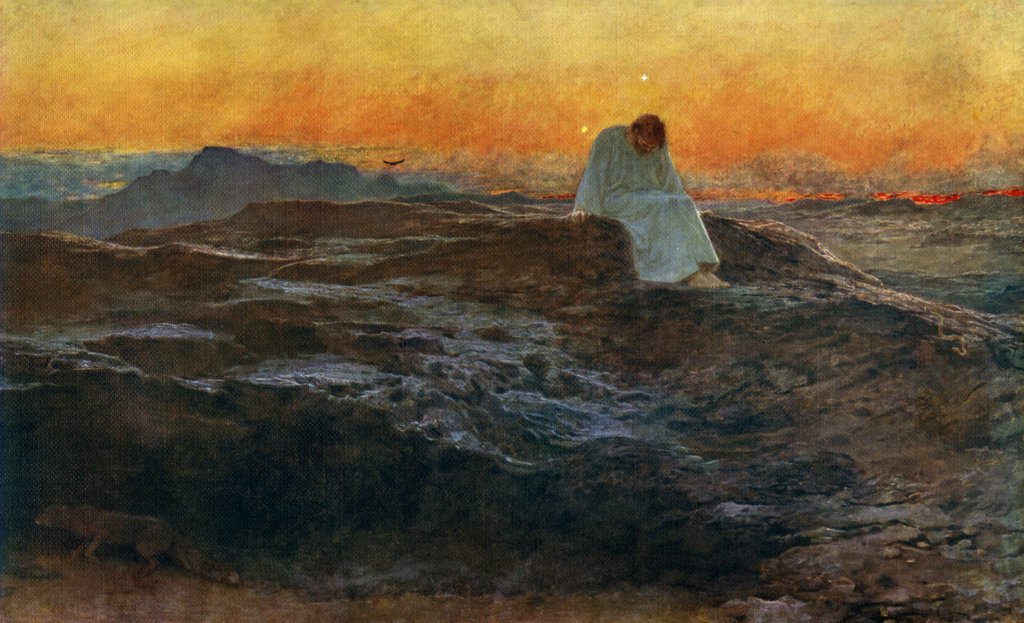
Christ in the Desert, 1898, by Breton Rivière

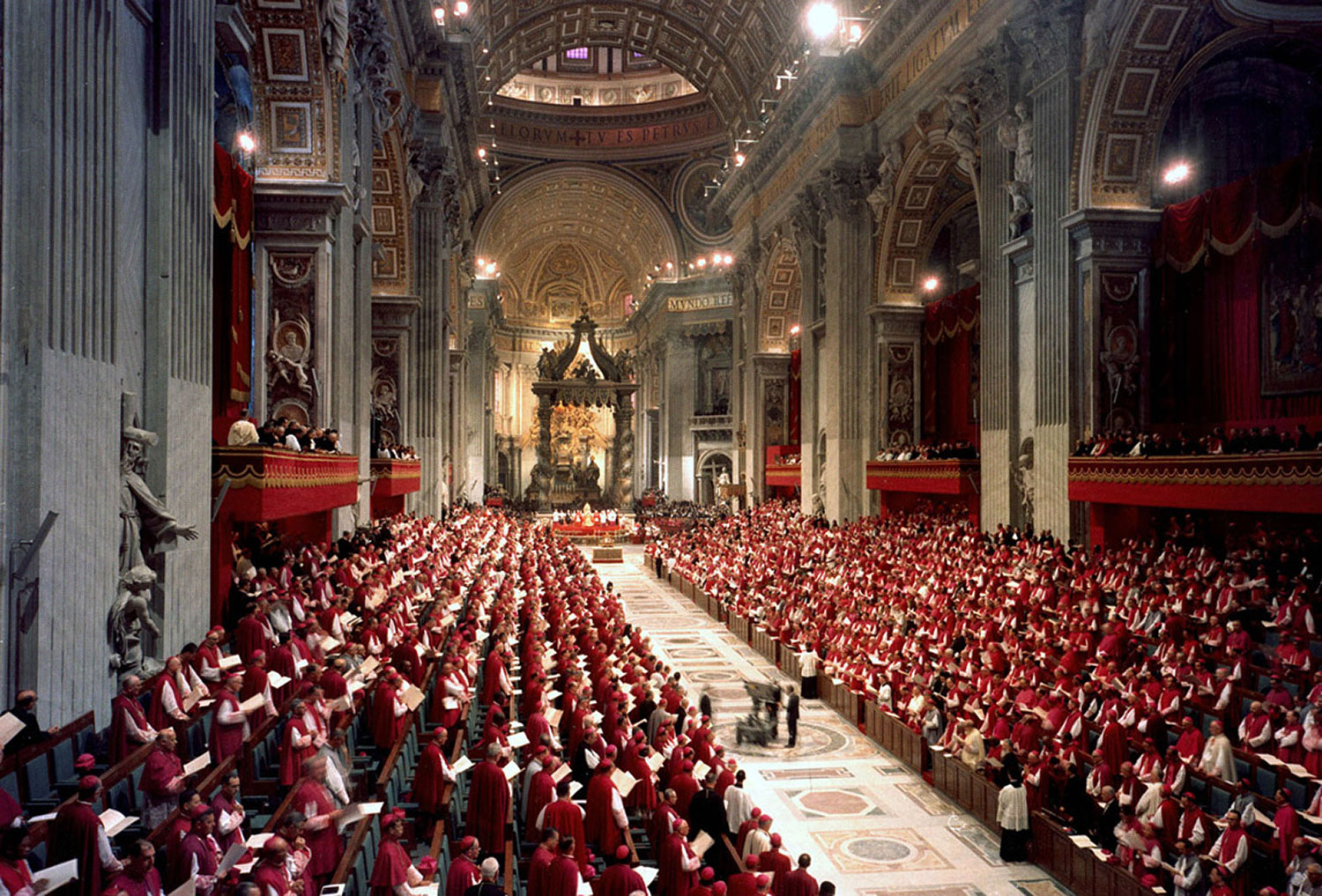
I have been enjoying Peter Kwasniewski’s new book Close the Workshop, which argues that the old rite did not need to be fixed and that the new rite cannot be fixed. To support his argument, Kwasniewski begins with an analysis of the Second Vatican Council’s Constitution on the Liturgy, Sacrosanctum Concilium (SC), arguing that the document was not kidnapped later on but contains within itself timebombs that were then detonated by Archbishop Bugnini and his colleagues.

One of the fruitful ways that Kwasniewski proceeds in his task is by assembling several statements from SC that, when stripped of their reassuring context and laid bare, can be seen in a new and rather startling light. In the same spirit, and on this solemn day of Good Friday, I would like to call our attention to Article 110 of this document:
Paenitentia temporis quadragesimalis non tantum sit interna et individualis, sed quoque externa et socialis. Praxis vero paenitentialis, juxta nostrae aetatis et diversarum regionum possibilitates necnon fidelium condiciones, foveatur, et ab auctoritatibus, de quibus in art. 22, commendetur.
Sacrum tamen esto jejunium paschale, feria VI in Passione et Morte Domini ubique celebrandum et, juxta opportunitatem, etiam Sabbato sancto producendum, ut ita, elato et aperto animo, ad gaudia dominicae Resurrectionis perveniatur.
The English translation for which is:
During Lent penance should not be only internal and individual, but also external and social. The practice of penance should be fostered in ways that are possible in our own times and in different regions, and according to the circumstances of the faithful; it should be encouraged by the authorities mentioned in Art. 22.
Nevertheless, let the paschal fast be kept sacred. Let it be celebrated everywhere on Good Friday and, where possible, prolonged throughout Holy Saturday, so that the joys of the Sunday of the resurrection may be attained with uplifted and clear mind.
The first paragraph affirms the traditional teaching that corporate Lenten penances are good and that the Church has the capacity to make prudential adjustments to these penances according to place and time. But it stops short of declaring that the Church has the right to mandate fasts, using the language of encouragement (foveatur and commendetur) rather than prescription. One of the controversies of the Protestant Reformation was whether the Church has the authority to tell the faithful that they must fast on pain of sin, with figures like Zwingli vehemently maintaining that she does not. The first paragraph of SC 110 seems hesitant to condemn Zwingli’s error. It also omits any reference to the guidance of the Holy Spirit in shaping the Church’s penitential practices, which could give the impression that such practices are purely manmade or positivist.
If the first paragraph shies away from declaring all of the Church’s authority, the second paragraph swings in the opposite direction by implying that the Church, or more specifically, the Council Fathers, have the power to desecrate or de-sacralize Lent. The sentence, “Nevertheless, let the paschal fast be kept sacred,” is filled with implications. “Nevertheless” (tamen) is a disjunction that separates the “paschal fast” of Good Friday from the forty-day Lenten fast. The paschal fast alone is here deemed sacred, thereby insinuating that the Lenten fast is no longer sacred. The original Latin is even more voluntaristic than the official English translation: whereas the English “let the paschal fast be kept sacred” presumes that the paschal fast is already sacred and that the Council Fathers have graciously decided to keep it that way, the Latin original “let the paschal fast be sacred” depicts a world in which nothing is sacred unless so deemed by recognition of the Council.
The logic undergirding “Nevertheless, let the paschal fast be kept sacred” is the following. The sacred is what is set apart and generally not subject to human tinkering. But the first paragraph of SC 110, which affirms the Church’s ability to change Lenten penances, is apparently going to be used to make radical changes to the Lenten fast; instead of approaching the fast with awe and respect, the liturgical reformers plan to be aggressive and gut it. The fast’s protected status as sacred must therefore be removed before such a gutting can take place. A sacred custom that defined the season of Lent for 1,6000 years old shall be sacred no more.
That the Lenten fast was universally considered sacred prior to SC 110 there is no doubt. Every Roman-rite bishop at the Council was obliged to recite or sing during the Lenten Office of Vespers the hymn Audi Benigne Conditor, the opening verse of which is:
Audi, benigne Conditor,
Nostras preces cum fletibus,
In hoc sacro jejunio
Fusas quadragenario.
Which I translate as:
Hearken, O kind Creator,
To our prayers with our tears,
During this sacred fast,
Spread out over forty days.
Unless a High-ranking feast day intervened, every member of the Roman Rite clergy had to read these words every day from the first Saturday of Lent until the Friday of the Fourth Week of Lent, approximately twenty-eight times. Multiply this by the number of years that a man has been obliged to recite the Divine Office (since his days in the seminary), and it is not a stretch to imagine that the majority of the voting bishops knew this hymn by heart.
And if they did not, the daily orations of Lent were there to reinforce the doctrine that the fast is sacred or (which amounts to the same thing) that God and not man instituted the Lenten fast. Of the several I could have chosen, here are four:
Be mindful, O Lord, of our supplications: and grant that we may keep with devout service this solemn fast, which Thou hast wholesomely ordained for the healing of our souls and bodies. Through. –Collect, Saturday after Ash Wednesday
Of Thy goodness, we beseech Thee, O Lord, continue to help us in the observance of this holy fast, that having learned our duties from Thee, we may carry them out by the help of Thy grace. Through. –Collect, Tuesday of the Second Week in Lent
Grant, we beseech Thee, almighty God, that cleansed by this sacred fast, we may be brought by Thee with pure hearts to the holy season which is to come. Through. –Collect, Friday of the Second Week of Lent
Grant, we beseech Thee, almighty God, as year by year we keep this sacred fast with devotion, we may please Thee both in body and soul. Through. –Collect, Monday of the Fourth Week of Lent
I draw attention to this liturgical evidence not in order to condemn the 2,158 bishops who approved Sacrosanctum Concilium, but to marvel at the ingenuity of the document’s drafters, who were able to convince an overwhelming majority to turn their backs on a tradition they knew without knowing for the most part that they were doing so.
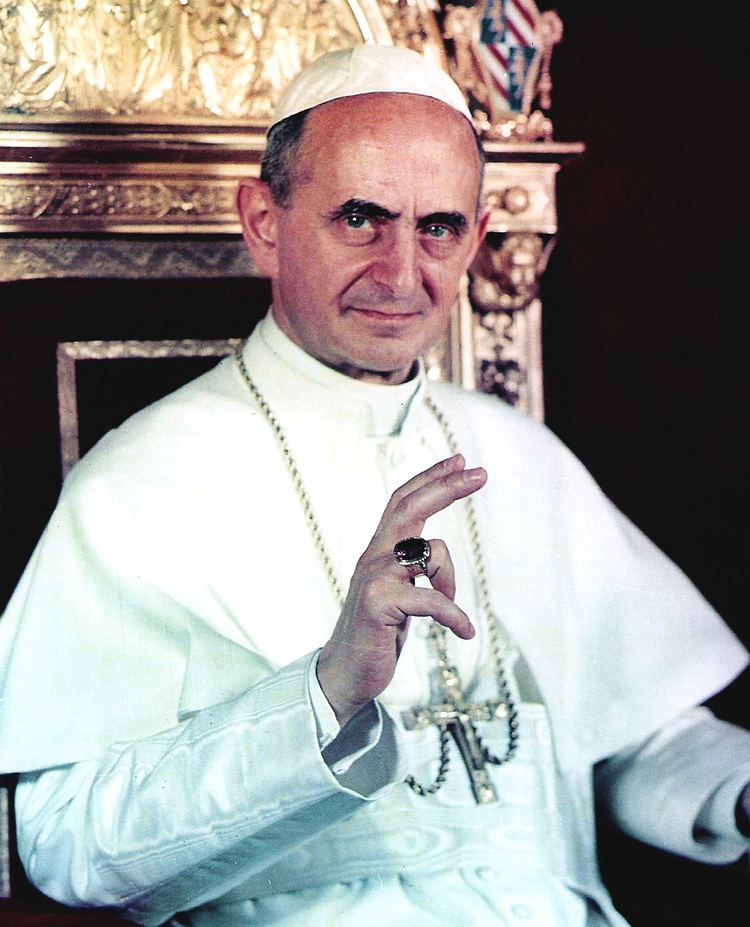
SC 110 is also important as part of the broader debate about the plight of the sacred in the wake of Vatican II. Does the new liturgy renew the sacred or undermine it? Paul VI himself seems to have been of two minds. On one hand, in a remarkable speech in 1966, he finger-wagged the Consilium in charge of the changes about reverencing the sacred, respecting tradition and a sense of history, and searching for what is best rather than what is new. And a friend of the Pope, Cardinal Antonelli, wrote in 1967 that Paul VI was “pained by a certain tendency to de-sacralize the liturgy.” On the other hand, when introducing liturgy in the vernacular, the Pope defended the innovation even though, he admitted, it means that we have become “profane intruders in the literary preserve of sacred utterance” and have sacrificed “the beauty, the power, and the expressive sacrality of Latin” (General Audience, November 26, 1969).
The liturgical reformers, incidentally, were true to the inuendoes of SC 110. In his 1966 Paenitemini, Paul VI eliminated the mandatory Lenten fast but kept the Good Friday fast “sacred.” The reformers’ new edition of the Missal reflects the new Lent that they invented. The 1962 Missal mentions, explains, and prays for the practice of fasting on every day of Lent prior to Holy Week: the traditional rite’s Preface for Lent, which is used daily from Ash Wednesday until Passiontide, is supplemented almost daily with additional references to fasting in the proper prayers. The 1969 Missal, on the other hand, retains several references to fasting on Ash Wednesday (the other mandatory fast day), but there are only two required references to the fasts of the faithful for the rest of the season. Consequently, with the exception of Ash Wednesday, the new Missal offers very little guidance on fasting and almost no prayers for its success.
“The practice of penance,” Sacrosanctum Concilium states, “should be fostered.” But if one wants regular instruction on the nature and meaning of fasting, and if, moreover, one wants priests and congregations daily praying and offering up the Holy Sacrifice for the efficacy of one’s fasts, one is better off turning to the Missal used during Vatican II rather than the one that followed it.

Tuesday, February 18, 2025

The Antiquity and Universality of Fore-Lent (Part 2)

We continue with part 2 of Henri de Villiers’ examination of the various forms and traditions of the pre-Lenten period. Click here to read part 1.

Quinquagesima Week, the fast of Heraclius, Cheesefare Week
In both East and West, the week immediately before Lent took on a penitential character very early, beginning at first with abstinence from meat. We must remember that the early Church followed a strictly vegetarian diet for all of Lent. For the week immediately preceding Lent (the Latin Quinquagesima, Tyrophagia in the Byzantine Rite), although meat is removed from the diet, milk products, eggs and other animal products may still be consumed.

To better understand the origins of this week, we must also consider that Lent lasts for seven weeks in the East, and for six in the West. In the East, where there is no fast on either Saturday (except for Holy Saturday) or Sunday, this makes for a Lent of 36 fast-days. In the West, where the fast is kept also on Saturday, but never on Sunday, this gave the same number of days, following the Roman custom before the time of St Gregory the Great. To compensate for the missing days and to make the symbolic number of 40, the number of days of Christ’s fast in the desert, the Christians chose to anticipate the official beginning of Lent by a week. This was also done in consideration of the possible occurrence of feasts that displace the fast, principally the Annunciation.
The removal of meat from the diet in the week before Lent is attested early in the West. Quinquagesima Sunday is called in the ancient Latin books “Dominica ad carnes tollendas” or “levandas” (whence the term Carnival), indicating that one began to take away meat right after the Sunday, passing to the strict vegetarian diet only in the following week. The first week of Lent is then called “in capite jejunii – at the beginning of the fast.” Before the time of St Gregory, the Roman Lent began on the Monday after the First Sunday, the custom still followed by the Ambrosian and Mozarabic Rites. St Gregory set the fast to begin on the Wednesday of Quinquagesima, to make a complete period of 40 days. (To this very day, the Roman Rite retains the Office of Quinquagesima week even after Ash Wednesday, and the proper rubrics of Lent begin only with First Vespers of the First Sunday.)

The institution of Quinquagesima week is attributed by the Liber Pontificalis to the eighth Pope St Telesphorus (125 to 136–138). This attribution may be purely legendary, but since the notice of Telesphorus was written under Pope St Hormisdas (514-523), we can infer that this custom was already of immemorial use at the time, if it could plausibly be attributed to such an early predecessor. The so-called Leonine Sacramentary contains a Mass for Quinquagesima, the text of which seems to have been written in the reign of Pope Vigilius, ca. 538 A.D.

In the East, we can follow the same early indications of the establishment of Cheesefare Week (Tyrophagia). The pilgrim Egeria (Itinerarium 27, 1) reports that an eighth week of penance was kept at Jerusalem in the 4th century. Between the 5th and 6th centuries, the Georgian lectionaries, which are based on the Jerusalem liturgy of this period, bear witness to the existence of special readings for the two weeks before Lent.

In the 6th century, St Dorotheus of Gaza attests that the institution of a penitential week before Lent was already considered ancient in his time: “These are the Fathers who later agreed to add another week, both to train in advance and to urge on those who will give themselves over to the work of fasting, and to honor these fasts with the number of the Holy Forty Days which Our Lord Himself passed in fasting.” (Spiritual Works, 15, 159)

The custom of a week of ascetic practice before Lent, already attested before the 6th century (St Severus of Antioch counts it in his description of Lent), was sanctioned by official decision in the 7th century, in the reign of the Emperor Heraclius (610-41). The origin of his fast is uncertain. Most authors connect it with the events of the war which took place between the Byzantine Empire and the Persian Sassanid Empire from 602 to 628, during which the Jewish population of Palestine rebelled against the Christians and the power of Constantinople, and allied with the Persian troops. This led to the fall of Jerusalem to the Persians, the loss of the relics of the True Cross, and the massacre of 90,000 Christians. By the time Jerusalem was reconquered by the Byzantine armies, and Heraclius entered the city in triumph in 629, all the Christian churches, including the Holy Sepulcher, were in ruins. The Emperor ordered a massacre of the rebel Jewish forces, despite a previous promise of amnesty. In penance for this act of perjury, the Patriarch of Jerusalem instituted a week of fasting before the beginning of Great Lent.

This arrangement was at first supposed to last for only 70 years, but endures to this day with this name among the Copts of Egypt and Ethiopia. Alongside this more common explanation, another is generally neglected, namely, that Heraclius prescribed to his troops a week of abstinence from meat, and the reduction in the use of milk products, during the sixth year of his wars against the Persian, to implore God for victory. It is also possible that both explanations are true, and more than probable that they merely ratified a custom already widespread. In the following century, St John Damascene attests that Lent is preceded by a preparatory week. (cf. On the Holy Fast, 5).
The institution of a week of mitigated fasting before Great Lent, which was done very early in both East and West, has two virtues, one symbolic and the other practical. On the one hand, this week of semi-fasting was perceived as a way of fulfilling the sum of forty days; on the other, the transition to the strictly vegetarian diet was made easier by a gradual progression.

Monday, February 17, 2025

The Antiquity and Universality of Fore-Lent (Part 1)

This article by Henri de Villiers was originally published in French on the website of the Schola Sainte-Cécile in 2014. It will be reproduced here in my English translation in four parts, since it is fairly long, and definitely worth a careful read. In it, Henri examines the universal Christian tradition of the preparatory period before Lent in the various forms in which it is practiced by the Eastern and Western churches.

In all ancient Christian liturgies, one finds a period of preparation for the great fast of Lent, during which the faithful are informed of the arrival of this major season of the liturgical year, so that they can slowly begin the ascetical exercises that will accompany them until Easter. This preparatory period before Lent generally lasts for three weeks. In the Roman Rite, these three Sundays are called Septuagesima, Sexagesima and Quinquagesima, names which derive from a system used in antiquity, counting the periods of ten days within which each of these Sundays falls. They precede the first Sunday of Lent, which is called Quadragesima in Latin.

The churches of the Syriac and Coptic tradition have preserved an older state of things, comprising two shorter periods of fasting, the fast of the Ninevites, and the fast of Heraclius, which are probably the starting point for the presence of Fore-Lent in the other rites.

The reminder of human fragility, meditation on the last things, and consequently, prayer for the dead, are recurrent elements of this liturgical season.

Inexplicably, the modern rite of Paul VI suppressed Fore-Lent from its liturgical year, notwithstanding its antiquity and universality.

The Origins of Fore-Lent: The Fast of the Ninevites
“And the word of the Lord came to Jonah the second time, saying: ‘Arise, and go to Nineveh the great city: and preach in it the preaching that I bid thee. And Jonah arose, and went to Nineveh, according to the word of the Lord: now Nineveh was a great city of three days’ journey. And Jonah began to enter into the city one day’s journey: and he cried, and said, ‘Yet forty days, and Nineveh shall be destroyed. And the men of Nineveh believed in God: and they proclaimed a fast, and put on sackcloth from the greatest to the least. And the word came to the king of Nineveh; and he rose up out of his throne, and cast away his robe from him, and was clothed with sackcloth, and sat in ashes. And he caused it to be proclaimed and published in Nineveh from the mouth of the king and of his princes, saying, ‘Let neither men nor beasts, oxen nor sheep, taste any thing: let them not feed, nor drink water. And let men and beasts be covered with sackcloth, and cry to the Lord with all their strength, and let them turn every one from his evil way, and from the iniquity that is in their hands. Who can tell if God will turn, and forgive: and will turn away from his fierce anger, and we shall not perish?’ And God saw their works, that they were turned from their evil way: and God had mercy with regard to the evil which he had said that he would do to them, and he did it not.” (Jonah 3)
To commemorate the fast of the Ninevites, the churches of Syria instituted a fast which runs from Monday of the third week before the beginning of Lent (the Monday after the Roman Septuagesima). These days are called “Baʻūṯá d-Ninwáyé” in Syriac, which can be translated as the Rogation (or Supplication) of the Ninevites. It seems that this fast initially lasted the whole week, more precisely, from Monday to Friday, since fasting on Saturday and Sunday are unknown to the Orient. (However, abstinence without fast may continue through these days.) The fast of Nineveh was eventually reduced to three days: Monday, Tuesday and Wednesday, while Thursday became a “day of thanksgiving of the Ninevites” in the Assyro-Chaldean rite. Traditionally, the number of these three days of fasting is explained by the three days passed by Jonah in the whale. This fast of Nineveh, which is very strict, is still kept by the various Syriac churches of both the Eastern tradition (the Chaldean, Assyrian and Syro-Malabar churches) and of the Western (Syriac churches). Among the Assyro-Chaldeans, the book of Jonah is read at the Divine Liturgy of the third day. This fast remains very popular; some of the faithful drink and eat nothing at all for the three days. Alone among the churches of the Syriac tradition, the Maronite Church no longer has the fast of the Ninevites properly so-called, but has adopted the arrangement which we will discuss later on of the three weeks of preparation for Great Lent.

The Egyptian Coptic Church, and likewise the Ethiopian, received from the Syrian churches this custom of the Supplication of the Ninevites. In the Coptic liturgy, these three days of rogation in memory of the Fast of Nineveh, also called “the fast of Jonah”, strictly follow the liturgical uses of Lent: the Eucharistic liturgy is celebrated after Vespers, the hymns are sung in the Lenten tone, without cymbals, and the readings are taken from the lectionary of Lent. The fast of Nineveh was adopted by the Coptic Church under the 62nd Patriarch of Alexandria, Abraham (or Ephrem, 975-78), who was of Syrian origin. It is possible that it was adopted more anciently in Ethiopia; the first bishop of Axum, St Frumentius, was of Syrian origin, and the Church of Ethiopia was reorganized in the 6th century by a group of nine Syrian Saints, who contributed enormously to the evangelization of the Ethiopian countryside. The fast of Nineveh (Soma Nanawe) is very strict for them, and no one is dispensed from it.
To what period does the fast of the Ninevites belong among the Syrians? Certain things indicate that it was probably practiced very anciently. Saint Ephrem, deacon of Edessa, composed hymns for the fast of the Ninevites; it seems that it lasted a week in that period, and not three days as it does today. The Armenian church has a fast of Nineveh that lasts for five days, beginning on the same Monday as the Syrians, and ends on the following Friday, on which the appeal of Jonah to the Ninevites is mentioned. This is also a full week of fasting, since the Armenians also do not fast on Saturday or Sunday, a constant in the East. These days have a fast and strict abstinence like that of Lent, and Armenian writers claim that it was established by St Gregory the Illuminator at the time of the general conversion of the Armenians in 301. It is likely that St Gregory simply continued a custom already in use among the neighboring Syrian Christians. The institution of this fast, which seems to be ancient among the Assyro-Chaldeans, may then have passed (or been re-established) in the 6th century among their Syrian Jacobite cousins at the behest of St Maruthua, the Jacobite Catholicos of Tagrit, during a plague in the region of Nineveh. It is possible that its reduction to a fast of three days instead of a week also dates to this period.

Wednesday, September 18, 2024

By Nothing But Prayer and Fasting

Because of the movable date of Easter, and of everything that depends on it, the Ember Days of September can occur within any of the weeks after Pentecost from the 13th to the 19th inclusive. This year, they occur within the 17th week, where they are traditionally placed within the Roman Missal [1], a textual arrangement which reflects a very ancient theme that permeates the Masses of this set of Ember Days. (Next year, Easter will be very late, on April 20th, and the September Ember days will fall within the 14th week.)
The Collect of the 17th Sunday after Pentecost is a very ancient one, found in different places in the various versions of the Gelasian Sacramentary, but already fixed to the 17th Sunday in the Gregorian Sacramentary by the end of the 8th century. “Da quaesumus, Domine, populo tuo diabolica vitare contagia, et te solum Deum pura mente sectari. – Grant to Thy people, o Lord, to shun (or ‘avoid, escape from’) diabolical contamination, and to follow Thee, who alone art God, with a pure mind.” [2] This is the only Mass Collect of the ecclesiastical year that refers directly to diabolical influence, but the Secret of the 15th Sunday has a similar theme: “May Thy sacraments preserve us, o Lord, and always protect us against diabolical incursions.”

Folio 115r of the Gellone Sacramentary, a sacramentary of the Gelasian type dated 780-800, with the prayer “Da quaesumus...” assigned to the 20th week after Pentecost. (Bibliothèque nationale de France, Département des Manuscrits, Latin 12048)
On the Ember Wednesday of September, the Gospel is St Mark’s account of the healing of a possessed child, chapter 9, 16-28. Apart from Easter and the Ascension, the ancient Roman lectionary makes very little of use of St Mark, notwithstanding the tradition that the Evangelist was a disciple of St Peter and composed the Gospel while he was with him in Rome. Here, his version was surely chosen for the moving account of the exchange between Christ and the child’s father, which is less detailed in St Matthew’s version.

“And He asked his father, ‘How long time is it since this hath happened unto him?’ But he said, ‘From his infancy, and oftentimes hath he cast him into the fire and into waters to destroy him. But if thou canst do any thing, help us, having compassion on us.’ And Jesus saith to him, ‘If thou canst believe, all things are possible to him that believeth.’ And immediately the father of the boy crying out, with tears said, ‘I do believe, Lord: help my unbelief.’ ”

The lower half of Raphael’s Transfiguration, the story which precedes the Gospel of Ember Wednesday. The possessed child’s father, on the right side in green, presents him to the Apostles; Raphael beautifully captures the pleading in his facial expression. The brightness of the figure symbolizes his faith, as it does likewise in that of the possessed child, for devils, as St James says, have no doubts about God. (“Thou believest that there is one God. Thou dost well: the devils also believe, and tremble.” 2, 19). The brightest figure, the woman kneeling next to the boy and pointing at him, is an allegorical figure of Faith itself; where the light on these figures expresses their belief, the nine Apostles on the left are wrapped in shadow to symbolize the lack of faith that prevented them from casting out the devil.
At the end of the passage, the disciples ask Christ why they could not expel the devil, to which He replies, “This kind can go out by nothing, but by prayer and fasting.” In the Office, these words are sung at Lauds as the antiphon of the Benedictus.

On Ember Friday, the Gospel is that of the woman who anoints the Lord’s feet in the house of Simon the Pharisee, St Luke 7, 36-50. This is one of the very few examples of a Gospel which is repeated from another part of the temporal cycle; it is also read on the Thursday of Passion week, and again on the feast of St Mary Magdalene, with whom the woman is traditionally identified in the West. This identification is partly reinforced by the words of St Luke which come immediately after it (chapter 8, 1-3), although they are not read in the liturgy.

“And it came to pass afterwards, that He travelled through the cities and towns, preaching and evangelizing the kingdom of God; and the twelve with him, and certain women who had been healed of evil spirits and infirmities: Mary who is called Magdalen, out of whom seven devils were gone forth, and Joanna the wife of Chusa, Herod’s steward, and Susanna, and many others who ministered unto him of their substance.”

On Saturday, the Gospel is two stories from St Luke, chapter 13, 6-17, the parable of the fig tree, and the healing of the woman “who had a spirit of infirmity… and was bowed together, (nor) could she look upwards at all.” The choice of this Gospel for the Saturday is a very deliberate one, since it takes place in a synagogue, the ruler of which, “being angry that Jesus had healed on the Sabbath, answering, said to the multitude, ‘Six days there are wherein you ought to work. In them therefore come, and be healed, and not on the Sabbath day.” To this Christ answers, “Ye hypocrites, doth not every one of you, on the Sabbath day, loose his ox or his ass from the manger, and lead them to water? And ought not this daughter of Abraham, whom Satan hath bound, lo, these eighteen years, be loosed from this bond on the Sabbath day?”

An ancient Christian sarcophagus known as the Sarcophagus of the Two Brothers, made in the second quarter of the 4th century, now in the Vatican Museums. The healing of the crippled woman is depicted in the upper left.
Each of these Gospels, therefore, refers to the same theme as the Collect of the 17th Sunday, the Church’s prayer to the Lord to protect Her and Her individual members from the malign influence of the devil.

It is a well-known fact that the Ember Days are one of the very oldest features of the Roman Rite. Pope St Leo I (444-61) preached numerous sermons on them, and believed them to be of apostolic origin, as he says, for example, in his second sermon on Pentecost. “To the present solemnity, most beloved, we must also add such devotion, that we keep the fast which follows it, according to the Apostolic tradition. For this must also be counted among the great gifts of the Holy Spirit, that fasting has been given to us as a defense against the enticements of the flesh and the snares of the devil, by which we may overcome all temptations, with the help of God.” (Sermon 76; PL 54, 411B)

Likewise, in his second sermon on the Ember Days of September, he refers to Christ’s words about fasting which are read on Wednesday. [3] “In every contest of the Christian’s struggle, temperance is of the greatest value and utility, to such a degree that the most savage demonic spirits, who are not put to flight from the bodies of the possessed by the commands of any exorcist, are driven out just by the force of fasts and prayers, as the Lord sayeth, ‘This kind of demons is not cast out except by fasting and prayer.’ The prayer of one who fasteth, therefore, is pleasing to God, and terrible to the devil…” (Sermon 87; ibid. 439b)

The collect of the 17th Sunday after Pentecost is one of the more obvious cases of a prayer deemed unsuitable by the post-Conciliar reformers for the ears of Modern Man™, who must never be confronted with any “negative” ideas while at prayer. Despite its antiquity and the universality of its place within the Roman Rite, it was removed altogether from the Missal, along with the Ember Days, most references to fasting, and all references to the devil. In a similar vein, when the pseudo-anaphora of pseudo-Hippolytus was adapted as the Second Eucharistic Prayer, the original version of the section that parallels the Qui pridie, “Who, when he was delivered to voluntary suffering, in order to dissolve death, and break the chains of the devil, and tread down hell, and bring the just to the light, and set the limit, and manifest the resurrection,” was reduced to “At the time He was betrayed and entered willingly into His Passion…”

However, as Fr Zuhlsdorf once noted, the 2002 revised edition of the Missal contains certain hints of an awareness that the post-Conciliar reform wantonly threw out far too much of the traditional Roman Rite. Among the things which it restored is the traditional prayer of the 17th Sunday after Pentecost, which now appears as an optional collect among the Masses “for any necessity”, raising the total number of references to the devil in the Missal to one.

The General Instruction of the Roman Missal contains an exhortation (and no more than that) to the effect that Rogation Days and Ember Days “should be indicated” (“indicentur”, not “indicandae sunt – must be indicated”) on local calendars, and a rubric (I.45) that it is the duty (“oportet”) of episcopal conferences to establish both the time and manner of their celebration. Unsurprisingly, this rubric has mostly been ignored. However, it has become impossible for any Catholic who loves the Church to ignore the hideous consequences of the almost total abandonment of any kind of formal, liturgically guided ascetic discipline, and the free reign which this seems to have given to the devil. A permanent and universal restoration of the traditional discipline of fasting, including the Ember Days, would be a small but important step in the direction of ending that free reign.

[1] In many medieval liturgical books, they are placed after the last Mass of the season after Pentecost, as for example in the Sarum Missal.

[2] The earliest manuscripts read “dominum” instead of “Deum”; the change would have been made since “Domine” is already said at the beginning. Many manuscripts read “puro corde – with a pure heart” instead of “pura mente.”

[3] It is tempting to think of this as proof that the Roman lectionary tradition, which is first attested in the lectionary of Wurzburg ca. 700 AD, was already set down 250 years earlier in Pope Leo’s time. This is quite possible, of course, but it is equally possible that the unknown compiler of the lectionary was inspired to choose this Gospel by reading Pope Leo’s sermon.

Monday, February 05, 2024

In the Approach to Lent: Fasting Matters

The Church has hallowed the practice of fasting, encourages it, and mandates it at certain times. Why? The Angelic Doctor writes that fasting is practiced for a threefold purpose: “First, in order to bridle the lusts of the flesh… Secondly, we have recourse to fasting in order that the mind may arise more freely to the contemplation of heavenly things…Thirdly, in order to satisfy for sins...’”

St. Basil the Great also affirmed the importance of fasting for protection against demonic forces: “The fast is the weapon of protection against demons. Our Guardian Angels more readily stay with those who have cleansed our souls through fasting.”

The Baltimore Catechism echoes these sentiments: “The Church commands us to fast and abstain, in order that we may mortify our passions and satisfy for our sins” (BC#2 Q. 395). Concerning this rationale, Fr. Thomas Kinkead in An Explanation of the Baltimore Catechism of Christian Doctrine published in 1891 writes, “Remember it is our bodies that generally lead us into sin; if therefore we punish the body by fasting and mortification, we atone for the sin, and thus God wipes out a part of the temporal punishment due to it.”

Pope St. Leo the Great in 461 wisely counseled that fasting is a means and not an end in itself. For those who could not observe the strictness of fasting, he sensibly said, “What we forego by fasting is to be given as alms to the poor.” To forgo fasting, even if for legitimate health reasons, does not excuse a person from the universal command to do penance (cf. Luke 13, 3). It must be stated that we do not gain merits in the performance of penance, no matter how severe, if we are in the state of mortal sin. Staying in the state of grace is essential for meriting.

Learning What We Have Lost is the First Step in Recovering Our Heritage

But how do we fast as Catholics? While the modern Church has reduced fasting to nearly nonexistent levels, our forefathers regularly fasting. Fasting was as essential to Catholic life as Sunday Mass. In fact, roughly 1/3 of the year was a day of fasting and 2/3 of the year were days of abstinence. Not all days of abstinence were fasting days but all days of fasting were those of abstinence.

The book “The Definitive Guide to Catholic Fasting and Abstinence” by Matthew Plese goes over in detail the forgotten history of how we have lost our heritage in fasting and abstinence steadily over the centuries. But as we must do with the Mass, devotions, and customs, we can help restore Christendom by implementing fasting in our own lives voluntarily in the manner practiced by our ancestors. Thus, we lay the foundation to Catholic culture brick by brick and restore fasting in a manner that our Catholic forefathers knew and practiced.

The following chart is taken from that book and reproduced here with the author’s permission for the edification of all. As seen here, fasting did not vanish in the aftermath of the 1960s revolution. On the contrary, fasting and abstinence were slowly eroded over the centuries (click to enlarge): 


This Lent we can refer to this chart as a guide to help us implement authentic and truly Catholic fasting and abstinence goals, which go far behind the minimum required by Church law. To this end, the example of St. Fructuosus should inspire us to want to do more. Fr. Alban Butler in Moveable Feasts and Fasts provides the following testimony:
St. Fructuosus, the holy bishop of Tarragon in Spain, in the persecution of Valerian in 259, being led to martyrdom on a Friday at ten o’clock in the morning, refused to drink, because it was not the hour to break the fast of the day, though fatigued with imprisonment, and standing in need of strength to sustain the conflict of his last agony. "It is a fast," said he: "I refuse to drink; it is not yet the ninth hour; death itself shall not oblige me to abridge my fast."
That is the kind of devotion we should likewise exhibit in our own Lenten resolutions in the observance of the Church’s precepts!

Key of Terms and Annotated Citations

The following list of definitions and citations was provided by Matthew Plese to accompany the chart.

Definitions:

1. A collation is a small repast allowed originally only in the evenings of fast days.

2. A frustulum is a small repast allowed originally only in the mornings on fast days.

3. Xerophagiae is a diet of simple, dry, uncooked food, such as raw nuts, bread, fruits, and vegetables. Fish and oil are not part of it; neither are flesh and animal products. It was a precept to fast on these things alone during Holy Week by custom and/or decree until the time of Gregory the Great who mentions nothing of it. It may still have been a custom at that time but no mention of it is made in the decretals.

4. The “Passion Fast” is a term which refers to the fast which began for some as early as sunset on Holy Thursday and for others as late as 8am on Good Friday. No one was allowed to eat any food during that time until midnight on Easter Sunday, which, since most fasted for Communion, extended until morning on Easter Sunday. It was often called a “40hrs Fast” and represents the original Lenten fast. For those too weak to follow this fast, the minimum fast at this time was that of xerophagiae.

Annotated Citations

1. Water is not allowed during the day outside of sunset repast. (Butler, Moveable Feasts, 1839, p.155) (Cf. AP. S. Prudentius, hymn, vi, p.188)

2. On the Sunset Repast. (Butler, p.149) (Tertullian, De Jejun., c.x., p.549); (Weiser, Handbook of Christian Feasts and Customs, 1958, p.170)

3. When the collation was allowed by indult. (Butler, p. 149)

4. When the collation was allowed to the laity. (Butler, p. 152)

5. The original size of the collation. (Butler, p.152)

6. When the collation became ¼ of a meal or 8 ounces. It became ¼ of a meal in the 16th century. (Laymann, Theologia Moralis, 1630, Lib. IV, Tract. VIII, Ch. I, pp.186-187)

7. The frustulum originated around the time of St. Alphonsus Liguori c. 18th century (The Jurist, 1952, p.188) The more common opinion is that St. Alphonsus speaks of electuaries, which were popular in his time. That the origins of the frustulum can be traced to his time is true as a kind of proto-frustulum. However, the greater proof lies in the claim that the frustulum was not explicitly allowed until the end of the 19th century. (Catholic Encyclopedia, Lent)

8. Fish in Lent is permitted in its simple “less dainty” form in the 7th century. The allowance of shellfish was permitted around the 10th century (Butler, Moveable Feasts…, 1839, p.146)

9. That animal products were not had on days of abstinence. (Weiser, p.170) (Cf. Decretals of Gratian, Letter of Pope St. Gregory the Great to Saint Augustine of Canterbury, 604 AD)

10. That Sundays were days of abstinence. (Thurston, Herbert. "Lent." The Catholic Encyclopedia, Vol. 9, 1910)

11. The Passion Fast. (Weiser, Handbook of Christian Feasts and Customs, p.201) (Cf. The writings of Saint Irenaeus in 202 AD as quoted in The Church History of Eusebius V 24, 12; PG, 20, 502f)

12. Xerophagiae in Lent. (Butler, p.203-4)

13. On wine in Lent. (Dom Prosper Guéranger, The Liturgical Year: Lent, 1887, p. 5) (Cf. St. Cyril of Jerusalem, Catech. iv)

14. On when liquids other than wine and water allowed. (St. Thomas Aquinas, Summa Theologiae, IIa IIae, qu.cxlvii, art.vi; Rev. Antoine Villien, A History of the Commandments of the Church, p. 315.) Since liquids do not break the fast, the kind of liquid and/or when it can be taken is now a non-matter. This discourse by St. Thomas was the beginning of this radical change which would not become a general custom until around the 15th century, when food came to be allowed at the collation. Until then, liquid was, strictly speaking, only allowed twice a day.

15. When the time of the meal changed to 3pm. (Butler, p.149; St. Thomas, Summa Theologiae, IIa IIae, q. 147, a. 7)

16. When the time of the meal changed to 12pm. (Butler, p.150; Durandus a S. Porciano, in 4 dist., 15 quaest., 9., art. 7)

17. When the time of the meal became a defunct matter. (CIC/17, c.1252)

18. Not less than a second meal for collation size. (Jone, p. 263; McHugh and Callan, pp. 3118-3119) As of 1951, the United States Conference of Bishops adopted the relative norm as the law for the US and as such now allows the collation to be more than 8 ounces.

19. The quality of food at the collation: fish, warm fish, animal products. (Butler, p. 153; Metropolitan Catholic Almanac and Laity’s Directory, 1839, Baltimore; Villien, p. 312)

20. The consumption of both fish and flesh meat at the same meal. (Butler, p.163)

Sunday, July 31, 2022

The Byzantine Fast of the Dormition

In addition to Great Lent, the Byzantine tradition has three other fasts connected with major feasts. The liturgical year begins on September 1st, so the first of these is the fast of the Nativity, which runs from November 15th to December 24th; this is almost exactly the same span as Advent in the Ambrosian and Mozarabic Rites. Another fast is kept from the Monday after the feast of All Saints (which is celebrated on the Sunday after Pentecost) to the feast of Ss Peter and Paul; because of the variable date of the former, this can run as long as 42 days, or as short as 8. The fast of the Dormition is kept from August 1-14, and is the strictest of the three, with no consumption of meat, dairy, fish, wine or oil; the last two may be taken on weekends, and fish on the feast of the Transfiguration. There are also a number of interesting liturgical features connected with this period.

An icon of the feast of the Procession of the Cross
The first day, August 1st, is a feast known as the “Procession of the Honorable and Life-Giving Cross”, which is celebrated jointly with one of the most ancient and universal Christian feasts, that of the Seven Maccabee Brothers. In Constantinople, on the evening of July 31st, the relics of the True Cross were brought from the imperial treasury to Hagia Sophia, and laid upon the main altar. Over the next two weeks, they were processed through the streets and venerated by the faithful; this was done also in part to ward off the various illnesses which frequently afflicted the city in the intense summer heat. This procession was last celebrated in 1452, the year before the fall of the city, but the memory of it is still preserved in the liturgical books. As on the feast of the Exaltation of the Cross and the Third Sunday of Lent, the rubrics prescribe that at the end of Orthros, an icon of the Cross be brought from the sanctuary to the nave, and solemnly venerated, after which the following hymn is sung.

Come ye faithful, let us adore the life-giving wood on which Christ, the King of glory, willingly stretched out His hands, and exalted us unto the ancient blessedness, whom once the enemy, having despoiled us by pleasure, banished from God. Come ye faithful, let us adore the wood by which we were made worthy to break the curses of the invisible foes. Come, all ye nations of the gentiles, let us honor the Lord’s Cross with hymns. Rejoice, o Cross, the perfect release of fallen Adam. In Thee our most faithful kings make their boast, as they mightily subject the Ishmaelite people by thy power. Greeting thee now with fear, we Christians glorify God, Who was nailed upon thee, saying ‘Lord, who wast nailed upon this, have mercy upon us, as Thou art good and love-mankind.’

The words “the Ishmaelite people” mean the Saracens, over whom the Byzantine Emperor Manuel I Comnenus (1143-80) gained a major victory in 1158, and instituted the feast in commemoration thereof. The same day is also the anniversary of the Baptism of the Rus’, a crucial event for the Christianization of the Eastern Slavs, which took place in the year 988, in the reign of the king Saint Volodymyr. For this reason, it is the custom of some of the Slavic churches to bless water on August 1st, in the form known as the Lesser Blessing, to distinguish it from the Great Blessing held on Epiphany. In both forms, a hand-cross is passed through the water three times in the form of a cross; at the Lesser Blessing, the following troparion is sung. “O Lord, save Thy people, and bless Thine inheritance. Grant victories to the Orthodox Christians over their adversaries, and by virtue of Thy Cross, preserve Thy habitation!”

(A recording made last September at the Greek-Catholic Cathedral of the Holy Cross in Uzhhorod, Ukraine, on the patronal feast day.)
During the Dormition fast, the Greek tradition also prescribes the celebration of a service known as the Supplicatory Canon, or Paraklesis, modelled on the hour of Orthros; there are two forms of it, the Greater and Lesser, which are said on alternate days, beginning on the evening of August 1st. (In the Slavic tradition, these are shortened very considerably by the omission of most of the long series of hymns which is properly known as a “canon.”) Both of them are supplications to the Virgin Mary to intercede to Her Son on behalf of mankind; the lesser canon may also be sung at any point in the year, especially in times of suffering and difficulty. The following troparia, which are sung shortly after the beginning of the service, give the general theme; these are the same in both versions.

Let us sinners and lowly ones now fervently run to the Mother of God, and fall down in repentance, crying from the depths of our soul: o Lady, have mercy on us and help us; hasten, (for) we are lost in the multitude of our errors. Do not turn Thy servants away, for we have received Thee alone as our hope.
We, the unworthy, will never cease to speak, o Mother of God, of Thy mighty deeds, for if Thou didst not stand to intercede for us, who would have delivered us from such great? Who would have preserved us until now in our freedom? O Lady, we shall not depart from you, for you always save your servants from every sort of tribulation.

Towards the end, the following exapostilarion is sung, looking forward to the upcoming feast. The Virgin Mary addresses the Apostles, who, according to a very ancient tradition, were all present for Her dormition, and laid Her to rest in the same place where Her Son had once been laid.

O ye Apostles, gathered together here from the ends of the earth in the place of Gethesemane, take care of (or ‘bury’) my body; and do Thou, my Son and my God, receive my soul.

The Dormition of the Virgin, by Pietro Cavallini, 1296-1300; mosaic in apse of the church of Santa Maria in Trastevere, Rome.

Wednesday, May 25, 2022

Durandus on the Minor Litanies

The following excerpts are taken from book VI, chapter 102 of William Durandus’ treatise on the Divine Offices.

On the three days before the feast of the Lord’s Ascension, the Rogations, which are also called the Litanies: the Greek word “litania” in Latin is “supplication”, or “rogation” (from ‘rogare – to ask’), on which the Holy Church asks God… to destroy the counsel of those who wish to live outside Her peace. At the same time, we also beseech God that He may defend us from a sudden death, and from every infirmity, and we ask the Saints, that they may intercede for us before God. …

The Procession of St Gregory the Great, by an anonymous Sienese painter of the mid-16th century. The traditional story recounts that when the procession described below reached the Mausoleum of Hadrian, which is fairly close to St Peter’s Basilica, an angel appeared over it with a drawn sword in his hand, which he then sheathed, symbolizing the end of the plague as in 2 Samuel 24.
Now the Litanies are two, the Greater and the Lesser. The Greater is on the feast of the blessed Mark, and was created by the blessed Gregory (the Great), because of a plague, which caused a swelling of the groin. Paul, a monk of Monte Cassino, the author of “The History of the Lombards”, wrote the story of its institution, saying that in the time of Pope Pelagius (II, 579-90) there was so great a flood in Italy, that the waters rose as high as the upper windows of the temple of Nero in Rome … Then there came forth up the Tiber a multitude of serpents, and one very large dragon among them, whose breath corrupted the air; from this came the plague in the groin, from which men died suddenly all over the place. When nearly the whole population of Rome had been destroyed, Pelagius declared a fast and procession for all, but during it, he himself died, along with seventy others. Gregory I, who is also called the Great, took his place, and commanded that this Litany be observed throughout the world; it is therefore called the Gregorian or Roman Litany. It is also called “Black Crosses”, since, as a sign of mourning for the death of so many men, and as a sign of penance, people wear black clothing, and the crosses and altars are veiled in black.

A folio of the Echternach Sacramentary, 895AD, with the stational prayers for the Greater Litanies as they were done in Rome; the stations are at the church of San Lorenzo in Lucina, St Valentine (very far up the Tiber), “ad Pontem Olbi”, a corruption of “ad Pontem Milvium – at the Milvian bridge”, “at the Cross”, which was a station set up along the way, and two “in the atrium” of St Peter’s Basilica. (Bibliothèque nationale de France. Département des Manuscrits. Latin 9433; folio 76r.)
The Lesser Litanies, which are also called Rogations and processions, take place on the three days before the Ascension, … they were created in Vienne by the blessed Mamertus, bishop of that city. Because of a plague of wolves and other wild beasts, who were ferociously killing men in Gaul, and because of the dangerous earthquakes which were frequently taking place there, he enjoined a fast of three days on the people, and instituted the Litanies. But when the danger had passed, the fast became a custom of annual observance … This latter is called the Lesser Litany, because it was instituted by a lesser person, that is, by a simple bishop, and in a less important place, Vienne, while the Greater (Litany) is so called because it was instituted in a more important place, namely, Rome, and by a greater person, namely, Gregory the Great, and because of a great and very serious plague. However, the Lesser Litany is older, since it was instituted when Zeno was Emperor (ca. 470 AD), and the Greater in the time of the Emperor Maurice (582-602)

Litanies are also held for many other reasons, wherefore Pope Liberius established that a litany should be held for war, famine, pestilence, and other imminent adversities of this sort, so that we may escape from them by supplications, prayers and fasts. Therefore, because in this time of the year especially wars are wont to break out, and the fruits of the earth, which are still in bud or flower, can easily be corrupted in many different ways, the litanies are held, so that we may ask God to turn these things away from us, and to defend and deliver us from bad weather, and war, and the enemies of the Christian religion, as we also implore the patronage of the Saints …

… we beseech the Saints, because of our poverty, and their glory, and reverence for God. And when we celebrate the Litany because of imminent dangers, in penitential and mournful garb, we represent that last procession of the women who wept after the Lord when He was being led to the Cross, weeping, according to the Lord’s command, for ourselves and our children.

The imposition of ashes before the Rogation procession celebrated in 2017 in Milan; in the Ambrosian Rite, the penitential character of the Rogation days is far more marked than in the Roman Rite.
The Litanies also take place in this time, since the Church now asks more confidently, because Christ ascends, Who said, “Ask and ye shall receive.” (In the Gospel of the Sunday before the Ascension, John 16, 23-30.) She fasts at this time and prays, that through the mortification of the flesh, She may have little to do with it, and gain wings for herself through prayer, which is the wing by which the soul flies up to heaven. Thus is She is able to freely follow Christ as He ascends, and opens the way for us, and flies upon the wings of the wind. This is the reason why we join the last litany, the last fast, to the Ascension, so that through prayers and fasts, we may be able to lay aside the weight of the flesh, and follow Christ as He ascends.

Therefore, during the Litanies, there is a procession, and in some churches, (the antiphon) Exsurge, Domine is sung at the beginning. The Gospel canticle “Holy God, holy mighty one, holy immortal one, have mercy on us,” is also to be sung repeatedly by the boys’ choir, for John of Damascus tells the story … that in Constantinople, litanies were held because of some trouble, and a boy was taken up to heaven from the midst of the people, and there taught this chant; and returning to the people, sang it before everyone, and at once the trouble ceased. This chant was approved by the Council of Chalcedon, and therefore it is considered praiseworthy and authoritative …

… in the procession itself, the Cross goes first, and the reliquaries of the Saints, so that by the banner of the Cross, and the prayers of the Saints, demons may be repelled…

A banner is also carried to represent the victory of Christ’s Resurrection and Ascension, since He went up to heaven with great spoils … just as the multitude of the faithful follow the banner in the procession, so also a great gathering of the Saints accompanies Christ as He ascends. Banners are also carried in imitation of that which is said by Isaiah (11, 12), “And he shall set up a standard unto the nations, and shall assemble the fugitives of Israel, and shall gather together the dispersed of Juda from the four quarters of the earth.” The Church took the carrying of banners and crosses from Constantine, who, when in a dream he saw the sign of the Cross, and heard the words ‘By this sign thou shalt conquer’, ordered the Cross to be marked on his war banners. The fact that in the Litanies the cross-bearer takes his cross from the altar reminds us that Simon of Cyrene took it from Christ’s shoulders.

A Rogation procession held in the village of Balatonderics, Hungary in 2017.
In some places, the litany is done in the fields, so that demons may be expelled from the crops, or rather, so that the crops may be preserved by the Lord. … It has also become the custom that a dragon with a long tail, upright and inflated, should go before the Cross and banners on the first two days, but on the last day, looking back, with its tail deflated and lowered, it follows behind. For this dragon symbolizes the devil, who in three periods, that is, before the law, and under the law, and in the time of grace, which these three days symbolize, has deceived men, and even now seeks to deceive them. In the first two periods, he reigned, and as if he were the lord of the world, had a long tail, which shows his power, and inflated, which symbolizes his pride. For this reason, Christ calls him the prince of this world (John 12, 31) and John says in the Apocalypse (12, 4) that the dragon, falling from heaven, drew with him the third part of the stars, which symbolize people. And the Lord says in the Gospel, “I saw Satan falling like a lightning bolt from heaven” (Luke 10, 18), as a figure of which, on two days he goes at the head … But in the time of grace, he is beaten by Christ, and power is given to the Apostles to cast out unclean spirits; therefore, on the third day he follows after the Cross, to show that his power is lost through the spread of the Faith, and his tail is deflated, and hangs down, and is not long, because he does not dare to reign as mightily as he formerly did, but rather seduces men through suggestion, and in a hidden way, those whom he sees to be lazy and remiss in good works, and who follow not the way of life, as if he were looking back like a thief, to see if someone may wander and fall away from the righteousness of the Faith, so that he can draw that person to himself …

A page from an 1882 scholarly edition of the Sarum Processional, by W.G. Henderson, showing the order of the Rogation procession. The rubric above the image mentions both a dragon and a lion carried in the procession, the latter presumably in reference to the words of Apocalypse 5, 5, “Behold the lion from the tribe of Judah hath conquered.”
On the Litanies, all must abstain from servile labor, … and be present for the procession until the end, so that, just as all have sinned, so all may ask for forgiveness, and all raise their hearts to God, with their hands, that is, raise up their zeal for prayer.

But since on the preceding days, a double Alleluia, is sung, why on these days is only one sung? And again, since Alleluia is not said on other fast days, why is it said on this one? To the first question, we answer that ... a double Alleluia is sung on the preceding days because of the double stole which will be given in the general resurrection, namely, that of the soul and of the body. But the liturgy of Easter, which this signifies, is now finished, and therefore, the cause being taken removed, the effect is also removed . To the second, we answer that on the other fast days, Alleluia is not sung because it is a song of joy, and those fasts are held because of sins, wherefore they are called fasts of mourning; but this fast, and that of Pentecost, are matters of rejoicing, because they are not held for sins, but so that the power of the devil, and the plague, may be removed; and therefore, Alleluia is sung on them.

More recent articles:

For more articles, see the NLM archives: