Since today is the anniversary of the death of Pope St Leo I in 461, and his feast day in the post-Conciliar Rite, it seems like a good day for the seventh and final installment of this series on the thirteen papal namesakes of our new Holy Father Leo XIV; click these links to read part 1, part 2, part 3, part 4, part 5, and part 6.
Before the reign of Bl. Pius IX (1846-78), nine among the successors of St Peter (numbering 254 at that point) had reigned for more than 20 years, but none had ever reached the 25 years traditionally ascribed to Peter himself. For many centuries, therefore, it had been part of the papal coronation ritual that as soon as the cardinal archbishop of Ostia placed the crown on a new pope’s head, he would say to him, “Numquam videbis annos Petri. – Thou shalt never see the years of Peter”: a way of reminding him, amid the glories of the Church’s highest office, that like all popes, he is the steward of Another.
But Pius IX did in fact live to see the years of Peter, surpassing the 25-year mark in 1871, and living for more than 6½ years beyond that. This custom was then removed from the coronation rite, and his successor, Leo XIII, reigned for exactly 25 years and 4 months. (St John Paul II, who beatified Pius IX in 2003, also surpassed it, reigning for a bit less than 26½ years.) Pope Leo was over 93 at the time of his death, and had been in the service of the Church since he was in his 20s, making any attempt at a convenient summary of his career a difficult prospect.
He was born Vincenzo Gioacchino Pecci on March 2, 1810, the sixth of seven children, in a small town called Carpineto, about 40 miles to the southeast of Rome. He was usually called by his middle name, which is Italian for “Joachim”. His mother’s name was Anna; as pope, Leo would raise the grade of the feasts of both of Our Lady’s parents. When he was eight, he and the brother right before him, Giuseppe, were sent to the Jesuit school in Viterbo, where he excelled especially in Latin; throughout his life, he was known for the high quality of his compositions in both prose and poetry in that language. Like most educated Italians of his era, he was also deeply interested in the works of Dante Alighieri. Giuseppe would go on to enter the Jesuit order, and become a well-respected theology professor; at his brother’s first consistory, in May of 1879, he was elevated to the cardinalate, the last man to receive that honor from a member of his immediate family.
A photograph of Cardinal Giuseppe Pecci taken in 1887.
Gioacchino completed a doctorate in theology in 1832, after which he entered the diplomatic academy, and studied canon and civil law at the University of Rome. His evident talents brought him to the attention of officials in the Curia, leading to his appointment in 1837 to various offices. Now on the track for greater promotions still, he was ordained at the very end of the year to the subdeaconate, deaconate and priesthood, all within a fortnight.
Fr Pecci’s first major responsibility was as delegate to Benevento, an exclave of the Papal State within the territory of the kingdom of Naples. The Napoleonic wars had left the south of Italy in a very disturbed state, but Fr Pecci proved himself a skilled administrator, particularly in dealing with the problem of the gangs of brigands, many of them former soldiers, who plagued the area. In the wake of this success, he was transferred to Perugia, and he did equally well there, despite strong revolutionary sentiment against the papal government. In January of 1843, he was made nuncio to Belgium, then a very new state, (founded in 1830, but only generally recognized since 1839; Pecci was only the third nuncio), where the Catholic majority was ruled by a Lutheran monarch who strongly favored the policies of the anti-Catholic Liberal party. After receiving episcopal consecration, he went to Brussels, and over the following three years, was highly effective in defending the Catholic interest, even earning the king’s good will, despite their strong political differences.
Three years later, however, on the death of the bishop of Perugia, Pope Gregory XVI, at the request of the populace, decided to appoint Mgr. Pecci as his successor. He arrived in Rome very shortly before the pope’s death on June 1, 1846, and took possession of his see, where he would remain for the next 32 years, about two months later.
The church of St Constantius (‘Costanzo’ in Italian), the first bishop of Perugia, traditionally said to have died as a martyr in the persecution of Marcus Aurelius, ca. 170. The construction was begun by Bp Pecci, but the decoration was not concluded until some time after his papal election. (Image from Wikimedia Commons by Lumen roma, CC BY-SA 3.0)
The diocese of Perugia flourished under his long episcopacy, despite the many difficulties visited upon it by the anti-clericalism and thievery of the Italian government during the so-called Risorgimento. He took close interest in his seminary, occasionally teaching and examining there in person, and in the other educational institutions under his jurisdiction, and built more than fifty new churches. Although he did not waver in his support of the Holy See and the Papal State, he managed to do so with great tact, and was not disturbed in the possession of his see by the government, even after Perugia was occupied in 1859. (For comparison, the much more important see of Bologna, once the second city of the Papal State, remained vacant for three years after the city was occupied by the anticlerical government.)
Pius IX had made Pecci a cardinal in 1853; in 1877, he appointed him chamberlain of the Apostolic See, a position which required him to live in Rome. Pius died less than five months later, on February 7, and Cardinal Pecci, now close to 68, was elected pope on February 20, taking the name Leo XIII partly in honor of Leo XII, who had been pope when he was beginning his ecclesiastical career.
The cheaper and more facile sorts of histories that abound in our era, and especially within the Church, have been wont to cast Pius IX as a hopeless reactionary, determined to keep the Church stuck in a world that had passed away, and Leo XIII as the forward-thinking progressive who finally embraced the modern world in all its glory. Even Italian Wikipedia, which is generally quite good on Church history, says that Leo’s choice of name was intended as a deliberate sign of change, without mentioning that it had long been customary for popes to not repeat the name of their predecessors (only six have done so in the last 1000 years), and that if there was ever a modern pope who deserved the title of reactionary, it was Leo XII.
A contemporary engraving of the moment of Leo XIII’s papal coronation. (Public domain image from Wikimedia Commons.)
One of my teachers, the late Fr Reginald Foster OCD, who worked as a Latin secretary in the Vatican for 41 years, was a great admirer of his fellow Latinist Leo XIII, and one of his favorite anecdotes about him perfectly illustrates this classic misrepresentation of him. The title of Leo’s famous encyclical on the condition of laborers, “Rerum novarum”, seems to mean “of new things”, until, as Fr Foster would say, “you look in your dictionary and see that ‘res novae’ means ‘revolution’. Then you need to look at the words that follow, ‘semel excitata cupidine’, and what you have there means, ‘Once the lust for revolution has been stirred up...’ He wasn’t in favor of it, my friends!”
Despite the many successes of Pius’ reign, when Leo XIII took the throne, anti-clericalism was very much on the ascendant throughout the formerly Catholic world, not just in Italy. In 1870, the kingdom of Italy had seized the remains of the Papal State, where it continued its policy of stealing from the Church as much as it dared. Pius IX had withdrawn into the Vatican and refused to cooperate with the existence of this government of brigands by setting foot on the soil which it illegally occupied. Like him, Leo XIII would remain a “prisoner in the Vatican” for the rest of his life, as would Pius X and Benedict XV after him. He is buried in the Lateran basilica, in fact, because he was the first pope in centuries who was never able to visit the building, his own cathedral, as pope.
He also continued Pius IX’s policy of prohibiting Catholics from participating in the political life of the Italian state, an extension of this standing protest. This policy ultimately failed, and was gradually walked back by his successors; I make note of it here because it gives the lie to the overly simplistic view of his papacy as a drastic volte face from that of Pius.
The heart of European anti-clericalism was in France; Leo’s attempts to persuade the Catholic monarchists to accept the Republic fell flat, but the crisis which led to yet another wave of persecution, and concomitant massive theft of the Church’s property, did not hit until early in the reign of Pius X. In Germany, the ludicrous spectacle of Bismark’s Kulturkampf fell apart under its own weight, the position of Catholics became much more favorable, and the pope received the Lutheran Kaiser Wilhelm II in the Vatican three times, on very cordial terms. Concordats were established with various states that protected the interests of Catholics and the Church.
Leo took great interest in the Eastern Catholic Churches, and is remembered as a good friend to them, and as the pope who initiated the process by which their rites and customs were purged of Romanizations. A schism among the Armenian Catholics was ended, and a college for them was established in Rome, along with another for the Ruthenians. Unfortunately, if there was ever a monarch who could be called a reactionary, it was the Russian Tsar Alexander III, who came to the throne in 1881. The barbaric persecution of Ruthenian Catholics in the Russian Empire worsened, and diplomatic relations with the Holy See were not restored until shortly before the Alexander’s death in 1894. The first impetus towards the foundation of a Russian Catholic Church began in Leo’s reign, led by the philosopher Volodymyr Soloviov.
The famous portrait of Cardinal Newman made in 1881 by Sir John Everett Millais. (Public domain image from Wikimedia Commons)
Catholicism continued to grow during Leo’s papacy in both England and the United States, both of which also were of special interest to him. As Pius IX had restored the Catholic hierarchy in England, so Leo did in Scotland in the very first year of his papacy, and established it in British India in 1886. At his very first consistory, held in 1879, he made St John Henry Newman, the most prominent convert in England, a cardinal. The building of Westminster Cathedral was begun, and the church was opened for services very shortly before his death. Leo also issued the encyclical Apostolic Curae, recognizing the non-validity of Anglican sacramental orders.
In 1886, he made the archbishop of Baltimore, James Gibbons, a cardinal, only the second American to receive that honor. (Over 25 years and four months, Leo held 27 consistories, at which a total of 147 cardinals were appointed. The number of cardinals was then fixed at 70, which means he fully remade the College twice.) Cardinal Gibbons would later receive the letter Testem Benevolentiae against “Americanism”, one expression among many of the idea that the conditions of modern life required changes to the deposit of Faith, anticipating the general condemnation of modernism later made by Pius X.
Over the course of his 25-year papacy, he issued 85 encyclicals. Comparing this to Pius IX’s 36, issued over 31 years, it is fair to see here an overinflation, and consequent devalution, of the papal magisterium, not the first in its long history. This is balanced somewhat by their comparative brevity; all 11 of his encyclicals on the rosary together are shorter than St John Paul II’s one. Among the most notable of these, apart from those previously mentioned, are Aeterni Patris, which reestablished the preeminence of Scholastic and Thomistic philosophy, and Providentissimus Deus, on Biblical studies.
There are many anecdotes one could tell about such a long pontificate; I include here one which I had the pleasure of sharing with the late Fr John Hunwicke, himself also a great scholar of classical languages and literature. On one occasion, Pope Leo woke up in the middle of the night, and began ringing the bell for his servants, shouting “Il piede! Il piede!”, Italian for “the foot!” They assumed he had hurt his foot and wanted a doctor, but what he wanted was pen and paper. He had just solved, in his sleep (as one does) the problem of a metrical foot in a poem he was working on, and waking up with the solution in his head, he wanted to jot it down before he forgot it.
He also has the interesting distinction of being not just the first pope to be filmed, but the earliest born person ever to be filmed, and the first pope to have his voice recorded. In this video, the sound recording, made in 1903, of the Pope singing the Ave, Maria, is imposed on the film made in 1896.
At the time of his election, he seemed to many to be in rather poor health, and like Leo XII, he predicted that his own reign would be brief; unlike Leo XII’s, his prediction proved false. Not only did he become the second pope in a row to surpass the years of Peter, as noted at the beginning of this article; at 93, he died as the oldest pope in all of history. (This should be qualified by noting that Pope St Agatho, who died in 681, is traditionally said to have been 107 at the time of his decease, but this cannot be verified. Benedict XVI was 95 at the time of his death, but, of course, not pope.) In the later years of his papacy, there was a popular joke in Italy that the cardinals had tried to elect a Holy Father, but had elected an Eternal Father instead.
As has now been our tradition for several years, we commemorate the feast of the Holy Rosary with some excerpts from one of the encyclicals on the subject by His Holiness Pope Leo XIII (1878-1903). Altogether, he wrote eleven of these, all published in September (except one, at the very end of August), looking forward to the feast, which in his time was kept on the first Sunday of October. In 1911, with the reform of the breviary and liturgical calendar, his successor Pope St Pius X fixed it to October 7, the date of the famous Battle of Lepanto which it commemorates.
The following is an excerpt from the last such encyclical, that of 1898, Diuturni temporis. The pope seems to write as if he expects to die soon, and thus, as if this will be his last opportunity to address a subject so near and dear to his heart. By the autumn of 1898, he was more than half-way through the 21st year of his reign, which had surpassed the length of all but eight previous papacies. For many centuries, it was part of the papal coronation ritual that as soon as the cardinal archbishop of Ostia had placed the crown on the new pope’s head, he would say to him, “Numquam videbis annos Petri. – Thou shalt never see the years of Peter”, since no pope had ever surpassed St Peter’s 25 years as bishop of Rome. However, Leo’s predecessor, Bl. Pius IX, did surpass that mark in 1871, and then continued for more than 6½ beyond that. This custom was removed from the coronation rite, and Leo himself reached exactly 25 years and 4 months.
Looking back over the long space of time which by God’s will we have passed in the supreme pontificate, we cannot but acknowledge that, despite our demerits, we have enjoyed the most powerful protection of divine Providence. This We deem must be attributed principally to the united, and therefore most powerful, prayers, which, as once for Peter (Acts 12, 5), so now also for ourselves, are uninterruptedly poured forth by the universal Church. Wherefore we first of all give the greatest thanks to God, the giver of all good things, and as long as life lasts, we shall cherish in mind and heart all things received from Him. Then there comes to our mind the sweet remembrance of the august Queen of Heaven’s motherly protection; and this memory likewise we shall dutifully preserve inviolate, thanking her and proclaiming her benefits. From her, as from an abundant spring, are derived the streams of heavenly graces. “In her hand are the treasures of the Lord’s mercies” (St John Damascene, sermon 1 on the Nativity of the Virgin). “God wishes her to be the beginning of all good things.” (St Irenaeus, Contra Valen., 1, 3. 33) In the love of this tender mother, which We have constantly striven to foster and increase day by day, we confidently hope to end our days.
For a long time, desiring to place the welfare of human society in an increase of devotion to the Virgin, as in a mighty fortress, we have never ceased to promote the custom of the Marian Rosary the among the Christian faithful, by publishing encyclical letters on this subject since September 1, 1883, … And since God’s merciful counsel once this year again allows us to see the approaching month of October, which we have already consecrated to the Heavenly Queen of the Rosary, we would not refrain from addressing you;
Driven, therefore, by a constant desire that the Christian people should ever be convinced of the power and dignity of Mary’s Rosary, having first recalled that the origin of this prayer is divine rather than human, we showed it to be an admirable garland woven from the Angelic Salutation, interspersed with the Lord’s Prayer, and joined to the observance of meditation, and a form of prayer most powerful and particularly fruitful for the attainment of immortal life. For besides the excellence of the prayers, it affords a suitable protection of the faith, and an outstanding model of virtue through the mysteries proposed for contemplation. (We showed) further how easy the devotion is and how suited to the character of the people, since it offers them an absolutely perfect model of domestic life in consideration of the Holy Family of Nazareth, and that therefore the Christian people has never failed to experience its most salutary power.
The Feast of the Rosary, 1506, by the German painter Albrecht Dürer
For these reasons especially, we have repeatedly encouraged the recitation of the Holy Rosary, and have endeavored to increase its dignity by a more solemn cult, following in this the footsteps of our predecessors. For just as Pope Sixtus V of happy memory approved the ancient custom of reciting the Rosary, and Gregory XIII dedicated a feast to this title, which Clement VIII then inscribed in the martyrology, Clement XI ordered to be kept by the universal Church, and Benedict XIII inserted into the Roman Breviary, so did we, in perpetual testimony of our affection for this devotion, command that the same solemnity with its office should be celebrated in the universal Church as a double of the second class, and will that the entire month of October be consecrated to this devotion. Finally, we ordered that the invocation “Queen of the most Holy Rosary” be added to the Litany of Loreto an augury of victory in our present warfare.
The Pope goes on to say that he intends to publish an apostolic constitution which will enumerate the rights, privileges and indulgences which are enjoyed by the members of the various Rosary sodalities.
Let this constitution of ours be a testimony of our love for the most august Mother of God, and at the same time offer both encouragement to all the Christian faithful and a reward of their piety, so that in the last hour of life they may be relieved by her assistance and able most sweetly to rest in her embrace.
Having heartily besought these things from Almighty God through the Queen of the most Holy Rosary, as an earnest and pledge of heavenly blessings, venerable brethren, to your clergy and to the people entrusted to the care of each one of you, we lovingly impart the apostolic benediction.
Exactly 150 years ago, on August 6, 1875, the great Ecuadorean president Gabriel García Moreno, quite possibly the greatest modern Catholic politician and the one who bore the most perfect witness to the social kingship of Jesus Christ, was assassinated on the steps of the cathedral of Quito, the capital city of Ecuador. In spite of many “liberalizing” reforms for his country, his counterrevolutionary conservatism was a constant irritant to the anticlerical and freemasonic elements that plotted his death.
The best account of García Moreno’s life online is that written by Gary Potter, which can be found in a number of places, such as FishEaters. Here is Potter’s account, drawing on the classic biography by Fr. Berthe. That the president was a saintly Catholic is difficult to dispute. In particular, one should note the centrality of the Holy Mass to his life.
According to Fr. Berthe: “Not only did he not fear death, but like the martyrs he desired it for the love of God. How often did he write and utter these words: ‘What a happiness and glory for me if I should be called upon to shed my blood for Jesus Christ and His Church.’”
Did he mean that? Had he been truly transformed, truly converted, when he abandoned the ways of his young manhood and returned to religion? We have heard here about some of the laws he saw enacted in favor of the Church, in favor of the Faith. Let us add to the picture that he attended Mass every day, that he recited the Rosary every day, that he spent a half-hour every day in meditation. Was he sincere in all this, or was all of it a pose, a kind of public-relations campaign in days before PR existed? If he was seen at Mass every morning, was that simply an 1870’s version of the photo-op? […]
Fr. Berthe does quote him talking about hypocrisy as such. This was when he was accused of it on account of letting himself be seen practicing the Faith publicly. “Hypocrisy,” he said, “consists in acting differently from what one believes. Real hypocrites, therefore, are men who have the Faith, but who, from respect, do not dare to show it in their practice.”
If that were not all the answer needed as to whether García Moreno was a hypocrite, it can be demonstrated in various ways that the private man and public one corresponded perfectly. No demonstration could be clearer, however, than citing the rule for himself that he wrote down in his copy of the Imitation of Christ. It was mentioned earlier. Bearing in mind that he did not know death awaited him outside the cathedral on August 6, 1875, that he did not know the Imitation would be found in his pocket that day, and that therefore the rule would ever be read by anyone else, here it is in its entirety:
“Every morning when saying my prayers I will ask specially for the virtue of humility.
“Every day I will hear Mass, say the Rosary, and read, besides a chapter of the Imitation, this rule and the annexed instructions.
“I will take care to keep myself as much as possible in the presence of God, especially in conversation, so as not to speak useless words. I will constantly offer my heart to God, and principally before beginning any action.
“I will say to myself continually: I am worse than a demon and deserve that Hell should be my dwelling-place. When I am tempted, I will add: What shall I think of this in the hour of my last agony?
“In my room, never to pray sitting when I can do so on my knees or standing. Practice daily little acts of humility, like kissing the ground, for example. Desire all kinds of humiliations, while taking care at the same time not to deserve them. To rejoice when my actions or my person are abused and censured.
“Never to speak of myself, unless it be to own my defects or faults.
“To make every effort, by the thought of Jesus and Mary, to restrain my impatience and contradict my natural inclinations. To be patient and amiable even with people who bore me; never to speak evil of my enemies.
“Every morning, before beginning my work, I will write down what I have to do, being very careful to distribute my time well, to give myself only to useful and necessary business and to continue it with zeal and perseverance. I will scrupulously observe the laws of justice and truth, and have no intention in all my actions save the greater glory of God.
“I will make a particular examination twice a day on my exercise of different virtues, and a general examination every evening. I will go to confession every week.
“I will avoid all familiarities, even the most innocent, as prudence requires. I will never pass more than an hour in any amusement, and in general, never before eight o’clock in the evening.”
A statue in honor of Garcia Moreno at the Basílica del Voto Nacional del Ecuador
Another writer, Joseph Sladky, offers more details about his daily horarium, which would put to shame some modern active and contemplative religious orders:
His Rule of Life [as president] also demonstrates the discipline of his daily life. His day was ordered and regular. He arose at 5:00 A.M., proceeded to church at 6:00 A.M., hearing Mass and making his meditation. At 7:00 A.M. he visited the sick in the hospital, after which he worked in his room until 10:00 A.M. After a frugal breakfast, he worked with his ministers until 3:00 P.M. After dinner at 4:00 P.M., he made necessary visits and settled disputes. At 6:00 P.M. he returned home to spend time with his family until 9:00 P.M. When others took rest or went to their amusements, he returned to his office, working until 11:00 P.M. or midnight.
Potter resumes with details about the president’s death:
The medical examination of García Moreno after he was killed showed he was shot six times and struck by a machete fourteen. One of the machete blows sliced into his brain.
Incredibly, he did not die immediately. When cathedral priests reached him, he was still breathing. He was carried back inside and laid at the foot of a statue of Our Lady of Seven Sorrows. A doctor was called, but could do nothing. One of the priests urged him to forgive his killers. He could not speak, but his eyes answered that he had already done so. Extreme Unction was administered. Fifteen minutes later he was dead, there in the cathedral.
The exact place where Garcia Moreno gave up his spirit to God, marked in the cathedral of Quito
Sladky notes that the uprising expected by the anarchists never materialized; the president was too beloved.
After the assassination of García Moreno, the whole town of Quito went into mourning, with the bells tolling continuously. The conspirators thought that the assassination would break into a revolution. They were to be disappointed. For three days, while his body lay in State in the cathedral, thousands of sobbing people came to pay their respects to the man who had done so much for their country. In the session of 16 September 1875 the Ecuadorian Congress issued a decree in which they paid homage to García Moreno as “The Regenerator of his country, and the Martyr of Catholic Civilization.”
The president’s tomb in the cathedral
In 1921, the centennial of García Moreno’s birth, a poet penned these accurate words:
The eternal passage of time Has not dimmed the greatness that is thine, And never will, in all surety, Leave in darkened obscurity The brilliant glory of your life sublime!
Sadly, I think it is fair to say even if García Moreno is fully suitable for beatification (as I believe he is, on the basis of an objective evaluation of his life), he would currently be seen as too “off-message” from Vatican II’s Dignitatis Humane, Gaudium et Spes, and so forth. He is a president of Immortale Dei and Quas Primas, documents out of fashion. But perhaps this too will change someday.
After all, García Moreno’s last words were, “God does not die.” And neither does the truth about the primacy of the spiritual and the supernatural over the temporal and the natural, without which the latter withers and dies.
In the course of his Papacy, the fourth longest in history, Pope Leo XIII (1878-1903) issued eleven encyclicals on the Rosary, in the years 1883, ’84 and ’87, and then each year from 1891-98. All of them were published in September (except one, at the very end of August), looking forward to the feast of the Holy Rosary, which in his time was kept on the first Sunday of October. The feast was later fixed by Pope St Pius X to October 7, the date of the famous Battle of Lepanto which it commemorates, inter alia. Much of what Pope Leo writes is every bit as germane to the condition of the Church and society as it was when it was written over a century ago. In keeping with our custom of several years’ standing, we mark this great feast with an excerpt from one of them, the 1891 Encyclical Octobri mense adventante, in my own corrected translation. (On the Vatican’s website you can read the full text in Latin, and a rather sadly bowdlerized English version of it.)
At the coming of the month of October, which is consecrated and dedicated to the most Blessed Virgin of the Rosary, we are greatly pleased to recall how greatly in preceding years We have commended to you, venerable brethren, our wish that the faithful throughout the world, urged by your authority and by your zeal, should redouble their piety towards the great Mother of God, the mighty helper of the Christian people, and should pray to her throughout the month, and invoke Her by that most holy rite of the Rosary, which the Church, especially in uncertain and most difficult times, has ever used and celebrated for the accomplishment of all desires.
This year once again do We take care to publish Our wishes, once again to encourage you by the same exhortations. We are urged and persuaded to this in love for the Church, whose sufferings, far from being mitigated, increase daily in number and in gravity. Well-known to all are the evils we deplore: war made upon the sacred dogmas which the Church holds and transmits; derision cast upon the integrity of that Christian virtue which she has in keeping; … attack made, with most impudent audacity and criminal malice against Christ Himself, as if to utterly abolish or destroy from its foundation the Divine work of His Redemption – that work which, indeed, no adverse power shall ever destroy.
The Battle of Lepanto, by Paolo Veronese, ca. 1572, now in the Academy Gallery in Venice
No new events are these for the Church militant. Jesus foretold to His disciples that She must enter upon a daily battle and struggle in order to teach men the truth and guide them to eternal salvation. And indeed, throughout the course of ages She fights undaunted, even to martyrdom, rejoicing and glorying in nothing more than the fact that She can dedicate Her own blood along with her Founder’s, wherein She holds the most certain hope of the victory promised to Her. …
Through this storm of evils, in the midst of which the Church struggles so fiercely, all her devout children see by how holy a duty they are bound to pray to God with greater instance, and especially the reason for which they must strive to give to their prayers the greatest possible efficacy. Faithful to the example of our most religious fathers and elders, let us have recourse to Mary, our holy Sovereign. Let us call upon Mary, the Mother of Christ and our own, and with one heart beseech Her, “Show thyself to be a mother; through Thee, may He accept our prayers Who, born for us, consented to be Thine.” (from the Vesper hymn of the Office of the Virgin Mary Ave, Maris Stella) …
Now, among the several rites and manners of paying honor to the Divine Mother, since some are to be preferred, inasmuch as we know them to be more powerful and more pleasing to Her, for this reason We specially mention by name and recommend the Rosary … which recalls to our minds the great mysteries of Jesus and His Mother, their joys, sorrows, and triumphs... As the faithful devoutly call to mind and contemplate these august mysteries, it is wondrous to see how great is the aid they receive in the nourishment of their faith, in defense against ignorance and the disease of error, and in the lifting up and supporting of the mind towards virtue.
Indeed, the thought and memory of him who thus prays, enlightened by the light of the Faith, are drawn towards these mysteries with the greatest joy and zeal, are fixed and absorbed therein, and cannot sufficiently wonder at the ineffable work of the Redemption of mankind, achieved at such a price and by events so great. Then the mind is filled with gratitude and love before these proofs of Divine love; its hope is strengthened and increased; its desire is increased for the heavenly rewards which Christ has prepared for those who have united themselves to Him by the imitation of His example and the sharing of His sufferings. Prayer is poured forth in the midst of these things by words coming from God Himself, from the Archangel Gabriel, and from the Church; full of praise and of saving petitions, it is renewed and continued in an order at once fixed and various, and the fruits of its devotion are ever new and sweet.
As has now been our tradition for several years, we commemorate the feast of the Holy Rosary with some excerpts from one of the encyclicals on the subject by His Holiness Pope Leo XIII (1878-1903). Altogether, he wrote eleven of these, all published in September (except one, at the very end of August), looking forward to the feast, which in his time was kept on the first Sunday of October. In 1911, with the reform of the breviary and liturgical calendar, his successor Pope St Pius X fixed it to October 7, the date of the famous Battle of Lepanto which it commemorates. Much of what Pope Leo writes is every bit as germane to the condition of society and the Church as it was when it was written over a century ago. The following is an excerpt from the 1892 Encyclical Magnae Dei Matris, with a few corrections of the English translation given on the Vatican’s website, where you can also read the full text in Latin.
It is now only too plain how many and of what nature are the corrupting agencies by which the wickedness of the world deceitfully strives to weaken and completely uproot from souls their Christian faith and the observance of God’s law on which that faith is fed is brought to fruitfulness. Already the Lord’s fields are everywhere turning into a wilderness abounding in ignorance of the Faith, in error and vice, as though blown upon by a most foul plague. And to add to the anguish of this thought, so far from putting a check on such insolent and destructive depravity, or imposing the punishment deserved, they who can and should correct matters seem in many cases, by their indifference or open connivance, to increase the spirit of evil.
We have good reason to deplore the public institutions in which the teaching of the sciences and arts is purposely so organized that the name of God is passed over in silence or disparaged; to deplore the license - growing more shameless by the day - in publishing or speaking any kind of insult to Christ our God and His Church. And We deplore no less the consequent laxity and apathy in the practice of the Catholic religion which if not quite open apostasy from the Faith, will most certainly lead there, since it is a manner of life having nothing in common with faith. Nobody who ponders this disorder and the surrender of the most fundamental principles will be astonished if afflicted nations everywhere are groaning under the heavy hand of God’s vengeance and stand anxious and trembling in fear of worse calamities.
The Fifteen Mysteries and the Virgin of the Rosary; Netherlandish, ca. 1515-20, possibly by Goswijn van der Weyden (active by 1491, died after 1538). Public domain image from Wikimedia Commons.
Now, to appease the might of an outraged God and to bring that health of soul so needed by those who are sorely afflicted, there is nothing better than devout and persevering prayer, provided it be joined with a love for and practice of Christian life. And we deem that both of these, the spirit of prayer and the practice of Christian life, are best attained through the Mary’s Rosary. ...
When we have recourse to Mary in prayer, we are having recourse to the Mother of mercy, who loves us so well that, whatever the necessity that presses upon us especially in attaining eternal life, She is instantly at our side of her own accord, even though she has not been invoked. She dispenses grace with a generous hand from that treasure with which from the beginning she was divinely endowed in fullest abundance that she might be worthy to be the Mother of God. By the fullness of grace which confers on her the most illustrious of her many titles, the Blessed Virgin is infinitely superior to all the hierarchies of men and angels, the one creature who is closest of all to Christ. “It is a great thing in any saint to have grace sufficient for the salvation of many souls; but to have enough to suffice for the salvation of everybody in the world, is the greatest of all; and this is found in Christ and in the Blessed Virgin.” (St Thomas Aquinas, opus vij de Salutatione Angelica) ...
It is scarcely possible to say how pleasing and gratifying to her it is when we greet her with the Angelic Salutation, “full of grace”; and in repeating it, fashion these words of praise into crowns for her. For every time we say them, we recall the memory of her exalted dignity and of the Redemption of the human race which God began through her. We likewise bring to mind the divine and everlasting bond which links her with the joys and sorrows, the humiliations and triumphs of Christ in directing and helping mankind to eternal life. ...
Therefore, let us approach Mary confidently, wholeheartedly beseeching her by the bonds of her motherhood which unite her so closely to Jesus and at the same time to us. Let us with deepest devotion invoke her constant aid in the prayer which she herself has indicated and which is most acceptable to her. Then with good reason shall we rest with an easy and joyous mind under the protection of the best of mothers.
As has now been our tradition for several years, we commemorate the feast of the Holy Rosary with some excerpts from one of the encyclicals on the subject by His Holiness Pope Leo XIII (1878-1903). Altogether, he wrote eleven of these, all published in September (except one, at the very end of August), looking forward to the feast, which in his time was kept on the first Sunday of October. In 1911, with the reform of the breviary and liturgical calendar, his successor Pope St Pius X fixed it to October 7, the date of the famous Battle of Lepanto which it commemorates.
The following is an excerpt from the last such encyclical, that of 1898, Diuturni temporis. The pope seems to write as if he expects to die soon, and thus, as if this will be his last opportunity to address a subject so near and dear to his heart. By the autumn of 1898, he was more than half-way through the 21st year of his reign, which had surpassed the length of all but eight previous papacies. For many centuries, it was part of the papal coronation ritual that as soon as the cardinal archbishop of Ostia had placed the crown on the new pope’s head, he would say to him, “Numquam videbis annos Petri. – Thou shalt never see the years of Peter”, since no pope had ever surpassed St Peter’s 25 years as bishop of Rome. However, Leo’s predecessor, Bl. Pius IX, did surpass that mark in 1871, and then continued for more than 6½ beyond that. This custom was removed from the coronation rite, and Leo himself reached exactly 25 years and 4 months.
Looking back over the long space of time which by God’s will we have passed in the supreme pontificate, we cannot but acknowledge that, despite our demerits, we have enjoyed the most powerful protection of divine Providence. This We deem must be attributed principally to the united, and therefore most powerful, prayers, which, as once for Peter (Acts 12, 5), so now also for ourselves, are uninterruptedly poured forth by the universal Church. Wherefore we first of all give the greatest thanks to God, the giver of all good things, and as long as life lasts, we shall cherish in mind and heart all things received from Him. Then there comes to our mind the sweet remembrance of the august Queen of Heaven’s motherly protection; and this memory likewise we shall dutifully preserve inviolate, thanking her and proclaiming her benefits. From her, as from an abundant spring, are derived the streams of heavenly graces. “In her hand are the treasures of the Lord’s mercies” (St John Damascene, sermon 1 on the Nativity of the Virgin). “God wishes her to be the beginning of all good things.” (St Irenaeus, Contra Valen., 1, 3. 33) In the love of this tender mother, which We have constantly striven to foster and increase day by day, we confidently hope to end our days.
For a long time, desiring to place the welfare of human society in an increase of devotion to the Virgin, as in a mighty fortress, we have never ceased to promote the custom of the Marian Rosary the among the Christian faithful, by publishing encyclical letters on this subject since September 1, 1883, … And since God’s merciful counsel once this year again allows us to see the approaching month of October, which we have already consecrated to the Heavenly Queen of the Rosary, we would not refrain from addressing you;
Driven, therefore, by a constant desire that the Christian people should ever be convinced of the power and dignity of Mary’s Rosary, having first recalled that the origin of this prayer is divine rather than human, we showed it to be an admirable garland woven from the Angelic Salutation, interspersed with the Lord’s Prayer, and joined to the observance of meditation, and a form of prayer most powerful and particularly fruitful for the attainment of immortal life. For besides the excellence of the prayers, it affords a suitable protection of the faith, and an outstanding model of virtue through the mysteries proposed for contemplation. (We showed) further how easy the devotion is and how suited to the character of the people, since it offers them an absolutely perfect model of domestic life in consideration of the Holy Family of Nazareth, and that therefore the Christian people has never failed to experience its most salutary power.
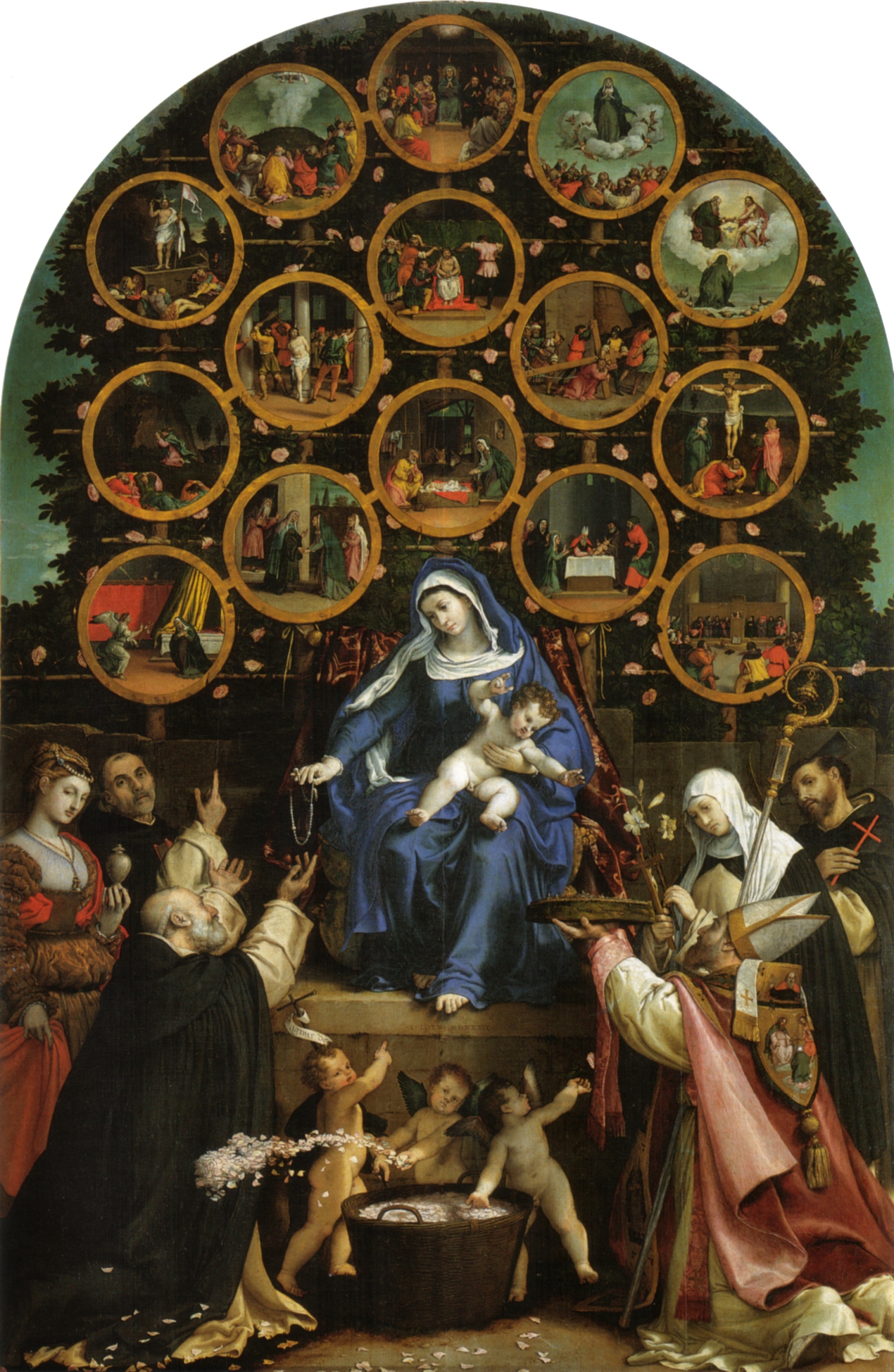
The Madonna of the Rosary, by Lorenzo Lotto, 1539
For these reasons especially, we have repeatedly encouraged the recitation of the Holy Rosary, and have endeavored to increase its dignity by a more solemn cult, following in this the footsteps of our predecessors. For just as Pope Sixtus V of happy memory approved the ancient custom of reciting the Rosary, and Gregory XIII dedicated a feast to this title, which Clement VIII then inscribed in the martyrology, Clement XI ordered to be kept by the universal Church, and Benedict XIII inserted into the Roman Breviary, so did we, in perpetual testimony of our affection for this devotion, command that the same solemnity with its office should be celebrated in the universal Church as a double of the second class, and will that the entire month of October be consecrated to this devotion. Finally, we ordered that the invocation “Queen of the most Holy Rosary” be added to the Litany of Loreto an augury of victory in our present warfare.
The Pope goes on to say that he intends to publish an apostolic constitution which will enumerate the rights, privileges and indulgences which are enjoyed by the members of the various Rosary sodalities.
Let this constitution of ours be a testimony of our love for the most august Mother of God, and at the same time offer both encouragement to all the Christian faithful and a reward of their piety, so that in the last hour of life they may be relieved by her assistance and able most sweetly to rest in her embrace.
Having heartily besought these things from Almighty God through the Queen of the most Holy Rosary, as an earnest and pledge of heavenly blessings, venerable brethren, to your clergy and to the people entrusted to the care of each one of you, we lovingly impart the apostolic benediction.
The fourth of July is, in most parts of the world, a day like any other. In the pre-55 Roman calendar, it would have been a day within the octave of the Holy Apostles Peter and Paul, with the Mass “Mihi autem.” Current Ordos usually say “feria.” On this day the United States of America celebrates a national holiday called Independence Day, for which, in the Novus Ordo, a perfectly ridiculous “proper Mass” has been cobbled together that reeks of Masonic “Manifest Destiny” patriotism (see here for the texts and my detailed critique). Traditional priests more modestly and more appropriately celebrate a votive Mass in honor of the country's patroness, the Immaculate Conception, or a votive Mass for Peace.
At this time of its history, the USA is — or at least is in continual danger of — devolving into violence and anarchy. Some would blame this on very recent social movements and educational failure; others would see it as rooted in longstanding philosophical errors and habits of life that take time to work out their consequences. The recent welcome overthrow of Roe v. Wade has stoked the fires of the culture wars still further. As a student of political history I find fascinating the genre of dreamy praise directed to the US government and its founding documents as practically the best the world has ever seen, and this, not on the lips of secularists or Protestants, from whom one might expect the message, but on the lips of important Catholic figures. Let’s begin with Cardinal Gibbons, who stated in a speech at the Catholic University of America on January 19, 1897:
If I had the privilege of modifying the Constitution of the United States, I would not expunge or alter a single paragraph, a single line, or a single word of that important instrument. The Constitution is admirably adapted to the growth and expansion of the Catholic religion, and the Catholic religion is admirably adapted to the genius of the Constitution. They fit together like two links in the same chain.
The same prelate returned to this theme twelve years later in the North American Review of March 1909: “American Catholics rejoice in our separation of Church and state, and I can conceive no combination of circumstances likely to arise which would make a union desirable for either Church or state.”
A statue (of Leo XIII) that I saw every week at CUA in grad school...
Another Americanist of distinction was Isaac Hecker (1819–1888), founder of the Paulist Fathers, who is quoted in Walter Elliott’s Life of Father Hecker as saying:
The form of government of the United States is preferable to Catholics above other forms. It is more favorable than others to the practice of those virtues which are the necessary conditions of the development of the religious life of man. This government leaves men a larger margin of liberty of action, and hence for cooperation with the guidance of the Holy Spirit, than any other government under the sun. With these popular institutions men enjoy greater liberty in working out their true destiny. The Catholic Church will therefore flourish all the more in this republican country in proportion as her representatives keep, in their civil life, to the lines of their republicanism. (p. 293)
And yet, even one so wedded to Vatican-II-style religious liberty and the separation of Church and State as John Courtney Murray had the perspicacity to see, and the honest to state, the real situation “on the ground” (this, in a lecture at Loyola University in Baltimore in 1940):
American culture, as it exists, is actually the quintessence of all that is decadent in the culture of the Western Christian world. It would seem to be erected on the triple denial that has corrupted Christian culture at its roots, the denial of metaphysical reality, the primacy of the spiritual over the material, of the social over the individual . . . . Its most striking characteristic is its profound materialism . . . . It has given citizens everything to live for and nothing to die for. And its achievement may be summed up thus: It has gained a continent and lost its own soul.
Such a blistering assessment brings to mind G. K. Chesterton’s quip in the New York Times of February 1, 1931: “There is nothing the matter with Americans except their ideals. The real American is all right; it is the ideal American who is all wrong.”
A last passage worth sharing on this fourth of July is written by a man of dual origin, Spanish and English, namely, the historian Henry Sire, whose wide-ranging book Phoenix from the Ashes does not neglect to make some critical remarks about the role America played in the dechristianization of the world and the decatholicizing of the Church:
Across the Atlantic, there was a new Protestant power, adding its strength to those of Europe, and here, too, the work of sapping Catholic societies was prominent. It had already been seen in the French Revolution, in which the American example was influential, and the process continued in the nineteenth century. The United States, like Britain, supported the revolt of Spanish America, and in 1867 they were directly responsible for the victory of an anti-clerical regime in Mexico. A less commonly noticed achievement was that of decatholicising the lands — the seaboards of the Gulf of Mexico and the Pacific — which the United States acquired by purchase or conquest between 1803 and 1848. For a contrast, we may look to the case of Quebec after its annexation by Britain; a policy of respecting the native institutions allowed Quebec to survive essentially as a traditional Catholic society. A different fate was that of the Spanish and French colonies that fell to republican expansion, as their institutions were overruled in favour of the self-evident truths of Thomas Jefferson. Yet it would be petty to find fault with the American Republic merely for what it did to Catholic societies. It also followed the career of territorial expansion led by its Protestant precursors, Holland and Britain. The empire that those powers built up in far-off lands was available to the Americans on their doorstep. It is not generally remarked that the United States is the only country in the modern world which in the recent past — specifically the years from 1811 to 1898 — has acquired its national territory by dispossessing the existing inhabitants and by launching wars of aggression against its neighbours; but that record has not hampered the United States from presenting itself as the world’s moral pastor in international affairs, so successfully has democracy been identified with virtue and innocence. Internally, the years after the Civil War became known for their corruption and political manipulation, and for the rise of the robber barons of large-scale capitalism, showing that the country’s domestic morality matched that in foreign relations. By that period, the United States was taking the place of Britain as the example of modernity. American society became the leader in advances against the older Christian ethos, a trend that became stronger in the twentieth century. The undermining of sexual morality included, amongst other signs, a growing fashion for divorce, encouraged by the strength of the feminist movement. A Protestant tradition that busied itself in imposing teetotalism and biblical literalism was engaged in looking the wrong way while these vices stole upon it. (pp. 133–34)
After that sobering passage, it does not seem quite right to say among ourselves in the USA, “Happy Independence Day!,” much less (in keeping with the faux new rite optional memorial) “Blessed Independence Day!” Rather, we might say, as indeed all Catholic citizens of any Western country at this time must say: Miserere nostri, Domine, quia peccavimus tibi.
In the course of his Papacy, the fourth longest in history, Pope Leo XIII (1878-1903) issued eleven encyclicals on the Rosary, in the years 1883, ’84 and ’87, and then each year from 1891-98. All of them were published in September (except one, at the very end of August), looking forward to the feast of the Holy Rosary, which in his time was kept on the first Sunday of October. The feast was later fixed by Pope St Pius X to October 7, the date of the famous Battle of Lepanto which it commemorates, inter alia. Much of what Pope Leo writes is every bit as germane to the condition of the Church and society as it was when it was written over a century ago. In keeping with our custom of several years’ standing, we mark this great feast with an excerpt from one of them, the 1891 Encyclical Octobri mense adventante, in my own corrected translation. (On the Vatican’s website you can read the full text in Latin, and a rather sadly bowdlerized English version of it.)
At the coming of the month of October, which is consecrated and dedicated to the most Blessed Virgin of the Rosary, we are greatly pleased to recall how greatly in preceding years We have commended to you, venerable brethren, our wish that the faithful throughout the world, urged by your authority and by your zeal, should redouble their piety towards the great Mother of God, the mighty helper of the Christian people, and should pray to her throughout the month, and invoke Her by that most holy rite of the Rosary, which the Church, especially in uncertain and most difficult times, has ever used and celebrated for the accomplishment of all desires.
This year once again do We take care to publish Our wishes, once again to encourage you by the same exhortations. We are urged and persuaded to this in love for the Church, whose sufferings, far from being mitigated, increase daily in number and in gravity. Well-known to all are the evils we deplore: war made upon the sacred dogmas which the Church holds and transmits; derision cast upon the integrity of that Christian virtue which she has in keeping; … attack made, with most impudent audacity and criminal malice against Christ Himself, as if to utterly abolish or destroy from its foundation the Divine work of His Redemption – that work which, indeed, no adverse power shall ever destroy.
The Battle of Lepanto, by Paolo Veronese, ca. 1572, now in the Academy Gallery in Venice
No new events are these for the Church militant. Jesus foretold to His disciples that She must enter upon a daily battle and struggle in order to teach men the truth and guide them to eternal salvation. And indeed, throughout the course of ages She fights undaunted, even to martyrdom, rejoicing and glorying in nothing more than the fact that She can dedicate Her own blood along with her Founder’s, wherein She holds the most certain hope of the victory promised to Her. …
Through this storm of evils, in the midst of which the Church struggles so fiercely, all her devout children see by how holy a duty they are bound to pray to God with greater instance, and especially the reason for which they must strive to give to their prayers the greatest possible efficacy. Faithful to the example of our most religious fathers and elders, let us have recourse to Mary, our holy Sovereign. Let us call upon Mary, the Mother of Christ and our own, and with one heart beseech Her, “Show thyself to be a mother; through Thee, may He accept our prayers Who, born for us, consented to be Thine.” (from the Vesper hymn of the Office of the Virgin Mary Ave, Maris Stella) …
Now, among the several rites and manners of paying honor to the Divine Mother, since some are to be preferred, inasmuch as we know them to be more powerful and more pleasing to Her, for this reason We specially mention by name and recommend the Rosary … which recalls to our minds the great mysteries of Jesus and His Mother, their joys, sorrows, and triumphs... As the faithful devoutly call to mind and contemplate these august mysteries, it is wondrous to see how great is the aid they receive in the nourishment of their faith, in defense against ignorance and the disease of error, and in the lifting up and supporting of the mind towards virtue.
Indeed, the thought and memory of him who thus prays, enlightened by the light of the Faith, are drawn towards these mysteries with the greatest joy and zeal, are fixed and absorbed therein, and cannot sufficiently wonder at the ineffable work of the Redemption of mankind, achieved at such a price and by events so great. Then the mind is filled with gratitude and love before these proofs of Divine love; its hope is strengthened and increased; its desire is increased for the heavenly rewards which Christ has prepared for those who have united themselves to Him by the imitation of His example and the sharing of His sufferings. Prayer is poured forth in the midst of these things by words coming from God Himself, from the Archangel Gabriel, and from the Church; full of praise and of saving petitions, it is renewed and continued in an order at once fixed and various, and the fruits of its devotion are ever new and sweet.
As has now been our tradition for several years, we commemorate the feast of the Holy Rosary with some excerpts from one of the many encyclicals on the subject by His Holiness Pope Leo XIII (1878-1903). All of these were published in September (except one, at the very end of August), looking forward to the feast, which in his time was kept on the first Sunday of October, but fixed by his successor, Pope St Pius X, to October 7, the date of the famous Battle of Lepanto which it commemorates. Especially in light of the most recent social encyclical, what Pope Leo writes is every bit as germane as it was when it was written over a century ago. He identifies three ills that particularly afflict human society, and to each proposes a spiritual remedy, based on the three sets of mysteries of the Rosary. These excerpts are taken from the 1893 Encyclical Laetitiae Sanctae, in the English translation given on the Vatican’s website, where you can also read the full text in Latin.
We are convinced that the Rosary, if devoutly used, is bound to benefit not only the individual but society at large. No one will do Us the injustice to deny that in the discharge of the duties of the Supreme Apostolate We have laboured - as, God helping, We shall ever continue to labour - to promote the civil prosperity of mankind. Repeatedly have We admonished those who are invested with sovereign power that they should neither make nor execute laws except in conformity with the equity of the Divine mind. On the other hand, we have constantly besought citizens who were conspicuous by genius, industry, family, or fortune, to join together in common counsel and action to safeguard and to promote whatever would tend to the strength and well-being of the community. Only too many causes are at work, in the present condition of things, to loosen the bonds of public order, and to withdraw the people from sound principles of life and conduct.
The Madonna of the Rosary, by Guido Reni, 1598
There are three influences which appear to Us to have the chief place in effecting this downgrade movement of society. These are-first, the distaste for a simple and labourious life; secondly, repugnance to suffering of any kind; thirdly, the forgetfulness of the future life.
The Joyful Mysteries
We deplore - and those who judge of all things merely by the light and according to the standard of nature join with Us in deploring, that society is threatened with a serious danger in the growing contempt of those homely duties and virtues which make up the beauty of humble life. … For evils such as these let us seek a remedy in the Rosary, which consists in a fixed order of prayer combined with devout meditation on the life of Christ and His Blessed Mother. …
These are precious examples of goodness, of modesty, of humility, of hard-working endurance, of kindness to others, of diligence in the small duties of daily life, and of other virtues, and once they have made their influence felt they gradually take root in the soul, and in course of time fail not to bring about a happy change of mind and conduct. Then will each one begin to feel his work to be no longer lowly and irksome, but grateful and lightsome, and clothed with a certain joyousness by his sense of duty in discharging it conscientiously. Then will gentler manners everywhere prevail; home-life will be loved and esteemed, and the relations of man with man will be loved and esteemed, and the relations of man with man will be hallowed by a larger infusion of respect and charity. And if this betterment should go forth from the individual to the family and to the communities, and thence to the people at large so that human life should be lifted up to this standard, no one will fail to feel how great and lasting indeed would be the gain which would be achieved for society.
The Sorrowful Mysteries
A second evil, one which is specially pernicious, and one which, owing to the increasing mischief which it works among souls, we can never sufficiently deplore, is to be found in repugnance to suffering and eagerness to escape whatever is hard or painful to endure. The greater number are thus robbed of that peace and freedom of mind which remains the reward of those who do what is right undismayed by the perils or troubles to be met with in doing so. Rather do they dream of a chimeric civilization in which all that is unpleasant shall be removed, and all that is pleasant shall be supplied. By this passionate and unbridled desire of living a life of pleasure, the minds of men are weakened, and if they do not entirely succumb, they become demoralized and miserably cower and sink under the hardships of the battle of life.
In such a contest example is everything, and a powerful means of renewing our courage will undoubtedly be found in the Holy Rosary, if from our earliest years our minds have been trained to dwell upon the sorrowful mysteries of Our Lord's life, and to drink in their meaning by sweet and silent meditation. In them we shall learn how Christ, “the Author and Finisher of Our faith,” began “to do and teach,” in order that we might see written in His example all the lessons that He Himself had taught us for the bearing of our burden of labour and sorrow, and mark how the sufferings which were hardest to bear were those which He embraced with the greatest measure of generosity and good will. … We see Him bound like a malefactor, subjected to the judgment of the unrighteous, laden with insults, covered with shame, assailed with false accusations, torn with scourges, crowned with thorns, nailed to the cross, accounted unworthy to live, and condemned by the voice of the multitude as deserving of death. Here, too, we contemplate the grief of the most Holy Mother, whose soul was not merely wounded but “pierced” by the sword of sorrow, so that she might be named and become in truth “the Mother of Sorrows.” Witnessing these examples of fortitude, not with sight but by faith, who is there who will not feel his heart grow warm with the desire of imitating them?
Then, be it that the “earth is accursed” and brings forth “thistles and thorns,”- be it that the soul is saddened with grief and the body with sickness; even so, there will be no evil which the envy of man or the rage of devils can invent, nor calamity which can fall upon the individual or the community, over which we shall not triumph by the patience of suffering. For this reason it has been truly said that “it belongs to the Christian to do and to endure great things,” for he who deserves to be called a Christian must not shrink from following in the footsteps of Christ. …
The Glorious Mysteries
The third evil for which a remedy is needed is one which is chiefly characteristic of the times in which we live. Men in former ages, although they loved the world, and loved it far too well, did not usually aggravate their sinful attachment to the things of earth by a contempt of the things of heaven. Even the right-thinking portion of the pagan world recognized that this life was not a home but a dwelling-place, not our destination, but a stage in the journey. But men of our day, albeit they have had the advantages of Christian instruction, pursue the false goods of this world in such wise that the thought of their true Fatherland of enduring happiness is not only set aside, but, to their shame be it said, banished and entirely erased from their memory, notwithstanding the warning of St. Paul, “We have not here a lasting city, but we seek one which is to come” (Heb. xiii., 4).
… But men of carnal mind, who love nothing but themselves, allow their thoughts to grovel upon things of earth until they are unable to lift them to that which is higher. For, far from using the goods of time as a help towards securing those which are eternal, they lose sight altogether of the world which is to come, and sink to the lowest depths of degradation. We may doubt if God could inflict upon man a more terrible punishment than to allow him to waste his whole life in the pursuit of earthly pleasures, and in forgetfulness of the happiness which alone lasts for ever.
It is from this danger that they will be happily rescued, who, in the pious practice of the Rosary, are wont, by frequent and fervent prayer, to keep before their minds the glorious mysteries. These mysteries are the means by which in the soul of a Christian a most clear light is shed upon the good things, hidden to sense, but visible to faith, “which God has prepared for those who love Him.” From them we learn that death is not an annihilation which ends all things, but merely a migration and passage from life to life. By them we are taught that the path to Heaven lies open to all men, and as we behold Christ ascending thither, we recall the sweet words of His promise, “I go to prepare a place for you.” By them we are reminded that a time will come when “God will wipe away every tear from our eyes,” and that “neither mourning, nor crying, nor sorrow, shall be any more,” and that “We shall be always with the Lord,” and “like to the Lord, for we shall see Him as He is,” and “drink of the torrent of His delight,” as “fellow-citizens of the saints,” in the blessed companionship of our glorious Queen and Mother. …
Here alone we discover the true relation between time and eternity, between our life on earth and our life in heaven; and it is thus alone that are formed strong and noble characters. When such characters can be counted in large numbers, the dignity and well-being of society are assured. All that is beautiful, good, and true will flourish in the measure of its conformity to Him who is of all beauty, goodness, and truth the first Principle and the Eternal Source.
In the course of his Papacy, the fourth longest in history, Pope Leo XIII (1878-1903) issued eleven encyclicals on the Rosary, in the years 1883, ’84 and ’87, and then each year from 1891-98. All of them were published in September (except one, at the very end of August), looking forward to the feast of the Holy Rosary, which in his time was kept on the first Sunday of October. The feast was later fixed by Pope St Pius X to October 7, the date of the famous Battle of Lepanto which it commemorates, inter alia. Much of what Pope Leo writes is every bit as germane to the condition of society and the Church as it was when it was written over a century ago. The following is an excerpt from the 1892 Encyclical Magnae Dei Matris, with a few corrections of the English translation given on the Vatican’s website, where you can also read the full text in Latin.
It is now only too plain how many and of what nature are the corrupting agencies by which the wickedness of the world deceitfully strives to weaken and completely uproot from souls their Christian faith and the observance of God’s law on which that faith is fed is brought to fruitfulness. Already the Lord’s fields are everywhere turning into a wilderness abounding in ignorance of the Faith, in error and vice, as though blown upon by a most foul plague. And to add to the anguish of this thought, so far from putting a check on such insolent and destructive depravity, or imposing the punishment deserved, they who can and should correct matters seem in many cases, by their indifference or open connivance, to increase the spirit of evil.
We have good reason to deplore the public institutions in which the teaching of the sciences and arts is purposely so organized that the name of God is passed over in silence or disparaged; to deplore the license - growing more shameless by the day - in publishing or speaking any kind of insult to Christ our God and His Church. And We deplore no less the consequent laxity and apathy in the practice of the Catholic religion which if not quite open apostasy from the Faith, will most certainly lead there, since it is a manner of life having nothing in common with faith. Nobody who ponders this disorder and the surrender of the most fundamental principles will be astonished if afflicted nations everywhere are groaning under the heavy hand of God’s vengeance and stand anxious and trembling in fear of worse calamities.
Now, to appease the might of an outraged God and to bring that health of soul so needed by those who are sorely afflicted, there is nothing better than devout and persevering prayer, provided it be joined with a love for and practice of Christian life. And we deem that both of these, the spirit of prayer and the practice of Christian life, are best attained through the Mary’s Rosary. ...
The Madonna of the Rosary, by Anthony van Dyck, 1623-4; in the Rosary Oratory of the Church of St Dominic in Palermo, Sicily. (Public domainimage from Wikimedia Commons.)
When we have recourse to Mary in prayer, we are having recourse to the Mother of mercy, who loves us so well that, whatever the necessity that presses upon us especially in attaining eternal life, She is instantly at our side of her own accord, even though she has not been invoked. She dispenses grace with a generous hand from that treasure with which from the beginning she was divinely endowed in fullest abundance that she might be worthy to be the Mother of God. By the fullness of grace which confers on her the most illustrious of her many titles, the Blessed Virgin is infinitely superior to all the hierarchies of men and angels, the one creature who is closest of all to Christ. “It is a great thing in any saint to have grace sufficient for the salvation of many souls; but to have enough to suffice for the salvation of everybody in the world, is the greatest of all; and this is found in Christ and in the Blessed Virgin.” (St Thomas Aquinas, opus vij de Salutatione Angelica) ...
It is scarcely possible to say how pleasing and gratifying to her it is when we greet her with the Angelic Salutation, “full of grace”; and in repeating it, fashion these words of praise into crowns for her. For every time we say them, we recall the memory of her exalted dignity and of the Redemption of the human race which God began through her. We likewise bring to mind the divine and everlasting bond which links her with the joys and sorrows, the humiliations and triumphs of Christ in directing and helping mankind to eternal life. ...
Therefore, let us approach Mary confidently, wholeheartedly beseeching her by the bonds of her motherhood which unite her so closely to Jesus and at the same time to us. Let us with deepest devotion invoke her constant aid in the prayer which she herself has indicated and which is most acceptable to her. Then with good reason shall we rest with an easy and joyous mind under the protection of the best of mothers.


.jpg)

.jpg)


.jpg)

.jpg)