Friday, September 27, 2024

The Epistle Settings


Lost in Translation #105

A standard feature of all Apostolic liturgies is the use of Scriptural readings to illuminate the liturgical occasion, rather than to deepen Biblical literacy per se. Readings from the Old and New Testament were generally chosen because of their thematic relevance to the season or day. Occasionally, readings were composed of specific verses selected from a Biblical passage for appropriateness to the liturgical day, with other less appropriate verses omitted, in order to further hone the message. There also exist readings of a type called a “cento”, from a Latin word meaning “patchwork”, which are assembled from verses of different books of the Bible. (These are extremely rare in the Roman and Ambrosian Rites, but common in the Byzantine.) To paraphrase Fr. Joseph Jungmann, the Church did not hesitate to break the bread of God’s word in order to prepare the faithful for a particular Eucharist breaking of the bread. [1]

One curious component of this verbal bread-breaking is the addition of settings to the sacred texts. Before reading a passage from the Bible, the reader (a lector, subdeacon, or priest) announces the name of the book from which it is taken and then adds an introductory word of address or explanation. Words of address typically go with New Testament readings while words of explanation typically go with Old Testament readings. When an Old Testament reading is used, for example, it is common to see it prefaced with “In diebus illis – In those days”, or “Haec dicit Dominus – Thus saith the Lord”. Both introductions are designed to heighten the audience’s attention.
So too are the words of address that preface a New Testament reading. Most of the readings from the Acts of the Apostles begin with In diebus illis, and the same is true of Revelation, for even though much of this apocalyptic book is a vision of the future, the revelations were given to St. John “in those days.” We will say more about In diebus illis when we discuss the Gospel setting In illo tempore in the next essay.
As for the Epistles: “Fratres – Brethren”) begins readings from St. Paul’s congregational letters [2], “Carissime – Dearly beloved” (singular) begins those from his pastoral letters [3], and “Carissimi –Dearly beloved” (plural) begins the so-called Catholic Epistles. [4] And because the Roman Missal ascribes the Epistle to the Hebrews to Saint Paul and treats it as a congregational letter, passages from Hebrews begin with Fratres as well.
St. Paul does not begin his own epistles with these greetings, although at some point he does address the churches in most of his congregational letters with Fratres. In his pastoral letters, Paul refers to Timothy and to Titus as his beloved son (dilectus filius), and once he refers to Timothy as his dearly beloved son (carissimus filius – Titus 1, 2) As for the Catholic Epistles, Saints Peter, John, and Jude all address their audiences with Carissimi (1 Pet. 2, 11; 1 John 2,7; Jude 3) while Saint James does not.
The greetings therefore serve as rough but reliable signposts, reminding the listener of the passage’s literary or ecclesiastical context. And thanks to their ordering in the Missal, they form illuminating clusters on the calendar.
The beginning of the Epistle to the Galatians in a medieval Bible.
Fratres, used for Paul’s congregational epistles, is the most common address and can be found throughout the year in both the Temporal and Sanctoral Cycles.
The single-number Carissime, used for Paul’s epistles to Timothy and Titus, appears in the Temporal Cycle only during Christmastide: the Midnight Mass, the Christmas Dawn Mass, on days within the Octave of the Nativity, on the Christmas Octave, and on the Saturday Mass for the Blessed Virgin Mary from Christmas to Candlemas. It is more common in the Sanctoral Cycle, where it is used on a variety of Saints’ feast days. The use of Carissime during the Christmas season is apt, a warm reminder of how God so loved the world that He gave us His only Son.
The plural-number Carissimi, used for the Catholic epistles, appears in the Temporal Cycle only during Eastertide and the initial Sundays after Pentecost: Easter Friday, Easter Saturday, all the Sundays after Easter, the Lesser Rogation Days, the Sunday after the Ascension, the First through Third Sundays after Pentecost, and the Fifth Sunday after Pentecost. It appears less often in the Sanctoral Cycle. The use of Carissimi during the Easter season is apt, a warm reminder of how God has exalted His Son who was obedient unto death on a cross, and made us heirs of His grace. And insofar as more people are greater (in number) than one person, it is fitting that the plural Carissimi be used for the greatest season of the liturgy year.
Liturgical settings appear in the 1970 Roman Missal and are faithfully reproduced in the lectionaries of several modern languages. For reasons unknown to me, however, they do not appear in any of the official English translations. This omission, in my opinion, is especially regrettable with the Gospel settings, to which we shall turn in the next essay.
From the 2015 Lectionary of Spain
Notes
[1] Joseph A. Jungmann, The Mass of the Roman Rite (Christian Classics, 1974), 265.
[2] Romans, 1 Corinthians, 2 Corinthians, Galatians, Ephesians, Philippians, Colossians, 1 Thessalonians, and 2 Thessalonians.
[3] 1 Timothy, 2 Timothy, Titus.
[4] James, 1 Peter, 2 Peter, 1 John, 2 John, 3 John, and Jude.

Thursday, August 29, 2024

St John the Baptist and Subdeacon

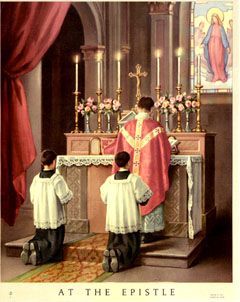
Today is the feast of the Beheading of St John the Baptist; by a nice coincidence, I happened to consult the part of William Durandus’ Rationale Divinorum Officiorum, the Summa Theologica of medieval liturgical commentaries, which discusses the rites of Mass (book 4), and thus discover his interesting explanation of the subdeacon’s singing of the Epistle, which he sees as a symbol of St John and his role in the life of Christ.

The Epistle should be read, according to Master William of Auxerre, on the right side of the Church, because Christ came first to the Jews, who are said to be on the right (i.e. the place of honor); nonetheless, it is better that it be done in the middle of the church, since John was in the middle between the Apostles and the Prophets. ... (This also refers to the opening words of the Introit of St John the Evangelist, “In the midst of the Church he opened his mouth”, Sir. 15, 5, also used in several other places in the liturgy.)

But the Epistle is put before the Gospel, for it designates the office which John exercised before Christ, since he went before the face of the Lord to prepare His ways, as he himself bear witness: “I am the voice of one crying out in the desert: ‘prepare ye the way of the Lord.’ ” John is therefore like the subdeacon, the minister under Him who said about Himself, “The Son of man came not to be served.” Wherefore, just as the preaching of John went before the preaching of Christ, so the Epistle goes before the Gospel. The Epistle also bears the figure of the Law and Prophecy, which preceded the coming of Christ, just as it precedes the Gospel; for the Law preceded the Gospel, as shadow goes before light, as fear before charity, and a beginning before perfection.

John the Baptist Preaching Before Herod, by the Dutch painter Pieter de Grebbe (1600 ca. - 1652/3; public domain image from Wikimedia Commons.) 
Only one acolyte accompanies the subdeacon when he is about to read the Epistle (a very typical medieval custom), because few followed the preaching of John, since the Law brings no one to perfection, but when the deacon is about the read the Gospel, subdeacons and acolytes and others accompany him, because very many received the preaching of the Gospel, which does bring to perfection. It can also be said that by the procession of the subdeacon and deacon to read, the two-fold manifestation of Christ in His two comings is signified. The first of these had only one Forerunner, namely John, which is signified by the procession of the subdeacon. The second will have two, namely, Enoch and Elijah (Apoc. 11), who are figured by the two or more who go before the deacon.
The face of the one who reads the Epistle should be turned to the altar, which signifies Christ, because the preaching of John directed himself and others towards Christ, from Whose countenance come forth judgment and justice. But (the acolyte) who goes before the subdeacon as he goes to read, does not turn his face towards the reader, because John directed those who heard him not to himself, but to Christ.
However, those who go before the deacon as he goes to read look towards the Gospel, and towards the face of the one who recites it, first, so that by the mutual regarding of each other, the love and charity of Christ may be designated, which are preached in the Gospel: secondly, that they may show themselves to be witness of the teaching of the Gospel, as we read in Isaiah (43, 10), “Ye are my witnesses, saith the Lord.”
St John the Baptist (lower right) at the head of the “praiseworthy number of the prophets”; fresco on the ceiling of the San Brizio chapel of the cathedral of Orvieto, Italy, by Fra Angelico and Benozzo Gozzoli. (Image from Wikimedia Commons by Sailko, CC BY 3.0)
But because John was the boundary between what preceded and what followed, in the middle between the Apostles and the Prophets, (for “the law and prophets (were) unto John, and from then, the kingdom of God was proclaimed” (Luke 16, 6)), therefore the Epistle is not always read from the prophets, nor always from the Apostles, but sometimes is taken from the Old Testament, and sometimes from the New. For John, whose voice the Epistle represents, preached along with the ancients that Christ would come, saying “He that is to come after me was before me”, and with the more recent, he shows that Christ is present, saying, “Behold the Lamb of God, behold him that taketh away the sins of the world.”

Wednesday, May 10, 2023

The Easter Epistles of the Byzantine Rite

At the Divine Liturgy of Easter Sunday, the Byzantine Rite begins a semi-continuous reading of the Acts of the Apostles and the Gospel of St John, which lasts until Pentecost. I describe it as “semi-continuous” because on several occasions, the readings are placed out of order for one reason or another. For example, John 2, 12-22 is read on Bright Friday, between parts of chapter 3 on Thursday and Saturday; after cleansing the temple, Jesus says “ ‘Destroy this temple, and in three days I will raise it up.’ … But He spoke of the temple of His body.” This is of course one week after Good Friday, the day on which the temple of His body was “destroyed.”
In a previous article, I explained why the Byzantine Rite does not read a Gospel of the Resurrection on Easter itself. The liturgy of Easter Sunday is meant to be understood as part of a unit, together with that of Holy Saturday, at which the Gospel is the whole of Matthew 28. This reading tells of the women at the tomb, their meeting with Christ, the bribing of the guards, Christ’s meeting with the disciples in Galilee, and the Great Commission. And thus, the story of the Resurrection has already been told by the first part of the Paschal liturgy.
A 10th century Greek Epistle lectionary; Bibliothèque nationale de France, grec 382, folios 1r and 2v. – As can be seen from the folio number, this is at the very beginning of the manuscript; Byzantine lectionaries are traditionally arranged according to the order of their liturgical use, starting with Easter. The Acts of the Apostles begins with the decorative letter in the margin of the right-hand page. The epistle reading is traditionally called “the Apostle” in the Byzantine Rite, and an epistle lectionary is also known as a “praxapostolos”, compounding “Apostle” with the Greek word “praxeis – acts.”
In a similar vein, the Epistle of Easter is Acts 1, 1-8, which only mentions the Resurrection in passing, and is mostly concerned with Christ’s charge to the Apostles to await the coming of the Holy Spirit at Pentecost. This establishes first of all that it is at Pentecost, the other great baptismal feast, that the Church will begin to fulfill the Great Commission, and furthermore, that it can only be fulfilled with and within the Church. And as with the Gospel, the Resurrection is already proclaimed at length in the Epistles (plural) of Holy Saturday. At the end of Matins, 1 Corinthians 5, 6-8 and Galatians 3, 13-14 are read as a single epistle, titled to the former.
“For Christ our pasch is sacrificed. Therefore let us feast … Christ hath redeemed us from the curse of the law… that the blessing of Abraham might come on the Gentiles through Christ Jesus: that we may receive the promise of the Spirit by faith.”
The first part of this corresponds to the Roman Epistle of Easter Sunday. The second part anticipates one of the principal themes of the Gospels of the Easter season, the passage from the law of Moses to the grace of Christ, as stated at the end of the Gospel of Easter itself, John 1, 1-17. “For the law was given by Moses; grace and truth came by Jesus Christ.”
At the Divine Liturgy of Holy Saturday, a ceremony designed for the administration of baptism, the Epistle is Romans 6, 3-11.
“… (we) who are baptized in Christ Jesus, are baptized in his death. For we are buried together with him by baptism into death; that as Christ is risen from the dead by the glory of the Father, so we also may walk in newness of life. For if we have been planted together in the likeness of his death, we shall be also in the likeness of his resurrection. … Knowing that Christ rising again from the dead, dieth now no more, death shall no more have dominion over him.”
St Thomas and the Risen Christ; illustration in an early 17th century Armenian Gospel book now in the Bodleian Library at Oxford University. (Image from Wikimedia Commons, CC BY 4.0)
Easter Sunday is the only feast day in the Byzantine Rite on which Vespers has its own Gospel, John 20, 19-25, read at the same hour at which the events it narrates occurred, when the Lord came to the Apostles as they were gathered together in fear, but Thomas was not among them. The following Sunday, this Gospel is repeated at the Divine Liturgy, and completed by adding verses 26-31, the meeting of Thomas with the Risen Lord in the presence of the other eleven.
The Epistle of St Thomas Sunday, Acts 5, 12-20, recounts the miracles which the Apostles performed in the first days after Pentecost, the adherence of many to the Church, the Apostles’ arrest, and their liberation by an angel. This reading is pulled forward, so to speak, by several days, to match this Gospel; having been confirmed in their faith by their meeting with the Risen Lord, and by Thomas’ touching of His glorious wounds, and then by the gift of the Holy Spirit, the Apostles are emboldened to preach the faith, with all the fear instilled by the events of Lord’s passion and death permanently removed.
The following Sunday is dedicated to Joseph of Arimathea and Nicodemus, who came to take care of burying Lord’s body, and to the several women who came to the tomb to anoint it (known as the Myrrh-bearers), and thus became the first to learn of His Resurrection. Following the lectio continua, the reading is Acts 6, 1-7, the institution of the diaconate. The women at the tomb are the first witnesses to the Resurrection, and one of the first seven deacons, Stephen, is the first martyr, i.e. witness, to die for the Faith, and for the proclamation of Christ’s Resurrection to the world.
An embroidered cloth icon of the Burial of Christ, known as an “ἐπιτάφιος (epitafios)” in Greek, an adjective meaning “above the tomb”; in Church Slavonic, it is called “плащаница (plashchanitsa) – the shroud.” At Vespers of Good Friday, this is laid on the altar, and at the end of the ceremony, brought down into the nave and set on a special table, which becomes the focal point of much of the liturgy until Easter night, when it is brought back to the altar, and covered with a white cloth, remaining there until the Easter season is over. Around the inner border are written the tropars of the Sunday of the Myrrh-bearing woman. (1682, from the Benaki Museum in Athens. Public domain image from Wikimedia Commons.)
As I described in my previous article, after the Sunday of the Myrrh-bearers, there is a shift in tenor, and the next three Gospels are chosen in reference to the upcoming feast of Pentecost qua baptismal feast.
The first of these is John 5, 1-15, the healing of the paralytic at the pool of Siloam. This is paired, for obvious reasons, with Acts 9, 32-42, St Peter’s healing of another paralytic, a man named Aeneas, and continues with the raising of the deceased woman Tabitha.
The next Sunday is dedicated to the Lord’s meeting with the Samaritan woman at the well of Jacob, John 4, 5-42. The Epistle, Acts 11, 19-30 (omitting verses 27-28) is out of order with that of the previous day, Acts 12, 1-11. In St John’s Gospel, the Samaritan woman, one whom the Jews regard as essentially no different from a gentile, is nevertheless the first person to whom Jesus says that He is the Messiah. In the Epistle, those who were scattered after the persecution that led to the death of Stephen go to Antioch, and preach the Lord Jesus to the gentiles, and it is there, among the gentiles, that “the disciples were first named Christians.” Therefore, the Epistle and Gospel together speak of the Church’s mission to the gentiles, to “make disciples of all nations”, as Christ commanded at the end of Matthew 28.
On the last Sunday before the Ascension, the Gospel is that of the man born blind whom Jesus heals, John 9, 1-38. Although this man is himself a Jew, the Church Fathers agree in taking his blindness as a symbol of the blindness of the gentile nations given over to idolatry.
In the Epistle, Acts 16, 16-34, Paul and Silas are in the city of Philippi, and expel a divining spirit from a young slave girl who was following them around and loudly proclaiming that they were “the servants of the most high God, who preach unto you the way of salvation.” For this they are arrested and imprisoned, on the pretext that they “preach a fashion which it is not lawful for us to receive nor observe, being Romans.” But of course, it is at the preaching of St Paul, the Apostle of the gentiles, that the Romans and the many nations of their empire will embrace the Jewish Messiah.
At midnight, which is to say, in the time of darkness, as they pray, an earthquake breaks the prison open, and the warden, fearing to be punished for losing his charges, thinks to kill himself. These facts, the darkness, the prison, the intended suicide, represent the despair of the nations lost in the sins of idolatry. But Paul stops him, assuring him that his prisoners have not fled, and so he calls for a light and goes to them, and receives the Faith, just as the blind man is made to see by Christ, the light of the world.
(The tapestry shown to the right depicts the liberation of St Paul from the prison in Philippi; the earthquake is represented by the large male figure in the lower section, similar to the giant Atlas of Greek mythology. This is one of a series made from preparatory designs by Raphael for the Sistine Chapel in the reign of Pope Leo X, 1513-21, now in the Vatican Museums. Image from Wikimedia Commons by Fabrizio Garrisi, CC BY-SA 4.0)
In the Byzantine Rite, Eastertide ends with the Wednesday before the Ascension, but the reading of Acts and St John continues until Pentecost inclusive. The Sunday between Ascension and Pentecost is a special commemoration of the Fathers of the First Council of Nicaea, and the reading from Acts 20 (16-18 and 28-36) is very artfully chosen for the day.
“(S)ending from Miletus to Ephesus, (Paul) called the elders of the Church. And when they were come to him, and were together, he said to them: Take heed to yourselves, and to the whole flock, wherein the Holy Ghost hath placed you bishops, to rule the church of God, which he hath purchased with his own blood. I know that, after my departure, ravening wolves will enter in among you, not sparing the flock. And of your own selves shall arise men speaking perverse things, to draw away disciples after them.”
An ecumenical council is, of course, an assembly of bishops, to whom Paul, speaking as an Apostle, gives a special charge to take heed for the Church. (The city of Ephesus, mentioned at the beginning of the reading, would later be the site of another ecumenical council, the third.) The “ravening wolves” and “men speaking perverse things” would then be the heresies that rise up in the Church, and the heretics that invent them.
The first formulaic expression of the Arian heresy was a song that Arius himself taught the people in Alexandria, with the words “There was a time when He was not.” The Gospel on this Sunday is John 17, 1-13, anticipated by several days within the order of the lectio continua, which answers this heresy with the words of Christ Himself, speaking to the Father: “I have glorified thee on the earth; I have finished the work which thou gavest me to do. And now glorify thou me, o Father, with thyself, with the glory which I had with thee, before the world was.”

Mosaic in Hagia Sophia in Constantinople, ca. 1261. Public domain image by Eusebius (Guillaume Piolle) from Wikimedia Commons

Thursday, March 18, 2021

An 18th-Century Epistle Book from Notre-Dame de Paris

Following up on Tuesday’s post on the mid-18th century Gospel book used at Notre-Dame de Paris, here is the accompanying book of Epistles. (Bibliothèque nationale de France, Département des Manuscrits, Latin 8895) This is also just a selection of the images, but it does include all of the headers with illustrations for the various feasts, of which there are fewer than in the Gospel book.
“The book of Epistles according to the use of the metropolitan church of Paris, 1753.”
The Midnight Mass of Christmas
Epiphany
A sample of a the many floral decorations; this is the only one that fills its page, and is placed right before the Purification.

The Purification; the high priest is dressed rather like the Pope, and his servant like a page at the French court, of which the Temple in Jerusalem was merely a prefiguration... 
Easter

Friday, February 14, 2020

The Epistle Book of the Royal Chapel at Versailles

Two weeks ago, we published pictures of the Gospel Book of the French royal chapel of Versailles; as a follow-up to that piece, and this morning’s item from Canticum Salomonis, here are pictures of the accompanying Epistle book, also made in the year 1776, from the website of the Bibliothèque Nationale de France (Département des manuscrits, Latin 8896).

“The Epistles according to the use of the royal chapel of Versailles.”
The First Sunday of Advent: St Paul writing the Epistle to the Romans
Christmas
Holy Innocents: “And I beheld, and lo a lamb stood upon Mount Sion, and with him a hundred forty-four thousand, having his name, and the name of his Father, written on their foreheads.” (Apocalypse 14, 1)
Epiphany
The Epistle of the blessing of the Palms, Exodus 15, 27 – 16, 7. “And Moses and Aaron said to the children of Israel, ‘In the evening you shall know that the Lord hath brought you forth out of the land of Egypt, and in the morning you shall see the glory of the Lord.’ ”

Wednesday, July 17, 2019

The Sunday Epistles after Pentecost

Following up on a recent post about the Sunday Gospels after Pentecost, this table shows the Epistles of the Sundays after Pentecost as they are arranged in the lectionary of Murbach, the second oldest of the Roman Rite (ca. 800 AD), and how they correspond to those in the Missal of St Pius V. A more detailed explanation is given below. (Click to enlarge.)

The relationship between Murbach and the Roman Missal requires little commentary. The Murbach system has 25 Sundays after Pentecost, the Roman 24; in the former, the first Sunday after Pentecost is treated as a true octave day, a custom which continued in northern Europe well into the 16th century, whereas at Rome, it was the first of the Sundays after Pentecost, not part of the octave (what we now call a “green Sunday”.) Murbach therefore has a proper Epistle for the octave day of Pentecost at the beginning of the series, which displaces all the other readings forward by one week. In the Murbach column, each reading is marked with a red Roman numeral that shows which Sunday it is on in the Roman Missal, always one Sunday earlier. The only other discrepancy is the Epistle for the Roman 23rd Sunday, which is 3 verses longer than its counterpart in Murbach.

The relationship between Murbach and the earlier Roman tradition is more complex. Here the point of reference is not the lectionary of Wurzburg, which dates to about a century earlier, and has no system of Epistles for the period after Pentecost. There is a block of forty readings from the epistles of St Paul, many of which appear in later lectionaries in the series after Pentecost; however, none of them is assigned to any specific day, and it seems clear that they were simply read as needed on the Sundays or ferias.

Instead, the point of comparison is an epistolary incorrectly attributed to Alcuin, one of the great scholars of the Carolingian era. This survives in two manuscripts, one at the Bibliothèque Municipale de Cambrai (cod. 553), and another at the Bibliothèque Nationale de France (cod. lat. 9452). Although these are both of the 9th century, they represent the Roman lectionary tradition as it stood in the reign of Pope Honorius I, who reigned two centuries earlier (625-38). The manuscript in Paris has a supplement of 65 readings, added by Helisachar, abbot of St Richier; Alcuin himself did also make some minor adjustments to the tradition represented by these two manuscripts. (A. Chupungco, Handbook for Liturgical Studies; the Eucharist, pp. 177-78)

In the lectionary of Alcuin, these Sundays are counted as 4 after Pentecost, 5 after the feast of Ss Peter and Paul, 5 after that of St Lawrence, 2 “of September“”, and 6 after the feast of St Michael, a total of only 22. There is also a series of nine “daily” readings, to which the supplement in the Parisian manuscript adds 34 more. This is the tradition which Murbach systematizes into a series of 25 Sundays after Pentecost.

In the table above, therefore, the first column indicates where each reading in Murbach appears in Alcuin. Fifteen of the twenty-five epistles in Murbach are taken from the Sundays after Pentecost in Alcuin, three from the older daily series, five from the newer daily series in the supplement, and two have no correspondent, one of these being the reading for the Octave day of Pentecost. Several epistles of the oldest series attested in Alcuin have been omitted in Murbach, and others reordered; nevertheless, there is still a discernible continuity between Alcuin and the Missal of St Pius V.

Folio 77r of the so-called Lectionary of Alcuin (Bibliothèque nationale de France Département des Manuscrits. Latin 9452, cropped); the Epistle of the Octave of Pentecost, 1 Cor. 12, 2-11, which is moved by Murbach to the 11th Sunday after Pentecost.

More recent articles:

For more articles, see the NLM archives: