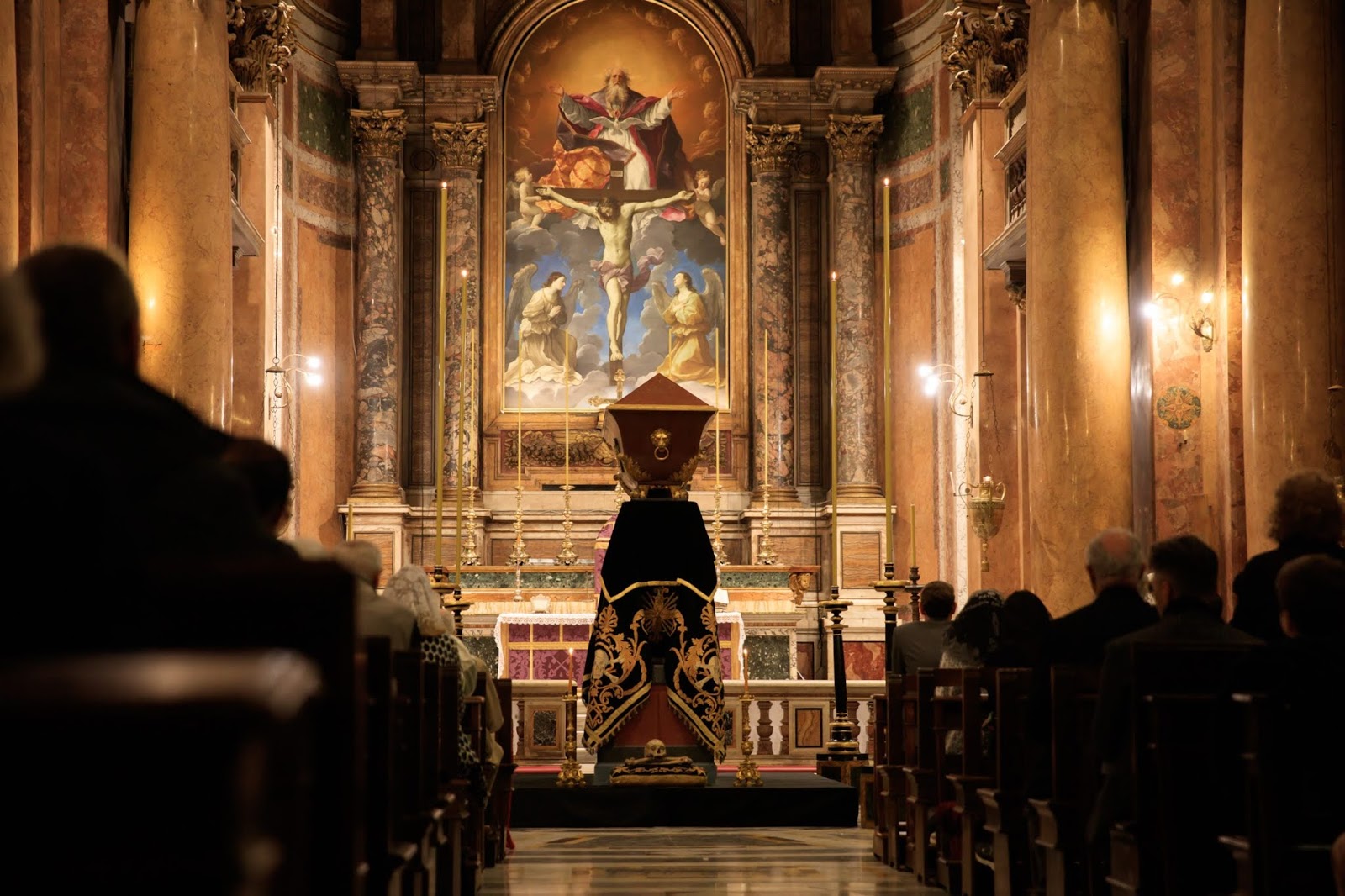
In 2022, the Axios Men’s Ensemble commissioned Benedict Sheehan, a three-time Grammy award nominee, to compose a memorial in response to Russia’s aggression in Ukraine, entitled Ukrainian War Requiem. This war, which began in 2014 and escalated into a full-scale Russian invasion in February 2022, has tragically claimed countless lives. This music is a solemn tribute to these victims. This November, from the 6th to the 15th, the Ensemble will bring the Requiem on a concert tour to nine locations across Canada.
Earlier this year, the Axios Men’s Ensemble was awarded Canada’s highest musical honour – a JUNO Award for the Classical Album of the Year (Large Ensemble) for the recording of the Ukrainian War Requiem. This marks the first time in JUNO Awards history that an a cappella recording has earned this distinction in the category.Thursday, October 29, 2026
Axios Men’s Ensemble Concert Tour of Benedict Sheehan’s Ukrainian War Requiem
Gregory DiPippoThursday, November 06, 2025
The Ambrosian Absolution at the Catafalque
Gregory DiPippoWhen the Mass is over, the celebrant and major ministers go to the Epistle side and remove their maniples; the celebrant removes his chasuble and dons a black cope. They then process out to the catafalque and stand at the head of it, preceded by two acolytes, one carrying the thurible and boat, and the other the holy water vessel and aspergil. In the meantime, the following antiphons are sung; the ninth, “In paradisum”, is sung only for the funeral of a bishop, priest or deacon. The music for these is quite simple, much of it with only one note per syllable, and the total length by note-count is less than that of the responsory Libera me which is sung at the Roman Absolution. (There are a number of other rites in the Ambrosian liturgy at which several antiphons are sung in a row without psalmody in this fashion, e.g. the Rogation days.)
| Usque in vita mea laudavi te, Domine: da requiem mihi cum Sanctis tuis in regione vivorum, et salva me. |
In my life I have always praised Thee, o Lord; grant me rest with Thy Saints in the land of the living, and save me. |
| Memorare, Domine, quae sit mea substantia; quis est homo qui vivit, et non videbit mor- tem? |
Remember, O Lord, what I am made of; what man liveth, and shall not see death? |
|
Adhaesit pavimento anima mea: vivifica me, Domine, secundum verbum tuum. |
My soul hath cleaved to the pave- ment: quicken Thou me according to thy word. Ps. 118, 25 |
|
Portio mea in terra viventium: me expectant justi, donec retri- buas mihi. |
My portion in the land of the living; the just wait for me, until Thou re- ward me. Ps. 141, 6 & 8 |
| Vide, Domine, humilitatem me- am, et dimitte omnia peccata mea. |
See, o Lord, my abjection, and for- give all my sins. Ps. 24, 18 |
| Tu jussisti nasci me, Domine; repromisisti, ut resurgerem. Jussione tua venio, Sanctissime; ne derelinquas me, quia pius es. | Thou didst command me to be born, o Lord, that I might rise again. At Thy command I come, o most Holy one; abandon me not, for Thou art gracious. |
| Credo, quod Dominus non me derelinquet, nec condemnabit me, cum venerit ad judicandum, sed miserebitur mei Redemptor meus, pius Deus. |
I believe that the Lord will not abandon me, nor condemn me, when He shall come to judge, but my Redeemer, the gracious God, will have mercy on me. |
|
Etenim pauci fuerunt dies mei; da mihi requiem cum Sanctis tuis, Domine. |
And indeed my days have been few; give me rest with Thy Saints, o Lord. |
| In paradisum deducant te An- geli, et cum gaudio suscipiant te sancti Martyres Dei. |
May the Angels lead thee into Para- dise, and may the holy Martyrs of God receive thee with joy. |
| Tu es, Domine, protector meus; in manus tuas, Domine, com- mendo spiritum meum. |
Thou art my protector, o Lord; into Thy hands, o Lord, I commend my spirit. Ps. 30, 5-6 |
In the following video, the antiphons are sung (from 0:36 to 4:43) alternating between the women’s and men’s sections of the choir; In paradisum is included, with the object “te” changed to the plural “vos”.
Once the antiphons are finished, the deacon intones another: “Redemptor meus vivit, * et in novissimo me renovabit. V. Renovabuntur denuo ossa mea, et in carne mea videbo Dominum Deum. – My Redeemer liveth, and at the end he shall renew me. V. My bones shall be renewed again, and in my flesh I shall see the Lord my God.” (Job 19, 25-26) This is a rare example of an “antiphona duplex”, an antiphon which is sung in full both before and after the psalm; the two parts (before and after the V.) are sung by two groups within the choir. The choir then begins Psalm 50, and the celebrant imposes incense in the thurible without blessing it.
At the verse “Asperges me hyssopo”, the celebrant takes the aspergil, and accompanied by the acolytes, who hold up the ends of the cope, he makes a circuit around the catafalque as in the Roman Rite, sprinkling each side of it with holy water three times. At the same time, the deacon takes the thurible and, walking immediately behind him, incenses the catafalque three times on each side. They return together to their place at the head of the catafalque. When the psalm is finished (without Gloria Patri or Requiem aeternam, neither of which is said with the psalms and canticles in the Office of the Dead), and the antiphon repeated, the celebrant says “Dominus vobiscum”, and a prayer appropriate to the occasion.
![]() |
| The deacon incensing the catafalque. |
Responsorium lectoris Qui suscitasti Lazarum quatriduanum foetidum, tu dona eis requiem, et locum indulgentiae. V. Requiem aeternam dona eis, Dómine: et lux perpétua lúceat eis. Tu dona eis requiem, et locum indulgentiae. – Thou who raised Lazarus that stank on the fourth day, grant to them rest, and a place of indulgence. Eternal rest grant to them, o Lord; and let perpetual light shine upon them. Grant to them rest, and a place of indulgence.
However, on All Souls’ Day, and at the Requiem of bishops, including the Pope, and on their anniversaries, the following is sung instead.
Responsorium diaconi Rogamus te, Domine Deus, quia peccavimus tibi: veniam petimus quam non meremur. * Manum tuam porrige lapsis, qui latroni confitenti paradisi januas aperuisti V. Vita nostra in dolore suspirat, et in opere non emendat: si expectas, non corripimur, et si vindicas, non duramus. Manum tuam... – We ask Thee, Lord God, because we have sinned against Thee: we seek forgiveness, which we do not deserve. * Stretch out Thy hand to the fallen, Who didst open the gates of Paradise to the thief that confessed. V. Our life sigheth in sorrow, and emendeth not in deed; if Thou forbear, we are not reproved, and if Thou avenge, we cannot endure. Stretch out ...
R. Voces nostras. Exaudi, Deus. R. Et miserere nobis.”, (Hear, o Christ, our voices. Hear o God, and have mercy on us.), and three Kyrie eleisons. (In the first video, it runs from 10:07 to 13:17, sung in an abbreviated form.)
As in the Roman Rite, the celebrant makes the sign of the Cross over the catafalque, saying “Requiem aeternam dona ei (eis) Domine. R. Et lux perpetua luceat ei (eis).” He adds “Anima istius, et animae omnium fidelium defunctorum per misericordiam Dei requiescant in pace. R. Amen.” The celebrant and ministers then all return in procession to the sacristy.
Posted Thursday, November 06, 2025
Labels: Ambrosian Chant, Ambrosian Rite, funerals, Mons. Amodeo, Nicola de' Grandi, Requiem
Monday, February 24, 2025
Benedict Sheehan’s Ukrainian War Requiem, Reviewed by Thomas Neal
Gregory DiPippoToday marks the third anniversary of the invasion of Ukraine by Russia. We are honored to share this review by our friend Thomas Neal of a recording of the Ukrainian War Requiem, commissioned by the Axios Men’s Ensemble from composer Benedict Sheehan, in remembrance of the victims of the invasion. The recording is now available from Capella Records. We urge all of our readers to continue pray for an end to the conflict and the establishment of a just peace.
In 2022, Damein Zakordonski and Steven Brese of the Axios Men’s Ensemble commissioned the multiple Grammy-nominated composer Benedict Sheehan to create a new work in honour of those fallen in the Ukraine-Russia conflict. The result is a substantial composition in twelve movements titled Ukrainian War Requiem, which received its premiere performance in April 2024. (Video of the part of the premiere performance at the church of St Basil the Great in Edmonton, Alberta; photos below.)
Described as “one of the leading voices in religious classical music in the 21st century” (ConcertoNet), Sheehan works out of the sacred choral traditions of Eastern Orthodoxy and has gained international recognition for his Liturgy of St. John Chrysostom (2020) and Vespers (2021).II. Psalm 90 (Псалом 90)
III. Great Litany (Велика Ектенія)
IV. Alleluia & Troparia (Алилуя і Тропарі)
V. Evlogitaria of the Departed (Евлогитарії)
VI. Sessional Hymn of the Departed (Сідальний: Упокой, Спасе наш)
VII. Psalm 50 (Псалом 50)
VIII. Canon (Канон)
IX. With the Souls (З Духами спочилих праведників)
X. Litany for the Dead (Заупокійна ектенія)
XI. Eternal Memory & Light (Вічная Пам’ять)
XII. In Paradisum
Ukrainians remember the dead in a beloved ritual called a panakhyda—a type of vigil centred on song. Mourners stand before God, in solidarity with survivors, and sing a panakhyda. It is a ritual reflecting on life and death, a lament of grief and loss, and of hope. [In the face of recent world events] the Ukrainian spirit continues to cry out to God in the panakhyda, commending the dead to God, singing them into God’s realm, remembering them for their sacrifice.
Saturday, November 02, 2024
The Dominican Libera me, Domine
Gregory DiPippoR. Líbera me, Dómine, de morte aeterna in die illa tremenda, * Quando caeli movendi sunt et terra, * Dum véneris judicáre sáeculum per ignem.
V. j Dies illa, dies irae, calamitátis et miseriæ, dies magna et amára valde. Quando.
V. ij Tremens factus sum ego et tímeo, dum discussio vénerit atque ventúra ira. Dum.
V. iij Quid ego misérrimus, quid dicam, vel quid faciam, cum nil boni pérferam ante tantum júdicem? Quando.
V. iv Nunc, Christe, te pétimus, miserére, quæsumus; qui venisti redímere pérditos, noli damnáre redemptos. Dum.
V. v Creátor omnium rerum Deus, qui me de limo terrae formasti, et mirabíliter proprio sánguine redemisti, corpusque meum, licet modo putrescat, de sepulchro facies in die judicii resuscitári: exaudi, exaudi me, ut ánimam meam in sinu Abrahae, Patriarchae tui, júbeas collocári.
Repetitur R. Líbera me.
R. Deliver me, O Lord, from eternal death on that awful day * when the heavens and the earth shall be shaken, * when Thou shalt come to judge the world by fire.
V. j That day shall be a day of wrath, of calamity and misery, a great day, and exceeding bitter. When the heavens...
V. ij Trembling do I become, and fearful, when the trial and wrath shall come. When Thou shalt come...
V. iij What shall I say or do, most wretched man that I am, since I have no good to bring before so great a judge? When the heavens...
V. iv Now, o Christ, we ask Thee, have mercy, we beseech Thee; Thou who came to redeem the lost, condemn not the redeemed. When Thou shalt come....
V. v Creator of all things, o God, Who formed me from the slime of the earth, and wondrously redeemed me with Thy own Blood, and, although it now rot, will cause my body to be raised up from the grave on the day of judgment: hear, o hear me, that Thou may command my soul to be placed in the bosom of Abraham, Thy Patriarch. Deliver me, o Lord...
Thursday, November 02, 2023
Durandus on Prayer for the Dead (Part 1)
Gregory DiPippoThe following is taken from the entry on All Souls’ Day in William Durandus’ Rationale Divinorum Officiorum (7.35), the Summa Theologiae of medieval liturgical commentaries. This is one of the longest sections of the seventh book, which covers the Sanctoral cycle, and will be presented in several parts as we begin the month especially dedicated to prayer for the dead.
This Office follows the feast of All Saints, and three consecutive days are dedicated to three mysteries. For the vigil of All Saints is a day of affliction; the solemnity is a day of exultation; but today is a day of prayer. On the first day, we afflict ourselves by fasting, as we remember the misery of this present life. On the second, we rejoice together with the blessedness of the Saints, bringing thanksgivings to the Lord. On the third, we pray for those who are detained in purgatory, obtaining for them with our prayers either a lesser suffering, or full absolution.
The commemoration of all the faithful departed was instituted by the Church on this day so that they might be helped by general services… for as Peter Damian says, St Odilo (born 962; abbot of Cluny from 994-1049), upon learning that at the volcano of Sicily (i.e. Mt Etna) frequent voices and wails of weeping demons were heard, because the souls of the deceased were being snatched away from their hands through almsgiving and prayers, decreed that in his monasteries, after the feast of All Saints, there should be a commemoration of the departed, which was afterwards approved by the whole Church. …![]() |
| A statue of St Odilo of Cluny in the basilica of St Urban in Troyes, France. As the inventor of All Souls’ Day, he is shown standing in the middle of the flames of Purgatory. (Image from Wikimedia Commons by GO69, CC0 1.0) |
| A Cretan icon of the 1490s. |
![]() |
| The Last Testament, Death and Burial of Moses, 1482, by Luca Signorelli. Fresco on a wall of the Sistine Chapel. |
The Premonstratensian Libera me, Domine
Gregory DiPippoR. Líbera me, Dómine, de morte aeterna * in die illa tremenda, * Quando caeli movendi sunt et terra, * dum véneris judicáre sáeculum per ignem.
V. j. Dies illa, dies irae, calamitátis et miseriæ, dies magna et amára valde, quando caeli movendi sunt et terra.
V. ij. Tremens factus sum ego et tímeo, dum discussio vénerit atque ventúra ira in die illa tremenda.
V. iij. Quid ego misérrimus, quid dicam, vel quid faciam, cum nil boni pérferam ante tantum júdicem in die illa tremenda?
V. iv. Plangent super se omnes tribus terrae; vix justus salvabitur, et ego miser ubi parebo in die illa tremenda?
V. v. Nunc, Christe, te déprecor, miserére, pie; qui venisti redímere nos, perpetim veni salvare in die illa tremenda, quando caeli movendi sunt et terra, dum véneris judicáre sáeculum per ignem.
R. Deliver me, O Lord, from eternal death on that awful day * when the heavens and the earth shall be shaken, when Thou shalt come to judge the world by fire.
V. j. That day shall be a day of wrath, of calamity and misery, a great day, and exceeding bitter. When the heavens and the earth shall be shaken.
V. ij. Trembling do I become, and fearful, when the trial and wrath shall come on that awful day.
V. iij. What shall I say or do, most wretched man that I am, since I have no good to bring before so great a judge on that awful day?
V. iv. All the tribes of the earth shal weep for themselves, the just man shall scarcely be saved, and where shall, a wretched man, appear on that awful day?
V. v. Now, o Christ, I beseech Thee, have mercy, o Good one; Thou who came to redeem us, come ever to save us on that awful day when the heavens and the earth shall be shaken, when Thou shalt come to judge the world by fire.
Thursday, November 10, 2022
The Ambrosian Office of the Dead
Gregory DiPippo![]() |
| Our longtime Ambrosian writer Nicola de’ Grandi intones an antiphon at Matins of the Dead, sung before a Requiem Mass for Mons. Angelo Amodeo in November of 2012, a couple of months after his death, with the Schola Sainte-Cécile. |
At Vespers, the same five psalms are said as in the Roman Rite (114, 119, 120, 129 and 137 by the traditional numeration). Their antiphons are almost the same, with a few minor variants in wording (e.g. “complacebo” instead of “placebo” for the first one.) The antiphon of 119 is slightly longer: “Alas for me, that my sojourning is prolonged, to dwell with them that dwell in Cedar.” The antiphon of the Magnificat consists of the same words which are used as the versicle in the Roman Rite: “I heard a voice from heaven, saying, ‘Blessed are the dead, who die in the Lord.’ ”
As in the Roman Rite, the Lord’s Prayer is said in silence as all kneel. The preces which follow it are longer than the Roman ones.
V. Requiem aeternam. R. Et lux.
V. Non intres in judicium. R. Cum servis tuis, Domine. (Enter not into judgment with Thy servants, o Lord.)
V. Ne tradas bestiis animas confitentium tibi. R. Animas pauperum tuorum ne obliviscaris in finem. (Deliver not up to beasts the souls of them that confess to Thee: forget not to the end the souls of Thy poor.)
V. Domine, exaudi orationem nostram. R. Et clamor noster ad te perveniat. (Hear, O Lord, our prayer: and let our cry come to Thee.)
V. Exsurge, Christe, adjuva nos. R. Et libera nos propter nomen tuum. (Arise, o Christ, help us, and deliver us for Thy name’s sake.)
Psalm 50 is then said, followed by another verse of the preces: V. Averte faciem tuam a peccatis nostris. R. Et omnes iniquitates nostras dele. (“Turn away Thy face from our sins, and blot out all our iniquities.”, the 11th verse of the preceding psalm, converted to the plural.) The celebrant then says “Dominus vobiscum” and the prayer or prayers relevant to the occasion. The hour concludes with V. Requiem aeternam and V. Animae istorum et omnium fidelium defunctorum per Dei misericordiam requiéscant in pace. R. Amen. (May the souls of these, (i.e., of those for whom the Office is specifically said) and of all the faithful departed through the mercy of God rest in peace. R. Amen.)
At Matins, there is no invitatory. (The regular Ambrosian Office does have an introductory section analogous to the Roman invitatory, but Psalm 94 is not a part of it.) The psalms, antiphons and readings of the first nocturn are the same as in the Roman Office. Following the normal pattern of Ambrosian Matins, there is a responsory after the first two readings, but not the third. The corpus of responsories is different from the Roman one, and will be explained in greater detail below.
In the second nocturn, the first two psalms (22 and 24) and their antiphons are the same as in the Roman Rite, as are the three readings; the third psalm, however, is Psalm 30 (where the Roman has 26), with the antiphon “Thou hast redeemed me, O Lord, the God of truth; into thy hands I commend my spirit.” This was certainly chosen because the Lord Himself spoke these same words on the Cross.
In the third nocturn, the psalms are 34, 39 and 41, where the Roman Rite has 39, 40 and 41. The antiphon of Psalm 34 is “But my soul shall rejoice in the Lord; and shall be delighted for his salvation.” Those of the other two psalms are the same as in the Roman Rite. The first two readings are also the same; the third, however, is 2 Maccabees 12, 43-46, the Roman Epistle for an anniversary Requiem Mass, and a foundational text for the theology of prayer for the dead.
“In those days: the most valiant Judas, have made a collection, sent twelve thousand drachms of silver to Jerusalem for sacrifice to be offered for the sins of the dead, thinking well and religiously concerning the resurrection. For if he had not hoped that they that were slain should rise again, it would have seemed superfluous and vain to pray for the dead; and because he considered that they who had fallen asleep with godliness, had great grace laid up for them. It is therefore a holy and wholesome thought to pray for the dead, that they may be loosed from sins.”
![]() |
| Judah Maccabee Redeeming the Sins of the Dead. From the Hours of Anne de Montmorency, 1550 (Public domain image from Wikimedia Commons.) |
The Ambrosian repertoire of Old Testament canticles does not include the canticle of Hezekiah (Isaiah 38, 10-20) which is said in the Roman Office of the Dead, and at the ferial office of Tuesday. The Ambrosian Office of the Dead therefore replaces it with Jonah 2, 3-10, which is also sung at Sunday Matins in summertime, and is one of the odes of Byzantine Orthros. However, the antiphon with which it is said is a slightly different version of the Roman antiphon from the canticle of Hezekiah: “A porta inferi erue, Domine, animas eorum.” (“From the gates of hell deliver their souls, o Lord.” The Roman version reads “deliver my soul.”)
The Benedictus follows immediately after the psalmody, with the same antiphon. The rest of Lauds is the same as the end of Vespers (from the Lord’s Prayer forward), except that Psalm 142 is said in place of Psalm 50.
The most significant divergence from the Roman Office for the Dead lies in the corpus of Matins responsories. Those of the first two nocturns correspond to some of the Roman responsories which accompany the readings from the book of Job at the beginning of September, rather than those of the Roman Office of the Dead. The third nocturne includes the Ambrosian version of the Libera me, which is much shorter than its Roman counterpart, and also serves as the Offertory chant of the daily and anniversary Requiem Mass. The final responsory is uniquely Ambrosian.
R. Non timebis, anima, quia Christus passus est, * per cujus passionem nos redempti sumus. V. Dominus custodiat te ab omni malo; custodiat animam tuam Dominus. Per cujus… (Thou shalt not fear, o soul, because Christ hath suffer, and by His passion we are redeemed. May the Lord keep thee from all evil: may the Lord keep thy soul. And by…)
R. Scio, Domine, quia morti me traditurus es, ubi constituta est domus omnis viventis. Credo in te, Domine, quia non ad consumptionem meam emittis manum tuam: * Si in profundo inferni demersus fuero, inde me liberabis. V. Memento, Domine, quia manus tuae fecerunt me, pelle et carne me induisti, vitam et misericoridam dedisti mihi. Si in profundo … (I know, o Lord, that Thou shalt hand me over to death, where the house of every man that liveth is established. I believe in Thee, o Lord, that Thou puttest forth Thy hand not to my destruction. If I shall be sunk down in the depth of hell, thence shalt Thou deliver me. Remember, o Lord, that Thy hands did make me, Thou didst clothe me with skin and flesh, and give me life and mercy. If I shall be...)
[1] For descriptive purposes, it is easier to say that the Office of the Dead is “stripped down” compared to the regular Office. It would of course be more accurate to describe it as “not built up”, since the absence of hymns, chapters, the introductory formulae etc. represents an archaic state of the Office before these elements were introduced.
Friday, November 04, 2022
The Ambrosian Absolution at the Catafalque
Gregory DiPippoWhen the Mass is over, the celebrant and major ministers go to the Epistle side and remove their maniples; the celebrant removes his chasuble and dons a black cope. They then process out to the catafalque and stand at the head of it, preceded by two acolytes, one carrying the thurible and boat, and the other the holy water vessel and aspergil. In the meantime, the following antiphons are sung; the ninth, “In paradisum”, is sung only for the funeral of a bishop, priest or deacon. The music for these is quite simple, much of it with only one note per syllable, and the total length by note-count is less than that of the responsory Libera me which is sung at the Roman Absolution. (There are a number of other rites in the Ambrosian liturgy at which several antiphons are sung in a row without psalmody in this fashion, e.g. the Rogation days.)
| Usque in vita mea laudavi te, Domine: da requiem mihi cum Sanctis tuis in regione vivorum, et salva me. |
In my life I have always praised Thee, o Lord; grant me rest with Thy Saints in the land of the living, and save me. |
| Memorare, Domine, quae sit mea substantia; quis est homo qui vivit, et non videbit mor- tem? |
Remember, O Lord, what I am made of; what man liveth, and shall not see death? |
|
Adhaesit pavimento anima mea: vivifica me, Domine, secundum verbum tuum. |
My soul hath cleaved to the pave- ment: quicken Thou me according to thy word. Ps. 118, 25 |
|
Portio mea in terra viventium: me expectant justi, donec retri- buas mihi. |
My portion in the land of the living; the just wait for me, until Thou re- ward me. Ps. 141, 6 & 8 |
| Vide, Domine, humilitatem me- am, et dimitte omnia peccata mea. |
See, o Lord, my abjection, and for- give all my sins. Ps. 24, 18 |
| Tu jussisti nasci me, Domine; repromisisti, ut resurgerem. Jussione tua venio, Sanctissime; ne derelinquas me, quia pius es. | Thou didst command me to be born, o Lord, that I might rise again. At Thy command I come, o most Holy one; abandon me not, for Thou art gracious. |
| Credo, quod Dominus non me derelinquet, nec condemnabit me, cum venerit ad judicandum, sed miserebitur mei Redemptor meus, pius Deus. |
I believe that the Lord will not abandon me, nor condemn me, when He shall come to judge, but my Redeemer, the gracious God, will have mercy on me. |
|
Etenim pauci fuerunt dies mei; da mihi requiem cum Sanctis tuis, Domine. |
And indeed my days have been few; give me rest with Thy Saints, o Lord. |
| In paradisum deducant te An- geli, et cum gaudio suscipiant te sancti Martyres Dei. |
May the Angels lead thee into Para- dise, and may the holy Martyrs of God receive thee with joy. |
| Tu es, Domine, protector meus; in manus tuas, Domine, com- mendo spiritum meum. |
Thou art my protector, o Lord; into Thy hands, o Lord, I commend my spirit. Ps. 30, 5-6 |
In the following video, the antiphons are sung (from 0:36 to 4:43) alternating between the women’s and men’s sections of the choir; In paradisum is included, with the object “te” changed to the plural “vos”.
Once the antiphons are finished, the deacon intones another: “Redemptor meus vivit, * et in novissimo me renovabit. V. Renovabuntur denuo ossa mea, et in carne mea videbo Dominum Deum. – My Redeemer liveth, and at the end he shall renew me. V. My bones shall be renewed again, and in my flesh I shall see the Lord my God.” (Job 19, 25-26) This is a rare example of an “antiphona duplex”, an antiphon which is sung in full both before and after the psalm; the two parts (before and after the V.) are sung by two groups within the choir. The choir then begins Psalm 50, and the celebrant imposes incense in the thurible without blessing it.
At the verse “Asperges me hyssopo”, the celebrant takes the aspergil, and accompanied by the acolytes, who hold up the ends of the cope, he makes a circuit around the catafalque as in the Roman Rite, sprinkling each side of it with holy water three times. At the same time, the deacon takes the thurible and, walking immediately behind him, incenses the catafalque three times on each side. They return together to their place at the head of the catafalque. When the psalm is finished (without Gloria Patri or Requiem aeternam, neither of which is said with the psalms and canticles in the Office of the Dead), and the antiphon repeated, the celebrant says “Dominus vobiscum”, and a prayer appropriate to the occasion.
![]() |
| The deacon incensing the catafalque. |
Responsorium lectoris Qui suscitasti Lazarum quatriduanum foetidum, tu dona eis requiem, et locum indulgentiae. V. Requiem aeternam dona eis, Dómine: et lux perpétua lúceat eis. Tu dona eis requiem, et locum indulgentiae. – Thou who raised Lazarus that stank on the fourth day, grant to them rest, and a place of indulgence. Eternal rest grant to them, o Lord; and let perpetual light shine upon them. Grant to them rest, and a place of indulgence.
However, on All Souls’ Day, and at the Requiem of bishops, including the Pope, and on their anniversaries, the following is sung instead.
Responsorium diaconi Rogamus te, Domine Deus, quia peccavimus tibi: veniam petimus quam non meremur. * Manum tuam porrige lapsis, qui latroni confitenti paradisi januas aperuisti V. Vita nostra in dolore suspirat, et in opere non emendat: si expectas, non corripimur, et si vindicas, non duramus. Manum tuam... – We ask Thee, Lord God, because we have sinned against Thee: we seek forgiveness, which we do not deserve. * Stretch out Thy hand to the fallen, Who didst open the gates of Paradise to the thief that confessed. V. Our life sigheth in sorrow, and emendeth not in deed; if Thou forbear, we are not reproved, and if Thou avenge, we cannot endure. Stretch out ...
R. Voces nostras. Exaudi, Deus. R. Et miserere nobis.”, (Hear, o Christ, our voices. Hear o God, and have mercy on us.), and three Kyrie eleisons. (In the first video, it runs from 10:07 to 13:17, sung in an abbreviated form.)
As in the Roman Rite, the celebrant makes the sign of the Cross over the catafalque, saying “Requiem aeternam dona ei (eis) Domine. R. Et lux perpetua luceat ei (eis).” He adds “Anima istius, et animae omnium fidelium defunctorum per misericordiam Dei requiescant in pace. R. Amen.” The celebrant and ministers then all return in procession to the sacristy.
Posted Friday, November 04, 2022
Labels: Ambrosian Chant, Ambrosian Rite, funerals, Mons. Amodeo, Nicola de' Grandi, Requiem
Wednesday, February 16, 2022
Requiem Mass for Ignatius Card. Kung in Washington DC, Febr. 26
Gregory DiPippoThe church of St Anthony of Padua in Washngton, D.C., will have a Solemn High Requiem Mass for Ignatius Cardinal Kung, in solidarity with the persecuted Church in China on Saturday, February 26th, at 11:00 AM. The church is located at 1029 Monroe Street NE.
Persecutions of Catholics in China and around the world still take place on a daily basis. As Catholics living in the free world, it is imperative that we pray for persecuted Christians, especially those who live under totalitarian regimes.
Thursday, November 25, 2021
A Sermon on the Death of a Poor Man
Gregory DiPippoJust under two weeks ago, a Sicilian man by the name of Gaetano Tinnirello, who had long lived homeless on the streets of Rome, passed away in hospital about a month after his 33rd birthday. He had long struggled with addiction; this was not the immediate cause of his death, which was brought on by a pulmonary infection, but had certainly weakened him. In recent years, he had taken to spending much of his time on the steps of the FSSP church in Rome, Santissima Trinità dei Pellegrini, and as he himself stated, “Since I have come close to this church, I feel better. I feel changed.” (This is written on the back of his funeral card.) Despite the many serious adversities of his life, he was always a cheerful man. After his death, the parish celebrated his funerary rites, and arranged for his body to be returned to his family in Sicily for burial.
Saint Philip Neri, pray for him.
Saint Benedict Joseph Labre, pray for him.
Holy Mary, Mother of God, pray for him.
Tuesday, November 02, 2021
The Dominican Libera me, Domine
Gregory DiPippoR. Líbera me, Dómine, de morte aeterna in die illa tremenda, * Quando caeli movendi sunt et terra, * Dum véneris judicáre sáeculum per ignem.
V. j Dies illa, dies irae, calamitátis et miseriæ, dies magna et amára valde. Quando.
V. ij Tremens factus sum ego et tímeo, dum discussio vénerit atque ventúra ira. Dum.
V. iij Quid ego misérrimus, quid dicam, vel quid faciam, cum nil boni pérferam ante tantum júdicem? Quando.
V. iv Nunc, Christe, te pétimus, miserére, quæsumus; qui venisti redímere pérditos, noli damnáre redemptos. Dum.
V. v Creátor omnium rerum Deus, qui me de limo terrae formasti, et mirabíliter proprio sánguine redemisti, corpusque meum, licet modo putrescat, de sepulchro facies in die judicii resuscitári: exaudi, exaudi me, ut ánimam meam in sinu Abrahae, Patriarchae tui, júbeas collocári.
Repetitur R. Líbera me.
R. Deliver me, O Lord, from eternal death on that awful day * when the heavens and the earth shall be shaken, * when Thou shalt come to judge the world by fire.
V. j That day shall be a day of wrath, of calamity and misery, a great day, and exceeding bitter. When the heavens...
V. ij Trembling do I become, and fearful, when the trial and wrath shall come. When Thou shalt come...
V. iij What shall I say or do, most wretched man that I am, since I have no good to bring before so great a judge? When the heavens...
V. iv Now, o Christ, we ask Thee, have mercy, we beseech Thee; Thou who came to redeem the lost, condemn not the redeemed. When Thou shalt come....
V. v Creator of all things, o God, Who formed me from the slime of the earth, and wondrously redeemed me with Thy own Blood, and, although it now rot, will cause my body to be raised up from the grave on the day of judgment: hear, o hear me, that Thou may command my soul to be placed in the bosom of Abraham, Thy Patriarch. Deliver me, o Lord...
Monday, November 02, 2020
Do We Pray for “the Dead” or for “the Faithful Departed”?
Peter KwasniewskiThis article was originally published at NLM on October 28, 2013, and is republished for the Commemoration of All Souls.
If one examines liturgical formulae to see how Catholics pray for the dead, one is struck by the specificity of intention, the delimited subject of these prayers — namely, baptized Christians. A much-loved prayer expresses it thus: “May the souls of the faithful departed (fidelium animae defunctorum), through the mercy of God, rest in peace.” As will be demonstrated below, the official liturgical books offer overwhelming evidence for this claim. First, however, let us consider what might be called the problem on the ground.
That the dead may rejoice forever in the house of the Lord… (p. 1); That the Son of Man may grant his salvation to those who have died… (p. 3); That the eternal light of salvation may shine upon those who have died (p. 6); That those who have died may find eternal rest… (p. 7); For our deceased relatives and friends, and all the departed, that they may be gathered into the eternal joy of their heavenly home… (p. 16); That the dead may be cleansed from all their sins… (p. 28); That the departed may taste and see the eternal goodness of God… (p. 39); That those who have died may live for ever in the God who is love (p. 66); That the dead may be called to perfect union with God for ever (p. 67); etc.Although I have not tabulated the hundreds of petitions for the dead included in this volume, my impression from using the book is that the language goes about half of the time in the traditional direction and the other half of the time in the generic/undifferentiated direction.
An older book, The Prayer of the Faithful for Weekdays, ed. Eltin Griffin, O.Carm. (Dublin: Dominican Publications, 1985; repr. 2003), exhibits a bigger problem in that it rarely has the living faithful praying for the faithful departed at all. When it does, the language tends to be elegant and specific, but with occasional lapses into vapid inclusivism:
Bring all the dead into the light that no darkness can quench; may we all meet in joy with you (p. 59); That Jesus, who is our resurrection and life, may give peace for ever to all who have died (p. 292).The problem was brought home to me when I was attending Mass at the Cathedral of the Madeleine in Salt Lake City one Sunday morning, and the deacon offered a public prayer for the deceased wife of the head of the Mormon church. This was, on any reading of it, an absurd petition to make, since the true Church of Jesus Christ has already defined that Mormons are not confessionally Christian and that their “baptism” is null and void.
In summary, at a Novus Ordo Mass we will frequently hear something like: “Let us pray for the dead…” or “For all who have died this week…” or “For all our departed loved ones… ”— with no specificity or delineation that we are praying for Christians or faithful who have died.
What’s the Big Deal?
To pray at the liturgy for someone who is either not known to have been a baptized Christian or known to have not been a baptized Christian, or to offer prayers “for the dead” in a completely generic way, without specifying that we are praying for departed brethren and servants of God, is not just a departure from custom; it implies and leads to theological error.
Those who are not Christian when they die cannot be saved; and the only people we know to be Christians in such a manner that we may publicly pray for them are those who were baptized or were formally seeking baptism (e.g., RCIA candidates). Someone who is neither baptized nor known to have been seeking baptism is simply not someone for whom we can publicly pray, as he or she is not known to be a member of the Mystical Body of Christ, and the liturgy of the Church is the prayer of the Mystical Body of Christ, the prayer of the Head and of the members in union with the Head. It is not the prayer of the non-members and it is only a prayer for non-members who have not yet departed from this world. Once non-members depart from this life, they are eternally non-members and they are never prayed for, either on earth or in heaven.
In short, we can and should pray for the living who are not yet joined with us, but we cannot pray for the dead who are not joined with us. This, it seems to me, is the fundamental reason why the Church’s formulas of prayer, stretching back as far as we have records and continuing right into the official liturgical books in use today, nearly always qualify the dead for whom we pray by indicating those who are servants or handmaids of God, those who are baptized, those who are united with the Son in a death like his (another reference to baptism), those who have faith (meaning at very least a votum implicitum for baptism), those on whom God has had mercy (in that they have received the effect of baptism prior to death), etc. — whatever the formula may be, it is never merely, without qualification, “the dead.”
The Usus Antiquior We begin with the usus antiquior, giving translations from the Baronius Missal.
Offertory. Accept, O holy Father, almighty and eternal God, this unspotted host, which I, Thine unworthy servant, offer to Thee . . . for all faithful Christians, both living and dead . . .
Roman Canon. Remember also, O Lord, Thy servants and handmaidens N. and N., who are gone before us with the sign of faith, and rest in the sleep of peace. To these, O Lord, and to all that rest in Christ, grant, we beseech Thee, a place of refreshing coolness, light, and peace.
From the Requiem Mass on All Souls:
Collect. O God, the Creator and Redeemer of all the faithful: grant to the souls of Thy servants and handmaidens the remission of all their sins: that through pious supplications, they may obtain that pardon, which they have always desired.
Tract. Absolve, O Lord, the souls of all the faithful departed from every bond of sin. And by the help of Thy grace may they be enabled to escape the avenging judgment: and enjoy the bliss of everlasting light.
Offertory. O Lord Jesus Christ, King of glory, deliver the souls of all the faithful departed from the pains of hell and from the bottomless pit: deliver them from the lion’s mouth, that hell swallow them not up, that they fall not into darkness, but let the standard-bearer Holy Michael lead them into that holy light, which Thou didst promise to Abraham and to his seed. . . .
Secret. Mercifully regard, we beseech Thee, O Lord, the Sacrifice which we offer Thee for the souls of Thy servants and handmaidens: that to those to whom Thou didst grant the favour of the Christian Faith, Thou wouldst also grant due reward.
Preface. For to Thy faithful people, Lord, life is changed, not taken away; and when the home of this earthly sojourn is dissolved, an eternal dwelling is made ready in heaven.From the Absolution and Burial:
Wherefore suffer not, we beseech Thee, the sentence Thou pronouncest in judgment upon one whom the faithful prayer of Christian people commends to Thee, to be a doom which shall crush him utterly. Rather succour him by Thy gracious favour, that he may escape Thine avenging justice who, in his lifetime, was signed with the seal of the holy Trinity.
Grant to Thy servant departed, O Lord, we beseech Thee, this favour, that he who desired to do Thy will may not receive punishment for his deeds; and that even as here on earth the true faith joined him to the ranks of the faithful, so in heaven by Thy mercy he may have fellowship with the choirs of Angels.Other prayers could be cited, but that’s plenty to establish the point. From the earliest liturgical records down to the 1962 editio typica of the Missale Romanum, when Catholics of all places and times prayed for the dead, this is how they prayed.
The Ordinary Form Drawing from the current ICEL translation of the Novus Ordo Missae:
Preface I for the Dead. Indeed for your faithful, Lord, life is changed not ended, and, when this earthly dwelling turns to dust, an eternal dwelling is made ready for them in heaven.
Eucharistic Prayer I. Remember also, Lord, your servants N. and N., who have gone before us with the sign of faith and rest in the sleep of peace. Grant them, O Lord, we pray, and all who sleep in Christ, a place of refreshment, light and peace.
Eucharistic Prayer II. Remember also our brothers and sisters who have fallen asleep in the hope of the resurrection, and all who have died in your mercy: welcome them into the light of your face.
Eucharistic Prayer II (in Masses for the Dead). Remember your servant N., whom you have called (today) from this world to yourself. Grant that he (she) who was united with your Son in a death like his, may also be one with him in his Resurrection.
Eucharistic Prayer III. To our departed brothers and sisters and to all who were pleasing to you at their passing from this life, give kind admittance to your kingdom. There we hope to enjoy for ever the fullness of your glory through Christ our Lord, through whom you bestow on the world all that is good.
Eucharistic Prayer III (in Masses for the Dead). Remember your servant N. whom you have called (today) from this world to yourself. Grant that he (she) who was united with your Son in a death like his, may also be one with him in his Resurrection, when from the earth he will raise up in the flesh those who have died, and transform our lowly body after the pattern of his own glorious body.
Eucharistic Prayer IV. Remember also those who have died in the peace of your Christ and all the dead, whose faith you alone have known.The last text, from E.P. IV, is the most ambiguous of the lot, but inasmuch as it mentions the faith of the departed, it is asserting (in line with defined Catholic doctrine) that God knows if a man or woman died with a sufficiently explicit and living faith in Christ the Redeemer to have been a sharer in the fruits of Redemption. “All who have died in your mercy,” from E.P. II, is a similar kind of formula.
On November 2nd, All Souls:
Second Mass, Collect. O God, glory of the faithful and life of the just, by the Death and Resurrection of whose Son we have been redeemed, look mercifully on your departed servants, that, just as they professed the mystery of our resurrection, so they may merit to receive the joys of eternal happiness.
Second Mass, Prayer over the Offerings. Almighty and merciful God, by means of these sacrificial offerings wash away, we pray, in the Blood of Christ, the sins of your departed servants, for you purify unceasingly by your merciful forgiveness those you once cleansed in the waters of Baptism.
Third Mass, Postcommunion. Through these sacrificial gifts which we have received, O Lord, bestow on your departed servants your great mercy and, to those you have endowed with the grace of Baptism, grant also the fullness of eternal joy.Again, other texts could be cited, but it is enough to point out that one can see two general trends. In the usus antiquior, the prayers for the dead are worded in such a way that there can be no doubt that the one being prayed for was a member of the Church through baptism. In the Novus Ordo, by contrast, most of the texts use qualifying language, either mentioning baptism explicitly or using words like “servant” or “handmaid,” but some texts are more generic and vague, although one can argue that the meaning is discernible from the context. In any case, the General Instruction of the Roman Missal removes all doubt when it says:
379. The Church offers the Eucharistic Sacrifice of Christ’s Pasch for the dead so that, since all the members of Christ’s Body are in communion with one another, what implores spiritual help for some, may bring comforting hope to others.In order to benefit from the Eucharistic Sacrifice or any other liturgical action of Christ and His Church, a departed soul must already be in communion with Christ and His Church. This is the reason we pray for those souls.
Thus, to ask what difference it makes whether we pray for (e.g.) “the dead” or “our dead,” “the departed” or “the faithful departed,” is precisely a test case of whether we adhere to the de fide doctrine extra ecclesiam nulla salus, “outside of the Church there is no salvation,” or have instead imbibed the poison of indifferentism, latitudinarianism, and false ecumenism, all of which involve a denial of Jesus Christ as the one Savior of mankind and the Catholic Church as His very Body in which all will be saved who are to be saved.
Two courses of action therefore suggest themselves. First, at a minimum, the Prayer of the Faithful or General Intercessions in an Ordinary Form liturgy must be written out with care so that we are raising up prayers for “the faithful departed,” “our brothers and sisters in Christ,” etc., and if a published version is used, it should be reviewed ahead of time (and corrected, if need be).
Second, we desperately need a renewal of catechesis in this area, because it touches on fundamentals of the Catholic Faith such as the necessity of belonging to Christ and the Church for salvation, the necessity of dying in a state of sanctifying grace in order to be admitted to the beatific vision (whether immediately or after purgation), the eternity of hell and the impenitence of the damned. These truths are not sufficiently known or preached nowadays, and given the truth of the axiom lex orandi, lex credendi, the way we are praying for the dead, week in and week out, will either confirm true doctrine or reinforce false doctrine.
Animae omnium fidelium defunctorum, per misericordiam Dei, requiescant in pace. Amen.
.jpg)


_Basilique_Saint-Urbain_Statue_de_Saint-Odilon.jpg)