Tuesday, March 04, 2025

David Clayton to Speak in Tyler, Texas, Tuesday, March 11th

The Way of Beauty - Spirituality for Creatives and Creativity for All
March 11th, 6pm at the Cathedral of the Immaculate Conception, 423 S Broadway, Tyler, Texas 
Reception to follow across the street at the Stabat Mater Atelier

Next Tuesday evening, I will give a talk at the Cathedral of the Immaculate Conception in Tyler, Texas,on The Way of Beauty - Spirituality for Creatives and Creativity for All.

When an artisan (artist) practices his art well, he is practising virtue, participating in God’s ongoing creative work, and contributing to a beautiful contemporary culture. That culture, mundane or sacred, is Christian to the degree that it bears the mark of divine beauty.

The traditional formation that might have been given to the great Catholic artists in the past did far more than teach them the skills of their craft. It was Catholic inculturation, and a formation that gave them a deep understanding of the tradition in which they worked. It was designed to develop an appreciation for and a deep understanding of the principles that underlie the beauty of the cosmos, and to impart the Christian practices and habits that incline the artist to follow inspiration and order the imagination. 

This talk will describe the core principles of such a formation, and discuss how they can be applied today to art education at any level and, more broadly, to any human activity, so that all of us can contribute gracefully and beautifully to the evangelization of contemporary culture. 

In his short presentation about the New Evangelization, Pope Benedict XVI wrote that we must cultivate the art of joyful living to draw people to the faith. The Way of Beauty is a formation that enables us to do just that: when we make beautiful choices, we follow the guiding light of divine beauty which is a source of joy, and draw others onto the same path.

Tuesday, December 17, 2024

David Clayton Interviewed by Tammy Peterson

On Christianity, Art and Culture, and Saving the West with Beauty

Here is an interview which I did with Tammy Peterson, recorded in September and published on her YouTube channel just a few days ago. Tammy is married to Jordan Peterson. Despite being a relatively new Christian convert (she was received into the Church only this past Easter), Tammy is an excellent interviewer on the Christian faith and culture from a Catholic perspective. Her approach displays a genuine curiosity and a sincere desire to learn from the interviewee. This made for an enjoyable and wide-ranging conversation in which I was given time and space to communicate what I thought was important. I have included her show notes below.


Show notes: David Clayton, a prominent UK-born artist, writer, and educator currently based in the US, is globally acknowledged for his artistic work and spiritual teachings. As Provost of Pontifex University, Clayton has a renowned Master of Sacred Arts program and serves as Artist-in-Residence at the Princeton-based Scala Foundation. Regularly contributing to respected publications and blogs like scalafoundation.org and newliturgicalmovement.org, he is also the creator of The Way of Beauty process, offering personal formation to people of varied backgrounds. Clayton's acclaimed works include The Little Oratory, The Way of Beauty, The Vision for You, and Veiling to Reveal, while his commissioned pieces beautify churches in the UK and US. His illustrious career further includes a seven-year tenure as Artist-in-Residence at Thomas More College of Liberal Arts.

Find more from David: The Vision for You, How To Discover the Life You Were Made For:
https://www.amazon.com/Vision-You-Dis...

Veiling to Reveal: John Paul II’s Theology of the Body and the Role of Clothing in Christian Art and Anthropology: https://a.co/d/9At9yRy

The Way of Beauty: Liturgy, Education, and Inspiration for Family, School, and College: https://a.co/d/bo56rYB

The Little Oratory: A Beginner’s Guide to Praying in the Home: https://a.co/d/1Ihdgfi

Information on The Way of Beauty workshops and personal coaching: https://thewayofbeauty.org/formation Blog: https://thewayofbeauty.org/blog

Contact: https://thewayofbeauty.org/contact

To connect with Tammy Peterson:
Instagram:   / tammy.m.peterson   Facebook:   / tammypetersonpodcast   TikTok:   / tammypetersonpodcast   Twitter:   / tammy1peterson   Rumble: https://rumble.com/c/TammyPetersonPod...

Tuesday, October 29, 2024

Why Beauty Matters

And “Art for Art’s Sake” Is Anti-Human

The purpose of art and the role of beauty in the culture have been subjects of ongoing debate. While some view art as existing purely for its own sake - ‘art for art’s sake’ - divorced from any broader utility or message, others argue that art must serve a didactic or ideological function. The traditional Christian perspective, however, offers a distinct understanding that avoids these extremes, and the result is art for God’s sake, which, if done well, will always be art for our sake too.

The interior of St Mark’s Cathedral Venice: Is this art for art’s sake, or art for God’s sake? (Image from Wikimedia Commons by Rob Hurson)
Central to the Christian view is the recognition of the profound unity of the material and spiritual dimensions in the human person. As beings composed of both body and soul, humans possess material and spiritual needs. Consequently, the purpose of art cannot be reduced solely to aesthetic considerations or purely practical or ideological aims. Rather, true art must harmonise these aspects, reflecting and serving the totality of human nature, material and spiritual.
This understanding is rooted in Christian anthropology, which sees beauty not as a superfluous addition to an object’s utility, but as an integral part of its purpose. When an object is truly beautiful, its beauty is seen as a sign that its purpose is in accord with God’s governance of the world—a reflection of divine inspiration or the beauty of Creation itself.
Take, for example, something as mundane as a toothbrush. While its primary purpose is the practical one of cleaning teeth and promoting bodily health, a well-designed toothbrush incorporates elements of beauty that speak to a broader understanding of human well-being. Its harmonious design serves its practical function and invites the user to consider the more profound implications of oral hygiene for overall health and spiritual vitality. While few will consciously contemplate such things when brushing their teeth (least of all first thing in the morning or last thing at night!), most of us, even with something as simple as a toothbrush, would not choose an ugly one in preference to a beautiful one. This means that we are accepting the invitation of beauty at some level.
This principle is even more evident and more important in works of art with a direct spiritual or liturgical purpose, such as sacred art or architecture. In these cases, beauty plays a crucial role in elevating the human spirit and facilitating the contemplation of the divine. For instance, the beauty of a cathedral is not merely an aesthetic embellishment, but a vital component of its purpose as a house of worship, drawing the hearts and minds of the faithful towards heaven.
The Christian perspective recognises that individuals possess free will and can respond positively or negatively to the call of beauty. While beauty can inspire a deepening desire for virtue and a closer relationship with God, it can also be rejected or dismissed as mere sentimentality.
Ultimately, the traditional Christian view sees art and beauty not as ends in themselves, but as means of elevating the human person and facilitating a deeper engagement with the spiritual realm. Beauty is not a superficial adornment but a reflection of the divine order – a sign that an object or work of art fulfils its intended purpose in harmony with God’s design.
In this understanding, the apprehension of beauty is not merely an emotional response but a profound experience that can engage the intellect, will, and emotions in a multifaceted way. It is a call to contemplate the divine, to pursue virtue, and to recognise the unity of the material and spiritual dimensions of human existence.
By integrating these perspectives, the traditional Christian view offers a nuanced and holistic approach to the purpose of art and the role of beauty – one that recognises their intrinsic value while situating them within a broader framework of human flourishing and spiritual growth.
One presumes that even Our Lady cleaned her teeth, and even this humble activity would have been done gracefully and beautifully.

Tuesday, September 26, 2023

The Art of Virtue and the Virtue of Art

This is the foreword to The Shape of the Artistic Mind, by Fr Bradley T. Elliot, OP, recently published by Pontifex University Press on September 6. It is written by Margarita Mooney Clayton.

What is art for? For many, the answer is that art is simply for self-expression or for enjoyment. Listening to music is pleasing (who chooses to listen to ambulance sirens?) Anyone who appreciates art can see that a Picasso is not a Rembrandt—the imprint of each artist is distinct.

What is moral virtue for? Moral virtue is a means of human perfection. Moral virtue is doing good; moral virtue requires effort, perhaps sacrificing something short-term for a longer-term material or spiritual benefit. 

The idea that art is related to moral virtue will strike many as quite odd. Art, understood as self-expression or enjoyment, is a spontaneous realm apart from the calculating, choosing, and sacrificing of virtue. Art as self-expression or enjoyment must therefore allow for total freedom to explore one’s desires; by contrast, the hard-won perfection of moral virtue requires restraint and discipline.

Modern Romantic notions of art have emphasized the subjectivity of human creativity, purportedly to free human instincts in order to reach their fulfillment. But by separating art from reason, Romanticism opened the way for what we see today: much of the art produced today is kitsch—excessively sentimental—or transgressive (seeking to shock or produce outrage).

Catholic kitsch: prayer cards from the 20th century
But in his book The Shape of the Artistic Mind,,  Fr. Brad Elliott, O.P., provides a crucial philosophical grounding that will connect art back to moral virtue. Re-thinking the relationship between art and virtue leads to very different answers to the questions: What is art for? What is moral virtue for?

Through a thorough review of Thomistic principles, Elliott moves from considerations about art as an imitation of God’s creation to art as a virtuous participation in God’s governance. For Elliott, both art and moral virtue are ways that humans imitate God; by imitating God, we therefore participate in His governance, as he draws all things back to Himself. To some finite degree, all creation, from small living organisms like molecules to inanimate things like stones, participate in God’s being. But Elliott emphasizes that only the rational human person participates in God's governance through the activity of acting and making.

By bringing new things into being, humans co-create with God. Apart from virtue, the power to bring new things into being will be disordered. As he writes, “art and morality are merely two aspects of man’s participation in the reason and creativity of God.” Hence, art seen as a practical virtue extends God’s governance over creation. Humans move towards their proper ends, contribute to their own governance, through co-creation with God.

Elliott contrasts this view with Plato, for whom human creativity could only ever represent a shadow of the ultimate reality. For Plato, no human advancement in knowledge or art could ever get us out of the cave—we are forever seeing only shadows of reality.

By contrast, Elliott explains that our rationality is not purely speculative or abstract. Rather, the human person has the unique capacity to take an idea and impress it upon the external world, making what we create something that shares in the spark of God’s reason. As he explains, building on St. Thomas Aquinas, Etienne Gilson and other Catholic thinkers, “by learning to imitate nature and her laws through skill or craft, the human intellect is also learning to imitate the Divine creator… Simply put; God, nature, human intellect, and art all relate by a mysterious pattern of imitation spanning the whole range of the cosmos.”

By emphasizing the intellect as a commonality between art and moral virtue, Elliott does not dis-regard human enjoyment or self-expression. The problem is that not all things that humans create, think, or do are good. If we are fallen and wounded creatures, why would we magically expect all art to be morally good? And why do so many people seem to think that there is no objectivity in what we enjoy or how we express ourselves?

Elliott’s Christian anthropology—his understanding of who we are as humans—underlies his entire argument. Human beings are a unity of body and soul; we have the capacity to make things and to contemplate. Elliott brilliantly describes how humans imitate God in a finite manner by bringing the outside world into the mind through contemplation and then going back out, perfecting things in art. As he writes:

“This bringing the outside world into the inside world terminating in the perfection of the inside, the intellect’s perfection of knowing, is the intrinsic operation of which St. Thomas speaks. By this action, the created intellect imitates God-as-artist in an unprecedented way, by imitating, in a finite manner, the oneness and unity of its creator…Art or craft is the mode by which the perfection of the inside world (the act of knowledge) impresses its likeness on the outside world; perfective action moving from the inside out.”

If moral virtue is imitating God’s goodness, and artistic creation is imitating God’s creation, then co-creating through art is one of the ways we participate in God’s governance. Art and moral virtue, thus, participating in God’s governance: using human freedom to direct our thinking and action towards their true ends.

Art understood as a practical virtue makes visible the invisible inner world of the human person and the goodness of God. By participating in God’s governance, art understood as a practical virtue contributes to the right ordering of creation.

St Joseph with Our Lord, by Georges De La Tour, French 17th century.
In spite of our woundedness as experienced in laziness, idle curiosity, and self-centeredness, we can grow in virtue through art. Elliott provocatively states that “it is the virtue of art that emerges as the supreme master coordinator between man’s internal and external worlds.” The very act of writing this short essay is an expression of art as a practical virtue: I’ve fought many distractions as I read and pondered Elliott’s words and crafted my own thoughts into words to share with readers.

Art is not moral as in a command about how to act, but art can “indirectly influence morals by providing an ‘aptness’ to act well.” Like books and articles which encapsulate ideas into form, the music, paintings, nature, we encounter are an invitation to contemplate God’s goodness. Focusing my attention to craft this article forms my inner life to be more apt in moral virtue. By co-creating with God, we imitate His goodness, participate in His governance, and bring more of creation into the divine unity.
St Bonaventure Receiving the Blessed Sacrament, by Francisco Herrera the Elder, Spanish, 17th century.

Margarita Mooney Clayton is founder and Executive Director of the Scala Foundation, a non-profit which has the mission of promoting beauty in education and the transformation of American culture.

Fr Bradley T. Elliot is a priest of the Western Dominican Province of the USA.

Tuesday, June 27, 2023

Access the Graced Imagination to Love and Serve the Lord

I want to recommend a short but brilliant article by Sr. Thomas More Stepnowski, O.P., on the workings of the imagination, and its important role in opening an internal door that leads to our grasp of Truth in faith and love, through the contemplation of God.

Sr. Stepnowski is a member of the St. Cecilia Dominican Congregation, based in Nashville, Tennessee and her article, entitled How the Mystery Is Imprinted in the Heart’s Memory - The Catechism of the Catholic Church and the Imagination is one essay in the book Speaking the Truth in Love: The Catechism and the New Evangelization, published by Emmaus Academic and edited by Petroc Willey and Scott Sollom.

An abbreviated version of Sr. Stepnowski’s piece appears online, here, in the University of Notre Dame’s Church Life Journal.

Both articles draw on an essay of W Norris Clarke called The Creative Imagination, which is in his book The Creative Retrieval of Saint Thomas Aquinas: Essays in Thomistic Philosophy, New and Old.

Sr Stepnowski describes how an imagination formed by the liturgy, and bestowed with God’s grace, gives us an enhanced ability to meditate upon both the Word of God in Scripture, and to read the Book of Nature with fresh eyes, recognizing Creation as a sign of the Creator.

This same imagination, which she terms a ‘graced imagination’, is a principle of creativity by which we, united to Christ and partaking of His divine nature, can see how to govern our own daily activities and participate in the creative work of God. Activity directed by the graced imagination, both in our worship or in our work outside the liturgy, leads to personal fulfillment.

In describing the graced imagination, the primary concern of Sr Stepnowski, consistent with the main theme of the book in which it appears, is its role in evangelization. She argues for catechesis that develops the creative imagination as a form of ‘pre-evangelization’, which primes us to be receptive to the truths of the faith.

In doing so, she distinguishes it from what is commonly called the ‘Catholic Imagination’ by cultural commentators. The graced imagination refers to all operations of the imagination enhanced by grace. This has a broader operation that permeates and informs potentially all operations of the intellect and will. The Catholic Imagination, on the other hand, is a term typically used by commentators to refer to the use of the imagination by creative Catholics in the fine arts, especially literature and poetry and would be used to apply to, for example, the works of Tolkein and Flannery O’Connor. The products of the Catholic Imagination may well result from a ‘graced’ imagination, but the graced imagination refers to the elevation of potentially every operation of the imagination, which can inform pretty much any human activity.

To explain this, she establishes first what the imagination is. The imagination she tells us, citing St Thomas Aquinas, is a faculty of the mind by which data - ‘colors, textures, scents’ and images - are first drawn from the senses and then stored for the use of the intellect. The imagination is more than a simple data warehouse, however, for it can subsequently piece together such data in novel ways, in response to other stimuli, and to create new pictures or ideas then delivered, so to speak, to the intellect. In the example she quotes, she says that if we are told of a ‘golden mountain’ that we have never seen, we immediately connect our impressions of golden objects and mountains we have seen, and then create a composite image of the golden mountain, which does not exist in reality.

This natural tendency to connect things in our mind is what allows us to derive meaning from what we see. However, as she points out the unguided or badly formed natural imagination can be unruly and it ‘rebuffs the intellect with grave consequences’, especially if harmful images, pornography for example, are among the stimuli.

It is wise therefore to seek an ordering principle that guides the imagination in what it selects and connects and which can read the signs of nature correctly. The best ordering principle, she says, is Scripture. Scripture tells us through the imagery of (e.g.) the Psalms, how to understand nature as a beautiful sign of the Creator. Once we have a catechesis that explains to us through the study of scripture the meaning of what we are seeing in nature, we are primed also to recognise the symbolism of what we see in sacred art and in the Church’s liturgy. As a result we are more likely to enter into the mystery of the sacramental life.

Through this process of Christian formation - a Christian inculturation, one might say - the ‘secular’ imagination can operate in an ordered way and help us to see things as God intends. This is still not necessarily the ‘graced’ imagination, however, for it might still rely on natural reason to understand what is seen. This ordered but natural imagination is the imagination of one who understands and maybe even delights superficially in the truth and sees the value of what he understands, but is always as a detached observer.

Jordan Peterson, as he presents himself publicly, adopts the position of one who has a well-ordered natural imagination. He is a gifted commentator who recognizes the value of and understands much of Scripture and the Christian view or nature as sign and symbol, but nevertheless treats it as a benign myth to learn from, rather than a truth to be grasped. It is fiction, but imparts good values and a pattern for good living. Through his approach, many have subsequently become practicing Christians, but he doesn’t admit to being a full believer himself in the way that a Christian would understand faith. He would argue, I think, that every society needs a myth or a story that imparts the values that its members must have in order to be fully participating members. Our myth is Salvation History, just as the Odyssey and the Aeneid were the myths for the Greeks and Romans, and so this should be imparted to Westerners.

Their myth: a 3rd century AD Roman mosaic of Odysseus, from Homer’s epic poem.

The graced imagination, in contrast, belongs to the person who not only accepts the meaning of symbolism intellectually, but loves what he knows as a sign of the Good in the most profound way. Such a person joyfully and willingly orders his life according to it at the deepest level. This is supernatural faith, and its sign is a desire and commitment to participate in the liturgy and the sacramental life, as a full member of the Catholic Church. The person with the graced imagination then partakes of the divine nature, and experiences the deepest fulfillment in this life. This becomes a positive reinforcing process with infinite progress, for the more deeply we participate in the mysteries of the sacramental life in this spirit, the more we are given and in turn, the more we desire it.

Going further than the scope of the article itself and here offering my own reactions, I would say that the person whose imagination is fired by grace becomes that ‘supernatural man’ described by Pius XI in Divini illius magistri as the product of a good Catholic education. The supernatural man not only experiences the continual deepening of his faith, as described above, but then contributes creatively to the work of God in the world around us, creating beauty and enhancing our surroundings to draw people to Him yet more powerfully.

There is no guarantee that this supernatural state can be induced in anyone by an education, as it requires a free assent of the heart, without compulsion, to be genuine. But partaking of the divine nature is within the reach of any who accept God in their hearts through Christ, and there is an established formation that inclines us, at least, to such a movement of the heart. This is a Catholic education with mystagogical catechesis at its heart and which leads us to its consummation in right worship.

Our ‘myth’? Noah in the Ark of Salvation, Palatine Chapel, Sicily 11th century AD

Conventional, classroom study of Scripture and Salvation History prepares us for right worship, but the greatest preparation for the Mass is the Liturgy of the Hours. Through the singing of the psalms and canticles of Scripture, and the readings in the context of the Church’s worship in the Liturgy of the Hours, the natural imagination is tutored and ordered in a profound way - more deeply than is possible by study of these texts in the classroom alone. Praying the Hours inclines us most powerfully to desire Christ as the still center of the Liturgy, in the Eucharist. The more that non-Catholics are immersed in this practice - even if initially only participating superficially, as say curious or sympathetic observers, the more it is likely that their hearts will be transformed.

Similarly, the Liturgy of the Hours prepares us to take what we receive in the Mass and apply it gracefully in the world. It refocuses our attention to follow the commandment we are given at the dismissal, to ‘go in peace to love and serve the Lord’ in the world. It inclines us powerfully to maintain an openness to grace, and to allow this same ‘graced’ or creative imagination to contribute to the ordering of our daily activities. This could lead to the production of high art that commentators would recognise as the product of a ‘Catholic Imagination’, but it could as likely lead to creative and inspired work in any other field of endeavor, including many that one would not normally associate with creativity, such as say bookkeeping or cleaning the bathroom (apologies to any noble book keepers and cleaners out there!)

As an artist I would note that the traditional formation of an artist is directed both to engendering the skills of his art, but also to forming the graced imagination.

I would argue that when such a formation is given to anyone (not just those who wish to become artists) in the context of good Catholic education, then it would develop the facility for supernatural creativity, as governed by a graced imagination.

So the child who develops a faculty for creativity in the course of painting classes will subsequently be able to apply that creativity in other fields, whatever their personal vocation might be. One could imagine, for example, that the student who discovers that his personal vocation is to be a software developer, might then humbly and as servant of God, produce new and powerful technology that aids mankind, and is in harmony with the common good. Similarly, the person who is called to motherhood or fatherhood would exercise their graced imagination in bringing up the children well.

Here is a summary of that formation, listed as the disciplines of the conventional Christian artistic training:

The Imitation of a Canon — the drawing and painting of a canon of great works of accepted past masters in the tradition. This engenders humility and a deep understanding of how great people have created art before them.

The Imitation of Nature — the drawing and painting of nature. This is studying the work of the Master Himself. Again it engenders a humility in that the artist must conform to reality. The humble artist is more likely to follow inspiration should God choose to give it to him.

A Catholic Inculturation — the study of all Catholic culture, including but not limited to painting. This is enhancing the students’ understanding and appreciation of Catholic culture in such a way that he understands its importance in a Christian society, and his place in contributing to it.

The Study of the Mathematics of Beauty — the study of the quadrivium and of sacred number. The four mathematical liberal arts of cosmology, geometry, arithmetic and music with a particular emphasis on how this numerical language articulates divine beauty. The study of sacred number involves understanding the symbolic quality of number in the Christian tradition. This is another ordering principle, again ordered by scripture as commented on by the Church Fathers, for the imagination.

Spiritual development — catechesis to the rites of initiation in the Church, and thereafter after a continuing catechesis - known as mystagogical catechesis - that directs the student to a deeping grasp and participation in her mysteries. This is the formation that involves the deep engagement with scripture and a grasp of Salvation History as described above.

Going beyond Imitation — The practice of the creation of beauty, through imagining and incarnating beautiful ideas as paintings. The best artist is not a pure copyist, but rather through the good use of imagination, raises up what he sees through partial abstraction and modification of what is seen so as to reveal invisible truths through the visible means of visual art. This is how, for example, the best artists can paint a portrait and communicate to us that this person is alive and has a soul, and is not simply a perfect wax model of person.
Copying existing works of art. This is someone learning the Academic Method of art trainging developed in the 16th century.

Rigorous study of nature: A figure study using the Academic Method.

Tuesday, January 31, 2023

We Must Recognize the Utility of Beauty if We are to Transform American Culture

It is common for people who wish to see beauty in contemporary culture to be critical of architecture, say, for being ugly because it is designed on ‘utilitarian’ principles. What they mean by this is that the architect has not considered how to make his design beautiful, because he is only interested in creating a building that serves its function. For example, a newly built library is ugly because the architect only considered how it could house and give people access to books, and made no effort to incorporate a beautiful design. The critics of such a library would argue, typically, that the artist ought to have made the library beautiful as well as creating a design based upon its utility (or to use another word, ‘usefulness’). 

I would argue slightly differently. I would say that when any human artifact is made well it is beautiful. Beauty is not something that is an add-on to its usefulness. Rather when the library is as useful in the fullest sense of the word, it is inevitable that it will  be beautiful. Beauty, as I see it, is intimately bound up with utility, because when it has integrity, everything about it is in conformity to its purpose.  

The problem with our ugly library is not that the architect was utilitarian. Rather, because he only considered the material instead of the spiritual needs of readers, he did not understand the full purpose of a library. In fact he was not utilitarian enough! If people are to be at ease and able to read in peace and tranquility, the building must be a beautiful environment for reading. These functions of a beautiful library are related to our spiritual needs. Any information that we read and which is grasped by the intellect will have an impact on our spiritual lives too and it is important that the environment predisposes us to open to both spiritual and intellectual formation through what we read. Traditional church architecture has been proven over time to create the environment leads to contemplation of God. The main focus on the design of churches is as a place of worship, however activity of worship properly  includes the engagement of the intellect through the reception of information that is imparted to us via written and spoken word. It is appropriate, therefore that the design of a library should draw on that of a church, so that we learn what we read in such a way that it raises our hearts to God. And, traditionally this is precisely what we see. It is no accident that the libraries of the Oxford and Cambridge colleges are built in the gothic style. The design of the library is not identical to the college chapel, being proper to the function of a library, but it is closely related to it.
The cloister at Boston Public Library, early 20th century
This is not suggesting that every human activity has a spiritual component. Rather, since the human person is a unity of body and soul,  even activities directed primarily towards the good of the body,  must impact the soul as well. 

Take the most mundane of activities, say, cleaning our teeth. I brush my teeth every day because I want to be healthy and I don’t want my breath to smell bad. I cannot for the life of me see how I can brush my teeth spiritually! However, to have bodily health contributes to my well being as a person and hence contributes in some indirect way to my spiritual health too, thereby enhancing my capacity to undertake the work of the Lord. A toothbrush suited to its purpose will therefore have a beauty that speaks of this greater picture of the benefits of cleaning our teeth in a way that is in harmony with its primary purpose, and will incline us to use it for the benefit of our health. This is the utility of beauty in a toothbrush! It would be perfectly reasonable, therefore, to incorporate traditional proportions, which are rooted in the beauty of the cosmos, into the design of toothbrushes. 

The mundane: English Edwardian toothbrushes

When, unlike a toothbrush,  the object we are considering does have a direct impact on the spiritual life, such as how we pray, then it is all the more obvious that its beauty, which directs us to God, has a direct impact on our ability to carry out that activity well. The beauty of sacred art plays a direct role in raising our hearts to heaven which is what we must do to pray well. This means that everything associated with the liturgy for example, the art, music, architecture, vestments and so on, must be appropriately beautiful in order to serve its purpose well. 

And the sacred! Both should be beautiful

Tuesday, January 24, 2023

Respect for Tradition is Vital if We Want a Culture of Beauty

Without it we have nothing to guide us

The traditional assumption is that when we apprehend beauty in the world around us, we are discerning a property that belongs to the objects regarded. Consistent with this, we call beauty an objective quality. This is to distinguish it from the subject - the person who views the object and makes a judgement on its beauty.

The strongest argument in favor of this assertion, I would say, is that when the assumption of the objectivity of beauty was broadly accepted, the culture that emerged from that society was more beautiful that it is today. Each of you ask yourself: which art, architecture or music is the most beautiful? Most people pick something from the past when people believed this. Similarly, I might ask which part of Oxford do the 10 million visitors visit each year? Or which part of Florence do similar number of tourists go to look at? Is it the part of town with the old buildings with designs rooted in the assumption of objective beauty and incorporating traditional harmony and proportion, or the new buildings built sine WW2 by architects who abandoned the old principles. It is the former. If you do not agree with me on this, you are entitled to your opinion, and you are very unlikely to accept the rest of my argument.

Would you rather pay for a holiday in Florence to see the Duomo…?

….or this 21st century student accommodation?

To categorize beauty as an objective quality is not to say that everyone makes the same judgements. Clearly there is a subjective element too, because we see differences in opinion from person to person on what is beautiful.

When there is a difference of opinion, one might ask, how do we know who is right? What standard is there to help us make such a judgement?

This is not an easy question to answer. In another context, if we were considering the morality of someone’s action for example, we might look to the Magisterium or to Scripture directly for an authoritative judgement. We can know that murder is wrong because Scripture tells us so!

However, there are no equivalent ‘Ten Commandments of beauty’ that God has revealed to us. As a consequence, it is usually fruitless to attempt to make rational arguments that one thing is more beautiful than another, or that my judgment is more accurate than yours, because there is no accepted visible standard that we can use to back up such a claim.

What about those criteria already mentioned - integrity, clarity and due proportion - some might ask? Can’t I apply these criteria to get a definitive answer?

These can help to a degree, but the difficulty here is that we still have to make a personal judgment on the degree of integrity, clarity and due proportion that the object possesses, and so are effectively left with the same difficulty, except multiplied by three!

The capacity of unaided human reason to judge beauty is so variable that we cannot be sure of the validity of any single judgment.

All is not lost, however; just because it is difficult to be sure that any single human judgement is good, it doesn’t mean that we have no measure at all. We know that human nature is drawn to beauty just as it is drawn to the common good, and so we can look at the broad pattern of likes and dislikes of most people over time in a society to consider what is beautiful. We might term this the ‘common taste’ and it is analogous to concepts such as common sense, common law and the highest of these, the common good.

This ‘common taste’ or, put another way, the common sense of what is beautiful, is that standard that emerges over time, and in the consideration of most people in a society. Another word for this common taste over generations is tradition. As an aspect of the culture, the artistic traditions of a society can vary from society to society even while retaining universal principles. So, for example, within the iconographic tradition of sacred art, each national church will tend to develop it’s own style: Greek icons are distinct from Russian icons, which are in turn distinct from English Romanesque icons.

The best way to decide if a piece of art is beautiful, therefore, is to ask what tradition tells us about it. If something has been considered beautiful by many people for a long period of time, there is a greater chance that it is beautiful than for those objects which only a few people appreciate for a short period of time. Tradition is not an infallible guide, but more reliable than a panel of elite intellectuals in a university art department!

In consulting tradition, we consider the society for whom a beautiful object was intended. So we would say that the cosmos was made for all men to behold and so if we want to consider whether or not the cosmos is objectively beautiful we ask ourselves if generally, men have thought that it was.

Similarly, when we look at sacred art, the best guide to the goodness of the style is consideration of the impact that it has on the worshipers in the churches for whom it was intended. Does it on the whole draw people to God as hoped? The pool of people to draw on in this latter category is much smaller than ‘all men’ and so the reliability of the judgment of the effect will be less certain, but nevertheless it is still the best that we have.

Popular culture vs tradition
This appeal to general opinion is likely to disturb some readers who, sensing that popular art and culture is low-brow and superficial, worry about an overreliance on democracy and popularity. However, if we give at least as much weight to the past as to the present, we have a good chance of overcoming the vagaries of fashion. Much of what is popular today will not even be known by the next generation. Some popular items will remain known and appreciated in subsequent generations, however, and it is these are more likely to be truly beautiful. Chesterton called this approach of considering both past and present opinion, the ‘democracy of the dead’. The more we look at the art that transcends its own time and has been considered beautiful by many people in the society for whom it was intended, the greater chance we have of being able to choose the best.

I would argue that we should be so respectful of tradition that in judging the best art we should adopt a general principle referred to by Benedict XVI as a ‘hermeneutic of continuity.’ By this principle, the default position is always with tradition. We assume that tradition has the best answer, the best content, the best style, unless we have compelling evidence that it does not. If current needs are identical to those of the past, we conform to tradition. Where needs are different, it must respond in accordance with the needs of the community (not to the mere whim of the artist). This principle was articulated in a different way by Pius XII in the encyclical Mediator Dei when he said the following:
What we have said about music, applies to the other fine arts, especially to architecture, sculpture and painting. Recent works of art which lend themselves to the materials of modern composition, should not be universally despised and rejected through prejudice. Modern art should be given free scope in the due and reverent service of the church and the sacred rites, provided that they preserve a correct balance between styles tending neither to extreme realism nor to excessive “symbolism,” and that the needs of the Christian community are taken into consideration rather than the particular taste or talent of the individual artist. (195)
These principles guide our judgment. There is room for much variation, and individual expression and taste even while remaining in conformity to the principles that Pius articulates. This is true of all artistic traditions. They conform to principles which can be applied differently according to different needs. This is not the same thing as having unbending rules that cannot be adapted to different situations. Indeed it is the mark of a living tradition that it can always adapt to contemporary needs without contravening the principles that define it. It is clear that Pius XII understood this.

Would you be more excited about studying here, Magdalen College, Oxford?

...or here, at Oxford’s 20th century Mathematical Institute, on the right?

Tuesday, October 25, 2022

Oh Happy Fault! God Permits Ugliness in the World So That Its Beauty Can Be Even Greater

Gargoyles and dissonant chords have a role in our appreciation of beauty, through the ancient Via Pulchritudinis Negativa - the Way of Beauty by Negation.

If beauty is good, and ugliness is the absence of beauty, then isn’t ugliness always bad? The answer is yes…generally. However, if we accept that all that is bad is permitted by God so that a greater good can arise from it, then this principle must apply to ugliness too. That is, that ugliness is present in this world so that a greater beauty can arise from it.

This was the view of some medieval commentators, who believed that the juxtaposition of ugliness and beauty can be used to enhance our ability to apprehend what is beautiful. For example the Irish Neo-Platonist philosopher John Scotus Eriugina wrote in the 9th century AD: 
For anything that is considered deformed in itself as part of a whole not only becomes beautiful in the totality, because it is well ordered, but is also a cause of Beauty in general; thus wisdom is illuminated by the relation to foolishness, knowledge by comparison with ignorance, which is merely imperfection and wanting, life by death, light by the opposition of shadows, worthy things by the lack of praise for them, and to be brief, all virtues only win praise by comparison with the opposite vices but without this comparison they would not be worthy of praise...As is the case with a beautiful painting, for example. For all that is ordered according to the design of divine Providence is good, beautiful and just. Indeed what could be better than the fact that the comparison of opposites lets us sing the ineffable praises of both the universe and the Creator?
De divisione naturae, V; quoted in The History of Beauty by Umberto Eco. 
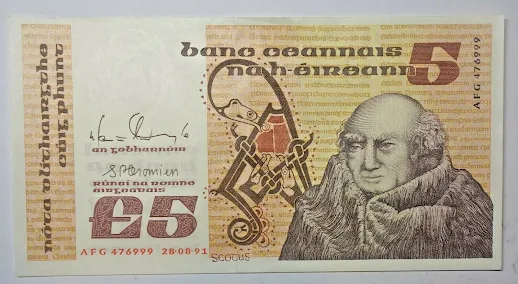
Johns Scotus Eriugina depicted on the Irish 5-pound note.
One might perhaps think of this as a sort of apophatic aesthetics. We approach the apprehension of Beauty by contrast with what it is not. This is analogous to apophatic theology (apophatic is Greek for negation), alternatively referred to as the via negativa (in Latin the ‘road of negation.’) These are commonly used terms for a way of approaching God that emphasizes His unknowability and the inadequacy of positive theological attributes to define Him. By the via negativa we describe God by referring to what he is not. For example, He is not finite, rather he is infinite; He is not bound by time, rather He is eternal. By this principle, we can also follow what one might call the via pulchritudinis negativa - the Way of Beauty by Negation - help us apprehend beauty.
Artists and musicians have applied this principle creatively through centuries.
As a general principle, artists will know that in a painting if everything is in accord with a perfectly idealized template or pattern it tends to look sterile and dull. When he introduces judiciously small and occasional deviations and aberrations, however, suddenly the whole work looks richer and more interesting and, paradoxically, more perfect. As an artist, I aim to paint things that incorporate principles of order, symmetry, harmonious proportions, and balance in the application of tone and color. Nevertheless, I always introduce anomalies that subtly break free of a rigid application of the idealized pattern in small details because I have found that it adds to the beauty of the whole.
Through centuries, artists who paint in Christian figurative traditions have always deviated from strict adherence to natural appearances. This partial abstraction is present in all authentic Christian art. The fact that we recognize that a piece of art conforms to, say, the iconographic, the gothic or baroque styles is because artists deviates from strict naturalism in accepted ways. The fact that when we look at traditional paintings in these styles and typically it doesn’t even think of this partial abstraction as ugly distortion is testament to how well traditional practices employ the via pulchritudinis negativa to raise the beauty of the painting.
Christ Pantocrator, by the 20th century iconographer Gregory Kroug
Similarly, when a virtuoso musician plays a piece of music, they do not play precisely what the composer has written down. So when Glenn Gould plays Bach, or Alfred Brendel plays Bach, they deviate subtly from the precise rendition of the score, lagging slightly in the rhythm here, leading slightly there, as they interpret the score. These tiny subtle aberrations contribute to what becomes a brilliant interpretation of the piece as a whole. And again, if we are even aware of what the pianist is doing, the effect is so powerful that we never interpret his variations as mistakes. It is often said that the greatest artists, musicians and composers master the rules and then know how to break them. I would say that in fact, they are not breaking the rules, rather, they are transcending them. By this I mean that they understand that such rules are simply man’s attempt to capture the beauty of an ideal and will be incomplete. They are necessary, but can only get us so close. The virtuoso intuits the ideal to which the rules are directing us, but which they cannot capture completely.
So we see gargoyles in Gothic cathedrals, which are skillfully and intricately carved distorted figures arising from the imagination of the mason that add to the overall beauty of the edifice.
A gargoyle from Salisbury Cathedral
Similarly, when illuminating manuscripts, monks would deliberately introduce ‘mistakes’. The reason often given is that this reflects an acknowledgement that man cannot match the perfection of God; this helps to remind us that even the ‘perfect’ version that would have been produced without the deliberate mistake cannot in fact match the perfection of God. To the modern eye is is difficult to see the ‘mistake’, but the beauty of the whole is still apparent.
A folio from the Lindisfarne Gospel

Tuesday, July 12, 2022

The Way of Beauty at St Stephen's Catholic School, Grand Rapids

A Pre-K Through 8 School That Has Made The Way of Beauty a Central Principle of Its Liberal Arts Education. The Parish and the School Work Together for Cultural Change.

One of the heartening aspects of pre-university education in this country is the growth in the number of classical academies. This is a broadly applied term, but they are schools that typically describe themselves as offering either a “great books” or “liberal arts” curriculum. 

I recently visited and spoke at St Stephen’s Catholic School in Grand Rapids, Michigan, which is one such school. Under the leadership of its principal, Elizabeth Black, and pastor, Fr Scott Nolan, it offers a Catholic education in which the liberal arts curriculum has been integrated with The Way of Beauty. This is a very carefully thought out program in which artistic creativity is a core part of the curriculum, such that all that is taught in the classroom is enriched by the incarnation of the Good and the True in the creation of beautiful artifacts. The schedule includes:
  • surveying - students will create a beautiful map of the grounds and buildings
  • needlepoint
  • gardening - the students grow beautiful flowers that will be used at Mass and they are taught the symbolism of those flowers. So, for example, they grow lilies that symbolize purity.
  • drawing and painting
  • cooking - students learn to create dishes that are in accord with the feasts and fasts of the Church. They then take the recipes home and teach mum and dad how to cook them too!
As an Englishman, I was especially enthusiastic that gardening for beauty was included. I asked if the culture was such that growing flowers was seen as something that only the girls would do, and was delighted to be told that no, boys are as happy to do this as girls are. Black told me that their students don’t see needlepoint as an exclusively feminine activity either. Again, I think this is a good thing. All of this is liturgically oriented: everyone understands how all that they do contributes to the ultimate human activity of the worship of God in the liturgy. The result is properly oriented experiential learning in which the student understands not just the “what” of a good education, but the “why”, and so wants to learn enthusiastically. When the purpose of education is ordered to our ultimate purpose as human beings, then this will give purpose and meaning to the rest of their lives too. Mass is celebrated ad orientem in the beautifully and imaginatively restored adjacent parish church, which is at the heart of the school life. (There is an article on the restoration in the Liturgical Arts Journal.) Beauty will indeed save the world.

St Stephen’s, before and after renovation

Tuesday, June 22, 2021

A Classic Book on Art and Beauty to Be Republished: “The Beauty of Holiness and the Holiness of Beauty”

Fr John Saward’s classic theological meditation on the works of Fra Angelico is to be re-published by Angelico Press, almost 25 years after it first appeared. You can purchase it here.

In October 2001, I decided to make a trip to the USA from London, where I was living at the time. I had just read John Paul II’s Letter to Artists. This short text, a survey of the range of Christian art over the centuries, and an exhortation for contemporary artists to emulate the greats of the past, was the first coming out of the contemporary Church that I had read that had any stamp of authority on it and which seemed to be making a case for the re-establishment of a Catholic culture of beauty. I knew nobody in the US, but wanted to try to connect with Catholic universities over here to persuade them to establish a new sort of Catholic art school that might create artists capable of responding to the Holy Father’s call.

I didn’t know the world of Catholic education at all, and approached, without any introduction and out of the blue, a number of big-name “Catholic” universities. In some cases, I just walked unannounced into the art departments on campus and asked to speak to the head. I was, naively, hoping to persuade them to stop teaching secular art and start forming Catholic artists.

Unsurprisingly, most couldn’t get rid of me fast enough. Here was a strange Englishman waving papal encyclicals at them and telling them they had been getting it wrong for years. It was not something they particularly relished, it seems. However, some did listen and explained that it was not as easy as I thought to transform the teaching goals of an established art school. They tried to connect me with students who they knew would feel as I did. As I started to talk to these two names kept on cropping up. Nearly all suggested first that I go back to England and approach someone called Stratford Caldecott, who lived in Oxford and published a journal called Second Spring (this I did, and he became a mentor to me). Second, they suggested that I read this book by Fr John Saward. By coincidence, Fr John also lived in Oxford, and Stratford Caldecott introduced me to him on one of my subsequent trips there.

I was captivated by this book, a work on Catholic art that was actually sympathetic to Catholic culture, and written by someone who unapologetically believed in the truth of the subjects portrayed in the paintings. Until then, every account of Catholic culture and painting I had read (with the exception of the very brief Letter to Artists) came under the category of art history, and was written by people who were clearly non-believers. They spoke of Catholic art - even if they appreciated its beauty - as the product of antiquated superstitious thought and formed by socio-economic factors (what I now realize is the standard Marxist critique, although they never said so). But this was different. Here was someone who not only talked about the content knowledgeably, but extended his discussion to the necessity for art and beauty in the culture. It was as much about philosophy and theology as it was about art. The name alone told me that this was different.

As a result, I understood that there was a Catholic way of discussing and appreciating art and culture that could begin to explain why the Church had been the source of so much beauty through the centuries...and why it had ceased to be so in recent times. The cleverness of the name alone captured my attention and told me that this was special. So much of what I have tried to do in the years since then in the mission to re-establish a Catholic culture of beauty has been inspired by what I read in this book.

Below are the reviews that appear on the book itself, including one by Cardinal Joseph Ratzinger, whose The Spirit of the Liturgy was first published around the same time as Fr Saward’s book, and translated from German into English by Saward himself.

The first, unattributed, is the summary from the publisher:
“Beauty will save the world,” said Dostoyevsky. In this book, John Saward presents a study of two ways in which the saving beauty of Christ shines upon the world: in the lives of His saints, and in the works of Christian art—“the beauty of holiness and the holiness of beauty.” This unique and unprecedented theological meditation centers on several works of art of the Dominican blessed, John of Fiesole, known to the world as Fra Angelico. Drawing on the wisdom of the Church’s Fathers and Doctors, Saward has written a book not on art history, but on the attractive radiance of Catholic truth. Its goal is to help Christians grow in wonder at the glory of Divine Revelation, to which both the Church’s saints and the Church’s art bear witness.
“The importance of this luminous book can scarcely be overestimated. The substance of Saward’s scholarship and his understanding of culture are dazzling. His vision is of utmost urgency. This is wise, deeply moving, and invigorating—a masterpiece!”
— MICHAEL O’BRIEN
“The more I read of John Saward’s work, the more I am inclined to include his name on the very short list of preeminently important twentieth-century Catholic writers. He opens to us yet another rich aspect of the Faith that seems scarcely to have been touched on before. Read it, and find your vision vastly deepened and heightened.”
— THOMAS HOWARD
“Professor Saward provides his readers a great service by his careful treatment of the connection between sacred art, the heroic virtue of saintly people, and the fullness of truth taught by Christ and His Church. The numerous citations of Catholic artists, poets, and musicians demonstrate how the Catholic Faith elevates civilization. Perhaps through efforts such as Professor Saward’s, we will see the prevailing culture of death in our day pale in the light of a civilization of life and love radiating from the beauty of holiness, and the holiness of beauty, that truth inspires.”
— CARDINAL JOSEPH RATZINGER
You can purchase it here.

FR. JOHN SAWARD is a Fellow of Blackfriars’ Hall and priest in charge of the parish of SS. Gregory and Augustine, Oxford.

Tuesday, June 01, 2021

Beauty in the Spiritual Life, Part 3: A Meditation on a Painting of Christ as the Eternal Flower of Paradise

An Image of the Sacred Heart Containing Flowers of the Tree of Life in Paradise

This is the final article in a series of three. In Part 1, I developed the idea of the impulse for beauty as a principle for choice that complements the moral conscience. In Part 2, I suggested ways in which the creative impulse for beauty can be stimulated and formed in our own lives, drawing on the artistic and spiritual tradition of the Church. I now focus on a single painting of the Sacred Heart of Jesus which is embedded with design principles that conform to the pattern of beauty that can permeate our lives too.

Let us consider an image that is ordered to the number eight in a way that might be surprising. This image is of Christ as the flower of the new Tree of Life, containing a seed that dies and then germinates to new life in us, as described in the Gospel (John 12, 24-26). We who are joined to Christ through the Eucharist can become flowers of paradise too.
The 6th-century saint Boethius, in his book De institutione arithmetica, describes the proportion 3:5:8 as one of among ten, which is musically derived. Amongst the others is one he calls The Fourth of Four, one from a group of four related proportions. In this book, Boethius does not ascribe any Christian significance to the numerical relationships; he is simply content to describe the mathematical basis of proportions commonly held to be beautiful. The Christological symbolism comes, I suggest, from the significance of the individual numbers of that proportion in Christian numerology: 3 is the number of the Trinity and spiritual life, 5 is the number of humanity (from the fact that we have five senses), and 8 (the sum of three and five), is the number of Christ, who is simultaneously God and man. This is also, incidentally, the proportion of the idealized man as described by the Roman author Vitruvius in his textbook written for architects in the 1st century AD.

The image of the Sacred Heart seen below includes a portrayal of the Flower of Christ in paradise. Each of the four rectangles that form the arms of a cross in the border contains a stylized representation of a plant which consists of a bulb containing a triangle, connected to a stem, which has a five-petalled flower or seed.
The bulb, or root, is the Trinity; the five-petalled flower, represents his humanity, and the plant as a whole, numerically represented by the number eight – three plus five – is the Flower of Christ in paradise. The Fruit that comes from this flower is that of the Tree of Life, forbidden to Adam and Eve, and which is now offered to each of us in the Eucharist.
Partaking of the divine nature as part of the Church, we too become spiritual flowers in Paradise. Christ is the fruit of those heavenly blooms, and He is offered to those who are drawn in by the sweet fragrance emanating from the flower, which corresponds to the love of Christ we perceive, one hopes, in our lives. It is the beauty of our lives that directs others to the source of that beauty, Christ.

The impulse to beauty, that conscience of creativity in our hearts, when attuned to the beauty of Christ, helps us to be by degrees an ever-more brilliantly colored, beautifully formed, and sweetly fragrant Christ-like Flower of Paradise. Unlike the natural flower, this one does not fade, wither and die in time. Rather, it becomes steadily more perfect and radiant in its beauty as we lead a Christian life, reaching the fullness of perfection when we are in union with him in the next life. We become eternal flowers in paradise.

“Jesse rejoices and David exults. Behold, like a branch planted by God, the Virgin has brought forth Christ, the eternal flower!” (From Morning Prayer on the Sunday of the Myrrh-Bearing Women, the second after Easter in the Byzantine Rite.)
The Maryvale Sacred Heart, painted by David Clayton; egg tempera on wooden panel, based upon a traditional design.
The painting above was commissioned in 2005 for the chapel at the Maryvale Institute in Birmingham, England, and is based upon a stained-glass window made in France in the 18th century which is in a side chapel at the Institute, the national center for the devotion to the Sacred Heart.

More recent articles:

For more articles, see the NLM archives: