Tuesday, March 14, 2023

Choosing Candles or Oil Lamps for the Image Corner in Your Domestic Church

Why does it matter? And where to get them from when you decide what you want.

For those of you who have an icon or image corner in your domestic church, you are accustomed to having to decide how to provide flame, safely, for your icon corner. The burning flame is a symbol of the Light of the World which becomes also a sign that, when lit, the household is in prayer time. It is also an important addition to the aesthetics. The flickering light is attractive in itself and renders the icons more beautiful through reflective interplay of light and dark. Also, if you have children, you will know that the presence of fire adds a focus that draws their attention to it, as powerfully as if they were moths. So here are the options that I have considered. I’ll start with the one that I prefer, which is an oil burning lamp.

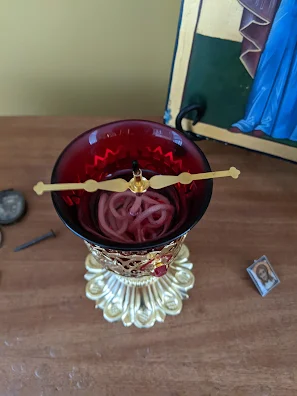
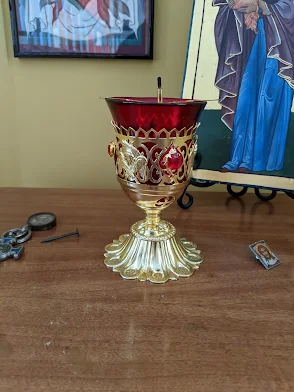
I bought this ‘lampada’ from Byzantine Catholic Supplies, which mailed it to me from their shop in Philadelphia. Along with this standing lampada, I bought the lamp, wick holders, wick and paraffin. They don’t have to be as ornate as this one - it is possible to buy the colored glass only and that will work perfectly well. Purists will insist upon olive oil as the fuel. Whichever fuel you use - the children of one Byzantine Catholic family did an experiment with a range of vegetable oils and found that crisco was the most cost efficient! - this will provide a constant flame reliably and as needed in an attractive setting. It is many hours before you will need to top up the fuel, and many more before you will need to replace the wick.

Many prefer the hanging lampada, this photo comes from a site by an Orthodox writer on how to set up an icon corner.
I rejected the hanging variety simply because of the practicalities. I was reluctant to start drilling or pinning things to my ceiling!

Candles

Monday, January 25, 2021

Building a Home Altar

In the past year, I’ve heard more frequently than ever before from people who are interested in building an altar for their home, or who have already done so.

Their reasons for doing it vary to some extent. Some would like to have a formal prayer corner with icons or statues and they wish to give it still more dignity by the installation of an altar beneath the holy images. Others have a spare room in the house that is well suited to become a chapel where people can go to pray the Divine Office, the Rosary, or read Scripture, and surely no chapel is complete without an altar to remind us of Christ the Rock, the supreme Sacrifice, and of our duty to make our hearts His altar. Still others have priest friends who stay with them when traveling through town or who might wish to have a quiet place to say Mass when they are not otherwise obliged to offer it, or who are looking ahead to darker and more difficult times, when good priests may be forced to make rounds from house to house, or go into hiding.

Whatever the reasons may be, we need to understand a few things before we go about setting up such an altar.

First, while the family is indeed a domestic church, and the home is a sanctified place once it has been formally blessed using the Rituale Romanum, nevertheless an altar of this kind has not received a solemn dedication, nor has a home chapel been consecrated for divine worship, and so their use should be seen as something of an exception, or at least, something that should have a reasonable justification. Certainly, an emergency situation, such as the State’s unjust suppression of worship in churches, or a bishop’s cancellation of such worship, would easily qualify.

Second, the altar, if possible, should have a first-class relic in it or at least placed on it for the offering of the Holy Sacrifice of the Mass. Some priests of my acquaintance travel with a Byzantine antimension. The very prayer said by the priest in the traditional Roman rite when he reaches the altar to kiss it before saying the Introit makes reference to relics in and near the altar: Oramus te, Domine, per merita Sanctorum tuorum [he kisses the sacred stone] quorum reliquiae hic sunt, et omnium Sanctorum: ut indulgere digneris omnia peccata mea. Amen (We beseech Thee, O Lord, by the merits of Thy Saints whose relics are here, and of all the Saints, that Thou wouldst vouchsafe to forgive me all my sins. Amen). A traditional priest should be able to assist you in sourcing relics.

Third, if you custom-build an altar, it would be improper to use it for any other purpose, especially once Mass has been offered on it. It should not double as a dining room table or a television stand or a surface for cleaning rifles. Let the altar be an altar and nothing more.

Fourth, make sure that the altar is built according to correct specifications. Most regular tables are too low to be suitable for Mass, since they are made for sitting, not for standing. Although dimensions can vary considerably and still be acceptable, the following dimensions work admirably for a home altar and have been found by priests of my acquaintance to be suitable: 39 inches in height; 59 inches wide; 20 inches deep. This height, depth, and breadth allows room for everything needed for the traditional Latin Mass.[1]

When space and resources allow, it is optimal to place an altar atop three steps, but this is not always practicable in a home setting. While the steps are a beautiful symbol, clergy are accustomed to “making do” with whatever situation they have  (e.g., many priests when traveling offer Mass in hotel rooms). I have also seen home altars fully dressed with an altar frontal in the appropriate liturgical color of the season or feast; this may be considered a refinement when everything else is in place.

A home altar with frontals (antependia)

My view is that we should be building altars in our homes. My wife and I commissioned a friend to build one, which we had the privilege to see “inaugurated” by Holy Mass three days in a row when a priest friend was passing through town. Built of sturdy wood and stained a dark brown, it was set up in our living room against the eastern wall, with an icon hung above it, and two first-class relics on top of it.

A last point. There is absolutely no need for a home altar to be a “Cranmer table,” that is, situated so that a priest can offer Mass versus populum or toward the congregation. Historically and theologically, this is an incorrect way to say Mass; it is not even what the Novus Ordo assumes by its own rubrics; and it is useless in the intimate situation of a liturgy done only a few feet away from the faithful. Any priest of the Roman rite should be able and willing to offer the sacrifice ad orientem (eastward). This, moreover, is usually necessary in a house because of the small space available, where an altar up against the wall is of much practical advantage.

Priests who offer the traditional Latin Mass are usually well-equipped to offer it anywhere, carrying with them reversible chasubles and the other garments, as well as candles, altar cards, and a missal. However, it is a good idea for those who have a home altar to keep a supply of candlesticks (preferable at least 51% beeswax), cruets for the water and wine, three layers of linens to dress the altar, and a small bell. It can’t hurt to have the other items, too, in case one ends up giving shelter to a fugitive who has lost his belongings or who never owned them to begin with.

How ironic it would be if the “Christian house church” — that concept so dear to the antiquarianizing liturgical revolutionaries who took it as a pretext for their streamlined modern prayer-service — turned out to be the place where the Tridentine Mass in all its medieval and Baroque density, albeit in temporarily humble circumstances, survived the coming persecution of Catholics.

Perhaps a time is coming when the words of St. John Chrysostom will be once again as accurate as they were in the fourth century:

As those who bring comedians, dancers, and harlots into their feasts call in demons and Satan himself and fill their homes with innumerable contentions (among them jealousy, adultery, debauchery, and countless evils); so those who invoke David with his lyre call inwardly on Christ. Where Christ is, let no demon enter; let him not even dare to look in in passing. Peace, delight, and all good things flow here as from fountains. Those [pagans] make their home a theatre; make yours a church. For where there are psalms, and prayers, and the dance of the prophets, and singers with pious intentions, no one will err if he call the assembly a church. [2]


NOTES

[1] Those who are interested in further detail can read Matthew Alderman on the proper shape, dimension, and placement of altars.

[2] St. John Chrysostom, from the Exposition of Psalm XLI, in Oliver Strunk, ed., Source Readings in Music History from Classical Antiquity through the Romantic Era (New York: W.W. Norton & Co., 1950), 69.

Tuesday, August 25, 2020

Will the Domestic Church Grow as the Institutional Church Shrinks?

I recently had a conversation with a priest friend who opined that when enforced shelter-at-home is over, many churches will not re-open. Those who went to church out of habit will very likely not come back once the habit is broken. If he is right (and I hope he isn’t, but I think he may be) where does it leave us?
Are our parishes set for closure?
It is a truism that it will be the most pious and most faithful who will work hardest to retain, or if necessary, regain the habit of church attendance. I imagine the scenario, therefore, in which fewer people are concentrated in stronger parishes. We might already be seeing the signs of this; I heard of one Latin Mass church recently that has increased the number of Masses each Sunday since shelter-in-place started, to serve a community that consists in some cases of people who drive for hours to get there each week. However, with the best will in the world, not everyone can do this, and the situation may be so dire that some may not be able to get to church even when everything is restored.
I have thought about how to respond to this general picture, and the best answer I can come up with is to focus on leading a good and holy life with home-based liturgical piety at its heart.

When our local church was forced to close down in March, our pastor inspired us to continue a life of holiness and penitence, even if we were unable to get to church and participate in the sacraments, with the story of St Mary of Egypt, who went 47 years without receiving communion. The reasons for this were particular to her, but the lesson I learn from this is not that I don’t need the Sacraments, but rather that when they are not available to me, I can still lead a good and holy life and grow in the love of God.

A contemporary neo-Coptic rendition of St Mary of Egypt. I like this one because you get a hint of her beauty as a young women, which played such a part in the dissolute life that she led before repentance.
Perhaps this might be a time in which we see a growth of the Domestic Church not as an alternative to the parish church (although it may have to be that for some), but rather as a support to it by which we might actually see an enrichment of parish life when we get back to church.

A more conventional icon of St Mary of Egypt
I wrote some time ago about a talk on the model for parish life based upon that of the early Church, called The Apostolic Blueprint for a Parish - A Model Christian Community in the Modern Age. This template isolated four necessary parts of parish life: liturgical, social, educational, and charitable. Once all of those are in place and working together, it is asserted, evangelization will occur. All of us can participate in any of these aspects of parish life, but each of us has a special gift to participate in one of them preferentially, so as to contribute to the build-up of the Christian community most efficiently.

It seems to me that we can focus on each of these aspects of Christian living as laypeople and, if the situation demands, without the parish as the focus. Through this, we can build up the Domestic Church and a vigorous regrowth of Christian community, based in our homes, might occur.

Benedict XVI was prescient in predicting that the Church will very likely have to shrink before it will grow, and in suggesting that the Domestic Church will be the driving force for the New Evangelization. It seems that it we are being pushed into the realization of both of these predictions sooner than expected.

The internet can actually contribute to this bringing together of people, by connecting us when we cannot be together in person. Again, this does not replace a personal connection, but can add to what is possible.

Here are the ways that I have responded in addition to getting to church on Sundays as best I can, still restricted at the moment in California: I have doubled down on praying the Liturgy of the Hours. Also, we have started regular workshops via video conferencing on the spiritual exercises contained in the book The Vision for You. These are directed towards deepening our faith and discerning personal vocation. In addition, I have tried to stay in touch with others as best I can and to be hospitable to those in my social bubble. I am sure each of you can do all of these things at least as badly as I can!

The educational and social elements can be opened up with video technology. This doesn’t need to mean formal registration in courses offered by universities, but informal groups forming to pass on personal experience and knowledge are to be encouraged.
A home altar
Finally, I received this email from our pastor. He was offering free Greek classes to children of the parish, and in addition, he does regular Bible studies online. But he also asked that this information be circulated amongst homeschooling groups. I am happy to do so in order to encourage the principle of homeschooling as part of the growth of the Domestic Church, in the hope that each of us will do what we can in these difficult times.
This is an announcement that the Academy of Classical Greek is now taking registrations for the 2020 Fall Semester. Class size is limited so please be sure to register early! With the new wave of homeschooling, we expect to be inundated this fall and have already begun receiving many inquiries!
All the important information about this coming semester and registration can be found here http://academyofclassicalgreek.com/courses/ Click here http://academyofclassicalgreek.com and watch one of the sample course recordings.
Please also take a moment to send out this email to whomever you think might be interested. Evcharisto!

Sincerely, Sebastian Carnazzo, PhD
Home altar

Tuesday, January 22, 2019

Scented Candles Designed for Your Domestic Church

Candles are a wonderful addition to your home prayer corner or icon corner. By their very nature as a source of light, they draw our attention. As a symbol of the Light that overcomes darkness, they also remind us of Christ and direct our thoughts to Him.

Incense is important too. The sense of smell is, we are told, the most evocative to our imaginations. We associate fragrances with places very readily and easily. It is important then to have fragrances that are consistently used with prayer and that we associate with heavenly activity - the worship of God.

When these two accompaniments to prayer are combined with a visual component of sacred art that is worthy of veneration and placed in our icon corner; with the consideration of posture so that we stand, bow and sit at appropriate junctures; and if we chant our prayers out loud, then we are engaging the senses more fully and approaching the desired ideal of praying with the whole person, body and soul. If we do this at home regularly, it will be a habit we take into the Mass and so deepen our participation there.

In my experience, candles and incense are not always the easiest things to manage in the home. Wax can flow onto surfaces and cause damage, and incense is by nature smoky and can be suffocating in small spaces.

One answer to this would be scented candles. I did try buying some from regular stores and the fragrances always seemed to be reminiscent of an overly sweet perfume which was highly evocative, admittedly, but not of a church!

I am pleased to have discovered these candles from Stella Maris & Co. which are available online at stellamarisandco.com. They are slow burning and long lasting, the wax is contained within the glass container and they are carefully scented so to appropriate to prayer (three different scents are available). They are beautifully packaged as well, incidentally.

The photos below are of my own domestic church.


The Penitent Magdalen contemplates Christ with her Stella Maris candle! (Captured by Georges De La Tour)

More recent articles:

For more articles, see the NLM archives: