Friday, July 24, 2026

The Fraction and Commingling

Lost in Translation #166

As the priest says the adjuration to the Embolism (per eumdem Dominum nostrum…), he breaks the Host in two and then breaks off a small particle. Laying down the two large halves on the paten, he holds the particle over the chalice, makes the sign of the cross three times with it, and says Pax Domini sit semper vobiscum, that is, “May the peace of the Lord be with you always.” The servers, congregation, or choir reply: Et cum spiritu tuo. The priest then drops the particle into the chalice as he says:

Haec commixtio et consecratio Corporis et Sanguinis Domini nostri Jesu Christi, fiat accipientibus nobis in vitam aeternam. Amen.
Which I translate as:
May this mingling and consecrating of the Body and Blood of our Lord Jesus Christ be, for us who are receiving it, for life everlasting. Amen.
Since the Middle Ages, the actions accompanying this prayer have been interpreted allegorically. As we noted in an earlier post, the death of Our Lord Jesus Christ is mystically represented at the Canon’s closing doxology by five signs of the cross, the first three hearkening to His three hours on the Cross and the last two signifying the separation of Christ’s soul from His body. And according to William Durandus, the three prayers that follow the Canon – the Praeceptis salutaribus, the Lord’s Prayer, and the Embolism – remind us of the three days that Our Lord’s body lay lifeless in the Sepulcher. [1]
Following this line of thought, the separation of the two halves of the Host represents the cleaving of Christ’s flesh when the soldier pierced His side with a lance (John 19, 34), while the placement of the particle in the chalice represents the Resurrection, the reunion of Christ’s body, blood, and soul. On Good Friday, Christ’s blood was separated from His body (tradition holds that He was all but exsanguinated) and His soul from His body, His soul descending to limbo and His body placed in the Sepulcher. (His divinity, on the other hand, remained present to all three). On that first Easter Sunday, all that had been sundered on Good Friday was reunited and glorified, never to be separated again.
The 1970 Missal lacks this symbolism, in part because the fraction rite was moved to a different location (which we will discuss in a later post). A.W.J. Keyzer writes of this part of the Novus Ordo:
The meaning of the fractio panis is ambiguous. It is a sign of unity. We participate in the one bread, we are part of it. This sign of unity concerns the community itself. It is also a sign of unity with Christ. A second meaning of the fractio panis lies in the breaking itself. The breaking, taken literally, is a condition for participation. The first Christians recognized the Lord in this ritual; it is even the name for Missa. In number 130, no prescriptions are included regarding the proper manner in which the host should be broken. The host is broken into a number of pieces, one of which is placed in the chalice. [2]
Peter J. Elliott concurs:
The third moment in the fourfold action of Jesus Christ is the “Breaking of the Bread”, or fraction. This practical action signifies that, in Communion, the many faithful are made one body in Christ, the one Bread (cf. 1 Corinthians 10, 17)….The breaking of the Host(s) is carried out over the paten(s), not over the chalice(s). [3]
All rites, Eastern and Western, have a fraction rite in which a particle from a newly consecrated Host is placed into the newly consecrated Precious Blood, but the city of Rome had two additional practices. First, in the titular churches, a particle of a Host consecrated at a papal Mass called the fermentum was dropped into the chalice to signify the presbyterate’s unity with their bishop. (Fortescue speculates that the Latin fermentum was chosen for this particle in part to convey the idea that it unites the bishop to his priests as leaven unites bread.) [4] Second, there was another custom of dropping a particle of a Host consecrated at a previous Mass (this one called the sancta) to express “the continuous unity of the eucharistic sacrifice” from one Mass to the next. [5]
No custom, however, quite explains the appearance of consecratio in the prayer, which gives the impression that the Host and Precious Blood have not yet been consecrated – and if they have been consecrated (and of course they have), it seems pointless to consecrate now what was maximally consecrated at the Words of Institution. Finally, there is something mildly ironic about using “consecration,” which means to set apart, in a prayer that is recited when putting two things together. The word choice was so perplexing that it was a topic of conversation at the Council of Trent. [6] Jungmann’s interpretation is:
The word consecratio, which stayed in the text in spite of the objections brought against it, and in spite of the fact that it was missing in some medieval texts here and there, must be rendered by “hallowing” in the sense that through the commingling a sacred token or symbol is effected in the sacramental species and mediately in the Body and Blood of Christ. [7]
I also believe that the word can be translated in light of the symbolic action that it accompanies. If we keep in mind that the chalice containing the particle represents the Risen Lord, I suggest the following: “May this coming together and setting apart of the Body and Blood of our Lord Jesus Christ…” The “coming together” alludes to the Resurrection, and the “setting apart” can refer to Christ’s glorified Body, which is set apart insofar as it is different from our current bodies and certainly more special. The Ambrosian Rite uses the formula: Haec commixtio consecrati corporis et sanguinis, “This mingling of the consecrated body and blood of Christ.” No doubt, “consecrated” refers to the sacramental action that has just taken place, but it too can be construed in a wider sense as Christ’s glorified Body.
“Hard sayings” are not the Novus Ordo’s forte, and so the offending word was removed in the 1970 Missal. The current prayer is:
Hac commixtio Corporis et Sanguinis Domini nostri Iesu Christi fiat accipientibus nobis in vitam aternam. No. 129
Which both the 1985 and 2011 ICEL versions translate as:
May this mingling of the Body and Blood of our Lord Jesus Christ bring eternal life to us who receive it.
Most other translations follow suit, although oddly, the Mexican, Italian, and French versions add the line “united in this chalice” after “Lord Jesus Christ.” [8] If anyone knows the back story to this interpolation (or any other modern vernacular translations, I am all ears (in the Commm box).

Notes
[1] William Durandus, Rationale Divinorum Officionorum IV.47.3.
[2] A.W.J. Keyzer, Om voor Gods gelaat te staan. Een expositio missae (Baarn: Gooi & Sticht, 1999), 193.
[3] Peter J. Elliott, Ceremonies of the Modern Roman Rite, 2nd ed. (Ignatius Press, 2005), nos. 324 and 325.
[4] Fortescue, 24.
[5] Jungmann, vol. 2, 312.
[6] See Jungmann, 311-313.
[7] Jungmann, 316.
[8] The Mexican Missal has El Cuerpo y la Sangre de nuestro Señor Jesucristo, unidos en este cáliz, sean para nosotros alimento de vida eterna. The third edition of the Italian Missal has Il Corpo e il Sangue del Signore nostro Gesù Cristo, uniti in questo calice, siano per noi cibo di vita eterna (p. 447). And the French has Que le Corps et le Sang de notre Seigneur Jésus Christ, réunis dans cette coupe, nourrissent en nous la vie éternelle.

Friday, July 10, 2026

The Embolism


Lost in Translation #165

After the Lord’s Prayer, the priest says:

Libera nos, quaesumus, Domine, ab omnibus malis, praeteritis, praesentibus et futuris: et intercedente beata et gloriosa semper Virgine Dei Genitrice María, cum beatis Apostolis tuis Petro et Paulo, atque Andrea, et omnibus Sanctis (signing himself with the paten), da propitius pacem in diebus nostris (kissing the paten): ut, ope misericordiæ tuæ adjuti, et a peccato simus semper liberi et ab omni perturbatione securi.
Which I translate as:
Deliver us, we beseech Thee, O Lord, from all evils, past, present, and future; and through the intercession of the Blessed and glorious ever Virgin Mary, the Mother of God, and Thy blessed Apostles, Peter and Paul, as well as Andrew, and of all the Saints (signing himself with the paten), graciously grant us peace in our days (kissing the paten), so that aided by the assistance of Thy mercy we may always be free from sin, and safe from all disturbance.
The name for this prayer is the Embolism (from the Greek embolismos, an addition or interpolation). Most Eastern Rites and all Western ones (Roman, Ambrosian, Gallican, Mozarabic) have one. The exception is the Byzantine Rite, which instead “adds” a Trinitarian ending: “For Thine is the kingdom and the power and the glory of the Father and of the Son and of the Holy Spirit, now and forever and unto ages of ages.” In the Roman Rite, the Embolism is said in a low voice except on Good Friday, when it is said aloud, perhaps to add urgency to the petition on that sorrowful day.
All Evils
The Roman embolism develops the last petition of the Lord’s Prayer. As we saw last week, since Latin lacks a definite article, Sed libera nos a malo can be translated “But deliver us from evil” rather than “But deliver us from the Evil One.” The embolism expands upon the nature of evil, asking for deliverance from all evils, past, present, and future. As Fr. Nicholas Gihr explains:
Of past evils, sins especially often continue to abide in their painful consequences, in their unhappy results and fruits the latter, therefore, should be totally removed and obviated. In the present we are pressed down by evils from within and without, from all sides, and from these we wish to be delivered. The future is frequently enveloped in darkness, and in its bosom conceals a host of threatening evils and from these we would beg to be spared. [1]
Four Saints
The Embolism seeks the intercession of all the saints, but it singles out four: the Blessed Virgin Mary and the Apostles Peter, Paul, and Andrew. As with the Confiteor, the prayer follows the ancient usage of calling some of the saints “Blessed” (beati) rather than “Saint” (sancti): in the Confiteor, it is Michael the Archangel and John the Baptist. In the Embolism, the usage is particularly appropriate since in asking for peace, the Embolism is essentially asking for happiness, and Beatus literally means “made happy.” We seek happiness with the aid of those who have been made happy in the light of glory.
The Church naturally turns to the Mother of God (as she does throughout the Mass) as her chief saintly intercessor, and the Church of Rome naturally turns to her own two founders, Peter and Paul, as she does elsewhere (see the Confiteor and the Suscipe Sancta Trinitas and the Prayers after Low Mass). It is thought that Pope St. Gregory the Great is the one who added Saint Andrew’s name to the Embolism, and three reasons are typically given for his decision: first, that Gregory had a personal devotion to Andrew; second, that Andrew is the next ranking Apostle after Peter and Paul (see the Communicantes); and third, that Gregory was influenced by the Byzantine Rite, which praises Andrew as the founder of the Faith in Constantinople. [2]
Yet none of these reasons explains why Gregory added Andrew’s name to this prayer and not someplace else. I believe the answer lies in the role that Andrew plays in the Gospels. Andrew is the Apostle who brings others to Christ. It was he who introduced his brother Peter to Jesus, (John 1, 40-42) and it was he who, along with Philip, tried to introduce some Gentiles to Jesus. (see John 12, 20-22) Moreover, Andrew is the Apostle who helps make an encounter with the Eucharistic Lord happen, for it was he who introduced the boy with the five loaves and two fishes to Jesus. (see John 6, 8-9) Just as Andrew is instrumental in a foreshadowing of the Eucharist (a miracle of the multiplication of the loaves and fishes), so too do we ask him now to be instrumental in preparing us for Holy Communion.
And our author/editor could have written Petro, Paulo, et Andrea but instead he wrote Petro et Paulo, atque Andrea. Atque is a conjunction with “adversative force”: whereas et “designates an external connection of different objects with each other,” atque in general indicates “a close internal connection between single words or whole clauses.” [3] Here, however, it is possible that the word stresses Andrew’s importance vis-à-vis Holy Communion, in which case it could be translated “and especially Andrew.” [4]
Evil vs. Peace
The prayer follows the pattern of “out with the bad, in with the good.” The bad that we want out is evil; the good that we want in is peace. One may wonder why we do not petition for a more natural opposite of evil, such as goodness or holiness. I suspect that there are two reasons. First, peace is the opposite of evil insofar as evil robs us of our peace. And second, we ask for peace as a preparation for Holy Communion because peace, as Augustine famously defines it, is the tranquility of order. [5] A soul that is truly at peace is a soul that is well ordered and thus maximally receptive to the graces of the Eucharist.
But the prayer also has in mind our welfare outside of Holy Communion. The ultimate goal of being delivered from evil and granted peace is to be free from sin always (our spiritual welfare) and to be secure from all disturbance (our temporal welfare). The word perturbatio can refer to a political disturbance such as a riot or a tumult, [6] or to a personal disturbance, as in a state of mental agitation. (The English derivative “perturbation” retains both of these meanings, although the political meaning is now considered obsolete.) [7] In On Genesis against the Manicheans, St. Augustine writes about perturbations in such a way that the passage almost seems to be an embolism of the Embolism:
This is the happy and tranquil life for man: when all his emotions are in accord with reason and truth, and they are called joys and loves: holy and chaste and good. But if they are not in accord while they are being ruled negligently, they rip the mind to pieces and dissipate it and make life utterly miserable. Then they are called perturbations and lusts and evil desires. [8]
Gestures
The gestures of the priest as he recites the Embolism add further meaning to the prayer. At the words, “graciously grant us peace in our days,” the priest makes the sign of the cross with the paten over himself, and when he finishes, he kisses the top of the paten. St. Paul tells the Colossians that Christ reconciled all things to Himself, “making peace through the blood of His cross” (1, 20), and here the sign of the cross draws the blessing of peace purchased by the cross: we can almost picture the priest’s perturbations getting reordered and pacified as the sign is made over him. The priest then kisses the paten before he places it under the Host and moves the paten and Host to the right of the chalice. A kiss is a sign of peace (and indeed the kiss of peace is to be given shortly at a Solemn High Mass), and the paten will soon assume the significance of the Holy Sepulcher, holding the Body of Our Lord. The priest’s kiss is thus a tender tribute to our Lord in the tomb. Further underscoring this symbolism is the placement of the Host to the right of the chalice, as the last drops of Blood that flowed from Our Lord came from His right side.
The Novus Ordo
During the creation of the Novus Ordo Missae, Pope Paul VI expressed a wish to keep the Embolism intact, but Annibale Bugnini and his peers did not accept his suggestion on the grounds that “it did not seem appropriate to repeat intercessions made a few moments ago in the Eucharistic Prayer.” [9] Both the Eucharistic Prayer I (the Roman Canon) and the Embolism are from the Patristic era, which according to Vatican II’s Sacrosanctum Concilium, was supposed to function as the gold standard for the ensuing liturgical reforms. [10]. Instead, Bugnini appealed to another principle from the same document, the elimination of “useless repetitions.” [11]. The only problem is that the intercessions in the Embolism are not a repetition of those in the Canon; they are distinctive.
And so, the 1970 Missal made several changes to the Embolism. First, it was to be said aloud always and not just on Good Friday. Second, a version of the Byzantine ending (also found in some Biblical manuscripts at Matthew 6, 13), “For the kingdom, the power and glory are yours, now and for ever,” was added, in part because of its “ecumenical value” – not, we speculate, in order to draw closer to the Byzantine Rite, but to be more aligned with Protestant services. [12] Third, the invocation of the four saints was removed, thus eliminating a “scandal of particularity” characteristic of all Apostolic liturgies. [13] Fourth, a reference to the Parousia was added in order to rescue “the embolism from a kind of ‘horizontalism.’ ” [14] Huh? And fifth, the tender gestures involving the paten were omitted.
Vernacular translations further flattened the Embolism. For the rich perturbatio, the first ICEL version used “protect us from all anxiety.” Anxiety is very much on the mind of modern man (fair enough), but the word is not a faithful transposition of what our spiritual ancestors meant by a perturbation. Fortunately, the 2011 ICEL fares much better with “safe from all distress,” which keeps both the personal and political connotations of the noun intact. For though we live in an age of psychological anxiety, we also live (and have always lived) in a time of political uncertainty. It would surely be a blessing and a great source of peace to be safe from all disturbances within and without.
Notes
[1] Gihr, 702.
[2] See Jungmann, 285-286.
[3] “Atque or ac,” Lewis & Short Latin Dictionary.
[4] See Ibid., I.B.b.
[5] City of God 19.13.
[6] See the Vulgate translation of 2 Machabees 13, 16.
[7] “Perturbation, noun,” OED, 1.a. and 1.b.
[8] De Genesi contra Manichaeos libri duo 1.31, trans. mine. Following Cicero’s Tusculan Disputations 4, 5, 10, Augustine holds that perturbation is the Latin equivalent of the Greek pathos. (City of God 8.17) Augustine also follows the Stoics and Cicero in defining the four disturbances (perturbationes) of the mind as desire, joy, fear, and sadness (see Conf. 10.14.21; Cicero, De finibus 3.10.35; Disputationes Tusculanae 4.6.11).
[9] Bugnini, 380.
[10] Sacrosanctum Concilum, 50.
[11] Ibid., 34.
[12] Bugnini, 376.
[13] See Peter Kwasniewski, The Once and Future Roman Rite (TAN Books, 2023), p. 228, n. 15. For his thoughts on the Embolism, see here.
[14] Bugnini, 376.

Thursday, July 09, 2026

The Votive Mass of St. Thomas More

Portrait of Sir Thomas More, by Hans Holbein the Younger, 1527
In the 1969 General Calendar, the celebration of Saints John Fisher and Thomas More is an optional memorial on June 22, whereas in England and Wales it has the rank of a feast. Neither appeared on the universal calendar prior to that date, but in England and Wales their combined feast was celebrated on July 9 after they were both canonized in 1935. (Yes, it took four hundred years for these heroic men to be raised to the altar). I suspect that the reason for the choice of July 9 was practical. St. John Fisher was martyred on June 22, 1535, but in the 1935 General Calendar late June was rather full: June 22 was the feast of St Paulinus of Nola, and the first available feria day was not until June 27. St Thomas More, on other hand, was martyred on July 6, 1535, the Octave of Saints Peter and Paul. (More himself considered it an honor to die on the same day as St Peter, to whose See he had remained loyal at all costs). Because July 7 is the feast of Saints Cyril and Methodius and July 8 that of St Elizabeth of Portugal, the first “free day” after July 6 was July 9.
In addition to a July 9 Mass for Saints John Fisher and Thomas More, which can be celebrated in the dioceses of England and Wales, there is a Votive Mass of St. Thomas More. Although it does not appear in the 1962 Roman Missal, it has been celebrated before outside of England without raising too many eyebrows (see here). Moreover, its propers are an excellent example of how the traditional liturgy tailors its petitions and lessons to the “genius” of a particular saint. [1]
The Introit is:
In Thy strength, O Lord, the just man shall joy: and in Thy salvation he shall rejoice exceedingly: Thou hast given him his heart’s desire. Ps. 20, 4 For Thou hast prevented him with blessings of sweetness: Thou hast set on his head a crown of precious stones.
These verses (Ps. 20, 1-4) are used as the generic Introit for a Martyr who is not a Pontiff, but the verse about coming before the martyr (the meaning of “preventing him”) with the blessings of sweetness holds special meaning in reference to the gentle St. Thomas More, and it anticipates a key theme of the Collect, which is:
Deus, qui beáto Thomæ Mártyri inter sǽculi illécebras et cárceris mortisque dolóres hílari fortíque ánimo crucem tuam amplecti tribuisti: concéde, quǽsumus, ejus intercessióne et exemplo, ut pro fide et justitia alácriter decertantes, ad æterna gaudia læti perveníre mereámur. Per Dóminum.
Which I translate as:
O God, who didst empower blessed Thomas Thy Martyr, amidst the allurements of the world and the pains of prison and death, to embrace Thy cross with a merry and courageous spirit: grant, we beseech, that by his intercession and example we may be quick to fight for faith and justice, and so, filled with cheer, deserve to attain eternal joys.
It is an excellent description of the witty and playful Saint. Erasmus famously called Thomas More a “man for all seasons” because he was the kind of man you wanted and could depend on in any circumstance or situation. He was a joy to be around. And his generous heart was quick to forgive, as he did when his judges condemned him to be hanged, drawn, and quartered. (Henry VIII had the sentence reduced to a beheading the night before his execution). Rather than express outrage at the unjust verdict and recoil at the gruesome way he thought he was to die, More prayed that they would all meet “merrily together” one day in heaven. The adjective hilaris, which I have translated as “merry”, is the perfect word to describe More. It is the only time that it appears in the traditional liturgy. [2]
The choice of II Maccabees 6, 18-28 for the Epistle is also distinctive: the only other time it appears in the traditional liturgy is the combined feast of Fisher and More. The passage tells the story of an old and pious scribe named Eleazar who was told by the Hellenistic occupiers of Israel to eat swine’s flesh or be executed. Eleazar chose a “most glorious death” over a “hateful life,” but his friends, moved by a “wicked pity,” suggested a clever way out: he could eat something that only looked like pork and thereby not violate the Law of Moses. Without delay Eleazar replied that it was not becoming for a man his age to dissemble, and that he would be giving bad example to the youth. “And having spoken thus, he was forthwith carried to execution.”
The Martyrdom of Eleazar the Scribe, by Gustave Doré; public domain image from Wikimedia Commons
The reading is perfect for the two martyrs but especially for More. His most famous work, Utopia, is proof that he could be a master of dissembling when he wanted to. The ironic fantasy fiction is written in such a way that the bitter truth about political life is cleverly hidden by “honeyed” absurdities. (See his Letter to Peter Giles). And after his resignation from the Chancellorship of England, More could have remained quiet, but he continued to write veiled critiques of Henry VIII’s decision to marry Anne Boleyn and declare himself head of the Church of England. It is possible that a shrewd lawyer like More could have found a loophole in the Oath of Supremacy, but instead of using a casuistic approach, he followed the path of Eleazar, even though he was not an old man but at the height of his skills.
The Gospel reading, Matthew 10, 34-42, is equally appropriate, for among other things it contains the verses: “And a man’s enemies shall be they of his own household. He that loveth father or mother more than Me is not worthy of Me.” Thomas More truly and sincerely loved his country’s father, the King, but he did not love Henry more than God.
The Secret is:
Hoc sacrificium redemptiónis nostræ, quǽsumus, omnípotens Deus, clementer réspice: et intercedente beáto Thoma Mártyre tuo, pro hac familia tua placátus assúme. Per Dóminum.
Which I translate as:
Look mercifully, we beseech Thee, Almighty God, on this sacrifice of our redemption: and by the intercession of blessed Thomas, Thy Martyr, graciously accept it on behalf of this Thy household. Through our Lord.
The prayer uses language that is common in Secrets: “Graciously accept,” for example, appears thirty-one times in the Secrets of the 1962 Roman Missal either as benignus assume or, as here, placatus assume. Nor is it unusual to refer to the Church as God’s household or family (familia), but in the over hundred times that the word appears in the Roman orations, it is in the Collect or the Postcommunion rather than the Secret.
The Postcommunion is:
Sint tibi, omnípotens Deus, grata nostræ servitútis obsequia: ut hæc sancta quæ súmpsimus, intercedente beáto Thoma Mártyre tuo, nobis ad capessenda pérpetis vitæ prǽmia profícere sentiámus. Per Dóminum.
Which I translate as:
O Almighty God, may the homage of our service be pleasing unto Thee, with the result that, by the intercession of blessed Thomas, Thy Martyr, we may feel these holy things which we have received bring about a snatching up of the rewards of perpetual life. Through our Lord.
Again, the language is and is not familiar. Petitions to feel the effects of the Eucharist (sentiamus) are common in Postcommunion prayers, but the construction of this prayer is unusually elaborate, as is the use of the verb capesso (snatch up, seize eagerly), which is nowhere to be found in the 1962 Missal. I wonder--and this would take a much more extensive study to confirm--if the diction is an implicit homage to the Renaissance humanist Latin in which More excelled.
In 1929, G.K. Chesterton wrote that “Thomas More is more important at this moment than at any moment since his death, even perhaps the great moment of his dying; but he is not quite so important as he will be in about a hundred years’ time.” As we approach the centenary of GK’s prophecy, let us pray that an increased use of the well-crafted Votive Mass of Thomas More will duly reflect the Saint’s ever-growing importance in the world today.
Notes
[1] For instance, the new Missal takes all the propers of the feast from the Common of Martyrs, with the sole exception of the Collect. And the Collect, aside from mentioning Fisher and More by name, could easily be used for any martyr since it has nothing distinctive about their lives. The new Collect is: “O God, who in martyrdom have brought true faith to its highest expression, graciously grant that, strengthened through the intercession of Saints John Fisher and Thomas More, we may confirm by the witness of our life the faith we profess with our lips. Through our Lord.”
[2] It appears once in the 2002 Missale Romanum, in the Oratio super Oblata for St. Philip Neri on May 26. The 2011 English edition translates the word as “cheerfully.”

Friday, July 03, 2026

The Lord’s Prayer

Lost in Translation #164

After saying the Praeceptis salutaribus, the priest recites or intones the Lord’s Prayer:

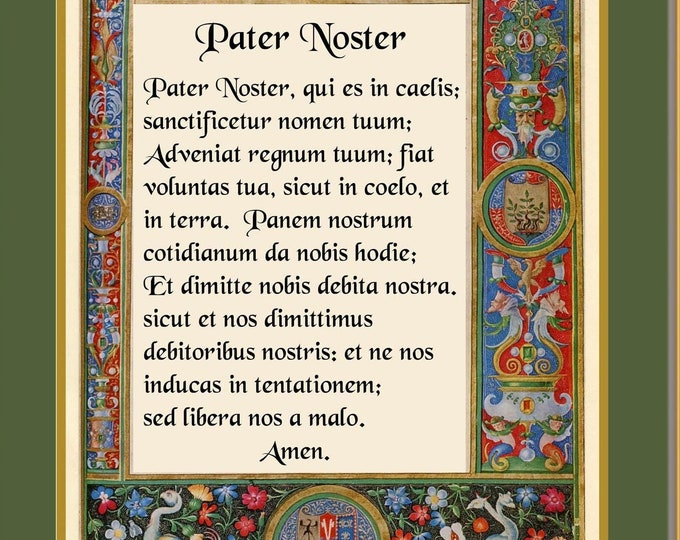
Pater noster, qui es in cælis, sanctificetur nomen tuum. Adveniat regnum tuum. Fiat voluntas tua, sicut in cælo et in terra. Panem nostrum quotidianum da nobis hodie, et dimitte nobis debita nostra sicut et nos dimittimus debitoribus nostris. Et ne nos inducas in tentationem.
℟. Sed libera nos a malo.
Which is traditionally translated as:
Our Father, Who art in Heaven, hallowed be Thy name; Thy kingdom come; Thy will be done on earth as it it is in Heaven. Give us this day our daily bread, and forgive us our trespasses, as we forgive those who trespass against us. And lead us not into temptation.
℟. But deliver us from evil.
It is beyond the pale of this little study to examine the long and robust tradition of commentaries on the Lord’s Prayer by the Church Fathers and medieval Doctors. Here, we limit our concerns to two: The placement of the prayer after the Canon, and how that placement shapes our reception of it.
Post Canon
In defending his decision to follow the Eastern custom of reciting the Our Father after the Canon, Pope St. Gregory the Great argues that it would be inappropriate to have any other prayer besides the one composed by Our Lord Himself follow the [manmade] Canon. The pairing is also appropriate when one considers an alternative name for the Canon used in the Middle Ages: “The Dangerous Lord’s Prayer.”
The Lord’s Prayer is related to the Canon in other ways as well: just as the Preface is the prologue to the Canon, the Lord’s Prayer is its epilogue. One can see this in the similarities between the Preface and the Lord’s Prayer. Both are introduced after a period of silence with the priest saying or intoning aloud, per omnia saecula saeculorum. Both have beautiful chant settings that are sung by the priest alone, both have responses from the congregation (the Sanctus and Sed libera nos a malo), and both use the word salutare. One could say that the Preface is the pro-logos, the Lord’s Prayer is the epi-logos, and in between is the Logos, made flesh and now dwelling sacramentally among us on the altar. In the words of Fr. Pius Parsch:
According to the great Pope [Gregory the Great], the Our Father is not so much a preparation for the Holy Banquet, as a consecration prayer, in the ancient sense of a prayer for the offering of the sacrifice. For this reason, in the Roman liturgy, it is recited by the celebrant alone, whereas in the Greek liturgy it is considered the table prayer of the congregation, who therefore recite it in common as a family about to approach the sacred banquet. According to Gregory I, therefore, the Our Father should be considered the completion of the Canon, corresponding to the Preface, in such wise that the Preface and the Our Father mark the beginning and the end of the Canon, which is recited in mystical silence. [1]
Needless to say, this ancient arrangement in the Roman Rite is undermined when the entire congregation sings the Our Father, a practice that reduces the similarity between the prologue and the epilogue. The practice is also a violation of a tradition as old as the Our Father itself in the Roman Rite, for Gregory the Great states that in contradistinction to the Greeks, at Rome the Lord’s Prayer is said a solo sacerdote.

St Gregory the Great, 1626/7, by the Spanish painter Francisco de Zurbarán. 
Another indication, incidentally, that the Canon and the Lord’s Prayer are meant to function together is the placement of the Solemn Nuptial Blessing over the bride and groom at a nuptial Mass. The intention seems to have been to place the prayer close to the Consecration at the nearest possible liturgical juncture. That the blessing was placed after the Lord’s Prayer rather than after the Great Amen suggests that the Canon and the Lord’s Prayers were seen as a practically indivisible unit.
Contextual Meaning
The Lord’s Prayer is also, of course, the beginning of the Communion Rite, thus forming a bridge between the Consecration and the reception of the Eucharist. It is when we view the Lord’s Prayer as a preparation for Holy Communion that its petitions take on added meaning.
“Our Father, who art in Heaven.” When the priest says these words, he is supposed to be staring at the Host. There is something almost ironic addressing the Father while looking at the Son and saying that God is in Heaven when He is also right before your eyes. But in a way the Eucharist, albeit in a veiled manner, is the fulfillment of John 14, 9: “He that seeth Me seeth the Father also.”
“Hallowed by Thy name.” The prayer does not say “Holy is your name” (although it certainly is), but “May your name be made holy or sanctified” (sanctificetur nomen tuum), as if we could increase the holiness of God’s name. God is maximally holy, and nothing on earth can change that. But His name can be rendered less holy by being “profaned” insofar as His chosen people, who are in a sense His representatives on earth, give Him a “bad name” by their behavior. In Ezekiel 43, 8 we read: “And they profaned My holy name by the abominations which they committed: for which reason I consumed them in My wrath.” The key, then, is to “hallow” God’s name by good behavior, but how can we be good without God? We cannot, and so we pray for help. As St. Cyprian of Carthage notes, when we say, “Hallowed be Thy name,” we mean, “May Thy name be hallowed in us”—that is, may we be transformed by sanctifying grace or holiness in order not to besmirch God’s name. [2] And to become further transfomred by sanctifying grace, we partake of the Eucharist.
“Thy kingdom come. Thy will be done, on earth as it is in Heaven.” Both of these petitions can be seen in light of what has gone before and in light of what is about to happen. When the priest turned bread and wine into Body and Blood, there is a way in which he already brought the Kingdom of God to earth, and there is a way in which He already did God’s will—namely, he obeyed the command, “Do this in memory of Me.” But when he and we receive Holy Communion, we also do God’s will and we also strengthen the bond between Him and us and each other, the Mystical Body of Christ, perhaps contributing to the coming of the Kingdom.
“Give us this day our daily bread.” Not surprisingly, this petition was interpreted by the Church Fathers to refer to the Eucharist, even when the Lord’s Prayer was said outside of Mass. The Eucharistic connection is even stronger in the version of the Our Father mentioned in St. Matthew’s Gospel: “Give us this day our supersubstantial bread.” (6, 11). With Holy Communion God is about to grant this petition of ours.
“Forgive us our trespasses.” Before the days of the second Confiteor, reciting this line before receiving Holy Communion was thought to absolve venial sins. In a sermon St. Augustine says:
If perchance, in consequence of human frailty, our thought seized on something indecent, if our tongue spoke something unjust, if our eye was turned to something unseemly, if our ear listened complacently to something unnecessary, it is blotted out by the Lord’s Prayer in the passage: “Forgive us our trespasses,” so that we may approach in peace and so we may not eat or drink what we receive unto judgment. [3]
“Lead us not into temptation.” This is one of the most fascinating verses of the New Testament to ponder because it ties into so many other verses. Here, we ask the Father not to do the very thing He did to His Son, “who was led by the Spirit into the desert, to be tempted by the devil” (Mt. 4, 1) (Yes, it was the Spirit who led Jesus, but who sent the Spirit if not the Father?) And yet we also read that God “will not suffer you to be tempted above that which you are able” and will help you “be able to bear it.” (I Cor. 10, 13) “Lead us not into temptation” is surely one of the “hard sayings” of Scripture (see Jn. 6, 61), and rather than grimace at it, we should embrace the challenge of wrestling with it.
Alas, not everyone agrees. In 1969, the Consilium for Constitution on Liturgy published Comme le Prévoit On The Translation of Liturgical Texts for Celebrations with a Congregation, which contains the following statement:
The correct biblical or Christian meaning of certain words and ideas will always need explanation and instruction. Nevertheless, no special literary training should be required of the people; liturgical texts should normally be intelligible to all, even to the less educated. For example, temptation as a translation of tentatio in the Lord’s Prayer is inaccurate and can only be misleading to people who are not biblical scholars. [4]
The assumptions of the authors are debatable, namely, that “temptation” is inaccurate and that only biblical scholars can understand the Lord’s Prayer (we wonder if the Lord would agree: would He command all of His disciples to use this prayer forever, knowing that only an elite would ever understand it?). Perhaps it is for these reasons that none of the official “vernacular” translations followed the advice of this document—not, that is, until 2019, when Pope Francis approved a request from the Italian bishops to change e non ci indurre in tentazione to non abbandonarci alla tentazione or “do not abandon us to temptation.” The allegedly problematic word “temptation” remains, but the ne nos inducas (Mē eisenkēs hēmas in the Greek) has been altered, despite the fact that the Greek verb in question eispherói (eis+phero, to lead into) is unambiguous. The decision prompted a not surprising backlash (see here and here and here and here).
“But deliver us from evil.” One petition that does admit of valid different interpretations is this one. Since Latin lacks a definitive article, libera nos a malo can mean “deliver us from evil” or “deliver us from the Evil One.” The original Greek has the definitive article in this verse, which is why Eastern churches use the latter translation. The Eastern versions, therefore, have the advantage of being more faithful to the biblical text, more vivid, and more evocative of Christ’s temptation in the desert, when He overcame the Evil One. The Latin, on the other hand, is more expansive, asking for protection not only from the Evil One, but all evils: sin, misfortune, illness, etc.
The fact that “But deliver us from evil” is a response from the people (respondentibus omnibus, as John the Arch-chanter says in the eighth century) gives this moment a special meaning. The lay faithful, listening to the Our Father as they did to the Preface, now affirm all that they have heard. “Basically, therefore,” Josef Jungmann concludes, “the people say the Our Father along with the celebrant. It is the people’s Communion prayer.” [5]
Notes
[1] Parsch, The Liturgy of the Mass, trans. Frederic C. Eckhoff (St. Louis, Missouri: Herder, 1940), 284. See Michael Fiedrowicz, The Traditional Mass: History, Form, & Theology of the Classical Roman Rite, trans. Rose Pfeifer (Brooklyn: Angelico Press, 2020), 107.
[2] Cyprian of Carthage, Treatise IV.12.
[3] Augustine, Sermo Denis 6 (229): Quia, sicut est humana fragilitas, si forte aliquid quod non decebat cogitatio nostra concepit, si aliquid lingua quod non oportebat effudit, si aliquid oculus sicut non decebat aspexit, si aliquid auris blandius quod non oportebat audiuit, si forte aliqua talia contracta sunt de huius mundi temptatione et uitae humanae fragilitate, tergitur dominica oratione, ubi dicitur dimitte nobis debita nostra; ut securi accedamus, ne quod accipimus in iudicium nobis manducemus et bibamus.
[4] [Comme le prevoit 15. a.
[5] Josef Jungmann, S.J., The Mass of the Roman Rite: Its Origins and Development, vol. 2 (New York: Benzinger Brothers, 1951), 288.

Friday, June 26, 2026

The Praeceptis salutaribus

Lost in Translation #163

After finishing the Canon, the priest introduces the Lord’s Prayer. He calls the assembly to pray with the familiar Oremus and then says or intones:

Praeceptis salutaribus moniti,
Et divina institutione formati,
Audemus dicere.
Which I translate as:
Taught by salutary precepts,
And formed by divine instruction,
We dare to say:
Transformative Teachings
The exhortation’s structure is redolent of the synonymous parallelisms found in the Psalms, whereby the second line reinstates or reiterates the first. For example, in Psalm 2, 1, the Psalmist cries out:
Why have the Gentiles raged,
And why have the people devised vain things?
The diction of the exhortation goes back to the third century. In his commentary on the Lord’s Prayer (appropriately enough), St. Cyprian of Carthage (d. 258) writes:
Qui inter cetera salutaria sua monita et praecepta divina, quibus populo suo consulit ad salutem, etiam orandi ipse formam dedit: ipse quid precaremur monuit et instruxit. [1]
Which I translate as:
Among His other salutary teachings and divine precepts with which He counsels His people for their salvation, He Himself also gave a form of prayer: He Himself taught and instructed what we should pray for.
Jungmann surmises that the Praeceptis salutaribus has the same fourth-century editor or author as the Roman Canon, whoever he may be. [2]
And the wording is somewhat distinctive. Instead of more obvious choices for the verb “to teach” such as docere or erudire or praecipere, the text has monere. Derived from mens, the Latin word for mind, it means “to call to mind,” but it is often used to admonish or warn. That fits well with Our Lord’s precepts, for as with the Ten Commandments, not choosing to embrace them is ominously choosing curse and death. (see Deut. 30, 19) Fittingly as well, these precepts are called “salutary,” for they bring health and salvation to all who follow them.
The second line also uses a distinctive word for teaching. The word institutio poses a challenge to translators, for it is not an “institution” in the sense of a corporate or legal establishment, but an education or induction into a higher mode.
And the effect of this induction is transformative, for we are formed (formati) by it. In our previous study of the Roman orations, we noted on several occasions how the prayers constitute what Pope Benedict XVI calls a “school of love” that reshapes and reorients our desires (see here and here). Now, in the Ordinary of the Mass, we see the same powerful claim being said about Christ’s teachings in general, and about the Lord’s Prayer in particular. Oddly, not a single pre-conciliar hand Missal that I consulted translates the past particle formati correctly, opting instead for “following” – as if the emphasis were on obedience rather than formation. [3] Happily, the 2011 English translation of the new Mass has “And formed by divine teaching.”
The Novus Ordo
There are two curious aspects to the Praeceptis salutaribus in the 1970 Missal. The first is the omission of Oremus at the beginning. When Pope Paul VI saw the first draft of the new Mass, he asked: “Why omit the ‘Let us pray’ before the Our Father?” Bugnini writes that the Consilium rejected the Holy Father’s “implied suggestion” on the grounds that “ ‘Let us pray’ is an invitation to prayer, but such an invitation is already contained in the exhortation that precedes the Our Father.” [4]
Second, although the original wording of the exhortation remains unchanged, there appears to be a strange international collusion against translating it accurately. Specifically, no official “vernacular” translation that I consulted keeps the text’s synonymous parallelism (with a past participle as the backbone of each clause) or makes an effort to convey its unusual diction; and every official translation that I consulted changes the adjective “saving” or “salutary” to the noun “Savior” or even, as in the German, “Lord and Redeemer” (see the Appendix of Modern Translations below). I do not know the origin of the latter preference, except to note that a Fr. Bonifatius Fischer wrote an obscure article in 1950 arguing that praeceptis salutaribus can also mean praeceptis Salvatoris (“precepts of the Savior”) [5], and that in his 1960 proposed “sample Mass,” Fr. H.A. Reinhold recommends the following:
Let us pray:
Obeying our Saviour’s command
And taught by his divine institution,
We dare to say: [6]
There is no mention of the issue by the Second Vatican Council, in the documents of the Magisterium, or in Annibale Bugnini’s memoir. Whatever the reason, the new formulation is accurate but unfortunate: accurate because our Savior did indeed command us to say the Lord’s prayer; unfortunate because it erases a verbal link between the Our Father and the Preface, which uses the same word (salutare). And as we will see in a later essay, the two prayers stand in a complementary relationship with each other.
Moreover, the replacement flattens the very Christian concept of a salutary, root-and-branch, transformative observance of a precept into a mere act of obedience. In the words of Fr. Ernest Fortin,
The truth which the Christian is persuaded to accept is not a truth in any ordinary sense of the word but… a beatifying or saving truth, which is fully appropriated only when it issues in those deeds to which it points as its fulfillment. [7]
All the new translations that I reviewed follow this turn in other ways as well, choosing words like “obedience” and “following” instead of words that more robustly point to teaching and formation. The problem with this shift is that in moving away from a transformative view of justification, it creates a vacuum for the Lutheran forensic view of justification, the so-called doctrine of imputed righteous.
One translation is egregious for a different reason. The Spanish in the Missal for Mexico is:
Fieles a la recomendación del Salvador,
y siguiendo su divina enseñanza,
nos atrevemos a decir: [8]
Which I translate as:
Faithful to the Savior’s recommendation,
And following his divine teaching,
We dare to say:
As we have seen, moniti can mean “advise” insofar as it connotes rebuking or admonishing, but the Biblical context rules out this possibility. Introducing the Lord’s Prayer, Jesus says to His disciples, “When you pray, say…” with “say” in the imperative voice. (Luke 11, 2) For that matter, how many times in the Gospels does Jesus Christ “recommend”? Conversely, how many times does He say: “Amen, Amen, I say unto you” or “Others have said, ‘Do this,’ but I say unto you, “Do that’”?
Giusto di Menabuoi, The Creation of the World; detail of the dome fresco in the Baptistery of Padua, 1378. (Image from Wikimedia Commons by Yukio Sanjo, CC BY-SA 3.0.)
The Audacity
Thankfully, every one of the consulted translations faithfully renders the final line, audemus dicere or “we dare to say.” The notion that praying the Our Father is a daring act comes from the Patristic era.
“Daily we dare to say (audemus quotidie dicere),” Augustine says in a sermon: “‘Thy kingdom come.’” [9] And Jerome writes:
[Our Lord] so instructed His Apostles that, daily at the sacrifice of His body, believers may be bold enough to say [audeant loqui], “Our Father, who art in Heaven, hallowed be Thy name…” [10]
The audacity of reciting the Lord’s Prayer lies chiefly in its first two words. As Blessed Columba Marmion explains, out of sheer love and generosity the First Person of the Holy Trinity has willed for all eternity to extend to us His Paternity, to recognize us as His adopted sons so that we can be filled with holiness and share in His eternal happiness. But although it is in accordance with our nature to call God our Creator, it is not natural for a creature to call his Creator “Father.” That privilege is the result of a purely supernatural act of adoption. “By nature God has only one Son,” Marmion observes; “by love He wills to have an innumerable multitude.” [11]
Thus, in calling God “our Father,” we accept the calling of divine adoption and the obligations that it entails. And hence, we should approach this divine intimacy with a healthy sense of fear and trembling. In the words of the Apostolic Constitutions (ca. 400):
Pray [the Lord’s Prayer] thrice in a day, preparing yourselves beforehand, that you may be worthy of the adoption of the Father; lest, when you call Him Father unworthily, you be reproached by Him, as Israel once His first-born son was told: “If I be a Father, where is my glory? And if I be a Lord, where is my fear?” (Malachi 1, 6) For the glory of fathers is the holiness of their children, and the honour of masters is the fear of their servants, as the contrary is dishonour and confusion. For says He: “Through you my name is blasphemed among the Gentiles.” (Is. 52, 5) [12]
“The glory of fathers is the holiness of their children.” If we wish to call God our Father, then we need to resemble Him like a son who is the spitting image of his dad. And the more we resemble Him, the worthier we are to receive His Son in Holy Communion.

Appendix of Modern Translations
The official French translation is:
Comme nous l’avons appris du Sauveur,
et selon son commandement,
nous osons dire: [13]
Which I translate as:
As we have learned it from the Savior,
And according to His commandment,
We dare to say:
The official Italian is:
Obedienti alla parola del Salvatore
e formati al suo divino insegnamento,
osiamo dire: [14]
Which I translate as:
Obedient to the word of the Savior,
And formed by His divine teaching,
We dare to say:
The German translation is:
Dem Wort unseres Herm uns Erlösers gehorsam,
Und getreu seiner Auftrag,
Wagen wir zu sprechen:
Which I translate as:
Obedient to the word of our Lord and Redeemer,
And faithful to His command,
We dare to say:
And the 2011 English translation is:
At the Savior’s command,
And formed by divine teaching,
We dare to say: [15]
Michael Foley is the author of Lost in Translation: Meditating on the Orations of the Traditional Roman Rite (Angelico Press, 2023).
Notes
[1] Cyprian, Treatise IV.2.
[2] Jungmann, vol. 2, 56-57.
[3] That includes the Father Lasance Missal, the St. Andrew’s Daily Missal, the Abbot Cabrol Missal, the Saint Joseph Daily Missal, the Baronius Press Missal, and the Marian Missal.
[4] Bugnini, 380.
[5] Bonifatius Fischer, O.S.B., “Praeceptis salutaribus moniti,” Archiv für Liturgiewissenschaft 1 (1950), 124-127.
[6] Reinhold, 96.
[7] Ernest L. Fortin, “Augustine and the Problem of Christian Rhetoric,” in Collected Essays, vol. 1 (Lanham, MD: Rowman & Littlefield Publishers, 1996), 85.
[8] Misal Romano (2017), 118.
[9] Augustine, Sermon 110.5.
[10 Jerome, Against the Pelagians III.15.
[11] Bl. Columba Marmion, Christ the Life of the Soul (Tacoma, WA: Angelico Press, 2012), 24, emphases added.
[12] Apostolic Constitutions 7.24.
[13] Missel Romain, 3rd. ed. [MAME Desclée, 2001], 512.
[14] Messale Romano, 3rd ed. [Fond.Ne Di Religione Santi Francesco D'assisi E Ca, 2020], 444.
[15] The Roman Missal, 3rd ed. (Washington, DC: USCCB Publishing, 2011), 336.

Friday, June 19, 2026

Per omnia saecula saeculorum and The Great Amen

Lost in Translation #162

Five words remain in the Roman Canon for us to examine.

Per omnia saecula saeculorum
The priest concludes the Canon’s doxology (the Per ipsum) by saying or intoning aloud, per omnia saecula saeculorum, or “unto ages of ages.” This Latin expression has an impressive biblical pedigree. It appears in various forms nineteen times in the Vulgate translation of the New Testament as a translation of the Greek eis tous aiōnas tōn aiōnōn. In most of these instances, the phrase is followed by the word “Amen,” suggesting that it already had a place in the worship of the early Church even before it was committed to writing by the authors of the New Testament.
The phrase requires some explanation, as it might conjure up an image of God passing through an infinite succession of temporal moments. And yet we know that eternity is not time ad infinitum but rather all of time (past, present, and future) as present in one single and complete “Now.” In the words of Boethius: “The flowing now makes time, the abiding now makes eternity.” For Boethius (and Aquinas), eternity is thus “the simultaneously whole and perfect possession of unending life.” [1] The talk of God living forever and ever or unto endless ages is therefore metaphorical, just like the corporeal descriptions of God in the Old Testament as having an arm or a hand. [2]
The Roman Missal uses the plural “ages of ages” (saecula saeculorum), but some passages in the New Testament (and other Christian prayers) instead have “age of ages” (saeculum saeculorum). According to St. Anselm, both point to God’s eternity but have different connotations: the singular “age of ages” bespeaks an indivisible unit (eternity as a single now?) while “ages of ages” in the plural conures up the notion of an unending immensity. [3] One can see why the latter is used in doxologies, which focus on God’s greatness.
The utterance of per omnia saecula saeculorum breaks a silence that has lasted the entire Canon (the priest’s audible Nobis quoque peccatoribus barely counts as an exception). It is common in apostolic liturgies to end silent prayers in this manner. This device, called an ecphonesis, [4] serves several purposes. First, it reconnects the priest with the congregation. In silent prayer, the priest prays to God one-to-one, as if he had entered into a cloud, “remaining hidden from them.” With the ecphonesis, he reunites “himself with the faithful in prayer,” [5] like Moses come down from the mountain. Second, the ecphonesis alerts the faithful that a new part of the Mass is about to begin. Third, it invites the faithful to affirm the priest’s petitions or activities with a response—in this case, with “The Great Amen.” As Nicholas Gihr writes:
By this majestic and overpowering conclusion, recited aloud or sung, the mystic and solemn silence of the Canon is broken, in order that the people, by answering Amen, may make known their assent to and approval of all that the priest alone with God praying and offering in the holy cloud has performed. [6]
And if the Canon makes present the Sacrifice of the Cross, it is not unreasonable to think of the end of the Canon as the end of Christ’s life on the Cross. We have already seen how the rubrics of the Per ipsum were interpreted as signs of Christ’s death. Similarly, the ecphonesis of per omnia saecula saeculorum was taken to signify Our Lord’s crying out in a loud voice before He gave up the ghost (Matt. 27, 50) while the “Amen” signified the centurion’s declaration “Indeed this was the Son of God” (Matt. 27, 54) as well as the lamentations of the women at the tomb. [7]
The Great Amen
The Great Amen, as we have seen, broadcasts the assent of the faithful to the Sacrifice that has just been made. Dionysius of Alexandria (d. 264-265) lists it as one of the three privileges granted to the laity at Mass, the other two being listening to the Eucharistic Prayer and receiving the sacred food. [8] The privilege was not taken lightly. The practice, at least as old as St. Justin Marty (ca. 150), was once observed with gusto. St. Jerome describes the Christians in Rome shouting the response:
Where else does “Amen” reverberate like thunderclaps in the sky, and where else are the empty shrines of false gods shaken to the core? [9]
The response is simple but powerful. “Amen” is one of the few Hebrew loanwords in Christian life and liturgy. Although it is often translated as “so be it” (as with the French ainsi-soit-il), it is an adverb that means “truly” or “verily.” Erasmus’ expansive definition is:
Asserting in a manner of having believed in and continuing with utter trust to believe in the truthfulness and certainty of what has just been disclosed. [10]
And yet the Church deigns to leave “Amen” untranslated, perhaps for the sake of keeping a connection with the first Jewish converts to the Faith or perhaps out of fear that something might be lost in translation. Jerome cites Origen on the subject:
Owing to the native peculiarity of each language, [loanwords] cannot be expressed in the same way in another country as they have been uttered in their own country, and it is much better to cite them untranslated rather than to enfeeble their force by translation. [11]
What is enfeebled in this case, as Craig Toth writes, may be that sense of “a movingly heartfelt, confidently emphatic confirmation of what had just been prayed.” [12]
In any event, since the Great Amen is “the most important Amen in the entire Mass” [13] as well as “the people’s signature,” [14] we sympathize with those liturgists who advise the laity not to delegate this response to the ministers or the choir alone. It is an honor and a privilege to say to the newly confected Sacrament on the altar “Truly this is the Son of God” in the language of the Gospel’s first recipients.
Michael Foley is the author of Lost in Translation: Meditating on the Orations of the Traditional Roman Rite (Angelico Press, 2023).
Notes
[1] St. Thomas Aquinas, Summa Theologiae I.10.1.
[2] Ibid., I.10.1.ad 4.
[3] St. Anselm, Proslogion 21.
[4] Adrian Fortescue, The Mass: A Study of the Roman Liturgy (London: Longmans, Green, and Co., 1912), 360.
[5] Pius Parsch, The Liturgy of the Mass, trans. Frederic C. Eckhoff (St. Louis, Missouri: Herder, 1940), 255.
[6] Nicholas Gihr, The Holy Sacrifice of the Mass: Dogmatically, Liturgically and Ascetically Explained, 6th ed. (St. Louis, Missouri: Herder, 1902), 694.
[7] William Durandus, Rationale Divinorum Officionorum IV.46.21.
[8] Quoted in Eusebius, Ecclesiastical History VII.9 (PG 20, 656).
[9] St. Jerome, Commentary on Galatians, trans. Andrew Cain (Washington, DC: Catholic University of America Press, 2010), 131-32.
[10] Quoted in Craig Toth and Louis Tofari, The Roman Canon: An Interlinear Translation (Romanitas Press, 2023), 232.
[11] Ibid., 232.
[12] Ibid., 232.
[13] John M. Cunningham, O.P., It is Right and Just: Responses of the Roman Missal (Pine Beach, NJ: Newman House Press, 2016), 45.
[14] Josef Jungmann, S.J., The Mass of the Roman Rite: Its Origins and Development, vol. 2, trans. Rev. Francis A. Brunner, C. SS. R. (New York: Benzinger Brothers, 1951), 273.

Friday, June 12, 2026

The Rubrics of the Per ipsum

Lost in Translation #161

We gratefully resume our series on the Latin of the Ordinary of the traditional Mass. In our last essay on the subject, we examined the language of the concluding doxology of the Roman Canon, the Per ipsum. Here, we examine the rubrics accompanying the prayer.

After saying the Per quem, the priest takes the Host with his right hand, and with his left he holds the knob of the chalice. He makes the sign of the cross with the Host over the chalice three times, saying: Per ipsum , et cum ipso , et in ipso ; then, still holding the chalice in the same manner, he makes the sign of the cross with the Host between himself and the chalice as he says est tibi Deo Patri omnipotenti, in unitate Spiritus Sancti. He then holds the Host over the chalice upright and elevates the Host and chalice together a few inches above the altar as he says omnis honor et gloria.
Although the story of how these rubrics came to be is a long and complicated one, [1] the end result is an example of what Rudolf Otto calls a mysterium fascinans – a fascinating mystery that piques our interest and draws us into a reality greater than ourselves. What do all these gestures mean?
According to Fr. Nicholas Gihr, “The accompanying rite harmonizes magnificently with the text of the prayer.” [2] The first three signs of the cross are about Jesus Christ, and hence it is appropriate that the Host is placed over the Precious Blood. The next two signs of the cross are made in reference to the Father and the Holy Spirit, and hence it is appropriate that they be made outside the chalice, for it was Christ and Christ alone who suffered and shed His Blood for us. [3] Finally, the elevation of the Host and chalice are made appropriately at the words “all honor and glory,” for honor and glory are elevated things, so to speak: as we saw in an earlier post, glory is especially linked to Heaven. 
The actions are also ripe for allegorical interpretation. St. Thomas Aquinas contends that while the three signs of the cross made at the Per quem signify the three prayers that Christ made on the Cross, [4] the three signs of the cross here signify His three hours on the Cross while the two signs of the Cross made over the corporal represent the separation of Christ’s soul from His body. [5] William Durandus sees an additional meaning in making these signs of the Cross from the edges of the chalice to the edge of the altar, as an allusion to Christ extending His arms on the Cross. [6] Durandus also construes the uncovering of the chalice at the beginning of the rite as a type for the Temple veil rending in two when Our Lord gave up the ghost; [7] while St. Peter Damien interprets the covering of the chalice at the end of the rite as a symbol of the great stone that covered the entrance to the tomb.
Progressive liturgists were not pleased with the rubrics of the Per ipsum. For Father H.A. Reinhold, author of Bringing the Mass to the People, the introduction of the Major Elevation after the consecration of the Host and Precious Blood had the unfortunate effect of dwarfing the Minor Elevation. According to him, the Major Elevation is the product of a debate among scholastics at the University of Paris in the thirteenth century as to whether the bread becomes the Body of Christ after the words “This is My Body” or whether it becomes so only after both species have been consecrated. The double elevation, he alleges, was instituted to show that each species is transubstantiated immediately after the relevant words are said over it. “The twofold elevation,” Reinhold concludes,
is therefore a remnant of a controversy long settled [read: and no longer necessary]. Its retention is an illustration of a French proverb: Ce n’est que le provisoire qui reste (“What is of temporary value stubbornly stays on”). [8]
Reinhold also does not like that the twofold elevation encourages devotion among the congregants. Eucharistic devotion, he opines, is better confined to the feast of Corpus Christi, Exposition, Adoration, and in processions, but not during the Canon. [9]
Reinhold recommends omitting the Major Elevation altogether “or, if retained, ring[ing] [the] bell only once, at the actual elevations.” [10] As for the Minor Elevation, it should be restored to “the ancient and more traditional Great Doxology,” namely, raising both species so they can “be seen by the ministers and the congregation.” [11] This claim about an “ancient” elevation that was meant to be seen by the faithful was a common assumption at the time Reinhold was writing, but as we shall see shortly, it is dubious.
Among the liturgists who agreed with Fr. Reinhold was Fr. Pius Parsch, who called the Minor Elevation “much more appropriate” than the Major and who even urged “his fellow-priests not to let this elevation remain the mere suggestion, which it now is, but to make it higher and slower, and thus also more impressive,” even though the rubrics at the time stated that the Host and chalice should only be elevated “a little bit” (aliquantulum). [12]
The more eminent liturgical scholar Josef Jungmann, on the hand, has a different assessment. For Jungmann, it is only natural that the faithful should adore their Lord the moment after He becomes sacramentally present on the altar. In the East, this adoration takes the form of a profession of Faith (like the “Memorial Acclamations” inserted into all the Eucharistic Prayers of the Novus Ordo). In comparison with the Eastern Rites, Jungmann states, “we must confess that the Roman liturgy of the first millenary lacked the impulse to direct the attention at once to the completion of the sacramental process, or to draw ritual deductions from it.” [13]
But beginning in the eleventh century, “an increased care for everything connected with the Sacrament” began to emerge; at the Abbey of Cluny, for example, the priests began observing the custom of canonical digits. And in the twelfth century, “the people entered to dominate the scene,” seeking “to look at the sacred species with their bodily eyes” as soon as possible. [14] In 1210, the Bishop of Paris ordered that the priest should lift the consecrated Host high enough to be seen by all, the first known rubric of its kind. The custom then spread rapidly across Europe.
The elevation of the chalice took longer to develop. There was concern that the Precious Blood might be spilled, and it was logistically more difficult, for in the Middle Ages, “the chalice used to be covered with the back part of the corporal folded up over it.” [15] Most of all, it was objected that one does not actually see the Precious Blood but only the chalice that contains it. Consequently, not even the Roman Missals of 1500, 1507, and 1526 mention it. Nevertheless, the 1570 Missal of Pope St. Pius V includes this second elevation.
Josef Andres Jungmann, S.J.
As for the Minor or “Little” Elevation, Jungmann rejects the idea that it is “the remnant of a larger one,” for the intention was never to show the holy gifts to the people but to offer them to God as an oblation. [16] Father Adrian Fortescue also notes that the wording of the prayer, est tibi . . . omnis honor et gloria, “suggests lifting the holy things to God rather than showing them to the people.” [17] And in his recent study of the Mass, Michael Fiedrowicz concludes that “the consecrated offerings… are not shown here for the veneration of the people but are rather raised up for the glorification of God.” [18]
Perhaps the modern temptation to read the Minor Elevation as a “showing to the people” comes from a comparison with Eastern Rites, which do have an elevation that shows the sacred species to the people at the words, “The holy things for the holy.” But the purpose of the Eastern elevation is to prepare the faithful for Holy Communion, which happens almost immediately after. Thus, the Roman equivalent of the Eastern elevation is not the Minor Elevation at the end of the Canon but the presentation of the Host at the Domine non sum dignus.
Despite being a consultor for the Consilium that created the Novus Ordo, Jungmann’s view was eclipsed, at least partially, by those of Reinhold and company.
Annibale Bugnini reports that in 1967, when the Consilium was creating new Eucharistic Prayers, it also wanted to introduce “the Alexandrian anaphora of St. Basil into the Roman liturgy.” [19] One way to do that was to replace the Minor Elevation with the Major Elevation. The study group was asked to vote on the following resolution:
2. Where is the elevation to be placed?
Response: It would be best to locate the showing and adoring of the sacred species at the end of the Eucharistic Prayer, because in the anaphoras of this Eastern tradition the full expression of the Church’s intention in using the words of Christ is not complete until that point…. The location of the elevation at the end would make it clearer that the intention of the Church in using Christ’s words (the same words it uses in the Roman Canon) is expressed in the total prayer of which the words of consecration are an inseparable part. [20]
Because the resolution barely failed to garner the necessary votes, the decision was left to the Holy Father. Apparently, Pope St. Paul VI decided on a compromise: the Major Elevation would stay, and the Minor Elevation would become, for lack of a better formulation, less minor. But the details regarding the latter’s promotion are surprisingly thin. The 2002 GIRM merely states:
At the end of the Eucharistic Prayer, the priest takes the paten with the host and the chalice and elevates them both while alone singing or saying the doxology, Per ipsum (Through him). No. 151.
Note that the height of the elevation is not stipulated, nor the position of the Host and chalice, that is, whether the Host should be above the chalice as before or held at the same altitude. Possibly because of this paucity of instruction, “many priests,” observes Fr. Dennis Smolarski, “are still under the impression the height formerly prescribed in the Tridentine Missal (a few inches) should be continued now.” But, Smolarski is quick to add, “the contrary is true,” for “evidence suggests that the doxology is the time for the grand gesture of lifting high the gifts towards heaven for all to see.” [21] Unfortunately, the author does not tell us what evidence he has in mind.
In his monumental Ceremonies of the Modern Roman Rite, then-Monsignor Peter J. Elliott offers the following advice:
The celebrant raises the chalice in his right hand, the paten in his left hand. He does not rest a Host upright on the paten, as this gesture is meant to signify sacrificial offering rather than “showing” to the assembly. It seems preferable to hold the vessels out directly over the corporal rather than separating them widely. They should be raised high, at least above eye-level, so that the gesture is strong and significant. [22]
Yi Wang, “Bishop Elliott and Lady Jacqueline”
In making these recommendations, Elliott is teasing out the implications of the changes to the rite and possibly drawing from the pre-conciliar arguments of figures like Reinhold and Parsch. Still, it bears mention that this “showing to the assembly” and this rejection of “sacrificial offering” is a novelty in the Roman liturgical tradition, as Jungmann had already demonstrated in 1948. In that tradition, the Minor Elevation beautifully completes the holy oblation, when the priest offers to God what is already His. Regardless of whether the congregation can see it or not, this gesture to me seems to be the stronger and more significant.

Michael Foley is the author of Lost in Translation: Meditating on the Orations of the Traditional Roman Rite (Angelico Press, 2023).
Notes
[1] Josef Jungmann, S.J., The Mass of the Roman Rite: Its Origins and Development, vol. 2 (New York: Benzinger Brothers, 1951), 266-270.
[2] Nicholas Gihr, The Holy Sacrifice of the Mass: Dogmatically, Liturgically and Ascetically Explained, 5th ed., (St. Louis, Missouri: Herder, 1918), 692.
[3] Pope Benedict XIV, De Sacrosancta Missae Sacrificio (Mainz: Franz Kirkheim, 1879), L.ii.c.xviii.n. 15.
[4] They are: “Father, forgive them”; “My God, My God, why hast Thou forsaken Me?” and “Father, into Thy hands I commend My spirit.”
[5] Summa Theologiae III.83.5.ad 3.
[6] William Durandus, Rationale Divinorum Officionorum IV.46.15.
[7] Ibid., IV.46.10.
[8] H.A. Reinhold, Bringing the Mass to the People (Baltimore: Helicon Press, 1950), 67.
[9] Ibid., 69.
[10] Ibid., 65.
[11] Ibid., 70-71.
[12] Pius Parsch, The Liturgy of the Mass, trans. Frederic C. Eckhoff (St. Louis, Missouri: Herder, 1940), 255.
[13] Jungmann, 205. In other words, according to this logic, the Major Elevation has the same function as a Memorial Acclamation, and therefore a Memorial Acclamation in the Roman Rite is redundant.
[14] Ibid., 206.
[15] Ibid., 208.
[16] Ibid., 266.
[17] Adrian Fortescue, The Mass: A Study of the Roman Liturgy (London: Longmans, Green, and Co., 1912), 360.
[18] Michael Fiedrowicz, The Traditional Mass: History, Form, & Theology of the Classical Roman Rite, trans. Rose Pfeifer (Brooklyn: Angelico Press, 2020), 106.
[19] Annibale Bugnini, The Reform of the Roman Liturgy: 1948-1975, trans. Matthew J. O’Connell (Collegeville, MN: Liturgical Press, 1990), 458.
[20] Ibid., 460.
[21] Dennis C. Smolarski, SJ, How Not to Say Mass: A Guidebook on Liturgical Principles and the Roman Missal, Revised Edition (Paulist Press, 2003), 87-88.
[22] Peter J. Elliott, Ceremonies of the Modern Roman Rite (San Francisco: Ignatius Press, 2005), no. 318.

Friday, February 20, 2026

A Prayer from Ash Wednesday

The Torment of St. Anthony, Michelangelo
Lost in Translation #161

I cannot resist the temptation to take a brief hiatus from our examination of the Ordinary of the Mass to mull upon a remarkable prayer from the Blessing of Ashes. After all have received their ashes on Ash Wendesay, the priest prays:

Concéde nobis, Dómine, praesidia militiae christiánae sanctis inchoáre jejuniis: ut contra spiritáles nequitias pugnatúri continentiae muniámur auxiliis. Per Christum Dóminum nostrum.
Which I translate as:
Grant to us, O Lord, to take up our positions in Christian warfare with holy fasts: that, as we do battle with spiritual evils, we may be protected by the help of self-denial. Through Christ our Lord.
Although this prayer is also in the 1970 Missal, spiritual combat is not a favorite theme among more progressive Catholics, who disdain this imagery as too aggressive or bellicose. And yet, spiritual combat is no mere metaphor: it is a reality sown into the DNA of Christian life. It is an essential part of St. Paul’s theology, (see Eph. 6, 11; 12) and it features prominently in the writings of the Church Fathers and medieval Doctors, such as St. Augustine and St. Hildegard of Bingen (and yes, women are called to be spiritual “shield-maidens,” as Tolkien might say, as well).
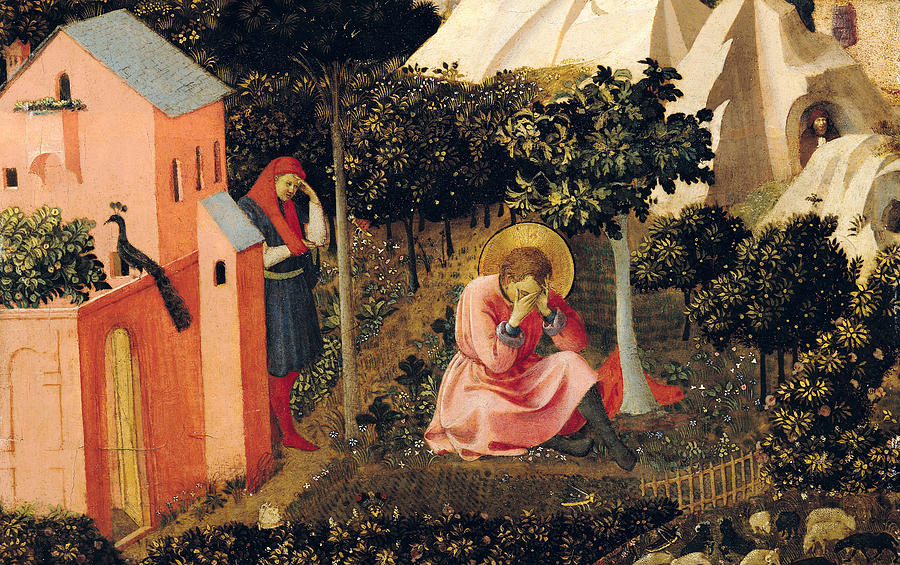
The Conversion of St. Augustine, Fra Angelico
It is curious that the 1970 Missal retains a reference to our “holy fasts,” since the mandatory Fast was eliminated in 1966, and since the Novus Ordo makes no reference to fasting in its other orations during Lent. The 1962 Missal, on the other hand, prays for a holy fast almost every day of the week in its prayers.
The Collect asks that we may be protected from spiritual evils by the help of continentia, which is usually translated as “self-denial.” Continentia entails self-denial, but it is more. On the verge of his conversion, St. Augustine prayed for “chastity and continence, but not yet,” afraid of giving up the dirty little pleasures with which he had grown so comfortably accustomed. (Conf. 8.7.17) Continence is a regaining of mastery over self, an ability to be self-contained (with God’s grace, of course) over the tug of the appetites; it is more self-control than self-denial. The 2011 ICEL translation comes admirably close when it translates continentia as “self-restraint.”
Finally, according to the economy of the prayer, continence becomes a defensive weapon against demonic assault, a shield or an armor. We enter into the Great Fast, as the Preface of Lent declares, to “curb our vices, elevate our minds, and bestow virtue and reward.” And in the words of the Secret for the First Sunday of Lent, we solemnly offer God “the sacrifice of the beginning of Lent, beseeching [Him], that by refraining from flesh at our meals, we may refrain from harmful pleasures.” In other words, we refrain from licit pleasures (regardless of what PETA tells you, there is nothing wrong with consuming the flesh of a warm-blooded animal) in order to take charge over pleasures that lean into the illicit (gluttonous habits, etc.). Such is the power of continence for which we pray as we enter into the annual Boot Camp of spiritual combat.

Friday, February 13, 2026

The Per ipsum

Lost in Translation #160

After the Per quem haec omnia, the priest concludes the Canon with:

Per ipsum, et cum ipso, et in ipso, est tibi Deo Patri omnipotenti, in unitáte Spíritus Sancti, omnis honor et gloria… per omnia saecula sæculórum. ℟. Amen.
Which I translate as:
Through His very self and with His very self and in His very self, all honor and glory belongs to You, God the Father Almighty, in the unity of the Holy Spirit, through all ages of ages. ℟. Amen.
The phrasing of the Per ipsum is inspired by Romans 11, 36:
Quis enim cognovit sensum Domini? aut quis consiliarius ejus fuit?
aut quis prior dedit illi, et retribuetur ei?
Quoniam ex ipso, et per ipsum, et in ipso sunt omnia: ipsi gloria in saecula. Amen(Rom. 11, 34-36)
Which the Douay-Rheims translates as:
For who hath known the mind of the Lord? Or who hath been His counsellor?
Or who hath first given to Him, and recompense shall be made Him?
For of Him, and by Him, and in Him, are all things: to Him be glory for ever. Amen.
In this passage, St. Paul is concluding a theologically dense reflection on salvation history and the cryptic role that Israel plays in it. He ends by stating that since God is the Creator of all (and we cannot say the same about ourselves), we should resign ourselves to the fact that He knows what He is doing even though we cannot fully understand His plan, and that we should glorify him. The triple expression – ;“of Him,” etc. – is primarily in reference to the Father (with a possible Trinitarian echo) and to the beginning, middle, and end of creation. All things have their origin in God; all things continue to exist by virtue of God; and all things have God as their end (the original Greek eis auton or “unto Him” more clearly expresses this idea than the Vulgate’s in ipso).
Although the Per ipsum also has creation in mind (because of the way that it follows the Per quem), it is different in a number of respects, not least of which is that the triple expression is in reference to the Son rather than the Father. We may therefore consider the prayer an example of spiritual eructation; but in this case it is not so much the content that is the object of rumination but a kind of grammar of ascent, a mode of thinking about the transcendent mysteries. [1]
Let us now turn to the different parts of the prayer. (We shall leave the very end and the Minor Elevation for another day.)
Per ipsum, et cum ipso, et in ipso
The prayer refers to the Son of God with the demonstrative pronoun ipse rather than is. Whereas the latter simply means “he,” the former is more emphatic and can be translated as “he himself,” “he the very one,” “he in person,” etc. And by making the sign of the cross each time he says ipse with the Host over the Precious Blood (as the rubrics instruct him to do), the priest adds an actual demonstration to a demonstrative word, almost literally pointing to the Person about whom he is speaking.
The prepositions are also telling. For Fr. Pius Parsch, the three expressions are not “mere amplifications but serve to reveal our most intimate relationship with Christ.” “Through” reminds us that He is our Mediator; “with” that He is the Person to whom we must unite as His mystical body; and “in” that we unite with Him “by the living union of grace.” [2] Fr. Jacques Olier has a beautiful reflection on the theme of unity in this prayer. “It is not enough,” he writes,
to pray with Jesus Christ and in His company…. it is necessary actually to be in unity with Jesus Christ, and to act before God in the power and in the grace of His Spirit, which cannot exist in us separately from His love. It is necessary, as Our Lord says, that we should be in Him, as He is in His Father. [3]
While Parsch and Olier think of the prepositions in relation to us, Fr. Nicholas Gihr stays closer to the original meaning of the text and views the prepositions in relation to the Father and the Holy Spirit. The First and Third Divine persons are honored through the Second “inasmuch as the God-man offers Himself on the altar.” The Father and the Holy Spirit also receive all honor and glory along with the Son, and they also receive it in the Son, for “all three Divine Persons by reason of the unity of their essence are eternally in each other, and, consequently, the veneration of one is not to be separated from the veneration of the other two.” [4]
Est tibi Deo Patri…glória
In Latin, there are three ways to indicate possession: a possessive pronoun (“It is His honor”), a genitive of possession (“The honor of God”), and a dative of possession (“To God is the honor”). The first two emphasize the possessor while the third emphasizes the fact of possession. If I say “it is His honor” or if I am speaking about “the honor of God,” I am saying that the honor is God’s and no one else’s. But if I say “To God is the honor,” I am saying that it is His and that He has other things as well.
Another difference between the genitive of possession and the dative of possession is that the former can sometimes indicate mere legal possession while the latter is more robust, implying a more personal relationship with or enjoyment of the thing possessed. Subsequently, it is sometimes called the “sympathetic dative.”
With these considerations in mind, we speculate that the Per ipsum suggests that all honor and glory belong to God the Father in a special way insofar as He has a unique relationship with them, and that He possesses many other things besides.
Pius Parsch views this ending as fraught with eschatology, and given that every Mass is a foretaste of the Wedding Feast of the Lamb, it is difficult to disagree:
This doxology is a presage of a scene that may take place at the end of time….Christ our Lord comes into the presence of His heavenly Father to announce that the work of the redemption has been accomplished: “My Father, the redemption of the human race has been consummated. The breach between Thee and mankind has been closed. Through Me, and with Me, and in Me, is unto Thee, Father, in the unity of the Holy Ghost, all honor and glory”…. It will be one of those magnificent liturgical moments, such as St. John pictures in the Apocalypse ; it will be the closing scene in the drama of salvation. [5]
But there is one problem. As we have seen with the Greater Doxology (the Gloria in excelsis), and as one can see with the Minor Doxology (the Gloria Patri), most doxologies are in the subjunctive mood: that is, they proclaim that glory should be given to God, not assert that glory already belongs to God. The Per ipsum, on the other hand, is in the indicative rather than the subjunctive: All honor and glory belongs to God right now and not just at the end of time. In the words of Fr. Josef Jungmann:
It is not by chance that this encomium… has the indicative form (est) instead of the subjunctive or “wishing” form. Here, where the Church is gathered, right in front of the altar on which the Sacrament reposes, gathered indeed to offer the Body and Blood of Christ in reverence – here God does actually receive all honor and glory. [6]
Perhaps the best way to reconcile these differing viewpoints is to recall the New Testament distinction between chronos (regular, sequential time) and Kairos, the time when God acts. Like all liturgy, the Eucharistic action is a moment not within chronos but Kairos, and as such there is no past or future but only present. In Kairos, the end is not nigh; the end is now.
Notes
[1] “Ascent” is not a typo. Although I am alluding to Newman’s grammar of assent, I am referring to a way of thinking by which we more easily ascend from quotidian realities up to the divine mysteries.
[2] Pius Parsch, The Liturgy of the Mass, trans. Frederic C. Eckhoff (St. Louis, Missouri: Herder, 1940), 254.
[3] Jean-Jacques Olier, The Mystical Meaning of the Ceremonies of the Mass, trans. David J. Critchley (Brooklyn: Angelico Press, 2024), 108.
[4] Nicholas Gihr, The Holy Sacrifice of the Mass: Dogmatically, Liturgically and Ascetically Explained, 5th ed., (St. Louis, Missouri: Herder, 1918), 692.
[5] Parsch, 254.
[6] Josef Jungmann, S.J., The Mass of the Roman Rite: Its Origins and Development, vol. 2 (New York: Benzinger Brothers, 1951), 266.

More recent articles:

For more articles, see the NLM archives: