Thursday, June 18, 2026

A Reconstruction of an Archaic Rite of Holy Communion (Part 3): Further Evidence

We are very pleased to share the final part of this essay by Zsolt Orbán: part one was published last week, and part two yesterday.

Elements supporting the above, which survive to this day in various liturgical traditions

1. The right palm held in the left hand
Naturally, on this point I do not assume that the hand position used in today’s ecclesiastical practice of communion in the hand is identical to that of antiquity, since the modern sacramental hand position – more precisely, the reception of the Eucharist by hand – differs substantially from the ancient sacrifice, despite the physical similarity of the hand positions.
The right palm, held in the left hand and turned upwards, is the traditional hand posture still found in today’s Orthodox tradition; however, this is naturally not used during the distribution of communion, but rather during blessings: for this is the hand posture for requesting a blessing – the gesture of the person asking for it.

2. The paten on the table
Among the textual sources, I mentioned above the letter of Bishop Dionysius of Alexandria, in which the sacrificial rite is alluded to; I believe this rite can be reconstructed in this paper based on the evidence provided by the images. To support this, I cite as an example the liturgy of the Copts, the modern heirs of the Alexandrian liturgical tradition, in which several elements can be identified that refer to what is depicted in the material artefacts and can be traced back to the practice depicted.
In the Codex Rossanensis, at the moment after the delivery of the Holy Body, Christ does not hold the paten in His hand, but rather takes the particle from the paten resting on the altar. Just as the Copts do in the video clip above.
3. The left palm of the celebrant
Christ places the piece taken with His right hand into the apostle’s mouth, whilst, as seen in the scene from the Codex Rossanensis, he holds his left palm protectively beneath it. After the communion, he continues to hold his left palm upwards, with his fingers slightly bent – so that no crumbs would be lost. Just as Coptic priests do: the video shows the way the priest holds his left palm. This seems very reminiscent of Christ, as seen in the enlarged image from the Rossano Codex above.
4. The communion cloth alluding to the ancient use of the himation
The small cloth worn by the communicant in the Coptic video also seems to evoke the himation seen in the images above. I believe that the changes in dress over the past one and a half thousand years may in themselves explain the replacement of the himation – that is, the ancient outer garment – during the Eucharist: the need to use a cloth, arising from reverence for the Eucharist, may have been stronger than the absence resulting from the disappearance of the himation due to changes in dress. However, the natural process of classifying items associated with the liturgy as sacred may also have led to the emergence of a cloth specifically intended for this purpose in liturgical use.
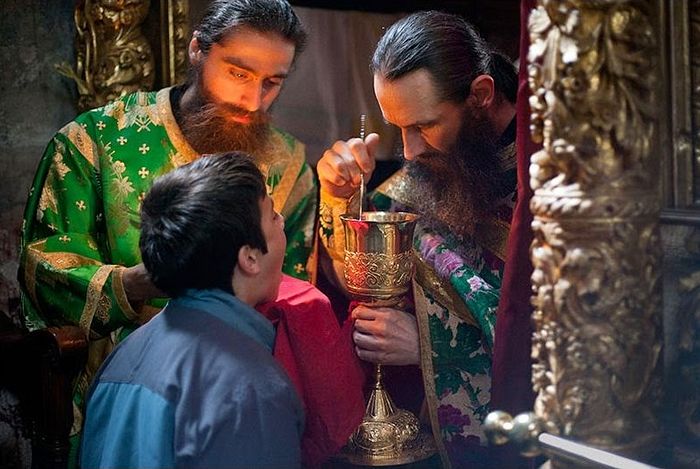
A communion shawl with a similar function is also used in the Byzantine liturgy, as can be clearly seen in the last video.
Among Ethiopian Christians (Ethiopian Orthodox Tewahedo Church), the himation – which has become entirely liturgical in purpose – has also been preserved under the name netela: both men and women wear it in church. This short video discusses how this shawl is worn and its spiritual significance:
5. The holy kiss
I have not found any trace of the kissing of the priest’s hand after communion in the various liturgical traditions, but in the Orthodox tradition there is another form of holy kiss that follows directly after Communion: after receiving the sacred species, the faithful kiss the base of the chalice. The holy kiss given to the base of the chalice, reminiscent of the himation, together with the use of a cloth identical to it in terms of its liturgical function:
Although this kiss differs from the presumed practice described in this text, in which a kiss might have been given to the right hand of the ministering priest, this may be explained by the change in the manner of communion under the two species compared to ancient practice. The distribution of the Body, placed in the Precious Blood, using a spoon – directly into the communicant’s mouth – eliminated the possibility of kissing the priest’s hand, as this could have endangered the contents of the chalice.
But the need to express the spiritual significance embodied in the kiss sought and found a place.
Concluding Remarks
The famous quote from Saint Basil (Letter 93) demonstrates that communion on the tongue was the normative mode of receiving the Eucharist in the Church from the beginning. Ecclesiastical practice deviated from this only under extraordinary circumstances, such as during times of persecution or a shortage of priests, and even then only temporarily (at the time the letter was written, around 372 AD, the practice of the lay faithful taking the Eucharist home was customary only in Alexandria). Despite this, the narrative of "communion in the hand" became dominant in the second half of the twentieth century, inextricably linked to the liturgical reform. The architects of the latter were enthusiastic proponents of this narrative (see, e.g., this article by Annibale Bugnini), which explains why today almost every scholarly textbook and popular publication treats it as a self-evident fact that communion on the tongue was unknown until the 8th or 9th century. Consequently, every written source is interpreted through the lens of this narrative. This, however, distorts the accurate understanding of historical reality and, by extension, hinders the return to correct ecclesiastical practice.
Therefore, it is crucial for researchers to finally re-examine the ancient sources allegedly proving the exclusivity or primacy of communion in the hand. They must thoroughly undertake the work that has been neglected for sixty years, researching actual ecclesiastical practice supported by the analysis of other available historical remains. Anyone who has examined in detail the ‘justifying’ textual interpretations and citations of Bugnini or the frequently cited Dom Ambrois Verheul OSB (La communion dans la main, in: Les questions liturgiques et paroissiales 50 (1969), pp. 115–122) can see their tendentious nature; thus, one can be confident that this narrative can be successfully refuted if the necessary time is dedicated to it.
In the preceding sections, I have addressed textual witnesses only partially; instead, I have attempted to reconstruct a probable ancient rite of communion based on the earliest surviving depictions of authentic liturgical scenes. Far from being contradicted, this reconstruction is rendered more plausible by even the most frequently cited textual sources of the ‘communion in the hand’ narrative, while elements preserved in various liturgical traditions support it in detail. I have done this in the hope of providing inspiration and insights to researchers, whose efforts are essential if a history of the concrete liturgical forms of receiving Holy Communion is to be compiled in accordance with historical reality.

Wednesday, June 17, 2026

A Reconstruction of an Archaic Rite of Holy Communion (Part 2): Insight into St. Cyril of Jerusalem’s Famous Text

The following essay is by Zsolt Orbán. Read Part 1 here.

The Testimony of Written Records

One might naturally ask: If Communion truly occurred in the way we described at the end of our first part, based on the Rossano Codex, the Riha paten, and the Stuma paten, why is there no written confirmation of such a practice?

In fact, such confirmation may well exist. To be sure, we lack a direct and unambiguous primary source that explicitly states – alongside other elements of the reconstructed rite – that “the priest places the Holy Body upon the believer’s tongue.” Nowhere is this ritual described in every minute detail; indeed, this very silence justifies the reconstruction attempted here.

At first glance, the available written records seem to confirm this rite only indirectly, insofar as they do not exclude, but rather permit, the interpretation I have presented. However, upon closer inspection, looking beyond popular translations that often embed their own interpretations, we find confirmation for this rite in the most unexpected places.

In the next section, while listing elements of the rite that survive to this day, I will demonstrate that most components of this reconstructed ritual have been preserved in the Coptic Liturgy. Since Christian liturgical traditions prior to the Novus Ordo did not develop ex nihilo, it is likely that the Coptic tradition did not emerge ex nihilo either, but was characterized by a continuity faithful to its origins. Consequently, elements of today’s practice may well have ancient roots.

If this is the case, the few remaining textual witnesses may indeed validate the reconstruction. Therefore, as witnesses to the reconstructed rite, I cite a frequently invoked Alexandrian example from Eusebius, and one from Saint Cyril of Jerusalem, along with a Syriac text often mentioned as another ancient precedent for the practice.

In his Historia ecclesiastica, Eusebius quotes a letter from Bishop Dionysius of Alexandria to the pope (book VII, chapter 9) regarding a believer who came from a heretical sect. Upon witnessing a true baptism for the first time, the man realized his own baptism had borne no resemblance to the real one and began to doubt its validity. From this letter, the following passage is often cited: “...and stretching forth his hands to receive the holy sustinence, and receiving it, and partaking of the Body and Blood of our Lord.” (“καὶ χεῖρας εἰς ὑποδοχὴν τῆς ἁγίας τροφῆς καὶ ταύτην καταδεξάμενον καὶ τοῦ σώματος καὶ τοῦ αἵματος τοῦ κυρίου ἡμῶν μετασχόντα.”)

Popular interpretation holds that “hands stretched forth to receive” clearly indicates communion in the hand. In reality, however, in nearly every Greek text cited as evidence for this practice, the word used for receiving Communion is the same one found here, yet its meaning is not what many assume. Among ancient Christians, the Greek word term hypodoché (ὑποδοχή) did not signify taking something into one’s palm. Originally, it was a Scriptural term for welcoming a guest (cf. Luke 10, 38 or 19, 6), and from there, it became a terminus technicus for Communion. This evolution is easily understood by anyone who recognizes that in Communion, we welcome the most Precious Guest. Furthermore, the text describes these hands as proteinanta (προτείναντα), meaning “stretched forward.” Thus, the actual meaning of the full expression used for Communion is: hands stretched forward for the welcoming / receiving of the Guest. This is correctly understood only when viewed through the lens of the practical ritual shown by the physical artifacts analysed earlier.

The second text is from the 17th Homily of Narsai of Edessa. This, too, is often presented as proof of communion in the hand; indeed, it cannot be ruled out that Alphonse Mingana, who discovered the text and was not above occasional forgery, sought to ensure it was read that way. In Dom R. H. Connolly’s translation, it reads:

“He who approaches to receive the Body stretches forth his hands, lifting up his right hand and placing it over its fellow. In the form of a cross the receiver joins his hands; and thus he receives the Body of our Lord upon a cross... And the priest who gives says unto him: ‘The Body of our Lord’... He receives in his hands the adorable Body of the Lord of all; and he embraces it and kisses it with love and affection.” (The liturgical homilies of Narsai online; see p. 108; in the original, p. 28)

Yet, in Mingana’s “original” Syriac text, the expression used for receiving the Host – just as in Eusebius – does not denote taking it with the hands. Instead, we find the same Scriptural term for “welcoming / receiving” as in the Greek. This term stems from the root Q-B-L, which in this context refers to the internal, spiritual, or faithful reception of the Sacrifice, much like in the Peshitta version of John 1, 12: “as many as received Him” (d-qabbelūhy).

Beyond the spiritual interpretation, the part of the expression referring to the hands allows for two grammatical readings. The preposition b- (b-īdayhī) can be either locative (‘in’) or instrumental (‘with/by means of’). In the latter case, Narsai’s text may not imply the Body being placed into the hands, but rather approaching the reception of the Body with hands outstretched in a gesture of welcome. The Syriac expression clearly supports this possibility precisely because of the aforementioned primary meaning of the terminus for communion. If, however, one still wishes to interpret the preposition as a locative, they may view it as a spiritual ‘place,’ much like the Father’s hands in Luke 23, 46, which feature the same preposition (b’idayk).

While the grammatical reading would ideally be determined by the subsequent parts of the text, the interpretation of the entire passage ultimately depends on what one considers a conceivable or plausible practice; thus, even the grammatical reading is decided primarily along extra-textual presuppositions. For example, it depends on whether one can imagine that the embracing and kissing of the Eucharist was not spiritual in sense, but an actual physical practice. Since I find this difficult to imagine, I more readily assume that the preposition has an instrumental meaning grammatically, involving a kind of spiritual instrumentality. Outstretched hands are symbols representing and signaling a readiness for reception, which practically served only to prevent crumbs from falling; thus, they are primarily spiritual instruments of a clearly spiritual reception. Therefore, in this text, the Body is perhaps not placed into the hands, but rather the communicant approaches for reception with outstretched hands, bowing.

The final example is the Fifth Mystagogical Catechesis of Saint Cyril of Jerusalem – often considered the “ultimate weapon” for proponents of communion in the hand. The passage in English reads:

“When, therefore, you approach, do not draw near with your wrists extended, nor with your fingers spread; but making your left hand a throne for the right, as for that which is about to receive the King, and hollowing your palm, receive the Body of Christ, saying, ‘Amen’.”

Migne’s edition: “Προσιὼν οὖν, μὴ τεταμένoις ταῖς τῶν χειρῶν καρποῖς προσέρχου, μηδὲ διῃρημένοις τοῖς δακτύλοις· ἀλλὰ τὴν ἀριστερὰν θρόνον ποιήσας τῇ δεξιᾷ, ὡς μελλούσῃ Βασιλέα ὑποδέχεσθαι· καὶ κοίλανας τὴν παλάμην, δέχου τὸ σῶμα τοῦ Χριστοῦ, ἐπιλέγων τὸ, Ἀμήν.” (PG 33, 1124-25, pdf pp. 562-3.)

Here again, we see the author using the technical term hypodechomai (ὑποδέχομαι) for the act of receiving. Even more interestingly: if we can momentarily set aside the ‘communion in the hand’ narrative, we discover that the scene described here is entirely compatible with the reconstructed rite, without the Holy Body ever touching the palm. Because the text does not forbid approaching with hands extended; rather, it forbids approaching with wrists separated, with the right palm not resting in the left, with the right palm not facing upward, or with fingers spread and arms flung wide. The purpose of closing the fingers and slightly hollowing the palms is obvious: to prevent any fragments of the holy Body from falling, an issue the text explicitly addresses with its analogy of gold dust.

Essentially, the text forbids the very hand gesture before reception that the images above depict as the posture of thanksgiving – after communion. If we recall the educational intent mentioned earlier, the Apostle on the Stuma paten – standing with arms wide and fingers spread – shows that the posture St. Cyril forbade before communion was actually the correct posture after communion, during the time of thanksgiving. This was a point of such significance that it demanded the instruction of the faithful; hence, its representation was deliberately sought, even while navigating the inherent constraints of pictorial composition.

It is also worth taking a closer look at the following passage:

“So then after having carefully hallowed thine eyes by the touch of the Holy Body, partake of it; giving heed lest thou lose any portion thereof; for whatever thou losest, is evidently a loss to thee as it were from one of thine own members. For tell me, if any one gave thee grains of gold, wouldest thou not hold them with all carefulness, being on thy guard against losing any of them, and suffering loss? Wilt thou not then much more carefully keep watch, that not a crumb fall from thee of what is more precious than gold and precious stones?” (Μετ’ ἀσφαλείας οὖν ἁγιάσας τοὺς ὀφθαλμοὺς τῇ ἐπαφῇ τοῦ ἁγίου σώματος μεταλάμβανε, προσέχων μὴ παραπολέσῃς τι ἐκ τούτου: ὅπερ γὰρ ἐὰν ἀπολέσῃς, τοῦτο ὡς ἀπὸ οἰκείου ἐζημιώθης μέλους. Εἰπὲ γάρ μοι, εἴ τίς σοι ἔδωκε ψήγματα χρυσίου, οὐκ ἂν μετὰ πάσης ἀσφαλείας ἐκράτεις, φυλαττόμενος μή τι αὐτῶν παραπολέσῃς καὶ ζημίαν ὑποστῇς; Οὐ πολλῷ οὖν μᾶλλον ἀσφαλέστερον τοῦ χρυσίου καὶ λίθων τιμίων τιμιωτέρον διασκοπήσεις ὑπὲρ τοῦ μὴ ψῖχα ἐκπεσεῖν.)

Those who view the above quote as irrefutable evidence for Communion in the hand generally fail to address what exactly was to be done after receiving the Most Holy Body. If this text were meant in a literal sense, then the Eucharist would have had to be touched to the eyes, just as later the remaining drops of the Holy Blood on the lips would have been smeared onto the sensory organs. Yet, it is highly contradictory that the author argues against dropping Eucharistic fragments using the gold dust metaphor, while simultaneously prescribing that it be kissed and touched to the eyes, acts that would obviously increase the risk of crumbs falling.

Furthermore, smearing droplets of the Holy Blood would almost inevitably result in dripping. Such a practice is highly improbable because – as proponents of Communion in the hand often overlook – those who possess an “excessive fear” of losing a single particle, likening it to the loss of their own limbs, do not typically handle the Blessed Sacrament in their hands, much less touch or smear it onto various parts of their body. Therefore, a sober interpretation suggests that the quote refers to actions in a spiritual sense; thus, the eyes are sanctified by gazing upon the Eucharist rather than by physical contact.

This is further supported by grammatical analysis, specifically the presence of the instrumental dative (dativus instrumenti) in the phrase τῇ ἐπαφῇ. This term, denoting contact or touch, can be rightly interpreted here as a kind of dativus instrumenti spiritualis.

Thus, this text serves as a vital supplement to the reconstructed ritual of the faithful’s Communion. With this detail, the action immediately preceding the reception of the Holy Body can be visualized: the communicant, approaching with hands extended and covered by the himation, raised his gaze to the Holy Body before receiving it, saying “Amen,” and then receiving it from the priest’s hand directly into his mouth.

Beyond its spiritual significance, the act of raising the eyes may have served a practical purpose. The phrase “carefully” (Μετ’ ἀσφαλείας) emphasizes the mindfulness with which the eyes are raised to gaze upon the Holy Body. This suggests a practical role for the gesture: by looking up at the Host, the face and mouth of the communicant, who approaches bowing with hands extended and covered, are placed in the optimal position for receiving Communion, thereby ensuring the safety of the metadosis (the priest’s handing over of the Holy Body). This aspect of safety is paramount, underscored by the Greek word for great care, “ἀσφάλεια”, a constant liturgical technical term in the Byzantine tradition. This very care is traditionally prescribed in Byzantine rubrics for priests administering the Eucharist. An example of this consistency is found in the Great Horologion (Horologion to Mega, p. 70), published in Venice in 1856, where the rubric for the priests’ communion prescribes: “And thus he takes what is in his hand with fear and great care.” (Καὶ οὕτω μεταλαμβάνει τοῦ ἐν χερσὶ μετὰ φόβου, καὶ πάσης ἀσφαλείας.)

In summary, it can be asserted with confidence that the texts presented here do not exclude the possibility of the reconstructed Communion rite. On the contrary, if we understand the spiritual state of the faithful – approaching bowed, with covered and extended hands as a humble sign of readiness to receive – we discover a posture identical to the traditional gesture of requesting a blessing preserved in Eastern traditions to this day, as we shall see in the final part of this essay.

Wednesday, June 10, 2026

A Reconstruction of an Archaic Rite of Holy Communion (Part 1): New Light on Traditional Eucharistic Praxis

The following article was sent to us by Zsolt Orbán, to whom we offer thanks. Mr. Orbán proposes a most intriguing hypothesis to account for what is depicted in a number of religious images and has survived to the present day in the customs of certain churches; the hypothesis also calls into question some of the changes in Eucharistic praxis characteristic of the twentieth-century liturgical reform. – PAK

According to the popular narrative, the Mass in ancient times took the form of a ‘love feast’, an agape so to speak, as is thought to be depicted in the wall paintings of the catacombs, with everyone seated around a single table. The Mass therefore did not take place with the congregation facing the Lord, and, most importantly, everyone received Communion in their hands.

The problem with this narrative is that it has no basis in reality: no text corroborates it, and no evidence in support of it can be found in the surviving pictorial records either.

In fact, none of the surviving wall paintings in the catacombs depict an actual liturgy. These images can only be regarded as symbolic references to the Holy Mass, to Christ, and to the Eucharist, and it is only in the case of depictions of Gospel scenes that they can be said to be artistic representations of historical events. Common themes include the wedding at Cana, the miraculous multiplication of the loaves, and the Last Supper; as symbols, the most frequent are the fish as a symbol of Christ (the fish – ichthys – is a Christian acronym: Jesus Christ, Son of God, Saviour), bread, and grapes all refer to the truths of the faith associated with the Holy Mass. In none of these symbolic references do we find any guidance regarding the Holy Mass or the manner of receiving Communion.

The earliest depictions of the rite of the Eucharist

A major innovation in depiction appeared sometime in the 4th or 5th century, perhaps first in the murals or mosaics surrounding the altar of a Christian basilica in Jerusalem. According to researchers’ assumptions, the archetype of such depictions may have been a mural or mosaic in a church in Jerusalem or Constantinople; most suspect that the former paintings of the destroyed Church of the Last Supper served as the model composition. Following this example, the motif of the Communion of the Apostles appears on liturgical metalwork and in books – at least according to the surviving works, generally dated to the 6th century, which survived iconoclasm. During this period, the motif of the Communion of the Apostles appears on several such liturgical objects and in Gospel books.

A characteristic feature of this mode of representation is that it depicts an explicit and specific reception of Holy Communion. On the two halves of the image, Christ himself administers communion to the apostles, giving them their share separately in the two species; this is the metadosis, the handing over of the Holy Body, and the metalepsis, signifying their partaking of the Holy Blood.

Of the earliest such depictions, I shall now examine the three earliest, and thus, from our perspective, the most significant examples, because unlike the speculations regarding the early Christian depictions mentioned above – which lack any concrete basis – these truly do depict an interpretable sacrificial practice, which is moreover supported by written texts. From these, it is indeed possible to reconstruct a highly probable communion practice which, according to the evidence of these artefacts, may have been widespread in the 5th and 6th centuries.

I. Codex Purpureus Rossanensis

This is an illuminated Gospel manuscript dating to the second half of the sixth century. It was discovered in the treasury of the cathedral in Rossano (southern Italy) and became widely known in the 19th century.

In this beautiful Gospel volume, with its crimson-coloured pages and delicate miniatures, two illustrations clearly depict a sacramental rite – the apostles receiving the Eucharist on their tongues. This, of course, has caused some difficult moments for ideologically driven researchers. For example, Franz Xaver von Funk, having established that the depiction shows Christ administering the Eucharist to the apostles on the tongue, declared – as a textbook example of a circular argument – that despite the many corroborating signs, the work could not date from the sixth century, because the practice of administering the Eucharist on the tongue did not exist before the eighth century.

The Receiving of the Holy Body

The scene is explained by the inscription at the top: “He took the bread, gave thanks, gave it to them, saying: This is my body.”

Christ stands on the left-hand side of the painting; the apostles approach him in a line, while in the segment below, Old Testament prophets point to the scene, their messages depicted on their pulpits with scriptural quotations (from left to right):

“O taste, and see that the Lord is sweet” (Psalm 33, 9); “This is the bread which the Lord hath given you to eat” (Exodus 16, 15); “And had rained down manna upon them to eat, and had given them the bread of heaven. Man ate the bread of angels.” (Psalm 77, 24-25); “And one of the seraphim flew to me… and said: ‘Behold this hath touched thy lips, and thy iniquities shall be taken away, and thy sin shall be cleansed.’ ” (Isaiah 6, 6-7)

What we see in the “communion” scene:

  1. Three apostles approach for communion from the right, standing and with their hands held open at the sides of their torsos, bowing slightly.
  1. Immediately before communion, one apostle stands with his outstretched hands concealed within his garment, forming a horizontal “altar cloth” from his himation (Greek outer garment).
  1. An apostle, bowing, places both hands beneath Christ’s right hand and leans his mouth towards Christ’s hand. Christ holds his left hand horizontally, fingers bent, palm facing upwards, as if holding something in his palm (or rather, as the celebrant holds his left palm in the video clip shown at the end of the text)
  1. An apostle beside him (in the background due to the composition of the image) raises his hands to heaven in thanksgiving.

A close-up of the reception of the Body of Christ

The reception of the Holy Blood

Christ stands here on the right, holding a chalice in both hands. The inscription above him reads: “Then he took the chalice in his hands, gave thanks, and gave it to them, saying, ‘This is my blood.’”

Below the Eucharist, there are again four Old Testament prophets; from left to right, the texts read: “This is the blood of the covenant, which the Lord hath made with you.” (Exodus 24, 8); “I take the chalice of salvation, and I call upon the name of the Lord.” (Ps. 115, 4); “And your chalice inebriateth me, like the finest wine.” (Ps 22, 5); “They that drink me shall yet thirst.” (Sir 24, 21)

What we see in the scene of the Eucharist:

  1. From the left, three apostles approach for communion, their hands held at waist height alongside their torsos with open palms, bowing slightly.
  1. In front of them, an apostle, just before receiving Communion, holds his hands at waist height, concealed within his garment, forming a horizontal ‘altar cloth’ from his himation.
  1. An apostle bows, holding his hands beneath Christ’s hands holding the chalice, but without touching it.
  1. An apostle stands beside him (behind him in the picture due to the composition), his left hand visible.

A close-up of the reception of the chalice

II. The Riha paten

This is a communion dish belonging to a hoard of liturgical vessels unearthed in Syria at the beginning of the 20th century. Bbased on the imperial seal found on the bottom of the vessel, it may have been made in Constantinople during the reign of Emperor Justinian II (565–578).

Christ himself is offering the Eucharist to the apostles; the two scenes of the reception of the two species are depicted in a single composition. Researchers believe that this type of depiction was originally modelled on a scene on the walls flanking the altar of a church in Jerusalem, from where it was copied and arranged into one composition on vessels and icons.

The reception of the Holy Blood is depicted on the left side of the paten:

  1. Four apostles in the background; due to the composition, their hands are not visible
  1. An apostle before the Eucharist, holding his hand out at waist height with an open palm
  1. An apostle, his hands covered by his himation, holds them out at waist height, raised slightly, whilst drinking from the chalice held by Christ. His hands do not touch the chalice, being covered by the himation.

Close-up of the Communion scene

The chalice used for communion can be seen on the right side of the altar. Below is a photograph of a similar 6th century chalice.

The reception of the Holy Body on the right side of the paten:

  1. Four apostles in the background; their hands are not visible due to the composition
  1. One apostle just before receiving Communion, his hand extended forward at waist height with an open palm
  1. One apostle leans towards Christ’s right hand, holding his own hands (right hand in left palm, thumb resting on the back of the right hand) directly beneath Christ’s hand; his himation no longer covers his hands, it hangs from his left arm.

The “communion” scene enlarged

III. The Stuma paten

This paten is of the same period as the Riha paten and belongs to the same treasure hoard found at Caper Koraon (modern day Kurin, Syria). Based on the imperial seal visible on it, the paten was likely made in 577-78.

The reception of the Holy Body on the right-hand side of the paten:

  1. Three apostles in the background; due to the composition, their hands are not visible.
  1. An apostle before the Eucharist, his right hand raised with an open palm, his left hand hidden beneath his himation
  1. An apostle leaning towards Christ’s right hand, his mouth at the back of Christ’s hand, his elbows at waist height, his hands slightly raised and covered by the himation
  1. Another apostle, bowing after Communion, hands extended forward in thanksgiving, fingers slightly spread, palms turned upwards and spread apart, his himation hanging from his left hand.

The reception of the Holy Blood on the left side of the paten:

  1. Four apostles in the background; their hands are not visible due to the composition.
  1. An apostle stands with uplifted hands veiled by a himation, his eyes turned heavenward.
  1. Another apostle drinks from the chalice, which Christ holds out to him with both hands. The apostle’s hands are not visible; they are covered by the himation (the lower edge of the himation is clearly identifiable as it hangs in front of the altar cloth).

Regarding the depiction on the patens, researchers note that, contrary to the order of the liturgy, the wine appears on the left and the bread on the right, although in eighty percent of cases this is usually the reverse. Christ always gives the bread with his right hand and holds the chalice in both hands.

Common features of the depicted communion scenes

Based on the images presented, in my opinion, despite the differences in the individual details visible in them, common features can be identified, on the basis of which a communion rite can be reconstructed using the following interpretative principles. The principles are:

a. the same rite

A common feature of the objects presented is that researchers generally associate them with the eastern, Syrian regions: this applies not only to the two patens but also to the Rossano Codex, which, according to several researchers, may have been brought to Italy to escape the wrath of iconoclasts. And since their dates of origin can also be placed in the same period, we may rightly assume that the sacrificial features depicted on them may be representations of the same sacrificial rite.

b. the simultaneous depiction of a sequence of actions occurring one after the other

Another important point concerns the relationship between the depicted reality and the medium of representation: in these images, a dynamic sequence of events is narrated using static visual elements. Consequently, these compositions are series of cartoon-like images, woven together from several scene fragments determined by the constraints of space and composition. This can be observed in the procession of the apostles approaching the Eucharist, in which the preparations before the Eucharist, the moment of the Eucharist itself, and the actions preceding or following it in chronological order all appear simultaneously.

c. didactic nature

The third aspect concerns the function of the depictions. These were not originally mere decorations, narrative accounts or illustrations, but depictions of a didactic nature. This is particularly true if the researchers’ theory regarding the archetype of the depiction is correct and the Communion of the Apostles did indeed first appear in the wall paintings of a church. For this very reason, these depictions do not merely portray an ancient event – for which it would have sufficed to capture the moment of communion – but the depicted scene fragments also convey a kind of teaching. Simultaneously they present a chronological arrangement of the event’s parts in accordance with the essence of the given teaching – precisely in the spirit of didactic intent.

Reconstruction of the Communion practice

Based on the above considerations, the specific rite of communion can be reconstructed from these depictions, despite the variations visible on individual objects.

To begin with, it is worth paying attention to the himations.

In this regard, we can see that in the Rossano Codex, in the part of the scene closest to the moment of the communion, the hands of the apostle receiving communion are not concealed in the himation; this is only visible with the apostle behind the communicant. On the Riha paten, the himation is on the hands only when receiving the Holy Blood, whereas on the Stuma paten, it is present when receiving both species. Based on the first point outlined above, these differences cannot be attributed to a different rite; therefore, there must be another reason for the variation in the depictions.

Regarding the use of the himation, rather than some more abstract, elusive spiritual significance in holding it horizontally like a cloth, we may surmise a more concrete, practical-spiritual reason stemming from reverence for the Holy Eucharist: the endeavour to prevent the Body and Blood from falling. If, however, this is the case, it is at first incomprehensible why, in the Rossano Codex, we see hands concealed within the himation only in the case of the apostle preparing for communion. Why does the Rossano Codex not show hands covered by the himation in the case of the apostle closest to Christ? And why is the himation absent from the Riha paten during the reception of the Body?

The reason for this is that, due to the limited scope of the composition, only the scene depicting the teaching intended to be conveyed could be included: the frame from the ‘cartoon’ that carries a very essential teaching.

The use of the himation at the moment of communion probably took place in every instance as depicted on the Stuma paten.

The reconstructed sequence of the Eucharist:

  1. Before the person preparing for communion reaches the celebrant, they spread their himation over both hands. Since this may have been done for the reason mentioned above, it would make no sense for them to do so if the himation were not already on their hands at the time of communion; it can therefore be assumed that it was always in place.
  1. At the moment of communion, the communicant stands bowed, holding his hands, covered by the himation, outstretched beneath the minister’s hands, both when receiving the Body and the Blood. Furthermore, at the moment of communion, his hands do not touch either the chalice or the bread.
  1. The minister places the Host in the communicant’s mouth. In doing so, he does not hold the paten in his hand, but takes the Host from the paten on the altar table with his right hand, whilst holding his left palm beneath it so that not a single crumb falls. The communicant’s himation, held horizontally, acts as a ‘safety cloth’ to prevent the sacred species from falling… (as can be seen in the video linked at the end of the text)
  1. Immediately after Communion, the images suggest that the communicant leans towards the minister’s hand and kisses the back of their right hand – but only upon receiving the Body.
  1. After the kiss of the hand, the communicant stands (Rossano Codex, Riha paten) or bows (Stuma paten), raising empty palms to the sky or extending them forward in thanksgiving.

Instead of the reception of the Holy Body, all three objects depicted show a kiss given to the back of Christ’s right hand; for if they were to depict the Body being placed in the mouth, the celebrant would not be leaning towards the back of the hand. If there was indeed a kiss on the minister’s hand immediately after Communion, this would not have been possible during the reception of the Precious Blood, as the minister held the chalice with both hands, and its contents could easily have spilled if the communicant had leaned towards the minister’s hand. And since, due to the narrow frames, only the essentials could be depicted in such a pictorial composition, the moment of receiving the Body is not visible in any of them.

The reason for this may well be found in the didactic nature of the church scene, which can be regarded as the archetype for the depiction of the Apostles’ Communion: since there is a difference regarding whether a kiss of the hand takes place during the reception of the two elements, it was necessary to emphasise to the congregation when depicting the Communion that the teaching should be before their eyes: one may only kiss the minister’s hand after receiving the Body, but not after receiving the Precious Blood.

To be concluded next week.

Monday, December 15, 2025

A Catechesis on and Examination of the Use and Construction of Altar Rails in the Novus Ordo Missae

The following article is written by a diocesan priest. The mounting attack on altar rails throughout the Church, renewing the iconoclasm of the 1970s, is a cause of deep concern to every serious Catholic. For this reason it behooves us to understand that even according to the rules that govern the Novus Ordo, there is absolutely no basis for a bishop to oppose the use or the construction of altar rails in churches. – Dr. Kwasniewski

There are many elements in our Catholic faith that can easily be thought of as superfluous due to their lack of effecting certain actions ­– which does not make them invalid or illicit. However, this minimalistic approach is the opposite of what we are as Catholics. We do not love certain elements because we think they make us holier in and of themselves. Rather, we love them because they express to us the reality of Him who is holy. In loving these elements, we do not subject ourselves to a form of separation from sincere affection. On the contrary, our innermost beings are drawn into a deep charity that cannot be described. In other words, we encounter the living God. Devotion is not fanaticism. Devotion is a form of expressing the soul’s inner longing for union with the Divine. The spiritual becoming tangible.

This document has three set purposes. The first is to inform the reader about the historical, theological, and liturgical uses regarding the altar rails. The second is to instill in the reader a richer understanding of the nature of this tradition, and to deepen his love for such things. The third is to examine the legality of liturgical furnishings that belong to this category, the category of the “superfluous” or “not necessary”, and answer the question of whether they may be used, and whether they may be banned. By the end of this document, the reader will understand that altar rails have a basis in the historical and theological dimensions of the Mass, and may be utilized and even promoted, in light of recent legislation.

1. Historical Basis

Our best early resources regarding details in the liturgy come from the fourth century. It was after the Edict of Milan in 313 and the Edict of Thessalonica in 380 that the early Christian witnesses address the liturgy that had emerged into the public eye. Along with this, we still have much evidence of the architecture of the early Christian Church.

A universal constant from this period through the present day was a barrier between the sanctuary and the people. The theological significance of this barrier is to distinguish the Holy of Holies from the inner court, as was done in the tabernacle, and later, the Temple. Our forefathers saw the Mass as the re-presentation of Calvary, and Calvary as the fulfillment of Temple worship. Hence, elements of vesture and architecture, such as the barrier, carried over from our Jewish forbears.

In the East, this took the form of the iconostasis, a barrier at the entrance of the sanctuary. Only clerics and acolytes are permitted to pass through the iconostasis. The priest emerges at Communion to give communion to the faithful there present.

In the West, this initially took the form of a sectioned-off wall, known as a balustrade, which would veil the actions in the sanctuary from the congregation. As time progressed, this barrier would eventually become the rood screen, which was far more common in the West. This screen, while still separating the nave from the sanctuary, served as a mystical meeting point between God’s dwelling place, the new Sancta Sanctorum, and the outer holy place, where God’s elect dwelt. The faithful approached and received the Body of Christ at the roodscreen.

In the medieval era, as Eucharistic theology developed, so did Eucharistic piety. Throughout the West, essentially from the time of the Cluniac Reforms and through the thirteenth century, canon law moved to only allowing the priest, with consecrated hands, to handle the Sacred Species, except by indult. At the same time, already by the nineth century, a combination of popular piety and ecclesiastical legislation brought about the standardization of reception of Holy Communion kneeling on the tongue.

The more modern architecture of the altar rail come into vogue during the Counter-Reformation. To combat Protestant accusations of mystification, artisans made the sanctuary more visible by putting up a rail rather than a rood screen. This became the standard in Christendom for the next 400 years. The rail stood as a culmination of centuries of theological and liturgical development. It still separated the sanctuary from the nave, and allowed a simple and traditional method of distribution of Holy Communion, while also fostering Eucharistic piety and active participation, since the faithful in said churches were able more clearly to observe the Holy Sacrifice of the Mass.

Figure 1: The Ballustrade of S. Maria in Cosmedin, Rome
(source: Liturgical Arts Journal)

Figure 2: The layout of the Temple
(source: Wikimedia Commons)

2. The GIRM and Altar Rails

The General Instruction of the Roman Missal, which governs all things pertaining to the Novus Ordo Mass, explicitly allows for the erection of the altar rail. Following the perennial tradition of the Church, paragraph 295 states that the sanctuary “should be marked off from the body of the church either by its being somewhat elevated or by a particular structure and ornamentation.” In practice, this “or” is inclusive, and sanctuaries are often constructed with a fixed elevation and some structure and ornamentation.

Reading this in light of the tradition, we can only interpret this “structure” as the altar rail. In ecclesial legislation, grants are to be applied broadly in the law, and lower authorities than the Universal Law cannot restrict a grant (Can. 36 §1.). Since it is permitted in the General Instruction, it cannot be forbidden that priests choose to mark their sanctuaries by the use of the rail.

The GIRM also specifies that in the arrangement of the Church there should be easy access when it comes to the reception of Holy Communion. It instructs us as follows: “moreover, benches or seating should be so arranged, especially in newly built churches, that the faithful can easily take up the bodily postures required for the different parts of the celebration and can have easy access for the reception of Holy Communion” (GIRM #311).

Although there is no explicit mention on the usage of the rails themselves in these latter norms, the altar rail is still a traditional means by which these norms may be fulfilled. They provide a literal “easy access” to the Sacrament, whether one is standing or kneeling to receive Communion.

Finally, in practical terms, distribution of Holy Communion via this “easy access” at altar rails only speeds up the distribution of Communion. When the congregation lines up at the rails, the distributor may go from person to person without much loss of time in between people. With this in mind, the more common form of distribution seems to provide less “easy access” for the faithful to receive Communion. Many, especially old people, struggle to very quickly kneel to receive without delaying the rest of the line. It is within their right to receive in this manner. Yet, “easy access” is oftentimes not given at a standard parish for the faithful to receive in this way.

In sum, altar rails fulfills the requirements of the GIRM in a traditional and arguably fuller way that is not in contradiction to the law of the Church. It is an erroneous opinion that they are harmful, or even in contradiction to the law of the Church.

3. Altar Rails in Light of Redemptionis Sacramentum

At this point, the rubrics have not given any explicit statement as to whether the altar rails may be utilized. They have also not specified whether reception at the altar rail is something altogether prohibited, or whether it can be prohibited by the bishop.

This brings us to Redemptionis Sacramentum, written by Cardinal Arinze of the CDW (now known as the DDW) in 2004, during the reign of St John Paul II, written in the wake of the 2003 encyclical titled Ecclesia de Eucharistia, which called for instruction on liturgical norms.

In paragraph 4 of RS, the CDW promptly states one of the greatest reasons for issuing said instruction:
In this regard it is not possible to be silent about… abuses, even quite grave ones, against the nature of the Liturgy and the Sacraments as well as the tradition and the authority of the Church, which in our day not infrequently plague liturgical celebrations in one ecclesial environment or another. In some places the perpetration of liturgical abuses has become almost habitual, a fact which obviously cannot be allowed and must cease” (RS, 4).
The point in the promulgation of this document, as stated above is to root out liturgical abuses from the preceding decades. It further seeks to restore liturgical celebrations to the “tradition and authority” of the Church, as opposed to the innovations which had been introduced since the promulgation of the New Mass in 1969, often by priest celebrants.

Within the same instruction the CDW includes a section that is directed towards bishops. This section, and the following, are crucial, because the whole document is focused on proper liturgical norms being implemented, keeping in mind the Church’s orthopraxical tradition. In paragraph 19, the CDW states, “The diocesan bishop, the first steward of the mysteries of God in the particular Church entrusted to him, is the moderator, promoter and guardian of her whole liturgical life” (RS, 19). The bishop is the protector of the diocese’s liturgical life.

Moving forward, the CDW states:
It pertains to the diocesan bishop, then, ‘within the limits of his competence, to set forth liturgical norms in his diocese, by which all are bound.’ Still, the bishop must take care not to allow the removal of that liberty foreseen by the norms of the liturgical books so that the celebration may be adapted in an intelligent manner to the Church building, or to the group of the faithful who are present, or to particular pastoral circumstances in such a way that the universal sacred rite is truly accommodated to human understanding. The bishop governs the particular Church entrusted to him, and it is his task to regulate, to direct, to encourage, and sometimes also to reprove; this is a sacred task that he has received through episcopal ordination, which he fulfills in order to build up his flock in truth and holiness (RS, 21-22).
It is within the rights of the bishop to create liturgical norms for his diocese. These liturgical norms are for the accomplishment of the same task laid out in Redemptionis Sacramentum itself, that is, to stop liturgical abuses and to educate. Many abuses occur out of “ignorance, in that they involve a rejection of those elements whose deeper meaning is not understood and whose antiquity is not recognized” (RS, 9).

Yet, the above quotation puts a limit on the bishop’s authority, for “the bishop must take care not to allow the removal of that liberty foreseen by the norms of the liturgical books so that the celebration may be adapted in an intelligent manner to the Church building, or to the group of the faithful who are present, or to particular pastoral circumstances.” Thus, the bishop cannot encroach in his liturgical norms upon certain liberties given to the laity and priests alike.

Obviously, this could be taken in an anarchical way that completely contradicts the spirit of the document, by which one claims that everything is an “adaptation… to a particular pastoral” circumstance. In terms, then, of authentic interpretation, what is this liberty “foreseen by the norms of the liturgical books”?

On the most fundamental level, it is that which is printed within the Missal and the GIRM that gives a priest or a member of the lay faithful an option. For example, the priest is given the option to announce the Sign of Peace (Missale Romanum, 128). The lay faithful are given the option to receive Communion kneeling or standing; on the hand (unless there is “a risk of profanation”) or on the tongue (RS, 90). Hence, “it is not licit to deny Holy Communion to any of Christ’s faithful solely on the grounds… that the person wishes to receive the Eucharist kneeling or standing” (RS, 91). These options, which are printed in the rubrics, are liberties that the bishop cannot remove.

But the document does not stop here. It also allows “that the celebration may be adapted in an intelligent manner to the Church building, or to the group of the faithful who are present, or to particular pastoral circumstances in such a way that the universal sacred rite is truly accommodated to human understanding.” Here, we must understand these rubrics within the mindset of its legislator. Again, the point in this clause is not to allow anarchy within the liturgy—far from it! Rather, the mind of the legislator points solely to the traditional practices within the liturgy. This is where altar rails come back into the discussion.

Many church buildings, especially those which have been built in a traditional manner, have retained, restored, or constructed, an altar rail. Is this outside of the purview of the Novus Ordo or Redemptionis Sacramentum? Absolutely not. RS was written for the restoration of tradition within the Sacred Liturgy. The CDW notes, quite explicitly that “the structures and forms of the sacred celebrations according to each of the Rites of both East and West are in harmony with the practice of the universal Church also as regards practices received universally from apostolic and unbroken tradition, which it is the Church’s task to transmit faithfully and carefully to future generations” (RS, 9).

Notably, the CDW is not referring to the perennial Tradition, in terms of doctrine, but tradition, in terms of liturgical customs. RS mentions “tradition” 23 times throughout the whole document. The abuses addressed in RS are against, “against the nature of the Liturgy and the Sacraments as well as the tradition and the authority of the Church” (RS, 4).

With this in mind, reception of Holy Communion at the altar rail, even in the Novus Ordo, is something hardly spoken of in the rubrics, and thus afforded liberty. It is an appropriate adaptation to the liturgy, with the interior of the church in mind. It is an appropriate adaptation to the lay faithful who desire to receive Communion at the rail. Thus, it is not within the purview of the bishop to ban this or any other traditional practice, not explicitly forbidden in the rubrics. The Church’s judgment in these matters has always been on the side of upholding the tradition. The use of the altar rail is a laudable expression of that tradition.

Conclusion

Considering the history, theology, and instructions regarding altar rails, we can now clearly state that these liturgical furnishings are not only permitted, but also a laudatory and traditional enhancement to the sanctuary. They are a gate to the “altar of God, to God my exceeding joy” (Ps. 42). Truly, from the author’s experience, the faithful view the altar rail as an altar for their own sacrifice of their lives, and a place where heaven and Earth meet. In fine, the view, not only of the faithful and clergy, but more importantly of Holy Mother Church, is reiterated by Pope Benedict XVI, “What earlier generations held as sacred, remains sacred and great for us too, and it cannot be all of a sudden entirely forbidden or even considered harmful.”

Wednesday, July 09, 2025

Clarity on Genuflections Around Communion in the Usus Antiquior

I received the following question from a reader, and given that others might find themselves with a similar question, or might simply wish to doublecheck that they are doing the right thing, I share my response today at NLM.

The Query: I am seeking instruction on the rubric in the Missal of 1962 which directs the priest to genuflect prior to retrieving the Blessed Sacrament from the tabernacle in the ciborium, and again after reposing it. I know Novus Ordo instructions do not point to this gesture. Would you be so kind as to indicate where such an instruction may be found, should it exist? And the rationale behind it.”

The Response: The instructions can be found in the 1962 Ritus Servandus which read as follows in translation:
X. The Lord’s Prayer and everything else up to the end of Communion…

6. If there are some to communicate during the Mass, the minister [read “server”] warns them a little beforehand with a ring of the bell. The Priest, after drinking the Blood, places the Chalice a little toward the Gospel side, but still within the Corporal, and covers it with the Pall.
  • Then, if there are consecrated Hosts upon the Corporal, having made a genuflection, he places Them upon the Paten.
  • If They have been consecrated in the same Mass within a Pyx/Ciborium, he places the Pyx/Ciborium in the middle of the Altar, uncovers It, and genuflects.
  • If the Hosts to be administered have been consecrated beforehand, having opened the Tabernacle, he genuflects, extracts the Pyx/Ciborium and uncovers It.
He takes the Pyx/Ciborium or Paten with the Sacrament in his left hand, and takes one Host in his right, which he holds somewhat elevated over the Pyx/Ciborium or Paten with his thumb and index finger, and standing at the center of the Altar, facing the communicants, says: Ecce Agnus Dei, ecce qui tollit peccata mundi. Then he says: Domine, non sum dignus, ut intres sub tectum meum, sed tantum dic verbo, et sanabitur anima mea. After repeating this the third time, he goes to their right, that is, to the Epistle side, and facing each one, holding the Sacrament, he makes the sign of the cross with It over the Pyx or Paten, saying at the same time: Corpus Domini nostri Jesu Christi custodiat animam tuam in vitam aeternam. Amen.

7. After the Faithful have communicated, the Celebrant returns to the Altar. Then, if there have been any Hosts upon the Corporal, he wipes it with the Paten, and if there are Fragments upon it, places them in the Chalice. If Hosts remain in the Pyx/Ciborium, he places It upon the Corporal, covers It, replaces It in the Tabernacle, genuflects, and closes the door.

Afterward he places in the Chalice any Fragments, which he happens to find upon the Paten, which was placed under the mouths of the communicants. Then he says secretly Quod ore sumpsimus, etc., and purifies himself, saying Corpus tuum, Domine, quod sumpsi, etc., and does everything as above. If there is a Tabernacle upon the Altar, and a Pyx/Ciborium with consecrated Hosts remains upon the Altar until the end of Mass, They are saved, which is prescribed at the end of Mass on Holy Thursday.
Thus, for the actual rubrics in the missal. The general principle is that any time the Priest and ministers interact with the Blessed Sacrament, a reverence is shown. This is also the case when the proximity between the ministers and the Blessed Sacrament changes, such as when the Tabernacle opens or shuts.

As to why this is done, it should be self-explanatory: under the signs of bread and wine, Our Lord Jesus Christ Himself is present, in person, and so we should reverence the Person as we would do when entering the presence of a King, or leaving it. The lack of such a gesture would be nothing better than negligence or contempt, if not a sign of a merely notional assent to the Real Presence rather than the real assent of supernatural faith.

It is worth pointing out, in addition, that the number of genuflections in connection with the Sacrament were reduced in 1962. If one takes a look at Matters Liturgical of 1956 (n. 238), the genuflections were:
  • When the tabernacle is opened
  • When the Priest uncovers the ciborium and turns for the Misereatur…
  • When the Priest turns from back the Misereatur…
  • After returning to the altar after Communion and placing down the ciborium (if hosts remain) 
  • After placing the ciborium in the Tabernacle, before closing the door (if hosts remain)

Even not considering the Confiteor before Communion, there would have been two additional genuflections pre-62, one when the ciborium is uncovered and one at returning from the distribution (presumably connected with the immediate or somewhat immediate covering). Yet another indication of the involvement, in the code of rubrics for the 1962 missal, of the same reductionistic and horizontalizing reformers who would later, as part of the Consilium, take advantage of a wide permission to deconstruct and destroy.

In practice, as would be expected, the strict following of the ’62 Ritus is not universal, with the older practice still finding a place, even as occurs with the repetition of the Confiteor and other carryovers from the past.

Back to the point at hand, I would recommend that every celebrant of the TLM obtain a copy of a translation of the Ritus (it is in the Missal itself in Latin), which the FSSP sells here (along with other items).  It is important to be familiar with the Ritus along with the rubrics to get a full picture of how Mass is to be celebrated.

Photos by Allison Girone.

Visit Dr. Kwasniewski’s Substack “Tradition & Sanity”; personal site; composer site; publishing house Os Justi Press and YouTube, SoundCloud, and Spotify pages.

Monday, September 05, 2022

Tensions in the Catholic Tradition on Frequent Communion

Recently a friend was talking to me about his and his family’s discernment that led to their decision to receive Holy Communion once a month instead of more regularly as they had done before. He explained it this way: for many centuries Communion was taken with the utmost seriousness, because Catholics really believed it to be the Body, Blood, Soul, and Divinity of Christ, Whom one would not dare to approach without the most thorough preparation and deliberateness, including a sacramental Confession of one’s sins after an examination of conscience.

Historians may lament the infrequency of Communion in previous ages, he went on, but the infrequency came with a certain benefit: when Catholics did make their obligatory Communion, it was a much bigger deal. Similarly, even religious, who had consecrated their entire lives to Christ and strived to live every moment for Him, would not receive Communion every day, but had to ask permission of their spiritual directors. The reason was not necessarily a harmful scrupulosity or the noxious fumes of Jansenism, but simply an awareness that approaching the divine Bridegroom for the most complete union possible in this life is not something to be done lightly or, as it were, by routine.

Lastly, my friend noted that even Pius X, or rather the document Sacra Tridentina issued by his authority, had established stipulations, which tend to be forgotten. Among these was the following: “A right intention [for communicating] consists in this: that he who approaches the Holy Table should do so, not out of routine, or vain glory, or human respect, but that he wish to please God, to be more closely united with Him by charity, and to have recourse to this divine remedy for his weakness and defects.” Is it realistic to think that most people will be this conscientious and not fall into routine if they receive practically every time they go to Mass (and even more, if they go daily)? On the contrary, said my interlocutor, ever since he and his family lessened the frequency and intensified their preparation, the times of Communion have grown in importance and, for lack of a better word, impact.

One might cite in defense of such a view the following passage from St. John of the Cross:

There are others, again, who, because of this gluttony, know so little of their own unworthiness and misery and have thrust so far from them the loving fear and reverence which they owe to the greatness of God, that they hesitate not to insist continually that their confessors shall allow them to communicate often. And, what is worse, they frequently dare to communicate without the leave and consent of the minister and steward of Christ, merely acting on their own opinion, and contriving to conceal the truth from him. And for this reason, because they desire to communicate continually, they make their confessions carelessly, being more eager to eat than to eat cleanly and perfectly, although it would be healthier and holier for them had they the contrary inclination and begged their confessors not to command them to approach the altar so frequently: between these two extremes, however, the better way is that of humble resignation. But the boldness referred to is a thing that does great harm, and men may fear to be punished for such temerity. [1]

St John of the Cross, St Bonaventure, St Pius X

Now, although it is undeniably true that the Holy Eucharist was received less in past centuries, we can still find many great saints who recommended more frequent reception, which can be seen as the background for Pius X’s encouragement for the same — even for daily Communion, provided one is in a state of grace and fulfills the other conditions. I have taken up this topic in other places [2], but I would like to offer just one medieval witness, namely, St. Bonaventure (1221–1274), who takes a line that is, one might say, between the rigorism of St. John of the Cross and the apparent relaxedness of St. Pius X:

If a person were always prepared, it would always be beneficial for him to receive this sacrament; provided, that is, that the abode of his soul is pure and he can receive this food with reverence and devotion. In the early Church, therefore, when Christians were clean through baptismal innocence and fervent with charity through the gift of the Holy Spirit, it was proper for them to communicate every day. But later on, as charity grew cold and many lost their baptismal innocence by sin, it was left to the judgment and conscience of each individual to receive when he felt himself suitably disposed, lest otherwise he receive to his damnation.
          If he sees himself in the condition of the primitive Church, he is to be praised if he receives daily. If he finds himself in the state of the present-day Church [!], namely, cold and torpid, he does well to receive rarely. And if he believes he is in mid-way, he should act accordingly, that is, at times stasy away from Communion in order to restore his devotion. For this Guest is to be received with due honor and love. So that as a man finds himself inclined in one direction or the other, he should act accordingly — which is to be learned by experience. Consequently all the reasons given in favor of the first class (i.e., daily reception) are to be understood with the proviso that worthy dispositions are present — a condition which is generally fulfilled in very few cases. [3]

Another medieval scholastic, Meister Eckhart (c. 1260–c. 1328), imagines a Christian raising a heartfelt objection, and then gives a response:

Now you might say: Sir, I find that I am so empty and cold and worn out that I dare not go to our Lord. And I shall say: then all the greater is your need to go to your God, for it is in Him that you will be warmed and kindled, and in Him you will be made holy, to Him alone will you be joined and with Him alone made one, for you will find that the Sacrament possesses, as does nothing else, the grace by which your bodily strength will be united and collected through the wonderful power of our Lord’s bodily presence, so that all man’s distracted thoughts and intentions are here united and gathered together, and what was dispersed and debased is here raised up again and its due order restored as it is offered to God. . . . For we shall be transformed into Him and wholly united with Him so that what is His becomes ours, and all that is ours becomes His, our heart and His one heart, our body and His one Body.[4] 

A great spiritual writer who addresses this topic in many places is Mother Mectilde of the Blessed Sacrament (1614–1698), who was well connected with all the currents of spirituality in the Grand Siècle. Here are some excerpts, written to laywomen:
He wants to come to you and nevertheless you do not receive Him. You have many small weaknesses that will be eradicated only by availing yourself of this Eucharistic bread. Why deprive your soul of an infinite good? Listen to the voice of this marvelous Savior who calls from the depth of your heart, “Aperi, aperi, mihi soror, mea sponsa. Open to Me, open to Me, My sister, My bride, My beloved, your heart, that I may make My eternal dwelling in it and take My rest in you.” He wants to be united to you, in order to make you entirely one with Him… Surely, if you do not listen to this divine voice I will be a thousand times more aggrieved than if I were condemned to death. I see the moments passing, the weeks and months, and, by I do not know what temptation, you delay your eternal happiness. I beg you not to go on any longer like this, for fear that, when you desire to receive Communion, you are no longer able; and meanwhile you deprive your soul of the divine life. [5] 

My desire would be to see you receive Communion often… You cannot give yourself too much to Jesus Christ, nor can you surrender too much to His intentions to possess you through this adorable Sacrament. You need to drown your weakness in His divine power and in the desire to be completely filled with Him. “As I live for My Father,” says Jesus Christ, “so all those who receive Me live for Me.”3 O blessed life, to live for Jesus Christ and from Jesus Christ, to be nourished and sustained by Him! This is why He is in the Host and will be there until the end of the world. And His desire is to be received now, so that He may continually work the effects of His love and His mercy, that He might live in us and we in Him — in short, that we be transformed in His love, being completely engulfed in the divinity and made absolutely one with Jesus Christ. It seems to me that a soul who communicates frequently receives a great deal more strength, grace, and blessing than those who refrain. [6] 

[T]here is a temptation to refrain, under the pretext of seeing yourself little disposed to receive it. Go to God with trust and love, do not deprive yourself of Him out of fear. Alas! What presumption to think that we are able to prepare for Communion! It is God alone who can prepare us by His graces and His mercies. Accordingly, you have nothing and can do nothing unless God gives it to you. Present yourself to Him so that you may receive what He desires to give you, and ask Jesus to receive Himself in you and to glorify Himself there, since you are incapable of being able to do this well. Let His love supply for everything. And in this simple disposition, receive Communion often. [7]

We will never be worthy of Communion, having no such power in ourselves; but Jesus Christ, through His part in Holy Communion, has sanctified ours and has merited for us the grace to receive Communion. Do not allow this favor which Jesus Christ granted you to be fruitless. [8]

Mother Mectilde adds a new aspect by reminding us that Communion has a “cosmic” purpose that goes beyond anything we can do by or for ourselves. It is, in fact, the heaven-supplied way in which we can allow Our Lord to do for us and in us what we can never do:

In the Mass, all the mysteries of Jesus Christ Our Lord are represented to us. A soul who is a little enlightened finds there all the dispositions with which He acted and suffered during the course of His holy life. The Mass is an ineffable mystery in which the eternal Father receives infinite homage: in it He is adored, loved, and praised as much as He deserves; and that is why we are advised to receive Communion frequently, in order to render to God, through Jesus, all the duties we owe Him. This is impossible without Jesus Christ who comes into us in order to accomplish [in us] the same sacrifice as that of the Holy Mass. [9]

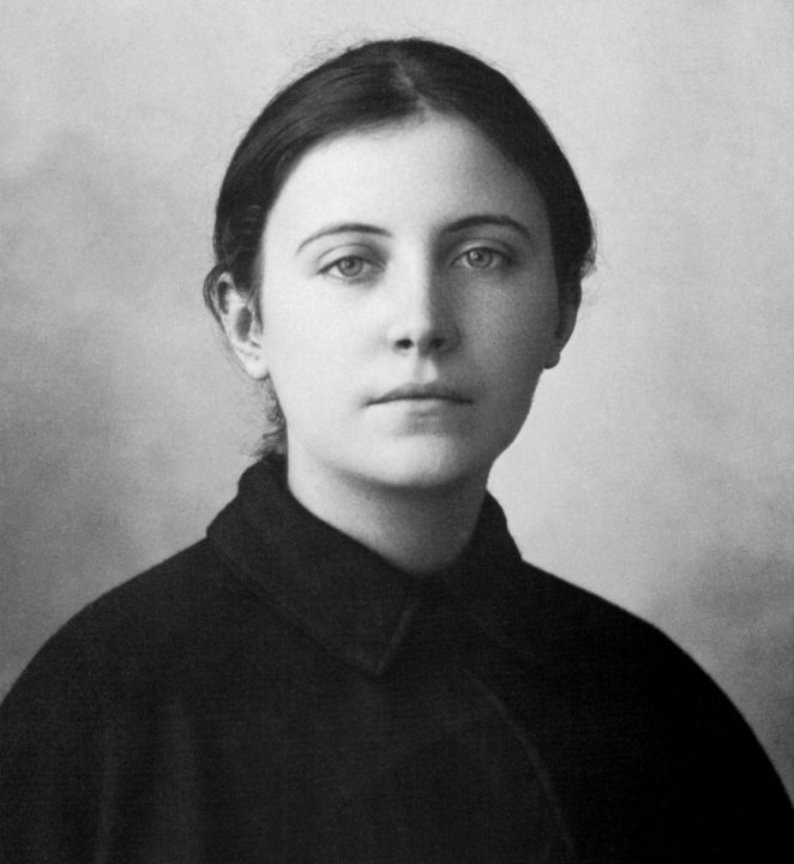
A saint closer to our times, St. Gemma Galgani (1878–1903), was madly devoted to receiving the Lord Jesus daily, to such an extent that her confessor had to forbid her to think about the next day’s Communion, otherwise she would get no sleep! She, as a mystic of the Passion of Christ, understood far better than most of us will ever do the gap between man and God: “It [Communion] is a question of uniting two extremes: God Who is everything and the creature who is nothing; God Who is light and the creature who is darkness; God Who is holiness and the creature who is sin.” This thought afflicted her, but the thought of the love of God overcame her fears. In her own words:

Yes, I know, Jesus, it is better to receive Thee than to look at Thee, but I am afflicted because I feel that were I to prepare myself for years and years like the Angels, yet I should never be worthy to receive Thee. O Jesus, it is sweet to confess my misery before Thee. Help me, O Lord! Ah! I can still cast myself at Thy feet. I still love the Faith, and a thousand times I repeat and will continue to repeat, it is always better to receive Thee than to look at Thee. [10]  


NOTES

[1] Dark Night of the Soul, Book 1, chapter VI, paragraph 4 (Image Books, 1959).

[2] See, e.g., here, here, here, and here, all of which migrated into my book Holy Bread of Eternal Life; see especially “The Blessings—and Dangers—of Holy Communion,” which quotes, inter alia, Augustine and Aquinas on our question.

[3] In IV Sent., dist. 12, pars 2, a. 2, q. 2 (Opera omnia [Paris, 1866], 5:535).

[4] From Rede der underscheidunge, chapter 20; translation adapted from that of Edmund Colledge, O.S.A., and Bernard McGinn in Meister Eckhart: The Essential Sermons (Mahwah, NJ: Paulist Press, 1981), 271, and that of Oliver Davies in Meister Eckhart: Selected Writings (New York: Penguin, 1994), 34.

[5] The Mystery of Incomprehensible Love. The Eucharistic Message of Mother Mectilde of the Blessed Sacrament (Brooklyn, NY: Angelico Press, 2020), 34.

[6] Ibid., 35.

[7] Ibid., 36.

[8] Ibid., 54. To a nun she writes: “Do your utmost to not abstain from taking Communion. You must go to God for Himself, so that He may come into you to fight for His interests Himself” (ibid., 36).

[9] Ibid., 30–31.

[10] From The Life of Gemma Galgani by Fr. Germanus of St. Stanislaus (Charlotte, NC: TAN Books, 2012); see 288–90, excerpts of which may be found here.

Monday, June 20, 2022

Communion under the Species of Wine for Health Reasons and the Traditional Latin Mass

During this octave of Corpus Christi, and just before the feast of the Most Precious Blood on July 1st, it seems appropriate to publish the following letter, which I wrote in response to an inquiry from a person burdened with an extreme wheat allergy, whereby any exposure to wheat, even gluten-free, causes strong adverse reactions. Since this question comes up more and more often nowadays, it is well that it be dealt with in a principled and practical way. I am aware, of course, that opinions vary a lot, and I would be particularly interested in hearing from clergy in the comments. Let me clarify at the outset that I am not at all in favor, in the Latin rite, of a blanket policy of “communion under both kinds” for the laity (see here for a good explanation of the traditional viewpoint) and that I see the use of the chalice, as described in the letter, as a reasonable concession to be made only for those who cannot communicate with low-gluten hosts, which already have the Church's approval.

June 15, 2022

Dear N.,

It was good to meet you recently at the Washington, DC premiere of Episode 2 of Mass of the Ages. Thank you for sharing a little of your story with me, including your struggles with severe wheat and gluten allergies. The question of the laity receiving from the chalice in case of grave necessity can be considered an open question; it is surely one that requires amicable and serious discussion.

My attention was first drawn to the problem of celiac Catholics close to home, since my wife was diagnosed years ago with celiac and we had to address how best to handle sacramental Communion. The phenomenon of allergies to gluten and/or to wheat is a reality. [1] There are a number of theories as to why we are seeing more of it at this time in history. Some think it has to do with hybridizations and genetic modifications of crops, others that it has to do with food quality and modern life strains. Whatever the exact etiology, the condition is real and far from imaginary or exaggerated. People can get very sick from foods or drinks contaminated with allergens; I’ve seen it firsthand.

As we know, the miracle of transubstantiation changes the substance of the bread and the wine into the substance of the Body and Blood of Christ, but it leaves intact the accidents, the quantity and qualities, of the substances that were once present. The remaining accidents affect the body as if they were still present in a natural substance.

For this reason, the Church has deemed it just and reasonable that celiacs should be accommodated, as long as the divinely instituted matter of the sacrament is respected. [2] It is easy enough to see how this may be done in the traditional Roman Rite with those who can tolerate a low-gluten host, for it is easy to ensure that some such hosts are consecrated and available. The difficulty arises rather with those whose sensitivity is such that they can receive only under the form of wine.

The rubrics of the old missal do not prohibit the giving of the chalice to the laity for the simple reason that they do not envision it at all; it is not even mentioned. It is entirely ignored, since it long ago ceased to be the custom to share the chalice with the faithful on any occasion, with the rather peculiar exception of Catholic emperors and monarchs. However, there is no inherent reason why the Precious Blood could not be shared with a member of the faithful in a case of true necessity, as long as all due precautions were taken into account.

The fact that the rubrics of the old rite do not anticipate or envision such a thing is not logically or canonically tantamount to the exclusion or forbiddance of such a thing in a case of true necessity. Necessity is, after all, the mother of invention, and it could be assumed that in a healthy situation in which the Congregation for Divine Worship was properly functioning to support the organic development of tradition rather than acting as a policeman to suppress it, a solution would have been worked out sooner or later, as adumbrated in note 1. Unfortunately, now is not the time to be submitting new dubia to the CDW or any other Vatican dicastery! It is rather the time to use common sense, historical precedents, and sound sacramental principles to arrive at a reverent practical solution consistent with the nature of the Roman Rite.

Historically, there are two relevant precedents for communicating the laity with the Precious Blood: first, the fistula or liturgical metal straw, which was mentioned as recently as the Latin edition of the 1969 General Instruction of the Roman Missal, but which is not, perhaps, very practical anymore, and in any case difficult to obtain; second, the spoon, as used in the Byzantine tradition, which is readily available. [3]

The procedure would be as follows. The priest consecrates, in addition to the large chalice, a small chalice with a little wine in it, which has been placed on the corporal as would a ciborium. [4] At communion time, after everyone else has received the host, the communicant in need of the chalice approaches and kneels. The priest brings down the small chalice from the altar, with the spoon, and gently places a few drops of the Precious Blood into the mouth of the communicant, who holds a purifactor under her mouth as a precaution. The priest then takes the purificator and returns to the altar to perform the usual ablutions, in the course of which the small chalice and spoon are rinsed as well, and dried with the purificator. [5]

Alternatively, the spoon could be skipped, and the priest tilts the chalice gently to the communicant’s lips, himself holding a purificator under the rim of the chalice. I have seen this done and it presents no difficulties. Any spillage is prevented by the purificator being present.

A last alternative — though the least desirable, because it moves into a practice stemming from and associated with the Novus Ordo — is that the communicant take the small chalice from the priest, drink its content, and return it to him. If this were to be done, the communicant should wear a pair of gloves, as is the normal respectful way for the non-ordained to handle sacred vessels.

Once accustomed to the procedure, the adding of a little wine to a small chalice, the bringing of that chalice to the person who needs it, and the cleansing of it afterward along with the other vessels should not add more than one minute to the duration of Mass. Again, I have seen all this done with my own eyes, otherwise I would not be able to speak about it with confidence. In one case, it was a diocesan priest who brought the small chalice and tilted it to the communicant’s mouth; in two other cases I have seen it done by members of the Priestly Fraternity of St. Peter. As note 2 indicates, I recently learned of an SSPX priest who uses the spoon method. Suffice it to say that this accommodation can be made and is being made.

Some may question whether it is ever necessary for a member of the faithful to receive Communion. Surely this question should answer itself. Our Lord urged His disciples to eat and drink His Flesh and Blood, and said that we would have no life within us if we failed to do so; Scripture and Tradition alike teach that baptism orders the baptized to sacramental participation in the Eucharist. This is the revealed basis for the canonical requirement that the faithful receive at least once a year, having duly cleansed their souls in Confession. Due to concomitance (Our Lord being fully present under either species), this requirement is fulfilled by receiving either the host or the chalice. If there were an extremely rare case of a person who was simply unable to receive under either species, he would have no choice, sadly, but to resign himself to the inscrutable decrees of Providence and to make fervent spiritual communions. It seems unnecessarily harsh, however, to deprive a member of the faithful of sacramental Communion simply on account of an allergy to wheat, when there is an alternative at hand.

Communion may not be denied to a properly-disposed member of the faithful, as canon 843 (CIC 1983) §1 states: “Sacred ministers cannot deny the sacraments to those who seek them at appropriate times, are properly disposed, and are not prohibited by law from receiving them.” It would seem unreasonable and unkind to say to a celiac who can commune only under the species of wine: “You are not allowed to do that at the Latin Mass, you must go instead to the Novus Ordo Mass.” This would be setting up a strange conflict or competition between forms of the Mass, when in reality the faithful should be able to satisfy their obligations and receive sacramental nourishment at either one.

Yours in Christ,

Peter Kwasniewski

ADDENDUM (6/27/22)

I should have said in the above letter that it is important to be considerate about making the request to a priest to accommodate a special need, since doing so does involve a certain inconvenience and adds a bit of time, which affects everyone present at Mass. It's not enough, in other words, to speculate that, since one is feeling unwell and can't find another cause, it must be or could be this particular food allergy. Rather, someone must be medically certain that he has this problem before bothering a priest about it; a scientific test result would seem to be appropriate in this case, for the ease of everyone's conscience.

NOTES

[1] Some priests seem to be unaware that a wheat allergy is distinct from a gluten allergy, even if they often go together. Someone who suffers from the former cannot receive even a low-gluten host without negative consequences.

[2] See “Circular Letter to all Presidents of the Episcopal Conferences concerning the use of low-gluten altar breads and mustum as matter for the celebration of the Eucharist,” sent by Joseph Cardinal Ratzinger as Prefect of the Congregation for the Doctrine of the Faith on 24 July 2003 (text here), B1: “A layperson affected by celiac disease, who is not able to receive Communion under the species of bread, including low-gluten hosts, may receive Communion under the species of wine only.”

[3] It seems that the Vatican was already thinking along these lines in a 1959 ruling from the Holy Office (Canon Law Digest on Canon 852): “The Holy Office has received the petition of Anne T., who desires to receive Holy Communion but finds it difficult to so because she suffers from a severe allergy to wheat in all its forms. After careful consideration of all the circumstances of the case, this Supreme Sacred Tribunal has decreed: ‘Favor granted whereby the petitioner may receive Holy Communion in the Oriental rite under the species of wine only; opportune safeguards are to be used to avoid wonderment on the part of the faithful.’” It seems to me that if things had evolved naturally over the next decade instead of the upheaval of the 1960s, this question would eventually have been dealt with and the same logic applied to the Roman Rite. After all, Sacrosanctum Concilium proposed a modest increase in the number and circumstances of those who could receive under both kinds, which logically includes receiving under either kind. The fact that this practice was subsequently extended indiscriminately, contrary to the Council’s provisions, does not rule out a reasonable use of it.

[4] It would be appropriate that a drop of water be added to this chalice, and that it be covered with a (small) pall.

[5] A world-famous expert on usus antiquior rubrics, Louis Tofari of Romanitas Press, wrote the following to me when I asked him for his thoughts on this matter: “Yes, I am familiar with this situation, and in fact, we had a similar one several years ago with a gentleman who also suffered from an adverse reaction from low-gluten hosts, despite several trials. So the pastor ended up doing this instead: he would consecrate a small portion of Precious Blood in another chalice and then communicate It with an Eastern Rite golden spoon and using a purificator held by the gentleman as a safeguard — thus imitating the Byzantine practice; this was also done after everyone else had received normally. This being said, the gentleman was not a daily Mass-goer, so this was done only on Sundays usually, and with advance notice from him (and not every Sunday at that, either). So this is certainly an extraordinary option for an extraordinary situation and to my mind, perfectly legitimate. Note also, Fr. N. is an older priest and a former district superior, thus had quite a great deal of pastoral experience.”

More recent articles:

For more articles, see the NLM archives: