In the Divine Office this past Sunday, we learned from St Augustine that God “judged it better to make good out of evil things, rather than to not permit evil things to be.” Yesterday, I discovered by happy accident that this even applies to something as awful as reality television. In India, there is a subgenre of reality programming in which people from rural areas who have had little or no experience of Western culture are exposed to it and asked for their reactions. (Judging from the number of examples on YouTube, this genre appears to be quite popular.) The introduction is just as cheesy as such things are wont to be in the West, but don’t be put off: it is truly fascinating to see how quickly these gentlemen, on hearing the Dies Irae in Gregorian chant, come to express deeply Christian sentiments about the meaning of a prayer which they do not understand. (The elderly man on the left is even moved at one point to make the Sign of the Cross.) Perhaps there is a lesson for the Church to be learned from this, that Her divinely-given mission “to make disciples of all nations” has profited nothing by abandoning “that stupendous and incomparable artistic and spiritual thing, the Gregorian chant”, and good music in general.
No less beautiful are their reactions to Greek Orthodox chant. One of them immediately knows without being told, “... this thing is centuries old, and has been going on since time immemorial”, and another says, “it’s pulling my heart from inside. It’s a good prayer, I want it to not end, and (I) keep listening to it forever. This thing is reaching the heart.”Friday, February 18, 2022
Thursday, March 04, 2021
A Look at the English Standard Version (Catholic Edition) Lectionary for the Ordinary Form
Readers of NLM may be aware that last year, the Catholic Bishops’ Conference of India (CBCI) promulgated a new translation of the lectionary for the Ordinary Form, using the English Standard Version: Catholic Edition (ESV-CE) except for the Psalms, which are from the Abbey Psalms and Canticles (APC).
The ESV was first published in 2001, and is fundamentally a revision of the Revised Standard Version (1971). It describes itself as an “essentially literal” translation, and “seeks to be transparent to the original text, letting the reader see as directly as possible the structure and exact force of the original”. [1] The translation was carried out by a group of more than one hundred Evangelical Protestant scholars and advisors, and has undergone a number of small revisions over the last two decades (2007, 2011, 2016).
In 2017, after a small group of Catholic scholars in India had been commissioned by the CBCI to examine the ESV and make any necessary changes to the text to ensure fidelity to the teaching of the Church, the ESV-CE was approved by the Indian Bishops as the first step towards the new OF lectionary translation. The ESV-CE Bible was published in India in 2018, and in the United States in late 2019 by The Augustine Institute; in the United Kingdom, it is scheduled for publication later this year. The Indian ESV-CE lectionary text was confirmed by the CDWDS in December 2019, and came into force in India on 5th April 2020 (Palm Sunday).


Following the hard work of the CBCI, the Bishops’ Conference of Scotland (BCS) voted last July to also adopt the ESV-CE (with APC) for a new translation of the OF lectionary, replacing the Jerusalem Bible (with the Grail Psalter). And just last month, the Catholic Bishops’ Conference of England and Wales (CBCEW) announced that they had decided to do the same. At the time of writing, the Irish, Australian, and New Zealand Bishops’ Conferences have yet to announce any replacement, but it looks as though that the ESV-CE is likely to be the de facto English-language Catholic Bible version outside of North America. [2]
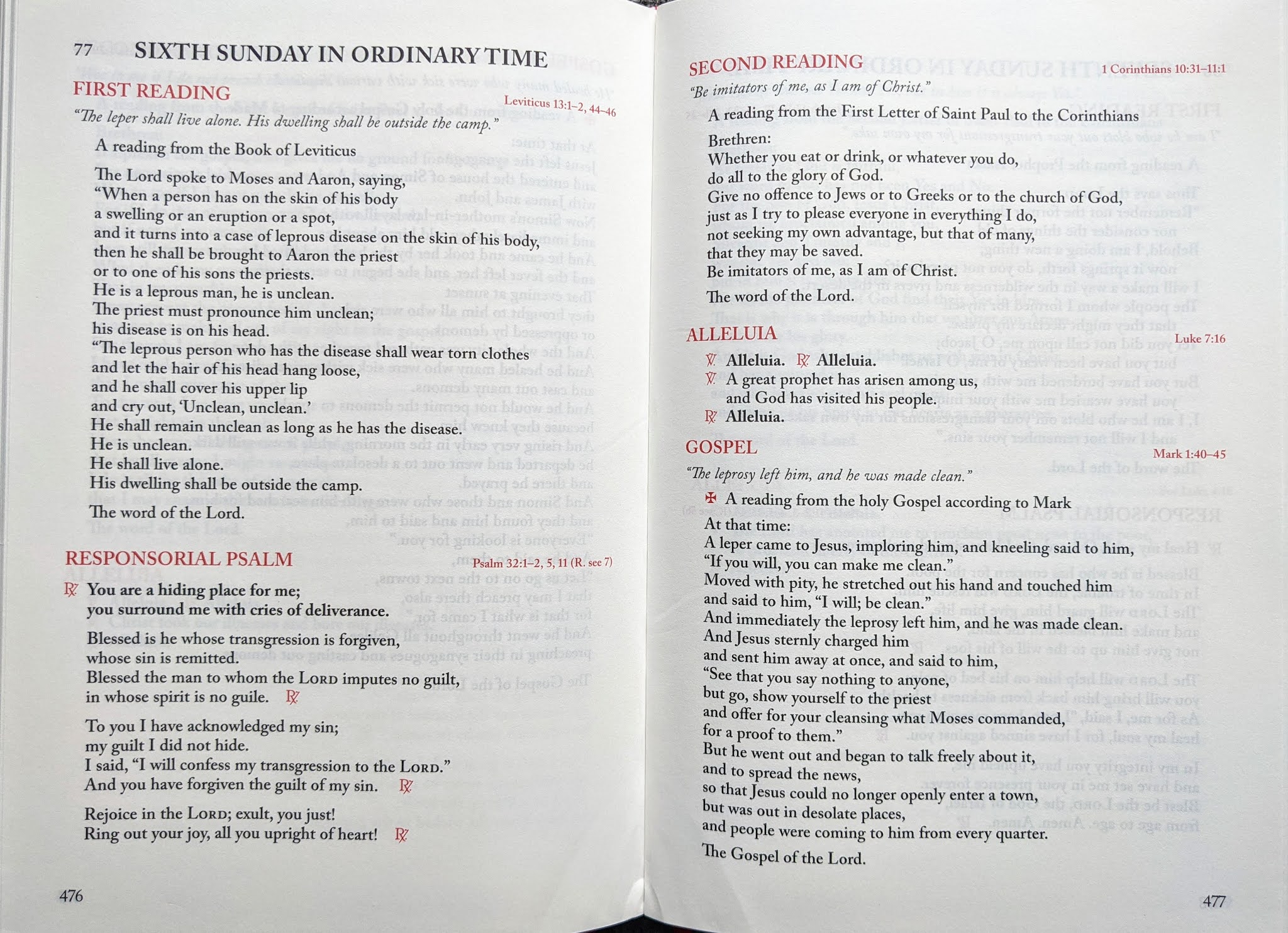
So, as a result, I thought that NLM readers would appreciate a quick look at the Indian ESV-CE lectionary itself - especially as there seems very little in the way of information online about these volumes at the moment other than that they exist! I have been fortunate enough to acquire a copy, so here are some pictures, along with my observations, both positive and negative.

The CBCI decided on a three-volume layout:
- Sundays and Solemnities (xxxiv + 966 pp) - this contains Years A, B and C of the Sunday cycle of readings, plus Solemnities.
- Weekdays (xxviii + 1106 pp) - this contains Years I and II of the weekday cycle of readings.
- Proper of Saints, Commons, Ritual Masses, Masses for Various Needs and Occasions, Votive Masses, Masses for the Dead (xxx + 1152 pp) - basically, everything else!

This layout, like any other, has a number of things to recommend it, but also contains compromises. First, it means that the cost for parishes, currently ₹7,500 for all three volumes (about $103/£73), is lower than it would be for other possible publishing arrangements. There is a certain logic to having the Sunday readings in one volume and the weekday readings in another. However, in the medium-term this may come at the cost of longevity: for example, the Sundays and Solemnities volume is going to get three times as much use compared to if each year of the Sunday cycle were its own individual volume. Similarly, the fact that the Funeral Mass readings are at the back of Volume 3 is perhaps not ideal for longevity, though the quality of the binding is fair. (Please bear in mind that my copies have travelled halfway across the world!)
The BCS and CBCEW, in consultation with publishers, [3] may decide on other layouts, such as having three volumes for each year of the Sunday cycle, or separate volumes for Nuptial Masses, Funeral Masses, etc.

Volumes 1 and 2 have two ribbons, with Volume 3 having three ribbons. This is appreciated, but the third volume really could have done with just one more ribbon; I will explain why below.
Use is made of the reference numbers of the 1981 Ordo lectionum Missae, editio typica altera (OLM), with the 2015 additiones, which is good. The celebrations proper to India have also been added in without disturbing these reference numbers. However, the lack of small headings at the top of each page does make sections more difficult to find than they could have been otherwise - this is not really a problem in Volumes 1 or 2, but is much more so in Volume 3 due to the variety of material contained in that volume.