Anonymous, the Archangel Gabriel, depicted on the predella of the high altar at the subsidiary church of Pesenbach, Upper Austria, 1495
In the traditional Roman calendar, the feast days of saints are sometimes clustered together to form archipelagos of holiness that allow the faithful to meditate longer on a sacred mystery. These archipelagos do not always consist of consecutive days. On January 15, the Church celebrates the feast of St. Paul the First Hermit, and two days later she celebrates the Saint who discovered that Saint Paul was the first hermit, St. Antony the Abbot. September 29 is the feast of St. Michael the Archangel, and three days later is the feast of the Guardian Angels (October 2). On February 11, the universal Church celebrates the apparitions of Our Lady of Lourdes, and one week later, some locales are permitted to celebrate the feast of the Saint to whom Our Lady of Lourdes appeared, St. Bernadette Soubirous (even though she died on April 16). St Agnes’ feast day is January 21, and on January 28 the Church commemorates the apparition of St. Agnes to her parents when they were praying at her tomb eight days later. September 8 celebrates the Mother of God’s birthday, September 12 Her most holy name, and September 15 her Seven Sorrows.
Often, however, the clusters of which I speak are formed by two consecutive feasts. On January 25, the Church celebrates the Conversion of St. Paul the Apostle, and the day before she remembers Paul’s faithful companion Saint Timothy. The feast of the Assumption of the Blessed Virgin Mary is August 15 and that of her father Saint Joachim August 16. The Exaltation of the Holy Cross is September 14 and the feast of the Seven Sorrows of the Blessed Virgin September 15. The Augustinian friars celebrated the Conversion of Saint Augustine on May 5, and as a result, the feast of St. Monica, who was so instrumental in her son’s conversion, was placed on the Roman calendar on May 4. [1]
We should not be surprised, then, to see in the 1962 Roman calendar the feast of St. Gabriel the Archangel on March 24, and the Annunciation on March 25. What is surprising is how long it took to make this obvious pairing. While the Annunciation is one of the oldest feasts in Christendom, the feast of Mary’s messenger did not find its rightful place until 1921. But before we turn to that feast, let us learn more about the angel that it honors.
The Angel
Along with Saints Michael and Raphael, Gabriel is one of only three angels mentioned by name in the canonical Scriptures. [3] Unlike Michael, the Bible does not refer to Gabriel as an archangel, but he is nonetheless recognized as such by the Church. As Pope St. Gregory the Great explains, angels as an order are the spirits that deliver messages of lesser importance, and archangels are, among other things, the order of spirits that deliver messages of greater importance. [3] Since the message that Gabriel was delivering was of the utmost importance, it stands to reason that he was an archangel.
Gabriel appears four times in the Bible, twice in the Old Testament and twice in the New. In Daniel 8, 15-26 and 9, 21-27, the archangel explains to the prophet Daniel the meaning of his perplexing visions. Gabriel may also be the subject of Daniel 10, 5-6, which describes a dazzling man clad in linen and gold. Jewish tradition holds that Gabriel is also the angel who destroyed Sodom and the host of Sennacherib, the angel who buried the body of Moses (as opposed to Michael? See Jude 9), and the angel who marked the figure Tau on the foreheads of the Elect (Ezekiel 9:4). [4]
Gabriel also appears in apocryphal literature. In the Book of Enoch, he is a ferocious guardian of Israel, ordered by God to “proceed against the bastards and the reprobates, and against the children of fornication” (1 Enoch 10, 9).
In the New Testament, Gabriel appears once to Zachary (Luke 1, 5-25) and once to the Blessed Virgin Mary (Luke 1, 26-38). However, it is not unreasonable to believe, as some in the early Church did, that Gabriel is also the angel who appeared to Saint Joseph (Matt. 1, 20 & 24; 2, 13 & 19) and the shepherds (Luke 2, 8-12), and that he consoled or “strengthened” Our Lord in the Garden of Gethsemane (Luke 22, 43). Accordingly, on his feast day we pray that he console and strengthen us as well. [5]
And what will Gabriel’s role be at the end of time? Matthew 24:31 mentions angels with a trumpet foretelling the end of the world, but Gabriel is not named. The earliest reference to “Gabriel’s horn” is in a hymn by the Armenian Saint Nerses the Gracious (1102-1173); from there it passed into Armenian Christian art. Milton’s Paradise Lost (1667) is the first time that Gabriel blowing his trumpet appears in English; the trope later became ubiquitous in Black spirituals and songs such as “The Eyes of Texas” (1903). Although there is no authoritative Catholic source for this belief, it is not unreasonable to imagine that the angel who announced Christ’s First Coming will announce His Second.
The name Gabriel is Hebrew for “God is my strength” or the “strength of God.” If Gabriel did indeed destroy Sodom as well as a host of bastards and reprobates, the appropriateness of the name is not difficult to grasp. But how does divine strength relate to his all-important role as messenger to the Blessed Virgin Mary? According to Gregory the Great, “God’s strength” (“Gabriel”) announced the coming of the Lord “of heavenly powers, mighty in battle”—in other words, an angel whose name refers to divine power is the herald for the Person who wields divine power. Similarly, St. Bernard of Clairvaux notes that since Jesus Christ is “the power of God” (1 Cor. 1, 34), it is fitting that His Incarnation be announced by an angel of that name. “On one hand, Christ is called the strength or power of God,” Bernard preaches, “on the other, the angel: the angel only nominally, but Christ substantively as well.” [7]
Theological Tutor
Saint Gabriel deserves special attention in our thoughts and imagination because he is a stern but merciful teacher of theology done rightly. When he visits the Levite priest Zachary, the archangel announces the good news that he is to be the father of the Forerunner of the Messiah despite his age and that of his wife. Zachary, however, perhaps puffed up on his pedigreed learning, balks. “Whereby shall I know this?” he asks. “For I am an old man, and my wife is advanced in years” (Luke 1, 18). Zachary’s question springs from doubt rather than faith; the message of God does not fit into his paradigm of what he thinks he knows, and so he is apt to reject it. Consequently, Gabriel rebukes him:
And the angel answering, said to him: ‘I am Gabriel, who stand before God: and am sent to speak to thee, and to bring thee these good tidings. And behold, thou shalt be dumb, and shalt not be able to speak until the day wherein these things shall come to pass, because thou hast not believed my words, which shall be fulfilled in their time’ (Luke 1, 19-20).
James Tissot, "The Vision of Zacharias," 1886-1894
Gabriel’s next apparition is to a fifteen-year-old girl in Nazareth named Mary. When he announces a far more momentous event, that she will be the Mother of God, the simple maiden too asks a question: “How shall this be done, because I know not man?” (Luke 1:34). Mary knows how the birds and bees work, and she also knows (according to St. Thomas Aquinas)[8] that she has made a vow of perpetual virginity. She does not doubt the angel, but she bravely asks a question of a different order: in light of what I hold, how will things (which I know by faith will come to pass) come to pass?
Rather than punish her, the angel rewards her with an answer. “The Holy Ghost shall come upon thee,” he explains, “and the power of the most High shall overshadow thee. And therefore also the Holy which shall be born of thee shall be called the Son of God” (Luke 1:35).
Leonardo da Vinci, "The Annunciation," ca. 1472
God does not mind when we ask pressing questions: as St. John Henry Newman famously stated, a thousand questions do not add up to a single doubt. The key is whether our questions are an outgrowth of faith seeking understanding (fides quaerens intellectum) or an attempt to undermine the faith in light of our own fancy druthers. St. Gabriel’s schooling of Zachary and Mary offers an invaluable lesson in how to do, and how not to do, Catholic theology. All Catholic theologians, I submit, can be divided into two categories: Zecharian theologians whose uncertainties dead end into heresy and apostasy, and Marian theologians who push the envelope but never doubt the first principles of the Faith. Thanks be to God, Zachary learned his lesson the hard way, and we pray that his modern counterparts will do the same.
Patronages
As the most important messenger in the history of the universe, the Archangel Gabriel is the patron saint of a wide array of trades and hobbies that involve communication. The heavenly herald is a patron of broadcasters, communication workers, diplomats, information workers, messengers, military signals, postal workers, radio, telecommunications, telegraphs, telephones, and television. And if the angel is a patron of postal workers, why not stamp collectors? Hence Gabriel is the protector and promoter of philatelists.
What is less clear is why St. Gabriel is invoked against rheumatism. Perhaps the angel’s alacrity in carrying messages back and forth from Heaven gave hope to people suffering from bad joints, or perhaps artistic portrayals of Gabriel genuflecting limberly before the Virgin were a similar source of inspiration.
The Feast
Angels were added to the Church calendar gradually. In A.D. 530, Pope Boniface II consecrated a basilica in Michael’s honor on the Salarian Way about seven miles from Rome, with the ceremonies beginning on the evening of September 29 and ending the following day. Subsequent celebrations of this dedication were held first on September 30 and later on September 29. In the traditional calendar, “Michaelmas,” as it is also called, maintains the official title “The Dedication of Saint Michael the Archangel,” even though the basilica it commemorates disappeared over a thousand years ago.
Michaelmas also commemorates all the heavenly hosts (including Gabriel and Raphael by name in the Divine Office), but the primary focus is on St. Michael. Over time, the Church began to see the wisdom of singling out particular angels for liturgical veneration. In 1670, Pope Clement X included the Feast of the Guardian Angels on October 2 of the universal calendar, the first available day after Michaelmas. And in 1921, Pope Benedict XV added separate feasts celebrating the divine missions of the Archangels Gabriel and Raphael, the latter on October 24 and the former on March 24.
Pope Benedict XV
The Holy Father’s rationale is worthy of reflection. According to the official annals of the Holy See, Benedict XV acted “in compliance with the hopes and wishes of many bishops” and “was deeply moved by their specific, valid arguments.” In consultation with the Sacred Congregation of Rites, he authorized a mandatory Office and Mass for the Feasts of the Holy Family, Gabriel, and Raphael. “It escapes no one’s notice,” he writes,
how right and salutary (aequum et salutare) it is for the domestic family and for society itself to foster and propagate the association of the Holy Family that has been established by the Apostolic See, strengthened by laws, and honored with indulgences and special privileges for sodalities and parishes—and, with this same end in mind, to worship and celebrate the Holy Family of Nazareth in the universal Church through a particular liturgical rite and with a continual and fruitful meditation on their kindnesses and imitation of their virtues.
The Pope continues:
It is no less fitting as well, for the increase of piety and of actual association with the Holy Family, to commemorate with religious celebration the divine mission of both Archangels, namely, Saint Gabriel for announcing the mystery of the Lord’s Incarnation, and Saint Raphael, whose kindnesses bestowed on the family of Tobias are described in the Sacred Scriptures.[9]
The feast instituted by Pope Benedict XV is a great gift to the Church: the Divine Office draws the faithfuls’ attention to his appearance in the Book of Daniel as well as his disciplining of Zachary in the Gospel according to Saint Luke, which is nowhere highlighted properly elsewhere in the liturgical year, old or new. Drawing from a sermon by St. Bernard of Clairvaux (which is in the Matins readings), the Collect of the Mass focuses on a wondrous fact: that of all the billions of angels created by God, Gabriel was chosen from all eternity to announce the mystery of the Divine Incarnation:
O God, who among all the other angels didst choose the Archangel Gabriel to announce the mystery of Thine Incarnation, grant kindly: that we who celebrate his feast on earth may feel his very patronage in Heaven. Thou who livest.
The Postcommunion Prayer for the Mass is likewise instructive:
Having partaken of the mysteries of Thy Body and Blood, O Lord our God, we beseech Thy clemency: that as we know that Gabriel announced Thine Incarnation, so too with his help, may we obtain the benefits of the same Incarnation. Thou who livest.
The Postcommunion artfully connect the archangel’s message to the Incarnation in the womb of the Blessed Virgin Mary to the Incarnation that happens at every valid celebration of the Holy Sacrifice of the Mass. We address Jesus Christ in this prayer (as we did at the Collect) as the Person who became Incarnate for our sake, at the announcement of his servant Gabriel. But the fact of the Incarnation is one thing, the benefits thereof another. The demons figured out that God became man, but it did not profit them. We pray that the (non-fallen) angel who helped bring out the Incarnation will help us benefit from its effects.
The Novus Ordo
In the 1969 Roman Missal, September 29 is the combined “Feast of Saints Michael, Gabriel, and Raphael, Archangels.” No official reason was given for what Dr. Peter Kwasniewski calls an “almost rabid smushing together” of feasts [10] (as opposed to the archipelagic clustering mentioned earlier), but it may have had something to do with the antiquarian tendencies of Archbishop Bugnini and his colleagues, who disdained relatively recent additions to the calendar. Whatever the reason, it was, in our view, an unhelpful reduction, and for four reasons.
First, it is more appropriate to honor St. Gabriel on March 24 than in late September. So what if for most of the history of the Roman Rite Gabriel was indirectly honored only on Michaelmas? The Ethiopian Church has honored Gabriel with his own feast for centuries, the Coptic Church honors him with three feasts, and the Byzantine Rite does with two. (In the latter, one of the feasts falls on March 26, the day after the Annunciation.) For Rome to give Gabriel his own feast on the eve of the Annunciation is a no-brainer, and for Rome to annul this long overdue development (which is in keeping with the other apostolic churches) forty-seven years later is lamentable and, we might add, hardly ecumenical.
Second, it is beneficial to meditate on the nature and ministries of the angels, especially in a materialist age such as ours that forgets or denies a vast unseen spiritual world and the countless invisible acts of angelic mediation that are taking place right now in the realms of both nature and supernature. Peppering the calendar with commemorations of angels heightens “angel awareness” throughout the year, and that is good.
Third—and continuing with the topic of angelic ministries—having different feasts for different angels is fitting because different angels have different missions, as the Scriptures make clear. The Church reserves a day to celebrate all the Saints in Heaven (November 1), but she still observes individual saints’ days in order to honor their peculiar talents and graces. Similarly, the Church can institute an All Angels’ Day if she wishes (which I am not recommending since Michaelmas arguably fulfills this function in both calendars), but she should still honor some angels on other days.
Fourth, the family is arguably under assault like never before, and it needs all the resources it can get. If Pope Benedict XV was right in his belief that devotion to Gabriel increases devotion to the Holy Family (and we believe he was), then the calendar is now less effective in “increasing piety” and tightening our bonds to the “association” of Jesus, Mary, and Joseph. And that is not good for the family or for society.
Let us pray that Saint Gabriel the Archangel is once again given the honor he is due by the people of God—before he blows his horn.
This article appears in the 2022 Winter/Spring issue of The Latin Mass magazine. Many thanks to the editors of TLM for its republication here.
Notes
[1] In the Novus Ordo calendar, a similar batching occurs by moving Monica’s feast day to August 27, the day before the Feast of St. Augustine. It is, however, less appropriate, for Monica is closely tied to Augustine’s conversion rather than his death, which occurred four decades after hers.
[2] In the book of Tobias / Tobit, Raphael states that he is one of the seven Angels “who stand before the Lord” (12, 15). Filling in the blanks, Eastern Orthodox and Byzantine Catholic Christians identify the other four Archangels as Uriel, Jegudiel or Jehudiel, Selaphiel or Salathiel, and Barachiel. The names of these angels, however, are taken from Jewish and Christian apocrypha and not from the Bible.
[3] Homily 32, 8-9.
[4] See Hugh Pope, “St. Gabriel the Archangel,” The Catholic Encyclopedia,. vol. 6. (New York: Robert Appleton Company, 1909), 23 Jan. 2022.
[5] See the Lauds Hymn Placare, Christe, Servulis.
[6] Homily 32, 8-9.
[7] Homily 1 on Missus est, 2, trans. mine.
[8] See St. Thomas Aquinas, Summa Theologiae III.28.4.
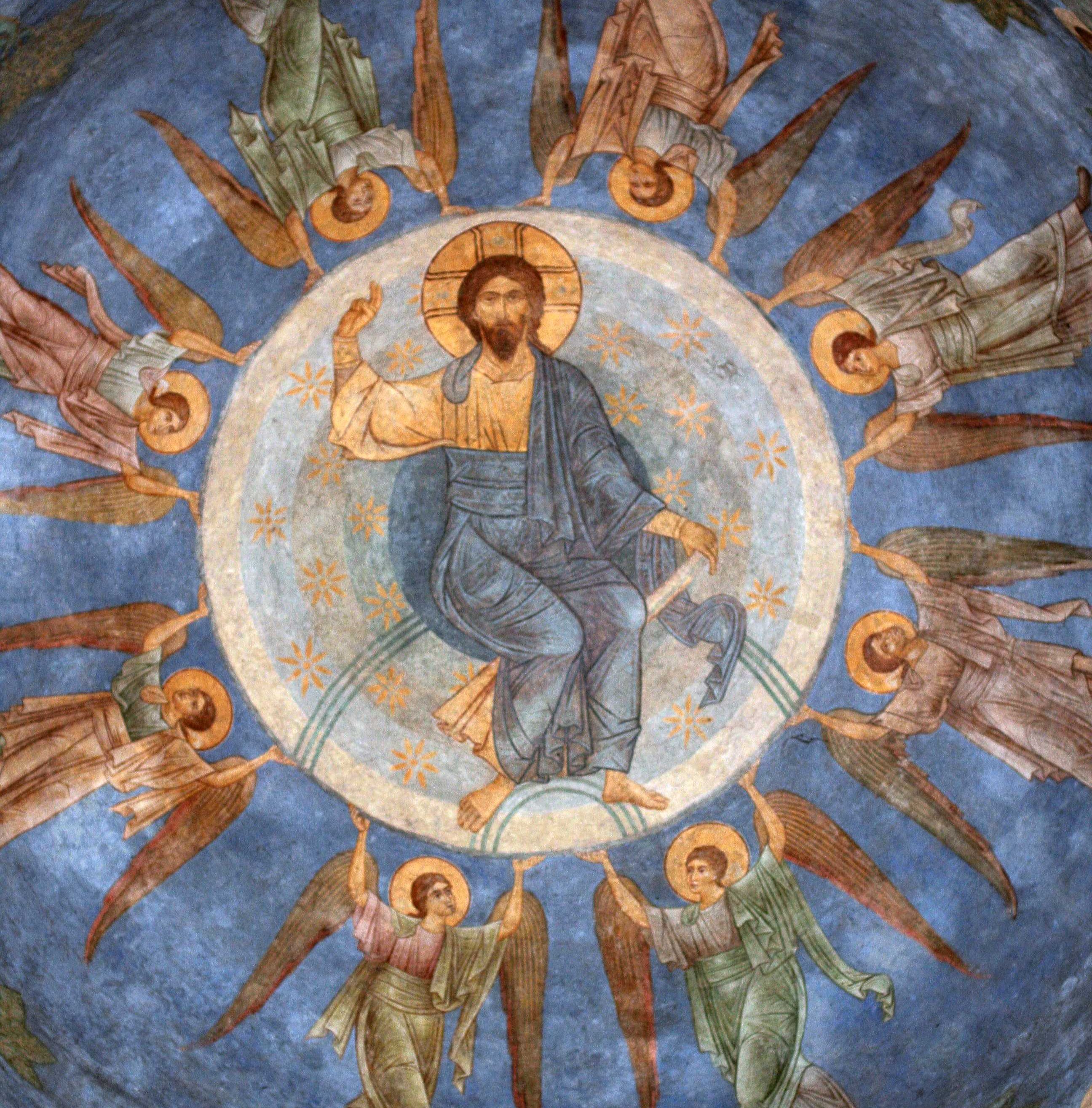
The Ascension of Christ, Mirozhsky Monastery, Pskov
In Fr. Claude Barthe’s remarkable book A Forest of Symbols: The Traditional Mass and Its Meaning(Angelico Press, 2023, reviewed here), we are introduced early on to the allegorical understanding of Christ as an “Angel,” that is, a messenger and mediator, in keeping with the Septuagint’s use of the phrase “Angel of the Great Counsel” in Isaiah 9:6. Speaking of the Asperges, Fr Barthe says:
The aspersion itself, which follows when the ministers have entered the church, is really a combination of blessing and exorcism, almost a domestic rite. It resembles the aspersions seen in monasteries when a tour was made of the cloister, or the individual cells were visited. The final prayer of this ceremony, Exaudi nos, Domine . . . (Hear us, O holy Lord, almighty Father, eternal God: and vouchsafe to send thy holy angel from heaven, to guard, cherish, protect, visit, and defend all that dwell in this house), which is that of the blessing prescribed by the Ritual when the priest blesses a house as he enters it to carry out a ceremony, refers to the habitaculum, the house where one lives, for which one requests a visit from the Angel of God. This is also a first reference to “the Angel of God,” that is, to Christ himself, who is asked to come down to this place… There is a link between this water and the Blood of Christ, since immersion in the waters of baptism represents in reality immersion in the cistern of Christ’s propitiatory Blood. (36)
Later, speaking of the rite of incensation, Fr. Barthe comments:
The humanity of Jesus Christ, consumed (or consummated, as the classical writers used to say) in the sacrifice, lifts his prayer up to the Father, the only prayer that the Father finds acceptable, to which are joined the prayers of the saints, thrown like grains of incense into the burning furnace of love of Christ’s holy soul…. [T]he Angel of the Apocalypse (Rev 8:3–4)…draws near to the altar and offers the incense with the prayers of the saints… This Angel is, of course, Christ himself, and his golden censer (or scoop) is his precious humanity: “Let my prayer be directed as incense in thy sight; the lifting up of my hands, as evening sacrifice” (Ps 140:2). (41)
Concerning the incensation at the offertory, he develops the point further:
Of course, the offering of incense at the altar also symbolizes the Angel who stood beside the altar of the Temple, holding in his hand the censer from which the smoke of the incense rose in the presence of the Lord (Rev 8:3–4). This angel is compared to St Michael, but above all reflects Christ, the Angel of Great Counsel, offering his own immaculate flesh, full of the fire of the Holy Spirit, to the Lord on our behalf on the altar of the Cross, in the odor of sweetness. The smoke of the incense gives material expression, in some way, along with the prayer of Christ, to the prayers of his saints. (91–92)
Then comes the most mysterious angel of all, the one mentioned in the “communion epiklesis” of the Roman Canon, the Supplices te rogamus:
We most humbly beseech thee, almighty God, to command that these things be borne by the hands of thy holy angel to thine altar on high, in the sight of thy divine majesty, that as many of us as, at this altar, shall partake of and receive the most holy Body ✠ and ✠ Blood of thy Son may be filled with every heavenly blessing and grace, through the same Christ our Lord. Amen.
On which Fr. Barthe observes:
There have been many discussions of the identity of the “Angel.” Durandus wrote, “He is the Angel of Great Counsel, the Counsellor on whose advice the Father created and recreated the world,” otherwise known as Christ-Wisdom, the Word incarnate. But he adds that the altar on high in the presence of God is also the crucified Christ sitting in glory at the right hand of the Father. The Angel brings these “sacraments” to this altar, revealing his wounds, and interceding for us who bring the sacraments to fulfilment on earth. Olier and Pierre Lebrun take a similar view. It is worth noting that the De Sacramentis refers to angels in the plural (per manus angelorum tuorum) rather than the singular, which would not contradict the idea of a “communion epiklesis,” but would prevent identification of the angels with Christ. St Thomas Aquinas, who thinks that the Angel can be compared to Christ, derives the following mystical etymology: the Mass, missa, takes its name from the fact that, through the Angel, the priest sends (mittit) his prayers to God, or again because Christ is the approved victim sent (missa) to us. All of which underlines that the meaning of the prayer Supplices te rogamus is at the heart of this oblation of the holy victim, which we know as the Canon, and is therefore also at the heart of the whole celebration. (117–18)
The Christological interpretation is classic and theologically attractive.
However, if we take the other interpretation, namely, that the angel who is tasked with bringing our offering before God is a reference to the created angel depicted in the book of Revelation as bringing the prayers of the saints before God, we can see some neat things about the Canon.
Note, first, how differently the Canon handles angels and saints. We ask to be admitted to the saints’ company, and we offer the Mass to their honor and remembrance, and we ask that they pray for us, but we never explicitly ask them to do the one thing the angel does: offer the Mass to God. In fact, the saints are never described as worshipping God (of course they do worship God—I’m just talking about what the text explicitly says). But the one other time angels are mentioned in the Canon lines up perfectly with the task of this angel of Revelation: the Preface describes the angels—above all, the cherubim and the seraphim—as ceaselessly worshipping God.
All of this suggests to me that, as the angels are by their very nature the mediators between God and men, so are they by their very nature the ones who would mediate even our prayers to God. The saints have joined the angels by grace, to be sure, but grace has not simply abolished the difference in nature between human souls and angelic choirs. The Mass seems to nod to this difference by a selectivity of description: saints do worship God ceaselessly, but that is not the role assigned them in the text of the Canon; angels do pray for us, but that is not the role assigned to them in the Canon. Rather, the angels are the primordial divine attendants; the saints are those who have joined the angels; and we hope to join the saints.
Because we are speaking of the Canon, allow me to mention one last beautiful subtlety: the sudden shift in prayer after the consecration. Up to that point, all prayer is directed to the Father through the Son in the Holy Spirit; but after that point, prayer is consistently directed to the Son directly—and naturally enough, because THERE HE IS. Before the consecration, all prayer is shaped by the mystery of the Trinity; after the consecration, prayer is shaped by the Incarnation. In this way, the form of the prayer reflects the great mystery of God’s inner life piercing into our world of space and time through the Son taking on flesh.
Anonymous, the Archangel Gabriel, depicted on the predella of the high altar at the subsidiary church of Pesenbach, Upper Austria, 1495
In the traditional Roman calendar, the feast days of saints are sometimes clustered together to form archipelagos of holiness that allow the faithful to meditate longer on a sacred mystery. These archipelagos do not always consist of consecutive days. On January 15, the Church celebrates the feast of St. Paul the First Hermit, and two days later she celebrates the Saint who discovered that Saint Paul was the first hermit, St. Antony the Abbot. September 29 is the feast of St. Michael the Archangel, and three days later is the feast of the Guardian Angels (October 2). On February 11, the universal Church celebrates the apparitions of Our Lady of Lourdes, and one week later, some locales are permitted to celebrate the feast of the Saint to whom Our Lady of Lourdes appeared, St. Bernadette Soubirous (even though she died on April 16). St Agnes’ feast day is January 21, and on January 28 the Church commemorates the apparition of St. Agnes to her parents when they were praying at her tomb eight days later. September 8 celebrates the Mother of God’s birthday, September 12 Her most holy name, and September 15 her Seven Sorrows.
Often, however, the clusters of which I speak are formed by two consecutive feasts. On January 25, the Church celebrates the Conversion of St. Paul the Apostle, and the day before she remembers Paul’s faithful companion Saint Timothy. The feast of the Assumption of the Blessed Virgin Mary is August 15 and that of her father Saint Joachim August 16. The Exaltation of the Holy Cross is September 14 and the feast of the Seven Sorrows of the Blessed Virgin September 15. The Augustinian friars celebrated the Conversion of Saint Augustine on May 5, and as a result, the feast of St. Monica, who was so instrumental in her son’s conversion, was placed on the Roman calendar on May 4. [1]
We should not be surprised, then, to see in the 1962 Roman calendar the feast of St. Gabriel the Archangel on March 24, and the Annunciation on March 25. What is surprising is how long it took to make this obvious pairing. While the Annunciation is one of the oldest feasts in Christendom, the feast of Mary’s messenger did not find its rightful place until 1921. But before we turn to that feast, let us learn more about the angel that it honors.
The Angel
Along with Saints Michael and Raphael, Gabriel is one of only three angels mentioned by name in the canonical Scriptures. [3] Unlike Michael, the Bible does not refer to Gabriel as an archangel, but he is nonetheless recognized as such by the Church. As Pope St. Gregory the Great explains, angels as an order are the spirits that deliver messages of lesser importance, and archangels are, among other things, the order of spirits that deliver messages of greater importance. [3] Since the message that Gabriel was delivering was of the utmost importance, it stands to reason that he was an archangel.
Gabriel appears four times in the Bible, twice in the Old Testament and twice in the New. In Daniel 8, 15-26 and 9, 21-27, the archangel explains to the prophet Daniel the meaning of his perplexing visions. Gabriel may also be the subject of Daniel 10, 5-6, which describes a dazzling man clad in linen and gold. Jewish tradition holds that Gabriel is also the angel who destroyed Sodom and the host of Sennacherib, the angel who buried the body of Moses (as opposed to Michael? See Jude 9), and the angel who marked the figure Tau on the foreheads of the Elect (Ezekiel 9:4). [4]
Gabriel also appears in apocryphal literature. In the Book of Enoch, he is a ferocious guardian of Israel, ordered by God to “proceed against the bastards and the reprobates, and against the children of fornication” (1 Enoch 10, 9).
In the New Testament, Gabriel appears once to Zachary (Luke 1, 5-25) and once to the Blessed Virgin Mary (Luke 1, 26-38). However, it is not unreasonable to believe, as some in the early Church did, that Gabriel is also the angel who appeared to Saint Joseph (Matt. 1, 20 & 24; 2, 13 & 19) and the shepherds (Luke 2, 8-12), and that he consoled or “strengthened” Our Lord in the Garden of Gethsemane (Luke 22, 43). Accordingly, on his feast day we pray that he console and strengthen us as well. [5]
And what will Gabriel’s role be at the end of time? Matthew 24:31 mentions angels with a trumpet foretelling the end of the world, but Gabriel is not named. The earliest reference to “Gabriel’s horn” is in a hymn by the Armenian Saint Nerses the Gracious (1102-1173); from there it passed into Armenian Christian art. Milton’s Paradise Lost (1667) is the first time that Gabriel blowing his trumpet appears in English; the trope later became ubiquitous in Black spirituals and songs such as “The Eyes of Texas” (1903). Although there is no authoritative Catholic source for this belief, it is not unreasonable to imagine that the angel who announced Christ’s First Coming will announce His Second.
The name Gabriel is Hebrew for “God is my strength” or the “strength of God.” If Gabriel did indeed destroy Sodom as well as a host of bastards and reprobates, the appropriateness of the name is not difficult to grasp. But how does divine strength relate to his all-important role as messenger to the Blessed Virgin Mary? According to Gregory the Great, “God’s strength” (“Gabriel”) announced the coming of the Lord “of heavenly powers, mighty in battle”—in other words, an angel whose name refers to divine power is the herald for the Person who wields divine power. Similarly, St. Bernard of Clairvaux notes that since Jesus Christ is “the power of God” (1 Cor. 1, 34), it is fitting that His Incarnation be announced by an angel of that name. “On one hand, Christ is called the strength or power of God,” Bernard preaches, “on the other, the angel: the angel only nominally, but Christ substantively as well.” [7]
Theological Tutor
Saint Gabriel deserves special attention in our thoughts and imagination because he is a stern but merciful teacher of theology done rightly. When he visits the Levite priest Zachary, the archangel announces the good news that he is to be the father of the Forerunner of the Messiah despite his age and that of his wife. Zachary, however, perhaps puffed up on his pedigreed learning, balks. “Whereby shall I know this?” he asks. “For I am an old man, and my wife is advanced in years” (Luke 1, 18). Zachary’s question springs from doubt rather than faith; the message of God does not fit into his paradigm of what he thinks he knows, and so he is apt to reject it. Consequently, Gabriel rebukes him:
And the angel answering, said to him: ‘I am Gabriel, who stand before God: and am sent to speak to thee, and to bring thee these good tidings. And behold, thou shalt be dumb, and shalt not be able to speak until the day wherein these things shall come to pass, because thou hast not believed my words, which shall be fulfilled in their time’ (Luke 1, 19-20).
James Tissot, "The Vision of Zacharias," 1886-1894
Gabriel’s next apparition is to a fifteen-year-old girl in Nazareth named Mary. When he announces a far more momentous event, that she will be the Mother of God, the simple maiden too asks a question: “How shall this be done, because I know not man?” (Luke 1:34). Mary knows how the birds and bees work, and she also knows (according to St. Thomas Aquinas)[8] that she has made a vow of perpetual virginity. She does not doubt the angel, but she bravely asks a question of a different order: in light of what I hold, how will things (which I know by faith will come to pass) come to pass?
Rather than punish her, the angel rewards her with an answer. “The Holy Ghost shall come upon thee,” he explains, “and the power of the most High shall overshadow thee. And therefore also the Holy which shall be born of thee shall be called the Son of God” (Luke 1:35).
Leonardo da Vinci, "The Annunciation," ca. 1472
God does not mind when we ask pressing questions: as St. John Henry Newman famously stated, a thousand questions do not add up to a single doubt. The key is whether our questions are an outgrowth of faith seeking understanding (fides quaerens intellectum) or an attempt to undermine the faith in light of our own fancy druthers. St. Gabriel’s schooling of Zachary and Mary offers an invaluable lesson in how to do, and how not to do, Catholic theology. All Catholic theologians, I submit, can be divided into two categories: Zecharian theologians whose uncertainties dead end into heresy and apostasy, and Marian theologians who push the envelope but never doubt the first principles of the Faith. Thanks be to God, Zachary learned his lesson the hard way, and we pray that his modern counterparts will do the same.
Patronages
As the most important messenger in the history of the universe, the Archangel Gabriel is the patron saint of a wide array of trades and hobbies that involve communication. The heavenly herald is a patron of broadcasters, communication workers, diplomats, information workers, messengers, military signals, postal workers, radio, telecommunications, telegraphs, telephones, and television. And if the angel is a patron of postal workers, why not stamp collectors? Hence Gabriel is the protector and promoter of philatelists.
What is less clear is why St. Gabriel is invoked against rheumatism. Perhaps the angel’s alacrity in carrying messages back and forth from Heaven gave hope to people suffering from bad joints, or perhaps artistic portrayals of Gabriel genuflecting limberly before the Virgin were a similar source of inspiration.
The Feast
Angels were added to the Church calendar gradually. In A.D. 530, Pope Boniface II consecrated a basilica in Michael’s honor on the Salarian Way about seven miles from Rome, with the ceremonies beginning on the evening of September 29 and ending the following day. Subsequent celebrations of this dedication were held first on September 30 and later on September 29. In the traditional calendar, “Michaelmas,” as it is also called, maintains the official title “The Dedication of Saint Michael the Archangel,” even though the basilica it commemorates disappeared over a thousand years ago.
Michaelmas also commemorates all the heavenly hosts (including Gabriel and Raphael by name in the Divine Office), but the primary focus is on St. Michael. Over time, the Church began to see the wisdom of singling out particular angels for liturgical veneration. In 1670, Pope Clement X included the Feast of the Guardian Angels on October 2 of the universal calendar, the first available day after Michaelmas. And in 1921, Pope Benedict XV added separate feasts celebrating the divine missions of the Archangels Gabriel and Raphael, the latter on October 24 and the former on March 24.
Pope Benedict XV
The Holy Father’s rationale is worthy of reflection. According to the official annals of the Holy See, Benedict XV acted “in compliance with the hopes and wishes of many bishops” and “was deeply moved by their specific, valid arguments.” In consultation with the Sacred Congregation of Rites, he authorized a mandatory Office and Mass for the Feasts of the Holy Family, Gabriel, and Raphael. “It escapes no one’s notice,” he writes,
how right and salutary (aequum et salutare) it is for the domestic family and for society itself to foster and propagate the association of the Holy Family that has been established by the Apostolic See, strengthened by laws, and honored with indulgences and special privileges for sodalities and parishes—and, with this same end in mind, to worship and celebrate the Holy Family of Nazareth in the universal Church through a particular liturgical rite and with a continual and fruitful meditation on their kindnesses and imitation of their virtues.
The Pope continues:
It is no less fitting as well, for the increase of piety and of actual association with the Holy Family, to commemorate with religious celebration the divine mission of both Archangels, namely, Saint Gabriel for announcing the mystery of the Lord’s Incarnation, and Saint Raphael, whose kindnesses bestowed on the family of Tobias are described in the Sacred Scriptures.[9]
The feast instituted by Pope Benedict XV is a great gift to the Church: the Divine Office draws the faithfuls’ attention to his appearance in the Book of Daniel as well as his disciplining of Zachary in the Gospel according to Saint Luke, which is nowhere highlighted properly elsewhere in the liturgical year, old or new. Drawing from a sermon by St. Bernard of Clairvaux (which is in the Matins readings), the Collect of the Mass focuses on a wondrous fact: that of all the billions of angels created by God, Gabriel was chosen from all eternity to announce the mystery of the Divine Incarnation:
O God, who among all the other angels didst choose the Archangel Gabriel to announce the mystery of Thine Incarnation, grant kindly: that we who celebrate his feast on earth may feel his very patronage in Heaven. Thou who livest.
The Postcommunion Prayer for the Mass is likewise instructive:
Having partaken of the mysteries of Thy Body and Blood, O Lord our God, we beseech Thy clemency: that as we know that Gabriel announced Thine Incarnation, so too with his help, may we obtain the benefits of the same Incarnation. Thou who livest.
The Postcommunion artfully connect the archangel’s message to the Incarnation in the womb of the Blessed Virgin Mary to the Incarnation that happens at every valid celebration of the Holy Sacrifice of the Mass. We address Jesus Christ in this prayer (as we did at the Collect) as the Person who became Incarnate for our sake, at the announcement of his servant Gabriel. But the fact of the Incarnation is one thing, the benefits thereof another. The demons figured out that God became man, but it did not profit them. We pray that the (non-fallen) angel who helped bring out the Incarnation will help us benefit from its effects.
The Novus Ordo
In the 1969 Roman Missal, September 29 is the combined “Feast of Saints Michael, Gabriel, and Raphael, Archangels.” No official reason was given for what Dr. Peter Kwasniewski calls an “almost rabid smushing together” of feasts [10] (as opposed to the archipelagic clustering mentioned earlier), but it may have had something to do with the antiquarian tendencies of Archbishop Bugnini and his colleagues, who disdained relatively recent additions to the calendar. Whatever the reason, it was, in our view, an unhelpful reduction, and for four reasons.
First, it is more appropriate to honor St. Gabriel on March 24 than in late September. So what if for most of the history of the Roman Rite Gabriel was indirectly honored only on Michaelmas? The Ethiopian Church has honored Gabriel with his own feast for centuries, the Coptic Church honors him with three feasts, and the Byzantine Rite does with two. (In the latter, one of the feasts falls on March 26, the day after the Annunciation.) For Rome to give Gabriel his own feast on the eve of the Annunciation is a no-brainer, and for Rome to annul this long overdue development (which is in keeping with the other apostolic churches) forty-seven years later is lamentable and, we might add, hardly ecumenical.
Second, it is beneficial to meditate on the nature and ministries of the angels, especially in a materialist age such as ours that forgets or denies a vast unseen spiritual world and the countless invisible acts of angelic mediation that are taking place right now in the realms of both nature and supernature. Peppering the calendar with commemorations of angels heightens “angel awareness” throughout the year, and that is good.
Third—and continuing with the topic of angelic ministries—having different feasts for different angels is fitting because different angels have different missions, as the Scriptures make clear. The Church reserves a day to celebrate all the Saints in Heaven (November 1), but she still observes individual saints’ days in order to honor their peculiar talents and graces. Similarly, the Church can institute an All Angels’ Day if she wishes (which I am not recommending since Michaelmas arguably fulfills this function in both calendars), but she should still honor some angels on other days.
Fourth, the family is arguably under assault like never before, and it needs all the resources it can get. If Pope Benedict XV was right in his belief that devotion to Gabriel increases devotion to the Holy Family (and we believe he was), then the calendar is now less effective in “increasing piety” and tightening our bonds to the “association” of Jesus, Mary, and Joseph. And that is not good for the family or for society.
Let us pray that Saint Gabriel the Archangel is once again given the honor he is due by the people of God—before he blows his horn.
This article appears in the 2022 Winter/Spring issue of The Latin Mass magazine. Many thanks to the editors of TLM for its republication here.
Notes
[1] In the Novus Ordo calendar, a similar batching occurs by moving Monica’s feast day to August 27, the day before the Feast of St. Augustine. It is, however, less appropriate, for Monica is closely tied to Augustine’s conversion rather than his death, which occurred four decades after hers.
[2] In the book of Tobias / Tobit, Raphael states that he is one of the seven Angels “who stand before the Lord” (12, 15). Filling in the blanks, Eastern Orthodox and Byzantine Catholic Christians identify the other four Archangels as Uriel, Jegudiel or Jehudiel, Selaphiel or Salathiel, and Barachiel. The names of these angels, however, are taken from Jewish and Christian apocrypha and not from the Bible.
[3] Homily 32, 8-9.
[4] See Hugh Pope, “St. Gabriel the Archangel,” The Catholic Encyclopedia,. vol. 6. (New York: Robert Appleton Company, 1909), 23 Jan. 2022.
[5] See the Lauds Hymn Placare, Christe, Servulis.
[6] Homily 32, 8-9.
[7] Homily 1 on Missus est, 2, trans. mine.
[8] See St. Thomas Aquinas, Summa Theologiae III.28.4.
From the Breviary according to the use of the Roman Curia, 1529, the continuation of the sermon for the fifth day in the Octave of All Saints:
To this day’s solemnity, dedicated to all the Saints, let us now call the heavenly and angelic spirits, who, knowing no fall or disobedience, stand in their numberless legions, looking upon the countenance of the divine majesty with clear and unfailing sight, sounding forth the harmony of an unending hymn, and the glory of the supreme and simple godhead. There the seraphim burn before Him, the Cherubim shine, the Thrones sit in judgment; there the exalted Dominations, that hold primacy among the great spirits in the halls of heaven, worship God. There the mighty order of Principalities holds sway over the host of heaven, there the Powers rule, and with burning zeal press down the necks of the princes of hell. There the glory of the blessed Virtues shines forth, and the magnificence of the Archangels, the lovely innocence of the Angels.
It is these who drive from us the assaults of the enemy, who proclaim to us the secrets of the divine will, strengthen our minds when we grow weak, and always pray for us before our Father in heaven. Upon us, therefore, is laid a great obligation to preserve our honest conduct in all places, since nowhere can we hide from the sight of such princes and guardians, and of the divine majesty.
The ceiling of the Baptistery of Florence, ca. 1240-1300. The Nine Choirs of Angels are depicted within the third octagonal band from the lantern; the Cherubim and Seraphim (not labelled) to either side of Christ, followed, in clockwise order, by the Thrones, Virtues, Principalities, Angels, Archangels, Powers, and Dominations.
We say that there are nine Orders of Angels, for, by the witness of the holy Word, we know that there are Angels, Archangels, Virtues, Powers, Principalities, Dominations, Thrones, Cherubim, and Seraphim. For nearly every page of the holy Word bears witness that there are Angels and Archangels. The books of the Prophets, as is well known, often speak of the Cherubim and Seraphim. Paul the Apostle, writing to the Ephesians, (1, 21), enumerates the names of four Orders, saying “above every Principality, and Power, and Virtue, and Domination”. And again, writing to the Colossians, (1, 16), he says, “Whether they be Thrones, or Powers, or Dominations, or Principalities”. When, therefore, the Thrones are added to the four Orders of which he spoke to the Ephesians, there are five Orders; and when the Angels and the Archangels, the Cherubim and the Seraphim are added to them, there are found to be beyond all doubt nine Orders of Angels. But one must know that the word ‘Angel’ is the name of an office, not of a nature. For those holy spirits of the.heavenly fatherland are always spirits, but in no wise can they always be called Angels; for then alone are they Angels, when something is announced by them. Whence also it is said by the Psalmist (103, 4) “Who maketh spirits his messangers!” as if it were to say more clearly, “Who, when He willeth, maketh His messengers even those spirits that He hath always with Him.” - Saint Gregory the Great, Homily 34 on the Gospels
The Nine Choirs of Angels; Greek icon, late 18th-century
In honor of today’s feastday of the Guardian Angels, it seems highly fitting to share some excerpts from the Angelic Doctor’s treatment of “The Guardianship of the Good Angels” (Summa theologiae, Prima Pars, Question 113). The the whole question, which consists of eight articles, may be found here.
***
It is written (Ps. 90:11): “He hath given His angels charge over thee, to keep thee in all thy ways.” According to the plan of Divine Providence, we find that in all things the movable and variable are moved and regulated by the immovable and invariable; as all bodily things by immovable spiritual substances . . . It is manifest, moreover, that as regards things to be done, human knowledge and affection can vary and fail from good in many ways; and so it was necessary that angels should be deputed for the guardianship of men, in order to regulate them and move them to good.
By free-will man can avoid evil to a certain degree, but not in any sufficient degree; forasmuch as he is weak in affection towards good on account of the manifold passions of the soul. Likewise universal natural knowledge of the law, which by nature belongs to man, to a certain degree directs man to good, but not in a sufficient degree; because in the application of the universal principles of law to particular actions man happens to be deficient in many ways. Hence it is written (Wis. 9:14): “The thoughts of mortal men are fearful, and our counsels uncertain.” Thus man needs to be guarded by the angels.
***
On the text, “Their angels in heaven,” etc. (Mt. 8:10), Jerome says: “Great is the dignity of souls, for each one to have an angel deputed to guard it from its birth.”
Man is guarded in two ways; in one way by particular guardianship, according as to each man an angel is appointed to guard him; and such guardianship belongs to the lowest order of the angels, whose place it is, according to Gregory, to announce the “lesser things”; for it seems to be the least of the angelic offices to procure what concerns the salvation of only one man. The other kind of guardianship is universal, multiplied according to the different orders. For the more universal an agent is, the higher it is. Thus the guardianship of the human race belongs to the order of Principalities, or perhaps to the Archangels, whom we call the angel princes. Hence, Michael, whom we call an archangel, is also styled “one of the princes” (Dan. 10:13). Moreover all corporeal creatures are guarded by the Virtues; and likewise the demons by the Powers, and the good spirits by the Principalities, according to Gregory’s opinion (Hom. xxxiv in Ev.).
***
Man while in this state of life, is, as it were, on a road by which he should journey towards heaven. On this road man is threatened by many dangers both from within and from without, according to Ps. 159:4: “In this way wherein I walked, they have hidden a snare for me.” And therefore as guardians are appointed for men who have to pass by an unsafe road, so an angel guardian is assigned to each man as long as he is a wayfarer. When, however, he arrives at the end of life he no longer has a guardian angel; but in the kingdom he will have an angel to reign with him, in hell a demon to punish him.
Christ as man was guided immediately by the Word of God: wherefore He needed not be guarded by an angel. Again as regards His soul, He was a comprehensor, although in regard to His passible body, He was a wayfarer. In this latter respect it was right that He should have not a guardian angel as superior to Him, but a ministering angel as inferior to Him. Whence it is written (Mt. 4:11) that “angels came and ministered to Him.”
***
As Origen observes, there are two opinions on this matter [of when a man receives his guardian angel]. For some have held that the angel guardian is appointed at the time of baptism, others, that he is appointed at the time of birth. The latter opinion Jerome approves, and with reason. For those benefits which are conferred by God on man as a Christian, begin with his baptism; such as receiving the Eucharist, and the like. But those which are conferred by God on man as a rational being, are bestowed on him at his birth, for then it is that he receives that nature. Among the latter benefits we must count the guardianship of angels. Wherefore from the very moment of his birth man has an angel guardian appointed to him.
As long as the child is in the mother’s womb it is not entirely separate, but by reason of a certain intimate tie, is still part of her: just as the fruit while hanging on the tree is part of the tree. And therefore it can be said with some degree of probability, that the angel who guards the mother guards the child while in the womb. But at its birth, when it becomes separate from the mother, an angel guardian is appointed to it; as Jerome, above quoted, says.
***
The demons are ever assailing us, according to 1 Pt. 5:8: “Your adversary the devil, as a roaring lion, goeth about, seeking whom he may devour.” Much more therefore do the good angels ever guard us.
The guardianship of the angels is an effect of Divine Providence in regard to man. Now it is evident that neither man, nor anything at all, is entirely withdrawn from the providence of God: for in as far as a thing participates in being, so far is it subject to the providence that extends over all being. God indeed is said to forsake man, according to the ordering of His providence, but only in so far as He allows man to suffer some defect of punishment or of fault. In like manner it must be said that the angel guardian never forsakes a man entirely, but sometimes he leaves him in some particular, for instance by not preventing him from being subject to some trouble, or even from falling into sin, according to the ordering of divine judgments. In this sense Babylon and the House of Israel are said to have been forsaken by the angels, because their angel guardians did not prevent them from being subject to tribulation.





.jpeg)





