Monday, September 30, 2024

Defending So-Called Doublets by Understanding Parallelism

Symmetry like that of these towers in Paris is common to all works of art, musical, poetic, rhetorical, dance, etc. What is strange is not to have parallelism. Photo by Priscilla Fraire (source)
One of the pet peeves of the modern liturgists was what they liked to call “doublets,” namely, elements that seemed to them to be redundant or uselessly repetitious. Adhering to the odd belief of Romano Guardini that devotion is characterized by repetition but liturgy by linear singularity (see this lecture of mine for the relevant texts), they claimed after the Council that the Offertory rite needlessly and confusingly anticipated the Canon and therefore needed to be radically modified. As we all know, their solution was to jettison nearly all of the existing Offertory and replace it with a faux-Jewish workerist blessing of bread and wine.

It is hard to evade the impression that such reformers were like the Enlightenment and Victorian critics who complained of obscurities, infelicities, and improprieties in Shakespeare’s plays, and therefore felt themselves justified in diligently “correcting” them for modern readers. Looking back today, we can only marvel that otherwise literate and competent people should be so blind to the extraordinary perfection of the Bard’s works, as he achieved his goals with full mastery of materials.

In his superb book Forest of Symbols, Fr. Claude Barthe guides us to see the hardly accidental or incidental parallelism that exists between the Offertory of the Roman Rite and the Roman Canon. So far from this being an example of useless repetition or incoherent anticipation, it is a glowing example of how the liturgy proceeds by way of preparation, reinforcement, parallelism, building a system of cross-references that allow the fullest meaning to be grasped—much as men have two eyes and two ears in order to see and to hear a single reality better, or as a train rides on two parallel tracks in order to remain stable and not veer to the left or right. Indeed, just about every cognitive process involves multiple sources that are compared with and complete one another. What would be strange is reducing the approach to truth to a single line, unaccompanied and unrelational. Nor is it at all surprising that no divino-apostolic liturgical rite exhibits this rationalist flaw.

Let us consider the parallels in detail, quoting from Barthe, pp. 84–88.

Parallel #1

The Suscipe, sancte Pater,
hanc immaculatam hostiam…
(Receive, O holy Father, almighty, eternal God, this spotless host, which I, thine unworthy servant, do offer unto thee, my living and true God, for mine own countless sins, offences, and negligences, and for all here present; as also for all faithful Christians, living and dead, that it may avail for my own and for their salvation unto life eternal)

…corresponds to the Hanc igitur
(We therefore beseech thee, O Lord, to be appeased, and to receive this offering of our bounden duty, as also of thy whole household; order our days in thy peace; grant that we may be rescued from eternal damnation, and counted within the fold of thine elect) of the Canon and to the consecration of the Host (This is my Body). This Suscipe is particularly important for the development of the ultimate propitiatory purpose of the Mass: an oblation for the sins of the living and the dead with a view to their salvation.

Parallel #2

The Deus qui humanae and
the Offerimus, tibi, Domine, calicem salutaris
(O God, who in creating human nature didst marvelously ennoble it, and hast still more marvelously reformed it; grant that, by the mystery of this water and wine, we may be made partakers of his divinity who vouchsafed to become partaker of our humanity, Jesus Christ, thy Son, our Lord… We offer unto thee, O Lord, the chalice of salvation, beseeching thy clemency, that it may rise up in the sight of thy divine majesty, as a savor of sweetness, for our salvation, and for that of the whole world)

…correspond to the consecration of the wine
(This is the chalice of my blood).
Deus, qui Humanae substantiae…is, as we have seen, an ancient prayer assigned by the sacramentaries to the feast of Christmas. It refers to the representation, by the admixture of the water to the wine, of the union of the faithful with Christ. It does no more than take up an allegory of the patristic period to which reference has already been made (“When the wine in the chalice is mixed with the water, the people is being united with Christ,” says St Cyprian), which in its turn depends for its authority at least on scriptural symbolism: “The waters that you saw. . . are peoples, and nations, and tongues” (Apoc. 17, 15). Attention is thus focused on the humanity of Christ and of the faithful united with him.

The text has not given an a posteriori allegorical explanation to the action, the admixture: on the contrary, it is a clear example of the allegorical meaning of the action explaining the choice of accompanying texts. In fact, the admixture is of immense theological importance. The decree of the Council of Florence (1438–1445) relating to the Armenians, who only acknowledged the one divine nature in Christ and who consecrated only wine, without the water that symbolizes Christ’s humanity, refers to the extreme appropriateness of the admixture, citing Apoc.17, 15.

To tell the truth, the allegory is double: in the Milanese and Carthusian rites the prayer also alludes to the water that issued from Christ’s side. In fact it is a triple allegory, if we take account of St Thomas Aquinas, who in addition to a historical reason gives three mystical reasons for the mixing of wine and water in the chalice, of which the first two have just been mentioned: as a representation of the Passion, with the water and the Blood flowing from Christ’s open side (in the Carthusian Offertory, the priest says, “From the side of Our Lord Jesus Christ flowed Blood and water for the redemption of the world”); as a symbol of the union of the people with Christ; but also, as a demonstration of the effect of the sacrament, namely entry into eternal life, represented by the water that quenches every thirst (John 4, 13-14).

Parallel #3

The prayer using the royal “we,” and the invocation, which derive from Gallican missals:

In spiritu humilitatis…
Veni, sanctificator…
(In a humble spirit, and a contrite heart, may we be received by thee, O Lord; and may our sacrifice so be offered up in thy sight this day that it may be pleasing to thee, O Lord God… Come, O thou who makest holy, almighty, eternal God and bless this sacrifice, prepared for thy holy name)

correspond to the epiklesis,
Supplices te rogamus…
(We most humbly beseech thee, Almighty God, to command that these things be borne by the hands of thy holy angel to thine altar on high, in the sight of thy divine majesty, that as many of us as, at this altar, shall partake of and receive the most holy Body and Blood of thy Son, may be filled with every heavenly blessing and grace)

For all that, it does not seem that the sanctificator invoked here is specifically intended as the Person of the Holy Spirit. Moreover, contrary to the usual opinion, the notion of an epiklesis (a request, accompanied by a deep bow, that the power of God may descend or that the sacrifice may be raised up to him) does not necessarily imply an entreaty to the Holy Spirit.

Parallel #4

Psalm 25, 6-12,

Lavabo inter innocentes manus meas…
(I wash my hands among the innocent . . . Destroy not my soul with the wicked, O God: nor my life with men of blood. In whose hands are iniquities: their right hand is filled with gifts. But I have walked in mine innocence . . . My foot hath stood in the straight way: in the churches I will bless thee, O Lord), which accompanies the washing of his hands by the celebrant, and has given its name to the action,

prepares us for the
Nobis quoque peccatoribus…
(To us sinners, also, thy servants, hoping in the multitude of thy mercies, vouchsafe to grant some part and fellowship with the holy apostles and martyrs…into whose company we pray thee admit us, not considering our merit, but of thine own free pardon).

“Wash yourselves, be clean,” says Isaiah (1, 16). According to liturgical historians, this washing of hands may have been mystical from the very beginning. If not, it could be more plausibly linked to the solemn censing than to the ancient oblation of the people: St Cyril of Jerusalem (c. 315–386) had already noted that those who had to wash their hands did not have a share in the receiving of the oblations.

This washing of the hands, it seems, was already present in the pontifical Mass of the fifth and sixth centuries, and was at the same point in the Mass as it is today. The priest who is going to offer the sacrifice washes his hands, symbolizing his deeds, to indicate that he must wash and purify his conscience of evil deeds with the tears of penitence and compunction, according to the verse, “Every night I will wash my bed: I will water my couch with my tears” (Ps. 6, 7).

Parallel #5

The last great prayer of the Offertory,

Suscipe, sancta Trinitas,…
ob memoriam passionis, resurrectionis, et ascensionis…
(Receive, O Holy Trinity, this offering, which we make to thee, in remembrance of the Passion, Resurrection, and Ascension of our Lord Jesus Christ, and in honor of blessed Mary ever virgin, of blessed John the Baptist, of the holy apostles Peter and Paul, of these and of all the saints: that it may avail to their honor and our salvation: and may they vouchsafe to intercede for us in heaven, whose memory we celebrate on earth)

highlights the finality of the sacrifice. It is an anamnesis (remembrance, recollection), like that in the Canon,

Unde et memores…
(Wherefore, O Lord, we thy servants, as also thy holy people, calling to mind the blessed passion of the same Christ thy Son our Lord, and also his rising up from hell, and his glorious ascension into heaven, do offer unto thy most excellent majesty, of thine own gifts bestowed upon us…).

But the prayer also recalls the

Communicantes
with its roll call of the saints
(Communicating, and reverencing the memory, first, of the glorious Mary, ever a Virgin, Mother of our Lord Jesus Christ; likewise of thy blessed apostles and martyrs, Peter and Paul, Andrew, James…and of all thy saints; by whose merits and prayers grant that in all things we may be guarded by thy protecting help).

It is a prayer addressed to the Holy Trinity, even though the Canon, like every Eucharistic prayer, is addressed to the Father. Latinists will note that in the oldest missals the more classical form in honore with the ablative was used (beatae Mariae semper Virginis et…) rather than in honorem with the accusative, an effect heightened by the fact that an ad honorem (ut illis proficiat ad honorem) follows. In honore is equivalent to in veneratione, in honore sanctorum, and makes us think of the “in honore deorum,” the feast day of the gods in old Latin. We may also note that the progression illis ad honorem…nobis ad salutem…; intercedere in caelis…quorum memoriam agimus in terris is an interesting imitation in the Latin of the High Middle Ages of the measured parallelisms of the Latin of Late Antiquity.

Parallel #6

Orate, fratres…
(Brethren, pray that my sacrifice and yours may be acceptable to God the Father Almighty. May the Lord receive the sacrifice at thy hands, to the praise and glory of his name, to our benefit, and to that of all his holy church)

…recalls the prayer
Quam oblationem of the Canon
(Which offering do thou, O God, vouchsafe in all things, to bless, consecrate, approve, make reasonable and acceptable)

Fiat acceptabile— facere acceptabilem, that the sacrifice that is offered may be judged acceptable by God himself so that he can receive it. The theology is admirable, and again reveals the rigorous precision of Rome’s lex orandi.

But this Orate, fratres is above all a greeting, like Dominus vobiscum: the priest kisses the altar and extends his hands as a sign of peace. It can thus be a sort of blessing by the priest who is going to offer the sacrifice: we will note, in fact, that the double idea of an acceptable sacrifice and of an offering by the celebrant on behalf of those in whose name he is making the offering reappears in Placeat tibi, sancta Trinitas… (May the homage of my service be pleasing to thee, O holy Trinity; and grant that the sacrifice which I, though unworthy, have offered in the sight of thy majesty, may be acceptable to thee: and through thy mercy win forgiveness for me and for all those for whom I have offered it), the other apologia that precedes the final blessing.

Now, for the Orate, fratres the celebrant turns round in a complete circle, in a movement that is identical to that of the final blessing. Finally, we must remember that at the end of the silent prayer of the Offertory (representing the silent prayer of Christ in the Garden of Gethsemane), the priest’s invitation to the ministers to pray before entering on the sacrifice echoes that of Christ to his disciples at Gethsemane: “Pray, lest ye enter into temptation” (Luke 22, 40).

*   *   *
Fr. Barthe proceeds to show that the many other “doublets” of the Roman Rite are equally carefully contrived to bring out the fullest depth of theological meaning, even as the equivalent doublets in the Byzantine rite are. Barthe helps us to see, from new perspectives, the profound analogies between East and West that the liturgical reform almost obliterated and that the Roman Rite in its classical integrity preserves as a witness to catholicity.

Did not all these rites take their cue from the very Word of God, in which repetition and parallelism are key features? Hebrew poetry cannot be understood at all unless one grasps its use of parallel phrases that echo one another in a sort of conceptual rhyme. And who could forget the thunderous verse of the prophet Jeremiah: “Trust not in lying words, saying: The temple of the Lord, the temple of the Lord, it is the temple of the Lord” (Jer. 7, 4). It’s not enough to have a consecrated building; one must live as a consecrated people, receiving humbly and gratefully all that the Lord wishes to give. It’s not enough to have a “valid rite”; one must have the fullness of tradition, which is the fullness of validity: valid from and for a people the Lord has made His own, in a love announced, anticipated, achieved, fulfilled, and renewed.

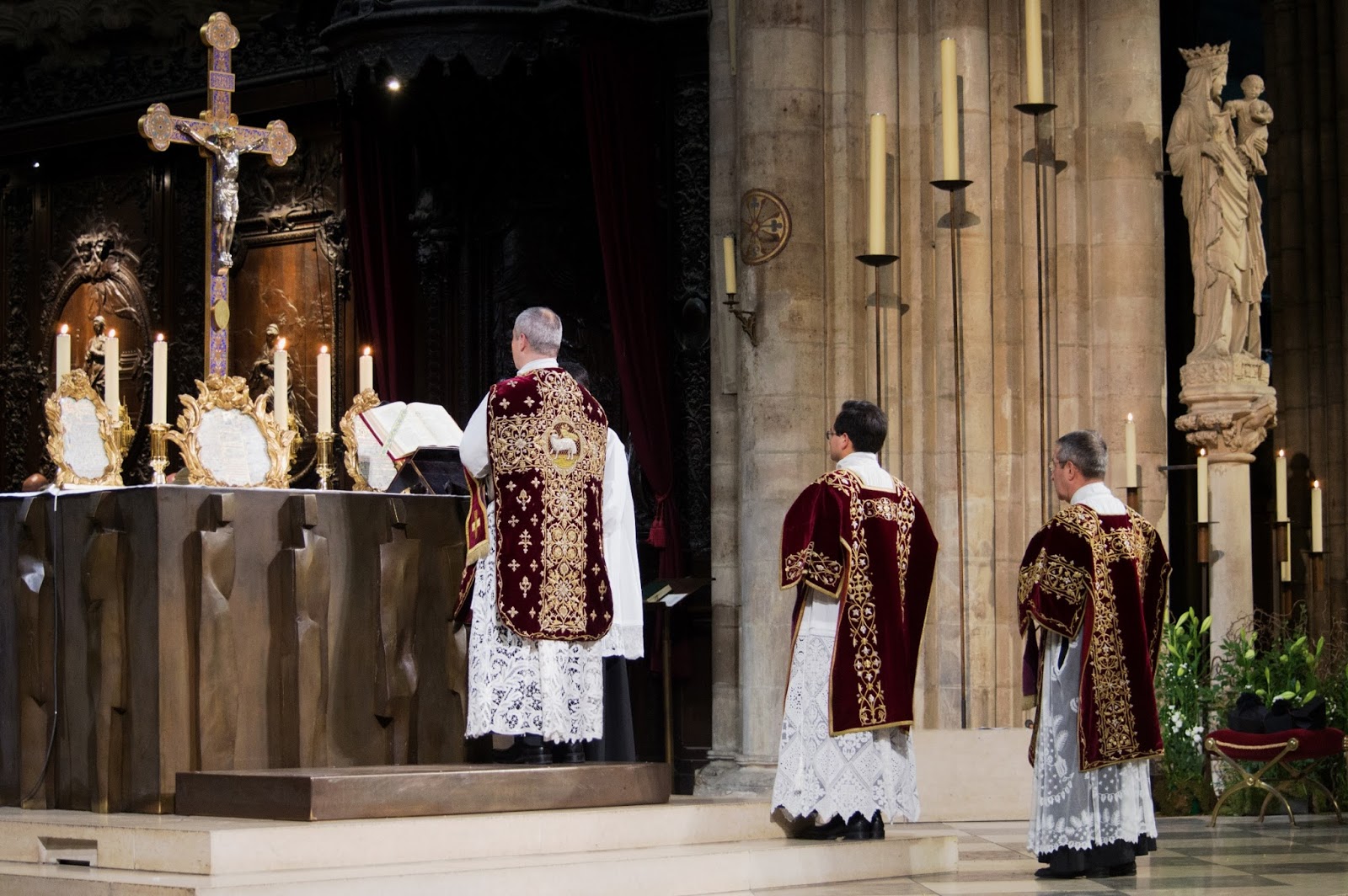
Photo by Jan Canty (source)

Visit Dr. Kwasniewski’s Substack “Tradition & Sanity”; personal site; composer site; publishing house Os Justi Press and YouTube, SoundCloud, and Spotify pages.

Monday, April 01, 2024

St. Francis de Sales’ Method of Hearing Mass in Union with the Sacred Passion of Jesus Christ

Sts. Therese, Francis of Assisi, Wenceslaus, Margaret Mary & Francis de Sales: all would have been familiar with Mass allegories (Saint Anthony of Padua Catholic Church, Dayton, Ohio: source

The original Liturgical Movement tended, as a rule, to frown severely on the “methods of hearing Mass” that were proposed in popular devotional books of the Counter-Reformation era. They argued that these methods forcibly superimposed on the Mass an artificial allegory that was foreign to the original intended meaning or function of its various parts, and that it helped to divide the subjective prayer-life of Catholics from the objective content of the liturgy itself.

While one may grant that the proliferation of private forms of prayer during Mass did have certain negative consequences—most importantly, a loss of appreciation of the richness of the prayers of the Church in and of themselves, an appreciation that was much improved by the creation and distribution of hand missals, which are now a ubiquitous feature of traditional Catholic life—nevertheless it seems that here, as elsewhere, the critiques were often too severe and too simplistic.

As Fr Claude Barthe has demonstrated in his masterful work A Forest of Symbols: The Traditional Mass and Its Meaning, the “reading” of the stages of the life of Christ in the Mass is a practice that not only goes back quite a long ways but finds easy correspondence to textual and structural features in the Western Mass. That is, the so-called “allegory” finds more support in the rite than the critics allow. And if there is a certain arbitrariness in various interpretations and methods, it is at the same time limited by an overwhelming consensus in broad outlines and intended purposes.

A devotional work from 1809 in this genre
For me, this question remained entirely “academic” in the worst sense until, one day, I decided I was going to try some of these old devotional approaches to the Mass. I reasoned: “If generations of Catholics followed such devotions and seemed to do so profitably, maybe there is something more to it than meets the eye. Maybe I need to get over my Liturgical Movement strait-jacket and rediscover a variety of ways of engaging with the liturgy.” So I went ahead and tried various “methods of hearing the Mass,” and to my surprise, the attempt went smoothly and bore spiritual fruit! I’m not sure I’d want this to be my habitual approach, but at the same time, I began to grasp why something like it had dominated for centuries.

I recommend that my fellow Catholics give it a try. Although we are now in the Easter season when we dwell on the Resurrection of the Lord, the Mass is always the commemoration of His saving Passion together with His glorious resurrection and ascension, and that makes the following method by St. Francis de Sales quite fitting at any time of the year. 

Another example
Method of Hearing Mass in Union with the Sacred Passion of Jesus Christ
St. Francis de Sales

When the priest goes to the foot of the altar: Jesus enters the garden

O Lord Jesus Christ, Son of the Living God, Who wast pleased voluntarily to endure mortal terror and anguish at the view of Thine approaching passion, give me grace henceforth to consecrate all my sorrows to Thee. O God of my heart! Assist me to support my trials in union with Thine agony, that through the merits of Thy Passion they may become profitable to my soul.

At the beginning of Mass: Prayer of Jesus in the garden

Lord Jesus Christ, Son of the Living God, Who wast pleased to be comforted by an angel in Thy dreadful agony, grant through the merits of Thy prayer in the garden that Thy consoling angel may ever assist me in mine.

At the Confiteor: Jesus prostrated in the garden

Lord Jesus Christ, Who in the excess of Thine anguish, wast bathed in a sweat of blood while praying to Thy Father in the Garden of Olives, grant that I may participate in Thy sorrows by sympathy, and unite bitter tears of repentance with Thy tears of blood.

The priest kisses the altar: Judas betrays Jesus with a kiss

Lord Jesus Christ, who didst submit to the embrace of Judas, preserve me by Thy grace, from misfortune of ever betraying Thee, and assist me to repay calumny and injustice with cordial charity and active kindness.

The priest goes to the Epistle side: Jesus is dragged to prison

Lord Jesus Christ, Who didst submit to be bound with ropes by the hands of wicked men, break, I beseech Thee, the chains of my sins and attach the powers of my soul and body closely to Thee by bonds of charity, that they may never escape from the salutary restraint of perfect submission to Thy Divine Will.

At the Introit: Jesus receives a blow

Lord Jesus Christ, Who wast conducted as a criminal to the house of Annas, grant that I may never suffer myself to be led into sin by temptations of the evil spirit, or the evil suggestions of my fellow creatures, but that I may be securely guided by the Divine Spirit in the perfect accomplishment of Thy holy ordinances.

At the Kyrie eleison: Jesus is thrice denied by Peter

Lord Jesus Christ, Who didst submit to be thrice denied in the house of  Caiphas, by the head and prince of the apostles preserve me from the danger of evil company, that I may not be exposed to the misfortune of separation from Thee.
 
From an illustrated devotional for Mass (source)
At the Dominus vobiscum: Jesus looks at Peter and touches his heart

Lord Jesus Christ, who by one glance of love didst melt the heart of St. Peter into a fountain of penitential tears, grant by Thy mercy that I may weep for my sins and never by word or deed deny Thee, who art my lord and my God.

At the Epistle: Jesus is conducted to the house of Pilate

Lord Jesus Christ, Who wast pleased to be led before Pilate, and there falsely accused, teach me to avoid the deceits of the wicked, and to profess my faith by the constant practice of good works.

At the munda cor meum: Jesus is led to Herod

Lord Jesus Christ, who didst silently endure to be again falsely accused before Herod, grant me patience under calumny, and silence under outrages.

At the Gospel: Jesus is mocked as a fool and sent back to Pilate

Lord Jesus Christ, Who didst submit to be sent as a fool by Herod to Pilate, who though enemies before, then became friends, strengthen me so powerfully by Thy grace, that instead of apprehending the machinations of the wicked, I may learn to bear their malice as Thou didst and thus render their injustice profitable to my soul.

The priest uncovers the chalice: Jesus is stripped of His garments

Lord Jesus Christ, Who wast pleased to be despoiled of Thy garments and most inhumanly scourged for love of me, grant me grace to lay aside the burden of my sins by a good confession, and never to appear before Thee despoiled of the virtues of a Christian.

At the Offertory: Jesus is scourged

Lord Jesus Christ, Who wast pleased to be fastened to the pillar and torn with stripes, grant me grace to patiently endure the scourges of Thy paternal correction and never more to grieve Thy Heart with my sins.

The priest offers the Chalice: Jesus is crowned with thorns

Lord Jesus Christ, Who didst submit, through love for me, to be crowned with thorns, grant that my heart may be so penetrated with the thorns of repentance in this world, that I may deserve to be hereafter crowned with Thee in glory.

The priest washes his fingers: Pilate washes his hands

Lord Jesus Christ, Son of the living God, Who, although declared innocent by Pilate wast subjected to the insults and outrages of the Jews, grant me the grace to lead an irreproachable life and at the same time to maintain a holy indifference to the opinions of men.

At the Orate fratres: Pilate says to the Jews, “Behold the Man”

Lord Jesus Christ, Who didst submit to the derision of the Jews, and voluntarily wear the badges of their insolent mockery, grant that I may faithfully resist all emotions of vainglory and appear before Thee on the day of judgment clothed in the sacred garment of Thy humility.

At the Preface: Jesus is condemned to death

Lord Jesus Christ, Who, though the God of all sanctity, didst submit through love for me to a most ignominious condemnation, grant me grace to avoid rash judgments and strengthen me to bear with patience, the injustice of men.

At the Memento for the living: Jesus carries His Cross

Lord Jesus Christ, Who didst carry thy heavy Cross for my salvation, grant that I may voluntarily embrace the cross of mortification and carry it daily for Thy love.

At the Communicantes: Veronica wipes with a linen cloth the Face of Jesus

Lord Jesus Christ, Who on Thy way to Calvary, didst say to the holy women that wept for the love of Thee: "Weep not for me but for yourselves;” give me the grace to weep for my sins with tears of holy contrition and love that will render me agreeable to Thy divine Majesty.

Blessing of the bread and wine: Jesus is nailed to the Cross

Lord Jesus Christ, Who wast nailed to the Cross for my redemption, attaching to it through Thy Sacred Flesh, my sins, and the eternal punishment due to them, grant me Thy saving fear, that resolutely observing Thy Holy precepts, I may ever be attached to the Cross with Thee.

At the elevation of the Host: The Cross of Jesus is elevated between Heaven and earth.

Lord Jesus Christ, Who wast pleased to be elevated on the Cross and exalted above the earth for the love of me, detach my heart, I beseech Thee, from all terrestrial affections and elevate my understanding to the consideration of Heavenly things.

At the elevation of the Chalice: The Blood of Jesus flows from His wounds.

Lord Jesus Christ, Thy sacred wounds are the inexhaustible source of all grace; grant then, that Thy Precious Blood may purify my soul from all evil thoughts and prove a salutary remedy for all my spiritual miseries.

At the Memento for the dead: Jesus prays for all men

Lord Jesus Christ, who didst pray on the Cross for all men, even for Thine executioners, grant me the spirit of meekness and patience, that according to Thy precepts and example I may love my enemies and cordially return good for evil.

At the Nobis quoque peccatoribus: The conversion of the thief (St. Dismas)

Lord Jesus Christ, who didst promise the joys of Heaven to the penitent thief, look on me with eyes of compassion and say to my soul at the last moment of my life: “This day shalt thou be with Me in Paradise.”

At the Pater Noster: The seven words of Christ

Lord Jesus Christ, Who from the cross didst recommend Thy Blessed Mother to the beloved disciple, and the disciple to Thy Mother, receive me, I beseech Thee, under Thy protection, and grant that amidst the snares and perils of this world I may never lose the treasure of thy friendship.

At the division of the Host: Jesus expires of the Cross

Lord Jesus Christ, Who before expiring on the Cross didst commend Thy Soul to Thy Father, grant that I may die spiritually with You now, and so confide my eternal destiny with confidence to Thy hands at the hour of my death.

The priest puts a particle of the Host into the Chalice: The Soul of Jesus descends into limbo

Lord Jesus Christ, who after overthrowing the empire of Satan didst descend into limbo to liberate the souls imprisoned there ; apply, I beseech Thee, the merits of Thy Blood and Passion to the suffering souls in Purgatory, that, being absolved from their sins, they may be received into Thy bosom, and enjoy eternal peace.

At the Agnus Dei: The conversion of sinners

Lord Jesus Christ, the contemplation of Thy torments has excited repentance in many hearts; grant me, through the efficacy of Thy painful sufferings and ignominious death, perfect contrition for my past offenses, and the grace to avoid all willful sin.

At the Communion: Jesus is buried

Lord Jesus Christ, Who wast pleased to be buried in a new monument, give me a new heart, so that being buried with Thee, I may attain to the glory of Thy resurrection.

At the Ablution: Jesus is embalmed

Lord Jesus Christ, who wast pleased to be embalmed and wrapped in a clean linen cloth by Joseph and Nicodemus, give me the grace to receive most worthily, Thy Precious Body and Blood in the Holy Sacrament of the Altar, with a heart embalmed with the precious ointment of Thy virtues.

After the Communion: The Resurrection of Jesus Christ

Lord Jesus Christ, Who didst triumphantly issue from the fast sealed monument, grant that, rising from the tomb of my sins, I may walk in newness of life so that when Thou shalt appear in glory I may merit also to appear with Thee.

At the Dominus vobiscum: Jesus appears to His disciples

Lord Jesus Christ, who didst gladden the hearts of Thy Blessed Mother and Thine apostles by manifesting Thyself to them after Thy Resurrection, grant that, since I cannot be so happy as to behold Thee in this mortal life, I may hereafter enjoy the unclouded vision of Thy glory.

At the Postcommunion: Jesus converses for forty days with His disciples

Lord Jesus Christ, Who after Thy Resurrection deign to converse for forty days with Thy disciples, instructing them in the mysteries of our faith, increase, I beseech Thee, my knowledge of those Divine Truths, and confirm my belief in them.

The last Dominus vobiscum: Jesus ascends to Heaven

Lord Jesus Christ, Who didst ascend gloriously into Heaven in the presence of Thy disciples, grant me so to love Thee that I may desire none but eternal joys, and aspire to the possession of Thee as the first and best of all blessings.

At the priest’s blessing: The descent of the Holy Ghost

Lord Jesus Christ, Who didst send the Holy Ghost on Thine apostles, while engaged in unanimous and persevering prayer, purify my soul, I beseech Thee, that the Paraclete, finding therein a dwelling well pleasing to Him, may adorn it with His gifts and replenish it with His consolations

Thanksgiving after Mass

Lord Jesus Christ, Son of God and Redeemer of men, I humbly thank Thee for having permitted me to assist today at the Most Holy Sacrifice of the Mass. I beseech Thee, through the efficacy of  that adorable Sacrifice, to strengthen me against all temptations, and to grant that, having served Thee faithfully in this life, I may hereafter attain to the possession of Thy glory. Amen.

Visit Dr. Kwasniewski’s Substack “Tradition & Sanity”; personal site; composer site; publishing house Os Justi Press and YouTube, SoundCloud, and Spotify pages.

Monday, August 14, 2023

On the Christ-Angel of the Roman Mass

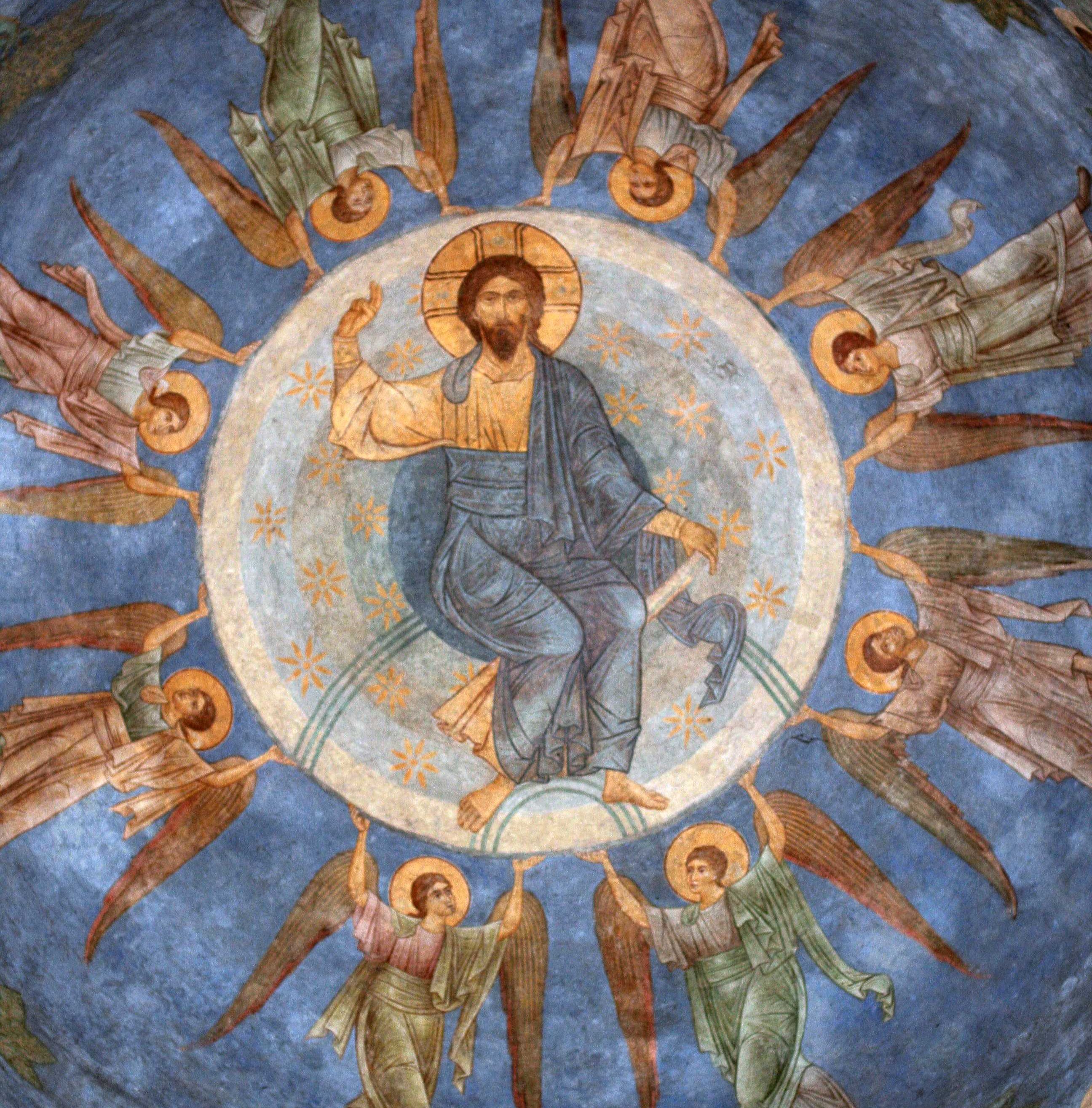
The Ascension of Christ, Mirozhsky Monastery, Pskov
In Fr. Claude Barthe’s remarkable book A Forest of Symbols: The Traditional Mass and Its Meaning (Angelico Press, 2023, reviewed here), we are introduced early on to the allegorical understanding of Christ as an “Angel,” that is, a messenger and mediator, in keeping with the Septuagint’s use of the phrase “Angel of the Great Counsel” in Isaiah 9:6. Speaking of the Asperges, Fr Barthe says:
The aspersion itself, which follows when the ministers have entered the church, is really a combination of blessing and exorcism, almost a domestic rite. It resembles the aspersions seen in monasteries when a tour was made of the cloister, or the individual cells were visited. The final prayer of this ceremony, Exaudi nos, Domine . . . (Hear us, O holy Lord, almighty Father, eternal God: and vouchsafe to send thy holy angel from heaven, to guard, cherish, protect, visit, and defend all that dwell in this house), which is that of the blessing prescribed by the Ritual when the priest blesses a house as he enters it to carry out a ceremony, refers to the habitaculum, the house where one lives, for which one requests a visit from the Angel of God. This is also a first reference to “the Angel of God,” that is, to Christ himself, who is asked to come down to this place… There is a link between this water and the Blood of Christ, since immersion in the waters of baptism represents in reality immersion in the cistern of Christ’s propitiatory Blood. (36)
Later, speaking of the rite of incensation, Fr. Barthe comments:

The humanity of Jesus Christ, consumed (or consummated, as the classical writers used to say) in the sacrifice, lifts his prayer up to the Father, the only prayer that the Father finds acceptable, to which are joined the prayers of the saints, thrown like grains of incense into the burning furnace of love of Christ’s holy soul…. [T]he Angel of the Apocalypse (Rev 8:3–4)…draws near to the altar and offers the incense with the prayers of the saints… This Angel is, of course, Christ himself, and his golden censer (or scoop) is his precious humanity: “Let my prayer be directed as incense in thy sight; the lifting up of my hands, as evening sacrifice” (Ps 140:2). (41)

Concerning the incensation at the offertory, he develops the point further:

Of course, the offering of incense at the altar also symbolizes the Angel who stood beside the altar of the Temple, holding in his hand the censer from which the smoke of the incense rose in the presence of the Lord (Rev 8:3–4). This angel is compared to St Michael, but above all reflects Christ, the Angel of Great Counsel, offering his own immaculate flesh, full of the fire of the Holy Spirit, to the Lord on our behalf on the altar of the Cross, in the odor of sweetness. The smoke of the incense gives material expression, in some way, along with the prayer of Christ, to the prayers of his saints. (91–92)

Then comes the most mysterious angel of all, the one mentioned in the “communion epiklesis” of the Roman Canon, the Supplices te rogamus:

We most humbly beseech thee, almighty God, to command that these things be borne by the hands of thy holy angel to thine altar on high, in the sight of thy divine majesty, that as many of us as, at this altar, shall partake of and receive the most holy Body ✠ and ✠ Blood of thy Son may be filled with every heavenly blessing and grace, through the same Christ our Lord. Amen.

On which Fr. Barthe observes:

There have been many discussions of the identity of the “Angel.” Durandus wrote, “He is the Angel of Great Counsel, the Counsellor on whose advice the Father created and recreated the world,” otherwise known as Christ-Wisdom, the Word incarnate. But he adds that the altar on high in the presence of God is also the crucified Christ sitting in glory at the right hand of the Father. The Angel brings these “sacraments” to this altar, revealing his wounds, and interceding for us who bring the sacraments to fulfilment on earth. Olier and Pierre Lebrun take a similar view. It is worth noting that the De Sacramentis refers to angels in the plural (per manus angelorum tuorum) rather than the singular, which would not contradict the idea of a “communion epiklesis,” but would prevent identification of the angels with Christ. St Thomas Aquinas, who thinks that the Angel can be compared to Christ, derives the following mystical etymology: the Mass, missa, takes its name from the fact that, through the Angel, the priest sends (mittit) his prayers to God, or again because Christ is the approved victim sent (missa) to us. All of which underlines that the meaning of the prayer Supplices te rogamus is at the heart of this oblation of the holy victim, which we know as the Canon, and is therefore also at the heart of the whole celebration. (117–18)

The Christological interpretation is classic and theologically attractive.

However, if we take the other interpretation, namely, that the angel who is tasked with bringing our offering before God is a reference to the created angel depicted in the book of Revelation as bringing the prayers of the saints before God, we can see some neat things about the Canon.

Note, first, how differently the Canon handles angels and saints. We ask to be admitted to the saints’ company, and we offer the Mass to their honor and remembrance, and we ask that they pray for us, but we never explicitly ask them to do the one thing the angel does: offer the Mass to God. In fact, the saints are never described as worshipping God (of course they do worship God—I’m just talking about what the text explicitly says). But the one other time angels are mentioned in the Canon lines up perfectly with the task of this angel of Revelation: the Preface describes the angels—above all, the cherubim and the seraphim—as ceaselessly worshipping God.

All of this suggests to me that, as the angels are by their very nature the mediators between God and men, so are they by their very nature the ones who would mediate even our prayers to God. The saints have joined the angels by grace, to be sure, but grace has not simply abolished the difference in nature between human souls and angelic choirs. The Mass seems to nod to this difference by a selectivity of description: saints do worship God ceaselessly, but that is not the role assigned them in the text of the Canon; angels do pray for us, but that is not the role assigned to them in the Canon. Rather, the angels are the primordial divine attendants; the saints are those who have joined the angels; and we hope to join the saints.

Because we are speaking of the Canon, allow me to mention one last beautiful subtlety: the sudden shift in prayer after the consecration. Up to that point, all prayer is directed to the Father through the Son in the Holy Spirit; but after that point, prayer is consistently directed to the Son directly—and naturally enough, because THERE HE IS. Before the consecration, all prayer is shaped by the mystery of the Trinity; after the consecration, prayer is shaped by the Incarnation. In this way, the form of the prayer reflects the great mystery of God’s inner life piercing into our world of space and time through the Son taking on flesh.

Leaf from a Beatus manuscript: the Opening of the Fifth Seal (1180), Spanish, from the Met collections

Join Dr. Kwasniewski at his Substack "Tradition & Sanity." You can read or listen to more at his personal sitecomposer siteYouTubeSoundCloud, and Spotify, and visit his publishing house Os Justi Press.

Monday, April 17, 2023

A Compact Guidebook to the Allegorical Meaning of the Mass

The name of Fr. Claude Barthe is well known to lovers of the Latin liturgical heritage. Ordained in 1979 by Marcel Lefebvre and incardinated in 2005 into the diocese of Fréjus-Toulon in France, he has taught for the seminary of the Institute of the Good Shepherd and the Institute of Christ the King Sovereign Priest, and has published numerous liturgical studies and essays on current affairs (you can read some of his work at Res Novae). He also serves as chaplain of the annual Summorum Pontificum Pilgrimage in Rome. I had the pleasure of meeting him for the first time this past October in Rome.

Since that time, I was called upon to proofread the translation of one of his most important books: A Forest of Symbols: The Traditional Mass and Its Meaning, which has just been published by Angelico Press (it appeared in French all the way back in 2011). I've been happy to see it ranked for a week as the #1 bestseller at Amazon in the category of Christian Rites & Ceremonies, and now #1 and #4 in the category Catholicism (!). As well it should be: the book is masterful, packing so much depth into a handily short space.

So, what is the purpose of this book? How does it differ from, say, Fiedrowicz's introduction to the TLM (which is still my "go-to" recommedation for anyone seeking a deep dive into the TLM's history, form, and theology), or the recent detailed history of the Roman Rite by Fr. Lang, or my own defense of the unicity of the Roman Rite?

This book has one and only one central purpose: to explain, defend, and carry out the allegorical interpretation of the Mass. As Fr. Barthe points out, for over a thousand years, the Roman Mass was approached as a "forest of symbols," to use an evocative phrase from Baudelaire. Every part of the rite, every ceremony, down to the smallest sign of the cross or movement from left to right or incensation pattern, was eagerly mined for meaning. Yes, one might say these meanings were imposed, but one could also say they were discovered, elicited from the rite itself, due to the extreme ease or naturalness with which our forefathers saw spiritual meanings in all kinds of things, above all in Scripture. They extracted the full juice of the grape and allowed it to mature into rich wine.

So far from this being "eisegesis" (i.e., reading into something what can't possibly have been intended to be there), it is a form of spiritual exegesis based on the belief that God has communicated something of His infinite depth of truth, some revelation of Himself, into all that He has made or caused, including the liturgy that emerged from the centuries of faith. Yes, human authors and architects may not have been thinking of all that is present in their writings or their works, but God knows, and wills, deeper meanings than His human instruments can fathom. This is taken for granted in the ages of faith, and one who reads St. Bernard of Clairvaux's sermons on the Song of Songs or William Durandus's commentary on the Mass can readily see how fruitful this assumption is, discerning layer after layer of significance in what might have seemed purely functional or historically conditioned or even initially arbitrary.

Fr Claude Barthe
The back cover of this book expressly makes the connection between biblical literacy and liturgical literacy:
The Christian liturgy—and the Roman liturgy in particular—developed and thrived within a tradition of commentary and meditation that was fundamental for its understanding, running parallel with the same way of approaching Scripture. The rationalist influences that led to the decline and eventual rejection of the mystical or spiritual senses of Scripture in favor of a narrowly-conceived literal sense led to a narrowing of liturgy as well, which was reduced to its material parts and their various functions. While in recent decades the importance of the spiritual sense of Scripture has been reclaimed, its liturgical equivalent remains in shadow. The present book addresses this lacuna with an easy-to-understand summary of the traditional approach to the “forest of symbols” contained in the Roman Mass.
Reading it, I was struck once again by the transformation of mind that occurs when a person comes to appreciate the inner continuity and coherence of the Roman Rite (by which I mean, of course, the usus antiquior, the only Roman Rite there is). When you understand the Mass in each of its parts, down to the grainiest detail, you see that everything is in the right place: it all makes sense, fits together, and nourishes meditation. The sterility of the academic rationalism that rejected the allegorical approach was the necessary precondition for the violent dismantling and reconstruction of liturgy that took place in the twentieth century, much as the mechanistic assumptions of modern materialistic medicine are the precondition for sex changes, which treat organs like computer components.

There is so much wonderful material in this book that a review could easily go on for thousands of words. I will try, then, to quote just a few passages that give a taste of the whole, which consists of 150 pages of commentary followed by an appendix of the Order of Mass in Latin and English columns.

To skeptics, Fr Barthe makes the unanswerable rejoinder that
this spiritual commentary on the liturgy is already at work in the New Testament, particularly in the Apocalypse, but also in the Epistle to the Hebrews and in the Gospel according to St John. The Apocalypse itself proceeds in this way to complex mystical interpretations of cultic objects that will go on to serve as models for patristic and medieval authors: the seven lamps are the seven spirits of God (4:5); the gold cups full of perfume represent the prayers of the saints (5:8 and 8:3–4); and the fine linen with which the Spouse is clothed signifies the virtues of the saints (19:8). (p. 10)
The introduction is a marvelous compact history of the allegorical reading. He says, for example, concerning Amalarius of Metz (c. 780-850):
One of Amalarius’s principal ideas, which he acquired as part of an already well-established tradition and which became a key element in the spiritual interpretation of the Eucharistic sacrifice, is that there is a link between the unfolding of the Mass and the history of salvation: the Mass represents the mission of Jesus Christ, from the proclamation of his arrival on earth, to which the Introit corresponds, sung by the choir, who in their turn represent the choir of prophets who foretold Christ’s arrival, up to his Ascension, to which corresponds the Ite missa est, the dismissal of the faithful (we will return to this), with which those assisting at the Mass are dismissed just as Christ dismissed his apostles on the Mount of Olives. (14)
One of the finest fruits of this study is a revitalized appreciation of the normativity of the Solemn Mass, since the symbolism unfolded in the sources is very much keyed to the presence of all the ministers doing all that belongs to them:
The special characteristic of a solemn Mass is that it revolves
around the actions of three sacred ministers: the priest, the deacon, and the subdeacon, who all belong to the major orders. And the three of them, from one point of view, are simply one; and when a single bench without a back (called the sedilia) is available, they all sit on it together. This is because the three ministers of the solemn Mass all represent the same Jesus Christ in three different states: yesterday, today, and world without end.
       The subdeacon represents the Old Testament, Jesus Christ yesterday, who was proclaimed partly in the sayings of the prophets, and partly in figures by the saintly individuals who preceded his coming. As is appropriate, the subdeacon always occupies the lowest rank, that of incompleteness....
       The deacon represents the New Testament, Jesus Christ today, proclaimed in his fullness by the apostles and their successors, the bishops, who are the propagators of the Gospel....
       The celebrant himself is most fully identified with JesusChrist today and world without end, as he presently is and always will be, in glory in heaven. The celebrant is the instrument and the representative of Christ glorious and victorious, the Christ who makes himself really present on the altar in the elements of bread and wine in order to accomplish there his sacrifice for the remission of sins and to the glory of his Father. The priest who celebrates at the altar is the image of Jesus Christ priest and victim, but an unbloody victim in his heavenly state. (24-25)
Most astonishing to me was the discussion of the Offertory, which extends for several pages, and makes an ironclad defense of the sacrificial Offertory, so arrogantly rejected by the liturgical reformers, whose radical modification of the missal at just this point is among the most infamous and execrable of their acts of vandalism. I will quote some of it here, but can only urge the reader of this review to make haste in procuring a copy of Forest of Symbols.
Here we enter the Offertory, strictly speaking, a term that must be understood in the strong sense of a “sacrifice.” The oblations that will shortly be consecrated are brought to the altar and unveiled. All the Christian liturgies, in a spiritual pedagogy married to the very rhythm of the Incarnation—“when he cometh into the world, he saith: Sacrifice and oblation thou wouldest not: but a body thou hast fitted to me . . . . Then said I: Behold I come: in the head of the book it is written of me: that I should do thy will, O God” (Heb 10:5–7)—proceed to a sort of pre-consecration. At once, the liturgical sequence is upset: the Offertory anticipates the act that is going to reproduce the sacrifice of the Cross, just as Christ anticipated the offering of Passion. 
       Allegorically, this moment of the Mass therefore recalls those moments in Christ’s life in which more than elsewhere he offers himself in an anticipation of his Passion: the offering of Christ to the Father, as we have just seen, when he came into the world and entered the womb of Mary; the offering of Christ in the Temple, at the Presentation; and the offering during the Agony in the Garden of Gethsemane, which is recalled particularly when the priest invites the ministers to pray (Orate fratres . . . ), an invitation like that of Gethsemane (Lk 22:40), and when the priest prays in silence, recalling the solitary prayer of Christ on the Mount of Olives.
       At this point we must emphasize the traditional comparison of the Offertory of the Mass with the Presentation of Jesus in the Temple. Surely that Presentation was above all a liturgical action? This rite applied to firstborn males, forty days after their birth. It was when parents really repurchased their male firstborn, for whom in substitution they gave the animals offered in sacrifice. The rite reflected the preservation of the firstborn of the Hebrews during the tenth of the plagues of Egypt, and the sacrifice of Isaac demanded of Abraham his father. Firstborn male children and Abraham’s firstborn son are both figures of Christ, the sacrificed Son of God: figures that were not yet fully realized, since the firstborn of the Hebrews had been spared, as had Abraham’s only son. 
       By this act Jesus showed what he had come into the world to accomplish: his self-offering on the Cross and for eternity. He did this first on the altar and in the temple formed by the womb of his mother. He next demonstrated it on the day of the Presentation in the Temple at Jerusalem. He finally repeated it in the Garden of Gethsemane.... At the Presentation Mary offered her Son in advance as a sacrifice as she would one day have to offer him to God on Calvary, in the manner of a priest who, at the Mass, offers in advance the oblations that he is again going to offer (in the sacrificial sense of the word) at the consecration. Mary also lifted up Jesus in her hands to put him in the hands of Simeon, who represents the eternal Father, in the same way that the priest lifts up a little above the altar the host and the chalice that he offers. By this offering in the Temple, Jesus Christ was made ready to be offered in his entirety, in the same way that the oblations are prepared for the perfect offering that takes place at the consecration. (76-79)
The foregoing are characteristic examples of the insights Fr Barthe has gathered by his assudious labors in the vast treasury of the allegorists. We must be grateful to him, to his translator David Critchley, and to Angelico Press for adding yet another arrow to the quiver of traditionalist literature. How ironic it is that, at the very time when the Roman Rite is under renewed papal and episcopal attack, the traditional movement is producing a mighty literature on this rite's beauty, fittingness, and orthodoxy, compared with which the reform rite's current promotional literature is limp, untruthful, and uninspiring. Such a thought brings both comfort and assurance.


A Forest of Symbols may be obtained from any Amazon site as well as from Barnes & Noble.

More recent articles:

For more articles, see the NLM archives: