Tuesday, June 03, 2025

Icon Painting Workshop in Crete, August 1-10th, taught by George Kordis

I will be attending this 10-day residential course this summer. It welcomes all, from absolute beginners to seasoned artists, and can be a masterclass for professionals.

Writing the Light is a program of instruction in traditional Byzantine-style iconography that offers comprehensive training through its Certificate Program, from soup to nuts. Their classes are predominantly distance-learning or online, but are supplemented by in-person intensive workshops taught by master teachers, and led by the main teacher, renowned Orthodox iconographer George Kordis. The workshops are part of the full program, but you don’t need to be enrolled in the Certificate Program to attend. Many do so for personal enrichment and enjoyment without completing the whole program. They take place in various locations: Crete, Dublin, Ireland, and several in the US. I recommend Writing the Light instruction, especially to those who want a fully integrated training program that may lead to becoming working artists, and those seeking classes for personal enrichment.

The program emphasises a welcoming approach; many Catholics are enrolled as students. To register and read more about the class, follow this link.

My wife, Margarita, who teaches at Princeton, and I are looking forward to participating in this residential workshop. We have both been invited to speak to the group, but we will also be following George’s tutoring, and painting icons along with the group. As speakers, we represent the Scala Foundation, where Margarita serves as Executive Director, and I am Artist in Residence, and Pontifex University, which offers the Master of Sacred Arts program, where I also serve as Provost and Dean of the Faculty of Sacred Arts. Writing the Light encourages all their students to complement their practical training with the online intellectual and cultural formation that the Pontifex University classes offer.

In my talk, I will emphasise the relevance of traditional Byzantine iconography to all Christians, discuss the impact that sacred art has on the wider culture, and discuss the importance today to all painters of learning traditional iconography, at the very least as a foundational discipline, regardless of what form they eventually specialize in, if we want to re-establish a Christian culture of beauty in the secular West.

Margarita will speak on the importance of artistic practice in education—both K-12 and higher education—as a formative tool not just for future artists, but for the development of every student’s capacity for perception, imagination, and creativity; and how both the making and contemplation of sacred art, such as icons, can nurture a graced imagination that informs all human activity, where beauty, virtue, moral formation, and the love of God are not separate pursuits, but work in unity.

To register and read more about the class, follow this link.

George Kordis is one of the foremost iconographers of our time. His approach, rooted in and never straying from tradition, emphasises rhythmical and flowing line as the basis of form, bringing the tradition alive for contemporary artists. Whether you’re a beginner or a seasoned iconographer, the course is designed to meet you where you are, guiding you through the whole painting process.

Tuesday, July 25, 2023

Full 2-Year Formation in Iconography At St Vladimir’s Orthodox Seminary - Open to Catholics

Dr George Kordis, renowned iconographer and former artist-in-residence at the Institute of Sacred Arts at St Vladimir’s Orthodox Theological Seminary in Yonkers, New York, is launching a two-year program in Byzantine iconography. Open to Catholics, this is a hybrid program, which is predominantly online, with individualized residencies in the United States or Greece. 

The program admits around 15 per class, with the first class starting in the fall, and the next intake in January 2024, as space and entrance qualifications permit. I have been told that the first class is almost full and approximately 50% Catholic, so it is worth applying now, and if you don’t get in for the fall, try to enroll for the January intake. Students in this program will build a firm foundation for their future practice of iconography by completing a comprehensive range of coursework, ranging from technical workshops on drawing to lecture classes on art history, theology, and aesthetics.
Dr Kordis has been teaching iconography students in his native Greece for over 30 years. Through this certificate program, he intends to teach students to ground themselves in the iconographic tradition, while also bringing their own creative touch to their work, so that “students become vibrant creators, not just copyists.”

The Writing the Light program curriculum is ideally designed for a 2-year period of study, but is responsive to each individual student and their specific needs with flexibility and affordability.

A final thesis of an original composition of an icon(s) will be the culmination of the program coursework, with an exhibition at the Mets Art Center in Athens, Greece, and/or at another appropriate exhibition space in the United States.

Upon completion of the program, each student will have gained:
  • a well-rounded foundation in the studio practice of iconography,
  • preparation to continue working towards a professional level within the structure of sacred Christian Orthodox art,
  • accomplishment of specific artistic studies to pursue a passion.
Each year only 10 – 16 students will be admitted into the program, building a close creative community with fellow students and instructors. Live (synchronous) online classes, online seminars and sustained in-person residencies of one week to ten days will feature regular touch points with each student. This is a part-time program that allows students to continue to maintain their current life-work flow, and manage the Certificate workload – an average of 5 to 12 hours per week for the online portion, with full immersion during the residential periods.

NOTE: the Certificate program with Writing the Light does not count towards academic credit with St. Vladimir’s Seminary.

TWO CORE PARTS TO THE CURRICULUM:

ONLINE – Classes are a balanced combination of a recorded (asynchronous) e-learning system and LIVE (synchronous) virtual seminars and classes delivered through Zoom and Vimeo, with long-distance critique and oversight.

RESIDENCIES – There are four required residencies and multiple options for students to choose from. These immersions are a critical part of the program to provide valuable in-person instruction, critique and oversight for growth and artistic progress. With an international scope, these 7 to 10-day residencies are a critical part of the program to provide valuable in-person instruction, critique and oversight for growth and artistic progress. The flexibility for students to choose the location and time of year of the residencies to fit into their life schedule is a major asset to the program.

CRITICAL EXPERIENCES 

+ One-on-one mentorship with Dr. George Kordis

+ Structured instruction with proven methods

+ Rigorous iconographic practice and discourse

+ Focused studio production 

+ Concept and creative development 

+ Critical analysis and articulation

+ Exposure to early Byzantine examples 

+ Immersion in contemporary iconography

+ Knowledge of best Professional practices

+ Networking opportunities within an international community of iconographers

+ One-of-a kind professional internships

+ Experience from portable icons to professional church painting 

Students in this program will:

  • Mentor under one of the leading iconographers, artists and Byzantine scholars in the world with Dr. George Kordis

  • Create a unique body of their own iconographic work based on the building blocks of the Byzantine system, yet living in Christian tradition

  • Demonstrate the skills, knowledge and discipline necessary for a successful professional pursuit of iconography in the specialized field of sacred arts

  • Develop a “Tool Box” of sustainable working methodologies to support and challenge each student’s personal studio practice alongside professional-level skills

  • Gain extensive experience using traditional and modern iconographic art materials and diverse painting techniques

  • Accomplish a solid, working knowledge of Theology and Aesthetics in Byzantine Iconography

  • Understand the history, theories and movements that have shaped Byzantine iconography with a foundation in its contemporary practice internationally

  • Effectively gain an understanding of both traditional and modern techniques necessary to create beautiful and original new work centered around tradition and individual style

  • Actively engage with a supportive, extended creative community of new friends 

  • Develop a diverse international and professional network

  • Meaningfully contribute to artistic culture and the advancement of sacred arts 

  • Share creative work with a professional Thesis Exhibition in Athens and/or New York 

  • Obtain a Certificate of accomplishment given by Writing the Light 

  • Be prepared to advance to a professional level within their own practice 
Tuesday, February 01, 2022

Hold the Line! The Iconography and Workshops of George Kordis

Now that Covid restrictions are slowly being lifted - well, in the UK, Ireland, and Greece at least, and who knows, even California might follow at some point - I thought it might be worth planning to attend some in-person icon painting classes in the coming year, even if you have to go to Greece to find one.

George Kordis, a Greek native and Orthodox iconographer, has a reputation for being an excellent teacher, especially of drawing icons. Ordinarily, he visits the US regularly, and offers workshops in both Greece and the US. His US workshops are on hold for now, but he is offering classes in Athens and Crete this summer in English: see his website writingthelight.com. For those who don’t have the resources and time to get to Greece, he is now offering online courses at iconographytoday.com/en.

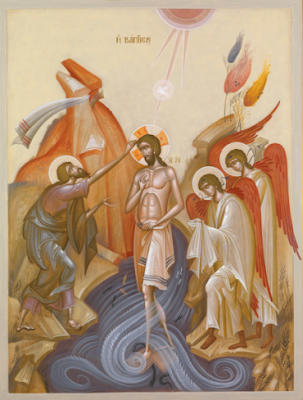
Kordis is renowned for his style of draughtsmanship, which incorporates rhythmical, sweeping lines that embed a dynamic and harmonious proportion into his compositions.

Iconography primarily uses line to describe form. This is distinct from Baroque art, for example, which uses tonal contrast to describe form. In order to draw with the line, we must understand what a line is representing in a drawing, which is the perceivable edge of an object. This might seem to be a statement of the obvious, but it is not, because there are no lines in nature, only contrasting edges.
We are able to perceive an object because it stands out from the background that surrounds it. The contrast between the background and the object will be either a contrast of color or contrast of tone. If there is no contrast, then the edge is invisible to us. (This fact is used to make a soldier wearing camouflage disappear in the dappled light of the woods, for example). 
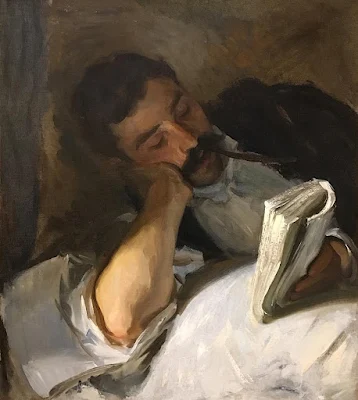
Artists represent this contrast either by drawing a line to represent the contrasting edges, or by painting the conjunction of an area of dark tone and an area of light tone. Leonardo da Vinci always used the method of adjacent areas of different tones, and set the standard for naturalistic art up until the beginning of the 20th century. For example, in this painting by John Singer Sargent, there are barely any lines at all. What we perceive as a line is typically the conjunction of two contrasting areas. This is actually closer to what we see in nature. A line, therefore, is a partial abstraction of what is seen. It is interesting that children will instinctively draw with lines and not tone. Typically we have to be taught to draw and paint as we actually see things.
When the artist uses line to describe form, he will use some tonal and color variation as well, but these are always supporting players in describing form - the work has been done by the line, so to speak - and so the use of color and tone becomes more decorative and symbolic of form than descriptive. The artist therefore has much more freedom in this second phase if he understands what he is doing.

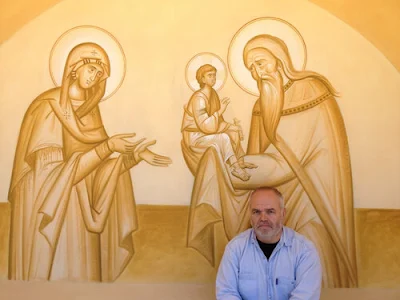
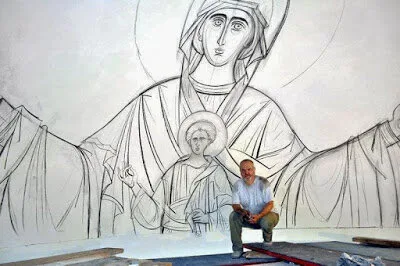
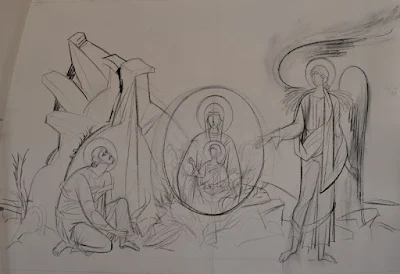
If we look at Kordis’ line drawings, they are distinctive by virtue of the wonderful grace and flow in the use of line, certainly, but nevertheless are still conventional iconographic drawings.

When Kordis adds color, however, he is much less conventional and loose in its application. This gives his icons a modern feel, but because his draughtsmanship is so precise, he stays within the bounds of the iconographic tradition. When I look at them, he achieves an effect by which the figures are not only radiating uncreated light, they are so saturated with light, it seems, that the light almost seems to be dripping off them. This is an effect I would want to master! If this were me, I might change the color palette slightly (just my personal taste, you may differ from me on this front), but I would love to have the opportunity to study with this master iconographer so that I could learn his techniques and observe how he uses this freedom in the use of color. I would then probably adapt this to my own particular taste.
Theophany - the Baptism of the Lord

More recent articles:

For more articles, see the NLM archives: